<?xml version="1.0" encoding="ISO-8859-1"?><article xmlns:mml="http://www.w3.org/1998/Math/MathML" xmlns:xlink="http://www.w3.org/1999/xlink" xmlns:xsi="http://www.w3.org/2001/XMLSchema-instance">
<front>
<journal-meta>
<journal-id>0120-548X</journal-id>
<journal-title><![CDATA[Acta Biológica Colombiana]]></journal-title>
<abbrev-journal-title><![CDATA[Acta biol.Colomb.]]></abbrev-journal-title>
<issn>0120-548X</issn>
<publisher>
<publisher-name><![CDATA[Universidad Nacional de Colombia, Facultad de Ciencias, Departamento de Biología]]></publisher-name>
</publisher>
</journal-meta>
<article-meta>
<article-id>S0120-548X2006000200003</article-id>
<title-group>
<article-title xml:lang="es"><![CDATA[RIBONUCLEASAS: [subtitle]SU POTENCIAL TERAPÉUTICO EN INFECCIONES VIRALES]]></article-title>
<article-title xml:lang="en"><![CDATA[Ribonucleases: [subtitle]Theurapetical potential on Viral Infections]]></article-title>
</title-group>
<contrib-group>
<contrib contrib-type="author">
<name>
<surname><![CDATA[ÚSUGA]]></surname>
<given-names><![CDATA[XIOMARA]]></given-names>
</name>
</contrib>
<contrib contrib-type="author">
<name>
<surname><![CDATA[RUGELES]]></surname>
<given-names><![CDATA[MARÍA TERESA]]></given-names>
</name>
</contrib>
</contrib-group>
<aff id="A01">
<institution><![CDATA[,Universidad de Antioquia. Medellín, Colombia Grupo InmunovirologíaBiogénesis ]]></institution>
<addr-line><![CDATA[Medellín ]]></addr-line>
<country>Colombia</country>
</aff>
<pub-date pub-type="pub">
<day>00</day>
<month>06</month>
<year>2006</year>
</pub-date>
<pub-date pub-type="epub">
<day>00</day>
<month>06</month>
<year>2006</year>
</pub-date>
<volume>11</volume>
<numero>2</numero>
<fpage>31</fpage>
<lpage>44</lpage>
<copyright-statement/>
<copyright-year/>
<self-uri xlink:href="http://www.scielo.org.co/scielo.php?script=sci_arttext&amp;pid=S0120-548X2006000200003&amp;lng=en&amp;nrm=iso"></self-uri><self-uri xlink:href="http://www.scielo.org.co/scielo.php?script=sci_abstract&amp;pid=S0120-548X2006000200003&amp;lng=en&amp;nrm=iso"></self-uri><self-uri xlink:href="http://www.scielo.org.co/scielo.php?script=sci_pdf&amp;pid=S0120-548X2006000200003&amp;lng=en&amp;nrm=iso"></self-uri><abstract abstract-type="short" xml:lang="es"><p><![CDATA[En la actualidad existe un gran interés por identificar proteínas o péptidos antimicrobianos que puedan ser herramientas terapéuticas que eviten el establecimiento o permitan el control de diferentes infecciones. Las ribonucleasas (RNasas), pertenecientes a la superfamilia Ribonucleasa A, son enzimas que participan en varios procesos fisiológicos, que van desde el procesamiento alternativo del RNA hasta la angiogénesis. Estas enzimas son expresadas por diferentes tejidos y exhiben especificidades variables contra diferentes sustratos de RNA. El potencial terapéutico de las RNasas se ha sugerido en procesos oncogénicos; adicionalmente, se ha descrito que tienen actividad antiviral directa y el potencial de activar células del sistema inmune innato induciendo su maduración y la producción de citoquinas proinflamatorias. Nuestro grupo de investigación ha realizado estudios que señalan la capacidad de cuatro RNasas recombinantes: EDN, 4EDN, RNasa A y angiogenina de inhibir la replicación del virus de la inmunodeficiencia humana tipo 1 en linfocitos T de sangre periférica activados. En este artículo se revisará la clasificación de las ribonucleasas que constituyen la superfamilia RNasa A y se describirá, en forma detallada, lo que se conoce de la función biológica, acción antiviral y mecanismo de acción de las RNasas a las que se les ha reportado actividad antiviral.]]></p></abstract>
<abstract abstract-type="short" xml:lang="en"><p><![CDATA[Currently, there is a great interest to identify proteins or antimicrobial peptides to be included in the therapeutic arsenal for preventing different infectious diseases. Ribonucleases (RNases) that belong to the Ribonuclease A superfamily participate in several physiologic processes, from alternative splicing of RNA to organogenesis. These enzymes are expressed by various tissues and exhibit variable specificities against different RNA substrates. The therapeutic potential of RNases has been suggested for oncogenic processes; in addition, direct antiviral activity and the potential to activate cells from the innate immune system, inducing their maturation and release of proinflammatory cytokines have been also associated with these enzymes. Our research team, have carried out studies that indicate the ability of four recombinant RNases: EDN, 4EDN, RNase A and angiogenin to inhibit HIV1 replication in activated peripheral blood T lymphocytes. In this article we review the classification of RNases that belong to the Ribonucleases A superfamily; we describe in detail what is known regarding the biologic function, inhibitory activity and mechanism of action of the RNases recognized by their antiviral activity.]]></p></abstract>
<kwd-group>
<kwd lng="es"><![CDATA[actividad antiviral]]></kwd>
<kwd lng="en"><![CDATA[RNasa 1]]></kwd>
<kwd lng="es"><![CDATA[EDN]]></kwd>
<kwd lng="es"><![CDATA[ECP]]></kwd>
<kwd lng="es"><![CDATA[ONC]]></kwd>
<kwd lng="en"><![CDATA[antiviral activity]]></kwd>
<kwd lng="en"><![CDATA[RNase 1]]></kwd>
<kwd lng="en"><![CDATA[EDN]]></kwd>
<kwd lng="en"><![CDATA[ECP]]></kwd>
<kwd lng="en"><![CDATA[ONC]]></kwd>
</kwd-group>
</article-meta>
</front><body><![CDATA[ <P   align="center"><B><FONT size="+1">RIBONUCLEASAS: SU POTENCIAL TERAP&Eacute;UTICO EN INFECCIONES VIRALES</B>     <br> <b>Ribonucleases: Theurapetical potential on Viral Infections </b></p>     <P>XIOMARA &Uacute;SUGA<sup>1</sup>, MAR&Iacute;A TERESA RUGELES<sup>1</sup>    <br>   <sup>1</sup>Grupo Inmunovirolog&iacute;aBiog&eacute;nesis, Universidad de Antioquia.   Medell&iacute;n, Colombia. </P>       <P align="justify">Presentado marzo 15 de 2006, aceptado junio 30 de 2006, correcciones agosto 10 de 2006. </p>     <center>       <p align="left">RESUMEN </p> </center>      <P> En la actualidad existe un gran inter&eacute;s por identificar prote&iacute;nas o p&eacute;ptidos antimicrobianos que puedan ser herramientas terap&eacute;uticas que eviten el establecimiento o permitan el control de diferentes infecciones. Las ribonucleasas (RNasas), pertenecientes a la superfamilia Ribonucleasa A, son enzimas que participan en varios procesos fisiol&oacute;gicos, que van desde el procesamiento alternativo del RNA hasta la angiog&eacute;nesis. Estas enzimas son expresadas por diferentes tejidos y exhiben especificidades variables contra diferentes sustratos de RNA. El potencial terap&eacute;utico de las RNasas se ha sugerido en procesos oncog&eacute;nicos; adicionalmente, se ha descrito que tienen actividad antiviral directa y el potencial de activar c&eacute;lulas del sistema inmune innato induciendo su maduraci&oacute;n y la producci&oacute;n de citoquinas proinflamatorias. Nuestro grupo de investigaci&oacute;n ha realizado estudios que se&ntilde;alan la capacidad de cuatro RNasas recombinantes: EDN, 4EDN, RNasa A y angiogenina de inhibir la replicaci&oacute;n del virus de la inmunodeficiencia humana tipo 1 en linfocitos T de sangre perif&eacute;rica activados. En este art&iacute;culo se revisar&aacute; la clasificaci&oacute;n de las ribonucleasas que constituyen la superfamilia RNasa A y se describir&aacute;, en forma detallada, lo que se conoce de la funci&oacute;n biol&oacute;gica, acci&oacute;n antiviral y mecanismo de acci&oacute;n de las RNasas a las que se les ha reportado actividad antiviral. </P>     <P><B>Palabras clave: </B>actividad antiviral, RNasa 1, EDN, ECP, ONC. </P>   ABSTRACT     <P>Currently, there is a great interest to identify proteins or antimicrobial peptides to be included in the therapeutic arsenal for preventing different infectious diseases. Ribonucleases (RNases) that belong to the Ribonuclease A superfamily participate in several physiologic processes, from alternative splicing of RNA to organogenesis. These enzymes are expressed by various tissues and exhibit variable specificities against different RNA substrates. The therapeutic potential of RNases has been suggested for oncogenic processes; in addition, direct antiviral activity and the potential to activate cells from the innate immune system, inducing their maturation and release of proinflammatory cytokines have been also associated with these enzymes. Our research team, have carried out studies that indicate the ability of four recombinant RNases: EDN, 4EDN, RNase A and angiogenin to inhibit HIV1 replication in activated peripheral blood T lymphocytes. In this article we review the classification of RNases that belong to the Ribonucleases A superfamily; we describe in detail what is known regarding the biologic function, inhibitory activity and mechanism of action of the RNases recognized by their antiviral activity. </P>      ]]></body>
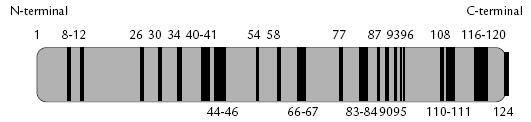
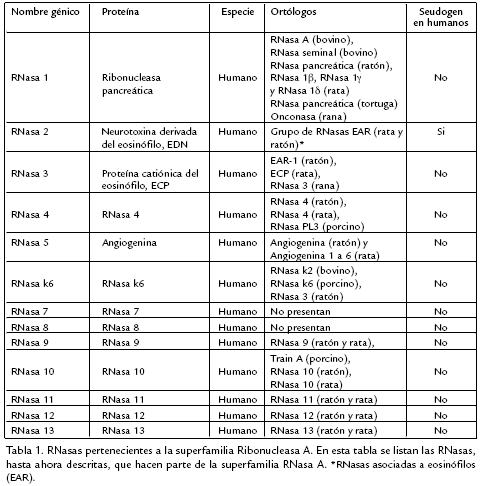
<body><![CDATA[<P><B>Key words: </B>antiviral activity, RNase 1, EDN, ECP, ONC. </P>   <B>INTRODUCCI&Oacute;N </b>      <P> La poblaci&oacute;n de RNA en las c&eacute;lulas es controlada postranscripcionalmente por enzimas denominadas ribonucleasas (RNasas) que poseen especificidades comunes o diferentes, exhiben un patr&oacute;n de expresi&oacute;n variable y difieren en su actividad contra diferentes sustratos de RNA (Deshpande y Shankar, 2002). Una sola c&eacute;lula puede contener hasta 20 RNasas diferentes, las cuales pueden hacer parte de complejos supramoleculares y funcionar en conjunto con otras enzimas (Deutscher y Li, 2001). Las RNasas y sus hom&oacute;logos estructurales son mol&eacute;culas reguladoras que controlan procesos que van desde el procesamiento alternativo a la organog&eacute;nesis (Beintema y Kleineidam, 1998). Diferentes estudios apoyan el uso de algunas RNasas para el tratamiento de enfermedades infecciosas y el c&aacute;ncer, aunque su potencial terap&eacute;utico est&aacute; limitado por su habilidad para penetrar las c&eacute;lulas (Costanzi <I>et al.</I><I>, </I>2005). </P>       <p   align="justify" ><B>DEFINICI&Oacute;N </b></p >     <P align="justify" >Las RNasas son prote&iacute;nas con actividad enzim&aacute;tica presentes en bacterias (Ilinskaya <I>et al.</I><I>, </I>2001), hongos (Kao y Davies, 1999), plantas superiores (Roalson y McCubbin, 2003) y mam&iacute;feros (Breukelman <I>et al.</I><I>, </I>2001), que participan en procesos fisiol&oacute;gicos diversos tales como: muerte celular (Lin <I>et al.,</I>1994), replicaci&oacute;n del DNA (Deshpande y Shankar, 2002), transcripci&oacute;n, procesamiento y edici&oacute;n del RNA (Deshpande y Shankar, 2002), defensa del hospedero (Domachowske <I>et al.</I><I>, </I>1998) y control del crecimiento tumoral (Griffiths <I>et al.</I><I>, </I>1997). </P >     <p   align="justify" ><B>CLASIFICACI&Oacute;N </b></p >      <P   align="justify" > Las ribonucleasas est&aacute;n divididas en tres grandes familias: la superfamilia RNasa A, la familia T1 y la familia T2. La superfamilia Ribonucleasa A est&aacute; constituida por las RNasas de mam&iacute;feros y otros vertebrados como aves, reptiles y anfibios (Soochin <I>et al.</I><I>, </I>2005). Este grupo de prote&iacute;nas presenta altas tasas de duplicaci&oacute;n g&eacute;nica y p&eacute;rdida de genes de lo que ha resultado un n&uacute;mero variable de genes en diferentes especies (Soochin <I>et al.</I><I>, </I>2005). En el ser humano, los genes que las codifican est&aacute;n ubicados en el brazo largo del cromosoma 14. Sierakowska y Shugar (1977) agruparon las RNasas humanas en dos categor&iacute;as: RNasas secretadas y no secretadas; posteriormente, el grupo de Weickmann <I>et al</I><I>. </I>(1981) cambi&oacute; el t&eacute;rmino de secretadas por el de RNasas de tipo pancre&aacute;tico y Sorrentino y Libonati (1994), introdujeron el t&eacute;rmino no pancre&aacute;ticas en reemplazo de no secretadas. Las RNasas de tipo pancre&aacute;tico incluyen tanto ribonucleasas encontradas en el p&aacute;ncreas como en otros flu&iacute;dos corporales con propiedades catal&iacute;ticas y estructurales similares a las RNasas pancre&aacute;ticas humanas y de bovino. El t&eacute;rmino de tipo no pancre&aacute;tico se utiliz&oacute; para las RNasas que presentan propiedades catal&iacute;ticas y tienen secuencia similar a la neurotoxina derivada del eosin&oacute;filo (EDN) o a la RNasa K2 de ri&ntilde;&oacute;n de bovino. Otros miembros de la superfamilia RNasa A, tales como la RNasa 4 y la RNasa PL3 de h&iacute;gado porcino constituyen una tercera familia denominadas RNasas de tipo pancre&aacute;tico/no pancre&aacute;tico, las cuales son estructuralmente m&aacute;s similares a las RNasas de tipo pancre&aacute;tico pero comparten algunas propiedades catal&iacute;ticas con ambos tipos de ribonucleasas (Sorrentino y Libonati, 1997). </P >     <P align="center"><a name="tabla1"></a><img src="/img/revistas/abc/v11n2/2a03t01.JPG" ></P>     <P  align="justify" >Actualmente algunos autores se refieren a las cinco primeras RNasas (<a href="#tabla1">Tabla 1</a>) como RNasas pancre&aacute;ticas seg&uacute;n la clasificaci&oacute;n anteriormente descrita. Debido a que dichas clasificaciones pueden crear confusi&oacute;n, ninguno de esos t&eacute;rminos ser&aacute; usado en esta revisi&oacute;n. </P >     <P align="center" ><a name="fig1"></a><img src="/img/revistas/abc/v11n2/2a03f01.JPG"></P >     <P   align="justify" ><a href="#fig1">Figura 1</a>. Representaci&oacute;n esquem&aacute;tica de una RNasa humana. Las l&iacute;neas continuas (  ) corresponden a los amino&aacute;cidos conservados entre las RNasas 1 a 8. Las l&iacute;neas en puntos (&hellip;.) representan ciste&iacute;nas conservadas entre los miembros de la superfamilia RNasa A. Las l&iacute;neas discontinuas () corresponden a los residuos del sitio activo de las RNasa 1 (H12, K41, H119) los cuales est&aacute;n presentes en todas las RNasas de la superfamilia RNasa A en posiciones similares (Soochin <I>et al.</I><I>, </I>2005). Las RNasas 9 y 10 no poseen la tr&iacute;ada catal&iacute;tica ni el p&eacute;ptido se&ntilde;al (Penttinen <I>et al.</I><I>, </I>2003) y las RNasas 11, 12 y 13 presentan variabilidad en la regi&oacute;n de la tr&iacute;ada catal&iacute;tica (Soochin <I>et al.</I><I>, </I>2005). </P >     ]]></body>
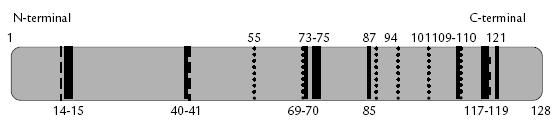
<body><![CDATA[<P   >Estas enzimas est&aacute;n compuestas de un p&eacute;ptido se&ntilde;al de aproximadamente 25 amino&aacute;cidos y un p&eacute;ptido maduro con alrededor de 130 amino&aacute;cidos. Las RNasas presentan varias caracter&iacute;sticas estructurales conservadas, entre las cuales son particularmente importantes tres residuos catal&iacute;ticos (una lisina y dos histidinas) y de seis a ocho ciste&iacute;nas que forman tres o cuatro puentes disulfuro (Soochin <I>et al.</I><I>, </I>2005; <a href="#fig1">Figs. 1</a> y <a href="#fig2">2</a>). La homolog&iacute;a entre las RNasas que hacen parte de la superfamilia RNasa A puede ser entre 20% hasta casi un 100% (Soochin <I>et al.</I><I>, </I>2005). Las RNasas 9 y 10 no poseen la tr&iacute;ada catal&iacute;tica ni el p&eacute;ptido se&ntilde;al (Penttinen <I>et al.</I><I>, </I>2003) y las RNasas 11, 12 y 13 presentan variabilidad en la regi&oacute;n de la tr&iacute;ada catal&iacute;tica (Soochin <I>et al.</I><I>, </I>2005), lo que sugiere que estas enzimas no poseen actividad ribonucleol&iacute;tica. Todas estas enzimas exhiben una estructura tridimensional similar; las mayores diferencias se encuentran en otros residuos que forman el sitio activo ribonucleol&iacute;tico el cual es responsable de las diferentes actividades espec&iacute;ficas y preferencias de sustrato. A continuaci&oacute;n se describir&aacute;n, en mayor detalle, las RNasas humanas y la onconasa para las cuales la actividad antiviral ha sido demostrada <I>in vitro</I>. </P >     <P   >&nbsp;</P >      <P align="left"  ><a name="fig2"></a><img src="/img/revistas/abc/v11n2/2a03f02.JPG" >    <br> <a href="#fig2">Figura 2</a>. Representaci&oacute;n esquem&aacute;tica de la RNasa A bovina. Las l&iacute;neas continuas corresponden a los residuos conservados entre esta RNasa y la Onconasa. </P >     <p   ><B>RNASA PANCRE&Aacute;TICA HUMANA/RNASA 1 </b></p >      <P >&Eacute;sta es una glicoprote&iacute;na con una masa molecular de 15 kDa sin glicosilaci&oacute;n, secretada por un gran n&uacute;mero de tejidos tales como: p&aacute;ncreas (Weickmann <I>et al.</I>, 1981), ri&ntilde;&oacute;n (Mizuta <I>et al.</I>, 1990), h&iacute;gado, cerebro, bazo (Futami <I>et al.</I>, 1997) y endotelio (Landr&eacute; <I>et al., </I>2002); tambi&eacute;n es producida por c&eacute;lulas tumorales de adenocarcinoma pancre&aacute;tico (Peracaula <I>et al.</I>, 2000). Adicionalmente, se encuentra en plasma seminal (De Prisco <I>et al.</I>,1984) y orina (Futami <I>et al.</I>, 1997). Es una de las RNasas de mayor circulaci&oacute;n en sangre con una concentraci&oacute;n aproximada de 400 ng/mL (Weickmann <I>et al.</I>, 1984). Esta enzima monom&eacute;rica est&aacute; constituida por 128 amino&aacute;cidos y seg&uacute;n  el tejido de origen puede presentar diferentes patrones de glicosilaci&oacute;n, con tres puntos de glicosilaci&oacute;n en el extremo amino terminal en los residuos asparagina34 (Asn34), Asn76 y Asn88. La enzima de origen urinario presenta los tres sitios glicosilados ;  la prote&iacute;na pancre&aacute;tica y parte de la RNasa 1 seminal s&oacute;lo est&aacute;n glicosiladas en Asn34 mientras que la enzima del ri&ntilde;&oacute;n no es glicosilada, al igual que el 50% de las enzima s  presentes en plasma seminal y cerebro (Sorrentino y Libonati, 1997). Se ha encontrad o  alteraci&oacute;n en el patr&oacute;n de glicosilaci&oacute;n de la RNasa 1 producida por tejido de adenocarcinoma pancre&aacute;tico y l&iacute;neas celulares de tumor pancre&aacute;tico. La RNasa 1 en condiciones normales presenta niveles m&aacute;s altos de fucosa y ausencia de &aacute;cido si&aacute;lico en comparaci&oacute;n a la RNasa 1 secretada por la l&iacute;nea celular tumoral humana pancre&aacute;tica (Dwek <I>et al.</I>, 2003). Aunque la estructura primaria de esta prote&iacute;na muestra un 70% de identidad con la RNasa bovina A (Soochin <I>et al.</I>, 2005), a diferencia de esta prote&iacute;na, la RNasa 1 humana posee una gran actividad contra el RNA de doble cadena, contiene mayor proporci&oacute;n de residuos b&aacute;sicos, su actividad es diferencialmente influenciada por la fuerza i&oacute;nica y los iones divalentes y tiene una extensi&oacute;n en su porci&oacute;n carboxiloterminal de cuatro residuos de amino&aacute;cidos (Sorrentino y Libonati, 1997). Funci&oacute;n biol&oacute;gica. Aunque la RNasa pancre&aacute;tica humana no ha sido asociada con alguna funci&oacute;n biol&oacute;gica en especial (Sorrentino y Libonati, 1997), se demostr&oacute; que cataliza eficientemente la degradaci&oacute;n del RNA de doble cadena <I>in vitro </I>(Sorrentino <I>et al.</I>, 2003), lo que sugiere su participaci&oacute;n en la respuesta inmune innata. Adem&aacute;s, se encontr&oacute; que es capaz de estimular c&eacute;lulas dendr&iacute;ticas para la producci&oacute;n de varios factores solubles e inducir su maduraci&oacute;n <I>in vitro </I>(De Yang <I>et al.</I>, 2003). El uso de un conjugado de RNasa pancre&aacute;tica y alb&uacute;mina de suero humano inyectado en ratones infectados con virus Influenza A e Influenza B, mostr&oacute; alta actividad antiviral (Zelepuga <I>et al.</I>, 2003). Estudios recientes nuestros se&ntilde;alan que la RNasa pancre&aacute;tica recombinante inhibe la replicaci&oacute;n del virus de la inmunodeficiencia humana tipo 1 (VIH1) en un cultivo primario de linfocitos T activados (Bedoya <I>et al.</I>, en prensa). Mecanismo de acci&oacute;n. La regi&oacute;n amino terminal tiene un papel importante en el clivaje del RNA. Exhibe actividad catal&iacute;tica espec&iacute;fica por pirimidinas con una preferencia marcada por sustrato policitosina (poliC) sobre poliuracilo (poliU). Adem&aacute;s, esta enzima es dos veces m&aacute;s activa que la RNasa A bovina, por poliadenina (poliA) debido a la presencia del residuo asp&aacute;rtico83 (Asp83). Su acci&oacute;n catal&iacute;tica se potencia en altas concentraciones de cloruro de sodio (NaCl) y muestra actividad &oacute;ptima a pH 8,0 (Boix <I>et al.</I>, 1996). Inhibidores. Esta RNasa no es citot&oacute;xica gracias a la acci&oacute;n neutralizante de la prote&iacute;na inhibidor de ribonucleasa (IR), glicoprote&iacute;na citos&oacute;lica de 50 kDa, cuya funci&oacute;n es preservar la integridad del RNA celular (Sorrentino y Libonati, 1997). Gaur <I>et al</I>. (2001) demostraron que los residuos lisina7 (Lis7), glutamina11 (Gln11), Asn71 y glut&aacute;mico111 (Glu111) en la RNasa pancre&aacute;tica humana son los amino&aacute;cidos que interact&uacute;an con el IR. </P >     <p   ><B>NEUROTOXINA DERIVADA DEL EOSIN&Oacute;FILO EDN/RNASA 2 </b></p >     <P > Esta prote&iacute;na es producida y almacenada en eosin&oacute;filos (Durack <i>et al., </I>1981), y se ha encontrado en h&iacute;gado (Sorrentino <I>et al.</I><I>, </I>1988), bazo (Yasuda et al.<I>, </I>1990), neutr&oacute;filos (Sur <I>et al.</I><I>, </I>1998), placenta (Shapiro y Vallee, 1991), monocitos/macr&oacute;fagos activados (De Yang et al.<I>, </I>2004) y en orina (Beintema et al.<I>, </I>1988). Su peso molecular es de 18,4 kDa; es una prote&iacute;na termoestable (Motojima et al.<I>, </I>1989), cati&oacute;nica y con una vida media en sangre muy corta (Boix et al.<I>, </I>1996). La estructura tridimensional de la EDN se caracteriza por la presencia de tres asas que la hacen diferente de las otras RNasas de la superfamilia RNasa A. Adem&aacute;s, presenta una inserci&oacute;n de amino&aacute;cidos Asp115 a tirosina123 (Tyr123) que comparte con la prote&iacute;na cati&oacute;nica del eosin&oacute;filo y la RNasa k6 (Rosenberg, 1998). Posee cinco sitios potenciales para glicosilaci&oacute;n en el amino&aacute;cido asparagina (Beintema y Kleineidam, 1998). La EDN presenta dos formas alternas resultado de un procesamiento alternativo o de una modificaci&oacute;n postrasduccional; una de ellas contiene cuatro amino&aacute;cidos adicionales (SerinaLeucinaHistidinaValina) en la regi&oacute;n amino terminal, considerada como parte de la secuencia se&ntilde;al ((4)EDN; Shapiro y Vallee, 1991). La EDN presenta una homolog&iacute;a del 67% con la prote&iacute;na cati&oacute;nica del eosin&oacute;filo. Su actividad neurot&oacute;xica se demostr&oacute; cuando al ser inyectada intratecalmente en conejos indujo un s&iacute;ndrome de rigidez muscular, ataxia y par&aacute;lisis asociada con p&eacute;rdida de las c&eacute;lulas de Purkinje; s&iacute;ndrome conocido como Fen&oacute;meno Gordon (Rosenberg, 1998). Sus niveles en sangre se han encontrado elevados en enfermedades asociadas con eosinofilia como por ejemplo en infecci&oacute;n por helmintos (Durack <I>et al.</I><I>, </I>1979), asma bronquial (Tischendorf <I>et al.</I><I>, </I>1996) y dermatitis at&oacute;pica (Dahl <I>et al.</I><I>, </I>1978). Funci&oacute;n biol&oacute;gica. Act&uacute;a como quimioquina para c&eacute;lulas dendr&iacute;ticas maduras e inmaduras mediante la activaci&oacute;n de la prote&iacute;na quinasa activada por mit&oacute;genos p42/44 (MAPK; Sugai <I>et al.</I><I>, </I>1992). Adicionalmente, se ha demostrado su acci&oacute;n antiviral <I>in vitr</I><I>o </I>en l&iacute;neas celulares cr&oacute;nicamente infectadas con el VIH1 y contra el virus respiratorio sincitial (Domachowske <I>et al.</I><I>, </I>1998), y es responsable por la actividad antiVIH1 que exhibe el sobrenadante de reacciones alog&eacute;nicas (Rugeles <I>et al.</I><I>, </I>2003). Recientemente reportamos que la enzima EDN recombinante inhibe la replicaci&oacute;n del VIH1 en linfocitos T activados (Bedoya <I>et al.</I><I>, </I>en prensa). Mecanismo de acci&oacute;n. Se ha demostrado su acci&oacute;n de ribonucleasa sobre RNA de cadena sencilla con preferencia sobre poli (U); esta actividad es inhibida en altas concentraciones de NaCl (De Yang <I>et al.</I><I>, </I>2004) y muestra actividad ribonucleasa &oacute;ptima sobre RNA de levadura a pH entre 6,57,0 (Sorrentino y Libonati, 1997). Es incapaz de catalizar la hidr&oacute;lisis de nucle&oacute;tidos c&iacute;clicos por la ausencia del amino&aacute;cido fenilalanina en la posici&oacute;n 120 (Sorrentino y Libonati, 1997) y de degradar RNA de doble cadena bajo algunas condiciones experimentales (Motojima <I>et al.</I><I>, </I>1989). Inhibidores. La actividad de la EDN es neutralizada por el inhibidor de ribonucleasa placentaria humana (Sorrentino y Libonati, 1994); el efecto neutralizante es dependiente de la dosis (Iyer <I>et al.</I><I>, </I>2005). </P > <B>PROTE&Iacute;NA CATI&Oacute;NICA DEL EOSIN&Oacute;FILO ECP/RNASA 3 </b>      <P > Esta RNasa constituye uno de los mayores componentes granulares del eosin&oacute;filo (Olsson y Venge, 1972). Adicionalmente, se ha encontrado en l&iacute;neas celulares eosinof&iacute;licas (Olsson <I>et al.</I><I>, </I>1977) y en neutr&oacute;filos (Sur <I>et al.</I><I>, </I>1998). Es una prote&iacute;na secretada, de car&aacute;cter b&aacute;sico y su propiedad altamente cati&oacute;nica es dependiente del n&uacute;mero de residuos de arginina en la superficie molecular. En su secuencia presenta tres sitios de glicosilaci&oacute;n, en la regi&oacute;n amino terminal, con oligosac&aacute;ridos complejos similares a los encontrados en EDN. ECP presenta un peso molecular de 15,6 kDa sin glicosilar, mientras que las formas glicosiladas pueden variar entre 16 y 22 kDa (Barker <I>et al.</I><I>, </I>1989). La RNasa 3 presenta un 70% de homolog&iacute;a con EDN; las diferencias entre estas dos RNasas radica en el n&uacute;mero de residuos de arginina, que en EDN son nueve y en la ECP alcanza un total de 19 residuos. Su actividad ribonucleol&iacute;tica es mucho menor que la de EDN. Funci&oacute;n biol&oacute;gica. Varias actividades de la ECP han sido caracterizadas <I>in vitr</I><I>o </I>tales como disminuci&oacute;n del tiempo de coagulaci&oacute;n dependiente del factor XII de la cascada de coagulaci&oacute;n (Venge <I>et al.</I><I>, </I>1979), aumento de la fibrinolisis por activaci&oacute;n del plasmin&oacute;geno inducida por uroquinasa (Dahl y Venge, 1979) y regulaci&oacute;n de los componentes de la v&iacute;a cl&aacute;sica del complemento. Adem&aacute;s, se demostr&oacute; en varios estudios que la ECP tiene toxicidad hacia <I>Schistosom</I><I>a </I>(Ackerman <I>et al.</I><I>, </I>1985), <I>Trypanosom</I><I>a </I>(Molina <I>e</I><I>t </I>al.<I>, </I>1988), <I>Microphilaria</I><I>e </I>(Hamann <I>et al.</I><I>, </I>1990), <I>Trichinella </I>(Hamann <I>et al.</I><I>, </I>1987) y Plasmodiu<I>m </I>(Waters et al.<I>, </I>1987). Tambi&eacute;n se demostr&oacute; su actividad contra bacterias Gramnegativas y Grampositivas independiente de su acci&oacute;n ribonucleol&iacute;tica (Carreras <I>e</I><I>t </I>al.<I>, </I>2003). Es t&oacute;xica para c&eacute;lulas y tejidos de mam&iacute;feros (Maeda <I>et al.</I><I>, </I>2002). La ECP humana recombinante ha demostrado actividad antiviral contra formas extracelulares del virus respiratorio sincitial (Domachowske et al.<I>, </I>1998). Mecanismo de acci&oacute;n. La ECP es considerada como una enzima con actividad espec&iacute;fica por RNA de cadena sencilla, con preferencia por poli(U). <I>In vitro</I>, la ECP muestra actividad &oacute;ptima a valores de pH entre 6,57,0 con RNA de levadura como sustrato y es incapaz de catalizar la hidr&oacute;lisis de nucle&oacute;tidos c&iacute;clicos (Sorrentino y Glitz, 1991). Debido a su car&aacute;cter altamente cati&oacute;nico, la ECP puede unirse a mol&eacute;culas cargadas negativamente de las membranas celulares, siendo capaz de formar canales selectivos no i&oacute;nicos o poros estables en la membrana (Young <I>et al.</I><I>, </I>1986). Adem&aacute;s de la formaci&oacute;n del poro transmembrana, la ECP se internaliza y por medio de la interacci&oacute;n con la prote&iacute;na carboxipeptidasa E, en c&eacute;lulas neuroendocrinas, escapa al ataque proteol&iacute;tico. Si logra acumularse en exceso y sobrepasa la concentraci&oacute;n de los inhibidores de RNasas, induce la degradaci&oacute;n de mol&eacute;culas de RNA citos&oacute;lico inhibiendo el crecimiento celular (Wu <I>et al.</I><I>, </I>2004). Inhibidores. Su acci&oacute;n citot&oacute;xica es completamente bloqueada por el inhibidor de RNasa citos&oacute;lico expresado ubicuamente (Maeda <I>et al.</I><I>, </I>2002). </P > <B>ONCONASA/P30/RANPIRNASA </b>      <P> La onconasa (ONC) es una RNasa aislada de oocitos y de embriones en estad&iacute;o temprano de la <I>Rana pipiens</I>. Es un miembro de la superfamilia RNasa A que presenta un 30% de homolog&iacute;a con la RNasa A bovina. A pesar del bajo grado de homolog&iacute;a entre las estructuras primarias, la estructura tridimensional de la ONC muestra una topolog&iacute;a muy similar a la RNasa A (Ardelt <I>et al.</I><I>, </I>1994). Posee los principales residuos del sitio activo y tres de los cuatro puentes disulfuro caracter&iacute;sticos de las RNasas; sin embargo, la ONC parece tener un &uacute;nico mecanismo catal&iacute;tico debido a un residuo piroglutamato en su regi&oacute;n amino terminal (Boix <I>et al.</I><I>, </I>1996). Es una prote&iacute;na con alta estabilidad t&eacute;rmica gracias a su estructura terciaria compacta (Notomista <I>et al.</I><I>, </I>2000). La ONC aislada de los oocitos de <I>Rana pipien</I><I>s </I>ha sido evaluada en varios ensayos cl&iacute;nicos en humanos como terapia antitumoral (Costanzi <I>et al.</I><I>, </I>2005). </P >      ]]></body>
<body><![CDATA[<P   >Funci&oacute;n biol&oacute;gica. Se ha demostrado que esta RNasa es citot&oacute;xica <I>in vitr</I><I>o </I>para varias l&iacute;neas celulares tumorales de mam&iacute;fero (Darzynkiewicz <I>et al.</I><I>, </I>1988) y se ha descrito tambi&eacute;n actividad antitumoral <I>in viv</I><I>o </I>en modelos animales (Milkulski <I>et al.</I><I>, </I>1990). Tiene una gran capacidad de inhibir la replicaci&oacute;n del VIH1 en l&iacute;neas cr&oacute;nicamente infectadas con este virus (Saxena <I>et al.</I><I>, </I>1996). Mecanismo de acci&oacute;n. ONC muestra una actividad espec&iacute;fica disminu&iacute;da hacia sustratos espec&iacute;ficos en comparaci&oacute;n con la RNasa A; exhibe preferencia por poli(U) y por poliguanina(poliG). Su actividad &oacute;ptima se alcanza a pH 5,5. Estudios previos en modelos animales indican que la citotoxicidad de ONC se debe a su capacidad de unirse a la superficie celular, entrar al citosol y degradar el RNA causando la muerte celular (Wu <I>et al.</I><I>, </I>1993). Iordanov <I>et al</I><I>. </I>(2000) report&oacute; la especificidad de ONC por RNA de transferencia, sin afectar el RNA ribosomal y mensajero. Las c&eacute;lulas tratadas con ONC presentaron signos de apoptosis similares a los inducidos por caspasa3, que fueron independientes de la inhibici&oacute;n de la s&iacute;ntesis de prote&iacute;nas. Inhibidores. Las RNasas de anfibios no son bloqueadas por el inhibidor de ribonucleasas placentarias de mam&iacute;feros (Beintema y Kleineidam, 1998), lo que puede explicar su alta citotoxicidad en c&eacute;lulas de mam&iacute;feros. </P >     <p   ><B>PAPEL ANTIVIRAL DE LAS RIBONUCLEASAS </b></p >      <P> Los mam&iacute;feros est&aacute;n constantemente expuestos a una gran cantidad de microorganismos contra los cuales responden a trav&eacute;s del sistema inmune innato y adaptativo. La inmunidad innata representa la primera l&iacute;nea de defensa que es r&aacute;pidamente activada en respuesta a la invasi&oacute;n microbiana, de la cual hacen parte diferentes c&eacute;lulas y factores solubles. En los &uacute;ltimos a&ntilde;os, varios de estos factores solubles con actividad microbicida, entre ellos las RNasas, han suscitado particular inter&eacute;s por el potencial terap&eacute;utico que tienen. </P >      <P   >Se ha propuesto que algunas RNasas se unen a la superficie celular, gracias a su car&aacute;cter altamente cati&oacute;nico, entran al citosol y degradan el RNA induciendo la muerte celular. Esta acci&oacute;n catal&iacute;tica <I>per s</I><I>e </I>de las RNasas hace parte del mecanismo antiviral de estas enzimas, tal como se ha sugerido para la ONC y la ECP, las cuales degradan el RNA ribosomal. La acci&oacute;n citot&oacute;xica sobre la c&eacute;lula blanco limitar&iacute;a la replicaci&oacute;n viral. Adicionalmente, se ha sugerido una acci&oacute;n directa de las RNasas, particularmente de la ONC sobre el RNA viral en cultivo de c&eacute;lulas H9 infectadas con el VIH1 (Saxena <I>et al.</I><I>, </I>1996). En el caso de virus DNA, la acci&oacute;n catal&iacute;tica de las RNasas podr&iacute;a darse despu&eacute;s de la transcripci&oacute;n, una vez se hayan producido los RNAm. Otro mecanismo efector es la acci&oacute;n quimiot&aacute;ctica y por ende proinflamatoria, como la actividad exhibida por EDN. Al reclutar c&eacute;lulas dendr&iacute;ticas se induce la producci&oacute;n de factores quimiot&aacute;cticos para otras c&eacute;lulas del sistema inmune; de esta manera, EDN potencia la respuesta innata y promueve la inmunidad adaptativa que permitir&iacute;a eliminar m&aacute;s f&aacute;cilmente la infecci&oacute;n viral (Shapiro y Vallee, 1991). </P >     <P   >El potencial terap&eacute;utico de las RNasas fue inicialmente explorado por Glukhov <I>et al</I><I>. </I>(1976) al usar la RNasa 1 para el tratamiento de pacientes infectados con el virus de la encefalitis <I>Tickborne</I>. Despu&eacute;s del tratamiento, se observ&oacute; una r&aacute;pida resoluci&oacute;n de los s&iacute;ntomas men&iacute;ngeos y de la pleocitosis en el flu&iacute;do cerebroespinal. Desde entonces, se han realizado varios estudios que han evaluado el uso terap&eacute;utico de estas enzimas en otros modelos, particularmente tumorales, tanto <I>in vitr</I><I>o </I>como <I>in vivo</I>. Utilizando EDN purificada, a partir de preparaciones comerciales de la hormona gonadotropina cori&oacute;nica humana (hCG), se observ&oacute; una disminuci&oacute;n del crecimiento de una l&iacute;nea celular derivada de Sarcoma de Kaposi, KSIMM, la cual fue dependiente de la dosis. Igualmente, se analiz&oacute; un p&eacute;ptido sint&eacute;tico de 16 residuos, similar a la secuencia activa de la enzima 4EDN, el cual exhibi&oacute; un efecto citot&oacute;xico dependiente de la dosis, sobre la misma l&iacute;nea celular (Dricu <I>et al.</I><I>, </I>2004). La ONC tambi&eacute;n ha sido evaluada como agente antitumoral en estudios de fase II en pacientes con mesotelioma maligno (Milkulski <I>e</I><I>t </I>al.<I>, </I>2002) y en estudios de fase I administr&aacute;ndola en forma intravenosa a pacientes con diferentes tipos de tumores, quienes hab&iacute;an presentado resistencia a otras terapias (Milkuski <I>et al.,</I>1993). Esta RNasa demostr&oacute; una buena actividad antitumoral y un perfil de toxicidad tolerable. Actualmente se est&aacute;n realizando estudios de fase III con esta RNasa para el tratamiento del c&aacute;ncer de pulm&oacute;n, pancre&aacute;tico y mesotelioma maligno. </P >     <p   align="left" ><B>CONCLUSIONES </b></p >     <P   align="justify" >Bas&aacute;ndose en estudios realizados <I>in vitr</I><I>o </I>y algunos <I>in vivo</I><I>, </I>es evidente que las RNasas tienen actividad antimicrobiana potencial, y un papel importante en iniciar y amplificar la respuesta inmune innata y adaptativa contra la invasi&oacute;n microbiana. La actividad antiviral demostrada para estas RNasas abre un nuevo campo de estudio dirigido a la creaci&oacute;n de una nueva clase de agentes antivirales usando estas prote&iacute;nas o formas modificadas.</P >     <p   align="left" ><B>AGRADECIMIENTOS </b></p >     <P   align="justify" ><B>Est</b>a revisi&oacute;n hace parte del proyecto financiado por Colciencias y la Universidad de Antioquia, c&oacute;digo 1150412948. </P >     <p   align="left" ><B>BIBLIOGRAF&Iacute;A </b></p >     ]]></body>
<body><![CDATA[<P   align="justify" >ACKERMAN SJ, GLEICH GJ, LOEGERING DA, RICHARDSON BA, BUTTERWORTH AE. Comparative Toxicity of Purified Human Eosinophil Granule Cationic Proteins for Schistosomula of <I>Schistosoma mansoni</I>. Am J Trop Med Hyg. 1985;34:735&ndash;745. </P >     <!-- ref --><P   align="justify" >ARDELT W, LEE HS, RANDOLPH G, VIERA A, MIKULSKI, SM, SHOGEN K, Enzymatic Characterization of Onconase, a Novel Ribonuclease with Antitumor Activity. Protein Sci. 1994;3:S137. </P >    &nbsp;&nbsp;&nbsp;&nbsp;&nbsp;&nbsp;&nbsp;&nbsp;[&#160;<a href="javascript:void(0);" onclick="javascript: window.open('/scielo.php?script=sci_nlinks&ref=000044&pid=S0120-548X200600020000300002&lng=','','width=640,height=500,resizable=yes,scrollbars=1,menubar=yes,');">Links</a>&#160;]<!-- end-ref --><!-- ref --><P   align="justify" >BARKER RL, LOEGERING DA, TEN RM, HAMANN KJ, PEASE LR, GLEICH GJ. Eosinophil Cationic Protein cDNA Comparison with Other Toxic Cationic Proteins and Ribonucleases. J Immunol. 1989;143:952955. </P >    &nbsp;&nbsp;&nbsp;&nbsp;&nbsp;&nbsp;&nbsp;&nbsp;[&#160;<a href="javascript:void(0);" onclick="javascript: window.open('/scielo.php?script=sci_nlinks&ref=000045&pid=S0120-548X200600020000300003&lng=','','width=640,height=500,resizable=yes,scrollbars=1,menubar=yes,');">Links</a>&#160;]<!-- end-ref --><!-- ref --><P   align="justify" >BEDOYA V, BOASSO A, HARDY AW, RYBAK S, SHEARER GM, RUGELES MT. Ribonucleases in HIV1 Inhibition: Effect of Recombinant RNases on Infection of Primary T Cells and Immune ActivationInduced RNase Gene and Protein Expression. AIDS Res Hum Retroviruses. In press. 2006 </P >    &nbsp;&nbsp;&nbsp;&nbsp;&nbsp;&nbsp;&nbsp;&nbsp;[&#160;<a href="javascript:void(0);" onclick="javascript: window.open('/scielo.php?script=sci_nlinks&ref=000046&pid=S0120-548X200600020000300004&lng=','','width=640,height=500,resizable=yes,scrollbars=1,menubar=yes,');">Links</a>&#160;]<!-- end-ref --><!-- ref --><P   align="justify" >BEINTEMA JJ, KLEINEIDAM RG. The Ribonuclease A Superfamily: General Discussion. Cell Mol Life Sci. 1998;54:825832. </P >    &nbsp;&nbsp;&nbsp;&nbsp;&nbsp;&nbsp;&nbsp;&nbsp;[&#160;<a href="javascript:void(0);" onclick="javascript: window.open('/scielo.php?script=sci_nlinks&ref=000047&pid=S0120-548X200600020000300005&lng=','','width=640,height=500,resizable=yes,scrollbars=1,menubar=yes,');">Links</a>&#160;]<!-- end-ref --><!-- ref --><P   align="justify" >BEINTEMA JJ, BLANK A, SCHIEVEN GL, DEKKER CA, SORRENTINO S, LIBONATI M. Differences In Glycosilation Pattern of Human Secretory Ribonucleases. Biochem J. 1988;255:501505. </P >    &nbsp;&nbsp;&nbsp;&nbsp;&nbsp;&nbsp;&nbsp;&nbsp;[&#160;<a href="javascript:void(0);" onclick="javascript: window.open('/scielo.php?script=sci_nlinks&ref=000048&pid=S0120-548X200600020000300006&lng=','','width=640,height=500,resizable=yes,scrollbars=1,menubar=yes,');">Links</a>&#160;]<!-- end-ref --><!-- ref --><P   align="justify" >BOIX E, WU Y, VASANDANI VM, SAXENA S, ARDELT W, LADNER J, YOULE RJ. Role of the N Terminus in RNase A Homologues: Differences in Catalytic Activity, Ribonuclease Inhibitor Interaction and Cytotoxicity. J Mol Biol. 1996;257:9921007. </P >    &nbsp;&nbsp;&nbsp;&nbsp;&nbsp;&nbsp;&nbsp;&nbsp;[&#160;<a href="javascript:void(0);" onclick="javascript: window.open('/scielo.php?script=sci_nlinks&ref=000049&pid=S0120-548X200600020000300007&lng=','','width=640,height=500,resizable=yes,scrollbars=1,menubar=yes,');">Links</a>&#160;]<!-- end-ref --><!-- ref --><P   align="justify" >BREUKELMAN HI, JEKEL PA, DUBOIS JY, MULDER PP, WARMELS HW, BEINTEMA JJ. Secretory Ribonucleases in the Primitive Ruminant chevrotain <I>Tragulu</I><I>s </I><I>javanicus</I>. Eur J Biochem. 2001;268:38903897. </P >    &nbsp;&nbsp;&nbsp;&nbsp;&nbsp;&nbsp;&nbsp;&nbsp;[&#160;<a href="javascript:void(0);" onclick="javascript: window.open('/scielo.php?script=sci_nlinks&ref=000050&pid=S0120-548X200600020000300008&lng=','','width=640,height=500,resizable=yes,scrollbars=1,menubar=yes,');">Links</a>&#160;]<!-- end-ref --><!-- ref --><P   align="justify" >CARRERAS E, BOIX E, ROSENBERG JF, CUCHILLO CM, NOGUES MV. Both Aromatic and Cationic Residues Contribute to the Membranelytic and Bactericidal Activity of Eosinophil Cationic Protein. Biochemistry. 2003;42:66366644. </P >    &nbsp;&nbsp;&nbsp;&nbsp;&nbsp;&nbsp;&nbsp;&nbsp;[&#160;<a href="javascript:void(0);" onclick="javascript: window.open('/scielo.php?script=sci_nlinks&ref=000051&pid=S0120-548X200600020000300009&lng=','','width=640,height=500,resizable=yes,scrollbars=1,menubar=yes,');">Links</a>&#160;]<!-- end-ref --><!-- ref --><P   align="justify" >COSTANZI J, SIDRANSKY D, NAVON A, GOLDSWEIG H. Ribonucleases as a Novel proApoptotic Anticancer Strategy: Review of the Preclinical and Clinical Data for Ranpirnase. Cancer Invest. 2005;23:643650. </P >    &nbsp;&nbsp;&nbsp;&nbsp;&nbsp;&nbsp;&nbsp;&nbsp;[&#160;<a href="javascript:void(0);" onclick="javascript: window.open('/scielo.php?script=sci_nlinks&ref=000052&pid=S0120-548X200600020000300010&lng=','','width=640,height=500,resizable=yes,scrollbars=1,menubar=yes,');">Links</a>&#160;]<!-- end-ref --><P   align="justify" >DAHL R, VENGE P. Enhancement of UrokinaseInduced Plasminogen Activation by the Cationic Protein of Human Eosinophil Granulocytes. Thromb Res. 1979;14:599&ndash;608. </P >     <!-- ref --><P   align="justify" >DAHL R, VENGE P, OLSSON I. Variations of Blood Eosinophils and Eosinophil Cationic Proteins in Serum of Patients with Bronquial Asthma. Allergy. 1978;33:211215. </P >    &nbsp;&nbsp;&nbsp;&nbsp;&nbsp;&nbsp;&nbsp;&nbsp;[&#160;<a href="javascript:void(0);" onclick="javascript: window.open('/scielo.php?script=sci_nlinks&ref=000054&pid=S0120-548X200600020000300012&lng=','','width=640,height=500,resizable=yes,scrollbars=1,menubar=yes,');">Links</a>&#160;]<!-- end-ref --><!-- ref --><P   align="justify" >DARZYNKIEWICZ Z, CARTER SP, MIKULSKI SM, ARDELT WJ, SHOGEN K. Cytostatic and Cytotoxic Effects of Pannon (P30 Protein), a Novel Anticancer Agent. Cell Tissue Kinet. 1988;21:169182. </P >    &nbsp;&nbsp;&nbsp;&nbsp;&nbsp;&nbsp;&nbsp;&nbsp;[&#160;<a href="javascript:void(0);" onclick="javascript: window.open('/scielo.php?script=sci_nlinks&ref=000055&pid=S0120-548X200600020000300013&lng=','','width=640,height=500,resizable=yes,scrollbars=1,menubar=yes,');">Links</a>&#160;]<!-- end-ref --><!-- ref --><P   align="justify" >DE PRISCO R, SORRENTINO S, LEONE E, LIBONATI M. A Ribonuclease from Human Seminal Plasma Active on Double Stranded RNA. Biochim Biophys Acta. 1984;788:356363. </P >    &nbsp;&nbsp;&nbsp;&nbsp;&nbsp;&nbsp;&nbsp;&nbsp;[&#160;<a href="javascript:void(0);" onclick="javascript: window.open('/scielo.php?script=sci_nlinks&ref=000056&pid=S0120-548X200600020000300014&lng=','','width=640,height=500,resizable=yes,scrollbars=1,menubar=yes,');">Links</a>&#160;]<!-- end-ref --><!-- ref --><P   align="justify" >DE YANG QQ, ROSENBERG H, CHEN Q, DYER KD, KUROSAKA K, OPPENHEIM J. Eosinophil Derived Neurotoxin (EDN), an Antimicrobial Protein with Chemotactic Activities for Dendritic Cells. Blood. 2003;102:33963403. </P >    &nbsp;&nbsp;&nbsp;&nbsp;&nbsp;&nbsp;&nbsp;&nbsp;[&#160;<a href="javascript:void(0);" onclick="javascript: window.open('/scielo.php?script=sci_nlinks&ref=000057&pid=S0120-548X200600020000300015&lng=','','width=640,height=500,resizable=yes,scrollbars=1,menubar=yes,');">Links</a>&#160;]<!-- end-ref --><!-- ref --><P   align="justify" >DE YANG QQ, BIRAGYN A, HOOVER DM, LUBKOWSKI J, OPPENHEIM JJ. Multiple Roles of Antimicrobial Defensins, Cathelicidins and EosinophilDerived Neurotoxin in Host Defense. Annu Rev Immunol. 2004;22:181215. </P >    &nbsp;&nbsp;&nbsp;&nbsp;&nbsp;&nbsp;&nbsp;&nbsp;[&#160;<a href="javascript:void(0);" onclick="javascript: window.open('/scielo.php?script=sci_nlinks&ref=000058&pid=S0120-548X200600020000300016&lng=','','width=640,height=500,resizable=yes,scrollbars=1,menubar=yes,');">Links</a>&#160;]<!-- end-ref --><!-- ref --><P   align="justify" >DE YANG QQ, ROSENBERG HF, RYBAK SM, NEWTON DL, WANG ZY, FU Q, <I>et al</I><I>. </I>Human Ribonuclease A Superfamily members EosinophilDerived Neurotoxin and Pancreatic Ribonuclease, induce Dendritic and Activation. J Immunol. 2004;173:61346142. </P >    &nbsp;&nbsp;&nbsp;&nbsp;&nbsp;&nbsp;&nbsp;&nbsp;[&#160;<a href="javascript:void(0);" onclick="javascript: window.open('/scielo.php?script=sci_nlinks&ref=000059&pid=S0120-548X200600020000300017&lng=','','width=640,height=500,resizable=yes,scrollbars=1,menubar=yes,');">Links</a>&#160;]<!-- end-ref --><!-- ref --><P   align="justify" >DESHPANDE RA, SHANKAR V. Ribonucleases from T2 Family. Crit Rev Microbiol. 2002;28:79122. </P >    &nbsp;&nbsp;&nbsp;&nbsp;&nbsp;&nbsp;&nbsp;&nbsp;[&#160;<a href="javascript:void(0);" onclick="javascript: window.open('/scielo.php?script=sci_nlinks&ref=000060&pid=S0120-548X200600020000300018&lng=','','width=640,height=500,resizable=yes,scrollbars=1,menubar=yes,');">Links</a>&#160;]<!-- end-ref --><!-- ref --><P   align="justify" >DEUTSCHER MP, LI Z. Exoribonucleases and Their Multiple Roles in RNA Metabolism. Prog Nucleic Acid Res Mol Biol. 2001;66:67105. </P >    &nbsp;&nbsp;&nbsp;&nbsp;&nbsp;&nbsp;&nbsp;&nbsp;[&#160;<a href="javascript:void(0);" onclick="javascript: window.open('/scielo.php?script=sci_nlinks&ref=000061&pid=S0120-548X200600020000300019&lng=','','width=640,height=500,resizable=yes,scrollbars=1,menubar=yes,');">Links</a>&#160;]<!-- end-ref --><!-- ref --><P   align="justify" >DOMACHOWSKE JB, BONVILLE CA, DYER KD, ROSENBERG HF. Evolution of Antiviral Activity in the Ribonuclease A Gene Superfamily: Evidence for a Specific Interaction Between EosinophilDerived Neurotoxin (EDN/RNase 2) and Respiratory Syncytial Virus. Nucleic Acids Res. 1998;26:53275332. </P >    &nbsp;&nbsp;&nbsp;&nbsp;&nbsp;&nbsp;&nbsp;&nbsp;[&#160;<a href="javascript:void(0);" onclick="javascript: window.open('/scielo.php?script=sci_nlinks&ref=000062&pid=S0120-548X200600020000300020&lng=','','width=640,height=500,resizable=yes,scrollbars=1,menubar=yes,');">Links</a>&#160;]<!-- end-ref --><!-- ref --><P   align="justify" >DURACK DT, SUMI SM, KLEBANOFF SJ. Neurotoxicity of Human Eosinophils. Proc Natl Acad Sci U S A. 1979;76:14431447. </P >    &nbsp;&nbsp;&nbsp;&nbsp;&nbsp;&nbsp;&nbsp;&nbsp;[&#160;<a href="javascript:void(0);" onclick="javascript: window.open('/scielo.php?script=sci_nlinks&ref=000063&pid=S0120-548X200600020000300021&lng=','','width=640,height=500,resizable=yes,scrollbars=1,menubar=yes,');">Links</a>&#160;]<!-- end-ref --><!-- ref --><P   align="justify" >DURACK DT, ACKERMAN SJ, LOEGERING DA, GLEICH GJ. Purification of Human EosinophilDerived Neurotoxin. Proc Natl Acad Sci U S A. 1981;78:51655169. </P >    &nbsp;&nbsp;&nbsp;&nbsp;&nbsp;&nbsp;&nbsp;&nbsp;[&#160;<a href="javascript:void(0);" onclick="javascript: window.open('/scielo.php?script=sci_nlinks&ref=000064&pid=S0120-548X200600020000300022&lng=','','width=640,height=500,resizable=yes,scrollbars=1,menubar=yes,');">Links</a>&#160;]<!-- end-ref --><P   align="justify" >DRICU A, SERGIUBOGDAN C, BRISMAR K, BIBERFELD P, ANDERSSON LC. A Synthetic Peptide Derived from the Human EosinophilDerived Neurotoxin Induces Apoptosis in Kaposi&rsquo;s Sarcoma Cells. Anticancer Res. 2004;24:14271432. </P >     <!-- ref --><P   align="justify" >DWEK RA, RUDD PM, DE LLORENS R. Glycosylation of Human Pancreatic Ribonuclease: Differences Between Normal and Tumor States. Glycobiology. 2003;13:227244. </P >    &nbsp;&nbsp;&nbsp;&nbsp;&nbsp;&nbsp;&nbsp;&nbsp;[&#160;<a href="javascript:void(0);" onclick="javascript: window.open('/scielo.php?script=sci_nlinks&ref=000066&pid=S0120-548X200600020000300024&lng=','','width=640,height=500,resizable=yes,scrollbars=1,menubar=yes,');">Links</a>&#160;]<!-- end-ref --><!-- ref --><P   align="justify" >FUTAMI J, TSUSHIMA Y, MURATO Y, TADA H, SASAKI J, SENO M. Tissue Specific Expression of PancreaticType Rnases and RNase Inhibitor in Humans. DNA Cell Biol. 1997;16:413419. </P >    &nbsp;&nbsp;&nbsp;&nbsp;&nbsp;&nbsp;&nbsp;&nbsp;[&#160;<a href="javascript:void(0);" onclick="javascript: window.open('/scielo.php?script=sci_nlinks&ref=000067&pid=S0120-548X200600020000300025&lng=','','width=640,height=500,resizable=yes,scrollbars=1,menubar=yes,');">Links</a>&#160;]<!-- end-ref --><!-- ref --><P   align="justify" >GAUR D, SWAMINATHAN S, BATRA JK. Interaction of Human Pancreatic Ribonuclease with Human Ribonuclease Inhibitor. J Biol Chem. 2001;216:2497824984. </P >    &nbsp;&nbsp;&nbsp;&nbsp;&nbsp;&nbsp;&nbsp;&nbsp;[&#160;<a href="javascript:void(0);" onclick="javascript: window.open('/scielo.php?script=sci_nlinks&ref=000068&pid=S0120-548X200600020000300026&lng=','','width=640,height=500,resizable=yes,scrollbars=1,menubar=yes,');">Links</a>&#160;]<!-- end-ref --><!-- ref --><P   align="justify" >GLUKHOV BN, JERUSALIMSKY AP, CANTER VM, SALGANIK RI. Ribonuclease Treatment of TickBorne Encephalitis. Arch Neurol. 1976;33:598603. </P >    &nbsp;&nbsp;&nbsp;&nbsp;&nbsp;&nbsp;&nbsp;&nbsp;[&#160;<a href="javascript:void(0);" onclick="javascript: window.open('/scielo.php?script=sci_nlinks&ref=000069&pid=S0120-548X200600020000300027&lng=','','width=640,height=500,resizable=yes,scrollbars=1,menubar=yes,');">Links</a>&#160;]<!-- end-ref --><P   align="justify" >GRIFFITHS SJ, ADAMS DJ, TALBOT SJ. Ribonuclease Inhibits Kaposi&rsquo;s Sarcoma. Nature. 1997;390:568. </P >     <!-- ref --><P   align="justify" >HAMANN KJ, BARKER RL, LOEGERING DA, GLEICH GJ. Comparative Toxicity of Purified Human Eosinophil Granule Proteins for Newborn Larvae of <I>Trichinell</I><I>a </I><I>spiralis</I><I>. </I>J Parasitol. 1987;73:523529. </P >    &nbsp;&nbsp;&nbsp;&nbsp;&nbsp;&nbsp;&nbsp;&nbsp;[&#160;<a href="javascript:void(0);" onclick="javascript: window.open('/scielo.php?script=sci_nlinks&ref=000071&pid=S0120-548X200600020000300029&lng=','','width=640,height=500,resizable=yes,scrollbars=1,menubar=yes,');">Links</a>&#160;]<!-- end-ref --><!-- ref --><P   align="justify" >HAMANN KJ, GLEICH GJ, CHECKEL JL, LOEGERING DA, McCALL JW, BARKER RL. <I>In vitr</I><I>o </I>Killing of Microfilariae of <I>Brugia pahang</I><I>i </I>and <I>Brugia malay</I><I>i </I>by Eosinophil Granule Proteins. J Immunol. 1990;144:31663173. </P >    &nbsp;&nbsp;&nbsp;&nbsp;&nbsp;&nbsp;&nbsp;&nbsp;[&#160;<a href="javascript:void(0);" onclick="javascript: window.open('/scielo.php?script=sci_nlinks&ref=000072&pid=S0120-548X200600020000300030&lng=','','width=640,height=500,resizable=yes,scrollbars=1,menubar=yes,');">Links</a>&#160;]<!-- end-ref --><!-- ref --><P   align="justify" >ILINSKAYA O, DECKER K, KOSCHINSKI A, DREYER F, REPP H. <I>Bacillu</I><I>s </I><I>Intermediu</I><I>s </I>Ribonuclease as Inhibitor of Cell Proliferation and Membrane Current. Toxicology. 2001;156:101107. </P >    &nbsp;&nbsp;&nbsp;&nbsp;&nbsp;&nbsp;&nbsp;&nbsp;[&#160;<a href="javascript:void(0);" onclick="javascript: window.open('/scielo.php?script=sci_nlinks&ref=000073&pid=S0120-548X200600020000300031&lng=','','width=640,height=500,resizable=yes,scrollbars=1,menubar=yes,');">Links</a>&#160;]<!-- end-ref --><!-- ref --><P   align="justify" >IORDANOV MS, RYABININA OP, WONG J, DINH T, NEWTON DL, RYBAK SM, <I>et al</I><I>. </I>Molecular Determinants of Apoptosis Induced by the Cytotoxic Ribonuclease Onconase: Evidence for Cytotoxic Mechanisms Different from Inhibition of Protein Synthesis. Cancer Res. 2000;1:19831994. </P >    &nbsp;&nbsp;&nbsp;&nbsp;&nbsp;&nbsp;&nbsp;&nbsp;[&#160;<a href="javascript:void(0);" onclick="javascript: window.open('/scielo.php?script=sci_nlinks&ref=000074&pid=S0120-548X200600020000300032&lng=','','width=640,height=500,resizable=yes,scrollbars=1,menubar=yes,');">Links</a>&#160;]<!-- end-ref --><!-- ref --><P   align="justify" >IYER S, HOLLOWAY DE, KUMA K, SHAPIRO R, ACHARYA KR. Molecular Recognition of Human Eosinophilderived Neurotoxin (RNase 2) by Placental Ribonuclease Inhibitor. J Mol Biol. 2005;347:637655. </P >    &nbsp;&nbsp;&nbsp;&nbsp;&nbsp;&nbsp;&nbsp;&nbsp;[&#160;<a href="javascript:void(0);" onclick="javascript: window.open('/scielo.php?script=sci_nlinks&ref=000075&pid=S0120-548X200600020000300033&lng=','','width=640,height=500,resizable=yes,scrollbars=1,menubar=yes,');">Links</a>&#160;]<!-- end-ref --><!-- ref --><P   align="justify" >KAO R, DAVIES J. Molecular Dissection of Mitolgillin Reveals that the Fungal Ribotoxins are a Family of Natural Genetically Engineered Ribonucleases. J Biol Chem. 1999; 274:1257612582. </P >    &nbsp;&nbsp;&nbsp;&nbsp;&nbsp;&nbsp;&nbsp;&nbsp;[&#160;<a href="javascript:void(0);" onclick="javascript: window.open('/scielo.php?script=sci_nlinks&ref=000076&pid=S0120-548X200600020000300034&lng=','','width=640,height=500,resizable=yes,scrollbars=1,menubar=yes,');">Links</a>&#160;]<!-- end-ref --><!-- ref --><P   align="justify" >LANDR&Eacute; JBP, HEWETT PW, OLIVOT J, FRIEDL P, KO Y, SACHINIDIS A, <I>et al</I><I>. </I>Human Endothelial Cells Selectively Express Large Amounts of PancreaticType Ribonuclease (Rnase 1). J Cell Biochem. 2002;86:540552. </P >    &nbsp;&nbsp;&nbsp;&nbsp;&nbsp;&nbsp;&nbsp;&nbsp;[&#160;<a href="javascript:void(0);" onclick="javascript: window.open('/scielo.php?script=sci_nlinks&ref=000077&pid=S0120-548X200600020000300035&lng=','','width=640,height=500,resizable=yes,scrollbars=1,menubar=yes,');">Links</a>&#160;]<!-- end-ref --><!-- ref --><P   align="justify" >LIN JJ, NEWTON DL, MIKULSKI SM, KUNG HF, YOULE RJ, RYBAK SM. Characterization of the Mechanism of Cellular and Cell Free Protein Synthesis Inhibition by an AntiTumor Ribonuclease. Biochem Biophys Res Commun. 1994;204:156162. </P >    &nbsp;&nbsp;&nbsp;&nbsp;&nbsp;&nbsp;&nbsp;&nbsp;[&#160;<a href="javascript:void(0);" onclick="javascript: window.open('/scielo.php?script=sci_nlinks&ref=000078&pid=S0120-548X200600020000300036&lng=','','width=640,height=500,resizable=yes,scrollbars=1,menubar=yes,');">Links</a>&#160;]<!-- end-ref --><!-- ref --><P   align="justify" >MAEDA T, KITAZOE M, TADA H, DE LLORENS R, SALOMON DS, UEDA M, <I>et al</I><I>. </I>Growth Inhibition of Mammalian Cells by Eosinophil Cationic Protein. Eur J Biochem. 2002;269:307316. </P >    &nbsp;&nbsp;&nbsp;&nbsp;&nbsp;&nbsp;&nbsp;&nbsp;[&#160;<a href="javascript:void(0);" onclick="javascript: window.open('/scielo.php?script=sci_nlinks&ref=000079&pid=S0120-548X200600020000300037&lng=','','width=640,height=500,resizable=yes,scrollbars=1,menubar=yes,');">Links</a>&#160;]<!-- end-ref --><!-- ref --><P   align="justify" >MAEDA T, MAHARA K, KITAZOE M, FUTAMI J, TAKIDANI A, KOSAKA M, <I>e</I><I>t </I><I>al</I><I>. </I>RNase 3 (ECP) Is an Extraordinarily Stable Protein among Human PancreaticType Rnases. J Biochem (Tokyo). 2002;132:737742. </P >    &nbsp;&nbsp;&nbsp;&nbsp;&nbsp;&nbsp;&nbsp;&nbsp;[&#160;<a href="javascript:void(0);" onclick="javascript: window.open('/scielo.php?script=sci_nlinks&ref=000080&pid=S0120-548X200600020000300038&lng=','','width=640,height=500,resizable=yes,scrollbars=1,menubar=yes,');">Links</a>&#160;]<!-- end-ref --><!-- ref --><P   align="justify" >MIKULSKI SM, BERNSTEIN E, ARDELT W, SHOGEN K, MENDUKE K. Striking Increase in Survival of Mice Bearing M109 Madison Carcinoma Treated with a Novel Protein from Amphibian Embryos. J Natl Cancer Inst. 1990;82:151153. </P >    &nbsp;&nbsp;&nbsp;&nbsp;&nbsp;&nbsp;&nbsp;&nbsp;[&#160;<a href="javascript:void(0);" onclick="javascript: window.open('/scielo.php?script=sci_nlinks&ref=000081&pid=S0120-548X200600020000300039&lng=','','width=640,height=500,resizable=yes,scrollbars=1,menubar=yes,');">Links</a>&#160;]<!-- end-ref --><!-- ref --><P   align="justify" >MIKULSKI SM, GROSSMAN AM, CARTER PW. Phase I Human Clinical Trial of Onconase P30 protein) Administered Intravenously on a Weekly Schedule in Cancer Patients with Solid Tumors. Int J Oncol. 1993;3:5764. </P >    &nbsp;&nbsp;&nbsp;&nbsp;&nbsp;&nbsp;&nbsp;&nbsp;[&#160;<a href="javascript:void(0);" onclick="javascript: window.open('/scielo.php?script=sci_nlinks&ref=000082&pid=S0120-548X200600020000300040&lng=','','width=640,height=500,resizable=yes,scrollbars=1,menubar=yes,');">Links</a>&#160;]<!-- end-ref --><!-- ref --><P   align="justify" >MIKULSKI SM, COSTANZI JJ, VOLGELZANG J, MCCACHREN S,TAUB RN, CHUN H, MITTELMAN A, <I>et al</I><I>. </I>Phase II Trial of a Single Weekly Intravenous Dose of Ranpirnase in Patients With Unresectable Malignant Mesothelioma. J Clin Oncol. 2002;20:274281. </P >    &nbsp;&nbsp;&nbsp;&nbsp;&nbsp;&nbsp;&nbsp;&nbsp;[&#160;<a href="javascript:void(0);" onclick="javascript: window.open('/scielo.php?script=sci_nlinks&ref=000083&pid=S0120-548X200600020000300041&lng=','','width=640,height=500,resizable=yes,scrollbars=1,menubar=yes,');">Links</a>&#160;]<!-- end-ref --><!-- ref --><P   align="justify" >MIZUTA K, AWAZU S, YASUDA T, KISHI K. Purification and Characterization of Three Ribonucleases from Human Kidney: Comparison with Urine Ribonucleases. Arch Biochem Biophys. 1990;281:144151. </P >    &nbsp;&nbsp;&nbsp;&nbsp;&nbsp;&nbsp;&nbsp;&nbsp;[&#160;<a href="javascript:void(0);" onclick="javascript: window.open('/scielo.php?script=sci_nlinks&ref=000084&pid=S0120-548X200600020000300042&lng=','','width=640,height=500,resizable=yes,scrollbars=1,menubar=yes,');">Links</a>&#160;]<!-- end-ref --><!-- ref --><P   align="justify" >MOLINA HA, KIERSZENBAUM F, HAMANN KJ, GLEICH GJ. Toxic Effects Produced or Mediated by Human Eosinophil Granule Components on <I>Trypanosom</I><I>a </I><I>cruzi</I><I>. </I>Am J Trop Med Hyg. 1988;38:327334. </P >    &nbsp;&nbsp;&nbsp;&nbsp;&nbsp;&nbsp;&nbsp;&nbsp;[&#160;<a href="javascript:void(0);" onclick="javascript: window.open('/scielo.php?script=sci_nlinks&ref=000085&pid=S0120-548X200600020000300043&lng=','','width=640,height=500,resizable=yes,scrollbars=1,menubar=yes,');">Links</a>&#160;]<!-- end-ref --><!-- ref --><P   align="justify" >MOTOJIMA S, FRIGAS E, LOEGERING DA, GLEICH GJ. Toxicity of Eosinophil Cationic Proteins for Guinea Pig Tracheal Epithelium <I>in vitro</I><I>. </I>Am Rev Respir Dis. 1989;139:801805. </P >    &nbsp;&nbsp;&nbsp;&nbsp;&nbsp;&nbsp;&nbsp;&nbsp;[&#160;<a href="javascript:void(0);" onclick="javascript: window.open('/scielo.php?script=sci_nlinks&ref=000086&pid=S0120-548X200600020000300044&lng=','','width=640,height=500,resizable=yes,scrollbars=1,menubar=yes,');">Links</a>&#160;]<!-- end-ref --><P   align="justify" >NOTOMISTA E, CATANZANO F, GRAZIANO G, PIAZ FD, BARONE G, D&rsquo;ALESSIO G, <I>et al</I><I>. </I>Onconase: An Unusually Stable Protein. Biochemistry. 2000;39:87118718. </P >     <!-- ref --><P   align="justify" >OLSSON I, VENGE P. Cationic Proteins of Human Granulocytes. Isolation of the Cationic Proteins from the Granules of Leukaemic Myeloid Cells. Scand J Haematol. 1972;9:204214. </P >    &nbsp;&nbsp;&nbsp;&nbsp;&nbsp;&nbsp;&nbsp;&nbsp;[&#160;<a href="javascript:void(0);" onclick="javascript: window.open('/scielo.php?script=sci_nlinks&ref=000088&pid=S0120-548X200600020000300046&lng=','','width=640,height=500,resizable=yes,scrollbars=1,menubar=yes,');">Links</a>&#160;]<!-- end-ref --><!-- ref --><P   align="justify" >OLSSON I, VENGE P, SPITZNAGEL JK, LEHRER RI. ArginineRich Cationic Proteins of Human Eosinophil Granules. Comparison of the Constituents of Eosinophilic and Neutrophilic Leukocytes. Lab Invest. 1977;36:493500. </P >    &nbsp;&nbsp;&nbsp;&nbsp;&nbsp;&nbsp;&nbsp;&nbsp;[&#160;<a href="javascript:void(0);" onclick="javascript: window.open('/scielo.php?script=sci_nlinks&ref=000089&pid=S0120-548X200600020000300047&lng=','','width=640,height=500,resizable=yes,scrollbars=1,menubar=yes,');">Links</a>&#160;]<!-- end-ref --><!-- ref --><P   align="justify" >PENTTINEN J, PUJIANTO DA, SIPILA P, HUHTANIEMI I, POUTANEN M. Discovery in Silico and Characterization <I>in vitr</I><I>o </I>of Novel Genes Exclusively Expressed in the Mouse Epididymis. Mol Endocrinol. 2003;17:21382151. </P >    &nbsp;&nbsp;&nbsp;&nbsp;&nbsp;&nbsp;&nbsp;&nbsp;[&#160;<a href="javascript:void(0);" onclick="javascript: window.open('/scielo.php?script=sci_nlinks&ref=000090&pid=S0120-548X200600020000300048&lng=','','width=640,height=500,resizable=yes,scrollbars=1,menubar=yes,');">Links</a>&#160;]<!-- end-ref --><!-- ref --><P   align="justify" >PERACAULA R, CLEARY KR, LORENZO J, DE LLORENS R, FRAZIER ML. Human Pancreatic Ribonuclease 1: Expression and Distribution in Pancreatic Adenocarcinoma. Cancer. 2000;89:12521258. </P >    &nbsp;&nbsp;&nbsp;&nbsp;&nbsp;&nbsp;&nbsp;&nbsp;[&#160;<a href="javascript:void(0);" onclick="javascript: window.open('/scielo.php?script=sci_nlinks&ref=000091&pid=S0120-548X200600020000300049&lng=','','width=640,height=500,resizable=yes,scrollbars=1,menubar=yes,');">Links</a>&#160;]<!-- end-ref --><!-- ref --><P   align="justify" >ROALSON EH, MCCUBBIN AG. SRNases and Sexual Incompatibility: Structure, Functions, and Evolutionary Perspectives. Mol Phylogenet Evol. 2003;29:490506. </P >    &nbsp;&nbsp;&nbsp;&nbsp;&nbsp;&nbsp;&nbsp;&nbsp;[&#160;<a href="javascript:void(0);" onclick="javascript: window.open('/scielo.php?script=sci_nlinks&ref=000092&pid=S0120-548X200600020000300050&lng=','','width=640,height=500,resizable=yes,scrollbars=1,menubar=yes,');">Links</a>&#160;]<!-- end-ref --><!-- ref --><P   align="justify" >ROSENBERG HF. The Eosinophil Ribonucleases. Cell Mol Life Sci. 1998;54:795803. </P >    &nbsp;&nbsp;&nbsp;&nbsp;&nbsp;&nbsp;&nbsp;&nbsp;[&#160;<a href="javascript:void(0);" onclick="javascript: window.open('/scielo.php?script=sci_nlinks&ref=000093&pid=S0120-548X200600020000300051&lng=','','width=640,height=500,resizable=yes,scrollbars=1,menubar=yes,');">Links</a>&#160;]<!-- end-ref --><!-- ref --><P   align="justify" >RUGELES MT, TRUBEY CM, BEDOYA VI, PINTO LA, OPPENHEIM JJ, RYBAK SM, <I>et al</I><I>. </I>Ribonuclease is Partly Responsible for the HIV1 Inhibitory Effect Activated by HLA Alloantigen Recognition. AIDS. 2003;17:481486. </P >    &nbsp;&nbsp;&nbsp;&nbsp;&nbsp;&nbsp;&nbsp;&nbsp;[&#160;<a href="javascript:void(0);" onclick="javascript: window.open('/scielo.php?script=sci_nlinks&ref=000094&pid=S0120-548X200600020000300052&lng=','','width=640,height=500,resizable=yes,scrollbars=1,menubar=yes,');">Links</a>&#160;]<!-- end-ref --><!-- ref --><P   align="justify" >SAXENA SK, GRAVELL M, WU YN, MIKULSKI SM, SHOGEN K, ARDELT W, <I>e</I><I>t </I><I>al</I>. Inhibition of HIV1 Production and Selective Degradation of Viral RNA by an Amphibian Ribonuclease. J Biol Chem. 1996;34:2078320788. </P >    &nbsp;&nbsp;&nbsp;&nbsp;&nbsp;&nbsp;&nbsp;&nbsp;[&#160;<a href="javascript:void(0);" onclick="javascript: window.open('/scielo.php?script=sci_nlinks&ref=000095&pid=S0120-548X200600020000300053&lng=','','width=640,height=500,resizable=yes,scrollbars=1,menubar=yes,');">Links</a>&#160;]<!-- end-ref --><!-- ref --><P   align="justify" >SHAPIRO R, VALLEE BL. Interaction of Human Placental Ribonuclease with Placental Ribonuclease Inhibitor. Biochemistry. 1991;30:22462225. </P >    &nbsp;&nbsp;&nbsp;&nbsp;&nbsp;&nbsp;&nbsp;&nbsp;[&#160;<a href="javascript:void(0);" onclick="javascript: window.open('/scielo.php?script=sci_nlinks&ref=000096&pid=S0120-548X200600020000300054&lng=','','width=640,height=500,resizable=yes,scrollbars=1,menubar=yes,');">Links</a>&#160;]<!-- end-ref --><!-- ref --><P   align="justify" >SIERAKOWSKA H, SHUGAR D. Mammalian Nucleolytic Enzymes. Prog Nucleic Acid Res Mol Biol. 1977;20:59130. </P >    &nbsp;&nbsp;&nbsp;&nbsp;&nbsp;&nbsp;&nbsp;&nbsp;[&#160;<a href="javascript:void(0);" onclick="javascript: window.open('/scielo.php?script=sci_nlinks&ref=000097&pid=S0120-548X200600020000300055&lng=','','width=640,height=500,resizable=yes,scrollbars=1,menubar=yes,');">Links</a>&#160;]<!-- end-ref --><!-- ref --><P   align="justify" >SOOCHIN C, JAAP J, BEINTEMA B, ZHANG J. The Ribonuclease A Superfamily of Mammals and Birds: Identifying New Members and Tracing Evolutionary Histories. Genomics. 2005;85:208220 </P >    &nbsp;&nbsp;&nbsp;&nbsp;&nbsp;&nbsp;&nbsp;&nbsp;[&#160;<a href="javascript:void(0);" onclick="javascript: window.open('/scielo.php?script=sci_nlinks&ref=000098&pid=S0120-548X200600020000300056&lng=','','width=640,height=500,resizable=yes,scrollbars=1,menubar=yes,');">Links</a>&#160;]<!-- end-ref --><!-- ref --><P   align="justify" >SORRENTINO S, GLITZ DG. Ribonuclease Activity and Substrate Preference of Human Eosinophil Cationic Protein (ECP). FEBS Lett. 1991;288:2326. </P >    &nbsp;&nbsp;&nbsp;&nbsp;&nbsp;&nbsp;&nbsp;&nbsp;[&#160;<a href="javascript:void(0);" onclick="javascript: window.open('/scielo.php?script=sci_nlinks&ref=000099&pid=S0120-548X200600020000300057&lng=','','width=640,height=500,resizable=yes,scrollbars=1,menubar=yes,');">Links</a>&#160;]<!-- end-ref --><!-- ref --><P   align="justify" >SORRENTINO S, LIBONATI M. Human Pancreatic Type and NonPancreatic Type Ribonucleases: a Direct SidebySide Comparison of Their Catalytic Properties. Arch Biochem Biophys. 1994;312:340348. </P >    &nbsp;&nbsp;&nbsp;&nbsp;&nbsp;&nbsp;&nbsp;&nbsp;[&#160;<a href="javascript:void(0);" onclick="javascript: window.open('/scielo.php?script=sci_nlinks&ref=000100&pid=S0120-548X200600020000300058&lng=','','width=640,height=500,resizable=yes,scrollbars=1,menubar=yes,');">Links</a>&#160;]<!-- end-ref --><!-- ref --><P   align="justify" >SORRENTINO S, LIBONATI M. StructureFunction Relationships in Human Ribonucleases: Main Distinctive Features of the Major RNase types. FEBS Lett. 1997;404:15. </P >    &nbsp;&nbsp;&nbsp;&nbsp;&nbsp;&nbsp;&nbsp;&nbsp;[&#160;<a href="javascript:void(0);" onclick="javascript: window.open('/scielo.php?script=sci_nlinks&ref=000101&pid=S0120-548X200600020000300059&lng=','','width=640,height=500,resizable=yes,scrollbars=1,menubar=yes,');">Links</a>&#160;]<!-- end-ref --><!-- ref --><P   align="justify" >SORRENTINO S, TUCKER GK, GLITZ DG. Purification and Characterization of a Ribonuclease from Human Liver. J Biol Chem. 1988;263:1612516131. </P >    &nbsp;&nbsp;&nbsp;&nbsp;&nbsp;&nbsp;&nbsp;&nbsp;[&#160;<a href="javascript:void(0);" onclick="javascript: window.open('/scielo.php?script=sci_nlinks&ref=000102&pid=S0120-548X200600020000300060&lng=','','width=640,height=500,resizable=yes,scrollbars=1,menubar=yes,');">Links</a>&#160;]<!-- end-ref --><P   align="justify" >SORRENTINO S, NADDEO M, RUSSO A, D&rsquo;ALESSIO G. Degradation of DoubleStranded RNA by Human Pancreatic Ribonuclease: Crucial Role of Noncatalytic Basic Amino Acid Residues. Biochemistry. 2003;42:1018210190. </P >     <!-- ref --><P   align="justify" >SUGAI T, SAKIYAMA Y, MATUMOTO S. Eosinophil Cationic Protein in Peripheral Blood of Pediatric Patients with Allergic Diseases. Clin Exp Allergy. 1992;22:275281. </P >    &nbsp;&nbsp;&nbsp;&nbsp;&nbsp;&nbsp;&nbsp;&nbsp;[&#160;<a href="javascript:void(0);" onclick="javascript: window.open('/scielo.php?script=sci_nlinks&ref=000104&pid=S0120-548X200600020000300062&lng=','','width=640,height=500,resizable=yes,scrollbars=1,menubar=yes,');">Links</a>&#160;]<!-- end-ref --><!-- ref --><P   align="justify" >SUR S, GLITZ DG, KITA H, KUJAWA SM, PETERSON EA, WEILER DA, <I>et al</I><I>. </I>Localization of EosinophilDerived Neurotoxin and Eosinophil Cationic Protein in Neutrophilic Leukocytes. J Leukoc Biol. 1998;63:715722. </P >    &nbsp;&nbsp;&nbsp;&nbsp;&nbsp;&nbsp;&nbsp;&nbsp;[&#160;<a href="javascript:void(0);" onclick="javascript: window.open('/scielo.php?script=sci_nlinks&ref=000105&pid=S0120-548X200600020000300063&lng=','','width=640,height=500,resizable=yes,scrollbars=1,menubar=yes,');">Links</a>&#160;]<!-- end-ref --><!-- ref --><P   align="justify" >TISCHENDORF FW, BRATTIG NW, B&Uuml;TTNER DW, PIEPER A, LINTZEL M. Serum Levels of Eosinophil Cationic Protein, EosinophilDerived Neurotoxin and Myeloperoxidase in Infections with Filariae and Schistosomes. Acta Trop. 1996;62:171182. </P >    &nbsp;&nbsp;&nbsp;&nbsp;&nbsp;&nbsp;&nbsp;&nbsp;[&#160;<a href="javascript:void(0);" onclick="javascript: window.open('/scielo.php?script=sci_nlinks&ref=000106&pid=S0120-548X200600020000300064&lng=','','width=640,height=500,resizable=yes,scrollbars=1,menubar=yes,');">Links</a>&#160;]<!-- end-ref --><!-- ref --><P   align="justify" >VENGE P, DAHL R, HALLGREN R. Enhancement of F XIIDependent Reactions by Eosinophil Cationic Protein. Thromb Res. 1979;14:641649. </P >    &nbsp;&nbsp;&nbsp;&nbsp;&nbsp;&nbsp;&nbsp;&nbsp;[&#160;<a href="javascript:void(0);" onclick="javascript: window.open('/scielo.php?script=sci_nlinks&ref=000107&pid=S0120-548X200600020000300065&lng=','','width=640,height=500,resizable=yes,scrollbars=1,menubar=yes,');">Links</a>&#160;]<!-- end-ref --><!-- ref --><P   align="justify" >WATERS LS, TAVERNE J, TAI PC, SPRY CJ, TARGETT GA, LAYFAIR JH. Killing of <I>Plasmodium falciparu</I><I>m </I>by Eosinophil Secretory Products. Infect Immun. 1987;55:877881. </P >    &nbsp;&nbsp;&nbsp;&nbsp;&nbsp;&nbsp;&nbsp;&nbsp;[&#160;<a href="javascript:void(0);" onclick="javascript: window.open('/scielo.php?script=sci_nlinks&ref=000108&pid=S0120-548X200600020000300066&lng=','','width=640,height=500,resizable=yes,scrollbars=1,menubar=yes,');">Links</a>&#160;]<!-- end-ref --><!-- ref --><P   align="justify" >WEICKMANN JL, ELSON M, GLITZ DG. Purification and Characterization of Human Pancreatic Ribonuclease. Biochemistry. 1981;20:12721278. </P >    &nbsp;&nbsp;&nbsp;&nbsp;&nbsp;&nbsp;&nbsp;&nbsp;[&#160;<a href="javascript:void(0);" onclick="javascript: window.open('/scielo.php?script=sci_nlinks&ref=000109&pid=S0120-548X200600020000300067&lng=','','width=640,height=500,resizable=yes,scrollbars=1,menubar=yes,');">Links</a>&#160;]<!-- end-ref --><!-- ref --><P   align="justify" >WEICKMANN JL, OLSON EM, GLITZ DG. Immunological Assay of Pancreatic Ribonuclease in Serum as an Indicator of Pancreatic Cancer. Cancer Res. 1984;44:16821687. </P >    &nbsp;&nbsp;&nbsp;&nbsp;&nbsp;&nbsp;&nbsp;&nbsp;[&#160;<a href="javascript:void(0);" onclick="javascript: window.open('/scielo.php?script=sci_nlinks&ref=000110&pid=S0120-548X200600020000300068&lng=','','width=640,height=500,resizable=yes,scrollbars=1,menubar=yes,');">Links</a>&#160;]<!-- end-ref --><!-- ref --><P   align="justify" >WU Y, MIKULSKI SM, ARDELT W, RYBAK SM, YOULE RJ. A Cytotoxic Ribonuclease. Study of the Mechanism of Onconase Cytotoxicity. J Biol Chem. 1993;268:1068610693. </P >    &nbsp;&nbsp;&nbsp;&nbsp;&nbsp;&nbsp;&nbsp;&nbsp;[&#160;<a href="javascript:void(0);" onclick="javascript: window.open('/scielo.php?script=sci_nlinks&ref=000111&pid=S0120-548X200600020000300069&lng=','','width=640,height=500,resizable=yes,scrollbars=1,menubar=yes,');">Links</a>&#160;]<!-- end-ref --><!-- ref --><P   align="justify" >WU Ch, CHANG H, CHANG MD. MembraneBound Carboxypeptidase E Facilitates the Entry of Eosinophil Cationic Protein into Neuroendocrine Cells. J. Biochem. 2004;382,841848. </P >    &nbsp;&nbsp;&nbsp;&nbsp;&nbsp;&nbsp;&nbsp;&nbsp;[&#160;<a href="javascript:void(0);" onclick="javascript: window.open('/scielo.php?script=sci_nlinks&ref=000112&pid=S0120-548X200600020000300070&lng=','','width=640,height=500,resizable=yes,scrollbars=1,menubar=yes,');">Links</a>&#160;]<!-- end-ref --><!-- ref --><P   align="justify" >YASUDA T, MIZUTA K, SATO W, KISHI K. Purification and Characterization of a Ribonuclease from Human Spleen. Immunological and Enzymological Comparison with Nonsecretory Ribonuclease from Human Urine. Eur J Biochem. 1990;191:523529. </P >    &nbsp;&nbsp;&nbsp;&nbsp;&nbsp;&nbsp;&nbsp;&nbsp;[&#160;<a href="javascript:void(0);" onclick="javascript: window.open('/scielo.php?script=sci_nlinks&ref=000113&pid=S0120-548X200600020000300071&lng=','','width=640,height=500,resizable=yes,scrollbars=1,menubar=yes,');">Links</a>&#160;]<!-- end-ref --><!-- ref --><P   align="justify" >YOUNG JDE, PETERSON CGB, VENGE P, COHN ZA. Mechanism of Membrane Damage Mediated by Human Eosinophil Cationic Protein. Nature. 1986;321:613616. </P >    &nbsp;&nbsp;&nbsp;&nbsp;&nbsp;&nbsp;&nbsp;&nbsp;[&#160;<a href="javascript:void(0);" onclick="javascript: window.open('/scielo.php?script=sci_nlinks&ref=000114&pid=S0120-548X200600020000300072&lng=','','width=640,height=500,resizable=yes,scrollbars=1,menubar=yes,');">Links</a>&#160;]<!-- end-ref --><!-- ref --><P   align="justify" >ZELEPUGA EA, PONOMAREVA RB, KOLIKOV VM, PAUTOV VD, SHEVELEVA TV, MEDVEDEV ML, <I>et al</I><I>. </I>Conjugates of Pancreatic Ribonuclease and LigandFree Human Serum Albumin. Biomed Khim. 2003;49:588596. </P > </font></font></font></font>    &nbsp;&nbsp;&nbsp;&nbsp;&nbsp;&nbsp;&nbsp;&nbsp;[&#160;<a href="javascript:void(0);" onclick="javascript: window.open('/scielo.php?script=sci_nlinks&ref=000115&pid=S0120-548X200600020000300073&lng=','','width=640,height=500,resizable=yes,scrollbars=1,menubar=yes,');">Links</a>&#160;]<!-- end-ref --> ]]></body><back>
<ref-list>
<ref id="B1">
<nlm-citation citation-type="journal">
<person-group person-group-type="author">
<name>
<surname><![CDATA[ACKERMAN]]></surname>
<given-names><![CDATA[SJ]]></given-names>
</name>
<name>
<surname><![CDATA[GLEICH]]></surname>
<given-names><![CDATA[GJ]]></given-names>
</name>
<name>
<surname><![CDATA[LOEGERING]]></surname>
<given-names><![CDATA[DA]]></given-names>
</name>
<name>
<surname><![CDATA[RICHARDSON]]></surname>
<given-names><![CDATA[BA]]></given-names>
</name>
<name>
<surname><![CDATA[BUTTERWORTH]]></surname>
<given-names><![CDATA[AE]]></given-names>
</name>
</person-group>
<article-title xml:lang="en"><![CDATA[Comparative Toxicity of Purified Human Eosinophil Granule Cationic Proteins for Schistosomula of Schistosoma mansoni]]></article-title>
<source><![CDATA[Am J Trop Med Hyg]]></source>
<year>1985</year>
<volume>34</volume>
<page-range>735-745</page-range></nlm-citation>
</ref>
<ref id="B2">
<nlm-citation citation-type="journal">
<person-group person-group-type="author">
<name>
<surname><![CDATA[ARDELT]]></surname>
<given-names><![CDATA[W]]></given-names>
</name>
<name>
<surname><![CDATA[LEE]]></surname>
<given-names><![CDATA[HS]]></given-names>
</name>
<name>
<surname><![CDATA[RANDOLPH]]></surname>
<given-names><![CDATA[G]]></given-names>
</name>
<name>
<surname><![CDATA[VIERA]]></surname>
<given-names><![CDATA[A]]></given-names>
</name>
<name>
<surname><![CDATA[MIKULSKI]]></surname>
<given-names><![CDATA[SM]]></given-names>
</name>
<name>
<surname><![CDATA[SHOGEN]]></surname>
<given-names><![CDATA[K]]></given-names>
</name>
</person-group>
<article-title xml:lang="en"><![CDATA[Enzymatic Characterization of Onconase, a Novel Ribonuclease with Antitumor Activity]]></article-title>
<source><![CDATA[Protein Sci]]></source>
<year>1994</year>
<volume>3</volume>
<page-range>S137</page-range></nlm-citation>
</ref>
<ref id="B3">
<nlm-citation citation-type="journal">
<person-group person-group-type="author">
<name>
<surname><![CDATA[BARKER]]></surname>
<given-names><![CDATA[RL]]></given-names>
</name>
<name>
<surname><![CDATA[LOEGERING]]></surname>
<given-names><![CDATA[DA]]></given-names>
</name>
<name>
<surname><![CDATA[TEN]]></surname>
<given-names><![CDATA[RM]]></given-names>
</name>
<name>
<surname><![CDATA[HAMANN]]></surname>
<given-names><![CDATA[KJ]]></given-names>
</name>
<name>
<surname><![CDATA[PEASE]]></surname>
<given-names><![CDATA[LR]]></given-names>
</name>
<name>
<surname><![CDATA[GLEICH]]></surname>
<given-names><![CDATA[GJ]]></given-names>
</name>
</person-group>
<article-title xml:lang="en"><![CDATA[Eosinophil Cationic Protein cDNA Comparison with Other Toxic Cationic Proteins and Ribonucleases]]></article-title>
<source><![CDATA[J Immunol]]></source>
<year>1989</year>
<volume>143</volume>
<page-range>952955</page-range></nlm-citation>
</ref>
<ref id="B4">
<nlm-citation citation-type="">
<person-group person-group-type="author">
<name>
<surname><![CDATA[BEDOYA]]></surname>
<given-names><![CDATA[V]]></given-names>
</name>
<name>
<surname><![CDATA[BOASSO]]></surname>
<given-names><![CDATA[A]]></given-names>
</name>
<name>
<surname><![CDATA[HARDY]]></surname>
<given-names><![CDATA[AW]]></given-names>
</name>
<name>
<surname><![CDATA[RYBAK]]></surname>
<given-names><![CDATA[S]]></given-names>
</name>
<name>
<surname><![CDATA[SHEARER]]></surname>
<given-names><![CDATA[GM]]></given-names>
</name>
<name>
<surname><![CDATA[RUGELES]]></surname>
<given-names><![CDATA[MT]]></given-names>
</name>
</person-group>
<article-title xml:lang="en"><![CDATA[Ribonucleases in HIV1 Inhibition: Effect of Recombinant RNases on Infection of Primary T Cells and Immune ActivationInduced RNase Gene and Protein Expression]]></article-title>
<source><![CDATA[AIDS Res Hum Retroviruses]]></source>
<year>2006</year>
</nlm-citation>
</ref>
<ref id="B5">
<nlm-citation citation-type="journal">
<person-group person-group-type="author">
<name>
<surname><![CDATA[BEINTEMA]]></surname>
<given-names><![CDATA[JJ]]></given-names>
</name>
<name>
<surname><![CDATA[KLEINEIDAM]]></surname>
<given-names><![CDATA[RG]]></given-names>
</name>
</person-group>
<article-title xml:lang="en"><![CDATA[The Ribonuclease A Superfamily: General Discussion]]></article-title>
<source><![CDATA[Cell Mol Life Sci]]></source>
<year>1998</year>
<volume>54</volume>
<page-range>825832</page-range></nlm-citation>
</ref>
<ref id="B6">
<nlm-citation citation-type="journal">
<person-group person-group-type="author">
<name>
<surname><![CDATA[BEINTEMA]]></surname>
<given-names><![CDATA[JJ]]></given-names>
</name>
<name>
<surname><![CDATA[BLANK]]></surname>
<given-names><![CDATA[A]]></given-names>
</name>
<name>
<surname><![CDATA[SCHIEVEN]]></surname>
<given-names><![CDATA[GL]]></given-names>
</name>
<name>
<surname><![CDATA[DEKKER]]></surname>
<given-names><![CDATA[CA]]></given-names>
</name>
<name>
<surname><![CDATA[SORRENTINO]]></surname>
<given-names><![CDATA[S]]></given-names>
</name>
<name>
<surname><![CDATA[LIBONATI]]></surname>
<given-names><![CDATA[M]]></given-names>
</name>
</person-group>
<article-title xml:lang="en"><![CDATA[Differences In Glycosilation Pattern of Human Secretory Ribonucleases]]></article-title>
<source><![CDATA[Biochem J]]></source>
<year>1988</year>
<volume>255</volume>
<page-range>501505</page-range></nlm-citation>
</ref>
<ref id="B7">
<nlm-citation citation-type="journal">
<person-group person-group-type="author">
<name>
<surname><![CDATA[BOIX]]></surname>
<given-names><![CDATA[E]]></given-names>
</name>
<name>
<surname><![CDATA[WU]]></surname>
<given-names><![CDATA[Y]]></given-names>
</name>
<name>
<surname><![CDATA[VASANDANI]]></surname>
<given-names><![CDATA[VM]]></given-names>
</name>
<name>
<surname><![CDATA[SAXENA]]></surname>
<given-names><![CDATA[S]]></given-names>
</name>
<name>
<surname><![CDATA[ARDELT]]></surname>
<given-names><![CDATA[W]]></given-names>
</name>
<name>
<surname><![CDATA[LADNER]]></surname>
<given-names><![CDATA[J]]></given-names>
</name>
<name>
<surname><![CDATA[YOULE]]></surname>
<given-names><![CDATA[RJ]]></given-names>
</name>
</person-group>
<article-title xml:lang="en"><![CDATA[Role of the N Terminus in RNase A Homologues: Differences in Catalytic Activity, Ribonuclease Inhibitor Interaction and Cytotoxicity]]></article-title>
<source><![CDATA[J Mol Biol]]></source>
<year>1996</year>
<volume>257</volume>
<page-range>9921007</page-range></nlm-citation>
</ref>
<ref id="B8">
<nlm-citation citation-type="journal">
<person-group person-group-type="author">
<name>
<surname><![CDATA[BREUKELMAN]]></surname>
<given-names><![CDATA[HI]]></given-names>
</name>
<name>
<surname><![CDATA[JEKEL]]></surname>
<given-names><![CDATA[PA]]></given-names>
</name>
<name>
<surname><![CDATA[DUBOIS]]></surname>
<given-names><![CDATA[JY]]></given-names>
</name>
<name>
<surname><![CDATA[MULDER]]></surname>
<given-names><![CDATA[PP]]></given-names>
</name>
<name>
<surname><![CDATA[WARMELS]]></surname>
<given-names><![CDATA[HW]]></given-names>
</name>
<name>
<surname><![CDATA[BEINTEMA]]></surname>
<given-names><![CDATA[JJ]]></given-names>
</name>
</person-group>
<article-title xml:lang="en"><![CDATA[Secretory Ribonucleases in the Primitive Ruminant chevrotain Tragulus javanicus]]></article-title>
<source><![CDATA[Eur J Biochem]]></source>
<year>2001</year>
<volume>268</volume>
<page-range>38903897</page-range></nlm-citation>
</ref>
<ref id="B9">
<nlm-citation citation-type="journal">
<person-group person-group-type="author">
<name>
<surname><![CDATA[CARRERAS]]></surname>
<given-names><![CDATA[E]]></given-names>
</name>
<name>
<surname><![CDATA[BOIX]]></surname>
<given-names><![CDATA[E]]></given-names>
</name>
<name>
<surname><![CDATA[ROSENBERG]]></surname>
<given-names><![CDATA[JF]]></given-names>
</name>
<name>
<surname><![CDATA[CUCHILLO]]></surname>
<given-names><![CDATA[CM]]></given-names>
</name>
<name>
<surname><![CDATA[NOGUES]]></surname>
<given-names><![CDATA[MV]]></given-names>
</name>
</person-group>
<article-title xml:lang="en"><![CDATA[Both Aromatic and Cationic Residues Contribute to the Membranelytic and Bactericidal Activity of Eosinophil Cationic Protein]]></article-title>
<source><![CDATA[Biochemistry]]></source>
<year>2003</year>
<volume>42</volume>
<page-range>66366644</page-range></nlm-citation>
</ref>
<ref id="B10">
<nlm-citation citation-type="journal">
<person-group person-group-type="author">
<name>
<surname><![CDATA[COSTANZI]]></surname>
<given-names><![CDATA[J]]></given-names>
</name>
<name>
<surname><![CDATA[SIDRANSKY]]></surname>
<given-names><![CDATA[D]]></given-names>
</name>
<name>
<surname><![CDATA[NAVON]]></surname>
<given-names><![CDATA[A]]></given-names>
</name>
<name>
<surname><![CDATA[GOLDSWEIG]]></surname>
<given-names><![CDATA[H]]></given-names>
</name>
</person-group>
<article-title xml:lang="en"><![CDATA[Ribonucleases as a Novel proApoptotic Anticancer Strategy: Review of the Preclinical and Clinical Data for Ranpirnase]]></article-title>
<source><![CDATA[Cancer Invest]]></source>
<year>2005</year>
<volume>23</volume>
<page-range>643650</page-range></nlm-citation>
</ref>
<ref id="B11">
<nlm-citation citation-type="journal">
<person-group person-group-type="author">
<name>
<surname><![CDATA[DAHL]]></surname>
<given-names><![CDATA[R]]></given-names>
</name>
<name>
<surname><![CDATA[VENGE]]></surname>
<given-names><![CDATA[P]]></given-names>
</name>
</person-group>
<article-title xml:lang="en"><![CDATA[Enhancement of UrokinaseInduced Plasminogen Activation by the Cationic Protein of Human Eosinophil Granulocytes]]></article-title>
<source><![CDATA[Thromb Res]]></source>
<year>1979</year>
<volume>14</volume>
<page-range>599-608</page-range></nlm-citation>
</ref>
<ref id="B12">
<nlm-citation citation-type="journal">
<person-group person-group-type="author">
<name>
<surname><![CDATA[DAHL]]></surname>
<given-names><![CDATA[R]]></given-names>
</name>
<name>
<surname><![CDATA[VENGE]]></surname>
<given-names><![CDATA[P]]></given-names>
</name>
<name>
<surname><![CDATA[OLSSON]]></surname>
<given-names><![CDATA[I]]></given-names>
</name>
</person-group>
<article-title xml:lang="en"><![CDATA[Variations of Blood Eosinophils and Eosinophil Cationic Proteins in Serum of Patients with Bronquial Asthma]]></article-title>
<source><![CDATA[Allergy]]></source>
<year>1978</year>
<volume>33</volume>
<page-range>211215</page-range></nlm-citation>
</ref>
<ref id="B13">
<nlm-citation citation-type="journal">
<person-group person-group-type="author">
<name>
<surname><![CDATA[DARZYNKIEWICZ]]></surname>
<given-names><![CDATA[Z]]></given-names>
</name>
<name>
<surname><![CDATA[CARTER]]></surname>
<given-names><![CDATA[SP]]></given-names>
</name>
<name>
<surname><![CDATA[MIKULSKI]]></surname>
<given-names><![CDATA[SM]]></given-names>
</name>
<name>
<surname><![CDATA[ARDELT]]></surname>
<given-names><![CDATA[WJ]]></given-names>
</name>
<name>
<surname><![CDATA[SHOGEN]]></surname>
<given-names><![CDATA[K]]></given-names>
</name>
</person-group>
<article-title xml:lang="en"><![CDATA[Cytostatic and Cytotoxic Effects of Pannon (P30 Protein), a Novel Anticancer Agent]]></article-title>
<source><![CDATA[Cell Tissue Kinet]]></source>
<year>1988</year>
<volume>21</volume>
<page-range>169182</page-range></nlm-citation>
</ref>
<ref id="B14">
<nlm-citation citation-type="journal">
<person-group person-group-type="author">
<name>
<surname><![CDATA[DE PRISCO]]></surname>
<given-names><![CDATA[R]]></given-names>
</name>
<name>
<surname><![CDATA[SORRENTINO]]></surname>
<given-names><![CDATA[S]]></given-names>
</name>
<name>
<surname><![CDATA[LEONE]]></surname>
<given-names><![CDATA[E]]></given-names>
</name>
<name>
<surname><![CDATA[LIBONATI]]></surname>
<given-names><![CDATA[M]]></given-names>
</name>
</person-group>
<article-title xml:lang="en"><![CDATA[A Ribonuclease from Human Seminal Plasma Active on Double Stranded RNA]]></article-title>
<source><![CDATA[Biochim Biophys Acta]]></source>
<year>1984</year>
<volume>788</volume>
<page-range>356363</page-range></nlm-citation>
</ref>
<ref id="B15">
<nlm-citation citation-type="journal">
<person-group person-group-type="author">
<name>
<surname><![CDATA[DE YANG]]></surname>
<given-names><![CDATA[QQ]]></given-names>
</name>
<name>
<surname><![CDATA[ROSENBERG]]></surname>
<given-names><![CDATA[H]]></given-names>
</name>
<name>
<surname><![CDATA[CHEN]]></surname>
<given-names><![CDATA[Q]]></given-names>
</name>
<name>
<surname><![CDATA[DYER]]></surname>
<given-names><![CDATA[KD]]></given-names>
</name>
<name>
<surname><![CDATA[KUROSAKA]]></surname>
<given-names><![CDATA[K]]></given-names>
</name>
<name>
<surname><![CDATA[OPPENHEIM]]></surname>
<given-names><![CDATA[J]]></given-names>
</name>
</person-group>
<article-title xml:lang="en"><![CDATA[Eosinophil Derived Neurotoxin (EDN), an Antimicrobial Protein with Chemotactic Activities for Dendritic Cells]]></article-title>
<source><![CDATA[Blood]]></source>
<year>2003</year>
<volume>102</volume>
<page-range>33963403</page-range></nlm-citation>
</ref>
<ref id="B16">
<nlm-citation citation-type="journal">
<person-group person-group-type="author">
<name>
<surname><![CDATA[DE YANG]]></surname>
<given-names><![CDATA[QQ]]></given-names>
</name>
<name>
<surname><![CDATA[BIRAGYN]]></surname>
<given-names><![CDATA[A]]></given-names>
</name>
<name>
<surname><![CDATA[HOOVER]]></surname>
<given-names><![CDATA[DM]]></given-names>
</name>
<name>
<surname><![CDATA[LUBKOWSKI]]></surname>
<given-names><![CDATA[J]]></given-names>
</name>
<name>
<surname><![CDATA[OPPENHEIM]]></surname>
<given-names><![CDATA[JJ]]></given-names>
</name>
</person-group>
<article-title xml:lang="en"><![CDATA[Multiple Roles of Antimicrobial Defensins, Cathelicidins and EosinophilDerived Neurotoxin in Host Defense]]></article-title>
<source><![CDATA[Annu Rev Immunol]]></source>
<year>2004</year>
<volume>22</volume>
<page-range>181215</page-range></nlm-citation>
</ref>
<ref id="B17">
<nlm-citation citation-type="journal">
<person-group person-group-type="author">
<name>
<surname><![CDATA[DE YANG]]></surname>
<given-names><![CDATA[QQ]]></given-names>
</name>
<name>
<surname><![CDATA[ROSENBERG]]></surname>
<given-names><![CDATA[HF]]></given-names>
</name>
<name>
<surname><![CDATA[RYBAK]]></surname>
<given-names><![CDATA[SM]]></given-names>
</name>
<name>
<surname><![CDATA[NEWTON]]></surname>
<given-names><![CDATA[DL]]></given-names>
</name>
<name>
<surname><![CDATA[WANG]]></surname>
<given-names><![CDATA[ZY]]></given-names>
</name>
<name>
<surname><![CDATA[FU]]></surname>
<given-names><![CDATA[Q]]></given-names>
</name>
</person-group>
<article-title xml:lang="en"><![CDATA[. Human Ribonuclease A Superfamily members EosinophilDerived Neurotoxin and Pancreatic Ribonuclease, induce Dendritic and Activation]]></article-title>
<source><![CDATA[J Immunol]]></source>
<year>2004</year>
<volume>173</volume>
<page-range>61346142</page-range></nlm-citation>
</ref>
<ref id="B18">
<nlm-citation citation-type="journal">
<person-group person-group-type="author">
<name>
<surname><![CDATA[DESHPANDE]]></surname>
<given-names><![CDATA[RA]]></given-names>
</name>
<name>
<surname><![CDATA[SHANKAR]]></surname>
<given-names><![CDATA[V]]></given-names>
</name>
</person-group>
<article-title xml:lang="en"><![CDATA[Ribonucleases from T2 Family]]></article-title>
<source><![CDATA[Crit Rev Microbiol]]></source>
<year>2002</year>
<volume>28</volume>
<page-range>79122</page-range></nlm-citation>
</ref>
<ref id="B19">
<nlm-citation citation-type="journal">
<person-group person-group-type="author">
<name>
<surname><![CDATA[DEUTSCHER]]></surname>
<given-names><![CDATA[MP]]></given-names>
</name>
<name>
<surname><![CDATA[LI]]></surname>
<given-names><![CDATA[Z]]></given-names>
</name>
</person-group>
<article-title xml:lang="en"><![CDATA[Exoribonucleases and Their Multiple Roles in RNA Metabolism]]></article-title>
<source><![CDATA[Prog Nucleic Acid Res Mol Biol]]></source>
<year>2001</year>
<volume>66</volume>
<page-range>67105</page-range></nlm-citation>
</ref>
<ref id="B20">
<nlm-citation citation-type="journal">
<person-group person-group-type="author">
<name>
<surname><![CDATA[DOMACHOWSKE]]></surname>
<given-names><![CDATA[JB]]></given-names>
</name>
<name>
<surname><![CDATA[BONVILLE]]></surname>
<given-names><![CDATA[CA]]></given-names>
</name>
<name>
<surname><![CDATA[DYER]]></surname>
<given-names><![CDATA[KD]]></given-names>
</name>
<name>
<surname><![CDATA[ROSENBERG]]></surname>
<given-names><![CDATA[HF]]></given-names>
</name>
</person-group>
<article-title xml:lang="en"><![CDATA[Evolution of Antiviral Activity in the Ribonuclease A Gene Superfamily: Evidence for a Specific Interaction Between EosinophilDerived Neurotoxin (EDN/RNase 2) and Respiratory Syncytial Virus]]></article-title>
<source><![CDATA[Nucleic Acids Res]]></source>
<year>1998</year>
<volume>26</volume>
<page-range>53275332</page-range></nlm-citation>
</ref>
<ref id="B21">
<nlm-citation citation-type="journal">
<person-group person-group-type="author">
<name>
<surname><![CDATA[DURACK]]></surname>
<given-names><![CDATA[DT]]></given-names>
</name>
<name>
<surname><![CDATA[SUMI]]></surname>
<given-names><![CDATA[SM]]></given-names>
</name>
<name>
<surname><![CDATA[KLEBANOFF]]></surname>
<given-names><![CDATA[SJ]]></given-names>
</name>
</person-group>
<article-title xml:lang="en"><![CDATA[Neurotoxicity of Human Eosinophils]]></article-title>
<source><![CDATA[Proc Natl Acad Sci U S A]]></source>
<year>1979</year>
<volume>76</volume>
<page-range>14431447</page-range></nlm-citation>
</ref>
<ref id="B22">
<nlm-citation citation-type="journal">
<person-group person-group-type="author">
<name>
<surname><![CDATA[DURACK]]></surname>
<given-names><![CDATA[DT]]></given-names>
</name>
<name>
<surname><![CDATA[ACKERMAN]]></surname>
<given-names><![CDATA[SJ]]></given-names>
</name>
<name>
<surname><![CDATA[LOEGERING]]></surname>
<given-names><![CDATA[DA]]></given-names>
</name>
<name>
<surname><![CDATA[GLEICH]]></surname>
<given-names><![CDATA[GJ]]></given-names>
</name>
</person-group>
<article-title xml:lang="en"><![CDATA[Purification of Human EosinophilDerived Neurotoxin]]></article-title>
<source><![CDATA[Proc Natl Acad Sci U S A]]></source>
<year>1981</year>
<volume>78</volume>
<page-range>51655169</page-range></nlm-citation>
</ref>
<ref id="B23">
<nlm-citation citation-type="journal">
<person-group person-group-type="author">
<name>
<surname><![CDATA[DRICU]]></surname>
<given-names><![CDATA[A]]></given-names>
</name>
<name>
<surname><![CDATA[SERGIUBOGDAN]]></surname>
<given-names><![CDATA[C]]></given-names>
</name>
<name>
<surname><![CDATA[BRISMAR]]></surname>
<given-names><![CDATA[K]]></given-names>
</name>
<name>
<surname><![CDATA[BIBERFELD]]></surname>
<given-names><![CDATA[P]]></given-names>
</name>
<name>
<surname><![CDATA[ANDERSSON]]></surname>
<given-names><![CDATA[LC]]></given-names>
</name>
</person-group>
<article-title xml:lang="en"><![CDATA[A Synthetic Peptide Derived from the Human EosinophilDerived Neurotoxin Induces Apoptosis in Kaposi&#8217;s Sarcoma Cells]]></article-title>
<source><![CDATA[Anticancer Res]]></source>
<year>2004</year>
<volume>24</volume>
<page-range>14271432</page-range></nlm-citation>
</ref>
<ref id="B24">
<nlm-citation citation-type="journal">
<person-group person-group-type="author">
<name>
<surname><![CDATA[DWEK]]></surname>
<given-names><![CDATA[RA]]></given-names>
</name>
<name>
<surname><![CDATA[RUDD]]></surname>
<given-names><![CDATA[PM]]></given-names>
</name>
<name>
<surname><![CDATA[DE LLORENS]]></surname>
<given-names><![CDATA[R]]></given-names>
</name>
</person-group>
<article-title xml:lang="en"><![CDATA[Glycosylation of Human Pancreatic Ribonuclease: Differences Between Normal and Tumor States]]></article-title>
<source><![CDATA[Glycobiology]]></source>
<year>2003</year>
<volume>13</volume>
<page-range>227244</page-range></nlm-citation>
</ref>
<ref id="B25">
<nlm-citation citation-type="journal">
<person-group person-group-type="author">
<name>
<surname><![CDATA[FUTAMI]]></surname>
<given-names><![CDATA[J]]></given-names>
</name>
<name>
<surname><![CDATA[TSUSHIMA]]></surname>
<given-names><![CDATA[Y]]></given-names>
</name>
<name>
<surname><![CDATA[MURATO]]></surname>
<given-names><![CDATA[Y]]></given-names>
</name>
<name>
<surname><![CDATA[TADA]]></surname>
<given-names><![CDATA[H]]></given-names>
</name>
<name>
<surname><![CDATA[SASAKI]]></surname>
<given-names><![CDATA[J]]></given-names>
</name>
<name>
<surname><![CDATA[SENO]]></surname>
<given-names><![CDATA[M]]></given-names>
</name>
</person-group>
<article-title xml:lang="en"><![CDATA[Tissue Specific Expression of PancreaticType Rnases and RNase Inhibitor in Humans]]></article-title>
<source><![CDATA[DNA Cell Biol]]></source>
<year>1997</year>
<volume>16</volume>
<page-range>413419</page-range></nlm-citation>
</ref>
<ref id="B26">
<nlm-citation citation-type="journal">
<person-group person-group-type="author">
<name>
<surname><![CDATA[GAUR]]></surname>
<given-names><![CDATA[D]]></given-names>
</name>
<name>
<surname><![CDATA[SWAMINATHAN]]></surname>
<given-names><![CDATA[S]]></given-names>
</name>
<name>
<surname><![CDATA[BATRA]]></surname>
<given-names><![CDATA[JK]]></given-names>
</name>
</person-group>
<article-title xml:lang="en"><![CDATA[Interaction of Human Pancreatic Ribonuclease with Human Ribonuclease Inhibitor]]></article-title>
<source><![CDATA[J Biol Chem]]></source>
<year>2001</year>
<volume>216</volume>
<page-range>2497824984</page-range></nlm-citation>
</ref>
<ref id="B27">
<nlm-citation citation-type="journal">
<person-group person-group-type="author">
<name>
<surname><![CDATA[GLUKHOV]]></surname>
<given-names><![CDATA[BN]]></given-names>
</name>
<name>
<surname><![CDATA[JERUSALIMSKY]]></surname>
<given-names><![CDATA[AP]]></given-names>
</name>
<name>
<surname><![CDATA[CANTER]]></surname>
<given-names><![CDATA[VM]]></given-names>
</name>
<name>
<surname><![CDATA[SALGANIK]]></surname>
<given-names><![CDATA[RI]]></given-names>
</name>
</person-group>
<article-title xml:lang="en"><![CDATA[Ribonuclease Treatment of TickBorne Encephalitis]]></article-title>
<source><![CDATA[Arch Neurol]]></source>
<year>1976</year>
<volume>33</volume>
<page-range>598603</page-range></nlm-citation>
</ref>
<ref id="B28">
<nlm-citation citation-type="journal">
<person-group person-group-type="author">
<name>
<surname><![CDATA[GRIFFITHS]]></surname>
<given-names><![CDATA[SJ]]></given-names>
</name>
<name>
<surname><![CDATA[ADAMS]]></surname>
<given-names><![CDATA[DJ]]></given-names>
</name>
<name>
<surname><![CDATA[TALBOT]]></surname>
<given-names><![CDATA[SJ]]></given-names>
</name>
</person-group>
<article-title xml:lang="en"><![CDATA[Ribonuclease Inhibits Kaposi&#8217;s Sarcoma]]></article-title>
<source><![CDATA[Nature]]></source>
<year>1997</year>
<volume>390</volume>
<page-range>568</page-range></nlm-citation>
</ref>
<ref id="B29">
<nlm-citation citation-type="journal">
<person-group person-group-type="author">
<name>
<surname><![CDATA[HAMANN]]></surname>
<given-names><![CDATA[KJ]]></given-names>
</name>
<name>
<surname><![CDATA[BARKER]]></surname>
<given-names><![CDATA[RL]]></given-names>
</name>
<name>
<surname><![CDATA[LOEGERING]]></surname>
<given-names><![CDATA[DA]]></given-names>
</name>
<name>
<surname><![CDATA[GLEICH]]></surname>
<given-names><![CDATA[GJ]]></given-names>
</name>
</person-group>
<article-title xml:lang="en"><![CDATA[Comparative Toxicity of Purified Human Eosinophil Granule Proteins for Newborn Larvae of Trichinella spiralis]]></article-title>
<source><![CDATA[J Parasitol]]></source>
<year>1987</year>
<volume>73</volume>
<page-range>523529</page-range></nlm-citation>
</ref>
<ref id="B30">
<nlm-citation citation-type="journal">
<person-group person-group-type="author">
<name>
<surname><![CDATA[HAMANN]]></surname>
<given-names><![CDATA[KJ]]></given-names>
</name>
<name>
<surname><![CDATA[GLEICH]]></surname>
<given-names><![CDATA[GJ]]></given-names>
</name>
<name>
<surname><![CDATA[CHECKEL]]></surname>
<given-names><![CDATA[JL]]></given-names>
</name>
<name>
<surname><![CDATA[LOEGERING]]></surname>
<given-names><![CDATA[DA]]></given-names>
</name>
<name>
<surname><![CDATA[McCALL]]></surname>
<given-names><![CDATA[JW]]></given-names>
</name>
<name>
<surname><![CDATA[BARKER]]></surname>
<given-names><![CDATA[RL]]></given-names>
</name>
</person-group>
<article-title xml:lang="en"><![CDATA[In vitro Killing of Microfilariae of Brugia pahangi and Brugia malayi by Eosinophil Granule Proteins]]></article-title>
<source><![CDATA[J Immunol]]></source>
<year>1990</year>
<volume>144</volume>
<page-range>31663173</page-range></nlm-citation>
</ref>
<ref id="B31">
<nlm-citation citation-type="journal">
<person-group person-group-type="author">
<name>
<surname><![CDATA[ILINSKAYA]]></surname>
<given-names><![CDATA[O]]></given-names>
</name>
<name>
<surname><![CDATA[DECKER]]></surname>
<given-names><![CDATA[K]]></given-names>
</name>
<name>
<surname><![CDATA[KOSCHINSKI]]></surname>
<given-names><![CDATA[A]]></given-names>
</name>
<name>
<surname><![CDATA[DREYER]]></surname>
<given-names><![CDATA[F]]></given-names>
</name>
<name>
<surname><![CDATA[REPP]]></surname>
<given-names><![CDATA[H]]></given-names>
</name>
</person-group>
<article-title xml:lang="en"><![CDATA[Bacillus Intermedius Ribonuclease as Inhibitor of Cell Proliferation and Membrane Current]]></article-title>
<source><![CDATA[Toxicology]]></source>
<year>2001</year>
<volume>156</volume>
<page-range>101107</page-range></nlm-citation>
</ref>
<ref id="B32">
<nlm-citation citation-type="journal">
<person-group person-group-type="author">
<name>
<surname><![CDATA[IORDANOV]]></surname>
<given-names><![CDATA[MS]]></given-names>
</name>
<name>
<surname><![CDATA[RYABININA]]></surname>
<given-names><![CDATA[OP]]></given-names>
</name>
<name>
<surname><![CDATA[WONG]]></surname>
<given-names><![CDATA[J]]></given-names>
</name>
<name>
<surname><![CDATA[DINH]]></surname>
<given-names><![CDATA[T]]></given-names>
</name>
<name>
<surname><![CDATA[NEWTON]]></surname>
<given-names><![CDATA[DL]]></given-names>
</name>
<name>
<surname><![CDATA[RYBAK]]></surname>
<given-names><![CDATA[SM]]></given-names>
</name>
</person-group>
<article-title xml:lang="en"><![CDATA[Molecular Determinants of Apoptosis Induced by the Cytotoxic Ribonuclease Onconase: Evidence for Cytotoxic Mechanisms Different from Inhibition of Protein Synthesis]]></article-title>
<source><![CDATA[Cancer Res]]></source>
<year>2000</year>
<volume>1</volume>
<page-range>19831994</page-range></nlm-citation>
</ref>
<ref id="B33">
<nlm-citation citation-type="journal">
<person-group person-group-type="author">
<name>
<surname><![CDATA[IYER]]></surname>
<given-names><![CDATA[S]]></given-names>
</name>
<name>
<surname><![CDATA[HOLLOWAY]]></surname>
<given-names><![CDATA[DE]]></given-names>
</name>
<name>
<surname><![CDATA[KUMA]]></surname>
<given-names><![CDATA[K]]></given-names>
</name>
<name>
<surname><![CDATA[SHAPIRO]]></surname>
<given-names><![CDATA[R]]></given-names>
</name>
<name>
<surname><![CDATA[ACHARYA]]></surname>
<given-names><![CDATA[KR]]></given-names>
</name>
</person-group>
<article-title xml:lang="en"><![CDATA[Molecular Recognition of Human Eosinophilderived Neurotoxin (RNase 2) by Placental Ribonuclease Inhibitor]]></article-title>
<source><![CDATA[J Mol Biol]]></source>
<year>2005</year>
<volume>347</volume>
<page-range>637655</page-range></nlm-citation>
</ref>
<ref id="B34">
<nlm-citation citation-type="journal">
<person-group person-group-type="author">
<name>
<surname><![CDATA[KAO]]></surname>
<given-names><![CDATA[R]]></given-names>
</name>
<name>
<surname><![CDATA[DAVIES]]></surname>
<given-names><![CDATA[J]]></given-names>
</name>
</person-group>
<article-title xml:lang="en"><![CDATA[Molecular Dissection of Mitolgillin Reveals that the Fungal Ribotoxins are a Family of Natural Genetically Engineered Ribonucleases]]></article-title>
<source><![CDATA[J Biol Chem]]></source>
<year>1999</year>
<volume>274</volume>
<page-range>1257612582</page-range></nlm-citation>
</ref>
<ref id="B35">
<nlm-citation citation-type="journal">
<person-group person-group-type="author">
<name>
<surname><![CDATA[LANDRÉ]]></surname>
<given-names><![CDATA[JBP]]></given-names>
</name>
<name>
<surname><![CDATA[HEWETT]]></surname>
<given-names><![CDATA[PW]]></given-names>
</name>
<name>
<surname><![CDATA[OLIVOT]]></surname>
<given-names><![CDATA[J]]></given-names>
</name>
<name>
<surname><![CDATA[FRIEDL]]></surname>
<given-names><![CDATA[P]]></given-names>
</name>
<name>
<surname><![CDATA[KO]]></surname>
<given-names><![CDATA[Y]]></given-names>
</name>
<name>
<surname><![CDATA[SACHINIDIS]]></surname>
<given-names><![CDATA[A]]></given-names>
</name>
</person-group>
<article-title xml:lang="en"><![CDATA[Human Endothelial Cells Selectively Express Large Amounts of PancreaticType Ribonuclease (Rnase 1)]]></article-title>
<source><![CDATA[J Cell Biochem]]></source>
<year>2002</year>
<volume>86</volume>
<page-range>540552</page-range></nlm-citation>
</ref>
<ref id="B36">
<nlm-citation citation-type="journal">
<person-group person-group-type="author">
<name>
<surname><![CDATA[LIN]]></surname>
<given-names><![CDATA[JJ]]></given-names>
</name>
<name>
<surname><![CDATA[NEWTON]]></surname>
<given-names><![CDATA[DL]]></given-names>
</name>
<name>
<surname><![CDATA[MIKULSKI]]></surname>
<given-names><![CDATA[SM]]></given-names>
</name>
<name>
<surname><![CDATA[KUNG]]></surname>
<given-names><![CDATA[HF]]></given-names>
</name>
<name>
<surname><![CDATA[YOULE]]></surname>
<given-names><![CDATA[RJ]]></given-names>
</name>
<name>
<surname><![CDATA[RYBAK]]></surname>
<given-names><![CDATA[SM]]></given-names>
</name>
</person-group>
<article-title xml:lang="en"><![CDATA[Characterization of the Mechanism of Cellular and Cell Free Protein Synthesis Inhibition by an AntiTumor Ribonuclease]]></article-title>
<source><![CDATA[Biochem Biophys Res Commun]]></source>
<year>1994</year>
<volume>204</volume>
<page-range>156162</page-range></nlm-citation>
</ref>
<ref id="B37">
<nlm-citation citation-type="journal">
<person-group person-group-type="author">
<name>
<surname><![CDATA[MAEDA]]></surname>
<given-names><![CDATA[T]]></given-names>
</name>
<name>
<surname><![CDATA[KITAZOE]]></surname>
<given-names><![CDATA[M]]></given-names>
</name>
<name>
<surname><![CDATA[TADA]]></surname>
<given-names><![CDATA[H]]></given-names>
</name>
<name>
<surname><![CDATA[DE LLORENS]]></surname>
<given-names><![CDATA[R]]></given-names>
</name>
<name>
<surname><![CDATA[SALOMON]]></surname>
<given-names><![CDATA[DS]]></given-names>
</name>
<name>
<surname><![CDATA[UEDA]]></surname>
<given-names><![CDATA[M]]></given-names>
</name>
</person-group>
<article-title xml:lang="en"><![CDATA[Growth Inhibition of Mammalian Cells by Eosinophil Cationic Protein]]></article-title>
<source><![CDATA[Eur J Biochem]]></source>
<year>2002</year>
<volume>269</volume>
<page-range>307316</page-range></nlm-citation>
</ref>
<ref id="B38">
<nlm-citation citation-type="journal">
<person-group person-group-type="author">
<name>
<surname><![CDATA[MAEDA]]></surname>
<given-names><![CDATA[T]]></given-names>
</name>
<name>
<surname><![CDATA[MAHARA]]></surname>
<given-names><![CDATA[K]]></given-names>
</name>
<name>
<surname><![CDATA[KITAZOE]]></surname>
<given-names><![CDATA[M]]></given-names>
</name>
<name>
<surname><![CDATA[FUTAMI]]></surname>
<given-names><![CDATA[J]]></given-names>
</name>
<name>
<surname><![CDATA[TAKIDANI]]></surname>
<given-names><![CDATA[A]]></given-names>
</name>
<name>
<surname><![CDATA[KOSAKA]]></surname>
<given-names><![CDATA[M]]></given-names>
</name>
</person-group>
<article-title xml:lang="en"><![CDATA[RNase 3 (ECP) Is an Extraordinarily Stable Protein among Human PancreaticType Rnases]]></article-title>
<source><![CDATA[J Biochem]]></source>
<year>2002</year>
<volume>132</volume>
<page-range>737742</page-range><publisher-loc><![CDATA[Tokyo ]]></publisher-loc>
</nlm-citation>
</ref>
<ref id="B39">
<nlm-citation citation-type="journal">
<person-group person-group-type="author">
<name>
<surname><![CDATA[MIKULSKI]]></surname>
<given-names><![CDATA[SM]]></given-names>
</name>
<name>
<surname><![CDATA[BERNSTEIN]]></surname>
<given-names><![CDATA[E]]></given-names>
</name>
<name>
<surname><![CDATA[ARDELT]]></surname>
<given-names><![CDATA[W]]></given-names>
</name>
<name>
<surname><![CDATA[SHOGEN]]></surname>
<given-names><![CDATA[K]]></given-names>
</name>
<name>
<surname><![CDATA[MENDUKE]]></surname>
<given-names><![CDATA[K]]></given-names>
</name>
</person-group>
<article-title xml:lang="en"><![CDATA[Striking Increase in Survival of Mice Bearing M109 Madison Carcinoma Treated with a Novel Protein from Amphibian Embryos]]></article-title>
<source><![CDATA[J Natl Cancer Inst]]></source>
<year>1990</year>
<volume>82</volume>
<page-range>151153</page-range></nlm-citation>
</ref>
<ref id="B40">
<nlm-citation citation-type="journal">
<person-group person-group-type="author">
<name>
<surname><![CDATA[MIKULSKI]]></surname>
<given-names><![CDATA[SM]]></given-names>
</name>
<name>
<surname><![CDATA[GROSSMAN]]></surname>
<given-names><![CDATA[AM]]></given-names>
</name>
<name>
<surname><![CDATA[CARTER]]></surname>
<given-names><![CDATA[PW]]></given-names>
</name>
</person-group>
<article-title xml:lang="en"><![CDATA[Phase I Human Clinical Trial of Onconase P30 protein) Administered Intravenously on a Weekly Schedule in Cancer Patients with Solid Tumors]]></article-title>
<source><![CDATA[Int J Oncol]]></source>
<year>1993</year>
<volume>3</volume>
<page-range>5764</page-range></nlm-citation>
</ref>
<ref id="B41">
<nlm-citation citation-type="journal">
<person-group person-group-type="author">
<name>
<surname><![CDATA[MIKULSKI]]></surname>
<given-names><![CDATA[SM]]></given-names>
</name>
<name>
<surname><![CDATA[COSTANZI]]></surname>
<given-names><![CDATA[JJ]]></given-names>
</name>
<name>
<surname><![CDATA[VOLGELZANG]]></surname>
<given-names><![CDATA[J]]></given-names>
</name>
<name>
<surname><![CDATA[MCCACHREN]]></surname>
<given-names><![CDATA[S]]></given-names>
</name>
<name>
<surname><![CDATA[TAUB]]></surname>
<given-names><![CDATA[RN]]></given-names>
</name>
<name>
<surname><![CDATA[CHUN]]></surname>
<given-names><![CDATA[H]]></given-names>
</name>
<name>
<surname><![CDATA[MITTELMAN]]></surname>
<given-names><![CDATA[A]]></given-names>
</name>
</person-group>
<article-title xml:lang="en"><![CDATA[Phase II Trial of a Single Weekly Intravenous Dose of Ranpirnase in Patients With Unresectable Malignant Mesothelioma]]></article-title>
<source><![CDATA[J Clin Oncol]]></source>
<year>2002</year>
<volume>20</volume>
<page-range>274281</page-range></nlm-citation>
</ref>
<ref id="B42">
<nlm-citation citation-type="journal">
<person-group person-group-type="author">
<name>
<surname><![CDATA[MIZUTA]]></surname>
<given-names><![CDATA[K]]></given-names>
</name>
<name>
<surname><![CDATA[AWAZU]]></surname>
<given-names><![CDATA[S]]></given-names>
</name>
<name>
<surname><![CDATA[YASUDA]]></surname>
<given-names><![CDATA[T]]></given-names>
</name>
<name>
<surname><![CDATA[KISHI]]></surname>
<given-names><![CDATA[K]]></given-names>
</name>
</person-group>
<article-title xml:lang="en"><![CDATA[Purification and Characterization of Three Ribonucleases from Human Kidney: Comparison with Urine Ribonucleases]]></article-title>
<source><![CDATA[Arch Biochem Biophys]]></source>
<year>1990</year>
<volume>281</volume>
<page-range>144151</page-range></nlm-citation>
</ref>
<ref id="B43">
<nlm-citation citation-type="journal">
<person-group person-group-type="author">
<name>
<surname><![CDATA[MOLINA]]></surname>
<given-names><![CDATA[HA]]></given-names>
</name>
<name>
<surname><![CDATA[KIERSZENBAUM]]></surname>
<given-names><![CDATA[F]]></given-names>
</name>
<name>
<surname><![CDATA[HAMANN]]></surname>
<given-names><![CDATA[KJ]]></given-names>
</name>
<name>
<surname><![CDATA[GLEICH]]></surname>
<given-names><![CDATA[GJ]]></given-names>
</name>
</person-group>
<article-title xml:lang="en"><![CDATA[Toxic Effects Produced or Mediated by Human Eosinophil Granule Components on Trypanosoma cruzi]]></article-title>
<source><![CDATA[Am J Trop Med Hyg]]></source>
<year>1988</year>
<volume>38</volume>
<page-range>327334</page-range></nlm-citation>
</ref>
<ref id="B44">
<nlm-citation citation-type="journal">
<person-group person-group-type="author">
<name>
<surname><![CDATA[MOTOJIMA]]></surname>
<given-names><![CDATA[S]]></given-names>
</name>
<name>
<surname><![CDATA[FRIGAS]]></surname>
<given-names><![CDATA[E]]></given-names>
</name>
<name>
<surname><![CDATA[LOEGERING]]></surname>
<given-names><![CDATA[DA]]></given-names>
</name>
<name>
<surname><![CDATA[GLEICH]]></surname>
<given-names><![CDATA[GJ]]></given-names>
</name>
</person-group>
<article-title xml:lang="en"><![CDATA[Toxicity of Eosinophil Cationic Proteins for Guinea Pig Tracheal Epithelium in vitro]]></article-title>
<source><![CDATA[Am Rev Respir Dis]]></source>
<year>1989</year>
<volume>139</volume>
<page-range>801805</page-range></nlm-citation>
</ref>
<ref id="B45">
<nlm-citation citation-type="journal">
<person-group person-group-type="author">
<name>
<surname><![CDATA[NOTOMISTA]]></surname>
<given-names><![CDATA[E]]></given-names>
</name>
<name>
<surname><![CDATA[CATANZANO]]></surname>
<given-names><![CDATA[F]]></given-names>
</name>
<name>
<surname><![CDATA[GRAZIANO]]></surname>
<given-names><![CDATA[G]]></given-names>
</name>
<name>
<surname><![CDATA[PIAZ]]></surname>
<given-names><![CDATA[FD]]></given-names>
</name>
<name>
<surname><![CDATA[BARONE]]></surname>
<given-names><![CDATA[G]]></given-names>
</name>
<name>
<surname><![CDATA[DALESSIO]]></surname>
<given-names><![CDATA[G]]></given-names>
</name>
</person-group>
<article-title xml:lang="en"><![CDATA[Onconase: An Unusually Stable Protein]]></article-title>
<source><![CDATA[Biochemistry]]></source>
<year>2000</year>
<volume>39</volume>
<page-range>87118718</page-range></nlm-citation>
</ref>
<ref id="B46">
<nlm-citation citation-type="journal">
<person-group person-group-type="author">
<name>
<surname><![CDATA[OLSSON]]></surname>
<given-names><![CDATA[I]]></given-names>
</name>
<name>
<surname><![CDATA[VENGE]]></surname>
<given-names><![CDATA[P]]></given-names>
</name>
</person-group>
<article-title xml:lang="en"><![CDATA[Cationic Proteins of Human Granulocytes. Isolation of the Cationic Proteins from the Granules of Leukaemic Myeloid Cells]]></article-title>
<source><![CDATA[Scand J Haematol]]></source>
<year>1972</year>
<volume>9</volume>
<page-range>204214</page-range></nlm-citation>
</ref>
<ref id="B47">
<nlm-citation citation-type="journal">
<person-group person-group-type="author">
<name>
<surname><![CDATA[OLSSON]]></surname>
<given-names><![CDATA[I]]></given-names>
</name>
<name>
<surname><![CDATA[VENGE]]></surname>
<given-names><![CDATA[P]]></given-names>
</name>
<name>
<surname><![CDATA[SPITZNAGEL]]></surname>
<given-names><![CDATA[JK]]></given-names>
</name>
<name>
<surname><![CDATA[LEHRER]]></surname>
<given-names><![CDATA[RI]]></given-names>
</name>
</person-group>
<article-title xml:lang="en"><![CDATA[ArginineRich Cationic Proteins of Human Eosinophil Granules. Comparison of the Constituents of Eosinophilic and Neutrophilic Leukocytes]]></article-title>
<source><![CDATA[Lab Invest]]></source>
<year>1977</year>
<volume>36</volume>
<page-range>493500</page-range></nlm-citation>
</ref>
<ref id="B48">
<nlm-citation citation-type="journal">
<person-group person-group-type="author">
<name>
<surname><![CDATA[PENTTINEN]]></surname>
<given-names><![CDATA[J]]></given-names>
</name>
<name>
<surname><![CDATA[PUJIANTO]]></surname>
<given-names><![CDATA[DA]]></given-names>
</name>
<name>
<surname><![CDATA[SIPILA]]></surname>
<given-names><![CDATA[P]]></given-names>
</name>
<name>
<surname><![CDATA[HUHTANIEMI]]></surname>
<given-names><![CDATA[I]]></given-names>
</name>
<name>
<surname><![CDATA[POUTANEN]]></surname>
<given-names><![CDATA[M]]></given-names>
</name>
</person-group>
<article-title xml:lang="en"><![CDATA[Discovery in Silico and Characterization in vitro of Novel Genes Exclusively Expressed in the Mouse Epididymis]]></article-title>
<source><![CDATA[Mol Endocrinol]]></source>
<year>2003</year>
<volume>17</volume>
<page-range>21382151</page-range></nlm-citation>
</ref>
<ref id="B49">
<nlm-citation citation-type="journal">
<person-group person-group-type="author">
<name>
<surname><![CDATA[PERACAULA]]></surname>
<given-names><![CDATA[R]]></given-names>
</name>
<name>
<surname><![CDATA[CLEARY]]></surname>
<given-names><![CDATA[KR]]></given-names>
</name>
<name>
<surname><![CDATA[LORENZO]]></surname>
<given-names><![CDATA[J]]></given-names>
</name>
<name>
<surname><![CDATA[DE LLORENS]]></surname>
<given-names><![CDATA[R]]></given-names>
</name>
<name>
<surname><![CDATA[FRAZIER]]></surname>
<given-names><![CDATA[ML]]></given-names>
</name>
</person-group>
<article-title xml:lang="en"><![CDATA[Human Pancreatic Ribonuclease 1: Expression and Distribution in Pancreatic Adenocarcinoma]]></article-title>
<source><![CDATA[Cancer]]></source>
<year>2000</year>
<volume>89</volume>
<page-range>12521258</page-range></nlm-citation>
</ref>
<ref id="B50">
<nlm-citation citation-type="journal">
<person-group person-group-type="author">
<name>
<surname><![CDATA[ROALSON]]></surname>
<given-names><![CDATA[EH]]></given-names>
</name>
<name>
<surname><![CDATA[MCCUBBIN]]></surname>
<given-names><![CDATA[AG]]></given-names>
</name>
</person-group>
<article-title xml:lang="en"><![CDATA[SRNases and Sexual Incompatibility: Structure, Functions, and Evolutionary Perspectives]]></article-title>
<source><![CDATA[Mol Phylogenet Evol]]></source>
<year>2003</year>
<volume>29</volume>
<page-range>490506</page-range></nlm-citation>
</ref>
<ref id="B51">
<nlm-citation citation-type="journal">
<person-group person-group-type="author">
<name>
<surname><![CDATA[ROSENBERG]]></surname>
<given-names><![CDATA[HF]]></given-names>
</name>
</person-group>
<article-title xml:lang="en"><![CDATA[The Eosinophil Ribonucleases]]></article-title>
<source><![CDATA[Cell Mol Life Sci]]></source>
<year>1998</year>
<volume>54</volume>
<page-range>795803</page-range></nlm-citation>
</ref>
<ref id="B52">
<nlm-citation citation-type="journal">
<person-group person-group-type="author">
<name>
<surname><![CDATA[RUGELES]]></surname>
<given-names><![CDATA[MT]]></given-names>
</name>
<name>
<surname><![CDATA[TRUBEY]]></surname>
<given-names><![CDATA[CM]]></given-names>
</name>
<name>
<surname><![CDATA[BEDOYA]]></surname>
<given-names><![CDATA[VI]]></given-names>
</name>
<name>
<surname><![CDATA[PINTO]]></surname>
<given-names><![CDATA[LA]]></given-names>
</name>
<name>
<surname><![CDATA[OPPENHEIM]]></surname>
<given-names><![CDATA[JJ]]></given-names>
</name>
<name>
<surname><![CDATA[RYBAK]]></surname>
<given-names><![CDATA[SM]]></given-names>
</name>
</person-group>
<article-title xml:lang="en"><![CDATA[Ribonuclease is Partly Responsible for the HIV1 Inhibitory Effect Activated by HLA Alloantigen Recognition]]></article-title>
<source><![CDATA[AIDS]]></source>
<year>2003</year>
<volume>17</volume>
<page-range>481486</page-range></nlm-citation>
</ref>
<ref id="B53">
<nlm-citation citation-type="journal">
<person-group person-group-type="author">
<name>
<surname><![CDATA[SAXENA]]></surname>
<given-names><![CDATA[SK]]></given-names>
</name>
<name>
<surname><![CDATA[GRAVELL]]></surname>
<given-names><![CDATA[M]]></given-names>
</name>
<name>
<surname><![CDATA[WU]]></surname>
<given-names><![CDATA[YN]]></given-names>
</name>
<name>
<surname><![CDATA[MIKULSKI]]></surname>
<given-names><![CDATA[SM]]></given-names>
</name>
<name>
<surname><![CDATA[SHOGEN]]></surname>
<given-names><![CDATA[K]]></given-names>
</name>
<name>
<surname><![CDATA[ARDELT]]></surname>
<given-names><![CDATA[W]]></given-names>
</name>
</person-group>
<article-title xml:lang="en"><![CDATA[Inhibition of HIV1 Production and Selective Degradation of Viral RNA by an Amphibian Ribonuclease]]></article-title>
<source><![CDATA[J Biol Chem]]></source>
<year>1996</year>
<volume>34</volume>
<page-range>2078320788</page-range></nlm-citation>
</ref>
<ref id="B54">
<nlm-citation citation-type="journal">
<person-group person-group-type="author">
<name>
<surname><![CDATA[SHAPIRO]]></surname>
<given-names><![CDATA[R]]></given-names>
</name>
<name>
<surname><![CDATA[VALLEE]]></surname>
<given-names><![CDATA[BL]]></given-names>
</name>
</person-group>
<article-title xml:lang="en"><![CDATA[Interaction of Human Placental Ribonuclease with Placental Ribonuclease Inhibitor]]></article-title>
<source><![CDATA[Biochemistry]]></source>
<year>1991</year>
<volume>30</volume>
<page-range>22462225</page-range></nlm-citation>
</ref>
<ref id="B55">
<nlm-citation citation-type="journal">
<person-group person-group-type="author">
<name>
<surname><![CDATA[SIERAKOWSKA]]></surname>
<given-names><![CDATA[H]]></given-names>
</name>
<name>
<surname><![CDATA[SHUGAR]]></surname>
<given-names><![CDATA[D]]></given-names>
</name>
</person-group>
<article-title xml:lang="en"><![CDATA[Mammalian Nucleolytic Enzymes]]></article-title>
<source><![CDATA[Prog Nucleic Acid Res Mol Biol]]></source>
<year>1977</year>
<volume>20</volume>
<page-range>59130</page-range></nlm-citation>
</ref>
<ref id="B56">
<nlm-citation citation-type="journal">
<person-group person-group-type="author">
<name>
<surname><![CDATA[SOOCHIN]]></surname>
<given-names><![CDATA[C]]></given-names>
</name>
<name>
<surname><![CDATA[JAAP]]></surname>
<given-names><![CDATA[J]]></given-names>
</name>
<name>
<surname><![CDATA[BEINTEMA]]></surname>
<given-names><![CDATA[B]]></given-names>
</name>
<name>
<surname><![CDATA[ZHANG]]></surname>
<given-names><![CDATA[J]]></given-names>
</name>
</person-group>
<article-title xml:lang="en"><![CDATA[The Ribonuclease A Superfamily of Mammals and Birds: Identifying New Members and Tracing Evolutionary Histories]]></article-title>
<source><![CDATA[Genomics]]></source>
<year>2005</year>
<volume>85</volume>
<page-range>208220</page-range></nlm-citation>
</ref>
<ref id="B57">
<nlm-citation citation-type="journal">
<person-group person-group-type="author">
<name>
<surname><![CDATA[SORRENTINO]]></surname>
<given-names><![CDATA[S]]></given-names>
</name>
<name>
<surname><![CDATA[GLITZ]]></surname>
<given-names><![CDATA[DG]]></given-names>
</name>
</person-group>
<article-title xml:lang="en"><![CDATA[Ribonuclease Activity and Substrate Preference of Human Eosinophil Cationic Protein (ECP)]]></article-title>
<source><![CDATA[FEBS Lett]]></source>
<year>1991</year>
<volume>288</volume>
<page-range>2326</page-range></nlm-citation>
</ref>
<ref id="B58">
<nlm-citation citation-type="journal">
<person-group person-group-type="author">
<name>
<surname><![CDATA[SORRENTINO]]></surname>
<given-names><![CDATA[S]]></given-names>
</name>
<name>
<surname><![CDATA[LIBONATI]]></surname>
<given-names><![CDATA[M]]></given-names>
</name>
</person-group>
<article-title xml:lang="en"><![CDATA[Human Pancreatic Type and NonPancreatic Type Ribonucleases: a Direct SidebySide Comparison of Their Catalytic Properties]]></article-title>
<source><![CDATA[Arch Biochem Biophys]]></source>
<year>1994</year>
<volume>312</volume>
<page-range>340348</page-range></nlm-citation>
</ref>
<ref id="B59">
<nlm-citation citation-type="journal">
<person-group person-group-type="author">
<name>
<surname><![CDATA[SORRENTINO]]></surname>
<given-names><![CDATA[S]]></given-names>
</name>
<name>
<surname><![CDATA[LIBONATI]]></surname>
<given-names><![CDATA[M]]></given-names>
</name>
</person-group>
<article-title xml:lang="en"><![CDATA[StructureFunction Relationships in Human Ribonucleases: Main Distinctive Features of the Major RNase types]]></article-title>
<source><![CDATA[FEBS Lett]]></source>
<year>1997</year>
<volume>404</volume>
<page-range>15</page-range></nlm-citation>
</ref>
<ref id="B60">
<nlm-citation citation-type="journal">
<person-group person-group-type="author">
<name>
<surname><![CDATA[SORRENTINO]]></surname>
<given-names><![CDATA[S]]></given-names>
</name>
<name>
<surname><![CDATA[TUCKER]]></surname>
<given-names><![CDATA[GK]]></given-names>
</name>
<name>
<surname><![CDATA[GLITZ]]></surname>
<given-names><![CDATA[DG]]></given-names>
</name>
</person-group>
<article-title xml:lang="en"><![CDATA[Purification and Characterization of a Ribonuclease from Human Liver]]></article-title>
<source><![CDATA[J Biol Chem]]></source>
<year>1988</year>
<volume>263</volume>
<page-range>1612516131</page-range></nlm-citation>
</ref>
<ref id="B61">
<nlm-citation citation-type="journal">
<person-group person-group-type="author">
<name>
<surname><![CDATA[SORRENTINO]]></surname>
<given-names><![CDATA[S]]></given-names>
</name>
<name>
<surname><![CDATA[NADDEO]]></surname>
<given-names><![CDATA[M]]></given-names>
</name>
<name>
<surname><![CDATA[RUSSO]]></surname>
<given-names><![CDATA[A]]></given-names>
</name>
<name>
<surname><![CDATA[DALESSIO]]></surname>
<given-names><![CDATA[G]]></given-names>
</name>
</person-group>
<article-title xml:lang="en"><![CDATA[Degradation of DoubleStranded RNA by Human Pancreatic Ribonuclease: Crucial Role of Noncatalytic Basic Amino Acid Residues]]></article-title>
<source><![CDATA[Biochemistry]]></source>
<year>2003</year>
<volume>42</volume>
<page-range>1018210190</page-range></nlm-citation>
</ref>
<ref id="B62">
<nlm-citation citation-type="journal">
<person-group person-group-type="author">
<name>
<surname><![CDATA[SUGAI]]></surname>
<given-names><![CDATA[T]]></given-names>
</name>
<name>
<surname><![CDATA[SAKIYAMA]]></surname>
<given-names><![CDATA[Y]]></given-names>
</name>
<name>
<surname><![CDATA[MATUMOTO]]></surname>
<given-names><![CDATA[S]]></given-names>
</name>
</person-group>
<article-title xml:lang="en"><![CDATA[Eosinophil Cationic Protein in Peripheral Blood of Pediatric Patients with Allergic Diseases]]></article-title>
<source><![CDATA[Clin Exp Allergy]]></source>
<year>1992</year>
<volume>22</volume>
<page-range>275281</page-range></nlm-citation>
</ref>
<ref id="B63">
<nlm-citation citation-type="journal">
<person-group person-group-type="author">
<name>
<surname><![CDATA[SUR]]></surname>
<given-names><![CDATA[S]]></given-names>
</name>
<name>
<surname><![CDATA[GLITZ]]></surname>
<given-names><![CDATA[DG]]></given-names>
</name>
<name>
<surname><![CDATA[KITA]]></surname>
<given-names><![CDATA[H]]></given-names>
</name>
<name>
<surname><![CDATA[KUJAWA]]></surname>
<given-names><![CDATA[SM]]></given-names>
</name>
<name>
<surname><![CDATA[PETERSON]]></surname>
<given-names><![CDATA[EA]]></given-names>
</name>
<name>
<surname><![CDATA[WEILER]]></surname>
<given-names><![CDATA[DA]]></given-names>
</name>
</person-group>
<article-title xml:lang="en"><![CDATA[Localization of EosinophilDerived Neurotoxin and Eosinophil Cationic Protein in Neutrophilic Leukocytes]]></article-title>
<source><![CDATA[J Leukoc Biol]]></source>
<year>1998</year>
<volume>63</volume>
<page-range>715722</page-range></nlm-citation>
</ref>
<ref id="B64">
<nlm-citation citation-type="journal">
<person-group person-group-type="author">
<name>
<surname><![CDATA[TISCHENDORF]]></surname>
<given-names><![CDATA[FW]]></given-names>
</name>
<name>
<surname><![CDATA[BRATTIG]]></surname>
<given-names><![CDATA[NW]]></given-names>
</name>
<name>
<surname><![CDATA[BÜTTNER]]></surname>
<given-names><![CDATA[DW]]></given-names>
</name>
<name>
<surname><![CDATA[PIEPER]]></surname>
<given-names><![CDATA[A]]></given-names>
</name>
<name>
<surname><![CDATA[LINTZEL]]></surname>
<given-names><![CDATA[M]]></given-names>
</name>
</person-group>
<article-title xml:lang="en"><![CDATA[Serum Levels of Eosinophil Cationic Protein, EosinophilDerived Neurotoxin and Myeloperoxidase in Infections with Filariae and Schistosomes]]></article-title>
<source><![CDATA[Acta Trop]]></source>
<year>1996</year>
<volume>62</volume>
<page-range>171182</page-range></nlm-citation>
</ref>
<ref id="B65">
<nlm-citation citation-type="journal">
<person-group person-group-type="author">
<name>
<surname><![CDATA[VENGE]]></surname>
<given-names><![CDATA[P]]></given-names>
</name>
<name>
<surname><![CDATA[DAHL]]></surname>
<given-names><![CDATA[R]]></given-names>
</name>
<name>
<surname><![CDATA[HALLGREN]]></surname>
<given-names><![CDATA[R]]></given-names>
</name>
</person-group>
<article-title xml:lang="en"><![CDATA[Enhancement of F XIIDependent Reactions by Eosinophil Cationic Protein]]></article-title>
<source><![CDATA[Thromb Res]]></source>
<year>1979</year>
<volume>14</volume>
<page-range>641649</page-range></nlm-citation>
</ref>
<ref id="B66">
<nlm-citation citation-type="journal">
<person-group person-group-type="author">
<name>
<surname><![CDATA[WATERS]]></surname>
<given-names><![CDATA[LS]]></given-names>
</name>
<name>
<surname><![CDATA[TAVERNE]]></surname>
<given-names><![CDATA[J]]></given-names>
</name>
<name>
<surname><![CDATA[TAI]]></surname>
<given-names><![CDATA[PC]]></given-names>
</name>
<name>
<surname><![CDATA[SPRY]]></surname>
<given-names><![CDATA[CJ]]></given-names>
</name>
<name>
<surname><![CDATA[TARGETT]]></surname>
<given-names><![CDATA[GA]]></given-names>
</name>
<name>
<surname><![CDATA[LAYFAIR]]></surname>
<given-names><![CDATA[JH]]></given-names>
</name>
</person-group>
<article-title xml:lang="en"><![CDATA[Killing of Plasmodium falciparum by Eosinophil Secretory Products]]></article-title>
<source><![CDATA[Infect Immun]]></source>
<year>1987</year>
<volume>55</volume>
<page-range>877881</page-range></nlm-citation>
</ref>
<ref id="B67">
<nlm-citation citation-type="journal">
<person-group person-group-type="author">
<name>
<surname><![CDATA[WEICKMANN]]></surname>
<given-names><![CDATA[JL]]></given-names>
</name>
<name>
<surname><![CDATA[ELSON]]></surname>
<given-names><![CDATA[M]]></given-names>
</name>
<name>
<surname><![CDATA[GLITZ]]></surname>
<given-names><![CDATA[DG]]></given-names>
</name>
</person-group>
<article-title xml:lang="en"><![CDATA[Purification and Characterization of Human Pancreatic Ribonuclease]]></article-title>
<source><![CDATA[Biochemistry]]></source>
<year>1981</year>
<volume>20</volume>
<page-range>12721278</page-range></nlm-citation>
</ref>
<ref id="B68">
<nlm-citation citation-type="journal">
<person-group person-group-type="author">
<name>
<surname><![CDATA[WEICKMANN]]></surname>
<given-names><![CDATA[JL]]></given-names>
</name>
<name>
<surname><![CDATA[OLSON]]></surname>
<given-names><![CDATA[EM]]></given-names>
</name>
<name>
<surname><![CDATA[GLITZ]]></surname>
<given-names><![CDATA[DG]]></given-names>
</name>
</person-group>
<article-title xml:lang="en"><![CDATA[Immunological Assay of Pancreatic Ribonuclease in Serum as an Indicator of Pancreatic Cancer]]></article-title>
<source><![CDATA[Cancer Res]]></source>
<year>1984</year>
<volume>44</volume>
<page-range>16821687</page-range></nlm-citation>
</ref>
<ref id="B69">
<nlm-citation citation-type="journal">
<person-group person-group-type="author">
<name>
<surname><![CDATA[WU]]></surname>
<given-names><![CDATA[Y]]></given-names>
</name>
<name>
<surname><![CDATA[MIKULSKI]]></surname>
<given-names><![CDATA[SM]]></given-names>
</name>
<name>
<surname><![CDATA[ARDELT]]></surname>
<given-names><![CDATA[W]]></given-names>
</name>
<name>
<surname><![CDATA[RYBAK]]></surname>
<given-names><![CDATA[SM]]></given-names>
</name>
<name>
<surname><![CDATA[YOULE]]></surname>
<given-names><![CDATA[RJ]]></given-names>
</name>
</person-group>
<article-title xml:lang="en"><![CDATA[A Cytotoxic Ribonuclease. Study of the Mechanism of Onconase Cytotoxicity]]></article-title>
<source><![CDATA[J Biol Chem]]></source>
<year>1993</year>
<volume>268</volume>
<page-range>1068610693</page-range></nlm-citation>
</ref>
<ref id="B70">
<nlm-citation citation-type="journal">
<person-group person-group-type="author">
<name>
<surname><![CDATA[WU]]></surname>
<given-names><![CDATA[Ch]]></given-names>
</name>
<name>
<surname><![CDATA[CHANG]]></surname>
<given-names><![CDATA[H]]></given-names>
</name>
<name>
<surname><![CDATA[CHANG]]></surname>
<given-names><![CDATA[MD]]></given-names>
</name>
</person-group>
<article-title xml:lang="en"><![CDATA[MembraneBound Carboxypeptidase E Facilitates the Entry of Eosinophil Cationic Protein into Neuroendocrine Cells]]></article-title>
<source><![CDATA[J. Biochem]]></source>
<year>2004</year>
<volume>382</volume>
<page-range>841848</page-range></nlm-citation>
</ref>
<ref id="B71">
<nlm-citation citation-type="journal">
<person-group person-group-type="author">
<name>
<surname><![CDATA[YASUDA]]></surname>
<given-names><![CDATA[T]]></given-names>
</name>
<name>
<surname><![CDATA[MIZUTA]]></surname>
<given-names><![CDATA[K]]></given-names>
</name>
<name>
<surname><![CDATA[SATO]]></surname>
<given-names><![CDATA[W]]></given-names>
</name>
<name>
<surname><![CDATA[KISHI]]></surname>
<given-names><![CDATA[K]]></given-names>
</name>
</person-group>
<article-title xml:lang="en"><![CDATA[Purification and Characterization of a Ribonuclease from Human Spleen. Immunological and Enzymological Comparison with Nonsecretory Ribonuclease from Human Urine]]></article-title>
<source><![CDATA[Eur J Biochem]]></source>
<year>1990</year>
<volume>191</volume>
<page-range>523529</page-range></nlm-citation>
</ref>
<ref id="B72">
<nlm-citation citation-type="journal">
<person-group person-group-type="author">
<name>
<surname><![CDATA[YOUNG]]></surname>
<given-names><![CDATA[JDE]]></given-names>
</name>
<name>
<surname><![CDATA[PETERSON]]></surname>
<given-names><![CDATA[CGB]]></given-names>
</name>
<name>
<surname><![CDATA[VENGE]]></surname>
<given-names><![CDATA[P]]></given-names>
</name>
<name>
<surname><![CDATA[COHN]]></surname>
<given-names><![CDATA[ZA]]></given-names>
</name>
</person-group>
<article-title xml:lang="en"><![CDATA[Mechanism of Membrane Damage Mediated by Human Eosinophil Cationic Protein]]></article-title>
<source><![CDATA[Nature]]></source>
<year>1986</year>
<volume>321</volume>
<page-range>613616</page-range></nlm-citation>
</ref>
<ref id="B73">
<nlm-citation citation-type="journal">
<person-group person-group-type="author">
<name>
<surname><![CDATA[ZELEPUGA]]></surname>
<given-names><![CDATA[EA]]></given-names>
</name>
<name>
<surname><![CDATA[PONOMAREVA]]></surname>
<given-names><![CDATA[RB]]></given-names>
</name>
<name>
<surname><![CDATA[KOLIKOV]]></surname>
<given-names><![CDATA[VM]]></given-names>
</name>
<name>
<surname><![CDATA[PAUTOV]]></surname>
<given-names><![CDATA[VD]]></given-names>
</name>
<name>
<surname><![CDATA[SHEVELEVA]]></surname>
<given-names><![CDATA[TV]]></given-names>
</name>
<name>
<surname><![CDATA[MEDVEDEV]]></surname>
<given-names><![CDATA[ML]]></given-names>
</name>
</person-group>
<article-title xml:lang="en"><![CDATA[Conjugates of Pancreatic Ribonuclease and LigandFree Human Serum Albumin]]></article-title>
<source><![CDATA[Biomed Khim]]></source>
<year>2003</year>
<volume>49</volume>
<page-range>588596</page-range></nlm-citation>
</ref>
</ref-list>
</back>
</article>