<?xml version="1.0" encoding="ISO-8859-1"?><article xmlns:mml="http://www.w3.org/1998/Math/MathML" xmlns:xlink="http://www.w3.org/1999/xlink" xmlns:xsi="http://www.w3.org/2001/XMLSchema-instance">
<front>
<journal-meta>
<journal-id>0120-548X</journal-id>
<journal-title><![CDATA[Acta Biológica Colombiana]]></journal-title>
<abbrev-journal-title><![CDATA[Acta biol.Colomb.]]></abbrev-journal-title>
<issn>0120-548X</issn>
<publisher>
<publisher-name><![CDATA[Universidad Nacional de Colombia, Facultad de Ciencias, Departamento de Biología]]></publisher-name>
</publisher>
</journal-meta>
<article-meta>
<article-id>S0120-548X2007000100002</article-id>
<title-group>
<article-title xml:lang="en"><![CDATA[BIOCONTROL OF Rhizoctonia solani IN NATIVE POTATO (Solanum phureja) PLANTS USING NATIVE Pseudomonas fluorescens]]></article-title>
<article-title xml:lang="es"><![CDATA[Control biológico de Rhizoctonia solani en plantas de papa criollaSolanum phureja usando cepas nativas de Pseudomonas fluorescens]]></article-title>
</title-group>
<contrib-group>
<contrib contrib-type="author">
<name>
<surname><![CDATA[BAUTISTA]]></surname>
<given-names><![CDATA[GLORIA]]></given-names>
</name>
<xref ref-type="aff" rid="A01"/>
</contrib>
<contrib contrib-type="author">
<name>
<surname><![CDATA[MENDOZA]]></surname>
<given-names><![CDATA[HENRY]]></given-names>
</name>
<xref ref-type="aff" rid="A02"/>
</contrib>
<contrib contrib-type="author">
<name>
<surname><![CDATA[URIBE]]></surname>
<given-names><![CDATA[DANIEL]]></given-names>
</name>
<xref ref-type="aff" rid="A01"/>
</contrib>
</contrib-group>
<aff id="A01">
<institution><![CDATA[,Universidad Nacional de Colombia, Sede Bogotá Instituto de Biotecnología Laboratorio de Microbiología Agrícola]]></institution>
<addr-line><![CDATA[Bogotá ]]></addr-line>
<country>Colombia</country>
</aff>
<aff id="A02">
<institution><![CDATA[,Universidad Nacional de Colombia, Sede Bogotá Facultad de Ciencias Departamento de Matemáticas y Estadística]]></institution>
<addr-line><![CDATA[Bogotá ]]></addr-line>
<country>Colombia</country>
</aff>
<pub-date pub-type="pub">
<day>00</day>
<month>06</month>
<year>2007</year>
</pub-date>
<pub-date pub-type="epub">
<day>00</day>
<month>06</month>
<year>2007</year>
</pub-date>
<volume>12</volume>
<numero>1</numero>
<fpage>19</fpage>
<lpage>32</lpage>
<copyright-statement/>
<copyright-year/>
<self-uri xlink:href="http://www.scielo.org.co/scielo.php?script=sci_arttext&amp;pid=S0120-548X2007000100002&amp;lng=en&amp;nrm=iso"></self-uri><self-uri xlink:href="http://www.scielo.org.co/scielo.php?script=sci_abstract&amp;pid=S0120-548X2007000100002&amp;lng=en&amp;nrm=iso"></self-uri><self-uri xlink:href="http://www.scielo.org.co/scielo.php?script=sci_pdf&amp;pid=S0120-548X2007000100002&amp;lng=en&amp;nrm=iso"></self-uri><abstract abstract-type="short" xml:lang="en"><p><![CDATA[Rhizoctonia solani is a soil borne phytopathogen associated with reduced plant vigor and tuber production in potato crops. There is a huge interest to search alternatives of biological control management of this disease, because the potato crops in Colombia are the highest consumers of chemical pesticides in Colombia. In order to obtain a fluorescent Pseudomonas strain with the capacity to reduce the disease symptoms produced by R. solani, determination and isolation of the predominant fluorescent Pseudomonas in several potato crops of the main Colombian producing region was done in a previous study. Six different P. fluorescens strains with none, moderate and high fungal growth inhibition capacity in vitro, were used in this study. Despite of the differences found in the dynamics of colonization and colonization capacity, all evaluated strains induced S. phureja growth and reduced disease symptoms produced by R. solani. Our results support the conclusion that association of P. fluorescens strains with S. phureja rhizosphere is a feasible alternative for the management of R. solani symptoms.]]></p></abstract>
<abstract abstract-type="short" xml:lang="es"><p><![CDATA[Rhizoctonia solani es un hongo fitopatógeno del suelo, el cual produce una reducción significativa del vigor de las plantas y de la producción de tubérculos en cultivos de papa. Es de gran interés la búsqueda de alternativas de manejo de esta enfermedad, especialmente desde la perspectiva de control biológico ya que los cultivos de papa son los mayores consumidores de plaguicidas de origen químicos en Colombia. Con el objeto de obtener una cepa del grupo de las Pseudomonas fluorescentes con la capacidad para reducir los síntomas de la enfermedad producidos por R. solani, se realizó en un estudio previo el aislamiento y caracterización de una colección de aislamientos de Pseudomonas fluorescentes provenientes de diferentes cultivos de la región papera más productiva del país. Seis cepas nativas de P. fluorescens con buena, moderada o ninguna capacidad para inhibir el crecimiento fúngico in vitro fueron seleccionadas. A pesar de las diferencias encontradas en términos de la dinámica y capacidad de colonización, todas las cepas evaluadas indujeron el crecimiento en las plantas de S. phureja y redujeron los síntomas de la enfermedad producidos por R. solani a nivel de invernadero. Nuestros resultados sustentan la conclusión que la asociación de cepas de P. fluorescens con la rizosfera de S. phureja es una alternativa para el manejo de R. solani en papa.]]></p></abstract>
<kwd-group>
<kwd lng="en"><![CDATA[Rhizobacteria]]></kwd>
<kwd lng="la"><![CDATA[Rhizoctonia solani]]></kwd>
<kwd lng="en"><![CDATA[fluorescent Pseudomonas]]></kwd>
<kwd lng="la"><![CDATA[Solanum phureja]]></kwd>
<kwd lng="en"><![CDATA[antagonism]]></kwd>
<kwd lng="es"><![CDATA[Rizobacterias]]></kwd>
<kwd lng="la"><![CDATA[Rhizoctonia solani]]></kwd>
<kwd lng="en"><![CDATA[fluorescent Pseudomonas]]></kwd>
<kwd lng="la"><![CDATA[Solanum phureja]]></kwd>
<kwd lng="es"><![CDATA[antagonismo]]></kwd>
</kwd-group>
</article-meta>
</front><body><![CDATA[  <HTML xmlns="undefined">      <P align="center"   ><b>BIOCONTROL OF <I>Rhizoctonia solan</I><I>i </I>IN NATIVE POTATO (<I>Solanum phureja</I>) PLANTS USING NATIVE <I>Pseudomonas fluorescen</I><I>s </I></b></P >     <P   align="center" ><b>Control biol&oacute;gico de <I>Rhizoctonia solan</I><I>i </I>en plantas de papa criolla<I>Solanum phureja </I>usando cepas nativas de <I>Pseudomonas fluorescens</I></b></p >     <P   >GLORIA BAUTISTA<Sup>1</Sup>, M. Sc.; HENRY MENDOZA<Sup>2</Sup>, M. Sc.;   DANIEL URIBE<Sup>1</Sup>, Ph. D. <Sup>1</Sup>Laboratorio de Microbiolog&iacute;a Agr&iacute;cola, Instituto de Biotecnolog&iacute;a,     Universidad Nacional de Colombia, Sede Bogot&aacute;, ciudad universitaria,     Carrera 30 No. 4503. Bogot&aacute;, Colombia. duribev@unal.edu.co <Sup>2</Sup>Departamento de Matem&aacute;ticas y Estad&iacute;stica, Facultad de Ciencias,        Universidad Nacional de Colombia, Sede Bogot&aacute;, ciudad universitaria,       Carrera 30 No. 4503. Bogot&aacute;, Colombia. hmendozar@unal.edu.co </P >     <P   >Presentado 14 de junio de 2006, aceptado 25 de octubre de 2006, correcciones 31 de enero de 2007. </P >     <p   align="left" ><B>ABSTRACT </b></p >     <P align="justify"   > <I>Rhizoctonia solan</I><I>i </I>is a soil borne phytopathogen associated with reduced plant vigor and tuber production in potato crops. There is a huge interest to search alternatives of biological control management of this disease, because the potato crops in Colombia are the highest consumers of chemical pesticides in Colombia. In order to obtain a fluorescent <I>Pseudomona</I><I>s </I>strain with the capacity to reduce the disease symptoms produced by <I>R. solani</I>, determination and isolation of the predominant fluorescent <I>Pseudomona</I><I>s </I>in several potato crops of the main Colombian producing region was done in a previous study. Six different <I>P</I><I>. </I><I>fluorescen</I><I>s </I>strains with none, moderate and high fungal growth inhibition capacity <I>in vitro</I>, were used in this study. Despite of the differences found in the dynamics of colonization and colonization capacity, all evaluated strains induced <I>S. phurej</I><I>a </I>growth and reduced disease symptoms produced by <I>R. solani</I>. Our results support the conclusion that association of <I>P. fluorescen</I><I>s </I>strains with <I>S. phurej</I><I>a </I>rhizosphere is a feasible alternative for the management of <I>R. solan</I><I>i </I>symptoms. </P >     <P   ><B>Key words:</B> Rhizobacteria, <I>Rhizoctonia solani</I><I>, </I>fluorescent <I>Pseudomonas</I>, <I>Solanum phureja</I>, antagonism. </P >     <p   align="left" ><B>RESUMEN </b></p >     <P align="justify"   > <I>Rhizoctonia solan</I><I>i </I>es un hongo fitopat&oacute;geno del suelo, el cual produce una reducci&oacute;n significativa del vigor de las plantas y de la producci&oacute;n de tub&eacute;rculos en cultivos de papa. Es de gran inter&eacute;s la b&uacute;squeda de alternativas de manejo de esta enfermedad, especialmente desde la perspectiva de control biol&oacute;gico ya que los cultivos de papa son los mayores consumidores de plaguicidas de origen qu&iacute;micos en Colombia. Con el objeto de obtener una cepa del grupo de las Pseudomonas fluorescentes</I> con la capacidad para reducir los s&iacute;ntomas de la enfermedad producidos por <I>R. solani</I>, se realiz&oacute; en un estudio previo el aislamiento y caracterizaci&oacute;n de una colecci&oacute;n de aislamientos de Pseudomona<I>s </I>fluorescentes provenientes de diferentes cultivos de la regi&oacute;n papera m&aacute;s productiva del pa&iacute;s. Seis cepas nativas de <I>P. fluorescen</I><I>s </I>con buena, moderada o ninguna capacidad para inhibir el crecimiento f&uacute;ngico <I>in vitr</I><I>o </I>fueron seleccionadas. A pesar de las diferencias encontradas en t&eacute;rminos de la din&aacute;mica y capacidad de colonizaci&oacute;n, todas las cepas evaluadas indujeron el crecimiento en las plantas de <I>S. phurej</I><I>a </I>y redujeron los s&iacute;ntomas de la enfermedad producidos por <I>R. solan</I><I>i </I>a nivel de invernadero. Nuestros resultados sustentan la conclusi&oacute;n que la asociaci&oacute;n de cepas de <I>P. fluorescen</I><I>s </I>con la rizosfera de <I>S. phurej</I><I>a </I>es una alternativa para el manejo de <I>R. solan</I><I>i </I>en papa. </P >     ]]></body>
<body><![CDATA[<P   align="justify" ><B>Palabras clave:</B> Rizobacterias, <I>Rhizoctonia solani</I>, fluorescent <I>Pseudomonas</I>, <I>Solanu</I><I>m </I><I>phureja</I>, antagonismo. </P >     <p   align="left" ><B>INTRODUCTION </b></p >     <P   align="justify" > The inoculation of seeds or roots with fluorescent <I>Pseudomona</I></b><I>s </I>to increase plant vigour and productivity has been a worldwide studied practice (Burr <I>et al.</I>, 1978; Kloepper <I>e</I><I>t </I><I>al.</I>, 1980; Wei <I>et al.</I>,1991; Bagnasco <I>et al.</I>, 1998). Investigation into the cause of the beneficial effect of this kind of bacteria has implicated them in the control of a wide range of root phytopathogens, amongst which <I>Gaeumannomyces gramini</I><I>s </I>var <I>tritic</I><I>i </I>(Poplawsky and Ellingboe, 1989; Slinninger <I>et al.</I>, 1996), <I>Rhizoctonia solan</I><I>i </I>(Howell and Stipanovic, 1979; Krechel <I>et al.</I>, 2002; Nielsen <I>et al.</I>,1999), <I>Erwinia carotovor</I><I>a </I>var <I>carotovor</I><I>a </I>(Kloepper <I>et al.</I>, 1980), <I>Pythium ultimu</I><I>m </I>and <I>Fusarium oxysporu</I><I>m </I>(Mao <I>et al.</I>, 1991; Benhamou <I>et al.</I>, 1996) can be singled out. The mechanisms suggested for achieving such inhibition include: production of antibiotics, iron chelating compounds, hydrolytic enzymes and biosurfactants (Hammer <I>et al.</I>, 1997; Raaijmakers <I>et al.</I>, 1997; Mazzola, 1998; Nielsen <I>et al.</I>, 2002); competition for favourable nutritional sites (Suslow and Schroth 1982); induction of systemic resistance (Benhamou <I>et al.</I>, 1996; Parmar and Dadarwal, 1999; Nandakumar <I>et al.</I>, 2001) and even due to their action as mycorrhizationhelper bacteria (Gamalero <I>et al.</I>, 2003). However, all disease suppressive mechanisms exhibited by rhizobacteria are essentially of no real value unless these bacteria can successfully establish themselves in the root environment (Nautiyal, 1997; Bagnasco <I>et al.</I>, 1998). The fluorescent <I>Pseudomona</I><I>s </I>can be found in the rhizosphere where microflora colonization depends on characteristics such as soil texture, rhizosphere pH, temperature, soil matric potential, soil water flow, plant species and even plant genotype (Bahme and Schroth 1987; Lemanceau <I>et al.</I>, 1995; Latour <I>et al.</I>, 1996; Berg <I>et al.</I>, 2002). </P >     <P   align="justify" ><I>Rhizoctonia solan</I><I>i </I>is a widely distributed pathogen affecting different economicall</I>y important crops, including the native Colombian potato</I><I>, </I><I>Solanum phurej</I><I>a </I>where the tuber quality and production are highly decreased by the action of this fungus (Krechel <I>et al.</I>, 2002). In this study we attempted to identify fluorescent <I>Pseudomona</I><I>s </I><I>strains</I>, useful for the suppression of <I>R. solan</I><I>i </I>in the <I>S. phurej</I><I>a </I>rhizosphere. Several activities were followed to fulfill our goal, firstly, from a previous study where a <I>Pseudomona</I><I>s </I>fluorescent strain collection was obtained (Uribe <I>et al.</I>, 1999), twelve isolates of <I>P. fluorescen</I><I>s </I>were selected and evaluated in terms of their antagonistic activity against <I>R. solan</I><I>i </I>in vitr<I>o </I>conditions. Then, six of those isolates with none, moderate and high fungal growth inhibition capacity <I>in vitr</I><I>o </I>were selected in order to analyze: a) the root colonization dynamics, b) growth promotion capacity and c) their antagonistic activity against <I>R. solani </I>in greenhouse conditions. </P >     <p   align="left" ><b>MATERIALS AND METHODS </b></p >      <p   align="justify" ><b>BACTERIAL AND FUNGAL STRAINS</b> </p >     <P   align="justify" ><I>Pseudomona</I><I>s </I>fluorescens strains obtained from <I>S. tuberosu</I><I>m </I>roots (IBPF.23, IBPF.26, IBPF.29, IBPF.30, IBPF.47, IBPF.63, IBPF.66, IBPF.78, IBPF.96, IBPF.102) and <I>S. phurej</I><I>a </I>roots (IBPF.25, IBPF.33, IBPF.34, IBPF.60, IBPF.62) were selected. Strains were cryopreserved at 70&ordm;C on Gherna medium (Gherna, 1986). Potato active <I>Rhizoctonia solan</I><I>i </I>isolate was obtained from a tuber affected by sclerotia using PotatoDextrose Agar (PDA, Oxoid, UK). Its identification was made according to Sneh <I>et al</I><I>. </I>(1991). <I>Trichoderma hamatu</I><I>m </I>T21 strain was provided by Professor Emira Garces from the Phytopathology strainbank, Department of Biology, Universidad Nacional de Colombia. This strain was selected for its capacity to reduce the incidence of disease caused by <I>R</I><I>. </I><I>solan</I><I>i </I>in beans (<I>Phaseolus vulgaris L</I>) by 80%, according to Leal and Plata (1996). </P >     <p   align="justify" ><b><I>In vitro Rhizoctonia solan</I><I>i </I>GROWTH INHIBITION ASSAYS</b> </p >     <P   align="justify" > The methodology of Carruthers <I>et al.</I>, (1994), with modifications, was used to determine fungal growth inhibition capacity of <I>P</I><I>. </I><I>fluorescen</I><I>s </I>isolates. Bacterial colonies grown for 48 h were streaked on the edges of Potato PDA plates and incubated at 25&ordm;C for 72 h. A 0.5 cm<Sup>2 </Sup>plug of a six days old <I>R. solan</I><I>i </I>culture was inoculated in the middle of the plate. Finally the plates were incubated at 25&ordm; C for six days and scored for inhibition of fungal growth by measuring the halo of growth daily in millimetres. The fungi inoculated with a nonantagonistic strain of <I>Escherichia col</I><I>i </I>were used as negative control. This assay was done as a Completely Random Design (CRD), having five replicas and two repetitions. The isolates used for this test were: IBPF.25, IBPF.29, IBPF.30, IBPF.33, IBPF.60, IBPF.62, IBPF.63, IBPF.66, IBPF.78, IBPF.96 and IBPF.102. The results were analyzed using SAS&rsquo;s ANOVA with SAS PROC GLM (SAS Institute 1994). </P >     <P   align="justify" ><b><I>Pseudomonas fluorescen</I><I>s </I>ANTAGONISM AGAINST <I>R. solan</I><I>i </I>UNDER GREENHOUSE CONDITIONS</b> </P >     ]]></body>
<body><![CDATA[<P   align="justify" > Six <I>P. fluorescen</I><I>s </I>strains characterized by presenting none (IBPF.63, IBPF.96), moderate (IBPF.25, IBPF.62) and high (IBPF.33, IBPF.60) fungal growth inhibition <I>in vitro</I>, were selected for the evaluation in greenhouse conditions. All strains showed negative potential for the potato tissue maceration test (Sands and Hankin, 1975). This test was done to eliminate the risk of working with any isolate capable of causing potato rot under storage conditions. Colonies with natural resistance to rifampicin were selected in order to be able to identify the <I>Pseudomona</I><I>s </I>strains of our interest and distinguish them from the natural population present in the soil. Selected strains presented total sensitivity at concentrations of 25 &micro;g ml<Sup>1 </Sup>or higher. No changes, in growth curves, colony morphology, duplication time, fluorescence pattern or <I>in vitr</I><I>o </I>antagonism, were found after the antibiotic selection using a concentration of 10 &micro;g ml<Sup>1</Sup>. </P >     <P   align="justify" >The methodology reported by van Peer <I>et al.</I>, (1990) and Kloepper <I>et al.</I>, (1980), was used for bacterial suspension preparation. A combined treatment maintaining the same amount of cfu ml<Sup>1 </Sup>(10<Sup>8 </Sup>cfu ml<Sup>1</Sup>), was prepared by mixing equal volumes of the bacterial suspension of each isolate. The production of <I>R. solan</I><I>i </I>and <I>T. hamatu</I><I>m </I>was carried out by inoculation in sterile wheat grains (previously soaked for 24 h in tap water), with 1 cm<Sup>2 </Sup>piece of mycelia grown in PDA. The wheat grains were then incubated at 25&ordm;C for three weeks. <I>Rhizoctonia solan</I><I>i </I>and <I>T. hamatu</I><I>m </I>inoculums were added to soil as previously described by De Freitas and Germida (1991). <I>Trychoderma hamatu</I><I>m </I>strain was added to the soil eight days before planting the potato seeds, whilst the pathogen was inoculated one day before. Plastic plantpots, containing approximately 2 kg of sterilized soil (soil texture sandy clay loam (sand 56%silt 9.12%clay 34.9%), pH: 5.0), were used to carry out root colonization and antagonism tests. The soil was sterilized in extrathick cardboard boxes, in two cycles of one hour at 121&ordm;C and 15 psi. Tuberseeds of <I>S. phurej</I><I>a </I>variety &ldquo;clone one&rdquo; were inoculated by submersion in the bacterial suspension. The untreated control and the treatment with <I>R. solan</I><I>i </I>alone were submerged in sterile 0.1 M MgSO4. </P >     <P   align="justify" >A CRD having seven replicas, was used for the evaluation of the seven treatments (six <I>P</I><I>. </I><I>fluorescen</I><I>s </I>isolates and the mix of isolates), against <I>R. solani</I>. A negative control (with neither pathogen nor antagonist), a disease marker (pathogen without antagonist) and a positive biological control (<I>T</I><I>. </I><I>hamatu</I><I>m </I>T21) were used. Disease presence was determined by the evaluation of tuber deformation, sclerotia and scarification formation in the tuber. Each symptom was divided in three categories as proposed by Delgado and Vargas (1989): deformed tubers: was divided in tuber without damage, moderate deformation (having depressions) and advanced deformation (abnormal lumps and growth). Sclerotia and scarification were divided in healt, moderate (less than 40% of tuber surface affection) and severe (more than 40% of tuber surface affection). </P >     <p   align="justify" ><b>ROOT COLONIZATION </b></p >     <P   align="justify" > The rhizospheric fluorescent <I>Pseudomona</I><I>s </I>population resistant to rifampicin (10 &micro;g ml<Sup>1</Sup>) was determined as cfu g<Sup>1 </Sup>of root in each one of these samples, following the methodology proposed by Kloepper <I>et al</I><I>. </I>(1980) and Lemanceau <I>et al</I><I>. </I>(1995). The dynamics of root colonization of the isolates was proposed as a CRD with seven treatments using a control (inoculated with 0.1 M MgSO4). Three replicas and five sampling points each 2225 d, were analyzed per treatment. A CRD having 2x8 factorial structure, with 16 treatments (six isolates, the bacterial mix and the control with and without <I>R. solani</I>,) and three replicas, was carried out to determine the possible influence of <I>R. solan</I><I>i </I>on <I>P. fluorescen</I><I>s </I>isolates colonization. The values were collected at the end of the culture cycle (day 122) and transformed logarithmically (log 10) for the root colonization analysis. </P >     <p   align="justify" ><b>PLANT PRODUCTION AND GROWTH PROMOTION</b> </p >     <P   align="justify" > Plant productivity was evaluated after harvesting by taking the number and average weight of tubers produced per plant. At this point, foliage height (in cm) and dry weight (in g) were also determined for plant growth promotion in the presence and absence of pathogen. The dry weight was determined by leaving the fresh plants in an oven at a temperate room at 40&ordm;C during eight days. These assays were carried out as a CRD having a 2x8 factorial structure, with 16 treatments and seven replicas. The <I>T</I><I>. </I><I>hamatu</I><I>m </I>isolate (T21) was used as a positive biological control. </P >     <p   align="justify" ><b>STATISTICAL ANALYSIS</b> </p >     <P   align="justify" > Root colonization and plant growth during culture cycle were carried out using growth measurements that were analyzed with SAS&rsquo;s PROC GLM. Other assays were analyzed using one and two ways ANOVA analysis, with SAS&rsquo;s PROC GLM (SAS Institute 1994). </P >     <P   align="left" ><b>RESULTS</b> </P >     ]]></body>
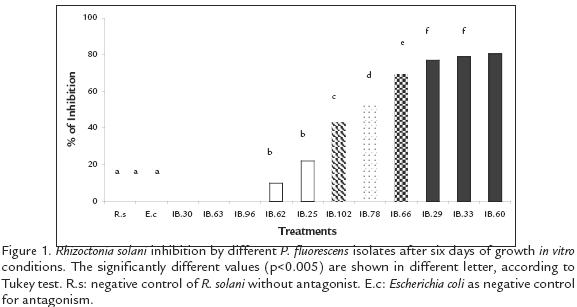
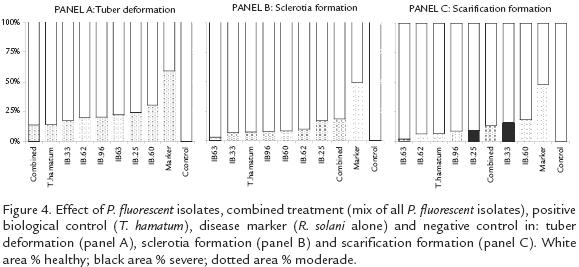
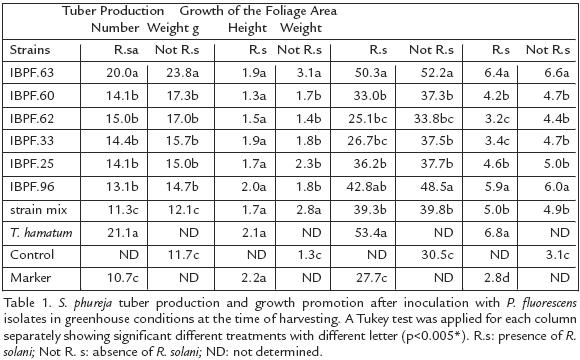
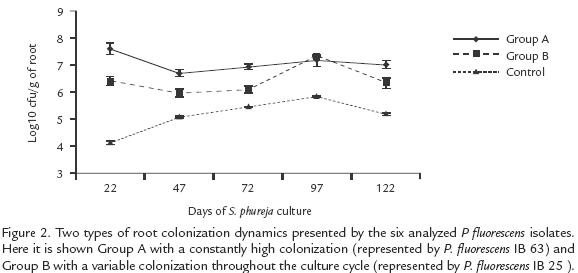
<body><![CDATA[<p   align="justify" ><b><I>Pseudomona</I><I>s </I><I>fluorescen</I><I>s </I>ANTAGONIST EFFECTIVITY AGAINST <I>R. solani in vitr</I><I>o </I></b></p >     <P   align="justify" >Eight of the eleven <I>P. fluorescen</I><I>s </I>strains evaluated, inhibited <I>in vitr</I><I>o </I>growth of <I>R. solan</I><I>i </I>(p=0.005*); the most significant inhibition occurred with the strains IBPf.29, IBPf.33 and IBPf.60 (77,8 and 80 % respectively). Then, there were five more strains with a moderate activity showing from 10% to 69% of growth inhibition and finally three more strains with none activity against <I>R. solan</I><I>i </I>showing a similar pattern that the negative control (<I>E. coli</I>;<a href="#figura1"> Fig. 1</a>). From the eleven strains, six were chosen to be evaluated in terms of colonization capacity, plant growth promotion and antagonism against <I>R. solan</I><I>i </I>in greenhouse conditions. Two of those strains presented none (IBPf.63, IBPf.96), two moderate (IBPf.25, IBPf. 62) and two high (IBPf.33, IBPf.60) antagonistic activity <I>in vitr</I><I>o </I>conditions against <I>R. solani</I>. </P ><a name="figura1"></a><img src="/img/revistas/abc/v12n1/v12n1a2f1.JPG" >     <P   align="justify" ><b>ROOT COLONIZATION DYNAMIC IN <I>S. phurej</I><I>a </I>BY <I>P. fluorescen</I><I>s </I>ISOLATES </b></P >     <P   align="justify" > <I>Pseudomona</I><I>s </I>fluorescens strains presented two main patterns in the dynamic of root colonization. In the first group from the seedling formation (day 22), up to the end (day 122), the cfu remained similar. Strains IBPf.33, IBPf.62 and IBPf.63 belong to this group represented by Group A (<a href="#figura2">Fig. 2</a>). The second pattern typified by Group B (<a href="#figura2">Fig. 2</a>), was featured by oscillations in the cfu throughout the potato culture cycle. The isolates of this group started with an intermediate cfu in the root system during the seedling formation. Then it was followed by a decrease in the fluorescent <I>Pseudomona</I><I>s </I>population during flowering and tuber formation (days 47 and 72 respectively in <a href="#figura2">Fig. 2</a>), followed by an increase in cfu during tuber swelling (day 97) and ending in a decrease in cfu at harvesting time (day 122). Isolates IBPf.25, IBPf.60 and IBPf.96 belong to this group. </P ><a name="figura2"></a><img src="/img/revistas/abc/v12n1/v12n1a2f2.JPG" >     <P   align="justify" ><b><I>Pseudomona</I><I>s </I><I>fluorescen</I><I>s </I>ROOT COLONIZATION IN THE PRESENCE AND ABSENCE OF <I>R. solan</I><I>i </I></b></P >     <P   align="justify" > At the time of harvesting (day 122), all isolates presented higher cfu g<Sup>1 </Sup>of root in the presence of <I>R. solan</I><I>i </I>compared to the treatments without the pathogen (p=0.05*). The combined treatment showed a colonization pattern different to that expressed by the other treatments. It was best in absence of the pathogen, surpassing other treatments by at least 0.5 logarithmic units, whilst colonization diminished in the presence of the pathogen by 1.4 logarithmic units, placing it amongst those treatments having the least colonizing effect (<a href="#figura3">Fig. 3</a>). Statistically significant differences were found between isolates in terms of root colonization. In the presence and absence of <I>R. solani</I>, the IBPf.33 and IBPf.63 isolates presented the greatest root colonization, surpassing other isolates by a range of 0.5 to 1.5 logarithmic units. </P ><a name="figura3"></a><img src="/img/revistas/abc/v12n1/v12n1a2f3.JPG" >     <P   align="justify" ><b><I>Pseudomona</I><I>s </I><I>fluorescen</I><I>s </I>ANTAGONIST EFFECTIVITY AGAINST <I>R. solan</I><I>i </I>IN GREENHOUSE CONDITIONS </b></P >     <P   align="justify" > All tested strains of <I>P. fluorescens </I>significantly reduced (p=0.0001*) the severity of the disease in the plants grown in greenhouse conditions. The tubers collected from all the plants inoculated with <I>Pseudomona</I><I>s </I>isolates presented at least 50% less incidence in all the symptoms at the moderate level (<a href="#figura4">Fig. 4</a>). <I>Pseudomona</I><I>s </I><I>fluorescen</I><I>s </I>application also prevented severe levels of disease by comparison with the disease marker, in which severe deformation, sclerotia and scarification were produced in 9.03%, 9.34% and 6.54% of the tubers respectively. In the same way, <I>T. hamatu</I><I>m </I>T21 application significantly reduced the symptoms of the disease and did not allow severe levels to be expressed (<a href="#figura4">Fig. 4</a>). </P ><a name="figura4"></a><img src="/img/revistas/abc/v12n1/v12n1a2f4.JPG" >     <p   align="justify" ><b>TUBER YIELD IN THE PRESENCE AND ABSENCE OF <I>R. solan</I><I>i </I></b></p >     <P   align="justify" > <I>Pseudomonas fluorescen</I><I>s </I>inoculation into <I>S. phurej</I><I>a </I>plants in the absence of the pathogen, increased tuber number and weight significantly in comparison with the untreated control and the disease marker (<a href="#tabla1">Table 1</a>). The IBPf.63 <I>P</I><I>. </I><I>fluorescen</I><I>s </I>strain and <I>T. hamatu</I><I>m </I>T21 positive control presented the greatest yield increase, with around two fold in comparison with both, the untreated control and the disease marker. The other strains although had lower tuber production increases (between 25% and 48%) and tuber weight gain (between 11% and 74%), were significantly greater than the control. It is important to mention that despite the differences in tuber number and weight between strains, the presence of <I>R. solan</I><I>i </I>did not affect those values within treatments (p=0.077). In the presence of the pathogen, the inoculation of <I>P. fluorescen</I><I>s </I>and <I>T</I><I>. </I><I>hamatu</I><I>m </I>T21, avoid the development of deformed small or large tubers, which were present in the disease marker (results not shown). This probably explains why a similar weight value in the disease marker, to that reached by tubers exposed to the <I>Pseudomona</I><I>s </I>strains (p=0.506), was obtained. </P ><a name="tabla1"></a><img src="/img/revistas/abc/v12n1/v12n1a2t1.JPG" >     ]]></body>
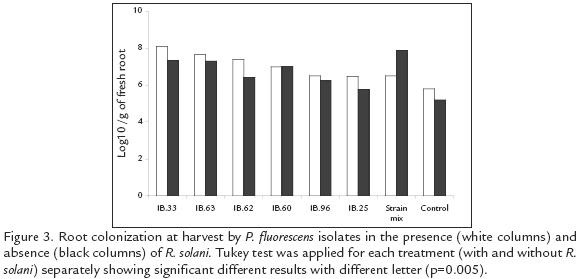
<body><![CDATA[<p   align="justify" ><b><I>Solanum phurej</I><I>a </I>GROWTH PROMOTION DUE TO THE ACTION OF <I>P. fluorescen</I><I>s </I></b></p >     <P   align="justify" > The height of the plants inoculated with <I>P</I><I>. </I><I>fluorescen</I><I>s </I>was superior to that obtained by control plants (noninoculated) from day 72 onwards (results not shown). In the last stage of the cycle (day 122), <I>P. fluorescen</I><I>s </I>inoculants produced an increase in height of at least 11% and 40% in dry weight, in relation to the control. The isolates IBPF.63 and IBPF.96 produced the greatest increases, equivalent to 71% and 59% in height and 110% and 90% in dry weight, respectively (p=0.0001; <a href="#tabla1">Table 1</a>). The growth promotion of the foliar area in the presence of the pathogen was also shown by the isolates IBPf.63 and IBPf.96 with increases of 128% and 106% in dry weight and 82% and 55% in plant height respectively. Those values were statistically different from the disease marker (2.77 g and 27.67 cm for weight and height, respectively). </P >      <p   align="left" ><B>DISCUSSION </b></p >     <P   align="justify" >One of the major goals in the study of soil microorganisms is to identify and manipulat</b>e natural microbial communities in the rhizosphere. In order to advance in this direction more studies need to be done in the structure and dynamics of microbial populations in the rhizosphere of plants (Nautiyal, 1997). With this idea in mind, our group started a research to identify the more representative species of fluorescent <I>Pseudomona</I><I>s </I>in the potato rhizosphere, in order to improve the chances of selecting the most successfully established bacteria of this type, for the <I>S. phurej</I><I>a </I>rhizosphere (Uribe <I>et al.</I>, 1999). We found <I>P</I><I>. </I><I>fluorescen</I><I>s </I>was the dominant species in the rhizosphere and rhizoplane of both <I>S.</I><I> tuberosum</I><I>and </I><I>S. phurej</I><I>a </I>(Uribe <I>et al.</I>, 1999). This finding allow us to design the current study where six strains of <I>P</I><I>. </I><I>fluorescen</I><I>s </I>were selected to identify their capacity of reduction of <I>R. solan</I><I>i </I>symptoms and the growth promotion in <I>S. phurej</I><I>a </I>plants. Despite of the lack of correlation between results of <I>in vitr</I><I>o </I>and <i>in vivo</i> antibiosis of fluorescent <I>Pseudomona</I><I>s </I>against several soilborne pathogenic fungi (Wei <I>et al.</I><I>, </I>1991; Reddy </I><I>et al.</I><I>, </I>1994</I><I>; </I>Bagnasco <I>et al.</I><I>, </I>1998), the <i>in vitro</i> antagonistic capacity of these bacteria has been continuously selected for screening purposes (Howell and Stipanovic, 1979; Mao <I>et al.</I><I>, </I>1991; Wei </I><I>et al.</I><I>, </I>1991; Reddy <I>et al.</I><I>, </I>1994; Nautiyal, 1997; Mazzola, 1998; Nandakumar <I>et al.</I>, 2001; Berg <I>et al.</I><I>, </I>2002). The success of that strategy for the prediction of antagonistic activity against <I>R. solan</I><I>i </I>in the rhizosphere of <I>S. phureja</I><I>, </I>was evaluated by application of <I>P</I><I>. </I><I>fluorescen</I><I>s </I>strains with none, moderate and high activity against <I>R. solan</I><I>i </I>under <I>in vitr</I><I>o </I>condition. No correlation of <I>in vitr</I><I>o </I>antibiosis with growth promotion or disease suppression under greenhouse condition was found. However, statistically significant correlation was found between colonization capacity and plant growth promotion (r2:77) and disease suppression (tuber deformation; sclerotia and scarfication formation reduction with r2:0.84, r2:0.89 and r2:0.81 respectively). These results suggest that the association of <I>P. fluorescen</I><I>s </I>isolates with the <I>S. phurej</I><I>a </I>rhizosphere and its antagonistic capacity against <I>R. solani</I>, is determined by the colonization capacity of the bacteria, more than the production of active compound against a pathogenic agent. The results obtained in this study show that <I>P. fluorescen</I><I>s </I>acts as a plant growth promoter of <I>S. phurej</I><I>a </I>by reducing the disease symptoms caused by <I>R. solani</I>, and increasing tuber production, plant weight and plant height. Although similar results have been reported for the related species <I>S. tuberosu</I><I>m </I>using <I>P. fluorescen</I><I>s </I>(Kloepper <I>et al.</I>, 1980; Burr <I>et al.</I>, 1978), this is to our knowledge, the first report of these kind of results for the Colombian native potato <I>S. phureja</I>. The dynamics of root colonization of six <I>P</I><I>. </I>fluorescen<I>s </I>isolates is presented here to understand the effect of this bacterium on <I>S</I><I>. </I>phurej<I>a </I>(<a href="#figura2">Fig. 2</a>). The population density obtained for each isolate varies differently throughout the crop cycle. Such variation is related with the phenologic changes of the plant as it is deduced from the relation between the tuber swelling phase (day 97), and the increase shown by the cfu of all <I>Pseudomona</I><I>s </I>isolates. However, the variations found overall crop cycle between the different strains shows that the association dynamic is a strain specific phenomenon, which is not well understood within the current body of knowledge (Burr <I>et al.</I>, 1978; Kloeper <I>et al.</I>, 1980; Loper <I>et al.</I>, 1984a; Mao <I>et al.</I>,1991, Nautiyal 1997). </P >     <P   align="justify" >Populations of the rifampicin resistant <I>Pseudomona</I><I>s </I>for all the treatments (except the isolate IBPf.60 and the combined treatment), were greater on potato rhizosphere infected with <I>R. solan</I><I>i </I>than on roots without the pathogen (<a href="#figura3">Fig. 3</a>). This effect probably resulted from the increased availability of root exudates released through lesions incited by the root pathogen (Mazzola, 1998). Despite of the <I>R. solan</I><I>i </I>establishment, the increase of tuber production in all plants inoculated with a single strain and the increase of plant weight induced by all except IBPf33 and IBPf25 isolates, was not affected by the presence of the pathogen. The lower population obtained by the combined treatment in presence of the pathogen, suggests a decrease in the colonization capacity of the strain mix under these conditions. That effect was probably due to the expression of different antagonistic compounds by some or each isolates, affecting the colonization of the artificial community. Such compounds usually provides a selective advantage over rhizosphere colonist, even if they are from the same or related species (Mazzola <I>et al.</I>, 1992; Raaijmakers <I>et al.</I>, 1995; Mazzola, 1998). The above mentioned results also explain why the mixture of <I>P. fluorescen</I><I>s </I>strains tested in this study was not superior in diminishing the severity of the <I>R. solan</I><I>i </I>symptoms, in comparison to the results obtained for each strain alone. Other studies using combinations of fluorescent <I>Pseudomona</I><I>s </I>have revealed the benefits of that strategy to provide greater control of different plant pests (Weller and Cook 1983; Pierson and Weller, 1994; Sindhu <I>et al.</I>, 2002). This suggests to us, that other combinations of the evaluated <I>Pseudomona</I><I>s </I>strains or even some strains with <I>T. hamatu</I><I>m </I>T21 isolate, can improve the results obtained in this study. Other strain combinations should improve results by expanding the espectrum of antifungal metabolites or mechanisms beyond those produced by <I>P</I><I>. </I>fluorescens. Nevertheless, compatibility between these agents must first be evaluated (Mazzola, 1998). </P >     <p   align="left" ><B>CONCLUSIONS </b></p >     <P   align="justify" > The results presented through this manuscript suggested that the utilization of <I>P</I></b><I>. </I><I>fluorescen</I><I>s </I>for the control of <I>R. solan</I><I>i </I>is a promising strategy for the management of the disease in field conditions. This affirmation is supported by the fact that all tested <I>P</I><I>. </I><I>fluorescen</I><I>s </I>isolates, reduced the disease severity on the plants. Such reduction was evident due to the decrease in the number of affected tubers with deformation, decrease in the number of sclerotium formation and de abolishment of the presence of severe symptoms on the plant. </P >     <P   align="justify" >Under the conditions tested, the isolates IBUNPf 063 and IBUNPf 033 can be considered for a next level of evaluation as a promising isolate due to its good performance in terms of colonization, plant growth promotion and the reduction of the <I>R. solan</I><I>i </I>disease symptoms. </P >     <p   align="left" ><B>ACKNOWLEDMENTS </b></p >     <P   align="justify" > We thank COLCIENCIAS for its economical support for the development of this project</b>; the Microbiology M.Sc. Program, the Facultad de Agronom&iacute;a, The Instituto de Biotecnolog&iacute;a, Universidad Nacional de Colombia, Sede Bogot&aacute;, for its technical and institutional support; Dr. Carlos &Ntilde;ustes (Facultad de Agronom&iacute;a, Universidad Nacional de Colombia, Sede Bogot&aacute;) for providing the <I>S. phurej</I><I>a </I>&ldquo;clone one&rdquo; seed and Dr. G. Khachatourians (Department of Applied Microbiology, University of Saskatchewan, Saskatoon, Canada) for his helpful comments and critical review of the manuscript. </P >     ]]></body>
<body><![CDATA[<p   align="left" ><B>REFERENCES </b></p >     <!-- ref --><P   align="justify" > BAGNASCO P, DE LA FUENTE L, GUALTIERI G, NOYA F, ARIAS A. Fluorescen</b>t <I>Pseudonoma</I><I>s </I>spp. As a Biocontrol Agents Against Forage Legume Root Pathogenic Fungi. Soil Biol Biochem. 1998;30:13171322. </P >    &nbsp;&nbsp;&nbsp;&nbsp;&nbsp;&nbsp;&nbsp;&nbsp;[&#160;<a href="javascript:void(0);" onclick="javascript: window.open('/scielo.php?script=sci_nlinks&ref=000054&pid=S0120-548X200700010000200001&lng=','','width=640,height=500,resizable=yes,scrollbars=1,menubar=yes,');">Links</a>&#160;]<!-- end-ref --><!-- ref --><P   align="justify" >BAHME JB, SCHROTH MN. Spatial Temporal Colonization Patterns of a Rhizobacterium on Underground Organs of Potato. Phytophatology. 1987;77:10931100. </P >    &nbsp;&nbsp;&nbsp;&nbsp;&nbsp;&nbsp;&nbsp;&nbsp;[&#160;<a href="javascript:void(0);" onclick="javascript: window.open('/scielo.php?script=sci_nlinks&ref=000055&pid=S0120-548X200700010000200002&lng=','','width=640,height=500,resizable=yes,scrollbars=1,menubar=yes,');">Links</a>&#160;]<!-- end-ref --><!-- ref --><P   align="justify" >BENHAMOU N, B&Eacute;LANGER RL, TIMOTHY CP. Induction of Differential Host Responses by <I>P. fluorescen</I><I>s </I>in T DNA Transformed Pea Roots After Challenge with <I>F</I><I>. </I><I>oxysporum </I>f. sp. pisi and <I>Pythium ultimum</I>. Phytopathology. 1996;86:11741185. </P >    &nbsp;&nbsp;&nbsp;&nbsp;&nbsp;&nbsp;&nbsp;&nbsp;[&#160;<a href="javascript:void(0);" onclick="javascript: window.open('/scielo.php?script=sci_nlinks&ref=000056&pid=S0120-548X200700010000200003&lng=','','width=640,height=500,resizable=yes,scrollbars=1,menubar=yes,');">Links</a>&#160;]<!-- end-ref --><!-- ref --><P   align="justify" >BERG G, ROSKOT N, STEIDLE A, EBERL L, ZOCK A, SMALLA K. Plant Dependent Genotypic and Phenotypic Diversity of Antagonistic Rhizobacteria Isolated from Different Verticillium Host Plant. Appl Environ Microbiol. 2002;68:33283338. </P >    &nbsp;&nbsp;&nbsp;&nbsp;&nbsp;&nbsp;&nbsp;&nbsp;[&#160;<a href="javascript:void(0);" onclick="javascript: window.open('/scielo.php?script=sci_nlinks&ref=000057&pid=S0120-548X200700010000200004&lng=','','width=640,height=500,resizable=yes,scrollbars=1,menubar=yes,');">Links</a>&#160;]<!-- end-ref --><!-- ref --><P   align="justify" >BURR TJ, SCHROTH MN, SUSLOW T. Increased Potato Yields by Treatment of SeedPieces with Specific Strains of <I>Pseudomona</I><I>s </I>Fluorescens and <I>P. putida</I><I>. </I>Phytopathology. 1978;68:13771383. </P >    &nbsp;&nbsp;&nbsp;&nbsp;&nbsp;&nbsp;&nbsp;&nbsp;[&#160;<a href="javascript:void(0);" onclick="javascript: window.open('/scielo.php?script=sci_nlinks&ref=000058&pid=S0120-548X200700010000200005&lng=','','width=640,height=500,resizable=yes,scrollbars=1,menubar=yes,');">Links</a>&#160;]<!-- end-ref --><!-- ref --><P   align="justify" >CARRUTHERS FL, CONNER AJ, MAHANTY HK. Identification of a Genetic Locus in <I>P. aureofacien</I><I>s </I>Involved in Fungal Inhibition. Appl Environ Microbiol. 1994;60:7177. </P >    &nbsp;&nbsp;&nbsp;&nbsp;&nbsp;&nbsp;&nbsp;&nbsp;[&#160;<a href="javascript:void(0);" onclick="javascript: window.open('/scielo.php?script=sci_nlinks&ref=000059&pid=S0120-548X200700010000200006&lng=','','width=640,height=500,resizable=yes,scrollbars=1,menubar=yes,');">Links</a>&#160;]<!-- end-ref --><!-- ref --><P   align="justify" >DE FREITAS JR, GERMIDA JJ. <I>Pseudomonas cepaci</I><I>a </I>and <I>Pseudomona</I><I>s </I><I>putid</I><I>a </I>as Winter Wheat Inoculants for Biocontrol of <I>Rhizoctonia solani</I><I>. </I>Can J Microbiol. 1991;37:780784. </P >    &nbsp;&nbsp;&nbsp;&nbsp;&nbsp;&nbsp;&nbsp;&nbsp;[&#160;<a href="javascript:void(0);" onclick="javascript: window.open('/scielo.php?script=sci_nlinks&ref=000060&pid=S0120-548X200700010000200007&lng=','','width=640,height=500,resizable=yes,scrollbars=1,menubar=yes,');">Links</a>&#160;]<!-- end-ref --><!-- ref --><P   align="justify" >DELGADO MC, VARGAS M. Grupos de anastomosis del fungi <I>Rhizoctonia solan</I><I>i </I>(Kuhn) y su reacci&oacute;n en materiales de papa con diversos grados de resistencia [posgraduate Thesis] Bogot&aacute;: Universidad Distrital Francisco Jos&eacute; de Caldas; 1989. </P >    &nbsp;&nbsp;&nbsp;&nbsp;&nbsp;&nbsp;&nbsp;&nbsp;[&#160;<a href="javascript:void(0);" onclick="javascript: window.open('/scielo.php?script=sci_nlinks&ref=000061&pid=S0120-548X200700010000200008&lng=','','width=640,height=500,resizable=yes,scrollbars=1,menubar=yes,');">Links</a>&#160;]<!-- end-ref --><!-- ref --><P   align="justify" >GAMALERO E, FRACCHIA L, CAVALETTO M, GARVAYE J, FREYKLETT P, VARESE GC, MARTINOTTI MG. Characterization of Functional Traits of Two Fluorescent Pseudomonads Isolated from Basidiomes of Ectomycorrhizal Fungi. Soil Biol Biochem. 2003;35:5565. </P >    &nbsp;&nbsp;&nbsp;&nbsp;&nbsp;&nbsp;&nbsp;&nbsp;[&#160;<a href="javascript:void(0);" onclick="javascript: window.open('/scielo.php?script=sci_nlinks&ref=000062&pid=S0120-548X200700010000200009&lng=','','width=640,height=500,resizable=yes,scrollbars=1,menubar=yes,');">Links</a>&#160;]<!-- end-ref --><!-- ref --><P   align="justify" >GHERNA J. Storage and Survival of Bacteria by UltraFree. Lett Appl Microbiol. 1986;3:127129. </P >    &nbsp;&nbsp;&nbsp;&nbsp;&nbsp;&nbsp;&nbsp;&nbsp;[&#160;<a href="javascript:void(0);" onclick="javascript: window.open('/scielo.php?script=sci_nlinks&ref=000063&pid=S0120-548X200700010000200010&lng=','','width=640,height=500,resizable=yes,scrollbars=1,menubar=yes,');">Links</a>&#160;]<!-- end-ref --><!-- ref --><P   align="justify" >HAMMER PE, HILL DS, LAM ST, PEE KHVAN, LIGON JM. Four Genes from <I>Pseudomonas fluorescen</I><I>s </I>that Encode the Biosynthesis of Pyrrolnitrin. Appl Environ Microbiol. 1997; 63:21472154. </P >    &nbsp;&nbsp;&nbsp;&nbsp;&nbsp;&nbsp;&nbsp;&nbsp;[&#160;<a href="javascript:void(0);" onclick="javascript: window.open('/scielo.php?script=sci_nlinks&ref=000064&pid=S0120-548X200700010000200011&lng=','','width=640,height=500,resizable=yes,scrollbars=1,menubar=yes,');">Links</a>&#160;]<!-- end-ref --><!-- ref --><P   align="justify" >HOWELL CR, STIPANOVIC RD. Control of <I>Rhizoctonia solan</I><I>i </I>on Cotton Seedlings with <I>Pseudomona</I><I>s </I><I>fluorescen</I><I>s </I>and with an Antibiotic Produced by the Bacterium. Phytopathology. 1979; 69:480482. </P >    &nbsp;&nbsp;&nbsp;&nbsp;&nbsp;&nbsp;&nbsp;&nbsp;[&#160;<a href="javascript:void(0);" onclick="javascript: window.open('/scielo.php?script=sci_nlinks&ref=000065&pid=S0120-548X200700010000200012&lng=','','width=640,height=500,resizable=yes,scrollbars=1,menubar=yes,');">Links</a>&#160;]<!-- end-ref --><!-- ref --><P   align="justify" >KLOEPPER JW, SCHROTH MN, MILLER TD. Effects of Rhizosphere Colonization by Plant Growth Promotion Rhizobacteria on Potato Plant Development and Yield. Phytopathology. 1980;70:10781082. </P >    &nbsp;&nbsp;&nbsp;&nbsp;&nbsp;&nbsp;&nbsp;&nbsp;[&#160;<a href="javascript:void(0);" onclick="javascript: window.open('/scielo.php?script=sci_nlinks&ref=000066&pid=S0120-548X200700010000200013&lng=','','width=640,height=500,resizable=yes,scrollbars=1,menubar=yes,');">Links</a>&#160;]<!-- end-ref --><!-- ref --><P   align="justify" >KRECHEL A, FAUPEL A, HALLMANN J, ULRICH A, BERG G. PotatoAssociated Bacteria and their Antagonistic Potential Towards PlantPathogenic Fungi and the PlantParasitic Nematode <I>Meloidogyne incognit</I><I>a </I>(Kofoid and Whithe) Chitwood. Can J Microbiol. 2002;48:772786. </P >    &nbsp;&nbsp;&nbsp;&nbsp;&nbsp;&nbsp;&nbsp;&nbsp;[&#160;<a href="javascript:void(0);" onclick="javascript: window.open('/scielo.php?script=sci_nlinks&ref=000067&pid=S0120-548X200700010000200014&lng=','','width=640,height=500,resizable=yes,scrollbars=1,menubar=yes,');">Links</a>&#160;]<!-- end-ref --><!-- ref --><P   align="justify" >LATOUR X, CORBERAND T, LAGUERRE G, ALLARD F, LEMANCEAU P. The Composition of Fluorescent Pseudomonad Populations Associated with Roots is Influenced by Plant and Soil Type. Appl Environ Microbiol. 1996;62:24492456. </P >    &nbsp;&nbsp;&nbsp;&nbsp;&nbsp;&nbsp;&nbsp;&nbsp;[&#160;<a href="javascript:void(0);" onclick="javascript: window.open('/scielo.php?script=sci_nlinks&ref=000068&pid=S0120-548X200700010000200015&lng=','','width=640,height=500,resizable=yes,scrollbars=1,menubar=yes,');">Links</a>&#160;]<!-- end-ref --><!-- ref --><P   align="justify" >LEAL ME, PLATA BY. Evaluaci&oacute;n de cepas nativas de <I>Trichoderma </I>spp. en el control de <I>Rhizoctonia solan</I><I>i </I>Kuhn en fr&iacute;jol (<I>Phaseolus vulgari</I><I>s </I>L) [Masters Thesis] Bogot&aacute;: Facultad de Agronom&iacute;a, Universidad Nacional de Colombia; 1996. </P >    &nbsp;&nbsp;&nbsp;&nbsp;&nbsp;&nbsp;&nbsp;&nbsp;[&#160;<a href="javascript:void(0);" onclick="javascript: window.open('/scielo.php?script=sci_nlinks&ref=000069&pid=S0120-548X200700010000200016&lng=','','width=640,height=500,resizable=yes,scrollbars=1,menubar=yes,');">Links</a>&#160;]<!-- end-ref --><!-- ref --><P   align="justify" >LEMANCEAU P, CORBERAND T, LATOUR X, LAGUERRE G, BOEUFGRA JM, ALABOUVETTE C. Effect of Two Plant Species, Flax and Tomato, on the Diversity of SoilBorn Populations of Fluorescent Pseudomonads. Appl Environ Microbiol. 1995;61:10041012. </P >    &nbsp;&nbsp;&nbsp;&nbsp;&nbsp;&nbsp;&nbsp;&nbsp;[&#160;<a href="javascript:void(0);" onclick="javascript: window.open('/scielo.php?script=sci_nlinks&ref=000070&pid=S0120-548X200700010000200017&lng=','','width=640,height=500,resizable=yes,scrollbars=1,menubar=yes,');">Links</a>&#160;]<!-- end-ref --><!-- ref --><P   align="justify" >MAO W, LEWIS JA, HEBBAR PK, LUMSDEN RD. Seed Treatment with a Fungal or a Bacterial Antagonist for Reducing Corn DampingOff Caused by Species of <I>Phytiu</I><I>m </I>and <I>Fusarium</I><I>. </I>Plant Dis. 1991;81:450454. </P >    &nbsp;&nbsp;&nbsp;&nbsp;&nbsp;&nbsp;&nbsp;&nbsp;[&#160;<a href="javascript:void(0);" onclick="javascript: window.open('/scielo.php?script=sci_nlinks&ref=000071&pid=S0120-548X200700010000200018&lng=','','width=640,height=500,resizable=yes,scrollbars=1,menubar=yes,');">Links</a>&#160;]<!-- end-ref --><!-- ref --><P   align="justify" >MAZZOLA M, COOK RJ, THOMASHOW LS, WELLER DM, PIERSON III LS. Contribution of Phenazine Antibiotic Biosynthesis to the Ecological Competence of Fluorescent Pseudomonads in Soil Habitats. Appl Environ Microbiol. 1992;58:26162624. </P >    &nbsp;&nbsp;&nbsp;&nbsp;&nbsp;&nbsp;&nbsp;&nbsp;[&#160;<a href="javascript:void(0);" onclick="javascript: window.open('/scielo.php?script=sci_nlinks&ref=000072&pid=S0120-548X200700010000200019&lng=','','width=640,height=500,resizable=yes,scrollbars=1,menubar=yes,');">Links</a>&#160;]<!-- end-ref --><!-- ref --><P   align="justify" >MAZZOLA M. The Potential of Natural and Genetically Engineered Fluorescent <I>Pseudomona</I><I>s </I>spp. as Biological Control Agents. In. Microbial Interactions in Agriculture and Forestry. Volume I. Ed. Subba Rao N.S and Dommergues, Y.R. Science Publishers, Inc. Enfield, N.H. USA. 1998. p. 193217. </P >    &nbsp;&nbsp;&nbsp;&nbsp;&nbsp;&nbsp;&nbsp;&nbsp;[&#160;<a href="javascript:void(0);" onclick="javascript: window.open('/scielo.php?script=sci_nlinks&ref=000073&pid=S0120-548X200700010000200020&lng=','','width=640,height=500,resizable=yes,scrollbars=1,menubar=yes,');">Links</a>&#160;]<!-- end-ref --><!-- ref --><P   align="justify" >NANDAKUMAR R, BABU S, VISWANATHAN R, RAGUCHANDER T, SAMIYAPPAN R. Induction of Systemic Resistance in Rice Against Sheath Blight Disease by <I>Pseudomonas fluorescens</I><I>. </I>Soil Biol Biochem. 2001;23:603612. </P >    &nbsp;&nbsp;&nbsp;&nbsp;&nbsp;&nbsp;&nbsp;&nbsp;[&#160;<a href="javascript:void(0);" onclick="javascript: window.open('/scielo.php?script=sci_nlinks&ref=000074&pid=S0120-548X200700010000200021&lng=','','width=640,height=500,resizable=yes,scrollbars=1,menubar=yes,');">Links</a>&#160;]<!-- end-ref --><!-- ref --><P   align="justify" >NAUTIYAL CS. Rhizosphere Competence of <I>Pseudomona</I><I>s </I>sp. NBRI9926 and Rhizobiumsp. NBRI9513 Involved in the Suppression of Chickpea (<I>Cicer arietinu</I><I>m </I>L.) pathogenic fungi. FEMS Microbiol Ecol. 1997;23:145158. </P >    &nbsp;&nbsp;&nbsp;&nbsp;&nbsp;&nbsp;&nbsp;&nbsp;[&#160;<a href="javascript:void(0);" onclick="javascript: window.open('/scielo.php?script=sci_nlinks&ref=000075&pid=S0120-548X200700010000200022&lng=','','width=640,height=500,resizable=yes,scrollbars=1,menubar=yes,');">Links</a>&#160;]<!-- end-ref --><!-- ref --><P   align="justify" >NIELSEN TH, CHRISTOPHER C, ANTHONI U, S&Oslash;RENSEN J. Viscosamide, a New Cyclic Depsipeptide with Surfactant and AntiFungal Properties Produced by <I>Pseudomonas fluorescens </I>DR54. J Appl Microbiol. 1999;87:8090. </P >    &nbsp;&nbsp;&nbsp;&nbsp;&nbsp;&nbsp;&nbsp;&nbsp;[&#160;<a href="javascript:void(0);" onclick="javascript: window.open('/scielo.php?script=sci_nlinks&ref=000076&pid=S0120-548X200700010000200023&lng=','','width=640,height=500,resizable=yes,scrollbars=1,menubar=yes,');">Links</a>&#160;]<!-- end-ref --><!-- ref --><P   align="justify" >NIELSEN TH, S&Oslash;RENSEN D, TOBIASEN C, ANDERSEN JB, CHRISTOPHERSEN C, GIVSKOV M, S&Oslash;RENSEN J. Antibiotic and Biosurfactant Properties of Cyclic Lipopeptides Produced by Fluorescent <I>Pseudomona</I><I>s </I>spp. from the Sugar Beet Rhizosphere. Appl Environ Microbiol. 2002;68:34163423. </P >    &nbsp;&nbsp;&nbsp;&nbsp;&nbsp;&nbsp;&nbsp;&nbsp;[&#160;<a href="javascript:void(0);" onclick="javascript: window.open('/scielo.php?script=sci_nlinks&ref=000077&pid=S0120-548X200700010000200024&lng=','','width=640,height=500,resizable=yes,scrollbars=1,menubar=yes,');">Links</a>&#160;]<!-- end-ref --><!-- ref --><P   align="justify" >PARMAR N, DADARWALL KR. Stimulation of Nitrogen Fixation and Induction of Flavonoid Like Compounds by Rhizobacteria. J Appl Microbiol. 1999;86:3644. </P >    &nbsp;&nbsp;&nbsp;&nbsp;&nbsp;&nbsp;&nbsp;&nbsp;[&#160;<a href="javascript:void(0);" onclick="javascript: window.open('/scielo.php?script=sci_nlinks&ref=000078&pid=S0120-548X200700010000200025&lng=','','width=640,height=500,resizable=yes,scrollbars=1,menubar=yes,');">Links</a>&#160;]<!-- end-ref --><!-- ref --><P   align="justify" >PIERSON EA, WELLER DM. Use of Mixtures of Fluorescent Pseudomonads to Suppress TakeAll and Improve the Growth of Wheat. Phytopathology. 1994;84:940947. </P >    &nbsp;&nbsp;&nbsp;&nbsp;&nbsp;&nbsp;&nbsp;&nbsp;[&#160;<a href="javascript:void(0);" onclick="javascript: window.open('/scielo.php?script=sci_nlinks&ref=000079&pid=S0120-548X200700010000200026&lng=','','width=640,height=500,resizable=yes,scrollbars=1,menubar=yes,');">Links</a>&#160;]<!-- end-ref --><!-- ref --><P   align="justify" >POPLAWSKY AR, ELLINGBOE AH. TakeAll Suppressive Properties of Bacterial Mutants Affected in Antibiosis. Phytopathology. 1989;79:143146. </P >    &nbsp;&nbsp;&nbsp;&nbsp;&nbsp;&nbsp;&nbsp;&nbsp;[&#160;<a href="javascript:void(0);" onclick="javascript: window.open('/scielo.php?script=sci_nlinks&ref=000080&pid=S0120-548X200700010000200027&lng=','','width=640,height=500,resizable=yes,scrollbars=1,menubar=yes,');">Links</a>&#160;]<!-- end-ref --><!-- ref --><P   align="justify" >RAAIJMAKERS JM, I VAN DER SLUIS, MOSTWER M, BAKER PA, SCHIPPERS B. Utilization of Heterologous Siderophores and Rhizosphere Competence of Fluorescent <i>Pseudomona</i><i>s </i>spp. Can J Microbiol. 1995;41:126135. </P >    &nbsp;&nbsp;&nbsp;&nbsp;&nbsp;&nbsp;&nbsp;&nbsp;[&#160;<a href="javascript:void(0);" onclick="javascript: window.open('/scielo.php?script=sci_nlinks&ref=000081&pid=S0120-548X200700010000200028&lng=','','width=640,height=500,resizable=yes,scrollbars=1,menubar=yes,');">Links</a>&#160;]<!-- end-ref --><!-- ref --><P   align="justify" >RAAIJMAKERS JM, WELLER DM, THOMASHOW LS. Frequency of Antibiotics Producing <I>Pseudomona</I><I>s </I>spp. in Natural Environments. Appl Environ Microbiol. 1997;63:881887. </P >    &nbsp;&nbsp;&nbsp;&nbsp;&nbsp;&nbsp;&nbsp;&nbsp;[&#160;<a href="javascript:void(0);" onclick="javascript: window.open('/scielo.php?script=sci_nlinks&ref=000082&pid=S0120-548X200700010000200029&lng=','','width=640,height=500,resizable=yes,scrollbars=1,menubar=yes,');">Links</a>&#160;]<!-- end-ref --><!-- ref --><P   align="justify" >REDDY MS, IN&Eacute;S RK, LAZAROVITS G. Relationship Between <I>in vitr</I><I>o </I>Growth Inhibition of Pathogens and Suppression of Preemergence CampingOff and Postemergence Root Rot of White Bean Seedlings in the Greenhouse by Bacteria. Can J Microbiol. 1994;40:113119. </P >    &nbsp;&nbsp;&nbsp;&nbsp;&nbsp;&nbsp;&nbsp;&nbsp;[&#160;<a href="javascript:void(0);" onclick="javascript: window.open('/scielo.php?script=sci_nlinks&ref=000083&pid=S0120-548X200700010000200030&lng=','','width=640,height=500,resizable=yes,scrollbars=1,menubar=yes,');">Links</a>&#160;]<!-- end-ref --><!-- ref --><P   align="justify" >SANDS DC, HANKIN L. Ecology and Physiology of Fluorescent Pectolytic Pseudomonads [<I>Pseudomonads fluorescens</I><I>, </I><I>Pseudomonas putida</I>, Soft Rot, Plants]. Phytopathology. 1975;65:921924. </P >    &nbsp;&nbsp;&nbsp;&nbsp;&nbsp;&nbsp;&nbsp;&nbsp;[&#160;<a href="javascript:void(0);" onclick="javascript: window.open('/scielo.php?script=sci_nlinks&ref=000084&pid=S0120-548X200700010000200031&lng=','','width=640,height=500,resizable=yes,scrollbars=1,menubar=yes,');">Links</a>&#160;]<!-- end-ref --><P   align="justify" >SAS-Institute. SasStat User&rsquo;s Guide. Aceclusfrq. Version 6. Volume 1. Forth Edition. Cary, North Carolina, USA; 1994. p. 890. </P >     <P   align="justify" >SINDHU SS, SUNEJA S, GOEL AK, PARMAR N, DADARWAL KR. Plant Growth Promoting Effects of <I>Pseudomona</I><I>s </I>sp. on Coinoculation with <I>Mesorhizobiu</I><I>m </I>sp. Cicer Strain Under Sterile and &ldquo;wilt sick&rdquo; Soil Conditions. Appl Soil Ecol. 2002;19:5764. </P >     <!-- ref --><P   align="justify" >SLINNINGER PJ, VAN CAEWENBERGE JE, BOTHAST RJ, WELLER DM, THOMASHOW LS, COOK RJ. Effect of Growth Culture Physiological State, Metabolites and Formulation on the Viability, Phytotoxicity and Efficacy of the TakeAll Biocontrol Agent <I>Pseudomonas fluorescen</I><I>s </I>279 Stored Encapsulated on Wheat Seeds. Appl Microbiol Biotechnol. 1996;45:391398. </P >    &nbsp;&nbsp;&nbsp;&nbsp;&nbsp;&nbsp;&nbsp;&nbsp;[&#160;<a href="javascript:void(0);" onclick="javascript: window.open('/scielo.php?script=sci_nlinks&ref=000087&pid=S0120-548X200700010000200034&lng=','','width=640,height=500,resizable=yes,scrollbars=1,menubar=yes,');">Links</a>&#160;]<!-- end-ref --><!-- ref --><P   align="justify" >SNEH B, BURPEE L, OGOSHI A. Identification of Rhizoctonia Species. Academic Press. New York; 1991. </P >    &nbsp;&nbsp;&nbsp;&nbsp;&nbsp;&nbsp;&nbsp;&nbsp;[&#160;<a href="javascript:void(0);" onclick="javascript: window.open('/scielo.php?script=sci_nlinks&ref=000088&pid=S0120-548X200700010000200035&lng=','','width=640,height=500,resizable=yes,scrollbars=1,menubar=yes,');">Links</a>&#160;]<!-- end-ref --><!-- ref --><P   align="justify" >SUSLOW TV, SCHROTH MN. Rhizobacteria of Sugarbeets: Effects of Seed Application and Root Colonization on Yield Fungal and Bacterial Phytopathogens. Phytopathology. 1982;72:199206. </P >    &nbsp;&nbsp;&nbsp;&nbsp;&nbsp;&nbsp;&nbsp;&nbsp;[&#160;<a href="javascript:void(0);" onclick="javascript: window.open('/scielo.php?script=sci_nlinks&ref=000089&pid=S0120-548X200700010000200036&lng=','','width=640,height=500,resizable=yes,scrollbars=1,menubar=yes,');">Links</a>&#160;]<!-- end-ref --><!-- ref --><P   align="justify" >URIBE D, ORTIZ E, PORTILLO M, BAUTISTA G, CER&Oacute;N J. Diversidad de <I>pseudomonas fluorescente</I><I>s </I>en cultivos de papa de la region cundiboyacense y su actividad antagonista <I>in vitr</I><I>o </I>sobre <I>Rhizoctonia solani</I><I>. </I>Rev Colomb Biotecnol. 1999;2:5058. </P >    &nbsp;&nbsp;&nbsp;&nbsp;&nbsp;&nbsp;&nbsp;&nbsp;[&#160;<a href="javascript:void(0);" onclick="javascript: window.open('/scielo.php?script=sci_nlinks&ref=000090&pid=S0120-548X200700010000200037&lng=','','width=640,height=500,resizable=yes,scrollbars=1,menubar=yes,');">Links</a>&#160;]<!-- end-ref --><!-- ref --><P   align="justify" >VAN PEER R, PUNTE HL, WEGER LA, SCHIPPERS B. Characterization of Root Surface and Endorhizosphere Pseudomonads in Relation to their Colonization of Roots. Appl Environ Microbiol. 1990;56:24622470. </P >    &nbsp;&nbsp;&nbsp;&nbsp;&nbsp;&nbsp;&nbsp;&nbsp;[&#160;<a href="javascript:void(0);" onclick="javascript: window.open('/scielo.php?script=sci_nlinks&ref=000091&pid=S0120-548X200700010000200038&lng=','','width=640,height=500,resizable=yes,scrollbars=1,menubar=yes,');">Links</a>&#160;]<!-- end-ref --><!-- ref --><P   align="justify" >WEI G, KLOEPER JW, TUZUN S. Induction of Systemic Resistance of Cucumber to <I>Colletotrichum orbicular</I><I>e </I>by Select Strains of Plant Growth Promoting Rhizobacteria. Phytopathology. 1991;81:15081512. </P >    &nbsp;&nbsp;&nbsp;&nbsp;&nbsp;&nbsp;&nbsp;&nbsp;[&#160;<a href="javascript:void(0);" onclick="javascript: window.open('/scielo.php?script=sci_nlinks&ref=000092&pid=S0120-548X200700010000200039&lng=','','width=640,height=500,resizable=yes,scrollbars=1,menubar=yes,');">Links</a>&#160;]<!-- end-ref --><!-- ref --><P   align="justify" >WELLER DM, COOK RJ. Suppression of TakeAll of Wheat by Seed Treatments with Fluorescent Pseudomonads. Phytopathology. 1983;78:463469. </P >    &nbsp;&nbsp;&nbsp;&nbsp;&nbsp;&nbsp;&nbsp;&nbsp;[&#160;<a href="javascript:void(0);" onclick="javascript: window.open('/scielo.php?script=sci_nlinks&ref=000093&pid=S0120-548X200700010000200040&lng=','','width=640,height=500,resizable=yes,scrollbars=1,menubar=yes,');">Links</a>&#160;]<!-- end-ref --></body> </HTML>      ]]></body><back>
<ref-list>
<ref id="B1">
<nlm-citation citation-type="journal">
<person-group person-group-type="author">
<name>
<surname><![CDATA[BAGNASCO]]></surname>
<given-names><![CDATA[P]]></given-names>
</name>
<name>
<surname><![CDATA[DE LA FUENTE]]></surname>
<given-names><![CDATA[L]]></given-names>
</name>
<name>
<surname><![CDATA[GUALTIERI]]></surname>
<given-names><![CDATA[G]]></given-names>
</name>
<name>
<surname><![CDATA[NOYA]]></surname>
<given-names><![CDATA[F]]></given-names>
</name>
<name>
<surname><![CDATA[ARIAS]]></surname>
<given-names><![CDATA[A]]></given-names>
</name>
</person-group>
<article-title xml:lang="en"><![CDATA[Fluorescent Pseudonomas spp. As a Biocontrol Agents Against Forage Legume Root Pathogenic Fungi]]></article-title>
<source><![CDATA[Soil Biol Biochem]]></source>
<year>1998</year>
<volume>30</volume>
<page-range>13171322</page-range></nlm-citation>
</ref>
<ref id="B2">
<nlm-citation citation-type="journal">
<person-group person-group-type="author">
<name>
<surname><![CDATA[BAHME]]></surname>
<given-names><![CDATA[JB]]></given-names>
</name>
<name>
<surname><![CDATA[SCHROTH]]></surname>
<given-names><![CDATA[MN]]></given-names>
</name>
</person-group>
<article-title xml:lang="en"><![CDATA[Spatial Temporal Colonization Patterns of a Rhizobacterium on Underground Organs of Potato]]></article-title>
<source><![CDATA[Phytophatology]]></source>
<year>1987</year>
<volume>77</volume>
<page-range>10931100</page-range></nlm-citation>
</ref>
<ref id="B3">
<nlm-citation citation-type="journal">
<person-group person-group-type="author">
<name>
<surname><![CDATA[BENHAMOU]]></surname>
<given-names><![CDATA[N]]></given-names>
</name>
<name>
<surname><![CDATA[BÉLANGER]]></surname>
<given-names><![CDATA[RL]]></given-names>
</name>
<name>
<surname><![CDATA[TIMOTHY]]></surname>
<given-names><![CDATA[CP]]></given-names>
</name>
</person-group>
<article-title xml:lang="en"><![CDATA[Induction of Differential Host Responses by P. fluorescens in T DNA Transformed Pea Roots After Challenge with F. oxysporum f. sp. pisi and Pythium ultimum]]></article-title>
<source><![CDATA[Phytopathology]]></source>
<year>1996</year>
<volume>86</volume>
<page-range>11741185</page-range></nlm-citation>
</ref>
<ref id="B4">
<nlm-citation citation-type="journal">
<person-group person-group-type="author">
<name>
<surname><![CDATA[BERG]]></surname>
<given-names><![CDATA[G]]></given-names>
</name>
<name>
<surname><![CDATA[ROSKOT]]></surname>
<given-names><![CDATA[N]]></given-names>
</name>
<name>
<surname><![CDATA[STEIDLE]]></surname>
<given-names><![CDATA[A]]></given-names>
</name>
<name>
<surname><![CDATA[EBERL]]></surname>
<given-names><![CDATA[L]]></given-names>
</name>
<name>
<surname><![CDATA[ZOCK]]></surname>
<given-names><![CDATA[A]]></given-names>
</name>
<name>
<surname><![CDATA[SMALLA]]></surname>
<given-names><![CDATA[K]]></given-names>
</name>
</person-group>
<article-title xml:lang="en"><![CDATA[Plant Dependent Genotypic and Phenotypic Diversity of Antagonistic Rhizobacteria Isolated from Different Verticillium Host Plant]]></article-title>
<source><![CDATA[Appl Environ Microbiol]]></source>
<year>2002</year>
<volume>68</volume>
<page-range>33283338</page-range></nlm-citation>
</ref>
<ref id="B5">
<nlm-citation citation-type="journal">
<person-group person-group-type="author">
<name>
<surname><![CDATA[BURR]]></surname>
<given-names><![CDATA[TJ]]></given-names>
</name>
<name>
<surname><![CDATA[SCHROTH]]></surname>
<given-names><![CDATA[MN]]></given-names>
</name>
<name>
<surname><![CDATA[SUSLOW]]></surname>
<given-names><![CDATA[T]]></given-names>
</name>
</person-group>
<article-title xml:lang="en"><![CDATA[Increased Potato Yields by Treatment of SeedPieces with Specific Strains of Pseudomonas Fluorescens and P. putida]]></article-title>
<source><![CDATA[Phytopathology]]></source>
<year>1978</year>
<volume>68</volume>
<page-range>13771383</page-range></nlm-citation>
</ref>
<ref id="B6">
<nlm-citation citation-type="journal">
<person-group person-group-type="author">
<name>
<surname><![CDATA[CARRUTHERS]]></surname>
<given-names><![CDATA[FL]]></given-names>
</name>
<name>
<surname><![CDATA[CONNER]]></surname>
<given-names><![CDATA[AJ]]></given-names>
</name>
<name>
<surname><![CDATA[MAHANTY]]></surname>
<given-names><![CDATA[HK]]></given-names>
</name>
</person-group>
<article-title xml:lang="en"><![CDATA[Identification of a Genetic Locus in P. aureofaciens Involved in Fungal Inhibition]]></article-title>
<source><![CDATA[Appl Environ Microbiol]]></source>
<year>1994</year>
<volume>60</volume>
<page-range>7177</page-range></nlm-citation>
</ref>
<ref id="B7">
<nlm-citation citation-type="journal">
<person-group person-group-type="author">
<name>
<surname><![CDATA[DE FREITAS]]></surname>
<given-names><![CDATA[JR]]></given-names>
</name>
<name>
<surname><![CDATA[GERMIDA]]></surname>
<given-names><![CDATA[JJ]]></given-names>
</name>
</person-group>
<article-title xml:lang="en"><![CDATA[Pseudomonas cepacia and Pseudomonas putida as Winter Wheat Inoculants for Biocontrol of Rhizoctonia solani]]></article-title>
<source><![CDATA[Can J Microbiol]]></source>
<year>1991</year>
<volume>37</volume>
<page-range>780784</page-range></nlm-citation>
</ref>
<ref id="B8">
<nlm-citation citation-type="">
<person-group person-group-type="author">
<name>
<surname><![CDATA[DELGADO]]></surname>
<given-names><![CDATA[MC]]></given-names>
</name>
<name>
<surname><![CDATA[VARGAS]]></surname>
<given-names><![CDATA[M]]></given-names>
</name>
</person-group>
<source><![CDATA[Grupos de anastomosis del fungi Rhizoctonia solani (Kuhn) y su reacción en materiales de papa con diversos grados de resistencia]]></source>
<year></year>
</nlm-citation>
</ref>
<ref id="B9">
<nlm-citation citation-type="journal">
<person-group person-group-type="author">
<name>
<surname><![CDATA[GAMALERO]]></surname>
<given-names><![CDATA[E]]></given-names>
</name>
<name>
<surname><![CDATA[FRACCHIA]]></surname>
<given-names><![CDATA[L]]></given-names>
</name>
<name>
<surname><![CDATA[CAVALETTO]]></surname>
<given-names><![CDATA[M]]></given-names>
</name>
<name>
<surname><![CDATA[GARVAYE]]></surname>
<given-names><![CDATA[J]]></given-names>
</name>
<name>
<surname><![CDATA[FREYKLETT]]></surname>
<given-names><![CDATA[P]]></given-names>
</name>
<name>
<surname><![CDATA[VARESE]]></surname>
<given-names><![CDATA[GC]]></given-names>
</name>
<name>
<surname><![CDATA[MARTINOTTI]]></surname>
<given-names><![CDATA[MG]]></given-names>
</name>
</person-group>
<article-title xml:lang="en"><![CDATA[Characterization of Functional Traits of Two Fluorescent Pseudomonads Isolated from Basidiomes of Ectomycorrhizal Fungi]]></article-title>
<source><![CDATA[Soil Biol Biochem]]></source>
<year>2003</year>
<volume>35</volume>
<page-range>5565</page-range></nlm-citation>
</ref>
<ref id="B10">
<nlm-citation citation-type="journal">
<person-group person-group-type="author">
<name>
<surname><![CDATA[GHERNA]]></surname>
<given-names><![CDATA[J]]></given-names>
</name>
</person-group>
<article-title xml:lang="en"><![CDATA[Storage and Survival of Bacteria by UltraFree]]></article-title>
<source><![CDATA[Lett Appl Microbiol]]></source>
<year>1986</year>
<volume>3</volume>
<page-range>127129</page-range></nlm-citation>
</ref>
<ref id="B11">
<nlm-citation citation-type="journal">
<person-group person-group-type="author">
<name>
<surname><![CDATA[HAMMER]]></surname>
<given-names><![CDATA[PE]]></given-names>
</name>
<name>
<surname><![CDATA[HILL]]></surname>
<given-names><![CDATA[DS]]></given-names>
</name>
<name>
<surname><![CDATA[LAM]]></surname>
<given-names><![CDATA[ST]]></given-names>
</name>
<name>
<surname><![CDATA[PEE]]></surname>
<given-names><![CDATA[KHVAN]]></given-names>
</name>
<name>
<surname><![CDATA[LIGON]]></surname>
<given-names><![CDATA[JM]]></given-names>
</name>
</person-group>
<article-title xml:lang="en"><![CDATA[Four Genes from Pseudomonas fluorescens that Encode the Biosynthesis of Pyrrolnitrin]]></article-title>
<source><![CDATA[Appl Environ Microbiol]]></source>
<year>1997</year>
<volume>63</volume>
<page-range>21472154</page-range></nlm-citation>
</ref>
<ref id="B12">
<nlm-citation citation-type="journal">
<person-group person-group-type="author">
<name>
<surname><![CDATA[HOWELL]]></surname>
<given-names><![CDATA[CR]]></given-names>
</name>
<name>
<surname><![CDATA[STIPANOVIC]]></surname>
<given-names><![CDATA[RD]]></given-names>
</name>
</person-group>
<article-title xml:lang="en"><![CDATA[Control of Rhizoctonia solani on Cotton Seedlings with Pseudomonas fluorescens and with an Antibiotic Produced by the Bacterium]]></article-title>
<source><![CDATA[Phytopathology]]></source>
<year>1979</year>
<volume>69</volume>
<page-range>480482</page-range></nlm-citation>
</ref>
<ref id="B13">
<nlm-citation citation-type="journal">
<person-group person-group-type="author">
<name>
<surname><![CDATA[KLOEPPER]]></surname>
<given-names><![CDATA[JW]]></given-names>
</name>
<name>
<surname><![CDATA[SCHROTH]]></surname>
<given-names><![CDATA[MN]]></given-names>
</name>
<name>
<surname><![CDATA[MILLER]]></surname>
<given-names><![CDATA[TD]]></given-names>
</name>
</person-group>
<article-title xml:lang="en"><![CDATA[Effects of Rhizosphere Colonization by Plant Growth Promotion Rhizobacteria on Potato Plant Development and Yield]]></article-title>
<source><![CDATA[Phytopathology]]></source>
<year>1980</year>
<volume>70</volume>
<page-range>10781082</page-range></nlm-citation>
</ref>
<ref id="B14">
<nlm-citation citation-type="journal">
<person-group person-group-type="author">
<name>
<surname><![CDATA[KRECHEL]]></surname>
<given-names><![CDATA[A]]></given-names>
</name>
<name>
<surname><![CDATA[FAUPEL]]></surname>
<given-names><![CDATA[A]]></given-names>
</name>
<name>
<surname><![CDATA[HALLMANN]]></surname>
<given-names><![CDATA[J]]></given-names>
</name>
<name>
<surname><![CDATA[ULRICH]]></surname>
<given-names><![CDATA[A]]></given-names>
</name>
<name>
<surname><![CDATA[BERG]]></surname>
<given-names><![CDATA[G]]></given-names>
</name>
</person-group>
<article-title xml:lang="en"><![CDATA[PotatoAssociated Bacteria and their Antagonistic Potential Towards PlantPathogenic Fungi and the PlantParasitic Nematode Meloidogyne incognita (Kofoid and Whithe) Chitwood]]></article-title>
<source><![CDATA[Can J Microbiol]]></source>
<year>2002</year>
<volume>48</volume>
<page-range>772786</page-range></nlm-citation>
</ref>
<ref id="B15">
<nlm-citation citation-type="journal">
<person-group person-group-type="author">
<name>
<surname><![CDATA[LATOUR]]></surname>
<given-names><![CDATA[X]]></given-names>
</name>
<name>
<surname><![CDATA[CORBERAND]]></surname>
<given-names><![CDATA[T]]></given-names>
</name>
<name>
<surname><![CDATA[LAGUERRE]]></surname>
<given-names><![CDATA[G]]></given-names>
</name>
<name>
<surname><![CDATA[ALLARD]]></surname>
<given-names><![CDATA[F]]></given-names>
</name>
<name>
<surname><![CDATA[LEMANCEAU]]></surname>
<given-names><![CDATA[P]]></given-names>
</name>
</person-group>
<article-title xml:lang="en"><![CDATA[The Composition of Fluorescent Pseudomonad Populations Associated with Roots is Influenced by Plant and Soil Type]]></article-title>
<source><![CDATA[Appl Environ Microbiol]]></source>
<year>1996</year>
<volume>62</volume>
<page-range>24492456</page-range></nlm-citation>
</ref>
<ref id="B16">
<nlm-citation citation-type="">
<person-group person-group-type="author">
<name>
<surname><![CDATA[LEAL]]></surname>
<given-names><![CDATA[ME]]></given-names>
</name>
<name>
<surname><![CDATA[PLATA]]></surname>
<given-names><![CDATA[BY]]></given-names>
</name>
</person-group>
<source><![CDATA[Evaluación de cepas nativas de Trichoderma spp. en el control de Rhizoctonia solani Kuhn en fríjol (Phaseolus vulgaris L)]]></source>
<year></year>
</nlm-citation>
</ref>
<ref id="B17">
<nlm-citation citation-type="journal">
<person-group person-group-type="author">
<name>
<surname><![CDATA[LEMANCEAU]]></surname>
<given-names><![CDATA[P]]></given-names>
</name>
<name>
<surname><![CDATA[CORBERAND]]></surname>
<given-names><![CDATA[T]]></given-names>
</name>
<name>
<surname><![CDATA[LATOUR]]></surname>
<given-names><![CDATA[X]]></given-names>
</name>
<name>
<surname><![CDATA[LAGUERRE]]></surname>
<given-names><![CDATA[G]]></given-names>
</name>
<name>
<surname><![CDATA[BOEUFGRA]]></surname>
<given-names><![CDATA[JM]]></given-names>
</name>
<name>
<surname><![CDATA[ALABOUVETTE]]></surname>
<given-names><![CDATA[C]]></given-names>
</name>
</person-group>
<article-title xml:lang="en"><![CDATA[Effect of Two Plant Species, Flax and Tomato, on the Diversity of SoilBorn Populations of Fluorescent Pseudomonads]]></article-title>
<source><![CDATA[Appl Environ Microbiol]]></source>
<year>1995</year>
<volume>61</volume>
<page-range>10041012</page-range></nlm-citation>
</ref>
<ref id="B18">
<nlm-citation citation-type="journal">
<person-group person-group-type="author">
<name>
<surname><![CDATA[MAO]]></surname>
<given-names><![CDATA[W]]></given-names>
</name>
<name>
<surname><![CDATA[LEWIS]]></surname>
<given-names><![CDATA[JA]]></given-names>
</name>
<name>
<surname><![CDATA[HEBBAR]]></surname>
<given-names><![CDATA[PK]]></given-names>
</name>
<name>
<surname><![CDATA[LUMSDEN]]></surname>
<given-names><![CDATA[RD]]></given-names>
</name>
</person-group>
<article-title xml:lang="en"><![CDATA[Seed Treatment with a Fungal or a Bacterial Antagonist for Reducing Corn DampingOff Caused by Species of Phytium and Fusarium]]></article-title>
<source><![CDATA[Plant Dis]]></source>
<year>1991</year>
<volume>81</volume>
<page-range>450454</page-range></nlm-citation>
</ref>
<ref id="B19">
<nlm-citation citation-type="journal">
<person-group person-group-type="author">
<name>
<surname><![CDATA[MAZZOLA]]></surname>
<given-names><![CDATA[M]]></given-names>
</name>
<name>
<surname><![CDATA[COOK]]></surname>
<given-names><![CDATA[RJ]]></given-names>
</name>
<name>
<surname><![CDATA[THOMASHOW]]></surname>
<given-names><![CDATA[LS]]></given-names>
</name>
<name>
<surname><![CDATA[WELLER]]></surname>
<given-names><![CDATA[DM]]></given-names>
</name>
<name>
<surname><![CDATA[PIERSON III]]></surname>
<given-names><![CDATA[LS]]></given-names>
</name>
</person-group>
<article-title xml:lang="en"><![CDATA[Contribution of Phenazine Antibiotic Biosynthesis to the Ecological Competence of Fluorescent Pseudomonads in Soil Habitats]]></article-title>
<source><![CDATA[Appl Environ Microbiol]]></source>
<year>1992</year>
<volume>58</volume>
<page-range>26162624</page-range></nlm-citation>
</ref>
<ref id="B20">
<nlm-citation citation-type="book">
<person-group person-group-type="author">
<name>
<surname><![CDATA[MAZZOLA]]></surname>
<given-names><![CDATA[M]]></given-names>
</name>
</person-group>
<article-title xml:lang="en"><![CDATA[The Potential of Natural and Genetically Engineered Fluorescent Pseudomonas spp. as Biological Control Agents]]></article-title>
<source><![CDATA[Microbial Interactions in Agriculture and Forestry]]></source>
<year>1998</year>
<volume>I</volume>
<page-range>193217</page-range><publisher-name><![CDATA[Subba Rao N.S and Dommergues, Y.R. Science Publishers, Inc. Enfield, N.H]]></publisher-name>
</nlm-citation>
</ref>
<ref id="B21">
<nlm-citation citation-type="journal">
<person-group person-group-type="author">
<name>
<surname><![CDATA[NANDAKUMAR]]></surname>
<given-names><![CDATA[R]]></given-names>
</name>
<name>
<surname><![CDATA[BABU]]></surname>
<given-names><![CDATA[S]]></given-names>
</name>
<name>
<surname><![CDATA[VISWANATHAN]]></surname>
<given-names><![CDATA[R]]></given-names>
</name>
<name>
<surname><![CDATA[RAGUCHANDER]]></surname>
<given-names><![CDATA[T]]></given-names>
</name>
<name>
<surname><![CDATA[SAMIYAPPAN]]></surname>
<given-names><![CDATA[R]]></given-names>
</name>
</person-group>
<article-title xml:lang="en"><![CDATA[Induction of Systemic Resistance in Rice Against Sheath Blight Disease by Pseudomonas fluorescens]]></article-title>
<source><![CDATA[Soil Biol Biochem]]></source>
<year>2001</year>
<volume>23</volume>
<page-range>603612</page-range></nlm-citation>
</ref>
<ref id="B22">
<nlm-citation citation-type="journal">
<person-group person-group-type="author">
<name>
<surname><![CDATA[NAUTIYAL]]></surname>
<given-names><![CDATA[CS]]></given-names>
</name>
</person-group>
<article-title xml:lang="en"><![CDATA[Rhizosphere Competence of Pseudomonas sp. NBRI9926 and Rhizobiumsp. NBRI9513 Involved in the Suppression of Chickpea (Cicer arietinum L.) pathogenic fungi]]></article-title>
<source><![CDATA[FEMS Microbiol Ecol]]></source>
<year>1997</year>
<volume>23</volume>
<page-range>145158</page-range></nlm-citation>
</ref>
<ref id="B23">
<nlm-citation citation-type="journal">
<person-group person-group-type="author">
<name>
<surname><![CDATA[NIELSEN]]></surname>
<given-names><![CDATA[TH]]></given-names>
</name>
<name>
<surname><![CDATA[CHRISTOPHER]]></surname>
<given-names><![CDATA[C]]></given-names>
</name>
<name>
<surname><![CDATA[ANTHONI]]></surname>
<given-names><![CDATA[U]]></given-names>
</name>
<name>
<surname><![CDATA[SØRENSEN]]></surname>
<given-names><![CDATA[J]]></given-names>
</name>
</person-group>
<article-title xml:lang="en"><![CDATA[Viscosamide, a New Cyclic Depsipeptide with Surfactant and AntiFungal Properties Produced by Pseudomonas fluorescens DR54]]></article-title>
<source><![CDATA[J Appl Microbiol]]></source>
<year>1999</year>
<volume>87</volume>
<page-range>8090</page-range></nlm-citation>
</ref>
<ref id="B24">
<nlm-citation citation-type="journal">
<person-group person-group-type="author">
<name>
<surname><![CDATA[NIELSEN]]></surname>
<given-names><![CDATA[TH]]></given-names>
</name>
<name>
<surname><![CDATA[SØRENSEN]]></surname>
<given-names><![CDATA[D]]></given-names>
</name>
<name>
<surname><![CDATA[TOBIASEN]]></surname>
<given-names><![CDATA[C]]></given-names>
</name>
<name>
<surname><![CDATA[ANDERSEN]]></surname>
<given-names><![CDATA[JB]]></given-names>
</name>
<name>
<surname><![CDATA[CHRISTOPHERSEN]]></surname>
<given-names><![CDATA[C]]></given-names>
</name>
<name>
<surname><![CDATA[GIVSKOV]]></surname>
<given-names><![CDATA[M]]></given-names>
</name>
<name>
<surname><![CDATA[SØRENSEN]]></surname>
<given-names><![CDATA[J]]></given-names>
</name>
</person-group>
<article-title xml:lang="en"><![CDATA[Antibiotic and Biosurfactant Properties of Cyclic Lipopeptides Produced by Fluorescent Pseudomonas spp. from the Sugar Beet Rhizosphere]]></article-title>
<source><![CDATA[Appl Environ Microbiol]]></source>
<year>2002</year>
<volume>68</volume>
<page-range>34163423</page-range></nlm-citation>
</ref>
<ref id="B25">
<nlm-citation citation-type="journal">
<person-group person-group-type="author">
<name>
<surname><![CDATA[PARMAR]]></surname>
<given-names><![CDATA[N]]></given-names>
</name>
<name>
<surname><![CDATA[DADARWALL]]></surname>
<given-names><![CDATA[KR]]></given-names>
</name>
</person-group>
<article-title xml:lang="en"><![CDATA[Stimulation of Nitrogen Fixation and Induction of Flavonoid Like Compounds by Rhizobacteria]]></article-title>
<source><![CDATA[J Appl Microbiol]]></source>
<year>1999</year>
<volume>86</volume>
<page-range>3644</page-range></nlm-citation>
</ref>
<ref id="B26">
<nlm-citation citation-type="journal">
<person-group person-group-type="author">
<name>
<surname><![CDATA[PIERSON]]></surname>
<given-names><![CDATA[EA]]></given-names>
</name>
<name>
<surname><![CDATA[WELLER]]></surname>
<given-names><![CDATA[DM]]></given-names>
</name>
</person-group>
<article-title xml:lang="en"><![CDATA[Use of Mixtures of Fluorescent Pseudomonads to Suppress TakeAll and Improve the Growth of Wheat]]></article-title>
<source><![CDATA[Phytopathology]]></source>
<year>1994</year>
<volume>84</volume>
<page-range>940947</page-range></nlm-citation>
</ref>
<ref id="B27">
<nlm-citation citation-type="journal">
<person-group person-group-type="author">
<name>
<surname><![CDATA[POPLAWSKY]]></surname>
<given-names><![CDATA[AR]]></given-names>
</name>
<name>
<surname><![CDATA[ELLINGBOE]]></surname>
<given-names><![CDATA[AH]]></given-names>
</name>
</person-group>
<article-title xml:lang="en"><![CDATA[TakeAll Suppressive Properties of Bacterial Mutants Affected in Antibiosis]]></article-title>
<source><![CDATA[Phytopathology]]></source>
<year>1989</year>
<volume>79</volume>
<page-range>143146</page-range></nlm-citation>
</ref>
<ref id="B28">
<nlm-citation citation-type="journal">
<person-group person-group-type="author">
<name>
<surname><![CDATA[RAAIJMAKERS]]></surname>
<given-names><![CDATA[JM]]></given-names>
</name>
<name>
<surname><![CDATA[VAN DER SLUIS]]></surname>
<given-names><![CDATA[I]]></given-names>
</name>
<name>
<surname><![CDATA[MOSTWER]]></surname>
<given-names><![CDATA[M]]></given-names>
</name>
<name>
<surname><![CDATA[BAKER]]></surname>
<given-names><![CDATA[PA]]></given-names>
</name>
<name>
<surname><![CDATA[SCHIPPERS]]></surname>
<given-names><![CDATA[B]]></given-names>
</name>
</person-group>
<article-title xml:lang="en"><![CDATA[Utilization of Heterologous Siderophores and Rhizosphere Competence of Fluorescent Pseudomonas spp]]></article-title>
<source><![CDATA[Can J Microbiol]]></source>
<year>1995</year>
<volume>41</volume>
<page-range>126135</page-range></nlm-citation>
</ref>
<ref id="B29">
<nlm-citation citation-type="journal">
<person-group person-group-type="author">
<name>
<surname><![CDATA[RAAIJMAKERS]]></surname>
<given-names><![CDATA[JM]]></given-names>
</name>
<name>
<surname><![CDATA[WELLER]]></surname>
<given-names><![CDATA[DM]]></given-names>
</name>
<name>
<surname><![CDATA[THOMASHOW]]></surname>
<given-names><![CDATA[LS]]></given-names>
</name>
</person-group>
<article-title xml:lang="en"><![CDATA[Frequency of Antibiotics Producing Pseudomonas spp. in Natural Environments]]></article-title>
<source><![CDATA[Appl Environ Microbiol]]></source>
<year>1997</year>
<volume>63</volume>
<page-range>881887</page-range></nlm-citation>
</ref>
<ref id="B30">
<nlm-citation citation-type="journal">
<person-group person-group-type="author">
<name>
<surname><![CDATA[REDDY]]></surname>
<given-names><![CDATA[MS]]></given-names>
</name>
<name>
<surname><![CDATA[INÉS]]></surname>
<given-names><![CDATA[RK]]></given-names>
</name>
<name>
<surname><![CDATA[LAZAROVITS]]></surname>
<given-names><![CDATA[G]]></given-names>
</name>
</person-group>
<article-title xml:lang="en"><![CDATA[Relationship Between in vitro Growth Inhibition of Pathogens and Suppression of Preemergence CampingOff and Postemergence Root Rot of White Bean Seedlings in the Greenhouse by Bacteria]]></article-title>
<source><![CDATA[Can J Microbiol]]></source>
<year>1994</year>
<volume>40</volume>
<page-range>113119</page-range></nlm-citation>
</ref>
<ref id="B31">
<nlm-citation citation-type="journal">
<person-group person-group-type="author">
<name>
<surname><![CDATA[SANDS]]></surname>
<given-names><![CDATA[DC]]></given-names>
</name>
<name>
<surname><![CDATA[HANKIN]]></surname>
<given-names><![CDATA[L]]></given-names>
</name>
</person-group>
<article-title xml:lang="en"><![CDATA[Ecology and Physiology of Fluorescent Pectolytic Pseudomonads [Pseudomonads fluorescens, Pseudomonas putida, Soft Rot, Plants]]]></article-title>
<source><![CDATA[Phytopathology]]></source>
<year>1975</year>
<volume>65</volume>
<page-range>921924</page-range></nlm-citation>
</ref>
<ref id="B32">
<nlm-citation citation-type="">
<collab>SAS-Institute</collab>
<source><![CDATA[SasStat User&#8217;s Guide: Aceclusfrq]]></source>
<year>1994</year>
<volume>1</volume>
<edition>Forth</edition>
<page-range>890</page-range><publisher-loc><![CDATA[Cary^eNorth Carolina North Carolina]]></publisher-loc>
</nlm-citation>
</ref>
<ref id="B33">
<nlm-citation citation-type="journal">
<person-group person-group-type="author">
<name>
<surname><![CDATA[SINDHU]]></surname>
<given-names><![CDATA[SS]]></given-names>
</name>
<name>
<surname><![CDATA[SUNEJA]]></surname>
<given-names><![CDATA[S]]></given-names>
</name>
<name>
<surname><![CDATA[GOEL]]></surname>
<given-names><![CDATA[AK]]></given-names>
</name>
<name>
<surname><![CDATA[PARMAR]]></surname>
<given-names><![CDATA[N]]></given-names>
</name>
<name>
<surname><![CDATA[DADARWAL]]></surname>
<given-names><![CDATA[KR]]></given-names>
</name>
</person-group>
<article-title xml:lang="en"><![CDATA[Plant Growth Promoting Effects of Pseudomonas sp. on Coinoculation with Mesorhizobium sp. Cicer Strain Under Sterile and &#8220;wilt sick&#8221; Soil Conditions]]></article-title>
<source><![CDATA[Appl Soil Ecol]]></source>
<year>2002</year>
<volume>19</volume>
<page-range>5764</page-range></nlm-citation>
</ref>
<ref id="B34">
<nlm-citation citation-type="journal">
<person-group person-group-type="author">
<name>
<surname><![CDATA[SLINNINGER]]></surname>
<given-names><![CDATA[PJ]]></given-names>
</name>
<name>
<surname><![CDATA[VAN CAEWENBERGE]]></surname>
<given-names><![CDATA[JE]]></given-names>
</name>
<name>
<surname><![CDATA[BOTHAST]]></surname>
<given-names><![CDATA[RJ]]></given-names>
</name>
<name>
<surname><![CDATA[WELLER]]></surname>
<given-names><![CDATA[DM]]></given-names>
</name>
<name>
<surname><![CDATA[THOMASHOW]]></surname>
<given-names><![CDATA[LS]]></given-names>
</name>
<name>
<surname><![CDATA[COOK]]></surname>
<given-names><![CDATA[RJ]]></given-names>
</name>
</person-group>
<article-title xml:lang="en"><![CDATA[Effect of Growth Culture Physiological State, Metabolites and Formulation on the Viability, Phytotoxicity and Efficacy of the TakeAll Biocontrol Agent Pseudomonas fluorescens 279 Stored Encapsulated on Wheat Seeds]]></article-title>
<source><![CDATA[Appl Microbiol Biotechnol]]></source>
<year>1996</year>
<volume>45</volume>
<page-range>391398</page-range></nlm-citation>
</ref>
<ref id="B35">
<nlm-citation citation-type="book">
<person-group person-group-type="author">
<name>
<surname><![CDATA[SNEH]]></surname>
<given-names><![CDATA[B]]></given-names>
</name>
<name>
<surname><![CDATA[BURPEE]]></surname>
<given-names><![CDATA[L]]></given-names>
</name>
<name>
<surname><![CDATA[OGOSHI]]></surname>
<given-names><![CDATA[A]]></given-names>
</name>
</person-group>
<source><![CDATA[Identification of Rhizoctonia Species]]></source>
<year>1991</year>
<publisher-loc><![CDATA[New York ]]></publisher-loc>
<publisher-name><![CDATA[Academic Press]]></publisher-name>
</nlm-citation>
</ref>
<ref id="B36">
<nlm-citation citation-type="journal">
<person-group person-group-type="author">
<name>
<surname><![CDATA[SUSLOW]]></surname>
<given-names><![CDATA[TV]]></given-names>
</name>
<name>
<surname><![CDATA[SCHROTH]]></surname>
<given-names><![CDATA[MN]]></given-names>
</name>
</person-group>
<article-title xml:lang="en"><![CDATA[Rhizobacteria of Sugarbeets: Effects of Seed Application and Root Colonization on Yield Fungal and Bacterial Phytopathogens]]></article-title>
<source><![CDATA[Phytopathology]]></source>
<year>1982</year>
<volume>72</volume>
<page-range>199206</page-range></nlm-citation>
</ref>
<ref id="B37">
<nlm-citation citation-type="journal">
<person-group person-group-type="author">
<name>
<surname><![CDATA[URIBE]]></surname>
<given-names><![CDATA[D]]></given-names>
</name>
<name>
<surname><![CDATA[ORTIZ]]></surname>
<given-names><![CDATA[E]]></given-names>
</name>
<name>
<surname><![CDATA[PORTILLO]]></surname>
<given-names><![CDATA[M]]></given-names>
</name>
<name>
<surname><![CDATA[BAUTISTA]]></surname>
<given-names><![CDATA[G]]></given-names>
</name>
<name>
<surname><![CDATA[CERÓN]]></surname>
<given-names><![CDATA[J]]></given-names>
</name>
</person-group>
<article-title xml:lang="es"><![CDATA[Diversidad de pseudomonas fluorescentes en cultivos de papa de la region cundiboyacense y su actividad antagonista in vitro sobre Rhizoctonia solani]]></article-title>
<source><![CDATA[Rev Colomb Biotecnol]]></source>
<year>1999</year>
<volume>2</volume>
<page-range>5058</page-range></nlm-citation>
</ref>
<ref id="B38">
<nlm-citation citation-type="journal">
<person-group person-group-type="author">
<name>
<surname><![CDATA[VAN PEER]]></surname>
<given-names><![CDATA[R]]></given-names>
</name>
<name>
<surname><![CDATA[PUNTE]]></surname>
<given-names><![CDATA[HL]]></given-names>
</name>
<name>
<surname><![CDATA[WEGER]]></surname>
<given-names><![CDATA[LA]]></given-names>
</name>
<name>
<surname><![CDATA[SCHIPPERS]]></surname>
<given-names><![CDATA[B]]></given-names>
</name>
</person-group>
<article-title xml:lang="en"><![CDATA[Characterization of Root Surface and Endorhizosphere Pseudomonads in Relation to their Colonization of Roots]]></article-title>
<source><![CDATA[Appl Environ Microbiol]]></source>
<year>1990</year>
<volume>56</volume>
<page-range>24622470</page-range></nlm-citation>
</ref>
<ref id="B39">
<nlm-citation citation-type="journal">
<person-group person-group-type="author">
<name>
<surname><![CDATA[WEI]]></surname>
<given-names><![CDATA[G]]></given-names>
</name>
<name>
<surname><![CDATA[KLOEPER]]></surname>
<given-names><![CDATA[JW]]></given-names>
</name>
<name>
<surname><![CDATA[TUZUN]]></surname>
<given-names><![CDATA[S]]></given-names>
</name>
</person-group>
<article-title xml:lang="en"><![CDATA[Induction of Systemic Resistance of Cucumber to Colletotrichum orbiculare by Select Strains of Plant Growth Promoting Rhizobacteria]]></article-title>
<source><![CDATA[Phytopathology]]></source>
<year>1991</year>
<volume>81</volume>
<page-range>15081512</page-range></nlm-citation>
</ref>
<ref id="B40">
<nlm-citation citation-type="journal">
<person-group person-group-type="author">
<name>
<surname><![CDATA[WELLER]]></surname>
<given-names><![CDATA[DM]]></given-names>
</name>
<name>
<surname><![CDATA[COOK]]></surname>
<given-names><![CDATA[RJ]]></given-names>
</name>
</person-group>
<article-title xml:lang="en"><![CDATA[Suppression of TakeAll of Wheat by Seed Treatments with Fluorescent Pseudomonads]]></article-title>
<source><![CDATA[Phytopathology]]></source>
<year>1983</year>
<volume>78</volume>
<page-range>463469</page-range></nlm-citation>
</ref>
</ref-list>
</back>
</article>