<?xml version="1.0" encoding="ISO-8859-1"?><article xmlns:mml="http://www.w3.org/1998/Math/MathML" xmlns:xlink="http://www.w3.org/1999/xlink" xmlns:xsi="http://www.w3.org/2001/XMLSchema-instance">
<front>
<journal-meta>
<journal-id>0120-6230</journal-id>
<journal-title><![CDATA[Revista Facultad de Ingeniería Universidad de Antioquia]]></journal-title>
<abbrev-journal-title><![CDATA[Rev.fac.ing.univ. Antioquia]]></abbrev-journal-title>
<issn>0120-6230</issn>
<publisher>
<publisher-name><![CDATA[Facultad de Ingeniería, Universidad de Antioquia]]></publisher-name>
</publisher>
</journal-meta>
<article-meta>
<article-id>S0120-62302011000100003</article-id>
<title-group>
<article-title xml:lang="en"><![CDATA[Surface characterization of borated &gamma;-alumina by using proton affinity distributions]]></article-title>
<article-title xml:lang="es"><![CDATA[Caracterización de la superficie de &gamma;-alúminas modificadas con boro usando distribuciones de afinidad protónica]]></article-title>
</title-group>
<contrib-group>
<contrib contrib-type="author">
<name>
<surname><![CDATA[Pérez Martínez]]></surname>
<given-names><![CDATA[David de Jesús]]></given-names>
</name>
<xref ref-type="aff" rid="A01"/>
</contrib>
<contrib contrib-type="author">
<name>
<surname><![CDATA[Acevedo Quiroga]]></surname>
<given-names><![CDATA[Guillermo Andrés]]></given-names>
</name>
<xref ref-type="aff" rid="A01"/>
</contrib>
<contrib contrib-type="author">
<name>
<surname><![CDATA[Giraldo Duarte]]></surname>
<given-names><![CDATA[Sonia Azucena]]></given-names>
</name>
<xref ref-type="aff" rid="A01"/>
</contrib>
<contrib contrib-type="author">
<name>
<surname><![CDATA[Centeno Hurtado]]></surname>
<given-names><![CDATA[Aristóbulo]]></given-names>
</name>
<xref ref-type="aff" rid="A01"/>
</contrib>
</contrib-group>
<aff id="A01">
<institution><![CDATA[,Universidad Industrial de Santander (UIS) Escuela de Ingeniería Química Centro de Investigaciones en Catálisis (CICAT)]]></institution>
<addr-line><![CDATA[Bucaramanga ]]></addr-line>
<country>Colombia</country>
</aff>
<pub-date pub-type="pub">
<day>00</day>
<month>01</month>
<year>2011</year>
</pub-date>
<pub-date pub-type="epub">
<day>00</day>
<month>01</month>
<year>2011</year>
</pub-date>
<numero>57</numero>
<fpage>23</fpage>
<lpage>30</lpage>
<copyright-statement/>
<copyright-year/>
<self-uri xlink:href="http://www.scielo.org.co/scielo.php?script=sci_arttext&amp;pid=S0120-62302011000100003&amp;lng=en&amp;nrm=iso"></self-uri><self-uri xlink:href="http://www.scielo.org.co/scielo.php?script=sci_abstract&amp;pid=S0120-62302011000100003&amp;lng=en&amp;nrm=iso"></self-uri><self-uri xlink:href="http://www.scielo.org.co/scielo.php?script=sci_pdf&amp;pid=S0120-62302011000100003&amp;lng=en&amp;nrm=iso"></self-uri><abstract abstract-type="short" xml:lang="es"><p><![CDATA[Alúminas modificadas con diferentes contenidos de boro (2, 3, 5 y 8 % en peso de B2O3) fueron preparadas con el objeto de ser usadas como soporte de catalizadores de hidrotratamiento CoMo. Estos soportes fueron caracterizados mediante distribución de afinidad protónica (DAP) obteniendo información sobre los cambios causados por la introducción de boro en los grupos hidroxilos superficiales. Estos últimos son los sitios donde posteriormente se anclarán el Mo y el Co al soporte. En las curvas DAP de las alúminas modificadas con boro se encontraron dos nuevos picos, los cuales no pueden ser atribuidos a hidroxilos de la alúmina. Estos nuevos picos se hacen más grandes al aumentar el contenido de boro en la alúmina, hasta el punto, que en la curva DAP de la alúmina con 8 % de B2O3 son prácticamente los únicos picos presentes. Comparando las curvas DAP de las alúminas modificadas con boro con sus respectivos espectros infrarrojo, en las regiones de hidroxilos (3900-3400 cm-1) y esquelética (debajo de 2000 cm-1), fue posible asignar los nuevos picos que aparecen en las curvas PAD de las alúminas modificadas con boro, a grupos hidroxilos unidos a especies de boro trigonal y tetragonal, respectivamente. Por tanto, del análisis de los PAD de alúminas modificadas con boro se puede inferir que los grupos OH de la alúmina son reemplazados por OH ligados a especies de boro. Las especies de boro trigonales fueron siempre predominantes, sin embargo la concentración relativa de compuestos tetraédricos aumenta con el contenido de boro.]]></p></abstract>
<kwd-group>
<kwd lng="en"><![CDATA[Alumina]]></kwd>
<kwd lng="en"><![CDATA[boron]]></kwd>
<kwd lng="en"><![CDATA[proton affinity distribution (PAD)]]></kwd>
<kwd lng="en"><![CDATA[infrared]]></kwd>
<kwd lng="en"><![CDATA[hydroxyls]]></kwd>
<kwd lng="es"><![CDATA[Alúmina]]></kwd>
<kwd lng="es"><![CDATA[boro]]></kwd>
<kwd lng="es"><![CDATA[distribución de afinidad protónica (DAP)]]></kwd>
<kwd lng="es"><![CDATA[infrarrojo]]></kwd>
<kwd lng="es"><![CDATA[hidroxilos]]></kwd>
</kwd-group>
</article-meta>
</front><body><![CDATA[ <p align="center"><font face="Verdana" size="4"> <b>Surface characterization of borated &gamma;-alumina by using proton affinity distributions</b></font></p>      <p align="center"><font face="Verdana" size="4"> <b>Caracterización de la superficie de &gamma;-alúminas modificadas con boro usando distribuciones de afinidad protónica</b></font></p>      <p> <font face="Verdana" size="2"> <i>David de Jes&uacute;s P&eacute;rez Mart&iacute;nez, Guillermo Andr&eacute;s Acevedo Quiroga, Sonia Azucena Giraldo Duarte, Arist&oacute;bulo Centeno Hurtado  </i></font></p>       <p> <font face="Verdana" size="2">Centro de Investigaciones en Catálisis (CICAT). Escuela de Ingeniería Química, Universidad Industrial de Santander (UIS). Cra 27. Calle 9. Bucaramanga, Colombia.</font></p>    <br>  <hr noshade size="1">     <p><font face="Verdana" size="3"><b>Abstract</b></font></p>       <p><font face="Verdana" size="2">Borated aluminas with different boria contents (2, 3, 5 and 8 wt.% B<sub>2</sub>O<sub>3</sub>) were prepared to be used as supports for hydrotreating CoMo catalysts. The borated aluminas were characterized by proton affinity distributions (PAD) to obtain information about changes caused by boron introduction in the surface hydroxyl groups. The later being the sites by means of Mo and Co are anchored to the support. Two new peaks, which cannot be attributed to alumina hydroxyl groups, were found in the PAD profiles of borated aluminas. These two new peaks increased with increasing boria loading, even, in the PAD profile of the alumina with 8 wt.% B<sub>2</sub>O<sub>3</sub> almost no other peaks were present. By comparing PAD profiles with FT-IR spectra of both the OH stretching (3900-3400 cm<sup>-1</sup>) and the skeletal (under 2000 cm<sup>-1</sup>) regions, it was possible to assign these new peaks to hydroxyls linked to trigonal and tetrahedral borated species, respectively. Thus, it could be inferred that boria OH groups progressively replaced alumina ones with increasing boria content forming a cover layer. Trigonal borated species were always predominant, however the relative population of tetrahedral species increased with increasing boria content. </font></p>       <p><font face="Verdana" size="2"><i>Keywords:</i> Alumina, boron, proton affinity distribution (PAD), infrared, hydroxyls.</font></p> <hr noshade size="1">      <p><font face="Verdana" size="3"><b>Resumen</b></font></p>      <p><font face="Verdana" size="2">Al&uacute;minas modificadas con diferentes contenidos de boro (2, 3, 5 y 8 % en peso de B<sub>2</sub>O<sub>3</sub>) fueron preparadas con el objeto de ser usadas como soporte de catalizadores de hidrotratamiento CoMo. Estos soportes fueron caracterizados mediante distribución de afinidad prot&oacute;nica (DAP) obteniendo información sobre los cambios causados por la introducción de boro en los grupos hidroxilos superficiales. Estos &uacute;ltimos son los sitios donde posteriormente se anclar&aacute;n el Mo y el Co al soporte. En las curvas DAP de las al&uacute;minas modificadas con boro se encontraron dos nuevos picos, los cuales no pueden ser atribuidos a hidroxilos de la al&uacute;mina. Estos nuevos picos se hacen m&aacute;s grandes al aumentar el contenido de boro en la al&uacute;mina, hasta el punto, que en la curva DAP de la al&uacute;mina con 8 % de B<sub>2</sub>O<sub>3</sub> son prácticamente los únicos picos presentes. Comparando las curvas DAP de las alúminas modificadas con boro con sus respectivos espectros infrarrojo, en las regiones de hidroxilos (3900-3400 cm<sup>-1</sup>) y esquel&eacute;tica (debajo de 2000 cm<sup>-1</sup>), fue posible asignar los nuevos picos que aparecen en las curvas PAD de las al&uacute;minas modificadas con boro, a grupos hidroxilos unidos a especies de boro trigonal y tetragonal, respectivamente. Por tanto, del an&aacute;lisis de los PAD de al&uacute;minas modificadas con boro se puede inferir que los grupos OH de la al&uacute;mina son reemplazados por OH ligados a especies de boro. Las especies de boro trigonales fueron siempre predominantes, sin embargo la concentración relativa de compuestos tetra&eacute;dricos aumenta con el contenido de boro. </font></p>      ]]></body>
<body><![CDATA[<p><font face="Verdana" size="2"><i>Palabras clave: </i>Al&uacute;mina, boro, distribuci&oacute;n de afinidad prot&oacute;nica (DAP), infrarrojo, hidroxilos.</font></p>  <hr noshade size="1">      <p><font face="Verdana" size="3"><b>Introduction</b></font></p>        <p> <font face="Verdana" size="2">Borated aluminas have been used as effective catalysts for reactions such as skeletal isomerization of n-butenes, m-xylene isomerization, Beckmman rearrangement, toluene disproportionation and selective oxidation of ethane [1-4]. They also have been used as supports for Re in methathesis of functionally substituted alkenes [5] and as support for CoMo and NiMo hydrotreating catalysts [6-12]. Recently, Saih and Segawa [6] showed that the hydrodesulfurization (HDS) activity of dibenzothiopehe and 4,6-dimethyldibenzothiophene over CoMo/B<sub>2</sub>O<sub>3</sub>(x)-Al<sub>2</sub>O<sub>3</sub> exhibit a maximum for B<sub>2</sub>O<sub>3</sub> loadings around 3-5 wt%. Flego et al. [12] tested different CoMo catalysts supported in mixed oxides of Al with B, Zr, Si and Mg and found that with the catalysts supported on the mixed oxide Al-B the highest HDS activity was obtained as well as a decrease in the hydrogenation (HYD) of butenes. We have also found that borated aluminas supported CoMo catalysts of 2-3 wt.% boria contents improve the selectivity (HDS/ HYD of internal olefins) in the hydrotreatment of synthetic FCC naphtha [8]. The improvement in the selectivity was linked to an increase in Br&ouml;nsted acidity and acidity strength as well as to the fact that boron causes changes in Co and Mo coordination and morphology [8, 13]. Thus, in order to explain the changes in the CoMo phase, it is necessary a proper characterization of the borated alumina is necessary to understand how Co and Mo are anchored to its surface.     <br>     <br> Proton affinity distribution (PAD) is a technique which has been used successfully to obtain an accurate description of the processes that result in the binding of ionic ligands to substrates used as catalysts supports [14-17]. In this approach, an analysis of the heterogeneity of proton binding sites at the oxide/solution interface could be achieved using PAD measurements [14-17]. In bare alumina these proton binding sites correspond to the surface hydroxyls [14-17]. Very accurate information about the distribution of different hydroxyls groups in alumina and alumina doped with small ions (Na<sup>+</sup>, F<sup>-</sup>) have been obtained [14, 15, 17]. This technique has also been used to obtain information about the binding of more complex ion such as PdCl<sub>4</sub><sup>2+</sup> and Pd(NH<sub>3</sub>)<sub>4</sub><sup>2+</sup> [14, 15]. Recently, in our group, this technique was used to characterize the surface of different commercial aluminas and of Pt catalysts supported on these [18]. Combining PAD with other techniques it was found that Pt dispersion could be associated with a specific interaction between Pt and the hydroxyl groups of the alumina [18]. Additional advantages of the PAD technique are its low cost and its simple implementation in the laboratory; because the only apparatus needed to obtain the potentiometric data is an automatic titrator.     <br>    <br> Consequently, in the present paper borated aluminas were prepared and characterized using PAD profiles to obtain information about the changes in surface hydroxyls caused by boron introduction, taking into account that these are the sites where Mo and Co are considered to be anchored if we used borated aluminas as the support for hydrotreating catalysts. From our knowledge, PAD profiles have not been used in the borated alumina system. Thus, a detailed interpretation of the PAD profiles of borated aluminas was needed. This interpretation was made by comparing PAD profiles of the borated aluminas with its corresponding IR spectra of the OH stretching and skeletal regions </font></p>      <p><font face="Verdana" size="3"><b>Experimental      </b> </font></p>         <p> <font face="Verdana" size="2"><b><i>Preparation of catalysts     </i></b></font></p>            <p> <font face="Verdana" size="2">   Boron modified aluminas (2, 3, 5 and 8 wt.% B<sub>2</sub>O<sub>3</sub>) were prepared by the incipient wetness impregnation of y-Al<sub>2</sub>O<sub>3</sub> (<i>Procatalyse</i>) with a methanol solution of H<sub>3</sub>BO<sub>3</sub> in the appropriated concentration. After impregnation, solids were dried under airflow at 393 K for 12 h and, finally, air calcined at 773 K for 4 h. The supports prepared in that way were named as AB(x), where x represents the B<sub>2</sub>O<sub>3</sub> wt.%. An unmodified y-Al<sub>2</sub>O<sub>3</sub> <i>Procatalyse</i> was used as a reference catalyst for comparison purposes. In preliminary experiments, it was found that the characterization results of an alumina impregnated only with methanol were quite similar to that of the unmodified alumina. Thus, the election of the unmodified alumina as a reference is valid for our purposes.   </font></p>     ]]></body>
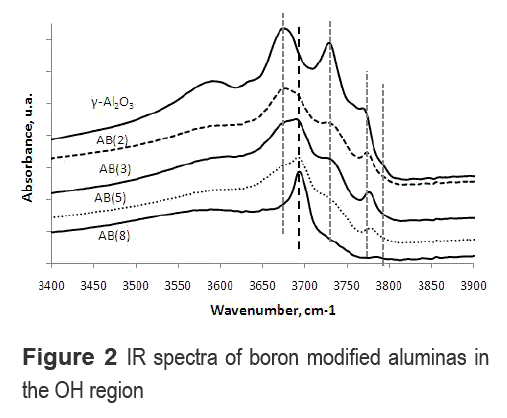
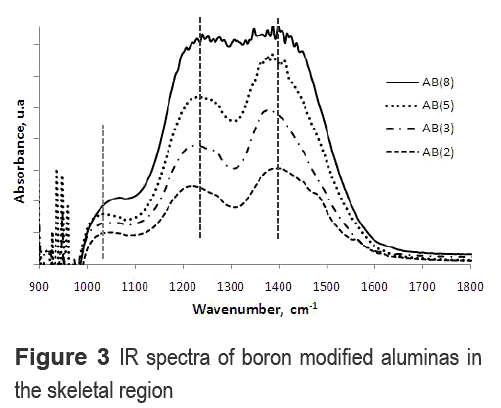
<body><![CDATA[<p> <font face="Verdana" size="2"><b><i>Characterization of catalysts     </i></b></font></p>       <p> <font face="Verdana" size="2">   The B content was analyzed by the inductively coupled plasma (ICP) technique. An ICP AES Thermo Jarrell Ash Iris apparatus was used. Proton affinity distribution (PAD) measurements were used to determine the particular surface characteristics of the pure alumina and boron modified aluminas. This characterization was carried out by potentiometric titration, using the procedure described by Schwarz et al. [14]. A Titroline Alpha (SCHOTT, ±0.001 pH units) equipped with a magnetic stirrer was used to perform titration measurements. All experiments were done using either 0.1 N HNO<sub>3</sub> or 0.1 N NaOH solutions. The samples (0.5 g) were first equilibrated with a neutral electrolyte (50 mL of 0.1 M NaNO<sub>3</sub> solution) under constant but gentle stirring. The titrations went continuously through a series of pseudo equilibrium states, and a large number of data was collected by adding 0.05 mL of titrant at a constant rate and reading the pH values every 90 s. In the case of titration with HNO<sub>3</sub> the final pH was 3 and in the case of titration with NaOH the final pH was 11. The proton consumption function was calculated from the balance equations and then converted into proton binding isotherms [14, 15]. The method proposed by Rudzinski and Jagiello [19] to calculate affinity distributions from proton binding isotherms was used as a model for these calculations.      <br>    <br>  FTIR spectra of dehydrated supports in the OH (3400-3900 cm<sup>-1</sup>) and skeletal region (800-1800 cm<sup>-1</sup>) were recorded with an IFS55 equinox spectrometer (Br&uuml;cker) equipped with a DTGS detector using 100 scans and a resolution of 4 cm<sup>-1</sup>. Supports powders were pressed (3 tons) into self-supported wafers (15 mg, 13 mm diameter) and placed in a homemade IR cell. Previously to take the respective IR spectra samples were dehydrated under vacuum (&lt;1.10<sup>-5</sup> mbar) at 773 K for 2 h and after left under vacuum all night.    </font></p>            <p><font face="Verdana" size="3"><b>Results and discussion </b> </font></p>        <p> <font face="Verdana" size="2">    <a href="#Figura1">Figure 1</a> shows PAD curves of AB(x) supports as well as the one of bare y-Al<sub>2</sub>O<sub>3</sub>. In the case of bare y-Al<sub>2</sub>O<sub>3</sub>, it can be observed the presence of OH group s type IA, IB, IIA and III [16, 17] of Kn&ouml;zinger and Ratnazamy [20] classification. The OH groups type III are the most acidic and they correspond to OH groups coordinated with three Al<sup>3+</sup> cations in octahedral interstices [20]. Type I OH groups are terminal ones coordinated to a single either tetrahedral (IA OH groups) or octahedral (IB OH groups) Al<sup>3+</sup> cation [20]. These are the most basic OH groups [20]. Whereas, type IIA OH groups are of character intermediate acidic and these consist of bridging OH groups which link an octahedral and a tetrahedral Al<sup>3+</sup> cation [20]. It is observed that in bare y-Al<sub>2</sub>O<sub>3</sub> the more acidic type III and IIA OH groups predominate, nevertheless, an important quantity of type IA and IB OH groups are present too.</font></p>      <p align="center"><img src="/img/revistas/rfiua/n57/n57a03i01.gif" ><a name="Figura1"></a></p>        <p> <font face="Verdana" size="2"> On the other hand, with the introduction of B on the alumina surface it is observed that the alumina OH groups disappear, especially those corresponding to the more basic OH groups (IA and IB), which are practically consumed after the introduction of 2 wt.% B<sub>2</sub>O<sub>3</sub>. At the same time, it can be observed that with increasing boron content two new peaks appear. One peak at pH ca. 3.8, in the limit zone between groups III and IIA appears and another one at pH ca. 9.9 in the left side of the pH region corresponding to OH groups type IB, which is only observed clearly in the PAD curve of AB(8). Concerning the first one, because of its intermediate position, this peak cannot be attributed either to OH groups type III or IIA of alumina and it seems to correspond to a new OH group linked to boron cations. Regarding the peak ca. pH = 9.9, this cannot be assigned to group IB of alumina because, according to literature [1, 3, 4, 6], basic OH sites are the sites where B is anchored on the alumina surface and these are the first in disappear, thus it will be logical to think that this peak is also due to new OH linked to borate species.   </font></p>            <p> <font face="Verdana" size="2">   To try to interpret the apparition of these new peaks in the PAD of boron modified aluminas, IR spectra of the OH region of AB(x) supports were obtained and they were compared with the bare y-Al<sub>2</sub>O<sub>3</sub> IR spectrum. These spectra are shown in <a href="#Figura2">figure 2</a>. For bare y-Al<sub>2</sub>O<sub>3</sub> the same OH groups observed in the PAD in <a href="#Figura1">figure 1</a> are also observed: IB (3790 cm<sup>-1</sup>), IA (3770 cm<sup>-1</sup>), IIA (3735 cm<sup>-1</sup>) and III (3680 cm<sup>-1</sup>) [20]. As its PAD profile, the more prominent peaks correspond to OH groups type III and IIA. In accordance with observed in the PAD profiles of AB(x) boron introduction causes a decrease in all the alumina OH groups, especially in the more basic ones (IA and IB). It is observed that the peak corresponding to OH group type III of alumina (3680) was progressively replaced by a new peak at ca. 3695 cm<sup>-1</sup>. Indeed, in the spectrum of AB(8) this is the only peak observed. This peak has already been reported by other authors [1, 2, 4-6], who concluded that it is due to OH groups linked to B species, because its frequency compares well with the v (OH) of free BOH groups such as those of H<sub>3</sub>BO<sub>3</sub> in N<sub>2</sub>cryogenic matrices (3668.5 cm<sup>-1</sup>) or on the surface of silica impregnated by boria (3703 cm<sup>-1</sup>). Thus, this fact confirms that new OH groups linked to borate species are generated on the borated alumina surface with increasing boron content as we have supposed to explain our PAD results. However in PAD profiles of borated aluminas (<a href="#Figura1">figure 1</a>) we observed two new peaks different from that of bare alumina, meanwhile in the IR of the OH stretching region only one new peak appears. Consequently, there is something missing in our explanation of PAD profiles. A possible explanation is that the IR peak located ca. 3695 cm<sup>-1</sup> is due to OH groups linked not only to one single borate species but to a variety of them which could react with protons in two different ways during the potentiometric titration. Thus, a look into the possible borate species existing in borated alumina surface is still needed.   </font></p>        <p align="center"><img src="/img/revistas/rfiua/n57/n57a03i02.gif" ><a name="Figura2"></a></p>        ]]></body>
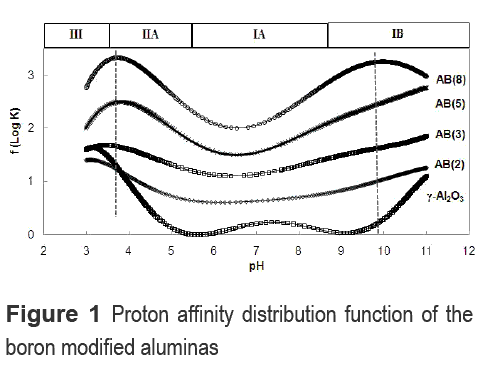
<body><![CDATA[<p> <font face="Verdana" size="2">   In some previous works [1-3, 5, 21] it has been evidenced, by using B<sup>11</sup> MAS-NMR, that there are two borate species coexisting in borated alumina surface: BO<sub>3</sub> trigonal species and BO<sub>4</sub> tetrahedral species. These species have been properly quantified in these works and it has been concluded that trigonal borated species are the main species at low content of boria and increased with increasing boria loading [2, 3, 5, 21]. However, tetrahedral borated species (BO<sub>4</sub>) also appears with increasing boria loading and its relative content increased with boria loading [2, 3, 5, 21]. Sato et al. [2] has shown that at boria contents above 2 wt.% these BO<sub>4</sub> species are formed. The differentiation between trigonal and tetrahedral borated species have also been shown in a more qualitatively way by using IR [4, 21]. In this sense, in boron oxide compounds, broad bands in the region 1500-1200 cm<sup>-1</sup> are typically due to the asymmetric B-0 stretching modes of BO<sub>3</sub> species. Tetrahedral borate species are instead characterized by complex absorptions due to asymmetric and symmetric BO<sub>4</sub> stretchings in the region 1100-900 cm<sup>-1</sup>. In <a href="#Figura3">figure 3</a>, the FT- IR spectra of the prepared borated aluminas in the skeletal region are presented. Two strong and broad peaks at ca. 1225 and 1400 cm<sup>-1</sup> are observed along with another small peak at ca. 1025 cm<sup>-1</sup>. According to the above stated [4, 21], the broad peaks could be attributed to BO<sub>3</sub> species and the small one to BO<sub>4</sub> species. The higher intensity and broadness of the peaks at ca. 1225 and 1400 cm<sup>-1</sup> indicates that BO<sub>3</sub> species are prevalent. Both kinds of peaks increased with increasing boria content as well as with the relative concentration of BO<sub>4</sub> species.  </font></p>          <p align="center"><img src="/img/revistas/rfiua/n57/n57a03i03.gif" ><a name="Figura3"></a></p>         <p> <font face="Verdana" size="2">   Flego et al. [1] have shown schematically that hydroxyls associated with borate species could be linked to both trigonal and tetrahedral species. These authors have shown seven different forms of how surface hydroxyls could be linked to borate species. However, in these schemes they have shown that hydroxyls linked either to trigonal or tetrahedral borates are always linked to one single B atom, different to the case of hydroxyls linked to Al<sup>+3</sup> ions which can be linked to 1, 2 or 3 of these. Consequently, if we classify surface borated hydroxyls according to their net charge, in a similar way to what Kn&ouml;zinger and Ratnazamy [20] used to classify alumina surface hydroxyls, we will obtain only two kinds of surface borated hydroxyls; those linked to trigonal and tetrahedral species. The net charge on the hydroxyl anion was calculated in the same way as Ratnazamg [20] as the sum of the negative charge of the hydroxyl and the sum of the strengths of the electrostatic bonds (cation charge divided by its coordination number) to the hydroxyl anion from adjacent cations. Thus, the net charge of an OH linked to borate trigonal species is zero meanwhile that of an OH linked to borate tetrahedral species is -0.25. IB and IA OH type groups of alumina have net charges of -0.5 and -0.25 respectively, and they are in the right side of the PAD profiles, meanwhile groups IIA and III have net charges of 0.25 and 0.5 respectively, and they are located in the right side of the PAD profile. Thus, in analogy with the assignation of peaks in alumina PAD profiles we assign the new peak appearing in alumina borates PAD at ca. pH = 3.8 to trigonal borated species, whereas that appearing at ca. 9.9 was assigned to tetrahedral borate species. Thus, according to our identification of peaks in the PAD profile of borated aluminas, using this technique in addition to the appearance of a new OH group linked to borate species, it will be also possible to distinguish between the groups linked to trigonal borated species and those linked to tetrahedral ones.     <br>    <br> Consequently, if we interpret the PAD profiles as already stated, we can conclude that with increasing boron concentration, alumina OH are progressively consumed and new boria OH appear. There are two kinds of boron hydroxyls; those linked to trigonal borate species and those linked to tetrahedral ones. Trigonal borated species always predominated in the interval of boria content used during the present work (0-8 wt.%), however tetrahedral species were present even at the lowest boria content used (2 wt.%) and their relative concentration increased as already found in previous literature reports [2, 3, 5, 21]. In the range 2-5 wt.%, we observed a mixture of boria and alumina hydroxyls, but in AB(8) practically the only OH groups observed were those of boria. The first alumina groups being consumed were the most basic ones (IA and IB), but after 2-3 wt.% boria, when these groups were almost totally consumed, the acidic OH groups (IIA and III) were also consumed. Thus, as already proposed by other authors [1, 5] we inferred that a polymeric boron cover layer was progressively formed over the alumina surface with increasing the boron loading. The formation of this polymeric cover layer would account for the decrease in the total number of hydroxyls with increasing boria loading. The OH of some of the monomeric boria species would condense to form an oxygen bridge which link one monomeric species with the one next to it to finally form the cover layer [1, 5]. Thus, if we need to support a metal on the surface of borated aluminas according the content of boria in the support this metal would be attached either to a mixture of boria and alumina hydroxyls or to boria hydroxyls only.     <br>    <br> The characterization of the OH groups existing in borated aluminas along with the knowledge of the relative quantity of boron in a given coordination is important to give an explanation to the changes observed in the performance of catalysts containing boria. For instance, it is well known that the increase in the relative content of borated tetrahedral species is related with the increasing strength of the acid sites as well as with the increase in the amount of Br&ouml;nsted acid sites [2, 5, 21]. In a previous work [8] we have reported that with increasing boria content in alumina supported CoMo both the concentration of Br&ouml;nsted acid sites and the strength of the acid sites were increased. This fact was very important because the changes in acidity generated increases in acid type olefin reactions, like isomerization and cracking, which competed with HDS and the HYD of olefins. It was found that in the range 2-3 wt.% boria content, cracking was less promoted than skeletal isomerization and than the isomerization of the double bond from external to internal position reaction [8]. Consequently, within this range an increase in the selectivity HDS/HYD of internal olefins was found [8]. Such change in selectivity is highly desired in the HDS of FCC naphtha, because internal olefins are the olefins with the highest concentration in FCC naphtha and they make a great contribution to the octane [22].     <br>    <br> On the other hand, the knowledge of the ratio of hydroxyls linked to borated species to that of hydroxyls linked to Al is important to explain the changes in the dispersion and distribution of species of supported metals like in the case of supported CoMo catalysts. For instance, we have observed changes in the Raman spectra of CoMo supported on borated aluminas [13]. These changes suggest that with increasing boria content the relative population of surface polymeric molybdenum compounds (Mo<sub>7</sub>O<sub>24</sub><sup>6-</sup> and Mo<sub>8</sub>O<sub>26</sub><sup>4-</sup>) increases, in detriment of the population of monomeric compounds. Also it was observed that the size of these polymeric compounds increases. This fact is explained because when increasing boria content Mo ions should anchor to borated OH instead of alumina ones during the impregnation process. Thus, from one side, Mo is stronger bonded to Al than to B atoms [6, 9-11] and from another point of view, the increase in boria content causes an increase in the local PZC, which is the cause of a displacement of the equilibrium between monomeric and polymeric Mo species [9-11]. </font></p>            <p><font face="Verdana" size="3"><b> Conclusions </b> </font></p>         ]]></body>
<body><![CDATA[<p> <font face="Verdana" size="2"> Proton affinity distributions profiles of borated aluminas gave us important and reliable information about the distribution of the different hydroxyls existing on its surface either attached to Al or B. These profiles were interpreted in detail and properly by comparing them with their corresponding IR spectra in the OH stretching and skeletal regions and by analogy with the alumina PAD profile interpretation used by other authors before. Thus, the new peaks appearing in the borated aluminas PAD profile were attributed to OH groups linked to trigonal borated species and tetrahedral ones. Both of these OH boria species appear even for the alumina with the lowest content of boria (2 wt.%) and trigonal borate species were always predominant. However, the relative concentration of tetrahedral borate species increased with increasing boria content. Boria hydroxyls progressively replaced alumina ones with increasing boria content until formation of a cover layer. The replacement of alumina hydroxyls by boria ones and the progressive formation of a cover layer would account for the changes observed on the surface properties of CoMo catalysts supported on borated aluminas in comparison with the catalyst supported on bare alumina.  </font></p>           <p><font face="Verdana" size="3"><b> Acknowledgments </b> </font></p>        <p> <font face="Verdana" size="2">   This work was possible due to the financial support of VIE-UIS in the frame of the project "Determinaci&oacute;n de las condiciones de HDT provenientes de fracciones pesadas: Estudio de la influencia de la composici&oacute;n", code 5435. D. J. P&eacute;rez-Mart&iacute;nez thanks COLCIENCIAS and UIS for the Ph.D. fellowship. Authors especially thank prof. E. M. Gaigneaux from the UCL in Belgium for hosting D. J. P&eacute;rez-Mart&iacute;nez in his lab for doing FT-IR measurements.   </font></p>        <p><font face="Verdana" size="3"><b> References </b> </font></p>     <!-- ref --><p> <font face="Verdana" size="2">     1. C. Flego, W. O. Parker Jr.  &quot;Characterization of y-Alumina and Borated Alumina Catalysts&quot;. <i>Appl. Catal. A.</i> Vol. 185. 1999. pp. 137-152.      &nbsp;&nbsp;&nbsp;&nbsp;&nbsp;&nbsp;&nbsp;&nbsp;[&#160;<a href="javascript:void(0);" onclick="javascript: window.open('/scielo.php?script=sci_nlinks&ref=000047&pid=S0120-6230201100010000300001&lng=','','width=640,height=500,resizable=yes,scrollbars=1,menubar=yes,');">Links</a>&#160;]<!-- end-ref --><br>    <!-- ref --><br> 2. S. Sato, M. Kuroki, T. Sodesawa,  F. Nozaki, G. Maciel. &quot;Surface Structure and Acidity of Alumina-Boria  Catalysts&quot;.  <i>J. Mol. Catal. A.</i> Vol. 104.  1995. pp.171-177.      &nbsp;&nbsp;&nbsp;&nbsp;&nbsp;&nbsp;&nbsp;&nbsp;[&#160;<a href="javascript:void(0);" onclick="javascript: window.open('/scielo.php?script=sci_nlinks&ref=000049&pid=S0120-6230201100010000300002&lng=','','width=640,height=500,resizable=yes,scrollbars=1,menubar=yes,');">Links</a>&#160;]<!-- end-ref --><br>    <!-- ref --><br> 3. A. M. Duarte de Farias, A. M. Lavogade Esteves, F.  Ziarelli, S. Caldarelli, M. A. Fraga, L. G. Appel. &quot;Boria modified alumina  probed by methanol dehydration and IR spectroscopy&quot;. <i>Appl. Surf. Sci</i>. Vol. 227. 2004. pp. 132-138.      &nbsp;&nbsp;&nbsp;&nbsp;&nbsp;&nbsp;&nbsp;&nbsp;[&#160;<a href="javascript:void(0);" onclick="javascript: window.open('/scielo.php?script=sci_nlinks&ref=000051&pid=S0120-6230201100010000300003&lng=','','width=640,height=500,resizable=yes,scrollbars=1,menubar=yes,');">Links</a>&#160;]<!-- end-ref --><br>    ]]></body>
<body><![CDATA[<!-- ref --><br> 4. A.  Delmastro, G. Gozzelino, D. Mazza, M. Vallino, G. Busca, V. Lorenzelli.  &quot;Characterization of Microporous Amorphous Alumina-Boria&quot;.<i>J. Chem. Soc. Faraday Trans</i>. Vol. 88. 1992. pp. 2065-2070.      &nbsp;&nbsp;&nbsp;&nbsp;&nbsp;&nbsp;&nbsp;&nbsp;[&#160;<a href="javascript:void(0);" onclick="javascript: window.open('/scielo.php?script=sci_nlinks&ref=000053&pid=S0120-6230201100010000300004&lng=','','width=640,height=500,resizable=yes,scrollbars=1,menubar=yes,');">Links</a>&#160;]<!-- end-ref --><br>    <!-- ref --><br> 5. M. Sibeijn, J. A. R. van Veen,  A. Bliek, J. A. Moulijn. &quot;On the Nature and Formation of the Active Sites  in Re<sub>2</sub>O<sub>7</sub> Metathesis Catalysts Supported on Borated Alnmina&quot;.<i>J. Catal</i>. Vol. 145. 1994. pp. 416-428.      &nbsp;&nbsp;&nbsp;&nbsp;&nbsp;&nbsp;&nbsp;&nbsp;[&#160;<a href="javascript:void(0);" onclick="javascript: window.open('/scielo.php?script=sci_nlinks&ref=000055&pid=S0120-6230201100010000300005&lng=','','width=640,height=500,resizable=yes,scrollbars=1,menubar=yes,');">Links</a>&#160;]<!-- end-ref --><br>    <!-- ref --><br> 6. Y. Saih, K. Segawa. &quot;Catalytic Activity of CoMo  Catalysts Supported on Boron-Modified Alumina for the Hydrodesulphurization of  Dibenzothiophene and 4,6-Dimethyldibenzothiophene&quot;. <i>Appl. Catal. A.</i> Vol. 353. 2009. pp. 258-265.      &nbsp;&nbsp;&nbsp;&nbsp;&nbsp;&nbsp;&nbsp;&nbsp;[&#160;<a href="javascript:void(0);" onclick="javascript: window.open('/scielo.php?script=sci_nlinks&ref=000057&pid=S0120-6230201100010000300006&lng=','','width=640,height=500,resizable=yes,scrollbars=1,menubar=yes,');">Links</a>&#160;]<!-- end-ref --><br>    <!-- ref --><br> 7. S. A. Giraldo, A. Centeno. &quot;Isomerization and  Cracking under HDS Conditions Using y-alumina Modified with Boron as Catalysts  Support&quot;. <i> Catal. Today</i>. Vol. 133-135.  2008. pp. 255-260.      &nbsp;&nbsp;&nbsp;&nbsp;&nbsp;&nbsp;&nbsp;&nbsp;[&#160;<a href="javascript:void(0);" onclick="javascript: window.open('/scielo.php?script=sci_nlinks&ref=000059&pid=S0120-6230201100010000300007&lng=','','width=640,height=500,resizable=yes,scrollbars=1,menubar=yes,');">Links</a>&#160;]<!-- end-ref --><br>    <!-- ref --><br> 8. D. P&eacute;rez Mart&iacute;nez, A. M. Lozano, C. J. Arias, V. C.  Porras, G. A. Olarte, S. A. Giraldo, A. Centeno. &quot;Comportamiento del  Catalizador CoMo/y-Al<sub>2</sub>O<sub>3</sub> Modificado con Boro y Potasio en  las Reacciones Simult&aacute;neas de Hidrogenaci&oacute;n de Olefinas e Hidrodesulfuraci&oacute;n de  2-metiltiofeno&quot;.  <i>Revista Colombiana de Qu&iacute;mica.</i>  Vol. 37. 2008. pp. 219-231.      &nbsp;&nbsp;&nbsp;&nbsp;&nbsp;&nbsp;&nbsp;&nbsp;[&#160;<a href="javascript:void(0);" onclick="javascript: window.open('/scielo.php?script=sci_nlinks&ref=000061&pid=S0120-6230201100010000300008&lng=','','width=640,height=500,resizable=yes,scrollbars=1,menubar=yes,');">Links</a>&#160;]<!-- end-ref --><br>    ]]></body>
<body><![CDATA[<!-- ref --><br> 9. F. Dumeignil, K. Sato, M. Imamura, N. Matsubayashi, E.  Payen, H. Shimada. &quot;Characterization and Hydrodesulfurization Activity of  CoMo Catalysts Supported on Boron-Doped Sol-Gel Alumina&quot;. <i>Appl. Catal. A.</i> Vol. 315. 2006. pp. 18-28.      &nbsp;&nbsp;&nbsp;&nbsp;&nbsp;&nbsp;&nbsp;&nbsp;[&#160;<a href="javascript:void(0);" onclick="javascript: window.open('/scielo.php?script=sci_nlinks&ref=000063&pid=S0120-6230201100010000300009&lng=','','width=640,height=500,resizable=yes,scrollbars=1,menubar=yes,');">Links</a>&#160;]<!-- end-ref --><br>    <!-- ref --><br> 10. U. Usman, M. Takaki, T. Kubota, Y. Okamoto.  &quot;Effect of Boron Addition on a MoO<sub>3</sub>/Al<sub>2</sub>O<sub>3</sub>  Catalyst Physicochemical Characterization&quot;. <i>Appl. Catal. A.</i> Vol. 286. 2005. pp. 148-154.      &nbsp;&nbsp;&nbsp;&nbsp;&nbsp;&nbsp;&nbsp;&nbsp;[&#160;<a href="javascript:void(0);" onclick="javascript: window.open('/scielo.php?script=sci_nlinks&ref=000065&pid=S0120-6230201100010000300010&lng=','','width=640,height=500,resizable=yes,scrollbars=1,menubar=yes,');">Links</a>&#160;]<!-- end-ref --><br>    <!-- ref --><br> 11. P. Torres Mancera, J. Ram&iacute;rez, R. Cuevas, A. Gutierrez  Alejandre, F. Murrieta, R. Luna &quot;Hydrodesulfurization of 4,6-DMDBT on NiMo  and CoMo catalysts supported on B<sub>2</sub>O<sub>3</sub>-Al<sub>2</sub>O<sub>3</sub>&quot;. <i>Catal. Today.</i> Vol. 107-108. 2005. pp. 551-558.      &nbsp;&nbsp;&nbsp;&nbsp;&nbsp;&nbsp;&nbsp;&nbsp;[&#160;<a href="javascript:void(0);" onclick="javascript: window.open('/scielo.php?script=sci_nlinks&ref=000067&pid=S0120-6230201100010000300011&lng=','','width=640,height=500,resizable=yes,scrollbars=1,menubar=yes,');">Links</a>&#160;]<!-- end-ref --><br>    <!-- ref --><br> 12. C. Flego, V. Arrigoni, M.  Ferrari, R. Riva, L. Zanibelli. &quot;Mixed Oxides as a Support for New CoMo  Catalysts&quot;. <i>Catal. Today.</i> Vol. 65.  2001. pp. 265-270.      &nbsp;&nbsp;&nbsp;&nbsp;&nbsp;&nbsp;&nbsp;&nbsp;[&#160;<a href="javascript:void(0);" onclick="javascript: window.open('/scielo.php?script=sci_nlinks&ref=000069&pid=S0120-6230201100010000300012&lng=','','width=640,height=500,resizable=yes,scrollbars=1,menubar=yes,');">Links</a>&#160;]<!-- end-ref --><br>    <!-- ref --><br> 13. D. J.  P&eacute;rez Mart&iacute;nez, P. Eloy, E. M. Gaigneaux, S. A. Giraldo, A. Centeno.  &quot;Study of the selectivity in FCC naphtha hydrotreating by modifying the  acid-base balance of CoMo/-Al<sub>2</sub>O<sub>3</sub> catalysts&quot;. <i>Appl. Catal. A.</i> Vol. 390. 2010. pp. 59-70.      &nbsp;&nbsp;&nbsp;&nbsp;&nbsp;&nbsp;&nbsp;&nbsp;[&#160;<a href="javascript:void(0);" onclick="javascript: window.open('/scielo.php?script=sci_nlinks&ref=000071&pid=S0120-6230201100010000300013&lng=','','width=640,height=500,resizable=yes,scrollbars=1,menubar=yes,');">Links</a>&#160;]<!-- end-ref --><br>    ]]></body>
<body><![CDATA[<!-- ref --><br> 14. J. Schwarz, C. Contescu, J. Jagiello. &quot;Proton  Affinity Distributions: A Scientific Basis for the Design and Construction of  Supported Metal Catalysis&quot;. G. Poncelet, J. Martens, B. Delmon, P. Jacobs,  P. Grange (editors).  <i>Preparation of Catalysts VI, Studies in Surface Science and Catalysis</i>. 91 ed. Ed. Elsevier. Amsterdam. 1995. pp. 237-252.      &nbsp;&nbsp;&nbsp;&nbsp;&nbsp;&nbsp;&nbsp;&nbsp;[&#160;<a href="javascript:void(0);" onclick="javascript: window.open('/scielo.php?script=sci_nlinks&ref=000073&pid=S0120-6230201100010000300014&lng=','','width=640,height=500,resizable=yes,scrollbars=1,menubar=yes,');">Links</a>&#160;]<!-- end-ref --><br>    <!-- ref --><br> 15. C. Contescu, J. Jagiello, J. A. Schwarz.  &quot;Heterogeneity of Proton Binding Sites at the Oxide/Solution  Interface&quot;.  <i>Langmuir.</i> Vol. 9.  1993. pp. 1754-1765.      &nbsp;&nbsp;&nbsp;&nbsp;&nbsp;&nbsp;&nbsp;&nbsp;[&#160;<a href="javascript:void(0);" onclick="javascript: window.open('/scielo.php?script=sci_nlinks&ref=000075&pid=S0120-6230201100010000300015&lng=','','width=640,height=500,resizable=yes,scrollbars=1,menubar=yes,');">Links</a>&#160;]<!-- end-ref --><br>    <!-- ref --><br> 16. C. Contescu, A. Contescu, J. A. Schwarz.  &quot;Thermodynamics of Proton Binding at the Alumina/ Aqueous Solution  Interface. A Phenomenological Approach&quot;. <i>J. Phys. Chem.</i> Vol. 98. 1994. pp. 4327-4335.      &nbsp;&nbsp;&nbsp;&nbsp;&nbsp;&nbsp;&nbsp;&nbsp;[&#160;<a href="javascript:void(0);" onclick="javascript: window.open('/scielo.php?script=sci_nlinks&ref=000077&pid=S0120-6230201100010000300016&lng=','','width=640,height=500,resizable=yes,scrollbars=1,menubar=yes,');">Links</a>&#160;]<!-- end-ref --><br>    <!-- ref --><br> 17. C. Contescu, A. Contescu, C.  Schramm, R. Sato, J. Schwarz. &quot;The Influence of Electropositive and  Electronegative Elements on Proton Binding to Gamma Al<sub>2</sub>O<sub>3</sub>  in Aqueous Suspensions&quot;.  <i>J. Coll. Int. Sci.</i> Vol. 165.  1994. pp. 66-71.      &nbsp;&nbsp;&nbsp;&nbsp;&nbsp;&nbsp;&nbsp;&nbsp;[&#160;<a href="javascript:void(0);" onclick="javascript: window.open('/scielo.php?script=sci_nlinks&ref=000079&pid=S0120-6230201100010000300017&lng=','','width=640,height=500,resizable=yes,scrollbars=1,menubar=yes,');">Links</a>&#160;]<!-- end-ref --><br>    <!-- ref --><br> 18. M. H. Pinz&oacute;n, A. Centeno, S. A.  Giraldo. &quot;Role of Pt in High Performance Pt-Mo Catalysts for  Hydrotreatment Reactions&quot;. <i>Appl. Catal. A.</i> Vol. 302. 2006. pp. 118-126.      &nbsp;&nbsp;&nbsp;&nbsp;&nbsp;&nbsp;&nbsp;&nbsp;[&#160;<a href="javascript:void(0);" onclick="javascript: window.open('/scielo.php?script=sci_nlinks&ref=000081&pid=S0120-6230201100010000300018&lng=','','width=640,height=500,resizable=yes,scrollbars=1,menubar=yes,');">Links</a>&#160;]<!-- end-ref --><br>    ]]></body>
<body><![CDATA[<!-- ref --><br> 19. W. Rudzinski, J. Jagiello. &quot;Low-Temperature  Adsorption of Gases on Heterogeneous Solid Surfaces: Surfaces with Random  Topography&quot;.  <i>J. Low Temp. Phys.</i> Vol. 45.  1981. pp. 1-19.      &nbsp;&nbsp;&nbsp;&nbsp;&nbsp;&nbsp;&nbsp;&nbsp;[&#160;<a href="javascript:void(0);" onclick="javascript: window.open('/scielo.php?script=sci_nlinks&ref=000083&pid=S0120-6230201100010000300019&lng=','','width=640,height=500,resizable=yes,scrollbars=1,menubar=yes,');">Links</a>&#160;]<!-- end-ref --><br>    <!-- ref --><br> 20. H. Kn&ouml;inger, P. Ratnasamy. &quot;Catalytic Aluminas:  Surface Models and Characterization of Surface Sites&quot;. <i>Catal. Rev.</i> Vol. 17. 1978. pp. 31-70.      &nbsp;&nbsp;&nbsp;&nbsp;&nbsp;&nbsp;&nbsp;&nbsp;[&#160;<a href="javascript:void(0);" onclick="javascript: window.open('/scielo.php?script=sci_nlinks&ref=000085&pid=S0120-6230201100010000300020&lng=','','width=640,height=500,resizable=yes,scrollbars=1,menubar=yes,');">Links</a>&#160;]<!-- end-ref --><br>    <!-- ref --><br> 21. F. M. Bautista, J. M. Campelo, A. Garcia, D. Luna, J.  M. Marinas, M. C. Moreno, A. A. Romero, J. A. Navio, M. Macias.  &quot;Structural and Textural Characterization of AlPO<sub>4</sub>-B<sub>2</sub>O<sub>3</sub>  and Al<sub>2</sub>O<sub>3</sub>-B<sub>2</sub>O<sub>3</sub> (5-30 wt% B<sub>2</sub>O<sub>3</sub>)  Systems Obtained by Boric Acid Impregnation&quot;. <i>J. Catal.</i> Vol. 173. 1998. pp. 333-344.      &nbsp;&nbsp;&nbsp;&nbsp;&nbsp;&nbsp;&nbsp;&nbsp;[&#160;<a href="javascript:void(0);" onclick="javascript: window.open('/scielo.php?script=sci_nlinks&ref=000087&pid=S0120-6230201100010000300021&lng=','','width=640,height=500,resizable=yes,scrollbars=1,menubar=yes,');">Links</a>&#160;]<!-- end-ref --><br>    <!-- ref --><br> 22. S.  Brunet, D. Mey, G. P&eacute;rot, C. Bouchy, F. Diehl. &quot;On the  Hydrodesulfurization of FCC Naphtha: A review&quot; <i>Appl. Catal. A.</i> Vol. 278. 2005. pp. 143-172. </font>&nbsp;&nbsp;&nbsp;&nbsp;&nbsp;&nbsp;&nbsp;&nbsp;[&#160;<a href="javascript:void(0);" onclick="javascript: window.open('/scielo.php?script=sci_nlinks&ref=000089&pid=S0120-6230201100010000300022&lng=','','width=640,height=500,resizable=yes,scrollbars=1,menubar=yes,');">Links</a>&#160;]<!-- end-ref --><p>&nbsp;</p>     <br>    <br>    ]]></body>
<body><![CDATA[<br>    <br>       <p><font face="Verdana" size="2">(Recibido el 03 de febrero de 2010. Aceptado el 15 de octubre de 2010)</font></p>     <p><font face="Verdana" size="2"><sup>*</sup>Autor de correspondencia: tel&eacute;fono: + 57 + 7 + 634 47 46, fax: + 57 + 7 + 634 46 84, correo electr&oacute;nico: <a href="mailto:acenteno@uis.edu.co">acenteno@uis.edu.co</a> (A. Centeno)</font></p>      ]]></body><back>
<ref-list>
<ref id="B1">
<label>1</label><nlm-citation citation-type="journal">
<person-group person-group-type="author">
<name>
<surname><![CDATA[Flego]]></surname>
<given-names><![CDATA[C]]></given-names>
</name>
<name>
<surname><![CDATA[Parker]]></surname>
<given-names><![CDATA[W. O]]></given-names>
</name>
</person-group>
<article-title xml:lang="en"><![CDATA[Characterization of y-Alumina and Borated Alumina Catalysts]]></article-title>
<source><![CDATA[Appl. Catal. A]]></source>
<year>1999</year>
<volume>185</volume>
<page-range>137-152</page-range></nlm-citation>
</ref>
<ref id="B2">
<label>2</label><nlm-citation citation-type="journal">
<person-group person-group-type="author">
<name>
<surname><![CDATA[Sato]]></surname>
<given-names><![CDATA[S]]></given-names>
</name>
<name>
<surname><![CDATA[Kuroki]]></surname>
<given-names><![CDATA[M]]></given-names>
</name>
<name>
<surname><![CDATA[Sodesawa]]></surname>
<given-names><![CDATA[T]]></given-names>
</name>
<name>
<surname><![CDATA[Nozaki]]></surname>
<given-names><![CDATA[F]]></given-names>
</name>
<name>
<surname><![CDATA[Maciel]]></surname>
<given-names><![CDATA[G]]></given-names>
</name>
</person-group>
<article-title xml:lang="en"><![CDATA[Surface Structure and Acidity of Alumina-Boria Catalysts]]></article-title>
<source><![CDATA[J. Mol. Catal. A]]></source>
<year>1995</year>
<volume>104</volume>
<page-range>171-177</page-range></nlm-citation>
</ref>
<ref id="B3">
<label>3</label><nlm-citation citation-type="journal">
<person-group person-group-type="author">
<name>
<surname><![CDATA[Duarte de Farias]]></surname>
<given-names><![CDATA[A. M]]></given-names>
</name>
<name>
<surname><![CDATA[Lavogade Esteves]]></surname>
<given-names><![CDATA[A. M]]></given-names>
</name>
<name>
<surname><![CDATA[Ziarelli]]></surname>
<given-names><![CDATA[F]]></given-names>
</name>
<name>
<surname><![CDATA[Caldarelli]]></surname>
<given-names><![CDATA[S]]></given-names>
</name>
<name>
<surname><![CDATA[Fraga]]></surname>
<given-names><![CDATA[M. A]]></given-names>
</name>
<name>
<surname><![CDATA[Appel]]></surname>
<given-names><![CDATA[L. G]]></given-names>
</name>
</person-group>
<article-title xml:lang="en"><![CDATA[Boria modified alumina probed by methanol dehydration and IR spectroscopy]]></article-title>
<source><![CDATA[Appl. Surf. Sci]]></source>
<year>2004</year>
<volume>227</volume>
<page-range>132-138</page-range></nlm-citation>
</ref>
<ref id="B4">
<label>4</label><nlm-citation citation-type="journal">
<person-group person-group-type="author">
<name>
<surname><![CDATA[Delmastro]]></surname>
<given-names><![CDATA[A]]></given-names>
</name>
<name>
<surname><![CDATA[Gozzelino]]></surname>
<given-names><![CDATA[G]]></given-names>
</name>
<name>
<surname><![CDATA[Mazza]]></surname>
<given-names><![CDATA[D]]></given-names>
</name>
<name>
<surname><![CDATA[Vallino]]></surname>
<given-names><![CDATA[M]]></given-names>
</name>
<name>
<surname><![CDATA[Busca]]></surname>
<given-names><![CDATA[G]]></given-names>
</name>
<name>
<surname><![CDATA[Lorenzelli]]></surname>
<given-names><![CDATA[V]]></given-names>
</name>
</person-group>
<article-title xml:lang="en"><![CDATA[Characterization of Microporous Amorphous Alumina-Boria]]></article-title>
<source><![CDATA[J. Chem. Soc. Faraday Trans]]></source>
<year>1992</year>
<volume>88</volume>
<page-range>2065-2070</page-range></nlm-citation>
</ref>
<ref id="B5">
<label>5</label><nlm-citation citation-type="journal">
<person-group person-group-type="author">
<name>
<surname><![CDATA[Sibeijn]]></surname>
<given-names><![CDATA[M]]></given-names>
</name>
<name>
<surname><![CDATA[van Veen]]></surname>
<given-names><![CDATA[J. A. R]]></given-names>
</name>
<name>
<surname><![CDATA[Bliek]]></surname>
<given-names><![CDATA[A]]></given-names>
</name>
<name>
<surname><![CDATA[Moulijn]]></surname>
<given-names><![CDATA[J. A]]></given-names>
</name>
</person-group>
<article-title xml:lang="en"><![CDATA[On the Nature and Formation of the Active Sites in Re2O7 Metathesis Catalysts Supported on Borated Alnmina]]></article-title>
<source><![CDATA[J. Catal]]></source>
<year>1994</year>
<volume>145</volume>
<page-range>416-428</page-range></nlm-citation>
</ref>
<ref id="B6">
<label>6</label><nlm-citation citation-type="journal">
<person-group person-group-type="author">
<name>
<surname><![CDATA[Saih]]></surname>
<given-names><![CDATA[Y]]></given-names>
</name>
<name>
<surname><![CDATA[Segawa]]></surname>
<given-names><![CDATA[K]]></given-names>
</name>
</person-group>
<article-title xml:lang="en"><![CDATA[Catalytic Activity of CoMo Catalysts Supported on Boron-Modified Alumina for the Hydrodesulphurization of Dibenzothiophene and 4,6-Dimethyldibenzothiophene]]></article-title>
<source><![CDATA[Appl. Catal. A]]></source>
<year>2009</year>
<volume>353</volume>
<page-range>258-265</page-range></nlm-citation>
</ref>
<ref id="B7">
<label>7</label><nlm-citation citation-type="journal">
<person-group person-group-type="author">
<name>
<surname><![CDATA[Giraldo]]></surname>
<given-names><![CDATA[S. A]]></given-names>
</name>
<name>
<surname><![CDATA[Centeno]]></surname>
<given-names><![CDATA[A]]></given-names>
</name>
</person-group>
<article-title xml:lang="en"><![CDATA[Isomerization and Cracking under HDS Conditions Using y-alumina Modified with Boron as Catalysts Support]]></article-title>
<source><![CDATA[Catal. Today]]></source>
<year>2008</year>
<page-range>133-135</page-range><page-range>255-260</page-range></nlm-citation>
</ref>
<ref id="B8">
<label>8</label><nlm-citation citation-type="journal">
<person-group person-group-type="author">
<name>
<surname><![CDATA[Pérez Martínez]]></surname>
<given-names><![CDATA[D]]></given-names>
</name>
<name>
<surname><![CDATA[Lozano]]></surname>
<given-names><![CDATA[A. M]]></given-names>
</name>
<name>
<surname><![CDATA[Arias]]></surname>
<given-names><![CDATA[C. J]]></given-names>
</name>
<name>
<surname><![CDATA[Porras]]></surname>
<given-names><![CDATA[V. C]]></given-names>
</name>
<name>
<surname><![CDATA[Olarte]]></surname>
<given-names><![CDATA[G. A]]></given-names>
</name>
<name>
<surname><![CDATA[Giraldo]]></surname>
<given-names><![CDATA[S. A]]></given-names>
</name>
<name>
<surname><![CDATA[Centeno]]></surname>
<given-names><![CDATA[A]]></given-names>
</name>
</person-group>
<article-title xml:lang="en"><![CDATA[Comportamiento del Catalizador CoMo/y-Al2O3 Modificado con Boro y Potasio en las Reacciones Simultáneas de Hidrogenación de Olefinas e Hidrodesulfuración de 2-metiltiofeno]]></article-title>
<source><![CDATA[Revista Colombiana de Química]]></source>
<year>2008</year>
<volume>37</volume>
<page-range>219-231</page-range></nlm-citation>
</ref>
<ref id="B9">
<label>9</label><nlm-citation citation-type="journal">
<person-group person-group-type="author">
<name>
<surname><![CDATA[Dumeignil]]></surname>
<given-names><![CDATA[F]]></given-names>
</name>
<name>
<surname><![CDATA[Sato]]></surname>
<given-names><![CDATA[K]]></given-names>
</name>
<name>
<surname><![CDATA[Imamura]]></surname>
<given-names><![CDATA[M]]></given-names>
</name>
<name>
<surname><![CDATA[Matsubayashi]]></surname>
<given-names><![CDATA[N]]></given-names>
</name>
<name>
<surname><![CDATA[Payen]]></surname>
<given-names><![CDATA[E]]></given-names>
</name>
<name>
<surname><![CDATA[Shimada]]></surname>
<given-names><![CDATA[H]]></given-names>
</name>
</person-group>
<article-title xml:lang="en"><![CDATA[Characterization and Hydrodesulfurization Activity of CoMo Catalysts Supported on Boron-Doped Sol-Gel Alumina]]></article-title>
<source><![CDATA[Appl. Catal. A]]></source>
<year>2006</year>
<volume>315</volume>
<page-range>18-28</page-range></nlm-citation>
</ref>
<ref id="B10">
<label>10</label><nlm-citation citation-type="journal">
<person-group person-group-type="author">
<name>
<surname><![CDATA[Usman]]></surname>
<given-names><![CDATA[U]]></given-names>
</name>
<name>
<surname><![CDATA[Takaki]]></surname>
<given-names><![CDATA[M]]></given-names>
</name>
<name>
<surname><![CDATA[Kubota]]></surname>
<given-names><![CDATA[T]]></given-names>
</name>
<name>
<surname><![CDATA[Okamoto]]></surname>
<given-names><![CDATA[Y]]></given-names>
</name>
</person-group>
<article-title xml:lang="en"><![CDATA[Effect of Boron Addition on a MoO3/Al2O3 Catalyst Physicochemical Characterization]]></article-title>
<source><![CDATA[Appl. Catal. A]]></source>
<year>2005</year>
<volume>286</volume>
<page-range>148-154</page-range></nlm-citation>
</ref>
<ref id="B11">
<label>11</label><nlm-citation citation-type="journal">
<person-group person-group-type="author">
<name>
<surname><![CDATA[Torres Mancera]]></surname>
<given-names><![CDATA[P]]></given-names>
</name>
<name>
<surname><![CDATA[Ramírez]]></surname>
<given-names><![CDATA[J]]></given-names>
</name>
<name>
<surname><![CDATA[Cuevas]]></surname>
<given-names><![CDATA[R]]></given-names>
</name>
<name>
<surname><![CDATA[Gutierrez Alejandre]]></surname>
<given-names><![CDATA[A]]></given-names>
</name>
<name>
<surname><![CDATA[Murrieta]]></surname>
<given-names><![CDATA[F]]></given-names>
</name>
<name>
<surname><![CDATA[Luna]]></surname>
<given-names><![CDATA[R]]></given-names>
</name>
</person-group>
<article-title xml:lang="en"><![CDATA[Hydrodesulfurization of 4,6-DMDBT on NiMo and CoMo catalysts supported on B2O3-Al2O3]]></article-title>
<source><![CDATA[Catal. Today]]></source>
<year>2005</year>
<volume>107-108</volume>
<page-range>551-558</page-range></nlm-citation>
</ref>
<ref id="B12">
<label>12</label><nlm-citation citation-type="journal">
<person-group person-group-type="author">
<name>
<surname><![CDATA[Flego]]></surname>
<given-names><![CDATA[C]]></given-names>
</name>
<name>
<surname><![CDATA[Arrigoni]]></surname>
<given-names><![CDATA[V]]></given-names>
</name>
<name>
<surname><![CDATA[Ferrari]]></surname>
<given-names><![CDATA[M]]></given-names>
</name>
<name>
<surname><![CDATA[Riva]]></surname>
<given-names><![CDATA[R]]></given-names>
</name>
<name>
<surname><![CDATA[Zanibelli]]></surname>
<given-names><![CDATA[L]]></given-names>
</name>
</person-group>
<article-title xml:lang="en"><![CDATA[Mixed Oxides as a Support for New CoMo Catalysts]]></article-title>
<source><![CDATA[Catal. Today]]></source>
<year>2001</year>
<volume>65</volume>
<page-range>265-270</page-range></nlm-citation>
</ref>
<ref id="B13">
<label>13</label><nlm-citation citation-type="journal">
<person-group person-group-type="author">
<name>
<surname><![CDATA[Pérez Martínez]]></surname>
<given-names><![CDATA[D. J]]></given-names>
</name>
<name>
<surname><![CDATA[Eloy]]></surname>
<given-names><![CDATA[P]]></given-names>
</name>
<name>
<surname><![CDATA[Gaigneaux]]></surname>
<given-names><![CDATA[E. M]]></given-names>
</name>
<name>
<surname><![CDATA[Giraldo]]></surname>
<given-names><![CDATA[S. A]]></given-names>
</name>
<name>
<surname><![CDATA[Centeno]]></surname>
<given-names><![CDATA[A]]></given-names>
</name>
</person-group>
<article-title xml:lang="en"><![CDATA[Study of the selectivity in FCC naphtha hydrotreating by modifying the acid-base balance of CoMo/-Al2O3 catalysts]]></article-title>
<source><![CDATA[Appl. Catal. A]]></source>
<year>2010</year>
<volume>390</volume>
<page-range>59-70</page-range></nlm-citation>
</ref>
<ref id="B14">
<label>14</label><nlm-citation citation-type="book">
<person-group person-group-type="author">
<name>
<surname><![CDATA[Schwarz]]></surname>
<given-names><![CDATA[J]]></given-names>
</name>
<name>
<surname><![CDATA[Contescu]]></surname>
<given-names><![CDATA[C]]></given-names>
</name>
<name>
<surname><![CDATA[Jagiello]]></surname>
<given-names><![CDATA[J]]></given-names>
</name>
</person-group>
<article-title xml:lang="en"><![CDATA[Proton Affinity Distributions: A Scientific Basis for the Design and Construction of Supported Metal Catalysis]]></article-title>
<person-group person-group-type="editor">
<name>
<surname><![CDATA[Poncelet]]></surname>
<given-names><![CDATA[G]]></given-names>
</name>
<name>
<surname><![CDATA[Martens]]></surname>
<given-names><![CDATA[J]]></given-names>
</name>
<name>
<surname><![CDATA[Delmon]]></surname>
<given-names><![CDATA[B]]></given-names>
</name>
<name>
<surname><![CDATA[Jacobs]]></surname>
<given-names><![CDATA[P]]></given-names>
</name>
<name>
<surname><![CDATA[Grange]]></surname>
<given-names><![CDATA[P]]></given-names>
</name>
</person-group>
<source><![CDATA[Preparation of Catalysts VI, Studies in Surface Science and Catalysis]]></source>
<year>1995</year>
<page-range>237-252</page-range><publisher-loc><![CDATA[Amsterdam ]]></publisher-loc>
<publisher-name><![CDATA[Ed. Elsevier]]></publisher-name>
</nlm-citation>
</ref>
<ref id="B15">
<label>15</label><nlm-citation citation-type="journal">
<person-group person-group-type="author">
<name>
<surname><![CDATA[Contescu]]></surname>
<given-names><![CDATA[C]]></given-names>
</name>
<name>
<surname><![CDATA[Jagiello]]></surname>
<given-names><![CDATA[J]]></given-names>
</name>
<name>
<surname><![CDATA[Schwarz]]></surname>
<given-names><![CDATA[J. A]]></given-names>
</name>
</person-group>
<article-title xml:lang="en"><![CDATA[Heterogeneity of Proton Binding Sites at the Oxide/Solution Interface]]></article-title>
<source><![CDATA[Langmuir]]></source>
<year>1993</year>
<volume>9</volume>
<page-range>1754-1765</page-range></nlm-citation>
</ref>
<ref id="B16">
<label>16</label><nlm-citation citation-type="journal">
<person-group person-group-type="author">
<name>
<surname><![CDATA[Contescu]]></surname>
<given-names><![CDATA[C]]></given-names>
</name>
<name>
<surname><![CDATA[Contescu]]></surname>
<given-names><![CDATA[A]]></given-names>
</name>
<name>
<surname><![CDATA[Schwarz]]></surname>
<given-names><![CDATA[J. A]]></given-names>
</name>
</person-group>
<article-title xml:lang="en"><![CDATA[Thermodynamics of Proton Binding at the Alumina/ Aqueous Solution Interface. A Phenomenological Approach]]></article-title>
<source><![CDATA[J. Phys. Chem]]></source>
<year>1994</year>
<volume>98</volume>
<page-range>4327-4335</page-range></nlm-citation>
</ref>
<ref id="B17">
<label>17</label><nlm-citation citation-type="journal">
<person-group person-group-type="author">
<name>
<surname><![CDATA[Contescu]]></surname>
<given-names><![CDATA[C]]></given-names>
</name>
<name>
<surname><![CDATA[Contescu]]></surname>
<given-names><![CDATA[A]]></given-names>
</name>
<name>
<surname><![CDATA[Schramm]]></surname>
<given-names><![CDATA[C]]></given-names>
</name>
<name>
<surname><![CDATA[Sato]]></surname>
<given-names><![CDATA[R]]></given-names>
</name>
<name>
<surname><![CDATA[Schwarz]]></surname>
<given-names><![CDATA[J]]></given-names>
</name>
</person-group>
<article-title xml:lang="en"><![CDATA[The Influence of Electropositive and Electronegative Elements on Proton Binding to Gamma Al2O3 in Aqueous Suspensions]]></article-title>
<source><![CDATA[J. Coll. Int. Sci]]></source>
<year>1994</year>
<volume>165</volume>
<page-range>66-71</page-range></nlm-citation>
</ref>
<ref id="B18">
<label>18</label><nlm-citation citation-type="journal">
<person-group person-group-type="author">
<name>
<surname><![CDATA[Pinzón]]></surname>
<given-names><![CDATA[M. H]]></given-names>
</name>
<name>
<surname><![CDATA[Centeno]]></surname>
<given-names><![CDATA[A]]></given-names>
</name>
<name>
<surname><![CDATA[Giraldo]]></surname>
<given-names><![CDATA[S. A]]></given-names>
</name>
</person-group>
<article-title xml:lang="en"><![CDATA[Role of Pt in High Performance Pt-Mo Catalysts for Hydrotreatment Reactions]]></article-title>
<source><![CDATA[Appl. Catal. A]]></source>
<year>2006</year>
<volume>302</volume>
<page-range>118-126</page-range></nlm-citation>
</ref>
<ref id="B19">
<label>19</label><nlm-citation citation-type="journal">
<person-group person-group-type="author">
<name>
<surname><![CDATA[Rudzinski]]></surname>
<given-names><![CDATA[W]]></given-names>
</name>
<name>
<surname><![CDATA[Jagiello]]></surname>
<given-names><![CDATA[J]]></given-names>
</name>
</person-group>
<article-title xml:lang="en"><![CDATA[Low-Temperature Adsorption of Gases on Heterogeneous Solid Surfaces: Surfaces with Random Topography]]></article-title>
<source><![CDATA[J. Low Temp. Phys]]></source>
<year>1981</year>
<volume>45</volume>
<page-range>1-19</page-range></nlm-citation>
</ref>
<ref id="B20">
<label>20</label><nlm-citation citation-type="journal">
<person-group person-group-type="author">
<name>
<surname><![CDATA[Knöinger]]></surname>
<given-names><![CDATA[H]]></given-names>
</name>
<name>
<surname><![CDATA[Ratnasamy]]></surname>
<given-names><![CDATA[P]]></given-names>
</name>
</person-group>
<article-title xml:lang="en"><![CDATA[Catalytic Aluminas: Surface Models and Characterization of Surface Sites]]></article-title>
<source><![CDATA[Catal. Rev]]></source>
<year>1978</year>
<volume>17</volume>
<page-range>31-70</page-range></nlm-citation>
</ref>
<ref id="B21">
<label>21</label><nlm-citation citation-type="journal">
<person-group person-group-type="author">
<name>
<surname><![CDATA[Bautista]]></surname>
<given-names><![CDATA[F. M]]></given-names>
</name>
<name>
<surname><![CDATA[Campelo]]></surname>
<given-names><![CDATA[J. M]]></given-names>
</name>
<name>
<surname><![CDATA[Garcia]]></surname>
<given-names><![CDATA[A]]></given-names>
</name>
<name>
<surname><![CDATA[Luna]]></surname>
<given-names><![CDATA[D]]></given-names>
</name>
<name>
<surname><![CDATA[Marinas]]></surname>
<given-names><![CDATA[J. M]]></given-names>
</name>
<name>
<surname><![CDATA[Moreno]]></surname>
<given-names><![CDATA[M. C]]></given-names>
</name>
<name>
<surname><![CDATA[Romero]]></surname>
<given-names><![CDATA[A]]></given-names>
</name>
<name>
<surname><![CDATA[Navio]]></surname>
<given-names><![CDATA[J. A]]></given-names>
</name>
<name>
<surname><![CDATA[Macias]]></surname>
<given-names><![CDATA[M]]></given-names>
</name>
</person-group>
<article-title xml:lang="en"><![CDATA[Structural and Textural Characterization of AlPO4-B2O3 and Al2O3-B2O3 (5-30 wt% B2O3) Systems Obtained by Boric Acid Impregnation]]></article-title>
<source><![CDATA[J. Catal]]></source>
<year>1998</year>
<volume>173</volume>
<page-range>333-344</page-range></nlm-citation>
</ref>
<ref id="B22">
<label>22</label><nlm-citation citation-type="journal">
<person-group person-group-type="author">
<name>
<surname><![CDATA[Brunet]]></surname>
<given-names><![CDATA[S]]></given-names>
</name>
<name>
<surname><![CDATA[Mey]]></surname>
<given-names><![CDATA[D]]></given-names>
</name>
<name>
<surname><![CDATA[Pérot]]></surname>
<given-names><![CDATA[G]]></given-names>
</name>
<name>
<surname><![CDATA[Bouchy]]></surname>
<given-names><![CDATA[C]]></given-names>
</name>
<name>
<surname><![CDATA[Diehl]]></surname>
<given-names><![CDATA[F]]></given-names>
</name>
</person-group>
<article-title xml:lang="en"><![CDATA[On the Hydrodesulfurization of FCC Naphtha: A review]]></article-title>
<source><![CDATA[Appl. Catal. A]]></source>
<year>2005</year>
<volume>278</volume>
<page-range>143-172</page-range></nlm-citation>
</ref>
</ref-list>
</back>
</article>