<?xml version="1.0" encoding="ISO-8859-1"?><article xmlns:mml="http://www.w3.org/1998/Math/MathML" xmlns:xlink="http://www.w3.org/1999/xlink" xmlns:xsi="http://www.w3.org/2001/XMLSchema-instance">
<front>
<journal-meta>
<journal-id>0120-6230</journal-id>
<journal-title><![CDATA[Revista Facultad de Ingeniería Universidad de Antioquia]]></journal-title>
<abbrev-journal-title><![CDATA[Rev.fac.ing.univ. Antioquia]]></abbrev-journal-title>
<issn>0120-6230</issn>
<publisher>
<publisher-name><![CDATA[Facultad de Ingeniería, Universidad de Antioquia]]></publisher-name>
</publisher>
</journal-meta>
<article-meta>
<article-id>S0120-62302011000200020</article-id>
<title-group>
<article-title xml:lang="en"><![CDATA[Artificial vision and identification for intelligent orientation using a compass]]></article-title>
<article-title xml:lang="es"><![CDATA[Orientación inteligente usando visión artificial e identificación con respecto a una brújula]]></article-title>
</title-group>
<contrib-group>
<contrib contrib-type="author">
<name>
<surname><![CDATA[Barranco Gutiérrez]]></surname>
<given-names><![CDATA[Alejandro Israel]]></given-names>
</name>
<xref ref-type="aff" rid="A01"/>
</contrib>
<contrib contrib-type="author">
<name>
<surname><![CDATA[Medel Juárez]]></surname>
<given-names><![CDATA[José de Jesús]]></given-names>
</name>
<xref ref-type="aff" rid="A01"/>
</contrib>
</contrib-group>
<aff id="A01">
<institution><![CDATA[,Applied Science and Advanced Technologies Research Center  ]]></institution>
<addr-line><![CDATA[Mexico ]]></addr-line>
<country>Mexico</country>
</aff>
<aff id="A02">
<institution><![CDATA[,Computer Research Center  ]]></institution>
<addr-line><![CDATA[México ]]></addr-line>
<country>Mexico</country>
</aff>
<pub-date pub-type="pub">
<day>00</day>
<month>03</month>
<year>2011</year>
</pub-date>
<pub-date pub-type="epub">
<day>00</day>
<month>03</month>
<year>2011</year>
</pub-date>
<numero>58</numero>
<fpage>191</fpage>
<lpage>198</lpage>
<copyright-statement/>
<copyright-year/>
<self-uri xlink:href="http://www.scielo.org.co/scielo.php?script=sci_arttext&amp;pid=S0120-62302011000200020&amp;lng=en&amp;nrm=iso"></self-uri><self-uri xlink:href="http://www.scielo.org.co/scielo.php?script=sci_abstract&amp;pid=S0120-62302011000200020&amp;lng=en&amp;nrm=iso"></self-uri><self-uri xlink:href="http://www.scielo.org.co/scielo.php?script=sci_pdf&amp;pid=S0120-62302011000200020&amp;lng=en&amp;nrm=iso"></self-uri><abstract abstract-type="short" xml:lang="en"><p><![CDATA[A method to determine the orientation of an object relative to Magnetic North using computer vision and identification techniques, by hand compass is presented. This is a necessary condition for intelligent systems with movements rather than the responses of GPS, which only locate objects within a region. Commonly, intelligent systems have vision tools and identification techniques that show their position on the hand compass without relying on a satellite network or external objects that indicate their location. The method of intelligent guidance is based on image recognition for the red needle of a compass, filtering the resulting image, and obtaining the angle direction, that allows finding the orientation of the object.]]></p></abstract>
<abstract abstract-type="short" xml:lang="es"><p><![CDATA[En este trabajo presentamos un método para determinar la orientación de un objeto con respecto al Polo Magnético utilizando la visión por computadora así como las técnicas de identificación, con respecto a la aguja de la brújula. Condición necesaria dentro de los sistemas inteligentes con movimiento en lugar de las respuestas del GPS, ya que solo ubica al objeto dentro de una región. Comúnmente, los sistemas inteligentes cuentan con herramientas de visión y las técnicas de identificación y solo requieren obtener su posición con respecto a la aguja de la brújula sin depender de una red de satélites o de objetos externos que indican su orientación. El método de orientación inteligente se basa en el reconocimiento de imágenes para la manecilla roja de una brújula y que al filtrar la imagen resultante se puede obtener el ángulo que tiene la aguja, permitiendo conocer la orientación del objeto.]]></p></abstract>
<kwd-group>
<kwd lng="en"><![CDATA[Computer vision]]></kwd>
<kwd lng="en"><![CDATA[identification]]></kwd>
<kwd lng="en"><![CDATA[hand compass]]></kwd>
<kwd lng="en"><![CDATA[RGB Image]]></kwd>
<kwd lng="es"><![CDATA[Visión por computadora]]></kwd>
<kwd lng="es"><![CDATA[identificación]]></kwd>
<kwd lng="es"><![CDATA[brújula]]></kwd>
<kwd lng="es"><![CDATA[imagen RGB]]></kwd>
</kwd-group>
</article-meta>
</front><body><![CDATA[ <p align="center"><font face="Verdana" size="4"> <b>Artificial vision and identification for intelligent orientation using a compass</b></font></p>      <p align="center"><font face="Verdana" size="4"> <b>Orientaci&oacute;n inteligente usando visi&oacute;n artificial e identificaci&oacute;n con respecto a una br&uacute;jula</b></font></p>      <p> <font face="Verdana" size="2"> <i>Alejandro Israel Barranco Guti&eacute;rrez<sup>1</sup>*, Jos&eacute; de Jes&uacute;s Medel Ju&aacute;rez<sup>1,2</sup>,</i></font></p>       <p> <font face="Verdana" size="2"><sup>1</sup>Applied Science and Advanced Technologies Research Center, Unidad Legar&iacute;a 694 Col. Irrigaci&oacute;n. Del Miguel Hidalgo C. P. 11500, Mexico D. F. Mexico    <br>    <br>  <sup>2</sup>Computer Research Center, Av. Juan de Dios B&aacute;tiz. Col. Nueva Industrial Vallejo. Delegaci&oacute;n Gustavo A. Madero C. P. 07738 M&eacute;xico D. F. Mexico</font></p>  <hr noshade size="1">      <p><font face="Verdana" size="3"><b>Abstract</b></font></p>      <p><font face="Verdana" size="2">A method to determine the orientation of an object relative to Magnetic North using computer vision and identification techniques, by hand compass is presented. This is a necessary condition for intelligent systems with movements rather than the responses of GPS, which only locate objects within a region. Commonly, intelligent systems have vision tools and identification techniques that show their position on the hand compass without relying on a satellite network or external objects that indicate their location. The method of intelligent guidance is based on image recognition for the red needle of a compass, filtering the resulting image, and obtaining the angle direction, that allows finding the orientation of the object.</font></p>      <p><font face="Verdana" size="2"><i>Keywords: </i>Computer vision, identification, hand compass, RGB Image.</font></p>  <hr noshade size="1">      <p><font face="Verdana" size="3"><b>Resumen</b></font></p>      ]]></body>
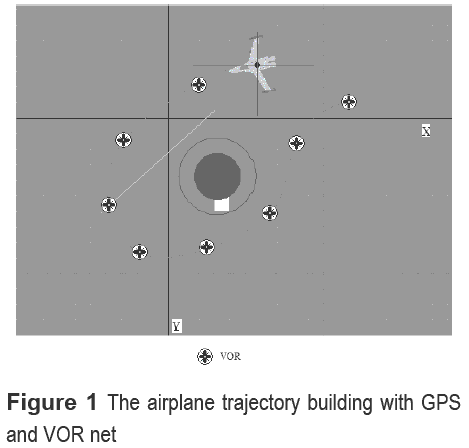
<body><![CDATA[<p><font face="Verdana" size="2">En este trabajo presentamos un m&eacute;todo para determinar la orientaci&oacute;n de un objeto con respecto al Polo Magn&eacute;tico utilizando la visi&oacute;n por computadora as&iacute; como las t&eacute;cnicas de identificaci&oacute;n, con respecto a la aguja de la br&uacute;jula. Condici&oacute;n necesaria dentro de los sistemas inteligentes con movimiento en lugar de las respuestas del GPS, ya que solo ubica al objeto dentro de una regi&oacute;n. Com&uacute;nmente, los sistemas inteligentes cuentan con herramientas de visi&oacute;n y las t&eacute;cnicas de identificaci&oacute;n y solo requieren obtener su posici&oacute;n con respecto a la aguja de la br&uacute;jula sin depender de una red de sat&eacute;lites o de objetos externos que indican su orientaci&oacute;n. El m&eacute;todo de orientaci&oacute;n inteligente se basa en el reconocimiento de im&aacute;genes para la manecilla roja de una br&uacute;jula y que al filtrar la imagen resultante se puede obtener el &aacute;ngulo que tiene la aguja, permitiendo conocer la orientaci&oacute;n del objeto.</font></p>       <p><font face="Verdana" size="2"><i>Palabras clave: </i>Visi&oacute;n por computadora, identificaci&oacute;n, br&uacute;jula, imagen RGB.</font></p>  <hr noshade size="1">      <p><font face="Verdana" size="3"><b>Introduction</b></font></p>       <p> <font face="Verdana" size="2">This paper demonstrates a  computer vision application with identification techniques in which the  computer understands the meaning of hand compass location. The compass, a  device used to determine geographical directions, usually consists of a  magnetic needle or needles, horizontally mounted or suspended, and free to  pivot until aligned with a Planet's magnetic field [1-3]. Autonomous mobile  robots need methods to obtain their location objective, commonly linked to  nearby environments [1], but in an actual technological situation, some of  them, have GPS (Global Positioning System) tools traveling around the world  autonomously [2]. However, what happens when the GPS system cannot operate  suitably? One solution is to show an application of computer vision to understand  the meaning of hand compass orientation for robot intelligent systems. For  example, the airplane viewed as intelligent system navigation is based in GPS,  and has limits with respect to trajectory changes. In this case, the  intelligent system considering the VOR (Very Omni-directional Range) net  indicates the trajectory as is illustrated in <a href="#Figura1">figure 1</a>.    <br>    <br>  The intelligent system  changes to a manual operation when it breaks communication with an airplane.  The compound tool has many technical limitations so that a normal hand compass  orientation methodology could be used as a tool in intelligent machines,  operating with internal computer vision and identification techniques.    <br>    <br>  The system used to locate  an airplane position on land is the GPS but its trajectory with aerodynamic  conditions, requires the VOR net system illustrated in <a href="#Figura1">figure 1</a>. The system  generated in this case is very complex. If one of these fails, the airplane  loses its trajectory, and has to change to manual mode, using compass location.  The airplane has a set of intelligent systems and identification techniques  which shutdown when there are external problems.</font></p>      <p align="center"><img src="/img/revistas/rfiua/n58/n58a20i01.gif" ><a name="Figura1"></a></p>      <p> <font face="Verdana" size="2">    ]]></body>
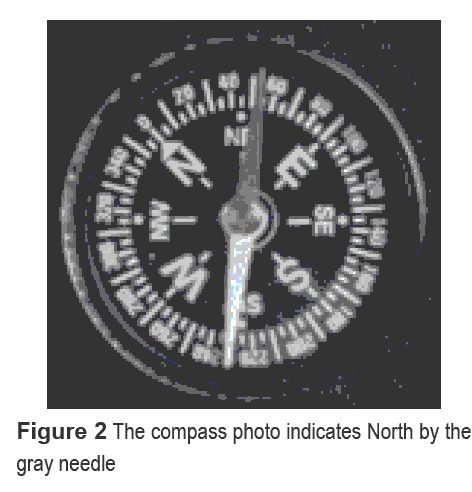
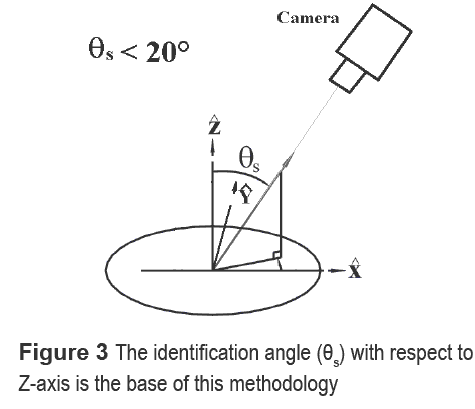
<body><![CDATA[<br>       <br>    <br>  Additionally this paper  focuses on an intelligent robot that needs to locate its position within any  solar system, which does not operate either GPS or VOR. It needs to determinate  the North Pole considering traditional magnetic hand compass directions, using  intelligent computer vision and identification techniques. The analysis  consists in: taking digital images of a compass identifying the needle that  determines the hand compass angle with respect to magnetic North. An example of  the images used in the experiment is shown in <a href="#Figura2">figure 2</a>, where the image has  resolution 1152 per 864 pixels. The black background and red needle, is  expressed in gray tones.    <br>    <br>      <p align="center"><img src="/img/revistas/rfiua/n58/n58a20i02.gif" ><a name="Figura2"></a></p>  This methodology works within limits  [4, 5]: the distance between the compass and the camera is variable and the  angle between the normal and the compass slope does not surpass 20 degrees, as  shown in <a href="#Figura3">figure 3</a>.</font></p>      <p>&nbsp;</p>      <p align="center"><img src="/img/revistas/rfiua/n58/n58a20i03.gif" ><a name="Figura3"></a></p>      <p> <font face="Verdana" size="2">    <br>       ]]></body>
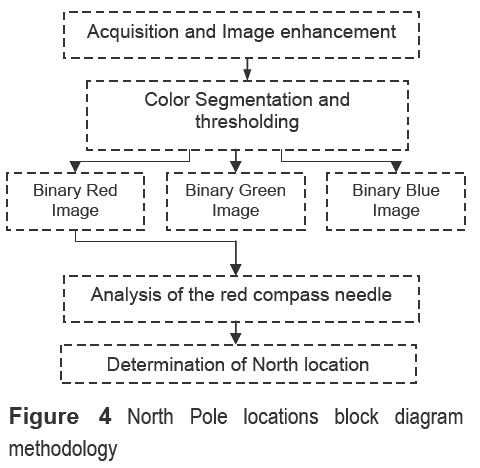
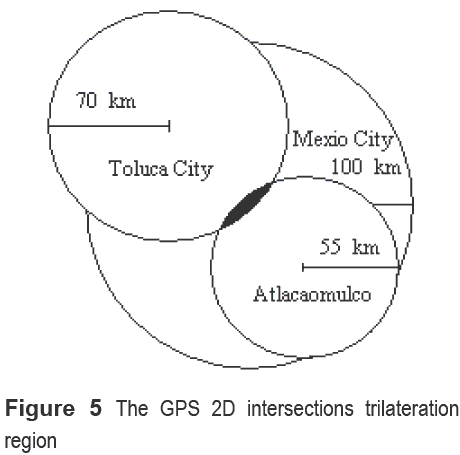
<body><![CDATA[<br>    <br>  For representative information of the  compass image there are many useful computer vision tools such as: image  enhancement methods, images thresholding, image segmentation and image analysis  [6-8]. Some of these tools have the objective to locate Magnetic North  considering the methodology proposed in <a href="#Figura4">figure 4</a>.</font></p>      <p align="center"><img src="/img/revistas/rfiua/n58/n58a20i04.gif" ><a name="Figura4"></a></p>      <p> <font face="Verdana" size="2"><b><i>Scenario for an intelligent robot approach</i></b></font></p>      <p> <font face="Verdana" size="2">The scenario described above is presented as a good option, but it is important to describe the efficiency of this method compared to GPS. First we describe how GPS works, and the environment in which an intelligent robot can act which is the same for GPS and the RTDM (Red Thresholding Discrimination Method). Both methods complement each other, giving an intelligent robot more autonomy when working in different environments and circumstances.</font></p>      <p><font face="Verdana" size="2"> GPS was first designed for  military purposes. The US Military developed and implemented a network using  satellites as a military navigation system around Earth, but soon opened it to  the public [9]. A GPS receiver's job is to locate four or more of these satellites,  figure the distance to each, and use this information to deduce its own  location. This operation, based on a simple mathematical principle called <i>trilateration</i> is illustrated in  <a href="#Figura5">figure 5</a>. It has been implemented in 2D and 3D scenarios [10]. First we explain  2D to give a general idea, and then 3D with the scenario of the intelligent  robot, showing its pros and cons. Finally the system will explain where and how  the gray TDM (Thresholding Discrimination Method) complements an intelligent  robot operation.</font></p>      <p align="center"><img src="/img/revistas/rfiua/n58/n58a20i05.gif" ><a name="Figura5"></a></p>      <p> <font face="Verdana" size="2">    <br>       <br>    ]]></body>
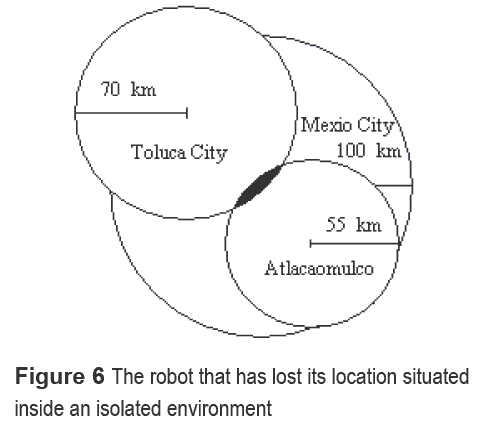
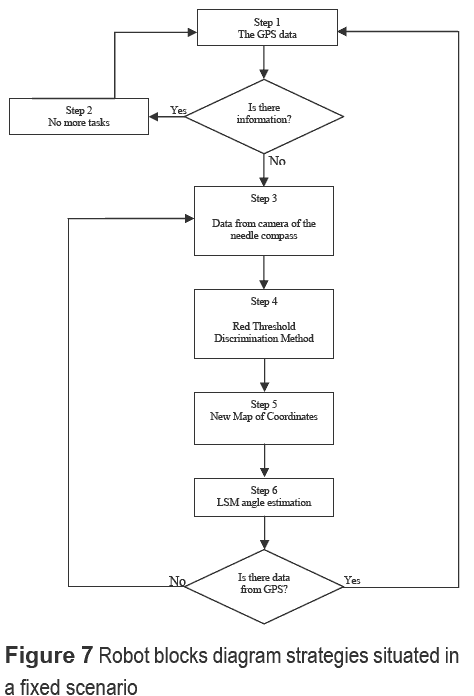
<body><![CDATA[<br>  The 2D intersections  trilateration allows locating an object, using three circles. For a 3D  scenario, the trilateration considered three intersected circles, obtaining the  zone location. The trilateration system applied to intelligent robots permits  autonomy in any field. The intelligent robot with defined end point trajectory,  selects its movements, with 2D or 3D information and criteria, to accomplish an  objective. The effect of weather conditions, noise, vibrations in a small room,  and the GSP will give wrong information, affecting the robot's location [11].  Therefore, the computer robot system requires intelligent algorithms, bounding  the disturbances and allowing the trajectory to accomplish its conditions. <a href="#Figura6">Figure 6</a> shows the situation where the robot is inside an isolated environment.    <br>    <br>      <p align="center"><img src="/img/revistas/rfiua/n58/n58a20i06.gif" ><a name="Figura6"></a></p>  RTDM avoids obstacles. It  is based on a hand compass registered by images, that permits the robot's  evolution trajectory, taking into account the last coordinates and the actual  location with respect to GLIM (Global Localization Image Map) described its  operations in a block diagram, such that the robot creates an intelligent  strategy situated in a fixed scenario (see example: [1, 12, 13]), as shown in  <a href="#Figura7">figure 7</a>.    <br>    <br>  This approach presents a  combination of two techniques; one is GPS and the other is RTDM giving a new  location [14].</font></p>       <p align="center"><img src="/img/revistas/rfiua/n58/n58a20i07.gif" ><a name="Figura7"></a></p>      <p>&nbsp;</p>     <br>      <p><font face="Verdana" size="3"><b>Experiment</b></font></p>       ]]></body>
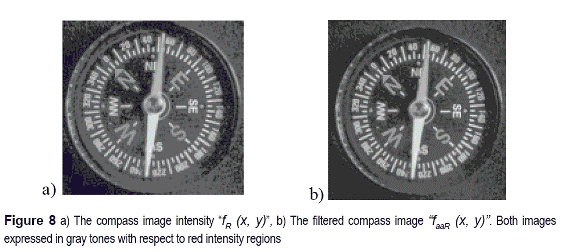
<body><![CDATA[<p> <font face="Verdana" size="2"><b><i>Image enhancement</i></b></font></p>      <p> <font face="Verdana" size="2">This experiment  necessitates enhancing the images eliminating noise at high frequency because  the camera is sensitive to high frequency noise and different illumination  qualitative, but before image filtering, it was necessary to observe an RGB  color image. Moreover, we can use each RGB color independently. So at the first  image processing stage we use the low pass filter as an <i>arithmetic averages filter</i> [15, 16].  For each RGB color we can obtain the intensity matrixes <i>f<sub>R</sub> (x, y), f<sub>G</sub> (x, y), f<sub>R</sub> (x, y), f<sub>B</sub> (x, y)</i>, respectively, as  shown in <a href="#Figura8">figure 8 a)</a>. Their deviations are described as equations described in  (1) and <a href="#Figura8">figure 8 b)</a>.</font></p>      <p> <img src="/img/revistas/rfiua/n58/n58a20e01.gif"></p>      <p> <font face="Verdana" size="2">Where <i>f<sub>aaR</sub>(x,y)</i> is the red  intensity image deviation, <i>f<sub>aaG</sub>(x,y)</i>  is the green, and <i>f<sub>aaB</sub>(x,y)</i>  is the blue and <i>n = 3</i> is the  filter kernel dimension applied for each RGB intensity matrix [17, 18]. For  example, <a href="#Figura8">figure 8 a)</a> shows the red image intensity, and <a href="#Figura8">figure 8 b)</a> shows the  filtered image, observing that the first image intensity has noises that affect  the contents.</font></p>      <p align="center"><img src="/img/revistas/rfiua/n58/n58a20i08.gif" ><a name="Figura8"></a></p>      <p> <font face="Verdana" size="2">    <br>       <br>    <br>  The same filter process  was used in green and blue functions described as equations <i>f<sub>aaG</sub></i> and <i>f<sub>aaB</sub></i>, respectively.</font></p>      <p> <font face="Verdana" size="2"><b><i>Color image thresholding</i></b></font></p>      ]]></body>
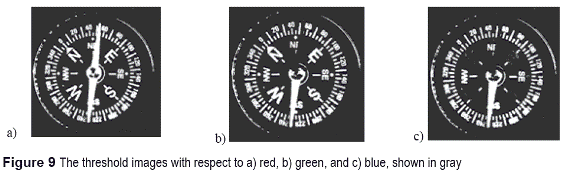
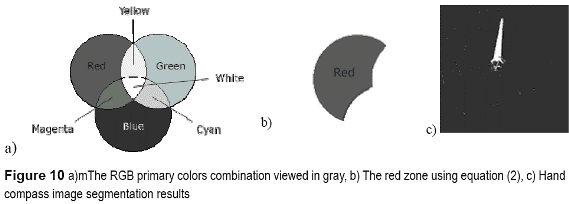
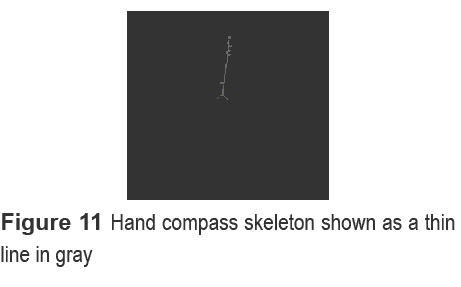
<body><![CDATA[<p> <font face="Verdana" size="2">At this stage we prepared  the object's separation in RGB image [15] to isolate the object of interest. We  are interested in finding the hand compass location. First we have to get the  hand compass information, and color separation images. The North pointer is  red, so first we have to make red color segmentation and we propose a simple  method segmentation process after the thresholding stage. So we implemented of  Otsu's method [6, 8]. We got three compass binary images: red, green, and blue,  as shown in <a href="#Figura9">figure 9 a)</a>, <a href="#Figura9">figure 9 b)</a> and, <a href="#Figura9">figure 9 c)</a>, respectively. An  important aspect we must observe is that white needle has a considerable amount  of red, green, and blue. The white pointers appear in the red, green, and blue  threshold images.</font></p>      <p align="center"><img src="/img/revistas/rfiua/n58/n58a20i09.gif" ><a name="Figura9"></a></p>      <p> <font face="Verdana" size="2"><b><i>Images segmentation</i></b></font></p>      <p> <font face="Verdana" size="2">At this stage, we isolated the  studied RGB image compass colors, shown in <a href="#Figura10">figure 10 a)</a>. Finding the red handle  color expressed symbolically as <i>red<sub>pure</sub></i>  in base to equation (2).</font></p>      <p> <img src="/img/revistas/rfiua/n58/n58a20e02.gif"></p>      <p> <font face="Verdana" size="2">The results with respect  equation (2) correspond to the zone shown in <a href="#Figura10">figure 10 b)</a>. Equation (2) allows  generate red pointers in the compass image. Therefore, the computer obtains the  image shown in <a href="#Figura10">figure 10 c)</a>, expressed in gray.</font></p>      <p align="center"><img src="/img/revistas/rfiua/n58/n58a20i10.gif" ><a name="Figura10"></a></p>      <p> <font face="Verdana" size="2"><b><i>ISkeletonization</i></b></font></p>      <p> <font face="Verdana" size="2">At this stage we obtained the mean line according  to the segmented image in <a href="#Figura9">figure 9 c)</a>, using techniques exposed in [14]  considering it removes pixels from object boundaries but does not allow objects  to separate. The pixels remaining make up the image skeleton as illustrated in  <a href="#Figura11">figure 11</a>. This option conserves the Euler number [6, 19].</font></p>     <p align="center"><img src="/img/revistas/rfiua/n58/n58a20i11.gif" ><a name="Figura11"></a></p>     ]]></body>
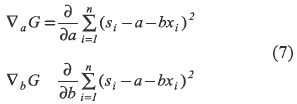
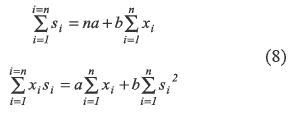
<body><![CDATA[<p> <font face="Verdana" size="2"><i>Angle estimation using Least Squares Method</i></font></p>      <p> <font face="Verdana" size="2">To estimate the compass  hand angle, we consider the skeleton points (see <a href="#Figura11">figure 11 c)</a>). Therefore, the  skeleton point set is expressed as {<em>s<sub>i</sub></em>:=  (<em>x<sub>i</sub>, y<sub>i</sub></em> )} &sube; R<sup>2</sup><sub>[1,n]</sub> with <i>i &isin; N</i>.    <br>         <br>  <i>Theorem 1</i>. Consider the function <i>f</i>(<i>x<sub>i</sub></i>) = a + <i>bx<sub>i</sub></i>, <i>f</i>(<i>x<sub>i</sub></i>) &isin; <i>R</i> that described the sequence of <i>s<sub>i</sub></i>. . The parameters estimation  is optimal and has the form <img src="/img/revistas/rfiua/n58/n58a20e03.gif"> and <img src="/img/revistas/rfiua/n58/n58a20e04.gif"></font></p>        <p><font face="Verdana" size="2">    <br>       <br>    <br>  <i>Proof 1</i>.  The functional error in discrete form is described by the second probability  moment</font></p>      <p> <img src="/img/revistas/rfiua/n58/n58a20e05.gif"></p>      <p> <font face="Verdana" size="2">Substituting the proposed function in equation (5):</font></p>      ]]></body>
<body><![CDATA[<p> <img src="/img/revistas/rfiua/n58/n58a20e06.gif"></p>      <p> <font face="Verdana" size="2">Where <i>&alpha;</i> and <i>b</i> are unknown parameters, with respect to the trajectory depicted by the skeleton  points sequence. In this sense, the gradients of equation (6) respect both  parameters:</font></p>      <p> <img src="/img/revistas/rfiua/n58/n58a20e07.gif"></p>      <p> <font face="Verdana" size="2">Simplifying the expressions considered in equations contained in (7):</font></p>      <p> <img src="/img/revistas/rfiua/n58/n58a20e08.gif"></p>      <p> <font face="Verdana" size="2">The equations contained in (8) are symbolically expressed as:</font></p>      <p> <img src="/img/revistas/rfiua/n58/n58a20e09.gif"></p>      <p> <font face="Verdana" size="2">The analytical parameters in base to equations contained in (9) have the forms:</font></p>      <p> <img src="/img/revistas/rfiua/n58/n58a20e10.gif"></p>      <p> <font face="Verdana" size="2"><i>Theorem 2</i>. The recursive functional error has the form:</font></p>      ]]></body>
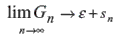
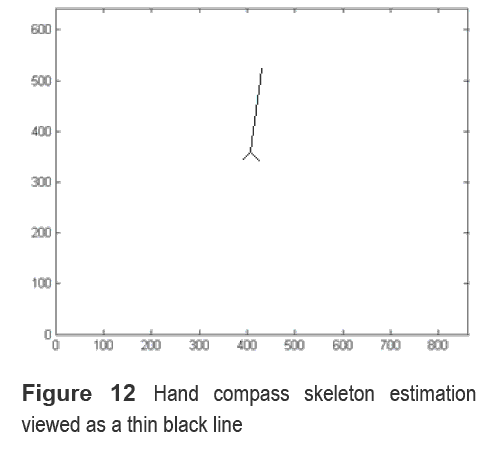
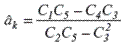
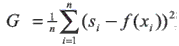
<body><![CDATA[<p> <img src="/img/revistas/rfiua/n58/n58a20e11.gif"></p>      <p> <font face="Verdana" size="2">Converge in AAP (Almost All Points) to <img src="/img/revistas/rfiua/n58/n58a20e11a.gif">    <br>    <br>  <i>Proof 2</i>. Considering the basic mathematical expression  </font></p>      <p> <img src="/img/revistas/rfiua/n58/n58a20e12.gif"></p>      <p> <font face="Verdana" size="2">According to [20, 21], <i>G<sub>n</sub></i> integrated by {<i>s<sub>i</sub></i> = <i>&mu;</i>(<i>x<sub>i</sub>, y<sub>i</sub></i>)  &lt;<i>&infin;, i = 1,n, n</i> &isin; Z<sub>+</sub> } as a metric sequences set in <i>L<sub>2</sub></i>, expressed as a group of  radio vectors in &zeta;G . The second probability  moment with respect to error identification <img src="/img/revistas/rfiua/n58/n58a20e12a.gif">, has a recursive form for  stationary conditions expressed in equation (11), and the sequence converges in  AAP , i.e.,&nbsp; <img src="/img/revistas/rfiua/n58/n58a20e12b.gif"> in agreement to optimal parameters results considered as equations contained in (10).    <br>    <br>  <i>Theorem 3</i>. According to camera reference point, the relative axes system is within a relative scope defined as an analytical technique:  </font></p>      <p> <img src="/img/revistas/rfiua/n58/n58a20e13.gif"></p>      <p> <font face="Verdana" size="2">Where: <em>&acirc;</em><em>k</em> is the camera relative scope and, <em>b</em><em>k</em> is the hand compass  scope. This means that <em>&acirc;</em><em>k</em> &nbsp;is a relative angular moving with respect to  the camera axes.    ]]></body>

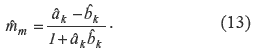
<body><![CDATA[<br>    <br>  <i>Proof 3</i>. The relative angular position considered in [5, 13, 17] ,  expressed as <em>m<sub>m</sub></em> is a  functional of unknown camera relative and hand compass scopes, described in  equations contained in (10), so that, the hand scopes estimation converge in  AAP in a agreement to theorem 2, obtaining equation (13).    <br>    <br>  Therefore, the relative  angle with respect to magnetic North according to the relative axes camera  position considered in equation (13) is depicted in <a href="#Figura12">figure 12 c)</a> showing the  identified line scope <i>bk</i>.    <br>    <br>     <p align="center"><img src="/img/revistas/rfiua/n58/n58a20i12.gif" ><a name="Figura12"></a></p>  The relative scope after  identifying the thin black line with respect to equation (13) based on equations  contained in (10), had a positive angle, and described as 4 grades deviation  with respect to Magnetic North.</font></p>      <p><font face="Verdana" size="3"><b>Conclusion</b></font></p>       <p> <font face="Verdana" size="2">In this paper we developed  an intelligent orientation methodology that could be used by intelligent  machines automatically locating Magnetic North, without considering an external  information system. The combination of identification stochastic techniques and  traditional computer vision, showed the slope as a thin black line, illustrated  in <a href="#Figura12">figure 12</a>, corresponding to equation (13).</font></p>        <p><font face="Verdana" size="2"> In future works we will  focus on expanding the dynamic location between different time intervals,  considering Nyquist restrictions.</font></p>      ]]></body>
<body><![CDATA[<p><font face="Verdana" size="3"><b>References</b></font></p>       <!-- ref --><p> <font face="Verdana" size="2">1. A. Ollero. <i>Rob&oacute;tica, manipuladores y robots m&oacute;viles</i>. Ed. Marcombo. Barcelona. 2001.  pp. 8-11.    &nbsp;&nbsp;&nbsp;&nbsp;&nbsp;&nbsp;&nbsp;&nbsp;[&#160;<a href="javascript:void(0);" onclick="javascript: window.open('/scielo.php?script=sci_nlinks&ref=000114&pid=S0120-6230201100020002000001&lng=','','width=640,height=500,resizable=yes,scrollbars=1,menubar=yes,');">Links</a>&#160;]<!-- end-ref --><br>    <!-- ref --><br>  2. O. Khatib, V. Kumar, D.  Rus. &quot;Robust GPS/INS-Aided Localization and Mapping via GPS Bias  Estimation&quot;. <i>The 10th International  Symposium on Experimental Robotics</i>. Brazil, 2008. pp. 1-2.    &nbsp;&nbsp;&nbsp;&nbsp;&nbsp;&nbsp;&nbsp;&nbsp;[&#160;<a href="javascript:void(0);" onclick="javascript: window.open('/scielo.php?script=sci_nlinks&ref=000116&pid=S0120-6230201100020002000002&lng=','','width=640,height=500,resizable=yes,scrollbars=1,menubar=yes,');">Links</a>&#160;]<!-- end-ref --><br>    <!-- ref --><br>  3. W. H. Hayt. <i>Teor&iacute;a electromagn&eacute;tica</i>. Ed. Mc Graw  Hill. Mexico. 2003. pp. 330-340.    &nbsp;&nbsp;&nbsp;&nbsp;&nbsp;&nbsp;&nbsp;&nbsp;[&#160;<a href="javascript:void(0);" onclick="javascript: window.open('/scielo.php?script=sci_nlinks&ref=000118&pid=S0120-6230201100020002000003&lng=','','width=640,height=500,resizable=yes,scrollbars=1,menubar=yes,');">Links</a>&#160;]<!-- end-ref --><br>    <!-- ref --><br>  4. R. Hartley.  A. Zisserman. <i>Multiple View Geometry in Computer Vision</i>. Ed. Cambridge  University Press. Canberra (Australia). 2003. pp. 151-178.    &nbsp;&nbsp;&nbsp;&nbsp;&nbsp;&nbsp;&nbsp;&nbsp;[&#160;<a href="javascript:void(0);" onclick="javascript: window.open('/scielo.php?script=sci_nlinks&ref=000120&pid=S0120-6230201100020002000004&lng=','','width=640,height=500,resizable=yes,scrollbars=1,menubar=yes,');">Links</a>&#160;]<!-- end-ref --><br>    <!-- ref --><br>  5. K. Voss, J. L  Marroquin, S. J. Guti&eacute;rrez, H. Suesse. <i>An&aacute;lisis  de Im&aacute;genes de Objetos Tridimensionales</i>. Ed. Polytechnic. Mexico.  2006. pp. 49-74.    &nbsp;&nbsp;&nbsp;&nbsp;&nbsp;&nbsp;&nbsp;&nbsp;[&#160;<a href="javascript:void(0);" onclick="javascript: window.open('/scielo.php?script=sci_nlinks&ref=000122&pid=S0120-6230201100020002000005&lng=','','width=640,height=500,resizable=yes,scrollbars=1,menubar=yes,');">Links</a>&#160;]<!-- end-ref --><br>    <!-- ref --><br>  6. J. H. Sossa. <i>Rasgos Descriptores para el reconocimiento de Objetos</i>. Ed. Polytechnic. Mexico. 2006. pp. 10-30.    &nbsp;&nbsp;&nbsp;&nbsp;&nbsp;&nbsp;&nbsp;&nbsp;[&#160;<a href="javascript:void(0);" onclick="javascript: window.open('/scielo.php?script=sci_nlinks&ref=000124&pid=S0120-6230201100020002000006&lng=','','width=640,height=500,resizable=yes,scrollbars=1,menubar=yes,');">Links</a>&#160;]<!-- end-ref --><br>    <!-- ref --><br>  7. M. Works. <i>Image Processing Toolbox for use with Matlab User's  Guide</i>. 2003. pp. 7/0- 7/ 11.    &nbsp;&nbsp;&nbsp;&nbsp;&nbsp;&nbsp;&nbsp;&nbsp;[&#160;<a href="javascript:void(0);" onclick="javascript: window.open('/scielo.php?script=sci_nlinks&ref=000126&pid=S0120-6230201100020002000007&lng=','','width=640,height=500,resizable=yes,scrollbars=1,menubar=yes,');">Links</a>&#160;]<!-- end-ref --><br>    <!-- ref --><br>  8. N. Otsu. &quot;A  threshold selection method from gray level histograms&quot;. <i>IEEE Transactions on Systems. Man, and Cybernetics</i>.  Vol. 9. 1979. pp. 62-66.    &nbsp;&nbsp;&nbsp;&nbsp;&nbsp;&nbsp;&nbsp;&nbsp;[&#160;<a href="javascript:void(0);" onclick="javascript: window.open('/scielo.php?script=sci_nlinks&ref=000128&pid=S0120-6230201100020002000008&lng=','','width=640,height=500,resizable=yes,scrollbars=1,menubar=yes,');">Links</a>&#160;]<!-- end-ref --><br>    <!-- ref --><br>  9. W. J. Lewandowski, W. Azoubib,  J. Klepczynski. &quot;GPS: primary tool for time transfer&quot;. <i>Proceedings of the IEEE</i>. Vol. 87. 1999.  pp. 163-172.    &nbsp;&nbsp;&nbsp;&nbsp;&nbsp;&nbsp;&nbsp;&nbsp;[&#160;<a href="javascript:void(0);" onclick="javascript: window.open('/scielo.php?script=sci_nlinks&ref=000130&pid=S0120-6230201100020002000009&lng=','','width=640,height=500,resizable=yes,scrollbars=1,menubar=yes,');">Links</a>&#160;]<!-- end-ref --><br>    <!-- ref --><br>  10. S. J. Peczalski, A.  Kriz, J. Carlson, S. G. Sampson. &quot;Military/civilian mixed-mode Global  Positioning System (GPS) receiver (MMGR)&quot;. <i>Aerospace Conference IEEE</i>. Vol. 4.  2004. pp. 2697- 2703.    &nbsp;&nbsp;&nbsp;&nbsp;&nbsp;&nbsp;&nbsp;&nbsp;[&#160;<a href="javascript:void(0);" onclick="javascript: window.open('/scielo.php?script=sci_nlinks&ref=000132&pid=S0120-6230201100020002000010&lng=','','width=640,height=500,resizable=yes,scrollbars=1,menubar=yes,');">Links</a>&#160;]<!-- end-ref --><br>    <!-- ref --><br>  11. G. Bullock, J. B.  King, T. M. Kennedy, H. L. Berry, E. D. Zanfino. &quot;Test results and  analysis of a low cost core GPS receiver for time transfer applications&quot;. <i>Frequency Control Symposium. Proceedings of the 1997  IEEE International</i>. Vol. 28. 1997. pp. 314-322.    &nbsp;&nbsp;&nbsp;&nbsp;&nbsp;&nbsp;&nbsp;&nbsp;[&#160;<a href="javascript:void(0);" onclick="javascript: window.open('/scielo.php?script=sci_nlinks&ref=000134&pid=S0120-6230201100020002000011&lng=','','width=640,height=500,resizable=yes,scrollbars=1,menubar=yes,');">Links</a>&#160;]<!-- end-ref --><br>    <!-- ref --><br>  12. G. A. I. Barranco. <i>Sistema Mecatr&oacute;nico Controlado Telem&aacute;ticamente</i>.  Ed.  Polytechnic. Mexico. 2006. pp. 10-12.    &nbsp;&nbsp;&nbsp;&nbsp;&nbsp;&nbsp;&nbsp;&nbsp;[&#160;<a href="javascript:void(0);" onclick="javascript: window.open('/scielo.php?script=sci_nlinks&ref=000136&pid=S0120-6230201100020002000012&lng=','','width=640,height=500,resizable=yes,scrollbars=1,menubar=yes,');">Links</a>&#160;]<!-- end-ref --><br>    <!-- ref --><br>  13. G. A. I.  Barranco. J. J. Medel. <i>Visi&oacute;n estereosc&oacute;pica por computadora</i>. Ed. Polytechnic. M&eacute;xico. 2007. pp. 1-4.    &nbsp;&nbsp;&nbsp;&nbsp;&nbsp;&nbsp;&nbsp;&nbsp;[&#160;<a href="javascript:void(0);" onclick="javascript: window.open('/scielo.php?script=sci_nlinks&ref=000138&pid=S0120-6230201100020002000013&lng=','','width=640,height=500,resizable=yes,scrollbars=1,menubar=yes,');">Links</a>&#160;]<!-- end-ref --><br>    <!-- ref --><br>  14. B. Espiau. &quot;A New  Approach To Visual Servoing In Robotics&quot;. <i>IEEE Transactions in Robotics and Automation</i>.  Vol. 18. 1992. pp. 313-326.    &nbsp;&nbsp;&nbsp;&nbsp;&nbsp;&nbsp;&nbsp;&nbsp;[&#160;<a href="javascript:void(0);" onclick="javascript: window.open('/scielo.php?script=sci_nlinks&ref=000140&pid=S0120-6230201100020002000014&lng=','','width=640,height=500,resizable=yes,scrollbars=1,menubar=yes,');">Links</a>&#160;]<!-- end-ref --><br>    <!-- ref --><br>  15. G. Ritter, J. Wilson. <i>Handbook of Computer Vision Algorithms in Image Algebra</i>.  Ed. ITK knowledge. 1996. pp. 125-158.    &nbsp;&nbsp;&nbsp;&nbsp;&nbsp;&nbsp;&nbsp;&nbsp;[&#160;<a href="javascript:void(0);" onclick="javascript: window.open('/scielo.php?script=sci_nlinks&ref=000142&pid=S0120-6230201100020002000015&lng=','','width=640,height=500,resizable=yes,scrollbars=1,menubar=yes,');">Links</a>&#160;]<!-- end-ref --><br>    <!-- ref --><br>  16. O. Faugeras, F.  Lustman. &quot;Motion and Structure from Motion in a Piecewise Planar  Environments&quot;. <i>Proceedings of the 8th WSEAS  International Conference on Computer Vision. INRIA France</i>. Vol.  1. 1988. pp. 2-4.    &nbsp;&nbsp;&nbsp;&nbsp;&nbsp;&nbsp;&nbsp;&nbsp;[&#160;<a href="javascript:void(0);" onclick="javascript: window.open('/scielo.php?script=sci_nlinks&ref=000144&pid=S0120-6230201100020002000016&lng=','','width=640,height=500,resizable=yes,scrollbars=1,menubar=yes,');">Links</a>&#160;]<!-- end-ref --><br>    <!-- ref --><br>  17. J. Lira. <i>Introducci&oacute;n al tratamiento digital de im&aacute;genes</i>.  Ed.  Polytechnic. Mexico. 2002. pp. 219&shy;336.    &nbsp;&nbsp;&nbsp;&nbsp;&nbsp;&nbsp;&nbsp;&nbsp;[&#160;<a href="javascript:void(0);" onclick="javascript: window.open('/scielo.php?script=sci_nlinks&ref=000146&pid=S0120-6230201100020002000017&lng=','','width=640,height=500,resizable=yes,scrollbars=1,menubar=yes,');">Links</a>&#160;]<!-- end-ref --><br>    <!-- ref --><br>  18. E. Trucco, A. Verri. <i>Introductory Techniques for 3d Computer Vision</i>.  Ed.  Prentice Hall. Gen&egrave;ve (Italy) 1998. pp. 220-292.    &nbsp;&nbsp;&nbsp;&nbsp;&nbsp;&nbsp;&nbsp;&nbsp;[&#160;<a href="javascript:void(0);" onclick="javascript: window.open('/scielo.php?script=sci_nlinks&ref=000148&pid=S0120-6230201100020002000018&lng=','','width=640,height=500,resizable=yes,scrollbars=1,menubar=yes,');">Links</a>&#160;]<!-- end-ref --><br>    <!-- ref --><br>  19. P. Gonz&aacute;les,  J. M. De la Cruz. <i>Visi&oacute;n por computador</i>. Ed.  AlfaOmega RaMa. Madrid 2004. pp. 65-294.    &nbsp;&nbsp;&nbsp;&nbsp;&nbsp;&nbsp;&nbsp;&nbsp;[&#160;<a href="javascript:void(0);" onclick="javascript: window.open('/scielo.php?script=sci_nlinks&ref=000150&pid=S0120-6230201100020002000019&lng=','','width=640,height=500,resizable=yes,scrollbars=1,menubar=yes,');">Links</a>&#160;]<!-- end-ref --><br>    <!-- ref --><br>  20. D. Poole. <i>Algebra Lineal: Una introducci&oacute;n moderna</i>. Ed. Thompson. M&eacute;xico. 2007.  pp. 577-590.    &nbsp;&nbsp;&nbsp;&nbsp;&nbsp;&nbsp;&nbsp;&nbsp;[&#160;<a href="javascript:void(0);" onclick="javascript: window.open('/scielo.php?script=sci_nlinks&ref=000152&pid=S0120-6230201100020002000020&lng=','','width=640,height=500,resizable=yes,scrollbars=1,menubar=yes,');">Links</a>&#160;]<!-- end-ref --><br>    <!-- ref --><br>  21. G. A. I. Barranco., J.  J. Medel., &quot;Digital Camera Calibration Analysis using Perspective  Projection Matrix&quot;. <i>Proceedings of the 8th WSEAS International Conference on signal processing,  robotics and automation</i>. 2009. pp. 321-325.</font>&nbsp;&nbsp;&nbsp;&nbsp;&nbsp;&nbsp;&nbsp;&nbsp;[&#160;<a href="javascript:void(0);" onclick="javascript: window.open('/scielo.php?script=sci_nlinks&ref=000154&pid=S0120-6230201100020002000021&lng=','','width=640,height=500,resizable=yes,scrollbars=1,menubar=yes,');">Links</a>&#160;]<!-- end-ref --><br>    <br>    <br>       <p><font face="Verdana" size="2">(Recibido el 21 de septiembre de 2009. Aceptado el 30 de noviembre de 2010)</font></p>     <p><font face="Verdana" size="2"><sup>*</sup>Autor de correspondencia: tel&eacute;fono: + 52 + 57 29 60 00, fax: + 52 + 53 95 41 47, correo electr&oacute;nico: <a href="mailto:barranco_alejandro@yahoo.com.mx">barranco_alejandro@yahoo.com.mx</a> (A. I. Barranco)</font></p>      ]]></body><back>
<ref-list>
<ref id="B1">
<label>1</label><nlm-citation citation-type="book">
<person-group person-group-type="author">
<name>
<surname><![CDATA[Ollero]]></surname>
<given-names><![CDATA[A]]></given-names>
</name>
</person-group>
<source><![CDATA[Robótica, manipuladores y robots móviles]]></source>
<year>2001</year>
<page-range>8-11</page-range><publisher-loc><![CDATA[Barcelona ]]></publisher-loc>
<publisher-name><![CDATA[Ed. Marcombo]]></publisher-name>
</nlm-citation>
</ref>
<ref id="B2">
<label>2</label><nlm-citation citation-type="confpro">
<person-group person-group-type="author">
<name>
<surname><![CDATA[Khatib]]></surname>
<given-names><![CDATA[O]]></given-names>
</name>
<name>
<surname><![CDATA[Kumar]]></surname>
<given-names><![CDATA[V]]></given-names>
</name>
<name>
<surname><![CDATA[Rus]]></surname>
<given-names><![CDATA[D]]></given-names>
</name>
</person-group>
<source><![CDATA[Robust GPS/INS-Aided Localization and Mapping via GPS Bias Estimation]]></source>
<year></year>
<conf-name><![CDATA[10 International Symposium on Experimental Robotics]]></conf-name>
<conf-date>2008</conf-date>
<conf-loc> </conf-loc>
<page-range>1-2</page-range></nlm-citation>
</ref>
<ref id="B3">
<label>3</label><nlm-citation citation-type="book">
<person-group person-group-type="author">
<name>
<surname><![CDATA[Hayt]]></surname>
<given-names><![CDATA[W. H]]></given-names>
</name>
</person-group>
<source><![CDATA[Teoría electromagnética]]></source>
<year>2003</year>
<page-range>330-340</page-range><publisher-loc><![CDATA[Mexico ]]></publisher-loc>
<publisher-name><![CDATA[Ed. Mc Graw Hill]]></publisher-name>
</nlm-citation>
</ref>
<ref id="B4">
<label>4</label><nlm-citation citation-type="book">
<person-group person-group-type="author">
<name>
<surname><![CDATA[Hartley]]></surname>
<given-names><![CDATA[R]]></given-names>
</name>
<name>
<surname><![CDATA[Zisserman]]></surname>
<given-names><![CDATA[A]]></given-names>
</name>
</person-group>
<source><![CDATA[Multiple View Geometry in Computer Vision]]></source>
<year>2003</year>
<page-range>151-178</page-range><publisher-loc><![CDATA[Canberra ]]></publisher-loc>
<publisher-name><![CDATA[Ed. Cambridge University Press]]></publisher-name>
</nlm-citation>
</ref>
<ref id="B5">
<label>5</label><nlm-citation citation-type="book">
<person-group person-group-type="author">
<name>
<surname><![CDATA[Voss]]></surname>
<given-names><![CDATA[K]]></given-names>
</name>
<name>
<surname><![CDATA[Marroquin]]></surname>
<given-names><![CDATA[J. L]]></given-names>
</name>
<name>
<surname><![CDATA[Gutiérrez]]></surname>
<given-names><![CDATA[S. J]]></given-names>
</name>
<name>
<surname><![CDATA[Suesse]]></surname>
<given-names><![CDATA[H]]></given-names>
</name>
</person-group>
<source><![CDATA[Análisis de Imágenes de Objetos Tridimensionales]]></source>
<year>2006</year>
<page-range>49-74</page-range><publisher-loc><![CDATA[Mexico ]]></publisher-loc>
<publisher-name><![CDATA[Ed. Polytechnic]]></publisher-name>
</nlm-citation>
</ref>
<ref id="B6">
<label>6</label><nlm-citation citation-type="book">
<person-group person-group-type="author">
<name>
<surname><![CDATA[Sossa]]></surname>
<given-names><![CDATA[J. H]]></given-names>
</name>
</person-group>
<source><![CDATA[Rasgos Descriptores para el reconocimiento de Objetos]]></source>
<year>2006</year>
<page-range>10-30</page-range><publisher-loc><![CDATA[Mexico ]]></publisher-loc>
<publisher-name><![CDATA[Polytechnic]]></publisher-name>
</nlm-citation>
</ref>
<ref id="B7">
<label>7</label><nlm-citation citation-type="">
<person-group person-group-type="author">
<name>
<surname><![CDATA[Works]]></surname>
<given-names><![CDATA[M]]></given-names>
</name>
</person-group>
<source><![CDATA[Image Processing Toolbox for use with Matlab User's Guide]]></source>
<year>2003</year>
</nlm-citation>
</ref>
<ref id="B8">
<label>8</label><nlm-citation citation-type="journal">
<person-group person-group-type="author">
<name>
<surname><![CDATA[Otsu]]></surname>
<given-names><![CDATA[N]]></given-names>
</name>
</person-group>
<article-title xml:lang="en"><![CDATA[A threshold selection method from gray level histograms]]></article-title>
<source><![CDATA[IEEE Transactions on Systems. Man, and Cybernetics]]></source>
<year>1979</year>
<volume>9</volume>
<page-range>62-66</page-range></nlm-citation>
</ref>
<ref id="B9">
<label>9</label><nlm-citation citation-type="journal">
<person-group person-group-type="author">
<name>
<surname><![CDATA[Lewandowski]]></surname>
<given-names><![CDATA[W. J]]></given-names>
</name>
<name>
<surname><![CDATA[Azoubib]]></surname>
<given-names><![CDATA[W]]></given-names>
</name>
<name>
<surname><![CDATA[Klepczynski]]></surname>
<given-names><![CDATA[J]]></given-names>
</name>
</person-group>
<article-title xml:lang="en"><![CDATA[GPS: primary tool for time transfer]]></article-title>
<source><![CDATA[Proceedings of the IEEE]]></source>
<year>1999</year>
<volume>87</volume>
<page-range>163-172</page-range></nlm-citation>
</ref>
<ref id="B10">
<label>10</label><nlm-citation citation-type="journal">
<person-group person-group-type="author">
<name>
<surname><![CDATA[Peczalski]]></surname>
<given-names><![CDATA[S. J]]></given-names>
</name>
<name>
<surname><![CDATA[Kriz]]></surname>
<given-names><![CDATA[A]]></given-names>
</name>
<name>
<surname><![CDATA[Carlson]]></surname>
<given-names><![CDATA[J]]></given-names>
</name>
<name>
<surname><![CDATA[Sampson]]></surname>
<given-names><![CDATA[S. G]]></given-names>
</name>
</person-group>
<article-title xml:lang="en"><![CDATA[Military/civilian mixed-mode Global Positioning System (GPS) receiver (MMGR)]]></article-title>
<source><![CDATA[Aerospace Conference IEEE]]></source>
<year>2004</year>
<volume>4</volume>
<page-range>2697- 2703</page-range></nlm-citation>
</ref>
<ref id="B11">
<label>11</label><nlm-citation citation-type="journal">
<person-group person-group-type="author">
<name>
<surname><![CDATA[Bullock]]></surname>
<given-names><![CDATA[G]]></given-names>
</name>
<name>
<surname><![CDATA[King]]></surname>
<given-names><![CDATA[J. B]]></given-names>
</name>
<name>
<surname><![CDATA[Kennedy]]></surname>
<given-names><![CDATA[T. M]]></given-names>
</name>
<name>
<surname><![CDATA[Berry]]></surname>
<given-names><![CDATA[H. L]]></given-names>
</name>
<name>
<surname><![CDATA[Zanfino]]></surname>
<given-names><![CDATA[E. D]]></given-names>
</name>
</person-group>
<article-title xml:lang="en"><![CDATA[Test results and analysis of a low cost core GPS receiver for time transfer applications]]></article-title>
<source><![CDATA[Frequency Control Symposium. Proceedings of the 1997 IEEE International]]></source>
<year>1997</year>
<volume>28</volume>
<page-range>314-322</page-range></nlm-citation>
</ref>
<ref id="B12">
<label>12</label><nlm-citation citation-type="book">
<person-group person-group-type="author">
<name>
<surname><![CDATA[Barranco]]></surname>
<given-names><![CDATA[G. A. I]]></given-names>
</name>
</person-group>
<source><![CDATA[Sistema Mecatrónico Controlado Telemáticamente]]></source>
<year>2006</year>
<page-range>10-12</page-range><publisher-loc><![CDATA[Mexico ]]></publisher-loc>
<publisher-name><![CDATA[Ed. Polytechnic]]></publisher-name>
</nlm-citation>
</ref>
<ref id="B13">
<label>13</label><nlm-citation citation-type="book">
<person-group person-group-type="author">
<name>
<surname><![CDATA[Barranco]]></surname>
<given-names><![CDATA[G. A. I]]></given-names>
</name>
<name>
<surname><![CDATA[Medel]]></surname>
<given-names><![CDATA[J. J]]></given-names>
</name>
</person-group>
<source><![CDATA[Visión estereoscópica por computadora]]></source>
<year>2007</year>
<page-range>1-4</page-range><publisher-loc><![CDATA[México ]]></publisher-loc>
<publisher-name><![CDATA[Ed. Polytechnic]]></publisher-name>
</nlm-citation>
</ref>
<ref id="B14">
<label>14</label><nlm-citation citation-type="journal">
<person-group person-group-type="author">
<name>
<surname><![CDATA[Espiau]]></surname>
<given-names><![CDATA[B]]></given-names>
</name>
</person-group>
<article-title xml:lang="en"><![CDATA[A New Approach To Visual Servoing In Robotics]]></article-title>
<source><![CDATA[IEEE Transactions in Robotics and Automation]]></source>
<year>1992</year>
<volume>18</volume>
<page-range>313-326</page-range></nlm-citation>
</ref>
<ref id="B15">
<label>15</label><nlm-citation citation-type="book">
<person-group person-group-type="author">
<name>
<surname><![CDATA[Ritter]]></surname>
<given-names><![CDATA[G]]></given-names>
</name>
<name>
<surname><![CDATA[Wilson]]></surname>
<given-names><![CDATA[J]]></given-names>
</name>
</person-group>
<source><![CDATA[Handbook of Computer Vision Algorithms in Image Algebra]]></source>
<year>1996</year>
<page-range>125-158</page-range><publisher-name><![CDATA[Ed. ITK knowledge]]></publisher-name>
</nlm-citation>
</ref>
<ref id="B16">
<label>16</label><nlm-citation citation-type="confpro">
<person-group person-group-type="author">
<name>
<surname><![CDATA[Faugeras]]></surname>
<given-names><![CDATA[O]]></given-names>
</name>
<name>
<surname><![CDATA[Lustman]]></surname>
<given-names><![CDATA[F]]></given-names>
</name>
</person-group>
<source><![CDATA[Motion and Structure from Motion in a Piecewise Planar Environments]]></source>
<year>1988</year>
<volume>1</volume>
<conf-name><![CDATA[8 WSEAS International Conference on Computer Vision]]></conf-name>
<conf-loc> </conf-loc>
<page-range>2-4</page-range></nlm-citation>
</ref>
<ref id="B17">
<label>17</label><nlm-citation citation-type="book">
<person-group person-group-type="author">
<name>
<surname><![CDATA[Lira]]></surname>
<given-names><![CDATA[J]]></given-names>
</name>
</person-group>
<source><![CDATA[Introducción al tratamiento digital de imágenes]]></source>
<year>2002</year>
<page-range>219&shy;336</page-range><publisher-loc><![CDATA[Mexico ]]></publisher-loc>
<publisher-name><![CDATA[Ed. Polytechnic]]></publisher-name>
</nlm-citation>
</ref>
<ref id="B18">
<label>18</label><nlm-citation citation-type="book">
<person-group person-group-type="author">
<name>
<surname><![CDATA[Trucco]]></surname>
<given-names><![CDATA[E]]></given-names>
</name>
<name>
<surname><![CDATA[Verri]]></surname>
<given-names><![CDATA[A]]></given-names>
</name>
</person-group>
<source><![CDATA[Introductory Techniques for 3d Computer Vision]]></source>
<year>1998</year>
<page-range>220-292</page-range><publisher-loc><![CDATA[Genève ]]></publisher-loc>
<publisher-name><![CDATA[Ed. Prentice Hall]]></publisher-name>
</nlm-citation>
</ref>
<ref id="B19">
<label>19</label><nlm-citation citation-type="book">
<person-group person-group-type="author">
<name>
<surname><![CDATA[Gonzáles]]></surname>
<given-names><![CDATA[P]]></given-names>
</name>
<name>
<surname><![CDATA[De la Cruz]]></surname>
<given-names><![CDATA[J. M]]></given-names>
</name>
</person-group>
<source><![CDATA[Visión por computador]]></source>
<year>2004</year>
<page-range>65-294</page-range><publisher-loc><![CDATA[Madrid ]]></publisher-loc>
<publisher-name><![CDATA[Ed. AlfaOmega RaMa]]></publisher-name>
</nlm-citation>
</ref>
<ref id="B20">
<label>20</label><nlm-citation citation-type="book">
<person-group person-group-type="author">
<name>
<surname><![CDATA[Poole]]></surname>
<given-names><![CDATA[D]]></given-names>
</name>
</person-group>
<source><![CDATA[Algebra Lineal: Una introducción moderna]]></source>
<year>2007</year>
<page-range>577-590</page-range><publisher-loc><![CDATA[México ]]></publisher-loc>
<publisher-name><![CDATA[Ed. Thompson]]></publisher-name>
</nlm-citation>
</ref>
<ref id="B21">
<label>21</label><nlm-citation citation-type="">
<person-group person-group-type="author">
<name>
<surname><![CDATA[Barranco]]></surname>
<given-names><![CDATA[G. A. I]]></given-names>
</name>
<name>
<surname><![CDATA[Medel]]></surname>
<given-names><![CDATA[J. J]]></given-names>
</name>
</person-group>
<source><![CDATA[Digital Camera Calibration Analysis using Perspective Projection Matrix]]></source>
<year></year>
</nlm-citation>
</ref>
</ref-list>
</back>
</article>