<?xml version="1.0" encoding="ISO-8859-1"?><article xmlns:mml="http://www.w3.org/1998/Math/MathML" xmlns:xlink="http://www.w3.org/1999/xlink" xmlns:xsi="http://www.w3.org/2001/XMLSchema-instance">
<front>
<journal-meta>
<journal-id>0120-6230</journal-id>
<journal-title><![CDATA[Revista Facultad de Ingeniería Universidad de Antioquia]]></journal-title>
<abbrev-journal-title><![CDATA[Rev.fac.ing.univ. Antioquia]]></abbrev-journal-title>
<issn>0120-6230</issn>
<publisher>
<publisher-name><![CDATA[Facultad de Ingeniería, Universidad de Antioquia]]></publisher-name>
</publisher>
</journal-meta>
<article-meta>
<article-id>S0120-62302011000200025</article-id>
<title-group>
<article-title xml:lang="en"><![CDATA[Modeling of genetic regulatory networks in the differentiation of neural crest stem cells to sensory neurons by means of boolean networks]]></article-title>
<article-title xml:lang="es"><![CDATA[Modelado de redes de regulación genética en la diferenciación de células madre de la cresta neural a neuronas sensoriales a través de redes booleanas]]></article-title>
</title-group>
<contrib-group>
<contrib contrib-type="author">
<name>
<surname><![CDATA[Aráus Patiño]]></surname>
<given-names><![CDATA[Jorge Marcelo]]></given-names>
</name>
<xref ref-type="aff" rid="A01"/>
</contrib>
<contrib contrib-type="author">
<name>
<surname><![CDATA[Groot Restrepo]]></surname>
<given-names><![CDATA[Helena]]></given-names>
</name>
<xref ref-type="aff" rid="A02"/>
</contrib>
<contrib contrib-type="author">
<name>
<surname><![CDATA[González Barrios]]></surname>
<given-names><![CDATA[Andrés Fernando]]></given-names>
</name>
<xref ref-type="aff" rid="A01"/>
</contrib>
</contrib-group>
<aff id="A01">
<institution><![CDATA[,Universidad de los Andes Department of Chemical Engineering Grupo de Diseño de Productos y Procesos (GDPP)]]></institution>
<addr-line><![CDATA[Bogotá ]]></addr-line>
<country>Colombia</country>
</aff>
<aff id="A02">
<institution><![CDATA[,Universidad de los Andes Facultad de Ciencias Laboratorio de Genética Humana)]]></institution>
<addr-line><![CDATA[Bogotá ]]></addr-line>
<country>Colombia</country>
</aff>
<pub-date pub-type="pub">
<day>00</day>
<month>03</month>
<year>2011</year>
</pub-date>
<pub-date pub-type="epub">
<day>00</day>
<month>03</month>
<year>2011</year>
</pub-date>
<numero>58</numero>
<fpage>238</fpage>
<lpage>246</lpage>
<copyright-statement/>
<copyright-year/>
<self-uri xlink:href="http://www.scielo.org.co/scielo.php?script=sci_arttext&amp;pid=S0120-62302011000200025&amp;lng=en&amp;nrm=iso"></self-uri><self-uri xlink:href="http://www.scielo.org.co/scielo.php?script=sci_abstract&amp;pid=S0120-62302011000200025&amp;lng=en&amp;nrm=iso"></self-uri><self-uri xlink:href="http://www.scielo.org.co/scielo.php?script=sci_pdf&amp;pid=S0120-62302011000200025&amp;lng=en&amp;nrm=iso"></self-uri><abstract abstract-type="short" xml:lang="en"><p><![CDATA[In the present study we have generated a GRN comprising the process by which neural crest stem cells develop to two types of sensory neurons (Propioceptors and Nocioceptors). We have also been able to find patterns of regulation (motifs) that act cooperatively to control such process. Surprisingly, these motifs take place in similar stages during the development of erythrocytes from hematopoietic stem cells. Regarding the complexity of the GRN found, we then used Random Boolean Networks (RBN) for this purpose, which showed key components as well as the dynamics of the process through changes in initial conditions. Finally, the motifs were reflected in the model, suggesting insights for further studies.]]></p></abstract>
<abstract abstract-type="short" xml:lang="es"><p><![CDATA[En el presente estudio se ha generado una RRG que describe el proceso por el cual células madre de la cresta neural son cometidas hacia dos tipos de neuronas sensoriales (Propioceptores y Nocioceptores). Se ha encontrado también patrones de regulación (motifs) que actúan de manera cooperativa para el control de dicho proceso. Estos mismos motifs aparecen en etapas similares del desarrollo de eritrocitos a partir de células madre hematipoyéticas. Las RRG son susceptibles al modelamiento. Dada la complejidad de la RRG hallada, una red Booleana aleatoria (RBA) fue usada, la cual mostró componentes claves y la dinámica del proceso a través de cambios en las condiciones iniciales. Finalmente, los motifs fueron reflejados en el modelo, sugiriendo futuros estudios.]]></p></abstract>
<kwd-group>
<kwd lng="en"><![CDATA[Neural crest]]></kwd>
<kwd lng="en"><![CDATA[GRN]]></kwd>
<kwd lng="en"><![CDATA[Boolean network]]></kwd>
<kwd lng="en"><![CDATA[nocioceptors]]></kwd>
<kwd lng="en"><![CDATA[propioceptors]]></kwd>
<kwd lng="es"><![CDATA[Cresta Neural]]></kwd>
<kwd lng="es"><![CDATA[RRG]]></kwd>
<kwd lng="en"><![CDATA[red Booleana]]></kwd>
<kwd lng="es"><![CDATA[nocioceptores]]></kwd>
<kwd lng="es"><![CDATA[propioceptores]]></kwd>
</kwd-group>
</article-meta>
</front><body><![CDATA[ <p align="center"><font face="Verdana" size="4"> <b>Modeling of genetic regulatory networks in the differentiation of neural crest stem cells to sensory neurons by means of boolean networks</b></font></p>      <p align="center"><font face="Verdana" size="4"> <b>Modelado de redes de regulaci&oacute;n gen&eacute;tica en la diferenciaci&oacute;n de c&eacute;lulas madre de la cresta neural a neuronas sensoriales a trav&eacute;s de redes booleanas.</b></font></p>      <p> <font face="Verdana" size="2"> <i>Jorge Marcelo Ar&aacute;us Pati&ntilde;o<sup>1, 2</sup>, Helena Groot Restrepo<sup>2</sup>, Andr&eacute;s Fernando Gonz&aacute;lez Barrios<sup>1</sup>* </i></font></p>       <p> <font face="Verdana" size="2"><sup>1</sup>Grupo de Dise&ntilde;o de Productos y Procesos (GDPP), Department of Chemical Engineering, Universidad de los Andes. Carrera 1 E N.&deg; 19 a 40, Edificio Mario Laserna, Bogot&aacute;, Colombia.    <br>       <br>  <sup>2</sup>Laboratorio de Gen&eacute;tica Humana, Facultad de Ciencias, Universidad de los Andes, Carrera 1 N.&deg; 18A -10 (M 201), Bogot&aacute;, Colombia. </font></p>  <hr noshade size="1">      <p><font face="Verdana" size="3"><b>Abstract</b></font></p>      <p><font face="Verdana" size="2">In the present study we  have generated a GRN comprising the process by which neural crest stem cells  develop to two types of sensory neurons (Propioceptors and Nocioceptors). We  have also been able to find patterns of regulation (motifs) that act  cooperatively to control such process. Surprisingly, these motifs take place in  similar stages during the development of erythrocytes from hematopoietic stem  cells.    <br>    <br>  Regarding the complexity  of the GRN found, we then used Random Boolean Networks (RBN) for this purpose,  which showed key components as well as the dynamics of the process through  changes in initial conditions. Finally, the motifs were reflected in the model,  suggesting insights for further studies.</font></p>      ]]></body>
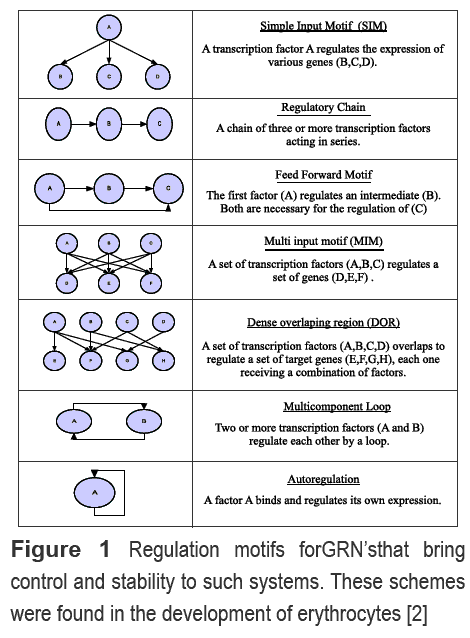
<body><![CDATA[<p><font face="Verdana" size="2"><i>Keywords: </i>Neural crest, GRN, Boolean network, nocioceptors, propioceptors.</font></p>  <hr noshade size="1">      <p><font face="Verdana" size="3"><b>Resumen</b></font></p>      <p><font face="Verdana" size="2">En el presente estudio se ha generado una RRG que describe el proceso por el cual c&eacute;lulas madre de la cresta neural son cometidas hacia dos tipos de neuronas sensoriales (Propioceptores y Nocioceptores). Se ha encontrado tambi&eacute;n patrones de regulaci&oacute;n (motifs) que act&uacute;an de manera cooperativa para el control de dicho proceso. Estos mismos motifs aparecen en etapas similares del desarrollo de eritrocitos a partir de c&eacute;lulas madre hematipoy&eacute;ticas. Las RRG son susceptibles al modelamiento. Dada la complejidad de la RRG hallada, una red Booleana aleatoria (RBA) fue usada, la cual mostr&oacute; componentes claves y la din&aacute;mica del proceso a trav&eacute;s de cambios en las condiciones iniciales. Finalmente, los motifs fueron reflejados en el modelo, sugiriendo futuros estudios.</font></p>       <p><font face="Verdana" size="2"><i>Palabras clave: </i>Cresta Neural, RRG, red Booleana, nocioceptores, propioceptores</font>.</p>   <hr noshade size="1">      <p><font face="Verdana" size="3"><b>Introduction</b></font></p>       <p> <font face="Verdana" size="2">The process of development  is one of the most complex phenomena found across multicellular organisms. At  first glance, it appears that a coordinated combination in space and time of <i>cisand trans</i> elements in the DNA,  transcription factors, transduction signalsand the processes that constitute  the molecular biology dogmaguides undifferentiated cells to a specific fate  [1], In the past decades, a great effort has been made in identifying the  interaction between these molecules, generating a wealth of results. Perhaps,  the best way to gather and condense these data is the generation of a genetic  regulatory network (GRN) [2], which can be further characterized by patterns of  transcription factor binding sites in <i>ciselements</i>[3], with all the molecules  (intra and extracellular) involved in a spatial and temporal frame (Control  logic GRN), or without taking in account these dimensions (Topological GRN)  [2]. Anyway, once the network is established it is possible to find regulatory  motifs en each step of the developmental process based on transcription  factors. For example, in the simple input motif (SIM), a transcription  activates a set of transcription factors (<a href="#Figura1">Figure 1A</a>).These patterns act cooperatively  and ultimately define the dynamic of the system, providing fine control and  regulation [2].    <br>    <br>  Continuous and  discontinuous kinetic approximations have been used to characterize GRN. To  date, three types of models have been reported for this purpose, namely (i)  deterministic, (ii) stochastic and (iii) Boolean models. Deterministic are  based on the solution of a system of ordinary differential equations, each one  expressing the kinetic interaction of one component relative to the others.  Therefore, it is necessary to obtain kinetic data from molecular techniques  like Real time PCR (RT-PCR)[4].Stochastic modeling is supported by the view in  which genetic and biochemical networks involve the interaction of integer  numbers of molecules that collide after random times, driven by Brownian motion  and it requires solving the master equation based on a probabilistic function  of Markovian origin [5]. Nonetheless, it is yet necessary to gather kinetic  data in order to obtain the evolution of the state probability in time. On the  other hand, Boolean logic based models require no kinetic parameters,hence they  are suitable fordescribing large GRN. However, they are unable to provide real  time dynamics as the events take place in the so called time units. These equations  allow deriving gene expression time profiles based on the truth table acquired  from microarrays data analysis [4].Random Boolean networks (RBN) were  originally proposed for genetic modeling and they are constituted by randomly  establishing the connection and the logic behind nodes. The computational  resources for performing such simulations derived the attention in different  alternatives such as asynchronous and temporal Boolean networks which intend  to avoid the synchronicity of RBNs and probabilistic Boolean networks which  incorporate the stochasticity hence avoiding the deterministic behavior once  the initial conditions are established [6]</font></p>      <p align="center"><img src="/img/revistas/rfiua/n58/n58a25i01.gif" ><a name="Figura1"></a></p>      <p> <font face="Verdana" size="2">    ]]></body>
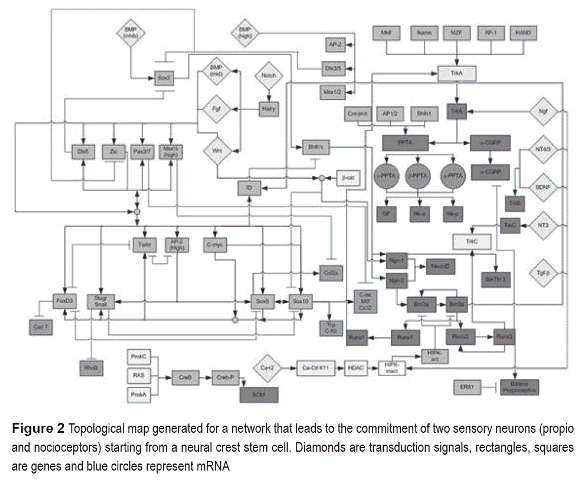
<body><![CDATA[<br>  Neural crest importance  could be briefly exposed as it has been recently coined &quot;the fourth germ  line&quot;based on is novelty asits cells migrate extensively during  organogenesis to generate many types of cellssuch as sensory, sympathetic and  parasympathetic neurons, epidermal pigment cells and Shwann cells. In  particular, the trunk neural crest migration leads to the formation of a  structure named dorsal root ganglia (DRG), which is composed of two types of  neurons, named propioceptorsand nocioceptors [4]. Due to its complexity, GRN  comprising such complex process has not been yet reported.Here in this work we  propose a Boolean based model of the differentiation of neural crest stem cells  to sensory neurons that would allow to elucidate the underpinnings of its  dynamics and the effect of key moleculesby  <i>in silico</i> deletions of specific signals.</font></p>      <p><font face="Verdana" size="3"><b>Methods</b></font></p>      <p> <font face="Verdana" size="2"><b><i>Topological GRN</i></b></font></p>      <p> <font face="Verdana" size="2">Topological network was  constructed based on previous reports. The underpinnings regarding precursors  are yet to be uncovered due to the lack of temporal gene expression  information, hence topological rather than control logic GRN was the base of  our approach. Firstly, network design was grounded on Swiers <i>et al</i>. [2] who proposed erythrocytes  development networks. Also, unique characteristics of developmental genetic  networks and its hierarchical organization established by Longabaugha [3] were  taken into account. Secondly, developmental process of Neural crest stem cells  (NCSC) to migratory phenotypewas based on Meulemans[7], while final commitment  was based on Raible[8]. Finally, specific interactions were obtained from  different works [8-23].    <br>    <br>  Some types of molecules  and events were obviated such as signals involved in transduction cascades and  differential splicingfor the sake of simplicity. Also, in the absence of  specific targets, some molecules were condensed in clusters (propioceptive  battery and the combined transduction signal Wnt, Fgf and BMP). The fact that  the neural crest GRN is conserved across vertebrates (Meulemans D, 2004),  allows us to take results from any specie in the taxa (<i>DanioReiro,XenopusLaevis, MusMusculus and Homo sapiens</i>).</font></p>      <p> <font face="Verdana" size="2"><b><i>Boolean logic applied to a neural crest GRN</i></b></font></p>      <p> <font face="Verdana" size="2">Boolean networks  facilitate the analysis of GRN based on some assumptions on its structure and  dynamics [4]. In the present study, Classic Boolean algorithm approach (RBN)  shown by Kauffman [24] was implemented. RBN's composed of K molecules and N  connections towards each component. Each molecule has an associated node, which  is composed of a logic function predetermined by the behavior of the gene or  protein in the network. This function is constructed by all the possible state  combinations of the N connections, which in turn determine the node state. The  algorithm begins with the establishment of the initial state of all the nodes  (initial conditions), followed by a stage in which each molecule examines its K  entry activities, consults its Boolean function and finally assumes the next  state in a new discrete time. The system then traces a trajectory and it is  possible that it can return to a previous state, given that the number of  states is finite. In fact, the deterministic nature of the algorithm may allow  the system to fall in a loop of states named attractor, which it is also a  trivial property of the system [24]. Initial conditions were varied in order to  determine the distribution of gene and proteins over a given discrete time,  system attractors, regime, and key molecules in the network.    <br>    <br>  RBN was generated by  analyzing interactions between genes and proteins and consequently assigning a  logic function to every node (<a href="#Figura2">Figure 2</a>).</font></p>      ]]></body>
<body><![CDATA[<p align="center"><img src="/img/revistas/rfiua/n58/n58a25i02.gif" ><a name="Figura2"></a></p>      <p> <font face="Verdana" size="2"> Connectivity and rule  matrices were established with the developed RBN and the Boolean function for  each node. Due to the size of the afore mentioned network () we decided to  split it in five RBN, within 8 and 9 nodes each based on criteria established  elsewhere [7,8].</font></p>      <p><font face="Verdana" size="3"><b>Results and discussion</b></font></p>      <p> <font face="Verdana" size="2"><b><i>Topological Genetic regulatory network</i></b></font></p>      <p> <font face="Verdana" size="2"><a href="#Figura2">Figure 2</a> schemes the  topological GRN that describes sensory neuron commitment from NCSC. These early  stage cells lie at the neural plate border, captivating transduction signals  from adjacent structures (Wnt, Fgf and BMP up regulated by Notch) [25]. BMP is  important in the process of competence of these cells and operates in a  gradient fashion over neural crest, epidermis and neural tube [8]. The low  signal in the neural tube induces the transcription of <i>Sox2</i>, a neural expression inductor  which can activate genes like <i>N-cam</i>  and <i>N-tubulin</i> and is  further repressed by Dlx3/5 and Dlx5.    <br>    <br>  We identified regulatory  motifs at various stages of differentiation and commitment based on those  reported by Swierset <i>al</i>. [2]. The  combination of BMP (mid), Fgf and Wnt signals induce a group of transcription  factors (Zic, Pax3/7, Dlx5, Msx) named neural plate border specifiers (NPBS),  which mediate the influence ofthose signals and the neural crest specifiers  (NCS) [7]. Two simple input motifs (SIM) (<a href="#Figura1">Figure 1</a>) were identified; one  conformed by BMP, AP-2, Msx1/2, Dlx3/5 and another by Dlx3/5, Sox2 and Zic.  This pattern confers activation or repression of transcription programs.    <br>    <br>  With the border specified,  molecular interactions permit the specification of the neural crest through its  NCS's. This process is morphologically evident by an epithelium-mesenquime  transition in which the NPBS induce the expression of FoxD3, Slug/ Snail,  Twist, Ap-2High, Sox9, Sox10 c-myc and ID, which are known as NCS. For example,  Slug/ Snail is necessary for delamination and along with FoxD3 regulates some  NCS, which is known to regulate migration, delamination and induction  processesby inducing genes like  <i>N-cadherin</i>, integrins and  <i>Cadherin7</i>. Neural crest specification is a process with high  regulation and control. Two SIM (c-myc, Sox10, Twist, Slug/Snail, FoxD3 and  Sox10, Twist, Slug/Snail, FoxD3), two positive multicomponent loops (Sox9 and  Sox10, Sox9 and Slug/Snail), two repressive (Twist and Ap-2High, FoxD3 and  Twist) and a multi input motif (MIM) between NPBS and NCS were found (<a href="#Figura1">Figure 1</a>  and <a href="#Figura2">2</a>). MIM generates a great transcription program at early stages, providing  spatial and temporal control via transduction signals [2]. This pattern is part  of a process called antagonist cross, in which cells are competent to choose a  specific fate.    <br>    ]]></body>
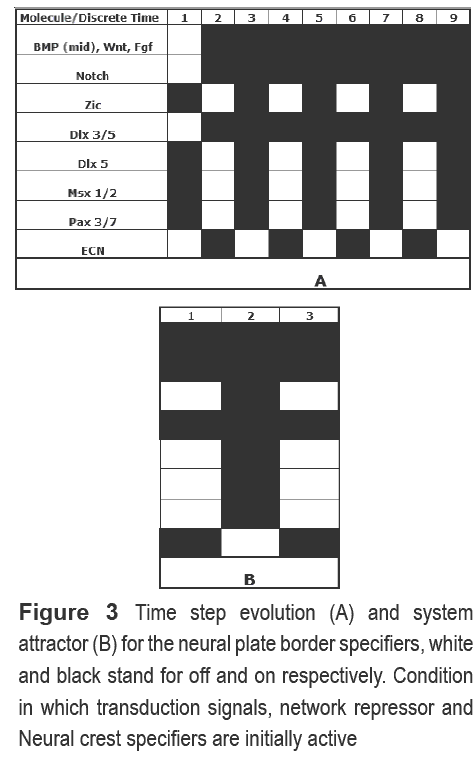
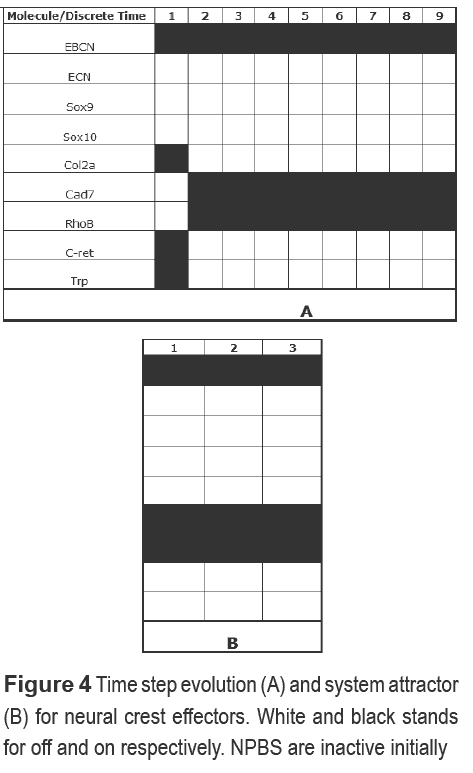
<body><![CDATA[<br>  Neural crest cell  migration is a process in which these cells detaches from the basal lamina and  are coupled to a transport system that allows the displacement to different  portions of the embryo. NCS activates or repress specific neural crest factors,  locomotion system and cellular support related proteins. A set of NCS (cRET,  Mitf, P0, Cx32, Trp and cKit) are specific targets on genes that define the  melanocyte, glia and sensory neuron genotype (<a href="#Figura2">Figure 2</a>) [25]. In the same way,  the coordinated action in time of signals and factors allows the progress of  migration and its cease. In this regard, two SIM motifs are distinguished (Sox  10, C-ret, Mitf, Cx32, TrpcKit and Sox9, Twist, Slug/Snail, FoxD3) as well as  two &quot;<i>feed forward</i>&quot;  patterns (Msx1/2, Sox9, Col2a and Pax3/7, Sox 10, Cret-Mitf) that confer  temporal control to GRN. Finally, a multicomponent loop between Sox9 and Sox 10  maintain the differentiated state in these cells (<a href="#Figura1">Figure 1</a> and <a href="#Figura2">2</a>).    <br>     <br>  Some of trunk neural crest  cells cease its migration at a zone in which they condense to form the dorsal  root ganglia (DRG). This structure receives neurotrophin transduction signals  (NGF, NT4/5, BDNF and NT3), Wnt-&beta;catenin and TGF-&beta;. These signals are  responsible for the management of the final commitment. In such process, many  regulatory motifs were found: Two auto&shy;regulation motifs (Brn3a and Runx3), one  SIM (Brn3a, Runx3 and Runx1), two &quot;<i>feed  forward</i>&quot; (Ngn-2, Brn3a, ID and Ngn-1,Brn3a and ID), three  MIM (Ngn1/2 and NeuroD;Mkif,Ikaros, Mzf,Ap-1, Hand with TrkA;  Cre-prot,Ap1/2,bhlh1 with PPTA) and four regulatory chains (Ngn- 2,Brn3a,Runx3,  propioceptive battery; TrkA, PPTA and propioceptor battery; Brn3a, Runx1, TrkA;  Sox2,Ngn-1 and Math3). The MIM motifs are responsible of maintain control over  gene expression programs, while regulatory chain motifs provide temporal  control to the system (<a href="#Figura1">Figure 1</a>). In general, the validity of the GRN generated  was made by comparing the presence of motifs in similar stages of  differentiation on a network that depict erythrocyte commitment [2].  Surprisingly, the regulatory patterns are common for both processes, which  support the view that the control of biological process is based on specific  rules of regulation.</font></p>      <p> <font face="Verdana" size="2"><b><i>Boolean logic applied to a neural crest GRN</i></b></font></p>      <p> <font face="Verdana" size="2">The topological GRN  generated was divided into five Boolean networks with 8 and 9 nodes for the  determination of its dynamics.Simulations were carried out at different  conditions based on previously developed rule and connectivity matrices.  Interestingly, each network reaches steady state during short discrete times (5  time units), presents orderly regimes and possesses one and two length  attractors. In one length attractors, the steady state is unique, and the  transcriptional program is activated only at the beginning. If a repressor acts  when the steady state is attained, the transcriptional program is not affected.  Two or more length attractors present a flexible and finer strategy for  regulation, generating a feedback between transcription factors, <i>cis</i> and <i>trans</i> elements ofgenes. This generates  a given pattern over time that can still be changed if a repressor is present.  Hallinan [29], present a study on the constituent effect of the genes implied  in the GRN, showing that of all the carried out simulations, 55% possesses a  two length attractor, for networks formed with 10 nodes. The same author  carries out studies on regulation motifs, in particular with those that show  auto-regulative ones, showing that the best way to analyze GRN of great size is  through the analysis of these control systems. With a small case of study  related genes involved in cancer, the simulations showed that the analyzed  motifs leads to a stationary state that behaves as an oscillator, result that  was obtained here when a differentiate state was desirable.    <br>    <br>  Five simulations were  performed for the NPBS network. At first, we wish to determine if only the  transductions signals are necessary for NPBS activation, so they were the only  initial nodes active. We also wanted to know the effect of DLX3/5 and DLX5 on  the system, so they were set active in two separate simulations. Two final  simulations were performed in order to determine the dynamic of the  differentiated state. In the first, all nodes were activated; in the second,  NCS was the only node inactive. As expected, activation of the entire  transduction signals lead to a specification of the border factors.  Furthermore, when activating DLX5, the process is accelerated but maintaining  the pattern observed when all transduction signals are activated. DLX3/5  repressor delays the specification on two discrete times. For the  differentiated state simulation, we found a pattern (<a href="#Figura3">Figure 3</a>) with a two  length attractor, in which transduction signals are only necessary at early  times for the specification of NPBS, alternating its state with NCS.</font></p>      <p align="center"><img src="/img/revistas/rfiua/n58/n58a25i03.gif" ><a name="Figura3"></a></p>      <p> <font face="Verdana" size="2"> The neural crest  specification was also modeled using a Boolean approximation. In this case,  NPBS were grouped in a single node to determine its effect on NCS. Some motifs  were not reflected (Multicomponent and SIM) partly because some molecules were  excluded. We first corroborated NCS activation results obtained in the NPBS  network, analyzing the system when transduction signals and NPBS are active. In  order to determine if the NCS activation is caused by the activation of both we  carried out a simulation for each node active finding that NCS was only  activated in the presence of NPBS. NPBS and signals induced the neural crest  effectors genes (NCEG) as expected, given that some NCS act repressively  (Twist, FoxD3 and Slug/Snail) over NCEG (<a href="#Figura4">Figure 4A</a>).</font></p>      <p align="center"><img src="/img/revistas/rfiua/n58/n58a25i04.gif" ><a name="Figura4"></a></p>      ]]></body>
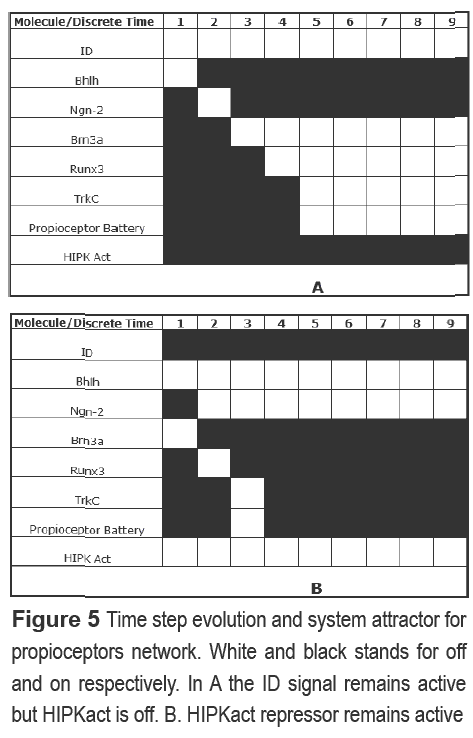
<body><![CDATA[<p> <font face="Verdana" size="2">    <br>  Stable activation of NCS  is observed (except for Ap-2high) and a two length attractor is achieved with  NCEG behaving intermittently. As in the NPBS network, a differentiated state  simulation was performed, obtaining a similar pattern. Therefore, it is  possible that the maintenance of early stages of differentiation occur  following a global program, represented by the combination of specific states.    <br>    <br>  Cellular migrationprocess  was also modeled because of its importance in the development of neural crest  cells. Because of a matrix size limitation, NCS and NPBS were chosen as unique  nodes. Sox9 and Sox 10 were taken as nodes, given its importance on neural  crest development (Scheppers, 2002). The default state was off in every node,  except for RhoB and Cad7. This state represents the initial migration process,  in which the migratory phenotype is absent and RhoB and Cad7 maintain the cells  attached in a epithelium fashion. NPBS alone can repress basal lamina support  and maintenance related factors (Rhob and Cad7) but is unable to generate the  migratory genotype. Neither can NCS, which activates Trp and the same factors  that NPBS does. The migratory pattern is finally observed with a further  activation of Sox9/10 and a NPBS off state. NPBS that act repressively are  inactivated and those that define the neural crest are activated. Finally, all  nodes excepting NPBS were activated, obtaining a similar pattern. It can be followed  that temporal control is important at this stage, given that NPBS must be  inactivated at a precise moment while NCS are active, allowing the migration of  these cells. This fact is further represented by two &quot;<i>feed forward</i>&quot; motifs (Pax3/7,  Sox 10, Cret-Mitf; Msx1/2,Sox9 and Col2a). The maintenance of the  differentiated state is given by a SIM made by Sox 10 and a multicomponent loop  (Sox9 and Sox10), which was also reflected on the model. In this last case, Sox  9 rescued Sox10 after two discrete times and after that, the migratory pattern  was observed.    <br>     <br>  The commitment of each sensory neuron type was taken apart, generating  two networks. In the propioceptor one, three general transcription factors (ID,  HIPK act and Bhlh), three DRG specific factors (Ngn-2,Brn3a and Runx3), a  membrane receptor (TrkC) and the propioceptive battery were included; in the  nocioceptor case, we included two groups of global transcription factors (  Ikaros,Mzf,Mkif, Ap-1, Hand; Cre-prot, Bhlh-1, Ap1/2), a transduction signal  (NGF), a specific transcription factor (Runx1), two related nocioceptor  proteins (PPTA, &alpha;-CGRP) and the nocioceptive battery. Common points were found  for both networks as for example the need of a key molecule In this regard,  Brn3a is necessary for propioceptor development because (i) If its activated  alone, it can promote the final genotype, (ii) its antagonist (HIPKact) repress  all the network (<a href="#Figura5">Figure 5</a>) and (iii) Its auto-regulative capability maintains  the differentiated state</font></p>      <p align="center"><img src="/img/revistas/rfiua/n58/n58a25i05.gif" ><a name="Figura5"></a></p>      <p> <font face="Verdana" size="2">  For its part, TrkA might  be the molecule implicated in the definite state of nocioceptor genotype  because it can activate the nocioceptive battery along with the two  transcription factor nodes. However, in the absence of Runx1 and transcription  factors, the molecule is unable to activate the battery. Another common point  is the fact that the signals involved in the activation of the networks are  needed only in a temporal manner, rather than spatially (NGF for TrkA and Bhlh  for Brn3a). The dynamic in each case is reflected by a cascade fashion  activation of intermediate molecules of the system (<a href="#Figura5">Figure 5</a>),which also  reflects the regulatory chain motif (Ngn-2, Brn3a, Runx3, propioceptive battery  in propioceptors; Trka, PPTA, nocioceptive battery in nocioceptors). However,  additional information about interaction between molecules is needed in the  nocioceptor network.    <br>     <br>  The propioceptor  specification posses nonetheless some particular characteristics that were  dilucidated by the Boolean model. The Id repressive effect occurs at a temporal  level over Ngn-2, given that the last is activated after some discrete times.  Also, the network reflect a  &quot;<i>feed forward</i>&quot; motif between Ngn-2, Brn3a, ID and two  auto-regulative (Brn3a and Runx3).</font></p>      ]]></body>
<body><![CDATA[<p><font face="Verdana" size="3"><b>Conclusions</b></font></p>      <p> <font face="Verdana" size="2">Information gathered to  date about interactions in developmental processes has made possible the  construction of new GRNs.  In the present study we have constructed a GRN that represents the molecular  basis by which neural crest stem cells are committed to two distinct sensory  neuron types. Aspects concerning the GRN presented are worth to be mentioned.  The auto-renovation character of stem cells was reflected in cellular  maintenance patterns in the topological map as well as in the Boolean model  implemented. C-myc, implicated on cellular division process behaves in an  expected way. Nonetheless, the stem cell/committed cell division was not  reflected, given a lack of specific markers for each type and the fact that  there is no consensus in the precursors hierarchy.    <br>    <br>  One and two length attractors were found, property related with the  number of nodes and connectivity. The appearance of attractors in all cases is  an indirect corroboration that the network is made in a proper way, since it is  an inherent property of these systems.</font></p>      <p><font face="Verdana" size="3"><b>References</b></font></p>      <!-- ref --><p> <font face="Verdana" size="2">1. S. Gilbert. <i>Developmental Biology</i>.  7<sup>a</sup> ed. Ed. Sinauer Associates In. Publishers. Sunderland (MA). 2006.  pp. 101-137.    &nbsp;&nbsp;&nbsp;&nbsp;&nbsp;&nbsp;&nbsp;&nbsp;[&#160;<a href="javascript:void(0);" onclick="javascript: window.open('/scielo.php?script=sci_nlinks&ref=000068&pid=S0120-6230201100020002500001&lng=','','width=640,height=500,resizable=yes,scrollbars=1,menubar=yes,');">Links</a>&#160;]<!-- end-ref --><br>    <!-- ref --><br>  2. G. Swiers, R. Patient, M. Loose.&quot;Genetic regulatory networks  programming hematopoietic stem cells and erythroid lineage specification&quot;. <i>Develop. Biol</i>. Vol. 294. 2006. pp.  525-540.    &nbsp;&nbsp;&nbsp;&nbsp;&nbsp;&nbsp;&nbsp;&nbsp;[&#160;<a href="javascript:void(0);" onclick="javascript: window.open('/scielo.php?script=sci_nlinks&ref=000070&pid=S0120-6230201100020002500002&lng=','','width=640,height=500,resizable=yes,scrollbars=1,menubar=yes,');">Links</a>&#160;]<!-- end-ref --><br>    <!-- ref --><br>  3. W. J. R Longabaugha, E.H. Davidson, H. Bolouri. &quot;Computational  representation of developmental genetic regulatory networks&quot;. <i>Develop. Biol</i>. Vol. 283. 2005. pp.  1-16.    &nbsp;&nbsp;&nbsp;&nbsp;&nbsp;&nbsp;&nbsp;&nbsp;[&#160;<a href="javascript:void(0);" onclick="javascript: window.open('/scielo.php?script=sci_nlinks&ref=000072&pid=S0120-6230201100020002500003&lng=','','width=640,height=500,resizable=yes,scrollbars=1,menubar=yes,');">Links</a>&#160;]<!-- end-ref --><br>    <!-- ref --><br>  4. R. Gupta,L. E. K. Achenie.&quot;A network model for gene  regulation&quot;. <i>Comp. Chem. Eng</i>.  Vol 31. 2006. pp. 950&shy;-961.    &nbsp;&nbsp;&nbsp;&nbsp;&nbsp;&nbsp;&nbsp;&nbsp;[&#160;<a href="javascript:void(0);" onclick="javascript: window.open('/scielo.php?script=sci_nlinks&ref=000074&pid=S0120-6230201100020002500004&lng=','','width=640,height=500,resizable=yes,scrollbars=1,menubar=yes,');">Links</a>&#160;]<!-- end-ref --><br>    <!-- ref --><br>  5. D. Wilkinson.  <i>Stochastic modeling for Systems Biology</i>. Ed.  Chapman&amp;Hall/CRC. Boca Raton (FL). 2006. pp. 345-370.    &nbsp;&nbsp;&nbsp;&nbsp;&nbsp;&nbsp;&nbsp;&nbsp;[&#160;<a href="javascript:void(0);" onclick="javascript: window.open('/scielo.php?script=sci_nlinks&ref=000076&pid=S0120-6230201100020002500005&lng=','','width=640,height=500,resizable=yes,scrollbars=1,menubar=yes,');">Links</a>&#160;]<!-- end-ref --><br>    <!-- ref --><br>  6. G. J. Hickman, P. T. Hodgman.&quot; Inference of genetic regulatory  networks using boolean-network inference methods&quot;. <i>J. Bioinform. Comput. Biol</i>. Vol  32.2005. pp. 1-7.    &nbsp;&nbsp;&nbsp;&nbsp;&nbsp;&nbsp;&nbsp;&nbsp;[&#160;<a href="javascript:void(0);" onclick="javascript: window.open('/scielo.php?script=sci_nlinks&ref=000078&pid=S0120-6230201100020002500006&lng=','','width=640,height=500,resizable=yes,scrollbars=1,menubar=yes,');">Links</a>&#160;]<!-- end-ref --><br>    <!-- ref --><br>  7. D. Meulemans, M. Bronner-Fraser.&quot;Gene-Regulatory Interactions in  Neural Crest Evolution and Development&quot;. <i>Develop. Cell</i>. Vol 7. 2004. pp. 291&shy;-299.    &nbsp;&nbsp;&nbsp;&nbsp;&nbsp;&nbsp;&nbsp;&nbsp;[&#160;<a href="javascript:void(0);" onclick="javascript: window.open('/scielo.php?script=sci_nlinks&ref=000080&pid=S0120-6230201100020002500007&lng=','','width=640,height=500,resizable=yes,scrollbars=1,menubar=yes,');">Links</a>&#160;]<!-- end-ref --><br>    <!-- ref --><br>  8. D. Raible.&quot;Development of the neural crest: achieving specificity  in regulatory pathways&quot;.  <i>Curr. Op. Cell. Biol</i>. Vol 18. 2006. pp. 698-703.    &nbsp;&nbsp;&nbsp;&nbsp;&nbsp;&nbsp;&nbsp;&nbsp;[&#160;<a href="javascript:void(0);" onclick="javascript: window.open('/scielo.php?script=sci_nlinks&ref=000082&pid=S0120-6230201100020002500008&lng=','','width=640,height=500,resizable=yes,scrollbars=1,menubar=yes,');">Links</a>&#160;]<!-- end-ref --><br>    <!-- ref --><br>  9. C. E. Krull.&quot;Segmental organization of neural crest  migration&quot;. <i>Mech. Develop</i>.  Vol. 105. 2001. pp. 37-45.    &nbsp;&nbsp;&nbsp;&nbsp;&nbsp;&nbsp;&nbsp;&nbsp;[&#160;<a href="javascript:void(0);" onclick="javascript: window.open('/scielo.php?script=sci_nlinks&ref=000084&pid=S0120-6230201100020002500009&lng=','','width=640,height=500,resizable=yes,scrollbars=1,menubar=yes,');">Links</a>&#160;]<!-- end-ref --><br>    <!-- ref --><br>  10. Y. Morikawa, F. D'Autreaux, M. D. Gershon,P. Cserjesi. &quot;Hand2  determines the noradrenergic phenotype in the mouse sympathetic nervous  system&quot;. <i>Develop. Biol</i>.  Vol. 307. 2007. pp. 114-126.    &nbsp;&nbsp;&nbsp;&nbsp;&nbsp;&nbsp;&nbsp;&nbsp;[&#160;<a href="javascript:void(0);" onclick="javascript: window.open('/scielo.php?script=sci_nlinks&ref=000086&pid=S0120-6230201100020002500010&lng=','','width=640,height=500,resizable=yes,scrollbars=1,menubar=yes,');">Links</a>&#160;]<!-- end-ref --><br>    <!-- ref --><br>  11. N. Douarin, E. Dupin. &quot;Multipotentiality of the neural  crest&quot;. <i>Curr. Op. Gen. Develop</i>. Vol 13. 2003. pp. 529&shy;-536.    &nbsp;&nbsp;&nbsp;&nbsp;&nbsp;&nbsp;&nbsp;&nbsp;[&#160;<a href="javascript:void(0);" onclick="javascript: window.open('/scielo.php?script=sci_nlinks&ref=000088&pid=S0120-6230201100020002500011&lng=','','width=640,height=500,resizable=yes,scrollbars=1,menubar=yes,');">Links</a>&#160;]<!-- end-ref --><br>    <!-- ref --><br>  12. C. Paratore, G. Brugnoli, H. Y.  Lye, U. Suter, L. Sommer. &quot;The Role of the Ets Domain Transcription Factor  Erm in Modulating Differentiation of Neural Crest Cells&quot;. <i>Develop</i>. Biol. Vol. 250. 2002. pp. 168-&shy;180.    &nbsp;&nbsp;&nbsp;&nbsp;&nbsp;&nbsp;&nbsp;&nbsp;[&#160;<a href="javascript:void(0);" onclick="javascript: window.open('/scielo.php?script=sci_nlinks&ref=000090&pid=S0120-6230201100020002500012&lng=','','width=640,height=500,resizable=yes,scrollbars=1,menubar=yes,');">Links</a>&#160;]<!-- end-ref --><br>    <!-- ref --><br>  13 L. Lo, D.  J.Anderson.&quot;Postmigratory Neural Crest Cells Expressing c-RET Display  Restricted Developmental and proliferative capacities&quot;. <i>Neuron</i>. Vol. 15. 1995. pp. 527-539.    &nbsp;&nbsp;&nbsp;&nbsp;&nbsp;&nbsp;&nbsp;&nbsp;[&#160;<a href="javascript:void(0);" onclick="javascript: window.open('/scielo.php?script=sci_nlinks&ref=000092&pid=S0120-6230201100020002500013&lng=','','width=640,height=500,resizable=yes,scrollbars=1,menubar=yes,');">Links</a>&#160;]<!-- end-ref --><br>    <!-- ref --><br>  14. S. Eng, J. Lanier, N.  Fedtsova, E. Turner. &quot;Coordinated regulation of gene expression by Brn3a  in developing sensory Ganglia&quot;. <i>Develop</i>. Vol. 131. 2004. pp. 3859&shy;-3870.    &nbsp;&nbsp;&nbsp;&nbsp;&nbsp;&nbsp;&nbsp;&nbsp;[&#160;<a href="javascript:void(0);" onclick="javascript: window.open('/scielo.php?script=sci_nlinks&ref=000094&pid=S0120-6230201100020002500014&lng=','','width=640,height=500,resizable=yes,scrollbars=1,menubar=yes,');">Links</a>&#160;]<!-- end-ref --><br>    <!-- ref --><br>  15. D. Levanon, D. Bettoun, C. Harris Cerruti, W. E.oolf, V. Negreanu,R.  Eilam, Y. Bernstein, D. Goldenberg, C. Xiao, M. Fliegauf,E. Kremer, F.Otto,O.  Brenner,A. Lev-Tov, Y. Groner.&quot;The Runx3 transcription factor regulates  development and survival of TrkC dorsal root ganglia neurons&quot;. <i>EMBO J</i>. Vol. 21. 13. 2002. pp.  3454-3463.    &nbsp;&nbsp;&nbsp;&nbsp;&nbsp;&nbsp;&nbsp;&nbsp;[&#160;<a href="javascript:void(0);" onclick="javascript: window.open('/scielo.php?script=sci_nlinks&ref=000096&pid=S0120-6230201100020002500015&lng=','','width=640,height=500,resizable=yes,scrollbars=1,menubar=yes,');">Links</a>&#160;]<!-- end-ref --><br>    <!-- ref --><br>  16. L. Ma, J. Merenmies, L. F. Parada. &quot;Molecular  characterization of the TrkA/NGF receptor minimal enhancer reveals regulation  by multiple cis elements to drive embryonic neuron expression&quot;. <i>Develop</i>. Vol. 127. 2000. pp. 3777-3788.    &nbsp;&nbsp;&nbsp;&nbsp;&nbsp;&nbsp;&nbsp;&nbsp;[&#160;<a href="javascript:void(0);" onclick="javascript: window.open('/scielo.php?script=sci_nlinks&ref=000098&pid=S0120-6230201100020002500016&lng=','','width=640,height=500,resizable=yes,scrollbars=1,menubar=yes,');">Links</a>&#160;]<!-- end-ref --><br>    <!-- ref --><br>  17. L. Ma, L. Lei, S. R. Eng, E. Turner, L. Parada. &quot;Brn3a  regulation of TrkA/NGF receptor expression in developing sensory neurons&quot;. <i>Develop</i>. Vol. 130. 2003. pp. 3525-3534.    &nbsp;&nbsp;&nbsp;&nbsp;&nbsp;&nbsp;&nbsp;&nbsp;[&#160;<a href="javascript:void(0);" onclick="javascript: window.open('/scielo.php?script=sci_nlinks&ref=000100&pid=S0120-6230201100020002500017&lng=','','width=640,height=500,resizable=yes,scrollbars=1,menubar=yes,');">Links</a>&#160;]<!-- end-ref --><br>    <!-- ref --><br>  18. L. Lei, L. Ma, S. Nef, T. Thai,L. Parada. &quot;mKlf7, a potential  transcriptional regulator of TrkA nerve growth factor receptor expression in  sensory and sympathetic neurons&quot;.  <i>Develop</i>. Vol. 128. 2001. pp. 1147-1158.    &nbsp;&nbsp;&nbsp;&nbsp;&nbsp;&nbsp;&nbsp;&nbsp;[&#160;<a href="javascript:void(0);" onclick="javascript: window.open('/scielo.php?script=sci_nlinks&ref=000102&pid=S0120-6230201100020002500018&lng=','','width=640,height=500,resizable=yes,scrollbars=1,menubar=yes,');">Links</a>&#160;]<!-- end-ref --><br>    <!-- ref --><br>  19. D. Levanona, O. Brenner, V. Negreaunu, D. Bettoun, R. Eilam, J.  Lotem, U. Gat, F. Otto, N. Speck,Y. Grone.&quot;Spatial and temporal expression  pattern of Runx3 (Aml2) and Runx1 (Aml1) indicates non&shy;redundant functions  during mouse embryogenesis&quot;. <i>Mech. Develop</i>. Vol. 109. 2001. pp. 413-417.    &nbsp;&nbsp;&nbsp;&nbsp;&nbsp;&nbsp;&nbsp;&nbsp;[&#160;<a href="javascript:void(0);" onclick="javascript: window.open('/scielo.php?script=sci_nlinks&ref=000104&pid=S0120-6230201100020002500019&lng=','','width=640,height=500,resizable=yes,scrollbars=1,menubar=yes,');">Links</a>&#160;]<!-- end-ref --><br>    <!-- ref --><br>  20. A. Wiggins, G. Wei, E. Doxakis, C. Wong, A. Tang, K. Zang, E. Luo, R.  L. Neve, L. F. Reichardt, E. Huang. &quot;Interaction of Brn3a and HIPK2  mediates transcriptional repression of sensory neuron survival&quot;. <i>J. Cell Biol</i>. Vol. 167. 2004. pp.  257-267.    &nbsp;&nbsp;&nbsp;&nbsp;&nbsp;&nbsp;&nbsp;&nbsp;[&#160;<a href="javascript:void(0);" onclick="javascript: window.open('/scielo.php?script=sci_nlinks&ref=000106&pid=S0120-6230201100020002500020&lng=','','width=640,height=500,resizable=yes,scrollbars=1,menubar=yes,');">Links</a>&#160;]<!-- end-ref --><br>    <!-- ref --><br>  21. H. Y. Lee, M. Kleber, L. Hari, V. Brault, U. Suter, M. M. Taketo, R.  Kemler, L. Sommer.&quot;Instructive Role of Wnt/ &#946;-Catenin in Sensory Fate  Specification in Neural Crest Stem Cells&quot;. <i>Science</i>. Vol. 303. 2004. pp. 1020-1023.    &nbsp;&nbsp;&nbsp;&nbsp;&nbsp;&nbsp;&nbsp;&nbsp;[&#160;<a href="javascript:void(0);" onclick="javascript: window.open('/scielo.php?script=sci_nlinks&ref=000108&pid=S0120-6230201100020002500021&lng=','','width=640,height=500,resizable=yes,scrollbars=1,menubar=yes,');">Links</a>&#160;]<!-- end-ref --><br>    <!-- ref --><br>  22. P. White, S. J.  Morrison, K. Orimito, C. Kubu, J. Verdi, D. J. Anderson. &quot;Neural Crest  Stem Cells Undergo Cell-Intrinsic Developmental Changes in Sensitivity to  Instructive Differentiation Signals&quot;. <i>Neuron</i>. Vol. 29. 2001. pp. 57-71.    &nbsp;&nbsp;&nbsp;&nbsp;&nbsp;&nbsp;&nbsp;&nbsp;[&#160;<a href="javascript:void(0);" onclick="javascript: window.open('/scielo.php?script=sci_nlinks&ref=000110&pid=S0120-6230201100020002500022&lng=','','width=640,height=500,resizable=yes,scrollbars=1,menubar=yes,');">Links</a>&#160;]<!-- end-ref --><br>    <!-- ref --><br>  23. S. A. Kauffman. &quot;Proposal for using the ensemble approach to  understand genetic regulatory networks&quot;. <i>J. Theor. Biol</i>. Vol. 230. 2004. pp.  581-590.    &nbsp;&nbsp;&nbsp;&nbsp;&nbsp;&nbsp;&nbsp;&nbsp;[&#160;<a href="javascript:void(0);" onclick="javascript: window.open('/scielo.php?script=sci_nlinks&ref=000112&pid=S0120-6230201100020002500023&lng=','','width=640,height=500,resizable=yes,scrollbars=1,menubar=yes,');">Links</a>&#160;]<!-- end-ref --><br>    <!-- ref --><br>  24. S. Scott. <i>Sensory Neurons</i>.  Ed. Oxford University. New York. 1992. pp. 45-67.    &nbsp;&nbsp;&nbsp;&nbsp;&nbsp;&nbsp;&nbsp;&nbsp;[&#160;<a href="javascript:void(0);" onclick="javascript: window.open('/scielo.php?script=sci_nlinks&ref=000114&pid=S0120-6230201100020002500024&lng=','','width=640,height=500,resizable=yes,scrollbars=1,menubar=yes,');">Links</a>&#160;]<!-- end-ref --><br>    <!-- ref --><br>  25. G. E. Schepers, R. D. Teasdale, P. Koopman. &quot;Twenty Pairs of  Sox: Extent, homology and nomenclature of mouse and human Sox transcription  factors&quot;. <i>Develop. Cell</i>.  Vol. 3. 2002. pp. 167-170.</font>&nbsp;&nbsp;&nbsp;&nbsp;&nbsp;&nbsp;&nbsp;&nbsp;[&#160;<a href="javascript:void(0);" onclick="javascript: window.open('/scielo.php?script=sci_nlinks&ref=000116&pid=S0120-6230201100020002500025&lng=','','width=640,height=500,resizable=yes,scrollbars=1,menubar=yes,');">Links</a>&#160;]<!-- end-ref --><br>     <br>    <br>       <p><font face="Verdana" size="2">(Recibido el 29 de septiembre de 2009. Aceptado el 1 de diciembre de 2010)</font></p>     <p><font face="Verdana" size="2"><sup>*</sup>Autor de  correspondencia: tel&eacute;fono: + 57 + 1 + 339 49 49 Ext. 3094, correo electr&oacute;nico: <a href="mailto:andgonza@uniandes.edu.co">andgonza@uniandes.edu.co</a> (A. Gonz&aacute;lez)</font></p>      ]]></body><back>
<ref-list>
<ref id="B1">
<label>1</label><nlm-citation citation-type="book">
<person-group person-group-type="author">
<name>
<surname><![CDATA[Gilbert]]></surname>
<given-names><![CDATA[S]]></given-names>
</name>
</person-group>
<source><![CDATA[Developmental Biology]]></source>
<year>2006</year>
<edition>7</edition>
<page-range>101-137</page-range><publisher-loc><![CDATA[Sunderland ]]></publisher-loc>
<publisher-name><![CDATA[Sinauer Associates In. Publishers]]></publisher-name>
</nlm-citation>
</ref>
<ref id="B2">
<label>2</label><nlm-citation citation-type="journal">
<person-group person-group-type="author">
<name>
<surname><![CDATA[Swiers]]></surname>
<given-names><![CDATA[G]]></given-names>
</name>
<name>
<surname><![CDATA[Patient]]></surname>
<given-names><![CDATA[R]]></given-names>
</name>
<name>
<surname><![CDATA[Loose]]></surname>
<given-names><![CDATA[M]]></given-names>
</name>
</person-group>
<article-title xml:lang="en"><![CDATA[Genetic regulatory networks programming hematopoietic stem cells and erythroid lineage specification]]></article-title>
<source><![CDATA[Develop. Biol]]></source>
<year>2006</year>
<volume>294</volume>
<page-range>525-540</page-range></nlm-citation>
</ref>
<ref id="B3">
<label>3</label><nlm-citation citation-type="journal">
<person-group person-group-type="author">
<name>
<surname><![CDATA[Longabaugha]]></surname>
<given-names><![CDATA[W. J. R]]></given-names>
</name>
<name>
<surname><![CDATA[Davidson]]></surname>
<given-names><![CDATA[E.H]]></given-names>
</name>
<name>
<surname><![CDATA[Bolouri]]></surname>
<given-names><![CDATA[H]]></given-names>
</name>
</person-group>
<article-title xml:lang="en"><![CDATA[Computational representation of developmental genetic regulatory networks]]></article-title>
<source><![CDATA[Develop. Biol]]></source>
<year>2005</year>
<volume>283</volume>
<page-range>1-16</page-range></nlm-citation>
</ref>
<ref id="B4">
<label>4</label><nlm-citation citation-type="journal">
<person-group person-group-type="author">
<name>
<surname><![CDATA[Gupta]]></surname>
<given-names><![CDATA[R]]></given-names>
</name>
<name>
<surname><![CDATA[Achenie]]></surname>
<given-names><![CDATA[L. E. K]]></given-names>
</name>
</person-group>
<article-title xml:lang="en"><![CDATA[A network model for gene regulation]]></article-title>
<source><![CDATA[Comp. Chem. Eng]]></source>
<year>2006</year>
<volume>31</volume>
<page-range>950&shy;-961</page-range></nlm-citation>
</ref>
<ref id="B5">
<label>5</label><nlm-citation citation-type="book">
<person-group person-group-type="author">
<name>
<surname><![CDATA[Wilkinson]]></surname>
<given-names><![CDATA[D]]></given-names>
</name>
</person-group>
<source><![CDATA[Stochastic modeling for Systems Biology]]></source>
<year>2006</year>
<page-range>345-370</page-range><publisher-loc><![CDATA[Boca Raton ]]></publisher-loc>
<publisher-name><![CDATA[Ed. Chapman&Hall/CRC]]></publisher-name>
</nlm-citation>
</ref>
<ref id="B6">
<label>6</label><nlm-citation citation-type="journal">
<person-group person-group-type="author">
<name>
<surname><![CDATA[Hickman]]></surname>
<given-names><![CDATA[G. J]]></given-names>
</name>
<name>
<surname><![CDATA[Hodgman]]></surname>
<given-names><![CDATA[P. T]]></given-names>
</name>
</person-group>
<article-title xml:lang="en"><![CDATA[Inference of genetic regulatory networks using boolean-network inference methods]]></article-title>
<source><![CDATA[J. Bioinform. Comput. Biol]]></source>
<year>2005</year>
<volume>32</volume>
<page-range>1-7</page-range></nlm-citation>
</ref>
<ref id="B7">
<label>7</label><nlm-citation citation-type="journal">
<person-group person-group-type="author">
<name>
<surname><![CDATA[Meulemans]]></surname>
<given-names><![CDATA[D]]></given-names>
</name>
<name>
<surname><![CDATA[Bronner-Fraser]]></surname>
<given-names><![CDATA[M]]></given-names>
</name>
</person-group>
<article-title xml:lang="en"><![CDATA[Gene-Regulatory Interactions in Neural Crest Evolution and Development]]></article-title>
<source><![CDATA[Develop. Cell]]></source>
<year>2004</year>
<volume>7</volume>
<page-range>291&shy;-299</page-range></nlm-citation>
</ref>
<ref id="B8">
<label>8</label><nlm-citation citation-type="journal">
<person-group person-group-type="author">
<name>
<surname><![CDATA[Raible]]></surname>
<given-names><![CDATA[D]]></given-names>
</name>
</person-group>
<article-title xml:lang="en"><![CDATA[Development of the neural crest: achieving specificity in regulatory pathways]]></article-title>
<source><![CDATA[Curr. Op. Cell. Biol]]></source>
<year>2006</year>
<volume>18</volume>
<page-range>698-703</page-range></nlm-citation>
</ref>
<ref id="B9">
<label>9</label><nlm-citation citation-type="journal">
<person-group person-group-type="author">
<name>
<surname><![CDATA[Krull]]></surname>
<given-names><![CDATA[C. E]]></given-names>
</name>
</person-group>
<article-title xml:lang="en"><![CDATA[Segmental organization of neural crest migration]]></article-title>
<source><![CDATA[Mech. Develop]]></source>
<year>2001</year>
<volume>105</volume>
<page-range>37-45</page-range></nlm-citation>
</ref>
<ref id="B10">
<label>10</label><nlm-citation citation-type="journal">
<person-group person-group-type="author">
<name>
<surname><![CDATA[Morikawa]]></surname>
<given-names><![CDATA[Y]]></given-names>
</name>
<name>
<surname><![CDATA[D'Autreaux]]></surname>
<given-names><![CDATA[F]]></given-names>
</name>
<name>
<surname><![CDATA[Gershon]]></surname>
<given-names><![CDATA[M. D]]></given-names>
</name>
<name>
<surname><![CDATA[Cserjesi]]></surname>
<given-names><![CDATA[P]]></given-names>
</name>
</person-group>
<article-title xml:lang="en"><![CDATA[Hand2 determines the noradrenergic phenotype in the mouse sympathetic nervous system]]></article-title>
<source><![CDATA[Develop. Biol]]></source>
<year>2007</year>
<volume>307</volume>
<page-range>114-126</page-range></nlm-citation>
</ref>
<ref id="B11">
<label>11</label><nlm-citation citation-type="journal">
<person-group person-group-type="author">
<name>
<surname><![CDATA[Douarin]]></surname>
<given-names><![CDATA[N]]></given-names>
</name>
<name>
<surname><![CDATA[Dupin]]></surname>
<given-names><![CDATA[E]]></given-names>
</name>
</person-group>
<article-title xml:lang="en"><![CDATA[Multipotentiality of the neural crest]]></article-title>
<source><![CDATA[Curr. Op. Gen. Develop]]></source>
<year>2003</year>
<volume>13</volume>
<page-range>529&shy;-536</page-range></nlm-citation>
</ref>
<ref id="B12">
<label>12</label><nlm-citation citation-type="journal">
<person-group person-group-type="author">
<name>
<surname><![CDATA[Paratore]]></surname>
<given-names><![CDATA[C]]></given-names>
</name>
<name>
<surname><![CDATA[Brugnoli]]></surname>
<given-names><![CDATA[G]]></given-names>
</name>
<name>
<surname><![CDATA[Lye]]></surname>
<given-names><![CDATA[H. Y]]></given-names>
</name>
<name>
<surname><![CDATA[Suter]]></surname>
<given-names><![CDATA[U]]></given-names>
</name>
<name>
<surname><![CDATA[Sommer]]></surname>
<given-names><![CDATA[L]]></given-names>
</name>
</person-group>
<article-title xml:lang="en"><![CDATA[The Role of the Ets Domain Transcription Factor Erm in Modulating Differentiation of Neural Crest Cells]]></article-title>
<source><![CDATA[Develop. Biol]]></source>
<year>2002</year>
<volume>250</volume>
<page-range>168-&shy;180</page-range></nlm-citation>
</ref>
<ref id="B13">
<label>13</label><nlm-citation citation-type="journal">
<person-group person-group-type="author">
<name>
<surname><![CDATA[Lo]]></surname>
<given-names><![CDATA[L]]></given-names>
</name>
<name>
<surname><![CDATA[Anderson]]></surname>
<given-names><![CDATA[D]]></given-names>
</name>
</person-group>
<article-title xml:lang="en"><![CDATA[Postmigratory Neural Crest Cells Expressing c-RET Display Restricted Developmental and proliferative capacities]]></article-title>
<source><![CDATA[Neuron]]></source>
<year>1995</year>
<volume>15</volume>
<page-range>527-539</page-range></nlm-citation>
</ref>
<ref id="B14">
<label>14</label><nlm-citation citation-type="journal">
<person-group person-group-type="author">
<name>
<surname><![CDATA[Eng]]></surname>
<given-names><![CDATA[S]]></given-names>
</name>
<name>
<surname><![CDATA[Lanier]]></surname>
<given-names><![CDATA[J]]></given-names>
</name>
<name>
<surname><![CDATA[Fedtsova]]></surname>
<given-names><![CDATA[N]]></given-names>
</name>
<name>
<surname><![CDATA[Turner]]></surname>
<given-names><![CDATA[E]]></given-names>
</name>
</person-group>
<article-title xml:lang="en"><![CDATA[Coordinated regulation of gene expression by Brn3a in developing sensory Ganglia]]></article-title>
<source><![CDATA[Develop]]></source>
<year>2004</year>
<volume>131</volume>
<page-range>3859&shy;-3870</page-range></nlm-citation>
</ref>
<ref id="B15">
<label>15</label><nlm-citation citation-type="journal">
<person-group person-group-type="author">
<name>
<surname><![CDATA[Levanon]]></surname>
<given-names><![CDATA[D]]></given-names>
</name>
<name>
<surname><![CDATA[Bettoun]]></surname>
<given-names><![CDATA[D]]></given-names>
</name>
<name>
<surname><![CDATA[Harris Cerruti]]></surname>
<given-names><![CDATA[C]]></given-names>
</name>
<name>
<surname><![CDATA[oolf]]></surname>
<given-names><![CDATA[W]]></given-names>
</name>
<name>
<surname><![CDATA[Negreanu]]></surname>
<given-names><![CDATA[V]]></given-names>
</name>
</person-group>
<article-title xml:lang="en"><![CDATA[The Runx3 transcription factor regulates development and survival of TrkC dorsal root ganglia neurons]]></article-title>
<source><![CDATA[EMBO J]]></source>
<year>2002</year>
<volume>21</volume>
<numero>13</numero>
<issue>13</issue>
<page-range>3454-3463</page-range></nlm-citation>
</ref>
<ref id="B16">
<label>16</label><nlm-citation citation-type="journal">
<person-group person-group-type="author">
<name>
<surname><![CDATA[Ma]]></surname>
<given-names><![CDATA[L]]></given-names>
</name>
<name>
<surname><![CDATA[Merenmies]]></surname>
<given-names><![CDATA[J]]></given-names>
</name>
<name>
<surname><![CDATA[Parada]]></surname>
<given-names><![CDATA[L. F]]></given-names>
</name>
</person-group>
<article-title xml:lang="en"><![CDATA[Molecular characterization of the TrkA/NGF receptor minimal enhancer reveals regulation by multiple cis elements to drive embryonic neuron expression]]></article-title>
<source><![CDATA[Develop]]></source>
<year>2000</year>
<volume>127</volume>
<page-range>3777-3788</page-range></nlm-citation>
</ref>
<ref id="B17">
<label>17</label><nlm-citation citation-type="journal">
<person-group person-group-type="author">
<name>
<surname><![CDATA[Ma]]></surname>
<given-names><![CDATA[L]]></given-names>
</name>
<name>
<surname><![CDATA[Lei]]></surname>
<given-names><![CDATA[L]]></given-names>
</name>
<name>
<surname><![CDATA[Eng]]></surname>
<given-names><![CDATA[S. R]]></given-names>
</name>
<name>
<surname><![CDATA[Parada]]></surname>
<given-names><![CDATA[L]]></given-names>
</name>
</person-group>
<article-title xml:lang="en"><![CDATA[Brn3a regulation of TrkA/NGF receptor expression in developing sensory neurons]]></article-title>
<source><![CDATA[Develop]]></source>
<year>2003</year>
<volume>130</volume>
<page-range>3525-3534</page-range></nlm-citation>
</ref>
<ref id="B18">
<label>18</label><nlm-citation citation-type="journal">
<person-group person-group-type="author">
<name>
<surname><![CDATA[Lei]]></surname>
<given-names><![CDATA[L]]></given-names>
</name>
<name>
<surname><![CDATA[Ma]]></surname>
<given-names><![CDATA[L]]></given-names>
</name>
<name>
<surname><![CDATA[Nef]]></surname>
<given-names><![CDATA[S]]></given-names>
</name>
<name>
<surname><![CDATA[Thai]]></surname>
<given-names><![CDATA[T]]></given-names>
</name>
<name>
<surname><![CDATA[Parada]]></surname>
<given-names><![CDATA[L]]></given-names>
</name>
</person-group>
<article-title xml:lang="en"><![CDATA[mKlf7, a potential transcriptional regulator of TrkA nerve growth factor receptor expression in sensory and sympathetic neurons]]></article-title>
<source><![CDATA[Develop]]></source>
<year>2001</year>
<volume>128</volume>
<page-range>1147-1158</page-range></nlm-citation>
</ref>
<ref id="B19">
<label>19</label><nlm-citation citation-type="journal">
<person-group person-group-type="author">
<name>
<surname><![CDATA[Levanona]]></surname>
<given-names><![CDATA[D]]></given-names>
</name>
<name>
<surname><![CDATA[Brenner]]></surname>
<given-names><![CDATA[O]]></given-names>
</name>
<name>
<surname><![CDATA[Negreaunu]]></surname>
<given-names><![CDATA[V]]></given-names>
</name>
<name>
<surname><![CDATA[Bettoun]]></surname>
<given-names><![CDATA[D]]></given-names>
</name>
</person-group>
<article-title xml:lang="en"><![CDATA[Spatial and temporal expression pattern of Runx3 (Aml2) and Runx1 (Aml1) indicates non&shy;redundant functions during mouse embryogenesis]]></article-title>
<source><![CDATA[Mech. Develop]]></source>
<year>2001</year>
<volume>109</volume>
<page-range>413-417</page-range></nlm-citation>
</ref>
<ref id="B20">
<label>20</label><nlm-citation citation-type="journal">
<person-group person-group-type="author">
<name>
<surname><![CDATA[Wiggins]]></surname>
<given-names><![CDATA[A]]></given-names>
</name>
<name>
<surname><![CDATA[Wei]]></surname>
<given-names><![CDATA[G]]></given-names>
</name>
<name>
<surname><![CDATA[Doxakis]]></surname>
<given-names><![CDATA[E]]></given-names>
</name>
<name>
<surname><![CDATA[Wong]]></surname>
<given-names><![CDATA[C]]></given-names>
</name>
</person-group>
<article-title xml:lang="en"><![CDATA[Interaction of Brn3a and HIPK2 mediates transcriptional repression of sensory neuron survival]]></article-title>
<source><![CDATA[J. Cell Biol]]></source>
<year>2004</year>
<volume>167</volume>
<page-range>257-267</page-range></nlm-citation>
</ref>
<ref id="B21">
<label>21</label><nlm-citation citation-type="journal">
<person-group person-group-type="author">
<name>
<surname><![CDATA[Lee]]></surname>
<given-names><![CDATA[H. Y]]></given-names>
</name>
<name>
<surname><![CDATA[Kleber]]></surname>
<given-names><![CDATA[M]]></given-names>
</name>
<name>
<surname><![CDATA[Hari]]></surname>
<given-names><![CDATA[L]]></given-names>
</name>
</person-group>
<article-title xml:lang="en"><![CDATA[Instructive Role of Wnt/ &#946;-Catenin in Sensory Fate Specification in Neural Crest Stem Cells]]></article-title>
<source><![CDATA[Science]]></source>
<year>2004</year>
<volume>303</volume>
<page-range>1020-1023</page-range></nlm-citation>
</ref>
<ref id="B22">
<label>22</label><nlm-citation citation-type="journal">
<person-group person-group-type="author">
<name>
<surname><![CDATA[White]]></surname>
<given-names><![CDATA[P]]></given-names>
</name>
<name>
<surname><![CDATA[Morrison]]></surname>
<given-names><![CDATA[S. J]]></given-names>
</name>
<name>
<surname><![CDATA[Orimito]]></surname>
<given-names><![CDATA[K]]></given-names>
</name>
<name>
<surname><![CDATA[Kubu]]></surname>
<given-names><![CDATA[C]]></given-names>
</name>
<name>
<surname><![CDATA[Verdi]]></surname>
<given-names><![CDATA[J]]></given-names>
</name>
<name>
<surname><![CDATA[Anderson]]></surname>
<given-names><![CDATA[D. J]]></given-names>
</name>
</person-group>
<article-title xml:lang="en"><![CDATA[Neural Crest Stem Cells Undergo Cell-Intrinsic Developmental Changes in Sensitivity to Instructive Differentiation Signals]]></article-title>
<source><![CDATA[Neuron]]></source>
<year>2001</year>
<volume>29</volume>
<page-range>57-71</page-range></nlm-citation>
</ref>
<ref id="B23">
<label>23</label><nlm-citation citation-type="journal">
<person-group person-group-type="author">
<name>
<surname><![CDATA[Kauffman]]></surname>
<given-names><![CDATA[S. A]]></given-names>
</name>
</person-group>
<article-title xml:lang="en"><![CDATA[Proposal for using the ensemble approach to understand genetic regulatory networks]]></article-title>
<source><![CDATA[J. Theor. Biol]]></source>
<year>2004</year>
<volume>230</volume>
<page-range>581-590</page-range></nlm-citation>
</ref>
<ref id="B24">
<label>24</label><nlm-citation citation-type="book">
<person-group person-group-type="author">
<name>
<surname><![CDATA[Scott]]></surname>
<given-names><![CDATA[S]]></given-names>
</name>
</person-group>
<source><![CDATA[Sensory Neurons]]></source>
<year>1992</year>
<page-range>45-67</page-range><publisher-loc><![CDATA[New York ]]></publisher-loc>
<publisher-name><![CDATA[Ed. Oxford University]]></publisher-name>
</nlm-citation>
</ref>
<ref id="B25">
<label>25</label><nlm-citation citation-type="journal">
<person-group person-group-type="author">
<name>
<surname><![CDATA[Schepers]]></surname>
<given-names><![CDATA[G. E]]></given-names>
</name>
<name>
<surname><![CDATA[Teasdale]]></surname>
<given-names><![CDATA[R. D]]></given-names>
</name>
<name>
<surname><![CDATA[Koopman]]></surname>
<given-names><![CDATA[P]]></given-names>
</name>
</person-group>
<article-title xml:lang="en"><![CDATA[Twenty Pairs of Sox: Extent, homology and nomenclature of mouse and human Sox transcription factors]]></article-title>
<source><![CDATA[Develop. Cell]]></source>
<year>2002</year>
<volume>3</volume>
<page-range>167-170</page-range></nlm-citation>
</ref>
</ref-list>
</back>
</article>