<?xml version="1.0" encoding="ISO-8859-1"?><article xmlns:mml="http://www.w3.org/1998/Math/MathML" xmlns:xlink="http://www.w3.org/1999/xlink" xmlns:xsi="http://www.w3.org/2001/XMLSchema-instance">
<front>
<journal-meta>
<journal-id>0120-6230</journal-id>
<journal-title><![CDATA[Revista Facultad de Ingeniería Universidad de Antioquia]]></journal-title>
<abbrev-journal-title><![CDATA[Rev.fac.ing.univ. Antioquia]]></abbrev-journal-title>
<issn>0120-6230</issn>
<publisher>
<publisher-name><![CDATA[Facultad de Ingeniería, Universidad de Antioquia]]></publisher-name>
</publisher>
</journal-meta>
<article-meta>
<article-id>S0120-62302011000300001</article-id>
<title-group>
<article-title xml:lang="en"><![CDATA[Design, modeling, control and implementation of a fuel cell generation system]]></article-title>
<article-title xml:lang="es"><![CDATA[Diseño, modelado, control e implementación de un sistema de generación basado en una pila de combustible]]></article-title>
</title-group>
<contrib-group>
<contrib contrib-type="author">
<name>
<surname><![CDATA[Ramos-Paja]]></surname>
<given-names><![CDATA[Carlos Andrés]]></given-names>
</name>
<xref ref-type="aff" rid="A01"/>
</contrib>
<contrib contrib-type="author">
<name>
<surname><![CDATA[Saavedra-Montes]]></surname>
<given-names><![CDATA[Andrés Julián]]></given-names>
</name>
<xref ref-type="aff" rid="A01"/>
</contrib>
<contrib contrib-type="author">
<name>
<surname><![CDATA[Giral]]></surname>
<given-names><![CDATA[Roberto]]></given-names>
</name>
<xref ref-type="aff" rid="A02"/>
</contrib>
<contrib contrib-type="author">
<name>
<surname><![CDATA[Vega Hincapié]]></surname>
<given-names><![CDATA[Julián David]]></given-names>
</name>
<xref ref-type="aff" rid="A01"/>
</contrib>
<contrib contrib-type="author">
<name>
<surname><![CDATA[Rios Angel]]></surname>
<given-names><![CDATA[Ramón Armando]]></given-names>
</name>
<xref ref-type="aff" rid="A01"/>
</contrib>
</contrib-group>
<aff id="A01">
<institution><![CDATA[,Universidad Nacional de Colombia  ]]></institution>
<addr-line><![CDATA[Medellín ]]></addr-line>
<country>Colombia</country>
</aff>
<aff id="A02">
<institution><![CDATA[,Universitat Rovira i Virgili  ]]></institution>
<addr-line><![CDATA[Tarragona ]]></addr-line>
<country>España</country>
</aff>
<pub-date pub-type="pub">
<day>00</day>
<month>06</month>
<year>2011</year>
</pub-date>
<pub-date pub-type="epub">
<day>00</day>
<month>06</month>
<year>2011</year>
</pub-date>
<numero>59</numero>
<fpage>9</fpage>
<lpage>22</lpage>
<copyright-statement/>
<copyright-year/>
<self-uri xlink:href="http://www.scielo.org.co/scielo.php?script=sci_arttext&amp;pid=S0120-62302011000300001&amp;lng=en&amp;nrm=iso"></self-uri><self-uri xlink:href="http://www.scielo.org.co/scielo.php?script=sci_abstract&amp;pid=S0120-62302011000300001&amp;lng=en&amp;nrm=iso"></self-uri><self-uri xlink:href="http://www.scielo.org.co/scielo.php?script=sci_pdf&amp;pid=S0120-62302011000300001&amp;lng=en&amp;nrm=iso"></self-uri><abstract abstract-type="short" xml:lang="en"><p><![CDATA[This paper proposes analytical expressions to support the design, modeling, control, and implementation of a fuel cell generation system based on power electronics. The system has been designed to ensure safe operating conditions for the fuel cell. The system protection constraints have been obtained by analyzing a detailed fuel cell model. The paper also proposes analytical expressions for designing a DC bus and its regulation system, which have been designed to ensure a voltage deviation between performance limits defined by the application. Finally, the analytical expressions, design procedures and control strategies have been implemented and experimentally validated interacting with the 1.2 kW NEXA Power Module, which is representative of the state of the art in fuel cell prototypes.]]></p></abstract>
<abstract abstract-type="short" xml:lang="es"><p><![CDATA[Este artículo propone expresiones analíticas para el diseño, modelado, control e implementación de un sistema de generación basado en una pila de combustible y una interfaz de electrónica de potencia. El sistema fue diseñado para garantizar condiciones seguras de operación de la pila de combustible. Las restricciones de protección del sistema fueron derivadas a partir del análisis de un modelo detallado de la pila de combustible. El artículo también propone expresiones analíticas para el diseño de un bus DC y su sistema de regulación, los cuales fueron diseñados para garantizar una desviación de voltaje dentro de los límites de desempeño definidos por la aplicación. Finalmente, las expresiones analíticas, procedimientos de diseño y estrategias de control fueron implementadas y validadas experimentalmente interactuando con el sistema "1.2 kW NEXA Power Module", el cual es representativo del estado del arte en prototipos de generación basados en pilas de combustible.]]></p></abstract>
<kwd-group>
<kwd lng="en"><![CDATA[Fuel cell]]></kwd>
<kwd lng="en"><![CDATA[DC/DC switching power converter]]></kwd>
<kwd lng="en"><![CDATA[safe operation conditions]]></kwd>
<kwd lng="es"><![CDATA[Pila de combustible]]></kwd>
<kwd lng="es"><![CDATA[convertidor de potencia DC/DC conmutado]]></kwd>
<kwd lng="es"><![CDATA[condiciones de operación segura]]></kwd>
</kwd-group>
</article-meta>
</front><body><![CDATA[ <p align="center"><font face="Verdana" size="4"> <b>Design, modeling, control and implementation of a fuel cell generation system</b></font></p>      <p align="center"><font face="Verdana" size="4"> <b>Dise&ntilde;o, modelado, control e implementaci&oacute;n de un sistema de generaci&oacute;n basado en una pila de combustible</b></font></p>      <p><font face="verdana" size="2"><i>Carlos Andr&eacute;s Ramos-Paja<sup>*1</sup>,  Andr&eacute;s Juli&aacute;n Saavedra-Montes<sup>1</sup>, Roberto Giral<sup>2</sup>, Juli&aacute;n  David Vega Hincapi&eacute;<sup>1</sup>, Ram&oacute;n Armando Rios Angel<sup>1</sup></i></font></p>       <p> <font face="verdana" size="2"><sup>1</sup>Universidad Nacional de Colombia, Carrera 80 N.&deg; 65-223, Medell&iacute;n,  Colombia     <br>       <br> <sup>2</sup>Universitat Rovira i Virgili, Avda. Pa&iacute;sos Catalans 26, 43007 Tarragona,  Espa&ntilde;a.</font></p>     <br>  <hr noshade size="1">     <p><font face="Verdana" size="3"><b>Abstract</b></font></p>       <p><font face="verdana" size="2">This  paper proposes analytical expressions to support the design, modeling, control,  and implementation of a fuel cell generation system based on power electronics.  The system has been designed to ensure safe operating conditions for the fuel  cell. The system protection constraints have been obtained by analyzing a  detailed fuel cell model. The paper also proposes analytical expressions for  designing a DC bus and its regulation system, which have been designed to ensure  a voltage deviation between performance limits defined by the application.  Finally, the analytical expressions, design procedures and control strategies  have been implemented and experimentally validated interacting with the 1.2 kW  NEXA Power Module, which is representative of the state of the art in fuel cell  prototypes.</font></p>       <p><font face="Verdana" size="2"><i>Keywords:</i>Fuel cell, DC/DC switching power converter, safe operation conditions. </font></p>  <hr noshade size="1">       ]]></body>
<body><![CDATA[<p><font face="Verdana" size="3"><b>Resumen</b></font></p>      <p><font face="Verdana" size="2">Este  art&iacute;culo propone  expresiones anal&iacute;ticas para el dise&ntilde;o, modelado, control e  implementaci&oacute;n de un sistema de generaci&oacute;n basado en una pila de combustible y  una interfaz de electr&oacute;nica de potencia. El sistema fue dise&ntilde;ado para  garantizar condiciones seguras de operaci&oacute;n de la pila de combustible. Las  restricciones de protecci&oacute;n del sistema fueron derivadas a partir del an&aacute;lisis  de un modelo detallado de la pila de combustible. El art&iacute;culo tambi&eacute;n propone  expresiones anal&iacute;ticas para el dise&ntilde;o de un bus DC y su sistema de regulaci&oacute;n,  los cuales fueron dise&ntilde;ados para garantizar una desviaci&oacute;n de voltaje dentro de  los l&iacute;mites de desempe&ntilde;o definidos por la aplicaci&oacute;n. Finalmente, las  expresiones anal&iacute;ticas, procedimientos de dise&ntilde;o y estrategias de control  fueron implementadas y validadas experimentalmente interactuando con el sistema  "1.2 kW NEXA Power Module", el cual es representativo del estado del  arte en prototipos de generaci&oacute;n basados en pilas de combustible.</font></p>      <p><font face="Verdana" size="2"><i>Palabras clave: </i>Pila de combustible, convertidor de potencia DC/DC conmutado, condiciones de operaci&oacute;n segura</font>.</p>  <hr noshade size="1">        <p><font face="Verdana" size="3"><b>Introduction</b></font></p>          <p><font face="Verdana" size="2"> Fuel cells (FC) are efficient  electric energy sources that produce minimal pollutant emissions, and therefore  are called low emission power sources. Fuel cells transform chemical energy  into electrical energy as long as reagents and appropriate conditions are  provided [1]. Unlike batteries, in fuel cells the reagents are stored outside  the system providing higher autonomy [2]. The main drawback of fuel cells  compared with batteries is their low safe bandwidth, which is mainly due to  mechanical restrictions in the fuel cell and ancillary devices, thus requiring  an additional energy storage device to supply high- frequency electrical loads  [3].    <br>    <br> Different types of fuel cells  use different technologies, electrolytes and/or membranes, being polymer  electrolyte membrane (PEM) fuel cells an interesting option due to its high  efficiency, low operating temperature, high power density, solid electrolytes,  relatively low corrosion and fast start-up compared with other generation  systems and fuel cell types [1].    <br>    <br> The main fuel cell damage  sources are the current ripples and high frequency load transients produced in  its operation without any type of control [4]. Those situations generate  degradation in the fuel cell membrane and electrodes, it mainly caused by  starvation of the reactants required to produce the current requested by the  load. Such phenomenon is discussed in the following section.    <br>    ]]></body>
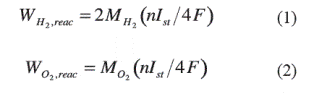
<body><![CDATA[<br> Those  topics have been addressed by using power electronics devices with  over-dimensioned input filters, which are commonly designed by considering  static electrical characteristics of the fuel cell [5] instead of important  dynamics such as oxygen excess ratio [6]. To deal with this topic, analytical  expressions for designing a power electronics system to ensure its safe  operation are proposed. The constraints in the system design are obtained by  analyzing a detailed fuel cell model. Similarly, its control strategy is  designed to ensure a safety operation according to the restrictions imposed by  the model analysis.    <br>    <br> The  remains of the paper are organized as follows. The next section describes a  dynamic fuel cell model used to define the power electronics constraints.  Furthermore, the paper presents the generation system, describing the circuital  design and mathematical modeling of the switching DC/DC power converter used to  protect the fuel cell, and also the control systems and protection routines  involved in the system operation. Finally, the experimental validation of the  system by using a benchmark fuel cell prototype is described. Subsequently, the  conclusions of the work are given.</font></p>      <p><font face="Verdana" size="2"><b><i>Fuel cell model analysis</i></b></font></p>      <p> <font face="Verdana" size="2">The fuel cell model used in this paper for the analysis and design is control-oriented and considers experimentally measurable inputs and outputs in order to fit it to the real prototype. The model interacts with the electrical load (DC/DC converter, battery charger, etc.) through electrical equations that model the fuel cell output impedance. The thermal effects on the stack voltage are also taken into account, and the main internal state predicted in the model is the oxygen excess ratio <i>&lambda;<sub>02</sub></i>, which is an important variable in FC control and safety [1].    <br>    <br> PEM fuel cells consume hydrogen and oxygen to produce electricity; the hydrogen and oxygen flows consumed in such electrochemical reaction for supplying the required stack current (I<sub>st</sub>) are given by the following equations (1) and (2), respectively.</font></p>      <p> <img src="/img/revistas/rfiua/n59/n59a01e01.gif"></p>      <p> <font face="Verdana" size="2">where <i>M<sub>H2</sub>, M<sub>0</sub>, n,</i> and <i>F</i> are the hydrogen and oxygen  molar masses, the number of cells in the stack and the Faraday constant,  respectively.    <br>    ]]></body>
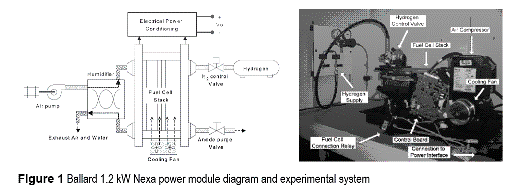
<body><![CDATA[<br>   The  relation between the oxygen flow provided to the stack and the one required to  supply the current demand is normally expressed by the oxygen excess ratio &lambda;<sub>o2</sub>[1]  defined in (3).</font></p>        <p> <img src="/img/revistas/rfiua/n59/n59a01e03.gif"></p>        <p> <font face="Verdana" size="2">Here,  <i>W<sub>o2,ca,in</sub></i> represents the cathode oxygen flow available in the air flow  <i>W<sub>ca,in</sub></i> in supplied by the FC compressor, and <i>W<sub>o2,reac</sub></i> represents  the oxygen flow consumed in the reaction, which depends on the stack current  (2).    <br>    <br>   High  oxygen excess ratio, and thus high oxygen partial pressure, improves the power  of the stack; however, after an optimum value is reached, a further increase of  its value causes an excessive increase in air compressor losses, thus degrading  the system efficiency [2].    <br>    <br>   The  control of the oxygen flow is critical because an oxygen concentration lower  than the one required to supply the stack current generates the oxygen  starvation effect (OST), which leads to the FC degradation [7]. Therefore, to  prevent the OST phenomenon, the oxygen excess ratio must be regulated within <i>&lambda;<sub>02</sub></i>  &ge; 1. In [8, 9] the authors propose to track <i>&lambda;<sub>02</sub></i>= 2 because this value provides  a safe margin against the OST effect.    <br>    <br> The applied modeling procedure  uses experimental data for identifying physical relations and for simplifying  complex equations derived from the involved models [3]. The model, then,  includes physical and electrochemical equations as well as behavioral relations  obtained by interpolating experimental data. The experimental setup used is the  Ballard 1.2 kW NEXA Power Module (NEXA), which is composed of a stack of 46  cells with membranes of 110 cm<sup>2</sup> surface area. The physical  configuration of the fuel cell NEXA module can be seen in <a href="#Figura1">figure 1</a>, which shows  the interaction between the stack, the air compressor, the humidifier, the  cooling system, the hydrogen supply and the anode purge valve.</font></font>      <p align="center"><img src="/img/revistas/rfiua/n59/n59a01i01.gif"><a name="Figura1"></a></p>      ]]></body>
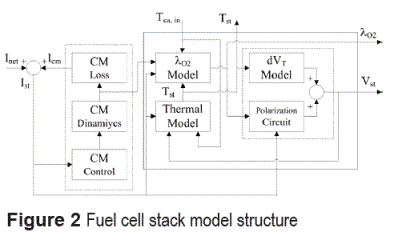
<body><![CDATA[<p> <font face="Verdana" size="2">The model inputs are the load current I<sub>net</sub> and the ambient temperature T<sub>ca,in</sub>. Its main outputs are the oxygen excess ratio <i>&lambda;<sub>O2</sub></i> and the stack voltage V<sub>st</sub>. The stack temperature T<sub>st</sub> is calculated in a thermal model used to estimate the voltage deviation caused by stack temperature changes, but it can be also used for prediction purposes.    <br>       <br> The thermal model can be obtained by energy balance as described in (4) [10]. </font></p>      <p><img src="/img/revistas/rfiua/n59/n59a01e04.gif" ></p>      <p> <font face="Verdana" size="2">The FC-load  interaction is modeled by a non-linear relation, where the voltage at the FC  terminals dependents on <i>&lambda;<sub>02</sub></i> and I<sub>st</sub>. Finally, the stack  voltage deviation dVT caused by changes in the stack temperature is  also modeled, reproducing in this way the non-linear fuel cell electrical  impedance. The model structure is given in <a href="#Figura2">figure 2</a>, which shows the compressor  dynamics, its losses, and the structure of the control board, where the  effective stack current depends on the load current and on the compressor  consumption.</font></p>      <p align="center"><img src="/img/revistas/rfiua/n59/n59a01i02.gif" ><a name="Figura2"></a></p>      <p> <font face="Verdana" size="2">      The model of the air  compressor is based on a Laplace representation of its dynamic behavior,  requiring a low computational load and, at the same time, providing a good  accuracy. Such transfer function, given in (5), has been identified from the  NEXA experimental data,</font></p>      <p><img src="/img/revistas/rfiua/n59/n59a01e05.gif" ></p>      <p> <font face="Verdana" size="2"> where V<sub>cp</sub> is the compressor control signal (0 %  - 100 %) and W<sub>cp</sub> is the air mass flow supplied to the FC stack. The  compressor control law implemented in the NEXA control board has been  experimentally identified as given in (6).</font></p>      <p><img src="/img/revistas/rfiua/n59/n59a01e06.gif" ></p>      ]]></body>
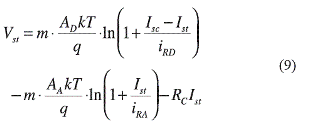
<body><![CDATA[<p> <font face="Verdana" size="2">  In  order to account for the power consumption due to FC system ancillaries, and  especially to the air compressor, the stack current I<sub>st</sub> must be  calculated by the sum of the net current I<sub>net</sub>  requested by the load and the  compressor current I<sub>cm</sub>. The consumption and losses of the ancillaries have been identified experimentally from the NEXA system as equation  (7). W<sub>cp</sub> (5), V<sub>cp</sub> (6) and I<sub>cm</sub> (7) identification processes have been performed  by following the traditional reactioncurve method.    </font></p>      <p><img src="/img/revistas/rfiua/n59/n59a01e07.gif" ></p>      <p><font face="Verdana" size="2">In  the polarization curve modeling by circuital equations, the effects considered  are: the activation of both electrodes v<sub>A</sub>, which corresponds to the  voltage contributions of each electrode depend on species and electrode  materials; the charge transfer from electrode to electrode v<sub>D</sub>  according to Fick's first law of diffusion [10, 11], related to the carrier  concentration; and the voltage drop v<sub>R</sub> due to the resistive parts of  the cell.    <br>    <br> The equivalent electric  equation that considers these three effects, and therefore describes the same &upsilon;(i) characteristic of the cell at any time t, is  given in (8),</font></p>      <p><img src="/img/revistas/rfiua/n59/n59a01e08.gif" ></p>      <p> <font face="Verdana" size="2">where  &#8710;E<sup>0</sup> is the open circuit voltage, it representing the difference of  the standard potentials of the electrodes.    <br>    <br> In the case of a stack consisting in the series connection  of m cells, some parameters in the equivalent circuit multiplies by m. Finally,  the stack impedance model is presented in (9),</font></p>      <p><img src="/img/revistas/rfiua/n59/n59a01e09.gif" ></p>      ]]></body>
<body><![CDATA[<p><font face="Verdana" size="2">where <i>m</i> = 46 for the NEXA, <i>R<sub>C</sub>= m&middot;r<sub>c</sub></i> stack resistance (r<sub>C</sub> is a singe cell resistance), <i>A<sub>D</sub></i> and  <i>A<sub>A</sub></i>  are parameters experimentally obtained, <i>k</i> is the Boltzmann constant, <i>q</i> the electron charge, and T  the stack temperature in Kelvin.    <br> The  short-circuit current I<sub>sc</sub> depends on <i>&lambda;<sub>02</sub></i>, and the equation  coefficients have been experimentally obtained from polarization curves with <i>&lambda;<sub>02</sub></i> values between 3.0 and 6.5. The identified short- circuit current  equation is given in (10).</font></p>        <p><img src="/img/revistas/rfiua/n59/n59a01e10.gif" ></p>          <p> <font face="Verdana" size="2">To  consider the effect of the temperature on the stack voltage, the deviation of  the polarization curve <i>dV<sub>T</sub></i> depending on the changes of the stack temperature from the  reference temperature (T<sub>0</sub>=35&deg;C) has been experimentally identified as (11 ),</font></p>        <p><img src="/img/revistas/rfiua/n59/n59a01e11.gif" ></p>            <p> <font face="Verdana" size="2">where {<img src="/img/revistas/rfiua/n59/n59a01e0a.gif" width="12" height="17" ><em>T<sub>st</sub> &gt;T<sub>o</sub>,  k<sub>dV</sub></em>=0.138} &#094; { <img src="/img/revistas/rfiua/n59/n59a01e0a.gif" width="12" height="17" ><em>T<sub>st</sub> </em>&le; <em>T<sub>0</sub></em>, <em>k<sub>dV</sub> </em>=0.250}. Finally, from the model  equations, it is concluded that fast positive changes in I<sub>st</sub> generate  fastnegative changes in <i>&lambda;<sub>02</sub></i>, and therefore it is necessary to  regulate the stack current and air flow compressor to avoid OST. In particular,  the stack current and stack power slopes must be in agreement with the maximum  air flow slope that ensures a <i>&lambda;<sub>02</sub></i> &gt; 1 condition, which can be  obtained from equation (5) and experimental current and power measurements. In  the 1.2 kW NEXA power module, the maximum admisible fuel cell power slew-rate  is equal to S<sub>Rfc</sub>=250 W/s.</font></p>          <p><font face="Verdana" size="3"><b>Experimental      </b> </font></p>       <p> <font face="Verdana" size="2"><b><i>Fuel cell generation system      </i></b></font></p>          <p> <font face="Verdana" size="2">The  design of a fuel cell-based power generation system to provide a regulated DC  bus with safe fuel cell operation must to consider power conversion circuits  and protection systems. The proposed fuel cell generation system considers an  unidirectional power flow from the system to the load. In order to design a  generic bus supply system, it has been considered a voltage regulated  unidirectional DC bus, but it can be easily extended to bidirectional  applications for regenerative loads.    <br>    ]]></body>
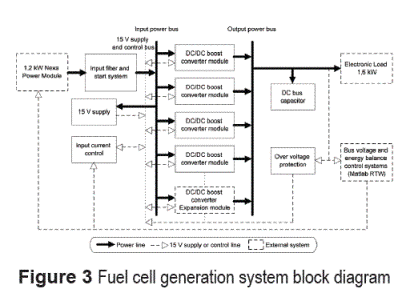
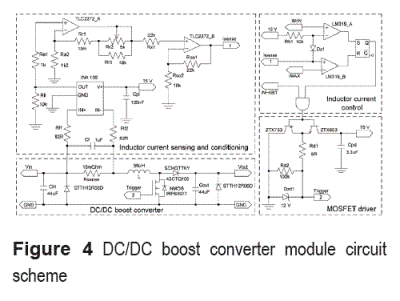
<body><![CDATA[<br> In  this paper is proposed to regulate the fuel cell current using an input current  controlled DC/DC switching converter [6], and an auxiliary storage device is  required for transients supply. In this aspect, the interaction of  supercapacitors and fuel cells has been analyzed in [12, 13], whose results are  also valid for high capacitive-low resistance capacitor banks.    <br>    <br> The block diagram of the  proposed fuel cell generation system is depicted in <a href="#Figura3">figure 3</a>. It considers a  DC/DC power converter and an input filter in series with the fuel cell NEXA  module, which regulates a capacitive DC bus to supply the load. Also, there are  considered the power converter input current control and bus overvoltage  protection.</font></p>        <p align="center"><img src="/img/revistas/rfiua/n59/n59a01i03.gif" ><a name="Figura3"></a></p>        <p> <font face="Verdana" size="2">The  NEXA user manual [14] reports maximum operating limits for stack voltage of 22  V at short current transients (60 A - 70 A for 10 ms - 1 ms, respectively) and  50 V for null stack current. In this paper it is considered a real, and  experimentally measured, safe stack voltage range between 26 V and 46 V. Also,  considering the common use of 48 V (or above) DC buses (telecom, aerospace,  electric vehicle, etc.), a boost DC/DC switching converter topology has been  selected. In addition, the boost topology has the inductor in series with the  power supply, allowing in this way to constrain the input current ripple, which  is not possible in buck converters due to its discontinuous input current,  requiring therefore a high input filter for this issue. The designed switching  converter has a nominal power of 1.2 kW to support the NEXA requirements, but  in order to make it robust, redundant and scalable, it was developed using four  power conversion modules, each one of them with a maximum power of 300 W. The  converter structure is also flexible to support lower or higher power systems  using different number of modules. This is showed in <a href="#Figura3">figure 3</a>, where input and  output power buses allow the connection of multiple power conversion modules.    <br>    <br> Considering  the negative impact of high frequency components of the current-ripple into the  FC health [4], this scheme allows to reduce those current components by  shifting the phase of inductor current waveforms. Such procedure generates that  parallel modules exhibit opposite current slopes for fractions of the switching  period producing a partial cancellation between the corresponding current  ripples.</font></p>        <p> <font face="Verdana" size="2"><b><i>DC/DC boost converter modules design</i></b></font></p>        <p> <font face="Verdana" size="2">The circuit scheme of each DC/DC boost converter module is depicted in <a href="#Figura4">figure 4</a>, where it is observed the boost converter, inductor current sensing and conditioning, inductor current control, and MOSFET driving circuit. The core of the converter module is the DC/DC boost converter, whose basic elements are the inductor L, MOSFET N-channel and SCHOTTKY diode, and also a R<sub>sense</sub> shunt resistor was introduced to measure the inductor current.</font></p>        <p align="center"><img src="/img/revistas/rfiua/n59/n59a01i04.gif" ><a name="Figura4"></a></p>        ]]></body>
<body><![CDATA[<p> <font face="Verdana" size="2">This switching converter can operate in two modes [15, 16]: Continuous Conduction Mode (CCM), when the inductor current exhibits a continuous waveform; and Discontinuous Conduction Mode (DCM), when the inductor current exhibits a discontinuous waveform. In this implementation, the converters operate in CCM, and each module supports up to 300 W and its inductor was designed for a nominal current of 10 A.</font></p>        <p> <font face="Verdana" size="2"><b><i>Inductor design      </i></b></font></p>       <p> <font face="Verdana" size="2">Since  the inductor current waveform is triangular, the equation (12) is used to  select the in ductor value L to obtain a desired &#8710;i<sub>L</sub> value [16], </font></p>        <p><img src="/img/revistas/rfiua/n59/n59a01e12.gif" ></p>          <p> <font face="Verdana" size="2">   where V<sub>g</sub> is the DC  input voltage, V is the DC output voltage, f is the switching frequency, and D  is the duty cycle given by D=(V-V<sub>g</sub>)/V for this boost topology. The  parameters considered in this design are V<sub>g</sub>=34 V, V=48 V, f=50 KHz, &#8710;i<sub>L</sub>=3.5  A and D=0.2917. The calculated inductor value was L=56 &micro;H, and the values  measured using a QUADTECH LCR 1910 inductance analyzer [17], at the nominal  conditions, are: L=56 &micro;H, R<sub>DC</sub>=12 m&Omega;, ESR<sub>20kHz</sub>=145 m&Omega;,  ESR<sub>50kHz</sub>=175 m&Omega; &nbsp;and ESR<sub>100kHz</sub>=300  m&Omega; .   </font></p>        <p> <font face="Verdana" size="2"><b><i>Input and output capacitors, and protection diodes</i></b></font></p>        <p> <font face="Verdana" size="2"> Since  the output capacitor voltage waveform is triangular, equation (13) is used to  select the capacitance C to obtain a given output voltage ripple magnitude &#8710;<em>v</em> [16]. </font></p>         <p><img src="/img/revistas/rfiua/n59/n59a01e13.gif" ></p>           <p> <font face="Verdana" size="2">In equation (13), R<sub>L</sub>  is the nominal load calculated by R<sub>L</sub>=V/I<sub>out</sub>=6.85 &Omega;. I<sub>out</sub>=V<sub>g</sub>  &middot;I<sub>nom</sub>/V=7 A is the maximum output  current, I<sub>nom</sub> =10 A is the converter nominal current,  and &#8710;<em>v</em>=0.5 V is the desired voltage ripple. From those parameters  a 41 &micro;F output capacitor was calculated, where the selected commercial value  was C = 44 &micro;F. The same value is used for the input capacitor. Additionally,  the capacitors were localized near to the inductor and diode, and the selected  capacitor technology was EPCOS MKT (100 V, 10 % tolerance), both to reduce the  electromagnetic radiation generated by the converter. Also, an anti-parallel  STTH12R06D diode was introduced to allow the inductor discharge and to avoid  negative capacitor voltages. Another anti-parallel diode was introduced in the  converter output to avoid negative voltage conditions in the capacitive bus,  i.e. in suddenly disconnection of inductive loads.    <br>    ]]></body>
<body><![CDATA[<br> In  addition, the series resistance of a MKT technology capacitor can be calculated  from (14),</font></p>         <p><img src="/img/revistas/rfiua/n59/n59a01e14.gif" ></p>             <p> <font face="Verdana" size="2">where  Q is the quality factor, which for MKT capacitors is Q=160. For the nominal  operating frequencies: ESR<sub>20kHz</sub>=17.28 m&Omega;, ESR<sub>50kHz</sub>=43.19  m&Omega; and ESR<sub>100kHz</sub>=86.39 m&Omega;. </font></p>          <p> <font face="Verdana" size="2"><b><i>DC bus capacitor design and voltage regulation </i></b></font></p>      <p> <font face="Verdana" size="2">A capacitive storage was selected to supply power transients due to its high-frequency capabilities, easy state of charge (SOC) estimation and low serial resistance in contrast to battery-based systems. In order to provide a regulated DC bus, the bus capacitor dimensioning and energy regulation must ensure a system behavior into admissible voltage limits and power transients restoring times. In the power interface, the relations between the switching converter, capacitor bus and load currents and powers are given by (15),</font></p>       <p><img src="/img/revistas/rfiua/n59/n59a01e15.gif" ></p>        <p><font face="Verdana" size="2">where <i>i<sub>dc/dc</sub></i> and <i>P<sub>dc/dc</sub></i> correspond to the output of  the switching converter, <i>i<sub>cb</sub></i> and <i>P<sub>cb</sub></i> to the bus capacitor, and <em>i<sub>Load</sub></em> and <i>P<sub>Load</sub></i> to the load. Also, it is necessary to take  into account the switching converter losses, which are represented by a power  conversion efficiency <i>&eta;<sub>dc/dc</sub></i> considered constant in all  the power range.    <br>       <br> In a power transient, the bus  capacitor initially supplies the power to the load, and then the fuel cell  operating point is moved to the new steady state constraining its maximum power  slope to the defined slew-rate limit. If the load current has a high-frequency  ripple, this one is supplied by the bus capacitor and the fuel cell provides  the low-frequency components.    <br>     ]]></body>
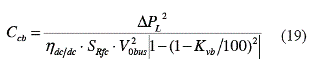
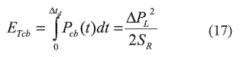
<body><![CDATA[<br> In  order to dimensioning the bus capacitor, the following DC bus parameters were  defined: maximum load power transient considered <i>&#8710;P<sub>L</sub></i> [W], maximum admissible fuel  cell power slew- rate S<sub>Rfc</sub> [W/s], and maximum acceptable bus voltage deviation <i>K<sub>vb</sub></i> (%). Due to the power  converter efficiency, the effective slew-rate limit that affects the power  delivered to the capacitor and load is <i>S<sub>R</sub> = &eta;<sub>dc/dc</sub> &middot; S<sub>Rfc</sub></i> [W/s].    <br>     <br> The  most critical load transient case is reached in a power step of <i>&#8710;P<sub>L</sub></i>, in which the fuel cell power  will be changed with a slope S<sub>Rfc</sub> until it reaches the new  steady-state power point at <i>&#8710;t<sub>d</sub>=&#8710;P<sub>L</sub>/S<sub>R</sub></i> [s]. Therefore, the power P<sub>cb</sub>(t) supplied by the capacitor  in this time interval can be expressed as (16), </font></p>      <p><img src="/img/revistas/rfiua/n59/n59a01e16.gif" ></p>       <p><font face="Verdana" size="2">and the energy E<sub>Tcb</sub> exchanged between the bus capacitor and the load is given by (17).  </font></p>         <p><img src="/img/revistas/rfiua/n59/n59a01e17.gif" ></p>           <p><font face="Verdana" size="2">Also, this energy difference produces a bus voltage variation of <i>(K<sub>vb</sub>/100)&middot;V<sub>0bus</sub></i> from its steady-state value <i>V<sub>0bus</sub></i>. This voltage change can also be expressed as a function of the capacitor initial and final energies, when the power exchange with the load has ended, as (18). </font></p>        <p><img src="/img/revistas/rfiua/n59/n59a01e18.gif" ></p>           <p><font face="Verdana" size="2">Finally, from (16), (17), and (18) can be calculated the capacitance that ensures the maximum bus voltage change and restoring time desired, at the given load transient, as (19).</font></p>        <p><img src="/img/revistas/rfiua/n59/n59a01e19.gif" ></p>          ]]></body>


<body><![CDATA[<p><font face="Verdana" size="2">Considering the parameters of  the experimental system <em>&eta;<sub>dc/dc</sub></em> = 85 %,<em> V<sub>obus</sub></em> = 48 V, <em>K<sub>vb</sub></em>=5 %, <i>&#8710;P<sub>L</sub></i> = 300 W and S<sub>Rfc</sub>= 250 W/s, the required bus  capacitance is  C<sub>cb</sub>=  1.9 F.    <br>    <br>     The  power conditioning input current must be controlled to regulate the fuel cell  stack current, and therefore the converter modules are controlled in current  mode. In this way, the inductor current was controlled by using the sliding  mode control technique [18], which provides a fast transient response with a  small overshoot, and guarantees a very low sensitivity to external  perturbations.</font></p>      <p> <font face="Verdana" size="2"><b><i>DC/DC Boost converter modules modeling and control</i></b></font></p>      <p> <font face="Verdana" size="2">The scheme of the selected DC/DC boost converter can be observed in <a href="#Figura4">figure 4</a>. By applying the average modeling technique, the bilinear system [16] given in (20) is obtained,</font></p>       <p><img src="/img/revistas/rfiua/n59/n59a01e20.gif"  ></p>        <p> <font face="Verdana" size="2"> where u represents the state of the MOSFET (u = 1 for ON, u = 0 for OFF) and diode <i>(u)</i>. For the converters sliding mode control [18], the desired sliding surface is described by (21),     </font></p> 	      <p><img src="/img/revistas/rfiua/n59/n59a01e21.gif"  ></p>  	       <p> <font face="Verdana" size="2"> where I<sub>BRef</sub> represents the average inductor current reference imposed to the boost converter, being it considered constant in the cycle and in the middle of the hysteresis band of the comparator [19]: I<sub>BRef</sub> = (IMAX+IMIN)/2, where IMAX and IMIN correspond to the maximum and minimum admissible current values, respectively.    <br>    ]]></body>

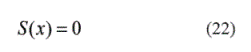
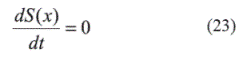
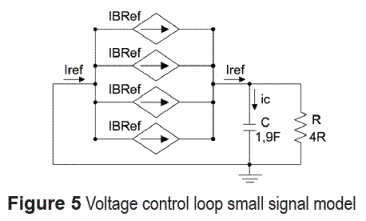
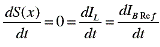
<body><![CDATA[<br>  To ensure a sliding trajectory around S(x), and therefore to achieve the control objective, it is necessary to satisfy the conditions given by (22) and (23).</font></p>        <p><img src="/img/revistas/rfiua/n59/n59a01e22.gif"  ></p>       <p><img src="/img/revistas/rfiua/n59/n59a01e23.gif"  ></p>        <p> <font face="Verdana" size="2">From (22), S(x)=0=I<sub>L</sub>-I<sub>BRef</sub>, therefore I<sub>L</sub>=I<sub>BRef</sub>, i.e. the control objective. Also, from (23), it is derived <img src="/img/revistas/rfiua/n59/n59a01e00.gif" >. From this equation, and using the sliding mode equivalent control technique for switching converters [18], equation (24) is obtained,    </font></p>        <p><img src="/img/revistas/rfiua/n59/n59a01e24.gif"  ></p>         <p> <font face="Verdana" size="2"> where u<sub>eq</sub>  represents the percentage of switching period when the MOSFET is ON. The  conditions to ensure the equivalent control are: 0 &lt; u<sub>eq</sub> &lt; 1&harr;1&gt;  1-u<sub>eq</sub> &gt; 0, which being applied to (24) leads to:</font> </p>         <p><img src="/img/revistas/rfiua/n59/n59a01e25.gif"  ></p>          <p> <font face="Verdana" size="2">   Inequality (25) constrains the  derivative of the reference between the inductor current charge and discharge  slopes, which define the conditions for existence of the sliding-mode.    <br>    <br> Considering the modules  current control, the closed loop modules can be modeled by ideal current  sources, and therefore the voltage control system can be expressed as given in  <a href="#Figura5">figure 5</a>. The equations that describe the voltage dynamics are: <em>i<sub>c</sub>=I<sub>ref</sub>  - V<sub>c </sub>/R =C dv<sub>c</sub> /dt </em>and <em>I<sub>ref</sub>  = P<sub>ref</sub> /v<sub>c</sub> , </em>which leads  to <em>dv<sub>c</sub> /dt = P<sub>ref</sub> /v<sub>c</sub>C - v <sub>c</sub>/RC.</em></font></p>        ]]></body>

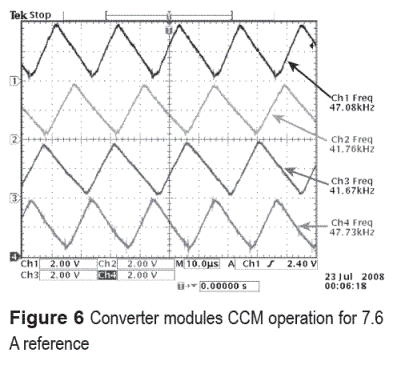
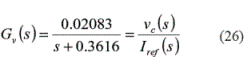
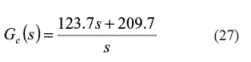
<body><![CDATA[<p align="center"><img src="/img/revistas/rfiua/n59/n59a01i05.gif" ><a name="Figura5"></a></p>        <p> <font face="Verdana" size="2"> Defining  the new state vector x = [v ], the voltage dynamics can be expressed by <em>x</em>=Ax+Bw, where  <img src="/img/revistas/rfiua/n59/n59a01e000.gif" > and w = [P<sub>ref</sub>]. In the nominal operating point, where the system is linearized, the steady state values are <i>v<sub>c</sub></i>=48 V and P<sub>ref</sub> =530 W.</font></p>       <p> <font face="Verdana" size="2">The bus voltage model depending on the overall input current is given by (26),      </font></p>          <p><img src="/img/revistas/rfiua/n59/n59a01e26.gif"  ></p>             <p> <font face="Verdana" size="2"> and the controller designed to ensure a  damping factor &xi;=0.707 and a settling time t<sub>s</sub>=2.7s is given by (27),  which provides an infinite gain margin and a phase margin PM=66.9. </font></p>           <p><img src="/img/revistas/rfiua/n59/n59a01e27.gif"  ></p>            <p><font face="Verdana" size="3"><b>Results and discussion </b> </font></p>           <p> <font face="Verdana" size="2">In the implementation of the current  controllers, a window comparator was used to detect when the current reaches  its maximum and minimum allowed values, where it triggers the RESET or SET  signals of a S-R flip-flop, respectively, as depicted in <a href="#Figura4">figure 4</a>. This  flip-flop reduces the circuit noise sensibility and it stores the switching  state applied to the MOSFET driver. <a href="#Figura6">Figure 6</a> shows the experimental inductor  currents of the four converter modules operating in CCM, where each module is  controlled by its own local current control which reference I<sub>BRef</sub> is  defined to obtain the desired average input  current I<sub>Ref</sub>.  </font></p>        <p align="center"><img src="/img/revistas/rfiua/n59/n59a01i06.gif" ><a name="Figura6"></a></p>        <p> <font face="Verdana" size="2">The inductor currents in the converter modules exhibit triangular waveforms, but due to the small differences in the inductors, capacitors, diodes and MOSFET drivers, the triggering times are not equal, causing in this way partial current ripple cancelation [20] as depicted in <a href="#Figura6">figure 6</a>. The experimental switching frequencies of the sliding-mode converters are between 40 kHz and 50 kHz.    ]]></body>
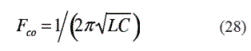
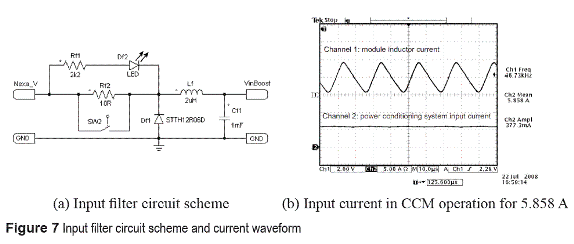
<body><![CDATA[<br>    <br> The amount of canceled ripple depends on the inductor currents phase differences, which depend on the electric elements discrepancies. In this way, the four-module power system gives a natural partial input current ripple cancelation.</font></p>         <p> <font face="Verdana" size="2"><b><i> Input filter</i></b></font></p>       <p> <font face="Verdana" size="2"> To reduce the high frequency components injected to the fuel cell, an input filter was designed to absorb the remaining current ripple not cancelled by the parallel operation of the converter modules, which in normal operating mode, is constrained to [0 A, 14 A]. The probability of experimenting the 14 A worst case, four modules in perfect phase, is minimum due to the electric elements differences, but for fuel cell safety it has been considered. The input filter consists in the L-C network (Lf, Cf1) observed in <a href="#Figura7">figure 7</a>, which cut-off frequency is given by (28), and in the implementation is equal to F<sub>co</sub>=3.5 kHZ.     </font></p>          <p align="center"><img src="/img/revistas/rfiua/n59/n59a01i07.gif" ><a name="Figura7"></a></p>           <p><img src="/img/revistas/rfiua/n59/n59a01e28.gif"  ></p>           <p><font face="Verdana" size="2">  This  frequency is a decade under the minimum switching frequency, being it enough to  remove the high frequency components from the fuel cell current. If a higher  load power is required, the current capacity of the filter must be increased,  but keeping the same cut-off frequency, and therefore the same inductance and  capacitance values.    <br>    <br> The  circuit scheme of the implemented input filter, depicted in <a href="#Figura7">figure 7(a)</a>, has an  additional network Rf2-SW2 used to charge the capacitive bus and input filter  with a constrained current slope to respect the fuel cell dynamics, and to  avoiding damages in the start-up of the system.    <br>    ]]></body>
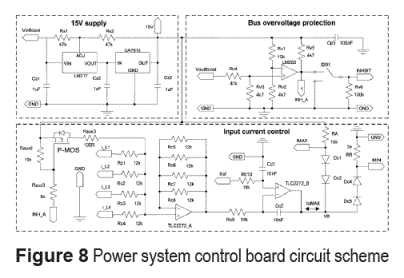
<body><![CDATA[<br>  The power conditioning  experimental current, and therefore fuel cell current, is depicted in <a href="#Figura7">figure 7(b)</a>. The measured input current ripple is approximately 377.3 mA, being this  ripple almost constant due to the low variation of the hysteresis band.    <br>    <br>  Such current ripple is acceptable because it represents less than 10 % of the nominal fuel cell current [21], being a 0.82 % in this experiment. Also, in the experiment presented in <a href="#Figura7">figure 7(b)</a>, the current ripple corresponds to 6.4 % of the DC current, it being under the maximum recommended 30 % limit for high and low frequency current ripples in fuel cells [14, 22]. Finally, <a href="#Figura7">figure 7(b)</a> also shows the current of one phase to illustrate the switching frequency.</font></p>          <p> <font face="Verdana" size="2"><b><i>Control board and overvoltage protection </i></b></font></p>          <p> <font face="Verdana" size="2">   The supervisory controller of  the converter modules includes the average input current control and  overvoltage protection, which ones must be applied to all the modules at any  time. Those control strategies were implemented in a single control board  described in <a href="#Figura8">figure 8</a>.    <br>    <br> The  control board includes a 15 V voltage source, which allows supplying the  ancillary devices using the fuel cell power without additionally supplies.    <br>    <br> The  average input current regulation strategy was implemented using a voltage  average operational amplifier, which calculates the average input current value  from the inductor current sensing signals of the converter modules. Next, the  error of the average current from the reference I<sub>ref</sub> is processed by  an integrator operational amplifier that closes the control loop. The resulting  control signal defines the average current reference for the sliding mode  current controllers, where the relation between RA and RB resistances in the  scheme of <a href="#Figura8">figure 8</a> defines the maximum and minimum values of the hysteresis  band.</font></p>          <p align="center"><img src="/img/revistas/rfiua/n59/n59a01i08.gif" ><a name="Figura8"></a></p>           ]]></body>
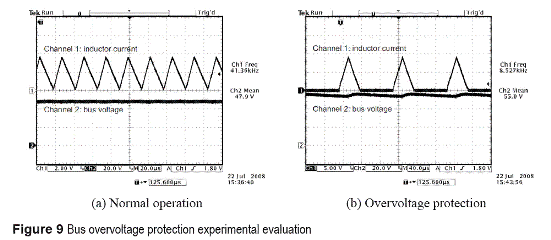
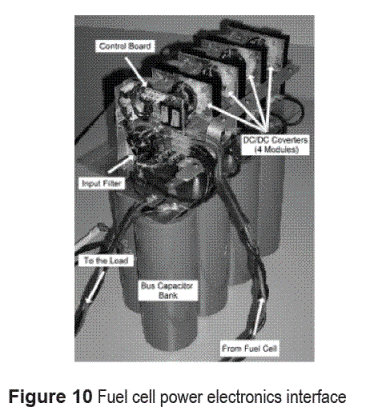
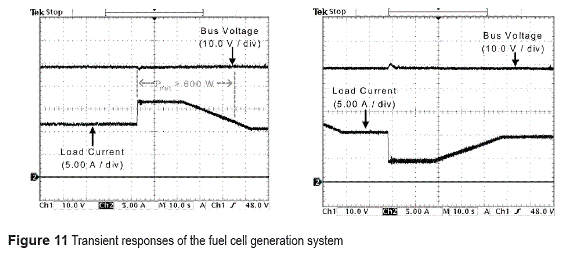
<body><![CDATA[<p><font face="Verdana" size="2"> The control board also implements the bus overvoltage protection, which consists in a comparator network that evaluates the bus voltage in front to a preset maximum allowed voltage of 55 V. The comparator generates an INHIBIT signal that forces the MOSFET shutdown in the converter modules, reactivating the MOSFET switching control when the overvoltage condition is over. An additional P-MOS MOSFET and resistors network has been introduced to minimize the current peaks in converter MOSFET reactivation, which is activated by the comparator output, INH_A in <a href="#Figura8">figure 8</a>, forcing the fast drop to zero of the integrator output. This condition disappears when the overvoltage condition ended because the P-MOS is inhibited and the integrator recover its control inputs. This generates a burst mode (BM) [23] behavior of the converter, where the converter absorbs in DCM the required average power in each cycle without incrementing the switching frequency in small current conditions. BM is used because to limit the output voltage, and therefore to prevent the destruction of the bus capacitor, it is required to reduce the converters current.    <br>    <br> The experimental evaluation of the overvoltage protection is depicted in <a href="#Figura9">figure 9</a>, where <a href="#Figura9">figure 9(a)</a> experiment shows a normal operation with the bus voltage under the restriction of 55 V, being 47.9 V in this case.  <a href="#Figura9">Figure 9(b)</a> presents the effect of the protection when the bus voltage arrives the 55 V limit, reporting a satisfactory behavior. It is observed the BM caused by the overvoltage protection, which generates a DCM inductor current.</font></p> 	       <p align="center"><img src="/img/revistas/rfiua/n59/n59a01i09.gif" ><a name="Figura9"></a></p>  	      <p> <font face="Verdana" size="2"><i>Transient response of the fuel cell generation system      </i></font></p>	 	       <p><font face="Verdana" size="2">The experimental fuel cell power electronics interface is depicted in <a href="#Figura10">figure 10</a>, where it is observed the 1.9 F bus capacitor bank, the four controlled DC/DC converter modules, the control board, and the input filter.   </font></p>          <p align="center"><img src="/img/revistas/rfiua/n59/n59a01i10.gif" ><a name="Figura10"></a></p>             <p> <font face="Verdana" size="2">  Finally,  the experimental behavior of the developed power electronics system interacting  with the 1.2 kW Nexa power system is presented in <a href="#Figura11">figure 11</a>, where the load  current exhibits high and low frequency transients that are compensated by the  voltage controller, regulating in this way the bus voltage in the desired  performance, where the maximum allowed deviation K<sub>vb</sub> = 5% from desired bus voltage V<sub>0bus</sub>  = 48 V is achieved. The maximum time interval when the bus voltage is deviated  from V<sub>0bus</sub> inside K<sub>vb</sub> band is calculated from the  capacitor differential equation to 5.4 s for a load transient equal to 300 W. A  first high power step-up transient (P<sub>net</sub> &gt; 600 W) generates a  small voltage reduction that is satisfactorily compensated by the voltage  regulator. Similarly, a second step-down transient is applied, and the power  electronics systems behave properly for the bus regulation. In both cases the  fuel cell current slope is constrained to avoid damages, and the restoring time  fulfills the performance criterion, and in particular in the higher load  transient of 289.6 W such time is 3.4 s, being therefore satisfactory.  Additionally, the slow slew-rate power transients (12 W/s) are rejected, which  allows achieving a negligible deviation from the nominal DC bus voltage. </font></p>           <p align="center"><img src="/img/revistas/rfiua/n59/n59a01i11.gif" ><a name="Figura11"></a></p>             <p><font face="Verdana" size="3"><b> Conclusions       </b> </font></p>          ]]></body>
<body><![CDATA[<p><font face="Verdana" size="2">    This paper proposes analytical expressions to design power electronics  systems intended to safely supply electronic loads using fuel cells. Experimental  results show the satisfactory regulation of the load bus with safe fuel cell operation,  validating the analytical expressions.    <br>    <br> The  proposed approach consisting of an array of four DC-DC converters in parallel  to reduce the current ripple in contrast to traditional singlestage  converters, which has been evidenced in the comparison of a single module and  the overall system current waveforms. This system is regulated to constrain the  slope of the fuel cell current into security limits. Additional filter design  has been discussed to provide an extra margin on the safety conditions.    <br>    <br> With  the objective of supplying electronic loads, it has been provided analytical  expressions to DC bus design according to performance specifications. Besides,  control structures were designed to regulate both the converter and the DC bus.  Additional overvoltage protection was designed to avoid damages on the DC bus,  load and converters. Experimental results show the correct operation of  protection systems in presence of load transients, validating the power  structure.    <br>    <br>  Finally, the use of advanced  techniques for switching converters design and control, such as interleaving,  would optimize the cancellation of current ripples to reduce significantly the  size of the input filter, which allows a future improvement of the proposed  system.</font></p>          <p><font face="Verdana" size="3"><b>Acknowledgments</b> </font></p>          <p><font face="Verdana" size="2">This work was supported by GAUNAL and GITA research groups of the Universidad Nacional de Colombia, and the GIT group of the Instituto Tecnol&oacute;gico Metropolitano under the projects DACOGEN-PV and MECOVA-WIND, by Universitat Rovira i Virgil, by the Spanish Ministerio de Ciencia e Innovaci&oacute;n under the project TEC2009-13172, and by the Colombian Departamento Administrativo de Ciencia, Tecnolog&iacute;a e Innovaci&oacute;n (COLCIENCIAS) under the scholarship 095-2005.      </font></p>         <p><font face="Verdana" size="3"><b>References</b> </font></p>          ]]></body>
<body><![CDATA[<!-- ref --><p> <font face="Verdana" size="2">1. &nbsp;J. T. Pukrushpan,  A. G. Stefanopoulou, P. Huei. "Control of fuel cell breathing".<i> Control  Systems Magazine IEEE</i>. Vol. 24. 2004. pp. 30-46.    &nbsp;&nbsp;&nbsp;&nbsp;&nbsp;&nbsp;&nbsp;&nbsp;[&#160;<a href="javascript:void(0);" onclick="javascript: window.open('/scielo.php?script=sci_nlinks&ref=000183&pid=S0120-6230201100030000100001&lng=','','width=640,height=500,resizable=yes,scrollbars=1,menubar=yes,');">Links</a>&#160;]<!-- end-ref --><br>        <!-- ref --><br> 2. J. T. Pukrushpan, A. G.  Stefanopoulou, H. Peng. <i>Control of fuel cell power systems: principles, modeling,  analysis, and feedback design.</i> Ed. Springer Verlag. London. 2004. pp. 1-61.    &nbsp;&nbsp;&nbsp;&nbsp;&nbsp;&nbsp;&nbsp;&nbsp;[&#160;<a href="javascript:void(0);" onclick="javascript: window.open('/scielo.php?script=sci_nlinks&ref=000185&pid=S0120-6230201100030000100002&lng=','','width=640,height=500,resizable=yes,scrollbars=1,menubar=yes,');">Links</a>&#160;]<!-- end-ref --><br>    <!-- ref --><br> 3. A. J. del Real, A. Arce, C.  Bordons. "Development and experimental validation of a PEM fuel cell  dynamic model". <i>Journal of Power Sources.</i> Vol. 173. 2007. pp. 310-324.    &nbsp;&nbsp;&nbsp;&nbsp;&nbsp;&nbsp;&nbsp;&nbsp;[&#160;<a href="javascript:void(0);" onclick="javascript: window.open('/scielo.php?script=sci_nlinks&ref=000187&pid=S0120-6230201100030000100003&lng=','','width=640,height=500,resizable=yes,scrollbars=1,menubar=yes,');">Links</a>&#160;]<!-- end-ref --><br>    <!-- ref --><br> 4. R. S. Gemmen.  "Analysis for the effect of inverter ripple current on fuel cell operating  condition". <i>Journal of Fluids Engineering.</i> Vol. 125. 2003. pp. 576-585.    &nbsp;&nbsp;&nbsp;&nbsp;&nbsp;&nbsp;&nbsp;&nbsp;[&#160;<a href="javascript:void(0);" onclick="javascript: window.open('/scielo.php?script=sci_nlinks&ref=000189&pid=S0120-6230201100030000100004&lng=','','width=640,height=500,resizable=yes,scrollbars=1,menubar=yes,');">Links</a>&#160;]<!-- end-ref --><br>    <!-- ref --><br> 5. D. D. Marquezini, D. B.  Ramos, R. Q. Machado, F. A. Farret. "Interaction between proton exchange  membrane fuel cells and power converters for AC integration". <i>IET Renewable  Power Generation.</i>  Vol. 2. 2008. pp. 151-161.    &nbsp;&nbsp;&nbsp;&nbsp;&nbsp;&nbsp;&nbsp;&nbsp;[&#160;<a href="javascript:void(0);" onclick="javascript: window.open('/scielo.php?script=sci_nlinks&ref=000191&pid=S0120-6230201100030000100005&lng=','','width=640,height=500,resizable=yes,scrollbars=1,menubar=yes,');">Links</a>&#160;]<!-- end-ref --><br>    ]]></body>
<body><![CDATA[<!-- ref --><br> 6. C. A. Ramos, A. Romero, R.  Giral, L. Martinez Salamero. "Maximum Power Point Tracking Strategy for  Fuel Cell Power Systems".<i> IEEE International Symposium on Industrial Electronics.</i> 2007. pp. 2613-2618.    &nbsp;&nbsp;&nbsp;&nbsp;&nbsp;&nbsp;&nbsp;&nbsp;[&#160;<a href="javascript:void(0);" onclick="javascript: window.open('/scielo.php?script=sci_nlinks&ref=000193&pid=S0120-6230201100030000100006&lng=','','width=640,height=500,resizable=yes,scrollbars=1,menubar=yes,');">Links</a>&#160;]<!-- end-ref --><br>    <!-- ref --><br> 7. C. Bordons, A. Arce, A. J.  del Real. "Constrained predictive control strategies for PEM fuel  cells".<i> American  Control Conference.</i>  2006. pp. 2486-2491.    &nbsp;&nbsp;&nbsp;&nbsp;&nbsp;&nbsp;&nbsp;&nbsp;[&#160;<a href="javascript:void(0);" onclick="javascript: window.open('/scielo.php?script=sci_nlinks&ref=000195&pid=S0120-6230201100030000100007&lng=','','width=640,height=500,resizable=yes,scrollbars=1,menubar=yes,');">Links</a>&#160;]<!-- end-ref --><br>    <!-- ref --><br> 8. A. Vahidi, A.  Stefanopoulou, P. Huei. "Current Management in a Hybrid Fuel Cell Power  System: A Model-Predictive Control Approach". <i>IEEE Transactions  on Control Systems Technology.</i> Vol. 14. 2006. pp. 1047-1057.    &nbsp;&nbsp;&nbsp;&nbsp;&nbsp;&nbsp;&nbsp;&nbsp;[&#160;<a href="javascript:void(0);" onclick="javascript: window.open('/scielo.php?script=sci_nlinks&ref=000197&pid=S0120-6230201100030000100008&lng=','','width=640,height=500,resizable=yes,scrollbars=1,menubar=yes,');">Links</a>&#160;]<!-- end-ref --><br>    <!-- ref --><br> 9. S. Kyung-Won, A. G.  Stefanopoulou. "Performance Limitations of Air Flow Control in Power-Autonomous  Fuel Cell Systems". <i>IEEE Transactions on Control Systems Technology.</i> Vol. 15. 2007. pp. 465-473.    &nbsp;&nbsp;&nbsp;&nbsp;&nbsp;&nbsp;&nbsp;&nbsp;[&#160;<a href="javascript:void(0);" onclick="javascript: window.open('/scielo.php?script=sci_nlinks&ref=000199&pid=S0120-6230201100030000100009&lng=','','width=640,height=500,resizable=yes,scrollbars=1,menubar=yes,');">Links</a>&#160;]<!-- end-ref --><br>    <!-- ref --><br> 10. C. Ramos Paja, R. Giral,  L. Martinez Salamero, J. Romano, A. Romero, G. Spagnuolo. "A PEM Fuel Cell  Model Featuring Oxygen Excess Ratio Estimation and Power Electronics  Interaction".<i> IEEE Transactions on Industrial Electronics. </i>Vol. 57. 2010. pp. 1914-1924.    &nbsp;&nbsp;&nbsp;&nbsp;&nbsp;&nbsp;&nbsp;&nbsp;[&#160;<a href="javascript:void(0);" onclick="javascript: window.open('/scielo.php?script=sci_nlinks&ref=000201&pid=S0120-6230201100030000100010&lng=','','width=640,height=500,resizable=yes,scrollbars=1,menubar=yes,');">Links</a>&#160;]<!-- end-ref --><br>    ]]></body>
<body><![CDATA[<!-- ref --><br> 11. G. Wang, M. Lee, W. Chen,  Y. Chen, M. Chien, M. Yu. "A Metal-Solution Field-Effect-Transistor  Enhanced Proton-Motive-Force Driving Photovoltaic".<i> IEEE Transactions  on Nanotechnology.</i>  Vol. 2. 2011. pp. 191-196.    &nbsp;&nbsp;&nbsp;&nbsp;&nbsp;&nbsp;&nbsp;&nbsp;[&#160;<a href="javascript:void(0);" onclick="javascript: window.open('/scielo.php?script=sci_nlinks&ref=000203&pid=S0120-6230201100030000100011&lng=','','width=640,height=500,resizable=yes,scrollbars=1,menubar=yes,');">Links</a>&#160;]<!-- end-ref --><br>    <!-- ref --><br> 12. J. Moreno, M. E. Ortuzar,  J. W. Dixon. "Energy- management system for a hybrid electric vehicle,  using ultracapacitors and neural networks". <i>IEEE Transactions  on Industrial Electronics.</i> Vol. 53. 2006. pp. 614-623.    &nbsp;&nbsp;&nbsp;&nbsp;&nbsp;&nbsp;&nbsp;&nbsp;[&#160;<a href="javascript:void(0);" onclick="javascript: window.open('/scielo.php?script=sci_nlinks&ref=000205&pid=S0120-6230201100030000100012&lng=','','width=640,height=500,resizable=yes,scrollbars=1,menubar=yes,');">Links</a>&#160;]<!-- end-ref --><br>    <!-- ref --><br> 13. M. Ortuzar, J. Moreno, J.  Dixon. "Ultracapacitor- Based Auxiliary Energy System for an Electric  Vehicle: Implementation and Evaluation".<i> IEEE Transactions  on Industrial Electronics.</i> Vol. 54. 2007. pp. 2147-2156.    &nbsp;&nbsp;&nbsp;&nbsp;&nbsp;&nbsp;&nbsp;&nbsp;[&#160;<a href="javascript:void(0);" onclick="javascript: window.open('/scielo.php?script=sci_nlinks&ref=000207&pid=S0120-6230201100030000100013&lng=','','width=640,height=500,resizable=yes,scrollbars=1,menubar=yes,');">Links</a>&#160;]<!-- end-ref --><br>    <!-- ref --><br> 14. Ballard Power Systems Inc. <i>Ballard Nexa  Power Module Users manual.</i> Ballard Power Systems Inc. Vancouver. 2006. pp. 90-100.    &nbsp;&nbsp;&nbsp;&nbsp;&nbsp;&nbsp;&nbsp;&nbsp;[&#160;<a href="javascript:void(0);" onclick="javascript: window.open('/scielo.php?script=sci_nlinks&ref=000209&pid=S0120-6230201100030000100014&lng=','','width=640,height=500,resizable=yes,scrollbars=1,menubar=yes,');">Links</a>&#160;]<!-- end-ref --><br>    <!-- ref --><br> 15. B. W. Williams.  "Basic DC-to-DC Converters". <i>IEEE Transactions  on Power Electronics.</i> Vol. 23. 2008. pp. 387-401.    &nbsp;&nbsp;&nbsp;&nbsp;&nbsp;&nbsp;&nbsp;&nbsp;[&#160;<a href="javascript:void(0);" onclick="javascript: window.open('/scielo.php?script=sci_nlinks&ref=000211&pid=S0120-6230201100030000100015&lng=','','width=640,height=500,resizable=yes,scrollbars=1,menubar=yes,');">Links</a>&#160;]<!-- end-ref --><br>    ]]></body>
<body><![CDATA[<!-- ref --><br> 16. R. W. Erickson, D. Maksimovic.<i> Fundamentals of  power electronics.</i>  Ed. Kluwer Academic Pub. Boston (MA). 2001. pp.107-126.    &nbsp;&nbsp;&nbsp;&nbsp;&nbsp;&nbsp;&nbsp;&nbsp;[&#160;<a href="javascript:void(0);" onclick="javascript: window.open('/scielo.php?script=sci_nlinks&ref=000213&pid=S0120-6230201100030000100016&lng=','','width=640,height=500,resizable=yes,scrollbars=1,menubar=yes,');">Links</a>&#160;]<!-- end-ref --><br>    <!-- ref --><br> 17. Quadtech Inc. Web page  available at  <a href="http://www.quadtech.com/" target="_blank">http://www.quadtech.com/</a>. Accessed 5 July 2008.    &nbsp;&nbsp;&nbsp;&nbsp;&nbsp;&nbsp;&nbsp;&nbsp;[&#160;<a href="javascript:void(0);" onclick="javascript: window.open('/scielo.php?script=sci_nlinks&ref=000215&pid=S0120-6230201100030000100017&lng=','','width=640,height=500,resizable=yes,scrollbars=1,menubar=yes,');">Links</a>&#160;]<!-- end-ref --><br>    <!-- ref --><br> 18. R. Giral, L. Martinez  Salamero, R. Leyva, J. Maixe. "Sliding-mode control of interleaved boost  converters". <i>IEEE Transactions on Circuits and Systems I:  Fundamental Theory and Applications. </i>Vol. 47. 2000.  pp. 1330-1339.    &nbsp;&nbsp;&nbsp;&nbsp;&nbsp;&nbsp;&nbsp;&nbsp;[&#160;<a href="javascript:void(0);" onclick="javascript: window.open('/scielo.php?script=sci_nlinks&ref=000217&pid=S0120-6230201100030000100018&lng=','','width=640,height=500,resizable=yes,scrollbars=1,menubar=yes,');">Links</a>&#160;]<!-- end-ref --><br>    <!-- ref --><br> 19. M. Lopez, L. G. de Vicuna,  M. Castilla, P. Gaya, O. Lopez. "Current distribution control design for  paralleled DC/DC converters using sliding-mode control".<i> IEEE Transactions  on Industrial Electronics.</i> Vol. 51. 2004. pp. 419-428.    &nbsp;&nbsp;&nbsp;&nbsp;&nbsp;&nbsp;&nbsp;&nbsp;[&#160;<a href="javascript:void(0);" onclick="javascript: window.open('/scielo.php?script=sci_nlinks&ref=000219&pid=S0120-6230201100030000100019&lng=','','width=640,height=500,resizable=yes,scrollbars=1,menubar=yes,');">Links</a>&#160;]<!-- end-ref --><br>    <!-- ref --><br> 20. D. J. Perreault, J. G.  Kassakian. "Distributed interleaving of paralleled power converters". <i>IEEE Transactions  on Circuits and Systems I: Fundamental Theory and Applications.</i> Vol. 44. 1997. pp. 728-734.    &nbsp;&nbsp;&nbsp;&nbsp;&nbsp;&nbsp;&nbsp;&nbsp;[&#160;<a href="javascript:void(0);" onclick="javascript: window.open('/scielo.php?script=sci_nlinks&ref=000221&pid=S0120-6230201100030000100020&lng=','','width=640,height=500,resizable=yes,scrollbars=1,menubar=yes,');">Links</a>&#160;]<!-- end-ref --><br>    ]]></body>
<body><![CDATA[<!-- ref --><br> 21. Y. R. de Novaes, R. R.  Zapelini, I. Barbi. "Design Considerations of a Long-Term Single-Phase  Uninterruptible Power Supply Based on Fuel Cells". <i>IEEE 36<sup>th</sup>  Power Electronics Specialists Conference. </i>2005. pp. 1628-1634.    &nbsp;&nbsp;&nbsp;&nbsp;&nbsp;&nbsp;&nbsp;&nbsp;[&#160;<a href="javascript:void(0);" onclick="javascript: window.open('/scielo.php?script=sci_nlinks&ref=000223&pid=S0120-6230201100030000100021&lng=','','width=640,height=500,resizable=yes,scrollbars=1,menubar=yes,');">Links</a>&#160;]<!-- end-ref --><br>    <!-- ref --><br> 22. C. Huang-Jen, Y. Chun-Jen,  L. Yu-Kang. "A DC/ DC converter topology for renewable energy  systems".<i> International journal of circuit theory and applications.</i> Vol. 37. 2009. pp. 485-495.    &nbsp;&nbsp;&nbsp;&nbsp;&nbsp;&nbsp;&nbsp;&nbsp;[&#160;<a href="javascript:void(0);" onclick="javascript: window.open('/scielo.php?script=sci_nlinks&ref=000225&pid=S0120-6230201100030000100022&lng=','','width=640,height=500,resizable=yes,scrollbars=1,menubar=yes,');">Links</a>&#160;]<!-- end-ref --><br>    <!-- ref --><br> 23. M. Budaes, L. Goras,  "Burst mode switching mechanism for an inductorless dc-dc converter".<i>  International  Semiconductor Conference.</i> 2007. pp. 463-466.</font>&nbsp;&nbsp;&nbsp;&nbsp;&nbsp;&nbsp;&nbsp;&nbsp;[&#160;<a href="javascript:void(0);" onclick="javascript: window.open('/scielo.php?script=sci_nlinks&ref=000227&pid=S0120-6230201100030000100023&lng=','','width=640,height=500,resizable=yes,scrollbars=1,menubar=yes,');">Links</a>&#160;]<!-- end-ref --><br>    <br>      <br>    <br>     <p><font face="Verdana" size="2">(Recibido el 8 de marzo de 2010. Aceptado el 10 de marzo de 2011)</font></p>     ]]></body>
<body><![CDATA[<p><font face="Verdana" size="2"><sup>*</sup>Autor de correspondencia: tel&eacute;fono: + 57 + 4 + 425 53 45, fax: + 57 + 4 + 234 10 02, correo electr&oacute;nico: <a href="mailto:caramosp@unal.edu.co">caramosp@unal.edu.co</a> (C. Ramos)</font></p>      ]]></body><back>
<ref-list>
<ref id="B1">
<label>1</label><nlm-citation citation-type="journal">
<person-group person-group-type="author">
<name>
<surname><![CDATA[Pukrushpan]]></surname>
<given-names><![CDATA[J. T]]></given-names>
</name>
<name>
<surname><![CDATA[Stefanopoulou]]></surname>
<given-names><![CDATA[A. G]]></given-names>
</name>
<name>
<surname><![CDATA[Huei]]></surname>
<given-names><![CDATA[P]]></given-names>
</name>
</person-group>
<article-title xml:lang="en"><![CDATA[Control of fuel cell breathing]]></article-title>
<source><![CDATA[Control Systems Magazine IEEE]]></source>
<year>2004</year>
<volume>24</volume>
<page-range>30-46</page-range></nlm-citation>
</ref>
<ref id="B2">
<label>2</label><nlm-citation citation-type="book">
<person-group person-group-type="author">
<name>
<surname><![CDATA[Pukrushpan]]></surname>
<given-names><![CDATA[J. T]]></given-names>
</name>
<name>
<surname><![CDATA[Stefanopoulou]]></surname>
<given-names><![CDATA[A. G]]></given-names>
</name>
<name>
<surname><![CDATA[Peng]]></surname>
<given-names><![CDATA[H]]></given-names>
</name>
</person-group>
<source><![CDATA[Control of fuel cell power systems: principles, modeling, analysis, and feedback design]]></source>
<year>2004</year>
<page-range>1-61</page-range><publisher-loc><![CDATA[London ]]></publisher-loc>
<publisher-name><![CDATA[Ed. Springer Verlag]]></publisher-name>
</nlm-citation>
</ref>
<ref id="B3">
<label>3</label><nlm-citation citation-type="journal">
<person-group person-group-type="author">
<name>
<surname><![CDATA[del Real]]></surname>
<given-names><![CDATA[A. J]]></given-names>
</name>
<name>
<surname><![CDATA[Arce]]></surname>
<given-names><![CDATA[A]]></given-names>
</name>
<name>
<surname><![CDATA[Bordons]]></surname>
<given-names><![CDATA[C]]></given-names>
</name>
</person-group>
<article-title xml:lang="en"><![CDATA[Development and experimental validation of a PEM fuel cell dynamic model]]></article-title>
<source><![CDATA[Journal of Power Sources]]></source>
<year>2007</year>
<volume>173</volume>
<page-range>310-324</page-range></nlm-citation>
</ref>
<ref id="B4">
<label>4</label><nlm-citation citation-type="journal">
<person-group person-group-type="author">
<name>
<surname><![CDATA[Gemmen]]></surname>
<given-names><![CDATA[R. S]]></given-names>
</name>
</person-group>
<article-title xml:lang="en"><![CDATA[Analysis for the effect of inverter ripple current on fuel cell operating condition]]></article-title>
<source><![CDATA[Journal of Fluids Engineering]]></source>
<year>2003</year>
<volume>125</volume>
<page-range>576-585</page-range></nlm-citation>
</ref>
<ref id="B5">
<label>5</label><nlm-citation citation-type="journal">
<person-group person-group-type="author">
<name>
<surname><![CDATA[Marquezini]]></surname>
<given-names><![CDATA[D. D]]></given-names>
</name>
<name>
<surname><![CDATA[Ramos]]></surname>
<given-names><![CDATA[D. B]]></given-names>
</name>
<name>
<surname><![CDATA[Machado]]></surname>
<given-names><![CDATA[R. Q]]></given-names>
</name>
<name>
<surname><![CDATA[Farret]]></surname>
<given-names><![CDATA[F. A]]></given-names>
</name>
</person-group>
<article-title xml:lang="en"><![CDATA[Interaction between proton exchange membrane fuel cells and power converters for AC integration]]></article-title>
<source><![CDATA[IET Renewable Power Generation]]></source>
<year>2008</year>
<volume>2</volume>
<page-range>151-161</page-range></nlm-citation>
</ref>
<ref id="B6">
<label>6</label><nlm-citation citation-type="journal">
<person-group person-group-type="author">
<name>
<surname><![CDATA[Ramos]]></surname>
<given-names><![CDATA[C. A]]></given-names>
</name>
<name>
<surname><![CDATA[Romero]]></surname>
<given-names><![CDATA[A]]></given-names>
</name>
<name>
<surname><![CDATA[Giral]]></surname>
<given-names><![CDATA[R]]></given-names>
</name>
<name>
<surname><![CDATA[Martinez Salamero]]></surname>
<given-names><![CDATA[L]]></given-names>
</name>
</person-group>
<article-title xml:lang="en"><![CDATA[Maximum Power Point Tracking Strategy for Fuel Cell Power Systems]]></article-title>
<source><![CDATA[IEEE International Symposium on Industrial Electronics]]></source>
<year>2007</year>
<page-range>2613-2618</page-range></nlm-citation>
</ref>
<ref id="B7">
<label>7</label><nlm-citation citation-type="journal">
<person-group person-group-type="author">
<name>
<surname><![CDATA[Bordons]]></surname>
<given-names><![CDATA[C]]></given-names>
</name>
<name>
<surname><![CDATA[Arce]]></surname>
<given-names><![CDATA[A]]></given-names>
</name>
<name>
<surname><![CDATA[del Real]]></surname>
<given-names><![CDATA[A. J]]></given-names>
</name>
</person-group>
<article-title xml:lang="en"><![CDATA[Constrained predictive control strategies for PEM fuel cells]]></article-title>
<source><![CDATA[American Control Conference]]></source>
<year>2006</year>
<page-range>2486-2491</page-range></nlm-citation>
</ref>
<ref id="B8">
<label>8</label><nlm-citation citation-type="journal">
<person-group person-group-type="author">
<name>
<surname><![CDATA[Vahidi]]></surname>
<given-names><![CDATA[A]]></given-names>
</name>
<name>
<surname><![CDATA[Stefanopoulou]]></surname>
<given-names><![CDATA[A]]></given-names>
</name>
<name>
<surname><![CDATA[Huei]]></surname>
<given-names><![CDATA[P]]></given-names>
</name>
</person-group>
<article-title xml:lang="en"><![CDATA[Current Management in a Hybrid Fuel Cell Power System: A Model-Predictive Control Approach]]></article-title>
<source><![CDATA[IEEE Transactions on Control Systems Technology]]></source>
<year>2006</year>
<volume>14</volume>
<page-range>1047-1057</page-range></nlm-citation>
</ref>
<ref id="B9">
<label>9</label><nlm-citation citation-type="journal">
<person-group person-group-type="author">
<name>
<surname><![CDATA[Kyung-Won]]></surname>
<given-names><![CDATA[S]]></given-names>
</name>
<name>
<surname><![CDATA[Stefanopoulou]]></surname>
<given-names><![CDATA[A. G]]></given-names>
</name>
</person-group>
<article-title xml:lang="en"><![CDATA[Performance Limitations of Air Flow Control in Power-Autonomous Fuel Cell Systems]]></article-title>
<source><![CDATA[IEEE Transactions on Control Systems Technology]]></source>
<year>2007</year>
<volume>15</volume>
<page-range>465-473</page-range></nlm-citation>
</ref>
<ref id="B10">
<label>10</label><nlm-citation citation-type="journal">
<person-group person-group-type="author">
<name>
<surname><![CDATA[Ramos Paja]]></surname>
<given-names><![CDATA[C]]></given-names>
</name>
<name>
<surname><![CDATA[Giral]]></surname>
<given-names><![CDATA[R]]></given-names>
</name>
<name>
<surname><![CDATA[Martinez Salamero]]></surname>
<given-names><![CDATA[L]]></given-names>
</name>
<name>
<surname><![CDATA[Romano]]></surname>
<given-names><![CDATA[J]]></given-names>
</name>
<name>
<surname><![CDATA[Romero]]></surname>
<given-names><![CDATA[A]]></given-names>
</name>
<name>
<surname><![CDATA[Spagnuolo]]></surname>
<given-names><![CDATA[G]]></given-names>
</name>
</person-group>
<article-title xml:lang="en"><![CDATA[A PEM Fuel Cell Model Featuring Oxygen Excess Ratio Estimation and Power Electronics Interaction]]></article-title>
<source><![CDATA[IEEE Transactions on Industrial Electronics]]></source>
<year>2010</year>
<volume>57</volume>
<page-range>1914-1924</page-range></nlm-citation>
</ref>
<ref id="B11">
<label>11</label><nlm-citation citation-type="journal">
<person-group person-group-type="author">
<name>
<surname><![CDATA[Wang]]></surname>
<given-names><![CDATA[G]]></given-names>
</name>
<name>
<surname><![CDATA[Lee]]></surname>
<given-names><![CDATA[M]]></given-names>
</name>
<name>
<surname><![CDATA[Chen]]></surname>
<given-names><![CDATA[W]]></given-names>
</name>
<name>
<surname><![CDATA[Chen]]></surname>
<given-names><![CDATA[Y]]></given-names>
</name>
<name>
<surname><![CDATA[Chien]]></surname>
<given-names><![CDATA[M]]></given-names>
</name>
<name>
<surname><![CDATA[Yu]]></surname>
<given-names><![CDATA[M]]></given-names>
</name>
</person-group>
<article-title xml:lang="en"><![CDATA[A Metal-Solution Field-Effect-Transistor Enhanced Proton-Motive-Force Driving Photovoltaic]]></article-title>
<source><![CDATA[IEEE Transactions on Nanotechnology]]></source>
<year>2011</year>
<volume>2</volume>
<page-range>191-196</page-range></nlm-citation>
</ref>
<ref id="B12">
<label>12</label><nlm-citation citation-type="journal">
<person-group person-group-type="author">
<name>
<surname><![CDATA[Moreno]]></surname>
<given-names><![CDATA[J]]></given-names>
</name>
<name>
<surname><![CDATA[Ortuzar]]></surname>
<given-names><![CDATA[M. E]]></given-names>
</name>
<name>
<surname><![CDATA[Dixon]]></surname>
<given-names><![CDATA[J. W]]></given-names>
</name>
</person-group>
<article-title xml:lang="en"><![CDATA[Energy- management system for a hybrid electric vehicle, using ultracapacitors and neural networks]]></article-title>
<source><![CDATA[IEEE Transactions on Industrial Electronics]]></source>
<year>2006</year>
<volume>53</volume>
<page-range>614-623</page-range></nlm-citation>
</ref>
<ref id="B13">
<label>13</label><nlm-citation citation-type="journal">
<person-group person-group-type="author">
<name>
<surname><![CDATA[Ortuzar]]></surname>
<given-names><![CDATA[M]]></given-names>
</name>
<name>
<surname><![CDATA[Moreno]]></surname>
<given-names><![CDATA[J]]></given-names>
</name>
<name>
<surname><![CDATA[Dixon]]></surname>
<given-names><![CDATA[J]]></given-names>
</name>
</person-group>
<article-title xml:lang="en"><![CDATA[Ultracapacitor- Based Auxiliary Energy System for an Electric Vehicle: Implementation and Evaluation]]></article-title>
<source><![CDATA[IEEE Transactions on Industrial Electronics]]></source>
<year>2007</year>
<volume>54</volume>
<page-range>2147-2156</page-range></nlm-citation>
</ref>
<ref id="B14">
<label>14</label><nlm-citation citation-type="book">
<collab>Ballard Power Systems Inc</collab>
<source><![CDATA[Ballard Nexa Power Module Users manual]]></source>
<year>2006</year>
<page-range>90-100</page-range><publisher-loc><![CDATA[Vancouver ]]></publisher-loc>
<publisher-name><![CDATA[Ballard Power Systems Inc]]></publisher-name>
</nlm-citation>
</ref>
<ref id="B15">
<label>15</label><nlm-citation citation-type="journal">
<person-group person-group-type="author">
<name>
<surname><![CDATA[Williams]]></surname>
<given-names><![CDATA[B. W]]></given-names>
</name>
</person-group>
<article-title xml:lang="en"><![CDATA[Basic DC-to-DC Converters]]></article-title>
<source><![CDATA[IEEE Transactions on Power Electronics]]></source>
<year>2008</year>
<volume>23</volume>
<page-range>387-401</page-range></nlm-citation>
</ref>
<ref id="B16">
<label>16</label><nlm-citation citation-type="book">
<person-group person-group-type="author">
<name>
<surname><![CDATA[Erickson]]></surname>
<given-names><![CDATA[R. W]]></given-names>
</name>
<name>
<surname><![CDATA[Maksimovic]]></surname>
<given-names><![CDATA[D]]></given-names>
</name>
</person-group>
<source><![CDATA[Fundamentals of power electronics]]></source>
<year>2001</year>
<page-range>107-126</page-range><publisher-loc><![CDATA[Boston ]]></publisher-loc>
<publisher-name><![CDATA[Ed. Kluwer Academic Pub]]></publisher-name>
</nlm-citation>
</ref>
<ref id="B17">
<label>17</label><nlm-citation citation-type="">
<source><![CDATA[]]></source>
<year></year>
</nlm-citation>
</ref>
<ref id="B18">
<label>18</label><nlm-citation citation-type="journal">
<person-group person-group-type="author">
<name>
<surname><![CDATA[Giral]]></surname>
<given-names><![CDATA[R]]></given-names>
</name>
<name>
<surname><![CDATA[Martinez Salamero]]></surname>
<given-names><![CDATA[L]]></given-names>
</name>
<name>
<surname><![CDATA[Leyva]]></surname>
<given-names><![CDATA[R]]></given-names>
</name>
<name>
<surname><![CDATA[Maixe]]></surname>
<given-names><![CDATA[J]]></given-names>
</name>
</person-group>
<article-title xml:lang="en"><![CDATA[Sliding-mode control of interleaved boost converters]]></article-title>
<source><![CDATA[IEEE Transactions on Circuits and Systems I: Fundamental Theory and Applications]]></source>
<year>2000</year>
<volume>47</volume>
<page-range>1330-1339</page-range></nlm-citation>
</ref>
<ref id="B19">
<label>19</label><nlm-citation citation-type="journal">
<person-group person-group-type="author">
<name>
<surname><![CDATA[Lopez]]></surname>
<given-names><![CDATA[M]]></given-names>
</name>
<name>
<surname><![CDATA[de Vicuna]]></surname>
<given-names><![CDATA[L. G]]></given-names>
</name>
<name>
<surname><![CDATA[Castilla]]></surname>
<given-names><![CDATA[M]]></given-names>
</name>
<name>
<surname><![CDATA[Gaya]]></surname>
<given-names><![CDATA[P]]></given-names>
</name>
<name>
<surname><![CDATA[Lopez]]></surname>
<given-names><![CDATA[O]]></given-names>
</name>
</person-group>
<article-title xml:lang="en"><![CDATA[Current distribution control design for paralleled DC/DC converters using sliding-mode control]]></article-title>
<source><![CDATA[IEEE Transactions on Industrial Electronics]]></source>
<year>2004</year>
<volume>51</volume>
<page-range>419-428</page-range></nlm-citation>
</ref>
<ref id="B20">
<label>20</label><nlm-citation citation-type="journal">
<person-group person-group-type="author">
<name>
<surname><![CDATA[Perreault]]></surname>
<given-names><![CDATA[D. J]]></given-names>
</name>
<name>
<surname><![CDATA[Kassakian]]></surname>
<given-names><![CDATA[J. G]]></given-names>
</name>
</person-group>
<article-title xml:lang="en"><![CDATA[Distributed interleaving of paralleled power converters]]></article-title>
<source><![CDATA[IEEE Transactions on Circuits and Systems I: Fundamental Theory and Applications]]></source>
<year>1997</year>
<volume>44</volume>
<page-range>728-734</page-range></nlm-citation>
</ref>
<ref id="B21">
<label>21</label><nlm-citation citation-type="confpro">
<person-group person-group-type="author">
<name>
<surname><![CDATA[de Novaes]]></surname>
<given-names><![CDATA[Y. R]]></given-names>
</name>
<name>
<surname><![CDATA[Zapelini]]></surname>
<given-names><![CDATA[R. R]]></given-names>
</name>
<name>
<surname><![CDATA[Barbi]]></surname>
<given-names><![CDATA[I]]></given-names>
</name>
</person-group>
<source><![CDATA[Design Considerations of a Long-Term Single-Phase Uninterruptible Power Supply Based on Fuel Cells]]></source>
<year></year>
<conf-name><![CDATA[36 Power Electronics Specialists Conference]]></conf-name>
<conf-date>2005</conf-date>
<conf-loc> </conf-loc>
<page-range>1628-1634</page-range></nlm-citation>
</ref>
<ref id="B22">
<label>22</label><nlm-citation citation-type="journal">
<person-group person-group-type="author">
<name>
<surname><![CDATA[Huang-Jen]]></surname>
<given-names><![CDATA[C]]></given-names>
</name>
<name>
<surname><![CDATA[Chun-Jen]]></surname>
<given-names><![CDATA[Y]]></given-names>
</name>
<name>
<surname><![CDATA[Yu-Kang]]></surname>
<given-names><![CDATA[L]]></given-names>
</name>
</person-group>
<article-title xml:lang="en"><![CDATA[A DC/ DC converter topology for renewable energy systems]]></article-title>
<source><![CDATA[International journal of circuit theory and applications]]></source>
<year>2009</year>
<volume>37</volume>
<page-range>485-495</page-range></nlm-citation>
</ref>
<ref id="B23">
<label>23</label><nlm-citation citation-type="confpro">
<person-group person-group-type="author">
<name>
<surname><![CDATA[Budaes]]></surname>
<given-names><![CDATA[M]]></given-names>
</name>
<name>
<surname><![CDATA[Goras]]></surname>
<given-names><![CDATA[L]]></given-names>
</name>
</person-group>
<source><![CDATA[Burst mode switching mechanism for an inductorless dc-dc converter]]></source>
<year></year>
<conf-name><![CDATA[ International Semiconductor Conference]]></conf-name>
<conf-date>2007</conf-date>
<conf-loc> </conf-loc>
<page-range>463-466</page-range></nlm-citation>
</ref>
</ref-list>
</back>
</article>