<?xml version="1.0" encoding="ISO-8859-1"?><article xmlns:mml="http://www.w3.org/1998/Math/MathML" xmlns:xlink="http://www.w3.org/1999/xlink" xmlns:xsi="http://www.w3.org/2001/XMLSchema-instance">
<front>
<journal-meta>
<journal-id>0120-6230</journal-id>
<journal-title><![CDATA[Revista Facultad de Ingeniería Universidad de Antioquia]]></journal-title>
<abbrev-journal-title><![CDATA[Rev.fac.ing.univ. Antioquia]]></abbrev-journal-title>
<issn>0120-6230</issn>
<publisher>
<publisher-name><![CDATA[Facultad de Ingeniería, Universidad de Antioquia]]></publisher-name>
</publisher>
</journal-meta>
<article-meta>
<article-id>S0120-62302011000300002</article-id>
<title-group>
<article-title xml:lang="en"><![CDATA[Decoupled control for internal combustion engines research test beds]]></article-title>
<article-title xml:lang="es"><![CDATA[Control desacoplado para bancos de ensayo para investigación en motores de combustión interna]]></article-title>
</title-group>
<contrib-group>
<contrib contrib-type="author">
<name>
<surname><![CDATA[López]]></surname>
<given-names><![CDATA[José David]]></given-names>
</name>
<xref ref-type="aff" rid="A01"/>
</contrib>
<contrib contrib-type="author">
<name>
<surname><![CDATA[Espinosa]]></surname>
<given-names><![CDATA[Jairo José]]></given-names>
</name>
<xref ref-type="aff" rid="A01"/>
</contrib>
<contrib contrib-type="author">
<name>
<surname><![CDATA[Agudelo]]></surname>
<given-names><![CDATA[John]]></given-names>
</name>
<xref ref-type="aff" rid="A02"/>
</contrib>
</contrib-group>
<aff id="A01">
<institution><![CDATA[,Universidad Nacional de Colombia Facultad de Minas Escuela de Mecatrónica]]></institution>
<addr-line><![CDATA[ ]]></addr-line>
</aff>
<aff id="A02">
<institution><![CDATA[,Universidad de Antioquia Facultad de Ingeniería ]]></institution>
<addr-line><![CDATA[Medellín ]]></addr-line>
<country>Colombia</country>
</aff>
<pub-date pub-type="pub">
<day>00</day>
<month>06</month>
<year>2011</year>
</pub-date>
<pub-date pub-type="epub">
<day>00</day>
<month>06</month>
<year>2011</year>
</pub-date>
<numero>59</numero>
<fpage>23</fpage>
<lpage>31</lpage>
<copyright-statement/>
<copyright-year/>
<self-uri xlink:href="http://www.scielo.org.co/scielo.php?script=sci_arttext&amp;pid=S0120-62302011000300002&amp;lng=en&amp;nrm=iso"></self-uri><self-uri xlink:href="http://www.scielo.org.co/scielo.php?script=sci_abstract&amp;pid=S0120-62302011000300002&amp;lng=en&amp;nrm=iso"></self-uri><self-uri xlink:href="http://www.scielo.org.co/scielo.php?script=sci_pdf&amp;pid=S0120-62302011000300002&amp;lng=en&amp;nrm=iso"></self-uri><abstract abstract-type="short" xml:lang="en"><p><![CDATA[This article presents a solid and robust automation model which has been developed and implemented in two different research engine test beds which were instrumented, one for diesel and the other one for spark ignition engines. The model, programmed in Matlab, is based on transfer functions with a decoupled (two single input single output systems) independent proportional and integral action controller that allows setting the desired engine speed and torque under stationary operation conditions. It was implemented in a Freescale HC08 family microcontroller external to the PC in order to avoid the risk of losing control during undesirable communication delays on the computer. The model has been validated in a wide range of engine operating modes, from low to high speeds and loads showing a good response. The first order transfer functions with delay have proven to be a good approximation even during the nonlinearities caused by turbocharger and electronic control unit incorporated in the engines. This low cost automation system has been tested for the last three years in a university engine laboratory showing a good performance.]]></p></abstract>
<abstract abstract-type="short" xml:lang="es"><p><![CDATA[En este artículo se presenta un modelo de automatización sólido y robusto, que ha sido desarrollado e implementado en bancos de ensayo debidamente instrumentados, usados para investigación tanto en motores diesel como de encendido por chispa. El modelo, programado en Matlab, está basado en funciones de transferencia con un controlador proporcional e integral desacoplado (dos sistemas de una entrada y una salida) que permite fijar las condiciones de operación estacionarias de régimen y par motor deseadas. El modelo se implementó en un microcontrolador de la familia Freescale HC08 externo al computador, con el objeto de evitar el riesgo de pérdida del control por eventuales retardos en la comunicación con el computador. El modelo ha sido validado en un amplio rango de modos de operación que van desde bajas hasta elevadas velocidades y cargas mostrando una respuesta apropiada. El uso de funciones de transferencia de primer orden con retardo probó ser una buena aproximación aún en presencia de las no linealidades generadas por el turbocompresor y la unidad de control electrónica de los motores. Este sistema de automatización de bajo costo ha sido probado durante los últimos tres años en un laboratorio de motores universitario mostrando excelente desempeño.]]></p></abstract>
<kwd-group>
<kwd lng="en"><![CDATA[Engine test bed]]></kwd>
<kwd lng="en"><![CDATA[automation]]></kwd>
<kwd lng="en"><![CDATA[transfer function]]></kwd>
<kwd lng="en"><![CDATA[decoupled controller]]></kwd>
<kwd lng="es"><![CDATA[Banco de ensayo de motores]]></kwd>
<kwd lng="es"><![CDATA[automatización]]></kwd>
<kwd lng="es"><![CDATA[funciones de transferencia]]></kwd>
<kwd lng="es"><![CDATA[control desacoplado]]></kwd>
</kwd-group>
</article-meta>
</front><body><![CDATA[ <p align="center"><font face="Verdana" size="4"> <b>Decoupled control for internal combustion engines research test beds </b></font></p>      <p align="center"><font face="Verdana" size="4"> <b>Control desacoplado para bancos de ensayo para investigaci&oacute;n en motores de combusti&oacute;n interna</b></font></p>      <p> <font face="Verdana" size="2"> <i>Jos&eacute; David L&oacute;pez<sup>1</sup>, Jairo Jos&eacute; Espinosa<sup>1</sup>, John Agudelo<sup>2*</sup> </i></font></p>       <p> <font face="verdana" size="2"><sup>1</sup>Automation and control group (GAUNAL), Mechatronics School, Faculty of Mines. Universidad Nacional de Colombia in Medell&iacute;n      <br>    <br> <sup>2</sup>Facultad de Ingenier&iacute;a, Universidad de Antioquia. Calle 67 N.° 53-108. Medell&iacute;n (Colombia)</font></p>     <br>  <hr noshade size="1">     <p><font face="Verdana" size="3"><b>Abstract</b></font></p>       <p><font face="Verdana" size="2">This  article presents a solid and robust automation model which has been developed  and implemented in two different research engine test beds which were  instrumented, one for diesel and  the other one for spark ignition engines. The model, programmed in Matlab, is  based on transfer functions with a decoupled (two single input single output  systems) independent proportional and integral action controller that allows  setting the desired engine speed and torque under stationary operation  conditions. It was implemented in a Freescale HC08 family microcontroller  external to the PC in order to avoid the risk of losing control during  undesirable communication delays on the computer.     <br>    ]]></body>
<body><![CDATA[<br> The model has been validated in a  wide range of engine operating modes, from low to high speeds and loads showing  a good response. The first order transfer functions with delay have proven to  be a good approximation even during the nonlinearities caused by turbocharger  and electronic control unit incorporated in the engines. This low cost  automation system has been tested for the last three years in a university  engine laboratory showing a good performance. </font></p>       <p><font face="Verdana" size="2"><i>Keywords:</i>Engine test bed, automation, transfer function,  decoupled controller.</font></p>  <hr noshade size="1">       <p><font face="Verdana" size="3"><b>Resumen</b></font></p>      <p><font face="Verdana" size="2">En este art&iacute;culo se presenta un modelo de  automatizaci&oacute;n s&oacute;lido y robusto, que ha sido desarrollado e implementado en  bancos de ensayo debidamente instrumentados, usados para investigaci&oacute;n tanto en  motores diesel como de encendido por chispa. El modelo, programado en Matlab,  est&aacute; basado en  funciones de transferencia con un controlador proporcional e integral  desacoplado (dos sistemas de una entrada y una salida) que permite fijar las  condiciones de operaci&oacute;n estacionarias de r&eacute;gimen y par motor deseadas. El  modelo se implement&oacute; en un microcontrolador de la familia Freescale HC08  externo al computador, con el objeto de evitar el riesgo de p&eacute;rdida del control  por eventuales retardos en la comunicaci&oacute;n con el computador.     <br>    <br> El modelo  ha sido validado en un amplio rango de modos de operaci&oacute;n que van desde bajas  hasta elevadas velocidades y cargas mostrando una respuesta apropiada. El uso  de funciones de transferencia de primer orden con retardo prob&oacute; ser una buena  aproximaci&oacute;n a&uacute;n en presencia de las no linealidades generadas por el  turbocompresor y la unidad de control electr&oacute;nica de los motores. Este sistema  de automatizaci&oacute;n de bajo costo ha sido probado durante los &uacute;ltimos tres a&ntilde;os  en un laboratorio de motores universitario mostrando excelente desempe&ntilde;o. </font></p>      <p><font face="Verdana" size="2"><i>Palabras clave: </i>Banco de ensayo de motores, automatizaci&oacute;n,  funciones de transferencia, control desacoplado.</font></p>  <hr noshade size="1">        <p><font face="Verdana" size="3"><b>Introduction</b></font></p>          <p><font face="Verdana" size="2">Investigation and  development tasks in internal combustion engines (ICE) requires precise and  reliable control systems in order to avoid false conclusions, especially when  small differences are expected. This is the case when several fuels, blends of  fuels, additives, fuel saving devices or postreatment systems (among others)  will be compared in an engine test bed. An internal combustion engine is a  machine that involves thermodynamic processes, fluid mechanics and chemical  reactions and modeling is still subject of discussion [1]. Several authors  agree that the dynamic of the combustion chamber is the dominant process of the  ICE [2-5], which implies the use of different models according to the engine  ignition system (compression or spark). This prevents the use of a generic  control model design. On the eddy currents dynamometer the coil inductance is  the result of its geometry and material characteristics [6-8]. In absence of  manufacturer information, it is possible to retrieve the parameters from  experimental data, in order to obtain a proper model since torque is directly  proportional to current flowing through the brake and shaft speed as well [9].     <br>    ]]></body>
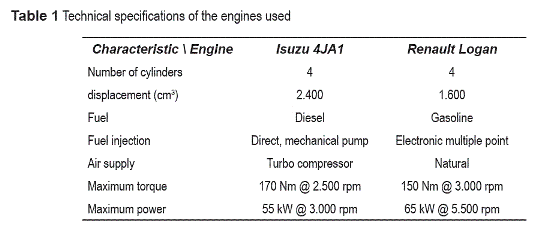
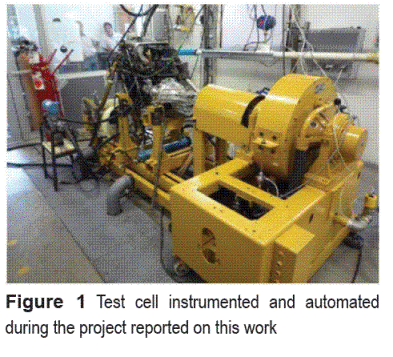
<body><![CDATA[<br> The inherent  difficult of modeling engine-brake assembly using phenomenological models  applied to control systems, such as the mentioned above, has forced some  authors to take into account a reduced number of variables. Hopkins and Morris  [10, 11] developed models with seven state variables with numerous parameters,  later Powers [4] reduced to five state variables and stated that for a digital  control, a relatively low order model (quasi-linear and discrete-time) was  adequate, due to the restrictions in control implementation, i.e. an approach  of transfer functions can be successful in the vicinity of a speed-torque  point. Bunker et al. [1] and Cook et al. [12] have followed this approach and  have designed models of two inputs and two outputs with transfer functions of  first and second order with delay applied to speed and torque control systems.     <br>    <br> In  this work a decoupled proportional integral control system for engine speed and  torque has been developed, it was based on first order transfer functions with  delay and it has been successfully implemented and validated in the whole range  of operation of a diesel and a spark ignition engine- dynamometer assembly  systems. This novel approach is different from those used by Cook et al. [12]  and Bunker et al. [1], since the formers included in their model the spark  ignition process as a fast dynamic in order to respond to transients in braking  torque, so this model could not be used in  diesel engines or without private information of the spark system. Bunker et  al. [1] used a second order model in the interdependent loops, which was  implemented, only on the lineal region of a spark ignition engine, avoiding  nonlinearities. The instrumentation and automation of both test bench for ICE  were developed and implemented by the authors. Results have proven to be  similar in performance to commercial test bench facilities but the financial  cost has been reduced more than twenty times.</font></p>      <p><font face="Verdana" size="3"><b>Methodology</b></font></p>      <p><font face="Verdana" size="2"><b><i> Equipment and systems</i></b></font></p>  <font face="Verdana" size="2">Two engine test  beds were instrumented and automated; one was used to research in diesel  engines and the other in spark ignition engines. <a href="#Figure1">Figure 1</a> shows one of the two  instrumented and  automated  cells and <a href="#Table1">table 1</a> presents the technical specification of the engines used in  this work.     <p align="center"><img src="/img/revistas/rfiua/n59/n59a02i01.gif" ><a name="Figure1"></a></p>      <p align="center"><img src="/img/revistas/rfiua/n59/n59a02t01.gif" ><a name="Table1"></a></p>  The  diesel engine was coupled to a Schenck W230 eddy current dynamometer, while the  spark ignition engine was coupled to a Schenck E90 eddy current dynamometer.  Both test beds have been instrumented with hot-wire air flow sensors (Magnetrol  TA2), K-type thermocouples (ambient temperature, inlet-outlet engine water,  oil, hot gases, turbocompressor inlet and outlet temperatures) and strain gage  pressure transducer sensors (ambient pressure, turbocompressor inlet and outlet  and oil pressures). The diesel fuel flow was measured with an electronic  balance, while the gasoline was measured with a Danfoss Masflo 6000  Coriolis-type mass flow sensor.      <br>    <br> The  engine speed sensors were mounted in the electromagnetic brakes. The Schenck  E90 brake had an optical sensor, while the Schenck W230 had a magnetic  reluctance sensor. A frequency- voltage converter based on the LM2907  integrated circuit was implemented.      <br>    ]]></body>
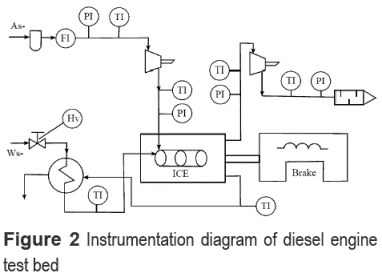
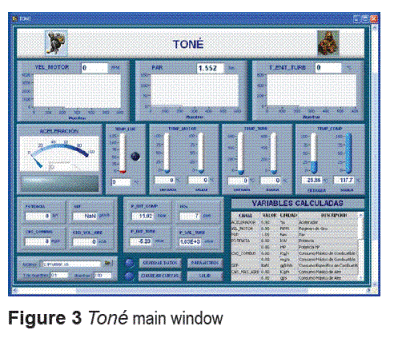
<body><![CDATA[<br> The  engine torque was measured with load cells attached to the brake stators. This  signal reached few milliamps and it was very sensitive to noise, to solve these  problems, a common mode rejection ratio amplifier (CMRR) was implemented. It  neglects the noise that enters through the casing and amplifies the signal  between 1000 and 5000 times. A low-pass  active filter with a cutoff frequency below the minimum engine speed (idle) was  implemented in order to avoid undesirable variations provoked by piston  movement. <a href="#Figure2">Figure 2</a> schematically shows the diesel engine test bed.       <p align="center"><img src="/img/revistas/rfiua/n59/n59a02i02.gif" ><a name="Figure2"></a></p>  In  order to obtain detailed thermodynamic information from the engines operating  with several renewable and conventional fuels, an in-cylinder piezoelectric  pressure transducer (Kistler 6056A) was mounted in cylinder No. 1. The  instantaneous signal was converted into voltage with a Kistler 5011B charge  amplifier. The instantaneous piston position was determined using an angular  encoder with a resolution of 1024 pulses/revolution (Heidennhain ROD 426)  coupled to the crankshaft at the opposite extreme of the fly-wheel.      <br>    <br> High  speed data were acquired using a LabView&trade; based software with a National  Instruments&trade; data acquisition system (Model PCI-MIO-16E-4 board). The program  developed by the authors for real time monitoring and recordering was called  Tone (<a href="#Figure3">Figure 3</a>).       <p align="center"><img src="/img/revistas/rfiua/n59/n59a02i03.gif" ><a name="Figure3"></a></p>  The  engine speed system is controlled by the fuel entering the combustion chambers  which is strongly governed by the throttle valve position of the acceleration  system. The engine speed and torque depend on the fuel entering the engine and  on the electric current supplied to the dynamometer, i.e. both variables are  interrelated and a change in any of them has a significant effect on the other.      <br>    <br> To control the  acceleration (degree of throttle valve opening) a direct current stepper motor  with an incorporated gearbox was used. A direct current flowing through the  brakes coil, similar to those used to control the speed in DC motors was used  to generate brake resistance (load). In order to guarantee the appropriate  operation mode, it was developed an 80V-20A source with a chopper based on  MOSFET transistor, controlled by a pulse width modulation (PWM) at a frequency  of 5 kHz. </font></p>      <p><font face="Verdana" size="2"><b><i>Automation model description</i></b></font>      <p><font face="Verdana" size="2"><i>Multiple inputs and multiple outputs (MIMO) transfer functions model</i></font></p>  <font face="Verdana" size="2">A test bench for  alternative fuel analysis must use commercial vehicle engines without  modifications, and the main comparison parameter is the power on different set  points of speed and torque. These requirements only allow using the throttle  and the brake load as actuators (considering that gasoline commercial vehicle  engines do not allow to modify the spark control).      <br>     ]]></body>
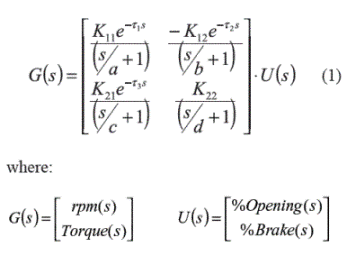
<body><![CDATA[<br> Based on the  considerations proposed by Powers [4] and the successful works developed by  Bunker et al. [1] and Cook et al. [10], the internal combustion engines used in  this project were modeled with independent transfer functions [13-15] according  to the matrix of eq. (1), where only both actuators and control variables were  related  reducing  the number of parameters that must be calculated:     <p> <img src="/img/revistas/rfiua/n59/n59a02e01.gif"></p>      <br>    <br> <i>rpm(s)</i>:     <br>     <br> Engine  speed in rpm      <br>    <br> <i>Torque(s)</i>:      <br>    <br> Brake  torque in Nm      ]]></body>
<body><![CDATA[<br>    <br> <i>%Opening(s)</i>:      <br>    <br> Percentage  of throttle opening      <br>    <br> <i>%Brake(s)</i>:     <br>     <br> Electric current  entering the brake represented in divisions of PWM      <br>    <br> <i>K<sub>ij</sub></i>:     ]]></body>
<body><![CDATA[<br>     <br> Gains      <br>    <br> <i>&tau;<sub>i</sub></i>:      <br>    <br> Delay  in seconds       <br>    <br> 1/a,1/b,1/c,1/d  are the time constants of the subsystems.     <br>     <br> System  inputs are the percentage of throttle opening and current through the  dynamometer, and the outputs are the engine speed and torque. After several  tests the authors found that the nonlinearities become manifest on gain  changes, and less significant changes on pole locations and delays. Because of  this the authors implemented this first order transfer functions model.      ]]></body>
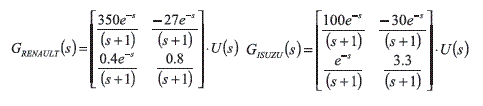
<body><![CDATA[<br>    <br> To  find the parameters of the matrix of transfer functions, the following  procedure was implemented, covering a wide range of engine operating modes:      <br>    <br> A  test of acceleration steps (each 5%) without any brake load was carried out  from idle to maximum engine speed. With the throttle valve fixed in the maximum  engine speed point, current steps (each 5%) were applied on the dynamometer  coil, increasing load until engine speed reached the minimum. Alternating the  acceleration and load, steps 1 and 2 were carried out until the engine reached  its maximum power in order to obtain relevant data from the majority operating  modes. The zero load test was detected as the region with higher instabilities  because the engine had greater gain with low load. When load was increased the  gain was reduced making the system more stable.     <br>    <br> The  IDENT toolbox of Matlab<sup>&reg;</sup> was used after obtaining these experimental  data in order to find the parameters of each curve, the models were adjusted  using sequential quadratic programming, and reducing the mean prediction error  with respect to a persistent excitation experiment on the plant. For a better  performance, the datasets were normalized before entering the program. 100  curves were acquired and 70 were used on identification, approximately eight  curves for each engine located throughout the operating range (speed and  torque) were used in order to obtain each subsystem model. All sub-models were  validated in operating modes different from those used in the procedure  described above.      <br>    <br> The first-order  models with delay obtained for the engines were:      <p> <img src="/img/revistas/rfiua/n59/n59a02e02.gif"></p> The controller  response was affected by disturbances associated with each engine (i.e. the  turbocharger for diesel engine and the electronic control unit for spark  ignition engine).      <br>    ]]></body>
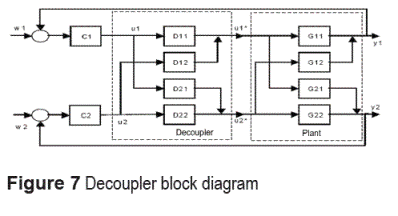
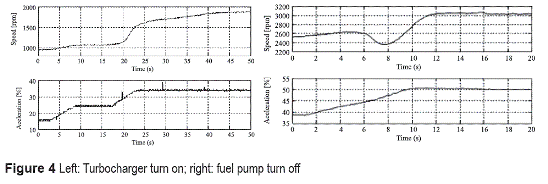
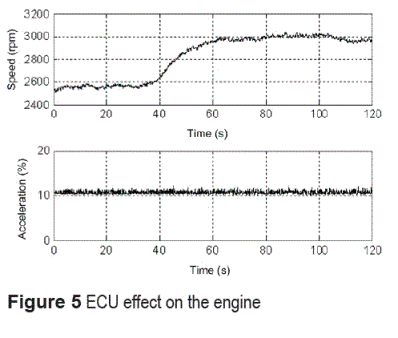
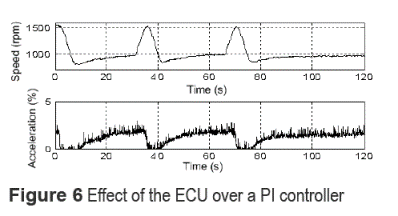
<body><![CDATA[<br>   Turbocharger turn-on and fuel pump  turn-off were the most significant nonlinearities of the diesel engine. The  first is provoked by engine fluid dynamics causing a sudden increase of engine  speed, while the second is provoked by the turbocharger turn on and the fuel  pump turn engine-fuel pump dynamics [16]. <a href="#Figure4">Figure 4</a> shows the turbocharger turn on and the fuel  pump turn off  processes for the Isuzu engine.       <p align="center"><img src="/img/revistas/rfiua/n59/n59a02i04.gif" ><a name="Figure4"></a></p> In a spark  ignition engine, the main nonlinearities are introduced by the electronic  control unit (ECU), which governs the fuel supply in order to guarantee a  stoichiometric fuel-air mixture. This means that fuel supply does not depend  exclusively on throttle valve (accelerator) position. Other nonlinearities as  the temperature effect do not have major impact on the engine and they are not  directly considered on this paper.  <a href="#Figure5">Figure 5</a> shows the ECU effect at 2.550 rpm  (without load) where the engine could not be stabilized, moving it to 3.000  rpm.</font></p>     <p align="center"><img src="/img/revistas/rfiua/n59/n59a02i05.gif" ><a name="Figure5"></a></p>        <p><font face="Verdana" size="2"><i><b>Independent proportional and integral action controller</b></i></font></p>       <p><font face="Verdana" size="2">The first strategy  explored divided the system into two single input single output (SISO) systems,  where engine speed was controlled by the throttle, and torque (or load) by the  magnitude of electric current induced in the brake dynamometer. There are different  design methodologies of this type of controller, the most common is the  Ziegler- Nichols tuning rule [17] for a proportional integral controller (PI),  but the damping effect inherent to this type of controller is added to  disturbances mentioned above (i.e. turbocharger and ECU), causing unwanted  oscillations in engine speed and torque as shown in  <a href="#Figure6">figure 6</a>. In this case, the  independent PI controller could not predict a change in speed produced by the  ECU, causing a periodic oscillation. </font></p>        <p align="center"><img src="/img/revistas/rfiua/n59/n59a02i06.gif" ><a name="Figure6"></a></p>        <p><font face="Verdana" size="2"><i>Decoupled PI action controller</i></font></p>      <p><font face="Verdana" size="2">After  a couple of tests [18], it was observed that the best control was obtained by  compensating the interactions between loops in order to reduce their negative  effects. This controller created compensators that cancel interdependent ties  of the system by using the matrix of transfer functions described in eq. (1).     <br>    <br> Engine speed was  related to accelerator position and torque was related to current in the brake.  Those control loops had the highest positive gains. Several procedures to  formalize this choice, such as the DC and resonant frequency closed loop gain  analysis, were also analyzed [19]. The interdependent loops were the engine  speed response caused by electric current in the brake (negative gain), and the  torque produced by a change in accelerator. A decoupler used to compensate the  effect of the actuator on each variable was designed and implemented. The  decoupler consists of a D  matrix which converts a multiple input multiple output (MIMO) system into two  SISO systems as shown in <a href="#Figure7">figure 7</a>.        ]]></body>
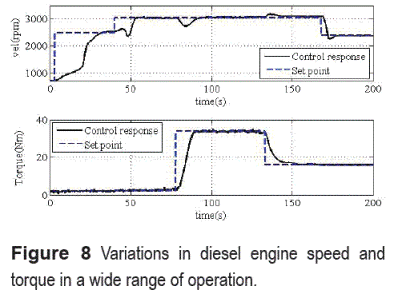
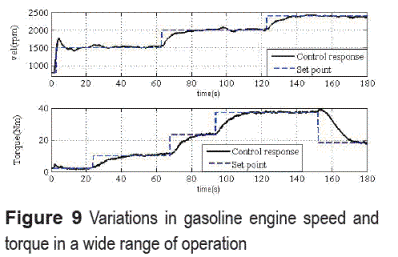
<body><![CDATA[<p align="center"><img src="/img/revistas/rfiua/n59/n59a02i07.gif" ><a name="Figure7"></a></p> Parameters of the D matrix were obtained  experimentally with the procedure described above,resulting:      <p> <img src="/img/revistas/rfiua/n59/n59a02e03.gif"></p> Once those loops were decoupled, a PI controller over the  resultant system was designed. Controller parameters were obtained by reducing  the overshoot and oscillations and finally it was implemented in a Freescale  HC08 family Motorola microcontroller. It was completely independent of the PC  in order to avoid the risk of losing control of the system due an unwanted  communication delay of the PC. The frequency sample used was 23 ms (min  response time of the stepper motor), and the microcontroller frequency was 10  MHz.</font></p>       <p><font face="Verdana" size="3"><b>Results and discussion </b></font></p>      <p><font face="Verdana" size="2"><b><i>Control system validation </i></b></font></p>        <p><font face="Verdana" size="2">Controller performance was evaluated by setting several  engine speed-torque operating modes, including the regions affected by  non-modeled dynamics. <a href="#Figure8">Figure 8</a>  shows the control response to several set point  changes on the diesel engine from 700 to 3.000 rpm and from 2 to 35 Nm. Note  the turn on effect of the compressor on the first velocity step and the turn  off effect of the fuel pump on the second step, then observe several changes on  torque and speed with a good response on the controller.      <p align="center"><img src="/img/revistas/rfiua/n59/n59a02i08.gif" ><a name="Figure8"></a></p> <a href="#Figure9">Figure 9</a> shows the powerful of the control developed in a  gasoline engine. The overall stability was not affected even the gasoline  engine response is faster than the diesel engine, but the speed presented over  damping on the first step due this higher speed response, the next steps did  not present over damping because the engine had load. Note that the overshoot  in speed due changes in torque is shorter than that of the diesel engine, again  this behavior is expected because of its faster response.      <p align="center"><img src="/img/revistas/rfiua/n59/n59a02i09.gif" ><a name="Figure9"></a></p> </font></p>      <p><font face="Verdana" size="2"><b><i>Other results</i></b></font></p>      <p><font face="Verdana" size="2">This control  system has been used during the last three years in the engine laboratory at  the Universidad de Antioquia  in Medell&iacute;n (Colombia). Both  engine test beds have been used in order to explore the performance and  emissions of diesel and  spark ignition engines using several biofuels and its blends with conventional  fuels over a wide range of engine operating modes. The use of blends such as  E20 (20% ethanol + 80% gasoline) and blends such as B5 and B20 (blends of diesel fuel with 5 and  20% of several indigenous biodiesel fuels have been analyzed using the  instrumentation and software herein presented. Those results have been published  in several scientific journals [20-24].      <br>    ]]></body>
<body><![CDATA[<br>   When  fuels with small concentration of additives are going to be tested, it is very  important to assure a very stable engine operation mode, which has been a  success with this control system. </font></p>      <p><font face="Verdana" size="3"><b>Conclusions</b></font></p>         <p><font face="Verdana" size="2">A low cost, powerful and robust  multivariable control system based on transfer functions was developed,  implemented and tested on two internal combustion engines (diesel and spark  ignition) test beds. The decoupling matrix  D  was updated depending on the engine fuel or type, avoiding major changes on the  control system. The controller was successfully tested in a wide range of  engine operating modes. It could pass through the engine nonlinearities such as  turbocharger turning on and some ECU points reaching the stabilization in  vicinity points.     <br>    <br>     The  process of designing a decoupled PI controller from a matrix of first order  transfer functions with delay for engine speed and torque, met the requirements  of control for mid range power engine test beds used for research activities. </font></p> 	     <p><font face="Verdana" size="3"><b>Acknowledgments</b></font></p>         <p><font face="Verdana" size="2">Authors  wish to thank the Colombian  Ministry of Agriculture and Rural Development, Sofasa- Renault  and El &Aacute;rea Metropolitana del  Valle de Aburr&aacute; for the financial  support of project No. 003 2007D3608-67 (Bioethanol E-20 project) and project  001 2007D3347-499 (Biodiesel). Also our acknowledgements to the  Comit&eacute; para el Desarrollo de la Investigaci&oacute;n (CODI) from Universidad de Antioquia for  their financial support to both projects mentioned above. The authors also  would like to thank the "Sostenibilidad" program 2009 of the Universidad de Antioquia  for financial support and professor Orlando Carrillo for his valuable  help during engine test beds instrumentation and control system development. </font></p>          <p><font face="Verdana" size="3"><b>References</b></font></p>             <!-- ref --><p><font face="Verdana" size="2">1.  B.  J. Bunker, M. A. Franchek, B. E Thomason. "Robust multivariable control of  an engine dynamometer system".  <i>IEEE transactions on control systems technology.</i>  Vol. 5. 1997. pp. 189-199.        &nbsp;&nbsp;&nbsp;&nbsp;&nbsp;&nbsp;&nbsp;&nbsp;[&#160;<a href="javascript:void(0);" onclick="javascript: window.open('/scielo.php?script=sci_nlinks&ref=000111&pid=S0120-6230201100030000200001&lng=','','width=640,height=500,resizable=yes,scrollbars=1,menubar=yes,');">Links</a>&#160;]<!-- end-ref --><br>    ]]></body>
<body><![CDATA[<!-- ref --><br>     2.  M.  Plint, A. Martyr. <i>Engine testing:  Theory and practice. </i>3rd  ed. Ed. Oxford: Butterworth - Heinemann. Oxford. 1997. pp. 45-190.  	     &nbsp;&nbsp;&nbsp;&nbsp;&nbsp;&nbsp;&nbsp;&nbsp;[&#160;<a href="javascript:void(0);" onclick="javascript: window.open('/scielo.php?script=sci_nlinks&ref=000113&pid=S0120-6230201100030000200002&lng=','','width=640,height=500,resizable=yes,scrollbars=1,menubar=yes,');">Links</a>&#160;]<!-- end-ref --><br>    <!-- ref --><br>     3.  J.  B. Heywood. <i>Internal combustion engine  fundamentals.</i> 2nd ed. Ed. Mc.Graw  Hill. New York. 1988. pp. 435-472.  	    &nbsp;&nbsp;&nbsp;&nbsp;&nbsp;&nbsp;&nbsp;&nbsp;[&#160;<a href="javascript:void(0);" onclick="javascript: window.open('/scielo.php?script=sci_nlinks&ref=000115&pid=S0120-6230201100030000200003&lng=','','width=640,height=500,resizable=yes,scrollbars=1,menubar=yes,');">Links</a>&#160;]<!-- end-ref --><br>    <!-- ref --><br>     4.  W.  F. Powers. "Internal Combustion Engine control system research at  FORD". <i>Memories of the 20th IEEE Conf. on  Decision and Control.</i> San Francisco  (USA). 1981. pp. 1447-1452. 	    &nbsp;&nbsp;&nbsp;&nbsp;&nbsp;&nbsp;&nbsp;&nbsp;[&#160;<a href="javascript:void(0);" onclick="javascript: window.open('/scielo.php?script=sci_nlinks&ref=000117&pid=S0120-6230201100030000200004&lng=','','width=640,height=500,resizable=yes,scrollbars=1,menubar=yes,');">Links</a>&#160;]<!-- end-ref --><br>     <!-- ref --><br>     5. L. A. Del Portillo, F.V. Tinaut, A.M. Bachiller, B.  Gim&eacute;nez. "Validaci&oacute;n de un modelo fenomenol&oacute;gico  para el estudio de motores diesel de inyecci&oacute;n directa".<i> Octavo congreso iberoamericano de ingenier&iacute;a mec&aacute;nica.</i> Cuzco. 23 -  25 de octubre de 2007. C&oacute;digo  1125. pp. 234-246.  	    &nbsp;&nbsp;&nbsp;&nbsp;&nbsp;&nbsp;&nbsp;&nbsp;[&#160;<a href="javascript:void(0);" onclick="javascript: window.open('/scielo.php?script=sci_nlinks&ref=000119&pid=S0120-6230201100030000200005&lng=','','width=640,height=500,resizable=yes,scrollbars=1,menubar=yes,');">Links</a>&#160;]<!-- end-ref --><br>    <!-- ref --><br>     6. K.  Lee, K. Park. "Optimal robust control of a contactless  brake system using an eddy current". <i>Mechatronics.</i>  Vol. 9. 1999. pp.  615 - 631.  	    &nbsp;&nbsp;&nbsp;&nbsp;&nbsp;&nbsp;&nbsp;&nbsp;[&#160;<a href="javascript:void(0);" onclick="javascript: window.open('/scielo.php?script=sci_nlinks&ref=000121&pid=S0120-6230201100030000200006&lng=','','width=640,height=500,resizable=yes,scrollbars=1,menubar=yes,');">Links</a>&#160;]<!-- end-ref --><br>    ]]></body>
<body><![CDATA[<!-- ref --><br>     7. M. I.  Gonzales. "Experiments with eddy currents the eddy current brake". <i> European Journal of Physics. </i>Vol. 25. 2004. pp 463 - 468.  	    &nbsp;&nbsp;&nbsp;&nbsp;&nbsp;&nbsp;&nbsp;&nbsp;[&#160;<a href="javascript:void(0);" onclick="javascript: window.open('/scielo.php?script=sci_nlinks&ref=000123&pid=S0120-6230201100030000200007&lng=','','width=640,height=500,resizable=yes,scrollbars=1,menubar=yes,');">Links</a>&#160;]<!-- end-ref --><br>    <!-- ref --><br>     8. A. H. Gosline,  G. Campion, V. Hayward. "On the use of eddy current brakes as tunable,  fast turn-on viscous dampers for haptic rendering".  <i>Proc. Eurohaptics</i>. Paris. 2006. pp 229 - 234.     &nbsp;&nbsp;&nbsp;&nbsp;&nbsp;&nbsp;&nbsp;&nbsp;[&#160;<a href="javascript:void(0);" onclick="javascript: window.open('/scielo.php?script=sci_nlinks&ref=000125&pid=S0120-6230201100030000200008&lng=','','width=640,height=500,resizable=yes,scrollbars=1,menubar=yes,');">Links</a>&#160;]<!-- end-ref --><br>    <!-- ref --><br>     9.  S.  Anwar. "A parametric model of an eddy current electric machine for  automotive braking applications". <i>IEEE  transactions on control systems technology.</i>  Vol. 12. 2004. pp  422-427.     &nbsp;&nbsp;&nbsp;&nbsp;&nbsp;&nbsp;&nbsp;&nbsp;[&#160;<a href="javascript:void(0);" onclick="javascript: window.open('/scielo.php?script=sci_nlinks&ref=000127&pid=S0120-6230201100030000200009&lng=','','width=640,height=500,resizable=yes,scrollbars=1,menubar=yes,');">Links</a>&#160;]<!-- end-ref --><br>    <!-- ref --><br>     10. H. G.  Hopkins, R. H. Borcherts, "Discrete time modeling of the torque response  of a spark-ignited fuel-injected engine".  <i>Applications of adaptive control.</i> Ed. Academic  Press. New York. 1980. pp.  491-508.     &nbsp;&nbsp;&nbsp;&nbsp;&nbsp;&nbsp;&nbsp;&nbsp;[&#160;<a href="javascript:void(0);" onclick="javascript: window.open('/scielo.php?script=sci_nlinks&ref=000129&pid=S0120-6230201100030000200010&lng=','','width=640,height=500,resizable=yes,scrollbars=1,menubar=yes,');">Links</a>&#160;]<!-- end-ref --><br>    <!-- ref --><br>     11. R.  L. Morris, R. H. Borcherts, M. V.  Warlick, H. G.  Hopkins, "Spark ignition engine model building-an identification approach  to throttle-torque response," <i>Workshop  on Adaptive Control.</i> Detroit (USA). 1981. pp 235-240     &nbsp;&nbsp;&nbsp;&nbsp;&nbsp;&nbsp;&nbsp;&nbsp;[&#160;<a href="javascript:void(0);" onclick="javascript: window.open('/scielo.php?script=sci_nlinks&ref=000131&pid=S0120-6230201100030000200011&lng=','','width=640,height=500,resizable=yes,scrollbars=1,menubar=yes,');">Links</a>&#160;]<!-- end-ref --><br>    ]]></body>
<body><![CDATA[<!-- ref --><br>     12.  J.  Cook, B. Powell. "Modeling of an internal combustion engine for control  analysis". <i>IEEE power control  systems magazine.</i> Vol. 8. 1988. pp. 20-26.  	    &nbsp;&nbsp;&nbsp;&nbsp;&nbsp;&nbsp;&nbsp;&nbsp;[&#160;<a href="javascript:void(0);" onclick="javascript: window.open('/scielo.php?script=sci_nlinks&ref=000133&pid=S0120-6230201100030000200012&lng=','','width=640,height=500,resizable=yes,scrollbars=1,menubar=yes,');">Links</a>&#160;]<!-- end-ref --><br>    <!-- ref --><br>     13. B.  Kuo. <i>Automatic control systems.  </i>6th ed. Ed.  Prentice Hall. New Jersey. 1995. pp  77-117.  	    &nbsp;&nbsp;&nbsp;&nbsp;&nbsp;&nbsp;&nbsp;&nbsp;[&#160;<a href="javascript:void(0);" onclick="javascript: window.open('/scielo.php?script=sci_nlinks&ref=000135&pid=S0120-6230201100030000200013&lng=','','width=640,height=500,resizable=yes,scrollbars=1,menubar=yes,');">Links</a>&#160;]<!-- end-ref --><br>    <!-- ref --><br>     14. R C.  Dorf, R. H.  Bishop. <i>Modern Control Systems.</i>  10th ed. Ed. Pearson Prentice Hall. Upper Saddle River. 2008. pp. 41-142.  	    &nbsp;&nbsp;&nbsp;&nbsp;&nbsp;&nbsp;&nbsp;&nbsp;[&#160;<a href="javascript:void(0);" onclick="javascript: window.open('/scielo.php?script=sci_nlinks&ref=000137&pid=S0120-6230201100030000200014&lng=','','width=640,height=500,resizable=yes,scrollbars=1,menubar=yes,');">Links</a>&#160;]<!-- end-ref --><br>    <!-- ref --><br>     15. C.  T. Chen.<i> Analog and Digital Control System  Design: Transfer-Function, State-Space, and Algebraic Methods.  </i>Saunders College Publishing. Philadelphia. 1993. pp. 93-115.     &nbsp;&nbsp;&nbsp;&nbsp;&nbsp;&nbsp;&nbsp;&nbsp;[&#160;<a href="javascript:void(0);" onclick="javascript: window.open('/scielo.php?script=sci_nlinks&ref=000139&pid=S0120-6230201100030000200015&lng=','','width=640,height=500,resizable=yes,scrollbars=1,menubar=yes,');">Links</a>&#160;]<!-- end-ref --><br>    <!-- ref --><br>     16. ISUZU.  <i>Technical manual of the diesel engine ISUZU 4JA1.</i>  Tokyo. 1991. pp 65-67.     &nbsp;&nbsp;&nbsp;&nbsp;&nbsp;&nbsp;&nbsp;&nbsp;[&#160;<a href="javascript:void(0);" onclick="javascript: window.open('/scielo.php?script=sci_nlinks&ref=000141&pid=S0120-6230201100030000200016&lng=','','width=640,height=500,resizable=yes,scrollbars=1,menubar=yes,');">Links</a>&#160;]<!-- end-ref --><br>    ]]></body>
<body><![CDATA[<!-- ref --><br>     17. J.  G. Ziegler, N. B. Nichols "Optimum settings for automatic  controllers". <i>Trans. ASME.</i> Vol.  64. 1942. pp. 759-768.     &nbsp;&nbsp;&nbsp;&nbsp;&nbsp;&nbsp;&nbsp;&nbsp;[&#160;<a href="javascript:void(0);" onclick="javascript: window.open('/scielo.php?script=sci_nlinks&ref=000143&pid=S0120-6230201100030000200017&lng=','','width=640,height=500,resizable=yes,scrollbars=1,menubar=yes,');">Links</a>&#160;]<!-- end-ref --><br>    <!-- ref --><br>     18. J.  D. L&oacute;pez. <i>ICE test bed  automation.</i> Master thesis (available in  Spanish). Universidad  de Antioquia. 2009. pp. 21-61.     &nbsp;&nbsp;&nbsp;&nbsp;&nbsp;&nbsp;&nbsp;&nbsp;[&#160;<a href="javascript:void(0);" onclick="javascript: window.open('/scielo.php?script=sci_nlinks&ref=000145&pid=S0120-6230201100030000200018&lng=','','width=640,height=500,resizable=yes,scrollbars=1,menubar=yes,');">Links</a>&#160;]<!-- end-ref --><br>    <!-- ref --><br>     19. J.  J. Espinosa. <i>Control lineal de sistemas multivariables.</i>  Ed.  Corporaci&oacute;n Universitaria de Ibagu&eacute;. Ibagu&eacute;. 2003.  pp 25-38.     &nbsp;&nbsp;&nbsp;&nbsp;&nbsp;&nbsp;&nbsp;&nbsp;[&#160;<a href="javascript:void(0);" onclick="javascript: window.open('/scielo.php?script=sci_nlinks&ref=000147&pid=S0120-6230201100030000200019&lng=','','width=640,height=500,resizable=yes,scrollbars=1,menubar=yes,');">Links</a>&#160;]<!-- end-ref --><br>    <!-- ref --><br>     20.  P.  Benjumea, J. Agudelo, A. Agudelo, "Effect of  altitude and palm oil biodiesel fuelling on the performance and  combustion characteristics of a HSDI diesel  engine", <i>Fuel.</i>  Vol.88. 2009. pp. 725 - 731.     &nbsp;&nbsp;&nbsp;&nbsp;&nbsp;&nbsp;&nbsp;&nbsp;[&#160;<a href="javascript:void(0);" onclick="javascript: window.open('/scielo.php?script=sci_nlinks&ref=000149&pid=S0120-6230201100030000200020&lng=','','width=640,height=500,resizable=yes,scrollbars=1,menubar=yes,');">Links</a>&#160;]<!-- end-ref --><br>    <!-- ref --><br>     21.  J  Agudelo, P. Benjumea, A.  Villegas, "Evaluation of nitrogen oxide  emissions and smoke opacity in a HSDI diesel engine fuelled with palm oil  biodiesel". <i>Rev. Fac. Ing.  Univ. Antioquia.</i> Vol. 51. 2010. pp. 62-71.    &nbsp;&nbsp;&nbsp;&nbsp;&nbsp;&nbsp;&nbsp;&nbsp;[&#160;<a href="javascript:void(0);" onclick="javascript: window.open('/scielo.php?script=sci_nlinks&ref=000151&pid=S0120-6230201100030000200021&lng=','','width=640,height=500,resizable=yes,scrollbars=1,menubar=yes,');">Links</a>&#160;]<!-- end-ref --><br>     ]]></body>
<body><![CDATA[<!-- ref --><br>     22.  J.  Agudelo, E. Guti&eacute;rrez, P.  Benjumea, "Experimental combustion analysis of a HSDI diesel engine  fuelled with palm oil biodiesel-diesel fuel blends. <i>Dyna.</i> Vol. 159. 2009. 103-113.     &nbsp;&nbsp;&nbsp;&nbsp;&nbsp;&nbsp;&nbsp;&nbsp;[&#160;<a href="javascript:void(0);" onclick="javascript: window.open('/scielo.php?script=sci_nlinks&ref=000153&pid=S0120-6230201100030000200022&lng=','','width=640,height=500,resizable=yes,scrollbars=1,menubar=yes,');">Links</a>&#160;]<!-- end-ref --><br>    <!-- ref --><br>     23.  J.  Agudelo, A. Agudelo, J. P&eacute;rez,  "Energy  and exergy analysis of a light duty diesel engine operating at different  altitudes". <i>Rev. Fac. Ing.  Univ. Antioquia.</i> Vol. 48. 2009. pp. 45-54.  	    &nbsp;&nbsp;&nbsp;&nbsp;&nbsp;&nbsp;&nbsp;&nbsp;[&#160;<a href="javascript:void(0);" onclick="javascript: window.open('/scielo.php?script=sci_nlinks&ref=000155&pid=S0120-6230201100030000200023&lng=','','width=640,height=500,resizable=yes,scrollbars=1,menubar=yes,');">Links</a>&#160;]<!-- end-ref --><br>    <!-- ref --><br>     24. J.  Agudelo, P. Benjumea, A. Agudelo. "Diagn&oacute;stico  exerg&eacute;tico del proceso de combusti&oacute;n en un motor Diesel". <i>Rev. Fac. Ing. Univ.  Antioquia.</i> Vol. 45. 2008. pp.  41-53. </font>&nbsp;&nbsp;&nbsp;&nbsp;&nbsp;&nbsp;&nbsp;&nbsp;[&#160;<a href="javascript:void(0);" onclick="javascript: window.open('/scielo.php?script=sci_nlinks&ref=000157&pid=S0120-6230201100030000200024&lng=','','width=640,height=500,resizable=yes,scrollbars=1,menubar=yes,');">Links</a>&#160;]<!-- end-ref --><br>       <br>       <br>     <p><font face="Verdana" size="2">(Recibido  el 04 de junio de 2010. Aceptado el 10 de marzo de 2011)</font></p>     <p><font face="Verdana" size="2"><sup>*</sup>Autor de correspondencia: tel&eacute;fono + 57 + 4  + 219 85 59, fax: + 57 + 4 + 211 05 03, correo electr&oacute;nico: <a href="mailto:jragude@udea.edu.co">jragude@udea.edu.co</a> (J.R. Agudelo)</font></p>     ]]></body>
<body><![CDATA[ ]]></body><back>
<ref-list>
<ref id="B1">
<label>1</label><nlm-citation citation-type="journal">
<person-group person-group-type="author">
<name>
<surname><![CDATA[Bunker]]></surname>
<given-names><![CDATA[B. J]]></given-names>
</name>
<name>
<surname><![CDATA[Franchek]]></surname>
<given-names><![CDATA[M. A]]></given-names>
</name>
<name>
<surname><![CDATA[Thomason]]></surname>
<given-names><![CDATA[B. E]]></given-names>
</name>
</person-group>
<article-title xml:lang="en"><![CDATA[Robust multivariable control of an engine dynamometer system]]></article-title>
<source><![CDATA[IEEE transactions on control systems technology]]></source>
<year>1997</year>
<volume>5</volume>
<page-range>189-199</page-range></nlm-citation>
</ref>
<ref id="B2">
<label>2</label><nlm-citation citation-type="book">
<person-group person-group-type="author">
<name>
<surname><![CDATA[Plint]]></surname>
<given-names><![CDATA[M]]></given-names>
</name>
<name>
<surname><![CDATA[Martyr]]></surname>
<given-names><![CDATA[A]]></given-names>
</name>
</person-group>
<source><![CDATA[Engine testing: Theory and practice]]></source>
<year>1997</year>
<edition>3</edition>
<page-range>45-190</page-range><publisher-loc><![CDATA[Oxford ]]></publisher-loc>
<publisher-name><![CDATA[Ed. Oxford]]></publisher-name>
</nlm-citation>
</ref>
<ref id="B3">
<label>3</label><nlm-citation citation-type="book">
<person-group person-group-type="author">
<name>
<surname><![CDATA[Heywood]]></surname>
<given-names><![CDATA[J. B]]></given-names>
</name>
</person-group>
<source><![CDATA[Internal combustion engine fundamentals]]></source>
<year>1988</year>
<edition>2</edition>
<page-range>435-472</page-range><publisher-loc><![CDATA[New York ]]></publisher-loc>
<publisher-name><![CDATA[Ed. Mc.Graw Hill]]></publisher-name>
</nlm-citation>
</ref>
<ref id="B4">
<label>4</label><nlm-citation citation-type="confpro">
<person-group person-group-type="author">
<name>
<surname><![CDATA[Powers]]></surname>
<given-names><![CDATA[W. F]]></given-names>
</name>
</person-group>
<source><![CDATA[Internal Combustion Engine control system research at FORD]]></source>
<year></year>
<conf-name><![CDATA[20 IEEE Conf. on Decision and Control]]></conf-name>
<conf-date>1981</conf-date>
<conf-loc>San Francisco </conf-loc>
<page-range>1447-1452</page-range></nlm-citation>
</ref>
<ref id="B5">
<label>5</label><nlm-citation citation-type="confpro">
<person-group person-group-type="author">
<name>
<surname><![CDATA[Del Portillo]]></surname>
<given-names><![CDATA[L. A]]></given-names>
</name>
<name>
<surname><![CDATA[Tinaut]]></surname>
<given-names><![CDATA[F.V]]></given-names>
</name>
<name>
<surname><![CDATA[Bachiller]]></surname>
<given-names><![CDATA[A.M]]></given-names>
</name>
<name>
<surname><![CDATA[Giménez]]></surname>
<given-names><![CDATA[B]]></given-names>
</name>
</person-group>
<source><![CDATA[Validación de un modelo fenomenológico para el estudio de motores diesel de inyección directa]]></source>
<year></year>
<conf-name><![CDATA[Octavo congreso iberoamericano de ingeniería mecánica]]></conf-name>
<conf-date>2007</conf-date>
<conf-loc>Cuzco </conf-loc>
<page-range>234-246</page-range></nlm-citation>
</ref>
<ref id="B6">
<label>6</label><nlm-citation citation-type="journal">
<person-group person-group-type="author">
<name>
<surname><![CDATA[Lee]]></surname>
<given-names><![CDATA[K]]></given-names>
</name>
<name>
<surname><![CDATA[Park]]></surname>
<given-names><![CDATA[K]]></given-names>
</name>
</person-group>
<article-title xml:lang="en"><![CDATA[Optimal robust control of a contactless brake system using an eddy current]]></article-title>
<source><![CDATA[Mechatronics]]></source>
<year>1999</year>
<volume>9</volume>
<page-range>615 - 631</page-range></nlm-citation>
</ref>
<ref id="B7">
<label>7</label><nlm-citation citation-type="journal">
<person-group person-group-type="author">
<name>
<surname><![CDATA[Gonzales]]></surname>
<given-names><![CDATA[M. I]]></given-names>
</name>
</person-group>
<article-title xml:lang="en"><![CDATA[Experiments with eddy currents the eddy current brake]]></article-title>
<source><![CDATA[European Journal of Physics]]></source>
<year>2004</year>
<volume>25</volume>
<page-range>463 - 468</page-range></nlm-citation>
</ref>
<ref id="B8">
<label>8</label><nlm-citation citation-type="journal">
<person-group person-group-type="author">
<name>
<surname><![CDATA[Gosline]]></surname>
<given-names><![CDATA[A. H]]></given-names>
</name>
<name>
<surname><![CDATA[Campion]]></surname>
<given-names><![CDATA[G]]></given-names>
</name>
<name>
<surname><![CDATA[Hayward]]></surname>
<given-names><![CDATA[V]]></given-names>
</name>
</person-group>
<article-title xml:lang="en"><![CDATA[On the use of eddy current brakes as tunable, fast turn-on viscous dampers for haptic rendering]]></article-title>
<source><![CDATA[Proc. Eurohaptics]]></source>
<year>2006</year>
<page-range>229 - 234</page-range><publisher-loc><![CDATA[Paris ]]></publisher-loc>
</nlm-citation>
</ref>
<ref id="B9">
<label>9</label><nlm-citation citation-type="journal">
<person-group person-group-type="author">
<name>
<surname><![CDATA[Anwar]]></surname>
<given-names><![CDATA[S]]></given-names>
</name>
</person-group>
<article-title xml:lang="en"><![CDATA[A parametric model of an eddy current electric machine for automotive braking applications]]></article-title>
<source><![CDATA[IEEE transactions on control systems technology]]></source>
<year>2004</year>
<volume>12</volume>
<page-range>422-427</page-range></nlm-citation>
</ref>
<ref id="B10">
<label>10</label><nlm-citation citation-type="book">
<person-group person-group-type="author">
<name>
<surname><![CDATA[Hopkins]]></surname>
<given-names><![CDATA[H. G]]></given-names>
</name>
<name>
<surname><![CDATA[Borcherts]]></surname>
<given-names><![CDATA[R. H]]></given-names>
</name>
</person-group>
<article-title xml:lang="en"><![CDATA[Discrete time modeling of the torque response of a spark-ignited fuel-injected engine]]></article-title>
<source><![CDATA[Applications of adaptive control]]></source>
<year>1980</year>
<page-range>491-508</page-range><publisher-loc><![CDATA[New York ]]></publisher-loc>
<publisher-name><![CDATA[Ed. Academic Press]]></publisher-name>
</nlm-citation>
</ref>
<ref id="B11">
<label>11</label><nlm-citation citation-type="">
<person-group person-group-type="author">
<name>
<surname><![CDATA[Morris]]></surname>
<given-names><![CDATA[R. L]]></given-names>
</name>
<name>
<surname><![CDATA[Borcherts]]></surname>
<given-names><![CDATA[R. H]]></given-names>
</name>
<name>
<surname><![CDATA[Warlick]]></surname>
<given-names><![CDATA[M. V]]></given-names>
</name>
<name>
<surname><![CDATA[Hopkins]]></surname>
<given-names><![CDATA[H. G]]></given-names>
</name>
</person-group>
<source><![CDATA[Spark ignition engine model building-an identification approach to throttle-torque response: Workshop on Adaptive Control]]></source>
<year>1981</year>
<page-range>235-240</page-range><publisher-loc><![CDATA[Detroit ]]></publisher-loc>
</nlm-citation>
</ref>
<ref id="B12">
<label>12</label><nlm-citation citation-type="journal">
<person-group person-group-type="author">
<name>
<surname><![CDATA[Cook]]></surname>
<given-names><![CDATA[J]]></given-names>
</name>
<name>
<surname><![CDATA[Powell]]></surname>
<given-names><![CDATA[B]]></given-names>
</name>
</person-group>
<article-title xml:lang="en"><![CDATA[Modeling of an internal combustion engine for control analysis]]></article-title>
<source><![CDATA[IEEE power control systems magazine]]></source>
<year>1988</year>
<volume>8</volume>
<page-range>20-26</page-range></nlm-citation>
</ref>
<ref id="B13">
<label>13</label><nlm-citation citation-type="book">
<person-group person-group-type="author">
<name>
<surname><![CDATA[Kuo]]></surname>
<given-names><![CDATA[B]]></given-names>
</name>
</person-group>
<source><![CDATA[Automatic control systems]]></source>
<year>1995</year>
<page-range>77-117</page-range><publisher-loc><![CDATA[New Jersey ]]></publisher-loc>
<publisher-name><![CDATA[Ed. Prentice Hall]]></publisher-name>
</nlm-citation>
</ref>
<ref id="B14">
<label>14</label><nlm-citation citation-type="book">
<person-group person-group-type="author">
<name>
<surname><![CDATA[Dorf]]></surname>
<given-names><![CDATA[R C]]></given-names>
</name>
<name>
<surname><![CDATA[Bishop]]></surname>
<given-names><![CDATA[R. H]]></given-names>
</name>
</person-group>
<source><![CDATA[Modern Control Systems]]></source>
<year>2008</year>
<edition>10</edition>
<page-range>41-142</page-range><publisher-name><![CDATA[Ed. Pearson Prentice Hall]]></publisher-name>
</nlm-citation>
</ref>
<ref id="B15">
<label>15</label><nlm-citation citation-type="book">
<person-group person-group-type="author">
<name>
<surname><![CDATA[Chen]]></surname>
<given-names><![CDATA[C. T]]></given-names>
</name>
</person-group>
<source><![CDATA[Analog and Digital Control System Design: Transfer-Function, State-Space, and Algebraic Methods]]></source>
<year>1993</year>
<page-range>93-115</page-range><publisher-loc><![CDATA[Philadelphia ]]></publisher-loc>
<publisher-name><![CDATA[Saunders College Publishing]]></publisher-name>
</nlm-citation>
</ref>
<ref id="B16">
<label>16</label><nlm-citation citation-type="">
<collab>ISUZU</collab>
<source><![CDATA[Technical manual of the diesel engine ISUZU 4JA1]]></source>
<year>1991</year>
<page-range>65-67</page-range><publisher-loc><![CDATA[Tokyo ]]></publisher-loc>
</nlm-citation>
</ref>
<ref id="B17">
<label>17</label><nlm-citation citation-type="journal">
<person-group person-group-type="author">
<name>
<surname><![CDATA[Ziegler]]></surname>
<given-names><![CDATA[J. G]]></given-names>
</name>
<name>
<surname><![CDATA[Nichols]]></surname>
<given-names><![CDATA[N. B]]></given-names>
</name>
</person-group>
<article-title xml:lang="en"><![CDATA[Optimum settings for automatic controllers]]></article-title>
<source><![CDATA[Trans. ASME]]></source>
<year>1942</year>
<volume>64</volume>
<page-range>759-768</page-range></nlm-citation>
</ref>
<ref id="B18">
<label>18</label><nlm-citation citation-type="book">
<person-group person-group-type="author">
<name>
<surname><![CDATA[López]]></surname>
<given-names><![CDATA[J. D]]></given-names>
</name>
</person-group>
<source><![CDATA[ICE test bed automation. Master thesis (available in Spanish)]]></source>
<year>2009</year>
<page-range>21-61</page-range><publisher-name><![CDATA[Universidad de Antioquia]]></publisher-name>
</nlm-citation>
</ref>
<ref id="B19">
<label>19</label><nlm-citation citation-type="book">
<person-group person-group-type="author">
<name>
<surname><![CDATA[Espinosa]]></surname>
<given-names><![CDATA[J. J]]></given-names>
</name>
</person-group>
<source><![CDATA[Control lineal de sistemas multivariables]]></source>
<year>2003</year>
<page-range>25-38</page-range><publisher-loc><![CDATA[Ibagué ]]></publisher-loc>
<publisher-name><![CDATA[Ed. Corporación Universitaria de Ibagué]]></publisher-name>
</nlm-citation>
</ref>
<ref id="B20">
<label>20</label><nlm-citation citation-type="journal">
<person-group person-group-type="author">
<name>
<surname><![CDATA[Benjumea]]></surname>
<given-names><![CDATA[P]]></given-names>
</name>
<name>
<surname><![CDATA[Agudelo]]></surname>
<given-names><![CDATA[J]]></given-names>
</name>
<name>
<surname><![CDATA[Agudelo]]></surname>
<given-names><![CDATA[A]]></given-names>
</name>
</person-group>
<article-title xml:lang="en"><![CDATA[Effect of altitude and palm oil biodiesel fuelling on the performance and combustion characteristics of a HSDI diesel engine]]></article-title>
<source><![CDATA[Fuel]]></source>
<year>2009</year>
<volume>88</volume>
<page-range>725 - 731</page-range></nlm-citation>
</ref>
<ref id="B21">
<label>21</label><nlm-citation citation-type="journal">
<person-group person-group-type="author">
<name>
<surname><![CDATA[Agudelo]]></surname>
<given-names><![CDATA[J]]></given-names>
</name>
<name>
<surname><![CDATA[Benjumea]]></surname>
<given-names><![CDATA[P]]></given-names>
</name>
<name>
<surname><![CDATA[Villegas]]></surname>
<given-names><![CDATA[A]]></given-names>
</name>
</person-group>
<article-title xml:lang="en"><![CDATA[Evaluation of nitrogen oxide emissions and smoke opacity in a HSDI diesel engine fuelled with palm oil biodiesel]]></article-title>
<source><![CDATA[Rev. Fac. Ing. Univ. Antioquia]]></source>
<year>2010</year>
<volume>51</volume>
<page-range>62-71</page-range></nlm-citation>
</ref>
<ref id="B22">
<label>22</label><nlm-citation citation-type="journal">
<person-group person-group-type="author">
<name>
<surname><![CDATA[Agudelo]]></surname>
<given-names><![CDATA[J]]></given-names>
</name>
<name>
<surname><![CDATA[Gutiérrez]]></surname>
<given-names><![CDATA[E]]></given-names>
</name>
<name>
<surname><![CDATA[Benjumea]]></surname>
<given-names><![CDATA[P]]></given-names>
</name>
</person-group>
<article-title xml:lang="en"><![CDATA[Experimental combustion analysis of a HSDI diesel engine fuelled with palm oil biodiesel-diesel fuel blends]]></article-title>
<source><![CDATA[Dyna]]></source>
<year>2009</year>
<volume>159</volume>
<page-range>103-113</page-range></nlm-citation>
</ref>
<ref id="B23">
<label>23</label><nlm-citation citation-type="journal">
<person-group person-group-type="author">
<name>
<surname><![CDATA[Agudelo]]></surname>
<given-names><![CDATA[J]]></given-names>
</name>
<name>
<surname><![CDATA[Agudelo]]></surname>
<given-names><![CDATA[A]]></given-names>
</name>
<name>
<surname><![CDATA[Pérez]]></surname>
<given-names><![CDATA[J]]></given-names>
</name>
</person-group>
<article-title xml:lang="en"><![CDATA[Energy and exergy analysis of a light duty diesel engine operating at different altitudes]]></article-title>
<source><![CDATA[Rev. Fac. Ing. Univ. Antioquia]]></source>
<year>2009</year>
<volume>48</volume>
<page-range>45-54</page-range></nlm-citation>
</ref>
<ref id="B24">
<label>24</label><nlm-citation citation-type="journal">
<person-group person-group-type="author">
<name>
<surname><![CDATA[Agudelo]]></surname>
<given-names><![CDATA[J]]></given-names>
</name>
<name>
<surname><![CDATA[Benjumea]]></surname>
<given-names><![CDATA[P]]></given-names>
</name>
<name>
<surname><![CDATA[Agudelo]]></surname>
<given-names><![CDATA[A]]></given-names>
</name>
</person-group>
<article-title xml:lang="en"><![CDATA[Diagnóstico exergético del proceso de combustión en un motor Diesel]]></article-title>
<source><![CDATA[Rev. Fac. Ing. Univ. Antioquia]]></source>
<year>2008</year>
<volume>45</volume>
<page-range>41-53</page-range></nlm-citation>
</ref>
</ref-list>
</back>
</article>