<?xml version="1.0" encoding="ISO-8859-1"?><article xmlns:mml="http://www.w3.org/1998/Math/MathML" xmlns:xlink="http://www.w3.org/1999/xlink" xmlns:xsi="http://www.w3.org/2001/XMLSchema-instance">
<front>
<journal-meta>
<journal-id>0120-6230</journal-id>
<journal-title><![CDATA[Revista Facultad de Ingeniería Universidad de Antioquia]]></journal-title>
<abbrev-journal-title><![CDATA[Rev.fac.ing.univ. Antioquia]]></abbrev-journal-title>
<issn>0120-6230</issn>
<publisher>
<publisher-name><![CDATA[Facultad de Ingeniería, Universidad de Antioquia]]></publisher-name>
</publisher>
</journal-meta>
<article-meta>
<article-id>S0120-62302011000300003</article-id>
<title-group>
<article-title xml:lang="en"><![CDATA[Far field from near field measurements: An approach to solve the inverse problem of electromagnetic radiation via genetic algorithms]]></article-title>
<article-title xml:lang="es"><![CDATA[Campo lejano a partir de mediciones de campo cercano: Una propuesta para resolver el problema inverso de radiación electromagnética con algoritmos genéticos]]></article-title>
</title-group>
<contrib-group>
<contrib contrib-type="author">
<name>
<surname><![CDATA[Rangel Merino]]></surname>
<given-names><![CDATA[Arturo]]></given-names>
</name>
<xref ref-type="aff" rid="A01"/>
</contrib>
<contrib contrib-type="author">
<name>
<surname><![CDATA[Linares y Miranda]]></surname>
<given-names><![CDATA[Roberto]]></given-names>
</name>
<xref ref-type="aff" rid="A01"/>
</contrib>
<contrib contrib-type="author">
<name>
<surname><![CDATA[López Bonilla]]></surname>
<given-names><![CDATA[José Luis]]></given-names>
</name>
<xref ref-type="aff" rid="A01"/>
</contrib>
</contrib-group>
<aff id="A01">
<institution><![CDATA[,Instituto Politécnico Nacional ESIME-Zacatenco ]]></institution>
<addr-line><![CDATA[México ]]></addr-line>
</aff>
<pub-date pub-type="pub">
<day>00</day>
<month>06</month>
<year>2011</year>
</pub-date>
<pub-date pub-type="epub">
<day>00</day>
<month>06</month>
<year>2011</year>
</pub-date>
<numero>59</numero>
<fpage>32</fpage>
<lpage>36</lpage>
<copyright-statement/>
<copyright-year/>
<self-uri xlink:href="http://www.scielo.org.co/scielo.php?script=sci_arttext&amp;pid=S0120-62302011000300003&amp;lng=en&amp;nrm=iso"></self-uri><self-uri xlink:href="http://www.scielo.org.co/scielo.php?script=sci_abstract&amp;pid=S0120-62302011000300003&amp;lng=en&amp;nrm=iso"></self-uri><self-uri xlink:href="http://www.scielo.org.co/scielo.php?script=sci_pdf&amp;pid=S0120-62302011000300003&amp;lng=en&amp;nrm=iso"></self-uri><abstract abstract-type="short" xml:lang="en"><p><![CDATA[In this paper the application ofthe Genetic Algorithms (GA) as a search method of a geometric configuration of elementary dipoles that solve the inverse problem of electromagnetic radiation are reported. The inverse problem of electromagnetic radiation appears as a new application in the electromagnetic compatibility area that allows estimating the far field radiation from near field measurements.]]></p></abstract>
<abstract abstract-type="short" xml:lang="es"><p><![CDATA[En este artículo se reporta la aplicación de los Algoritmos Genéticos como método de búsqueda de una configuración de dipolos elementales que resuelven el problema inverso de radiación electromagnética. El problema inverso de radiación electromagnética aparece como una aplicación en el área de compatibilidad electromagnética para permitir estimar las radiaciones de campo lejano a partir de mediciones de campo cercano.]]></p></abstract>
<kwd-group>
<kwd lng="en"><![CDATA[Far field]]></kwd>
<kwd lng="en"><![CDATA[near field]]></kwd>
<kwd lng="en"><![CDATA[measurements]]></kwd>
<kwd lng="en"><![CDATA[genetic algorithms]]></kwd>
<kwd lng="es"><![CDATA[Campo lejano]]></kwd>
<kwd lng="es"><![CDATA[campo cercano]]></kwd>
<kwd lng="es"><![CDATA[mediciones]]></kwd>
<kwd lng="es"><![CDATA[algoritmos genéticos]]></kwd>
</kwd-group>
</article-meta>
</front><body><![CDATA[ <p align="center"><font face="Verdana" size="4"> <b>Far field from near field measurements. An approach to solve the inverse problem of electromagnetic radiation via genetic algorithms</b></font></p>      <p align="center"><font face="Verdana" size="4"> <b>Campo lejano a partir de mediciones de campo cercano. Una propuesta para resolver el problema inverso de radiaci&oacute;n electromagn&eacute;tica con algoritmos gen&eacute;ticos</b></font></p>      <p> <font face="Verdana" size="2"> <i>Arturo Rangel Merino, Roberto Linares y Miranda, Jos&eacute; Luis L&oacute;pez Bonilla<sup>*</sup></i></font></p>       <p> <font face="verdana" size="2">ESIME-Zacatenco, Instituto Polit&eacute;cnico Nacional, Anexo Edificio 3, Col. Lindavista CP 07738, M&eacute;xico D.F.</font></p>     <br>  <hr noshade size="1">     <p><font face="Verdana" size="3"><b>Abstract</b></font></p>       <p><font face="Verdana" size="2">In this paper the application ofthe Genetic Algorithms (GA) as a search method of a geometric configuration of elementary dipoles that solve the inverse problem of electromagnetic radiation are reported. The inverse problem of electromagnetic radiation appears as a new application in the electromagnetic compatibility area that allows estimating the far field radiation from near field measurements.</font></p>       <p><font face="Verdana" size="2"><i>Keywords:</i>Far field, near field, measurements, genetic algorithms. </font></p>  <hr noshade size="1">       <p><font face="Verdana" size="3"><b>Resumen</b></font></p>      <p><font face="Verdana" size="2">En este art&iacute;culo se reporta la aplicaci&oacute;n de los Algoritmos Gen&eacute;ticos como m&eacute;todo de b&uacute;squeda de una configuraci&oacute;n de dipolos elementales que resuelven el problema inverso de radiaci&oacute;n electromagn&eacute;tica. El problema inverso de radiaci&oacute;n electromagn&eacute;tica aparece como una aplicaci&oacute;n en el &aacute;rea de compatibilidad electromagn&eacute;tica para permitir estimar las radiaciones de campo lejano a partir de mediciones de campo cercano.</font></p>      ]]></body>
<body><![CDATA[<p><font face="Verdana" size="2"><i>Palabras clave: </i>Campo lejano, campo cercano, mediciones, algoritmos gen&eacute;ticos</font>.</p>  <hr noshade size="1">        <p><font face="Verdana" size="3"><b>Introduction</b></font></p>          <p> <font face="Verdana" size="2"> The far field  electromagnetic radiation estimation is a common requirement in the  electromagnetic compatibility area. For this reason, the international  standards recommend limits of the emissions, which must be check in  environmental controlled, such as: a normalized open area site or an anechoic  chamber; it is why the evaluation of the conformity of the emission has a high  costs. In this paper a new solution to estimate far fields from near field  measurements in situ or controlled environments, which represents a  distribution and scope of the electromagnetic real radiation, is presented. The  solution is based on the inverse problem of electromagnetic radiation by means  of GA, which are applied to the search of geometric elementary dipoles  configurations. The problem of estimating far field when the model of radiation  is known (for example, an infinitesimal dipole [1]) is easy, because the  distance parameter of the model mentioned before is that of heavier weight.  However, when we have a DR which the radiation model is unknown, the far field  emission determination is carried out in the site of interest, which can be  impractical, vague and expensive.     <br>    <br> The  way of overcoming these drawbacks is to take in consideration the effects of  the RD in its surrounding space (near field zone), finding a dipolar  configuration or structure. From this structure and applying the  electromagnetic radiation inverse problem using GA, one can rebuild a radiation  pattern that allows the estimation of the far field emissions behavior just by  modifying the distance parameter. An optimization method is needed to resolve  the problem. One can find optimization methods in the current literature,  analytical as well as numerical, that are applied to electromagnetic. The  analytical methods still use integrals [2], gradients, etc; and the numerical  employs the moments method [3], finite differences in the time domain,  furthermore, the most recent one, the simulated annealing, ants colony [4],  genetic algorithms [5, 6] and others.    <br>     <br> The versatility of  GA [7-9] to adapt to the solution of any problem, without any mathematical  condition with regards to the function that is desired to optimize, is what  makes it attractive to be applied to the electromagnetic radiation inverse  problem. Every problem has its own characteristics, and it is necessary to tune  the AG operation parameters, as well as the ones of the same function that is  desired to optimize.  </font></p>      <p><font face="Verdana" size="3"><b>Methodology</b></font></p>      <p><font face="Verdana" size="2"> The electromagnetic radiation inverse problem is carried out by means of AG, which asks for an object function where it is important to define the problem geometry as well as the variables or parameters involved in each terms of the function. The geometry of the problematic to solve is developed from the electromagnetic fields regions, since the aim is the estimation of far field from near field measurements.    <br>    ]]></body>
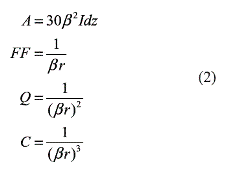
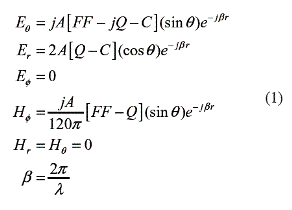
<body><![CDATA[<br> Since it is known, the equations (1) and (2) determine the field that an elementary dipole emits:</font></p>      <p> <img src="/img/revistas/rfiua/n59/n59a03e01.gif"></p>      <p> <font face="Verdana" size="2">where:      </font></p>      <p> <img src="/img/revistas/rfiua/n59/n59a03e02.gif"></p>      <p> <font face="Verdana" size="2">     From the previous equations  (1) and (2) the regions of near field and far field considering the distance  from RD to the observation point in electrical length have been specified, for <i>&beta;r = (2&pi;/&lambda;) r &lt; 1</i> we have the near field  zone. In this region it is possible to measure, and from the electromagnetic  radiation inverse problem it is possible to find a geometric configuration of  elementary sources to have a known model about radiation.     <br> The measurements  can be realized at any point of the zone of near surrounding field to the RD  and the search of the geometric configuration can be carried out by some  analytical or numerical method. As in many electromagnetic radiation problems,  the RD is located at the origin of a coordinated system of global reference and  the observation points or field measurement must be indexed to this system.     <br>     <br> For solving the  specific case, we propose a source structure (elementary dipoles) with random  location inside the global reference system. For the location of each of the  above elements mentioned before, each of them will have two orientations (&theta;,&phi;)  and three position (x,y,z) parameters, besides the excitation (I<sub>0</sub>) and the phase (&alpha;) parameters,  as well as, the parameter (TD) to differentiate an electrical dipole (TD=0)  from a magnetic dipole (TD=1), thus the total of variables for the  electromagnetic fields determination of the elementary dipoles is eight.     <br>     <br> The total field in  an observation point is calculated by the superposition theorem.     ]]></body>
<body><![CDATA[<br>     <br> Due to the fact  that the field emissions of an element of the structure dipolar is calculated  based on its reference, it is necessary to realize a transformation of the  observation point from the global system to the coordinates system of the  dipole under study.     <br>     <br> In  order to find the radiation model parameters (the excitation, orientation and  position) of every element of the configuration it is necessary to construct a  function called object function. This function can conform as the difference of  the measured field and the total field (superposition) of the configuration,  for example, for this case the object function is, <i>FO=E<sub>i</sub>-(E<sub>1</sub>+E<sub>2</sub>+E<sub>3</sub>+...+E<sub>n</sub>)|<sub>i</sub></i>,  where E<sub>i</sub> is  the field measure and <i>E<sub>1</sub>, E<sub>2</sub>, E<sub>3</sub>,</i> ... are the field values of the dipoles 1, 2, 3, ..., <i>n</i>, all of them in the  observation point <i>i</i>. If we have m points of field measures, a configuration dipolar  approximate would be the one that had the lowest sum of the differences in  every point. A problem like that represents an optimization problem. The object  function can be parameterized by analytical or numerical methods. For this case  we used the GAs, which is an optimization method that has given successful  results. For its versatility and no requirements of mathematical properties of  the function to optimize, the GAs are attractive to solve the electromagnetic  radiation inverse problem which is the approach of this work.     <br>     <br> Due to the  previous statements and given that the field superposition is composed of  harmonic own functions of the elementary dipoles field expressions, we can  expect that the configuration dipolar solution to the electromagnetic radiation  inverse problem is not unique. GA is based on a population of possible  solutions and three basic operators, cross, mutation and selection (or  reproduction according to Goldberg [7]). These operators applied successively to  the population (evolution) can produce an individual with wanted  characteristics and these could be reflected in the object function. Each  application of the operators to the population is called generation. The  population is constructed from a non fixed quantity of individuals, generally  it is a matricial arrangement, the rows of such arrangement are individuals  formed from the variable quantities on which the problem depends, that is to  say, an individual can be formed as a numerical arrangement with as many  elements as variables the problem have.     <br>     <br> The initial  population, needed for GA, is constructed generally as a random matrix that  respects the space values for every variable. Cross is an operator whose  function is to exchange the variables (genes or row entries) of two  individuals, the above mentioned exchange can be carried out of fixed form  (always in the same position), random form (position does not fix) or under  some scheme designed for it. The mutation is an operator whose task is to  change randomly some genes of one or more individuals of the population. The  selection is a function that selects the individuals who have better response  to the object function value expected.  </font></p>       <p><font face="Verdana" size="3"><b> Results and discussion     </b> </font></p>      <p> <font face="Verdana" size="2">The availability  of optimization programs based on GAs is vast, and any chosen package must be  studied and tested before being applied to the problem in question.     ]]></body>
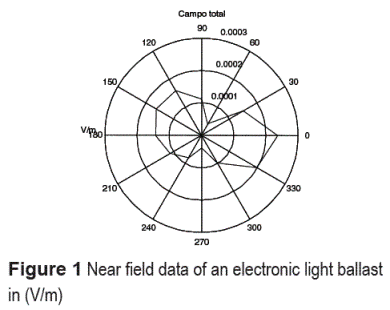
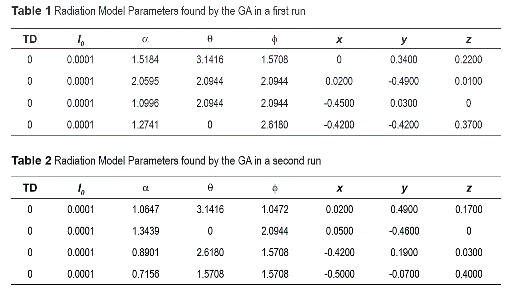
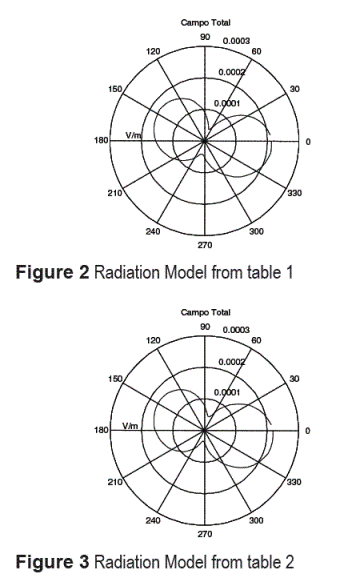
<body><![CDATA[<br>    <br> For  the problem to solve, in this document the results were obtained using MatLab [10] employing one GA real valued. The method was applied to a typical  electromagnetic compatibility problem on electronic ballasts lights. The  evaluation of the conformity of the electronic ballasts for the radiated  emissions is carried out in anechoic chambers or normalized sites,  nevertheless, in its real environment of operation it is not possible to affirm  that they do not produce disturbances to equipments or systems operating in its  vicinity, so it is important to determine the behavior and shape of the radiation  that they emit. The radiation pattern, of electronic ballast for discharge  lamps of high intensity, measured in an anechoic chamber is sketched in the  <a href="#Figura1">figure 1</a>). </font></p>      <p align="center"><img src="/img/revistas/rfiua/n59/n59a03i01.gif" ><a name="Figura1"></a></p>      <p> <font face="Verdana" size="2">With the near field data and a radiation model we apply the AG. The radiation models obtained are depicted in the <a href="#Tabla1">tables 1</a> and <a href="#Tabla1">2</a>, and the corresponding pattern are showed in the <a href="#Figura2">figures 2</a> and <a href="#Figura2">3</a>.</font></p>      <p align="center"><img src="/img/revistas/rfiua/n59/n59a03t01.gif" ><a name="Tabla1"></a></p>      <p align="center"><img src="/img/revistas/rfiua/n59/n59a03i02.gif" ><a name="Figura2"></a></p>      <p> <font face="Verdana" size="2">With the obtained radiation models it is possible to predict the far field behavior only modifying the distance parameter.</font></p>       <p><font face="Verdana" size="3"><b>Conclusion</b> </font></p>      <p> <font face="Verdana" size="2">The approach of a  radiation model parametrized via GA in regard to the emission of a RD (ballast)  is valid for electromagnetic compatibility problems, since it allows estimation  of the coverage of the radiated emission in far field zone. The GA that carries  out the optimization does not need complicated schemes on the selection  operator and it is sufficient with only three operators and a population to  apply the above mentioned operators. Nevertheless, it is very important that  the GA respects the quest interval for every variable of the object function at  all times, given that the GA process functions with random nature operators and  the time consumption can become excessive. The time of the process may swoop  down if GA can incorporate a programmable resolution for every variable. By the  information in the <a href="#Tabla1">tables 1</a> and <a href="#Tabla1">2</a> it is confirmed that the solution to the  inverse problem of the electromagnetic radiation is not unique, in this case  those of major weighting are reported, and in them it is possible to observe  the differences in the parameters of every radiation model.     <br>    ]]></body>
<body><![CDATA[<br> In spite of the  differences of parameters values in the above tables, the radiation pattern  plotted by both models are almost identical, this confirms that the solution is  not unique. The results presented in this work correspond to the optimization  of a object function of one aim, for which the case of the analyzed ballast  (measurements) are to the electrical total field, which does emphasis in the  contribution of this work, and is the approach of a solution of the inverse  problem of electromagnetic radiation. </font></p>       <p><font face="Verdana" size="3"><b>References</b> </font></p>        <!-- ref --><p> <font face="Verdana" size="2">1. C. A. Balanis. <i>Antenna Theory  Analysis and Design.</i> 2a. ed. Ed. Wiley. New York. 1987. pp. 134-207.     &nbsp;&nbsp;&nbsp;&nbsp;&nbsp;&nbsp;&nbsp;&nbsp;[&#160;<a href="javascript:void(0);" onclick="javascript: window.open('/scielo.php?script=sci_nlinks&ref=000055&pid=S0120-6230201100030000300001&lng=','','width=640,height=500,resizable=yes,scrollbars=1,menubar=yes,');">Links</a>&#160;]<!-- end-ref --><br>    <!-- ref --><br> 2. R. Laroussi, G. Costache.  "Far-Field Predictions from Near-Field Measurements Using an Exact  Integral Equation Solution". <i>IEEE Trans on  EMC.</i>  Vol. 36. 1994. pp. 189-195.     &nbsp;&nbsp;&nbsp;&nbsp;&nbsp;&nbsp;&nbsp;&nbsp;[&#160;<a href="javascript:void(0);" onclick="javascript: window.open('/scielo.php?script=sci_nlinks&ref=000057&pid=S0120-6230201100030000300002&lng=','','width=640,height=500,resizable=yes,scrollbars=1,menubar=yes,');">Links</a>&#160;]<!-- end-ref --><br>    <!-- ref --><br> 3. W. D. Rawle. "The  Method of Moments: A numerical Technique for Wire Antenna Design". <i>High Frequency  Electronics.</i>  Vol. 5. 2006. pp. 42-47.     &nbsp;&nbsp;&nbsp;&nbsp;&nbsp;&nbsp;&nbsp;&nbsp;[&#160;<a href="javascript:void(0);" onclick="javascript: window.open('/scielo.php?script=sci_nlinks&ref=000059&pid=S0120-6230201100030000300003&lng=','','width=640,height=500,resizable=yes,scrollbars=1,menubar=yes,');">Links</a>&#160;]<!-- end-ref --><br>    <!-- ref --><br> 4. C. M. Coleman, J. Rothwell, J. E. Ross.  "Investigation of Simulated Annealing, Ant-Colony Optimization and Genetic  Algorithms for Self-Structuring Antenna". <i>IEEE Trans on  Antennas and Propagation.</i> Vol. 52. pp. 1007-1014.     &nbsp;&nbsp;&nbsp;&nbsp;&nbsp;&nbsp;&nbsp;&nbsp;[&#160;<a href="javascript:void(0);" onclick="javascript: window.open('/scielo.php?script=sci_nlinks&ref=000061&pid=S0120-6230201100030000300004&lng=','','width=640,height=500,resizable=yes,scrollbars=1,menubar=yes,');">Links</a>&#160;]<!-- end-ref --><br>    ]]></body>
<body><![CDATA[<!-- ref --><br> 5. T. S. Sijher, A. A. Kishk. "Antenna Modeling by  Infinitesimal Dipoles Using Genetics Algorithms". <i>Progress in  Electromagnetics Research PIER.</i> Vol. 52 . p. 225-254.     &nbsp;&nbsp;&nbsp;&nbsp;&nbsp;&nbsp;&nbsp;&nbsp;[&#160;<a href="javascript:void(0);" onclick="javascript: window.open('/scielo.php?script=sci_nlinks&ref=000063&pid=S0120-6230201100030000300005&lng=','','width=640,height=500,resizable=yes,scrollbars=1,menubar=yes,');">Links</a>&#160;]<!-- end-ref --><br>    <!-- ref --><br> 6. B. Liu, L. Beghou, L.  Pichon. "Adaptive Genetic Algorithm Based Source Identification with  Near-Field Scanning". <i>Progress in Electromagnetics Research B.</i> Vol. 9. 2008. pp. 215-230.     &nbsp;&nbsp;&nbsp;&nbsp;&nbsp;&nbsp;&nbsp;&nbsp;[&#160;<a href="javascript:void(0);" onclick="javascript: window.open('/scielo.php?script=sci_nlinks&ref=000065&pid=S0120-6230201100030000300006&lng=','','width=640,height=500,resizable=yes,scrollbars=1,menubar=yes,');">Links</a>&#160;]<!-- end-ref --><br>    <!-- ref --><br> 7. D. E. Goldberg. <i>Genetic  Algorithms.</i>  Ed. Addison Wesley. New York. 1989. pp. 126-129.     &nbsp;&nbsp;&nbsp;&nbsp;&nbsp;&nbsp;&nbsp;&nbsp;[&#160;<a href="javascript:void(0);" onclick="javascript: window.open('/scielo.php?script=sci_nlinks&ref=000067&pid=S0120-6230201100030000300007&lng=','','width=640,height=500,resizable=yes,scrollbars=1,menubar=yes,');">Links</a>&#160;]<!-- end-ref --><br>    <!-- ref --><br> 8. R. L. Haupt. "An  Introduction to Genetic Algorithms for Electromagnetics". <i>IEEE Antennas and  Propagation Magazine.</i> Vol. 37. 1995. pp. 7-15.     &nbsp;&nbsp;&nbsp;&nbsp;&nbsp;&nbsp;&nbsp;&nbsp;[&#160;<a href="javascript:void(0);" onclick="javascript: window.open('/scielo.php?script=sci_nlinks&ref=000069&pid=S0120-6230201100030000300008&lng=','','width=640,height=500,resizable=yes,scrollbars=1,menubar=yes,');">Links</a>&#160;]<!-- end-ref --><br>    <!-- ref --><br> 9. A. Rangel Merino, J. L.  L&oacute;pez Bonilla Linares, R. Miranda. "Optimization Method based on Genetic  Algorithms".<i> Apeiron.</i> Vol. 12. 2005. pp. 393-408.     &nbsp;&nbsp;&nbsp;&nbsp;&nbsp;&nbsp;&nbsp;&nbsp;[&#160;<a href="javascript:void(0);" onclick="javascript: window.open('/scielo.php?script=sci_nlinks&ref=000071&pid=S0120-6230201100030000300009&lng=','','width=640,height=500,resizable=yes,scrollbars=1,menubar=yes,');">Links</a>&#160;]<!-- end-ref --><br>    ]]></body>
<body><![CDATA[<!-- ref --><br> 10. Matlab 7.0. R14. 2004.</font>&nbsp;&nbsp;&nbsp;&nbsp;&nbsp;&nbsp;&nbsp;&nbsp;[&#160;<a href="javascript:void(0);" onclick="javascript: window.open('/scielo.php?script=sci_nlinks&ref=000073&pid=S0120-6230201100030000300010&lng=','','width=640,height=500,resizable=yes,scrollbars=1,menubar=yes,');">Links</a>&#160;]<!-- end-ref --><br>    <br>    <br>     <p><font face="Verdana" size="2">(Recibido el 26 de junio de 2010. Aceptado el 10 de marzo de 2011)</font></p>     <p><font face="Verdana" size="2"><sup>*</sup>Autor de correspondencia: tel&eacute;fono: + 55 + 5 + 729 60 00 ext. 54839, correo electr&oacute;nico: <a href="mailto:jlopezb@ipn.mx">jlopezb@ipn.mx.</a> (J. L&oacute;pez)</font></p>      ]]></body><back>
<ref-list>
<ref id="B1">
<label>1</label><nlm-citation citation-type="book">
<person-group person-group-type="author">
<name>
<surname><![CDATA[Balanis]]></surname>
<given-names><![CDATA[C. A]]></given-names>
</name>
</person-group>
<source><![CDATA[Antenna Theory Analysis and Design]]></source>
<year>1987</year>
<edition>2</edition>
<page-range>134-207</page-range><publisher-loc><![CDATA[New York ]]></publisher-loc>
<publisher-name><![CDATA[Ed. Wiley]]></publisher-name>
</nlm-citation>
</ref>
<ref id="B2">
<label>2</label><nlm-citation citation-type="journal">
<person-group person-group-type="author">
<name>
<surname><![CDATA[Laroussi]]></surname>
<given-names><![CDATA[R]]></given-names>
</name>
<name>
<surname><![CDATA[Costache]]></surname>
<given-names><![CDATA[G]]></given-names>
</name>
</person-group>
<article-title xml:lang="en"><![CDATA[Far-Field Predictions from Near-Field Measurements Using an Exact Integral Equation Solution]]></article-title>
<source><![CDATA[IEEE Trans on EMC]]></source>
<year>1994</year>
<volume>36</volume>
<page-range>189-195</page-range></nlm-citation>
</ref>
<ref id="B3">
<label>3</label><nlm-citation citation-type="journal">
<person-group person-group-type="author">
<name>
<surname><![CDATA[Rawle]]></surname>
<given-names><![CDATA[W. D]]></given-names>
</name>
</person-group>
<article-title xml:lang="en"><![CDATA[The Method of Moments: A numerical Technique for Wire Antenna Design]]></article-title>
<source><![CDATA[High Frequency Electronics]]></source>
<year>2006</year>
<volume>5</volume>
<page-range>42-47</page-range></nlm-citation>
</ref>
<ref id="B4">
<label>4</label><nlm-citation citation-type="journal">
<person-group person-group-type="author">
<name>
<surname><![CDATA[Coleman]]></surname>
<given-names><![CDATA[C. M]]></given-names>
</name>
<name>
<surname><![CDATA[Rothwell]]></surname>
<given-names><![CDATA[J]]></given-names>
</name>
<name>
<surname><![CDATA[Ross]]></surname>
<given-names><![CDATA[J. E]]></given-names>
</name>
</person-group>
<article-title xml:lang="en"><![CDATA[Investigation of Simulated Annealing, Ant-Colony Optimization and Genetic Algorithms for Self-Structuring Antenna]]></article-title>
<source><![CDATA[IEEE Trans on Antennas and Propagation]]></source>
<year></year>
<volume>52</volume>
<page-range>1007-1014</page-range></nlm-citation>
</ref>
<ref id="B5">
<label>5</label><nlm-citation citation-type="journal">
<person-group person-group-type="author">
<name>
<surname><![CDATA[Sijher]]></surname>
<given-names><![CDATA[T. S]]></given-names>
</name>
<name>
<surname><![CDATA[Kishk]]></surname>
<given-names><![CDATA[A. A]]></given-names>
</name>
</person-group>
<article-title xml:lang="en"><![CDATA[Antenna Modeling by Infinitesimal Dipoles Using Genetics Algorithms]]></article-title>
<source><![CDATA[Progress in Electromagnetics Research PIER]]></source>
<year></year>
<volume>52</volume>
<page-range>225-254</page-range></nlm-citation>
</ref>
<ref id="B6">
<label>6</label><nlm-citation citation-type="journal">
<person-group person-group-type="author">
<name>
<surname><![CDATA[Liu]]></surname>
<given-names><![CDATA[B]]></given-names>
</name>
<name>
<surname><![CDATA[Beghou]]></surname>
<given-names><![CDATA[L]]></given-names>
</name>
<name>
<surname><![CDATA[Pichon]]></surname>
<given-names><![CDATA[L]]></given-names>
</name>
</person-group>
<article-title xml:lang="en"><![CDATA[Adaptive Genetic Algorithm Based Source Identification with Near-Field Scanning]]></article-title>
<source><![CDATA[Progress in Electromagnetics Research B]]></source>
<year>2008</year>
<volume>9</volume>
<page-range>215-230</page-range></nlm-citation>
</ref>
<ref id="B7">
<label>7</label><nlm-citation citation-type="book">
<person-group person-group-type="author">
<name>
<surname><![CDATA[Goldberg]]></surname>
<given-names><![CDATA[D. E]]></given-names>
</name>
</person-group>
<source><![CDATA[Genetic Algorithms]]></source>
<year>1989</year>
<page-range>126-129</page-range><publisher-loc><![CDATA[New York ]]></publisher-loc>
<publisher-name><![CDATA[Ed. Addison Wesley]]></publisher-name>
</nlm-citation>
</ref>
<ref id="B8">
<label>8</label><nlm-citation citation-type="journal">
<person-group person-group-type="author">
<name>
<surname><![CDATA[Haupt]]></surname>
<given-names><![CDATA[R. L]]></given-names>
</name>
</person-group>
<article-title xml:lang="en"><![CDATA[An Introduction to Genetic Algorithms for Electromagnetics]]></article-title>
<source><![CDATA[IEEE Antennas and Propagation Magazine]]></source>
<year>1995</year>
<volume>37</volume>
<page-range>7-15</page-range></nlm-citation>
</ref>
<ref id="B9">
<label>9</label><nlm-citation citation-type="journal">
<person-group person-group-type="author">
<name>
<surname><![CDATA[Rangel Merino]]></surname>
<given-names><![CDATA[A]]></given-names>
</name>
<name>
<surname><![CDATA[López Bonilla Linares]]></surname>
<given-names><![CDATA[J. L]]></given-names>
</name>
<name>
<surname><![CDATA[Miranda]]></surname>
<given-names><![CDATA[R]]></given-names>
</name>
</person-group>
<article-title xml:lang="en"><![CDATA[Optimization Method based on Genetic Algorithms]]></article-title>
<source><![CDATA[Apeiron]]></source>
<year>2005</year>
<volume>12</volume>
<page-range>393-408</page-range></nlm-citation>
</ref>
<ref id="B10">
<label>10</label><nlm-citation citation-type="">
<source><![CDATA[]]></source>
<year></year>
</nlm-citation>
</ref>
</ref-list>
</back>
</article>