<?xml version="1.0" encoding="ISO-8859-1"?><article xmlns:mml="http://www.w3.org/1998/Math/MathML" xmlns:xlink="http://www.w3.org/1999/xlink" xmlns:xsi="http://www.w3.org/2001/XMLSchema-instance">
<front>
<journal-meta>
<journal-id>0120-6230</journal-id>
<journal-title><![CDATA[Revista Facultad de Ingeniería Universidad de Antioquia]]></journal-title>
<abbrev-journal-title><![CDATA[Rev.fac.ing.univ. Antioquia]]></abbrev-journal-title>
<issn>0120-6230</issn>
<publisher>
<publisher-name><![CDATA[Facultad de Ingeniería, Universidad de Antioquia]]></publisher-name>
</publisher>
</journal-meta>
<article-meta>
<article-id>S0120-62302011000400015</article-id>
<title-group>
<article-title xml:lang="en"><![CDATA[Mathematical formulation of restrictions for the design of low voltage bandgap references]]></article-title>
<article-title xml:lang="es"><![CDATA[Formulación matemática de restricciones para el diseño de referencias de banda prohibida de bajo voltaje]]></article-title>
</title-group>
<contrib-group>
<contrib contrib-type="author">
<name>
<surname><![CDATA[Polanco]]></surname>
<given-names><![CDATA[Alicia]]></given-names>
</name>
<xref ref-type="aff" rid="A01"/>
</contrib>
<contrib contrib-type="author">
<name>
<surname><![CDATA[Nagy]]></surname>
<given-names><![CDATA[Agnes]]></given-names>
</name>
<xref ref-type="aff" rid="A01"/>
</contrib>
<contrib contrib-type="author">
<name>
<surname><![CDATA[Álvarez]]></surname>
<given-names><![CDATA[Manuel]]></given-names>
</name>
<xref ref-type="aff" rid="A01"/>
</contrib>
</contrib-group>
<aff id="A01">
<institution><![CDATA[,Instituto Superior Politécnico José Antonio Echeverría Microelectronics Research Center ]]></institution>
<addr-line><![CDATA[Habana ]]></addr-line>
<country>Cuba</country>
</aff>
<pub-date pub-type="pub">
<day>00</day>
<month>09</month>
<year>2011</year>
</pub-date>
<pub-date pub-type="epub">
<day>00</day>
<month>09</month>
<year>2011</year>
</pub-date>
<numero>60</numero>
<fpage>153</fpage>
<lpage>158</lpage>
<copyright-statement/>
<copyright-year/>
<self-uri xlink:href="http://www.scielo.org.co/scielo.php?script=sci_arttext&amp;pid=S0120-62302011000400015&amp;lng=en&amp;nrm=iso"></self-uri><self-uri xlink:href="http://www.scielo.org.co/scielo.php?script=sci_abstract&amp;pid=S0120-62302011000400015&amp;lng=en&amp;nrm=iso"></self-uri><self-uri xlink:href="http://www.scielo.org.co/scielo.php?script=sci_pdf&amp;pid=S0120-62302011000400015&amp;lng=en&amp;nrm=iso"></self-uri><abstract abstract-type="short" xml:lang="en"><p><![CDATA[Nowadays the qualities more looked for in the design of bandgap references are the low potential of the reference and the low value of its coefficient of temperature, being these parameters more favorable in curvature corrected bandgap references. The design parameters of bandgap references depend on the value of the potential of reference V REF; nevertheless, in the reported designs there are not paid attention to conditions that limit the attainable value of V REF. In this work the mathematical formulation of the restrictions that really limit the attainable value of the reference potential is presented in order that the design of a curvature corrected bandgap reference can be realizable.]]></p></abstract>
<abstract abstract-type="short" xml:lang="es"><p><![CDATA[Actualmente las cualidades más buscadas de las referencias bandgap son el bajo potencial de referencia y el bajo valor del coeficiente de temperatura, siendo estos parámetros más favorables en las referencias de bandgap con corrección de curvatura. Por otra parte y aunque claramente los parámetros de diseño dependen del valor del potencial de referencia V REF. Habitualmente en los diseños reportados no se analizan las condiciones que limitan el valor de V REF alcanzable. En este trabajo se presenta la formulación matemática de las restricciones que realmente limitan el valor alcanzable del potencial de referencia para que el diseño de una fuente de referencia de bandgap con corrección de curvatura sea realizable.]]></p></abstract>
<kwd-group>
<kwd lng="en"><![CDATA[curvature correction]]></kwd>
<kwd lng="en"><![CDATA[low temperature coefficient]]></kwd>
<kwd lng="en"><![CDATA[low voltage bandgap references]]></kwd>
<kwd lng="es"><![CDATA[bajo coeficiente de temperatura]]></kwd>
<kwd lng="es"><![CDATA[corrección de curvatura]]></kwd>
<kwd lng="es"><![CDATA[referencia bandgap de bajo potencial]]></kwd>
</kwd-group>
</article-meta>
</front><body><![CDATA[ <p align="center"><font face="Verdana" size="4"> <b>Mathematical formulation of restrictions for the design of low voltage bandgap references</b></font></p>      <p align="center"><font face="Verdana" size="4"> <b>Formulaci&oacute;n matem&aacute;tica de  restricciones para el dise&ntilde;o de referencias de banda prohibida de bajo voltaje</b></font></p>     <p align="center">&nbsp;</p>      <p> <font face="Verdana" size="2"> <i>Alicia Polanco<sup>*</sup>, Agnes Nagy, Manuel &Aacute;lvarez</i></font></p>       <p> <font face="Verdana" size="2">Microelectronics Research Center. Instituto Superior Polit&eacute;cnico Jos&eacute; Antonio Echeverr&iacute;a. Habana, Cuba.</font></p>      <br>  <hr noshade size="1">      <p><font face="Verdana" size="3"><b>Abstract</b></font></p>      <p><font face="Verdana" size="2">Nowadays  the qualities more looked for in the design of bandgap references are the low  potential of the reference and the low value of its coefficient of temperature,  being these parameters more favorable in curvature corrected bandgap  references.     <br>    <br> The  design parameters of bandgap references depend on the value of the potential of  reference V<sub>REF</sub>; nevertheless, in the reported designs there are not  paid attention to conditions that limit the attainable value of V<sub>REF</sub>.     ]]></body>
<body><![CDATA[<br>    <br> In  this work the mathematical formulation of the restrictions that really limit  the attainable value of the reference potential is presented in order that the  design of a curvature corrected bandgap reference can be realizable.</font></p>      <p><font face="Verdana" size="2"><i>Keywords: </i>curvature  correction, low temperature coefficient, low voltage bandgap references. </font></p>  <hr noshade size="1">      <p><font face="Verdana" size="3"><b>Resumen</b></font></p>       <p><font face="Verdana" size="2">Actualmente  las cualidades m&aacute;s buscadas de las referencias bandgap son el bajo potencial de  referencia y el bajo valor del coeficiente de temperatura, siendo estos  par&aacute;metros m&aacute;s favorables en las referencias de bandgap con correcci&oacute;n de  curvatura. Por otra parte y aunque claramente los par&aacute;metros de dise&ntilde;o dependen  del valor del potencial de referencia V<sub>REF</sub>. Habitualmente en los  dise&ntilde;os reportados no se analizan las condiciones que limitan el valor de V<sub>REF</sub>  alcanzable.     <br>    <br> En este trabajo se presenta la formulaci&oacute;n matem&aacute;tica  de las restricciones que realmente limitan el valor alcanzable del potencial de  referencia para que el dise&ntilde;o de una fuente de referencia de bandgap con  correcci&oacute;n de curvatura sea realizable. </font></p>       <p><font face="Verdana" size="2"><i>Palabras clave:</i>bajo coeficiente de temperatura, correcci&oacute;n de  curvatura, referencia bandgap de bajo potencial.</font></p>   <hr noshade size="1">      <p><font face="Verdana" size="3"><b>Introduction</b></font></p>         <p><font face="Verdana" size="2">Bandgap voltage references are frequently used in analog  circuits as voltage regulators and as such in A/D and D/A converters &#91;1&#93;. At  present the qualities more looked for in the design of bandgap references are  the low values of voltage and temperature coefficient &#91;2,3&#93;.     ]]></body>
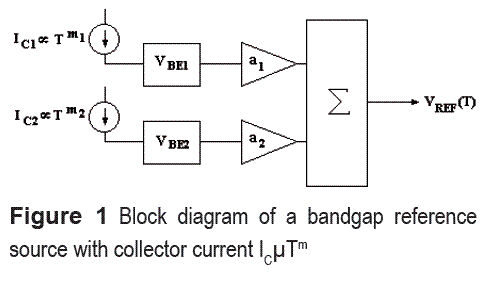
<body><![CDATA[<br>    <br> Although the dependencies of design parameters on the  wished value of reference voltage V<sub>REF</sub> are known, in the designs  reported in the literature &#91;3,4&#93; the attainable value of V<sub>REF</sub> is  rarely analyzed or its importance is neglected.     <br>    <br> In this work the mathematical formulation of the  restrictions that really limit the attainable V<sub>REF</sub> value and make a  design of a curvature corrected bandgap reference realizable, are obtained.  This value is verified experimentally through the design and measurement of bandgap  type circuits, based on the sum of two base-emitter voltages.</font> </p>      <p> <font face="Verdana" size="2"><b><i>Analysis of design equations</i></b></font></p>     <p> <font face="Verdana" size="2"> The block diagram of a low voltage bandgap reference, based  on the sum of two base-emitter voltages is shown in <a href="#Figura1">figure 1</a> &#91;2&#93;.       <p align="center"><img src="/img/revistas/rfiua/n60/n60a15i01.gif" ><a name="Figura1"></a></p> V<sub>BE1</sub> and V<sub>BE2</sub> stand for the  expressions of the base-emitter voltages of the transistors and m1 and m2  determine the bias current temperature dependences &#91;2,4,5&#93;.     <br>    <br> The expression of V<sub>REF</sub> (T) for the circuit of  <a href="#Figura1">figure 1</a> is given by equation (1):    <br>      ]]></body>
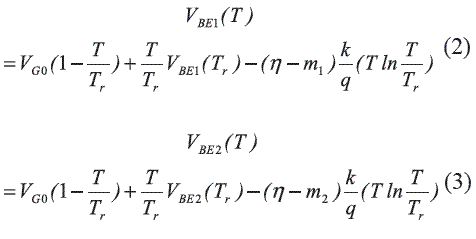
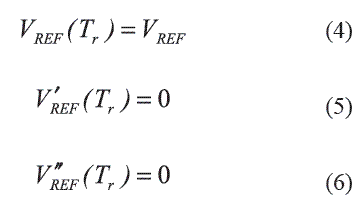
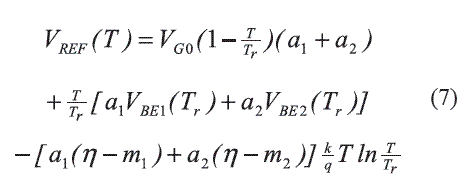
<body><![CDATA[<p> <img src="/img/revistas/rfiua/n60/n60a15e01.gif"></p>  Using the linear approximation of bandgap voltage V<sub>G</sub> (T) &#91;4,6,7&#93;, the expressions of V<sub>BE1</sub>(T)  and V<sub>BE2</sub>(T) can be written via equations (2) and (3):    <br>      <p> <img src="/img/revistas/rfiua/n60/n60a15e02.gif"></p>  where V<sub>G0</sub> is the bandgap voltage extrapolated at  zero Kelvin and &eta; is a parameter related to the temperature dependence of the  mobility of minority carriers in the base region &#91;8&#93;. Their values are obtained  from experimental measurements of V<sub>BE2</sub> (T<sub>r</sub>) &#91;4,8&#93;.     <br>    <br> For the design of bandgap  reference the parameters a1, a2, and VBE1 (Tr) of  expression (1) should be determined, taking into account the known values m<sub>1</sub>  , m<sub>2</sub> and V<sub>BE2</sub> (T<sub>r</sub> ).     <br>    <br> In order to reduce the temperature dependence of the  reference voltage, that is V<sub>REF</sub> (T)=V<sub>REF</sub> the Taylor  criterion will be applied.     <br>    <br> Using Taylor criterion at T= T<sub>r</sub>,  all possible derivates are zero around T<sub>r</sub>, so the equations (4), (5)  and (6) result:    <br>    ]]></body>
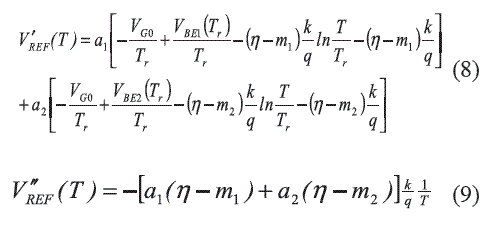
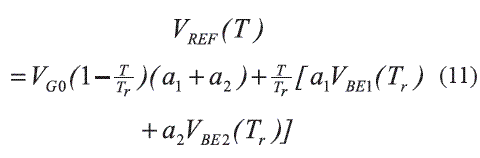
<body><![CDATA[<br>     <p> <img src="/img/revistas/rfiua/n60/n60a15e04.gif"></p>  Substituting (2) and (3) in (1), the expression (7) is  obtained:    <br>      <p> <img src="/img/revistas/rfiua/n60/n60a15e07.gif"></p>    From derivation of (7), equations (8) and (9) result:    <br>        <p> <img src="/img/revistas/rfiua/n60/n60a15e08.gif"></p>    The use of condition (6) in (9) allows obtaining equation  (10):    <br>      <p> <img src="/img/revistas/rfiua/n60/n60a15e10.gif"></p>      This condition is valid for all the temperature range.     <br>    <br>   Considering (10) in (7), equation (11) results:    ]]></body>
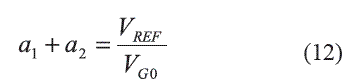
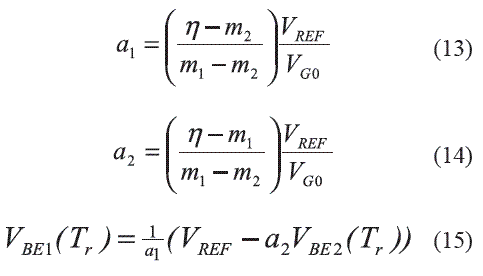
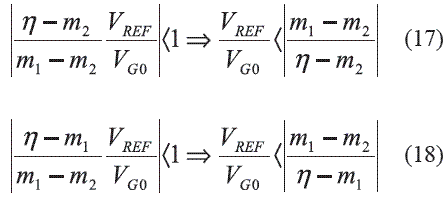
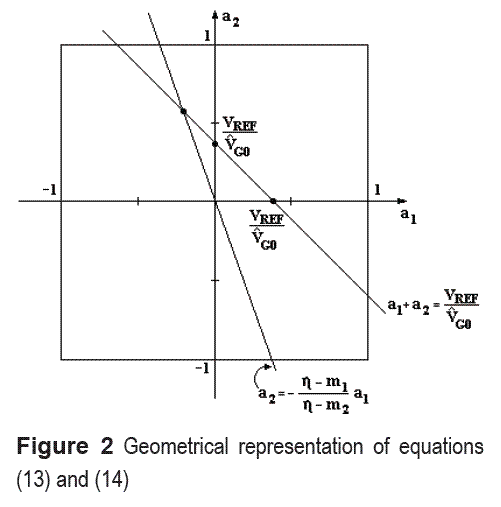
<body><![CDATA[<br>      <p> <img src="/img/revistas/rfiua/n60/n60a15e11.gif"></p>      From where the equation (12) is obtained:    <br>      <p> <img src="/img/revistas/rfiua/n60/n60a15e12.gif"></p>    Expressions (1), (10) and (12) form an equation system  which allows to obtain the parameters a<sub>1</sub>, a<sub>2</sub> and V<sub>BE1</sub>(T<sub>r</sub>)  as written in (13), (14) and (15):</font></p>      <p> <img src="/img/revistas/rfiua/n60/n60a15e13.gif"></p>      <p> <font face="Verdana" size="2"><b><i>Analysis of the design restrictions</i></b></font></p>     <p><font face="Verdana" size="2"> Equations (13) and (14) allow a convenient visualization of  the design conditions when they are represented as lines in a1, a2 planes, as  shown in <a href="#Figura2">figure 2</a> the solution for the design will be given by the intersection  of both lines.    <br> </font></p> <font face="Verdana" size="2">    <p align="center"><img src="/img/revistas/rfiua/n60/n60a15i02.gif" ><a name="Figura2"></a></p>     Since only the interval &#91;-1, 1&#93; is admitted for a<sub>1</sub> and  a<sub>2</sub> values, the design conditions given by (16), (17) and (18) have  to be satisfy:      <p> <img src="/img/revistas/rfiua/n60/n60a15e16.gif"></p>     ]]></body>
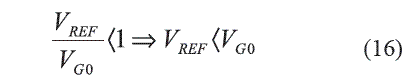
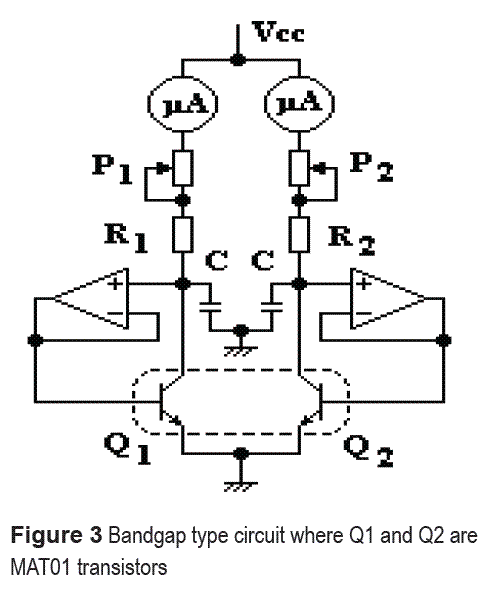
<body><![CDATA[<p> <img src="/img/revistas/rfiua/n60/n60a15e17.gif"></p>      For this reason V<sub>REF</sub>  has to be less than the minor of the three equations given by (16), (17) and  (18). This means that for a determined design, where m<sub>1</sub> and m<sub>2</sub>  values are given by the temperature dependence of the bias currents, and the  values of h and V<sub>G0</sub> depend on the transistor used, V<sub>REF</sub>  can not be greater than certain value that here will be denominated V<sub>REFMAX</sub></font></p>         <p> <font face="Verdana" size="2"><b><i>Use of the design restrictions in a practical case</i></b></font></p>      <p> <font face="Verdana" size="2">Criterion expressed in equations (16), (17) and (18)) was  assessed experimentally through the design and measurements of the bandgap type  circuit shown in <a href="#Figura3">figure 3</a>, using constants (m1=0) and IPTAT (m2=1) bias  currents.    <br>     <p align="center"><img src="/img/revistas/rfiua/n60/n60a15i03.gif" ><a name="Figura3"></a></p> A mathematical program was developed as a tool in order to:    <br>    <br> Calculate the values of &eta; and  V<sub>GO</sub> for the transistors MAT01 used (based in experimental  measurements of V<sub>BE</sub> at three different temperatures) and V<sub>REFMAX</sub>,  for m<sub>1</sub>=0 and m<sub>2</sub>=1.    <br>    <br> Calculate the design  parameters a<sub>1</sub>, a<sub>2</sub> and V<sub>BE1</sub>(Tr) for the wished  V<sub>REF</sub> .     <br>    ]]></body>
<body><![CDATA[<br> The requirements needed in the measurement of temperature,  potential and current to obtain a mistake less than 0.25 ppm/&ordm;C in  the range 20 to 100 &ordm;C were found by means of analysis of  sensibility as:     <br>    <br> a) Temperature: Resolution  better than 0.01 &ordm;C in the work range     <br>    <br> b) Potential: Resolution  better than 1 &mu;V     <br>    <br> c) The stability of the  potentials V<sub>BE1</sub>(T) and V<sub>BE2</sub>(T) better than 0.2 &mu;V  respectively     <br>    <br> For the measurement the following instruments were used:     <br>    ]]></body>
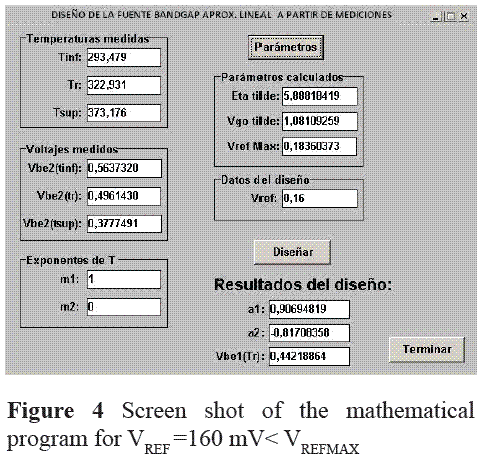
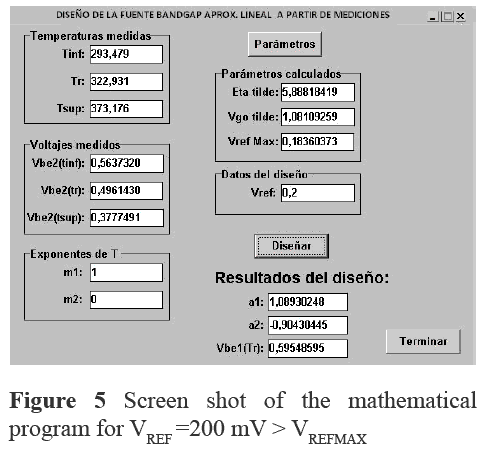
<body><![CDATA[<br> - Astandard platinum resistor  PT1000 DIN EN60751 as temperature sensor. The resistance of the PT1000 was measured  with a Keithley digital electrometer model 614.     <br>    <br> -Base-emitter voltages V<sub>BE1</sub>  (T) and V<sub>BE2</sub> (T) were measured with the Keithley nanovoltmeter  model 2182 with 100 nV resolution in a 1 V scale.     <br>    <br> For the used MAT01 transistors  the following values were obtained: &eta;=588818419, V<sub>GO</sub>=1.08109259 V  and V<sub>REFMAX</sub>=0.18360373  V.     <br>    <br> These results were used to calculate the design parameters  in two cases (The screen shots of the mathematical program are shown in <a href="#Figura4">figure 4</a> and <a href="#Figura5">5</a> respectively) :     <br>    <br> a.) V<sub>REF</sub>=160 mV &lt; V<sub>REFMAX</sub> (<a href="#Figura4">figure 4</a>)     <br>    ]]></body>
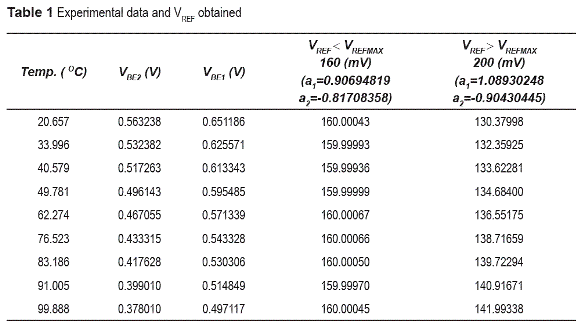
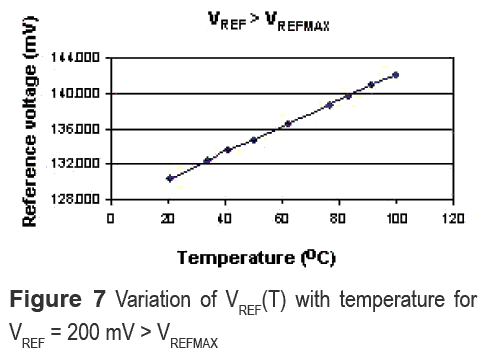
<body><![CDATA[<br> b.) V<sub>REF</sub> =200 mV &gt; V<sub>REFMAX</sub> (<a href="#Figura5">figure 5</a>)    <br>    <br>     <p align="center"><img src="/img/revistas/rfiua/n60/n60a15i04.gif" ><a name="Figura4"></a></p>     <p align="center"><img src="/img/revistas/rfiua/n60/n60a15i05.gif" ><a name="Figura5"></a></p> In screen shot of <a href="#Figura5">figure 5</a> the  value of a<sub>1</sub> &gt; 1 can be observed. This value is out of &#91;-1,1&#93;  interval (see <a href="#Figura2">figure 2</a>) affecting the a2 value too in equation (12).  , confirming that a design for V<sub>REF</sub> &gt; 0.18360 V=V<sub>REFMAX</sub> is  not possible.     <br>    <br> The reference voltage were  calculated in both cases, using in equation (1) the experimentally measured  values of V<sub>BE1</sub>(T) and V<sub>BE2</sub>(T) together with the values a<sub>1</sub>  and a<sub>2</sub> obtained by the mathematical program. The experimental  measurements and calculated V<sub>REF</sub> values are shown in <a href="#Tabla1">table 1</a>.    <br>    <br>     <p align="center"><img src="/img/revistas/rfiua/n60/n60a15t01.gif" ><a name="Tabla1"></a></p>  In <a href="#Tabla1">table 1</a> the values of V<sub>REF</sub>  were obtained using equation (1). For V<sub>REF</sub>&gt;V<sub>REFMAX</sub> case,  V<sub>REF</sub> values result far away from the design one (200 mV) due to  incorrect a<sub>1</sub> and a<sub>2</sub> values, showing that a target design  value greater than V<sub>REFMAX</sub> is not attainable. Besides their increase  with temperature invalids its use as a reference.     ]]></body>
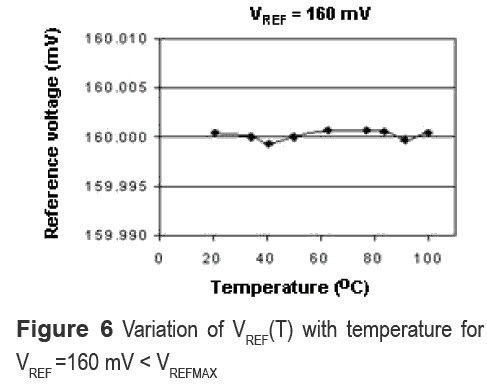
<body><![CDATA[<br>    <br>   In <a href="#Figura6">figures 6</a> and <a href="#Figura7">7</a> the variations of V<sub>REF</sub> with  temperature are shown for both cases.    <br>     <p align="center"><img src="/img/revistas/rfiua/n60/n60a15i06.gif" ><a name="Figura6"></a></p>     <p align="center"><img src="/img/revistas/rfiua/n60/n60a15i07.gif" ><a name="Figura7"></a></p>   For V<sub>REF</sub> &gt; V<sub>REFMAX</sub> case, V<sub>REF</sub> values result far away from the design one (200 mV) due to  incorrect a<sub>1</sub> and a<sub>2</sub> values.     <br>    <br> The reference voltage in <a href="#Figura6">figure 6</a>, designed to 160 mV has  an average temperature coefficient of U.1U1 ppm/&ordm;C, while the one of  the  <a href="#Figura7">figure 7</a>, designed to 200 mV shows an increase with temperature that  invalids its use as a reference.</font></p>         <p><font face="Verdana" size="3"><b>Conclusions</b> </font></p>      <p><font face="Verdana" size="2">The analysis and the  visualization of the design equations of a bandgap voltage reference based on  the sum of two base-emitter voltages lead to obtain three equations that really  limit the attainable value of the reference voltage V<sub>REF</sub>.     <br>    ]]></body>
<body><![CDATA[<br> This means that V<sub>REF</sub>  has to be less than the minor of the three quotas and can not overpass the  value of &nbsp;V<sub>REFMAX</sub>.     <br>    <br> This result was assessed experimentally through the design  and measurement of a bandgap type circuit. The results show that the reference  voltage designed to 160 mV &lt; V<sub>REFMAX</sub> has an average temperature  coefficient of 0.101 ppm/oC, while that designed to 200 mV &gt; V<sub>REFMAX</sub>  results far away from the design one, increasing with temperature. This  behavior invalids its use as a reference. This fact confirms the importance of  knowing restrictions that really limit the attainable value of reference  voltages, aspect not studied up to now. </font></p>      <p><font face="Verdana" size="3"><b>References</b> </font></p>      <!-- ref --><p><font face="Verdana" size="2">1. Analog Devices Inc. <i>Data Converter  Refernce Manual</i>. Vol.  1. 1992. pp. 2-1141.     &nbsp;&nbsp;&nbsp;&nbsp;&nbsp;&nbsp;&nbsp;&nbsp;[&#160;<a href="javascript:void(0);" onclick="javascript: window.open('/scielo.php?script=sci_nlinks&ref=000117&pid=S0120-6230201100040001500001&lng=','','width=640,height=500,resizable=yes,scrollbars=1,menubar=yes,');">Links</a>&#160;]<!-- end-ref --><br>    <!-- ref --><br> 2. A. Van Staveren. <i>Structures  electronic design of high-performance low-voltage low-power references.</i> PH.D. Thesis. Delft University  of Technology. The Netherlands. 1997. pp. 155-180.     &nbsp;&nbsp;&nbsp;&nbsp;&nbsp;&nbsp;&nbsp;&nbsp;[&#160;<a href="javascript:void(0);" onclick="javascript: window.open('/scielo.php?script=sci_nlinks&ref=000119&pid=S0120-6230201100040001500002&lng=','','width=640,height=500,resizable=yes,scrollbars=1,menubar=yes,');">Links</a>&#160;]<!-- end-ref --><br>    <!-- ref --><br> 3. A. Pletersek. "A  Compensated Bandgap Voltage Reference with Sub-1-V Supply Voltage". <i>Analog Integrated  Circuits and Signal Processing.</i> Vol. 44. 2005. pp. 5-15.     &nbsp;&nbsp;&nbsp;&nbsp;&nbsp;&nbsp;&nbsp;&nbsp;[&#160;<a href="javascript:void(0);" onclick="javascript: window.open('/scielo.php?script=sci_nlinks&ref=000121&pid=S0120-6230201100040001500003&lng=','','width=640,height=500,resizable=yes,scrollbars=1,menubar=yes,');">Links</a>&#160;]<!-- end-ref --><br>    ]]></body>
<body><![CDATA[<!-- ref --><br> 4. G. C. M. Meijer, P. C Schmale, K.  Van Zalinge. "A new curvature-corrected bandgap reference". <i>IEEE Journal of  Solid-State Circuits.</i> Vol. 17. 1982. pp. 1139-1143.     &nbsp;&nbsp;&nbsp;&nbsp;&nbsp;&nbsp;&nbsp;&nbsp;[&#160;<a href="javascript:void(0);" onclick="javascript: window.open('/scielo.php?script=sci_nlinks&ref=000123&pid=S0120-6230201100040001500004&lng=','','width=640,height=500,resizable=yes,scrollbars=1,menubar=yes,');">Links</a>&#160;]<!-- end-ref --><br>    <!-- ref --><br> 5. C. Popa. "Optimal  superior-order curvature-corrected voltage reference based on the weight  difference of gate-source voltages".<i> Analog Integrated  Circuits and Signal Processing. </i>Vol. 54. 2008. pp. 1-6.     &nbsp;&nbsp;&nbsp;&nbsp;&nbsp;&nbsp;&nbsp;&nbsp;[&#160;<a href="javascript:void(0);" onclick="javascript: window.open('/scielo.php?script=sci_nlinks&ref=000125&pid=S0120-6230201100040001500005&lng=','','width=640,height=500,resizable=yes,scrollbars=1,menubar=yes,');">Links</a>&#160;]<!-- end-ref --><br>    <!-- ref --><br> 6. A. Polanco, A. Nagy. M.  Alvarez. "Physical design to verify theoretical 0.1 ppm/&deg;C stability in a  bandgap type circuit".<i> Energ&iacute;a y Computaci&oacute;n</i>. Vol. 13.  2005. pp. 29-32.     &nbsp;&nbsp;&nbsp;&nbsp;&nbsp;&nbsp;&nbsp;&nbsp;[&#160;<a href="javascript:void(0);" onclick="javascript: window.open('/scielo.php?script=sci_nlinks&ref=000127&pid=S0120-6230201100040001500006&lng=','','width=640,height=500,resizable=yes,scrollbars=1,menubar=yes,');">Links</a>&#160;]<!-- end-ref --><br>    <!-- ref --><br> 7. R. Amador,  A. Polanco, A. Nagy, M. Alvarez. "Accurate design of low-voltage curvature-corrected  bandgap references". DCIS'2000. XV Design of Circuits and Integrated  Systems Conferences. Le Corum. Montpellier. France. Nov. 21-24. 2000.     &nbsp;&nbsp;&nbsp;&nbsp;&nbsp;&nbsp;&nbsp;&nbsp;[&#160;<a href="javascript:void(0);" onclick="javascript: window.open('/scielo.php?script=sci_nlinks&ref=000129&pid=S0120-6230201100040001500007&lng=','','width=640,height=500,resizable=yes,scrollbars=1,menubar=yes,');">Links</a>&#160;]<!-- end-ref --><br>    <!-- ref --><br> 8. R. Amador, A. Polanco, A.  Nagy. "The spread of &#951; and V<sub>G0</sub> and its influence on the  sensitivity of a bipolar I.C Celsius sensor". <i>Sensors and  Actuators.</i>  Vol. 77. 1999. pp. 9-13. </font>&nbsp;&nbsp;&nbsp;&nbsp;&nbsp;&nbsp;&nbsp;&nbsp;[&#160;<a href="javascript:void(0);" onclick="javascript: window.open('/scielo.php?script=sci_nlinks&ref=000131&pid=S0120-6230201100040001500008&lng=','','width=640,height=500,resizable=yes,scrollbars=1,menubar=yes,');">Links</a>&#160;]<!-- end-ref --><br>    ]]></body>
<body><![CDATA[<br>    <br>    <br>       <p><font face="Verdana" size="2">(Recibido el 10 de agosto de  2009. Aceptado el 14 de abril de 2011)</font></p>     <p><font face="Verdana" size="2"><sup>*</sup>Autor de correspondencia: tel&eacute;fono: + 53 + 07 + 645 29 35, correo electr&oacute;nico: <a href="mailto:alicia.polanco@electrica.cujae.edu.cu.">alicia.polanco@electrica.cujae.edu.cu.</a> (A. Polanco)</font></p>      ]]></body><back>
<ref-list>
<ref id="B1">
<label>1</label><nlm-citation citation-type="">
<collab>Analog Devices Inc</collab>
<source><![CDATA[Data Converter Refernce Manual]]></source>
<year>1992</year>
<volume>1</volume>
<page-range>2-1141</page-range></nlm-citation>
</ref>
<ref id="B2">
<label>2</label><nlm-citation citation-type="">
<person-group person-group-type="author">
<name>
<surname><![CDATA[Van Staveren]]></surname>
<given-names><![CDATA[A]]></given-names>
</name>
</person-group>
<source><![CDATA[Structures electronic design of high-performance low-voltage low-power references]]></source>
<year></year>
<page-range>155-180</page-range></nlm-citation>
</ref>
<ref id="B3">
<label>3</label><nlm-citation citation-type="journal">
<person-group person-group-type="author">
<name>
<surname><![CDATA[Pletersek]]></surname>
<given-names><![CDATA[A]]></given-names>
</name>
</person-group>
<article-title xml:lang="en"><![CDATA[A Compensated Bandgap Voltage Reference with Sub-1-V Supply Voltage]]></article-title>
<source><![CDATA[Analog Integrated Circuits and Signal Processing]]></source>
<year>2005</year>
<volume>44</volume>
<page-range>5-15</page-range></nlm-citation>
</ref>
<ref id="B4">
<label>4</label><nlm-citation citation-type="journal">
<person-group person-group-type="author">
<name>
<surname><![CDATA[Meijer]]></surname>
<given-names><![CDATA[G. C. M]]></given-names>
</name>
<name>
<surname><![CDATA[Schmale]]></surname>
<given-names><![CDATA[P. C]]></given-names>
</name>
<name>
<surname><![CDATA[Van Zalinge]]></surname>
<given-names><![CDATA[K]]></given-names>
</name>
</person-group>
<article-title xml:lang="en"><![CDATA[A new curvature-corrected bandgap reference]]></article-title>
<source><![CDATA[IEEE Journal of Solid-State Circuits]]></source>
<year>1982</year>
<volume>17</volume>
<page-range>1139-1143</page-range></nlm-citation>
</ref>
<ref id="B5">
<label>5</label><nlm-citation citation-type="journal">
<person-group person-group-type="author">
<name>
<surname><![CDATA[Popa]]></surname>
<given-names><![CDATA[C]]></given-names>
</name>
</person-group>
<article-title xml:lang="en"><![CDATA[Optimal superior-order curvature-corrected voltage reference based on the weight difference of gate-source voltages]]></article-title>
<source><![CDATA[Analog Integrated Circuits and Signal Processing]]></source>
<year>2008</year>
<volume>54</volume>
<page-range>1-6</page-range></nlm-citation>
</ref>
<ref id="B6">
<label>6</label><nlm-citation citation-type="journal">
<person-group person-group-type="author">
<name>
<surname><![CDATA[Polanco]]></surname>
<given-names><![CDATA[A]]></given-names>
</name>
<name>
<surname><![CDATA[Nagy]]></surname>
<given-names><![CDATA[A]]></given-names>
</name>
<name>
<surname><![CDATA[Alvarez]]></surname>
<given-names><![CDATA[M]]></given-names>
</name>
</person-group>
<article-title xml:lang="en"><![CDATA[Physical design to verify theoretical 0.1 ppm/&deg;C stability in a bandgap type circuit]]></article-title>
<source><![CDATA[Energía y Computación]]></source>
<year>2005</year>
<volume>13</volume>
<page-range>29-32</page-range></nlm-citation>
</ref>
<ref id="B7">
<label>7</label><nlm-citation citation-type="confpro">
<person-group person-group-type="author">
<name>
<surname><![CDATA[Amador]]></surname>
<given-names><![CDATA[R]]></given-names>
</name>
<name>
<surname><![CDATA[Polanco]]></surname>
<given-names><![CDATA[A]]></given-names>
</name>
<name>
<surname><![CDATA[Nagy]]></surname>
<given-names><![CDATA[A]]></given-names>
</name>
<name>
<surname><![CDATA[Alvarez]]></surname>
<given-names><![CDATA[M]]></given-names>
</name>
</person-group>
<source><![CDATA[Accurate design of low-voltage curvature-corrected bandgap references]]></source>
<year></year>
<conf-name><![CDATA[XV Design of Circuits and Integrated Systems Conferences]]></conf-name>
<conf-date>2000</conf-date>
<conf-loc>Montpellier </conf-loc>
</nlm-citation>
</ref>
<ref id="B8">
<label>8</label><nlm-citation citation-type="journal">
<person-group person-group-type="author">
<name>
<surname><![CDATA[Amador]]></surname>
<given-names><![CDATA[R]]></given-names>
</name>
<name>
<surname><![CDATA[Polanco]]></surname>
<given-names><![CDATA[A]]></given-names>
</name>
<name>
<surname><![CDATA[Nagy]]></surname>
<given-names><![CDATA[A]]></given-names>
</name>
</person-group>
<article-title xml:lang="en"><![CDATA[The spread of &#951; and V G0 and its influence on the sensitivity of a bipolar I.C Celsius sensor]]></article-title>
<source><![CDATA[Sensors and Actuators]]></source>
<year>1999</year>
<volume>77</volume>
<page-range>9-13</page-range></nlm-citation>
</ref>
</ref-list>
</back>
</article>