<?xml version="1.0" encoding="ISO-8859-1"?><article xmlns:mml="http://www.w3.org/1998/Math/MathML" xmlns:xlink="http://www.w3.org/1999/xlink" xmlns:xsi="http://www.w3.org/2001/XMLSchema-instance">
<front>
<journal-meta>
<journal-id>0120-6230</journal-id>
<journal-title><![CDATA[Revista Facultad de Ingeniería Universidad de Antioquia]]></journal-title>
<abbrev-journal-title><![CDATA[Rev.fac.ing.univ. Antioquia]]></abbrev-journal-title>
<issn>0120-6230</issn>
<publisher>
<publisher-name><![CDATA[Facultad de Ingeniería, Universidad de Antioquia]]></publisher-name>
</publisher>
</journal-meta>
<article-meta>
<article-id>S0120-62302013000100010</article-id>
<title-group>
<article-title xml:lang="en"><![CDATA[Active and reactive power flow regulation for a grid connected VSC based on fuzzy controllers]]></article-title>
<article-title xml:lang="es"><![CDATA[Regulación del flujo de potencia activa y reactiva en un convertidor VSC conectado a red mediante controladores difusos]]></article-title>
</title-group>
<contrib-group>
<contrib contrib-type="author">
<name>
<surname><![CDATA[Díaz Aldcmcí]]></surname>
<given-names><![CDATA[Nelson]]></given-names>
</name>
<xref ref-type="aff" rid="A01"/>
</contrib>
<contrib contrib-type="author">
<name>
<surname><![CDATA[Trujillo]]></surname>
<given-names><![CDATA[César Leonardo]]></given-names>
</name>
<xref ref-type="aff" rid="A01"/>
</contrib>
<contrib contrib-type="author">
<name>
<surname><![CDATA[Guarnizo]]></surname>
<given-names><![CDATA[José Guillermo]]></given-names>
</name>
<xref ref-type="aff" rid="A01"/>
</contrib>
</contrib-group>
<aff id="A01">
<institution><![CDATA[,Universidad Distrital Francisco José de Caldas Departamento de Ingeniería Electrónica ]]></institution>
<addr-line><![CDATA[Bogotá ]]></addr-line>
<country>Colombia</country>
</aff>
<pub-date pub-type="pub">
<day>00</day>
<month>03</month>
<year>2013</year>
</pub-date>
<pub-date pub-type="epub">
<day>00</day>
<month>03</month>
<year>2013</year>
</pub-date>
<numero>66</numero>
<fpage>118</fpage>
<lpage>130</lpage>
<copyright-statement/>
<copyright-year/>
<self-uri xlink:href="http://www.scielo.org.co/scielo.php?script=sci_arttext&amp;pid=S0120-62302013000100010&amp;lng=en&amp;nrm=iso"></self-uri><self-uri xlink:href="http://www.scielo.org.co/scielo.php?script=sci_abstract&amp;pid=S0120-62302013000100010&amp;lng=en&amp;nrm=iso"></self-uri><self-uri xlink:href="http://www.scielo.org.co/scielo.php?script=sci_pdf&amp;pid=S0120-62302013000100010&amp;lng=en&amp;nrm=iso"></self-uri><abstract abstract-type="short" xml:lang="en"><p><![CDATA[Voltage Source Converters (VSC) are one of the most used converters in distributed generation application and HVDC systems, since a VSC can operate either as inverter or rectifier. Furthermore, a VSC allows fast, accurate and independent active and reactive power flow control. However, a VSC is a double- input double-output non-linear control objet, therefore; nonlinear control strategies can be useful in order to obtain desired behaviors. In particular, knowledge based fuzzy controller does not require a mathematic model of the system it just relies on a qualitative knowledge about the behavior of the system. Moreover, the same fuzzy controller can be applied to any VSC with any power ratio. This paper presents the analysis, design and results obtained by using fuzzy controllers for regulating the active and reactive power flow in a Voltage Source Converter (VSC) connected to the utility grid. Additionally, it is shown that the transitory and stationary response of the VSC depends on the shape of membership functions at different power ratios. Digital simulation was performed in order to verify the behavior of the controller under different power levels. Finally, a VSC prototype with fuzzy controllers was tested experimentally.]]></p></abstract>
<abstract abstract-type="short" xml:lang="es"><p><![CDATA[Los convertidores de fuente de tención (VSC) son una de las topologías más utilizadas en sistemas de generación distribuida y sistemas de transmisión de alta tensión en corriente continua (HVDC). Esto, gracias a que el VSC puede operar como rectificador o como inversor. Adicionalmente, un VSC permite un control rápido preciso e independiente de del flujo de potencia activa y reactiva. Sin embargo, el VSC es un sistema de control no lineal, acoplado de dos entradas y dos salidas, por lo tanto, estrategias de control no lineales pueden resultar eficientes y simples de diseñar. En particular, el control difuso basado en conocimiento no requiere modelos matemáticos del sistema a controlar ya que este se basa en el conocimiento cualitativo que se tenga del comportamiento del sistema. Por lo tanto, el mismo controlador difuso se puede utilizar para diferentes convertidores VSC conectados a red, bajo diferentes niveles de transferencia de potencia. Este artículo, presenta el análisis, diseño y resultados de la implementación de controladores difusos para la regulación del flujo de potencia activa y reactiva de un VSC conectado a red. Además, se muestra la dependencia de la respuesta transitoria y de estado estacionario con la forma de las funciones de pertenencia del controlador difuso cuando este se aplica a diferentes niveles de transferencia de potencia. El desempeño de los controladores se verifica mediante simulación y mediante implementación física en un prototipo construido de un VSC.]]></p></abstract>
<kwd-group>
<kwd lng="en"><![CDATA[Voltage source converter]]></kwd>
<kwd lng="en"><![CDATA[fuzzy control]]></kwd>
<kwd lng="en"><![CDATA[membership functions]]></kwd>
<kwd lng="en"><![CDATA[grid connected system]]></kwd>
<kwd lng="es"><![CDATA[Convertidor VSC]]></kwd>
<kwd lng="es"><![CDATA[control difuso]]></kwd>
<kwd lng="es"><![CDATA[funciones de pertenencia]]></kwd>
<kwd lng="es"><![CDATA[sistema conectado a red]]></kwd>
</kwd-group>
</article-meta>
</front><body><![CDATA[ <p align="right"><b>ART&Iacute;CULO ORIGINAL</b></p>     <p align="right">&nbsp;</p>     <p align="center"><font size="4"> <b>Active and reactive power flow regulation for a grid connected VSC based on fuzzy controllers</b></font></p>     <p align="center">&nbsp;</p>     <p align="center"><font size="3"> <b>Regulaci&oacute;n del flujo de potencia activa y reactiva en un convertidor VSC conectado a red mediante controladores difusos</b></font></p>     <p align="center">&nbsp;</p>     <p align="center">&nbsp;</p>     <p> <i><b>Nelson D&iacute;az Aldcmc&iacute;, C&eacute;sar Leonardo Trujillo, Jos&eacute; Guillermo Guarnizo</b></i></p>       <p>Laboratorio de  Investigaci&oacute;n en Fuentes Alternativas de Energ&iacute;a del Departamento de Ingenier&iacute;a  Electr&oacute;nica, Universidad Distrital Francisco Jos&eacute; de Caldas, Carrera 7 N&deg; 40-53  Piso 5, Bogot&aacute;, Colombia.</p>     <p><sup>*</sup>Autor de correspondencia: tel&eacute;fono: + 57 + 1 + 323 93 00 ext. 1402,  correo electr&oacute;nico: <a href="mailto:nldiaza@udistrital.edu.co">nldiaza@udistrital.edu.co</a> (N.  D&iacute;az)</p>      ]]></body>
<body><![CDATA[<p>&nbsp;</p>     <p align="center">(Recibido el 1 de noviembre de 2012. Aceptado el 09 de febrero de 2013)</p>     <p align="center">&nbsp;</p>     <p align="center">&nbsp;</p> <hr noshade size="1">      <p><font size="3"><b>Abstract</b></font></p>       <p>Voltage Source Converters (VSC) are one of the most  used converters in distributed generation application and HVDC systems, since a  VSC can operate either as inverter or rectifier. Furthermore, a VSC allows  fast, accurate and independent active and reactive power flow control. However,  a VSC is a double- input double-output non-linear control objet, therefore;  nonlinear control strategies can be useful in order to obtain desired behaviors.  In particular, knowledge based fuzzy controller does not require a mathematic  model of the system it just relies on a qualitative knowledge about the  behavior of the system. Moreover, the same fuzzy controller can be applied to  any VSC with any power ratio. This paper presents the analysis, design and  results obtained by using fuzzy controllers for regulating the active and  reactive power flow in a Voltage Source Converter (VSC) connected to the  utility grid. Additionally, it is shown that the transitory and stationary  response of the VSC depends on the shape of membership functions at different  power ratios. Digital simulation was performed in order to verify the behavior  of the controller under different power levels. Finally, a VSC prototype with  fuzzy controllers was tested experimentally.</p>        <p><i>Keywords:</i> Voltage source converter, fuzzy control, membership functions, grid connected system</p>  <hr noshade size="1">      <p><font size="3"><b>Resumen</b></font></p>     <p>Los  convertidores de fuente de tenci&oacute;n (VSC) son una de las topolog&iacute;as m&aacute;s  utilizadas en sistemas de generaci&oacute;n distribuida y sistemas de transmisi&oacute;n de  alta tensi&oacute;n en corriente continua (HVDC). Esto, gracias a que el VSC puede  operar como rectificador o como inversor. Adicionalmente, un VSC permite un  control r&aacute;pido preciso e independiente de del flujo de potencia activa y  reactiva. Sin embargo, el VSC es un sistema de control no lineal, acoplado de  dos entradas y dos salidas, por lo tanto, estrategias de control no lineales  pueden resultar eficientes y simples de dise&ntilde;ar. En particular, el control  difuso basado en conocimiento no requiere modelos matem&aacute;ticos del sistema a  controlar ya que este se basa en el conocimiento cualitativo que se tenga del  comportamiento del sistema. Por lo tanto, el mismo controlador difuso se puede  utilizar para diferentes convertidores VSC conectados a red, bajo diferentes niveles  de transferencia de potencia. Este art&iacute;culo, presenta el an&aacute;lisis, dise&ntilde;o y  resultados de la implementaci&oacute;n de controladores difusos para la regulaci&oacute;n del  flujo de potencia activa y reactiva de un VSC conectado a red. Adem&aacute;s, se  muestra la dependencia de la respuesta transitoria y de estado estacionario con  la forma de las funciones de pertenencia del controlador difuso cuando este se  aplica a diferentes niveles de transferencia de potencia. El desempe&ntilde;o de los  controladores se verifica mediante simulaci&oacute;n y mediante implementaci&oacute;n f&iacute;sica  en un prototipo construido de un VSC.</p>      <p><i>Palabras clave: </i>Convertidor VSC, control difuso, funciones de pertenencia, sistema conectado a red</p>  <hr noshade size="1">      ]]></body>
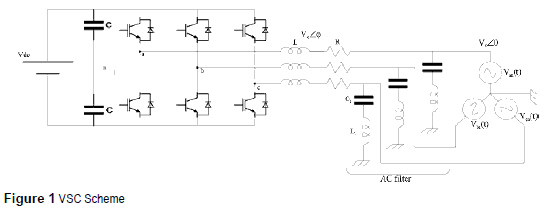
<body><![CDATA[<p>&nbsp;</p>     <p><font size="3"><b>Introduction</b></font></p>      <p>Within the last few years,  the increasing rate of renewable energy resources and new requirements of  energy, have aimed to more efficient and reliable way of convert and share  energy. In this sense, micro-grids appear as a possibility in order to generate  and manage energy flow adequately &#91;1&#93;. Indeed, energy resources are not usually  close to the consumption center then, it has to be delivered long distances and  it has to be integrated to conventional energy distribution systems. Even if  the energy generator is close to the load it is necessary a conversion in order  to match the requirements of the load.</p>       <p>Therefore, it is necessary  to use adequate interfaces that allow interconnecting sources of different  characteristics to the power grid &#91;2&#93;, For instance, if the energy source is  DC, it is necessary to turn the DC voltage into AC voltage with frequency,  amplitude and phase required for grid interconnection. On the other hand, if  the source of energy is AC, it is also necessary a synchronization &#91;2&#93;.</p>       <p>A voltage source converter  (VSC) is a power electronics based converter, capable of operating either like  an inverter as well as rectifier. The main function of a VSC is converting a DC  voltage into an AC current or an AC voltage into a DC current &#91;3&#93;, Forthat  reason, it can be used to couple a DC power source such as a photovoltaic  generator, to an AC grid. Additionally, a VSC can be used to couple an AC power  source, such as a wind generator, to a DC link, and the DC link can be coupled  to an AC power grid by means another VSC such as in HVDC systems &#91;3, 4&#93;,</p>       <p>When a VSC is connected to  an active load, the power flow between the active load and the VSC can be  controlled by adjusting the amplitude and phase of the generated voltage &#91;5,  6&#93;. As a matter of fact, the behavior of a grid connected VSC is similar to a  synchronous generator &#91;3&#93;, However, in a VSC, the active and reactive power  flow, are basically non-linear coupled control objects &#91;5, 7&#93;, In that case,  control methodologies based on mathematic an analytical models might result  complex &#91;8&#93;, In addition, analytical models may not accurately represent the  dynamic behavior of the VSC under different conditions of operation. In this  sense, intelligent nonlinear controllers could overcome the disadvantages of  linear controllers. In particular, the use of fuzzy logic has become more  important due to its adaptability with high nonlinearities, and applicability  in systems where model is unknown or even mathematically complex &#91;9, 10&#93;.</p>       <p>In this paper are proposed  knowledge based fuzzy controllers applied to a VSC in order to regulate the  power flow. In the first place, is analyzed the behavior of a grid connected  VSC and its power flow. Next, the qualitative knowledge about the behavior of  the system is synthetized by means of linguistic fuzzy rules of the type  (if-then) in order to obtain the power flow controllers. After that, simulation  result for two different VSCs are shown, it will be demonstrated that the same  qualitative knowledge can be applied to any VSC with any power ratio. Finally,  physical implementation of knowledge base fuzzy controllers to control  independently the active and reactive power flow is tested.</p>     <p>&nbsp;</p>     <p><font size="3"><b>VSC basic operation</b></font></p>      <p>A two level inverter  bridge is the most common topology used for VSC. The bridge is composed by 3  arms in which each one, is equipped by two self-commutating switches (IGBTs  commonly) as shown in <a href="#Figura1">figure 1</a> &#91;5&#93;, The diodes allow an inverse flow of the  current, and finally a converter- reactor per phase, which becomes the linkage  between the VSC and the AC load, complements a grid-connected system. Additionally,  there are capacitors at the DC side which have two basic functions; energy  storage, and filtering high frequency components &#91;5&#93;. The basic scheme of a VSC  is shown in <a href="#Figura1">figure 1</a>, where the DC sources represent the voltage of a bus DC or  even a DC generator.</p>        ]]></body>
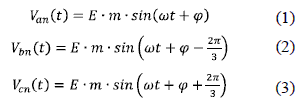
<body><![CDATA[<p align="center"><a name="Figura1"></a><img src="/img/revistas/rfiua/n66/n66a10i01.gif"></p>        <p>The main advantage of a  VSC is that its switches can be commuted at any time by appropriate gate  voltage. Therefore, the generated voltage wave can be easily adjusted and  modified. Nevertheless, when the transistors in each arm are switched  alternatively, it is important to regard dead times in order to prevent short  circuit during commutation of the switches in the branch &#91;3&#93;,</p>      <p>By Sinusoidal Pulse Wide Modulation (SPWM) control signals and  subsequent filtering of high frequency components, a sinusoidal AC voltage can  virtually be generated at any angle and any amplitude &#91;8, 10&#93;, Therefore, it is  possible to generate the three-phase waves with the correspondent phase shift  in each arm &#91;11 - 13&#93;, The fundamental components of the outputs voltages in  each phase are:</p>        <p align="center"><img src="/img/revistas/rfiua/n66/n66a10e01.gif"></p>        <p>Where (<i>E=V<sub>dc</sub> /2</i>) is the voltage in  the DC side of the converter in each pole, <em>V<i><sub>an</sub></i> </em>is the output voltage in the phase a, m is the modulation ratio that is the  relationship between the peak output voltage and the DC voltage m = E<sub>max</sub>/E,  &omega; is the angular frequency and &phi; is the phase shift  between the generated three-phase voltage and the utility grid.</p>        <p>Because of the feasibility  and simplicity to control the generated AC voltage waves at any phase,  amplitude and frequency, VSCs are highly used in distributed generation  systems, HVDC's and motor drivers.</p>          <p>&nbsp;</p>      <p><font size="3"><b>Grid-Connected VSC analysis</b></font></p>      <p>When the VSC is connected  to a power grid (active load), the active and reactive power flow can  independently be controlled manipulating the phase and amplitude of the AC  voltage generated by the VSC with respect to the AC grid voltage &#91;12 - 14&#93;. The  VSC connected to a power grid behaves like the stator of a synchronous machine  as shown in <a href="#Figura2">figure 2</a>. This assumption can be made regarding fundamental  frequency component only. For that reason, the VSC can almost instantaneously  control the active power and reactive power flow between generator and active  load.</p>        <p align="center"><a name="Figura2"></a><img src="/img/revistas/rfiua/n66/n66a10i02.gif"></p>        ]]></body>
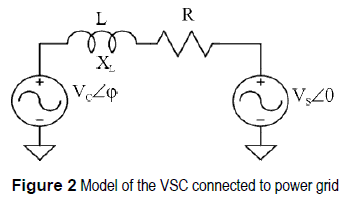
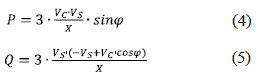
<body><![CDATA[<p>Then, the active power P  and reactive power Q flow between the converter and the power grid, are  expressed as in (4) and (5). These expressions can be obtained by means of a  phasorial analysis.</p>        <p align="center"><img src="/img/revistas/rfiua/n66/n66a10e04.gif"></p>        <p>Where Vc is the RMS value  of the fundamental component of the converter voltage, Vs is the RMS value of  the fundamental component of the AC grid voltage, X is the reactance of the  reactor that connects the two voltage sources, &phi; is the phase shift between Vc and Vs. In addition, at (4)  and (5) <em>R</em>, which is the resistance of  the line, is neglected in order to simplify the analysis &#91;11&#93;; this assumption  can be done taking into account that in a good design, the power losses of the  VSC are usually less than 5% of the rated capacity &#91;7&#93;. Moreover, analysis done  in a precedent work shows that in this range the expressions (4) and (5) are a  good approximation &#91;8&#93;.</p>          <p>Equations (4) and (5) show  that P depends on the phase shift (&phi;) mainly and Q depends on  the Vc amplitude mainly -Vc is controlled by the modulation ratio m-. In light  of the above, it is possible to control independently the active and reactive  power by adjusting the values of &phi; and m respectively &#91;15&#93;.</p>            <p>Using SPWM signals to  control the VSC and generated an AC wave voltage with any phase and amplitude,  permits a flexible control of power flow. In fact, some authors have proposed  that active and reactive power flow between a VSC and power grid can be  controlled independently by &phi; and m respectively &#91;16&#93;.  However, the relationships between &phi; and P and between m and Q are basically nonlinear &#91;8&#93;.  Consequently, a nonlinear control strategy may be more desirable rather than  conventional linear controllers in order to obtain good response in a wide  range of operation of VSC.</p>        <p>&nbsp;</p>      <p><font size="3"><b>Power flow fuzzy controllers</b></font></p>        <p>Lineal control theory uses  mathematical models of a process and some specifications of the expected  behavior in close loop, to design a controller &#91;9&#93;. These control strategies  are highly used in systems that can be assumed as linear in certain range of their  operation. Besides, it is absolutely necessary to obtain a linear model that  represents the relationship between input and output in order to design the  controller &#91;17&#93;.</p>        <p>However, for some systems  it is difficult to find out that linear model. Sometimes, it is necessary to  use sophisticated tools of identification in order to find out a linear  input-output transfer function &#91;8&#93;. Despite this, the found out model only  describes the system in a narrow range accurately. In addition, when the system  does not have constant parameters or has interdependence with others parameters  the found out model is less accurate.</p>        <p>Given the above points,  linear control strategies could be limited in design and performance. On the  other hand, non-linear strategies such as knowledge Based Fuzzy Control (KBFC)  &#91;10&#93;, outperform linear controllers in many of the cases exposed above. KBFC is  based on human knowledge which adds several types of information and can mix  different control strategies that can not easily be added through an analytical  control law. On top of that, like human knowledge, KBFC does not need an  accurate mathematical model in order to work out a control action &#91;9&#93;. What is  more, KBFC uses the experience and the knowledge of an expert about the  behavior of the system in order to work out the control action.</p>        ]]></body>
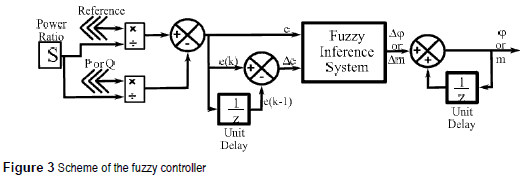
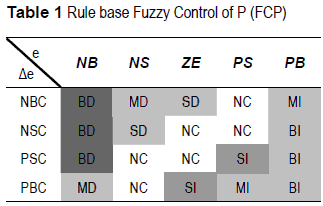
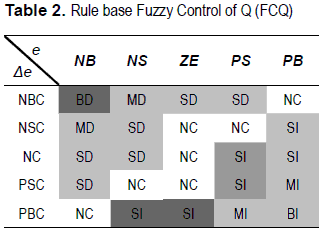
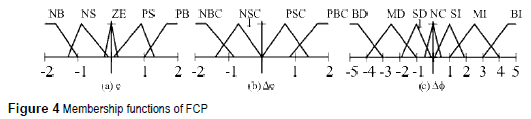
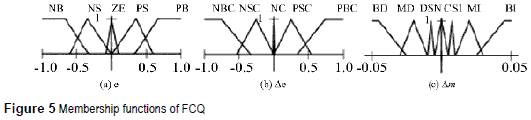
<body><![CDATA[<p>A kind of KBFC is the  rule-based fuzzy control, where the human knowledge is approximated by means of  linguistic fuzzy rules in the form if- then. Each rule describes the control  action in a particular condition of the system &#91;9&#93;. -Control action that would  be done by a human operator &#91;9&#93;-.Therefore, under a specific condition of the  system (<i>if</i> condition1) can  be specified an action (<i>then</i>  action1).</p>        <p>A rule base can be defined  throughout different conditions of a system in which each rule defines an  action for a specific condition. In the same way, both condition and action are  represented by linguistic terms such as (large, medium, small) for condition  and (increase a few, increase a lot) for actions, those linguistic terms belong  to fuzzy sets with overlapped boundaries. Therefore, by means of fuzzy sets it  is possible to get smooth interpolation between different rules, in order to  describe completely the behavior of the system with few rules &#91;9&#93;. That characteristic  allows the fuzzy control to represent the qualitative knowledge of a human  expert &#91;9&#93;.</p>        <p>Due to the nonlinear  behavior showed by the converter and supported in the advantages of fuzzy  control exposed before, nonlinear fuzzy controllers might be desirable to  control the active and reactive power independently by manipulating &phi; and m  respectively. Then, two PD fuzzy controllers (emulating PD linear controllers)  &#91;9&#93; in feedback mode were proposed, one for P under variations of &phi; (&Delta;&phi;), and  the second one for Q under variations of m (&Delta;m).</p>        <p>The controllers are based  on a Mamdani fuzzy inference system, that kind of controllers are usually used  into feedback systems because the rule base represents a static mapping between  antecedents and consequents &#91;10&#93;. The antecedents of the inference system are  the error (e) and the change at the error (&Delta;e = e(k)-e(K-1)) and the  consequents are the change at &phi; (&Delta;&phi;), and the change at (&Delta;m); for P and Q  respectively. Therefore, the linguistic rules can be described as follows:</p>        <p><b><i>If</i></b> e is (big, small, etc.), and &Delta;e is (big, small, etc.) <i><b>then</b></i> &phi; or m  (increases, decreases, etc).</p>      <p>  Consequently, it is  necessary to introduce pre and post-filters at each controller in order to  achieve the derivative input &Delta;e, and the accumulative effect at the output. In  addition, it is absolutely convenient to work with normalized inputs at the  fuzzy inference system in order to apply the controller to different power  ratios &#91;9&#93;. Then, the inputs of the controllers should be scaled by the power  ratio of the converter (S). To be more precise, the normalized domain for the  error at the controller of active power is (-2, 2), since the converter should  be able to change from rectifier to inverter or vice versa. Whereas, the normalized  domain for the error at the controller of reactive power is (-1, 1), since Q  should be remained near to zero. Finally, the scheme of the controller is shown  at <a href="#Figura3">figure 3</a>.</p>            <p align="center"><a name="Figura3"></a><img src="/img/revistas/rfiua/n66/n66a10i03.gif"></p>            <p>Into the fuzzy inference  system, there are defined the rule base and the membership functions that  provide a smooth interface between linguistic terms and numerical variables.  Five linguistic terms are defined for the error input (e) in both controllers  (negative big (NB), negative small (NS), zero error (ZE), positive small (PS),  and positive big (PB)), four for the change at the error input (&Delta;e) in the  controller for P (negative big change (NBC), negative small change (NSC),  positive small change (PSC), and positive big change (PBC)), and an additional  membership function is required for the change at the error input (&Delta;e) in the  controller for Q (No Change (NC)). This membership function avoids instability  when the power flow changes suddenly - take into account that the system is  coupled, so, a change in P affects Q-. Besides, seven linguistic terms were  defined for the output (big decrement (BD), medium decrement (MD), small  decrement (SD), no change (NC), small increment (SI), medium increment (MI),  and big increment (BI)). In particular, the amount of linguistic terms for each  process variable, were selected based on the qualitative knowledge of the  system. In <a href="#Tabla1">table 1</a> and <a href="#Tabla2">table 2</a> are summarized the rule base for the fuzzy  control of P (FCP) and the fuzzy control of Q (FCQ) respectively.</p>            <p align="center"><a name="Tabla1"></a><img src="/img/revistas/rfiua/n66/n66a10t01.gif" ></p>        <p align="center"><a name="Tabla2"></a><img src="/img/revistas/rfiua/n66/n66a10t02.gif" ></p>            ]]></body>
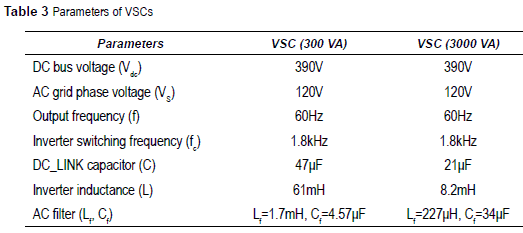
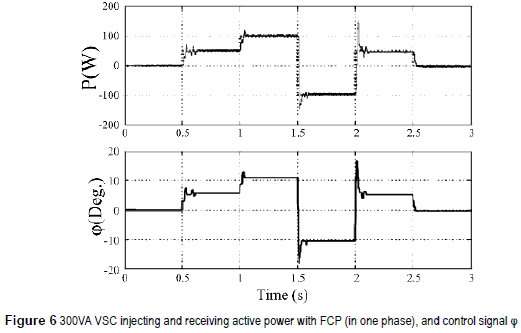
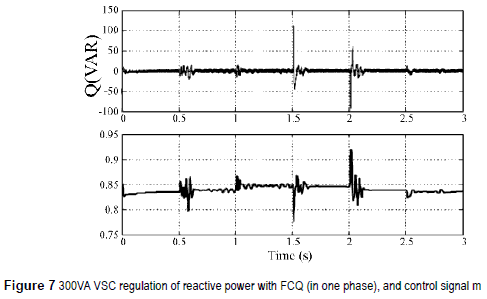
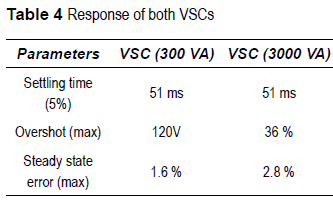
<body><![CDATA[<p>In the same way, the  membership functions were tuned based on the desired behavior - minimum error  in steady state and minimum oscillation in transitory state-. There were used  triangular and trapezoidal membership functions because of, they are simpler  computationally &#91;10&#93;. Accordingly, <a href="#Figura4">figure 4</a> shows the membership function for  FCP and <a href="#Figura5">figure 5</a> shows the membership function of FCQ.</p>            <p align="center"><a name="Figura4"></a><img src="/img/revistas/rfiua/n66/n66a10i04.gif"></p>        <p align="center"><a name="Figura5"></a><img src="/img/revistas/rfiua/n66/n66a10i05.gif"></p>            <p>&nbsp;</p>        <p><font size="3"><b>Simulation results</b></font></p>        <p>To verify the performance  of the controllers, a simulation bench was built in SimPowerSystem toolbox  ofMatlab. In addition, two different VSC 's with different power ratio were  dimensioned in order to verify the behavior of the controllers under systems  with different power ratio. The first VSC is a 3 00VA system and the second one  is a 3kVA system. It is supposed a balanced behavior at the 3 phasic systems;  therefore, simulation results just show the behavior of the system in one  phase. In <a href="#Tabla3">table 3</a> are summarized the main parameter of both tested systems.</p>        <p align="center"><a name="Tabla3"></a><img src="/img/revistas/rfiua/n66/n66a10t03.gif" ></p>          <p>The <a href="#Figura6">figure 6</a> shows the response of the 3 00VA VSC under changes at the power flow. It is  possible to see that the VSC is able to follow the reference (0, 50, 100, -100,  50 and 0 W) in either mode, like inverter or rectifier. In <a href="#Figura6">figure 6</a> are also  shown the response of the controller, and how the phase shift (&phi;) changes in order to  reach the reference. Likewise, <a href="#Figura7">figure 7</a> shows the reactive power flow control,  and how the modulation index is adjusted by the controller seeking to maintain  the reactive power flow close to zero.</p>        <p align="center"><a name="Figura6"></a><img src="/img/revistas/rfiua/n66/n66a10i06.gif"></p>      <p align="center"><a name="Figura7"></a><img src="/img/revistas/rfiua/n66/n66a10i07.gif"></p>          ]]></body>
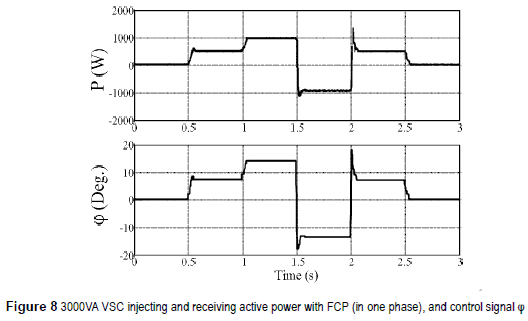
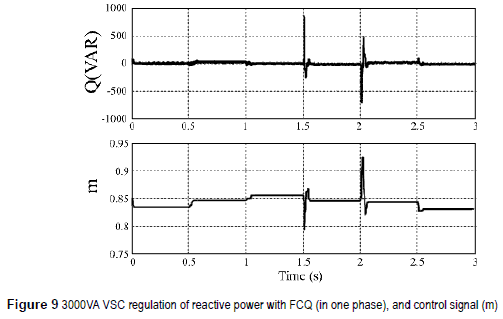
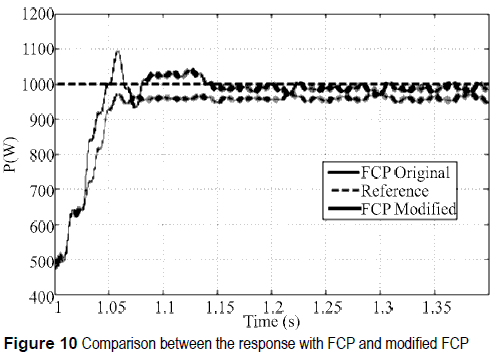
<body><![CDATA[<p>Besides,  <a href="#Figura8">figure 8</a> shows the response of the 3,000VA VSC under changes at the power flow  (0, 500, 1,000, -1,000, 500 and 0 W). <a href="#Figura8">Figure 8</a> also shows the way in which the  phase shift (&phi;) is adjusted by the controller. Similarly, <a href="#Figura9">figure 9</a> presents the  reactive power flow regulation and how the modulation index (m) is adjusted by  the controller.</p>        <p align="center"><a name="Figura8"></a><img src="/img/revistas/rfiua/n66/n66a10i08.gif"></p>      <p align="center"><a name="Figura9"></a><img src="/img/revistas/rfiua/n66/n66a10i09.gif"></p>        <p>The <a href="#Tabla4">table 4</a> summarizes the  main characteristics of systems is pretty similar, there are necessary near the  response of the systems with fuzzy controllers. 3 cycles to obtain the steady state.  However, the At <a href="#Tabla4">table 4</a> we can see that the settling time at both dynamic  responses and steady state error vary.</p>        <p align="center"><a name="Tabla4"></a><img src="/img/revistas/rfiua/n66/n66a10t04.gif" ></p>        <p>On top of that, <a href="#Figura6">figures 6</a>  and <a href="#Figura8">8</a> show that the control objective is reached accurately, in spite of  differences at the dynamic of both systems. Additionally, from figures <a href="#Figura7">figures 7</a> and <a href="#Figura9">9</a>,  it is possible to realize, that the system is not decoupled, and that hard  changes at the active power flow affects the reactive power flow control  deeply.</p>        <p>In particular, this  behavior was regarded at the moment of dimensioning the domain of the fuzzy  variables. First of all, the maximum value of &plusmn;5 for (&Delta;&phi;) was selected in order  to avoid hard changes at the active power flow that could perturb the reactive  power flow control. Second, despite the control of Q should always keeping this  value in zero, peaks at the response can reach the rate power values, for that  reason the domain of the control of Q should regard the entire power ratio  (-1,1). Finally, variations at the modulation index are not greater than 0.1,  so changes at (m) are restricted between &plusmn;0.05. In short, it was absolutely  necessary to know the behavior of the system in order to synthesize the  controllers.</p>        <p>Apart from that, the  stationary error increases when the power ratio increases. This fact can be  solved by adjusting the membership function NS, ZE and PS. However, a change on  the membership function will affect the dynamic response of the system. The  <a href="#Figura10">figure 10</a> shows a comparison between the original FCP and a modified FCP in  which the membership function NS, ZE and PS have been modified.</p>          <p align="center"><a name="Figura10"></a><img src="/img/revistas/rfiua/n66/n66a10i10.gif"></p>        <p><a href="#Figura10">Figure 10</a> shows a  reduction in the steady state error and changes at the dynamic response by  using the modified FCP. In light of the above, the performance of the system  would be improved if additional uncertainty is added to the shape of membership  functions, when the power ratio varies. In this sense, type-2 fuzzy sets allow  us to incorporate additional uncertainty to membership functions by defining  them as fuzzy membership functions &#91;18, 19&#93;. To conclude, that approach should  be addressed and evaluated at future works.</p>        ]]></body>
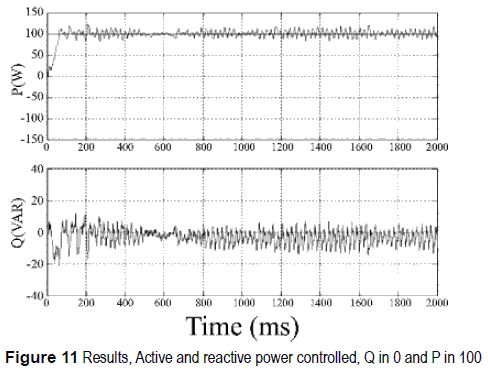
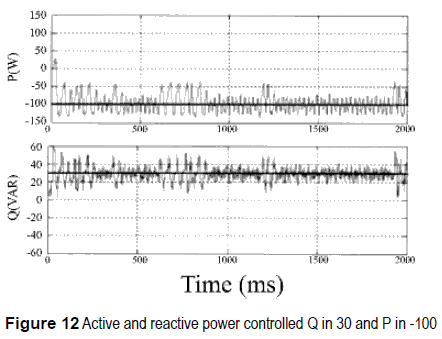
<body><![CDATA[<p>&nbsp;</p>      <p><font size="3"><b>Experimental results </b></font></p>        <p>Toverify the  developedcontrollers experimentally, a 300VA VSC prototype was implemented. The  data acquisition board PCI 6024E of N.I. and the software Real Time Windows  Target of MATLAB has been used for the implementation of the fuzzy controllers.</p>       <p> In short, <a href="#Figura11">figure 11</a> shows  the response of one phase of the VSC in real implementation. First, <a href="#Figura11">figure 11(a)</a>, shows the VSC transferring 100W to the AC network, at the same time, the  reactive power flow is regulated close to zero (<a href="#Figura11">figure 11(b)</a>). Likewise,  <a href="#Figura12">figure 12</a> shows the case when the AC network transfers power to the DC side of  the VSC (<a href="#Figura12">figure 12(a)</a>). Additionally, <a href="#Figura12">figure 12(b)</a> shows an inductive  behavior at the VSC, where the reactive power flow is regulated around 30VAR  (the reference of FCQ was changed intentionally in order to verify the behavior  of the controller).</p>            <p align="center"><a name="Figura11"></a><img src="/img/revistas/rfiua/n66/n66a10i11.gif"></p>        <p align="center"><a name="Figura12"></a><img src="/img/revistas/rfiua/n66/n66a10i12.gif"></p>            <p>From <a href="#Figura11">figures 11</a> and <a href="#Figura12">12</a> it  is possible to see that the response of the system follows the reference at  both controller (FCP and FCQ). However, it is also evident that signals have  high degree of oscillation. That sort of behavior is very common in power  systems due to a variety of interactions among components and the heavy power  transfer across interconnections that often create damping problems &#91;20&#93;.</p>            <p>&nbsp;</p>        <p><font size="3"><b>Conclusion</b> </font></p>         <p>In this paper non-linear  fuzzy controller were designed in order to control the active and reactive  power flow in a VSC connected to the grid. The knowledge base fuzzy controller  does not require and elaborated mathematic model of the converter, it just  requires a detailed knowledge about the behavior of the system. Therefore, the  same controllers can be applied to any VSC at any power ratio just by  normalizing the inputs of the controller with respect to the power ratio.</p>       ]]></body>
<body><![CDATA[<p> When power ratio  increases, the steady state error also increases. However, the steady state  error can be reduced by adjusting the shape of membership functions.  Additionally, changes at membership functions modify the dynamic response of  the system. Consequently, if the shape of the membership functions is adjusted  it would be possible to modify the steady state error and dynamic responses  such as overshot and damping. Fort that reason, type 2 fuzzy controller should  be addressed in future works.</p>        <p>Finally, it was  demonstrated that despite the VSC is a nonlinear coupled double-input double&shy;output  control object, P and Q can be controlled independently. Nevertheless, the  coupling between P and Q should be regarded at the control of Q.</p>          <p>&nbsp;</p>      <p><font size="3"><b>References</b> </font></p>      <!-- ref --><p>1. Y. Ruan, Q. Liu, W. Zhoun R.  Firestone, W. Gao, T. Watanabe. "Optimal option of distributed generation technologies  for various commercial buildings". <i>Applied  Energy</i>. Vol. 86. 2009. pp.1641-53.    &nbsp;&nbsp;&nbsp;&nbsp;&nbsp;&nbsp;&nbsp;&nbsp;[&#160;<a href="javascript:void(0);" onclick="javascript: window.open('/scielo.php?script=sci_nlinks&ref=000097&pid=S0120-6230201300010001000001&lng=','','width=640,height=500,resizable=yes,scrollbars=1,menubar=yes,');">Links</a>&#160;]<!-- end-ref --></p>       <!-- ref --><p>2. F. Blaabjerg,  R. Teodorescu, M. Liserre, A. Tirnbus. "Overview of control and grid  synchronization for distributed power generation systems". <i>IEEE Transactions on Industrial  Electronics</i>. Vol. 53. 2006. pp. 1398-1409.    &nbsp;&nbsp;&nbsp;&nbsp;&nbsp;&nbsp;&nbsp;&nbsp;[&#160;<a href="javascript:void(0);" onclick="javascript: window.open('/scielo.php?script=sci_nlinks&ref=000099&pid=S0120-6230201300010001000002&lng=','','width=640,height=500,resizable=yes,scrollbars=1,menubar=yes,');">Links</a>&#160;]<!-- end-ref --></p>       <!-- ref --><p>3. V. Sood. "HVDC and  FACTS controllers". Kluwer power electronics and power editions series.  Boston, Unite State of America. 2004. pp. 26-38.    &nbsp;&nbsp;&nbsp;&nbsp;&nbsp;&nbsp;&nbsp;&nbsp;[&#160;<a href="javascript:void(0);" onclick="javascript: window.open('/scielo.php?script=sci_nlinks&ref=000101&pid=S0120-6230201300010001000003&lng=','','width=640,height=500,resizable=yes,scrollbars=1,menubar=yes,');">Links</a>&#160;]<!-- end-ref --></p>       ]]></body>
<body><![CDATA[<!-- ref --><p>4. O. Gomis, A. Junyent,  A. Sumper, S. Galceran. "Maximum generation power evaluation of variable  frequency offshore wind farms when connected to a single power converter". <i>Applied Energy</i>.  Vol. 87. 2010. pp. 3103-09.    &nbsp;&nbsp;&nbsp;&nbsp;&nbsp;&nbsp;&nbsp;&nbsp;[&#160;<a href="javascript:void(0);" onclick="javascript: window.open('/scielo.php?script=sci_nlinks&ref=000103&pid=S0120-6230201300010001000004&lng=','','width=640,height=500,resizable=yes,scrollbars=1,menubar=yes,');">Links</a>&#160;]<!-- end-ref --></p>       <!-- ref --><p>5. S. Ruihua, Z. Chao, L.  Ruomei, Z. Xiaoxin. "VSCs based HVDC and its control strategy". IEEE/PES  Transmission and Distribution Conference and Exhibition: Asia and Pacific.  Dalian, China. 2005. pp. 1-6.    &nbsp;&nbsp;&nbsp;&nbsp;&nbsp;&nbsp;&nbsp;&nbsp;[&#160;<a href="javascript:void(0);" onclick="javascript: window.open('/scielo.php?script=sci_nlinks&ref=000105&pid=S0120-6230201300010001000005&lng=','','width=640,height=500,resizable=yes,scrollbars=1,menubar=yes,');">Links</a>&#160;]<!-- end-ref --></p>       <!-- ref --><p>6. L. Guangkai, L.  Gengyin, L. Haifeng, Z. Chengyong, Y. Ming. "Research on Dynamic  Characteristics of VSC-HVDC System". IEEE Power Engineering Society  General Meeting. Montreal, Quebec, Canada. 2006. pp. 1-5.    &nbsp;&nbsp;&nbsp;&nbsp;&nbsp;&nbsp;&nbsp;&nbsp;[&#160;<a href="javascript:void(0);" onclick="javascript: window.open('/scielo.php?script=sci_nlinks&ref=000107&pid=S0120-6230201300010001000006&lng=','','width=640,height=500,resizable=yes,scrollbars=1,menubar=yes,');">Links</a>&#160;]<!-- end-ref --></p>       <!-- ref --><p>7. G.  Zhang, Z. Xu, G. Wang. "A linear and decoupled control strategy for VSC based  HVDC system". IEEE/ PES Transmission and Distribution Conference and  Exposition Atlanta, Georgia, Unite State of America. Vol. 1.2001. pp.  14-19.    &nbsp;&nbsp;&nbsp;&nbsp;&nbsp;&nbsp;&nbsp;&nbsp;[&#160;<a href="javascript:void(0);" onclick="javascript: window.open('/scielo.php?script=sci_nlinks&ref=000109&pid=S0120-6230201300010001000007&lng=','','width=640,height=500,resizable=yes,scrollbars=1,menubar=yes,');">Links</a>&#160;]<!-- end-ref --></p>       <!-- ref --><p>8. C. Trujillo,  D. Velasco, J. Guarnizo, N. Diaz. "Design and implementation of a VSC for  interconnection with power grids, using the method of identification the system  through state space for the calculation of controllers". <i>Applied Energy</i>. Vol.  88. 2011. pp. 3169-&shy;75.    &nbsp;&nbsp;&nbsp;&nbsp;&nbsp;&nbsp;&nbsp;&nbsp;[&#160;<a href="javascript:void(0);" onclick="javascript: window.open('/scielo.php?script=sci_nlinks&ref=000111&pid=S0120-6230201300010001000008&lng=','','width=640,height=500,resizable=yes,scrollbars=1,menubar=yes,');">Links</a>&#160;]<!-- end-ref --></p>       ]]></body>
<body><![CDATA[<!-- ref --><p>9. R. Babuscka.  "Fuzzy and neural control disc course lecture notes". Delft  University of Technology. Delft, the Netherlands. 2009. pp. 1-56.    &nbsp;&nbsp;&nbsp;&nbsp;&nbsp;&nbsp;&nbsp;&nbsp;[&#160;<a href="javascript:void(0);" onclick="javascript: window.open('/scielo.php?script=sci_nlinks&ref=000113&pid=S0120-6230201300010001000009&lng=','','width=640,height=500,resizable=yes,scrollbars=1,menubar=yes,');">Links</a>&#160;]<!-- end-ref --></p>       <!-- ref --><p>10. N. Diaz, F.  Barbosa, C. Trujillo. "Analysis and design of a nonlinear fuzzy controller  applied to a VSC to control the active and reactive power flow". In:  Electronics, robotics and automotive mechanics conference. CERMA. Cuemavaca,  Morelos Mexico. 2007. pp. 417-22.    &nbsp;&nbsp;&nbsp;&nbsp;&nbsp;&nbsp;&nbsp;&nbsp;[&#160;<a href="javascript:void(0);" onclick="javascript: window.open('/scielo.php?script=sci_nlinks&ref=000115&pid=S0120-6230201300010001000010&lng=','','width=640,height=500,resizable=yes,scrollbars=1,menubar=yes,');">Links</a>&#160;]<!-- end-ref --></p>       <!-- ref --><p>11. G. Zhang, Z. Xu. "Steady-state  model for VSC based HVDC and its controller design". <i>IEEE Power Engineering Society  Winter Meeting</i>. Vol. 3. Columbus, Ohio, Unite Estate of America.  2001. pp. 1085-90.    &nbsp;&nbsp;&nbsp;&nbsp;&nbsp;&nbsp;&nbsp;&nbsp;[&#160;<a href="javascript:void(0);" onclick="javascript: window.open('/scielo.php?script=sci_nlinks&ref=000117&pid=S0120-6230201300010001000011&lng=','','width=640,height=500,resizable=yes,scrollbars=1,menubar=yes,');">Links</a>&#160;]<!-- end-ref --></p>       <!-- ref --><p>12. K. Padiyar, N. Prabhu.  "Modeling, control design and analysis of VSC based HVDC transmission systems".  International Conference on Power System Technology. PowerCon. Singapore. 2004.  pp. 774-79.    &nbsp;&nbsp;&nbsp;&nbsp;&nbsp;&nbsp;&nbsp;&nbsp;[&#160;<a href="javascript:void(0);" onclick="javascript: window.open('/scielo.php?script=sci_nlinks&ref=000119&pid=S0120-6230201300010001000012&lng=','','width=640,height=500,resizable=yes,scrollbars=1,menubar=yes,');">Links</a>&#160;]<!-- end-ref --></p>       <!-- ref --><p>13. L. Gonz&aacute;lez,  G. Garcer&aacute;, E. Figueres, R. Gonz&aacute;lez. "Effects of the PWM carrier signals  synchronization on the DC-link current in back-to-back converters". <i>Applied Energy</i>. Vol.  87. 2010. pp. 2491-2499.    &nbsp;&nbsp;&nbsp;&nbsp;&nbsp;&nbsp;&nbsp;&nbsp;[&#160;<a href="javascript:void(0);" onclick="javascript: window.open('/scielo.php?script=sci_nlinks&ref=000121&pid=S0120-6230201300010001000013&lng=','','width=640,height=500,resizable=yes,scrollbars=1,menubar=yes,');">Links</a>&#160;]<!-- end-ref --></p>       ]]></body>
<body><![CDATA[<!-- ref --><p>14. Gengyin, Z. Ming, H.  Jie, L. Guangkai, L. Haifeng. "Power Flow Calculation of Power System  Incorporating VSC-HVDC". International Conference on Power System  Technology. Singapore. PowerCon 2004. pp. 1562-1566.    &nbsp;&nbsp;&nbsp;&nbsp;&nbsp;&nbsp;&nbsp;&nbsp;[&#160;<a href="javascript:void(0);" onclick="javascript: window.open('/scielo.php?script=sci_nlinks&ref=000123&pid=S0120-6230201300010001000014&lng=','','width=640,height=500,resizable=yes,scrollbars=1,menubar=yes,');">Links</a>&#160;]<!-- end-ref --></p>       <!-- ref --><p>15. G. Li, G. Li, H.  Liang, C. Zhao, M. Yin. "Research on dynamic characteristics of VSC-HVDC  system". IEEE Power Engineering Society General Meeting. Montreal, Quebec,  Canada. 2006. pp. 1-6.    &nbsp;&nbsp;&nbsp;&nbsp;&nbsp;&nbsp;&nbsp;&nbsp;[&#160;<a href="javascript:void(0);" onclick="javascript: window.open('/scielo.php?script=sci_nlinks&ref=000125&pid=S0120-6230201300010001000015&lng=','','width=640,height=500,resizable=yes,scrollbars=1,menubar=yes,');">Links</a>&#160;]<!-- end-ref --></p>       <!-- ref --><p>16. J. Liu, M.  Han, X. Chen. "Development  of VSC HVDC quasi-steady-state model and its application". International  Conference on Sustainable Power Generation and Supply, 2009. SUPERGEN '09.  Nanjing, China. 2009. pp. 1-4.    &nbsp;&nbsp;&nbsp;&nbsp;&nbsp;&nbsp;&nbsp;&nbsp;[&#160;<a href="javascript:void(0);" onclick="javascript: window.open('/scielo.php?script=sci_nlinks&ref=000127&pid=S0120-6230201300010001000016&lng=','','width=640,height=500,resizable=yes,scrollbars=1,menubar=yes,');">Links</a>&#160;]<!-- end-ref --></p>       <!-- ref --><p>17. K. Astrom, R. Murray. <i>Feedback Systems: An Introduction  for Scientists and Engineers. Princeton University Press</i>.  Princeton, New Jersey, Unite Estate of America. 2010. pp. 131-164.    &nbsp;&nbsp;&nbsp;&nbsp;&nbsp;&nbsp;&nbsp;&nbsp;[&#160;<a href="javascript:void(0);" onclick="javascript: window.open('/scielo.php?script=sci_nlinks&ref=000129&pid=S0120-6230201300010001000017&lng=','','width=640,height=500,resizable=yes,scrollbars=1,menubar=yes,');">Links</a>&#160;]<!-- end-ref --></p>       <!-- ref --><p>18. L. Zadeh. "The  Concept of a Linguistic Variable and Its Application to Approximate  Reasoning-1". <i>Information Sciences</i>.  Vol. 8. 1975. pp. 199-249.    &nbsp;&nbsp;&nbsp;&nbsp;&nbsp;&nbsp;&nbsp;&nbsp;[&#160;<a href="javascript:void(0);" onclick="javascript: window.open('/scielo.php?script=sci_nlinks&ref=000131&pid=S0120-6230201300010001000018&lng=','','width=640,height=500,resizable=yes,scrollbars=1,menubar=yes,');">Links</a>&#160;]<!-- end-ref --></p>       ]]></body>
<body><![CDATA[<!-- ref --><p>19. H. Chamorro,  N. Diaz, J. Soriano, H. Espitia. "Active and reactive power flow fuzzy controller for VSC  HVDC using DBR and DBR type 2". Annual Meeting of the North American Fuzzy  Information Processing Society (NAFIPS). El Paso, Texas, Unite Estate of  America. 2011. pp.1-6.    &nbsp;&nbsp;&nbsp;&nbsp;&nbsp;&nbsp;&nbsp;&nbsp;[&#160;<a href="javascript:void(0);" onclick="javascript: window.open('/scielo.php?script=sci_nlinks&ref=000133&pid=S0120-6230201300010001000019&lng=','','width=640,height=500,resizable=yes,scrollbars=1,menubar=yes,');">Links</a>&#160;]<!-- end-ref --></p>       <!-- ref --><p>20. J. Paserba.  "Robust control in power systems &#91;book reviews&#93;". <i>Power and Energy Magazine, IEEE</i>.  Vol. 5. 2007. pp. 79-81.    &nbsp;&nbsp;&nbsp;&nbsp;&nbsp;&nbsp;&nbsp;&nbsp;[&#160;<a href="javascript:void(0);" onclick="javascript: window.open('/scielo.php?script=sci_nlinks&ref=000135&pid=S0120-6230201300010001000020&lng=','','width=640,height=500,resizable=yes,scrollbars=1,menubar=yes,');">Links</a>&#160;]<!-- end-ref --></p>        <p>&nbsp;</p>         ]]></body><back>
<ref-list>
<ref id="B1">
<label>1</label><nlm-citation citation-type="journal">
<person-group person-group-type="author">
<name>
<surname><![CDATA[Ruan]]></surname>
<given-names><![CDATA[Y]]></given-names>
</name>
<name>
<surname><![CDATA[Liu]]></surname>
<given-names><![CDATA[Q]]></given-names>
</name>
<name>
<surname><![CDATA[Zhoun]]></surname>
<given-names><![CDATA[W]]></given-names>
</name>
<name>
<surname><![CDATA[Firestone]]></surname>
<given-names><![CDATA[R.]]></given-names>
</name>
<name>
<surname><![CDATA[Gao]]></surname>
<given-names><![CDATA[W]]></given-names>
</name>
<name>
<surname><![CDATA[Watanabe]]></surname>
<given-names><![CDATA[T]]></given-names>
</name>
</person-group>
<article-title xml:lang="en"><![CDATA[Optimal option of distributed generation technologies for various commercial buildings]]></article-title>
<source><![CDATA[Applied Energy]]></source>
<year>2009</year>
<volume>86</volume>
<page-range>1641-53</page-range></nlm-citation>
</ref>
<ref id="B2">
<label>2</label><nlm-citation citation-type="journal">
<person-group person-group-type="author">
<name>
<surname><![CDATA[Blaabjerg]]></surname>
<given-names><![CDATA[F]]></given-names>
</name>
<name>
<surname><![CDATA[Teodorescu]]></surname>
<given-names><![CDATA[R]]></given-names>
</name>
<name>
<surname><![CDATA[Liserre]]></surname>
<given-names><![CDATA[M]]></given-names>
</name>
<name>
<surname><![CDATA[Tirnbus]]></surname>
<given-names><![CDATA[A]]></given-names>
</name>
</person-group>
<article-title xml:lang="en"><![CDATA[Overview of control and grid synchronization for distributed power generation systems]]></article-title>
<source><![CDATA[IEEE Transactions on Industrial Electronics]]></source>
<year>2006</year>
<volume>53</volume>
<page-range>1398-1409</page-range></nlm-citation>
</ref>
<ref id="B3">
<label>3</label><nlm-citation citation-type="">
<person-group person-group-type="author">
<name>
<surname><![CDATA[Sood]]></surname>
<given-names><![CDATA[V]]></given-names>
</name>
</person-group>
<source><![CDATA["HVDC and FACTS controllers"]]></source>
<year>2004</year>
<page-range>26-38</page-range><publisher-loc><![CDATA[Boston ]]></publisher-loc>
</nlm-citation>
</ref>
<ref id="B4">
<label>4</label><nlm-citation citation-type="journal">
<person-group person-group-type="author">
<name>
<surname><![CDATA[Gomis]]></surname>
<given-names><![CDATA[O]]></given-names>
</name>
<name>
<surname><![CDATA[Junyent]]></surname>
<given-names><![CDATA[A]]></given-names>
</name>
<name>
<surname><![CDATA[Sumper]]></surname>
<given-names><![CDATA[A]]></given-names>
</name>
<name>
<surname><![CDATA[Galceran]]></surname>
<given-names><![CDATA[S]]></given-names>
</name>
</person-group>
<article-title xml:lang="en"><![CDATA[Maximum generation power evaluation of variable frequency offshore wind farms when connected to a single power converter]]></article-title>
<source><![CDATA[Applied Energy]]></source>
<year>2010</year>
<volume>87</volume>
<page-range>3103-09</page-range></nlm-citation>
</ref>
<ref id="B5">
<label>5</label><nlm-citation citation-type="">
<person-group person-group-type="author">
<name>
<surname><![CDATA[Ruihua]]></surname>
<given-names><![CDATA[S.]]></given-names>
</name>
<name>
<surname><![CDATA[Chao]]></surname>
<given-names><![CDATA[Z.]]></given-names>
</name>
<name>
<surname><![CDATA[Ruomei]]></surname>
<given-names><![CDATA[L.]]></given-names>
</name>
<name>
<surname><![CDATA[Xiaoxin]]></surname>
<given-names><![CDATA[Z.]]></given-names>
</name>
</person-group>
<source><![CDATA["VSCs based HVDC and its control strategy"]]></source>
<year>2005</year>
<page-range>1-6</page-range><publisher-loc><![CDATA[Dalian ]]></publisher-loc>
</nlm-citation>
</ref>
<ref id="B6">
<label>6</label><nlm-citation citation-type="">
<person-group person-group-type="author">
<name>
<surname><![CDATA[Guangkai]]></surname>
<given-names><![CDATA[L.]]></given-names>
</name>
<name>
<surname><![CDATA[Gengyin]]></surname>
<given-names><![CDATA[L.]]></given-names>
</name>
<name>
<surname><![CDATA[Haifeng]]></surname>
<given-names><![CDATA[L.]]></given-names>
</name>
<name>
<surname><![CDATA[Chengyong]]></surname>
<given-names><![CDATA[Z.]]></given-names>
</name>
<name>
<surname><![CDATA[Ming]]></surname>
<given-names><![CDATA[Y.]]></given-names>
</name>
</person-group>
<source><![CDATA["Research on Dynamic Characteristics of VSC-HVDC System"]]></source>
<year>2006</year>
<page-range>1-5</page-range><publisher-loc><![CDATA[Montreal^eQuebec Quebec]]></publisher-loc>
</nlm-citation>
</ref>
<ref id="B7">
<label>7</label><nlm-citation citation-type="journal">
<person-group person-group-type="author">
<name>
<surname><![CDATA[Zhang]]></surname>
<given-names><![CDATA[G]]></given-names>
</name>
<name>
<surname><![CDATA[Xu]]></surname>
<given-names><![CDATA[Z]]></given-names>
</name>
<name>
<surname><![CDATA[Wang]]></surname>
<given-names><![CDATA[G]]></given-names>
</name>
</person-group>
<article-title xml:lang="en"><![CDATA[A linear and decoupled control strategy for VSC based HVDC system]]></article-title>
<source><![CDATA[IEEE/ PES Transmission and Distribution Conference and Exposition Atlanta, Georgia, Unite State of America]]></source>
<year>2001</year>
<volume>1</volume>
<page-range>14-19</page-range></nlm-citation>
</ref>
<ref id="B8">
<label>8</label><nlm-citation citation-type="journal">
<person-group person-group-type="author">
<name>
<surname><![CDATA[Trujillo]]></surname>
<given-names><![CDATA[C]]></given-names>
</name>
<name>
<surname><![CDATA[Velasco]]></surname>
<given-names><![CDATA[D]]></given-names>
</name>
<name>
<surname><![CDATA[Guarnizo]]></surname>
<given-names><![CDATA[J]]></given-names>
</name>
<name>
<surname><![CDATA[Diaz]]></surname>
<given-names><![CDATA[N]]></given-names>
</name>
</person-group>
<article-title xml:lang="en"><![CDATA[Design and implementation of a VSC for interconnection with power grids, using the method of identification the system through state space for the calculation of controllers]]></article-title>
<source><![CDATA[Applied Energy]]></source>
<year>2011</year>
<volume>88</volume>
<page-range>3169-&shy;75</page-range></nlm-citation>
</ref>
<ref id="B9">
<label>9</label><nlm-citation citation-type="book">
<person-group person-group-type="author">
<name>
<surname><![CDATA[Babuscka]]></surname>
<given-names><![CDATA[R.]]></given-names>
</name>
</person-group>
<source><![CDATA["Fuzzy and neural control disc course lecture notes"]]></source>
<year>2009</year>
<page-range>1-56</page-range><publisher-loc><![CDATA[Delft^ethe Netherlands the Netherlands]]></publisher-loc>
<publisher-name><![CDATA[Delft University of Technology]]></publisher-name>
</nlm-citation>
</ref>
<ref id="B10">
<label>10</label><nlm-citation citation-type="">
<person-group person-group-type="author">
<name>
<surname><![CDATA[Diaz]]></surname>
<given-names><![CDATA[N]]></given-names>
</name>
<name>
<surname><![CDATA[Barbosa]]></surname>
<given-names><![CDATA[F.]]></given-names>
</name>
<name>
<surname><![CDATA[Trujillo]]></surname>
<given-names><![CDATA[C.]]></given-names>
</name>
</person-group>
<article-title xml:lang="en"><![CDATA["Analysis and design of a nonlinear fuzzy controller applied to a VSC to control the active and reactive power flow"]]></article-title>
<source><![CDATA[Electronics, robotics and automotive mechanics conference]]></source>
<year>2007</year>
<page-range>417-22</page-range><publisher-loc><![CDATA[Cuemavaca^eMorelos Morelos]]></publisher-loc>
</nlm-citation>
</ref>
<ref id="B11">
<label>11</label><nlm-citation citation-type="">
<person-group person-group-type="author">
<name>
<surname><![CDATA[Zhang]]></surname>
<given-names><![CDATA[G.]]></given-names>
</name>
<name>
<surname><![CDATA[Xu]]></surname>
<given-names><![CDATA[Z.]]></given-names>
</name>
</person-group>
<source><![CDATA["Steady-state model for VSC based HVDC and its controller design"]]></source>
<year>2001</year>
<volume>3</volume>
<page-range>1085-90</page-range><publisher-loc><![CDATA[Columbus^eOhio Ohio]]></publisher-loc>
</nlm-citation>
</ref>
<ref id="B12">
<label>12</label><nlm-citation citation-type="">
<person-group person-group-type="author">
<name>
<surname><![CDATA[Padiyar]]></surname>
<given-names><![CDATA[K.]]></given-names>
</name>
<name>
<surname><![CDATA[Prabhu]]></surname>
<given-names><![CDATA[N.]]></given-names>
</name>
</person-group>
<source><![CDATA["Modeling, control design and analysis of VSC based HVDC transmission systems"]]></source>
<year>2004</year>
<page-range>774-79</page-range><publisher-loc><![CDATA[Singapore ]]></publisher-loc>
</nlm-citation>
</ref>
<ref id="B13">
<label>13</label><nlm-citation citation-type="journal">
<person-group person-group-type="author">
<name>
<surname><![CDATA[González]]></surname>
<given-names><![CDATA[L]]></given-names>
</name>
<name>
<surname><![CDATA[Garcerá]]></surname>
<given-names><![CDATA[G]]></given-names>
</name>
<name>
<surname><![CDATA[Figueres]]></surname>
<given-names><![CDATA[E]]></given-names>
</name>
<name>
<surname><![CDATA[González]]></surname>
<given-names><![CDATA[R]]></given-names>
</name>
</person-group>
<article-title xml:lang="en"><![CDATA[Effects of the PWM carrier signals synchronization on the DC-link current in back-to-back converters]]></article-title>
<source><![CDATA[Applied Energy]]></source>
<year>2010</year>
<volume>87</volume>
<page-range>2491-2499</page-range></nlm-citation>
</ref>
<ref id="B14">
<label>14</label><nlm-citation citation-type="confpro">
<person-group person-group-type="author">
<name>
<surname><![CDATA[Gengyin]]></surname>
</name>
<name>
<surname><![CDATA[Ming]]></surname>
<given-names><![CDATA[Z.]]></given-names>
</name>
<name>
<surname><![CDATA[Jie]]></surname>
<given-names><![CDATA[H.]]></given-names>
</name>
<name>
<surname><![CDATA[Guangkai]]></surname>
<given-names><![CDATA[L.]]></given-names>
</name>
<name>
<surname><![CDATA[Haifeng]]></surname>
<given-names><![CDATA[L.]]></given-names>
</name>
</person-group>
<source><![CDATA["Power Flow Calculation of Power System Incorporating VSC-HVDC"]]></source>
<year>2004</year>
<conf-name><![CDATA[ International Conference on Power System Technology]]></conf-name>
<conf-loc> </conf-loc>
<page-range>1562-1566</page-range><publisher-loc><![CDATA[Singapore ]]></publisher-loc>
</nlm-citation>
</ref>
<ref id="B15">
<label>15</label><nlm-citation citation-type="">
<person-group person-group-type="author">
<name>
<surname><![CDATA[Li]]></surname>
<given-names><![CDATA[G.]]></given-names>
</name>
<name>
<surname><![CDATA[Li]]></surname>
<given-names><![CDATA[G]]></given-names>
</name>
<name>
<surname><![CDATA[Liang]]></surname>
<given-names><![CDATA[H.]]></given-names>
</name>
<name>
<surname><![CDATA[Zhao]]></surname>
<given-names><![CDATA[C.]]></given-names>
</name>
<name>
<surname><![CDATA[Yin]]></surname>
<given-names><![CDATA[M.]]></given-names>
</name>
</person-group>
<source><![CDATA["Research on dynamic characteristics of VSC-HVDC system"]]></source>
<year>2006</year>
<page-range>1-6</page-range><publisher-loc><![CDATA[Montreal^eQuebec Quebec]]></publisher-loc>
</nlm-citation>
</ref>
<ref id="B16">
<label>16</label><nlm-citation citation-type="confpro">
<person-group person-group-type="author">
<name>
<surname><![CDATA[Liu]]></surname>
<given-names><![CDATA[J.]]></given-names>
</name>
<name>
<surname><![CDATA[Han]]></surname>
<given-names><![CDATA[M.]]></given-names>
</name>
<name>
<surname><![CDATA[Chen]]></surname>
<given-names><![CDATA[X.]]></given-names>
</name>
</person-group>
<source><![CDATA["Development of VSC HVDC quasi-steady-state model and its application"]]></source>
<year>2009</year>
<conf-name><![CDATA[ International Conference on Sustainable Power Generation and Supply]]></conf-name>
<conf-date>2009</conf-date>
<conf-loc> </conf-loc>
<page-range>1-4</page-range><publisher-loc><![CDATA[Nanjing ]]></publisher-loc>
</nlm-citation>
</ref>
<ref id="B17">
<label>17</label><nlm-citation citation-type="book">
<person-group person-group-type="author">
<name>
<surname><![CDATA[Astrom]]></surname>
<given-names><![CDATA[K.]]></given-names>
</name>
<name>
<surname><![CDATA[Murray]]></surname>
<given-names><![CDATA[R.]]></given-names>
</name>
</person-group>
<source><![CDATA[Feedback Systems: An Introduction for Scientists and Engineers]]></source>
<year>2010</year>
<page-range>131-164</page-range><publisher-loc><![CDATA[Princeton^eNew Jersey New Jersey]]></publisher-loc>
<publisher-name><![CDATA[Princeton University Press]]></publisher-name>
</nlm-citation>
</ref>
<ref id="B18">
<label>18</label><nlm-citation citation-type="journal">
<person-group person-group-type="author">
<name>
<surname><![CDATA[Zadeh]]></surname>
<given-names><![CDATA[L]]></given-names>
</name>
</person-group>
<article-title xml:lang="en"><![CDATA[The Concept of a Linguistic Variable and Its Application to Approximate Reasoning-1]]></article-title>
<source><![CDATA[Information Sciences]]></source>
<year>1975</year>
<volume>8</volume>
<page-range>199-249</page-range></nlm-citation>
</ref>
<ref id="B19">
<label>19</label><nlm-citation citation-type="">
<person-group person-group-type="author">
<name>
<surname><![CDATA[Chamorro]]></surname>
<given-names><![CDATA[H.]]></given-names>
</name>
<name>
<surname><![CDATA[Diaz]]></surname>
<given-names><![CDATA[N.]]></given-names>
</name>
<name>
<surname><![CDATA[Soriano]]></surname>
<given-names><![CDATA[J.]]></given-names>
</name>
<name>
<surname><![CDATA[Espitia]]></surname>
<given-names><![CDATA[H.]]></given-names>
</name>
</person-group>
<source><![CDATA["Active and reactive power flow fuzzy controller for VSC HVDC using DBR and DBR type 2"]]></source>
<year>2011</year>
<page-range>1-6</page-range><publisher-loc><![CDATA[El Paso^eTexas Texas]]></publisher-loc>
</nlm-citation>
</ref>
<ref id="B20">
<label>20</label><nlm-citation citation-type="journal">
<person-group person-group-type="author">
<name>
<surname><![CDATA[Paserba]]></surname>
<given-names><![CDATA[J]]></given-names>
</name>
</person-group>
<article-title xml:lang="en"><![CDATA[Robust control in power systems &#91;book reviews&#93;]]></article-title>
<source><![CDATA[Power and Energy Magazine, IEEE]]></source>
<year>2007</year>
<volume>5</volume>
<page-range>79-81</page-range></nlm-citation>
</ref>
</ref-list>
</back>
</article>