<?xml version="1.0" encoding="ISO-8859-1"?><article xmlns:mml="http://www.w3.org/1998/Math/MathML" xmlns:xlink="http://www.w3.org/1999/xlink" xmlns:xsi="http://www.w3.org/2001/XMLSchema-instance">
<front>
<journal-meta>
<journal-id>0121-4004</journal-id>
<journal-title><![CDATA[Vitae]]></journal-title>
<abbrev-journal-title><![CDATA[Vitae]]></abbrev-journal-title>
<issn>0121-4004</issn>
<publisher>
<publisher-name><![CDATA[Facultad de Química Farmacéutica, Universidad de Antioquia]]></publisher-name>
</publisher>
</journal-meta>
<article-meta>
<article-id>S0121-40042006000100005</article-id>
<title-group>
<article-title xml:lang="en"><![CDATA[MUCOADHESIVE DELIVERY SYSTEMS USING CARRAGEENAN AND EUDRAGIT RLPO]]></article-title>
<article-title xml:lang="es"><![CDATA[SISTEMAS DE LIBERACION CONTROLADA DE MUCOADHESIVOS UTILIZANDO CARRAGEENAN Y RLPO EUDRAGIT]]></article-title>
</title-group>
<contrib-group>
<contrib contrib-type="author">
<name>
<surname><![CDATA[RUÍZ]]></surname>
<given-names><![CDATA[Gloria]]></given-names>
</name>
<xref ref-type="aff" rid="A01"/>
</contrib>
<contrib contrib-type="author">
<name>
<surname><![CDATA[GHALY]]></surname>
<given-names><![CDATA[Evone S.]]></given-names>
</name>
<xref ref-type="aff" rid="A01"/>
</contrib>
</contrib-group>
<aff id="A01">
<institution><![CDATA[,University of Puerto Rico Medical Sciences Campus School of Pharmacy]]></institution>
<addr-line><![CDATA[San Juan ]]></addr-line>
<country>Puerto Rico</country>
</aff>
<pub-date pub-type="pub">
<day>00</day>
<month>03</month>
<year>2006</year>
</pub-date>
<pub-date pub-type="epub">
<day>00</day>
<month>03</month>
<year>2006</year>
</pub-date>
<volume>13</volume>
<numero>1</numero>
<fpage>31</fpage>
<lpage>39</lpage>
<copyright-statement/>
<copyright-year/>
<self-uri xlink:href="http://www.scielo.org.co/scielo.php?script=sci_arttext&amp;pid=S0121-40042006000100005&amp;lng=en&amp;nrm=iso"></self-uri><self-uri xlink:href="http://www.scielo.org.co/scielo.php?script=sci_abstract&amp;pid=S0121-40042006000100005&amp;lng=en&amp;nrm=iso"></self-uri><self-uri xlink:href="http://www.scielo.org.co/scielo.php?script=sci_pdf&amp;pid=S0121-40042006000100005&amp;lng=en&amp;nrm=iso"></self-uri><abstract abstract-type="short" xml:lang="es"><p><![CDATA[El objetivo de esta investigación es desarrollar una tableta de dos capas bioadhesive de liberación controlada. El comportamiento de la liberación de la droga y las propiedades físicas de las formulaciones de las tabletas usando dos polímeros (Carrageenan 934 y Eudragit RLPO) a tres niveles y a diferentes razones, a un nivel total de polímero de 40% p/p fueron comparados. Las formulaciones con dos polímeros a un nivel de 40% controlaron la liberación de la droga mejor que las que contenían un polímero. Las tabletas a razón (1:1) liberaron 46.4% mientras que las formulaciones a razones 3:1 y 1:3 liberaron 58.9% y 72.9%. La formulación con razón (1:1) fue seleccionada la mejor y probada para la disolución en HCl 0.1N y una solución amortiguadora de fosfato a pH 7.4 en adición a agua destilada. La liberación de la droga en la solución amortiguadora fue 96.3%, en HCl y agua destilada fue 59.1% y 46.4 %. Este estudio demuestra la importancia del uso de la combinación de polímeros para obtener una matriz bioadhesiva de liberación controlada y realzar las características de cada polímero.]]></p></abstract>
<abstract abstract-type="short" xml:lang="en"><p><![CDATA[The objective of this research is a bioadhesive two layers controlled release tablets. The drug release and the physical properties of tablet formulations using two polymers (Carrageenan 934 and Eudragit RL PO) at three levels and at a combination of different ratios of the two polymers were evaluated. Formulation containing 40% total polymer level and a ratio of 1 Carrageenan to 1 Eudragit RLPO was the best formulationa. This formulation was tested in different dissolution medium and at different rotational speed. The drug release was 96.3% in phosphate buffer pH 7.4; 59.1% in 0.1 N HCl and 46.4% in distilled water. This study demonstrates the significance of the combination of two polymers for obtaining controlled release bioadhesive matrix and enhancing the characteristic of each polymer.]]></p></abstract>
<kwd-group>
<kwd lng="es"><![CDATA[matrices de carrageenan]]></kwd>
<kwd lng="es"><![CDATA[matrices de wudragit RLPO]]></kwd>
<kwd lng="es"><![CDATA["Chlorpheniramine Maleate"]]></kwd>
<kwd lng="es"><![CDATA[bioadhesion]]></kwd>
<kwd lng="es"><![CDATA[mucoadesivo]]></kwd>
<kwd lng="es"><![CDATA[liberacion prolongada]]></kwd>
<kwd lng="es"><![CDATA[liberacion controlada]]></kwd>
<kwd lng="en"><![CDATA[Carrageenan matrices]]></kwd>
<kwd lng="en"><![CDATA[eudragit RLPO matrices]]></kwd>
<kwd lng="en"><![CDATA[chlorpheniramine maleate]]></kwd>
<kwd lng="en"><![CDATA[bioadhesion]]></kwd>
<kwd lng="en"><![CDATA[sustained release]]></kwd>
<kwd lng="en"><![CDATA[controlled release]]></kwd>
<kwd lng="en"><![CDATA[mucoadhesive]]></kwd>
</kwd-group>
</article-meta>
</front><body><![CDATA[  <b>MUCOADHESIVE DELIVERY SYSTEMS USING CARRAGEENAN AND EUDRAGIT RLPO </b>     <p> Gloria RU&Iacute;Z<sup>1</sup>* y Evone S. GHALY<sup>1</sup>    <br>   <sup>1</sup> School of Pharmacy, Medical Sciences Campus, University of Puerto Rico, G.P.O.    Box 365067, San Juan, Puerto Rico    <br> * Autor a quien se debe dirigir la correspondencia: <a href="mailto:eghaly@rcm.upr.edu">eghaly@rcm.upr.edu</a></p>     <p>Recibido: Noviembre 09 de 2005 Aceptado: Febrero 28 de 2006</p>     <p><b>SISTEMAS DE LIBERACION CONTROLADA DE MUCOADHESIVOS UTILIZANDO CARRAGEENAN  Y RLPO EUDRAGIT</b></p>     <p><b>RESUMEN</b></p>     <p>El objetivo de esta investigaci&oacute;n es desarrollar una tableta de dos    capas bioadhesive de liberaci&oacute;n controlada. El comportamiento de la liberaci&oacute;n    de la droga y las propiedades f&iacute;sicas de las formulaciones de las tabletas    usando dos pol&iacute;meros (Carrageenan 934 y Eudragit RLPO) a tres niveles    y a diferentes razones, a un nivel total de pol&iacute;mero de 40% p/p fueron    comparados. Las formulaciones con dos pol&iacute;meros a un nivel de 40% controlaron    la liberaci&oacute;n de la droga mejor que las que conten&iacute;an un pol&iacute;mero.    Las tabletas a raz&oacute;n (1:1) liberaron 46.4% mientras que las formulaciones    a razones 3:1 y 1:3 liberaron 58.9% y 72.9%. La formulaci&oacute;n con raz&oacute;n    (1:1) fue seleccionada la mejor y probada para la disoluci&oacute;n en HCl 0.1N    y una soluci&oacute;n amortiguadora de fosfato a pH 7.4 en adici&oacute;n a    agua destilada. La liberaci&oacute;n de la droga en la soluci&oacute;n amortiguadora    fue 96.3%, en HCl y agua destilada fue 59.1% y 46.4 %. Este estudio demuestra    la importancia del uso de la combinaci&oacute;n de pol&iacute;meros para obtener    una matriz bioadhesiva de liberaci&oacute;n controlada y realzar las caracter&iacute;sticas    de cada pol&iacute;mero.     <br>   <b>Palabras clave:</b> matrices de carrageenan, matrices de wudragit RLPO,    &#147;Chlorpheniramine Maleate&#148;, bioadhesion, mucoadesivo, liberacion prolongada,    liberacion controlada.</p>     <p><b>ABSTRACT</b></p>     ]]></body>
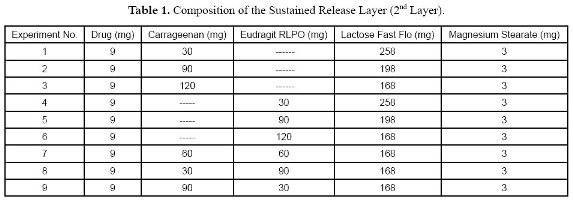
<body><![CDATA[<p>The objective of this research is a bioadhesive two layers controlled release    tablets. The drug release and the physical properties of tablet formulations    using two polymers (Carrageenan 934 and Eudragit RL PO) at three levels and    at a combination of different ratios of the two polymers were evaluated. Formulation    containing 40% total polymer level and a ratio of 1 Carrageenan to 1 Eudragit    RLPO was the best formulationa. This formulation was tested in different dissolution    medium and at different rotational speed. The drug release was 96.3% in phosphate    buffer pH 7.4; 59.1% in 0.1 N HCl and 46.4% in distilled water. This study demonstrates    the significance of the combination of two polymers for obtaining controlled    release bioadhesive matrix and enhancing the characteristic of each polymer.        <br>   <b>Keywords:</b> Carrageenan matrices, eudragit RLPO matrices, chlorpheniramine    maleate, bioadhesion, sustained release, controlled release, mucoadhesive.</p>     <p><b>INTRODUCTION</b></p>     <p>For systemic delivery, the oral route has been the preferred route of administration    for many systemically active drugs. However when administered by oral route    many drugs have been reported to be of low systemic bioavailability, short duration    therapeutic activity and or formation of inactive toxic metabolites (1).</p>     <p>Sustained or time-release systems are methods of drug delivery in which one    preparation will accomplish the desired medicinal effect with more efficiency    and longer duration than multiple dosage forms of the same drug (2). Recently    extensive efforts have been focused on the developing of a drug delivery system    which utilize the principles of bioadhesion for optimum delivery of drug from    device (3-8).</p>     <p>Mucoadhesive delivery systems were proven to be suitable for the purpose of    reduction of transit time of the dosage form through the gastro-intestinal tract    (9-11), and increasing bioavailability of drug (12-13). One of the most important    factor in the preparation of sustained release mucoadhesive dosage form is the    bioadhesive power of the polymer. Various synthetic as well as natural polymers    have been examined in drug delivery applications (14-20).</p>     <p>The overall goal of this research is to design and develop a bioadhesive controlled    release two layers chlorpheniramine maleate tablets using direct compression    technique. This is the first paper to investigate the effect of different level    of binary mixture of Carrageenan and Eudragit RLPO on the physical properties    and on drug release from bioadhesive tablets compared to a single bioadhesive    polymer.</p>     <p>Finally, to investigate the in vitro adhesion of the bioadhesive dosage form    to rats stomach tissues </p>     <p><b>MATERIALS AND METHODS</b></p>     <p><b>Materials</b></p>     ]]></body>
<body><![CDATA[<p>Chlorpheniramine maleate, lot Number 750605 (supplied by Glaxo-SmithKline,    Cidra Puerto Rico); Carrageenan NF, Type GP-812 NF, lot Number Zb 502 (Marine    Colloids, FMC Inc., Philadelphia, PA, USA); Eudragit RLPO, lot Number 0481236209    (supplied by Rhom, GmbH, Darmstadt, Germany); lactose fast flo, lot Number 64044-51-5    (Foremost Farm, Wisconsin, USA) and magnesium stearate, lot Number H20237J07    (supplied by Ruger Chemical Co., New Jersy, USA). All ingredients used in the    manufacture of the emulsion were of compendial grade.</p>     <p> <b>Preparation of Biadhesive Tablets</b></p>     <p>Direct compression method was used to prepare nine formulations (<a href="#t1">table    1</a>) where the level of Eudragit RLPO or Carrageenan was varied (10% w/w,    30 and 40% w/w) in order to evaluate the effect of polymer level on drug release.    Also the last three formulations were containing a combination of the two polymers    at different ratios of Carrageenan:Eudragit (1:1; 1:3 and 3:1) and the total    polymer level was 40%m to investigate the effect of combination of two polymers    on the mechanical properties and drug release from the bioadhesive tablets.    Also, control tablets and tablets containing high polymer level (<a href="#t2">table    2</a>) were prepared and evaluated.</p>     <p><img src="/img/revistas/vitae/v13n1/1a05t01.JPG" width="573" height="203"><a name="t1"></a></p>     <p><img src="/img/revistas/vitae/v13n1/1a05t02.JPG" width="577" height="521"><a name="t2"></a></p>     <p>    <br>   <b>Two Layers Tablets</b></p>     <p>Batch size was 1 Kg, the first layer weight is 100 mg containing 3 mg chlorpheniramine    maleate as a loading dose for rapid initial release of drug to reach therapeutic    blood level immediately and 1 mg magnesium stearate. The drug and lactose were    pass ed through screen # 12 in order to break agglomerates, weighed, introduced    into V blender ( Blend Master, Lab Blender P-K Ref. # C419379, Patterson Kelly    Co., Division of Harsco Corporation, PA, USA) and mixed by geometrical dilution    for 20 minutes. Magnesium stearate passed through screen #30 was added and mixed    for further 5 minutes.</p>     <p>The second layer, maintenance dose weight is 300 mg containing 9 mg chlorpheniramine    maleate, different levels of polymer, 9 mg magnesium stearate and lactose fast    flo sufficient quantity to complete up to 300 mg.</p>     <p>The drug, lactose and the polymer were passed through screen #12, weighed and    introduced in V blender, mixed with geometrical dilution for 20 minutes. Magnesium    stearate passed through screen #30, weighed, added to the mixture in V blender    and mixed for further 5 minutes    ]]></body>
<body><![CDATA[<br> </p>     <p><b>Weight, Thickness and Hardness </b></p>     <p>Ten tablets from each lot were measured for weight , thickness and hardness    (Schleuniger, serial number 4676, Vector Corporation, Iowa, USA).</p>     <p>The range, mean and standard deviation were calculated.</p>     <p><b>Friability </b></p>     <p>Three sets of five tablets were tested for friability. The initial weight was    recorded and the tablets were placed in friabilator (Erweka , Heusenstamm, Germany)    and were submitted to 100 rotations. Tablets were reweighed to determine friability    percent according to the following equation:</p>     <p> Percent Friability = ((Initial Weight &#150; Final Weight)/(Initial Weight))x100</p>     <p><b>Disintegration </b></p>     <p>Six tablets from each formulation was placed on the basket tube of the disintegration    apparatus (Erweka, Model ZT3-2, serial # 53354, Heusenstamm, Germany)and were    tested for disintegration in 900 ml distilled water at 370 C &plusmn;20 C.</p>     <p><b>Drug Content </b></p>     ]]></body>
<body><![CDATA[<p>Five tablets from each batch were grinded to a fine powder using mortar and    pestle. Three samples each of 0.4 g were transferred to 1000 ml volumetric flask    and completed to volume with distilled water. Samples were stirred for six hours.    A portion from each solution was filtered and analyzed for drug content using    UV spectrophotometer (DU &#150; 65, serial # 4310231, Bechman, California, USA).</p>     <p><b>Dissolution Testing </b></p>     <p>All batches were tested for dissolution using Apparatus 1, basket method (model    SR2. serial # 21-78 &#150; 29, Hansen Research , California, USA).at 50 rpm    using 500 ml distilled water at 370C &plusmn; 0.5&ordm;C. Samples volume of    10 ml were withdrawn at different time intervals over 6 hours period and were    replaced with 10 ml distilled water at room temperature. The drug concentration    in the different samples was determined by measuring the absorbances at 264    nm and using the slope and intercept obtained from the standard curve of chlorpheniramine    maleate in distilled water . The best formulation that controlled the drug release    was tested in 0.1 N HCl and phosphate buffer pH 7.4 in addition to the distilled    water. Also, was tested using two additional basket rotational speeds (100 rpm    and 150 rpm).</p>     <p><b>Diffusion Study </b></p>     <p>The glycerin was removed from the dialysis tubing in distilled water for 4    hours and then all sulfur compounds were removed by treating the tubing with    0.3 % w/v solution of sodium sulfite at 80&ordm;C for 1 minute.</p>     <p>The dialysis tubing was then washed with hot distilled water for 2 minutes,    followed by acidification with 0.2% w/v solution of sulfuric acid and finally,    all sulfuric acid was rinsed using hot distilled water.</p>     <p>The best tablet formulation was weighed and introduced in a dialysis bag containing    500 ml phosphate buffer and magnetic bar. The dialysis bag was introduced in    a beaker containing 500 ml phosphate buffer pH 7.4 and was stirred using magnetic    bar.</p>     <p>Samples of 5 ml were withdrawn from the beaker at different time intervals    up to 12 hours and were replaced with 5 ml buffer at room temperature.</p>     <p>The drug concentration in the different samples was calculated by measuring    absorbance at 264 nm using the slope and intercept obtained from standard curve    of chlorpheniramine maleate solutions. The diffusion study was performed in    two different mediums: 0.1 N HCl and phosphate buffer pH 7.4 and also, was done    in triplicates.</p>     <p><b>Bioadhesion Study </b></p>     ]]></body>
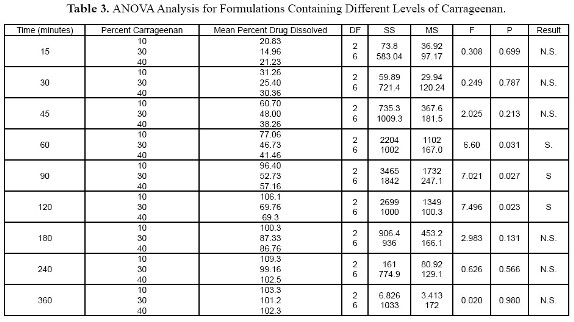
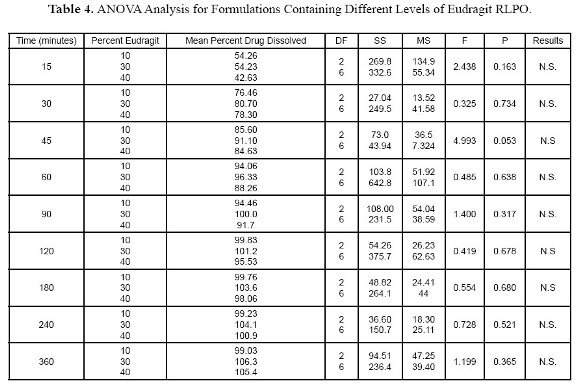
<body><![CDATA[<p>A modified tensioneter, Fisher surface tensiometer (model 21, Fischer Scientific    Co.) was used to measure mucoadhesive strength between bioadhesive tablets and    G.I.T. tissues. Skin from the abdominal region of six hairless CD rats (Norvergious    species, 6-8 weeks old, weight 400 g to 450 g, brought from Charles River Laboratories,    Wilmington, Boston, USA) were used. Rats were euthanized in pre-filled carbon    dioxide chamber for 5 minutes. The pressure of the chamber was between 20 PSI    to 25 PSI. Skin was lift, cut and removed from the abdominal region, soaked    in a 0.9% isotonic sodium chloride solution, cut in 2.5 cm X 2.5 cm pieces.</p>     <p>The rat skin tissue (0.96 mm thickness) was attached to the stopper (weight    2.96 g height in 0.092 cm and diameter 0.0885 cm) and secured with aluminum    vial cap with a hole of 10 mm diameter in the center. The stopper was hanged    to torsion arm of the instrument using a platinum &#150; iridium wire of 3.5    cm length and 0.026 cm diameter.</p>     <p>Another 2.5 cm X 2.5 cm section of the rat skin tissue was secured in the vial    by using a rubber. The vial was placed in a beaker (52 mm diameter) containing    100 ml phosphate buffer pH 7.4.</p>     <p>Sixty mg (60 mg) of the gel formulation was uniformly spread over the exposed    tissue in the stopper. The stopper was submerged in the beaker and the knob    was adjusted to zero. The scale was locked and the vial was moved, so it was    centered in the beaker and the beaker was moved to align the stopper and the    vfial. The beaker was raised slowly to bring tissue in contact. After 1 minute    of contact, the lock was released and a constant force of 10 mg/cm<sup>2</sup> was converted    into dyne/cm<sup>2</sup>.</p>     <p><b>Statistical Analysis</b></p>     <p>The ANOVA one way analysis was used to determine if there is significant differences    between the two variables and the t-test was used to examine if there is significant    differences between pairs. (<a href="#t3">Table 3</a> and <a href="#t4">table    4</a>).</p>     <p><img src="/img/revistas/vitae/v13n1/1a05t03.JPG" width="574" height="322"><a name="t3"></a></p>     <p><img src="/img/revistas/vitae/v13n1/1a05t04.JPG" width="577" height="388"><a name="t4"></a></p>     <p><b>RESULTS AND DISCUSSION</b></p>     <p> The simple factorial design was used to determine number of variables, levels    and effect of variables on response.</p>     ]]></body>
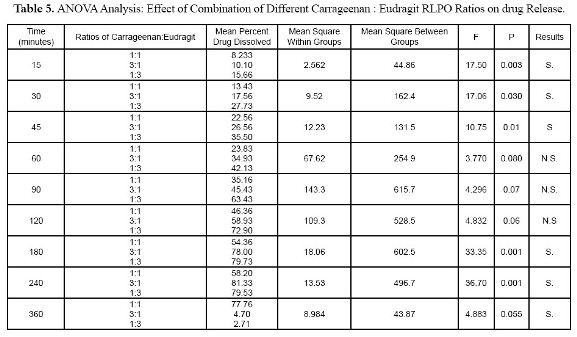
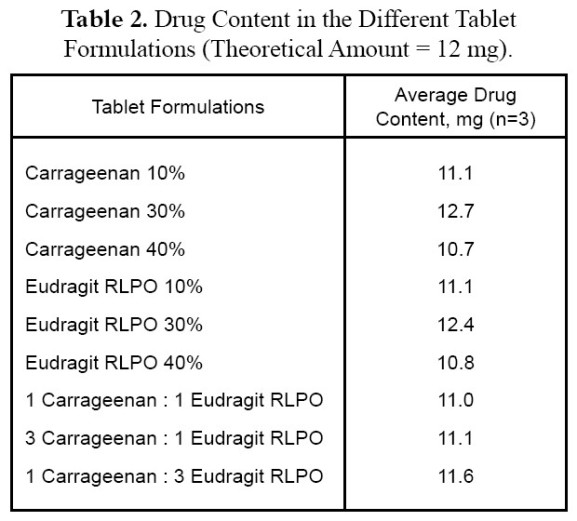
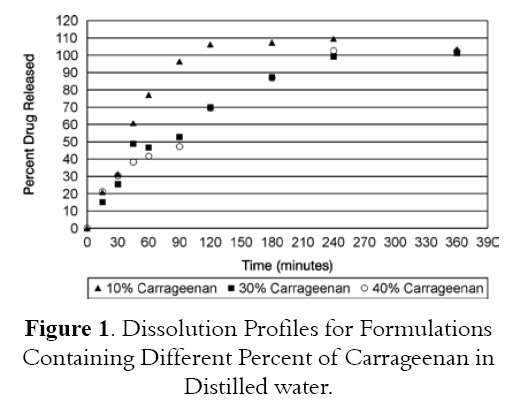
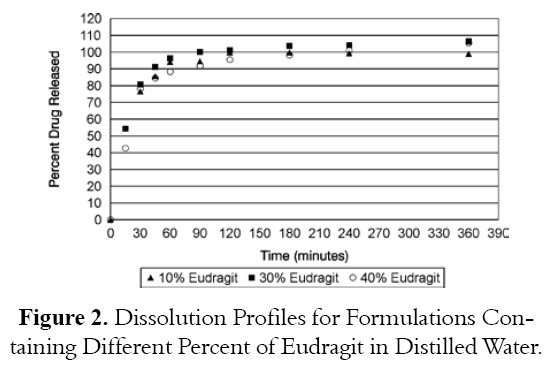
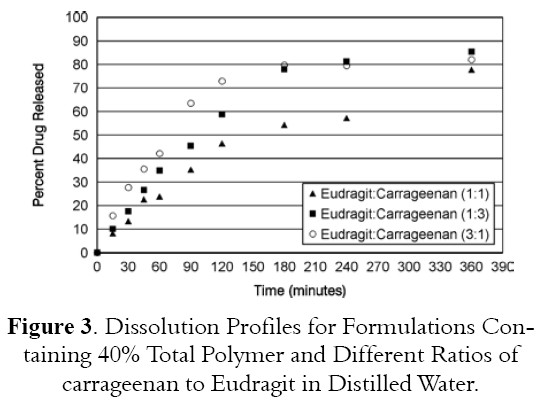
<body><![CDATA[<p>P<sup>n</sup> = 3<sup>1A</sup> + 3<sup>1B</sup> + 3<sup>1C</sup> where: n = number of variable; p = levels of variables;    A = Carrageenan at 3 levels (10%, 30 and 40%); B = Eudragit RLPO at 3 levels    (10%, 30 and 40%); C = polymer combination (1Carrageenan:1 Eudragit RLPO; 3    Carrageenan : 1 Eudragir RLPO; 1 Carrageenan : 3 Eudragit RLPO).</p>     <p>In phase 1 of the study, six formulations were prepared. Two polymers were    used: Carrageenan and Eudragit RLPO each at 3 levels (10%, 20 and 40%) to determine    the best level that will give lowest drug release. In the second phase, three    tablet formulations containing combination of the two polymers at a total polymer    level of 40% and at different ratios of Carrageenan:Eudragit RLPO (1:1; 1:3    and 3:1) were prepared. The nine tablet formulations are shown in <a href="#t1">Table    1</a>. All tablet formulations were assayed for drug content including control    tablets without polymer as shown in <a href="#t2">Table 2</a>.</p>     <p><a href="#f1">Figures 1</a> and <a href="#f2">2</a> show the dissolution profiles    for formulations containing different levels of Carrageenan and Eudragit RLPO    respectively. <a href="#f1">Figure 1</a> shows the dissolution profiles for    Bioadhesive tablets containing different levels of Carrageenan polymer. Formulation    containing 10% Carrageenan release all drug at 2 hours of testing dissolution    while formulations containing 30% or 40% Carrageenan released 69.8% and 69.34%    drug respectively. <a href="#f2">Figure 2</a> depicts the dissolution profiles    for formulations containing different levels of Eudragit RLPO. All formulations    containing different levels of Eudragit RLPO released all drugs at 2 hours of    testing dissolution. Formulation containing 10% Eudragit RLPO released 99.8%    while formulation containing 30% and 40% Eudragit RLPO released 101.24% and    95.51% drug at 2 hours of testing dissolution. It appears that the characteristics    of the polymers used affect drug release.</p>     <p><img src="/img/revistas/vitae/v13n1/1a05f01.JPG" width="514" height="410"><a name="f1"></a></p>     <p><img src="/img/revistas/vitae/v13n1/1a05f02.JPG" width="555" height="366"><a name="f2"></a></p>     <p> ANOVA analysis showed no sigmificant difference between formulations containing    10, 30 and 40% Carrgeenan and also ANOVA analysis showed no significant difference    between formulations containing 10%, 30 and 40% and Eudragit as shown in <a href="#t3">Tables    3</a> and <a href="#t4">4</a>.</p>     <p><a href="#f3">Figure 3</a> shows the dissolution profiles for formulation containing    combination of two polymers at 40% total polymer and different ratios of Carrageenan:Eudragit    RLPO(1:1; 3:1 and 1:3). Formulation containing 1 Carrageenan : 1 Eudragit RLPO    released 46.4% drug at 2 hours of testing dissolution while formulation containing    1 Carrageenan : 3 Eudragit RLPO and or 3 Carrageenan : 1 Eudragit RLPO released    59.9% and 72.9% drug respectively. These data indicated that best ratio of combination    is 1 Carrageenan : 1 Eudragit RLPO and as the ratio of Carrageenan to Eudragit    RLPO increases, the drug release increases. </p>     <p><img src="/img/revistas/vitae/v13n1/1a05f03.JPG" width="543" height="405"><a name="f3"></a></p>     <p></p>     <p><a href="#t5">Table 5</a>, one way ANOVA analysis shows significant differences    in drug release between formulations containing different ratios of Carrageenan    to Eudragit RLPO.</p>     ]]></body>
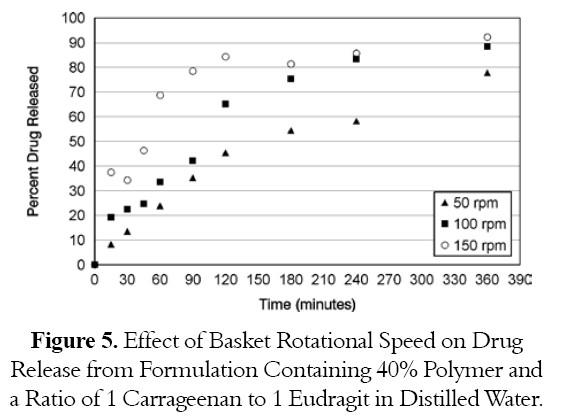
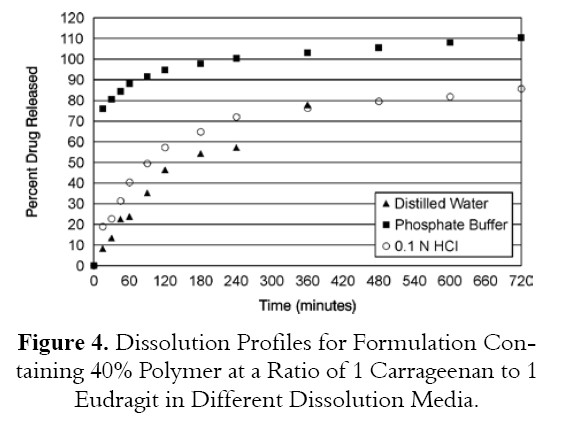
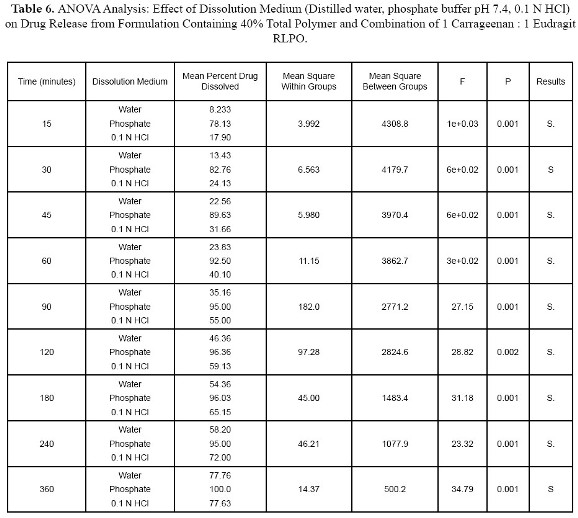
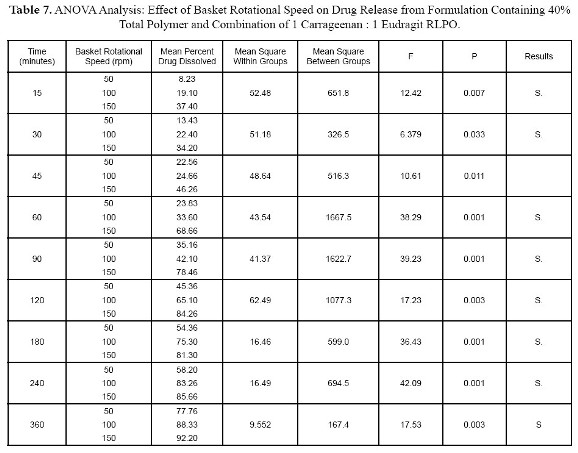
<body><![CDATA[<p><img src="/img/revistas/vitae/v13n1/1a05t05.JPG" width="577" height="337"><a name="t5"></a></p>     <p></p>     <p>The best formulation containing total polymer level of 40% and combination    of Carrageenan and Eudragit RLPO at 1:1 ratio was tested in two additional dissolution    medium: 0.1 N HCl and phosphate buffer pH 7.4.</p>     <p>Tablets tested in phosphate buffer pH 7.4 released 96.3% of drug at 2 hours    while tablets tested in 0.1 N HCl and distilled water released 59.1% and 46.4%    respectively as shown in <a href="#f4">Figure 4</a>. Eudragit RLPO is water    insoluble polymer and is not pH dependent and consequently drug release from    Eudragit RLPO is not affected by changing pH of dissolution medium. Carrageenan    is a sulfated polymer obtained from Algae and is hydrophilic polymer. Apparantly    Carrageen differ from other hydrophilic polymers which their gels strength are    disrupted in acidic media but Carrageenan maintain its gel strength in acidic    medium.and gave lower drug release in 0.1 N HCL than in phosphate buffer pH    7.3 </p>     <p><img src="/img/revistas/vitae/v13n1/1a05f04.JPG" width="563" height="428"><a name="f4"></a></p>     <p></p>     <p>ANOVA analysis supported the dissolution data and showed significant differences    between tablets tested in different dissolution medium as shown in <a href="#t6">Table    6</a>.</p>     <p><img src="/img/revistas/vitae/v13n1/1a05t06.JPG" width="578" height="518"><a name="t6"></a></p>     <p></p>     <p>The best formulation was also, tested at different basket rotational speed.    At 50 rpm, the percent drug release was 46.4% at 2 hours while percent drug    release at 100 rpm and 150 rpm was 65.1% and 84.3% respectively as shown in    <a href="#f5">Figure 5</a>. As the rotational speed opf the basket is increased,    the drug release is increased.</p>     ]]></body>
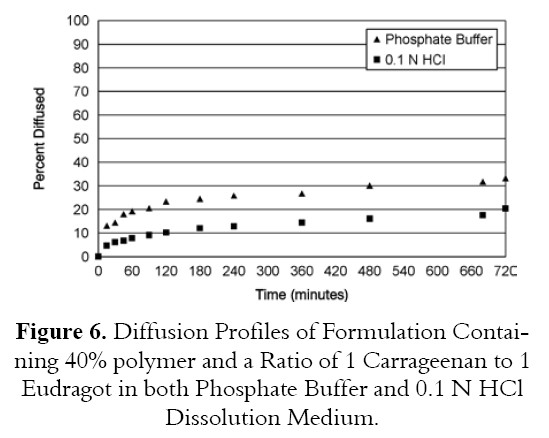
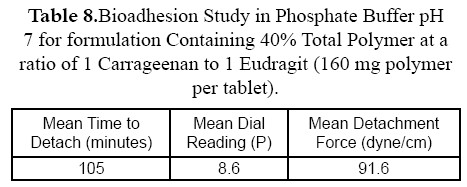
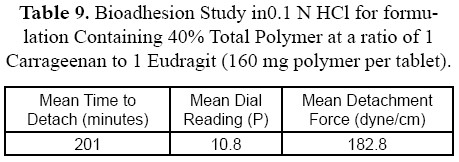
<body><![CDATA[<p><img src="/img/revistas/vitae/v13n1/1a05f05.JPG" width="561" height="420"><a name="f5"></a></p>     <p>ANOVA one way statistical analysis supported the dissolution data and showed    significant differences in drug release between tablet tested at different rotational    speeds as shown in <a href="#t7">Table 7</a>.</p>     <p><img src="/img/revistas/vitae/v13n1/1a05t07.JPG" width="578" height="453"><a name="t7"></a></p>     <p></p>     <p>The diffusion study for the best formulation showed that percent drug diffused    in phosphate buffer pH 7.4 was 33.2% at 12 hours while percent drug diffused    for the same best formulation in 0.1 N HCl was 20.4% (<a href="#f6">Figure 6</a>).    These data are similar to that obtained from dissolution data in different pH    dissolution medium. Amount of drug dissolute or diffused in 0.1 N HCl is lower    than that dissolute or diffused in phosphate buffer pH 7.4. as shown in <a href="#t8">Tables    8</a> and <a href="#t9">9</a>.</p>     <p><img src="/img/revistas/vitae/v13n1/1a05f06.JPG" width="549" height="438"><a name="f6"></a></p>     <p><img src="/img/revistas/vitae/v13n1/1a05t08.JPG" width="467" height="187"><a name="t8"></a></p>     <p><img src="/img/revistas/vitae/v13n1/1a05t09.JPG" width="459" height="162"><a name="t9"></a></p>     <p>The bioadhesion study (n = 3) indicated that force needed for detachement of    the bioadhesive tablet from the rat mucous membrane in phosphate buffer pH 7.4    was only 91.6 dynes/cm2 compared to 182.8 dynes/cm<sup>2</sup> force needed to detach the    same bioadhesive tablet from the rat skin in 0.1 N HCl.</p>     <p><b>SUMMARY AND CONCLUSION</b></p>     ]]></body>
<body><![CDATA[<p>The two layers bioadhesive delivery system has potential to be an effective    sustained release system over a long period of time for the antihistaminic chlorpheniramine    maleate.</p>     <p>The type and level of polymer used are fundamental factors that can affect    the drug release and also the physico-chemical properties of these mucoadhesive    devices.</p>     <p>The combination of carrageenan and Eudragit RLPO enhanced the characteristics    of each polymer. The combination of 1 Carrageenan to 1 Eudragit RLPO was found    to be the best candidate to develop a suitable bioadhesive dosage form.</p>     <p>Finally, the <i>in-vitro</i> study demonstrated the efficiency of the bioadhesion    of the developed dosage form. </p>     <p><b>BIBLIOGRAPHIC REFERENCES</b></p>     <!-- ref --><p>1. Chien W. Yin. Novel Drug Delivery Systems, Marcel Dekker Inc.,, New York,    p. 169-238.    &nbsp;&nbsp;&nbsp;&nbsp;&nbsp;&nbsp;&nbsp;&nbsp;[&#160;<a href="javascript:void(0);" onclick="javascript: window.open('/scielo.php?script=sci_nlinks&ref=000098&pid=S0121-4004200600010000500001&lng=','','width=640,height=500,resizable=yes,scrollbars=1,menubar=yes,');">Links</a>&#160;]<!-- end-ref --><!-- ref --><br>   2. Perioli, L.; Ambrogi, V.; Angelici, F.; Rioci, M.; Giovagnoli, S.; Capuccella,    M.; Rossi, C. (2004) Development of Mucoadhesive Patches for Buccal Administration    of Ibuprofen. J. Control Release. 99 (1), 73-82...    &nbsp;&nbsp;&nbsp;&nbsp;&nbsp;&nbsp;&nbsp;&nbsp;[&#160;<a href="javascript:void(0);" onclick="javascript: window.open('/scielo.php?script=sci_nlinks&ref=000099&pid=S0121-4004200600010000500002&lng=','','width=640,height=500,resizable=yes,scrollbars=1,menubar=yes,');">Links</a>&#160;]<!-- end-ref --><!-- ref --><br>   3. Ranga, K.N.; Buri, P. (1989) A Novel In-Situ Method to Test Polymers and    Coated Particles for Bioadhesion. Int. J. Pharm. 52, 265-270.    &nbsp;&nbsp;&nbsp;&nbsp;&nbsp;&nbsp;&nbsp;&nbsp;[&#160;<a href="javascript:void(0);" onclick="javascript: window.open('/scielo.php?script=sci_nlinks&ref=000100&pid=S0121-4004200600010000500003&lng=','','width=640,height=500,resizable=yes,scrollbars=1,menubar=yes,');">Links</a>&#160;]<!-- end-ref --><!-- ref --><br>   4. Yamamoto, H.; Takeuchi, H.; Kuno, Y. (2000) Mucoadhesive DL-Lactide/Glycolide    Copolymer nanospheres Coated with Chitosan to Improve Oral Delivery of Elcatonin.    Pharm. Dev. Technol. 5, 77-85.    &nbsp;&nbsp;&nbsp;&nbsp;&nbsp;&nbsp;&nbsp;&nbsp;[&#160;<a href="javascript:void(0);" onclick="javascript: window.open('/scielo.php?script=sci_nlinks&ref=000101&pid=S0121-4004200600010000500004&lng=','','width=640,height=500,resizable=yes,scrollbars=1,menubar=yes,');">Links</a>&#160;]<!-- end-ref --><!-- ref --><br>   5. Luessen, H. L.; De Leeww, B. J.; De Boer, A. B.; Verhoef, J. C. (1996) Mucoadhesive    Polymers in Peroral Peptide Drug Delivery. VI. Carbomer and Chitosan Improve    the Intestinal Absorption of the Peptide Drug Buselin In-Vivo. Pharm. Res.,    13, 1668-1672.    &nbsp;&nbsp;&nbsp;&nbsp;&nbsp;&nbsp;&nbsp;&nbsp;[&#160;<a href="javascript:void(0);" onclick="javascript: window.open('/scielo.php?script=sci_nlinks&ref=000102&pid=S0121-4004200600010000500005&lng=','','width=640,height=500,resizable=yes,scrollbars=1,menubar=yes,');">Links</a>&#160;]<!-- end-ref --><!-- ref --><br>   6. Moratzavi, S.A.; Smart, J.D. (1993) Investigation Into the Role of Water    Movement and Mucus Gel Hydrationin Mucoadhesion. J. Controlled Release. 25,    197-203.    &nbsp;&nbsp;&nbsp;&nbsp;&nbsp;&nbsp;&nbsp;&nbsp;[&#160;<a href="javascript:void(0);" onclick="javascript: window.open('/scielo.php?script=sci_nlinks&ref=000103&pid=S0121-4004200600010000500006&lng=','','width=640,height=500,resizable=yes,scrollbars=1,menubar=yes,');">Links</a>&#160;]<!-- end-ref --><!-- ref --><br>   7. Alireza, S.; Smart, J. (1994) An Invitro Method for Assessing the Duration    of Mucoadhesion. J. Controlled Release. 31, 207-212.    &nbsp;&nbsp;&nbsp;&nbsp;&nbsp;&nbsp;&nbsp;&nbsp;[&#160;<a href="javascript:void(0);" onclick="javascript: window.open('/scielo.php?script=sci_nlinks&ref=000104&pid=S0121-4004200600010000500007&lng=','','width=640,height=500,resizable=yes,scrollbars=1,menubar=yes,');">Links</a>&#160;]<!-- end-ref --><!-- ref --><br>   8. Bani-Jaber, A.; Al-Ghazawi, M. (2005) Sustained Release Characteristics of    Tablets Prepared with Mixed Matrixz of Sodium Carrageenan and Chitosan L Effect    of Polymer Weight Ratio, Dissolution Medium and Drug Type. Drug Dev. Ind. Pharm.    31 (3), 241-247.    &nbsp;&nbsp;&nbsp;&nbsp;&nbsp;&nbsp;&nbsp;&nbsp;[&#160;<a href="javascript:void(0);" onclick="javascript: window.open('/scielo.php?script=sci_nlinks&ref=000105&pid=S0121-4004200600010000500008&lng=','','width=640,height=500,resizable=yes,scrollbars=1,menubar=yes,');">Links</a>&#160;]<!-- end-ref --><!-- ref --><br>   9. Varma, M.; Singla, AK.; Dhawan, S. (2004) Release of Diltiazine Hydrochloride    from Hydrophilic Matrices of Polyethylene Oixide and carbopol. Drug Dev. Ind.    Pharm. 30 (5), 545-553..    &nbsp;&nbsp;&nbsp;&nbsp;&nbsp;&nbsp;&nbsp;&nbsp;[&#160;<a href="javascript:void(0);" onclick="javascript: window.open('/scielo.php?script=sci_nlinks&ref=000106&pid=S0121-4004200600010000500009&lng=','','width=640,height=500,resizable=yes,scrollbars=1,menubar=yes,');">Links</a>&#160;]<!-- end-ref --><!-- ref --><br>   10. Chi-Hyun, L.; Yie, W. C. (1996) Development and Evaluation of Mucoadhesive    Drug Delivery System for Dual Controlled Delivery of Nonoxynol-9. J. Controlled    Release. 39, 93-103.    &nbsp;&nbsp;&nbsp;&nbsp;&nbsp;&nbsp;&nbsp;&nbsp;[&#160;<a href="javascript:void(0);" onclick="javascript: window.open('/scielo.php?script=sci_nlinks&ref=000107&pid=S0121-4004200600010000500010&lng=','','width=640,height=500,resizable=yes,scrollbars=1,menubar=yes,');">Links</a>&#160;]<!-- end-ref --><!-- ref --><br>   11. Leimer, VM.; Marschutz, MK.; Bernkop-Schmurch, A. (2003) Mucoadhesive and    Cohesive Properties of Poly (Acrylic Acid)Cystein Conjugate with Regards to    their Molecular Mass. Int. J. Pharm. Sci. 18 (1), 89-96.    &nbsp;&nbsp;&nbsp;&nbsp;&nbsp;&nbsp;&nbsp;&nbsp;[&#160;<a href="javascript:void(0);" onclick="javascript: window.open('/scielo.php?script=sci_nlinks&ref=000108&pid=S0121-4004200600010000500011&lng=','','width=640,height=500,resizable=yes,scrollbars=1,menubar=yes,');">Links</a>&#160;]<!-- end-ref --><!-- ref --><br>   12. Liabot, JM.; Manzo, RH. Allemandi, DA. (2004) Drug Release from Carbomer:Carbomer    Sodium Salt Matrices With Potential Use as Mucoadhesive Drug Delivery System.    Int. J. Pharm. 276 (1-2), 59-66.    &nbsp;&nbsp;&nbsp;&nbsp;&nbsp;&nbsp;&nbsp;&nbsp;[&#160;<a href="javascript:void(0);" onclick="javascript: window.open('/scielo.php?script=sci_nlinks&ref=000109&pid=S0121-4004200600010000500012&lng=','','width=640,height=500,resizable=yes,scrollbars=1,menubar=yes,');">Links</a>&#160;]<!-- end-ref --><!-- ref --><br>   13. Remunan_Lopez, K.; Portero, A.; Vila-Hato, J. L.; Alonso, M. J. (1998) Design    and Evaluation of Chitosan / Ethyl Cellulose Mucoadhesive Bilayer Devicesfor    Buccal Drug Delivery. J. Controlled Release 55, 143-152.    &nbsp;&nbsp;&nbsp;&nbsp;&nbsp;&nbsp;&nbsp;&nbsp;[&#160;<a href="javascript:void(0);" onclick="javascript: window.open('/scielo.php?script=sci_nlinks&ref=000110&pid=S0121-4004200600010000500013&lng=','','width=640,height=500,resizable=yes,scrollbars=1,menubar=yes,');">Links</a>&#160;]<!-- end-ref --><!-- ref --><br>   14. Singh, B.; Ahuja, N. (2002) Development of Controlled Release Bucoadhesive    hydrophilic Matrices of Diltiazem Hydrochloride Optimization of Bioadhesion,    dissolution and Diffusion Process. Drug Dev. Ind. Pharm. 28, 431-442.    &nbsp;&nbsp;&nbsp;&nbsp;&nbsp;&nbsp;&nbsp;&nbsp;[&#160;<a href="javascript:void(0);" onclick="javascript: window.open('/scielo.php?script=sci_nlinks&ref=000111&pid=S0121-4004200600010000500014&lng=','','width=640,height=500,resizable=yes,scrollbars=1,menubar=yes,');">Links</a>&#160;]<!-- end-ref --><!-- ref --><br>   15. Rily, R.G.; Smart, J. D.; Tsibouklis, J.; Detmar, P.W.; Hampson, F.; Davis,    J.A. (2001) An Investigation of Mucus/Polymer rheological Synergism using Synthesised    and Charactarised Poly(Acrylic Acid). Int. J. Pharm. 217, 87-100.    &nbsp;&nbsp;&nbsp;&nbsp;&nbsp;&nbsp;&nbsp;&nbsp;[&#160;<a href="javascript:void(0);" onclick="javascript: window.open('/scielo.php?script=sci_nlinks&ref=000112&pid=S0121-4004200600010000500015&lng=','','width=640,height=500,resizable=yes,scrollbars=1,menubar=yes,');">Links</a>&#160;]<!-- end-ref --><!-- ref --><br>   16. Betageri, G.V.; Deshmukh, D.V.; Gupta, R.B. (2001) Oral Sustained Release    Bioadhesive Tablet Formulation of Didanosine. Drug Dev. Ind. Pharm. 27, 129-136.    &nbsp;&nbsp;&nbsp;&nbsp;&nbsp;&nbsp;&nbsp;&nbsp;[&#160;<a href="javascript:void(0);" onclick="javascript: window.open('/scielo.php?script=sci_nlinks&ref=000113&pid=S0121-4004200600010000500016&lng=','','width=640,height=500,resizable=yes,scrollbars=1,menubar=yes,');">Links</a>&#160;]<!-- end-ref --><!-- ref --><br>   17. Picker, K.M. (1999) Matrix Tablets of Carrageenans, I.A. Compaction Study.    Drug Dev. Ind. Pharm. 25, 329-337.    &nbsp;&nbsp;&nbsp;&nbsp;&nbsp;&nbsp;&nbsp;&nbsp;[&#160;<a href="javascript:void(0);" onclick="javascript: window.open('/scielo.php?script=sci_nlinks&ref=000114&pid=S0121-4004200600010000500017&lng=','','width=640,height=500,resizable=yes,scrollbars=1,menubar=yes,');">Links</a>&#160;]<!-- end-ref --><!-- ref --><br>   18. Mehta, K.A.; Kisla lioglu, M. S.; Phuapradit, W.; Malick, A.W.; Shah, N.    H. (2001). Release Performance of Poorly Soluble Drug from a Novel Eudragit-Based    Multi-Unit Errosion Matrix. Int. J. Pharm. 213, pp 7-12.    &nbsp;&nbsp;&nbsp;&nbsp;&nbsp;&nbsp;&nbsp;&nbsp;[&#160;<a href="javascript:void(0);" onclick="javascript: window.open('/scielo.php?script=sci_nlinks&ref=000115&pid=S0121-4004200600010000500018&lng=','','width=640,height=500,resizable=yes,scrollbars=1,menubar=yes,');">Links</a>&#160;]<!-- end-ref --><!-- ref --><br>   19. Boza, A.; De La cruz, Y.; Jordan, G.; jauregui-Haza, U.; Aleman, A.; Caraballo,    I. (2000). Statistical Optimization of a Sustained-Release Matrix Tablets of    Lobenzarit Disodium. Drug Dev. Ind. Pharm. 26, 1303-1307.    &nbsp;&nbsp;&nbsp;&nbsp;&nbsp;&nbsp;&nbsp;&nbsp;[&#160;<a href="javascript:void(0);" onclick="javascript: window.open('/scielo.php?script=sci_nlinks&ref=000116&pid=S0121-4004200600010000500019&lng=','','width=640,height=500,resizable=yes,scrollbars=1,menubar=yes,');">Links</a>&#160;]<!-- end-ref --><!-- ref --><br>   20. Khan, M. Z.; Stedul, H.P.; Kurjakovic, N. (2000). A pH Dependent Colon Targeted    Oral Drug Delivery System Using Methacrylic Acid Copolymer. II. Manipulation    of Drug Release Using Eudragit L 100 and Eudragit S 100 Combinations. Drug Dev.    Ind. Pharm. 26, 549-554. &nbsp;&nbsp;&nbsp;&nbsp;&nbsp;&nbsp;&nbsp;&nbsp;[&#160;<a href="javascript:void(0);" onclick="javascript: window.open('/scielo.php?script=sci_nlinks&ref=000117&pid=S0121-4004200600010000500020&lng=','','width=640,height=500,resizable=yes,scrollbars=1,menubar=yes,');">Links</a>&#160;]<!-- end-ref --> ]]></body><back>
<ref-list>
<ref id="B1">
<label>1</label><nlm-citation citation-type="book">
<person-group person-group-type="author">
<name>
<surname><![CDATA[W. Yin]]></surname>
<given-names><![CDATA[Chien]]></given-names>
</name>
</person-group>
<source><![CDATA[Novel Drug Delivery Systems]]></source>
<year></year>
<page-range>169-238</page-range><publisher-loc><![CDATA[New York ]]></publisher-loc>
<publisher-name><![CDATA[Marcel Dekker Inc.]]></publisher-name>
</nlm-citation>
</ref>
<ref id="B2">
<label>2</label><nlm-citation citation-type="journal">
<person-group person-group-type="author">
<name>
<surname><![CDATA[L.]]></surname>
<given-names><![CDATA[Perioli]]></given-names>
</name>
<name>
<surname><![CDATA[V.]]></surname>
<given-names><![CDATA[Ambrogi]]></given-names>
</name>
<name>
<surname><![CDATA[F.]]></surname>
<given-names><![CDATA[Angelici]]></given-names>
</name>
<name>
<surname><![CDATA[M.]]></surname>
<given-names><![CDATA[Rioci]]></given-names>
</name>
<name>
<surname><![CDATA[Giovagnoli]]></surname>
<given-names><![CDATA[S.]]></given-names>
</name>
<name>
<surname><![CDATA[Capuccella]]></surname>
<given-names><![CDATA[M.]]></given-names>
</name>
<name>
<surname><![CDATA[Rossi]]></surname>
<given-names><![CDATA[C.]]></given-names>
</name>
</person-group>
<article-title xml:lang="en"><![CDATA[Development of Mucoadhesive Patches for Buccal Administration of Ibuprofen]]></article-title>
<source><![CDATA[J. Control Release.]]></source>
<year>2004</year>
<volume>99</volume>
<numero>1</numero>
<issue>1</issue>
<page-range>73-82</page-range></nlm-citation>
</ref>
<ref id="B3">
<label>3</label><nlm-citation citation-type="journal">
<person-group person-group-type="author">
<name>
<surname><![CDATA[Ranga]]></surname>
<given-names><![CDATA[K.N.]]></given-names>
</name>
<name>
<surname><![CDATA[Buri]]></surname>
<given-names><![CDATA[P.]]></given-names>
</name>
</person-group>
<article-title xml:lang="en"><![CDATA[A Novel In-Situ Method to Test Polymers and Coated Particles for Bioadhesion]]></article-title>
<source><![CDATA[Int. J. Pharm.]]></source>
<year>1989</year>
<volume>52</volume>
<page-range>265-270</page-range></nlm-citation>
</ref>
<ref id="B4">
<label>4</label><nlm-citation citation-type="journal">
<person-group person-group-type="author">
<name>
<surname><![CDATA[Yamamoto]]></surname>
<given-names><![CDATA[H.]]></given-names>
</name>
<name>
<surname><![CDATA[Takeuchi]]></surname>
<given-names><![CDATA[H.]]></given-names>
</name>
<name>
<surname><![CDATA[Kuno]]></surname>
<given-names><![CDATA[Y.]]></given-names>
</name>
</person-group>
<article-title xml:lang="en"><![CDATA[Mucoadhesive DL-Lactide/Glycolide Copolymer nanospheres Coated with Chitosan to Improve Oral Delivery of Elcatonin]]></article-title>
<source><![CDATA[Pharm. Dev. Technol.]]></source>
<year>2000</year>
<volume>5</volume>
<page-range>77-85</page-range></nlm-citation>
</ref>
<ref id="B5">
<label>5</label><nlm-citation citation-type="journal">
<person-group person-group-type="author">
<name>
<surname><![CDATA[Luessen]]></surname>
<given-names><![CDATA[H. L.]]></given-names>
</name>
<name>
<surname><![CDATA[De Leeww]]></surname>
<given-names><![CDATA[B. J.]]></given-names>
</name>
<name>
<surname><![CDATA[De Boer]]></surname>
<given-names><![CDATA[A. B.]]></given-names>
</name>
<name>
<surname><![CDATA[Verhoef]]></surname>
<given-names><![CDATA[J. C.]]></given-names>
</name>
</person-group>
<article-title xml:lang="en"><![CDATA[Mucoadhesive Polymers in Peroral Peptide Drug Delivery. VI: Carbomer and Chitosan Improve the Intestinal Absorption of the Peptide Drug Buselin In-Vivo]]></article-title>
<source><![CDATA[Pharm. Res.]]></source>
<year>1996</year>
<volume>13</volume>
<page-range>1668-1672</page-range></nlm-citation>
</ref>
<ref id="B6">
<label>6</label><nlm-citation citation-type="journal">
<person-group person-group-type="author">
<name>
<surname><![CDATA[Moratzavi]]></surname>
<given-names><![CDATA[S.A.]]></given-names>
</name>
<name>
<surname><![CDATA[Smart]]></surname>
<given-names><![CDATA[J.D.]]></given-names>
</name>
</person-group>
<article-title xml:lang="en"><![CDATA[Investigation Into the Role of Water Movement and Mucus Gel Hydrationin Mucoadhesion]]></article-title>
<source><![CDATA[J. Controlled Release.]]></source>
<year>1993</year>
<volume>25</volume>
<page-range>197-203</page-range></nlm-citation>
</ref>
<ref id="B7">
<label>7</label><nlm-citation citation-type="journal">
<person-group person-group-type="author">
<name>
<surname><![CDATA[Alireza]]></surname>
<given-names><![CDATA[S.]]></given-names>
</name>
<name>
<surname><![CDATA[Smart]]></surname>
<given-names><![CDATA[J.]]></given-names>
</name>
</person-group>
<article-title xml:lang="en"><![CDATA[An Invitro Method for Assessing the Duration of Mucoadhesion]]></article-title>
<source><![CDATA[J. Controlled Release.]]></source>
<year>1994</year>
<volume>31</volume>
<page-range>207-212</page-range></nlm-citation>
</ref>
<ref id="B8">
<label>8</label><nlm-citation citation-type="journal">
<person-group person-group-type="author">
<name>
<surname><![CDATA[Bani-Jaber]]></surname>
<given-names><![CDATA[A.]]></given-names>
</name>
<name>
<surname><![CDATA[Al-Ghazawi]]></surname>
<given-names><![CDATA[M.]]></given-names>
</name>
</person-group>
<article-title xml:lang="en"><![CDATA[Sustained Release Characteristics of Tablets Prepared with Mixed Matrixz of Sodium Carrageenan and Chitosan L Effect of Polymer Weight Ratio, Dissolution Medium and Drug Type.]]></article-title>
<source><![CDATA[Drug Dev. Ind. Pharm.]]></source>
<year>2005</year>
<volume>31</volume>
<numero>3</numero>
<issue>3</issue>
<page-range>241-247</page-range></nlm-citation>
</ref>
<ref id="B9">
<label>9</label><nlm-citation citation-type="journal">
<person-group person-group-type="author">
<name>
<surname><![CDATA[Varma]]></surname>
<given-names><![CDATA[M.]]></given-names>
</name>
<name>
<surname><![CDATA[Singla]]></surname>
<given-names><![CDATA[AK.]]></given-names>
</name>
<name>
<surname><![CDATA[Dhawan]]></surname>
<given-names><![CDATA[S.]]></given-names>
</name>
</person-group>
<article-title xml:lang="en"><![CDATA[Release of Diltiazine Hydrochloride from Hydrophilic Matrices of Polyethylene Oixide and carbopol]]></article-title>
<source><![CDATA[Drug Dev. Ind. Pharm.]]></source>
<year>2004</year>
<volume>30</volume>
<numero>5</numero>
<issue>5</issue>
<page-range>545-553</page-range></nlm-citation>
</ref>
<ref id="B10">
<label>10</label><nlm-citation citation-type="journal">
<person-group person-group-type="author">
<name>
<surname><![CDATA[Chi-Hyun]]></surname>
<given-names><![CDATA[L.]]></given-names>
</name>
<name>
<surname><![CDATA[Yie]]></surname>
<given-names><![CDATA[W. C.]]></given-names>
</name>
</person-group>
<article-title xml:lang="en"><![CDATA[Development and Evaluation of Mucoadhesive Drug Delivery System for Dual Controlled Delivery of Nonoxynol-9]]></article-title>
<source><![CDATA[J. Controlled Release.]]></source>
<year>1996</year>
<volume>39</volume>
<page-range>93-103</page-range></nlm-citation>
</ref>
<ref id="B11">
<label>11</label><nlm-citation citation-type="journal">
<person-group person-group-type="author">
<name>
<surname><![CDATA[Leimer]]></surname>
<given-names><![CDATA[VM.]]></given-names>
</name>
<name>
<surname><![CDATA[Marschutz]]></surname>
<given-names><![CDATA[MK.]]></given-names>
</name>
<name>
<surname><![CDATA[Bernkop-Schmurch]]></surname>
<given-names><![CDATA[A.]]></given-names>
</name>
</person-group>
<article-title xml:lang="en"><![CDATA[Mucoadhesive and Cohesive Properties of Poly (Acrylic Acid)Cystein Conjugate with Regards to their Molecular Mass]]></article-title>
<source><![CDATA[Int. J. Pharm. Sci.]]></source>
<year>2003</year>
<volume>18</volume>
<numero>1</numero>
<issue>1</issue>
<page-range>89-96</page-range></nlm-citation>
</ref>
<ref id="B12">
<label>12</label><nlm-citation citation-type="journal">
<person-group person-group-type="author">
<name>
<surname><![CDATA[Liabot]]></surname>
<given-names><![CDATA[JM.]]></given-names>
</name>
<name>
<surname><![CDATA[Manzo]]></surname>
<given-names><![CDATA[RH.]]></given-names>
</name>
<name>
<surname><![CDATA[Allemandi]]></surname>
<given-names><![CDATA[DA.]]></given-names>
</name>
</person-group>
<article-title xml:lang="en"><![CDATA[Drug Release from Carbomer:Carbomer Sodium Salt Matrices With Potential Use as Mucoadhesive Drug Delivery System]]></article-title>
<source><![CDATA[Int. J. Pharm.]]></source>
<year>2004</year>
<volume>276</volume>
<numero>1-2</numero>
<issue>1-2</issue>
<page-range>59-66</page-range></nlm-citation>
</ref>
<ref id="B13">
<label>13</label><nlm-citation citation-type="journal">
<person-group person-group-type="author">
<name>
<surname><![CDATA[Remunan_Lopez]]></surname>
<given-names><![CDATA[K.]]></given-names>
</name>
<name>
<surname><![CDATA[Portero]]></surname>
<given-names><![CDATA[A.]]></given-names>
</name>
<name>
<surname><![CDATA[Vila-Hato]]></surname>
<given-names><![CDATA[J. L.]]></given-names>
</name>
<name>
<surname><![CDATA[Alonso]]></surname>
<given-names><![CDATA[M. J.]]></given-names>
</name>
</person-group>
<article-title xml:lang="en"><![CDATA[Design and Evaluation of Chitosan / Ethyl Cellulose Mucoadhesive Bilayer Devicesfor Buccal Drug Delivery]]></article-title>
<source><![CDATA[J. Controlled Release]]></source>
<year>1998</year>
<volume>55</volume>
<page-range>143-152</page-range></nlm-citation>
</ref>
<ref id="B14">
<label>14</label><nlm-citation citation-type="journal">
<person-group person-group-type="author">
<name>
<surname><![CDATA[Singh]]></surname>
<given-names><![CDATA[B.]]></given-names>
</name>
<name>
<surname><![CDATA[Ahuja]]></surname>
<given-names><![CDATA[N.]]></given-names>
</name>
</person-group>
<article-title xml:lang="en"><![CDATA[Development of Controlled Release Bucoadhesive hydrophilic Matrices of Diltiazem Hydrochloride Optimization of Bioadhesion, dissolution and Diffusion Process]]></article-title>
<source><![CDATA[Drug Dev. Ind. Pharm.]]></source>
<year>2002</year>
<volume>28</volume>
<page-range>431-442</page-range></nlm-citation>
</ref>
<ref id="B15">
<label>15</label><nlm-citation citation-type="journal">
<person-group person-group-type="author">
<name>
<surname><![CDATA[Rily]]></surname>
<given-names><![CDATA[R.G.]]></given-names>
</name>
<name>
<surname><![CDATA[Smart]]></surname>
<given-names><![CDATA[J. D.]]></given-names>
</name>
<name>
<surname><![CDATA[Tsibouklis]]></surname>
<given-names><![CDATA[J.]]></given-names>
</name>
<name>
<surname><![CDATA[Detmar]]></surname>
<given-names><![CDATA[P.W.]]></given-names>
</name>
<name>
<surname><![CDATA[Hampson]]></surname>
<given-names><![CDATA[F.]]></given-names>
</name>
<name>
<surname><![CDATA[Davis]]></surname>
<given-names><![CDATA[J.A.]]></given-names>
</name>
</person-group>
<article-title xml:lang="en"><![CDATA[An Investigation of Mucus/Polymer rheological Synergism using Synthesised and Charactarised Poly(Acrylic Acid)]]></article-title>
<source><![CDATA[Int. J. Pharm.]]></source>
<year>2001</year>
<volume>217</volume>
<page-range>87-100</page-range></nlm-citation>
</ref>
<ref id="B16">
<label>16</label><nlm-citation citation-type="journal">
<person-group person-group-type="author">
<name>
<surname><![CDATA[Betageri]]></surname>
<given-names><![CDATA[G.V.]]></given-names>
</name>
<name>
<surname><![CDATA[Deshmukh]]></surname>
<given-names><![CDATA[D.V.]]></given-names>
</name>
<name>
<surname><![CDATA[Gupta]]></surname>
<given-names><![CDATA[R.B.]]></given-names>
</name>
</person-group>
<article-title xml:lang="en"><![CDATA[Oral Sustained Release Bioadhesive Tablet Formulation of Didanosine]]></article-title>
<source><![CDATA[Drug Dev. Ind. Pharm.]]></source>
<year>2001</year>
<volume>27</volume>
<page-range>129-136</page-range></nlm-citation>
</ref>
<ref id="B17">
<label>17</label><nlm-citation citation-type="journal">
<person-group person-group-type="author">
<name>
<surname><![CDATA[Picker]]></surname>
<given-names><![CDATA[K.M.]]></given-names>
</name>
</person-group>
<article-title xml:lang="en"><![CDATA[Matrix Tablets of Carrageenans, I.A. Compaction Study]]></article-title>
<source><![CDATA[Drug Dev. Ind. Pharm.]]></source>
<year>1999</year>
<volume>25</volume>
<page-range>329-337</page-range></nlm-citation>
</ref>
<ref id="B18">
<label>18</label><nlm-citation citation-type="journal">
<person-group person-group-type="author">
<name>
<surname><![CDATA[Mehta]]></surname>
<given-names><![CDATA[K.A.]]></given-names>
</name>
<name>
<surname><![CDATA[Kisla lioglu]]></surname>
<given-names><![CDATA[M. S.]]></given-names>
</name>
<name>
<surname><![CDATA[Phuapradit]]></surname>
<given-names><![CDATA[W.]]></given-names>
</name>
<name>
<surname><![CDATA[Malick]]></surname>
<given-names><![CDATA[A.W.]]></given-names>
</name>
<name>
<surname><![CDATA[Shah]]></surname>
<given-names><![CDATA[N. H.]]></given-names>
</name>
</person-group>
<article-title xml:lang="en"><![CDATA[Release Performance of Poorly Soluble Drug from a Novel Eudragit-Based Multi-Unit Errosion Matrix]]></article-title>
<source><![CDATA[Int. J. Pharm.]]></source>
<year>2001</year>
<volume>213</volume>
<page-range>7-12</page-range></nlm-citation>
</ref>
<ref id="B19">
<label>19</label><nlm-citation citation-type="journal">
<person-group person-group-type="author">
<name>
<surname><![CDATA[Boza]]></surname>
<given-names><![CDATA[A.]]></given-names>
</name>
<name>
<surname><![CDATA[De La cruz]]></surname>
<given-names><![CDATA[Y.]]></given-names>
</name>
<name>
<surname><![CDATA[Jordan]]></surname>
<given-names><![CDATA[G.]]></given-names>
</name>
<name>
<surname><![CDATA[jauregui-Haza]]></surname>
<given-names><![CDATA[U.]]></given-names>
</name>
<name>
<surname><![CDATA[Aleman]]></surname>
<given-names><![CDATA[A.]]></given-names>
</name>
<name>
<surname><![CDATA[Caraballo]]></surname>
<given-names><![CDATA[I]]></given-names>
</name>
</person-group>
<article-title xml:lang="en"><![CDATA[Statistical Optimization of a Sustained-Release Matrix Tablets of Lobenzarit Disodium]]></article-title>
<source><![CDATA[Drug Dev. Ind. Pharm.]]></source>
<year>2000</year>
<volume>26</volume>
<page-range>1303-1307</page-range></nlm-citation>
</ref>
<ref id="B20">
<label>20</label><nlm-citation citation-type="journal">
<person-group person-group-type="author">
<name>
<surname><![CDATA[Khan]]></surname>
<given-names><![CDATA[M. Z.]]></given-names>
</name>
<name>
<surname><![CDATA[Stedul]]></surname>
<given-names><![CDATA[H.P.]]></given-names>
</name>
<name>
<surname><![CDATA[Kurjakovic]]></surname>
<given-names><![CDATA[N.]]></given-names>
</name>
</person-group>
<article-title xml:lang="en"><![CDATA[A pH Dependent Colon Targeted Oral Drug Delivery System Using Methacrylic Acid Copolymer: II. Manipulation of Drug Release Using Eudragit L 100 and Eudragit S 100 Combinations]]></article-title>
<source><![CDATA[Drug Dev. Ind. Pharm.]]></source>
<year>2000</year>
<volume>26</volume>
<page-range>549-554</page-range></nlm-citation>
</ref>
</ref-list>
</back>
</article>