<?xml version="1.0" encoding="ISO-8859-1"?><article xmlns:mml="http://www.w3.org/1998/Math/MathML" xmlns:xlink="http://www.w3.org/1999/xlink" xmlns:xsi="http://www.w3.org/2001/XMLSchema-instance">
<front>
<journal-meta>
<journal-id>0121-4500</journal-id>
<journal-title><![CDATA[Avances en Enfermería]]></journal-title>
<abbrev-journal-title><![CDATA[av.enferm.]]></abbrev-journal-title>
<issn>0121-4500</issn>
<publisher>
<publisher-name><![CDATA[Universidad Nacional de Colombia]]></publisher-name>
</publisher>
</journal-meta>
<article-meta>
<article-id>S0121-45002010000300002</article-id>
<title-group>
<article-title xml:lang="en"><![CDATA[Teenagers Want to be Mothers... But...]]></article-title>
<article-title xml:lang="es"><![CDATA[Las adolescentes quieren ser madres... pero...]]></article-title>
<article-title xml:lang="pt"><![CDATA[Adolescentes desejam ser mães&#8230; mas&#8230;]]></article-title>
</title-group>
<contrib-group>
<contrib contrib-type="author">
<name>
<surname><![CDATA[SOTO LESMES]]></surname>
<given-names><![CDATA[VIRGINIA INÉS]]></given-names>
</name>
<xref ref-type="aff" rid="A01"/>
</contrib>
<contrib contrib-type="author">
<name>
<surname><![CDATA[DURÁN DE VILLALOBOS]]></surname>
<given-names><![CDATA[MARÍA MERCEDES]]></given-names>
</name>
<xref ref-type="aff" rid="A02"/>
</contrib>
</contrib-group>
<aff id="A01">
<institution><![CDATA[,Universidad Nacional de Colombia Facultad de Enfermería ]]></institution>
<addr-line><![CDATA[ ]]></addr-line>
</aff>
<aff id="A02">
<institution><![CDATA[,Universidad Nacional de Colombia Facultad de Enfermería ]]></institution>
<addr-line><![CDATA[ ]]></addr-line>
</aff>
<pub-date pub-type="pub">
<day>00</day>
<month>10</month>
<year>2010</year>
</pub-date>
<pub-date pub-type="epub">
<day>00</day>
<month>10</month>
<year>2010</year>
</pub-date>
<volume>28</volume>
<fpage>16</fpage>
<lpage>28</lpage>
<copyright-statement/>
<copyright-year/>
<self-uri xlink:href="http://www.scielo.org.co/scielo.php?script=sci_arttext&amp;pid=S0121-45002010000300002&amp;lng=en&amp;nrm=iso"></self-uri><self-uri xlink:href="http://www.scielo.org.co/scielo.php?script=sci_abstract&amp;pid=S0121-45002010000300002&amp;lng=en&amp;nrm=iso"></self-uri><self-uri xlink:href="http://www.scielo.org.co/scielo.php?script=sci_pdf&amp;pid=S0121-45002010000300002&amp;lng=en&amp;nrm=iso"></self-uri><abstract abstract-type="short" xml:lang="en"><p><![CDATA[Based on grounded theory, this study describes the experience with pregnancy in a group of teenagers and proposes a hypothesis on that experience. The data was collected through in-depth interviews with 30 pregnant teenagers. Seven categories were drawn from the analysis: unexpected pregnancy, accepting pregnancy, experimenting with ways to look after yourself, suffering loss due to pregnancy, blaming yourself for the pregnancy, resisting abortion and rebuilding support networks. To construct a central category and, ultimately, to arrive at the assumption that teenage girls "want to become pregnant, but not so soon." Accordingly, the concept of ambivalence is used as the thread to demonstrate how this sequence of actions/interactions evolves in response to the pregnancy experience and how they align themselves pursuant to the conditions and changes in their ambivalent context. The conclusion is that pregnant teens leave contraception up to the male. However, when becoming pregnant, they assign no blame or responsibility to their sexual partner and even excuse him. Associate care or protection with changes in their social behavior and the physical changes are not significant. 21% of the teenagers in the study are in their second pregnancy. This is an indicator of dramatic proportions for the well-being of these young women and their unborn children. The parent-adolescent relationship is reinforced during the pregnancy. However, when the mothers of these teenagers learned their daughters were sexually active, they ignore it. Urgently calls for innovative strategies to provide individualized and contextualized care are made.]]></p></abstract>
<abstract abstract-type="short" xml:lang="es"><p><![CDATA[Este estudio se apoyó en la teoría fundamentada, los objetivos fueron: describir la experiencia del embarazo de un grupo de adolescentes y generar un planteamiento hipotético sobre las experiencias de su embarazo. Se recolectaron datos a través de entrevistas a profundidad a 30 adolescentes gestantes, Del análisis emergieron siete categorías: "Embarazo inesperado", "Asumiendo el embarazo", "Experimentando formas de cuidarse", "Padeciendo pérdidas por el embarazo", "Culpándose por el embarazo", "Resistiéndose al aborto" y "Reedificando redes de apoyo". Emerge la categoría central y por ende el planteamiento hipotético afirmando que las adolescentes están "Deseando el embarazo pero no tan pronto". Se parte del concepto ambivalencia como hilo conductor para mostrar cómo evoluciona esta secuencia de acciones/interacciones en respuesta a la experiencia del embarazo y cómo se alinean según las condiciones y cambios que han experimentado en su contexto también ambivalente. Se concluye que las adolescentes embarazadas delegan en el hombre la protección frente a un posible embarazo, sin embargo, cuando se enteran de estar embarazadas los excluyen y excusan de cualquier responsabilidad. Asocian cuidado con cambios en sus comportamientos sociales sin ser significativos los cambios físicos. El 21% de las participantes, están pasando por su segundo embarazo, indicador alarmante para el bienestar de estas jóvenes y sus hijos por nacer. La relación padres-adolescente se afianza durante el embarazo, aunque sus madres cuando tuvieron conocimiento de que sus hijas ya habían iniciado su actividad sexual, lo ignoraron. Se hace un llamado urgente a innovar estrategias de cuidado individualizado y contextualizado.]]></p></abstract>
<abstract abstract-type="short" xml:lang="pt"><p><![CDATA[Este estudo foi realizado com base teórica e objetivou o seguinte: descrever a experiência de gravidez e gerar uma hipótese sobre esse processo em um grupo de adolescentes; coletar dados através de entrevistas em profundidade realizadas em 30 adolescentes grávidas. Sete categorias surgiram da analise: "Gravidez inesperada"; "Assumindo a gravidez", "Experimentando métodos de prevenção", "Sofrendo perdas pela gravidez", "Sentindo culpa pela gravidez", "Rejeitando o aborto" e "Reconstruindo redes de apoio". Surge a categoria central e, portanto, a hipótese afirmando que as adolescentes estão "Querendo engravidar, mas não tão cedo". O estudo está baseado no conceito de "ambivalência" como fio condutor para mostrar a evolução desta seqüência de ações/interações em resposta à experiência da gravidez e como elas se agrupam segundo as condições e mudanças que têm vivenciado também dentro de um contexto ambivalente. Em conclusão, as adolescentes grávidas deixam no homem a tutela perante possível gravidez. Porém, assim que elas conhecem sua gravidez, rejeitam e desculpam os homens de qualquer responsabilidade. Elas relacionam cuidado com mudanças em seus comportamentos sociais sem considerar significativas as mudanças físicas. Dessa amostra de participantes, 21% está passando por sua segunda gravidez, isto é um indicador alarmante para o bem-estar das adolescentes e seus filhos por nascer. A relação pais/adolescentes se fortalece durante a gravidez, embora as mães não levassem em conta o fato de suas filhas terem iniciado sua atividade sexual. Fazemos um apelo urgente para a inovação de estratégias de cuidado individual e contextualizado.]]></p></abstract>
<kwd-group>
<kwd lng="en"><![CDATA[adolescent]]></kwd>
<kwd lng="en"><![CDATA[pregnancy]]></kwd>
<kwd lng="en"><![CDATA[qualitative research]]></kwd>
<kwd lng="en"><![CDATA[nursing care]]></kwd>
<kwd lng="en"><![CDATA[nursing]]></kwd>
<kwd lng="es"><![CDATA[adolescente]]></kwd>
<kwd lng="es"><![CDATA[embarazo]]></kwd>
<kwd lng="es"><![CDATA[investigación cualitativa]]></kwd>
<kwd lng="es"><![CDATA[atención de enfermería]]></kwd>
<kwd lng="es"><![CDATA[enfermería]]></kwd>
<kwd lng="pt"><![CDATA[adolescent, gravidez]]></kwd>
<kwd lng="pt"><![CDATA[pesquisa qualitativa]]></kwd>
<kwd lng="pt"><![CDATA[cuidados de enfermagem]]></kwd>
<kwd lng="pt"><![CDATA[enfermagem]]></kwd>
</kwd-group>
</article-meta>
</front><body><![CDATA[ <p><font face= "verdana" size= "3"><b>    <center>Teenagers  Want to be Mothers... But...</center></b></font></p>     <p><font face= "verdana" size= "3"><b>    <center>Las adolescentes quieren ser madres... pero...</center></b></font></p>     <p><font face= "verdana" size= "3"><b>    <center>Adolescentes desejam ser m&atilde;es&hellip; mas&hellip;</center></b></font></p> <font face= "verdana" size= "2">     <p>VIRGINIA IN&Eacute;S SOTO LESMES<sup>1</sup>, MAR&Iacute;A MERCEDES DUR&Aacute;N DE  VILLALOBOS<sup>2</sup><br /> </p>     <p><sup>1</sup> Enfermera, profesora asociada, Facultad de Enfermer&iacute;a,  Universidad Nacional de Colombia. Doctora en Enfermer&iacute;a, Universidad Nacional  de Colombia. Directora programa de doctorado en Enfermer&iacute;a, Universidad  Nacional de Colombia. <a href="mailto:%20visotol@unal.edu.co">visotol@unal.edu.co</a> Bogot&aacute;, Colombia. <br />   <sup>2</sup> Directora de Tesis, enfermera, profesora titular em&eacute;rita,  Facultad de Enfermer&iacute;a, Universidad Nacional de Colombia. Profesora em&eacute;rita  Universidad Nacional de Colombia; m&aacute;ster en Ciencias de la Enfermer&iacute;a.  <a href="mailto:%20mmvillalobos@gmail.com">mmvillalobos@gmail.com</a>, Bogot&aacute;, Colombia. <br />   Recibido:  12-06-10&nbsp;&nbsp;&nbsp; Aprobado: 20-08-10</p><hr size="1">     <p><b>Abstract</b></p>     <p>Based on  grounded theory, this study describes the experience with pregnancy in a group  of teenagers and proposes a hypothesis on that experience. The data was  collected through in-depth interviews with 30 pregnant teenagers. Seven  categories were drawn from the analysis: unexpected pregnancy, accepting  pregnancy, experimenting with ways to look after yourself, suffering loss due  to pregnancy, blaming yourself for the pregnancy, resisting abortion and  rebuilding support networks. To construct a central category and, ultimately,  to arrive at the assumption that teenage girls &quot;want to become pregnant, but  not so soon.&quot; Accordingly, the concept of ambivalence is used as the thread to  demonstrate how this sequence of actions/interactions evolves in response to  the pregnancy experience and how they align themselves pursuant to the  conditions and changes in their ambivalent context.</p>      ]]></body>
<body><![CDATA[<p>The  conclusion is that pregnant teens leave contraception up to the male. However,  when becoming pregnant, they assign no blame or responsibility to their sexual  partner and even excuse him. Associate care or protection with changes in their  social behavior and the physical changes are not significant. 21% of the  teenagers in the study are in their second pregnancy. This is an indicator of  dramatic proportions for the well-being of these young women and their unborn  children. The parent-adolescent relationship is reinforced during the  pregnancy. However, when the mothers of these teenagers learned their daughters  were sexually active, they ignore it. Urgently calls for innovative strategies  to provide individualized and contextualized care are made.</p>     <p><b>Key words:  </b>adolescent, pregnancy, qualitative research, nursing care, nursing</p>     <p><b>Resumen</b></p>     <p>Este estudio se apoy&oacute; en la teor&iacute;a fundamentada, los  objetivos fueron: describir la experiencia del embarazo de un grupo de  adolescentes y generar un planteamiento hipot&eacute;tico sobre las experiencias de su  embarazo. Se recolectaron datos a trav&eacute;s de entrevistas a profundidad a 30 adolescentes  gestantes, Del an&aacute;lisis emergieron siete categor&iacute;as: &quot;Embarazo inesperado&quot;,  &quot;Asumiendo el embarazo&quot;, &quot;Experimentando formas de cuidarse&quot;, &quot;Padeciendo  p&eacute;rdidas por el embarazo&quot;, &quot;Culp&aacute;ndose por el embarazo&quot;, &quot;Resisti&eacute;ndose al  aborto&quot; y &quot;Reedificando redes de apoyo&quot;. Emerge la categor&iacute;a central y por ende  el planteamiento hipot&eacute;tico afirmando que las adolescentes est&aacute;n &quot;Deseando el  embarazo pero no tan pronto&quot;. Se parte del concepto ambivalencia como hilo  conductor para mostrar c&oacute;mo evoluciona esta secuencia de acciones/interacciones  en respuesta a la experiencia del embarazo y c&oacute;mo se alinean seg&uacute;n las  condiciones y cambios que han experimentado en su contexto tambi&eacute;n ambivalente. </p>     <p>Se concluye que las adolescentes embarazadas delegan en el  hombre la protecci&oacute;n frente a un posible embarazo, sin embargo, cuando se  enteran de estar embarazadas los excluyen y excusan de cualquier  responsabilidad. Asocian cuidado con cambios en sus comportamientos sociales  sin ser significativos los cambios f&iacute;sicos. El 21% de las participantes, est&aacute;n  pasando por su segundo embarazo, indicador alarmante para el bienestar de estas  j&oacute;venes y sus hijos por nacer. La relaci&oacute;n padres-adolescente se afianza  durante el embarazo, aunque sus madres cuando tuvieron conocimiento de que sus  hijas ya hab&iacute;an iniciado su actividad sexual, lo ignoraron. Se hace un llamado  urgente a innovar estrategias de cuidado individualizado y contextualizado.    <br> </p>     <p><b>Palabras clave:</b> adolescente, embarazo, investigaci&oacute;n  cualitativa, atenci&oacute;n de enfermer&iacute;a , enfermer&iacute;a</p>     <p><b>Resumo</b></p>     <p>Este estudo  foi realizado com base te&oacute;rica e objetivou o seguinte: descrever a experi&ecirc;ncia  de gravidez e gerar uma hip&oacute;tese sobre esse processo em um grupo de  adolescentes; coletar dados atrav&eacute;s de entrevistas em profundidade realizadas  em 30 adolescentes gr&aacute;vidas.</p>     <p>Sete  categorias surgiram da analise: &quot;Gravidez inesperada&quot;; &quot;Assumindo a gravidez&quot;,  &quot;Experimentando m&eacute;todos de preven&ccedil;&atilde;o&quot;, &quot;Sofrendo perdas pela gravidez&quot;,  &quot;Sentindo culpa pela gravidez&quot;, &quot;Rejeitando o aborto&quot; e &quot;Reconstruindo redes de  apoio&quot;.</p>     ]]></body>
<body><![CDATA[<p>Surge a  categoria central e, portanto, a hip&oacute;tese afirmando que as adolescentes est&atilde;o  &quot;Querendo engravidar, mas n&atilde;o t&atilde;o cedo&quot;.&nbsp;  O estudo est&aacute; baseado no conceito de &quot;ambival&ecirc;ncia&quot; como fio condutor  para mostrar a evolu&ccedil;&atilde;o desta seq&uuml;&ecirc;ncia de a&ccedil;&otilde;es/intera&ccedil;&otilde;es em resposta &agrave;  experi&ecirc;ncia da gravidez e como elas se agrupam segundo as condi&ccedil;&otilde;es e mudan&ccedil;as  que t&ecirc;m vivenciado tamb&eacute;m dentro de um contexto ambivalente.</p>     <p>Em  conclus&atilde;o, as adolescentes gr&aacute;vidas deixam no homem a tutela perante poss&iacute;vel  gravidez.&nbsp; Por&eacute;m, assim que elas conhecem  sua gravidez, rejeitam e desculpam os homens de qualquer responsabilidade.&nbsp; Elas relacionam cuidado com mudan&ccedil;as em seus  comportamentos sociais sem considerar significativas as mudan&ccedil;as f&iacute;sicas. Dessa  amostra de participantes, 21% est&aacute; passando por sua segunda gravidez, isto &eacute; um  indicador alarmante para o bem-estar das adolescentes e seus filhos por  nascer.&nbsp; A rela&ccedil;&atilde;o pais/adolescentes se  fortalece durante a gravidez, embora as m&atilde;es n&atilde;o levassem em conta o fato de  suas filhas terem iniciado sua atividade sexual.&nbsp;&nbsp; Fazemos um apelo urgente para a inova&ccedil;&atilde;o de  estrat&eacute;gias de cuidado individual e contextualizado.</p>     <p><b>Palabras  chave: </b>adolescent, gravidez, pesquisa qualitativa, cuidados de enfermagem,  enfermagem</p><hr size="1">     <p><b>INTRODUCTION</b></p>     <p>The paper  we are about to present outlines the experience of pregnancy for a group of  teenagers. The authors found that teenagers &quot;want to become pregnant&hellip; but not  so soon.&quot;</p>     <p>In recent  decades, adolescence (1, 2) has come to be regarded, and even experienced, as a  time of life when &quot;people live at full speed&quot;. In fact, most adults feel it is  the happiest time of life. Pregnancy, at this stage in their development is an  experience that transformed the lives of a group of teenagers from the Kennedy  district in the city of Bogota. To cite only a couple of figures, according to  the United Nations Population Division, the rate of teenage pregnancy in the  Latin American and Caribbean region was 16.2% in 2002 (3). This represents  approximately 2.3 million teens and is 36% higher than the world average. </p>     <p>In 2006, in Bogot&aacute; alone,  there were 22.228 pregnancies reported among teenagers between 10 and 19 years  of age. This amounts to 719 pregnancies more than the year before and, in 90%  of these cases (18.205), the expectant mother was between 15 and 19 years of  age (4). These alarming figures place Bogot&aacute; at the same level as countries  such as Uganda and Sierra Leone. In Colombia, the teenage fertility rate in  2005 was estimated at 90 births per 1.000 women. However, in Bogot&aacute;, it was 170  per 1.000 inhabitants; in the aforementioned countries, the average is 200 for  every 1.000 inhabitants (4). </p>     <p>Different  approaches to the study of teenage pregnancy range from a focus on the physical  risks, which are associated with biological maturity (5, 6, 7, 8, 9, 10), to  the emotional risks, which are characterized by an increased need to be loved  and the fear of being a failure (11). This makes pregnant teens vulnerable to  pressure from partners or peers. In such cases, they can interrupt the process  of separation and individualization, achieving only partial identity as an  adult (12). Other approaches focus on the social risks associated with early  sexual relations (13, 14, 15), violence (16, 11), ethnic minorities (17, 18),  poverty (12, 13) and place of residence (13).     <br>   This study  is an attempt to understand what the experience of pregnancy is like for teens  and what elements intervene in that reality. </p>     <p>From a  conceptual standpoint, pregnant teens experiences can be understood in light of  the concepts of &quot;Experience (32, 33, 34), Symbolic Interactionism (36, 37, 38)  and Hermeneutics (21).&quot; Mead (1934) analyzes experience from the perspective of  communication, as an element that is essential to the social order, since  individual autonomy development and self-awareness in the field of one&rsquo;s own  experience is preeminently social (19). As for symbolic interactionism, the  same author recognizes that individual behavior cannot be analyzed without  considering the social context in which the individual deals with life (20).  For that reason, conscience is linked to the social context and is shaped  through continuous social interaction (20). Hermeneutics becomes part of this  conceptual framework, very much along the same lines as the other two concepts  mentioned already, since the interpreter and the object subject to  interpretation are understood as a single moment. This highlights the  inter-subjectivity of communication through language, which is the means by  which domination and social power are reproduced (21). It implies a  discontinuous and intermittent effort at translation and understanding, one  that occurs repeatedly. In other words, hermeneutics is associated with the art  of understanding what is communicated linguistically and translating it in to  what is understandable (21). </p>     ]]></body>
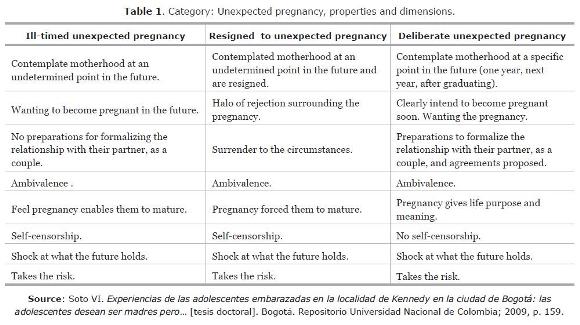
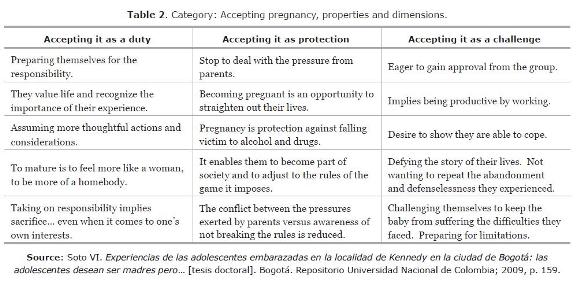
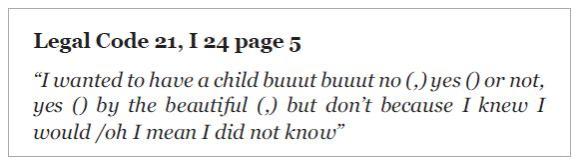
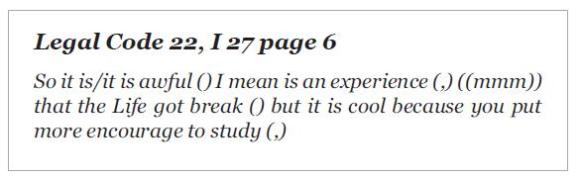
<body><![CDATA[<p><b>The design  framework</b> marks the transition from the conceptual to the empirical and, since  this subjective reality is unknown, it becomes an interpretive study (35).  Symbolic interactionism calls for fluid and dynamic processes with respect to  interpersonal relations in which meaning is created as a result of that  interaction, and where the assumption is that people construct their reality  through social interaction in which they use shared symbols (e.g. words,  clothing, gestures) to convey meaning. Accordingly, grounded theory (41) looks  at the meaning created in these social relationships, attempting to discover  how a group of pregnant teenagers defines the reality of their situation based  on their understanding of interpersonal interactions (22). </p>     <p>The  in-depth interview was the instrument selected to collect the information for  this study, based invariably on the premise that an interview is inevitably, at  some level, as personal and intimate a meeting as it is public (23). Thirty-one  in-depth interviews were conducted. Each lasted 50 minutes, on average, and  produced a wealth of information that amounted to 23 recorded hours. Scientific  rigor was ensured from the auditability (43) through periodic assessments on  committees tutorials. The credibility (44), collection of information took more  than 18 months; in addition, participants recognized their own experiences  through two focus groups.</p>     <p>Analysis  began once the interview was recorded and transcribed. The substantive codes  (39, 42) were identified; these are nothing more than the means by which  segments of sentences are recorded. Accompanied by the notes (40) that are  taken, they gave birth to construction of the categories, which are, in turn,  the concepts derived from the data (24) and represent the experiences of  pregnant teens in this particular context. Once a number of closely related  concepts began to accumulate, they were grouped according to their properties  and dimensions (24), which naturally were validated in each of the thirty-one  interviews. Seven categories emerged from this analysis. </p>     <p><b>Unexpected  pregnancy.</b> In their transition to adulthood, teenage girls believe they should  become mothers. In other words, they feed the need to assume a maternal role.  Having a baby makes them feel they have something of their own, someone who  depends solely on them. This is why the participants in the study admit to  having contemplated the possibility of motherhood at some point in the future.  Their stories show they equate motherhood with being an adult. Facing the  responsibility of an early pregnancy is seen as a way to achieve the  independence they long for. </p>     <p align="center"><img src="/img/revistas/aven/v28s1/ea02f1.jpg"></p>     <p>Of course,  because of that the very same transition, they go back and forth between being  a child and being an adult. This creates a great deal of uncertainty, making it  difficult for them to gauge the risks and consequences of an early pregnancy.  Recognizing the pregnancy is ill-timed, generates contradictory feelings and a  sense of loss, among other emotions. </p>     <p align="center"><img src="/img/revistas/aven/v28s1/ea02f2.jpg"></p>     <p>Here, it is  important to bring Mead into the equation. He sees the human experience as  essentially dynamic (19). Pregnancy experience is constructed on a temporary  and novel basis, not only with respect to the present, but to the past and  future as well. The future lies beyond the current pregnancy, and the pregnancy  unexpectedness&nbsp; is what makes it novel.  Pregnancy creates a future that comes as a surprise. </p>     <p>Another  dimension refers to an unexpected pregnancy that is met with resignation or is  the result of conjunctural conditions. Some pregnant teenagers acknowledged  their lack of preparation for pregnancy, accepting there is no alternative or  nothing that can be done. This acceptance state is one of resignation. It is as  if they are surrendering to the circumstances, and the experience is  accompanied by a halo of rejection, as pregnancy forces them to grow up.</p>     <p>A third  dimension of unexpected pregnancy becomes obvious when the participants  manifest acceptance that is more deliberate, inasmuch as they had contemplated motherhood  sometime in the future, had planned to formalize the relationship with their  partner, and had proposed certain arrangements or agreements concerning a  possible pregnancy (<a href="#t1">Table 1</a>).</p>     ]]></body>
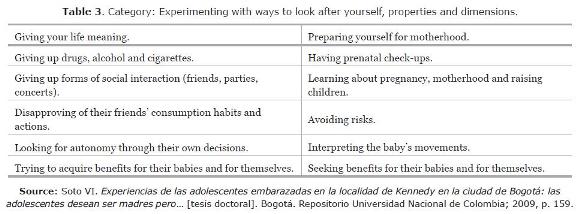
<body><![CDATA[<p align="center"><a name="t1"></a><img src="/img/revistas/aven/v28s1/ea02t1.jpg"></p>     <p>At this  point, it is important to emphasize that the concepts that qualify as  categories are abstractions and represent the life stories of all the teenagers  who took part in the study, reduced in conceptual terms and represented by them  (24). </p>     <p><b>The  category &quot;Accepting Pregnancy&quot;</b> is addressed, seeing as it is when teenagers  first give meaning to the experience and recognize it as an unavoidable  responsibility, one they may not be prepared for but cannot avoid, regardless  of whatever decision they make with respect to continuing the pregnancy. They  reveal having experienced thoughts and deeds aimed at avoiding disadvantages  for themselves and their babies. Pregnancy is recognized initially as a  situation that implies more responsibility, which they must assume. This  responsibility and maturity levels can be considered unusual for the  development stage in which these teenagers find themselves and, therefore,  should be used to advantage (25). They are willing to take on the motherhood  responsibility, but are still not specific about the difficulties they will  have to face. According, their course of life changes; they become more  conscious of the fact that someone will depend solely on them. </p>     <p>A second  variation of the properties in this category is evident when teenage girls  recognize this experience is an opportunity for help them to straighten out  their lives. It offers a kind of protection that helps them to integrate into  society and adjust to the rules it imposes. In this way, they think they can  avoid the conflict between peer pressure and the awareness of not having broken  society&rsquo;s rules. </p>     <p>Finally,  teenage girls acknowledge pregnancy as a way to prove themselves and to  demonstrate their abilities and potential to others. For them, taking on the  pregnancy challenge means they must work and be productive, to prosper with their  babies. One repeatedly hears the expression: &quot;so they can take care of  themselves&quot;. This could mean some of these girls were abandoned or neglected by  their parents. For this reason, they want a child, recognizing, of course,  their immaturity for the task, especially when they have to find work that will  give them enough income to achieve the goals they propose for themselves (<a href="#t2">Table  2</a>).</p>     <p align="center"><a name="t2"></a><img src="/img/revistas/aven/v28s1/ea02t2.jpg"></p>     <p><b>Experimenting  with ways to care for themselves:</b> this category reveals that teenagers  carefully examine their new identity as pregnant women and believe they cannot  do many of the things they did before becoming pregnant. They agree to exchange  some things for others, and associate responsibility with abandoning the ways  they had fun and interacted socially prior to the pregnancy. They claim to have  quit smoking and drinking, and stopped doing drugs, despite pressure from  friends or their partners, all for the sole purpose of protecting the baby. In  this case, it seems that pregnancy is an opportunity for more freedom and autonomy;  it is a positive change, besides being an interesting way to care for oneself.  A strategy that benefits them physically, mentally and socially. </p>     <p>Forsaking  certain habits and friends creates a feeling of strangeness; however, it does  not seem to be a feeling of loss. When listening again to the testimonies, one  finds that most of them contain no long silences, no substantial changes in  tone of voice, nor sobbing or crying. Giving up friends and social  relationships can be very painful, particularly when considering these two  aspects of adolescence can be more important and more intense than the  relationship teenagers have with their parents or relatives. </p>     <p>The  participants acknowledge they are getting ready for motherhood by having  regular medical check-ups, learning about pregnancy and preparing themselves  for child-raising through experiences with other children (<a href="#t3">Table 3</a>). </p>     <p align="center"><a name="t3"></a><img src="/img/revistas/aven/v28s1/ea02t3.jpg"></p>     ]]></body>
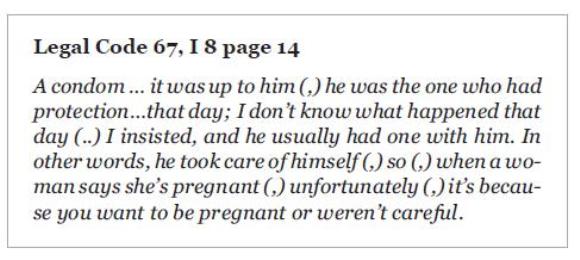
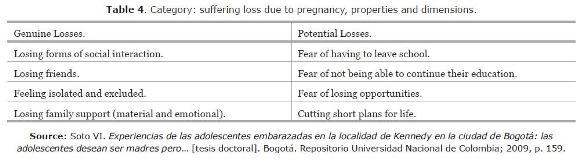
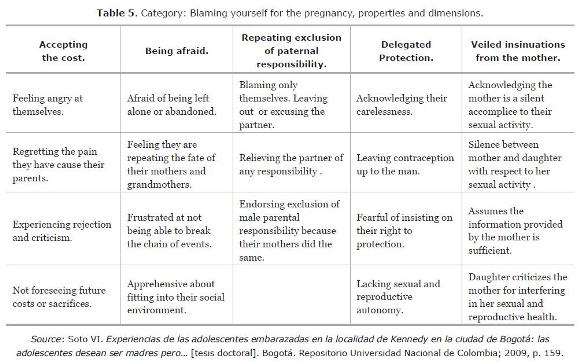
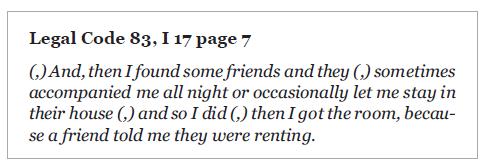
<body><![CDATA[<p>Suffering  loss due to pregnancy. For these teenage girls, experiencing real or even  potential loss is the price of continuing their pregnancy. They acknowledge  being forced to make decisions that are painful and full of disappointment.  These thoughts, which express suffering, are shaped by the form of social  interaction that occurs during this stage of development. At school, they  experience a greater loss when they feel rejected by their peers; it is a form  of social exclusion. Similar case occurs in the study of Whitehead (26),  reporting that teenagers succumb to the weight of social sanction and feel a  sense of social death (26). In addition, when these girls talk about their  lives, one detects expressions of loss when they emphasize how painful it is to  lose the support of the immediate family (parents, siblings). The loss of  emotional support is more significant than the loss of physical or material  support, and it creates added insecurity and low self-esteem (<a href="#t4">Table 4</a>). </p>     <p align="center"><a name="t4"></a><img src="/img/revistas/aven/v28s1/ea02t4.jpg"></p>     <p><b>Blaming  themselves for the pregnancy.</b> The use of expressions such as I felt, I  want-wanted, I had, I believe and to think is significant. They are repeated  from three to seven times in the testimonies and are accompanied by silence,  hesitation and changes in tone of voice. These expressions constitute part of  the basis for the construction of this category. The feeling is mediated  through a sense of grief. They acknowledge the suffering and disappointment  they have caused their loved ones. Most of these girls want to make sure they  do not fail and courageously grasp the consequences that lead them to assume  responsibility through a feeling of guilt. </p>     <p>The  dimensions in this category are significant. The first dimension concerns to  recognize they have broken the rules and feel they must pay the price. Their  conscience becomes more severe and sensitive to restrain aggression towards  others (27). The price includes being angry with themselves, the pain of having  disappointed their parents, the changes created in family dynamics, such as the  mother having to go to work to support the teenager and her unborn child, so as  to mitigate some of the tension generated by the father. In other cases, pain  is manifested when they realize they did not make better use of their  opportunities, such as access to education and the efforts of their parents to  provide what they need to attend school (clothing and school supplies). These tensions,  which generate guilt over having broken the rules, are associated with  rejection and blame. </p>     <p>The second  dimension deals with the harsh fear of being left alone with the responsibility  of a pregnancy, since that is the experience of the women around them such as  their mothers, sisters and friends. This reinterpretation heightens their  feeling of guilt. On the one hand, they knew the consequences; on the other,  they have disappointed their mothers, who had hoped their daughters would break  the chain of events in terms of having to assume a pregnancy alone.</p>     <p>The third  dimension becomes evident when the participants assume the pregnancy is their  fault and relieve the partner of any responsibility or even try to exempt him  of responsibility in a veiled way, particularly when they acknowledge the  existence and accessibility of means to avoid pregnancy. Relieving the sexual  partner of parental responsibility may be the result of what they have been  told by their grandmothers, mothers, aunts, older sisters or their friends who  ultimately were left alone to face the reality of pregnancy in a society where  they had broken the rules. It is valid to infer that the replication of  excluding or exempting the partner of paternal responsibility is almost  automatic among the participants. Ideas about the role sons and daughters must  play in society are conveyed to children early on, even in the womb, and are  based on the mother&rsquo;s way of thinking (the challenge is how nursing can help to  break this chain of events). </p>     <p>The fourth  dimension refers to the participants&rsquo; admission of not having made frequent and  disciplined use of condoms as a strategy to avoid pregnancy. They assume  responsibility for the pregnancy that resulted from failing to do so and blame  themselves. This feeling of guilt is aggravated when they admit their partner  was the one who used contraception and confess to having delegated ultimate  responsibility for contraception to the man. The perception is that these  teenagers do not take responsibility for their own care and are not positioned  to act autonomously with respect to their sexual and reproductive health.</p>     <p align="center"><img src="/img/revistas/aven/v28s1/ea02f3.jpg"></p>     <p>Finally, it  is clear that some participants were warned of the risk of pregnancy and admit  their mothers knew they were sexually active. Therefore, in their minds, having  the mother merely warn them to be careful about becoming pregnant seems  sufficient in itself. Some mothers try to talk about the use of family planning  methods, but in a veiled and shy way. Consequently, the explanation is not clear  enough for teenage girls to acquire any real self-determination with respect to  their sexual lives, much less to protect themselves and to plan properly. Some  of the testimonies are significant in that pregnant teenagers believe their  mothers have neither the criteria, nor the responsibility or the moral  authority to educate them and to give them the tools they need to manage their  sexual and reproductive health (<a href="#t5">Table 5</a>). </p>     <p align="center"><a name="t5"></a><img src="/img/revistas/aven/v28s1/ea02t5.jpg"></p>     ]]></body>
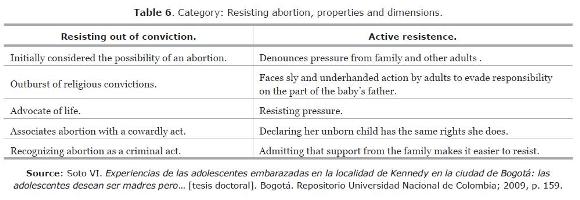
<body><![CDATA[<p>In this  respect, one wonders what happens with the sex education and health programs  offered in schools. What happens to the messages published in the press and  broadcast on radio and television about the use of condoms? </p>     <p><b>Resisting  abortion.</b> In these testimonies, one hears expressions such as I reacted, it  never occurred to me, I wouldn&rsquo;t be able to, it&rsquo;s illogical, they don&rsquo;t deserve  it, and so much pressure. The indication seems to be that girls somehow feel  capable of rejecting and opposing abortion as an unacceptable alternative.  Although abortion is associated with unwanted pregnancy, as noted by Mngadi  (28) and Drescher (17), the young women in this sample are able to assess the  harm that could come from trying to have an abortion. For example, they look on  abortion as a criminal act. They also suggest their unborn children should not  have to pay for their neglect with their lives, especially since they see their  unborn children equals. The participants in this study admit they initially  opposed abortion out of conviction. At first, perhaps because of the suddenness  of the experience, they see abortion as a way to deal with the tension  generated by an unexpected pregnancy. There also is an outburst of religious  beliefs, such as having the power to foster life, or believing God has sent  them a child so they can provide it with a better life than they had. They  claim to be defenders of life, recognizing the embryo is a person and declaring  abortion to be a cowardly and criminal act. These teenagers believe that, by  being mothers, they will not be alone and that motherhood may be the driving  force that enables them to achieve their goals. Therefore, they resist opting  for an abortion. </p>     <p>As for the  second dimension, the participants in this study mount strong resistance to any  kind of pressure. In some cases, it comes from the baby&rsquo;s father and is  influenced by a lack of security in terms of assuming paternal responsibility.  There also is pressure exercised aggressively by adults other than the parents  of the participants, as in the case of the partner&rsquo;s adult relatives, who may  attempt to exonerate or relieve him of any parental responsibility (<a href="#t6">Table 6</a>). </p>     <p align="center"><a name="t6"></a><img src="/img/revistas/aven/v28s1/ea02t6.jpg"></p>     <p><b>Rebuilding  support networks.</b> Almost all the participants reported having some type of  support when their primary network (parents) neglects to give them the support  they need. In such cases, teenage girls cling to their partners or their  mothers-in-law. In other cases, they take advantage of the support offered by  friends. </p>     <p align="center"><img src="/img/revistas/aven/v28s1/ea02f4.jpg"></p>     <p>Although  virtually all the participants acknowledge having some kind of support, it is  important to note that support is not always offered on acceptable terms with  respect to quality. Occasionally, an offer of support is accompanied by some  form of blackmail or conditioned in a way that implies increasing subordination  for these girls. One aspect that stands out in this category is that some  teenagers extol the support provided by the men around them (their sexual  partner and the girl&rsquo;s father). The father&rsquo;s support gives them a sense of  security they may not have experienced since early childhood. These forms of  interaction reflect an effort to rebuild relationships that perhaps were cut  short or ruined. On the one hand, this support helps to relieve a great deal of  the tension created by the experience of unexpected pregnancy; on the other, it  gives them tools to assume the pregnancy.</p>     <p><b>CENTRAL  CATEGORY</b></p>     <p>A central  category represents the main research topic. Its analytical power is based on  the ability to bring together all the categories to arrive at an explanation of  the whole (24). Ultimately, it focuses on interpreting the research topic and  identifying the main issues with respect to pregnant teenagers.     <br>   A process  that involves a series of sequential actions/interactions supports the  theoretical framework. These evolve and occur at a given time and place, and  change or sometimes remain the same in response to a situation or context (24). </p>     ]]></body>
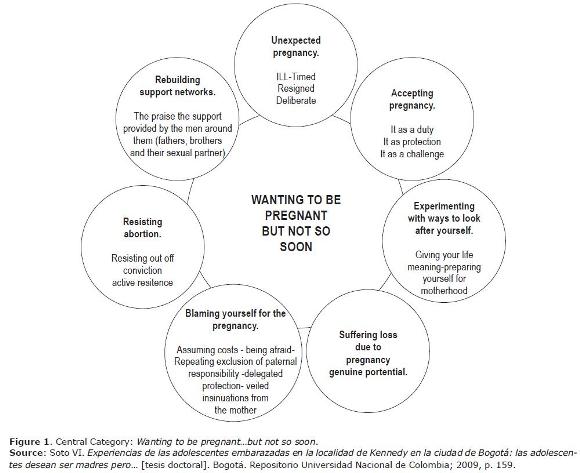
<body><![CDATA[<p>The process  is associated with the structure and aligned with the conditions surrounding  the actions/interactions. In other words, as they change they provide feedback  to the context and become part of the conditions that influence the next set of  actions/interactions (24). </p>     <p>The central  category, labeled Wanting to be pregnant&hellip; but not so soon,&nbsp; is the result of combining the seven  categories that emerged from the collected data (<a href="#f1">Figure 1</a>). Naturally, this  central category responds to the hypothesis that is expected to emerge from the  description of the pregnancy experience for these teens and an analysis of  their narratives, based on the data that emerged from the interviews (31).  Future research will very likely determine what parts of the concept &quot;Wanting  to be pregnant&hellip;but not so soon&quot; apply or are valid for other groups of pregnant  teenagers and what new concepts or hypotheses can be added to this initial  conceptualization, to construct a substantive theory that specifically  characterizes the phenomenon of teenage pregnancy.</p>     <p align="center"><a name="f1" id="f1"></a><img src="/img/revistas/aven/v28s1/ea02f5.jpg"></p>     <p>The central  category uses the invariable word &quot;but&quot; to oppose the concept &quot;wanting the  pregnancy&quot;. The concept &quot;not so soon&quot; is associated with the concept of time.  To contrast these two conditions it is important to note that in each of the  categories they are seen as expressions and emotions. Therefore, we start with  the concept of ambivalence as a highlight to show how the sequence of actions /  interactions evolves in response to the context of the experience of pregnancy  (30).</p>     <p>Ambivalence  is one of the most relevant concepts to properly observe and understand modern  and postmodern societies, a thorough understanding of problems that society  today lives (29). From the language, ambivalence is described as linguistic  correlate of the disorder, is deep sense of unease when unable to interpret the  situation and to choose among alternative courses of action (30). In addition,  ambivalence reveals when social consciousness arises that in all descriptions  of our language are inclusions and exclusions, constitutes structure and  disorder, establishing order and chaos (29). </p>     <p>That  disorder evidenced in the pregnant teenagers for the constant use of  expressions such as: &quot; accident,&quot; &quot;anger,&quot; &quot;did not have basis,&quot; &quot;not  much,&quot; &quot;not so,&quot; &quot;fear,&quot; &quot;believe,&quot; &quot;you cannot do anything,&quot;  &quot;assimilated,&quot; &quot;support,&quot; and of course &quot;but&quot;&ndash;experience recharged. Conflicting  feelings such as anxiety and fear by recognizing not being ready and at the same  time, feeling that was the opportunity that allowed them to mature. </p>     <p>When  teenagers express feelings clashing between them, allow to support the first  part of the central category Wanting pregnancy but&hellip;, through the categories  &quot;Unexpected pregnancy&quot; with different variations in inopportuneness,  resignation and deliberation, contemplating the desire for motherhood, running  the risk and being surprised at facing an uncertain future, and Accepting the  pregnancy, variations in accepting it as a duty that implies sacrifice. Even  when it comes to themselves as a protective strategy that enables them to get  their lives on track by avoiding alcohol and drugs, and as a challenge, defying  the story of their lives in the sense of not wanting to repeat the abandonment  and vulnerability experienced and, at the same time, preparing themselves for  limitations. </p>     <p>Following  with this inclusions and exclusions theme, the categories related with the  consequences of continuing pregnancy emerge to support the second part of the  central category &hellip;.Not so soon. Including time: Losses due to pregnancy vary  between real and potential ones. Blaming themselves for the pregnancy as a  side-effect of individualization Ways to take care of oneself: theory of  distinction in relation to action. </p>     <p>Finally,  Ambivalence is the driving force including the categories Resisting abortion  given by religious and moral convictions and Support networks: provide comfort  and relief. </p>     <p><b>CONCLUSIONS</b></p>     ]]></body>
<body><![CDATA[<p>The central  category represents the main research topic and the proposed hypothesis, based  on a process involving the actions/interactions of pregnant teens. The pregnant  teenagers mother&acute;s were aware their daughters had become sexually&nbsp; active, but chose to ignore the fact. The  pregnant teenagers acknowledge having delegated ultimate responsibility for  contraception to the man. The pregnant teenagers have limited autonomy with  respect to their sexual and reproductive health.</p>     <p>During  pregnancy, they absolve their sexual partner of any responsibility and even  excuse him in a veiled or indirect way. They repeat the fate of women close to  them, perhaps through oral transmission. </p>     <p>Challenge:  how can nursing break this chain of events? </p>     <p>The  physical changes during pregnancy are NOT significant. The important changes  are social. They do not acknowledge or understand their bodies. A high  proportion of teenagers (21%) are in their second pregnancy. Relationship with  the father&ndash;pregnant teenager becomes more steady and established.&ndash;Room for  nursing intervention.</p>     <p><b>CONTRIBUTIONS</b></p>     <p>Discipline:  transform care from the traditional and standardized approach. A complex  reality with no answer demands alternative solutions that include the context.</p>     <p>Practice:  strategies for care related to social construction in function of the  pregnancy. Need for schools to hire nurses who are experienced in working with  teens. Urgently calls for innovative strategies to provide individualized and  contextualized care and offer a model of nursing care for mothers and their  teenage daughters</p>     <p>Research:  on the epistemological debate to understand what the situation is like for  pregnant teens. Replicate in future research for a more in-depth understanding  of other similar groups.</p><hr size="1">     <p><b>REFERENCES</b>    <br>       ]]></body>
<body><![CDATA[<!-- ref --><br>   (1)  Pulido S,  Saldarriaga I, Escobar M. Proyecto educativo: Maternidad-paternidad como  proyecto de vida de los adolescentes. Investigaci&oacute;n educaci&oacute;n en enfermer&iacute;a.  1998; 16(2): 89-107.&nbsp;&nbsp;&nbsp;&nbsp;&nbsp;&nbsp;&nbsp;&nbsp;[&#160;<a href="javascript:void(0);" onclick="javascript: window.open('/scielo.php?script=sci_nlinks&ref=000093&pid=S0121-4500201000030000200001&lng=','','width=640,height=500,resizable=yes,scrollbars=1,menubar=yes,');">Links</a>&#160;]<!-- end-ref --><!-- ref --><p>(2)&nbsp;  Issler JR.  Embarazo en la adolescencia. Revista de Posgrado de la C&aacute;tedra VI la Medicina. 2001; 107:  11-23. &#91;Consultado 8 de abril de 2006&#93;. Disponible en <a href="http://www.pediatria.org.ec/%20bvs/2007/8.2.2007_full.pdf" target="_self">http://www.pediatria.org.ec/  bvs/2007/8.2.2007_full.pdf</a>.&nbsp;&nbsp;&nbsp;&nbsp;&nbsp;&nbsp;&nbsp;&nbsp;[&#160;<a href="javascript:void(0);" onclick="javascript: window.open('/scielo.php?script=sci_nlinks&ref=000094&pid=S0121-4500201000030000200002&lng=','','width=640,height=500,resizable=yes,scrollbars=1,menubar=yes,');">Links</a>&#160;]<!-- end-ref --><!-- ref --><p>(3)  Organizaci&oacute;n  Panamericana de la Salud  y Centro Latinoamericano de Perinatolog&iacute;a. &#91;Consultado el 10 de abril de 2009&#93;.  En: <a href="http://www.clap.ops-oms.org/web_2005/estadisticas%25%2020de%20la%20region/textos/e35%2068%20Embarazo%20%20Adolescente.htm" target="_blank">http://www.clap.ops-oms.org/web_2005/estadisticas% 20de%20la%20region/textos/e35%2068%20Embarazo%20  Adolescente.htm</a>.&nbsp;&nbsp;&nbsp;&nbsp;&nbsp;&nbsp;&nbsp;&nbsp;[&#160;<a href="javascript:void(0);" onclick="javascript: window.open('/scielo.php?script=sci_nlinks&ref=000095&pid=S0121-4500201000030000200003&lng=','','width=640,height=500,resizable=yes,scrollbars=1,menubar=yes,');">Links</a>&#160;]<!-- end-ref --><!-- ref --><p>(4) Embarazos en  j&oacute;venes, Bogot&aacute; se acerca a Uganda. El Tiempo, s&aacute;bado 16 de junio de 2007.  &#91;Consultado el 2 de febrero de 2009&#93;. En: <a href="http://www.eltiempo.com/archivo/documento">http://www.eltiempo.com/archivo/documento</a>.&nbsp;&nbsp;&nbsp;&nbsp;&nbsp;&nbsp;&nbsp;&nbsp;[&#160;<a href="javascript:void(0);" onclick="javascript: window.open('/scielo.php?script=sci_nlinks&ref=000096&pid=S0121-4500201000030000200004&lng=','','width=640,height=500,resizable=yes,scrollbars=1,menubar=yes,');">Links</a>&#160;]<!-- end-ref --><!-- ref --><p>(5) Sim&otilde;es da Silva A et al. Characteristics of adolescent  pregnancy in S&atilde;o Luis. Maranh&atilde;o, Brazil. Revista de Sa&uacute;de P&uacute;blica 2003  &#91;consultado el 30 de marzo de 2006&#93; 37(5): 559-65.. En: <a href="http://www.fsp.usp.br/rsp" target="_blank">http://www.fsp.usp.br/rsp</a>&nbsp;&nbsp;&nbsp;&nbsp;&nbsp;&nbsp;&nbsp;&nbsp;[&#160;<a href="javascript:void(0);" onclick="javascript: window.open('/scielo.php?script=sci_nlinks&ref=000097&pid=S0121-4500201000030000200005&lng=','','width=640,height=500,resizable=yes,scrollbars=1,menubar=yes,');">Links</a>&#160;]<!-- end-ref --><!-- ref --><p>(6) Conde AA, Beltran JM, Lammers C.  Maternal-perinatal morbidity and mortality associated with adolescent pregnancy  in Latin America: Cross-sectional study. American Journal of Obstetrics and  Gynecology. 2005; 192(2): 342-49.&nbsp;&nbsp;&nbsp;&nbsp;&nbsp;&nbsp;&nbsp;&nbsp;[&#160;<a href="javascript:void(0);" onclick="javascript: window.open('/scielo.php?script=sci_nlinks&ref=000098&pid=S0121-4500201000030000200006&lng=','','width=640,height=500,resizable=yes,scrollbars=1,menubar=yes,');">Links</a>&#160;]<!-- end-ref --><!-- ref --><p>(7) Eure C, Lindsay M, Graves W. Risk of  adverse pregnancy outcomes in young adolescent parturients in an inner-city  hospital. American Journal of Obstetrics and Gynecology. 2002; 186(5): 918-20.&nbsp;&nbsp;&nbsp;&nbsp;&nbsp;&nbsp;&nbsp;&nbsp;[&#160;<a href="javascript:void(0);" onclick="javascript: window.open('/scielo.php?script=sci_nlinks&ref=000099&pid=S0121-4500201000030000200007&lng=','','width=640,height=500,resizable=yes,scrollbars=1,menubar=yes,');">Links</a>&#160;]<!-- end-ref --><!-- ref --><p>(8) Bacon J. Adolescent sexuality and  pregnancy. Current Opinion in Obstetrics and Gynecology. 2000; 12(5): 345-47.&nbsp;&nbsp;&nbsp;&nbsp;&nbsp;&nbsp;&nbsp;&nbsp;[&#160;<a href="javascript:void(0);" onclick="javascript: window.open('/scielo.php?script=sci_nlinks&ref=000100&pid=S0121-4500201000030000200008&lng=','','width=640,height=500,resizable=yes,scrollbars=1,menubar=yes,');">Links</a>&#160;]<!-- end-ref --><!-- ref --><p>(9) Lenders C et al. Nutrition in adolescent  pregnancy. Current Opinion in Pediatrics. 2000; 12(3): 291-96&nbsp;&nbsp;&nbsp;&nbsp;&nbsp;&nbsp;&nbsp;&nbsp;[&#160;<a href="javascript:void(0);" onclick="javascript: window.open('/scielo.php?script=sci_nlinks&ref=000101&pid=S0121-4500201000030000200009&lng=','','width=640,height=500,resizable=yes,scrollbars=1,menubar=yes,');">Links</a>&#160;]<!-- end-ref --><!-- ref --><p>(10) Olausson P, Cnattingius S, Haglund B.  Teenage pregnancies and risk of late fetal death and infant mortality.  Obstetrical &amp; Gynecological Survey. 1999; 54(8): 484-85.&nbsp;&nbsp;&nbsp;&nbsp;&nbsp;&nbsp;&nbsp;&nbsp;[&#160;<a href="javascript:void(0);" onclick="javascript: window.open('/scielo.php?script=sci_nlinks&ref=000102&pid=S0121-4500201000030000200010&lng=','','width=640,height=500,resizable=yes,scrollbars=1,menubar=yes,');">Links</a>&#160;]<!-- end-ref --><!-- ref --><p>(11) Foster H Jr. et al. Teen pregnancy-problems  and approaches: Panel presentations. American Journal of Obstetrics and  Gynecology. 1999; 181 (Suppl 1): 32-6. &nbsp;&nbsp;&nbsp;&nbsp;&nbsp;&nbsp;&nbsp;&nbsp;[&#160;<a href="javascript:void(0);" onclick="javascript: window.open('/scielo.php?script=sci_nlinks&ref=000103&pid=S0121-4500201000030000200011&lng=','','width=640,height=500,resizable=yes,scrollbars=1,menubar=yes,');">Links</a>&#160;]<!-- end-ref --><!-- ref --><p>(12) Merritt V. Young, Poor, and pregnant: The psychology of teenage motherhood. Journal  of the American Academy of Child &amp; Adolescent Psychiatry. 1996;  35(2):256-57.&nbsp;&nbsp;&nbsp;&nbsp;&nbsp;&nbsp;&nbsp;&nbsp;[&#160;<a href="javascript:void(0);" onclick="javascript: window.open('/scielo.php?script=sci_nlinks&ref=000104&pid=S0121-4500201000030000200012&lng=','','width=640,height=500,resizable=yes,scrollbars=1,menubar=yes,');">Links</a>&#160;]<!-- end-ref --><!-- ref --><p>(13) Ministerio de la Protecci&oacute;n Social,  Direcci&oacute;n General de Salud P&uacute;blica. Pol&iacute;tica Nacional de salud sexual y  reproductiva; 2003. &#91;Consultado el 23 de julio de 2008&#93;. En:<a href="http://%20www.minproteccionsocial.gov.co/acercaMinisterio/Paginas/%20Pol&#195;ADticasformuladasporelMinisteriodelaProtecci&#195;%20&#179;nSocial.aspx" target="_blank">http://  www.minproteccionsocial.gov.co/acercaMinisterio/Paginas/  Pol%C3ADticasformuladasporelMinisteriodelaProtecci%C3 %B3nSocial.aspx</a>.&nbsp;&nbsp;&nbsp;&nbsp;&nbsp;&nbsp;&nbsp;&nbsp;[&#160;<a href="javascript:void(0);" onclick="javascript: window.open('/scielo.php?script=sci_nlinks&ref=000105&pid=S0121-4500201000030000200013&lng=','','width=640,height=500,resizable=yes,scrollbars=1,menubar=yes,');">Links</a>&#160;]<!-- end-ref --><!-- ref --><p>(14) Feldmann J, Middleman A. Adolescent  sexuality and sexual behavior. Current Opinion in Obstetrics and Gynecology.  2002; 14(5) 489-93.&nbsp;&nbsp;&nbsp;&nbsp;&nbsp;&nbsp;&nbsp;&nbsp;[&#160;<a href="javascript:void(0);" onclick="javascript: window.open('/scielo.php?script=sci_nlinks&ref=000106&pid=S0121-4500201000030000200014&lng=','','width=640,height=500,resizable=yes,scrollbars=1,menubar=yes,');">Links</a>&#160;]<!-- end-ref --><!-- ref --><p>(15) Foster H Jr, Keynote address: Taming the  tempest of teen pregnancy. American Journal of Obstetrics and Gynecology.  Julio, 1999; 181 (Suppl 1): 28-31. &nbsp;&nbsp;&nbsp;&nbsp;&nbsp;&nbsp;&nbsp;&nbsp;[&#160;<a href="javascript:void(0);" onclick="javascript: window.open('/scielo.php?script=sci_nlinks&ref=000107&pid=S0121-4500201000030000200015&lng=','','width=640,height=500,resizable=yes,scrollbars=1,menubar=yes,');">Links</a>&#160;]<!-- end-ref --><!-- ref --><p>(16) Hogan DP, Sun R, Cornwell GT. Sexual and  fertility behaviors of American females aged 15-19 years: 1985, 1990, and 1995.  American of Journal Public Health. 2000; 90(9): 1421-1425&nbsp;&nbsp;&nbsp;&nbsp;&nbsp;&nbsp;&nbsp;&nbsp;[&#160;<a href="javascript:void(0);" onclick="javascript: window.open('/scielo.php?script=sci_nlinks&ref=000108&pid=S0121-4500201000030000200016&lng=','','width=640,height=500,resizable=yes,scrollbars=1,menubar=yes,');">Links</a>&#160;]<!-- end-ref --><!-- ref --><p>(17) Drescher KM, Monga M, Williams P.  Promecene-Cook, P, Schneider K. Perceived quality of life in pregnant  adolescent girls. American Journal of Obstetrics and Gynecology. 2003; 188(5):  1231-1233.&nbsp;&nbsp;&nbsp;&nbsp;&nbsp;&nbsp;&nbsp;&nbsp;[&#160;<a href="javascript:void(0);" onclick="javascript: window.open('/scielo.php?script=sci_nlinks&ref=000109&pid=S0121-4500201000030000200017&lng=','','width=640,height=500,resizable=yes,scrollbars=1,menubar=yes,');">Links</a>&#160;]<!-- end-ref --><!-- ref --><p>(18) Omar H, Richard J. Cultural sensitivity in  providing reproductive care to adolescents. Current Opinion in Obstetrics and  Gynecology. 2004; 16(5): 367-70.&nbsp;&nbsp;&nbsp;&nbsp;&nbsp;&nbsp;&nbsp;&nbsp;[&#160;<a href="javascript:void(0);" onclick="javascript: window.open('/scielo.php?script=sci_nlinks&ref=000110&pid=S0121-4500201000030000200018&lng=','','width=640,height=500,resizable=yes,scrollbars=1,menubar=yes,');">Links</a>&#160;]<!-- end-ref --><!-- ref --><p>(19) Meed GH. Movements of thought in the  nineteenth century. In: Moore M H. editor. Reed Book. The Internet encyclopedia  of philosophy. Chicago. 2007. &#91;consultado el 30 de abril de 2008&#93;. En:  <a href="http://www.iep.utm.edu/1/about.htm" target="_blank">http://www.iep.utm.edu/1/about.htm</a> Chicago. &nbsp;&nbsp;&nbsp;&nbsp;&nbsp;&nbsp;&nbsp;&nbsp;[&#160;<a href="javascript:void(0);" onclick="javascript: window.open('/scielo.php?script=sci_nlinks&ref=000111&pid=S0121-4500201000030000200019&lng=','','width=640,height=500,resizable=yes,scrollbars=1,menubar=yes,');">Links</a>&#160;]<!-- end-ref --><!-- ref --><p>(20) Miranda M.  Pragmatismo, interaccionismo simb&oacute;lico y trabajo social. De c&oacute;mo la caridad y  la filantrop&iacute;a se hicieron cient&iacute;ficas. (Tesis doctoral). Tarragona.  Universitat Rovira i Virgili; 2003.&nbsp;&nbsp;&nbsp;&nbsp;&nbsp;&nbsp;&nbsp;&nbsp;[&#160;<a href="javascript:void(0);" onclick="javascript: window.open('/scielo.php?script=sci_nlinks&ref=000112&pid=S0121-4500201000030000200020&lng=','','width=640,height=500,resizable=yes,scrollbars=1,menubar=yes,');">Links</a>&#160;]<!-- end-ref --><!-- ref --><p>(21) Reposo A,  Valencia M. Actitudes posmodernas frente al positivismo. Consecuencias  metodol&oacute;gicas. Dise&ntilde;o Urbano y Paisaje. 2004; 1(2): 21-42. &#91;Consultado el 8 de  abril de 2009&#93;. En <a href="http://www.ucentral.cl/Sitio%20web%202003/%20Revista%25%2020Farq/02.htm" target="_blank">http://www.ucentral.cl/Sitio%20web%202003/ Revista%  20Farq/02.htm</a>&nbsp;&nbsp;&nbsp;&nbsp;&nbsp;&nbsp;&nbsp;&nbsp;[&#160;<a href="javascript:void(0);" onclick="javascript: window.open('/scielo.php?script=sci_nlinks&ref=000113&pid=S0121-4500201000030000200021&lng=','','width=640,height=500,resizable=yes,scrollbars=1,menubar=yes,');">Links</a>&#160;]<!-- end-ref --><!-- ref --><p>(22) Fassinger Ruth E. Paradigms, Praxis,  Problems, and promise: Grounded theory in counseling psychology research. Journal of Counseling Psychology.  2005; 52(2) 156-66.&nbsp;&nbsp;&nbsp;&nbsp;&nbsp;&nbsp;&nbsp;&nbsp;[&#160;<a href="javascript:void(0);" onclick="javascript: window.open('/scielo.php?script=sci_nlinks&ref=000114&pid=S0121-4500201000030000200022&lng=','','width=640,height=500,resizable=yes,scrollbars=1,menubar=yes,');">Links</a>&#160;]<!-- end-ref --><!-- ref --><p>(23) Banister P, Burman E, Parker I, Taylor M.  M&eacute;todos cualitativos en Sociolog&iacute;a. Una gu&iacute;a para la investigaci&oacute;n.  Guadalajara. Universidad de Guadalajara, centro Universitario de Ciencias de la Salud; 2004. &nbsp;&nbsp;&nbsp;&nbsp;&nbsp;&nbsp;&nbsp;&nbsp;[&#160;<a href="javascript:void(0);" onclick="javascript: window.open('/scielo.php?script=sci_nlinks&ref=000115&pid=S0121-4500201000030000200023&lng=','','width=640,height=500,resizable=yes,scrollbars=1,menubar=yes,');">Links</a>&#160;]<!-- end-ref --><!-- ref --><p>(24) Strauss A,  Corbin J. Bases de la investigaci&oacute;n cualitativa, t&eacute;cnicas y procedimientos para  desarrollar la teor&iacute;a fundamentada. Medell&iacute;n. Universidad de Antioquia. 2002. &nbsp;&nbsp;&nbsp;&nbsp;&nbsp;&nbsp;&nbsp;&nbsp;[&#160;<a href="javascript:void(0);" onclick="javascript: window.open('/scielo.php?script=sci_nlinks&ref=000116&pid=S0121-4500201000030000200024&lng=','','width=640,height=500,resizable=yes,scrollbars=1,menubar=yes,');">Links</a>&#160;]<!-- end-ref --><!-- ref --><p>(25) Rentschler D. Pregnant adolescents'  perspectives of pregnancy. American Journal of Maternal Child Nursing. 2003;  28(6): 377-383.&nbsp;&nbsp;&nbsp;&nbsp;&nbsp;&nbsp;&nbsp;&nbsp;[&#160;<a href="javascript:void(0);" onclick="javascript: window.open('/scielo.php?script=sci_nlinks&ref=000117&pid=S0121-4500201000030000200025&lng=','','width=640,height=500,resizable=yes,scrollbars=1,menubar=yes,');">Links</a>&#160;]<!-- end-ref --><!-- ref --><p>(26) Whitehead E. Teenage pregnancy: On the road  to social death. International Journal of Nursing Studies. 2001; 38(4):  437-446. &#91;Consultado el 20 de abril de 2005&#93;. En: <a href="http://www.%20ncbi.nlm.nih.gov/sites/entrez" target="_blank">http://www.ncbi.nlm.nih.gov/sites/entrez</a>. &nbsp;&nbsp;&nbsp;&nbsp;&nbsp;&nbsp;&nbsp;&nbsp;[&#160;<a href="javascript:void(0);" onclick="javascript: window.open('/scielo.php?script=sci_nlinks&ref=000118&pid=S0121-4500201000030000200026&lng=','','width=640,height=500,resizable=yes,scrollbars=1,menubar=yes,');">Links</a>&#160;]<!-- end-ref --><!-- ref --><p>(27) Freud S. Civilization and its discontents. En:  Garland D. Castigo y sociedad moderna un estudio de teor&iacute;a social. Barcelona. XXI editores; 1999. &nbsp;&nbsp;&nbsp;&nbsp;&nbsp;&nbsp;&nbsp;&nbsp;[&#160;<a href="javascript:void(0);" onclick="javascript: window.open('/scielo.php?script=sci_nlinks&ref=000119&pid=S0121-4500201000030000200027&lng=','','width=640,height=500,resizable=yes,scrollbars=1,menubar=yes,');">Links</a>&#160;]<!-- end-ref --><!-- ref --><p>(28) Mngadi P, et al. Quality of maternity care  for adolescent mothers in Mbabane, Swaziland. International Nursing  Review. 2002; 49(1): 38-46.&nbsp;&nbsp;&nbsp;&nbsp;&nbsp;&nbsp;&nbsp;&nbsp;[&#160;<a href="javascript:void(0);" onclick="javascript: window.open('/scielo.php?script=sci_nlinks&ref=000120&pid=S0121-4500201000030000200028&lng=','','width=640,height=500,resizable=yes,scrollbars=1,menubar=yes,');">Links</a>&#160;]<!-- end-ref --><!-- ref --><p>(29) Bauman Z. El  concepto de la ambivalencia y la metodolog&iacute;a de las distinciones. En: Beriain  J; Iturrate J. editores. Para comprender la teor&iacute;a sociol&oacute;gica; 1998. &nbsp;&nbsp;&nbsp;&nbsp;&nbsp;&nbsp;&nbsp;&nbsp;[&#160;<a href="javascript:void(0);" onclick="javascript: window.open('/scielo.php?script=sci_nlinks&ref=000121&pid=S0121-4500201000030000200029&lng=','','width=640,height=500,resizable=yes,scrollbars=1,menubar=yes,');">Links</a>&#160;]<!-- end-ref --><!-- ref --><p>(30) Bauman Z.  Modernidad y ambivalencia. En: Beriain J. compilador. Las consecuencias perversas  de la modernidad. Barcelona: Anthropos; 1996, pp. 73-119.&nbsp;&nbsp;&nbsp;&nbsp;&nbsp;&nbsp;&nbsp;&nbsp;[&#160;<a href="javascript:void(0);" onclick="javascript: window.open('/scielo.php?script=sci_nlinks&ref=000122&pid=S0121-4500201000030000200030&lng=','','width=640,height=500,resizable=yes,scrollbars=1,menubar=yes,');">Links</a>&#160;]<!-- end-ref --><!-- ref --><p>(31) Soto VI.  Experiencias de las adolescentes embarazadas en la localidad de Kennedy en la  ciudad de Bogot&aacute;: las adolescentes desean ser madres pero... &#91;tesis doctoral&#93;.  Bogot&aacute;. Repositorio Universidad Nacional de Colombia; 2009, p. 159.&nbsp;&nbsp;&nbsp;&nbsp;&nbsp;&nbsp;&nbsp;&nbsp;[&#160;<a href="javascript:void(0);" onclick="javascript: window.open('/scielo.php?script=sci_nlinks&ref=000123&pid=S0121-4500201000030000200031&lng=','','width=640,height=500,resizable=yes,scrollbars=1,menubar=yes,');">Links</a>&#160;]<!-- end-ref --><!-- ref --><p>(32) Husserl E.  Ideas relativas a una fenomenolog&iacute;a pura y una filosof&iacute;a fenomenol&oacute;gica. 2.a ed. M&eacute;xico. Fondo de Cultura  Econ&oacute;mica; 1993. &nbsp;&nbsp;&nbsp;&nbsp;&nbsp;&nbsp;&nbsp;&nbsp;[&#160;<a href="javascript:void(0);" onclick="javascript: window.open('/scielo.php?script=sci_nlinks&ref=000124&pid=S0121-4500201000030000200032&lng=','','width=640,height=500,resizable=yes,scrollbars=1,menubar=yes,');">Links</a>&#160;]<!-- end-ref --><!-- ref --><p>(33) Simmons H. Philosophic and scientific  inquiry: The interface. En: Kikuchi J, Simmons H. Philosophic inquiry in  nursing. Newbury Park, SAGE Publications; 1992, pp. 9-25.&nbsp;&nbsp;&nbsp;&nbsp;&nbsp;&nbsp;&nbsp;&nbsp;[&#160;<a href="javascript:void(0);" onclick="javascript: window.open('/scielo.php?script=sci_nlinks&ref=000125&pid=S0121-4500201000030000200033&lng=','','width=640,height=500,resizable=yes,scrollbars=1,menubar=yes,');">Links</a>&#160;]<!-- end-ref --><!-- ref --><p>(34) Caru A, Cova. Revisiting Consumption  Experience: A More Humble but Complete View of the concept. Marketing  Theory. 2003; 3(2), 269. &#91;Consultado el 15 de junio de 2008&#93; En:  <a href="http://www.sagepublications.com" target="_blank">http://www.sagepublications.com</a>.&nbsp;&nbsp;&nbsp;&nbsp;&nbsp;&nbsp;&nbsp;&nbsp;[&#160;<a href="javascript:void(0);" onclick="javascript: window.open('/scielo.php?script=sci_nlinks&ref=000126&pid=S0121-4500201000030000200034&lng=','','width=640,height=500,resizable=yes,scrollbars=1,menubar=yes,');">Links</a>&#160;]<!-- end-ref --><!-- ref --><p>(35) Monti E, Tingen M. Multiple paradigms of  nursing science. Advances in Nursing Science. 1999; 21(4): 64-80.&nbsp;&nbsp;&nbsp;&nbsp;&nbsp;&nbsp;&nbsp;&nbsp;[&#160;<a href="javascript:void(0);" onclick="javascript: window.open('/scielo.php?script=sci_nlinks&ref=000127&pid=S0121-4500201000030000200035&lng=','','width=640,height=500,resizable=yes,scrollbars=1,menubar=yes,');">Links</a>&#160;]<!-- end-ref --><!-- ref --><p>(36) Blumer H. Symbolic interactionism as  defined by Herbert Blumer. The Society for More Creative Speech, 1996.  &#91;consultado el 15 de marzo de 2007&#93;. En: <a href="http://www.cdharris.net/text/blumer.html" target="_blank">http://www.cdharris.net/text/blumer.html</a>.&nbsp;&nbsp;&nbsp;&nbsp;&nbsp;&nbsp;&nbsp;&nbsp;[&#160;<a href="javascript:void(0);" onclick="javascript: window.open('/scielo.php?script=sci_nlinks&ref=000128&pid=S0121-4500201000030000200036&lng=','','width=640,height=500,resizable=yes,scrollbars=1,menubar=yes,');">Links</a>&#160;]<!-- end-ref --><!-- ref --><p>(37) Blumer H.  Interaccionismo simb&oacute;lico: perspectiva y m&eacute;todo. Berkeley. University of California Press; 1982.  Citado por Miranda, p. 260.&nbsp;&nbsp;&nbsp;&nbsp;&nbsp;&nbsp;&nbsp;&nbsp;[&#160;<a href="javascript:void(0);" onclick="javascript: window.open('/scielo.php?script=sci_nlinks&ref=000129&pid=S0121-4500201000030000200037&lng=','','width=640,height=500,resizable=yes,scrollbars=1,menubar=yes,');">Links</a>&#160;]<!-- end-ref --><!-- ref --><p>(38) Joas H.  Interaccionismo simb&oacute;lico. En: Giddens A, Turner, J, et al. La teor&iacute;a social  hoy. Barcelona: Alianza  Editorial; 1990, p. 117. &nbsp;&nbsp;&nbsp;&nbsp;&nbsp;&nbsp;&nbsp;&nbsp;[&#160;<a href="javascript:void(0);" onclick="javascript: window.open('/scielo.php?script=sci_nlinks&ref=000130&pid=S0121-4500201000030000200038&lng=','','width=640,height=500,resizable=yes,scrollbars=1,menubar=yes,');">Links</a>&#160;]<!-- end-ref --><!-- ref --><p>(39) Charmaz K. Constructing grounded theory. London. Sage Publications; 2006. &nbsp;&nbsp;&nbsp;&nbsp;&nbsp;&nbsp;&nbsp;&nbsp;[&#160;<a href="javascript:void(0);" onclick="javascript: window.open('/scielo.php?script=sci_nlinks&ref=000131&pid=S0121-4500201000030000200039&lng=','','width=640,height=500,resizable=yes,scrollbars=1,menubar=yes,');">Links</a>&#160;]<!-- end-ref --><!-- ref --><p>(40) Hutchinson S. Grounded theory: The method.  En: Munhall P, Oiler C. Nursing Research. A qualitative perspective.  Connecticut. Appleton-C; 1986, pp. 111-30. &nbsp;&nbsp;&nbsp;&nbsp;&nbsp;&nbsp;&nbsp;&nbsp;[&#160;<a href="javascript:void(0);" onclick="javascript: window.open('/scielo.php?script=sci_nlinks&ref=000132&pid=S0121-4500201000030000200040&lng=','','width=640,height=500,resizable=yes,scrollbars=1,menubar=yes,');">Links</a>&#160;]<!-- end-ref --><!-- ref --><p>(41) Chenitz C, S.. Qualitative research using  grounded theory. En: Chenitz C, S. From Practice to Grounded Theory.  Qualitative research in nursing. California. Addison Wesley Publishing Company;  1946, pp. 3-15.&nbsp;&nbsp;&nbsp;&nbsp;&nbsp;&nbsp;&nbsp;&nbsp;[&#160;<a href="javascript:void(0);" onclick="javascript: window.open('/scielo.php?script=sci_nlinks&ref=000133&pid=S0121-4500201000030000200041&lng=','','width=640,height=500,resizable=yes,scrollbars=1,menubar=yes,');">Links</a>&#160;]<!-- end-ref --><!-- ref --><p>(42) Goulding C. Grounded theory: A practical  guide for management, Business and market researchers. London. Sage  Publications; 2002.&nbsp;&nbsp;&nbsp;&nbsp;&nbsp;&nbsp;&nbsp;&nbsp;[&#160;<a href="javascript:void(0);" onclick="javascript: window.open('/scielo.php?script=sci_nlinks&ref=000134&pid=S0121-4500201000030000200042&lng=','','width=640,height=500,resizable=yes,scrollbars=1,menubar=yes,');">Links</a>&#160;]<!-- end-ref --><!-- ref --><p>(43) Strubert H, Carpenter D. Qualitative  research in nursing. Advancing the humanistic imperative. 2.a ed. Philadelphia. Lippincott; 1999, p.  331. &nbsp;&nbsp;&nbsp;&nbsp;&nbsp;&nbsp;&nbsp;&nbsp;[&#160;<a href="javascript:void(0);" onclick="javascript: window.open('/scielo.php?script=sci_nlinks&ref=000135&pid=S0121-4500201000030000200043&lng=','','width=640,height=500,resizable=yes,scrollbars=1,menubar=yes,');">Links</a>&#160;]<!-- end-ref --><!-- ref --><p>(44) Trentini  M, Paim L.. Pesquisa convergente assistencial: um desenho que une o fazer e o  pensar na pr&aacute;tica assistencial em sa&uacute;de-enfermagem. 2 ed. Insular. Citado por  Mota MF. Cuidado humaniza no pr&egrave;-natal: Um olhar para al&eacute;m das diverg&ecirc;ncias e  converg&ecirc;ncias. Universidad Federal de Santa Catarina; 2006, p.  209.&nbsp;&nbsp;&nbsp;&nbsp;&nbsp;&nbsp;&nbsp;&nbsp;[&#160;<a href="javascript:void(0);" onclick="javascript: window.open('/scielo.php?script=sci_nlinks&ref=000136&pid=S0121-4500201000030000200044&lng=','','width=640,height=500,resizable=yes,scrollbars=1,menubar=yes,');">Links</a>&#160;]<!-- end-ref --> ]]></body><back>
<ref-list>
<ref id="B1">
<label>1</label><nlm-citation citation-type="journal">
<person-group person-group-type="author">
<name>
<surname><![CDATA[Pulido]]></surname>
<given-names><![CDATA[S]]></given-names>
</name>
<name>
<surname><![CDATA[Saldarriaga]]></surname>
<given-names><![CDATA[I]]></given-names>
</name>
<name>
<surname><![CDATA[Escobar]]></surname>
<given-names><![CDATA[M]]></given-names>
</name>
</person-group>
<article-title xml:lang="es"><![CDATA[Proyecto educativo: Maternidad-paternidad como proyecto de vida de los adolescentes.]]></article-title>
<source><![CDATA[Investigación educación en enfermería.]]></source>
<year>1998</year>
<volume>16</volume>
<numero>2</numero>
<issue>2</issue>
<page-range>89-107</page-range></nlm-citation>
</ref>
<ref id="B2">
<label>2</label><nlm-citation citation-type="journal">
<person-group person-group-type="author">
<name>
<surname><![CDATA[Issler]]></surname>
<given-names><![CDATA[JR]]></given-names>
</name>
</person-group>
<article-title xml:lang="es"><![CDATA[Embarazo en la adolescencia]]></article-title>
<source><![CDATA[Revista de Posgrado de la Cátedra VI la Medicina.]]></source>
<year>2001</year>
<volume>107</volume>
<page-range>11-23</page-range></nlm-citation>
</ref>
<ref id="B3">
<label>3</label><nlm-citation citation-type="">
<collab>Organización Panamericana de la Salud y Centro Latinoamericano de Perinatología</collab>
<source><![CDATA[]]></source>
<year></year>
</nlm-citation>
</ref>
<ref id="B4">
<label>4</label><nlm-citation citation-type="">
<source><![CDATA[Embarazos en jóvenes, Bogotá se acerca a Uganda]]></source>
<year>16 d</year>
<month>e </month>
<day>ju</day>
</nlm-citation>
</ref>
<ref id="B5">
<label>5</label><nlm-citation citation-type="journal">
<person-group person-group-type="author">
<name>
<surname><![CDATA[Simões da Silva]]></surname>
<given-names><![CDATA[A]]></given-names>
</name>
</person-group>
<article-title xml:lang="pt"><![CDATA[Characteristics of adolescent pregnancy in São Luis. Maranhão, Brazil.]]></article-title>
<source><![CDATA[Revista de Saúde Pública 2003]]></source>
<year></year>
<volume>37</volume>
<numero>5</numero>
<issue>5</issue>
<page-range>559-65</page-range></nlm-citation>
</ref>
<ref id="B6">
<label>6</label><nlm-citation citation-type="journal">
<person-group person-group-type="author">
<name>
<surname><![CDATA[Conde]]></surname>
<given-names><![CDATA[AA]]></given-names>
</name>
<name>
<surname><![CDATA[Beltran]]></surname>
<given-names><![CDATA[JM]]></given-names>
</name>
<name>
<surname><![CDATA[Lammers]]></surname>
<given-names><![CDATA[C]]></given-names>
</name>
</person-group>
<article-title xml:lang="en"><![CDATA[Maternal-perinatal morbidity and mortality associated with adolescent pregnancy in Latin America: Cross-sectional study]]></article-title>
<source><![CDATA[American Journal of Obstetrics and Gynecology]]></source>
<year>2005</year>
<volume>192</volume>
<numero>2</numero>
<issue>2</issue>
<page-range>342-49</page-range></nlm-citation>
</ref>
<ref id="B7">
<label>7</label><nlm-citation citation-type="journal">
<person-group person-group-type="author">
<name>
<surname><![CDATA[Eure]]></surname>
<given-names><![CDATA[C]]></given-names>
</name>
<name>
<surname><![CDATA[Lindsay]]></surname>
<given-names><![CDATA[M]]></given-names>
</name>
<name>
<surname><![CDATA[Graves]]></surname>
<given-names><![CDATA[W]]></given-names>
</name>
</person-group>
<article-title xml:lang="en"><![CDATA[Risk of adverse pregnancy outcomes in young adolescent parturients in an inner-city hospital.]]></article-title>
<source><![CDATA[American Journal of Obstetrics and Gynecology]]></source>
<year>2002</year>
<volume>186</volume>
<numero>5</numero>
<issue>5</issue>
<page-range>918-20</page-range></nlm-citation>
</ref>
<ref id="B8">
<label>8</label><nlm-citation citation-type="journal">
<person-group person-group-type="author">
<name>
<surname><![CDATA[Bacon]]></surname>
<given-names><![CDATA[J]]></given-names>
</name>
</person-group>
<article-title xml:lang="en"><![CDATA[Adolescent sexuality and pregnancy]]></article-title>
<source><![CDATA[Current Opinion in Obstetrics and Gynecology]]></source>
<year>2000</year>
<volume>12</volume>
<numero>5</numero>
<issue>5</issue>
<page-range>345-47</page-range></nlm-citation>
</ref>
<ref id="B9">
<label>9</label><nlm-citation citation-type="journal">
<person-group person-group-type="author">
<name>
<surname><![CDATA[Lenders]]></surname>
<given-names><![CDATA[C]]></given-names>
</name>
</person-group>
<article-title xml:lang="en"><![CDATA[Nutrition in adolescent pregnancy]]></article-title>
<source><![CDATA[Current Opinion in Pediatrics]]></source>
<year>2000</year>
<volume>12</volume>
<numero>3</numero>
<issue>3</issue>
<page-range>291-96</page-range></nlm-citation>
</ref>
<ref id="B10">
<label>10</label><nlm-citation citation-type="journal">
<person-group person-group-type="author">
<name>
<surname><![CDATA[Olausson]]></surname>
<given-names><![CDATA[P]]></given-names>
</name>
<name>
<surname><![CDATA[Cnattingius]]></surname>
<given-names><![CDATA[S]]></given-names>
</name>
<name>
<surname><![CDATA[Haglund]]></surname>
<given-names><![CDATA[B]]></given-names>
</name>
</person-group>
<article-title xml:lang="en"><![CDATA[Teenage pregnancies and risk of late fetal death and infant mortality]]></article-title>
<source><![CDATA[Obstetrical & Gynecological Survey]]></source>
<year>1999</year>
<volume>54</volume>
<numero>8</numero>
<issue>8</issue>
<page-range>484-85</page-range></nlm-citation>
</ref>
<ref id="B11">
<label>11</label><nlm-citation citation-type="journal">
<person-group person-group-type="author">
<name>
<surname><![CDATA[Foster]]></surname>
<given-names><![CDATA[H Jr.]]></given-names>
</name>
</person-group>
<article-title xml:lang="en"><![CDATA[Teen pregnancy-problems and approaches: Panel presentations.]]></article-title>
<source><![CDATA[American Journal of Obstetrics and Gynecology]]></source>
<year>1999</year>
<volume>181</volume>
<numero>^s1</numero>
<issue>^s1</issue>
<supplement>1</supplement>
<page-range>32-6</page-range></nlm-citation>
</ref>
<ref id="B12">
<label>12</label><nlm-citation citation-type="journal">
<person-group person-group-type="author">
<name>
<surname><![CDATA[Merritt]]></surname>
<given-names><![CDATA[V]]></given-names>
</name>
</person-group>
<article-title xml:lang="en"><![CDATA[Young, Poor, and pregnant: The psychology of teenage motherhood.]]></article-title>
<source><![CDATA[Journal of the American Academy of Child & Adolescent P]]></source>
<year>1996</year>
<volume>35</volume>
<numero>2</numero>
<issue>2</issue>
<page-range>256-57</page-range></nlm-citation>
</ref>
<ref id="B13">
<label>13</label><nlm-citation citation-type="">
<collab>Ministerio de la Protección Social^dDirección General de Salud Pública</collab>
<source><![CDATA[Política Nacional de salud sexual y reproductiva]]></source>
<year>2003</year>
</nlm-citation>
</ref>
<ref id="B14">
<label>14</label><nlm-citation citation-type="journal">
<person-group person-group-type="author">
<name>
<surname><![CDATA[Feldmann]]></surname>
<given-names><![CDATA[J]]></given-names>
</name>
<name>
<surname><![CDATA[Middleman]]></surname>
<given-names><![CDATA[A]]></given-names>
</name>
</person-group>
<article-title xml:lang="en"><![CDATA[Adolescent sexuality and sexual behavior]]></article-title>
<source><![CDATA[Current Opinion in Obstetrics and Gynecology]]></source>
<year>2002</year>
<volume>14</volume>
<numero>5</numero>
<issue>5</issue>
<page-range>489-93</page-range></nlm-citation>
</ref>
<ref id="B15">
<label>15</label><nlm-citation citation-type="journal">
<person-group person-group-type="author">
<name>
<surname><![CDATA[Foster]]></surname>
<given-names><![CDATA[H Jr]]></given-names>
</name>
</person-group>
<article-title xml:lang="en"><![CDATA[Keynote address: Taming the tempest of teen pregnancy.]]></article-title>
<source><![CDATA[American Journal of Obstetrics and Gynecology]]></source>
<year>Juli</year>
<month>o,</month>
<day> 1</day>
<volume>181</volume>
<numero>^s1</numero>
<issue>^s1</issue>
<supplement>1</supplement>
<page-range>28-31</page-range></nlm-citation>
</ref>
<ref id="B16">
<label>16</label><nlm-citation citation-type="journal">
<person-group person-group-type="author">
<name>
<surname><![CDATA[Hogan]]></surname>
<given-names><![CDATA[DP]]></given-names>
</name>
<name>
<surname><![CDATA[Sun]]></surname>
<given-names><![CDATA[R]]></given-names>
</name>
<name>
<surname><![CDATA[Cornwell]]></surname>
<given-names><![CDATA[GT]]></given-names>
</name>
</person-group>
<article-title xml:lang="en"><![CDATA[Sexual and fertility behaviors of American females aged 15-19 years: 1985, 1990, and 1995.]]></article-title>
<source><![CDATA[American of Journal Public Health.]]></source>
<year>2000</year>
<volume>90</volume>
<numero>9</numero>
<issue>9</issue>
<page-range>1421-1425</page-range></nlm-citation>
</ref>
<ref id="B17">
<label>17</label><nlm-citation citation-type="journal">
<person-group person-group-type="author">
<name>
<surname><![CDATA[Drescher]]></surname>
<given-names><![CDATA[KM]]></given-names>
</name>
<name>
<surname><![CDATA[Monga]]></surname>
<given-names><![CDATA[M]]></given-names>
</name>
<name>
<surname><![CDATA[Williams]]></surname>
<given-names><![CDATA[P]]></given-names>
</name>
<name>
<surname><![CDATA[Promecene-Cook]]></surname>
<given-names><![CDATA[P]]></given-names>
</name>
<name>
<surname><![CDATA[Schneider]]></surname>
<given-names><![CDATA[K]]></given-names>
</name>
</person-group>
<article-title xml:lang="en"><![CDATA[Perceived quality of life in pregnant adolescent girls]]></article-title>
<source><![CDATA[American Journal of Obstetrics and Gynecology]]></source>
<year>2003</year>
<volume>188</volume>
<numero>5</numero>
<issue>5</issue>
<page-range>1231-1233</page-range></nlm-citation>
</ref>
<ref id="B18">
<label>18</label><nlm-citation citation-type="journal">
<person-group person-group-type="author">
<name>
<surname><![CDATA[Omar]]></surname>
<given-names><![CDATA[H]]></given-names>
</name>
<name>
<surname><![CDATA[Richard]]></surname>
<given-names><![CDATA[J]]></given-names>
</name>
</person-group>
<article-title xml:lang="en"><![CDATA[Cultural sensitivity in providing reproductive care to adolescents]]></article-title>
<source><![CDATA[Current Opinion in Obstetrics and Gynecology.]]></source>
<year>2004</year>
<volume>16</volume>
<numero>5</numero>
<issue>5</issue>
<page-range>367-70</page-range></nlm-citation>
</ref>
<ref id="B19">
<label>19</label><nlm-citation citation-type="">
<person-group person-group-type="author">
<name>
<surname><![CDATA[Meed]]></surname>
<given-names><![CDATA[GH]]></given-names>
</name>
</person-group>
<article-title xml:lang="en"><![CDATA[Movements of thought in the nineteenth century]]></article-title>
<person-group person-group-type="editor">
<name>
<surname><![CDATA[Moore]]></surname>
<given-names><![CDATA[M H]]></given-names>
</name>
</person-group>
<source><![CDATA[Reed Book. The Internet encyclopedia of philosophy]]></source>
<year>2007</year>
<month>30</month>
<day> d</day>
<publisher-loc><![CDATA[Chicago ]]></publisher-loc>
</nlm-citation>
</ref>
<ref id="B20">
<label>20</label><nlm-citation citation-type="">
<person-group person-group-type="author">
<name>
<surname><![CDATA[Miranda]]></surname>
<given-names><![CDATA[M]]></given-names>
</name>
</person-group>
<source><![CDATA[Pragmatismo, interaccionismo simbólico y trabajo social. De cómo la caridad y la filantropía se hicieron científicas.]]></source>
<year></year>
</nlm-citation>
</ref>
<ref id="B21">
<label>21</label><nlm-citation citation-type="journal">
<person-group person-group-type="author">
<name>
<surname><![CDATA[Reposo]]></surname>
<given-names><![CDATA[A]]></given-names>
</name>
<name>
<surname><![CDATA[Valencia]]></surname>
<given-names><![CDATA[M]]></given-names>
</name>
</person-group>
<article-title xml:lang="es"><![CDATA[Actitudes posmodernas frente al positivismo. Consecuencias metodológicas]]></article-title>
<source><![CDATA[Diseño Urbano y Paisaje]]></source>
<year>2004</year>
<volume>1</volume>
<numero>2</numero>
<issue>2</issue>
<page-range>21-42</page-range></nlm-citation>
</ref>
<ref id="B22">
<label>22</label><nlm-citation citation-type="journal">
<person-group person-group-type="author">
<name>
<surname><![CDATA[Fassinger Ruth]]></surname>
<given-names><![CDATA[E]]></given-names>
</name>
</person-group>
<article-title xml:lang="en"><![CDATA[Paradigms, Praxis, Problems, and promise: Grounded theory in counseling psychology research.]]></article-title>
<source><![CDATA[Journal of Counseling Psychology]]></source>
<year>2005</year>
<volume>52</volume>
<numero>2</numero>
<issue>2</issue>
<page-range>156-66</page-range></nlm-citation>
</ref>
<ref id="B23">
<label>23</label><nlm-citation citation-type="book">
<person-group person-group-type="author">
<name>
<surname><![CDATA[Banister]]></surname>
<given-names><![CDATA[P]]></given-names>
</name>
<name>
<surname><![CDATA[Burman]]></surname>
<given-names><![CDATA[E]]></given-names>
</name>
<name>
<surname><![CDATA[Parker]]></surname>
<given-names><![CDATA[I]]></given-names>
</name>
<name>
<surname><![CDATA[Taylor]]></surname>
<given-names><![CDATA[M]]></given-names>
</name>
</person-group>
<source><![CDATA[Métodos cualitativos en Sociología. Una guía para la investigación.]]></source>
<year>2004</year>
<publisher-loc><![CDATA[Guadalajara ]]></publisher-loc>
<publisher-name><![CDATA[Universidad de Guadalajara, centro Universitario de Ciencias de la Salud]]></publisher-name>
</nlm-citation>
</ref>
<ref id="B24">
<label>24</label><nlm-citation citation-type="book">
<person-group person-group-type="author">
<name>
<surname><![CDATA[Strauss]]></surname>
<given-names><![CDATA[A]]></given-names>
</name>
<name>
<surname><![CDATA[Corbin]]></surname>
<given-names><![CDATA[J]]></given-names>
</name>
</person-group>
<source><![CDATA[Bases de la investigación cualitativa, técnicas y procedimientos para desarrollar la teoría fundamentada]]></source>
<year>2002</year>
<publisher-loc><![CDATA[Medellín ]]></publisher-loc>
<publisher-name><![CDATA[Universidad de Antioquia]]></publisher-name>
</nlm-citation>
</ref>
<ref id="B25">
<label>25</label><nlm-citation citation-type="journal">
<person-group person-group-type="author">
<name>
<surname><![CDATA[Rentschler]]></surname>
<given-names><![CDATA[D]]></given-names>
</name>
</person-group>
<article-title xml:lang="en"><![CDATA[Pregnant adolescents' perspectives of pregnancy]]></article-title>
<source><![CDATA[American Journal of Maternal Child Nursing]]></source>
<year>2003</year>
<volume>28</volume>
<numero>6</numero>
<issue>6</issue>
<page-range>377-383</page-range></nlm-citation>
</ref>
<ref id="B26">
<label>26</label><nlm-citation citation-type="journal">
<person-group person-group-type="author">
<name>
<surname><![CDATA[Whitehead]]></surname>
<given-names><![CDATA[E]]></given-names>
</name>
</person-group>
<article-title xml:lang="en"><![CDATA[Teenage pregnancy: On the road to social death]]></article-title>
<source><![CDATA[International Journal of Nursing Studies]]></source>
<year>2001</year>
<volume>38</volume>
<numero>4</numero>
<issue>4</issue>
<page-range>437-446</page-range></nlm-citation>
</ref>
<ref id="B27">
<label>27</label><nlm-citation citation-type="book">
<person-group person-group-type="author">
<name>
<surname><![CDATA[Freud]]></surname>
<given-names><![CDATA[S]]></given-names>
</name>
</person-group>
<article-title xml:lang="en"><![CDATA[Civilization and its discontents]]></article-title>
<person-group person-group-type="editor">
<name>
<surname><![CDATA[Garland]]></surname>
<given-names><![CDATA[D]]></given-names>
</name>
</person-group>
<source><![CDATA[y sociedad moderna un estudio de teoría social]]></source>
<year>1999</year>
<publisher-loc><![CDATA[Barcelona ]]></publisher-loc>
<publisher-name><![CDATA[XXI editores]]></publisher-name>
</nlm-citation>
</ref>
<ref id="B28">
<label>28</label><nlm-citation citation-type="journal">
<person-group person-group-type="author">
<name>
<surname><![CDATA[Mngadi]]></surname>
<given-names><![CDATA[P]]></given-names>
</name>
</person-group>
<article-title xml:lang="en"><![CDATA[Quality of maternity care for adolescent mothers in Mbabane, Swaziland]]></article-title>
<source><![CDATA[International Nursing Review]]></source>
<year>2002</year>
<volume>49</volume>
<numero>1</numero>
<issue>1</issue>
<page-range>38-46</page-range></nlm-citation>
</ref>
<ref id="B29">
<label>29</label><nlm-citation citation-type="">
<person-group person-group-type="author">
<name>
<surname><![CDATA[Bauman]]></surname>
<given-names><![CDATA[Z]]></given-names>
</name>
</person-group>
<article-title xml:lang="es"><![CDATA[El concepto de la ambivalencia y la metodología de las distinciones]]></article-title>
<person-group person-group-type="editor">
<name>
<surname><![CDATA[Beriain]]></surname>
<given-names><![CDATA[J]]></given-names>
</name>
<name>
<surname><![CDATA[Iturrate]]></surname>
<given-names><![CDATA[J]]></given-names>
</name>
</person-group>
<source><![CDATA[Para comprender la teoría sociológica]]></source>
<year>1998</year>
</nlm-citation>
</ref>
<ref id="B30">
<label>30</label><nlm-citation citation-type="book">
<person-group person-group-type="author">
<name>
<surname><![CDATA[Bauman]]></surname>
<given-names><![CDATA[Z]]></given-names>
</name>
</person-group>
<article-title xml:lang="es"><![CDATA[Modernidad y ambivalencia]]></article-title>
<person-group person-group-type="editor">
<name>
<surname><![CDATA[Beriain]]></surname>
<given-names><![CDATA[J]]></given-names>
</name>
</person-group>
<source><![CDATA[Las consecuencias perversas de la modernidad]]></source>
<year>1996</year>
<page-range>73-119</page-range><publisher-loc><![CDATA[Barcelona ]]></publisher-loc>
<publisher-name><![CDATA[Anthropos]]></publisher-name>
</nlm-citation>
</ref>
<ref id="B31">
<label>31</label><nlm-citation citation-type="">
<person-group person-group-type="author">
<name>
<surname><![CDATA[Soto]]></surname>
<given-names><![CDATA[VI]]></given-names>
</name>
</person-group>
<source><![CDATA[Experiencias de las adolescentes embarazadas en la localidad de Kennedy en la ciudad de Bogotá: las adolescentes desean ser madres pero...]]></source>
<year></year>
</nlm-citation>
</ref>
<ref id="B32">
<label>32</label><nlm-citation citation-type="book">
<person-group person-group-type="author">
<name>
<surname><![CDATA[Husserl]]></surname>
<given-names><![CDATA[E]]></given-names>
</name>
</person-group>
<source><![CDATA[Ideas relativas a una fenomenología pura y una filosofía fenomenológica]]></source>
<year>1993</year>
<edition>2</edition>
<publisher-loc><![CDATA[México ]]></publisher-loc>
<publisher-name><![CDATA[Fondo de Cultura Económica]]></publisher-name>
</nlm-citation>
</ref>
<ref id="B33">
<label>33</label><nlm-citation citation-type="book">
<person-group person-group-type="author">
<name>
<surname><![CDATA[Simmons]]></surname>
<given-names><![CDATA[H]]></given-names>
</name>
</person-group>
<article-title xml:lang="en"><![CDATA[Philosophic and scientific inquiry: The interface]]></article-title>
<person-group person-group-type="editor">
<name>
<surname><![CDATA[Kikuchi]]></surname>
<given-names><![CDATA[J]]></given-names>
</name>
<name>
<surname><![CDATA[Simmons]]></surname>
<given-names><![CDATA[H]]></given-names>
</name>
</person-group>
<source><![CDATA[Philosophic inquiry in nursing]]></source>
<year>1992</year>
<page-range>9-25</page-range><publisher-loc><![CDATA[Newbury Park ]]></publisher-loc>
<publisher-name><![CDATA[SAGE Publications]]></publisher-name>
</nlm-citation>
</ref>
<ref id="B34">
<label>34</label><nlm-citation citation-type="journal">
<person-group person-group-type="author">
<name>
<surname><![CDATA[Caru]]></surname>
<given-names><![CDATA[A]]></given-names>
</name>
</person-group>
<article-title xml:lang="en"><![CDATA[Revisiting Consumption Experience: A More Humble but Complete View of the concept]]></article-title>
<source><![CDATA[Marketing Theory]]></source>
<year>2003</year>
<volume>3</volume>
<numero>2</numero>
<issue>2</issue>
<page-range>269</page-range></nlm-citation>
</ref>
<ref id="B35">
<label>35</label><nlm-citation citation-type="journal">
<person-group person-group-type="author">
<name>
<surname><![CDATA[Monti]]></surname>
<given-names><![CDATA[E]]></given-names>
</name>
<name>
<surname><![CDATA[Tingen]]></surname>
<given-names><![CDATA[M]]></given-names>
</name>
</person-group>
<article-title xml:lang="en"><![CDATA[Multiple paradigms of nursing science]]></article-title>
<source><![CDATA[Advances in Nursing Science]]></source>
<year>1999</year>
<volume>21</volume>
<numero>4</numero>
<issue>4</issue>
<page-range>64-80</page-range></nlm-citation>
</ref>
<ref id="B36">
<label>36</label><nlm-citation citation-type="">
<person-group person-group-type="author">
<name>
<surname><![CDATA[Blumer]]></surname>
<given-names><![CDATA[H]]></given-names>
</name>
</person-group>
<source><![CDATA[Symbolic interactionism as defined by Herbert Blumer. The Society for More Creative Speech]]></source>
<year>1996</year>
</nlm-citation>
</ref>
<ref id="B37">
<label>37</label><nlm-citation citation-type="book">
<person-group person-group-type="author">
<name>
<surname><![CDATA[Blumer]]></surname>
<given-names><![CDATA[H]]></given-names>
</name>
</person-group>
<source><![CDATA[Interaccionismo simbólico: perspectiva y método]]></source>
<year>1982</year>
<page-range>260</page-range><publisher-loc><![CDATA[Berkeley ]]></publisher-loc>
<publisher-name><![CDATA[University of California Press]]></publisher-name>
</nlm-citation>
</ref>
<ref id="B38">
<label>38</label><nlm-citation citation-type="book">
<person-group person-group-type="author">
<name>
<surname><![CDATA[Joas]]></surname>
<given-names><![CDATA[H]]></given-names>
</name>
</person-group>
<article-title xml:lang="es"><![CDATA[Interaccionismo simbólico]]></article-title>
<person-group person-group-type="editor">
<name>
<surname><![CDATA[Giddens]]></surname>
<given-names><![CDATA[A]]></given-names>
</name>
<name>
<surname><![CDATA[Turner]]></surname>
<given-names><![CDATA[J]]></given-names>
</name>
</person-group>
<source><![CDATA[La teoría social hoy]]></source>
<year>1990</year>
<page-range>117</page-range><publisher-loc><![CDATA[Barcelona ]]></publisher-loc>
<publisher-name><![CDATA[Alianza Editorial]]></publisher-name>
</nlm-citation>
</ref>
<ref id="B39">
<label>39</label><nlm-citation citation-type="book">
<person-group person-group-type="author">
<name>
<surname><![CDATA[Charmaz]]></surname>
<given-names><![CDATA[K]]></given-names>
</name>
</person-group>
<source><![CDATA[Constructing grounded theory]]></source>
<year>2006</year>
<publisher-loc><![CDATA[London ]]></publisher-loc>
<publisher-name><![CDATA[Sage Publications]]></publisher-name>
</nlm-citation>
</ref>
<ref id="B40">
<label>40</label><nlm-citation citation-type="book">
<person-group person-group-type="author">
<name>
<surname><![CDATA[Hutchinson]]></surname>
<given-names><![CDATA[S]]></given-names>
</name>
</person-group>
<article-title xml:lang="en"><![CDATA[Grounded theory: The method]]></article-title>
<person-group person-group-type="editor">
<name>
<surname><![CDATA[Munhall]]></surname>
<given-names><![CDATA[P]]></given-names>
</name>
<name>
<surname><![CDATA[Oiler]]></surname>
<given-names><![CDATA[C]]></given-names>
</name>
</person-group>
<source><![CDATA[Nursing Research. A qualitative perspective]]></source>
<year>1986</year>
<page-range>111-30</page-range><publisher-loc><![CDATA[Connecticut ]]></publisher-loc>
<publisher-name><![CDATA[Appleton-C]]></publisher-name>
</nlm-citation>
</ref>
<ref id="B41">
<label>41</label><nlm-citation citation-type="book">
<person-group person-group-type="author">
<name>
<surname><![CDATA[Chenitz C]]></surname>
<given-names><![CDATA[S]]></given-names>
</name>
</person-group>
<article-title xml:lang="en"><![CDATA[Qualitative research using grounded theory]]></article-title>
<person-group person-group-type="editor">
<name>
<surname><![CDATA[Chenitz C]]></surname>
<given-names><![CDATA[S]]></given-names>
</name>
</person-group>
<source><![CDATA[From Practice to Grounded Theory. Qualitative research in nursing.]]></source>
<year>1946</year>
<page-range>3-15</page-range><publisher-loc><![CDATA[California ]]></publisher-loc>
<publisher-name><![CDATA[Addison Wesley Publishing Company]]></publisher-name>
</nlm-citation>
</ref>
<ref id="B42">
<label>42</label><nlm-citation citation-type="book">
<person-group person-group-type="author">
<name>
<surname><![CDATA[Goulding]]></surname>
<given-names><![CDATA[C]]></given-names>
</name>
</person-group>
<source><![CDATA[Grounded theory: A practical guide for management, Business and market researchers]]></source>
<year>2002</year>
<publisher-loc><![CDATA[London ]]></publisher-loc>
<publisher-name><![CDATA[Sage Publications]]></publisher-name>
</nlm-citation>
</ref>
<ref id="B43">
<label>43</label><nlm-citation citation-type="book">
<person-group person-group-type="author">
<name>
<surname><![CDATA[Strubert]]></surname>
<given-names><![CDATA[H]]></given-names>
</name>
<name>
<surname><![CDATA[Carpenter]]></surname>
<given-names><![CDATA[D]]></given-names>
</name>
</person-group>
<source><![CDATA[Qualitative research in nursing. Advancing the humanistic imperative]]></source>
<year>1999</year>
<edition>2</edition>
<page-range>331</page-range><publisher-loc><![CDATA[Philadelphia ]]></publisher-loc>
<publisher-name><![CDATA[Lippincott]]></publisher-name>
</nlm-citation>
</ref>
<ref id="B44">
<label>44</label><nlm-citation citation-type="book">
<person-group person-group-type="author">
<name>
<surname><![CDATA[Trentini]]></surname>
<given-names><![CDATA[M]]></given-names>
</name>
<name>
<surname><![CDATA[Paim]]></surname>
<given-names><![CDATA[L]]></given-names>
</name>
</person-group>
<article-title xml:lang="pt"><![CDATA[Pesquisa convergente assistencial: um desenho que une o fazer e o pensar na prática assistencial em saúde-enfermagem]]></article-title>
<person-group person-group-type="editor">
<name>
<surname><![CDATA[Mota]]></surname>
<given-names><![CDATA[MF]]></given-names>
</name>
</person-group>
<source><![CDATA[Cuidado humaniza no prè-natal: Um olhar para além das divergências e convergências]]></source>
<year>2006</year>
<page-range>209</page-range><publisher-name><![CDATA[Universidad Federal de Santa Catarina]]></publisher-name>
</nlm-citation>
</ref>
</ref-list>
</back>
</article>