<?xml version="1.0" encoding="ISO-8859-1"?><article xmlns:mml="http://www.w3.org/1998/Math/MathML" xmlns:xlink="http://www.w3.org/1999/xlink" xmlns:xsi="http://www.w3.org/2001/XMLSchema-instance">
<front>
<journal-meta>
<journal-id>0121-5051</journal-id>
<journal-title><![CDATA[Innovar]]></journal-title>
<abbrev-journal-title><![CDATA[Innovar]]></abbrev-journal-title>
<issn>0121-5051</issn>
<publisher>
<publisher-name><![CDATA[Facultad de Ciencias Económicas. Universidad Nacional de Colombia.]]></publisher-name>
</publisher>
</journal-meta>
<article-meta>
<article-id>S0121-50512008000100002</article-id>
<title-group>
<article-title xml:lang="en"><![CDATA[Recognition and recall of product placements in films and broadcast programmes]]></article-title>
<article-title xml:lang="es"><![CDATA[Reconocimiento y recordación de los productos exhibidos en películas y en programas emitidos por televisión]]></article-title>
<article-title xml:lang="fr"><![CDATA[Reconnaissance et évocation de produits placés dans des films et des programmes de télévision]]></article-title>
<article-title xml:lang="pt"><![CDATA[Reconhecimento e recordação dos produtos exibidos em filmes e em programas emitidos por televisão]]></article-title>
</title-group>
<contrib-group>
<contrib contrib-type="author">
<name>
<surname><![CDATA[van der Waldt]]></surname>
<given-names><![CDATA[D. L. R]]></given-names>
</name>
<xref ref-type="aff" rid="A01"/>
</contrib>
<contrib contrib-type="author">
<name>
<surname><![CDATA[Du Preez]]></surname>
<given-names><![CDATA[L. D]]></given-names>
</name>
</contrib>
<contrib contrib-type="author">
<name>
<surname><![CDATA[Williams]]></surname>
<given-names><![CDATA[S]]></given-names>
</name>
</contrib>
</contrib-group>
<aff id="A01">
<institution><![CDATA[,University of Pretoria Faculty of Economic and Management Science Department of Marketing and Communication Management]]></institution>
<addr-line><![CDATA[ ]]></addr-line>
</aff>
<pub-date pub-type="pub">
<day>01</day>
<month>01</month>
<year>2008</year>
</pub-date>
<pub-date pub-type="epub">
<day>01</day>
<month>01</month>
<year>2008</year>
</pub-date>
<volume>18</volume>
<numero>31</numero>
<fpage>19</fpage>
<lpage>28</lpage>
<copyright-statement/>
<copyright-year/>
<self-uri xlink:href="http://www.scielo.org.co/scielo.php?script=sci_arttext&amp;pid=S0121-50512008000100002&amp;lng=en&amp;nrm=iso"></self-uri><self-uri xlink:href="http://www.scielo.org.co/scielo.php?script=sci_abstract&amp;pid=S0121-50512008000100002&amp;lng=en&amp;nrm=iso"></self-uri><self-uri xlink:href="http://www.scielo.org.co/scielo.php?script=sci_pdf&amp;pid=S0121-50512008000100002&amp;lng=en&amp;nrm=iso"></self-uri><abstract abstract-type="short" xml:lang="en"><p><![CDATA[The purpose of this article is to investigate product placements in films and broadcast programmes regarding recognition and recall of product names. The sample consisted of undergraduate male and female students aged 18 to 24 attending a tertiary level institution in Pretoria, South Africa. The findings showed that even though there was no perfectly positive relationship between the prominence and recognition of products placed in films, someone watching a film was more likely to recognise a product if it were to be shown audio-visually. It can therefore be concluded that if a product is placed more prominently in a film, the recognition thereof will be higher. This study can be a benchmark as it is one of the first studies conducted in South Africa regarding the perception of product placements in film.]]></p></abstract>
<abstract abstract-type="short" xml:lang="es"><p><![CDATA[El propósito de este artículo es investigar la exhibición de productos (product placements) en películas y en programas emitidos por televisión, para determinar el grado de reconocimiento y recordación de los nombres de estos productos. La muestra estuvo comprendida por un grupo de estudiantes de pregrado de una institución universitaria de Pretoria, Sudáfrica. Las edades del grupo oscilaban entre 18 y 24 años, con individuos de ambos sexos. Los hallazgos mostraron que a pesar de no existir una relación perfectamente proporcional entre la prominencia y el reconocimiento de productos mostrados en una película, un espectador es más dado a reconocer un producto si se muestra en una combinación de estímulos auditivos y visuales. Por tanto, se puede concluir que si un producto se exhibe de manera prominente, su reconocimiento posterior será más alto. Este estudio puede tomarse como punto de referencia sobre la comprensión de los “product placements”, por constituirse en uno de los primeros estudios realizados en Sudáfrica en este campo.]]></p></abstract>
<abstract abstract-type="short" xml:lang="fr"><p><![CDATA[L´objectif de cet article est d´étudier le placement de produits (product placements) dans les films et les émissions télévisées, afin de déterminer le degré de reconnaissance et d´évocation des noms de ces produits. L´échantillon, un groupe d´étudiants et d´étudiantes universitaires de Pretoria, Afrique du Sud, correspondait à une tranche d´âge de 18 à 24 ans. Selon les résultats obtenus, même s´il n´y a pas de rapport totalement proportionnel entre la proéminence et la reconnaissance de produits placés dans un film, le spectateur est plus enclin à reconnaître un produit lorsque celui-ci apparaît accompagné de stimulus auditifs et visuels. Ainsi, il est possible de conclure que lorsqu´un produit est placé de façon proéminente dans un film, plus tard il sera reconnu davantage. S´agissant de l´une des premières études réalisées en Afrique du Sud dans ce domaine, elle pourra servir comme point de référence pour comprendre les « product placements » dans les films.]]></p></abstract>
<abstract abstract-type="short" xml:lang="pt"><p><![CDATA[O propósito deste artigo é investigar a exibição de produtos (product placements) em filmes e em programas emitidos por televisão, para determinar o grau de reconhecimento e recordação dos nomes destes produtos. A amostra esteve conformada por um grupo de estudantes de graduação de uma instituição universitária de Pretoria, África do Sul. As idades do grupo oscilavam entre 18 e 24 anos, com indivíduos de ambos os sexos. As descobertas mostraram que, apesar de não existir uma relação perfeitamente proporcional entre a proeminência e o reconhecimento de produtos mostrados em um filme, um espectador de filmes é mais propenso a reconhecer um produto se este é mostrado em uma combinação de estímulos auditivos e visuais. Portanto, pode-se concluir que se um produto é exibido de maneira proeminente em um filme, seu reconhecimento posterior será mais alto. Este estudo pode ser tomado como um ponto de referência sobre a compreensão dos product placements nos filmes, por constituir-se em um dos primeiros estudos realizados na África do Sul neste campo.]]></p></abstract>
<kwd-group>
<kwd lng="en"><![CDATA[Product placements]]></kwd>
<kwd lng="en"><![CDATA[recognition]]></kwd>
<kwd lng="en"><![CDATA[recall]]></kwd>
<kwd lng="en"><![CDATA[film]]></kwd>
<kwd lng="en"><![CDATA[television]]></kwd>
<kwd lng="en"><![CDATA[advertising]]></kwd>
<kwd lng="en"><![CDATA[new media]]></kwd>
<kwd lng="en"><![CDATA[consumers]]></kwd>
<kwd lng="es"><![CDATA[Exhibición de productos]]></kwd>
<kwd lng="es"><![CDATA[reconocimiento]]></kwd>
<kwd lng="es"><![CDATA[recordación]]></kwd>
<kwd lng="es"><![CDATA[películas]]></kwd>
<kwd lng="es"><![CDATA[televisión]]></kwd>
<kwd lng="es"><![CDATA[propaganda]]></kwd>
<kwd lng="es"><![CDATA[nuevas tecnologías de comunicación]]></kwd>
<kwd lng="es"><![CDATA[consumidores]]></kwd>
<kwd lng="fr"><![CDATA[Placement de produits]]></kwd>
<kwd lng="fr"><![CDATA[reconnaissance]]></kwd>
<kwd lng="fr"><![CDATA[évocation]]></kwd>
<kwd lng="fr"><![CDATA[films]]></kwd>
<kwd lng="fr"><![CDATA[télévision]]></kwd>
<kwd lng="fr"><![CDATA[publicité]]></kwd>
<kwd lng="fr"><![CDATA[nouvelles technologies de communication]]></kwd>
<kwd lng="fr"><![CDATA[consommateurs]]></kwd>
<kwd lng="pt"><![CDATA[Exibição de produtos]]></kwd>
<kwd lng="pt"><![CDATA[reconhecimento]]></kwd>
<kwd lng="pt"><![CDATA[recordação]]></kwd>
<kwd lng="pt"><![CDATA[filmes]]></kwd>
<kwd lng="pt"><![CDATA[televisão]]></kwd>
<kwd lng="pt"><![CDATA[propaganda]]></kwd>
<kwd lng="pt"><![CDATA[novas tecnologias de comunicação]]></kwd>
<kwd lng="pt"><![CDATA[consumidores]]></kwd>
</kwd-group>
</article-meta>
</front><body><![CDATA[  <font face="verdana" size="2">     <p>&nbsp;</p>     <p>&nbsp;</p>     <p>       <center>     <font size="4"><b>    Recognition and recall of product placements   in films and broadcast programmes     </b></font>   </center> </p>     <p>       <center>     <font size="3"><b> Reconocimiento y recordaci&oacute;n de los productos exhibidos en pel&iacute;culas y en programas emitidos por televisi&oacute;n       </b></font>   </center> </p>     <p>       <center>     <font size="3"><b> Reconnaissance et &eacute;vocation de produits plac&eacute;s dans des films et des programmes de t&eacute;l&eacute;vision       </b></font>   </center> </p>     <p>       ]]></body>
<body><![CDATA[<center>     <font size="3"><b> Reconhecimento e recorda&ccedil;&atilde;o dos produtos exibidos em filmes e em programas emitidos por televis&atilde;o       </b></font>   </center> </p>     <p>&nbsp;</p>     <p>D. L. R. van der Waldt*, L. D. Du Preez &amp; S. Williams</p>     <p>* Dr De la Rey van der Waldt is Subject   Head: Communication Management in the   Department of Marketing and Communication   Management, Faculty of Economic   and Management Science, University of   Pretoria, Republic of South Africa. This   article is based on a survey conducted by   L. D. Du Preez and S. Williams as part of   their honours degree project.   Email:   <a href="mailto:Delarey.vanderwaldt@up.ac.za">Delarey.vanderwaldt@up.ac.za</a></p>     <p><hr size="1"></p>     <p><font size="3"><b>Abstract</b></font></p>     <p>  The purpose of this article is to investigate product placements in films and broadcast programmes regarding recognition and recall of   product names. The sample consisted of undergraduate male and female students aged 18 to 24 attending a tertiary level institution   in Pretoria, South Africa.</p>     <p>  The findings showed that even though there was no perfectly positive relationship between the prominence and recognition of products   placed in films, someone watching a film was more likely to recognise a product if it were to be shown audio-visually. It can therefore be   concluded that if a product is placed more prominently in a film, the recognition thereof will be higher.</p>     <p>  This study can be a benchmark as it is one of the first studies conducted in South Africa regarding the perception of product placements   in film.</p>     <p><font size="3"><b>  Key words: </b></font></p>     ]]></body>
<body><![CDATA[<p>Product placements, recognition, recall, film, television, advertising, new media, consumers.</p>     <p>&nbsp;</p>     <p><font size="3"><b>Resumen</b></font></p>     <p>  El prop&oacute;sito de este art&iacute;culo es investigar la exhibici&oacute;n de productos (<i>product placements</i>) en pel&iacute;culas y en programas emitidos por   televisi&oacute;n, para determinar el grado de reconocimiento y recordaci&oacute;n de los nombres de estos productos. La muestra estuvo comprendida   por un grupo de estudiantes de pregrado de una instituci&oacute;n universitaria de Pretoria, Sud&aacute;frica. Las edades del grupo oscilaban   entre 18 y 24 a&ntilde;os, con individuos de ambos sexos.</p>     <p>  Los hallazgos mostraron que a pesar de no existir una relaci&oacute;n perfectamente proporcional entre la prominencia y el reconocimiento   de productos mostrados en una pel&iacute;cula, un espectador es m&aacute;s dado a reconocer un producto si se muestra en una combinaci&oacute;n de   est&iacute;mulos auditivos y visuales. Por tanto, se puede concluir que si un producto se exhibe de manera prominente, su reconocimiento   posterior ser&aacute; m&aacute;s alto.</p>     <p>  Este estudio puede tomarse como punto de referencia sobre la comprensi&oacute;n de los “product placements”, por constituirse en uno de   los primeros estudios realizados en Sud&aacute;frica en este campo.</p>     <p><font size="3"><b>  Palabras clave: </b></font></p>     <p>Exhibici&oacute;n de productos, reconocimiento, recordaci&oacute;n, pel&iacute;culas, televisi&oacute;n, propaganda, nuevas tecnolog&iacute;as de   comunicaci&oacute;n, consumidores.</p>     <p>&nbsp;</p>     <p><font size="3"><b> R&eacute;sum&eacute;</b></font></p>     ]]></body>
<body><![CDATA[<p>  L&#39;objectif de cet article est d&#39;&eacute;tudier le placement de produits (<i>product placements</i>) dans les films et les &eacute;missions t&eacute;l&eacute;vis&eacute;es, afin de   d&eacute;terminer le degr&eacute; de reconnaissance et d&#39;&eacute;vocation des noms de ces produits. L&#39;&eacute;chantillon, un groupe d&#39;&eacute;tudiants et d&#39;&eacute;tudiantes   universitaires de Pretoria, Afrique du Sud, correspondait &agrave; une tranche d&#39;&acirc;ge de 18 &agrave; 24 ans.</p>     <p>  Selon les r&eacute;sultats obtenus, m&ecirc;me s&#39;il n&#39;y a pas de rapport totalement proportionnel entre la pro&eacute;minence et la reconnaissance de   produits plac&eacute;s dans un film, le spectateur est plus enclin &agrave; reconna&icirc;tre un produit lorsque celui-ci appara&icirc;t accompagn&eacute; de stimulus   auditifs et visuels. Ainsi, il est possible de conclure que lorsqu&#39;un produit est plac&eacute; de fa&ccedil;on pro&eacute;minente dans un film, plus tard il sera   reconnu davantage.</p>     <p>  S&#39;agissant de l&#39;une des premi&egrave;res &eacute;tudes r&eacute;alis&eacute;es en Afrique du Sud dans ce domaine, elle pourra servir comme point de r&eacute;f&eacute;rence   pour comprendre les « <i>product placements</i> » dans les films.</p>     <p><font size="3"><b> Mots cl&eacute;: </b></font></p>     <p>Placement de produits, reconnaissance, &eacute;vocation, films, t&eacute;l&eacute;vision, publicit&eacute;, nouvelles technologies de communication,   consommateurs.</p>     <p>&nbsp;</p>     <p><font size="3"><b>Resumo</b></font></p>     <p>  O prop&oacute;sito deste artigo &eacute; investigar a exibi&ccedil;&atilde;o de produtos (<i>product placements</i>) em filmes e em programas emitidos por televis&atilde;o,   para determinar o grau de reconhecimento e recorda&ccedil;&atilde;o dos nomes destes produtos. A amostra esteve conformada por um grupo de   estudantes de gradua&ccedil;&atilde;o de uma institui&ccedil;&atilde;o universit&aacute;ria de Pretoria, &Aacute;frica do Sul. As idades do grupo oscilavam entre 18 e 24 anos,   com indiv&iacute;duos de ambos os sexos.</p>     <p>  As descobertas mostraram que, apesar de n&atilde;o existir uma rela&ccedil;&atilde;o perfeitamente proporcional entre a proemin&ecirc;ncia e o reconhecimento   de produtos mostrados em um filme, um espectador de filmes &eacute; mais propenso a reconhecer um produto se este &eacute; mostrado em   uma combina&ccedil;&atilde;o de est&iacute;mulos auditivos e visuais. Portanto, pode-se concluir que se um produto &eacute; exibido de maneira proeminente em   um filme, seu reconhecimento posterior ser&aacute; mais alto.</p>     <p>  Este estudo pode ser tomado como um ponto de refer&ecirc;ncia sobre a compreens&atilde;o dos product placements nos filmes, por constituir-se   em um dos primeiros estudos realizados na &Aacute;frica do Sul neste campo.</p>     ]]></body>
<body><![CDATA[<p><font size="3"><b>  Palavras-chave:</b></font></p>     <p>Exibi&ccedil;&atilde;o de produtos, reconhecimento, recorda&ccedil;&atilde;o, filmes, televis&atilde;o, propaganda, novas tecnologias de comunica&ccedil;&atilde;o,   consumidores.</p>     <p>&nbsp;</p>     <p><font size="3"><b>1. Introduction</b></font></p>     <p>  A study by Russell (2002: 307) indicates that prominence   plays an important role in the recognition and   recall of product placements in films because firms   spent more than US$1.5 billion on product placements   during 2005, followed by Brazil and Australia   with a spent of $285 million and $104 million, respectively   (ABC Arts, 2006: 1). The advancement of new   technological devices as communication vehicles will   cause traditional advertising to become less significant   (Hornick, 2006: 1). The biggest advantage of product   placements is the fact that the message has a wide reach   and a long life with declining cost per exposure (Wiles &amp; Danielova, 2006: 3).</p>     <p>  Product placements in film, according to Balasubramanian   (1994: 2), can be seen as “hidden but paid”   messages that include product names, products, or the   name of a firm aimed at film audiences via the unobtrusive   entry of product identifiers through audio and/ or visual means for promotional purposes.</p>     <p>  According to Dodd &amp; Johnstone (2000: 142) and Mc-   Kechnie &amp; Zhou (2003: 350), the advent of digital   television, the Internet, the growing numbers of commercial   radio stations and increased household penetration   of internationally broadcast cable and satellite   channels, as well as video cassettes and DVD players,   have significantly increased the choice of where   to place product advertising in a medium. It has also   highlighted the need for communicating more effectively   with potential consumers. A typical film with   international distribution can reach over one hundred   million viewers as it moves from box office to video/   DVD to television (Vollmers &amp; Mizerski, 1994: 98). In   order to reach this vast number of consumers and to   secure competitive advantage among them, advertisers   should seek to exploit previously under-used channels   of communication. One of these channels is product placement (Dodd &amp; Johnstone, 2000: 142).</p>     <p>  Product placements make a significant contribution to   the story line of a film, adding realism and credibility,   thus facilitating memory (Russell, 2002: 308). There   are three ways in which products can be featured in   a film, which are identified by Smith (1985: 85): the   product itself, a logo is displayed or an advertisement is placed as a background prop.</p>     <p>  DeLorme &amp; Reid (1999: 2), Belch &amp; Belch (2001: 459-   460), and Fill (2002: 724) put forward a number of advantages   of product placements. The advantages of   product placements include: Exposure to the product   means that the levels of impact can be high because   cinema audiences are very attentive to large-screen   presentations. On average, the life span of the film is   estimated at three years. When this is combined by the   video and DVD rental market and television broadcasting   of the feature film, it is extended for a much longer   period. The frequency of placement in the feature   film relates to the manner in which the product is presented   or used in the film, and it could be repeatedly   exposed during all the film. Product placements could   also be a support for other media. Source association is   another advantage of product placements. When film   attendees see their favourite film star using the product,   the impact of this exposure could be high. The   cost for placing products in feature films may range   from free samples to millions of ZA Rands. The cost   per minute of this form of advertising can be very low   in comparison to other media, due to the high volume   of exposures it generates. Average recall of products   that were placed in feature films showed approximately   38% the next day (Gupta &amp; Lord, 1998, in Belch &amp; Belch, 2001: 459). Bypassing regulations is another advantage of product placements in a feature film. Product placements allow for cigarettes and alcohol manufacturers to expose their products, circumventing these restrictions.</p>     <p>  However, according to DeLorme &amp; Reid (1999: 2),</p>     ]]></body>
<body><![CDATA[<p><ul>   <small>  the disadvantages of product placements are that marketers   and advertisers have limited control over the product   placement process. It includes the inability to guarantee   the release date or the success of a particular film, the   possibility of a product being edited from the film, the   risk of negative or unclear product portrayal in the film   setting, the difficulty in measuring effectiveness, and the   lack of audience selectivity in the film medium.</small>     </ul></p>     <p>  From the disadvantages mentioned above, management   can easily identify the obstacles that they may be   faced with when working with product placements.</p>     <p>&nbsp;</p>     <p><font size="3"><b>  2. Research problem and objectives</b></font></p>     <p>  Little published information exists in a South African   context on product placements in films (EbscoHost,   Emerald and Science Direct search engines &#091;Accessed:   January-February 2008&#093;. Van der Waldt (2005:   13) states that attention should be given to recognition   and recall as a focus of future research. It is therefore   necessary that marketers determine which product   should be placed, where, and in which film, with the   intention to increase recognition and recall of these   placements in the mind of film attendees. This study   was undertaken to investigate the usage of products in   films and the perception of males and females in this   regard. The researchers aimed to answer the following   research questions:</p>     <p>Do film attendees recognise products placed in films?</p>     <p>  Do film attendees recall products placed in films?</p>     <p>&nbsp;</p>     <p><font size="3"><b>  3. Literature review</b></font></p>     ]]></body>
<body><![CDATA[<p><font size="3"><b><i>  3.1 Recognition</i></b></font></p>     <p>  According to Dodd &amp; Johnstone (2000: 143), product   recognition can be seen as a person’s ability to identify   a product name in a film. In order to a product   to be effectively recognised in a film, it should have   a reasonable length of exposure time, as well as having   a well-integrated placement such as audio, visual   or audio-visual. Product recognition requires an individual   to differentiate or discriminate encountered stimuli   from a set of extraneous and possibly distracting   stimuli (Dodd &amp; Johnstone, 2000: 143). Products, previously   demonstrated by others, should have some defining   feature in order to it to be recognised.</p>     <p>Products or product recognition depends significantly   on the objective and subjective nature of product   placements in media such as films as identified   by D’Astous and Chartier (2000: 33). The length of   time that a product is shown can be seen as objective   in nature and depending on the extent to which   a product is placed in a scene of a film, and whether   the film attendee could or could not miss the product   can be seen as subjective in nature. Products can be   built into a film indirectly through creative placements   such as outdoor billboards advertising the product or   through on-set placements where a product is placed   in its natural environment, such as a bottle of Pepsi   on a kitchen table. This latter type of placements also   adds realism to the product and film (Dodd &amp; Johnstone, 2000: 143).</p>     <p>  Depending on the stimuli received during a film, a film   attendee may or may not identify different products   strategically placed within a film. Six major categories   regarding differences in the way in which products   were placed in films leading to the recognition   of them emerged in an analysis conducted by D’Astous &amp; Chartier (2000: 33). It was found that recognition of products depends on subtlety, length, and integration within the scene of a film, personal judgement, product awareness and the verbal announcement of the product’s name within the film.</p>     <p>  Previous research by Gupta &amp; Lord (1998: 49) has   shown that recall and recognition will be higher when   a product placement includes both an audio and a visual   compared to that of only a subtle visual usage.   Prominent visual placement is where a product is easily   identified by its position and size and when it is included   in a major scene within a film. A subtle visual placement   of the product has a limited time of exposure   and is often used as a background prop without audio   reinforcement. For example, where a vehicle passes a   billboard on a highway and one could only subtly see   the advertisement flashing in the background.</p>     <p>  This research attempted to evaluate the recognition a   film attendee had when viewing a product that is placed   prominently.</p>     <p>  H<sub>1</sub>: <i>The likelihood of a film attendee recognising a product   placed in a film is higher when the product placement is   more prominent.</i></p>     <p><font size="3"><b><i>3.2 Recall</i></b></font></p>     <p>  According to Aaker (1996: 10), product recall is a   person’s ability to recollect product names used in a   film that has been viewed. It has been found that a   film attendee’s recall is higher when a product placement   is repeatedly vis-&agrave;-vis than when it is shown   once. Product recall relates to consumers’ ability to   retrieve the product from memory given the category,   and the needs fulfilled by the product as a cue   (Aaker, 1996: 10). Hence, cues such as product categories,   a purchase or usage of a product or scenes   from a film may aid the recall of those products stored   within it (Dodd &amp; Johnstone, 2000: 143). It requires   consumers to correctly generate the product from memory   when given a relevant cue. Product awareness   can provide a host of competitive advantages for the   marketer. According to Aaker (1996: 174), three distinct   advantages are: it provides the product with a   sense of familiarity; the salience of a product will determine   if it is recalled at a key time in the purchasing   process and product awareness is an asset that can   be remarkably durable and thus sustainable. One influencing   factor can be a person’s memory and recall.   Repeated exposure of a product within a film plays   an important role, and Balasubramanian (1994: 21)   emphasises that recall is considered a crucial gauge of   a product placement’s effectiveness.</p>     <p>  Product association is one of many means that a marketer   can use to stimulate their products in the mind   of a consumer. According to Bov&eacute;e, Houston &amp; Thill   (1995: 248), product associations can be defined as   perceptions and images that people link with particular   products. Marketing programmes that link strongly   create a positive product image, favourable, unique   and admirable associations to the product in the   consumer’s memory (Keller, 2003: 70). The association   attached to a company and its products can therefore   be key enduring business assets.</p>     ]]></body>
<body><![CDATA[<p>  Alba &amp; Chattopadhyay (1986: 363) found that a film   attendee’s recent and repeated exposure to a product increases its salience and thereby increasing his/her   product recall. Product salience is seen as the prominence   or level of activation of the product in the memory   (Berry &amp; Miller, 1998: 3). All human beings are   involved in decision-making processes in their everyday   life that incorporates memory processes. Atkinson &amp;   Shiffrin (1971: 84) state that incoming information   from the external environment travels via the sensory   memory into the short-term memory (STM). Salient   information is then passed to the long-term memory   (LTM) where it can be stored during several minutes   or many years (Atkinson &amp; Shiffrin, 1971: 84). A   film attendee has a greater probability of STM recall   if the exposure is recent, whereas the more frequent a   film attendee is exposed to the stimulus over time, the   greater the chance of recall via LTM.</p>     <p>  H<sub>2</sub>: <i>Repeated exposure to product placements within a   film will increase a film attendee’s recall.</i></p>     <p>&nbsp;</p>     <p><font size="3"><b>  4. Method</b></font></p>     <p>  Non-probability convenience sampling was used to select   18 to 24 years old students, at a tertiary institution   in Pretoria, South Africa. Respondents were chosen at   random, being those students who attended a specific   lecture that was on a predetermined date. A sample   size of 223 responses realised. The respondents were   shown 11 film clips of well-known films. Once these   clips had been viewed, they were requested to complete   the questionnaires allocated to them. The researchers   were present throughout the data collection   process, so that queries could have been answered and   this was done without intentionally provoking bias.   The film clips shown as well as the questionnaires that   were completed were all conducted in English.</p>     <p>  The use of scenes in a film clip had been selected to   help stimulate recall and recognition in the minds of   the students. Examples of various products were included   in the clip. The first clips shown to the respondents   came from the film <i>How to lose a guy in 10 days</i>.   The product name is <i>Coca Cola</i> (duration: 36 seconds).   The setting is at a refreshment counter at a basketball   game. The story: A man runs to the refreshment counter   and orders a <i>Coke</i> with no ice. The salesman pitches   all the specials offered with <i>Coke</i>. The man gets   frustrated and repeats that he wants a <i>Coke</i> with no   ice, pays and takes the already poured <i>Coke</i> from the   salesman and runs back to the basketball game.</p>     <p>  The second product name is <i>People Magazine</i> (duration:   15 seconds). The setting is in a bathroom. The   story: A man turns the water on in the shower while   conversing with a lady who is seated on the toilet lid.   The <i>People magazine</i> is shown from a magazine rack   behind her, next to the toilet.</p>     <p>  The second film clips came from the film <i>S.W.A.T.</i>  The product names are <i>McDonald’s</i> and <i>Dr Pepper</i>   (duration: 24 seconds). The setting is at a traffic department.   The story: Man sitting at a reception desk    in the traffic department eating a <i>McDonald</i>’s meal.   The meal and a <i>Dr Pepper</i> are openly displayed on the desk in front of the man. </p>     <p> The third film clips came from the film <i>Gone in 60 seconds</i>,    where <i>Porsche</i> featured (duration: 20 seconds).   The setting is in an automobile dealership. The story:   Three men drive to the dealership and forcefully enter   the display room. They break open the <i>Porsche</i> key   storage compartment and proceed to steal a silver coloured   <i>Porsche</i>. Relevant non-verbal variable: Breaking   open a branded key box and stealing a <i>Porsche</i>. The   brand name, <i>Jack Daniels</i> also featured for 30 seconds   in a bar setting. The story: The bar lady pours a tot of   <i>Jack Daniels</i>, places her hand on top of the bottle while   conversing with another man. The man pays for a   customers drink and leaves the bar. The customer proceeds   to ask for his drink, the bar lady instead drinks   it herself.</p>     <p>  Kate &amp; Leopold is the fourth film clips that the respondents   were exposed to. In the scene <i>Gillette Foamy</i> and   <i>Colgate</i> were shown for 31 seconds in a bathroom setting.   The story: A man reads the instructions on the   bottle of how to use <i>Gillette Foamy</i> shaving cream. He   proceeds to follow the instructions.</p>     ]]></body>
<body><![CDATA[<p>  The fifth clips came from the film <i>What Women Want</i>.   In this scene, various products were shown, such as:   Anti-wrinkle cream, mascara, moisturising lipstick,   bath beads, quick-dry nail polish, at home waxing kit,   <i>Wonder Bra</i>, home pregnancy test, hair volumiser, pore   cleansing strips, <i>Advil</i>, pantyhose, <i>Visa Card</i> (duration:   22 seconds). The setting is in a boardroom on a table.   The story: A lady explains the contents of the beauty   kit that each member in the boardroom has in front of   them. While she is mentioning each item in the beauty   kit, each member analyses the relevant contents.</p>     <p><i>  Just Married</i> was the sixth film clip that the respondents   were exposed to. Two scenes were selected. The   first was in a bedroom, where <i>Nike</i> was prominent (duration:   10 seconds). The story: A man is busy studying   at a desk in his room, while a dog continuously pulls   at the man’s pants showing his <i>Nike</i> shoes. The second   scene featured <i>Pepsi</i> (duration: 21 seconds) in a lounge   setting. The story: A man and his father are talking   in the lounge with a <i>Pepsi</i> being displayed in front of   them on the table.</p>     <p>  The seventh clips came from <i>Swordfish</i>. Three scenes   were selected depicting <i>Heineken</i>, <i>Smirnoff Vodka</i>,   <i>Marlboro</i> cigarettes, <i>Nokia</i> and <i>Yellow Cab</i>. <i>Heineken</i> (duration: 16 seconds) was shown in a “trailer” home   setting. The story: A lady opens the fridge in the   “trailer” home to take out a refreshment. She proceeds   to take one of the many Heineken beers in the fridge   and opens and drinks it. <i>Smirnoff Vodka</i> and <i>Marlboro</i>   cigarettes (duration: 22 seconds) in a lounge setting.   The story: A lady speaks to her former husband over   the telephone while smoking a cigarette and pouring   herself a glass of <i>Smirnoff Vodka</i> with an empty box of   <i>Marlboro</i> cigarettes lying on the table. <i>Nokia</i> and <i>Yellow   Cab</i> featured for 16 seconds in another scene on a   merry-go-round. The story: A little girl is sitting on a   merry-go-round using her <i>Nokia</i> Mobile telephone to   call for the number of a <i>Yellow Cab</i>.</p>     <p>  The eighth clips, that contained a number of various   products, is the film <i>Bend it like Beckham</i>. <i>Playstation</i>,   <i>Vodafone</i>, <i>Ford</i>, <i>Amstel Beer</i>, <i>Master Card</i>, and <i>Adidas</i>   featured for 36 seconds in a soccer stadium setting.   The story: A soccer tournament is taking place, where   T-shirts, sponsored by Vodafone, are worn by the soccer   players as well as the spectators and the rest of the   logo’s are found as advertising banners surrounding   the soccer field.</p>     <p>  In another scene, <i>Lucozade Sport</i>, <i>Adidas</i> and <i>Reebok</i>   were shown for 11 seconds in a training session on   a sports field. The story: A coach wearing a <i>Reebok</i>   sweater is training soccer players. He walks towards a   lady sitting in the grand stand above a <i>Lucozade</i> advertising   banner and the lady who takes over the exercises   is wearing an <i>Adidas</i> top.</p>     <p><i>  Two Weeks Notice</i> was the ninth film clip in which the   <i>GQ Magazine</i> was shown (duration: 15 seconds) at a   formal business function. The story: Two ladies approach   a man and proceed to ask him to sign the <i>GQ   Magazine</i>. The last film clips came from <i>The Italian Job</i>.   The <i>Mini Cooper</i> was shown in one scene for 16 seconds   in an automobile workshop. The story: A man is   approached by another who offers him money to open   up a storage container that contains <i>Mini Coopers</i>.</p>     <p>  Specific products at different prominence and intensity   levels were included to test whether this affected   the respondent’s perception of product placements in   film. Lights in the venue were dimmed in an attempt   to simulate the cinematic experience.</p>     <p>&nbsp;</p>     <p><font size="3"><b>  5. Results</b></font></p>     <p>  Scenes from the above films were viewed by respondents   with the aim of determining the respondents’   ability to recall specific products placed therein. “Fake”   products were intentionally placed in the question to   test the respondents’ ability to recall the actual products   within the clip.</p>     ]]></body>
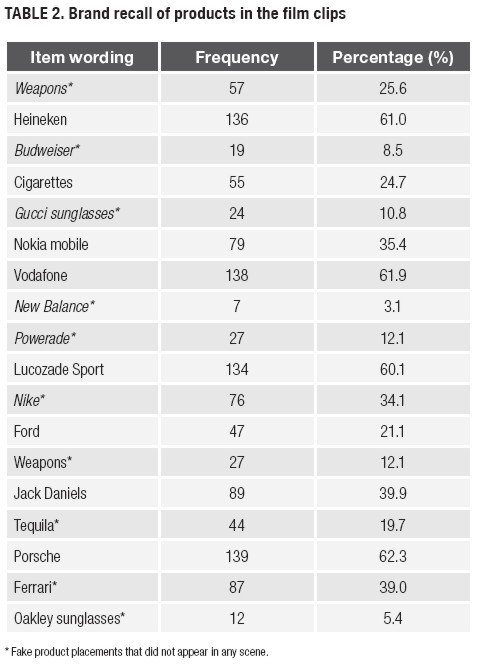
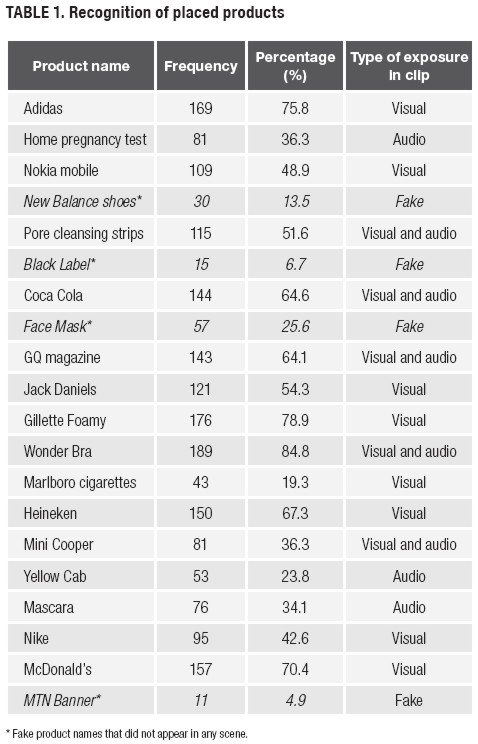
<body><![CDATA[<p>&nbsp;</p>     <p><font size="3"><b><i>  5.1 Product recognition</i></b></font></p>     <p>  Recognition is determined by how prominent a product   placement is in a film scene. This was determined   by placing products in two separate categories, namely,   prominence and subtlety. Prominence was described   as a product being shown audibly and visually, whereas   subtlety was described as a product being shown   either audibly or visually. In <a href="#t1">Table 1</a>, the percentage   recognition by the respondents is shown for the various   products.</p>     <p><a name="t1">&nbsp;</a></p>     <p>    <center><img src="/img/revistas/inno/v18n31/31a02t1.jpg"></center></p>     <p>The fake product names that did not appear in any   scene represented a relatively low percentage of recognition   among the respondents. The names of products   that were only audible received relatively low   percentages as opposed to those products that were   visible and those that were both audible and visible to the respondents.</p>     <p>&nbsp;</p>     <p><font size="3"><b><i>  5.2 Product recall</i></b></font></p>     <p>  Recall was tested by the ability of the respondents to   remember the product names that appeared in scenes   from the film clip. <a href="#t2">Table 2</a> includes product names that were given to the respondents and they were   then asked if they could recall/remember it. The table   consists of product names that appeared in the above   mentioned film clips.</p>     ]]></body>
<body><![CDATA[<p><a name="t2">&nbsp;</a></p>     <p>    <center><img src="/img/revistas/inno/v18n31/31a02t2.jpg"></center></p>     <p>Sixty one percent of the total respondents recalled   viewing <i>Heineken</i> in the film clip, which represented   a relatively high percentage of recall among the respondents.   This product was repeatedly shown in the   film clip. The respondents (27.4%) recalled viewing   “cigarettes” in the film clip, which represented a very low percentage of recall among the respondents. This   product was repeatedly shown in the film clip. Thirty   five percent of the total respondents recalled viewing   <i>Nokia</i> mobile in the film clip, which represented a relatively   low percentage of recall among the respondents.   This product was only shown once off and not repeated in the film clip.</p>     <p>  Nearly 62% of the respondents recalled viewing <i>Vodafone</i>   in the film clip, which represented a relatively   high percentage of recall among the respondents. This   product was repeatedly shown in the film clip. Sixty   percent of the respondents recalled viewing <i>Lucozade   Sport</i> in the film clip, which represented a relatively   high percentage of recall among the respondents. This   product was repeatedly shown in the film clip. The   respondents (21%) recalled viewing <i>Ford</i> in the film   clip, which represented a very low percentage of recall   among the respondents. This product was repeatedly   shown in the film clip. Although the brand name <i>Nike</i>   did not appear in the film clip, 34% mentioned that   they recall the brand name.</p>     <p>  Nearly 40% of the respondents recalled viewing <i>Jack   Daniels</i> in the film clip, which represented a relatively   low percentage of recall among the respondents. This   product was repeatedly shown in the film clip. Sixty   two percent of the respondents recalled viewing <i>Porsche</i>   in the film clip, which represented a relatively high   percentage of recall among the respondents. This product   was repeatedly shown in the film clip.</p>     <p>&nbsp;</p>     <p><font size="3"><b>  6. Hypotheses testing</b></font></p>     <p>  A 0.05 level of significance was used in the hypotheses   testing.</p>     <p>  H<sub>1</sub>: <i>The likelihood of a film attendee recognising a product   placed in a film is higher when the product placement is   more prominent</i>.</p>     ]]></body>
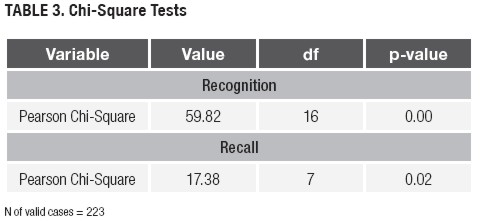
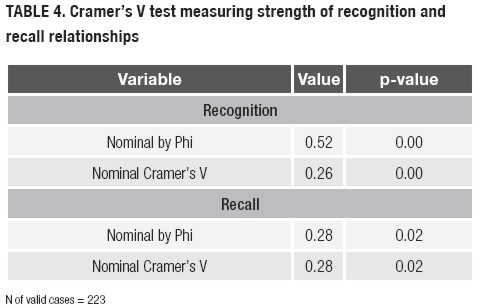
<body><![CDATA[<p>  As there was a relationship between product placements   being more prominent and being less prominent,   it could be defined as a one-tailed hypothesis.   Recognition was tested on whether the item was only   shown visually, only mentioned audibly or both audibly   and visually in the scenes in a film clip.</p>     <p>  H<sub>2</sub>: <i>Repeated exposure to product placements within a   film will increase a film attendee’s recall</i>.</p>     <p>  The formulation of this alternative hypothesis stated   that there was a relationship or correlation between   variables. As there was an increasing relationship between   repeated exposure of product placements and   that of an attendee’s recall, it could therefore be defined   as a one-tailed hypothesis. The non-parametric Cramer’s V test was considered for this hypothesis to   test the strength of the relationship between the repeated   exposure of product placements and that of   an attendee’s recall. As this method only tests for the   strength of the relationship, a Chi-Square test had to   be conducted to determine the significance level of   the variables. As the variable repeated exposure falls   into the category of nominal data only a non-parametric   test could be used and, for the purpose of this study,   the Cramer’s V and Chi-Square tests were selected.   The Cramer’s V test was used to test the strength of   the relationship being measured and as it is a non-parametric   test no assumptions have to be met. <a href="#t3">Table 3</a>   depicts the results of the Chi-Square test measuring   the two-tailed p-value for the recognition of products   as well as the recall thereof within film clips.</p>     <p><a name="t3">&nbsp;</a></p>     <p>    <center><img src="/img/revistas/inno/v18n31/31a02t3.jpg"></center></p>     <p>There is a significant relationship between the prominence   of a product and a film attendee’s recognition of a product placed in a film as the p-value was calculated to be 0.00 on a 95% confidence level. There is a significant relationship between repeated exposure of a product and a film attendee’s recall of a product placed in a film as the p-value was calculated to be 0.00 on a 95% confidence level.</p>     <p>  The Cramer’s V test measures the strength of relationships.   In <a href="#t4">Table 4</a>, the results for the strength of recognition   of product placements as well as recall in the   film clips are illustrated.</p>     <p><a name="t4">&nbsp;</a></p>     <p>    ]]></body>
<body><![CDATA[<center><img src="/img/revistas/inno/v18n31/31a02t4.jpg"></center></p>     <p>If the Cramer’s V value is 1 there is a perfect relationship   between the variables, but this test showed a value   of 0.26 and therefore the relationship is relatively   weak. The p-value of the Chi-Square test was shown   as the significance value for the Pearson Chi-Square   from the table above. This value of 0.00 needed to be   converted to the appropriate one-tailed p-value, as this   hypothesis is directional. To increase the accuracy of   the calculation below, the full p-value as calculated in   SPSS was used. Since the one-tailed p-value of 0.00   was smaller than the significance value of 0.05, the   null hypothesis can be rejected. As shown above in   <a href="#t4">Table 4</a>, it can be concluded that there is a significant   relationship between the prominence of a product and   a film attendee’s recognition of a product placed in a   film. It can also be concluded that the strength of the   relationship is not very strong as the Cramer’s V value   was 0.26. The Cramer’s V statistic is a measure of the   association between 2 variables and takes on values   between 0 and 1; with 1 indicating perfect association.   It can therefore be concluded that the strength of the   relationship is not very strong as the Cramer’s V value was 0.26 (Kanfer, 2007: personal E-Mail).</p>     <p>  This test showed a value of 0.28 and therefore the relationship   is not strong. The p-value of the Chi-Square   test was shown as the significance value for the Pearson   Chi-Square from the table above. This value of   0.02 needed to be converted to the appropriate onetailed   p-value, as this hypothesis is directional. The   resultant p-value is 0.01 and is smaller than the significance   value of 0.05. The null hypothesis can be rejected   and it can be concluded that there is a significant   relationship between the repeated exposure of product   placements and that of an attendee’s recall. The more   often and the longer that an attendee is exposed to the   product the better their recall and recognition.</p>     <p>&nbsp;</p>     <p><font size="3"><b>7. Limitations of the research</b></font></p>     <p>  The survey was limited to the products shown in scenes   of a film clips that was compiled from ten wellknown   feature films that attracted and many young   respondents within the given age group. Random selections   of brand names that are familiar and used by   this target group were selected as stimulus material. A   larger sample with specific target characteristics can   be considered from numerous other films. The ordinary   class situation was not a true experience of the   cinema theatre, and the short film clip was also not   experienced as a feature film. As a result, the respondents   could have been more attentive towards product recognition and recall.</p>     <p>&nbsp;</p>     <p><font size="3"><b>  8. Conclusion and recommendations</b></font></p>     <p>  New technologies, integrated marketing communications   and social trends are likely to cause product   placement to increase. To fully analyse these changes   and implement marketing strategies thereof, benchmark   studies are needed. In that context, the present   research might establish a benchmark regarding perceptions   of product placements with regard to product   recognition and product recall of products placed in   a film. The findings show that even though there is   not a perfectly positive relationship between prominence   and recognition of products placed in films, a   film attendee is more likely to recognise a product if it   is shown audio-visually than if it is only shown either   audibly or visually. Film attendees’ ability to recall a   product is shown to be more likely, if the product is   repeatedly shown throughout the film than if it is only   shown once. The relationship between recall and repeated   exposure is not perfect, but it is positive. The following recommendations can be considered.</p>     <p>  Marketers can place their products in films to increase   film attendees’ awareness and recognition, but as   it was found that there is not a very strong relationship   between recognition and prominence of products   in films, recognition does not necessarily increase in   proportion to whether the product is placed audibly,   visually or audio-visually. A product is more likely to   be recognised if it is prominently shown through audio and visual means.</p>     ]]></body>
<body><![CDATA[<p>  Marketers can place their products repeatedly in films   to increase awareness and recall of film attendees, but   the number of times the product is repeated does not   necessarily indicate the number of times the film attendee   will recall it. A product is more likely to be recalled   if it is shown repeatedly than if it is only shown once off.</p>     <p>  For future research, marketers should take into consideration   that only a few factors were discussed in   this study to determine a film attendee’s perceptions   of product placements within films, namely, product   recognition and product recall. Marketers can break   the clutter of advertisements in traditional media, by   strategically placing products in new, more unconventional   media as to complement the marketing strategy.   Product placement as a solo marketing effort with   little integration into the IMC strategy of the organisation   is worthless. It is recommended that marketers   could also include the following variables to broaden   the investigation of this topic thereby having a deeper understanding in this regard:</p> <ul>     <p>       <li> Realism could be investigated to determine whether     product placements make films seem more     realistic, as well as the cinematic experience more     true to life.</li> </p>     <p>       <li>  Product awareness could be more specifically focused     on with the intention of shedding more light of     the perception film attendees have with regard to     product placement in films as a captive audience   with little influence from external noise.</li> </p>     <p>       <li> The impact of product placements in the escalating     mobile media usage should be investigated.</li> </p>     <p>       <li> The rise of citizen-generated media on Youtube,     product placement based sponsorship of citizen media     is going to be an issue for marketing, legislators     and academics to pursue further.</li> </p>     ]]></body>
<body><![CDATA[<p>       <li> A larger and more heterogeneous sample can be     used which is more representative of the South African     population. A sample that will include more     ethnic groups can be considered as a main variable     in a study surrounding the perception of product     placements in films. All age groups should be considered     with the aim of determining different perceptions     that specific ethnic groups have towards     product placements in films. This is paramount in     a country with more than 11 official languages and     more than 23 distinctive and homogeneous cultural     groupings.</li> </p>     <p>       <li> A film attendee’s intention to purchase a product     once it has been viewed in a film can be explored     by researchers as to detect the causal impact of the     exposure to the product and the purchase thereof.</li> </p>     <p>       <li> Brand salience is another factor that can be included     in future surveys.</li> </p>     </ul>     <p>&nbsp;</p>     <p><font size="3"><b>Bibliographical references</b></font></p>     <!-- ref --><p>Aaker, D. A. (1996). <i>Building strong products</i>. London: the free press.&nbsp;&nbsp;&nbsp;&nbsp;&nbsp;&nbsp;&nbsp;&nbsp;[&#160;<a href="javascript:void(0);" onclick="javascript: window.open('/scielo.php?script=sci_nlinks&ref=000152&pid=S0121-5051200800010000200001&lng=','','width=640,height=500,resizable=yes,scrollbars=1,menubar=yes,');">Links</a>&#160;]<!-- end-ref --><!-- ref --><p>Alba, J. W. &amp; Chattopadhyay, A. (1986). Salience   effects in product recall. <i>Journal of Marketing   Research</i>, <i>23</i>(4), 363-369.&nbsp;&nbsp;&nbsp;&nbsp;&nbsp;&nbsp;&nbsp;&nbsp;[&#160;<a href="javascript:void(0);" onclick="javascript: window.open('/scielo.php?script=sci_nlinks&ref=000153&pid=S0121-5051200800010000200002&lng=','','width=640,height=500,resizable=yes,scrollbars=1,menubar=yes,');">Links</a>&#160;]<!-- end-ref --><!-- ref --><p>Atkinson, R. C. &amp; Shiffrin, R. M. (1971). The control   of short-term memory. <i>Scientific American</i>,   <i>224</i>, 82-90.&nbsp;&nbsp;&nbsp;&nbsp;&nbsp;&nbsp;&nbsp;&nbsp;[&#160;<a href="javascript:void(0);" onclick="javascript: window.open('/scielo.php?script=sci_nlinks&ref=000154&pid=S0121-5051200800010000200003&lng=','','width=640,height=500,resizable=yes,scrollbars=1,menubar=yes,');">Links</a>&#160;]<!-- end-ref --><!-- ref --><p>Balasubramanian, S. K. (1994). Beyond advertising   and publicity: hybrid messages   and public policy issues. <i>Journal of   Advertising</i>, <i>23</i>(4), 1-21. Retrieved June   14, 2004, from <a href="http://weblinks1.epnet.com/citation.asp?tb=1&_ua=%5F2&_sid+92317498%2D8" target="_blank">http://weblinks1.epnet.com/citation.asp?tb=1&amp;_ua=%5F2&amp;_ sid+92317498%2D8</a>&nbsp;&nbsp;&nbsp;&nbsp;&nbsp;&nbsp;&nbsp;&nbsp;[&#160;<a href="javascript:void(0);" onclick="javascript: window.open('/scielo.php?script=sci_nlinks&ref=000155&pid=S0121-5051200800010000200004&lng=','','width=640,height=500,resizable=yes,scrollbars=1,menubar=yes,');">Links</a>&#160;]<!-- end-ref --><!-- ref --><p>Belch, G. E. &amp; Belch, M. A. (2001). <i>Advertising   and promotion: An integrated marketing   communications perspective</i> (5<sup>th</sup> ed.). New   York: mcgraw-hill.&nbsp;&nbsp;&nbsp;&nbsp;&nbsp;&nbsp;&nbsp;&nbsp;[&#160;<a href="javascript:void(0);" onclick="javascript: window.open('/scielo.php?script=sci_nlinks&ref=000156&pid=S0121-5051200800010000200005&lng=','','width=640,height=500,resizable=yes,scrollbars=1,menubar=yes,');">Links</a>&#160;]<!-- end-ref --><!-- ref --><p>Berry, L. &amp; Miller, S. (1998). Product salience versus   product image: two theories of advertising   effectiveness. <i>Journal of Advertising   Research</i>, <i>12</i>(2), 1-11.&nbsp;&nbsp;&nbsp;&nbsp;&nbsp;&nbsp;&nbsp;&nbsp;[&#160;<a href="javascript:void(0);" onclick="javascript: window.open('/scielo.php?script=sci_nlinks&ref=000157&pid=S0121-5051200800010000200006&lng=','','width=640,height=500,resizable=yes,scrollbars=1,menubar=yes,');">Links</a>&#160;]<!-- end-ref --><!-- ref --><p>Bov&eacute;e, C. L., Houston, M. J. &amp; Thill, J. V. (1995).   Marketing (2<sup>nd</sup> ed.). London: McGraw-Hill.&nbsp;&nbsp;&nbsp;&nbsp;&nbsp;&nbsp;&nbsp;&nbsp;[&#160;<a href="javascript:void(0);" onclick="javascript: window.open('/scielo.php?script=sci_nlinks&ref=000158&pid=S0121-5051200800010000200007&lng=','','width=640,height=500,resizable=yes,scrollbars=1,menubar=yes,');">Links</a>&#160;]<!-- end-ref --><!-- ref --><p>CBC Arts Online. (2006). Product placement report. Retrieved August 30,   2006, from <a href="http://www.cbc.ca/story/arts/national/2006/08/20/productplacementreport.html?ref=rss" target="_blank">http://www.cbc.ca/story/arts/national/2006/08/20/productplacementreport.html?ref=rss</a>&nbsp;&nbsp;&nbsp;&nbsp;&nbsp;&nbsp;&nbsp;&nbsp;[&#160;<a href="javascript:void(0);" onclick="javascript: window.open('/scielo.php?script=sci_nlinks&ref=000159&pid=S0121-5051200800010000200008&lng=','','width=640,height=500,resizable=yes,scrollbars=1,menubar=yes,');">Links</a>&#160;]<!-- end-ref --><!-- ref --><p>Cohen, N. (2006). <i>Virtual product placement infiltrates   TV, news, games</i>. Retrieved August   18, 2006, from <a href="http://www.ecommercetimes.com/story/48956.html/" target="_blank">http://www.ecommercetimes.com/story/48956.html/</a>&nbsp;&nbsp;&nbsp;&nbsp;&nbsp;&nbsp;&nbsp;&nbsp;[&#160;<a href="javascript:void(0);" onclick="javascript: window.open('/scielo.php?script=sci_nlinks&ref=000160&pid=S0121-5051200800010000200009&lng=','','width=640,height=500,resizable=yes,scrollbars=1,menubar=yes,');">Links</a>&#160;]<!-- end-ref --><!-- ref --><p>D’astous, A. &amp; Chartier, F. (2000). A study of factors   affecting consumer evaluations and   memory of product placements in movies.   <i>Journal of Current Issues and Research in   Advertising</i>, <i>22</i>(2), 31-40.&nbsp;&nbsp;&nbsp;&nbsp;&nbsp;&nbsp;&nbsp;&nbsp;[&#160;<a href="javascript:void(0);" onclick="javascript: window.open('/scielo.php?script=sci_nlinks&ref=000161&pid=S0121-5051200800010000200010&lng=','','width=640,height=500,resizable=yes,scrollbars=1,menubar=yes,');">Links</a>&#160;]<!-- end-ref --><!-- ref --><p>Delorme, D. E. &amp; Reid, L. N. (1999). Moviegoers’   experiences and interpretations   of products in fi lms revisited.   <i>Journal of Advertising</i>, <i>28</i>(2), 1-30. Retrieved   March 6, 2004, from <a href="http://weblinks3.epnet.com/citation.asp?tb=1&_ug=dbs+buh+sid+33E64EB3%2DB13D" target="_blank">http://weblinks3.epnet.com/citation.asp?tb=1&amp;_ug=dbs+buh+sid+33E64EB3%2DB13D</a>&nbsp;&nbsp;&nbsp;&nbsp;&nbsp;&nbsp;&nbsp;&nbsp;[&#160;<a href="javascript:void(0);" onclick="javascript: window.open('/scielo.php?script=sci_nlinks&ref=000162&pid=S0121-5051200800010000200011&lng=','','width=640,height=500,resizable=yes,scrollbars=1,menubar=yes,');">Links</a>&#160;]<!-- end-ref --><!-- ref --><p>Dodd, C. A. &amp; Johnstone, E. (2000). Placements   as mediators of product salience within a   UK cinema audience. <i>Journal of Marketing   Communications</i>, <i>6</i>,141-158.&nbsp;&nbsp;&nbsp;&nbsp;&nbsp;&nbsp;&nbsp;&nbsp;[&#160;<a href="javascript:void(0);" onclick="javascript: window.open('/scielo.php?script=sci_nlinks&ref=000163&pid=S0121-5051200800010000200012&lng=','','width=640,height=500,resizable=yes,scrollbars=1,menubar=yes,');">Links</a>&#160;]<!-- end-ref --><!-- ref --><p>Ebscohost. (2008). Accessed January 13, 2008,   from <a href="http://0-ejournals.ebsco.com.innopac.up.ac.za/Home.asp" target="_blank">http://0-ejournals.ebsco.com.innopac.up.ac.za/Home.asp</a>&nbsp;&nbsp;&nbsp;&nbsp;&nbsp;&nbsp;&nbsp;&nbsp;[&#160;<a href="javascript:void(0);" onclick="javascript: window.open('/scielo.php?script=sci_nlinks&ref=000164&pid=S0121-5051200800010000200013&lng=','','width=640,height=500,resizable=yes,scrollbars=1,menubar=yes,');">Links</a>&#160;]<!-- end-ref --><!-- ref --><p>  Emerald. (2008). Accessed January 13, 2008,   from <a href="http://0-www.emeraldinsight.com.innopac.up.ac.za/" target="_blank">http://0-www.emeraldinsight.com.innopac.up.ac.za/</a>&nbsp;&nbsp;&nbsp;&nbsp;&nbsp;&nbsp;&nbsp;&nbsp;[&#160;<a href="javascript:void(0);" onclick="javascript: window.open('/scielo.php?script=sci_nlinks&ref=000165&pid=S0121-5051200800010000200014&lng=','','width=640,height=500,resizable=yes,scrollbars=1,menubar=yes,');">Links</a>&#160;]<!-- end-ref --><!-- ref --><p>Fill, C. (2002). <i>Marketing communications: contexts,   strategies and applications</i> (3rd ed.).   London: Prentice Hall Financial Times.&nbsp;&nbsp;&nbsp;&nbsp;&nbsp;&nbsp;&nbsp;&nbsp;[&#160;<a href="javascript:void(0);" onclick="javascript: window.open('/scielo.php?script=sci_nlinks&ref=000166&pid=S0121-5051200800010000200015&lng=','','width=640,height=500,resizable=yes,scrollbars=1,menubar=yes,');">Links</a>&#160;]<!-- end-ref --><!-- ref --><p>Gould, S. J., Gupta, P. B. &amp; Grabner-Kräuter, S.   (2000). Product placements in movies: a   cross-cultural analysis of Austrian, French   and American consumers’ attitudes toward   this emerging, international promotional   medium. <i>Journal of Advertising</i>, <i>29</i>(4), 41-58.&nbsp;&nbsp;&nbsp;&nbsp;&nbsp;&nbsp;&nbsp;&nbsp;[&#160;<a href="javascript:void(0);" onclick="javascript: window.open('/scielo.php?script=sci_nlinks&ref=000167&pid=S0121-5051200800010000200016&lng=','','width=640,height=500,resizable=yes,scrollbars=1,menubar=yes,');">Links</a>&#160;]<!-- end-ref --><!-- ref --><p>Gupta, P. B. &amp; Lord, K. R. (1998). Product placement   in movies: the effect of prominence   and mode on audience recall. <i>Journal   of Current Issues and Research in Advertising</i>,   <i>20</i>(1), 47-59.&nbsp;&nbsp;&nbsp;&nbsp;&nbsp;&nbsp;&nbsp;&nbsp;[&#160;<a href="javascript:void(0);" onclick="javascript: window.open('/scielo.php?script=sci_nlinks&ref=000168&pid=S0121-5051200800010000200017&lng=','','width=640,height=500,resizable=yes,scrollbars=1,menubar=yes,');">Links</a>&#160;]<!-- end-ref --><!-- ref --><p>Hornick, L. A. (2006). The evolution of product   placement: consumer awareness and ethical   considerations. Retrieved September   6, 2006, from <a href="http://eidr.wvu.edu./eidr/documentdata.elDR?documentid=4542-8k-/" target="_blank">http://eidr.wvu.edu./eidr/documentdata.elDR?documentid=4542-8k-/</a>&nbsp;&nbsp;&nbsp;&nbsp;&nbsp;&nbsp;&nbsp;&nbsp;[&#160;<a href="javascript:void(0);" onclick="javascript: window.open('/scielo.php?script=sci_nlinks&ref=000169&pid=S0121-5051200800010000200018&lng=','','width=640,height=500,resizable=yes,scrollbars=1,menubar=yes,');">Links</a>&#160;]<!-- end-ref --><!-- ref --><p>  Kanfer, F. H. J. (2007, august 28). <i>Cramer V</i> (personal   e-mail). Department of Statistics,   University of Pretoria, South Africa.&nbsp;&nbsp;&nbsp;&nbsp;&nbsp;&nbsp;&nbsp;&nbsp;[&#160;<a href="javascript:void(0);" onclick="javascript: window.open('/scielo.php?script=sci_nlinks&ref=000170&pid=S0121-5051200800010000200019&lng=','','width=640,height=500,resizable=yes,scrollbars=1,menubar=yes,');">Links</a>&#160;]<!-- end-ref --><!-- ref --><p>Keller, K. L. (2003). Strategic product management:   building, measuring and managing   product equity (2nd ed.). Upper Saddle River,   NJ: prentice-hall.&nbsp;&nbsp;&nbsp;&nbsp;&nbsp;&nbsp;&nbsp;&nbsp;[&#160;<a href="javascript:void(0);" onclick="javascript: window.open('/scielo.php?script=sci_nlinks&ref=000171&pid=S0121-5051200800010000200020&lng=','','width=640,height=500,resizable=yes,scrollbars=1,menubar=yes,');">Links</a>&#160;]<!-- end-ref --><!-- ref --><p>Mcdaniel, C. &amp; Gates, R. (2001). <i>Marketing Research   Essentials</i> (3rd ed.). Cincinatti, Oh:   South-Western College.&nbsp;&nbsp;&nbsp;&nbsp;&nbsp;&nbsp;&nbsp;&nbsp;[&#160;<a href="javascript:void(0);" onclick="javascript: window.open('/scielo.php?script=sci_nlinks&ref=000172&pid=S0121-5051200800010000200021&lng=','','width=640,height=500,resizable=yes,scrollbars=1,menubar=yes,');">Links</a>&#160;]<!-- end-ref --><!-- ref --><p>Mckechnie, S. A. &amp; Zhou, J. (2003). Product placement   in movies: a comparison of Chinese   and American consumers’ attitudes.   <i>International Journal of Advertising</i>, <i>22</i>,   349-374.&nbsp;&nbsp;&nbsp;&nbsp;&nbsp;&nbsp;&nbsp;&nbsp;[&#160;<a href="javascript:void(0);" onclick="javascript: window.open('/scielo.php?script=sci_nlinks&ref=000173&pid=S0121-5051200800010000200022&lng=','','width=640,height=500,resizable=yes,scrollbars=1,menubar=yes,');">Links</a>&#160;]<!-- end-ref --><!-- ref --><p>Nelson, M. R. &amp; Mcleod, L. E. (2005). Adolescent   product consciousness and product   placements: awareness, liking and perceived   effects on self and others. <i>International   Journal of Consumer studies</i>, <i>29</i>(6), 515-528. Retrieved September 6, 2006, from   <a href="http://0-www.blackwell-synergy.com.innopac.up.ac.za/doi/full/10.1111/j.1470-6431.2005.00429.x" target="_blank">http://0-www.blackwell-synergy.com.innopac.up.ac.za/doi/full/10.1111/j.1470-6431.2005.00429.x</a>&nbsp;&nbsp;&nbsp;&nbsp;&nbsp;&nbsp;&nbsp;&nbsp;[&#160;<a href="javascript:void(0);" onclick="javascript: window.open('/scielo.php?script=sci_nlinks&ref=000174&pid=S0121-5051200800010000200023&lng=','','width=640,height=500,resizable=yes,scrollbars=1,menubar=yes,');">Links</a>&#160;]<!-- end-ref --><!-- ref --><p>Russell, C. A. (2002). Investigating the effectiveness   of product placements in television   shows: the role of modality and plot connection   congruence on product memory   and attitude. <i>Journal of Consumer Research</i>, <i>29</i>, 306-318.&nbsp;&nbsp;&nbsp;&nbsp;&nbsp;&nbsp;&nbsp;&nbsp;[&#160;<a href="javascript:void(0);" onclick="javascript: window.open('/scielo.php?script=sci_nlinks&ref=000175&pid=S0121-5051200800010000200024&lng=','','width=640,height=500,resizable=yes,scrollbars=1,menubar=yes,');">Links</a>&#160;]<!-- end-ref --><!-- ref --><p>Schejter, A. M. (2004). Product placement as   an international practice: Moral, legal, regulatory   and trade implications. Retrieved   September 6, 2006, from <a href="http://www.web.si.umich.edu/tprc/papers/2004/304/product%20placement%20tprc.pdf./" target="_blank">http://www.web.si.umich.edu/tprc/papers/2004/304/product%20placement%20tprc.pdf./</a>&nbsp;&nbsp;&nbsp;&nbsp;&nbsp;&nbsp;&nbsp;&nbsp;[&#160;<a href="javascript:void(0);" onclick="javascript: window.open('/scielo.php?script=sci_nlinks&ref=000176&pid=S0121-5051200800010000200025&lng=','','width=640,height=500,resizable=yes,scrollbars=1,menubar=yes,');">Links</a>&#160;]<!-- end-ref --><!-- ref --><p>Sabinet. (2008). Accessed february 7, 2008,   from <a href="http://0-search.sabinet.co.za.innopac.up.ac.za/" target="_blank">http://0-search.sabinet.co.za.innopac.up.ac.za/</a>&nbsp;&nbsp;&nbsp;&nbsp;&nbsp;&nbsp;&nbsp;&nbsp;[&#160;<a href="javascript:void(0);" onclick="javascript: window.open('/scielo.php?script=sci_nlinks&ref=000177&pid=S0121-5051200800010000200026&lng=','','width=640,height=500,resizable=yes,scrollbars=1,menubar=yes,');">Links</a>&#160;]<!-- end-ref --><!-- ref --><p>  Science Direct. (2008). Accessed January   16, 2008, from <a href="http://0-www.sciencedirect.com.innopac.up.ac.za/science?_ob=BrowseListURL&_type=subject&subjColl=14&zone=brws&_acct=C000005298&_version=1&_urlVersion=0&_userid=59388&md5=6dcfe4cc6b2182dfdade5ff066154ef0" target="_blank">http://0-www.sciencedirect.com.innopac.up.ac.za/science?_ob=BrowseListURL&amp;_type=subject&amp; subjColl=14&amp; zone=brws&amp;_acct=C000005298&amp;_version=1&amp;_urlVersion=0&amp;_userid=59388&amp; md5=6dcfe4cc6b2182dfdade5ff066154ef0</a>&nbsp;&nbsp;&nbsp;&nbsp;&nbsp;&nbsp;&nbsp;&nbsp;[&#160;<a href="javascript:void(0);" onclick="javascript: window.open('/scielo.php?script=sci_nlinks&ref=000178&pid=S0121-5051200800010000200027&lng=','','width=640,height=500,resizable=yes,scrollbars=1,menubar=yes,');">Links</a>&#160;]<!-- end-ref --><!-- ref --><p>  Smith, B. (1985). Casting Product for special   effect. <i>Beverage World</i>, 104, 83-91.&nbsp;&nbsp;&nbsp;&nbsp;&nbsp;&nbsp;&nbsp;&nbsp;[&#160;<a href="javascript:void(0);" onclick="javascript: window.open('/scielo.php?script=sci_nlinks&ref=000179&pid=S0121-5051200800010000200028&lng=','','width=640,height=500,resizable=yes,scrollbars=1,menubar=yes,');">Links</a>&#160;]<!-- end-ref --><!-- ref --><p><i>Source Watch</i>. (2006). <i>Product placement</i>. Retrieved   August 28, 2006, from <a href="http://www.sourcewatch.org/index.php?title=Product_placement" target="_blank">http://www.sourcewatch.org/index.php?title=Product_placement</a>&nbsp;&nbsp;&nbsp;&nbsp;&nbsp;&nbsp;&nbsp;&nbsp;[&#160;<a href="javascript:void(0);" onclick="javascript: window.open('/scielo.php?script=sci_nlinks&ref=000180&pid=S0121-5051200800010000200029&lng=','','width=640,height=500,resizable=yes,scrollbars=1,menubar=yes,');">Links</a>&#160;]<!-- end-ref --><!-- ref --><p>Van der Waldt, D. L. R. (2005). The role of product   placement in feature films and broadcast   television programmes: an IMC perspective. <i>Communicare</i>, <i>24</i>(2), 1-16.&nbsp;&nbsp;&nbsp;&nbsp;&nbsp;&nbsp;&nbsp;&nbsp;[&#160;<a href="javascript:void(0);" onclick="javascript: window.open('/scielo.php?script=sci_nlinks&ref=000181&pid=S0121-5051200800010000200030&lng=','','width=640,height=500,resizable=yes,scrollbars=1,menubar=yes,');">Links</a>&#160;]<!-- end-ref --><!-- ref --><p>Vollmers, S. &amp; Mizerski, R. (1994). A review   and investigation into the effectiveness of   product placement in films. In K. W. King   (ed.), <i>The Proceedings of the 1994 Academy   of Advertising Convention</i> (pp. 97-101).   Athens, GA: University of Georgia.&nbsp;&nbsp;&nbsp;&nbsp;&nbsp;&nbsp;&nbsp;&nbsp;[&#160;<a href="javascript:void(0);" onclick="javascript: window.open('/scielo.php?script=sci_nlinks&ref=000182&pid=S0121-5051200800010000200031&lng=','','width=640,height=500,resizable=yes,scrollbars=1,menubar=yes,');">Links</a>&#160;]<!-- end-ref --><!-- ref --><p>  Wiles, M. A. &amp; Danielova, A. (2006). The impact   of product placement on firm market value.   Retrieved September 1, 2006, from <a href="http://kelly.iu.edu/marketing/" target="_blank">http://kelly.iu.edu/marketing/</a>&nbsp;&nbsp;&nbsp;&nbsp;&nbsp;&nbsp;&nbsp;&nbsp;[&#160;<a href="javascript:void(0);" onclick="javascript: window.open('/scielo.php?script=sci_nlinks&ref=000183&pid=S0121-5051200800010000200032&lng=','','width=640,height=500,resizable=yes,scrollbars=1,menubar=yes,');">Links</a>&#160;]<!-- end-ref --> ]]></body><back>
<ref-list>
<ref id="B1">
<nlm-citation citation-type="book">
<person-group person-group-type="author">
<name>
<surname><![CDATA[Aaker]]></surname>
<given-names><![CDATA[D. A]]></given-names>
</name>
</person-group>
<source><![CDATA[Building strong products]]></source>
<year>1996</year>
<publisher-loc><![CDATA[London ]]></publisher-loc>
<publisher-name><![CDATA[the free press]]></publisher-name>
</nlm-citation>
</ref>
<ref id="B2">
<nlm-citation citation-type="journal">
<person-group person-group-type="author">
<name>
<surname><![CDATA[Alba]]></surname>
<given-names><![CDATA[J. W.]]></given-names>
</name>
<name>
<surname><![CDATA[Chattopadhyay]]></surname>
<given-names><![CDATA[A]]></given-names>
</name>
</person-group>
<article-title xml:lang="en"><![CDATA[Salience effects in product recall]]></article-title>
<source><![CDATA[Journal of Marketing Research]]></source>
<year>1986</year>
<volume>23</volume>
<numero>4</numero>
<issue>4</issue>
<page-range>363-369</page-range></nlm-citation>
</ref>
<ref id="B3">
<nlm-citation citation-type="journal">
<person-group person-group-type="author">
<name>
<surname><![CDATA[Atkinson]]></surname>
<given-names><![CDATA[R. C.]]></given-names>
</name>
<name>
<surname><![CDATA[Shiffrin]]></surname>
<given-names><![CDATA[R. M]]></given-names>
</name>
</person-group>
<article-title xml:lang="en"><![CDATA[The control of short-term memory]]></article-title>
<source><![CDATA[Scientific American]]></source>
<year>1971</year>
<volume>224</volume>
<page-range>82-90</page-range></nlm-citation>
</ref>
<ref id="B4">
<nlm-citation citation-type="journal">
<person-group person-group-type="author">
<name>
<surname><![CDATA[Balasubramanian]]></surname>
<given-names><![CDATA[S. K]]></given-names>
</name>
</person-group>
<article-title xml:lang="en"><![CDATA[Beyond advertising and publicity: hybrid messages and public policy issues]]></article-title>
<source><![CDATA[Journal of Advertising]]></source>
<year>1994</year>
<volume>23</volume>
<numero>4</numero>
<issue>4</issue>
<page-range>1-21</page-range></nlm-citation>
</ref>
<ref id="B5">
<nlm-citation citation-type="book">
<person-group person-group-type="author">
<name>
<surname><![CDATA[Belch]]></surname>
<given-names><![CDATA[G. E.]]></given-names>
</name>
<name>
<surname><![CDATA[Belch]]></surname>
<given-names><![CDATA[M. A]]></given-names>
</name>
</person-group>
<source><![CDATA[Advertising and promotion: An integrated marketing communications perspective]]></source>
<year>2001</year>
<edition>5th</edition>
<publisher-loc><![CDATA[New York ]]></publisher-loc>
<publisher-name><![CDATA[mcgraw-hill]]></publisher-name>
</nlm-citation>
</ref>
<ref id="B6">
<nlm-citation citation-type="journal">
<person-group person-group-type="author">
<name>
<surname><![CDATA[Berry]]></surname>
<given-names><![CDATA[L.]]></given-names>
</name>
<name>
<surname><![CDATA[Miller]]></surname>
<given-names><![CDATA[S]]></given-names>
</name>
</person-group>
<article-title xml:lang="en"><![CDATA[Product salience versus product image: two theories of advertising effectiveness]]></article-title>
<source><![CDATA[Journal of Advertising Research]]></source>
<year>1998</year>
<volume>12</volume>
<numero>2</numero>
<issue>2</issue>
<page-range>1-11</page-range></nlm-citation>
</ref>
<ref id="B7">
<nlm-citation citation-type="book">
<person-group person-group-type="author">
<name>
<surname><![CDATA[Bovée]]></surname>
<given-names><![CDATA[C. L]]></given-names>
</name>
<name>
<surname><![CDATA[Houston]]></surname>
<given-names><![CDATA[M. J.]]></given-names>
</name>
<name>
<surname><![CDATA[Thill]]></surname>
<given-names><![CDATA[J. V]]></given-names>
</name>
</person-group>
<source><![CDATA[Marketing]]></source>
<year>1995</year>
<edition>2nd</edition>
<publisher-loc><![CDATA[London ]]></publisher-loc>
<publisher-name><![CDATA[McGraw-Hill]]></publisher-name>
</nlm-citation>
</ref>
<ref id="B8">
<nlm-citation citation-type="">
<collab>CBC Arts Online</collab>
<source><![CDATA[Product placement report]]></source>
<year>2006</year>
</nlm-citation>
</ref>
<ref id="B9">
<nlm-citation citation-type="">
<person-group person-group-type="author">
<name>
<surname><![CDATA[Cohen]]></surname>
<given-names><![CDATA[N]]></given-names>
</name>
</person-group>
<source><![CDATA[Virtual product placement infiltrates TV, news, games]]></source>
<year>2006</year>
</nlm-citation>
</ref>
<ref id="B10">
<nlm-citation citation-type="journal">
<person-group person-group-type="author">
<name>
<surname><![CDATA[D’astous]]></surname>
<given-names><![CDATA[A.]]></given-names>
</name>
<name>
<surname><![CDATA[Chartier]]></surname>
<given-names><![CDATA[F]]></given-names>
</name>
</person-group>
<article-title xml:lang="en"><![CDATA[A study of factors affecting consumer evaluations and memory of product placements in movies]]></article-title>
<source><![CDATA[Journal of Current Issues and Research in Advertising]]></source>
<year>2000</year>
<volume>22</volume>
<numero>2</numero>
<issue>2</issue>
<page-range>31-40</page-range></nlm-citation>
</ref>
<ref id="B11">
<nlm-citation citation-type="journal">
<person-group person-group-type="author">
<name>
<surname><![CDATA[Delorme]]></surname>
<given-names><![CDATA[D. E.]]></given-names>
</name>
<name>
<surname><![CDATA[Reid]]></surname>
<given-names><![CDATA[L. N]]></given-names>
</name>
</person-group>
<article-title xml:lang="en"><![CDATA[Moviegoers’ experiences and interpretations of products in fi lms revisited]]></article-title>
<source><![CDATA[Journal of Advertising]]></source>
<year>1999</year>
<volume>28</volume>
<numero>2</numero>
<issue>2</issue>
<page-range>1-30</page-range></nlm-citation>
</ref>
<ref id="B12">
<nlm-citation citation-type="journal">
<person-group person-group-type="author">
<name>
<surname><![CDATA[Dodd]]></surname>
<given-names><![CDATA[C. A.]]></given-names>
</name>
<name>
<surname><![CDATA[Johnstone]]></surname>
<given-names><![CDATA[E]]></given-names>
</name>
</person-group>
<article-title xml:lang="en"><![CDATA[Placements as mediators of product salience within a UK cinema audience]]></article-title>
<source><![CDATA[Journal of Marketing Communications]]></source>
<year>2000</year>
<volume>6</volume>
<page-range>141-158</page-range></nlm-citation>
</ref>
<ref id="B13">
<nlm-citation citation-type="">
<collab>Ebscohost</collab>
<source><![CDATA[]]></source>
<year>2008</year>
</nlm-citation>
</ref>
<ref id="B14">
<nlm-citation citation-type="">
<collab>Emerald</collab>
<source><![CDATA[]]></source>
<year>2008</year>
</nlm-citation>
</ref>
<ref id="B15">
<nlm-citation citation-type="book">
<person-group person-group-type="author">
<name>
<surname><![CDATA[Fill]]></surname>
<given-names><![CDATA[C]]></given-names>
</name>
</person-group>
<source><![CDATA[Marketing communications: contexts, strategies and applications]]></source>
<year>2002</year>
<edition>3rd</edition>
<publisher-loc><![CDATA[London ]]></publisher-loc>
<publisher-name><![CDATA[Prentice Hall Financial Times]]></publisher-name>
</nlm-citation>
</ref>
<ref id="B16">
<nlm-citation citation-type="journal">
<person-group person-group-type="author">
<name>
<surname><![CDATA[Gould]]></surname>
<given-names><![CDATA[S. J]]></given-names>
</name>
<name>
<surname><![CDATA[Gupta]]></surname>
<given-names><![CDATA[P. B.]]></given-names>
</name>
<name>
<surname><![CDATA[Grabner-Kräuter]]></surname>
<given-names><![CDATA[S]]></given-names>
</name>
</person-group>
<article-title xml:lang="en"><![CDATA[Product placements in movies: a cross-cultural analysis of Austrian, French and American consumers’ attitudes toward this emerging, international promotional medium]]></article-title>
<source><![CDATA[Journal of Advertising]]></source>
<year>2000</year>
<volume>29</volume>
<numero>4</numero>
<issue>4</issue>
<page-range>41-58</page-range></nlm-citation>
</ref>
<ref id="B17">
<nlm-citation citation-type="journal">
<person-group person-group-type="author">
<name>
<surname><![CDATA[Gupta]]></surname>
<given-names><![CDATA[P. B.]]></given-names>
</name>
<name>
<surname><![CDATA[Lord]]></surname>
<given-names><![CDATA[K. R]]></given-names>
</name>
</person-group>
<article-title xml:lang="en"><![CDATA[Product placement in movies: the effect of prominence and mode on audience recall]]></article-title>
<source><![CDATA[Journal of Current Issues and Research in Advertising]]></source>
<year>1998</year>
<volume>20</volume>
<numero>1</numero>
<issue>1</issue>
<page-range>47-59</page-range></nlm-citation>
</ref>
<ref id="B18">
<nlm-citation citation-type="">
<person-group person-group-type="author">
<name>
<surname><![CDATA[Hornick]]></surname>
<given-names><![CDATA[L. A]]></given-names>
</name>
</person-group>
<source><![CDATA[The evolution of product placement: consumer awareness and ethical considerations]]></source>
<year>2006</year>
</nlm-citation>
</ref>
<ref id="B19">
<nlm-citation citation-type="book">
<person-group person-group-type="author">
<name>
<surname><![CDATA[Kanfer]]></surname>
<given-names><![CDATA[F. H. J]]></given-names>
</name>
</person-group>
<source><![CDATA[Cramer V]]></source>
<year>2007</year>
<month>, </month>
<day>au</day>
<publisher-name><![CDATA[Department of Statistics, University of Pretoria]]></publisher-name>
</nlm-citation>
</ref>
<ref id="B20">
<nlm-citation citation-type="book">
<person-group person-group-type="author">
<name>
<surname><![CDATA[Keller]]></surname>
<given-names><![CDATA[K. L]]></given-names>
</name>
</person-group>
<source><![CDATA[Strategic product management: building, measuring and managing product equity]]></source>
<year>2003</year>
<edition>2nd</edition>
<publisher-loc><![CDATA[Upper Saddle River^eNJ NJ]]></publisher-loc>
<publisher-name><![CDATA[prentice-hall]]></publisher-name>
</nlm-citation>
</ref>
<ref id="B21">
<nlm-citation citation-type="book">
<person-group person-group-type="author">
<name>
<surname><![CDATA[Mcdaniel]]></surname>
<given-names><![CDATA[C.]]></given-names>
</name>
<name>
<surname><![CDATA[Gates]]></surname>
<given-names><![CDATA[R]]></given-names>
</name>
</person-group>
<source><![CDATA[Marketing Research Essentials]]></source>
<year>2001</year>
<edition>3rd</edition>
<publisher-loc><![CDATA[Cincinatti^eOh Oh]]></publisher-loc>
<publisher-name><![CDATA[South-Western College]]></publisher-name>
</nlm-citation>
</ref>
<ref id="B22">
<nlm-citation citation-type="journal">
<person-group person-group-type="author">
<name>
<surname><![CDATA[Mckechnie]]></surname>
<given-names><![CDATA[S. A.]]></given-names>
</name>
<name>
<surname><![CDATA[Zhou]]></surname>
<given-names><![CDATA[J]]></given-names>
</name>
</person-group>
<article-title xml:lang="en"><![CDATA[Product placement in movies: a comparison of Chinese and American consumers’ attitudes]]></article-title>
<source><![CDATA[International Journal of Advertising]]></source>
<year>2003</year>
<volume>22</volume>
<page-range>349-374</page-range></nlm-citation>
</ref>
<ref id="B23">
<nlm-citation citation-type="journal">
<person-group person-group-type="author">
<name>
<surname><![CDATA[Nelson]]></surname>
<given-names><![CDATA[M. R.]]></given-names>
</name>
<name>
<surname><![CDATA[Mcleod]]></surname>
<given-names><![CDATA[L. E]]></given-names>
</name>
</person-group>
<article-title xml:lang="en"><![CDATA[Adolescent product consciousness and product placements: awareness, liking and perceived effects on self and others]]></article-title>
<source><![CDATA[International Journal of Consumer studies]]></source>
<year>2005</year>
<volume>29</volume>
<numero>6</numero>
<issue>6</issue>
<page-range>515-528</page-range></nlm-citation>
</ref>
<ref id="B24">
<nlm-citation citation-type="journal">
<person-group person-group-type="author">
<name>
<surname><![CDATA[Russell]]></surname>
<given-names><![CDATA[C. A]]></given-names>
</name>
</person-group>
<article-title xml:lang="en"><![CDATA[Investigating the effectiveness of product placements in television shows: the role of modality and plot connection congruence on product memory and attitude]]></article-title>
<source><![CDATA[Journal of Consumer Research]]></source>
<year>2002</year>
<volume>29</volume>
<page-range>306-318</page-range></nlm-citation>
</ref>
<ref id="B25">
<nlm-citation citation-type="">
<person-group person-group-type="author">
<name>
<surname><![CDATA[Schejter]]></surname>
<given-names><![CDATA[A. M]]></given-names>
</name>
</person-group>
<source><![CDATA[Product placement as an international practice: Moral, legal, regulatory and trade implications]]></source>
<year>2004</year>
</nlm-citation>
</ref>
<ref id="B26">
<nlm-citation citation-type="">
<collab>Sabinet</collab>
<source><![CDATA[]]></source>
<year>2008</year>
</nlm-citation>
</ref>
<ref id="B27">
<nlm-citation citation-type="">
<collab>Science Direct</collab>
<source><![CDATA[]]></source>
<year>2008</year>
</nlm-citation>
</ref>
<ref id="B28">
<nlm-citation citation-type="journal">
<person-group person-group-type="author">
<name>
<surname><![CDATA[Smith]]></surname>
<given-names><![CDATA[B]]></given-names>
</name>
</person-group>
<article-title xml:lang="en"><![CDATA[Casting Product for special effect]]></article-title>
<source><![CDATA[Beverage World]]></source>
<year>1985</year>
<volume>104</volume>
<page-range>83-91</page-range></nlm-citation>
</ref>
<ref id="B29">
<nlm-citation citation-type="">
<collab>Source Watch</collab>
<source><![CDATA[Product placement]]></source>
<year>2006</year>
</nlm-citation>
</ref>
<ref id="B30">
<nlm-citation citation-type="journal">
<person-group person-group-type="author">
<name>
<surname><![CDATA[Van der Waldt]]></surname>
<given-names><![CDATA[D. L. R]]></given-names>
</name>
</person-group>
<article-title xml:lang="en"><![CDATA[The role of product placement in feature films and broadcast television programmes: an IMC perspective]]></article-title>
<source><![CDATA[Communicare]]></source>
<year>2005</year>
<volume>24</volume>
<numero>2</numero>
<issue>2</issue>
<page-range>1-16</page-range></nlm-citation>
</ref>
<ref id="B31">
<nlm-citation citation-type="book">
<person-group person-group-type="author">
<name>
<surname><![CDATA[Vollmers]]></surname>
<given-names><![CDATA[S.]]></given-names>
</name>
<name>
<surname><![CDATA[Mizerski]]></surname>
<given-names><![CDATA[R]]></given-names>
</name>
</person-group>
<article-title xml:lang="en"><![CDATA[A review and investigation into the effectiveness of product placement in films]]></article-title>
<person-group person-group-type="editor">
<name>
<surname><![CDATA[King]]></surname>
<given-names><![CDATA[K. W]]></given-names>
</name>
</person-group>
<source><![CDATA[The Proceedings of the 1994 Academy of Advertising Convention (pp: 97-101)]]></source>
<year>1994</year>
<publisher-loc><![CDATA[Athens^eGA GA]]></publisher-loc>
<publisher-name><![CDATA[University of Georgia]]></publisher-name>
</nlm-citation>
</ref>
<ref id="B32">
<nlm-citation citation-type="">
<person-group person-group-type="author">
<name>
<surname><![CDATA[Wiles]]></surname>
<given-names><![CDATA[M. A]]></given-names>
</name>
<name>
<surname><![CDATA[Danielova]]></surname>
<given-names><![CDATA[A]]></given-names>
</name>
</person-group>
<source><![CDATA[The impact of product placement on firm market value]]></source>
<year>2006</year>
</nlm-citation>
</ref>
</ref-list>
</back>
</article>