<?xml version="1.0" encoding="ISO-8859-1"?><article xmlns:mml="http://www.w3.org/1998/Math/MathML" xmlns:xlink="http://www.w3.org/1999/xlink" xmlns:xsi="http://www.w3.org/2001/XMLSchema-instance">
<front>
<journal-meta>
<journal-id>0121-5051</journal-id>
<journal-title><![CDATA[Innovar]]></journal-title>
<abbrev-journal-title><![CDATA[Innovar]]></abbrev-journal-title>
<issn>0121-5051</issn>
<publisher>
<publisher-name><![CDATA[Facultad de Ciencias Económicas. Universidad Nacional de Colombia.]]></publisher-name>
</publisher>
</journal-meta>
<article-meta>
<article-id>S0121-50512010000300011</article-id>
<title-group>
<article-title xml:lang="en"><![CDATA[The impact of cultural resources on multicultural team performance]]></article-title>
<article-title xml:lang="es"><![CDATA[La influencia de los recursos culturales en los resultados de un equipo multicultural]]></article-title>
<article-title xml:lang="fr"><![CDATA[L'influence des ressources culturelles sur les résultats d'une équipe multiculturelle]]></article-title>
<article-title xml:lang="pt"><![CDATA[A influência dos recursos culturais nos resultados de uma equipe multicultural]]></article-title>
</title-group>
<contrib-group>
<contrib contrib-type="author">
<name>
<surname><![CDATA[García-Cabrera]]></surname>
<given-names><![CDATA[Antonia Mercedes]]></given-names>
</name>
<xref ref-type="aff" rid="A01"/>
</contrib>
<contrib contrib-type="author">
<name>
<surname><![CDATA[García-Soto]]></surname>
<given-names><![CDATA[María Gracia]]></given-names>
</name>
<xref ref-type="aff" rid="A02"/>
</contrib>
</contrib-group>
<aff id="A01">
<institution><![CDATA[,Universidad de Las Palmas de Gran Canaria  ]]></institution>
<addr-line><![CDATA[ ]]></addr-line>
<country>Spain</country>
</aff>
<aff id="A02">
<institution><![CDATA[,Universidad de Las Palmas de Gran Canaria  ]]></institution>
<addr-line><![CDATA[ ]]></addr-line>
<country>Spain</country>
</aff>
<pub-date pub-type="pub">
<day>00</day>
<month>09</month>
<year>2010</year>
</pub-date>
<pub-date pub-type="epub">
<day>00</day>
<month>09</month>
<year>2010</year>
</pub-date>
<volume>20</volume>
<numero>38</numero>
<fpage>141</fpage>
<lpage>160</lpage>
<copyright-statement/>
<copyright-year/>
<self-uri xlink:href="http://www.scielo.org.co/scielo.php?script=sci_arttext&amp;pid=S0121-50512010000300011&amp;lng=en&amp;nrm=iso"></self-uri><self-uri xlink:href="http://www.scielo.org.co/scielo.php?script=sci_abstract&amp;pid=S0121-50512010000300011&amp;lng=en&amp;nrm=iso"></self-uri><self-uri xlink:href="http://www.scielo.org.co/scielo.php?script=sci_pdf&amp;pid=S0121-50512010000300011&amp;lng=en&amp;nrm=iso"></self-uri><abstract abstract-type="short" xml:lang="en"><p><![CDATA[The work appears in response to the greater interaction among employees of different nationalities. This interaction results from the growing use of teams in multinationals. Thus, we examine the importance of diverse national values to the performance of a multicultural team. To that end, we conduct an exploratory study that utilizes a resources-processes-results framework and includes variables of cultural and social processes to explain the performance of such teams. Our research results provide new measures of the cultural resources of the team and conclusions regarding their influence on the team performance.]]></p></abstract>
<abstract abstract-type="short" xml:lang="es"><p><![CDATA[La presente investigación surge en respuesta al creciente uso de equipos de trabajo por parte de las empresas multinacionales y, consecuentemente, a la mayor interacción entre empleados de diferente nacionalidad que se produce en las mismas. Sobre la base de este hecho, en este artículo se analiza la importancia de la coexistencia de diversos valores nacionales y su repercusión en los resultados de los equipos multiculturales. A tal objeto, llevamos a cabo un estudio exploratorio que utiliza un esquema recursos-procesos-resultados e incluye variables relativas a los recursos culturales y a los procesos sociales para explicar los resultados de tales equipos. La investigación llevada a cabo permite ofrecer a la literatura nuevas medidas de los recursos culturales del equipo, así como conclusiones relativas a su influencia en los resultados de los mismos.]]></p></abstract>
<abstract abstract-type="short" xml:lang="fr"><p><![CDATA[La présente investigation est effectuée en raison de l'utilisation croissante d'équipes de travail par les entreprises multinationales et de l'interaction intensifiée entre employés de différentes nationalités engendrée par ce processus. Sur cette base, l'article analyse l'importance de la coexistence de valeurs nationales différentes et sa répercussion sur les résultats des équipes multiculturelles. à cet effet, une étude d'exploration est réalisée, utilisant un schéma ressources-processus-résultats, avec inclusion de variables relatives en ce qui concerne les ressources culturelles et les processus sociaux pour l'explication des résultats de ces équipes. L'investigation effectuée permet de proposer de nouvelles mesures des ressources culturelles de l'équipe, ainsi que des conclusions relatives à leur influence sur les résultats obtenus.]]></p></abstract>
<abstract abstract-type="short" xml:lang="pt"><p><![CDATA[A presente pesquisa surge em resposta ao crescente uso de equipes de trabalho por parte das empresas multinacionais e, conseqüentemente, da maior interação entre empregados de diferentes nacionalidades, que ocorre nas mesmas. Baseando-se neste fato, neste artigo analisa-se a importância da coexistência de diversos valores nacionais e sua repercussão nos resultados das equipes multiculturais. Com esse objetivo, realizamos um estudo exploratório que utiliza um esquema recursos-processos-resultados e inclui variáveis relativas aos recursos culturais e aos processos sociais para explicar os resultados de tais equipes. A pesquisa realizada permite oferecer à literatura novas medidas dos recursos culturais da equipe, assim como conclusões relativas à sua influência nos resultados dos mesmos.]]></p></abstract>
<kwd-group>
<kwd lng="en"><![CDATA[cultural heterogeneity]]></kwd>
<kwd lng="en"><![CDATA[team]]></kwd>
<kwd lng="en"><![CDATA[performance]]></kwd>
<kwd lng="en"><![CDATA[national culture]]></kwd>
<kwd lng="es"><![CDATA[heterogeneidad cultural]]></kwd>
<kwd lng="es"><![CDATA[equipo]]></kwd>
<kwd lng="es"><![CDATA[resultados]]></kwd>
<kwd lng="es"><![CDATA[cultura nacional]]></kwd>
<kwd lng="fr"><![CDATA[hétérogénéité culturelle]]></kwd>
<kwd lng="fr"><![CDATA[équipe]]></kwd>
<kwd lng="fr"><![CDATA[résultats]]></kwd>
<kwd lng="fr"><![CDATA[culture nationale]]></kwd>
<kwd lng="pt"><![CDATA[heterogeneidade cultural]]></kwd>
<kwd lng="pt"><![CDATA[equipe]]></kwd>
<kwd lng="pt"><![CDATA[resultados]]></kwd>
<kwd lng="pt"><![CDATA[cultura nacional]]></kwd>
</kwd-group>
</article-meta>
</front><body><![CDATA[  <font face="verdana" size="2">     <p>&nbsp;</p>     <p>&nbsp;</p>     <p>       <center>     <font size="4">    <b>The impact of cultural resources on  multicultural team performance     </b></font>   </center> </p>     <p>       <center>     <font size="3">    <b>La influencia de los recursos culturales en los resultados de un equipo multicultural</b></font>   </center> </p>     <p>       <center>     <font size="3"><b>L'influence des ressources culturelles sur les     r&eacute;sultats d'une &eacute;quipe multiculturelle     </b></font>   </center> </p>     <p>       ]]></body>
<body><![CDATA[<center>     <font size="3"><b>A influ&ecirc;ncia dos recursos culturais nos resultados de uma equipe multicultural</b></font>   </center> </p>     <p>&nbsp;</p>     <p>  Antonia Mercedes Garc&iacute;a-Cabrera* &amp;   Mar&iacute;a Gracia Garc&iacute;a-Soto**</p>     <p>  * Is an Assistant Professor of Strategic Management at the Universidad de Las Palmas   de Gran Canaria, Spain. She received her PhD in Management in 1994 and her areas of   academic interest include Organizational Identity, MNCs and Cross-Cultural Management, and Entrepreneurship.  Correo electr&oacute;nico: <a href="mailto:agarcia@dede.ulpgc.es">agarcia@dede.ulpgc.es</a></p>     <p>  ** Is an Associate Professor of Strategic Management at the Universidad de Las Palmas   de Gran Canaria, Spain. She received her PhD in Management in 2003 and her areas of   academic interest include Corporate Governance, MNCs and Cross-Cultural Management,   and Entrepreneurship. Correo electr&oacute;nico: <a href="mailto:ggarcia@dede.ulpgc.es">ggarcia@dede.ulpgc.es</a></p>     <p>&nbsp;</p>     <p>Recibido: enero de 2009 Aprobado: octubre de 2010</p>     <p><hr noshade size="1"></p>     <p>&nbsp;</p>     <p> <font size="3"><b>Abstract:</b></font></p>     ]]></body>
<body><![CDATA[<p>The work appears in response to the greater interaction among employees of different   nationalities. This interaction results from the growing use of teams in multinationals. Thus, we   examine the importance of diverse national values to the performance of a multicultural team. To   that end, we conduct an exploratory study that utilizes a resources-processes-results framework   and includes variables of cultural and social processes to explain the performance of such teams.   Our research results provide new measures of the cultural resources of the team and conclusions regarding their influence on the team performance.</p>     <p> <font size="3"><b>Key words:</b></font></p>     <p>cultural heterogeneity, team, performance, national culture.</p>     <p>&nbsp;</p>     <p> <font size="3"><b>Resumen:</b></font></p>     <p>La presente investigaci&oacute;n surge en respuesta al   creciente uso de equipos de trabajo por parte de las empresas   multinacionales y, consecuentemente, a la mayor interacci&oacute;n   entre empleados de diferente nacionalidad que se produce en   las mismas. Sobre la base de este hecho, en este art&iacute;culo se   analiza la importancia de la coexistencia de diversos valores   nacionales y su repercusi&oacute;n en los resultados de los equipos   multiculturales. A tal objeto, llevamos a cabo un estudio exploratorio   que utiliza un esquema recursos-procesos-resultados   e incluye variables relativas a los recursos culturales y a los   procesos sociales para explicar los resultados de tales equipos.   La investigaci&oacute;n llevada a cabo permite ofrecer a la literatura   nuevas medidas de los recursos culturales del equipo, as&iacute; como   conclusiones relativas a su influencia en los resultados de los   mismos.</p>     <p> <font size="3"><b>Palabras clave:</b></font></p>     <p>heterogeneidad cultural, equipo, resultados,  cultura nacional.</p>     <p>&nbsp;</p>     <p><font size="3">  <b>R&eacute;sum&eacute;:</b></font></p>     ]]></body>
<body><![CDATA[<p>La pr&eacute;sente investigation est effectu&eacute;e en raison de   l'utilisation croissante d'&eacute;quipes de travail par les entreprises   multinationales et de l'interaction intensifi&eacute;e entre employ&eacute;s de   diff&eacute;rentes nationalit&eacute;s engendr&eacute;e par ce processus. Sur cette   base, l'article analyse l'importance de la coexistence de valeurs   nationales diff&eacute;rentes et sa r&eacute;percussion sur les r&eacute;sultats des   &eacute;quipes multiculturelles. &agrave; cet effet, une &eacute;tude d'exploration est   r&eacute;alis&eacute;e, utilisant un sch&eacute;ma ressources-processus-r&eacute;sultats,   avec inclusion de variables relatives en ce qui concerne les ressources   culturelles et les processus sociaux pour l'explication   des r&eacute;sultats de ces &eacute;quipes.</p>     <p>  L'investigation effectu&eacute;e permet de proposer de nouvelles   mesures des ressources culturelles de l'&eacute;quipe, ainsi que des   conclusions relatives &agrave; leur influence sur les r&eacute;sultats obtenus.  </p>     <p><font size="3"><b>Mots-clefs: </b></font></p>     <p>h&eacute;t&eacute;rog&eacute;n&eacute;it&eacute; culturelle, &eacute;quipe, r&eacute;sultats, culture   nationale.</p>     <p>&nbsp;</p>     <p><font size="3">  <b>Resumo:</b></font></p>     <p>A presente pesquisa surge em resposta ao crescente   uso de equipes de trabalho por parte das empresas multinacionais   e, conseq&uuml;entemente, da maior intera&ccedil;&atilde;o entre empregados   de diferentes nacionalidades, que ocorre nas mesmas.   Baseando-se neste fato, neste artigo analisa-se a import&acirc;ncia   da coexist&ecirc;ncia de diversos valores nacionais e sua repercuss&atilde;o   nos resultados das equipes multiculturais. Com esse objetivo,   realizamos um estudo explorat&oacute;rio que utiliza um esquema   recursos-processos-resultados e inclui vari&aacute;veis relativas aos   recursos culturais e aos processos sociais para explicar os resultados   de tais equipes. A pesquisa realizada permite oferecer &agrave;   literatura novas medidas dos recursos culturais da equipe, assim   como conclus&otilde;es relativas &agrave; sua influ&ecirc;ncia nos resultados dos   mesmos.</p>     <p> <font size="3"><b>Palavras chave:</b></font></p>     <p>heterogeneidade cultural, equipe, resultados,  cultura nacional.</p>     <p>&nbsp;</p>     ]]></body>
<body><![CDATA[<p> <font size="3"><b>Introduction</b></font></p>     <p>  The unceasing cross-border movement of the working population is the result   of market globalization and the changes that international labor legislation   has undergone (Maznevski, 1994). This movement promotes contact within   organizations among people with different training, skills, experience and   values (Milliken &amp; Martins, 1996). At the same time, teams have become   a tool more and more used in companies (Campion et al., 1993; Langfred,   2000; Pearson, 1992), which has led to an increase in the time that workers   spend with colleagues in their particular work-team (Milliken &amp; Martins,   1996). The combination of the above-mentioned tendencies gives rise to   an increasing literature stimulated by the debate about the effects that   diversity has within the teams (Cox et al., 1991; Hambrick et al., 1998; Hopkins &amp; Hopkins, 2002; Watson et al., 1993).</p>     <p>  Diversity or heterogeneity, in its broadest sense, is considered a doubleedged   sword, because it increases the opportunity to improve the productivity   and satisfaction of the team members while at the same time increasing   the probability that they will be dissatisfied and unable to identify with   the team (Milliken &amp; Martins, 1996). However, the diversity of a team can   be considered and analyzed from many variables (Bell, 2007): surface-level   composition variables, such as age, gender, education, religion; and deeplevel composition variables, such as personality factor, individual values, and national values. In this work, after a detailed study of all of those was carried out, we opted to focus mainly on the diversity generated by national values since, while the other variables have been measured in many studies, neither national values (Salk &amp; Brannen, 2000; Hambrick et al., 1998; Snell et al., 1998; Snow et al., 1996; Canney Davison, 1994) nor their effect on team performance (Earley &amp; Mosakowski, 2000) have been sufficiently considered in  the literature on teams. In addition, although demographic  differences may be important, deep-level composition variables  can have a stronger influence on team performance  (Bell, 2007). What is more, some authors have found that  age-based and gender-based employee group belonging  do not override nationality-based belonging with regard  to different interpersonal relations -<i>e.g.</i>, leadership preferences  (Zander &amp; Romani, 2004). In addition, most of  the cultural research within teams was developed in the  theoretical field; for that reason, the bibliographical review  revealed hardly any publication that expressly tackle the  problem of cultural diversity within teams by conceiving it  as a continuous independent variable to analyze its effect  on their performance (<i>e.g.</i>, Earley &amp; Mosakowski, 2000; Vodosek, 2007).</p>     <p>  However, a team's performance results from the different   interactions or processes that take place within it,   such as transition, action and interpersonal processes   (see meta-analysis of LePine et al., 2008), which include   decision-making, cooperation or conflict management   processes -social processes- (<i>e.g.</i>, Gaertner et al., 1990;   McCain, 1996; Tjosvold et al., 2003). Those interactions   are influenced by the cultural characteristics of the individuals   comprising the team together with other resources   of the organizational environment (<i>e.g.</i>, organizational   culture, team structure, incentive system), although the   latter are not the subject matter of analysis in this study.   Thus, we aim to respond to the following two issues: (1)   <i>How do national values influence the social processes that   take place in the team?</i> and (2) <i>How do the social processes   of a multicultural team influence the results achieved by   the team?</i></p>     <p>  To that end, we review the literature on national values,   social processes and results of multicultural teams, which   enable us to formulate the hypotheses that are the aim of   the empirical work. In the second part of this work, we present   the main characteristics of the methodology, taking   into consideration the peculiarities and gaps mentioned   in the literature on multicultural teams. More specifically,   the vast majority of the empirical works reviewed used   laboratory teams as the basis for studying the validity of   their propositions (Cox et al., 1991; Earley &amp; Mosakowski,   2000; Watson et al., 1993; Watson &amp; Kumar, 1992). Those   works assume the limitations of those samples, which   are isolated from the effects of the organizational environment   while, at the same time, avoiding the difficulty   involved in attaining an appropriate number of teams to   extract conclusions (Cox, 1990). Therefore, we conduct this   research in the multinational company and respond to the   call of Cohen and Bailey (1997) for more empirical works   in natural contexts. The third part of this work contains the   results of the statistical analyses on which the conclusions   are based.</p>     <p>&nbsp;</p>     <p><font size="3"><b>  Theoretical bases</b></font></p>     <p> <font size="3"><b><i>The multicultural team in the multinational   company</i></b></font></p>     <p>  Multinational firms are creating teams that are heterogeneous   in nationality, to generate synergies or integrate   and coordinate their multiple subsidiaries, among other   aspects. However, the constitution and efficient functioning   of those teams has not always been simple and, in fact,   multinationals have implemented them "&#91;...&#93; sometimes   with great success and sometimes severe frustration"   (Hambrick et al., 1998, p. 181).</p>     <p>  In this research, we interpret teams as sets of individuals   with complementary skills, who are committed to a common   purpose for which they are responsible, who make a   coordinated effort and whose performance is higher than   the sum of the individual contributions (Greenberg &amp; Baron,   1997; Katzenbach &amp; Smith, 1993). Thus, the concept of   team comprises a wider range of attributes than that of the   group, interpreted as social alliance that involves interaction   (McGrath, 1984), although much of the accumulated   knowledge about teams stems from research on groups   with similar dynamics to teams (Klimoski &amp; Mohammed,   1994). Therefore, in the theoretical review we occasionally   refer to groups. Moreover, we consider another attribute in   the conceptualization of the team, namely heterogeneity   of nationality. This reflects the presence of individuals of   different national origins within the team.</p>     ]]></body>
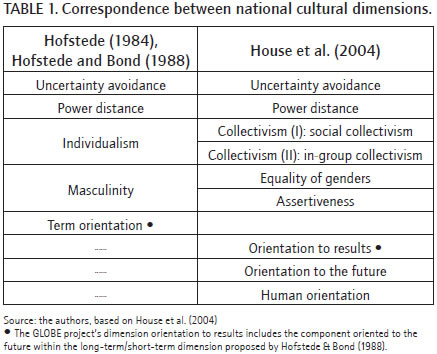
<body><![CDATA[<p>&nbsp;</p>     <p><font size="3"><b><i>  National differences in cultural values</i></b></font></p>     <p>  Culture is a complex and difficult term to define (Groeschl  &amp; Doherty, 2000). However, most of the concepts coincide   in understanding culture as the values shared by the individual   components of a human group (<i>e.g.</i>, societies, ethnic   groups, races, etc.) that influence on the behavior of those   individuals and the social relations established between   them in organizations.</p>     <p>  In that respect, Schwartz (1992) analyzes the values of individuals   in 25 countries using a sample of secondary school teachers and students. Schwartz (1994) further analyzed   his data at the cultural level and found seven culture-level   value types, which were summarized into three dimensions   -<i>i.e.</i>, embeddedness versus autonomy, hierarchy versus   egalitarianism, mastery versus harmony. Smith et al. (1996)   also identify dimensions of cultural variation from employees   of business organizations in 43 nations -<i>i.e.</i>, values   related universalistic versus particularistic obligations,   achievement versus ascription orientation, and individualism   versus collectivism structure. Ronen &amp; Shenkar (1986)   classify countries according to the work-related values.   The differences in national culture identified by Hofstede   in samples of IBM employees (Hofstede, 1984), and some   later works using student samples (Hofstede &amp; Bond,   1988; The Chinese Culture Connection, 1987), allow him   to identify five independent dimensions that explain differences   in terms of national culture. Finally, the GLO BE   project (House et al., 2004) analyzes culture by focusing   on the values to which employees aspire (&laquo;should be&raquo;), although   it also includes the visible/explicit level of cultural   analysis by studying real behaviors and organizational   practices (&laquo;as is&raquo;).</p>     <p>  Hence, there is great deal of literature available on national   culture, on cultural dimensions and typologies, and on variables   that allows an empirical study of such national values.</p>     <p>One piece of work that stands out from that literature   is the typology proposed by Hofstede (2001; 1984), due to   its widespread use in all areas of international management   research. More specifically, he establishes that the cultural   dimensions of power distance, uncertainty avoidance, individualism,   masculinity and term orientation permit the   characterization of a particular national population. The   GLOBE project (House et al., 2004) expands and clarifies   those dimensions and provides a total of nine dimensions (see <a href="#t1">Table 1</a>).</p>     <p><a name="t1">&nbsp;</a></p>     <p>    <center><img src="/img/revistas/inno/v20n38/38a11t1.jpg"></center></p>     <p>  On the basis of those two approaches, the following dimensions   -uncertainty avoidance, power distance, individualism,   masculinity and term orientation- are chosen in this   work for several reasons: (1) they constitute dimensions that   determine the degree to which individuals promote or avoid   certain practices and behaviors within social groups, which   enables us to support our arguments about the individual's   action in favor of the team, and (2) they are all based on the   cultural dimensions initially proposed by Hofstede (2001;   1984), and thus their wider use in research has given rise to   numerous publications that discuss their fundaments and   repercussions in the context of the firm and work-teams. Our   research serves to expand those works that make empirical   use of Hofstede's framework and S&oslash;ndergaard (1994, p.   448) provides the reasons that led us to that: "&#91;...&#93; relevance   and rigour". Of course, we also find works that criticize that   framework (<i>e.g.</i>, Jeanquart-Barone &amp; Peluchette, 1999;   Schramm-Nielsen, 2000; Tayeb, 2001), leading to Hofstede   (1998) making an individualized response to each of them.   Those criticisms apart, <i>Culture's Consequences</i> provides   a framework, concepts and definitions that are firmly   established and widely known in the academic context.   Moreover, that framework offers a common platform for   debating matters related to cross-national management   (Schramm-Nielsen, 2000). The cultural dimensions considered in this study are detailed below.</p>     ]]></body>
<body><![CDATA[<p><i>Power distance</i>. Inequality among humans is produced in   areas such as prestige, wealth, power or the subordinateboss   relationship in the context of organizations. For   Hofstede (2001; 1984), that cultural dimension represents   a measure of interpersonal power or influence between the   boss and the subordinate and how it is seen by the less powerful of those two.</p>     <p> <i>Uncertainty avoidance</i>. A relevant issue faced by any society   is the uncertainty created by unawareness of future   events. This basic fact of life means that, faced with that   uncertain future, human beings take a position in a continuum   that ranges from full acceptance and assumption of   that uncertainty to intolerable anxiety about it (Hofstede,   2001; 1984). When individuals have high uncertainty   avoidance, the stress caused by uncertainty, for example,   makes them want to seek greater stability in their   professional career and to avoid risks, so they show longer tenure in their firm (Clugston et al., 2000).</p>     <p><i>  Individualism</i>. Societies differ in the relationship between   what is individual and what is collective, the dependence   of the individual on the group and, in short, in the meaning   given by individuals to the personal pronouns "I" and "we"   (Hofstede &amp; Bond, 1988). Collectivism and individualism   are opposites in this third dimension of national culture (Hofstede, 2001; 1984).</p>     <p><i>  Masculinity</i>. This value refers to individuals' roughness and   competitiveness in the firm, as well as their determination   in the pursuit of material success. When masculine values   predominate, individuals are assertive, and consider   belonging to a social group in which they do not stand   out as a result of their own individual merits -being in   an undifferentiated average- a failure, so they have a   strong need for achievement (Hofstede, 1984). At the   opposite extreme, individuals with feminine values put   greater stress on interdependence in relationships, feelings,   teamwork, quality of life in the firm, and reconciling work and family life.</p>     <p><i>  Term orientation</i>. This dimension refers to the orientation   given to life over a period -long or short term-, in other   words, whether one lives for the future or for the present (The Chinese Culture Connection, 1987).</p>     <p>&nbsp;</p>     <p><font size="3"><b><i>  The influence of culture on the results of the  multicultural team</i></b></font></p>     <p>  The study of teams and the results they achieve has been   tackled using descriptive models (Canney Davison, 1995;   Cohen &amp; Bailey, 1997; Gladstein, 1984; Kirkman &amp; Rosen,   1999; Langfred, 2000; Maznevski, 1994; Nebus, 1999; Stewart &amp; Barrick, 2000). In general, descriptive models permit an understanding of the team and its results from an overall and intrinsic perspective. These models include a wide set of variables associated with the functioning and characteristics of the teams, whose behavior affects the results they achieve. The most important of these models was developed in 1964 by McGrath, who used a resourcesprocesses- results framework to explore the efficiency of work groups. McGrath proposes that resources -<i>i.e.</i>, the elements available to the team to perform its tasks- are combined to affect the processes of the team -<i>i.e.</i>, a set of actions that take place in the team-, which, in turn, influence its results -<i>i.e.</i>, effects or consequences of the processes. This model is probably the dominant historical vision of groups (Canney Davison, 1995; Cohen &amp; Bailey, 1997; Gladstein, 1984; Kirkman &amp; Rosen, 1999; Langfred, 2000; Maznevski, 1994; Nebus, 1999; Stewart &amp; Barrick, 2000), since most research works share the presumption that the processes influence the relationship between the resources provided to the team and the results achieved (LePine et al., 2008). Therefore, we base this research on that model.</p>     <p>  After the theoretical review, we were able to confirm that,   although most of the authors have theoretically proposed   overall models that include practically all the variables relevant   to the study (Canney Davison, 1995; Cohen &amp; Bailey,   1997; Gladstein, 1984; Kirkman &amp; Rosen, 1999; Langfred,   2000; Maznevski, 1994; Nebus, 1999; Stewart &amp; Barrick,   2000), when empirical objectives are set, they analyze a   summarized model. In those models, they condense the   resource variables -<i>e.g.</i>, Stewart &amp; Barrick (2000) consider   only the team structure-; the process variables -<i>e.g.</i>,   Canney Davison (1995) analyze only the communication   process-; or both -<i>e.g.</i>, Maznevski (1994) selects diversity   as a resource and communication as a process. However,   they all conclude that, whatever the number and variety   of variables, a relationship exists between the resources   available to the teams and the results they achieve. That   relationship is also influenced by the processes that take   place inside the team (Canney Davison, 1995; Maznevski,   1994; Gladstein, 1984; LePine et al., 2008; Stewart &amp; Barrick,   2000). We follow this approach and select the following   study variables: the cultural resources of the team, the   social processes, and the results related to those processes   (<a href="/img/revistas/inno/v20n38/38a11f1.jpf" target="_blank">Figure 1</a>).</p>     <p> <i>Cultural resources of the team</i>. The composition variables   of the team can be operationalized from individual-level   variables by making use of additive measures (<i>e.g.</i>, sum,   mean, etc.), disjunctive measures (<i>e.g.</i>, maximum), etc.   (Steiner, 1972). Steiner (1972) recommends the use of the   most appropriate aggregation technique for each specific   task developed by the team. Nevertheless, the typology   of this author is especially useful in laboratory studies   where the researcher is able to control the task variable   of the team. In field studies, however, given that the   teams participating in the study have to carry out various   tasks, the joint use of different aggregation forms seems   more convenient (Bell, 2007). Then, we study the cultural   resources of the team by the joint interpretation of two   elements: (1) the cultural profile of the team for each   dimension of national culture (<i>i.e.</i>, mean of Hofstede's   scores for each cultural dimension taking the nationality of   the team members into consideration) -which represents   the central cultural tendency of the team for each of the   above mentioned dimensions- and (2) the heterogeneity   or degree of dispersion of national cultures present in the   team (<i>i.e.</i>, variance, standard deviation) -which represents   the total level of diversity or variability existing in the team   in each cultural dimension. Thus, heterogeneity shows, in   an aggregate fashion, the extent to which each member   differs from the rest of the team in each cultural dimension.   Certainly, those variables, as we conceptualize them,   have neither been measured nor explicitly included in the models to analyze results that we have had the opportunity   to study, which leads us to consider this as part of our contribution   to the study of multicultural teams. Nevertheless,   some previous works in the literature have aimed to study   the cultural diversity of the team and its effect on the   performance -amongst which that of Vodosek (2007) is   identified-, although this analyzes exclusively the cultural   diversity of the team for the values of individualism and   through the individual's perception on such cultural values.   Compared to this research, ours covers a greater range   of cultural resources of the team -<i>i.e.</i>, cultural diversity   and profile, individualism and also masculinity, distance   power, uncertainty avoidance. Of even greater significance   is our analysis on the culture at a macro-level by means   of the existing values in a nation or country. Culture at   a macro-level reflects a reality external to the individual,   while the culture measured at an individual level reflects   the individuals' perception of that reality, so individuals   acquire and accept the culture of their society at different   levels (Dorfman &amp; Howell, 1988).</p>     ]]></body>
<body><![CDATA[<p> <i>The social processes of the team</i>. Amongst the different   team processes analyzed in the literature -<i>i.e.</i>, transition,   action and interpersonal processes (see meta-analysis   of LePine et al., 2008)-, the current research chooses   communication, conflict management, cooperation and   participatory decision-making processes as here the   cultural diversity of the team may have a greater impact.   The team resource is the purpose of the analysis in this   research. These so-called social processes correspond to   the interpersonal relationships among team members   (Stewart &amp; Barrick, 2000) and explain many of the variations   in their results (Hopkins &amp; Hopkins, 2002), amongst   which is to be found team member satisfaction (<i>e.g.</i>,   Cohen et al., 1996; Jehn, 1995; Vinokur-Kaplan, 1995;   Weisman et al., 1993). Firstly, communication is defined   as the transmission of signals by means of a code common   to the sender and receiver. Since the interpretation of that   code is influenced by the cultural norms and values of   each individual in the team, the communication process   depends on the knowledge that the team members have   not only of the code used, but also of the cultural norms   and values associated with it. This is because communication   comprises not only the transmission, but also the   understanding of the meaning (Robbins, 2001). Moreover,   cooperation consists of working together to a common   end and is essential for obtaining the results that have   been established (Bettenhausen, 1991). Thus, the interaction   that occurs when there is a cooperative group   effort represents how the group members work together   and what they do to complete the tasks they have been   assigned (Watson &amp; Michaelsen, 1988). In turn, conflict   is an important part of the processes in teams; in fact,   it is considered inherent to them (Appelbaum &amp; Shapiro,   1998; Bettenhausen, 1991; Smith &amp; Berg, 1987). Conflict   within a team occurs when tension between the members   becomes apparent "due to real or perceived differences"   (De Dreu &amp; Van Vianen, 2001, p. 309). Finally, decisionmaking   involves the identification and selection of   alternative solutions that lead to the desired situation.   Generally, the process begins with the appearance of a   problem and ends when a solution is achieved. However,   the quality of the adopted decision is important because   it affects the possibilities of the individuals' promotion   and contributes to the success or failure of the team.</p>     <p><i>  The results of the social processes</i>. The main consequences   of the social processes that take place in teams, in this multicultural   case, are the cohesion and satisfaction of their   members (<i>e.g.</i>, Cohen et al., 1996; Jehn, 1995; Vinokur-   Kaplan, 1995; Weisman et al., 1993). Researchers have   recently begun to measure cohesion as a multidimensional   construct where they distinguish instrumental or task cohesion   -<i>i.e.</i>, that developed when the group members depend   on others to achieve the group's objectives-from social or   socioemotional cohesion -<i>i.e.</i>, that developed when the   individuals feel emotional satisfaction from their participation   in the group- (Buelens et al., 2002; Langfred, 2000).   Satisfaction is the degree to which the individuals feel   happy working in the team (Jehn et al., 1997). It is important   for the general welfare and psychological functioning   of the individual, and affects the levels of absenteeism and   staff turnover and, probably the results obtained (Verkuyten   et al., 1993). Therefore, the satisfaction of each team   member seems to have a significant impact on the collective   welfare (Jeanquart-Miles &amp; Mangold, 2002). Nerkar et al. (1996) identified two constructs related to satisfaction:   instrumental satisfaction and social satisfaction. The first   centers on the satisfaction of the members of the team   with its functioning, while the second is related to the   interaction among the team members.</p>     <p>&nbsp;</p>     <p><font size="3"><b><i>  Research hypotheses</i></b></font></p>     <p>  Taking the selection of variables into account, we now   analyze the relationships between the team's cultural   resources -cultural heterogeneity and cultural profile-   and the social processes to then analyze the relationship   between those processes and the team's results.</p>     <p><i>  Cultural heterogeneity</i> reflects the cultural diversity in the   team. Heterogeneity appears to have both positive and   negative effects. From a positive point of view, diversity   highlights the range of perspectives and the ability to   solve problems, generates alternatives and establishes criteria to measure them thus improving the quality of   decisions that are adopted, favors conflict management   and generates many interesting ideas to be shared with colleagues   (Duriau, 2004; Hambrick et al., 1998; Maznevski,   1994; Milliken &amp; Martins, 1996). However, heterogeneity   may give rise to "process losses" in multicultural teams due   to communication difficulties, mistrust, interpersonal stress   and the possible establishment of cultural stereotypes   among team members (Hambrick et al., 1998), which will   lead to lower results than those achieved by homogeneous   teams (Vodosek, 2007; Watson et al., 1993). In effect,   when the team is made up of individuals from different origins,   interpersonal dynamics and communication models   are more complicated than in a nationally uniform team   (Canney Davison, 1994; Mayo &amp; Pastor, 2003). However,   although heterogeneity accentuates those communication   difficulties (Adler, 1983; Mayo &amp; Pastor, 2003; Watson   et al., 1993), various authors state that, with time, it is   possible to overcome the disadvantages (Watson et al.,   1993). Due to these approaches, the following hypothesis   is proposed:</p> <ul>       <p> <b>H1.</b><i> The cultural heterogeneity existing in a multicultural   team that interacts over a prolonged period is associated   positively with the social processes that occur in the team.</i></p>    </ul>     <p>  Moreover, the teams have another cultural resource that   we have denominated <i>cultural profile</i>. This permits the   relationship between the cultural tendency of the team   and the social processes taking place within it to be established.   First, cultural profile can influence the type of   communication within the team. If we consider the dimensions   of national culture, we can indicate that there are   two dimensions influencing that social process. It has been   stated that, when the power distance is high (the more   powerful people/bosses tend to devalue the worth of   the performance and criteria of less powerful employees),   communication will be limited because workers are afraid   to express their own ideas. What is more, as the patterns   of power inequality within organizations reflect the values   of both parties (authority exists only where it is matched   by obedience), employees do not feel that it is natural to   speak up (Hofstede, 2001).</p>     <p>  On the other hand, when collectivism is predominant,   individuals show a clear emotional dependence on groups,   which tend to be strong and cohesioned (Hofstede, 2001).   The more collectivist the values are, the more the norms   -rather than individual attitudes- predict the individual's   behavior (Bontempo &amp; Rivero, 1992). Such individuals place   great value on accepting group norms (Hofstede, 1984) and   behave in accordance with them (Yao &amp; Wang, 2006) because   they need be accepted by the group. Then, conformity   is related with collectivist cultures where individual's opinions   are predetermined by the groups to which they belong   and on which the managers put pressure so that conformity   and orderliness exist within. The collectivist values,   therefore, may restrict the quality of the communication   within the group. However, if individualism is high, it will   encourage the efficient communication that enables the   work to be done well (Chen et al., 1998). This is possible   because the people belonging to individualistic societies   expect the team members' personal opinions to be listened   to and moreover, they do not tend to conform falsely to   their partners or accept the criteria of their group if they do   not share those ideas. All the above justifies the following   research hypotheses:</p> <ul>       ]]></body>
<body><![CDATA[<p> <b>H2a.</b> <i>The greater the cultural value of power distance in a   multicultural team is, the lower the communication that   occurs in the team will be</i>.</p>     <p> <b>H2b.</b> <i>The greater the cultural value of individualism in   a multicultural team is, the greater the communication   that occurs in the team will be</i>.</p>    </ul>     <p>  Second, cooperative conduct occurring within the teams is   also related to the national values of the team members.   Taking the literature review into account, there is support   because collectivist values make individuals act more   cooperatively with their colleagues (Noordin et al., 2002;   Perlow &amp; Weeks, 2002). This is probably true because collectivists   are more dependent and reliant on groups, that   is, more predisposed to be communitarian and to focus   on collective responsibility (Earley &amp; Gibson, 1998). As a   result, they consider individual performance as less important   than group performance, and subordinate their needs   and desires to the requirements of in-groups (<i>e.g.</i>, goal   achievement). At the same time, individualists emphasize   competition (Cox et al., 1991) and display a more restricted   pattern of helping due to their having been brought up in   a society built on independence and individual contribution   (Perlow &amp; Weeks, 2002).</p>     <p>  The masculinity dimension is also reflected in the cooperation   process in a way that the female cultures are   recognized as having a greater ability to develop group dynamics   such as cooperation. The concerns for interpersonal   relations and life quality in feminine cultures, and for material   rewards and competition in the masculine ones, justify   that the first are able to treat job and people aspects as   interdependent, whereas the latter see these in opposition   (Hofstede, 2001). As a result, individuals in a feminine culture   emphasize that cooperation is an important process   that improves both humanization and performance of the   work and, therefore, they make an effort to achieve it. The   above leads us to propose the following hypothesis:</p> <ul>       <p><b>H3.</b> <i>The greater the cultural values of individualism or   masculinity in a multicultural team are, the lower the cooperation that occurs in the team will be</i>.</p>    </ul>     <p>  The cultural profile of multicultural teams shows distinctions   about the different forms of conflict management.   The literature review indicates that low uncertainty avoidance,   which is characterized by openness to the change   and new ideas and a greater tolerance of diversity   (Hofstede, 2001), is related to an open style of conflict   management (Pheng &amp; Yuquan, 2002; Kozan, 1997). That   is true because in those cultures a wider acceptance of   what the individual brings to the team and greater respect   for individuality is assumed. As a result, those values make   it possible for the team members to exchange opinions,   to discuss new approaches, and to explicitly accept usual   disagreements that are necessary to manage the conflicts.   However, when the uncertainty avoidance is high (there   is more conservatism, a stronger desire for law and order   and a greater fear of things foreign and unknown), the   open style of conflict management is avoided and ignored   (Hofstede, 2001). There, conflict management is based on   universalist principles and rules -that is, regulative conflict   management- (Kozan, 1997). Thus, this cultural variable   can contribute to our understanding the way in which   information is transmitted within the group and consequently,   the reason why the communication process within   the team facilitates or hinders the open management of conflict that appears within.</p> <ul>     <p> <b>H4.</b> <i>The greater the cultural value of uncertainty avoidance   in a multicultural team is, the less open management of conflict between the team members there will be</i>.</p>    </ul>     ]]></body>
<body><![CDATA[<p>  The participation of the team members in the decisionmaking   process will be affected by the profile of national   culture that characterizes the team. Therefore, a cultural   profile that stands out for its low power distance score will   show greater disposition towards participatory decisionmaking   because hierarchy is understood as inequality of   roles resulting in higher interaction between superiors and   subordinates (Bochner &amp; Hesketh, 1994; Bu et al., 2001;   Hofstede, 2001; Newman &amp; Nollen, 1996; Schermerhorn   &amp; Bond, 1997; Schramm-Nielsen, 2000). This is the    same as what will occur if the uncertainty avoidance is    low (high participative decision-making), since those    cultural values are related to openness to new ideas,    willingness to face ambiguity and change, tolerance    of diversity and a low work stress. Lastly, when we consider    the individualism dimension, the literature review    indicates that, the higher the score in this dimension, the    lower the individual willingness to participate in decisionmaking    within the team because they prefer an individual    decision-making process (Bochner &amp; Hesketh, 1994; Hofstede,    2001; Pheng &amp; Yuquan, 2002). The above enables us to propose the following research hypothesis:</p> <ul>     <p> <b>H5.</b> <i>The greater the cultural values of power distance,    individualism or uncertainty avoidance in a multicultural    are, the less participatory team decision-making there will be</i>.</p>    </ul>     <p>   The individuals comprising the team interact to carry out    various processes and tasks in which the execution requires    cognitive, verbal and behavioral abilities and it is through    developing these processes and tasks that the individuals    achieve the collective objectives established for the team    (Bell, 2007). Therefore, the adequate development of the    team processes demands that the individuals possess    the necessary technical knowledge, the values, the skills,    etc., in order for those team processes to be successfully    developed. According to Arciniega et al. (2008), the team    members' interaction entails processes of exchanging    information and ideas (<i>i.e.</i>, communication), making decisions,    etc., in which non-visible personal heterogeneities,    such as values, need to go into action. As a result, we    can stated that the team processes carry out a mediator's    role, as a result of which the national cultural values of    the individuals comprising the team (resources) combine    and act to achieve the established objectives (results), as is    proposed in McGrath's model (McGrath, 1984). By reason    of this approach and after analyzing the relationship between    the cultural characteristics and the social processes,    we study the interaction of the latter with the results of the multicultural team.</p>     <p>   Firstly, <i>communication</i> has a direct and positive effect on    achieving the results established for the team in a way    that, while good intra-group communication does not    guarantee good results, it seems evident that poor communication    leads to disastrous results. Snow et al. (1996)    specifically state that the efficiency of the team begins    with the development of a group process to communicate    functional information necessary to carry out the tasks    entrusted to the group. In fact, an efficient communication    process enables the team members to be informed of    those questions relevant for carrying this out successfully    -<i>i.e.</i>, assigning specific tasks, changing the work patterns,    etc.- (Gladstein, 1984). In this way, when there is an open    and frequent communication facilitating prompt access to    the necessary information, this will improve not only the    team performance but also the team member satisfaction    (Baldwin et al., 1997). However, in spite of the communication-    efficiency relationship has been considered in many models (<i>e.g.</i>, Gladstein, 1984; Pearce &amp; Ravlin, 1987) and corroborated in laboratory studies, it has not been studied extensively in fieldwork (Campion et al., 1993).</p>     <p>  Laboratory studies have been able to confirm that <i>cooperation</i>   is critical for the team to achieve efficiency and is,   therefore, included as a relevant variable in various models   (<i>e.g.</i>, Gladstein, 1984; Pearce &amp; Ravlin, 1987). However, its   isolated influence has not been evaluated in the company   context, since the work of Campion et al. (1993) verified   the joint relationship between the factor <i>Communication   and Cooperation within the team</i> and the efficiency   achieved by the team. On those lines, Bettenhausen (1991)   maintains that establishing and maintaining a cooperative   working atmosphere is critical to the team's results. Furthermore,   the team member interaction in the cooperation   process makes it easier to gain assistance in carrying out   the tasks, learning knowledge and skills available in the   team, as well as a greater colleague integration all of   which may improve the instrumental and social satisfaction   of the team members.</p>     <p>  The role played by <i>conflict</i> within a team is a particularly   ambiguous issue (Lovelace et al., 2001; Tjosvold et al., 2003). While some authors have associated conflict   with greater innovation and more efficient interpersonal   relations (De Dreu &amp; Van Vianen, 2001; Tjosvold et al.,   2003), others associate it with lower levels of efficiency   and higher staff turnover (De Dreu &amp; Van Vianen, 2001;   Vodosek, 2007; Tjosvold et al., 2003). In this respect Jehn   (1994) distinguishes between emotional conflict and task   conflict, emphasizing the negative role that may be placed   by the former in team performance compared to the positive   role of the latter. However, the acceptance of conflict   permits it to be experienced as an important contribution   that favors the functioning and results of the team (Ravlin   et al., 2000; Tjosvold et al., 2003), while creating the need   for it to be adequately managed is necessary. In fact,   Canney Davison (1994) considers improbable that a team   avoiding conflict will attain a high level of results. Given the   interest in knowing the effects of the cultural dimensions   on the team's results, in this work, rather than attempting   to clarify whether conflict is positive or negative, we   attempt to corroborate that its management influences the   instrumental and social satisfaction of the individuals comprising   the teams. In this regard, we must emphasize that   conflict management assumes recognizing its existence,   as well as searching for solutions that, at the end, benefit   positively in developing an appropriate work environment, and result in the team member satisfaction.</p>     <p>  Participatory <i>decision-making process</i> provides a broader   set of perspectives and generates better understanding   and acceptance of the decisions adopted (Maznevski,   1994). Furthermore, participatory decision-making process   allows the individuals to integrate more easily in the team   and perceive that their contributions are valued by their   colleagues as well as sharing the credit of the achieved   objectives, thus making them wish for new goals. However,   there are also significant disadvantages associated with   the pressure applied by a few to reach an agreement, with   the process dominated by a few participants, or with the   appearance and consolidation of group thinking. In any   case and whatever the form of decision-making within   the team, authors treat it as a fundamental variable for   achieving the results established for the team (Hopkins  &amp; Hopkins, 2002; Salk &amp; Brannen, 2000; Snow et al.,   1996). It has also been stated that, although there is a   relationship between participative decision-making and   results, it is only associated with the quantified results by   measuring the satisfaction of the team members (Cohen &amp;   Bailey, 1997), which we aim to corroborate for the multicultural   teams in our work. As a result, we put forward the following hypothesis:</p> <ul>     <p><b>  H6.</b> <i>The greater the use of social processes is, the better the results achieved by the team will be</i>.</p>    </ul>     ]]></body>
<body><![CDATA[<p>&nbsp;</p>     <p><font size="3"><b>Methodology</b></font></p>     <p>  The works that contemplate cultural diversity in organizations   as a research parameter have been conducted in a   laboratory (Cox et al., 1991; Earley &amp; Mosakowski, 2000;   Polzer et al., 2002; Watson et al., 1993; Watson &amp; Kumar,   1992), especially when the analyzed variables are nationality   or ethnic group (Williams &amp; O'Reilly III, 1998). There   is a similar tendency when the object of analysis is the   multicultural work team, for which there are two reasons   (Cox, 1990): (a) the difficulty in finding sufficient cultural   diversity in organizations to be able to conduct such studies   and (b) the unwillingness of firms to collaborate in   works that address the analysis of cultural differences,   which many associate with racism, ethnocentrism, etc.   However, multicultural teams are created in organizations   as a means of achieving objectives and they are   very rarely an end in themselves. Thus, if these groups are   studied outside the organization, they are isolated from   the organizational environment, and then the individual's   concern for the team outcome may not emerge (Bell,   2007) which may have a direct influence on the quality   of the results obtained (Campion et al., 1993). In Bell's   (2007, p. 600) opinion, "Features of the setting could   potentially affect the observed relationships between   composition variables and team performance, especially   those composition variables related to performance by fostering beneficial social process".</p>     <p>We opted to undertake an exploratory field work so that   it was feasible to make a contribution to the literature by   providing new research hypotheses based on studies in the   context of the multinational organization. An exploratory   work was advisable given the following: (i) the low willingness   of firms to collaborate in multicultural studies (Cox,   1990); (ii) the lack of empirical works that link heterogeneity   in national values and results in multicultural teams;   and (iii) the difficulty in identifying a set of comparable   teams for the research. Given the exploratory nature of   the study, we propose to obtain comparable, but diverse,   sample units in a way that represents variability while at   the same time being quantitatively sufficient to statistically test the proposed hypotheses.</p>     <p>&nbsp;</p>     <p><font size="3"><b><i>  Universe and sample selection</i></b></font></p>     <p>  Multinationals were contacted in Spain with the aim of   identifying active multicultural teams in those firms. A   strict set of requirements with which the teams had to   comply was established. Those requirements ensured the   multicultural (at least one member must be of a different   nationality) and natural (they operate effectively in multinational   firms) character, as well as the necessary interaction   and interdependence of the members (<i>e.g.</i>, sharing a   common objective, autonomy to manage and lead its work,   hold face-to-face meetings, etc.). Our sample includes not   only permanent teams (together for over two years) but   also temporary teams having been established for at least   3 months and 100 hours so that the effect of cultural   heterogeneity can be analyzed. The relative irrelevance of   the activity sector when researching work teams (Kirkman   &amp; Rosen, 1999; Stewart &amp; Barrick, 2000), and the abovementioned    difficulties linked to locating the teams, led us    to make contact with multinationals operating in different    sectors and to use the so-called "by relationships" method    to identify the teams. As a result of that effort, we identify    14 teams in 7 multinationals operating in three different    sectors (tourism, distribution and manufacturing). To be    precise, the 101 individuals of which the 14 teams were    comprised were identified and information was accessed    on each individual regarding the nationality. Furthermore,    each team member received a questionnaire, obtaining a final valid sample of 40.</p>     <p>&nbsp;</p>     <p><font size="3"><b><i>   Information gathering instrument</i></b></font></p>     <p>   A standardized, self-administered questionnaire was drawn    up in two versions: English and Spanish. Those two languages    were decided on for the reason that in the multinationals    established in Spain, a great number of the individuals    are Spanish or of Hispanic origin, and as regards the other    important group whose language is not Spanish, the official    language of communication of the multinational firms    participating in the study is English. Because the correct    translation of a questionnaire is a key issue in an international    research, and therefore, object of concern (<i>e.g.</i>, Leung    &amp; Bond, 1989; Peng et al., 1991; Vandenberg &amp; Lance,     2000), in the current work, the back-translation technique     suggested by Usunier (1998) was used and it has been     applied in relevant works such as that of Verkuyten et al.     (1993). To apply the technique, in light of the scales constructed     and tested in English-speaking countries, scales     were formulated in Spanish and were then subsequently     translated into English by native professional translators.     Subsequently, the original scales taken as a reference     point and constructed in English were compared with that     obtained after translating our elaborated Spanish version     into English. Finally, this questionnaire was tested by collaborating     managers with experience in different countries     and who mastered both languages, as well as university     professors who had spent time in different countries of     the European Union. On taking all these precautions, it     is possible to guarantee the suitability of the terms, the     correct translation and the measurement equivalence in all the variables employed.</p>     ]]></body>
<body><![CDATA[<p>    The questionnaire was structured in four parts. The first     part contains questions related to the demographic     description of the team. The second one contains twelve     items about the social processes. To be specific, the scale     used to evaluate communication within the team is based     on that used by Campion et al. (1993). It should be pointed     out that the scale used to obtain information about the cooperation     process is strictly the one proposed by Campion     et al. (1993). Conflict management is measured using the     scale proposed and validated by Canney Davison (1995) in     her study of multinational teams. Finally, the scale used for     participatory decision-making is based on that proposed by     Campion et al. (1993) and Watson &amp; Michaelsen (1988).     The third one, which deals with the results achieved by the     team, includes 14 adapted items regarding the members'     satisfaction on belonging to the team (Ancona, 1990;     Anderson, 1983; Canney Davison, 1995; Cohen et al.,     1996; Williams, 1998) and the internal cohesion achieved     in the team (Watson &amp; Michaelsen, 1988). The fourth     one includes demographic questions about the individual     completing the questionnaire to establish a demographic, cultural and professional profile.</p>     <p>&nbsp;</p>     <p><font size="3"><b><i>  Measurement of cultural resources</i></b></font></p>     <p>  The team's cultural resources are defined by the joint interpretation   of two elements: (1) the average cultural profile of the team for each national culture dimension (<i>i.e.</i>, average   of the national values of the team members) and (2) the   cultural heterogeneity, or degree of dispersion of national   cultures present in the team. To calculate the two variables   for each of the 14 teams participating in the study, the   scores of the cultural dimensions that corresponded to the   nationality according to the results of Hofstede's study   (2001) were assigned to the 101 members in the 14 teams.</p>     <p>  The literature review reveals that there is no measure   describing the cultural profile of the team, so this research   attempts to take a step towards determining that profile.   To that end, we establish that the score obtained by   each team for a cultural dimension, for example power   distance, can be calculated by means of the arithmetical   average of the cultural scores established in the work of   Hofstede (2001) for that cultural dimension. Thus, a higher   score indicated greater power distance as an average   cultural value in the team. That procedure is also followed   to calculate the average scores of the values of uncertainty   avoidance, individualism, masculinity and orientation to   the term orientation. We are aware that we are creating an   average of the profiles of the national values of the team   members, which means (i) that we are giving an individual   the score for his/her country of origin, which Hofstede   (2001; 1984) called "ecological fallacy", (ii) that there   are differences between countries that are not reflected   in the numbers (Hambrick et al., 1998), and (iii) that the   data collected and treated refers to the dimension <i>term   orientation</i>, which has not yet been calculated in some of   the countries including seven of the twelve nationalities   in the sample. As a result, this last cultural dimension was   excluded from the analysis. However, this variable, as we   conceptualize it, has not been explicitly incorporated in   the models to measure the results of multicultural teams.   Therefore, we are exploring both the method used and the   relationship of this dimension with the social processes.</p>     <p>  Cultural heterogeneity has been measured in different   ways. In the empirical research of Earley &amp; Mosakowski   (2000) and Anderson (1983), it has been classified according   to the number of different nationalities or ethnic   groups in each team. Other works have not specified the   degree of heterogeneity since they were performed with   teams of students who the authors themselves distributed   among homogeneous and heterogeneous groups without   specifying that degree (<i>e.g.</i>, Cox et al., 1991; Watson et al.,   1993; Watson &amp; Kumar, 1992). Although Vodosek's work   (2007) measures the heterogeneity, it does so through   the individuals' perceptions on the cultural values. Consequently,   in this research the measurement of the team's   heterogeneity is explored, calculating it as the typical deviation   of each cultural dimension referring to the average   profile of the team. Note that a higher score indicates a   greater distance between the cultural values of each team   member and the team's average in that dimension, which   means that the heterogeneity is greater for the team.   Hence, and using an example of a multicultural team, a   low level of uncertainty in the team can be achieved in two   ways: either by forming a team of individuals belonging to   cultures with low uncertainty avoidance, or by combining   individuals so that the team includes individuals with very   low levels of uncertainty avoidance and others with moderate   levels of uncertainty avoidance. In both cases the   cultural profile is the same, but the heterogeneity varies   considerably between them. Researchers are increasingly   recognizing that dispersion is a construct of interest rather   than merely a way of assessing whether aggregation -<i>i.e.</i>,   average- is appropriate (Randel, 2003) and it is conceptually   and empirically different from cultural means and   captures social processes that cultural means are unable   to capture (Au &amp; Cheng, 2004).</p>     <p>  Once the profile and cultural heterogeneity of each of the   14 teams was calculated and the information of the 40   valid cases in which this study is based was acquired, the   corresponding values for belonging to a specific team were   assigned to each of the 40 individuals in the database.</p>     <p>&nbsp;</p>     <p><font size="3"><b><i>  Data analysis</i></b></font></p>     <p>  The statistical tool used to reduce the dimensionality of   the scale to measure the team results -individual satisfaction   and perception of cohesion- was the principal components   analysis with <i>varimax</i> rotation. This tool consists   in obtaining a reduced number of factors which give an   explanation for the greater part of the total variability   of the observed variables. To be precise, this technique,   requiring no previous hypothesis on the data structure and   interrelationships, allows us to obtain synthetic indices   from a phenomenon that has been measured through the   partial multiple indicators (Gonz&aacute;lez, 1991). Compared to   other methods of rotation, <i>varimax</i> rotation was chosen   as it simplifies the number of variables in each factor thus   facilitating their interpretation.</p>     ]]></body>
<body><![CDATA[<p>  Kolmogorov-Smirnov's test was used to contrast the   normality of the variables. Furthermore, the statistical   power of the information was analyzed and subsequently,   Pearson's correlation statistics were applied to contrast the   association between variables and test the formulated hypotheses.   Finally, and for the particular relations between   the social processes of the team and the results, a post   hoc analysis was carried out with the aim of identifying   the influence that the different social processes may have   on the different types of results identified in the principal component analysis -<i>i.e.</i>, intrinsic satisfaction versus   extrinsic satisfaction of the individual for his/her participating   in the team.</p>     <p>&nbsp;</p>     <p><font size="3"><b>  Statistical analyses and discussion of results</b></font></p>     <p> <font size="3"><b><i>Descriptive analysis of the sample</i></b></font></p>     <p>  The results of the descriptive analysis of demographic   characteristics of those surveyed showed a sample comprising   men (47.5%) and women (52.5%), mostly with an   age between 27 and 37 (55%), that had a medium-high   education level (high school or vocational training, 37.5%;   higher university studies, 25%) and were born mainly in   Spain (55%) or Germany (17.5%). When asked about their   involvement with multicultural teams, 62 per cent of the   participants in the survey indicated that they worked in   teams comprising more than six members, while 25 per   cent worked in teams of between 4 and 6 members and   the rest in smaller teams. The respondents were also asked   for the number of teams in which they had worked and the   results gave an average of five teams for the sample as a   whole. These teams, in 64.3% of the cases, were formed   one year prior to the empirical study, 14.3% had been together   for between 1 and 2 years, whereas the remaining   21.4%, had been together for over two years.</p>     <p>&nbsp;</p>     <p><font size="3"><b><i>  Dimensionality of the measuring scales:  validity and reliability</i></b></font></p>     <p>  As <a href="/img/revistas/inno/v20n38/38a11t2.jpg" target="_blank">Table 2</a> shows, the factor analysis carried out for the   team results indicates the presence of four factors: (1)   <i>identification with the team and pride in belonging to it;</i>   (2) <i>satisfaction from the personal contribution to the team</i>;   (3) <i>satisfaction with the team's working atmosphere</i>, (4)   <i>satisfaction with the team's achievement of results</i>. The   first two factors refer to intrinsic satisfaction -<i>i.e.</i>, how   satisfied the individual feels on the whole, and what he/   she contributes to the team-, while the other two refer to   extrinsic satisfaction -<i>i.e.</i>, the individual's satisfaction with   what he/she receives from the team. Consequently, the   factors obtained combine the items relative to task cohesion,   socioemotional cohesion, instrumental satisfaction   and social satisfaction identified in the literature.</p>     <p>  The validity of the scale was also analyzed, that is, the   extent to which this is indeed measuring what it should   be measuring. Regarding this point, the construct validity   is made clear given the principal component factor   analysis made it possible to summarize and synthesize the   observed phenomenon. Furthermore, the content validity   is guaranteed with both the theoretical and empirical   literature review as well as the pretest of the questionnaire.   The discriminant validity is corroborated as the correlation between each pair of factors obtained in this analysis has   a correlation of 0.000, guaranteeing concepts of variance.   Moreover, the global reliability of the scale measured with   Cronbach's alpha statistic rises to 0.889.</p>     <p>  Finally, since there is no sense in applying a factorial   method to scales with three items or less, each theoretical   dimension measured by means of three items -communication,   cooperation, conflict and decision-making- was   transformed into a variable where the values were the average   of the values of the items comprising the scale. The   new variables were used in the later statistical analyses.</p>     ]]></body>
<body><![CDATA[<p>&nbsp;</p>     <p><font size="3"><b><i>  Normality test and statistical power of the data</i></b></font></p>     <p>  We corroborate the normality of the variable as a step prior   to using the most appropriate statistics to test the research   hypotheses. In this respect, the Kolmogorov-Smirnov test is   used confirming the normality of all the variables that were   object of the study (<a href="/img/revistas/inno/v20n38/38a11t3.jpg" target="_blank">Table 3</a>).</p>     <p>  Subsequently, we calculated the statistical power of the   data to carry out the correlation tests. In this respect   both the effect size and the sample size were taken into   consideration and three levels were calculated. First, an   average effect size of 0.37 was considered for the correlations   between the heterogeneity and the social processes   and a statistical power of 77.64 per cent was obtained.   Second, for the cultural profile and those processes, taking   an average effect size of 0.34 into consideration, the   statistical power rose to 71.88 per cent. Finally, for the   correlations between the social processes and the results,   the statistical power reached 87.49 per cent for an average   effect size of 0.43. Given that values the same or superior   to 80 per cent (Cohen, 1992) are considered a high level of   statistical power, the levels of power obtained for our study   may be considered acceptable in view of the exploratory   nature of the current work.</p>     <p>&nbsp;</p>     <p><font size="3"><b><i>  Hypotheses test  </i></b></font></p>     <p>The bivariate correlations between the variable heterogeneity   and cultural profile of the team and the different   social processes (<a href="/img/revistas/inno/v20n38/38a11t4.jpg" target="_blank">Table 4</a>) respond to the first five research   hypotheses.</p>     <p>  With reference to the cultural heterogeneity of the team,   Hypothesis 1 is partially supported. To be specific, in teams   with a high degree of heterogeneity in the dimensions of   power distance, uncertainty avoidance and individualism   there is a positive relationship between the team's cultural   heterogeneity and communication. Hofstede (2001; 1984),   Hambrick et al. (1998) and Canney Davison (1995; 1994)   stand out among the authors that take that positive relationship   into consideration, although in a theoretical and   general way that does not make distinctions by dimension,   in comparison to what we have attempted to do in this   study. Moreover, in our sample, the team members' involvement   in decision-making is positively related to the team's   heterogeneity in terms of power distance and uncertainty   avoidance, which confirms the relationships proposed by   Pheng &amp; Yuquan (2002) and Bu et al. (2001). However,   the results also show that there is no relationship between   the heterogeneity and the processes of cooperation and   conflict management in our sample.</p>     <p>  Furthermore, the association between the cultural profile   and the processes of communication (H2) and participatory   decision-making (H5) are also partially confirmed in   the sample. Therefore, as Hofstede (2001) states, the more   unequally "power" is shared (high distance power) the   more intense the differences between individuals become   and the more the bidirectional information exchange will   be resented (H2a). In addition to the relationships established   in the literature, the analyses have also showed that,   in the teams where the individuals worked, the degree of   uncertainty avoidance also negatively affects communication   within the team. As a consequence of anxiety caused by the unknown, rules and norms are established to be   used as standards (Hofstede, 2001). So, situations of   uncertainty and the spontaneous information that could   upset the balance brought by the established guidelines   is prevented. Besides, the team members may even fear   the consequences resulting from openly expressing their   thoughts.</p>     <p>  The position adopted by the team when faced with uncertain   and/or unknown events is also negatively related   to the participation of the individuals in decision-making,   so that involvement of all the team members occurs   when there is low uncertainty avoidance (H5). However,   the theoretical review clearly reveals that cooperation   processes and conflict management are associated with   cultural profiles that are not confirmed in our research (H3   and H4).</p>     ]]></body>
<body><![CDATA[<p>  Regarding the association between the social processes   and results (H6), it can be said that, apart from cooperation,   all the personal interactions (communication, conflict   management and decision-making) were reflected in the   results achieved by the team (<a href="/img/revistas/inno/v20n38/38a11t5.jpg" target="_blank">Table 5</a>). The empirical works   consulted do not establish the association of the cooperation   process on its own, but jointly with communication   (Campion et al., 1993). This makes clear that, in our sample,   this variable, when isolated, is not related to results. To   be specific, the relationship is established between the   processes of communication, conflict management and   involvement of team members in decision-making with   intrinsic and/or extrinsic satisfaction.</p>     <p>  The evidence of the exploratory work undertaken in   natural teams showed that the transmission of information,   which characterizes the process of communication as   well as those of conflict management and participatory   decision-making, is essential in the processes taking place   within teams, as Proehl (1997), Canney Davison (1995) and   Maznevski (1994) put forward. Hence, those three abovementioned   processes are positively related to the <i>identification   with, and pride in belonging to, the team</i> factor in a   way that the information flow within the team is important   for its members to feel proud of belonging to that team   and to wish to continue working together. Furthermore,   conflict management and participation in decision-making   are positively related to how satisfied the individual is by   his/her contribution to the team. For those processes, the   individual detects how well he/she is considered within   the team, whether in a discussion meeting or in finding   a solution. Finally, these results highlight the greater relevance   of the two social processes by their relation with the team results. This possible greater relevance, identified   from the analyses carried out, was not established as a   research hypothesis due to the absence of literature to   analyze it. Various post hoc analyses, carried out to study   this in depth, can be seen detailed below.</p>     <p>&nbsp;</p>     <p><font size="3"><b><i>  Post hoc statistical analyses</i></b></font></p>     <p>  The post hoc statistical analyses were carried out with the   purpose of identifying the influence the social processes   may have on the intrinsic and extrinsic satisfaction of   the individuals, as measurements of the team results in   which those individuals are members. Two path models   were carried out where the goodness of fit index, following   the recommendations of Hair et al. (1999), was evaluated   by means of the absolute fit index (Chi-square and   RMSEA ), the incremental fit index (TLI and NFI), and the   parsimony fit index (CMIN/DF). Both models presented   an adequate goodness of fit index for any of the indices   analyzed: (1) intrinsic satisfaction (CMIN =0.499, p=0.480;   RMSEA=0.000; NFI=0.990; TLI=1.229; CMIN/DF=0.499);   and (2) extrinsic satisfaction (CMIN =0.277, p=0.598;   RMSEA=0.000; NFI=0.993; TLI=1.483; CMIN/DF=0.277).   The results of the path models (Figures <a href="#f2">2</a> and <a href="#f3">3</a>) for intrinsic   satisfaction and for extrinsic satisfaction reinforce the   significant roles that participatory decision-making and   conflict management, compared to the remaining social   processes, play in the satisfaction of the individuals in   the sample. Specifically, participation in decision-making   represents a relevant element of both the intrinsic and   extrinsic satisfaction of the team members. Obviously, to   make decisions it is essential to have information available   that is accessed and transmitted by means of communication   (Watson &amp; Kumar, 1992), making the correlation   between the different social processes evident. On the   same lines, conflict management provides a better working   environment (extrinsic satisfaction) that is recognized by   the team members and leads to greater satisfaction.</p>     <p><a name="f2">&nbsp;</a></p>     <p>    <center><img src="/img/revistas/inno/v20n38/38a11f2.jpg"></center></p>     <p><a name="f3">&nbsp;</a></p>     <p>    ]]></body>
<body><![CDATA[<center><img src="/img/revistas/inno/v20n38/38a11f3.jpg"></center></p>     <p>&nbsp;</p>     <p><font size="3"><b>  Conclusions</b></font></p>     <p>  This research faced the challenge of developing new operational   measurements of the cultural resources of the team   -cultural profile and heterogeneity-, as well as realizing   empirical research with natural teams with a multicultural   character. As a result of that effort, and responding to the   first research objective, we can verify that the heterogeneity   present in the multicultural teams in our sample is   partially and positively associated with the communication   process and with the participatory decision-making   that both take place in the teams. Therefore, the results   obtained confirm that cultural heterogeneity improves the   processes by stimulating the sharing of ideas, alternative   options and, specifically, perspectives, as Hambrick et al.   (1998) and Maznevski (1994) put forward. In this work,   we have likewise confirmed that cultural profile is also   associated with the processes of communication and of   participatory decision-making. However, a breakdown of that profile into each of the national dimensions reveals   that <i>uncertainty avoidance</i> is mainly associated with   those processes. The <i>power distance</i> dimension is directly   associated with communication in terms of heterogeneity   and cultural profile. These empirical results are consistent   with the theoretical approaches proposed by Hofstede,   who emphasizes how important the cultural dimensions of   uncertainty avoidance and power distance are for the performance   of the teams. Then, the overall cultural resources   of the multicultural team, which have been operationalized   in this work, are related to two of the four social processes   analyzed in the research, namely: communication and   participatory decision-making.</p>     <p>  About the second research objective, we now highlight   the importance of participatory decision-making, communication   and conflict management due to their relationship   with the results achieved by the team, measured in   terms of satisfaction and cohesion (intrinsic and extrinsic   satisfaction). If we return to the previous conclusions   about the relationship between the cultural resources of   the team and the processes of communication and participatory   decision-making, we are finally able to explain   the importance of the cultural profile and heterogeneity   of the teams on the results of the social processes that   occur within those teams. The decision-making is the main   link between the resources and the results analyzed in this   study. Thus, the chosen sample has enabled an analysis   of the results achieved by multicultural teams based on a   descriptive model that responds to the classic pattern of   resources-processes-results.</p>     <p>  This research work has a series of implications that are   both academic and practical for business management.   From a <i>theoretical perspective</i>, different contributions   stand out. Firstly, we propose a model that incorporates   the relevant role that certain cultural resources -<i>i.e.</i>,   uncertainty avoidance, power distance, and to a lesser   extent individualism- play in specific social processes -<i>i.e.</i>,   participatory decision-making and to a lesser extent communication   process, necessary for making decisions- and   that influence the results of the multicultural team, in terms   of intrinsic and extrinsic satisfaction of their members. This   model, put together from an exploratory empirical work,   must be object to empirical contrastation with a greater   sample size as a step prior to its theoretical generalization.   Secondly, this work identifies the existing relationship   between the uncertainty avoidance level of the team and   the communication processes, a relationship for which   no previous reference was identified in the literature.   Our work, moreover, highlights the negativity of this   relationship, in such a way that the greater levels of uncertainty   avoidance in the team are detrimental to their   communication processes. In this respect, the relevance of   that association must be taken into consideration, as communication   underlies the development of the remaining   social processes of the team, although these processes are   difficult to be undertaken without their existing suitable   levels of communication. Thirdly, although it was possible   to demonstrate the cooperation in conjunction with the   communication that had an effect on the team results, in   our work -where the cooperation process was analyzed   isolatedly- such an association was not corroborated.</p>     <p>  From a <i>methodological perspective</i>, we have proposed new   forms of operationalizing the team's cultural resources.   Specifically, this article expands research on cultural   diversity in the team by incorporating two complementary   variables- cultural heterogeneity and cultural profile -that   offer a more realistic and complete view of the team cultural   problems. These constructs are developed, respectively,   from the arithmetical average and the standard deviation   as means of aggregation to construct variables that define   the team resources. Furthermore, both the cultural profile   and the heterogeneity are analyzed isolatedly for each of   the national cultural values. Compared to a significant   part of previous literature, these variables offer two clear   advantages: (1) they are based on the measurement of the   national cultural values of each team member; and (2) they   offer numerical data that can be incorporated as continuous   independent variables into a wider range of statistical   analysis with the aim of analyzing its effect on the team.</p>     <p>  Some previous works have made use of the standard deviation   to study the cultural diversity in the team (Vodosek,   2007) and the arithmetical average to know a specific   cultural profile (Paulus et al., 2005) using team members'   cultural personal values -<i>i.e.</i>, individual subjective perception   about national values. The measurements we propose,   however, are upheld in the conceptualization of national   values as a social reality, which are common to all the   individuals of a country. It entails new advantages: (1) the   measures of cultural profile and cultural heterogeneity are   based on data that have been stable throughout time -the   classification of the countries carried out recently in the   GLO BE project shows hardly any difference from that of   Hofstede's initial proposal in spite of a period of almost   two decades between both studies-; and (2) with the influence   of such cultural resources on the team performance, it   seems feasible that work teams are formed in the company   with the suitable cultural resources. To carry out detailed   studies of the employees' values is not necessary because   knowing only the employees' nationality could be enough.</p>     <p>  Secondly, our work contributed to filling the empirical gap   in organizational environments that characterizes this field of study in which the number of laboratory works is   disproportionately higher than that of those undertaken   with natural teams in organizations. Those lab works assume   the limitations of those samples, which are isolated   from the effects of the organizational environment due to   two reasons: firstly, the difficulties involved in attaining   an appropriate number of multicultural teams (Cox, 1990),   and secondly, because of the need to establish combinations   of nationalities to make the study of cultural diversity   feasible. In that context, the measures provided in this   work offer new possibilities to undertake studies in the   organizational context.</p>     <p>  From a <b><i>practical perspective</i></b>, this work has several implications   for any company that uses teams as a way of   working. Thus, a company can consider the constitution   of multicultural teams with suitable cultural resources to   achieve the desired results. Although designing such a   composition of teams may not be possible in every situation,   in Bell's (2007, p. 606) opinion "&#91;...&#93; when feasible   (<i>e.g.</i>, organizational restructuring, selection for team-based   jobs) practitioners can use team composition to increase   team performance".</p>     ]]></body>
<body><![CDATA[<p>  Firstly, companies can consider the creation of multicultural   teams with cultural profiles that result in higher   team performance. In that respect, participatory decisionmaking,   according to the results of our research, may be   promoted by forming teams with low uncertainty avoidance.   For example, let us consider a multicultural team   created to develop new products. If the cultural profile   of that team, calculated from the members' nationalities,   is one of low uncertainty avoidance, it can be deduced   that the team will produce more and better ideas since   such a cultural tendency favors the acceptance of risks   (Sivakumar &amp; Nakata, 2003) and an active participation   in decision-making. Then individuals show greater satisfaction   for belonging to the team. However, the literature   review reveals that there are few works that analyze the   effect of the profile conceptualized in the way that we propose   since research interest has focused on the roles that   the individuals of different cultural profiles play within the   team (Chen et al., 2002; Watson et al., 2005). Our work   furthermore highlights that communication processes in   multicultural teams may be promoted by forming teams   with low distance power and low uncertainty avoidance.</p>     <p>  Secondly, the cultural heterogeneity in work-teams offers   the firm possibility of studying and providing the team   with the combination of individuals with different cultural   profiles that guarantees a suitable level of heterogeneity.   Hence, and still using the example of the multicultural   team formed to develop new products, a low level of uncertainty   in the team can be achieved in two ways: either   by forming a homogeneous team of individuals with low   uncertainty avoidance, or by forming a heterogeneous   team combining individuals with very low and moderate   levels of uncertainty avoidance. The homogeneity that   characterizes the first team translates into agreement   on the level of risk assumption, gathering of information   and the generation of new ideas for the design of new   products. However, in the second team, the individuals   with very low risk avoidance could contribute more and   riskier ideas while those with moderate risk avoidance will   question those ideas and seek standards on which they   can base discussion of the proposed ideas. One outcome   of that process is that the existence of alternative points   of view (<i>i.e.</i>, heterogeneity) contributes to a better quality   decision and a higher level of satisfaction of team members   due to the high level of discussion and interaction   produced amongst the colleagues.</p>     <p>  Finally, this research work has implications not only for   companies with team-based corporate philosophies,   but also for those whose human resources comprise   individuals of different nationalities. Managers in those   contexts will have to recognize that the contributions to   the organizational environment made by individuals with   different national values may create difficulties. However,   the heterogeneity generated by those differences must be   accepted as an increase of value for the company rather   than viewed as a problem. Then, in the era of the global   firm, cultural diversity must be recognized, understood and   used appropriately in organizations (Adler et al., 1986),   especially in the context of work-teams on which organizations   increasingly base their activities.</p>     <p>  This study has some limitations and certain recommendations   can be made with a view to future studies.   The principal limitation of this exploratory work lies in   the number of sample cases, which determines that the   conclusions can only be extrapolated to the population of   the study. Therefore, to expand the sample to attain levels   of representativeness that make it possible to generalize   the results to larger populations is necessary. In addition,   we are aware that we are working with new measures of   constructs in this line of research and that some of our   considerations lack the strong theoretical support. However,   we believe that our work opens a new way of studying   cultural diversity in multicultural work-teams whose   analysis represents a challenge for future research. We are   also aware of the limitation of not having taken into account   the team external processes and those related to the   tasks although we consider them extremely significant and   recommend the development of works that include them.</p>     <p>Finally, the conclusions provide new issues of interest   that could be analyzed in greater depth and scope in   future research works; for example, (1) continuing with   the study of suitable levels of heterogeneity for each type   of task undertaken by the team; (2) the importance of   the national value of uncertainty avoidance as a critical   cultural resource in the multicultural team; (3) expanding   knowledge of the link between communication and the   other social processes; and (4) broadening knowledge   of the importance of team members' participation in   decision-making to the achievement of results and the development of the other processes.</p>     <p>&nbsp;</p>     <p><font size="3"><b>References</b></font></p>     <!-- ref --><p>  Adler, N.J. (1983). Organizational development in a multicultural environment.   <i>The Journal of Applied Behavioral Science</i>, <i>19</i>(3), 349-365.    &nbsp;&nbsp;&nbsp;&nbsp;&nbsp;&nbsp;&nbsp;&nbsp;[&#160;<a href="javascript:void(0);" onclick="javascript: window.open('/scielo.php?script=sci_nlinks&ref=000170&pid=S0121-5051201000030001100001&lng=','','width=640,height=500,resizable=yes,scrollbars=1,menubar=yes,');">Links</a>&#160;]<!-- end-ref --></p>     <!-- ref --><p>  Adler, N.J., Doktor, R. &amp; Redding, S.G. (1986). From the Atlantic to the   Pacific century. Cross-cultural management reviewed. <i>Journal of Management</i>, <i>12</i>, 295-318.    &nbsp;&nbsp;&nbsp;&nbsp;&nbsp;&nbsp;&nbsp;&nbsp;[&#160;<a href="javascript:void(0);" onclick="javascript: window.open('/scielo.php?script=sci_nlinks&ref=000172&pid=S0121-5051201000030001100002&lng=','','width=640,height=500,resizable=yes,scrollbars=1,menubar=yes,');">Links</a>&#160;]<!-- end-ref --></p>     <!-- ref --><p>  Ancona, D.G. (1990). Outward bound: strategies for team survival in an organization. <i>Academy of Management Journal</i>, <i>33</i>(2), 334-365.    &nbsp;&nbsp;&nbsp;&nbsp;&nbsp;&nbsp;&nbsp;&nbsp;[&#160;<a href="javascript:void(0);" onclick="javascript: window.open('/scielo.php?script=sci_nlinks&ref=000174&pid=S0121-5051201000030001100003&lng=','','width=640,height=500,resizable=yes,scrollbars=1,menubar=yes,');">Links</a>&#160;]<!-- end-ref --></p>     <!-- ref --><p>  Anderson, L.R. (1983). Management of the mixed-cultural work group. <i>Organizational Behavior and Human Performance</i>, <i>31</i>, 303-220.    &nbsp;&nbsp;&nbsp;&nbsp;&nbsp;&nbsp;&nbsp;&nbsp;[&#160;<a href="javascript:void(0);" onclick="javascript: window.open('/scielo.php?script=sci_nlinks&ref=000176&pid=S0121-5051201000030001100004&lng=','','width=640,height=500,resizable=yes,scrollbars=1,menubar=yes,');">Links</a>&#160;]<!-- end-ref --></p>     <!-- ref --><p>  Appelbaum, S.H. &amp; Shapiro, B. (1998). The management of multicultural group conflict. <i>Organization Studies</i>, <i>25</i>(8), 1339-1362.    &nbsp;&nbsp;&nbsp;&nbsp;&nbsp;&nbsp;&nbsp;&nbsp;[&#160;<a href="javascript:void(0);" onclick="javascript: window.open('/scielo.php?script=sci_nlinks&ref=000178&pid=S0121-5051201000030001100005&lng=','','width=640,height=500,resizable=yes,scrollbars=1,menubar=yes,');">Links</a>&#160;]<!-- end-ref --></p>     <!-- ref --><p>  Arciniega, L.M., Woehr, D.J. &amp; Poling, T. (2008). El impacto de la diversidad   de valores en los equipos sobre las variables de proceso y   el desempe&ntilde;o de la tarea. <i>Revista Latinoamericana de Psicolog&iacute;a</i>, <i>40</i>(3), 523-538.    &nbsp;&nbsp;&nbsp;&nbsp;&nbsp;&nbsp;&nbsp;&nbsp;[&#160;<a href="javascript:void(0);" onclick="javascript: window.open('/scielo.php?script=sci_nlinks&ref=000180&pid=S0121-5051201000030001100006&lng=','','width=640,height=500,resizable=yes,scrollbars=1,menubar=yes,');">Links</a>&#160;]<!-- end-ref --></p>     <!-- ref --><p>  Au, K. &amp; Cheung, W.L. (2004). Intra-cultural variation and job autonomy   in 42 countries. <i>Team Performance Management</i>, <i>4</i>(5), 211-234.    &nbsp;&nbsp;&nbsp;&nbsp;&nbsp;&nbsp;&nbsp;&nbsp;[&#160;<a href="javascript:void(0);" onclick="javascript: window.open('/scielo.php?script=sci_nlinks&ref=000182&pid=S0121-5051201000030001100007&lng=','','width=640,height=500,resizable=yes,scrollbars=1,menubar=yes,');">Links</a>&#160;]<!-- end-ref --></p>     <!-- ref --><p>  Baldwin, T. T., Bedell, M. D. &amp; Johnson, J. L. (1997). The social fabric of a   team-based M.B.A.: Network effects on student satisfaction and performance. <i>The Academy of Management Journal</i>, <i>40</i>(6), 1369-1397.    &nbsp;&nbsp;&nbsp;&nbsp;&nbsp;&nbsp;&nbsp;&nbsp;[&#160;<a href="javascript:void(0);" onclick="javascript: window.open('/scielo.php?script=sci_nlinks&ref=000184&pid=S0121-5051201000030001100008&lng=','','width=640,height=500,resizable=yes,scrollbars=1,menubar=yes,');">Links</a>&#160;]<!-- end-ref --></p>     <!-- ref --><p>  Bell, S.T. (2007). Deep-Level composition variables as predictors of   team performance: A meta-analysis. <i>Journal of Applied Psychology</i>, <i>92</i>(3), 595-615.    &nbsp;&nbsp;&nbsp;&nbsp;&nbsp;&nbsp;&nbsp;&nbsp;[&#160;<a href="javascript:void(0);" onclick="javascript: window.open('/scielo.php?script=sci_nlinks&ref=000186&pid=S0121-5051201000030001100009&lng=','','width=640,height=500,resizable=yes,scrollbars=1,menubar=yes,');">Links</a>&#160;]<!-- end-ref --></p>     <!-- ref --><p>  Bettenhausen, K.L. (1991). Five years of group's research: What we have   learned and what needs to be addressed. <i>Journal of Management</i>, <i>17</i>(2), 345-381.    &nbsp;&nbsp;&nbsp;&nbsp;&nbsp;&nbsp;&nbsp;&nbsp;[&#160;<a href="javascript:void(0);" onclick="javascript: window.open('/scielo.php?script=sci_nlinks&ref=000188&pid=S0121-5051201000030001100010&lng=','','width=640,height=500,resizable=yes,scrollbars=1,menubar=yes,');">Links</a>&#160;]<!-- end-ref --></p>     <!-- ref --><p>  Bochner, S. &amp; Hesketh, B. (1994). Power distance, individualism/collectivism,   and job-related attitudes in a culturally diverse work group. <i>Journal of Cross-Cultural Psychology</i>, <i>25</i>(2), 233-257.    &nbsp;&nbsp;&nbsp;&nbsp;&nbsp;&nbsp;&nbsp;&nbsp;[&#160;<a href="javascript:void(0);" onclick="javascript: window.open('/scielo.php?script=sci_nlinks&ref=000190&pid=S0121-5051201000030001100011&lng=','','width=640,height=500,resizable=yes,scrollbars=1,menubar=yes,');">Links</a>&#160;]<!-- end-ref --></p>     <!-- ref --><p>  Bontempo, R. &amp; Rivero, J.C. (1992, August). <i>Cultural variation in cognition:   The role of self-concept in the attitude-behavior link</i>. Paper presented at the Academy of Management, Las Vegas, Nevada.    &nbsp;&nbsp;&nbsp;&nbsp;&nbsp;&nbsp;&nbsp;&nbsp;[&#160;<a href="javascript:void(0);" onclick="javascript: window.open('/scielo.php?script=sci_nlinks&ref=000192&pid=S0121-5051201000030001100012&lng=','','width=640,height=500,resizable=yes,scrollbars=1,menubar=yes,');">Links</a>&#160;]<!-- end-ref --></p>     <!-- ref --><p>  Bu, N., Craig, T.J. &amp; Peng, T.K. (2001). Acceptance of supervisory direction   in typical workplace situations. A comparison of US, Taiwanese   and PRC employees. <i>International Journal of Cross Cultural Management</i>, <i>1</i>(2), 131-152.    &nbsp;&nbsp;&nbsp;&nbsp;&nbsp;&nbsp;&nbsp;&nbsp;[&#160;<a href="javascript:void(0);" onclick="javascript: window.open('/scielo.php?script=sci_nlinks&ref=000194&pid=S0121-5051201000030001100013&lng=','','width=640,height=500,resizable=yes,scrollbars=1,menubar=yes,');">Links</a>&#160;]<!-- end-ref --></p>     <!-- ref --><p>  Buelens, M., Kreitner, M. &amp; Kinicki, A. (2002). <i>Organizational Behaviour</i>. Maidenhead: McGraw-Hill.    &nbsp;&nbsp;&nbsp;&nbsp;&nbsp;&nbsp;&nbsp;&nbsp;[&#160;<a href="javascript:void(0);" onclick="javascript: window.open('/scielo.php?script=sci_nlinks&ref=000196&pid=S0121-5051201000030001100014&lng=','','width=640,height=500,resizable=yes,scrollbars=1,menubar=yes,');">Links</a>&#160;]<!-- end-ref --></p>     <!-- ref --><p>  Campion, M.A., Medsker, G. &amp; Higgs, C. (1993). Relations between work   group characteristics and effectiveness: implications for designing effective work groups. <i>Personal Psychology</i>, <i>6</i>(4), 823-850.    &nbsp;&nbsp;&nbsp;&nbsp;&nbsp;&nbsp;&nbsp;&nbsp;[&#160;<a href="javascript:void(0);" onclick="javascript: window.open('/scielo.php?script=sci_nlinks&ref=000198&pid=S0121-5051201000030001100015&lng=','','width=640,height=500,resizable=yes,scrollbars=1,menubar=yes,');">Links</a>&#160;]<!-- end-ref --></p>     <!-- ref --><p>  Canney Davison, S. (1994). Creating a high performance international team. <i>Journal of Management Development</i>, <i>13</i>(2), 81-90.    &nbsp;&nbsp;&nbsp;&nbsp;&nbsp;&nbsp;&nbsp;&nbsp;[&#160;<a href="javascript:void(0);" onclick="javascript: window.open('/scielo.php?script=sci_nlinks&ref=000200&pid=S0121-5051201000030001100016&lng=','','width=640,height=500,resizable=yes,scrollbars=1,menubar=yes,');">Links</a>&#160;]<!-- end-ref --></p>     <!-- ref --><p>  Canney Davison, S. (1995). <i>Intercultural Process in Multinational Teams</i>. Unpublished Ph. D. Dissertation, London Business School, London.    &nbsp;&nbsp;&nbsp;&nbsp;&nbsp;&nbsp;&nbsp;&nbsp;[&#160;<a href="javascript:void(0);" onclick="javascript: window.open('/scielo.php?script=sci_nlinks&ref=000202&pid=S0121-5051201000030001100017&lng=','','width=640,height=500,resizable=yes,scrollbars=1,menubar=yes,');">Links</a>&#160;]<!-- end-ref --></p>     <!-- ref --><p>  Chen, C. C., Chen, X. &amp; Meindl, J. R. (1998). How can cooperation be forested?   The cultural effects of individualism-collectivism. <i>Academy of Management Review</i>, <i>23</i>(2), 285-304.    &nbsp;&nbsp;&nbsp;&nbsp;&nbsp;&nbsp;&nbsp;&nbsp;[&#160;<a href="javascript:void(0);" onclick="javascript: window.open('/scielo.php?script=sci_nlinks&ref=000204&pid=S0121-5051201000030001100018&lng=','','width=640,height=500,resizable=yes,scrollbars=1,menubar=yes,');">Links</a>&#160;]<!-- end-ref --></p>     <!-- ref --><p>  Chen, C.C., Peng, M. W. &amp; Saparito, P. (2002). Individualism, collectivism,   and opportunism: a cultural perspective on transaction cost economics. <i>Journal of Management</i>, <i>28</i>(4), 567-583.    &nbsp;&nbsp;&nbsp;&nbsp;&nbsp;&nbsp;&nbsp;&nbsp;[&#160;<a href="javascript:void(0);" onclick="javascript: window.open('/scielo.php?script=sci_nlinks&ref=000206&pid=S0121-5051201000030001100019&lng=','','width=640,height=500,resizable=yes,scrollbars=1,menubar=yes,');">Links</a>&#160;]<!-- end-ref --></p>     <!-- ref --><p>  Clugston, M., Howell, J. P. &amp; Dorfman, P. W. (2000). Does cultural socialization   predict multiple bases and foci of commitment. <i>Journal of Management</i>, <i>26</i>(1), 5-30.    &nbsp;&nbsp;&nbsp;&nbsp;&nbsp;&nbsp;&nbsp;&nbsp;[&#160;<a href="javascript:void(0);" onclick="javascript: window.open('/scielo.php?script=sci_nlinks&ref=000208&pid=S0121-5051201000030001100020&lng=','','width=640,height=500,resizable=yes,scrollbars=1,menubar=yes,');">Links</a>&#160;]<!-- end-ref --></p>     <!-- ref --><p>  Cohen, J. (1992). A power premier. <i>Psychological Bulletin</i>, <i>112</i>, 155-159.    &nbsp;&nbsp;&nbsp;&nbsp;&nbsp;&nbsp;&nbsp;&nbsp;[&#160;<a href="javascript:void(0);" onclick="javascript: window.open('/scielo.php?script=sci_nlinks&ref=000210&pid=S0121-5051201000030001100021&lng=','','width=640,height=500,resizable=yes,scrollbars=1,menubar=yes,');">Links</a>&#160;]<!-- end-ref --></p>     <!-- ref --><p>  Cohen, S. G. &amp; Bailey, D. (1997). What makes teams work: group effectiveness   research from the shop floor to the executive suite. <i>Journal of Management</i>, <i>23</i>(3), 239-290.    &nbsp;&nbsp;&nbsp;&nbsp;&nbsp;&nbsp;&nbsp;&nbsp;[&#160;<a href="javascript:void(0);" onclick="javascript: window.open('/scielo.php?script=sci_nlinks&ref=000212&pid=S0121-5051201000030001100022&lng=','','width=640,height=500,resizable=yes,scrollbars=1,menubar=yes,');">Links</a>&#160;]<!-- end-ref --></p>     <!-- ref --><p>  Cohen, S. G., Ledford, G. E. &amp; Spreitzer, G. M. (1996). A predictive model   of self-managing work team effectiveness. <i>Human Relations</i>, <i>49</i>(5), 643-676.    &nbsp;&nbsp;&nbsp;&nbsp;&nbsp;&nbsp;&nbsp;&nbsp;[&#160;<a href="javascript:void(0);" onclick="javascript: window.open('/scielo.php?script=sci_nlinks&ref=000214&pid=S0121-5051201000030001100023&lng=','','width=640,height=500,resizable=yes,scrollbars=1,menubar=yes,');">Links</a>&#160;]<!-- end-ref --></p>     <!-- ref --><p>  Cox, T. (1990). Problems with research by organizational scholars on issues   of race and ethnicity. <i>Journal of Applied Behavioral Science</i>, <i>26</i>(1), 5-23.    &nbsp;&nbsp;&nbsp;&nbsp;&nbsp;&nbsp;&nbsp;&nbsp;[&#160;<a href="javascript:void(0);" onclick="javascript: window.open('/scielo.php?script=sci_nlinks&ref=000216&pid=S0121-5051201000030001100024&lng=','','width=640,height=500,resizable=yes,scrollbars=1,menubar=yes,');">Links</a>&#160;]<!-- end-ref --></p>     <!-- ref --><p>  Cox, T.H., Lobel, S. A. &amp; McLeod, P. L. (1991). Effects of ethnic group   cultural differences on cooperative and competitive behavior on a group task. <i>Academy of Management Journal</i>, <i>34</i>(4), 827-847.    &nbsp;&nbsp;&nbsp;&nbsp;&nbsp;&nbsp;&nbsp;&nbsp;[&#160;<a href="javascript:void(0);" onclick="javascript: window.open('/scielo.php?script=sci_nlinks&ref=000218&pid=S0121-5051201000030001100025&lng=','','width=640,height=500,resizable=yes,scrollbars=1,menubar=yes,');">Links</a>&#160;]<!-- end-ref --></p>     <!-- ref --><p>  De Dreu, C. K. W. &amp; Van Vianen, A. E. M. (2001). Managing relationship   conflict and the effectiveness of organizational teams. <i>Journal of Organizational Behavior</i>, <i>22</i>, 309-328.    &nbsp;&nbsp;&nbsp;&nbsp;&nbsp;&nbsp;&nbsp;&nbsp;[&#160;<a href="javascript:void(0);" onclick="javascript: window.open('/scielo.php?script=sci_nlinks&ref=000220&pid=S0121-5051201000030001100026&lng=','','width=640,height=500,resizable=yes,scrollbars=1,menubar=yes,');">Links</a>&#160;]<!-- end-ref --></p>     <!-- ref --><p>  Dorfman, P. W. &amp; Howell, J. P. (1988). Dimensions of national culture and   effective leadership patterns: Hofstede revisited. <i>Advances in International Comparative Management</i>, <i>3</i>, 127-150.    &nbsp;&nbsp;&nbsp;&nbsp;&nbsp;&nbsp;&nbsp;&nbsp;[&#160;<a href="javascript:void(0);" onclick="javascript: window.open('/scielo.php?script=sci_nlinks&ref=000222&pid=S0121-5051201000030001100027&lng=','','width=640,height=500,resizable=yes,scrollbars=1,menubar=yes,');">Links</a>&#160;]<!-- end-ref --></p>     <!-- ref --><p>  Duriau, V. J. (2004). <i>The performance of global business teams within   multinational corporations: The test of an intervening process   model</i>. Unpublished Ph. D. Dissertation, University of Maryland, Maryland, Estados Unidos.    &nbsp;&nbsp;&nbsp;&nbsp;&nbsp;&nbsp;&nbsp;&nbsp;[&#160;<a href="javascript:void(0);" onclick="javascript: window.open('/scielo.php?script=sci_nlinks&ref=000224&pid=S0121-5051201000030001100028&lng=','','width=640,height=500,resizable=yes,scrollbars=1,menubar=yes,');">Links</a>&#160;]<!-- end-ref --></p>     <!-- ref --><p>  Earley, P. C. &amp; Gibson, C. B. (1998). Taking stock in our progress on individualism-collectivism: 100 years of solidarity and community. <i>Journal of Management</i>, <i>24</i>(3), 265-304.    &nbsp;&nbsp;&nbsp;&nbsp;&nbsp;&nbsp;&nbsp;&nbsp;[&#160;<a href="javascript:void(0);" onclick="javascript: window.open('/scielo.php?script=sci_nlinks&ref=000226&pid=S0121-5051201000030001100029&lng=','','width=640,height=500,resizable=yes,scrollbars=1,menubar=yes,');">Links</a>&#160;]<!-- end-ref --></p>     <!-- ref --><p>  Earley, P. C. &amp; Mosakowski, E. (2000). Creating hybrid team cultures:   An empirical test of transnational team functioning. <i>Academy of Management Journal</i>, <i>43</i>(1), 26-49.    &nbsp;&nbsp;&nbsp;&nbsp;&nbsp;&nbsp;&nbsp;&nbsp;[&#160;<a href="javascript:void(0);" onclick="javascript: window.open('/scielo.php?script=sci_nlinks&ref=000228&pid=S0121-5051201000030001100030&lng=','','width=640,height=500,resizable=yes,scrollbars=1,menubar=yes,');">Links</a>&#160;]<!-- end-ref --></p>     <!-- ref --><p>  Gaertner, S. L., Mann, J. A., Dovidio, J. F., Murrell, A. J. &amp; Pomare, M.   (1990). How does cooperation reduce intergroup bias? <i>Journal of Personality and Social Psychology</i>, <i>59</i>(4), 692-704.    &nbsp;&nbsp;&nbsp;&nbsp;&nbsp;&nbsp;&nbsp;&nbsp;[&#160;<a href="javascript:void(0);" onclick="javascript: window.open('/scielo.php?script=sci_nlinks&ref=000230&pid=S0121-5051201000030001100031&lng=','','width=640,height=500,resizable=yes,scrollbars=1,menubar=yes,');">Links</a>&#160;]<!-- end-ref --></p>     <!-- ref --><p>  Gladstein, D. L. (1984). Groups in context: A model of task group effectiveness. <i>Administrative Science Quarterly</i>, <i>29</i>, 499-514.    &nbsp;&nbsp;&nbsp;&nbsp;&nbsp;&nbsp;&nbsp;&nbsp;[&#160;<a href="javascript:void(0);" onclick="javascript: window.open('/scielo.php?script=sci_nlinks&ref=000232&pid=S0121-5051201000030001100032&lng=','','width=640,height=500,resizable=yes,scrollbars=1,menubar=yes,');">Links</a>&#160;]<!-- end-ref --></p>     <!-- ref --><p>  Gonz&aacute;lez, B. (1991). <i>An&aacute;lisis multivariante. Aplicaci&oacute;n al &aacute;mbito sanitario</i>. Barcelona: Sage Editores.    &nbsp;&nbsp;&nbsp;&nbsp;&nbsp;&nbsp;&nbsp;&nbsp;[&#160;<a href="javascript:void(0);" onclick="javascript: window.open('/scielo.php?script=sci_nlinks&ref=000234&pid=S0121-5051201000030001100033&lng=','','width=640,height=500,resizable=yes,scrollbars=1,menubar=yes,');">Links</a>&#160;]<!-- end-ref --></p>     <!-- ref --><p>  Greenberg, J. &amp; Baron, R. A. (1997). <i>Behavior in Organizations</i>. Uppe sSaddle River, N.J: Prentice Hall.    &nbsp;&nbsp;&nbsp;&nbsp;&nbsp;&nbsp;&nbsp;&nbsp;[&#160;<a href="javascript:void(0);" onclick="javascript: window.open('/scielo.php?script=sci_nlinks&ref=000236&pid=S0121-5051201000030001100034&lng=','','width=640,height=500,resizable=yes,scrollbars=1,menubar=yes,');">Links</a>&#160;]<!-- end-ref --></p>     <!-- ref --><p>  Groeschl, S. &amp; Doherty, L. (2000). Conceptualising Culture. <i>Cross-Cultural Management-An International Journal</i>, <i>7</i>(4), 12-17.    &nbsp;&nbsp;&nbsp;&nbsp;&nbsp;&nbsp;&nbsp;&nbsp;[&#160;<a href="javascript:void(0);" onclick="javascript: window.open('/scielo.php?script=sci_nlinks&ref=000238&pid=S0121-5051201000030001100035&lng=','','width=640,height=500,resizable=yes,scrollbars=1,menubar=yes,');">Links</a>&#160;]<!-- end-ref --></p>     <!-- ref --><p>  Hair, J. F., Anderson, R., Tatham, R. &amp; Black, W. (1999). <i>An&aacute;lisis multivariante</i> (5ta ed.). Madrid: Prentice-Hall Iberia.    &nbsp;&nbsp;&nbsp;&nbsp;&nbsp;&nbsp;&nbsp;&nbsp;[&#160;<a href="javascript:void(0);" onclick="javascript: window.open('/scielo.php?script=sci_nlinks&ref=000240&pid=S0121-5051201000030001100036&lng=','','width=640,height=500,resizable=yes,scrollbars=1,menubar=yes,');">Links</a>&#160;]<!-- end-ref --></p>     <!-- ref --><p>  Hambrick, D. C., Canney Davison, S., Snell, S. A. &amp; Snow, C. C. (1998). When groups consist of multiple nationalities: Towards a new understanding of the implications. <i>Organization Studies</i>, <i>19</i>(2), 181-205.    &nbsp;&nbsp;&nbsp;&nbsp;&nbsp;&nbsp;&nbsp;&nbsp;[&#160;<a href="javascript:void(0);" onclick="javascript: window.open('/scielo.php?script=sci_nlinks&ref=000242&pid=S0121-5051201000030001100037&lng=','','width=640,height=500,resizable=yes,scrollbars=1,menubar=yes,');">Links</a>&#160;]<!-- end-ref --></p>     <!-- ref --><p>  Hofstede, G. (1984). <i>Culture's Consequences. International Differences   in Work-Related Values</i>. California: Sage Publications.    &nbsp;&nbsp;&nbsp;&nbsp;&nbsp;&nbsp;&nbsp;&nbsp;[&#160;<a href="javascript:void(0);" onclick="javascript: window.open('/scielo.php?script=sci_nlinks&ref=000244&pid=S0121-5051201000030001100038&lng=','','width=640,height=500,resizable=yes,scrollbars=1,menubar=yes,');">Links</a>&#160;]<!-- end-ref --></p>     <!-- ref --><p>  Hofstede, G. (1998). A case for comparing apples with oranges. International   differences in values. <i>International Journal of Comparative   Sociology</i>, <i>39</i>(1), 16-31.    &nbsp;&nbsp;&nbsp;&nbsp;&nbsp;&nbsp;&nbsp;&nbsp;[&#160;<a href="javascript:void(0);" onclick="javascript: window.open('/scielo.php?script=sci_nlinks&ref=000246&pid=S0121-5051201000030001100039&lng=','','width=640,height=500,resizable=yes,scrollbars=1,menubar=yes,');">Links</a>&#160;]<!-- end-ref --></p>     <!-- ref --><p>  Hofstede, G. (2001). <i>Culture's Consequences. Comparing Values, Behaviors,   Institutions and Organizations Across Nations</i>. California:   Sage Publications.    &nbsp;&nbsp;&nbsp;&nbsp;&nbsp;&nbsp;&nbsp;&nbsp;[&#160;<a href="javascript:void(0);" onclick="javascript: window.open('/scielo.php?script=sci_nlinks&ref=000248&pid=S0121-5051201000030001100040&lng=','','width=640,height=500,resizable=yes,scrollbars=1,menubar=yes,');">Links</a>&#160;]<!-- end-ref --></p>     <!-- ref --><p>  Hofstede, G. &amp; Bond, M.H. (1988). The Confucius connection: From cultural   roots to economic growth. <i>Organizational Dynamics</i>, <i>16</i>(4),   4-21.    &nbsp;&nbsp;&nbsp;&nbsp;&nbsp;&nbsp;&nbsp;&nbsp;[&#160;<a href="javascript:void(0);" onclick="javascript: window.open('/scielo.php?script=sci_nlinks&ref=000250&pid=S0121-5051201000030001100041&lng=','','width=640,height=500,resizable=yes,scrollbars=1,menubar=yes,');">Links</a>&#160;]<!-- end-ref --></p>     <!-- ref --><p>  Hopkins, W. E. &amp; Hopkins, S. A. (2002). Effects of cultural recomposition   on group interaction processes. <i>The Academic of Management Review</i>,   <i>27</i>(4), 541-553.    &nbsp;&nbsp;&nbsp;&nbsp;&nbsp;&nbsp;&nbsp;&nbsp;[&#160;<a href="javascript:void(0);" onclick="javascript: window.open('/scielo.php?script=sci_nlinks&ref=000252&pid=S0121-5051201000030001100042&lng=','','width=640,height=500,resizable=yes,scrollbars=1,menubar=yes,');">Links</a>&#160;]<!-- end-ref --></p>     <!-- ref --><p>  House, R. J., Hanges, P. J., Javidan, M., Dorfman, P. W. &amp; Gupta, V. (2004).   <i>Culture, leadership and organizations: The GLOBE study of 62 societies</i>.   California: Sage Publications.    &nbsp;&nbsp;&nbsp;&nbsp;&nbsp;&nbsp;&nbsp;&nbsp;[&#160;<a href="javascript:void(0);" onclick="javascript: window.open('/scielo.php?script=sci_nlinks&ref=000254&pid=S0121-5051201000030001100043&lng=','','width=640,height=500,resizable=yes,scrollbars=1,menubar=yes,');">Links</a>&#160;]<!-- end-ref --></p>     <!-- ref --><p>  Jeanquart-Barone, S. &amp; Peluchette, J. V. (1999). Examining the impact of   the cultural dimension of uncertainty avoidance on staffing decisions:   A look at US and German firms. <i>Cross Cultural Management</i>,   <i>6</i>(3), 3-12.    &nbsp;&nbsp;&nbsp;&nbsp;&nbsp;&nbsp;&nbsp;&nbsp;[&#160;<a href="javascript:void(0);" onclick="javascript: window.open('/scielo.php?script=sci_nlinks&ref=000256&pid=S0121-5051201000030001100044&lng=','','width=640,height=500,resizable=yes,scrollbars=1,menubar=yes,');">Links</a>&#160;]<!-- end-ref --></p>     <!-- ref --><p>  Jeanquart-Miles, S. &amp; Mangold, G. (2002). The impact of team leader   performance on team member satisfaction: The subordinate's perspective.   <i>Team Performance Management: An International Journal</i>,   <i>8</i>(5/6), 113-121.    &nbsp;&nbsp;&nbsp;&nbsp;&nbsp;&nbsp;&nbsp;&nbsp;[&#160;<a href="javascript:void(0);" onclick="javascript: window.open('/scielo.php?script=sci_nlinks&ref=000258&pid=S0121-5051201000030001100045&lng=','','width=640,height=500,resizable=yes,scrollbars=1,menubar=yes,');">Links</a>&#160;]<!-- end-ref --></p>     <!-- ref --><p>  Jehn, K. A. (1994). Enhancing Effectiveness: An investigation of advantages   and disadvantages of value-based intragroup conflict. <i>International   Journal of Conflict Management</i>, <i>5</i>, 223-238.    &nbsp;&nbsp;&nbsp;&nbsp;&nbsp;&nbsp;&nbsp;&nbsp;[&#160;<a href="javascript:void(0);" onclick="javascript: window.open('/scielo.php?script=sci_nlinks&ref=000260&pid=S0121-5051201000030001100046&lng=','','width=640,height=500,resizable=yes,scrollbars=1,menubar=yes,');">Links</a>&#160;]<!-- end-ref --></p>     <!-- ref --><p>  Jehn, K. A. (1995). A multimethod examination of the benefits and detriments   of intragroup conflict. <i>Administrative Science Quarterly</i>,   <i>40</i>(2), 256-282&nbsp;&nbsp;&nbsp;&nbsp;&nbsp;&nbsp;&nbsp;&nbsp;[&#160;<a href="javascript:void(0);" onclick="javascript: window.open('/scielo.php?script=sci_nlinks&ref=000262&pid=S0121-5051201000030001100047&lng=','','width=640,height=500,resizable=yes,scrollbars=1,menubar=yes,');">Links</a>&#160;]<!-- end-ref --><!-- ref --><p>  Jehn, K. A., Chadwick, C. &amp; Thatcher, S. (1997). To agree or not to agree:   the effects of value congruence, individual demographic dissimilarity   and conflict on work outcomes. <i>International Journal of   Conflict Management</i>, <i>8</i>, 287-306.    &nbsp;&nbsp;&nbsp;&nbsp;&nbsp;&nbsp;&nbsp;&nbsp;[&#160;<a href="javascript:void(0);" onclick="javascript: window.open('/scielo.php?script=sci_nlinks&ref=000263&pid=S0121-5051201000030001100048&lng=','','width=640,height=500,resizable=yes,scrollbars=1,menubar=yes,');">Links</a>&#160;]<!-- end-ref --></p>     <!-- ref --><p>  Katzenbach, J. R. &amp; Smith, D. K. (1993). The discipline of teams. <i>Harvard   Business Review</i>, <i>71</i>(2), 111-120.    &nbsp;&nbsp;&nbsp;&nbsp;&nbsp;&nbsp;&nbsp;&nbsp;[&#160;<a href="javascript:void(0);" onclick="javascript: window.open('/scielo.php?script=sci_nlinks&ref=000265&pid=S0121-5051201000030001100049&lng=','','width=640,height=500,resizable=yes,scrollbars=1,menubar=yes,');">Links</a>&#160;]<!-- end-ref --></p>     <!-- ref --><p>  Kirkman, B. L. &amp; Rosen, B. (1999). Beyond self-management: Antecedents   and consequences of team empowerment. <i>Academy of Management   Journal</i>, <i>42</i>(1), 58-74.    &nbsp;&nbsp;&nbsp;&nbsp;&nbsp;&nbsp;&nbsp;&nbsp;[&#160;<a href="javascript:void(0);" onclick="javascript: window.open('/scielo.php?script=sci_nlinks&ref=000267&pid=S0121-5051201000030001100050&lng=','','width=640,height=500,resizable=yes,scrollbars=1,menubar=yes,');">Links</a>&#160;]<!-- end-ref --></p>     <!-- ref --><p>  Klimoski, R. &amp; Mohammed, S. (1994). Team mental model: construct o   metaphor? <i>Journal of Management</i>, <i>20</i>(2), 403-437.    &nbsp;&nbsp;&nbsp;&nbsp;&nbsp;&nbsp;&nbsp;&nbsp;[&#160;<a href="javascript:void(0);" onclick="javascript: window.open('/scielo.php?script=sci_nlinks&ref=000269&pid=S0121-5051201000030001100051&lng=','','width=640,height=500,resizable=yes,scrollbars=1,menubar=yes,');">Links</a>&#160;]<!-- end-ref --></p>     <!-- ref --><p>  Kozan, M. K. (1997). Culture and conflict management: A theoretical   framework. <i>The International Journal of Conflict Management</i>,   <i>8</i>(4), 338-360.    &nbsp;&nbsp;&nbsp;&nbsp;&nbsp;&nbsp;&nbsp;&nbsp;[&#160;<a href="javascript:void(0);" onclick="javascript: window.open('/scielo.php?script=sci_nlinks&ref=000271&pid=S0121-5051201000030001100052&lng=','','width=640,height=500,resizable=yes,scrollbars=1,menubar=yes,');">Links</a>&#160;]<!-- end-ref --></p>     ]]></body>
<body><![CDATA[<!-- ref --><p>  Langfred, C. W. (2000). The paradox of self-management: Individual   and group autonomy in work groups. <i>Journal of Organizational   Behavior</i>, <i>21</i>, 563-585.    &nbsp;&nbsp;&nbsp;&nbsp;&nbsp;&nbsp;&nbsp;&nbsp;[&#160;<a href="javascript:void(0);" onclick="javascript: window.open('/scielo.php?script=sci_nlinks&ref=000273&pid=S0121-5051201000030001100053&lng=','','width=640,height=500,resizable=yes,scrollbars=1,menubar=yes,');">Links</a>&#160;]<!-- end-ref --></p>     <!-- ref --><p>  LePine, J. A., Piccolo, R. F., Jackson, C. L., Mathieu, J. E. &amp; Saul, J. R. (2008).   A meta-analysis of teamwork processes: tests of a multidimensional   model and relationships with team effectiveness criteria.   <i>Personnel Psychology</i>, <i>61</i>, 273-307.    &nbsp;&nbsp;&nbsp;&nbsp;&nbsp;&nbsp;&nbsp;&nbsp;[&#160;<a href="javascript:void(0);" onclick="javascript: window.open('/scielo.php?script=sci_nlinks&ref=000275&pid=S0121-5051201000030001100054&lng=','','width=640,height=500,resizable=yes,scrollbars=1,menubar=yes,');">Links</a>&#160;]<!-- end-ref --></p>     <!-- ref --><p>  Leung, K. &amp; Bond, M. H. (1989). On the empirical identification of dimensions   for cross-cultural comparisons. <i>Journal of Cross-Cultural   Psychology</i>, <i>20</i>(2), 133-151.    &nbsp;&nbsp;&nbsp;&nbsp;&nbsp;&nbsp;&nbsp;&nbsp;[&#160;<a href="javascript:void(0);" onclick="javascript: window.open('/scielo.php?script=sci_nlinks&ref=000277&pid=S0121-5051201000030001100055&lng=','','width=640,height=500,resizable=yes,scrollbars=1,menubar=yes,');">Links</a>&#160;]<!-- end-ref --></p>     <!-- ref --><p>  Lovelace, K., Shapiro, D. L. &amp; Weingart, L. R. (2001). Maximizing crossfunctional   new product teams' innovativeness and constraint   adherence: A conflict communications perspective. <i>Academy of   Management Journal</i>, <i>44</i>(4), 779-793.    &nbsp;&nbsp;&nbsp;&nbsp;&nbsp;&nbsp;&nbsp;&nbsp;[&#160;<a href="javascript:void(0);" onclick="javascript: window.open('/scielo.php?script=sci_nlinks&ref=000279&pid=S0121-5051201000030001100056&lng=','','width=640,height=500,resizable=yes,scrollbars=1,menubar=yes,');">Links</a>&#160;]<!-- end-ref --></p>     <!-- ref --><p>  Mayo, M. &amp; Pastor, J.C. (2003, may 18-20). Building effective networks   in work teams: Implications for managing diversity and leadership   development. In: <i>Proceedings of the fourth Human Resources   Management in the New Economy Symposium</i>, C&aacute;diz, Espa&ntilde;a   (pp. 834-848).    &nbsp;&nbsp;&nbsp;&nbsp;&nbsp;&nbsp;&nbsp;&nbsp;[&#160;<a href="javascript:void(0);" onclick="javascript: window.open('/scielo.php?script=sci_nlinks&ref=000281&pid=S0121-5051201000030001100057&lng=','','width=640,height=500,resizable=yes,scrollbars=1,menubar=yes,');">Links</a>&#160;]<!-- end-ref --></p>     ]]></body>
<body><![CDATA[<!-- ref --><p>  Maznevski, M. L. (1994). Understanding our differences: Performance in   decision-making groups with diverse members. <i>Human Relations</i>,   <i>47</i>(5), 531-552.    &nbsp;&nbsp;&nbsp;&nbsp;&nbsp;&nbsp;&nbsp;&nbsp;[&#160;<a href="javascript:void(0);" onclick="javascript: window.open('/scielo.php?script=sci_nlinks&ref=000283&pid=S0121-5051201000030001100058&lng=','','width=640,height=500,resizable=yes,scrollbars=1,menubar=yes,');">Links</a>&#160;]<!-- end-ref --></p>     <!-- ref --><p>  McCain, B. (1996). Multicultural team learning: An approach towards   communication competency. <i>Management Decision</i>, <i>34</i>(6), 65-68.    &nbsp;&nbsp;&nbsp;&nbsp;&nbsp;&nbsp;&nbsp;&nbsp;[&#160;<a href="javascript:void(0);" onclick="javascript: window.open('/scielo.php?script=sci_nlinks&ref=000285&pid=S0121-5051201000030001100059&lng=','','width=640,height=500,resizable=yes,scrollbars=1,menubar=yes,');">Links</a>&#160;]<!-- end-ref --></p>     <!-- ref --><p>  McGrath, J. (1984). <i>Groups: Interaction and Performance</i>. Englewood   Cliffs, NJ: Prentice Hall.    &nbsp;&nbsp;&nbsp;&nbsp;&nbsp;&nbsp;&nbsp;&nbsp;[&#160;<a href="javascript:void(0);" onclick="javascript: window.open('/scielo.php?script=sci_nlinks&ref=000287&pid=S0121-5051201000030001100060&lng=','','width=640,height=500,resizable=yes,scrollbars=1,menubar=yes,');">Links</a>&#160;]<!-- end-ref --></p>     <!-- ref --><p>  Milliken, F. J. &amp; Martins, Ll. (1996). Searching for common threads: Understanding   the multiple effects of diversity in organizational   groups. <i>Academy of Management Review</i>, <i>21</i>, 402-433.    &nbsp;&nbsp;&nbsp;&nbsp;&nbsp;&nbsp;&nbsp;&nbsp;[&#160;<a href="javascript:void(0);" onclick="javascript: window.open('/scielo.php?script=sci_nlinks&ref=000289&pid=S0121-5051201000030001100061&lng=','','width=640,height=500,resizable=yes,scrollbars=1,menubar=yes,');">Links</a>&#160;]<!-- end-ref --></p>     <!-- ref --><p>  Nebus, J. (1999). International teams: their social capital and its effect   on MNE knowledge creation and knowledge transfer. In: <i>Proceedings   of the Academy of Management Chicago Conference</i>, Chicago,   USA (pp. 1-50).    &nbsp;&nbsp;&nbsp;&nbsp;&nbsp;&nbsp;&nbsp;&nbsp;[&#160;<a href="javascript:void(0);" onclick="javascript: window.open('/scielo.php?script=sci_nlinks&ref=000291&pid=S0121-5051201000030001100062&lng=','','width=640,height=500,resizable=yes,scrollbars=1,menubar=yes,');">Links</a>&#160;]<!-- end-ref --></p>     ]]></body>
<body><![CDATA[<!-- ref --><p>  Nerkar, A. A., McGrath, R. G. &amp; Macmillan, I. C. (1996). Three facets of   satisfaction and their influence on the performance of innovation   teams. <i>Journal of Business Venturing</i>, <i>11</i>, 167-188.    &nbsp;&nbsp;&nbsp;&nbsp;&nbsp;&nbsp;&nbsp;&nbsp;[&#160;<a href="javascript:void(0);" onclick="javascript: window.open('/scielo.php?script=sci_nlinks&ref=000293&pid=S0121-5051201000030001100063&lng=','','width=640,height=500,resizable=yes,scrollbars=1,menubar=yes,');">Links</a>&#160;]<!-- end-ref --></p>     <!-- ref --><p>  Newman, K. L. &amp; Nollen, S. D. (1996). Culture and congruence: The fit   between management practices and national culture. <i>Journal of   International Business Studies</i>, <i>27</i>(4), 753-779.    &nbsp;&nbsp;&nbsp;&nbsp;&nbsp;&nbsp;&nbsp;&nbsp;[&#160;<a href="javascript:void(0);" onclick="javascript: window.open('/scielo.php?script=sci_nlinks&ref=000295&pid=S0121-5051201000030001100064&lng=','','width=640,height=500,resizable=yes,scrollbars=1,menubar=yes,');">Links</a>&#160;]<!-- end-ref --></p>     <!-- ref --><p>  Noordin, F., Williams, T. &amp; Zimmer, C. (2002). Career commitment in collectivism   and individualist cultures: a comparative study. <i>International Journal of Human Resource Management</i>, <i>13</i>(1), 35-54.    &nbsp;&nbsp;&nbsp;&nbsp;&nbsp;&nbsp;&nbsp;&nbsp;[&#160;<a href="javascript:void(0);" onclick="javascript: window.open('/scielo.php?script=sci_nlinks&ref=000297&pid=S0121-5051201000030001100065&lng=','','width=640,height=500,resizable=yes,scrollbars=1,menubar=yes,');">Links</a>&#160;]<!-- end-ref --></p>     <!-- ref --><p>  Paulus, T. M., Bichelmeyer, B., Malopinsky, L., Pereira, M. &amp; Rastogi, P.   (2005). Power distance and group dynamics of an international   project team: a case study. <i>Teaching in Higher Education</i>, <i>10</i>(1),   43-55.    &nbsp;&nbsp;&nbsp;&nbsp;&nbsp;&nbsp;&nbsp;&nbsp;[&#160;<a href="javascript:void(0);" onclick="javascript: window.open('/scielo.php?script=sci_nlinks&ref=000299&pid=S0121-5051201000030001100066&lng=','','width=640,height=500,resizable=yes,scrollbars=1,menubar=yes,');">Links</a>&#160;]<!-- end-ref --></p>     <!-- ref --><p>  Pearce, J. A. &amp; Ravlin, E. C. (1987). The design and activation of self-regulating   work groups. <i>Human Relations</i>, <i>40</i>(11), 751-782.    &nbsp;&nbsp;&nbsp;&nbsp;&nbsp;&nbsp;&nbsp;&nbsp;[&#160;<a href="javascript:void(0);" onclick="javascript: window.open('/scielo.php?script=sci_nlinks&ref=000301&pid=S0121-5051201000030001100067&lng=','','width=640,height=500,resizable=yes,scrollbars=1,menubar=yes,');">Links</a>&#160;]<!-- end-ref --></p>     ]]></body>
<body><![CDATA[<!-- ref --><p>  Pearson, C. A. L. (1992). Autonomous workgroups: An evaluation at an   industrial site. <i>Human Relations</i>, <i>45</i>(9), 905-936.    &nbsp;&nbsp;&nbsp;&nbsp;&nbsp;&nbsp;&nbsp;&nbsp;[&#160;<a href="javascript:void(0);" onclick="javascript: window.open('/scielo.php?script=sci_nlinks&ref=000303&pid=S0121-5051201000030001100068&lng=','','width=640,height=500,resizable=yes,scrollbars=1,menubar=yes,');">Links</a>&#160;]<!-- end-ref --></p>     <!-- ref --><p>  Peng, T. K., Peterson, M. F. &amp; Shyi, Y. (1991). Quantitative methods in   cross-national management research: Trends and equivalence issues.   <i>Journal of Organizational Behaviour</i>, <i>12</i>, 87-107.    &nbsp;&nbsp;&nbsp;&nbsp;&nbsp;&nbsp;&nbsp;&nbsp;[&#160;<a href="javascript:void(0);" onclick="javascript: window.open('/scielo.php?script=sci_nlinks&ref=000305&pid=S0121-5051201000030001100069&lng=','','width=640,height=500,resizable=yes,scrollbars=1,menubar=yes,');">Links</a>&#160;]<!-- end-ref --></p>     <!-- ref --><p>  Perlow, L. &amp; Weeks, J. (2002). Who's helping whom? Layers of culture   and workplace behavior. <i>Journal of Organizational Behavior</i>, <i>23</i>,   345-361.    &nbsp;&nbsp;&nbsp;&nbsp;&nbsp;&nbsp;&nbsp;&nbsp;[&#160;<a href="javascript:void(0);" onclick="javascript: window.open('/scielo.php?script=sci_nlinks&ref=000307&pid=S0121-5051201000030001100070&lng=','','width=640,height=500,resizable=yes,scrollbars=1,menubar=yes,');">Links</a>&#160;]<!-- end-ref --></p>     <!-- ref --><p>  Pheng, L. S. &amp; Yuquan, S. (2002). An exploratory study of Hofstede's   cross-cultural dimensions in construction projects. <i>Management   Decision</i>, <i>40</i>(1), 7-16.    &nbsp;&nbsp;&nbsp;&nbsp;&nbsp;&nbsp;&nbsp;&nbsp;[&#160;<a href="javascript:void(0);" onclick="javascript: window.open('/scielo.php?script=sci_nlinks&ref=000309&pid=S0121-5051201000030001100071&lng=','','width=640,height=500,resizable=yes,scrollbars=1,menubar=yes,');">Links</a>&#160;]<!-- end-ref --></p>     <!-- ref --><p>  Polzer, J. T., Milton, L. P. &amp; Swann, W. B. (2002). Capitalizing on diversity:   Interpersonal congruence in small work groups. <i>Administrative   Science Quarterly</i>, <i>47</i>(2), 296-325.    &nbsp;&nbsp;&nbsp;&nbsp;&nbsp;&nbsp;&nbsp;&nbsp;[&#160;<a href="javascript:void(0);" onclick="javascript: window.open('/scielo.php?script=sci_nlinks&ref=000311&pid=S0121-5051201000030001100072&lng=','','width=640,height=500,resizable=yes,scrollbars=1,menubar=yes,');">Links</a>&#160;]<!-- end-ref --></p>     ]]></body>
<body><![CDATA[<!-- ref --><p>  Proehl, R. A. (1997). Enhancing the effectiveness of cross-functional   teams. <i>Team Performance Management</i>, <i>3</i>(3), 137-149.    &nbsp;&nbsp;&nbsp;&nbsp;&nbsp;&nbsp;&nbsp;&nbsp;[&#160;<a href="javascript:void(0);" onclick="javascript: window.open('/scielo.php?script=sci_nlinks&ref=000313&pid=S0121-5051201000030001100073&lng=','','width=640,height=500,resizable=yes,scrollbars=1,menubar=yes,');">Links</a>&#160;]<!-- end-ref --></p>     <!-- ref --><p>  Randel, A. E. (2003). The salience of culture in multinational teams and   its relation to team citizenship behaviour. <i>International Journal of   Cross-Cultural Management</i>, <i>3</i>(1), 27-44.    &nbsp;&nbsp;&nbsp;&nbsp;&nbsp;&nbsp;&nbsp;&nbsp;[&#160;<a href="javascript:void(0);" onclick="javascript: window.open('/scielo.php?script=sci_nlinks&ref=000315&pid=S0121-5051201000030001100074&lng=','','width=640,height=500,resizable=yes,scrollbars=1,menubar=yes,');">Links</a>&#160;]<!-- end-ref --></p>     <!-- ref --><p>  Ravlin, E. C., Thomas, D. C. &amp; Ilsev, A. (2000). Beliefs about values, status,   and legitimacy in multicultural groups. Influences on intragroup   conflict. In P. C. Earley and H. Singh (eds.), <i>Innovations in   International and Cross-Cultural Management</i> (pp. 17-51). Thousand   Oaks: Sage.    &nbsp;&nbsp;&nbsp;&nbsp;&nbsp;&nbsp;&nbsp;&nbsp;[&#160;<a href="javascript:void(0);" onclick="javascript: window.open('/scielo.php?script=sci_nlinks&ref=000317&pid=S0121-5051201000030001100075&lng=','','width=640,height=500,resizable=yes,scrollbars=1,menubar=yes,');">Links</a>&#160;]<!-- end-ref --></p>     <!-- ref --><p>  Robbins, S. P. (2001). <i>Organizational Behavior</i>. Upper Saddle River, NJ:   Prentice Hall.    &nbsp;&nbsp;&nbsp;&nbsp;&nbsp;&nbsp;&nbsp;&nbsp;[&#160;<a href="javascript:void(0);" onclick="javascript: window.open('/scielo.php?script=sci_nlinks&ref=000319&pid=S0121-5051201000030001100076&lng=','','width=640,height=500,resizable=yes,scrollbars=1,menubar=yes,');">Links</a>&#160;]<!-- end-ref --></p>     <!-- ref --><p>Ronen, S. &amp; Shenkar, O. (1986). Organizational studies-the merits of   the blunt approach. <i>Academy of Management Review</i>, <i>11</i>(4), 860- 863.    &nbsp;&nbsp;&nbsp;&nbsp;&nbsp;&nbsp;&nbsp;&nbsp;[&#160;<a href="javascript:void(0);" onclick="javascript: window.open('/scielo.php?script=sci_nlinks&ref=000321&pid=S0121-5051201000030001100077&lng=','','width=640,height=500,resizable=yes,scrollbars=1,menubar=yes,');">Links</a>&#160;]<!-- end-ref --></p>     ]]></body>
<body><![CDATA[<!-- ref --><p>  Salk, J. E. &amp; Brannen, M. Y. (2000). National culture, networks, and individual   influence in a multinational management team. <i>Academy of Management Journal</i>, <i>43</i>(2), 191-202.    &nbsp;&nbsp;&nbsp;&nbsp;&nbsp;&nbsp;&nbsp;&nbsp;[&#160;<a href="javascript:void(0);" onclick="javascript: window.open('/scielo.php?script=sci_nlinks&ref=000323&pid=S0121-5051201000030001100078&lng=','','width=640,height=500,resizable=yes,scrollbars=1,menubar=yes,');">Links</a>&#160;]<!-- end-ref --></p>     <!-- ref --><p>  Schermerhorn, J. R. &amp; Bond, M. H. (1997). Cross-cultural leadership dynamics   in collectivism and high power distance settings. <i>Leadership &amp; Organization Development Journal</i>, <i>18</i>(4), 187-193.    &nbsp;&nbsp;&nbsp;&nbsp;&nbsp;&nbsp;&nbsp;&nbsp;[&#160;<a href="javascript:void(0);" onclick="javascript: window.open('/scielo.php?script=sci_nlinks&ref=000325&pid=S0121-5051201000030001100079&lng=','','width=640,height=500,resizable=yes,scrollbars=1,menubar=yes,');">Links</a>&#160;]<!-- end-ref --></p>     <!-- ref --><p>   Schramm-Nielsen, J. (2000). How to interpreted uncertainty avoidance    scores: A comparative study of Danish and French firms. <i>Cross Cultural Management-An International Journal</i>, <i>7</i>(4), 3-11.    &nbsp;&nbsp;&nbsp;&nbsp;&nbsp;&nbsp;&nbsp;&nbsp;[&#160;<a href="javascript:void(0);" onclick="javascript: window.open('/scielo.php?script=sci_nlinks&ref=000327&pid=S0121-5051201000030001100080&lng=','','width=640,height=500,resizable=yes,scrollbars=1,menubar=yes,');">Links</a>&#160;]<!-- end-ref --></p>     <!-- ref --><p>   Schwartz, S. H. (1992). The universal content and structure of values:    Theoretical advances and empirical tests in 20 countries. In M.    Zanna (ed.), <i>Advances in experimental social psychology</i> (pp. 1-65). New York: Academic Press.    &nbsp;&nbsp;&nbsp;&nbsp;&nbsp;&nbsp;&nbsp;&nbsp;[&#160;<a href="javascript:void(0);" onclick="javascript: window.open('/scielo.php?script=sci_nlinks&ref=000329&pid=S0121-5051201000030001100081&lng=','','width=640,height=500,resizable=yes,scrollbars=1,menubar=yes,');">Links</a>&#160;]<!-- end-ref --></p>     <!-- ref --><p>   Schwartz, S. H. (1994). Cultural dimensions of valures: Toward and understanding of national differences. In U. Kim, H. C. Triandis, C.    Kagitcibasi, S. C. Choi and G. Yoon (eds.), <i>Individualism and collectivism:   Theoretical and methodological issues</i> (pp. 85-119). Thousand Oaks, CA: Sage.    &nbsp;&nbsp;&nbsp;&nbsp;&nbsp;&nbsp;&nbsp;&nbsp;[&#160;<a href="javascript:void(0);" onclick="javascript: window.open('/scielo.php?script=sci_nlinks&ref=000331&pid=S0121-5051201000030001100082&lng=','','width=640,height=500,resizable=yes,scrollbars=1,menubar=yes,');">Links</a>&#160;]<!-- end-ref --></p>     ]]></body>
<body><![CDATA[<!-- ref --><p>   Sivakumar, K. &amp; Nakata, Ch. (2003). Designing global new product    teams: Optimizing the effects of national culture on new product development. <i>International Marketing Review</i>, <i>20</i>(4), 397-445.    &nbsp;&nbsp;&nbsp;&nbsp;&nbsp;&nbsp;&nbsp;&nbsp;[&#160;<a href="javascript:void(0);" onclick="javascript: window.open('/scielo.php?script=sci_nlinks&ref=000333&pid=S0121-5051201000030001100083&lng=','','width=640,height=500,resizable=yes,scrollbars=1,menubar=yes,');">Links</a>&#160;]<!-- end-ref --></p>     <!-- ref --><p>   Smith, K. &amp; Berg, D. (1987). A paradoxical conception of group dynamics. <i>Human Relations</i>, <i>40</i>, 633-658.    &nbsp;&nbsp;&nbsp;&nbsp;&nbsp;&nbsp;&nbsp;&nbsp;[&#160;<a href="javascript:void(0);" onclick="javascript: window.open('/scielo.php?script=sci_nlinks&ref=000335&pid=S0121-5051201000030001100084&lng=','','width=640,height=500,resizable=yes,scrollbars=1,menubar=yes,');">Links</a>&#160;]<!-- end-ref --></p>     <!-- ref --><p>   Smith, P. B., Dugan, S. &amp; Trompenaars, F. (1996). National culture and    the values of organizational employees: A dimensional analysis    across 43 nations. <i>Journal of Cross-Cultural Psychology</i>, <i>27</i>(2), 231-264.    &nbsp;&nbsp;&nbsp;&nbsp;&nbsp;&nbsp;&nbsp;&nbsp;[&#160;<a href="javascript:void(0);" onclick="javascript: window.open('/scielo.php?script=sci_nlinks&ref=000337&pid=S0121-5051201000030001100085&lng=','','width=640,height=500,resizable=yes,scrollbars=1,menubar=yes,');">Links</a>&#160;]<!-- end-ref --></p>     <!-- ref --><p>   Snell, S. A., Snow, C. C., Canney Davison, S. &amp; Hambrick, D. C. (1998). Designing    and supporting transnational teams: The human resource agenda. <i>Cross Cultural Management</i>, <i>37</i>(2), 147-158.    &nbsp;&nbsp;&nbsp;&nbsp;&nbsp;&nbsp;&nbsp;&nbsp;[&#160;<a href="javascript:void(0);" onclick="javascript: window.open('/scielo.php?script=sci_nlinks&ref=000339&pid=S0121-5051201000030001100086&lng=','','width=640,height=500,resizable=yes,scrollbars=1,menubar=yes,');">Links</a>&#160;]<!-- end-ref --></p>     <!-- ref --><p>   Snow, C. C., Snell, S. A., Canney Davison, S. &amp; Hambrick, D. C. (1996). Use    transnational teams to globalize your company. <i>Organizational Dynamics</i>, <i>24</i>(4), 50-67.    &nbsp;&nbsp;&nbsp;&nbsp;&nbsp;&nbsp;&nbsp;&nbsp;[&#160;<a href="javascript:void(0);" onclick="javascript: window.open('/scielo.php?script=sci_nlinks&ref=000341&pid=S0121-5051201000030001100087&lng=','','width=640,height=500,resizable=yes,scrollbars=1,menubar=yes,');">Links</a>&#160;]<!-- end-ref --></p>     ]]></body>
<body><![CDATA[<!-- ref --><p>   S&oslash;ndergaard, M. (1994). Hofstede's consequences: a    study of reviews, citations and replications. <i>Organizations Studies</i>, <i>15</i>(3), 447-456.    &nbsp;&nbsp;&nbsp;&nbsp;&nbsp;&nbsp;&nbsp;&nbsp;[&#160;<a href="javascript:void(0);" onclick="javascript: window.open('/scielo.php?script=sci_nlinks&ref=000343&pid=S0121-5051201000030001100088&lng=','','width=640,height=500,resizable=yes,scrollbars=1,menubar=yes,');">Links</a>&#160;]<!-- end-ref --></p>     <!-- ref --><p>   Steiner, I. (1972). <i>Group processes and productivity</i>. New York: Academic Press.    &nbsp;&nbsp;&nbsp;&nbsp;&nbsp;&nbsp;&nbsp;&nbsp;[&#160;<a href="javascript:void(0);" onclick="javascript: window.open('/scielo.php?script=sci_nlinks&ref=000345&pid=S0121-5051201000030001100089&lng=','','width=640,height=500,resizable=yes,scrollbars=1,menubar=yes,');">Links</a>&#160;]<!-- end-ref --></p>     <!-- ref --><p>   Stewart, G. L. &amp; Barrick, M. R. (2000). Team structure and performance:    Assessing the mediating role of intrateam process and the    moderating role of task type. <i>Academy of Management Journal</i>, <i>43</i>(2), 135-148.    &nbsp;&nbsp;&nbsp;&nbsp;&nbsp;&nbsp;&nbsp;&nbsp;[&#160;<a href="javascript:void(0);" onclick="javascript: window.open('/scielo.php?script=sci_nlinks&ref=000347&pid=S0121-5051201000030001100090&lng=','','width=640,height=500,resizable=yes,scrollbars=1,menubar=yes,');">Links</a>&#160;]<!-- end-ref --></p>     <!-- ref --><p>   Tayeb, M. (2001). Conducting research across cultures: overcoming    drawbacks and obstacles. <i>International Journal of Cross Cultural Management</i>, <i>1</i>(1), 91-108.    &nbsp;&nbsp;&nbsp;&nbsp;&nbsp;&nbsp;&nbsp;&nbsp;[&#160;<a href="javascript:void(0);" onclick="javascript: window.open('/scielo.php?script=sci_nlinks&ref=000349&pid=S0121-5051201000030001100091&lng=','','width=640,height=500,resizable=yes,scrollbars=1,menubar=yes,');">Links</a>&#160;]<!-- end-ref --></p>     <!-- ref --><p>   The Chinese Culture Connection (1987). Chinese values and the search    for culture-free dimensions of culture. <i>Journal of Cross-Cultural Psychology</i>, <i>18</i>(2), 143-164.    &nbsp;&nbsp;&nbsp;&nbsp;&nbsp;&nbsp;&nbsp;&nbsp;[&#160;<a href="javascript:void(0);" onclick="javascript: window.open('/scielo.php?script=sci_nlinks&ref=000351&pid=S0121-5051201000030001100092&lng=','','width=640,height=500,resizable=yes,scrollbars=1,menubar=yes,');">Links</a>&#160;]<!-- end-ref --></p>     ]]></body>
<body><![CDATA[<!-- ref --><p>   Tjosvold, D., Hui, Ch., Ding, D. &amp; Hu, J. (2003). Conflict values and team    relationships: Conflict's contribution to team effectiveness and    citizenship in China. <i>Journal of Organizational Behavior</i>, <i>24</i>(1), 69-88.    &nbsp;&nbsp;&nbsp;&nbsp;&nbsp;&nbsp;&nbsp;&nbsp;[&#160;<a href="javascript:void(0);" onclick="javascript: window.open('/scielo.php?script=sci_nlinks&ref=000353&pid=S0121-5051201000030001100093&lng=','','width=640,height=500,resizable=yes,scrollbars=1,menubar=yes,');">Links</a>&#160;]<!-- end-ref --></p>     <!-- ref --><p>   Usunier, J.C. (1998). <i>International &amp; Cross Cultural Management Research</i>. London: Sage Publications.    &nbsp;&nbsp;&nbsp;&nbsp;&nbsp;&nbsp;&nbsp;&nbsp;[&#160;<a href="javascript:void(0);" onclick="javascript: window.open('/scielo.php?script=sci_nlinks&ref=000355&pid=S0121-5051201000030001100094&lng=','','width=640,height=500,resizable=yes,scrollbars=1,menubar=yes,');">Links</a>&#160;]<!-- end-ref --></p>     <!-- ref --><p>   Vandenberg, R. J. &amp; Lance, C. E. (2000). A Review and synthesis of the    measurement invariance literature: suggestions, practices, and    recommendations for organizational research. <i>Organizational Research Methods</i>, <i>3</i>(1), 4-70.    &nbsp;&nbsp;&nbsp;&nbsp;&nbsp;&nbsp;&nbsp;&nbsp;[&#160;<a href="javascript:void(0);" onclick="javascript: window.open('/scielo.php?script=sci_nlinks&ref=000357&pid=S0121-5051201000030001100095&lng=','','width=640,height=500,resizable=yes,scrollbars=1,menubar=yes,');">Links</a>&#160;]<!-- end-ref --></p>     <!-- ref --><p>   Verkuyten, M., De Jong, W. &amp; Masson, C. N. (1993). Job satisfaction    among ethnic minorities in the Netherlands. <i>Applied Psychology: An International Review</i>, <i>42</i>(2), 171-189.    &nbsp;&nbsp;&nbsp;&nbsp;&nbsp;&nbsp;&nbsp;&nbsp;[&#160;<a href="javascript:void(0);" onclick="javascript: window.open('/scielo.php?script=sci_nlinks&ref=000359&pid=S0121-5051201000030001100096&lng=','','width=640,height=500,resizable=yes,scrollbars=1,menubar=yes,');">Links</a>&#160;]<!-- end-ref --></p>     <!-- ref --><p>   Vinokur-Kaplan, D. (1995). Treatment Teams That Work (and Those That    Don't): An Application of Hackman's Group Effectiveness Model    to Interdisciplinary Teams in Psychiatric Hospitals. <i>Journal of Applied Behavioral Science</i>, <i>31</i>(3), 303-327.    &nbsp;&nbsp;&nbsp;&nbsp;&nbsp;&nbsp;&nbsp;&nbsp;[&#160;<a href="javascript:void(0);" onclick="javascript: window.open('/scielo.php?script=sci_nlinks&ref=000361&pid=S0121-5051201000030001100097&lng=','','width=640,height=500,resizable=yes,scrollbars=1,menubar=yes,');">Links</a>&#160;]<!-- end-ref --></p>     ]]></body>
<body><![CDATA[<!-- ref --><p>   Vodosek, M. (2007). Intragroup conflict as a mediator between cultural    diversity and work group outcomes. <i>International Journal of Conflict Management</i>, <i>18</i>(4), 345-375.    &nbsp;&nbsp;&nbsp;&nbsp;&nbsp;&nbsp;&nbsp;&nbsp;[&#160;<a href="javascript:void(0);" onclick="javascript: window.open('/scielo.php?script=sci_nlinks&ref=000363&pid=S0121-5051201000030001100098&lng=','','width=640,height=500,resizable=yes,scrollbars=1,menubar=yes,');">Links</a>&#160;]<!-- end-ref --></p>     <!-- ref --><p>   Watson, W. E. &amp; Kumar, K. (1992). Differences in decision making regarding    risk taking: A comparison of culturally diverse and culturally    homogeneous task groups. <i>International Journal of Intercultural Relations</i>, <i>16</i>(1), 53-65.    &nbsp;&nbsp;&nbsp;&nbsp;&nbsp;&nbsp;&nbsp;&nbsp;[&#160;<a href="javascript:void(0);" onclick="javascript: window.open('/scielo.php?script=sci_nlinks&ref=000365&pid=S0121-5051201000030001100099&lng=','','width=640,height=500,resizable=yes,scrollbars=1,menubar=yes,');">Links</a>&#160;]<!-- end-ref --></p>     <!-- ref --><p>   Watson, W. E. &amp; Michaelsen, L. K. (1988). Group interaction behaviors    that affect group performance on an intellective task. <i>Group and Organization Studies</i>, <i>13</i>(4), 495-516.    &nbsp;&nbsp;&nbsp;&nbsp;&nbsp;&nbsp;&nbsp;&nbsp;[&#160;<a href="javascript:void(0);" onclick="javascript: window.open('/scielo.php?script=sci_nlinks&ref=000367&pid=S0121-5051201000030001100100&lng=','','width=640,height=500,resizable=yes,scrollbars=1,menubar=yes,');">Links</a>&#160;]<!-- end-ref --></p>     <!-- ref --><p>   Watson, W.E., BarNir, A. &amp; Pavur, R. (2005). Cultural diversity and learning    teams: The impact on desired academic team processes. <i>International Journal of Intercultural Relations</i>, <i>29</i>, 449-467.    &nbsp;&nbsp;&nbsp;&nbsp;&nbsp;&nbsp;&nbsp;&nbsp;[&#160;<a href="javascript:void(0);" onclick="javascript: window.open('/scielo.php?script=sci_nlinks&ref=000369&pid=S0121-5051201000030001100101&lng=','','width=640,height=500,resizable=yes,scrollbars=1,menubar=yes,');">Links</a>&#160;]<!-- end-ref --></p>     <!-- ref --><p>   Watson, W.E., Kumar, K. &amp; Michaelsen, L.K. (1993). Cultural diversity's    impact on interaction process and performance: Comparing homogeneous    and diverse task groups. <i>Academy of Management Journal</i>, <i>36</i>(3), 590-602.    &nbsp;&nbsp;&nbsp;&nbsp;&nbsp;&nbsp;&nbsp;&nbsp;[&#160;<a href="javascript:void(0);" onclick="javascript: window.open('/scielo.php?script=sci_nlinks&ref=000371&pid=S0121-5051201000030001100102&lng=','','width=640,height=500,resizable=yes,scrollbars=1,menubar=yes,');">Links</a>&#160;]<!-- end-ref --></p>     ]]></body>
<body><![CDATA[<!-- ref --><p>   Weisman, C.S., Gordon, D.L., Cassard, S.D., Bergner, M. &amp; Wong, R.    (1993). The effects of unit self management on hospital nurses'    work process, satisfaction, and retention. <i>Medical Care</i>, <i>31</i>(5), 381-393.    &nbsp;&nbsp;&nbsp;&nbsp;&nbsp;&nbsp;&nbsp;&nbsp;[&#160;<a href="javascript:void(0);" onclick="javascript: window.open('/scielo.php?script=sci_nlinks&ref=000373&pid=S0121-5051201000030001100103&lng=','','width=640,height=500,resizable=yes,scrollbars=1,menubar=yes,');">Links</a>&#160;]<!-- end-ref --></p>     <!-- ref --><p>   Williams, K.Y. &amp; O'Reilly III , C.A. (1998). Demography and diversity in    organizations: A review of 40 years of research. <i>Research in Organizational Behavior</i>, <i>20</i>, 77-140.    &nbsp;&nbsp;&nbsp;&nbsp;&nbsp;&nbsp;&nbsp;&nbsp;[&#160;<a href="javascript:void(0);" onclick="javascript: window.open('/scielo.php?script=sci_nlinks&ref=000375&pid=S0121-5051201000030001100104&lng=','','width=640,height=500,resizable=yes,scrollbars=1,menubar=yes,');">Links</a>&#160;]<!-- end-ref --></p>     <!-- ref --><p>   Williams, T. (1998). Job satisfaction in teams. <i>The International Journal of Human Resource Management</i>, <i>9</i>(5), 782-799.    &nbsp;&nbsp;&nbsp;&nbsp;&nbsp;&nbsp;&nbsp;&nbsp;[&#160;<a href="javascript:void(0);" onclick="javascript: window.open('/scielo.php?script=sci_nlinks&ref=000377&pid=S0121-5051201000030001100105&lng=','','width=640,height=500,resizable=yes,scrollbars=1,menubar=yes,');">Links</a>&#160;]<!-- end-ref --></p>     <!-- ref --><p>   Yao, X. &amp; Wang, L. (2006). The predictability of normative organizational    commitment for turnover in Chinese companies: A cultural perspective.    <i>The International Journal of Human Resource Management</i>, <i>17</i>(6), 1058-1075.    &nbsp;&nbsp;&nbsp;&nbsp;&nbsp;&nbsp;&nbsp;&nbsp;[&#160;<a href="javascript:void(0);" onclick="javascript: window.open('/scielo.php?script=sci_nlinks&ref=000379&pid=S0121-5051201000030001100106&lng=','','width=640,height=500,resizable=yes,scrollbars=1,menubar=yes,');">Links</a>&#160;]<!-- end-ref --></p>     <!-- ref --><p>   Zander, L. &amp; Romani, L. (2004). When nationality matters. A study of departmental,    hierarchical, professional, gender, and age-based employee    groupings. Leadership preferences across 15 countries. <i>International Journal of Cross Cultural Management</i>, <i>4</i>(3), 291-315.    &nbsp;&nbsp;&nbsp;&nbsp;&nbsp;&nbsp;&nbsp;&nbsp;[&#160;<a href="javascript:void(0);" onclick="javascript: window.open('/scielo.php?script=sci_nlinks&ref=000381&pid=S0121-5051201000030001100107&lng=','','width=640,height=500,resizable=yes,scrollbars=1,menubar=yes,');">Links</a>&#160;]<!-- end-ref --></p> </font>     ]]></body>
<body><![CDATA[ ]]></body><back>
<ref-list>
<ref id="B1">
<nlm-citation citation-type="journal">
<person-group person-group-type="author">
<name>
<surname><![CDATA[Adler]]></surname>
<given-names><![CDATA[N.J]]></given-names>
</name>
</person-group>
<article-title xml:lang="en"><![CDATA[Organizational development in a multicultural environment]]></article-title>
<source><![CDATA[The Journal of Applied Behavioral Science]]></source>
<year>1983</year>
<volume>19</volume>
<numero>3</numero>
<issue>3</issue>
<page-range>349-365</page-range></nlm-citation>
</ref>
<ref id="B2">
<nlm-citation citation-type="journal">
<person-group person-group-type="author">
<name>
<surname><![CDATA[Adler]]></surname>
<given-names><![CDATA[N.J]]></given-names>
</name>
<name>
<surname><![CDATA[Doktor]]></surname>
<given-names><![CDATA[R]]></given-names>
</name>
<name>
<surname><![CDATA[Redding]]></surname>
<given-names><![CDATA[S.G]]></given-names>
</name>
</person-group>
<article-title xml:lang="en"><![CDATA[From the Atlantic to the Pacific century]]></article-title>
<source><![CDATA[Cross-cultural management reviewed. Journal of Management]]></source>
<year>1986</year>
<volume>12</volume>
<page-range>295-318</page-range></nlm-citation>
</ref>
<ref id="B3">
<nlm-citation citation-type="journal">
<person-group person-group-type="author">
<name>
<surname><![CDATA[Ancona]]></surname>
<given-names><![CDATA[D.G]]></given-names>
</name>
</person-group>
<article-title xml:lang="en"><![CDATA[Outward bound: strategies for team survival in an organization]]></article-title>
<source><![CDATA[Academy of Management Journal]]></source>
<year>1990</year>
<volume>33</volume>
<numero>2</numero>
<issue>2</issue>
<page-range>334-365</page-range></nlm-citation>
</ref>
<ref id="B4">
<nlm-citation citation-type="journal">
<person-group person-group-type="author">
<name>
<surname><![CDATA[Anderson]]></surname>
<given-names><![CDATA[L.R]]></given-names>
</name>
</person-group>
<article-title xml:lang="en"><![CDATA[Management of the mixed-cultural work group]]></article-title>
<source><![CDATA[Organizational Behavior and Human Performance]]></source>
<year>1983</year>
<volume>31</volume>
<page-range>303-220</page-range></nlm-citation>
</ref>
<ref id="B5">
<nlm-citation citation-type="journal">
<person-group person-group-type="author">
<name>
<surname><![CDATA[Appelbaum]]></surname>
<given-names><![CDATA[S.H]]></given-names>
</name>
<name>
<surname><![CDATA[Shapiro]]></surname>
<given-names><![CDATA[B]]></given-names>
</name>
</person-group>
<article-title xml:lang="en"><![CDATA[The management of multicultural group conflict]]></article-title>
<source><![CDATA[Organization Studies]]></source>
<year>1998</year>
<volume>25</volume>
<numero>8</numero>
<issue>8</issue>
<page-range>1339-1362</page-range></nlm-citation>
</ref>
<ref id="B6">
<nlm-citation citation-type="journal">
<person-group person-group-type="author">
<name>
<surname><![CDATA[Arciniega]]></surname>
<given-names><![CDATA[L.M]]></given-names>
</name>
<name>
<surname><![CDATA[Woehr]]></surname>
<given-names><![CDATA[D.J]]></given-names>
</name>
<name>
<surname><![CDATA[Poling]]></surname>
<given-names><![CDATA[T]]></given-names>
</name>
</person-group>
<article-title xml:lang="es"><![CDATA[El impacto de la diversidad de valores en los equipos sobre las variables de proceso y el desempeño de la tarea]]></article-title>
<source><![CDATA[Revista Latinoamericana de Psicología]]></source>
<year>2008</year>
<volume>40</volume>
<numero>3</numero>
<issue>3</issue>
<page-range>523-538</page-range></nlm-citation>
</ref>
<ref id="B7">
<nlm-citation citation-type="journal">
<person-group person-group-type="author">
<name>
<surname><![CDATA[Au]]></surname>
<given-names><![CDATA[K]]></given-names>
</name>
<name>
<surname><![CDATA[Cheung]]></surname>
<given-names><![CDATA[W.L]]></given-names>
</name>
</person-group>
<article-title xml:lang="en"><![CDATA[Intra-cultural variation and job autonomy in 42 countries]]></article-title>
<source><![CDATA[Team Performance Management]]></source>
<year>2004</year>
<volume>4</volume>
<numero>5</numero>
<issue>5</issue>
<page-range>211-234</page-range></nlm-citation>
</ref>
<ref id="B8">
<nlm-citation citation-type="journal">
<person-group person-group-type="author">
<name>
<surname><![CDATA[Baldwin]]></surname>
<given-names><![CDATA[T. T]]></given-names>
</name>
<name>
<surname><![CDATA[Bedell]]></surname>
<given-names><![CDATA[M. D]]></given-names>
</name>
<name>
<surname><![CDATA[Johnson]]></surname>
<given-names><![CDATA[J. L]]></given-names>
</name>
</person-group>
<article-title xml:lang="en"><![CDATA[The social fabric of a team-based M.B.A.: Network effects on student satisfaction and performance]]></article-title>
<source><![CDATA[The Academy of Management Journal]]></source>
<year>1997</year>
<volume>40</volume>
<numero>6</numero>
<issue>6</issue>
<page-range>1369-1397</page-range></nlm-citation>
</ref>
<ref id="B9">
<nlm-citation citation-type="journal">
<person-group person-group-type="author">
<name>
<surname><![CDATA[Bell]]></surname>
<given-names><![CDATA[S.T]]></given-names>
</name>
</person-group>
<article-title xml:lang="en"><![CDATA[Deep-Level composition variables as predictors of team performance: A meta-analysis]]></article-title>
<source><![CDATA[Journal of Applied Psychology]]></source>
<year>2007</year>
<volume>92</volume>
<numero>3</numero>
<issue>3</issue>
<page-range>595-615</page-range></nlm-citation>
</ref>
<ref id="B10">
<nlm-citation citation-type="journal">
<person-group person-group-type="author">
<name>
<surname><![CDATA[Bettenhausen]]></surname>
<given-names><![CDATA[K.L]]></given-names>
</name>
</person-group>
<article-title xml:lang="en"><![CDATA[Five years of group's research: What we have learned and what needs to be addressed]]></article-title>
<source><![CDATA[Journal of Management]]></source>
<year>1991</year>
<volume>17</volume>
<numero>2</numero>
<issue>2</issue>
<page-range>345-381</page-range></nlm-citation>
</ref>
<ref id="B11">
<nlm-citation citation-type="journal">
<person-group person-group-type="author">
<name>
<surname><![CDATA[Bochner]]></surname>
<given-names><![CDATA[S]]></given-names>
</name>
<name>
<surname><![CDATA[Hesketh]]></surname>
<given-names><![CDATA[B]]></given-names>
</name>
</person-group>
<article-title xml:lang="en"><![CDATA[Power distance, individualism/collectivism, and job-related attitudes in a culturally diverse work group]]></article-title>
<source><![CDATA[Journal of Cross-Cultural Psychology]]></source>
<year>1994</year>
<volume>25</volume>
<numero>2</numero>
<issue>2</issue>
<page-range>233-257</page-range></nlm-citation>
</ref>
<ref id="B12">
<nlm-citation citation-type="confpro">
<person-group person-group-type="author">
<name>
<surname><![CDATA[Bontempo]]></surname>
<given-names><![CDATA[R]]></given-names>
</name>
<name>
<surname><![CDATA[Rivero]]></surname>
<given-names><![CDATA[J.C]]></given-names>
</name>
</person-group>
<source><![CDATA[Cultural variation in cognition: The role of self-concept in the attitude-behavior link]]></source>
<year>1992</year>
<month>, </month>
<day>Au</day>
<conf-name><![CDATA[ Academy of Management]]></conf-name>
<conf-loc>Las Vegas Nevada</conf-loc>
</nlm-citation>
</ref>
<ref id="B13">
<nlm-citation citation-type="journal">
<person-group person-group-type="author">
<name>
<surname><![CDATA[Bu]]></surname>
<given-names><![CDATA[N]]></given-names>
</name>
<name>
<surname><![CDATA[Craig]]></surname>
<given-names><![CDATA[T. J]]></given-names>
</name>
<name>
<surname><![CDATA[Peng]]></surname>
<given-names><![CDATA[T. K]]></given-names>
</name>
</person-group>
<article-title xml:lang="en"><![CDATA[Acceptance of supervisory direction in typical workplace situations: A comparison of US, Taiwanese and PRC employees]]></article-title>
<source><![CDATA[International Journal of Cross Cultural Management]]></source>
<year>2001</year>
<volume>1</volume>
<numero>2</numero>
<issue>2</issue>
<page-range>131-152</page-range></nlm-citation>
</ref>
<ref id="B14">
<nlm-citation citation-type="book">
<person-group person-group-type="author">
<name>
<surname><![CDATA[Buelens]]></surname>
<given-names><![CDATA[M]]></given-names>
</name>
<name>
<surname><![CDATA[Kreitner]]></surname>
<given-names><![CDATA[M]]></given-names>
</name>
<name>
<surname><![CDATA[Kinicki]]></surname>
<given-names><![CDATA[A]]></given-names>
</name>
</person-group>
<source><![CDATA[Organizational Behaviour]]></source>
<year>2002</year>
<publisher-loc><![CDATA[Maidenhead ]]></publisher-loc>
<publisher-name><![CDATA[McGraw-Hill]]></publisher-name>
</nlm-citation>
</ref>
<ref id="B15">
<nlm-citation citation-type="journal">
<person-group person-group-type="author">
<name>
<surname><![CDATA[Campion]]></surname>
<given-names><![CDATA[M. A]]></given-names>
</name>
<name>
<surname><![CDATA[Medsker]]></surname>
<given-names><![CDATA[G]]></given-names>
</name>
<name>
<surname><![CDATA[Higgs]]></surname>
<given-names><![CDATA[C]]></given-names>
</name>
</person-group>
<article-title xml:lang="en"><![CDATA[Relations between work group characteristics and effectiveness: implications for designing effective work groups]]></article-title>
<source><![CDATA[Personal Psychology]]></source>
<year>1993</year>
<volume>6</volume>
<numero>4</numero>
<issue>4</issue>
<page-range>823-850</page-range></nlm-citation>
</ref>
<ref id="B16">
<nlm-citation citation-type="journal">
<person-group person-group-type="author">
<name>
<surname><![CDATA[Canney Davison]]></surname>
<given-names><![CDATA[S]]></given-names>
</name>
</person-group>
<article-title xml:lang="en"><![CDATA[Creating a high performance international team]]></article-title>
<source><![CDATA[Journal of Management Development]]></source>
<year>1994</year>
<volume>13</volume>
<numero>2</numero>
<issue>2</issue>
<page-range>81-90</page-range></nlm-citation>
</ref>
<ref id="B17">
<nlm-citation citation-type="book">
<person-group person-group-type="author">
<name>
<surname><![CDATA[Canney Davison]]></surname>
<given-names><![CDATA[S]]></given-names>
</name>
</person-group>
<source><![CDATA[Intercultural Process in Multinational Teams]]></source>
<year>1995</year>
<publisher-loc><![CDATA[London ]]></publisher-loc>
<publisher-name><![CDATA[London Business School]]></publisher-name>
</nlm-citation>
</ref>
<ref id="B18">
<nlm-citation citation-type="journal">
<person-group person-group-type="author">
<name>
<surname><![CDATA[Chen]]></surname>
<given-names><![CDATA[C. C]]></given-names>
</name>
<name>
<surname><![CDATA[Chen]]></surname>
<given-names><![CDATA[X]]></given-names>
</name>
<name>
<surname><![CDATA[Meindl]]></surname>
<given-names><![CDATA[J. R]]></given-names>
</name>
</person-group>
<article-title xml:lang="en"><![CDATA[How can cooperation be forested?: The cultural effects of individualism-collectivism]]></article-title>
<source><![CDATA[Academy of Management Review]]></source>
<year>1998</year>
<volume>23</volume>
<numero>2</numero>
<issue>2</issue>
<page-range>285-304</page-range></nlm-citation>
</ref>
<ref id="B19">
<nlm-citation citation-type="journal">
<person-group person-group-type="author">
<name>
<surname><![CDATA[Chen]]></surname>
<given-names><![CDATA[C. C]]></given-names>
</name>
<name>
<surname><![CDATA[Peng]]></surname>
<given-names><![CDATA[M. W]]></given-names>
</name>
<name>
<surname><![CDATA[Saparito]]></surname>
<given-names><![CDATA[P]]></given-names>
</name>
</person-group>
<article-title xml:lang="en"><![CDATA[Individualism, collectivism, and opportunism: a cultural perspective on transaction cost economics]]></article-title>
<source><![CDATA[Journal of Management]]></source>
<year>2002</year>
<volume>28</volume>
<numero>4</numero>
<issue>4</issue>
<page-range>567-583</page-range></nlm-citation>
</ref>
<ref id="B20">
<nlm-citation citation-type="journal">
<person-group person-group-type="author">
<name>
<surname><![CDATA[Clugston]]></surname>
<given-names><![CDATA[M]]></given-names>
</name>
<name>
<surname><![CDATA[Howell]]></surname>
<given-names><![CDATA[J. P]]></given-names>
</name>
<name>
<surname><![CDATA[Dorfman]]></surname>
<given-names><![CDATA[P. W]]></given-names>
</name>
</person-group>
<article-title xml:lang="en"><![CDATA[Does cultural socialization predict multiple bases and foci of commitment]]></article-title>
<source><![CDATA[Journal of Management]]></source>
<year>2000</year>
<volume>26</volume>
<numero>1</numero>
<issue>1</issue>
<page-range>5-30</page-range></nlm-citation>
</ref>
<ref id="B21">
<nlm-citation citation-type="journal">
<person-group person-group-type="author">
<name>
<surname><![CDATA[Cohen]]></surname>
<given-names><![CDATA[J]]></given-names>
</name>
</person-group>
<article-title xml:lang="en"><![CDATA[A power premier]]></article-title>
<source><![CDATA[Psychological Bulletin]]></source>
<year>1992</year>
<volume>112</volume>
<page-range>155-159</page-range></nlm-citation>
</ref>
<ref id="B22">
<nlm-citation citation-type="journal">
<person-group person-group-type="author">
<name>
<surname><![CDATA[Cohen]]></surname>
<given-names><![CDATA[S. G]]></given-names>
</name>
<name>
<surname><![CDATA[Bailey]]></surname>
<given-names><![CDATA[D]]></given-names>
</name>
</person-group>
<article-title xml:lang="en"><![CDATA[What makes teams work: group effectiveness research from the shop floor to the executive suite]]></article-title>
<source><![CDATA[Journal of Management]]></source>
<year>1997</year>
<volume>23</volume>
<numero>3</numero>
<issue>3</issue>
<page-range>239-290</page-range></nlm-citation>
</ref>
<ref id="B23">
<nlm-citation citation-type="journal">
<person-group person-group-type="author">
<name>
<surname><![CDATA[Cohen]]></surname>
<given-names><![CDATA[S. G]]></given-names>
</name>
<name>
<surname><![CDATA[Ledford]]></surname>
<given-names><![CDATA[G. E]]></given-names>
</name>
<name>
<surname><![CDATA[Spreitzer]]></surname>
<given-names><![CDATA[G. M]]></given-names>
</name>
</person-group>
<article-title xml:lang="en"><![CDATA[A predictive model of self-managing work team effectiveness]]></article-title>
<source><![CDATA[Human Relations]]></source>
<year>1996</year>
<volume>49</volume>
<numero>5</numero>
<issue>5</issue>
<page-range>643-676</page-range></nlm-citation>
</ref>
<ref id="B24">
<nlm-citation citation-type="journal">
<person-group person-group-type="author">
<name>
<surname><![CDATA[Cox]]></surname>
<given-names><![CDATA[T]]></given-names>
</name>
</person-group>
<article-title xml:lang="en"><![CDATA[Problems with research by organizational scholars on issues of race and ethnicity]]></article-title>
<source><![CDATA[Journal of Applied Behavioral Science]]></source>
<year>1990</year>
<volume>26</volume>
<numero>1</numero>
<issue>1</issue>
<page-range>5-23</page-range></nlm-citation>
</ref>
<ref id="B25">
<nlm-citation citation-type="journal">
<person-group person-group-type="author">
<name>
<surname><![CDATA[Cox]]></surname>
<given-names><![CDATA[T. H]]></given-names>
</name>
<name>
<surname><![CDATA[Lobel]]></surname>
<given-names><![CDATA[S. A]]></given-names>
</name>
<name>
<surname><![CDATA[McLeod]]></surname>
<given-names><![CDATA[P. L]]></given-names>
</name>
</person-group>
<article-title xml:lang="en"><![CDATA[Effects of ethnic group cultural differences on cooperative and competitive behavior on a group task]]></article-title>
<source><![CDATA[Academy of Management Journal]]></source>
<year>1991</year>
<volume>34</volume>
<numero>4</numero>
<issue>4</issue>
<page-range>827-847</page-range></nlm-citation>
</ref>
<ref id="B26">
<nlm-citation citation-type="journal">
<person-group person-group-type="author">
<name>
<surname><![CDATA[De Dreu]]></surname>
<given-names><![CDATA[C. K. W]]></given-names>
</name>
<name>
<surname><![CDATA[Van Vianen]]></surname>
<given-names><![CDATA[A. E. M]]></given-names>
</name>
</person-group>
<article-title xml:lang="en"><![CDATA[Managing relationship conflict and the effectiveness of organizational teams]]></article-title>
<source><![CDATA[Journal of Organizational Behavior]]></source>
<year>2001</year>
<volume>22</volume>
<page-range>309-328</page-range></nlm-citation>
</ref>
<ref id="B27">
<nlm-citation citation-type="journal">
<person-group person-group-type="author">
<name>
<surname><![CDATA[Dorfman]]></surname>
<given-names><![CDATA[P. W]]></given-names>
</name>
<name>
<surname><![CDATA[Howell]]></surname>
<given-names><![CDATA[J. P]]></given-names>
</name>
</person-group>
<article-title xml:lang="en"><![CDATA[Dimensions of national culture and effective leadership patterns: Hofstede revisited]]></article-title>
<source><![CDATA[Advances in International Comparative Management]]></source>
<year>1988</year>
<volume>3</volume>
<page-range>127-150</page-range></nlm-citation>
</ref>
<ref id="B28">
<nlm-citation citation-type="book">
<person-group person-group-type="author">
<name>
<surname><![CDATA[Duriau]]></surname>
<given-names><![CDATA[V. J]]></given-names>
</name>
</person-group>
<source><![CDATA[The performance of global business teams within multinational corporations: The test of an intervening process model]]></source>
<year>2004</year>
<publisher-loc><![CDATA[^eMaryland Maryland]]></publisher-loc>
<publisher-name><![CDATA[University of Maryland]]></publisher-name>
</nlm-citation>
</ref>
<ref id="B29">
<nlm-citation citation-type="journal">
<person-group person-group-type="author">
<name>
<surname><![CDATA[Earley]]></surname>
<given-names><![CDATA[P. C]]></given-names>
</name>
<name>
<surname><![CDATA[Gibson]]></surname>
<given-names><![CDATA[C. B]]></given-names>
</name>
</person-group>
<article-title xml:lang="en"><![CDATA[Taking stock in our progress on individualism-collectivism: 100 years of solidarity and community]]></article-title>
<source><![CDATA[Journal of Management]]></source>
<year>1998</year>
<volume>24</volume>
<numero>3</numero>
<issue>3</issue>
<page-range>265-304</page-range></nlm-citation>
</ref>
<ref id="B30">
<nlm-citation citation-type="journal">
<person-group person-group-type="author">
<name>
<surname><![CDATA[Earley]]></surname>
<given-names><![CDATA[P. C]]></given-names>
</name>
<name>
<surname><![CDATA[Mosakowski]]></surname>
<given-names><![CDATA[E]]></given-names>
</name>
</person-group>
<article-title xml:lang="en"><![CDATA[Creating hybrid team cultures: An empirical test of transnational team functioning]]></article-title>
<source><![CDATA[Academy of Management Journal]]></source>
<year>2000</year>
<volume>43</volume>
<numero>1</numero>
<issue>1</issue>
<page-range>26-49</page-range></nlm-citation>
</ref>
<ref id="B31">
<nlm-citation citation-type="journal">
<person-group person-group-type="author">
<name>
<surname><![CDATA[Gaertner]]></surname>
<given-names><![CDATA[S. L]]></given-names>
</name>
<name>
<surname><![CDATA[Mann]]></surname>
<given-names><![CDATA[J. A]]></given-names>
</name>
<name>
<surname><![CDATA[Dovidio]]></surname>
<given-names><![CDATA[J. F]]></given-names>
</name>
<name>
<surname><![CDATA[Murrell]]></surname>
<given-names><![CDATA[A. J]]></given-names>
</name>
<name>
<surname><![CDATA[Pomare]]></surname>
<given-names><![CDATA[M]]></given-names>
</name>
</person-group>
<article-title xml:lang="en"><![CDATA[How does cooperation reduce intergroup bias?]]></article-title>
<source><![CDATA[Journal of Personality and Social Psychology]]></source>
<year>1990</year>
<volume>59</volume>
<numero>4</numero>
<issue>4</issue>
<page-range>692-704</page-range></nlm-citation>
</ref>
<ref id="B32">
<nlm-citation citation-type="journal">
<person-group person-group-type="author">
<name>
<surname><![CDATA[Gladstein]]></surname>
<given-names><![CDATA[D. L]]></given-names>
</name>
</person-group>
<article-title xml:lang="en"><![CDATA[Groups in context: A model of task group effectiveness]]></article-title>
<source><![CDATA[Administrative Science Quarterly]]></source>
<year>1984</year>
<volume>29</volume>
<page-range>499-514</page-range></nlm-citation>
</ref>
<ref id="B33">
<nlm-citation citation-type="book">
<person-group person-group-type="author">
<name>
<surname><![CDATA[González]]></surname>
<given-names><![CDATA[B]]></given-names>
</name>
</person-group>
<source><![CDATA[Análisis multivariante: Aplicación al ámbito sanitario]]></source>
<year>1991</year>
<publisher-loc><![CDATA[Barcelona ]]></publisher-loc>
<publisher-name><![CDATA[Sage Editores]]></publisher-name>
</nlm-citation>
</ref>
<ref id="B34">
<nlm-citation citation-type="book">
<person-group person-group-type="author">
<name>
<surname><![CDATA[Greenberg]]></surname>
<given-names><![CDATA[J]]></given-names>
</name>
<name>
<surname><![CDATA[Baron]]></surname>
<given-names><![CDATA[R. A]]></given-names>
</name>
</person-group>
<source><![CDATA[Behavior in Organizations]]></source>
<year>1997</year>
<publisher-loc><![CDATA[Uppe sSaddle River^eN.J N.J]]></publisher-loc>
<publisher-name><![CDATA[Prentice Hall]]></publisher-name>
</nlm-citation>
</ref>
<ref id="B35">
<nlm-citation citation-type="journal">
<person-group person-group-type="author">
<name>
<surname><![CDATA[Groeschl]]></surname>
<given-names><![CDATA[S]]></given-names>
</name>
<name>
<surname><![CDATA[Doherty]]></surname>
<given-names><![CDATA[L]]></given-names>
</name>
</person-group>
<article-title xml:lang="en"><![CDATA[Conceptualising Culture]]></article-title>
<source><![CDATA[Cross-Cultural Management-An International Journal]]></source>
<year>2000</year>
<volume>7</volume>
<numero>4</numero>
<issue>4</issue>
<page-range>12-17</page-range></nlm-citation>
</ref>
<ref id="B36">
<nlm-citation citation-type="book">
<person-group person-group-type="author">
<name>
<surname><![CDATA[Hair]]></surname>
<given-names><![CDATA[J. F]]></given-names>
</name>
<name>
<surname><![CDATA[Anderson]]></surname>
<given-names><![CDATA[R]]></given-names>
</name>
<name>
<surname><![CDATA[Tatham]]></surname>
<given-names><![CDATA[R]]></given-names>
</name>
<name>
<surname><![CDATA[Black]]></surname>
<given-names><![CDATA[W]]></given-names>
</name>
</person-group>
<source><![CDATA[Análisis multivariante]]></source>
<year>1999</year>
<edition>5</edition>
<publisher-loc><![CDATA[Madrid ]]></publisher-loc>
<publisher-name><![CDATA[Prentice-Hall Iberia]]></publisher-name>
</nlm-citation>
</ref>
<ref id="B37">
<nlm-citation citation-type="journal">
<person-group person-group-type="author">
<name>
<surname><![CDATA[Hambrick]]></surname>
<given-names><![CDATA[D. C]]></given-names>
</name>
<name>
<surname><![CDATA[Canney Davison]]></surname>
<given-names><![CDATA[S]]></given-names>
</name>
<name>
<surname><![CDATA[Snell]]></surname>
<given-names><![CDATA[S. A]]></given-names>
</name>
<name>
<surname><![CDATA[Snow]]></surname>
<given-names><![CDATA[C. C]]></given-names>
</name>
</person-group>
<article-title xml:lang="en"><![CDATA[When groups consist of multiple nationalities: Towards a new understanding of the implications]]></article-title>
<source><![CDATA[Organization Studies]]></source>
<year>1998</year>
<volume>19</volume>
<numero>2</numero>
<issue>2</issue>
<page-range>181-205</page-range></nlm-citation>
</ref>
<ref id="B38">
<nlm-citation citation-type="book">
<person-group person-group-type="author">
<name>
<surname><![CDATA[Hofstede]]></surname>
<given-names><![CDATA[G]]></given-names>
</name>
</person-group>
<source><![CDATA[Culture's Consequences: International Differences in Work-Related Values]]></source>
<year>1984</year>
<publisher-loc><![CDATA[California ]]></publisher-loc>
<publisher-name><![CDATA[Sage Publications]]></publisher-name>
</nlm-citation>
</ref>
<ref id="B39">
<nlm-citation citation-type="journal">
<person-group person-group-type="author">
<name>
<surname><![CDATA[Hofstede]]></surname>
<given-names><![CDATA[G]]></given-names>
</name>
</person-group>
<article-title xml:lang="en"><![CDATA[A case for comparing apples with oranges]]></article-title>
<source><![CDATA[International differences in values. International Journal of Comparative Sociology]]></source>
<year>1998</year>
<volume>39</volume>
<numero>1</numero>
<issue>1</issue>
<page-range>16-31</page-range></nlm-citation>
</ref>
<ref id="B40">
<nlm-citation citation-type="book">
<person-group person-group-type="author">
<name>
<surname><![CDATA[Hofstede]]></surname>
<given-names><![CDATA[G]]></given-names>
</name>
</person-group>
<source><![CDATA[Culture's Consequences: Comparing Values, Behaviors, Institutions and Organizations Across Nations]]></source>
<year>2001</year>
<publisher-loc><![CDATA[California ]]></publisher-loc>
<publisher-name><![CDATA[Sage Publications]]></publisher-name>
</nlm-citation>
</ref>
<ref id="B41">
<nlm-citation citation-type="journal">
<person-group person-group-type="author">
<name>
<surname><![CDATA[Hofstede]]></surname>
<given-names><![CDATA[G]]></given-names>
</name>
<name>
<surname><![CDATA[Bond]]></surname>
<given-names><![CDATA[M. H]]></given-names>
</name>
</person-group>
<article-title xml:lang="en"><![CDATA[The Confucius connection: From cultural roots to economic growth]]></article-title>
<source><![CDATA[Organizational Dynamics]]></source>
<year>1988</year>
<volume>16</volume>
<numero>4</numero>
<issue>4</issue>
<page-range>4-21</page-range></nlm-citation>
</ref>
<ref id="B42">
<nlm-citation citation-type="journal">
<person-group person-group-type="author">
<name>
<surname><![CDATA[Hopkins]]></surname>
<given-names><![CDATA[W. E]]></given-names>
</name>
<name>
<surname><![CDATA[Hopkins]]></surname>
<given-names><![CDATA[S. A]]></given-names>
</name>
</person-group>
<article-title xml:lang="en"><![CDATA[Effects of cultural recomposition on group interaction processes]]></article-title>
<source><![CDATA[The Academic of Management Review]]></source>
<year>2002</year>
<volume>27</volume>
<numero>4</numero>
<issue>4</issue>
<page-range>541-553</page-range></nlm-citation>
</ref>
<ref id="B43">
<nlm-citation citation-type="book">
<person-group person-group-type="author">
<name>
<surname><![CDATA[House]]></surname>
<given-names><![CDATA[R. J]]></given-names>
</name>
<name>
<surname><![CDATA[Hanges]]></surname>
<given-names><![CDATA[P. J]]></given-names>
</name>
<name>
<surname><![CDATA[Javidan]]></surname>
<given-names><![CDATA[M]]></given-names>
</name>
<name>
<surname><![CDATA[Dorfman]]></surname>
<given-names><![CDATA[P. W]]></given-names>
</name>
<name>
<surname><![CDATA[Gupta]]></surname>
<given-names><![CDATA[V]]></given-names>
</name>
</person-group>
<source><![CDATA[Culture, leadership and organizations: The GLOBE study of 62 societies]]></source>
<year>2004</year>
<publisher-loc><![CDATA[California ]]></publisher-loc>
<publisher-name><![CDATA[Sage Publications]]></publisher-name>
</nlm-citation>
</ref>
<ref id="B44">
<nlm-citation citation-type="journal">
<person-group person-group-type="author">
<name>
<surname><![CDATA[Jeanquart-Barone]]></surname>
<given-names><![CDATA[S]]></given-names>
</name>
<name>
<surname><![CDATA[Peluchette]]></surname>
<given-names><![CDATA[J. V]]></given-names>
</name>
</person-group>
<article-title xml:lang="en"><![CDATA[Examining the impact of the cultural dimension of uncertainty avoidance on staffing decisions: A look at US and German firms]]></article-title>
<source><![CDATA[Cross Cultural Management]]></source>
<year>1999</year>
<volume>6</volume>
<numero>3</numero>
<issue>3</issue>
<page-range>3-12</page-range></nlm-citation>
</ref>
<ref id="B45">
<nlm-citation citation-type="journal">
<person-group person-group-type="author">
<name>
<surname><![CDATA[Jeanquart-Miles]]></surname>
<given-names><![CDATA[S]]></given-names>
</name>
<name>
<surname><![CDATA[Mangold]]></surname>
<given-names><![CDATA[G]]></given-names>
</name>
</person-group>
<article-title xml:lang="en"><![CDATA[The impact of team leader performance on team member satisfaction: The subordinate's perspective]]></article-title>
<source><![CDATA[Team Performance Management: An International Journal]]></source>
<year>2002</year>
<volume>8</volume>
<numero>5/6</numero>
<issue>5/6</issue>
<page-range>113-121</page-range></nlm-citation>
</ref>
<ref id="B46">
<nlm-citation citation-type="journal">
<person-group person-group-type="author">
<name>
<surname><![CDATA[Jehn]]></surname>
<given-names><![CDATA[K. A]]></given-names>
</name>
</person-group>
<article-title xml:lang="en"><![CDATA[Enhancing Effectiveness: An investigation of advantages and disadvantages of value-based intragroup conflict]]></article-title>
<source><![CDATA[International Journal of Conflict Management]]></source>
<year>1994</year>
<volume>5</volume>
<page-range>223-238</page-range></nlm-citation>
</ref>
<ref id="B47">
<nlm-citation citation-type="journal">
<person-group person-group-type="author">
<name>
<surname><![CDATA[Jehn]]></surname>
<given-names><![CDATA[K. A]]></given-names>
</name>
</person-group>
<article-title xml:lang="en"><![CDATA[A multimethod examination of the benefits and detriments of intragroup conflict]]></article-title>
<source><![CDATA[Administrative Science Quarterly]]></source>
<year>1995</year>
<volume>40</volume>
<numero>2</numero>
<issue>2</issue>
<page-range>256-282</page-range></nlm-citation>
</ref>
<ref id="B48">
<nlm-citation citation-type="journal">
<person-group person-group-type="author">
<name>
<surname><![CDATA[Jehn]]></surname>
<given-names><![CDATA[K. A]]></given-names>
</name>
<name>
<surname><![CDATA[Chadwick]]></surname>
<given-names><![CDATA[C]]></given-names>
</name>
<name>
<surname><![CDATA[Thatcher]]></surname>
<given-names><![CDATA[S]]></given-names>
</name>
</person-group>
<article-title xml:lang="en"><![CDATA[To agree or not to agree: the effects of value congruence, individual demographic dissimilarity and conflict on work outcomes]]></article-title>
<source><![CDATA[International Journal of Conflict Management]]></source>
<year>1997</year>
<volume>8</volume>
<page-range>287-306</page-range></nlm-citation>
</ref>
<ref id="B49">
<nlm-citation citation-type="journal">
<person-group person-group-type="author">
<name>
<surname><![CDATA[Katzenbach]]></surname>
<given-names><![CDATA[J. R]]></given-names>
</name>
<name>
<surname><![CDATA[Smith]]></surname>
<given-names><![CDATA[D. K]]></given-names>
</name>
</person-group>
<article-title xml:lang="en"><![CDATA[The discipline of teams]]></article-title>
<source><![CDATA[Harvard Business Review]]></source>
<year>1993</year>
<volume>71</volume>
<numero>2</numero>
<issue>2</issue>
<page-range>111-120</page-range></nlm-citation>
</ref>
<ref id="B50">
<nlm-citation citation-type="journal">
<person-group person-group-type="author">
<name>
<surname><![CDATA[Kirkman]]></surname>
<given-names><![CDATA[B. L]]></given-names>
</name>
<name>
<surname><![CDATA[Rosen]]></surname>
<given-names><![CDATA[B]]></given-names>
</name>
</person-group>
<article-title xml:lang="en"><![CDATA[Beyond self-management: Antecedents and consequences of team empowerment]]></article-title>
<source><![CDATA[Academy of Management Journal]]></source>
<year>1999</year>
<volume>42</volume>
<numero>1</numero>
<issue>1</issue>
<page-range>58-74</page-range></nlm-citation>
</ref>
<ref id="B51">
<nlm-citation citation-type="journal">
<person-group person-group-type="author">
<name>
<surname><![CDATA[Klimoski]]></surname>
<given-names><![CDATA[R]]></given-names>
</name>
<name>
<surname><![CDATA[Mohammed]]></surname>
<given-names><![CDATA[S]]></given-names>
</name>
</person-group>
<article-title xml:lang="en"><![CDATA[Team mental model: construct o metaphor?]]></article-title>
<source><![CDATA[Journal of Management]]></source>
<year>1994</year>
<volume>20</volume>
<numero>2</numero>
<issue>2</issue>
<page-range>403-437</page-range></nlm-citation>
</ref>
<ref id="B52">
<nlm-citation citation-type="journal">
<person-group person-group-type="author">
<name>
<surname><![CDATA[Kozan]]></surname>
<given-names><![CDATA[M. K]]></given-names>
</name>
</person-group>
<article-title xml:lang="en"><![CDATA[Culture and conflict management: A theoretical framework]]></article-title>
<source><![CDATA[The International Journal of Conflict Management]]></source>
<year>1997</year>
<volume>8</volume>
<numero>4</numero>
<issue>4</issue>
<page-range>338-360</page-range></nlm-citation>
</ref>
<ref id="B53">
<nlm-citation citation-type="journal">
<person-group person-group-type="author">
<name>
<surname><![CDATA[Langfred]]></surname>
<given-names><![CDATA[C. W]]></given-names>
</name>
</person-group>
<article-title xml:lang="en"><![CDATA[The paradox of self-management: Individual and group autonomy in work groups]]></article-title>
<source><![CDATA[Journal of Organizational Behavior]]></source>
<year>2000</year>
<volume>21</volume>
<page-range>563-585</page-range></nlm-citation>
</ref>
<ref id="B54">
<nlm-citation citation-type="journal">
<person-group person-group-type="author">
<name>
<surname><![CDATA[LePine]]></surname>
<given-names><![CDATA[J. A]]></given-names>
</name>
<name>
<surname><![CDATA[Piccolo]]></surname>
<given-names><![CDATA[R. F]]></given-names>
</name>
<name>
<surname><![CDATA[Jackson]]></surname>
<given-names><![CDATA[C. L]]></given-names>
</name>
<name>
<surname><![CDATA[Mathieu]]></surname>
<given-names><![CDATA[J. E]]></given-names>
</name>
<name>
<surname><![CDATA[Saul]]></surname>
<given-names><![CDATA[J. R]]></given-names>
</name>
</person-group>
<article-title xml:lang="en"><![CDATA[A meta-analysis of teamwork processes: tests of a multidimensional model and relationships with team effectiveness criteria]]></article-title>
<source><![CDATA[Personnel Psychology]]></source>
<year>2008</year>
<volume>61</volume>
<page-range>273-307</page-range></nlm-citation>
</ref>
<ref id="B55">
<nlm-citation citation-type="journal">
<person-group person-group-type="author">
<name>
<surname><![CDATA[Leung]]></surname>
<given-names><![CDATA[K]]></given-names>
</name>
<name>
<surname><![CDATA[Bond]]></surname>
<given-names><![CDATA[M.H]]></given-names>
</name>
</person-group>
<article-title xml:lang="en"><![CDATA[On the empirical identification of dimensions for cross-cultural comparisons]]></article-title>
<source><![CDATA[Journal of Cross-Cultural Psychology]]></source>
<year>1989</year>
<volume>20</volume>
<numero>2</numero>
<issue>2</issue>
<page-range>133-151</page-range></nlm-citation>
</ref>
<ref id="B56">
<nlm-citation citation-type="journal">
<person-group person-group-type="author">
<name>
<surname><![CDATA[Lovelace]]></surname>
<given-names><![CDATA[K]]></given-names>
</name>
<name>
<surname><![CDATA[Shapiro]]></surname>
<given-names><![CDATA[D. L]]></given-names>
</name>
<name>
<surname><![CDATA[Weingart]]></surname>
<given-names><![CDATA[L. R]]></given-names>
</name>
</person-group>
<article-title xml:lang="en"><![CDATA[Maximizing crossfunctional new product teams' innovativeness and constraint adherence: A conflict communications perspective]]></article-title>
<source><![CDATA[Academy of Management Journal]]></source>
<year>2001</year>
<volume>44</volume>
<numero>4</numero>
<issue>4</issue>
<page-range>779-793</page-range></nlm-citation>
</ref>
<ref id="B57">
<nlm-citation citation-type="confpro">
<person-group person-group-type="author">
<name>
<surname><![CDATA[Mayo]]></surname>
<given-names><![CDATA[M]]></given-names>
</name>
<name>
<surname><![CDATA[Pastor]]></surname>
<given-names><![CDATA[J. C]]></given-names>
</name>
</person-group>
<article-title xml:lang="en"><![CDATA[Building effective networks in work teams: Implications for managing diversity and leadership development]]></article-title>
<source><![CDATA[]]></source>
<year>2003</year>
<month>, </month>
<day>ma</day>
<conf-name><![CDATA[fourth Human Resources Management in the New Economy Symposium]]></conf-name>
<conf-loc>Cádiz </conf-loc>
<page-range>834-848</page-range></nlm-citation>
</ref>
<ref id="B58">
<nlm-citation citation-type="journal">
<person-group person-group-type="author">
<name>
<surname><![CDATA[Maznevski]]></surname>
<given-names><![CDATA[M. L]]></given-names>
</name>
</person-group>
<article-title xml:lang="en"><![CDATA[Understanding our differences: Performance in decision-making groups with diverse members]]></article-title>
<source><![CDATA[Human Relations]]></source>
<year>1994</year>
<volume>47</volume>
<numero>5</numero>
<issue>5</issue>
<page-range>531-552</page-range></nlm-citation>
</ref>
<ref id="B59">
<nlm-citation citation-type="journal">
<person-group person-group-type="author">
<name>
<surname><![CDATA[McCain]]></surname>
<given-names><![CDATA[B]]></given-names>
</name>
</person-group>
<article-title xml:lang="en"><![CDATA[Multicultural team learning: An approach towards communication competency]]></article-title>
<source><![CDATA[Management Decision]]></source>
<year>1996</year>
<volume>34</volume>
<numero>6</numero>
<issue>6</issue>
<page-range>65-68</page-range></nlm-citation>
</ref>
<ref id="B60">
<nlm-citation citation-type="book">
<person-group person-group-type="author">
<name>
<surname><![CDATA[McGrath]]></surname>
<given-names><![CDATA[J]]></given-names>
</name>
</person-group>
<source><![CDATA[Groups: Interaction and Performance]]></source>
<year>1984</year>
<publisher-loc><![CDATA[Englewood Cliffs^eNJ NJ]]></publisher-loc>
<publisher-name><![CDATA[Prentice Hall]]></publisher-name>
</nlm-citation>
</ref>
<ref id="B61">
<nlm-citation citation-type="journal">
<person-group person-group-type="author">
<name>
<surname><![CDATA[Milliken]]></surname>
<given-names><![CDATA[F. J]]></given-names>
</name>
<name>
<surname><![CDATA[Martins]]></surname>
<given-names><![CDATA[Ll]]></given-names>
</name>
</person-group>
<article-title xml:lang="en"><![CDATA[Searching for common threads: Understanding the multiple effects of diversity in organizational groups]]></article-title>
<source><![CDATA[Academy of Management Review]]></source>
<year>1996</year>
<volume>21</volume>
<page-range>402-433</page-range></nlm-citation>
</ref>
<ref id="B62">
<nlm-citation citation-type="confpro">
<person-group person-group-type="author">
<name>
<surname><![CDATA[Nebus]]></surname>
<given-names><![CDATA[J]]></given-names>
</name>
</person-group>
<article-title xml:lang="en"><![CDATA[International teams: their social capital and its effect on MNE knowledge creation and knowledge transfer]]></article-title>
<source><![CDATA[]]></source>
<year>1999</year>
<conf-name><![CDATA[ Academy of Management Chicago Conference]]></conf-name>
<conf-loc>Chicago </conf-loc>
<page-range>1-50</page-range></nlm-citation>
</ref>
<ref id="B63">
<nlm-citation citation-type="journal">
<person-group person-group-type="author">
<name>
<surname><![CDATA[Nerkar]]></surname>
<given-names><![CDATA[A. A]]></given-names>
</name>
<name>
<surname><![CDATA[McGrath]]></surname>
<given-names><![CDATA[R. G]]></given-names>
</name>
<name>
<surname><![CDATA[Macmillan]]></surname>
<given-names><![CDATA[I. C]]></given-names>
</name>
</person-group>
<article-title xml:lang="en"><![CDATA[Three facets of satisfaction and their influence on the performance of innovation teams]]></article-title>
<source><![CDATA[Journal of Business Venturing]]></source>
<year>1996</year>
<volume>11</volume>
<page-range>167-188</page-range></nlm-citation>
</ref>
<ref id="B64">
<nlm-citation citation-type="journal">
<person-group person-group-type="author">
<name>
<surname><![CDATA[Newman]]></surname>
<given-names><![CDATA[K. L]]></given-names>
</name>
<name>
<surname><![CDATA[Nollen]]></surname>
<given-names><![CDATA[S. D]]></given-names>
</name>
</person-group>
<article-title xml:lang="en"><![CDATA[Culture and congruence: The fit between management practices and national culture]]></article-title>
<source><![CDATA[Journal of International Business Studies]]></source>
<year>1996</year>
<volume>27</volume>
<numero>4</numero>
<issue>4</issue>
<page-range>753-779</page-range></nlm-citation>
</ref>
<ref id="B65">
<nlm-citation citation-type="journal">
<person-group person-group-type="author">
<name>
<surname><![CDATA[Noordin]]></surname>
<given-names><![CDATA[F]]></given-names>
</name>
<name>
<surname><![CDATA[Williams]]></surname>
<given-names><![CDATA[T]]></given-names>
</name>
<name>
<surname><![CDATA[Zimmer]]></surname>
<given-names><![CDATA[C]]></given-names>
</name>
</person-group>
<article-title xml:lang="en"><![CDATA[Career commitment in collectivism and individualist cultures: a comparative study]]></article-title>
<source><![CDATA[International Journal of Human Resource Management]]></source>
<year>2002</year>
<volume>13</volume>
<numero>1</numero>
<issue>1</issue>
<page-range>35-54</page-range></nlm-citation>
</ref>
<ref id="B66">
<nlm-citation citation-type="journal">
<person-group person-group-type="author">
<name>
<surname><![CDATA[Paulus]]></surname>
<given-names><![CDATA[T. M]]></given-names>
</name>
<name>
<surname><![CDATA[Bichelmeyer]]></surname>
<given-names><![CDATA[B]]></given-names>
</name>
<name>
<surname><![CDATA[Malopinsky]]></surname>
<given-names><![CDATA[L]]></given-names>
</name>
<name>
<surname><![CDATA[Pereira]]></surname>
<given-names><![CDATA[M]]></given-names>
</name>
<name>
<surname><![CDATA[Rastogi]]></surname>
<given-names><![CDATA[P]]></given-names>
</name>
</person-group>
<article-title xml:lang="en"><![CDATA[Power distance and group dynamics of an international project team: a case study]]></article-title>
<source><![CDATA[Teaching in Higher Education]]></source>
<year>2005</year>
<volume>10</volume>
<numero>1</numero>
<issue>1</issue>
<page-range>43-55</page-range></nlm-citation>
</ref>
<ref id="B67">
<nlm-citation citation-type="journal">
<person-group person-group-type="author">
<name>
<surname><![CDATA[Pearce]]></surname>
<given-names><![CDATA[J. A]]></given-names>
</name>
<name>
<surname><![CDATA[Ravlin]]></surname>
<given-names><![CDATA[E. C]]></given-names>
</name>
</person-group>
<article-title xml:lang="en"><![CDATA[The design and activation of self-regulating work groups]]></article-title>
<source><![CDATA[Human Relations]]></source>
<year>1987</year>
<volume>40</volume>
<numero>11</numero>
<issue>11</issue>
<page-range>751-782</page-range></nlm-citation>
</ref>
<ref id="B68">
<nlm-citation citation-type="journal">
<person-group person-group-type="author">
<name>
<surname><![CDATA[Pearson]]></surname>
<given-names><![CDATA[C. A. L]]></given-names>
</name>
</person-group>
<article-title xml:lang="en"><![CDATA[Autonomous workgroups: An evaluation at an industrial site]]></article-title>
<source><![CDATA[Human Relations]]></source>
<year>1992</year>
<volume>45</volume>
<numero>9</numero>
<issue>9</issue>
<page-range>905-936</page-range></nlm-citation>
</ref>
<ref id="B69">
<nlm-citation citation-type="journal">
<person-group person-group-type="author">
<name>
<surname><![CDATA[Peng]]></surname>
<given-names><![CDATA[T. K]]></given-names>
</name>
<name>
<surname><![CDATA[Peterson]]></surname>
<given-names><![CDATA[M. F]]></given-names>
</name>
<name>
<surname><![CDATA[Shyi]]></surname>
<given-names><![CDATA[Y]]></given-names>
</name>
</person-group>
<article-title xml:lang="en"><![CDATA[Quantitative methods in cross-national management research: Trends and equivalence issues]]></article-title>
<source><![CDATA[Journal of Organizational Behaviour]]></source>
<year>1991</year>
<volume>12</volume>
<page-range>87-107</page-range></nlm-citation>
</ref>
<ref id="B70">
<nlm-citation citation-type="journal">
<person-group person-group-type="author">
<name>
<surname><![CDATA[Perlow]]></surname>
<given-names><![CDATA[L]]></given-names>
</name>
<name>
<surname><![CDATA[Weeks]]></surname>
<given-names><![CDATA[J]]></given-names>
</name>
</person-group>
<article-title xml:lang="en"><![CDATA[Who's helping whom?: Layers of culture and workplace behavior]]></article-title>
<source><![CDATA[Journal of Organizational Behavior]]></source>
<year>2002</year>
<volume>23</volume>
<page-range>345-361</page-range></nlm-citation>
</ref>
<ref id="B71">
<nlm-citation citation-type="journal">
<person-group person-group-type="author">
<name>
<surname><![CDATA[Pheng]]></surname>
<given-names><![CDATA[L. S]]></given-names>
</name>
<name>
<surname><![CDATA[Yuquan]]></surname>
<given-names><![CDATA[S]]></given-names>
</name>
</person-group>
<article-title xml:lang="en"><![CDATA[An exploratory study of Hofstede's cross-cultural dimensions in construction projects]]></article-title>
<source><![CDATA[Management Decision]]></source>
<year>2002</year>
<volume>40</volume>
<numero>1</numero>
<issue>1</issue>
<page-range>7-16</page-range></nlm-citation>
</ref>
<ref id="B72">
<nlm-citation citation-type="journal">
<person-group person-group-type="author">
<name>
<surname><![CDATA[Polzer]]></surname>
<given-names><![CDATA[J. T]]></given-names>
</name>
<name>
<surname><![CDATA[Milton]]></surname>
<given-names><![CDATA[L. P]]></given-names>
</name>
<name>
<surname><![CDATA[Swann]]></surname>
<given-names><![CDATA[W. B]]></given-names>
</name>
</person-group>
<article-title xml:lang="en"><![CDATA[Capitalizing on diversity: Interpersonal congruence in small work groups]]></article-title>
<source><![CDATA[Administrative Science Quarterly]]></source>
<year>2002</year>
<volume>47</volume>
<numero>2</numero>
<issue>2</issue>
<page-range>296-325</page-range></nlm-citation>
</ref>
<ref id="B73">
<nlm-citation citation-type="journal">
<person-group person-group-type="author">
<name>
<surname><![CDATA[Proehl]]></surname>
<given-names><![CDATA[R. A]]></given-names>
</name>
</person-group>
<article-title xml:lang="en"><![CDATA[Enhancing the effectiveness of cross-functional teams]]></article-title>
<source><![CDATA[Team Performance Management]]></source>
<year>1997</year>
<volume>3</volume>
<numero>3</numero>
<issue>3</issue>
<page-range>137-149</page-range></nlm-citation>
</ref>
<ref id="B74">
<nlm-citation citation-type="journal">
<person-group person-group-type="author">
<name>
<surname><![CDATA[Randel]]></surname>
<given-names><![CDATA[A. E]]></given-names>
</name>
</person-group>
<article-title xml:lang="en"><![CDATA[The salience of culture in multinational teams and its relation to team citizenship behaviour]]></article-title>
<source><![CDATA[International Journal of Cross-Cultural Management]]></source>
<year>2003</year>
<volume>3</volume>
<numero>1</numero>
<issue>1</issue>
<page-range>27-44</page-range></nlm-citation>
</ref>
<ref id="B75">
<nlm-citation citation-type="book">
<person-group person-group-type="author">
<name>
<surname><![CDATA[Ravlin]]></surname>
<given-names><![CDATA[E. C]]></given-names>
</name>
<name>
<surname><![CDATA[Thomas]]></surname>
<given-names><![CDATA[D. C]]></given-names>
</name>
<name>
<surname><![CDATA[Ilsev]]></surname>
<given-names><![CDATA[A]]></given-names>
</name>
</person-group>
<article-title xml:lang="en"><![CDATA[Beliefs about values, status, and legitimacy in multicultural groups: Influences on intragroup conflict]]></article-title>
<person-group person-group-type="editor">
<name>
<surname><![CDATA[Earley]]></surname>
<given-names><![CDATA[P. C]]></given-names>
</name>
<name>
<surname><![CDATA[Singh]]></surname>
<given-names><![CDATA[H]]></given-names>
</name>
</person-group>
<source><![CDATA[Innovations in International and Cross-Cultural Management]]></source>
<year>2000</year>
<page-range>17-51</page-range><publisher-loc><![CDATA[Thousand Oaks ]]></publisher-loc>
<publisher-name><![CDATA[Sage]]></publisher-name>
</nlm-citation>
</ref>
<ref id="B76">
<nlm-citation citation-type="book">
<person-group person-group-type="author">
<name>
<surname><![CDATA[Robbins]]></surname>
<given-names><![CDATA[S. P]]></given-names>
</name>
</person-group>
<source><![CDATA[Organizational Behavior]]></source>
<year>2001</year>
<publisher-loc><![CDATA[Upper Saddle River^eNJ NJ]]></publisher-loc>
<publisher-name><![CDATA[Prentice Hall]]></publisher-name>
</nlm-citation>
</ref>
<ref id="B77">
<nlm-citation citation-type="journal">
<person-group person-group-type="author">
<name>
<surname><![CDATA[Ronen]]></surname>
<given-names><![CDATA[S]]></given-names>
</name>
<name>
<surname><![CDATA[Shenkar]]></surname>
<given-names><![CDATA[O]]></given-names>
</name>
</person-group>
<article-title xml:lang="en"><![CDATA[Organizational studies-the merits of the blunt approach]]></article-title>
<source><![CDATA[Academy of Management Review]]></source>
<year>1986</year>
<volume>11</volume>
<numero>4</numero>
<issue>4</issue>
<page-range>860-863</page-range></nlm-citation>
</ref>
<ref id="B78">
<nlm-citation citation-type="journal">
<person-group person-group-type="author">
<name>
<surname><![CDATA[Salk]]></surname>
<given-names><![CDATA[J. E]]></given-names>
</name>
<name>
<surname><![CDATA[Brannen]]></surname>
<given-names><![CDATA[M. Y]]></given-names>
</name>
</person-group>
<article-title xml:lang="en"><![CDATA[National culture, networks, and individual influence in a multinational management team]]></article-title>
<source><![CDATA[Academy of Management Journal]]></source>
<year>2000</year>
<volume>43</volume>
<numero>2</numero>
<issue>2</issue>
<page-range>191-202</page-range></nlm-citation>
</ref>
<ref id="B79">
<nlm-citation citation-type="journal">
<person-group person-group-type="author">
<name>
<surname><![CDATA[Schermerhorn]]></surname>
<given-names><![CDATA[J. R]]></given-names>
</name>
<name>
<surname><![CDATA[Bond]]></surname>
<given-names><![CDATA[M. H]]></given-names>
</name>
</person-group>
<article-title xml:lang="en"><![CDATA[Cross-cultural leadership dynamics in collectivism and high power distance settings]]></article-title>
<source><![CDATA[Leadership & Organization Development Journal]]></source>
<year>1997</year>
<volume>18</volume>
<numero>4</numero>
<issue>4</issue>
<page-range>187-193</page-range></nlm-citation>
</ref>
<ref id="B80">
<nlm-citation citation-type="journal">
<person-group person-group-type="author">
<name>
<surname><![CDATA[Schramm-Nielsen]]></surname>
<given-names><![CDATA[J]]></given-names>
</name>
</person-group>
<article-title xml:lang="en"><![CDATA[How to interpreted uncertainty avoidance scores: A comparative study of Danish and French firms]]></article-title>
<source><![CDATA[Cross Cultural Management-An International Journal]]></source>
<year>2000</year>
<volume>7</volume>
<numero>4</numero>
<issue>4</issue>
<page-range>3-11</page-range></nlm-citation>
</ref>
<ref id="B81">
<nlm-citation citation-type="book">
<person-group person-group-type="author">
<name>
<surname><![CDATA[Schwartz]]></surname>
<given-names><![CDATA[S. H]]></given-names>
</name>
</person-group>
<article-title xml:lang="en"><![CDATA[The universal content and structure of values: Theoretical advances and empirical tests in 20 countries]]></article-title>
<person-group person-group-type="editor">
<name>
<surname><![CDATA[Zanna]]></surname>
<given-names><![CDATA[M]]></given-names>
</name>
</person-group>
<source><![CDATA[Advances in experimental social psychology]]></source>
<year>1992</year>
<page-range>1-65</page-range><publisher-loc><![CDATA[New York ]]></publisher-loc>
<publisher-name><![CDATA[Academic Press]]></publisher-name>
</nlm-citation>
</ref>
<ref id="B82">
<nlm-citation citation-type="book">
<person-group person-group-type="author">
<name>
<surname><![CDATA[Schwartz]]></surname>
<given-names><![CDATA[S. H]]></given-names>
</name>
</person-group>
<article-title xml:lang="en"><![CDATA[Cultural dimensions of valures: Toward and understanding of national differences]]></article-title>
<person-group person-group-type="editor">
<name>
<surname><![CDATA[Kim]]></surname>
<given-names><![CDATA[U]]></given-names>
</name>
<name>
<surname><![CDATA[Triandis]]></surname>
<given-names><![CDATA[H. C]]></given-names>
</name>
<name>
<surname><![CDATA[Kagitcibasi]]></surname>
<given-names><![CDATA[C]]></given-names>
</name>
<name>
<surname><![CDATA[Choi]]></surname>
<given-names><![CDATA[S. C]]></given-names>
</name>
<name>
<surname><![CDATA[Yoon]]></surname>
<given-names><![CDATA[G]]></given-names>
</name>
</person-group>
<source><![CDATA[Individualism and collectivism: Theoretical and methodological issues]]></source>
<year>1994</year>
<page-range>85-119</page-range><publisher-loc><![CDATA[Thousand Oaks^eCA CA]]></publisher-loc>
<publisher-name><![CDATA[Sage]]></publisher-name>
</nlm-citation>
</ref>
<ref id="B83">
<nlm-citation citation-type="journal">
<person-group person-group-type="author">
<name>
<surname><![CDATA[Sivakumar]]></surname>
<given-names><![CDATA[K]]></given-names>
</name>
<name>
<surname><![CDATA[Nakata]]></surname>
<given-names><![CDATA[Ch]]></given-names>
</name>
</person-group>
<article-title xml:lang="en"><![CDATA[Designing global new product teams: Optimizing the effects of national culture on new product development]]></article-title>
<source><![CDATA[International Marketing Review]]></source>
<year>2003</year>
<volume>20</volume>
<numero>4</numero>
<issue>4</issue>
<page-range>397-445</page-range></nlm-citation>
</ref>
<ref id="B84">
<nlm-citation citation-type="journal">
<person-group person-group-type="author">
<name>
<surname><![CDATA[Smith]]></surname>
<given-names><![CDATA[K]]></given-names>
</name>
<name>
<surname><![CDATA[Berg]]></surname>
<given-names><![CDATA[D]]></given-names>
</name>
</person-group>
<article-title xml:lang="en"><![CDATA[A paradoxical conception of group dynamics]]></article-title>
<source><![CDATA[Human Relations]]></source>
<year>1987</year>
<volume>40</volume>
<page-range>633-658</page-range></nlm-citation>
</ref>
<ref id="B85">
<nlm-citation citation-type="journal">
<person-group person-group-type="author">
<name>
<surname><![CDATA[Smith]]></surname>
<given-names><![CDATA[P. B]]></given-names>
</name>
<name>
<surname><![CDATA[Dugan]]></surname>
<given-names><![CDATA[S]]></given-names>
</name>
<name>
<surname><![CDATA[Trompenaars]]></surname>
<given-names><![CDATA[F]]></given-names>
</name>
</person-group>
<article-title xml:lang="en"><![CDATA[National culture and the values of organizational employees: A dimensional analysis across 43 nations]]></article-title>
<source><![CDATA[Journal of Cross-Cultural Psychology]]></source>
<year>1996</year>
<volume>27</volume>
<numero>2</numero>
<issue>2</issue>
<page-range>231-264</page-range></nlm-citation>
</ref>
<ref id="B86">
<nlm-citation citation-type="journal">
<person-group person-group-type="author">
<name>
<surname><![CDATA[Snell]]></surname>
<given-names><![CDATA[S. A]]></given-names>
</name>
<name>
<surname><![CDATA[Snow]]></surname>
<given-names><![CDATA[C. C]]></given-names>
</name>
<name>
<surname><![CDATA[Canney Davison]]></surname>
<given-names><![CDATA[S]]></given-names>
</name>
<name>
<surname><![CDATA[Hambrick]]></surname>
<given-names><![CDATA[D. C]]></given-names>
</name>
</person-group>
<article-title xml:lang="en"><![CDATA[Designing and supporting transnational teams: The human resource agenda]]></article-title>
<source><![CDATA[Cross Cultural Management]]></source>
<year>1998</year>
<volume>37</volume>
<numero>2</numero>
<issue>2</issue>
<page-range>147-158</page-range></nlm-citation>
</ref>
<ref id="B87">
<nlm-citation citation-type="journal">
<person-group person-group-type="author">
<name>
<surname><![CDATA[Snow]]></surname>
<given-names><![CDATA[C. C]]></given-names>
</name>
<name>
<surname><![CDATA[Snell]]></surname>
<given-names><![CDATA[S. A]]></given-names>
</name>
<name>
<surname><![CDATA[Canney Davison]]></surname>
<given-names><![CDATA[S]]></given-names>
</name>
<name>
<surname><![CDATA[Hambrick]]></surname>
<given-names><![CDATA[D. C]]></given-names>
</name>
</person-group>
<article-title xml:lang="en"><![CDATA[Use transnational teams to globalize your company]]></article-title>
<source><![CDATA[Organizational Dynamics]]></source>
<year>1996</year>
<volume>24</volume>
<numero>4</numero>
<issue>4</issue>
<page-range>50-67</page-range></nlm-citation>
</ref>
<ref id="B88">
<nlm-citation citation-type="journal">
<person-group person-group-type="author">
<name>
<surname><![CDATA[Søndergaard]]></surname>
<given-names><![CDATA[M]]></given-names>
</name>
</person-group>
<article-title xml:lang="en"><![CDATA[Hofstede's consequences: a study of reviews, citations and replications]]></article-title>
<source><![CDATA[Organizations Studies]]></source>
<year>1994</year>
<volume>15</volume>
<numero>3</numero>
<issue>3</issue>
<page-range>447-456</page-range></nlm-citation>
</ref>
<ref id="B89">
<nlm-citation citation-type="book">
<person-group person-group-type="author">
<name>
<surname><![CDATA[Steiner]]></surname>
<given-names><![CDATA[I]]></given-names>
</name>
</person-group>
<source><![CDATA[Group processes and productivity]]></source>
<year>1972</year>
<publisher-loc><![CDATA[New York ]]></publisher-loc>
<publisher-name><![CDATA[Academic Press]]></publisher-name>
</nlm-citation>
</ref>
<ref id="B90">
<nlm-citation citation-type="journal">
<person-group person-group-type="author">
<name>
<surname><![CDATA[Stewart]]></surname>
<given-names><![CDATA[G. L]]></given-names>
</name>
<name>
<surname><![CDATA[Barrick]]></surname>
<given-names><![CDATA[M. R]]></given-names>
</name>
</person-group>
<article-title xml:lang="en"><![CDATA[Team structure and performance: Assessing the mediating role of intrateam process and the moderating role of task type]]></article-title>
<source><![CDATA[Academy of Management Journal]]></source>
<year>2000</year>
<volume>43</volume>
<numero>2</numero>
<issue>2</issue>
<page-range>135-148</page-range></nlm-citation>
</ref>
<ref id="B91">
<nlm-citation citation-type="journal">
<person-group person-group-type="author">
<name>
<surname><![CDATA[Tayeb]]></surname>
<given-names><![CDATA[M]]></given-names>
</name>
</person-group>
<article-title xml:lang="en"><![CDATA[Conducting research across cultures: overcoming drawbacks and obstacles]]></article-title>
<source><![CDATA[International Journal of Cross Cultural Management]]></source>
<year>2001</year>
<volume>1</volume>
<numero>1</numero>
<issue>1</issue>
<page-range>91-108</page-range></nlm-citation>
</ref>
<ref id="B92">
<nlm-citation citation-type="journal">
<collab>The Chinese Culture Connection</collab>
<article-title xml:lang="en"><![CDATA[Chinese values and the search for culture-free dimensions of culture]]></article-title>
<source><![CDATA[Journal of Cross-Cultural Psychology]]></source>
<year>1987</year>
<volume>18</volume>
<numero>2</numero>
<issue>2</issue>
<page-range>143-164</page-range></nlm-citation>
</ref>
<ref id="B93">
<nlm-citation citation-type="journal">
<person-group person-group-type="author">
<name>
<surname><![CDATA[Tjosvold]]></surname>
<given-names><![CDATA[D]]></given-names>
</name>
<name>
<surname><![CDATA[Hui]]></surname>
<given-names><![CDATA[Ch]]></given-names>
</name>
<name>
<surname><![CDATA[Ding]]></surname>
<given-names><![CDATA[D]]></given-names>
</name>
<name>
<surname><![CDATA[Hu]]></surname>
<given-names><![CDATA[J]]></given-names>
</name>
</person-group>
<article-title xml:lang="en"><![CDATA[Conflict values and team relationships: Conflict's contribution to team effectiveness and citizenship in China]]></article-title>
<source><![CDATA[Journal of Organizational Behavior]]></source>
<year>2003</year>
<volume>24</volume>
<numero>1</numero>
<issue>1</issue>
<page-range>69-88</page-range></nlm-citation>
</ref>
<ref id="B94">
<nlm-citation citation-type="book">
<person-group person-group-type="author">
<name>
<surname><![CDATA[Usunier]]></surname>
<given-names><![CDATA[J. C]]></given-names>
</name>
</person-group>
<source><![CDATA[International & Cross Cultural Management Research]]></source>
<year>1998</year>
<publisher-loc><![CDATA[London ]]></publisher-loc>
<publisher-name><![CDATA[Sage Publications]]></publisher-name>
</nlm-citation>
</ref>
<ref id="B95">
<nlm-citation citation-type="journal">
<person-group person-group-type="author">
<name>
<surname><![CDATA[Vandenberg]]></surname>
<given-names><![CDATA[R. J]]></given-names>
</name>
<name>
<surname><![CDATA[Lance]]></surname>
<given-names><![CDATA[C. E]]></given-names>
</name>
</person-group>
<article-title xml:lang="en"><![CDATA[A Review and synthesis of the measurement invariance literature: suggestions, practices, and recommendations for organizational research]]></article-title>
<source><![CDATA[Organizational Research Methods]]></source>
<year>2000</year>
<volume>3</volume>
<numero>1</numero>
<issue>1</issue>
<page-range>4-70</page-range></nlm-citation>
</ref>
<ref id="B96">
<nlm-citation citation-type="journal">
<person-group person-group-type="author">
<name>
<surname><![CDATA[Verkuyten]]></surname>
<given-names><![CDATA[M]]></given-names>
</name>
<name>
<surname><![CDATA[De Jong]]></surname>
<given-names><![CDATA[W]]></given-names>
</name>
<name>
<surname><![CDATA[Masson]]></surname>
<given-names><![CDATA[C. N]]></given-names>
</name>
</person-group>
<article-title xml:lang="en"><![CDATA[Job satisfaction among ethnic minorities in the Netherlands]]></article-title>
<source><![CDATA[Applied Psychology: An International Review]]></source>
<year>1993</year>
<volume>42</volume>
<numero>2</numero>
<issue>2</issue>
<page-range>171-189</page-range></nlm-citation>
</ref>
<ref id="B97">
<nlm-citation citation-type="journal">
<person-group person-group-type="author">
<name>
<surname><![CDATA[Vinokur-Kaplan]]></surname>
<given-names><![CDATA[D]]></given-names>
</name>
</person-group>
<article-title xml:lang="en"><![CDATA[Treatment Teams That Work (and Those That Don't): An Application of Hackman's Group Effectiveness Model to Interdisciplinary Teams in Psychiatric Hospitals]]></article-title>
<source><![CDATA[Journal of Applied Behavioral Science]]></source>
<year>1995</year>
<volume>31</volume>
<numero>3</numero>
<issue>3</issue>
<page-range>303-327</page-range></nlm-citation>
</ref>
<ref id="B98">
<nlm-citation citation-type="journal">
<person-group person-group-type="author">
<name>
<surname><![CDATA[Vodosek]]></surname>
<given-names><![CDATA[M]]></given-names>
</name>
</person-group>
<article-title xml:lang="en"><![CDATA[Intragroup conflict as a mediator between cultural diversity and work group outcomes]]></article-title>
<source><![CDATA[International Journal of Conflict Management]]></source>
<year>2007</year>
<volume>18</volume>
<numero>4</numero>
<issue>4</issue>
<page-range>345-375</page-range></nlm-citation>
</ref>
<ref id="B99">
<nlm-citation citation-type="journal">
<person-group person-group-type="author">
<name>
<surname><![CDATA[Watson]]></surname>
<given-names><![CDATA[W. E]]></given-names>
</name>
<name>
<surname><![CDATA[Kumar]]></surname>
<given-names><![CDATA[K]]></given-names>
</name>
</person-group>
<article-title xml:lang="en"><![CDATA[Differences in decision making regarding risk taking: A comparison of culturally diverse and culturally homogeneous task groups]]></article-title>
<source><![CDATA[International Journal of Intercultural Relations]]></source>
<year>1992</year>
<volume>16</volume>
<numero>1</numero>
<issue>1</issue>
<page-range>53-65</page-range></nlm-citation>
</ref>
<ref id="B100">
<nlm-citation citation-type="journal">
<person-group person-group-type="author">
<name>
<surname><![CDATA[Watson]]></surname>
<given-names><![CDATA[W. E]]></given-names>
</name>
<name>
<surname><![CDATA[Michaelsen]]></surname>
<given-names><![CDATA[L. K]]></given-names>
</name>
</person-group>
<article-title xml:lang="en"><![CDATA[Group interaction behaviors that affect group performance on an intellective task]]></article-title>
<source><![CDATA[Group and Organization Studies]]></source>
<year>1988</year>
<volume>13</volume>
<numero>4</numero>
<issue>4</issue>
<page-range>495-516</page-range></nlm-citation>
</ref>
<ref id="B101">
<nlm-citation citation-type="journal">
<person-group person-group-type="author">
<name>
<surname><![CDATA[Watson]]></surname>
<given-names><![CDATA[W. E]]></given-names>
</name>
<name>
<surname><![CDATA[BarNir]]></surname>
<given-names><![CDATA[A]]></given-names>
</name>
<name>
<surname><![CDATA[Pavur]]></surname>
<given-names><![CDATA[R]]></given-names>
</name>
</person-group>
<article-title xml:lang="en"><![CDATA[Cultural diversity and learning teams: The impact on desired academic team processes]]></article-title>
<source><![CDATA[International Journal of Intercultural Relations]]></source>
<year>2005</year>
<volume>29</volume>
<page-range>449-467</page-range></nlm-citation>
</ref>
<ref id="B102">
<nlm-citation citation-type="journal">
<person-group person-group-type="author">
<name>
<surname><![CDATA[Watson]]></surname>
<given-names><![CDATA[W. E]]></given-names>
</name>
<name>
<surname><![CDATA[Kumar]]></surname>
<given-names><![CDATA[K]]></given-names>
</name>
<name>
<surname><![CDATA[Michaelsen]]></surname>
<given-names><![CDATA[L. K]]></given-names>
</name>
</person-group>
<article-title xml:lang="en"><![CDATA[Cultural diversity's impact on interaction process and performance: Comparing homogeneous and diverse task groups]]></article-title>
<source><![CDATA[Academy of Management Journal]]></source>
<year>1993</year>
<volume>36</volume>
<numero>3</numero>
<issue>3</issue>
<page-range>590-602</page-range></nlm-citation>
</ref>
<ref id="B103">
<nlm-citation citation-type="journal">
<person-group person-group-type="author">
<name>
<surname><![CDATA[Weisman]]></surname>
<given-names><![CDATA[C. S]]></given-names>
</name>
<name>
<surname><![CDATA[Gordon]]></surname>
<given-names><![CDATA[D. L]]></given-names>
</name>
<name>
<surname><![CDATA[Cassard]]></surname>
<given-names><![CDATA[S. D]]></given-names>
</name>
<name>
<surname><![CDATA[Bergner]]></surname>
<given-names><![CDATA[M]]></given-names>
</name>
<name>
<surname><![CDATA[Wong]]></surname>
<given-names><![CDATA[R]]></given-names>
</name>
</person-group>
<article-title xml:lang="en"><![CDATA[The effects of unit self management on hospital nurses' work process, satisfaction, and retention]]></article-title>
<source><![CDATA[Medical Care]]></source>
<year>1993</year>
<volume>31</volume>
<numero>5</numero>
<issue>5</issue>
<page-range>381-393</page-range></nlm-citation>
</ref>
<ref id="B104">
<nlm-citation citation-type="journal">
<person-group person-group-type="author">
<name>
<surname><![CDATA[Williams]]></surname>
<given-names><![CDATA[K. Y]]></given-names>
</name>
<name>
<surname><![CDATA[O'Reilly III]]></surname>
<given-names><![CDATA[C. A]]></given-names>
</name>
</person-group>
<article-title xml:lang="en"><![CDATA[Demography and diversity in organizations: A review of 40 years of research]]></article-title>
<source><![CDATA[Research in Organizational Behavior]]></source>
<year>1998</year>
<volume>20</volume>
<page-range>77-140</page-range></nlm-citation>
</ref>
<ref id="B105">
<nlm-citation citation-type="journal">
<person-group person-group-type="author">
<name>
<surname><![CDATA[Williams]]></surname>
<given-names><![CDATA[T]]></given-names>
</name>
</person-group>
<article-title xml:lang="en"><![CDATA[Job satisfaction in teams]]></article-title>
<source><![CDATA[The International Journal of Human Resource Management]]></source>
<year>1998</year>
<volume>9</volume>
<numero>5</numero>
<issue>5</issue>
<page-range>782-799</page-range></nlm-citation>
</ref>
<ref id="B106">
<nlm-citation citation-type="journal">
<person-group person-group-type="author">
<name>
<surname><![CDATA[Yao]]></surname>
<given-names><![CDATA[X]]></given-names>
</name>
<name>
<surname><![CDATA[Wang]]></surname>
<given-names><![CDATA[L]]></given-names>
</name>
</person-group>
<article-title xml:lang="en"><![CDATA[The predictability of normative organizational commitment for turnover in Chinese companies: A cultural perspective]]></article-title>
<source><![CDATA[The International Journal of Human Resource Management]]></source>
<year>2006</year>
<volume>17</volume>
<numero>6</numero>
<issue>6</issue>
<page-range>1058-1075</page-range></nlm-citation>
</ref>
<ref id="B107">
<nlm-citation citation-type="">
<person-group person-group-type="author">
<name>
<surname><![CDATA[Zander]]></surname>
<given-names><![CDATA[L]]></given-names>
</name>
<name>
<surname><![CDATA[Romani]]></surname>
<given-names><![CDATA[L]]></given-names>
</name>
</person-group>
<article-title xml:lang="en"><![CDATA[When nationality matters: A study of departmental, hierarchical, professional, gender, and age-based employee groupings. Leadership preferences across 15 countries]]></article-title>
<source><![CDATA[]]></source>
<year>2004</year>
<volume>4</volume>
<numero>3</numero>
<issue>3</issue>
<page-range>291-315</page-range></nlm-citation>
</ref>
</ref-list>
</back>
</article>