<?xml version="1.0" encoding="ISO-8859-1"?><article xmlns:mml="http://www.w3.org/1998/Math/MathML" xmlns:xlink="http://www.w3.org/1999/xlink" xmlns:xsi="http://www.w3.org/2001/XMLSchema-instance">
<front>
<journal-meta>
<journal-id>0121-5051</journal-id>
<journal-title><![CDATA[Innovar]]></journal-title>
<abbrev-journal-title><![CDATA[Innovar]]></abbrev-journal-title>
<issn>0121-5051</issn>
<publisher>
<publisher-name><![CDATA[Facultad de Ciencias Económicas. Universidad Nacional de Colombia.]]></publisher-name>
</publisher>
</journal-meta>
<article-meta>
<article-id>S0121-50512011000200011</article-id>
<title-group>
<article-title xml:lang="en"><![CDATA[Innovative culture, management control systems and performance in small and medium-sized Spanish family firms]]></article-title>
<article-title xml:lang="es"><![CDATA[Cultura innovadora, sistemas de control de gestión y rendimiento en las Pymes familiares españolas]]></article-title>
<article-title xml:lang="fr"><![CDATA[Culture innovatrice, systèmes de contrôle de gestion et rendement dans les petites et moyennes entreprises familiales espagnoles]]></article-title>
<article-title xml:lang="pt"><![CDATA[Cultura inovadora, sistemas de controle de gestão e rendimento nas PME familiares espanholas]]></article-title>
</title-group>
<contrib-group>
<contrib contrib-type="author">
<name>
<surname><![CDATA[Duréndez]]></surname>
<given-names><![CDATA[Antonio]]></given-names>
</name>
<xref ref-type="aff" rid="A01"/>
</contrib>
<contrib contrib-type="author">
<name>
<surname><![CDATA[Madrid-Guijarro]]></surname>
<given-names><![CDATA[Antonia]]></given-names>
</name>
<xref ref-type="aff" rid="A02"/>
</contrib>
<contrib contrib-type="author">
<name>
<surname><![CDATA[García-Pérez-de-Lema]]></surname>
<given-names><![CDATA[Domingo]]></given-names>
</name>
<xref ref-type="aff" rid="A03"/>
</contrib>
</contrib-group>
<aff id="A01">
<institution><![CDATA[,Universidad Politécnica de Cartagena  ]]></institution>
<addr-line><![CDATA[ ]]></addr-line>
<country>Spain</country>
</aff>
<aff id="A02">
<institution><![CDATA[,Universidad Politécnica de Cartagena  ]]></institution>
<addr-line><![CDATA[ ]]></addr-line>
<country>Spain</country>
</aff>
<aff id="A03">
<institution><![CDATA[,Universidad Politécnica de Cartagena  ]]></institution>
<addr-line><![CDATA[ ]]></addr-line>
<country>Spain</country>
</aff>
<pub-date pub-type="pub">
<day>01</day>
<month>04</month>
<year>2011</year>
</pub-date>
<pub-date pub-type="epub">
<day>01</day>
<month>04</month>
<year>2011</year>
</pub-date>
<volume>21</volume>
<numero>40</numero>
<fpage>137</fpage>
<lpage>154</lpage>
<copyright-statement/>
<copyright-year/>
<self-uri xlink:href="http://www.scielo.org.co/scielo.php?script=sci_arttext&amp;pid=S0121-50512011000200011&amp;lng=en&amp;nrm=iso"></self-uri><self-uri xlink:href="http://www.scielo.org.co/scielo.php?script=sci_abstract&amp;pid=S0121-50512011000200011&amp;lng=en&amp;nrm=iso"></self-uri><self-uri xlink:href="http://www.scielo.org.co/scielo.php?script=sci_pdf&amp;pid=S0121-50512011000200011&amp;lng=en&amp;nrm=iso"></self-uri><abstract abstract-type="short" xml:lang="en"><p><![CDATA[The aim of this paper is to research on organizational culture and management of family firms. We identify family-firms innovative culture and assess the relationship between organizational culture, management control systems (MCS) use and their effects on performance of SME family-firms. With this purpose, we carry out an empirical analysis on a sample of Spanish SMEs (285 family and 151 non-family firms). Results show that (1) family-firms have a more hierarchical culture and a lesser extent of MCS use than non-family firms have, and (2) an innovative culture and the use of MCS have positive influences on family-firm performance.]]></p></abstract>
<abstract abstract-type="short" xml:lang="es"><p><![CDATA[El objetivo principal de este trabajo es analizar la cultura empresarial y los mecanismos de control de la gestión de la empresa familiar. Para ello, en primer lugar identificamos los distintos tipos de cultura empresarial, haciendo especial hincapié en las características de la cultura innovadora, y en segundo lugar evaluamos el efecto de la cultura empresarial y el uso de mecanismos de control de la gestión sobre el rendimiento de las Pyme familiares. Con este objetivo, llevamos a cabo un análisis empírico sobre una muestra de Pymes españolas (285 empresas familiares y 151 empresas no familiares). Los resultados muestran que (1) las empresas familiares se caracterizan por una cultura más jerárquica y por un menor uso de sistemas de control de gestión que las empresas no familiares, y (2) una cultura innovadora y el uso de sistemas de control influyen positivamente sobre el rendimiento de la empresa familiar.]]></p></abstract>
<abstract abstract-type="short" xml:lang="fr"><p><![CDATA[L'objectif principal de ce travail est d'analyser la culture entrepreneuriale et les mécanismes de contrôle de gestion de l'entreprise familiale. Pour ce faire nous avons tout d'abord identifié les différents types de culture entrepreneuriale, tout en soulignant principalement les caractéristiques innovatrices, ensuite, nous avons évalué l'effet de la culture entrepreneuriale et l'utilisation de mécanismes de contrôle de gestion sur le rendement des petites et moyennes entreprises familiales. A cet effet, une analyse empirique a été effectuée sur un échantillon de petites et moyennes entreprises espagnoles (285 entreprises familiales et 151 entreprises non familiales). Les résultats montrent que les entreprises familiales présentent une culture plus hiérarchique et une utilisation moins importante de systèmes de contrôle de gestion que les entreprises non familiales et, que la culture innovatrice et l'utilisation de systèmes de contrôle influencent de façon positive le rendement de l'entreprise familiale.]]></p></abstract>
<abstract abstract-type="short" xml:lang="pt"><p><![CDATA[O objetivo principal deste trabalho é analisar a cultura empresarial e os mecanismos de controle da gestão da empresa familiar. Para tanto, em primeiro lugar identificamos os distintos tipos de cultura empresarial, com especial ênfase nas características da cultura inovadora, e em segundo lugar avaliamos o efeito da cultura empresarial e o uso de mecanismos de controle da gestão sobre o rendimento das PME familiares. Com este objetivo, realizamos uma análise empírica sobre uma mostra de PME espanholas (285 empresas familiares e 151 empresas não familiares). Os resultados mostram que (1) as empresas familiares caracterizam-se por uma cultura mais hierárquica e por um menor uso de sistemas de controle de gestão que as empresas não familiares, e (2) uma cultura inovadora e o uso de sistemas de controle influem positivamente sobre o rendimento da empresa familiar.]]></p></abstract>
<kwd-group>
<kwd lng="en"><![CDATA[Family firm]]></kwd>
<kwd lng="en"><![CDATA[culture]]></kwd>
<kwd lng="en"><![CDATA[management control systems]]></kwd>
<kwd lng="en"><![CDATA[innovation]]></kwd>
<kwd lng="en"><![CDATA[performance]]></kwd>
<kwd lng="es"><![CDATA[empresa familiar]]></kwd>
<kwd lng="es"><![CDATA[cultura]]></kwd>
<kwd lng="es"><![CDATA[sistemas de control de gestión]]></kwd>
<kwd lng="es"><![CDATA[innovación]]></kwd>
<kwd lng="es"><![CDATA[rendimiento]]></kwd>
<kwd lng="fr"><![CDATA[entreprise familiale]]></kwd>
<kwd lng="fr"><![CDATA[culture]]></kwd>
<kwd lng="fr"><![CDATA[systèmes de contrôle de gestion]]></kwd>
<kwd lng="fr"><![CDATA[innovation]]></kwd>
<kwd lng="fr"><![CDATA[rendement]]></kwd>
<kwd lng="pt"><![CDATA[empresa familiar]]></kwd>
<kwd lng="pt"><![CDATA[cultura]]></kwd>
<kwd lng="pt"><![CDATA[sistemas de controle de gestão]]></kwd>
<kwd lng="pt"><![CDATA[inovação]]></kwd>
<kwd lng="pt"><![CDATA[rendimento]]></kwd>
</kwd-group>
</article-meta>
</front><body><![CDATA[  <font size="2" face="verdana">     <p>&nbsp;</p>     <p>&nbsp;</p>     <p>       <center>     <font size="4"><b>    Innovative culture,     management control systems     and performance in small and     medium-sized Spanish family firms     </b></font>   </center> </p>     <p>       <center>     <font size="3">    <b>Cultura innovadora, sistemas de control de gesti&oacute;n y     rendimiento en las Pymes familiares espa&ntilde;olas</b> </font>   </center> </p>     <p>       <center>     <font size="3"><b>Culture innovatrice, syst&egrave;mes de contr&ocirc;le de gestion       et rendement dans les petites et moyennes entreprises       familiales espagnoles       </b></font></center> </p>     <p>    ]]></body>
<body><![CDATA[<center><font size="3"><b>Cultura inovadora, sistemas de controle de gest&atilde;o e     rendimento nas PME familiares espanholas</b></font>   </center> </p>     <p>&nbsp;</p>     <p>  Antonio Dur&eacute;ndez*,   Antonia Madrid-Guijarro** &amp;  Domingo Garc&iacute;a-P&eacute;rez-de-Lema***</p>     <p>*  Universidad Polit&eacute;cnica de Cartagena, Spain. E-mail: <a href="mailto:antonio.durendez@upct.es">antonio.durendez@upct.es</a></p>     <p>**  Universidad Polit&eacute;cnica de Cartagena, Spain. E-mail: <a href="mailto:antonia.madrid@upct.es">antonia.madrid@upct.es</a></p>     <p>***  Universidad Polit&eacute;cnica de Cartagena, Spain. E-mail: <a href="mailto:domingo.garcia@upct.es">domingo.garcia@upct.es</a></p>     <p>&nbsp;</p>     <p>Recibido: junio de 2009 Aprobado: octubre de 2010</p> <hr noshade size="1" />     <p>&nbsp;</p>     <p> <font size="3"><b>Abstract:</b></font></p>     ]]></body>
<body><![CDATA[<p>The aim of this paper is to research on organizational culture and management of   family firms. We identify family-firms innovative culture and assess the relationship between organizational   culture, management control systems (MCS) use and their effects on performance of SME   family-firms. With this purpose, we carry out an empirical analysis on a sample of Spanish SMEs   (285 family and 151 non-family firms). Results show that (1) family-firms have a more hierarchical   culture and a lesser extent of MCS use than non-family firms have, and (2) an innovative culture and the use of MCS have positive influences on family-firm performance.</p>     <p> <font size="3"><b>Keywords:</b></font></p>     <p>Family firm, culture, management control systems, innovation, performance.</p>     <p>&nbsp;</p>     <p><font size="3"><b>Resumen:</b></font></p>     <p>El objetivo principal de este trabajo es analizar la cultura empresarial   y los mecanismos de control de la gesti&oacute;n de la empresa familiar.   Para ello, en primer lugar identificamos los distintos tipos de cultura empresarial,   haciendo especial hincapi&eacute; en las caracter&iacute;sticas de la cultura   innovadora, y en segundo lugar evaluamos el efecto de la cultura empresarial   y el uso de mecanismos de control de la gesti&oacute;n sobre el rendimiento   de las Pyme familiares. Con este objetivo, llevamos a cabo un an&aacute;lisis emp&iacute;rico   sobre una muestra de Pymes espa&ntilde;olas (285 empresas familiares y   151 empresas no familiares). Los resultados muestran que (1) las empresas   familiares se caracterizan por una cultura m&aacute;s jer&aacute;rquica y por un menor   uso de sistemas de control de gesti&oacute;n que las empresas no familiares, y (2)   una cultura innovadora y el uso de sistemas de control influyen positivamente   sobre el rendimiento de la empresa familiar.</p>     <p> <font size="3"><b>Palabras clave:</b></font></p>     <p>empresa familiar, cultura, sistemas de control de gesti&oacute;n,   innovaci&oacute;n, rendimiento.</p>     <p>&nbsp;</p>     <p><font size="3"><b>R&eacute;sum&eacute;:</b></font></p>     ]]></body>
<body><![CDATA[<p>L'objectif principal de ce travail est d'analyser la culture entrepreneuriale   et les m&eacute;canismes de contr&ocirc;le de gestion de l'entreprise familiale.   Pour ce faire nous avons tout d'abord identifi&eacute; les diff&eacute;rents types de   culture entrepreneuriale, tout en soulignant principalement les caract&eacute;ristiques   innovatrices, ensuite, nous avons &eacute;valu&eacute; l'effet de la culture entrepreneuriale   et l'utilisation de m&eacute;canismes de contr&ocirc;le de gestion sur le   rendement des petites et moyennes entreprises familiales. A cet effet, une   analyse empirique a &eacute;t&eacute; effectu&eacute;e sur un &eacute;chantillon de petites et moyennes   entreprises espagnoles (285 entreprises familiales et 151 entreprises   non familiales). Les r&eacute;sultats montrent que les entreprises familiales pr&eacute;sentent   une culture plus hi&eacute;rarchique et une utilisation moins importante   de syst&egrave;mes de contr&ocirc;le de gestion que les entreprises non familiales et,   que la culture innovatrice et l'utilisation de syst&egrave;mes de contr&ocirc;le influencent   de fa&ccedil;on positive le rendement de l'entreprise familiale.</p>     <p> <font size="3"><b>Mots-clefs:</b></font></p>     <p>entreprise familiale, culture, syst&egrave;mes de contr&ocirc;le de gestion,   innovation, rendement.</p>     <p>&nbsp;</p>     <p><font size="3"><b>Resumo:</b></font></p>     <p>O objetivo principal deste trabalho &eacute; analisar a cultura empresarial   e os mecanismos de controle da gest&atilde;o da empresa familiar. Para   tanto, em primeiro lugar identificamos os distintos tipos de cultura empresarial,   com especial &ecirc;nfase nas caracter&iacute;sticas da cultura inovadora,   e em segundo lugar avaliamos o efeito da cultura empresarial e o uso de   mecanismos de controle da gest&atilde;o sobre o rendimento das PME familiares.   Com este objetivo, realizamos uma an&aacute;lise emp&iacute;rica sobre uma mostra de   PME espanholas (285 empresas familiares e 151 empresas n&atilde;o familiares).   Os resultados mostram que (1) as empresas familiares caracterizam-se por   uma cultura mais hier&aacute;rquica e por um menor uso de sistemas de controle   de gest&atilde;o que as empresas n&atilde;o familiares, e (2) uma cultura inovadora e   o uso de sistemas de controle influem positivamente sobre o rendimento   da empresa familiar.</p>     <p> <font size="3"><b>Palavras chave:</b></font></p>     <p>empresa familiar, cultura, sistemas de controle de gest&atilde;o,   inova&ccedil;&atilde;o, rendimento.</p>     <p>&nbsp;</p>     <p>     ]]></body>
<body><![CDATA[<center><font size="3"><b>Introduction</b></font></center></p>     <p>  Previous research studies highlight the importance of family firms in current   economies due to their great capacity to generate employment, as well as   to their contribution to drive economic activity and to create wealth. The   particular idiosyncrasy of family businesses could be the reason they have   different cultural and strategic management behaviours to those of nonfamily   firms. Family businesses often have "intangible assets", such as family   dedication and commitment towards the company (Peteraf, 1993). These   aspects imply a more diligent protection of company traditions and values (Monreal et al., 2002).</p>     <p>  Organizational culture stands for collection of beliefs, expectations and values   shared by the people in a company (Leal, 1991). These beliefs and expectations   generate behavioural rules that make the company different.   The culture encompasses values and preferences about the goals the company   must achieve (De Long &amp; Fahey, 2000). Around the family company,   literature has identified a differentiated managerial culture, since two   very independent subsystems-family and business-cohabit jointly with divergent goals (Schwass, 2000). This fact leads to mix values from both subsystems that can be a source of troubles (Monreal, et al. 2002). The hierarchical values of the family determine the framework of cultural beliefs that condition the future development of the company, so the family culture will settle on the business strategy (Dodero, 2002).</p>     <p>  The most studied hypothesis by academicians is that   broadly established cultures strengthen business performance   (Rosenthal &amp; Masarech, 2003). This hypothesis is   based on the idea that organizations benefit from having   motivated employees aimed to achieve common goals (Kotter  &amp; Heskett, 1992).</p>     <p>  In addition, a well-developed and structured information   system is a sustainable competitive advantage (Barney,   1991, Morikawa, 2004). As management decisions should   be based on unbiased information, managerial techniques   such us financial planning, cost accounting and financial   diagnosis should be common tools in the decision-making   process. Nevertheless, several studies show that the use of   management control systems is not broadly implemented   in family firms (Kotey, 2005; Willingham &amp; Wright, 1985).</p>     <p>  The aim of this study is to analyse culture, management   control systems and their effects on performance of family   firms. We carry out an empirical study on a sample of 436   Spanish firms (285 family and 151 non-family firms). The   research questions we want to answer are the following: Is   culture of family firms different from non-family firms? Is   the use of management control systems in family firms different   from non-family firms? Does innovative culture improve   family firm performance? Can management control   systems help family firms to achieve a higher performance?</p>     <p>  We make the following contributions to family-firms research.   We deal with the gap identified by Zahra et al.   (2004) and Sharma et al. (1997), since most of the previous   studies analysing family-firms culture have focused   just on family firms, without taking into account the potential   differences between family and non-family firms.   Furthermore, we contribute to identify family-firms culture   starting from Cameron and Quinn's model. Due to innovative   culture allows companies to achieve sustainable competitive   advantages (Vermeulen, 2004), and it is a decisive   factor for economic growth (Cheng &amp; Tao, 1999), we complete   the model adding a new type of culture called "innovative   culture". Measuring innovation, we also contribute   to enhance the previous limited research on the role of   innovation within family firms (Craig &amp; Moores, 2006). In   that sense, identifying new dimensions on business culture   could help us to get better understanding on family business   behaviour. Additionally, because of the organizational   control systems are needed to transmit and reinforce   the culture of the firm (Flamholtz, 1983), we analyse the   differences in management control systems between family   and non-family firms. Finally, we pursue to test the   effects of organizational culture and the use of a management   control system on firm performance.</p>     <p>  The remaining of the paper is organized as follows. Firstly,   we determine the theoretical framework. We make a review   of the empirical literature, and then we define our   hypotheses. Secondly, we explain the methodology used   in the empirical study: Sample description, variables and   the models outlined. Thirdly, we carry out the analysis of   results and finally, we include the main conclusions.</p>     <p>&nbsp;</p>     <p>       ]]></body>
<body><![CDATA[<center>     <font size="3">    <b>Theoretical framework, empirical     evidence and hypotheses     </b></font>   </center> </p>     <p> <font size="3"><b>Family firm culture</b></font></p>     <p>  The culture shows the values, rules and customs of the   company. The managerial culture is a factor that can help   companies to achieve the planned goals. If managers   change the values, rules and customs of the company, they   could modify employees' behaviour and attitude, leading   to an improvement in the firm performance. In this sense,   the culture is achieving importance as a managerial instrument   to enhance the performance.</p>     <p>  In previous research literature around family firms' culture,   no theory supports the existence of a generally accepted   values and beliefs around what a family organizational   culture is. In this connection, there are some studies with   different overviews on family business culture, so the different   research approaches trying to identify family firms   culture by building a theory have failed, or unless are heterogeneous.   Following, we present the main research body   on family firms culture.</p>     <p>  Rand&oslash;y &amp; Goel (2003), James (1999), Danco (1975), and   Poza (1989) identify family values like trust and paternalism   that can encourage an atmosphere of commitment towards   the company. According to Schein (1985), Denison   et al. (2004), Gallo &amp; Amat (2003), the family culture is   made up by the beliefs and the values of the founder. In a   way, these motivations are powerful cultural drivers. They   sustain that family culture is rich in core values and performance-   enhancing behaviours. To this effect, high levels   of trust and commitment may result in greater efficiency   and higher profitability than those of non-family firms   (Lee, 2006). Founders are very influential and their prior   knowledge and experiences may cause them to form belief   systems about how to carry out daily activities (Johnson &amp;   Gill, 1993).</p>     <p>Habbershon et al. (2003, 1999), Chua et al. (1999), Olson   et al. (2003), and Hollander &amp; Elman (1988) maintain   that the interactions between family and business   subsystems generate a bundle of unique resources and   capabilities that they call "familiness", carrying out a   competitive advantage according to RBV (Resourcebased   view). According to Hoffman et al. (2006), "family   capital" is a special form of social capital (resources   coming from relationships among people) that is limited   to family relationships. Other proposals identify a double   orientation-family oriented firms that will be rather   rigid and will centralize decision making, so business   serves the family (Ward, 1987), and business oriented   firms, where family serves the business called business first firms (Dunn, 1995).</p>     <p>  In accordance with Pollak (1985), the own characteristics   of the family companies are included in four main concepts:   altruism, loyalty, monitoring and incentives. Family altruism   is the disinterested attitude among the family members to   promote the well-being of the entire family members. In a   way, the decisions are made keeping in mind everybody.   This supposes that the family bonds are narrowed, giving   place to a higher involvement and responsibility of relatives   within the business. Another characteristic is the loyalty   towards the family; the main concern is the family.</p>     <p>  Therefore, the family sentiment promotes values and attitudes   of respect towards the family that will be transferred   to the company. Monitoring is easy and more efficient   because of the joining of the business and family relationships,   since the communication and linking of the family   members is very transparent and quick. The incentives system   works in more efficient manner since the company is   a way of life and subsistence for the future generations of   the family.</p>     <p>  Some researches on family companies have tried to identify   and describe the cultural attributes of the family entrepreneur.   Dyer (1986) points out three typologies of   family companies: Patriarchal or autocratic one, where   the founder or some member of the family exercises a   dominant authoritarianism, so other family members   should accept his goals and decisions; collaborator one,   where the founder or head of the family shares the information   and the decisions with the relatives. In this type   of firm, all the family members participate on the decision   making process, in a way that the family shares goals   and values maintaining the family solidarity. Incompatible,   where the individual goals prevail, what gives place   to a higher amount of problems among the family members.   Under this typology, the family solidarity values are   breaking due to the predominance of individual goals.</p>     <p>  Other studies identify the paternalistic or autocratic culture   as the main culture associate to family firms. According   to Dyer (1986) and Sorenson (2000), the main kind   of leader in a family business is paternalistic or autocratic.   Autocratic leaders retain key information and decision   authority, and coerce others to agree (Bass, 1990).</p>     ]]></body>
<body><![CDATA[<p>Patriarchal family firm owners may also have doubts about   the competence of managers, who have previously little   responsibility in the firm, thus reducing the level of trust (Harrison et al., 1997).</p>     <p>  Zahra et al. (2004) research on family firms culture by testing   four dimensions: Individual orientation versus group   cultural orientation, internal orientation versus external   cultural orientation, assumptions concerning coordination   and control, and short orientation versus long-term time   orientation. They compare family versus non-family firms,   achieving the conclusion that external orientation in family   firms' culture is a significant antecedent of entrepreneurship, improving the ability to identify opportunities.</p>     <p>  This reasoning is reflected in the following hypothesis:</p> <ul>     <p> <b>H<sub>1</sub></b>: <i>Family firms hold an organizational culture different from non-family companies</i>.</p>    </ul>     <p>&nbsp;</p>     <p>       <center>     <font size="3"><b>    Family firm and Management   Controls Systems (MCS)     </b></font>   </center> </p>     <p>  Once the culture has been defined, the second step implies   using the organizational control system to transmit and   reinforce the culture of the family firm throughout the organization   to manage strategic and operational decisions   and actions (Flamholtz, 1983). The relationships between   an organisation's control system and culture are two-way   because once created, they have an impact on the way   values are subsequently changed, and this means culture   is regarded as something manageable thought partly created   through the passage of the organization (Herath et al., 2006).</p>     <p>  The theoretical framework about the need of MCS in the   family firm is based on two views. On one hand, Agency   Theory and Stewardship Theory consider that family firms   need to a lesser extent to implement MCS. This theoretical   position is sustained by the inexistence of agency cost due   to the concurrence of ownership and control in family companies   (Jensen &amp; Meckling, 1976; Fama &amp; Jensen, 1983;   Harris &amp; Raviv, 1991; Stulz, 1999). Stewardship Theory suggests   that managers behave as stewards devoted to interests   of the owners, in a manner that the personal goals of   family managers may be subordinated to company goals   because they are intrinsic to family managers (Chrisman   et al., 2007; Miller &amp; Le Breton-Miller, 2006; McConaughy   et al., 2001; Daily &amp; Dollinger, 1993; Thompson, 1960). In   this context, Corbetta &amp; Salvato (2004) argue that control   mechanism on family managers may lower steward's   motivation provoking a negative effect on the pro-organizational   behavior of family managers. These facts lead   Stewardship theory to predict that owners will not impose   management control mechanisms on family manager because   imposing them on family managers will lower performance (Chrisman et al., 2007).</p>     ]]></body>
<body><![CDATA[<p>  On the other hand, authors such as Carney &amp; Gedajlovic   (2002) affirm that the coupling of ownership and control   allows majority of owners to adopt inefficient practices   that reflect their own particularistic values and interests.   In that sense, G&oacute;mez-Mej&iacute;a et al. (2001), Schulze et al.   (2002) and Lubatkin et al. (2005) indicate that ownercontrol   engenders agency problems because the effectiveness   of external control mechanisms is compromised   when ownership is concentrated. These authors find   agency costs associated to family firms, thought of their   nature and basis are different from the case of the companies   where ownership and control are not together.   This way, the agency costs in the case of family companies   come from self-control of owner-manager and the   problems originated by the altruism of the family. Agency   costs in family firms give place not to allocate managing   positions according to the abilities of the candidates,   but exclusively for family altruism. Because of agency cost   due to altruism, the firm could bear inefficiency problems   in the management function. These facts lead to predict,   for the case of family firms, the need to control the decision-making process in hands of family managers.</p>     <p>  Most of the previous empirical evidence supports family   firms are characterized by a lower and a different use of   MCS than that of non-family firms (Kotey, 2005; Chua et   al. 2003; Perren et al., 1999). Perren et al. (1999) and Willingham   &amp; Wright (1985) confirm that owner-managers in    small firms move from informal methods of financial decision-making process to methods that are more formal, depending    on the business life cycle. Business growth seems    to be the factor that determines the change towards a    more formalized and transparent control system. Furthermore,    financial management decisions of owner-managers    are based upon evolutionary change and dynamic processes,    as well as on relationships established between owners    and external advisers, such as accountants, bank managers or other professionals (Deakins et al., 2002).</p>     <p>   Ho &amp; Wong (2001) indicate that owned-managed companies    are less transparent when providing financial    information, and they are more reluctant to facilitate voluntary    accounting and financial information. Financial    infomation in family businesses can be more partial than    in non-family businesses (Gallo, 1998). From another point    of view, according to Trostel &amp; Nichols (1982), financial    controls are used in family firms with the main purpose of    tax minimization, instead of being used for strategic and    performance decisions. Sorenson (2000) found negative or neutral relationships between autocratic leadership and formal planning in family businesses. In general, management practices tend to be informal in small family firms, with relatively low percentages of small firms undertaking management processes. Most of small family firms prepare regular income and expenditure reports. However, they use to a lesser extent budget forecasting than non-family firms (Kotey, 2005).</p>     <p>  In the research, we propose three main tools to assess   the management system of family firms: cost accounting   systems, short-term and cash-flows budgets, and financial   analysis. A cost accounting system allows managers   to elaborate information for decision-making process regarding   to inventories valuation, cost control, cost-benefit   analysis, and products and markets performance. Financial   planning lets firms assess their financial requirements with   enough time. Thus, efficiently considering the different   financing choices is possible. Finally, a financial analysis   helps the company to realise its strengths and weaknesses,   as far as liquidity, solvency, indebtedness and performance   are concerned.</p>     <p>  These arguments lead to the formulation of this hypothesis:</p> <ul>     <p> <b>H<sub>2</sub></b>: <i>Family firms use to a lesser extent management tools   for the decision-making process than non-family firms</i>.</p>    </ul>     <p>&nbsp;</p>     <p>       <center>     <font size="3"><b>    Influence of innovative culture     and management controls on     family firm performance     </b></font>   </center> </p>     ]]></body>
<body><![CDATA[<p>  The central issue associated with organizational culture is   its linkage with organizational performance. An increasing   body of evidence supports a linkage between an organization's   culture and its firm performance. Economic   turbulence cannot provide sustainable performance unless   an organisation's culture and people are fully prepared   and aligned to support changes. Culture is what distinguishes   truly high-performing organisations from the pack   (Jeuchter et al., 1998).</p>     <p>  Evidence has confirmed that companies that put emphasis   in key managerial components, such as customers, stakeholders   and employees, and leadership, outperform those   that do not have these cultural characteristics (Kotter &amp;   Heskett, 1992; Wagner &amp; Spencer, 1996). Companies   with strong cultures get higher performance than those   with weak cultures (Kotter &amp; Heskett, 1992; Gordon &amp; Di   Tomaso, 1992; Burt et al., 1994). Indeed, Kotter &amp; Heskett   (1992) revealed that during a 10-year period, companies   that deliberately built their cultures achieved better   performance than those without a clear culture. Sorensen   (2002) showed that companies with strong cultures   adapt quicker to the changing environment. The well-developed   organizational cultures facilitate the stability of   the performance in uncertainty environments. However,   as the volatility increases, these benefits dramatically decrease.   This pattern is consistent with the main trade-off   between exploration and exploitation pointed by March   (1991). This author suggests that companies with strong   culture are extremely good at taking advantage of established   competences, but they find difficulties to discover   new competences that best fit with the changing   environment conditions. These results suggest that the   best strategy for companies would be to develop cultures   clearly based on the exploratory learning attitude and innovation   (Gordon &amp; Di Tomaso, 1992).</p>     <p>"Organizational Culture Assessment Instrument" proposed   by Cameron &amp; Quinn (1999) identifies four cultures: market,   hierarchy, clan and adhocracy. The market culture puts   emphasis on the competitive advantage and the supremacy   in the market, leading to achieve the best performance.   Regarding hierarchical culture, the main characteristic is   its focus on the bureaucratic and formal aspects of organizations,   giving place to a low business performance. Adhocratic   culture highlights the importance of innovation   and a risk-taking approach. Finally, clan culture stresses   values such as the loyalty, tradition, in a manner where   internal focus on the organization could lead to a lack of   attention on the changing needs of the market. The orientation   of the business on the external over the internal   aspects is associated to a higher performance (Sorensen,   2002). Additionally, Nemeth (1997) considers that innovative   culture strengthens the cohesion, the loyalty and   some clear rules of attitudes and appropriate behaviours.   Furthermore, it promotes the autonomy of the working   teams, the management support for innovative research,   the departmental relationships, and the perception of a   competent management, as well as trust and honesty   (Shirivastava &amp; Souder, 1987).</p>     <p>  Considering these premises, we establish the following hypothesis:</p> <ul>     <p> <b>H<sub>3</sub></b>: <i>The innovative culture influences positively the family   firm performance</i>.</p>    </ul>     <p>  Regarding family firm arguments supported by Schulze et   al. (2002) and Lubatkin et al. (2005), they predict a positive   effect of the use of MCS mechanisms on performance   because of the elimination of inefficiencies caused by the   negative side of altruism and self-control. Analysing an issue   we have to keep in mind that MCS are not only used to   control manager's actions but also to improve the decision   making process. According to Simons (1995), the key issue   of management control systems is to manage the trade-off   between creative innovation and predictable goal achievement,   and to balance the dilemma between control and   flexibility.</p>     <p>Previous research literature confirms the effect of the use   of management control systems on performance, and its   importance on the innovation process. In this sense, Chapman   (1997) argues that innovation requires adequate use   of management control systems. D&aacute;vila (2000) positively   relates management control systems with innovation and   performance, and they are needed to ensure innovation effectiveness   (Simons, 1995). Bright et al. (1992) find a relationship   between the development of new cost techniques   and the improvement of product performance. Chenhall &amp;   Langfield-Smith (1998), on a sample of 140 Australian industrial   companies, find evidence on the positive relation   between use of management control systems and company   performance. Adler et al. (2000) show, after analysing 165   industrial companies of New Zealand, that management   control systems positively influences product performance.   Eventually, McMahon &amp; Davies (1994) state a positive correlation   between amplitude and frequency of accounting   information elaborated by the company and the net profit   per employee. Bisbe &amp; Otley (2004), on a sample of 120   Spanish companies, show that the greater the use of management   control systems is, the greater the effect of innovation   on SME performance is. Kennedy &amp; Affleck-Graves   (2001) indicate how the implementation of ABC cost control systems has a positive effect on performance.</p>     <p>&nbsp;</p>     <p>  These arguments lead to the following hypothesis:</p>     ]]></body>
<body><![CDATA[<p> <b>H<sub>4</sub></b>: <i>The use of management control systems increases the family firm performance</i>.</p>     <p>&nbsp;</p>     <p>       <center>     <font size="3"><b>    Methodology     </b></font>   </center> </p>     <p><font size="3"><b>  Sample</b></font></p>     <p>  Data was obtained from the project Introducci&oacute;n de la   Cultura Innovadora en las Empresas, funded by the European   Union. This database contains qualitative and quantitative   information gathered through a self-administered   questionnaire that was addressed to the company manager.   The fieldwork was developed in May and June 2003.   Our target population was composed of companies from   10 to 250-employee size. The distribution of companies in   the population has been considered starting from the <i>Directorio   de Empresas del Instituto Nacional de Estad&iacute;stica</i>.   The sample is composed by 436 Spanish SMEs companies   (285 family firms and 151 non-family firms). In <a href="/img/revistas/inno/v21n40/40a11t1.jpg" target="_blank">table 1</a>, we show the profile of the sample.</p>     <p>  Several empirical studies establish different definitions on   the concept of family firm (Villalonga &amp; Amit, 2006; Miller   et al., 2007). All of them consider whether ownership and   control of the company relies on hands of the family group,   as well as whether most of management positions are handled   by the members of the family group (Sharma et al.,   1997; Westhead &amp; Cowling, 1998; Upton &amp; Petty., 2000;   Chua et al., 2003). We tend to agree with Basu (2004)   that in family firm research there is no consensus on the   exact definition of a family business. Nonetheless, in 2009   the European Group of Owner Managed and Family Enterprises   (GEEF) and the Family Business Network (FBN) accepted   the following definition: 1. The majority of votes is   in possession of the natural person(s) who established the   firm, or in possession of the natural person(s) who has/   have acquired the share capital of the firm, or in the possession   of their spouses, parents, child or children's direct   heirs; 2. The majority of votes may be indirect or direct; 3.   At least one representative of the family or kin is involved   in the management or administration of the firm; 4. Listed   companies meet the definition of family enterprise if the   person who established or acquired the firm (share capital)   or their families or descendants possess 25 per cent of the right to vote mandated by their share capital.</p>     <p>  According to GEEF definition on family firms, we have just   able to accomplish with the first criteria-ownership in the   capital structure-so we have considered a business to be   a family firm when the family holds more than 50% of   the capital ownership. To test for non-6 response bias, we   use late respondents as surrogates for non-respondents   (Nwachukwu et al., 1997). Responses of firms answering   to the initial mailing (85% of the sample) were tested   with those responding to the follow-up (15% of the sample).   No responses were significantly different between   the two groups using t and chi-squares tests for all the   variables in the models.</p>     <p>&nbsp;</p>     <p><font size="3"><b>Measurement of variables</b></font></p> <ul>     ]]></body>
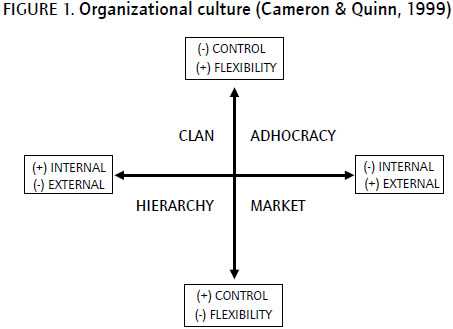
<body><![CDATA[<p><font size="3"><b>Organizational culture variable.</b></font></p>    </ul>     <p>  This concept is measured by the Organizational Culture   Assessment Instrument proposed by Cameron &amp; Quinn   (1999). These authors identify four cultures: market, hierarchy,   clan and adhocracy, in relation to two dimensions.   The first dimension shows the company orientation towards   control, stability and order. The companies within   this dimension fluctuate between, on one hand, those with   high stability, predictable and order emphasis, and on the   other hand those maintaining high flexibility levels, organic   structures and adaptation skills. The second dimension   regards the internal versus external business orientation.   Considering these two variables, we obtain the four types of culture (see <a href="#f1">Figure 1</a>).</p>     <p><a name="f1">&nbsp;</a></p>     <p>    <center><img src="/img/revistas/inno/v21n40/40a11f1.jpg"></center></p>     <p>  The clan culture is typical in companies that look for the internal   control of the organization but with flexibility, worrying   about its employees and showing a special customer   concern. The adhocratic culture is related to companies focused   on external aspects of the organization, looking for   a high degree of flexibility and innovation. The market culture   appears in those organizations that stress the external   orientation of the business, but considering at the same   time the need for control and internal stability. The hierarchical   culture pays special attention to internal aspects requiring control and stability. The literature states that in   any organization, in spite of having features of the four cultures,   one culture usually prevails over the others.</p>     <p>  In the questionnaire, managers were asked to distribute   100 points among four possible answers in relation to   "company definition", "managerial style", "shared values   by personnel" and "key successful aspects of the business"   (see <a href="/img/revistas/inno/v21n40/40a11t2.jpg" target="_blank">Table 2</a>).</p>     <p>  The total value of the clan culture is obtained by adding   the relative points to the answer "a" for the 4 questions.   The total value of the adhocratic culture implies the sum of   the points associated to the answers "b". The total value of the market culture contains the points of the answers "c".   The total value of the hierarchical culture is the sum of the   "d" answers.</p>     <p>  Clan culture value = (a1 + a2 + a3 + a4) = P<sub>1</sub></p>     ]]></body>
<body><![CDATA[<p>  Adhocratic culture value = (b1 + b2 + b3 + b4) = P<sub>2</sub></p>     <p>  Market culture value = (c1 + c2 + c3 + c4) = P<sub>3</sub></p>     <p>  Hierarchical culture value = (d1+ d2+ d3 + d4) = P<sub>4</sub></p>     <p>&nbsp;</p> <ul>     <p><font size="3"><b>  Innovative culture variable.</b></font></p>    </ul>     <p>  The values, rules and customs of an innovative culture are   in accord with those of the adhocratic and the clan cultures.   This argument is according to previous empirical results,   since family firms with a greater innovational posture   having both less formality and greater decentralization   (Craig &amp; Moores, 2006). Innovative companies hold a clear   and flexible orientation and are prone to changes. For this   reason, a new variable "innovative culture" has been calculated   through a mathematical algorithm. According to the   results of a panel of organisational research experts, this   algorithm is composed by three components that measure   the value of the innovative culture. This variable ranges   between 0 and 1. The more innovative the company is, the   higher the variable value is.</p>     <p>  Innovative culture = (<i>Z</i><sub>1</sub> + <i>Z</i><sub>2</sub>x100 + <i>Z</i><sub>3</sub>x100)/300</p>     <p>  Where:</p>     <p> <i>Z</i><sub>1</sub> reflects the total importance of clan (<i>P</i><sub>1</sub>) and adhocratic   (<i>P</i><sub>2</sub>) cultures. <i>Z</i><sub>1</sub>= <i>P</i><sub>1</sub> + <i>P</i><sub>2</sub>.</p>     ]]></body>
<body><![CDATA[<p> <i>Z</i><sub>2</sub> measures the importance of adhocratic culture in relation   to the sum of cultures that conforms the innovative   culture (adhocratic and clan cultures). This component is   needed because the panel of experts considered that the   adhocratic culture is more important than the clan culture   in the definition of the innovative culture. <i>Z</i><sub>2</sub> = <i>P</i><sub>2</sub>/(<i>P</i><sub>1</sub> + <i>P</i><sub>2</sub>).   <i>Z</i>3 considers the difference between the importance given   to both clan and adhocratic cultures. According to the panel   of experts, the smaller the difference between adhocratic   and clan cultures is, the more innovative the company is. <i>Z</i><sub>3</sub>   = 1 - &#91;(|<i>P</i><sub>2</sub> - <i>P</i><sub>1</sub>|)/(<i>P</i><sub>1</sub> + <i>P</i><sub>2</sub>)&#93;</p>     <p>&nbsp;</p> <ul>     <p><font size="3"><b>  Management Control Systems variable (MCS)</b></font></p>    </ul>     <p>  To analyse the level of MCS use, we measure the subjective   perception of managers about three items through   a 5-point Likert scale. The items considered are management   accounting techniques, short-term cash-flow budgets   and financial analysis. The variable is the average of those   three items, ranging from 1 to 5. Choe (2004) and Hoque   &amp; James (2000) have used this type of measure. <a href="/img/revistas/inno/v21n40/40a11t3.jpg" target="_blank">Table 3</a>    shows the reliability of the scales, verifying the consistency    of the variable. Furthermore, by means of a factorial analysis,    we prove that the previous indicators sum up in a single    factor properly reflect the considered measure about   the use of MCS.</p>     <p>&nbsp;</p> <ul>     <p><font size="3"><b>   Control variables.</b></font></p>    </ul>     <p> <i>Size</i>. This variable is the natural logarithm of the number of    full-time equivalent employees in 2003. This type of studies    has been broadly used the number of employees as a   size measurement (Malmi, 1999; Hoque &amp; James, 2000).</p>     <p> <i>Age</i>. This variable is the natural logarithm of the age of the    firm. Managers have used this variable in the family firm    context because this kind of firms could face some family    problems associated to complexity of the succession process   (Daily &amp; Dollinger, 1993; Ward, 2001).</p>     ]]></body>
<body><![CDATA[<p> <i>Sector</i>. As manufacturing and service firms compose our    sample, we consider a dummy variable that takes value 0    when the company belongs to the service sector and value   1 when the firm belongs to the manufacturing sector.</p>     <p>&nbsp;</p> <ul>     <p><font size="3"><b>   Performance variable.</b></font></p>    </ul>     <p>   Traditionally, researchers have successfully measured    performance in family-firms studies with quantitative information,    through measures of financial performance    (Anderson &amp; Reeb, 2003; Villalonga &amp; Amit, 2006) or operational   performance (Lee, 2006). Nevertheless, we have used the manager's perception about the competitive position   of the company, due that we wanted to consider   performance dimensions not contained in accounting information,   such as intangible assets, essential for competitive   success (Kaplan &amp; Norton, 1993). Other problem we   wanted to solve through qualitative information is the lag   between the date of the survey and the publication of the   accounting information, since annual accounts are made   publicly available around seven months after the end of   the accounting period. Finally, competitive success is a relative   concept (AECA, 1988), thus the relative position of   the company compared to its competitors becomes one of   the main indicators of success or failure.</p>     <p>  We have used the performance variables proposed by   Quinn &amp; Rohrbaugh (1983). These authors set a framework   for the organizational analysis, distinguishing three dimensions   within organizational efficiency. The first dimension   relates to the organizational approach, from an internal   point of view, based on a "micro" perspective about good   understanding and development of personnel, to an external   one, whose emphasis relies on a "macro" level of   business success. The second dimension is focused on the   organizational structure, making emphasis on business stability   and flexibility. The third dimension is based on organizational   means and aims. Four performance models arise from the combination of these three dimensions:</p>     <p> <i>Model of internal processes</i>. This model focused on internal   control, giving high importance to the information communication,   and considering stability and control as the   main goals.</p>     <p> <i>Model of open system</i>. This model is founded on external   flexibility, considering as main goals growth, resources and   external support.</p>     <p><i>  Rational model</i>. This model is related to control from an   external point of view, focusing on efficiency and productivity   criteria.</p>     <p><i>  Model of human relations</i>. This model pays attention to   flexibility from an internal point of view to develop the human resources within the firm.</p>     ]]></body>
<body><![CDATA[<p>  To assess these models, 12 items are used (3 items per   each model) through a Likert scale from 1 to 5. We build   a global performance variable, as the average of the 12   items, with a theoretical rank from 1 to 5. <a href="/img/revistas/inno/v21n40/40a11t4.jpg" target="_blank">Table 4</a> shows   the items used as well as the reliability of the scales and   the statistic tests.</p>     <p>  In <a href="/img/revistas/inno/v21n40/40a11t5.jpg" target="_blank">table 5</a>, we include the correlations matrix among all   the variables used in the analysis. As we can verify the correlation   values among independent variables are normally   correct, so we discard multicollinearity among independent   variables.</p>     <p>&nbsp;</p>     <p><font size="3"><b>  Statistical models</b></font></p>     <p>  Once we have defined the two groups of analysis (family   firms and non-family firms), our interest is to study the differences   between these two groups in relation to the behaviour   of the variables: organizational culture and MCS   use. To test these differences, we use the ANOVA test, and   Kruskall-Wallis test when the hypotheses of normality and variances homogeneity are not matched by the data. From   a multivariate point of view, we use logit regression analysis.   The Logit model is particularly suited for the analysis   since the dependent variable (Family versus non-family firms)   is an indicator variable (see Pindyck &amp; Rubinfeld, 1981). By   interpreting the regression coefficients, we can analyze the   association between a series of independent variables and   the fact that a firm is a family firm. The Logit model to test   H<sub>1</sub> is the following:</p>     <p> <i>Family firm<sub>i</sub></i> = <i>b<sub>0</sub></i> + b<sub>1</sub>&middot;culture<sub>i</sub> + <i>b<sub>2</sub>&middot;size<sub>i</sub></i> + <i>b<sub>3</sub>&middot;age<sub>i</sub></i> +   <i>b<sub>4</sub>&middot;sector<sub>i</sub></i> + Îµ<sub>i</sub></p>     <p>  Where, <i>Family firm</i> is a dummy variable that takes value   1 to identify the family firms, and value 0 to identify nonfamily   firms. <i>Culture</i> identifies the five types of culture   studied (clan, adhocratic, hierarchical, market and innovative   cultures). <i>Size</i> is the natural logarithm of the number of   full-time equivalent employees in 2003. <i>Age</i> is the natural   logarithm of the age of the firm. <i>Sector</i> takes value 0 for   service firms and value 1 for manufacturing firms. We run   this logit model five times, one considering each type of   culture. The Logit model to test H<sub>2</sub> is the following:</p>     <p> <i>Family firm<sub>i</sub></i> = <i>a<sub>0</sub></i> + <i>a<sub>1</sub>&middot;MCS<sub>i</sub></i> + <i>a<sub>2</sub> &middot;size<sub>i</sub></i> + <i>a<sub>3</sub>&middot;age<sub>i</sub></i> +   <i>a<sub>4</sub>&middot;sector<sub>i</sub></i> + <i>Îµ<sub>i</sub></i></p>     <p>  Where, <i>MCS</i> is the Management Control Systems use (average   of 3 tools: management accounting, short-term cashflow   budgets and financial analysis).</p>     <p>  The research starts testing the existence of organizational   culture and management control systems differences between   family and non-family firms, to identify the main   characteristics associated to family organizational culture.   Nevertheless, once we have proved family firms maintain a   differentiated culture and MCS from non-family businesses,   we just focus on the family firms sample because of our   second purpose regards to analyse the influence of this   particular organizational culture on performance of the   family firm.</p>     ]]></body>
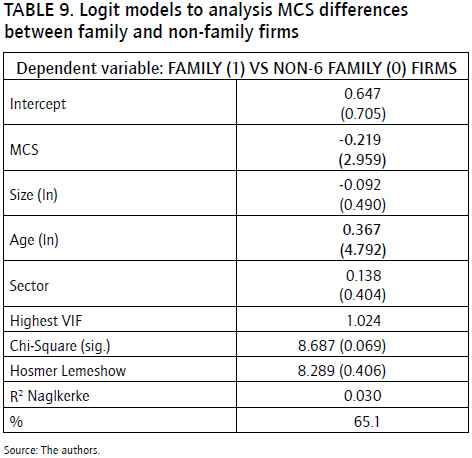
<body><![CDATA[<p>  To verify the effect of organizational culture (H<sub>3</sub>) and MCS   use (H<sub>4</sub>) on family firm performance, we use the hierarchical   regression analysis. This method allows us to introduce   the independent variables in different steps, so we can analyse   the effects of each group of independent variables.   In our case, firstly, we introduce the control variables and   the culture variables, and later on, we introduce the MCS   use variable. The standardized coefficients express the expected   change in the dependent variable for each variation   unit in the independent variables. The comparison   between the two models is carried out through the change   in <i>R</i><sup>2</sup>, that indicates if the new variable (MCS use), incorporated   to the second model, has influence on the analysed   dependent variable (Global Performance).</p> <ul>       <p> <b>Model 1</b>: <i>Global Performance<sub>i</sub></i> = <i>c<sub>0</sub></i> + <i>c<sub>1</sub>&middot;culture<sub>i</sub></i> +   <i>c<sub>2</sub>&middot; size<sub>i</sub></i> + <i>c<sub>3</sub>&middot;age<sub>i</sub></i> + <i>c<sub>4</sub>&middot;sector<sub>i</sub></i> + <i>Îµ<sub>i</sub></i></p>     <p> <b>Model 2</b>: <i>Global Performance<sub>i</sub></i> = <i>c'<sub>0</sub></i> + <i>c'<sub>1</sub>&middot;culture<sub>i</sub></i> +   <i>c'<sub>2</sub>&middot;size<sub>i</sub></i> + <i>c'<sub>3</sub>&middot;age<sub>i</sub></i> + <i>c'<sub>4</sub>&middot;sector<sub>i</sub></i> + <i>c<sub>5</sub> &middot;MCS</i> + <i>Îµ'<sub>i</sub></i></p>    </ul>     <p>  Where <i>Global Performance</i> is the average of the 12 items   linked to the Quinn and Rohrbaugh's model (1983). These   models are estimated only for the family firm sample. We   estimate one model for each type of culture.</p>     <p>&nbsp;</p>     <p>       <center>     <font size="3"><b>    Results     </b></font>   </center> </p>     <p> <a href="/img/revistas/inno/v21n40/40a11t6.jpg" target="_blank">Table 6</a> reveals the mean value of each type of culture   for family and non-family firms. On one hand, the level   of adhocratic culture in family firms (19.84) is significantly   lower than in non-family firms (22.08). The same   result is found for the level of innovative culture, where   non-family firms are characterised by a more innovative   culture (0.566) than that of family firms (0.541). On the other hand, the hierarchical culture is more important for   the family firms. In fact, the mean value of hierarchical culture   level ascends to 26.92 for family firms, while this value   decreases to 22.69 for non-family firms. This difference is   significant at 95%.</p>     <p><a href="/img/revistas/inno/v21n40/40a11t7.jpg" target="_blank">  Table 7</a> shows the results from the five logit regression   analyses by examining the importance of the relationships   between the probability of being a family firm and the   different types of culture (clan, adhocracy, market, hierarchy,   innovation), taking into account the control variables.   The chi-square statistics indicate that the models fit the   data fairly well, except for the estimations that consider   clan and market cultures as independent variables. The   coefficients for adhocratic culture (-0.022), hierarchical   culture (0.020) and innovative culture (-1.614) are highly   significant in the different estimations. These results verify   H<sub>1</sub> from a multivariate point of view-family firms are   characterised by a different culture than non-family firms.   In fact, family firms are less adhocratic, more hierarchical   and less innovative than non-family firms are. These findings   are in line with previously identified culture values in   family businesses research, such as autocratic leadership   and patriarchal or paternalistic culture (Marshall et al.,   2006; Kotey, 2005; Sorenson, 2000; Harrison et al., 1997;   Bass, 1990).</p>     ]]></body>
<body><![CDATA[<p><a href="/img/revistas/inno/v21n40/40a11t8.jpg" target="_blank">  Table 8</a> presents the results about the differences in MCS   use. The univariate analysis indicates that non-family firms   use these managerial tools more than family firms do. Indeed,   in a scale from 1 to 5, the mean use of these tools   is 3.61 for family businesses, while this value increases to   3.79 for the non-family firms. This difference is significant   at 95% level. The difference is due to a higher level of implementation   of cash-flow budgets and the firm financial   position analysis.</p>     <p><a href="#t9">Table 9</a> reveals the results from the logit regression analysis   by exploring the importance of relationships between   the probability of being a family firm and the use of MCS,   taking into account the control variables. The chi-square   statistic indicates that the model fits the data fairly well.   The coefficient associated to the MCS is negative (-0.219).   This finding leads to consider that family firms use MCS   more than non-family firms. These results verify H<sub>2</sub>, showing   differences between family and non-family firms in terms of MCS use.</p>     <p><a name="t9">&nbsp;</a></p>     <p>    <center><img src="/img/revistas/inno/v21n40/40a11t9.jpg"></center></p>     <p><a href="/img/revistas/inno/v21n40/40a11t10.jpg" target="_blank">Table 10</a> shows estimations of models 1 and 2 considering   the five types of culture as independent variables separately.   We note in all the models independent variables have   a variance inflation factor (VIF) below 1.08, so we discard   the presence of multicollinearity. The test of White (1980)   has not rejected homoscedasticity in all the models. Therefore,   coefficients show consistent standard error, which ensures the relevance and reliability of our estimations.</p>     <p>  About the third hypothesis, the most innovative cultures-   adhocratic and clan-have a positive and significant influence   on performance. In addition, the innovative culture   variable (as a mix of adhocratic and clan cultures) has a   positive coefficient with a very high significance (99%).   Therefore, we can accept our hypothesis that considers   those companies with more innovative cultures achieve   a higher performance. Our results are in line with those   of Bhaskaran (2006), Hsueh &amp; Tu (2004), Rosenau et al.   (1996), Morcillo (1997), DiBella &amp; Nevis (1998), and Tushman   &amp; O'Reilly (2002), who support innovative firms perform better.</p>     <p>  These results are showed in <a href="/img/revistas/inno/v21n40/40a11t10.jpg" target="_blank">Table 10</a> for each model 1,   where the standardised coefficients associated to the culture   variables are positive and significant for estimations   type 1 (clan culture: 0.226***), type 2 (adhocratic culture:   0.184***) and type 5 (innovative culture: 0.257***).   Nevertheless, we cannot obtain significant evidence on   the relationship between market culture and performance   (model 1 for type 3), since the global fitness of the model   is hardly significant (F: 1.550). We find a negative and   significant relationship between hierarchical culture and   performance (model 1, type 4: -0.246***). This result also   proves that the degree of hierarchical culture is associated   with a worse performance.</p>     <p>  Models 2, testing the MCS use, reveal the results of the   hierarchical regressions (<a href="/img/revistas/inno/v21n40/40a11t10.jpg" target="_blank">Table 10</a>). These results show the   positive and significant effect of MCS use on performance,   once we have taken into account the influence of culture.   This is so because the change in <i>R</i><sup>2</sup> is significant for each   type of estimation, as F statistic values disclose. In models   2, MCS use has a significant and a positive coefficient   (Type 1: 0.163**; Type 2: 0.144**; Type 3: 0.161**; Type 4:   0.148**; Type 5: 0.129**). Therefore, H<sub>4</sub> is confirmed.</p>     <p>&nbsp;</p>     ]]></body>
<body><![CDATA[<p>       <center>     <font size="3"><b>    Discussion     </b></font>   </center> </p>     <p>  There is not a consensus about a theory that supports the   existence of a generally accepted values and beliefs around   what the family organizational culture is. The research approaches   trying to identify a unique family firm culture are   heterogeneous and makes the comparison between studies   difficult. In this sense, the main aim of the study is to contribute identifying aspects associated to family business,   to fill a gap in literature around what the cultural   and organizational characteristics associated to family   firms are. With this research we try to go one step forward   contributing with new results to build a general theory on   family firms, starting from a broadly tested model which   classifies business in five cultures: market, hierarchy, clan,   adhocracy (Cameron and Quinn Model, 1999), adding an   innovative culture as a mix of clan and adhocratic cultures.   We compare organizational culture variables between family   and non-family firms to analyse the cultural differences   filling a gap in the literature identified by Zahra et al.   (2004).</p>     <p>  The findings confirm the existence of cultural differences   between family and non-family firms. In a manner, family   firms have their own cultural values and beliefs. They   maintain higher hierarchical and lower adhocratic values   than non-family firms. That means non-family firms are   more dynamic and adventurous than family businesses. In   the same way, regarding managerial style, non-family firms   concede more importance than family firms to promote individual   initiatives, risk taking and innovation, so there is   a commitment to innovation and continuous development.</p>     <p>  Family firms appear to be more hierarchical than non-family   firms are. Thus, they are more formalized and structured   companies, promoting employment stability and little uncertainty.   This fact is related to one of the main concerns   of the founder, since the altruism towards his relatives refers   to get a stable and lasting employment. Besides, a   more hierarchical organization supposes to keep a respect   towards established rules and company policies, as well   as to accomplish with organizational hierarchy. Regarding   strategic issues, a hierarchical organization within family   firms implies looking for efficiency, development of planning   for the production function, as well as implementing   low costs strategy.</p>     <p>  Organizational culture is linked to firm performance   (Rosenthal &amp; Masarech, 2003), therefore we test the effects   of organizational culture on family-firms performance.   The results point out towards a negative effect of   hierarchical culture on performance. Furthermore, adhocratic   and clan cultures have a positive and significant   influence on performance. Family firms that promote understanding   the company like a great family-sharing the   same values such as loyalty and commitment, working as   a team and worrying about employee satisfaction-will   develop a clan culture and reaching higher performance.   Besides, those family firms, which are characterised by a   dynamic and adventurous view of the firm, by individual initiatives   and innovation as key aspects in managerial style,   and commitment towards innovation and development of   new and innovative products as key values shared by employees,   will develop an adhocratic culture and achieving   higher performance.</p>     <p>We also measure the effect of the innovative culture variable   (as a mix of adhocratic and clan cultures) to contribute   enhancing the previous limited research on the role of   innovation within family firms (Craig &amp; Moores, 2006). To   this effect, identifying new dimensions on business culture   could help us to get better understanding on family   business behaviour. The results confirm the more innovative   the family firm is, the higher performance the firm will achieve.</p>     <p>  Additionally, due to the organizational control systems are   needed to transmit and reinforce the culture of the firm   (Flamholtz, 1983), we analyse the differences in management   control systems between family and non-family   firms. In this case, we take into account specificities of   family firm within the framework of Agency and Stewardship   Theories. We test the degree of implementation of a   cost accounting system, short-term and cash-flow budgets   and the use of financial analysis for the decision-making   process between family and non-family firms. Our results   confirm the less use of such management controls in the   case of family firms. We have obtained evidence to confirm   that the implementation of management controls in family   firms affects positively the firm performance. A priori,   it seems to be evidence to sustain the reasoning followed   by Schulze et al. (2002) and Lubatkin et al. (2005) that   predicts a positive effect of the use of MCS mechanisms   on performance because the elimination of inefficiencies   caused by the negative side of altruism and self-control.   Analysing this issue, we have to keep in mind that MCS   are not only used to control manager's actions, but also to   improve the decision-making process. According to Simons   (1995), the key issue of management control systems is   to manage the trade-off between creative innovation and   predictable goal achievement, and balancing the dilemma between control and flexibility.</p>     <p>&nbsp;</p>     <p>    ]]></body>
<body><![CDATA[<center><font size="3"><b>  Conclusions</b></font></center></p>     <p>  This research analyses the relationship among organizational   culture, management control systems and performance   of family firms, using a sample of 436 family (285)   and non-family (151) firms. To measure family firm culture,   we base our research on the Organizational Culture Assessment   Instrument proposed by Cameron &amp; Quinn (1999),   in which four cultures can be identified: market, hierarchical,   clan and adhocratic. This model has been improved by   building a new type of culture called "innovative culture",   because of innovative culture allows companies to achieve   sustainable competitive advantages. The results confirm   organizational cultural differences between family and   non-family firms. Family firms have their own culture, since   they have higher hierarchical and lower adhocratic values   than non-family firms. These results are in line with previously   identified culture values in family business research,   such as autocratic and patriarchal or paternalistic culture.   Furthermore, the empirical evidence proves that an innovative   culture (a mixture of clan and adhocracy) influences   positively on family firm performance, while a hierarchical culture has the opposite effect.</p>     <p>  As far as management control systems are concerned, we   found non-family firms use managerial tools more than   family firms do. Additionally, our findings show that management   control systems allow the company to achieve   higher organizational performance. Thus, we verify that   management control systems become an essential factor   for family firms, since they provide essential information   for decision-making process.</p>     <p>  We expect our results to be useful for family firms' entrepreneurs,   because they should be aware of benefits from   the implementation of an innovative culture and the use   of management control systems. They should understand   that an innovative attitude implies the adoption of new   ideas and values that are not threats but strengths, to gain   competitiveness and assure the future of the family firm.   The best strategy could be to focus on exploratory learning   and innovation. In this connection, family firms should face   key issues such as the succession process, internationalization,   professionalization, from an innovative point of view.   We also expect the results of the study help policy makers   to drive their efforts in continually facilitating the progress   of family firm, knowing they are main contributors to welfare   and well-being of developed economies.</p>     <p>&nbsp;</p>     <p>       <center>     <font size="3"><b>    Limitations and further research     </b></font>   </center> </p>     <p>  The research has some limitations that provide avenues for   future research. Several researchers have developed many   definitions to identify the concept of family firm, considering   variables related to ownership and control. Unfortunately,   in this research we have only been able to identify   the family ownership in the equity. In future research we   will consider family firm when it has the following characteristics:   the family owns and controls the company, as well   as the decision-making process, and there is a clear intention   of passing on the company to the next generation, according   to Sharma et al. (1997), Romano et al. (2000), and   Monreal et al. (2002).</p>     <p>  To test the use of management control systems in family   firms with the intention of reducing agency costs, to control   outside members in the board of directors would be   interesting for the characteristics associated to the board of directors, as well as for founder's tenure. Another important   agency cost control mechanism to consider is the   incentive compensation policies (Chrisman et al., 2007).   With the information of the study, we are not able to identify   the causality between the fact of being a family firm   and the less use of these controls. In this sense, we will   consider in future research the moderate effects associated   to self-control of owner-manager and the problems   originated by the altruism of the family.</p>     <p>  We are aware that we do not consider some important information   regarding specific characteristics from country   culture, that should be included in future research. Country   cultural values will determine the general framework   the entrepreneur faces when he starts and runs a business.   Besides, we should interpret the results cautiously,   since the sample reflects just the opinions from national   family-firms. This fact does not allow the generalization   of results. Moreover, the survey is self-reported and it was   only launched to the manager of the company, missing   some other important perceptions about the family firm   culture, such as those from family members, employees   and board members.</p>     ]]></body>
<body><![CDATA[<p>  Furthermore, the study only focuses on private small and   medium sized companies, the extension of the results to   large sized and public companies will help us to understand   the complete population of family firms. This line   of research is justified because governance mechanisms of   large sized family companies will lead to a different approach   to Agency and Stewardship Theories (Jaskiewicz &amp;   Klein, 2007). Private small and medium sized firms have a   high concentration of ownership and strong presence of   owners in the management, thus the goal alignment between   owners and managers is higher than in large listed   companies.</p>     <p>  Additionally, the results of the research would improve and   strengthen if we could consider a longitudinal database instead   of cross-sectional information. In this sense, the usefulness   of our results would improve verifying the positive   effect of the implementation of an innovative culture and   MCS on family firm performance from a longitudinal perspective,   increasing the awareness of family firms about   the importance to consider these factors as a source of   competitive advantages.</p>     <p>&nbsp;</p>     <p>       <center>     <font size="3"><b>    References     </b></font>   </center> </p>     <!-- ref --><p>  Adler, R., Everett, A.M. &amp; Waldron, M. (2000). Advanced management   accounting techniques in manufacturing: utilization, benefits, and   barriers to implementation. <i>Accounting Forum</i>, <i>24</i>(2), 131-50.    &nbsp;&nbsp;&nbsp;&nbsp;&nbsp;&nbsp;&nbsp;&nbsp;[&#160;<a href="javascript:void(0);" onclick="javascript: window.open('/scielo.php?script=sci_nlinks&ref=000198&pid=S0121-5051201100020001100001&lng=','','width=640,height=500,resizable=yes,scrollbars=1,menubar=yes,');">Links</a>&#160;]<!-- end-ref --></p>     <!-- ref --><p>  AECA. (1988). <i>La competitividad de la empresa: concepto, caracter&iacute;sticas   y factores determinantes. Principios de Organizaci&oacute;n de Empresas</i>.   Documento 4. Madrid: AECA.    &nbsp;&nbsp;&nbsp;&nbsp;&nbsp;&nbsp;&nbsp;&nbsp;[&#160;<a href="javascript:void(0);" onclick="javascript: window.open('/scielo.php?script=sci_nlinks&ref=000200&pid=S0121-5051201100020001100002&lng=','','width=640,height=500,resizable=yes,scrollbars=1,menubar=yes,');">Links</a>&#160;]<!-- end-ref --></p>     <!-- ref --><p>  Anderson, R.C. &amp; Reeb, D.M. (2003). Founding-family ownership and   firm performance: Evidence from the S&amp;P 500. <i>The Journal of Finance</i>,   <i>58</i>, 1301-1328.    &nbsp;&nbsp;&nbsp;&nbsp;&nbsp;&nbsp;&nbsp;&nbsp;[&#160;<a href="javascript:void(0);" onclick="javascript: window.open('/scielo.php?script=sci_nlinks&ref=000202&pid=S0121-5051201100020001100003&lng=','','width=640,height=500,resizable=yes,scrollbars=1,menubar=yes,');">Links</a>&#160;]<!-- end-ref --></p>     <!-- ref --><p>  Barney, J.B. (1991). Firm resources and sustained competitive advantage.   <i>Journal of Management</i>, <i>17</i>(1), 99-120.    &nbsp;&nbsp;&nbsp;&nbsp;&nbsp;&nbsp;&nbsp;&nbsp;[&#160;<a href="javascript:void(0);" onclick="javascript: window.open('/scielo.php?script=sci_nlinks&ref=000204&pid=S0121-5051201100020001100004&lng=','','width=640,height=500,resizable=yes,scrollbars=1,menubar=yes,');">Links</a>&#160;]<!-- end-ref --></p>     <!-- ref --><p>  Bass, B.M. (1990). <i>Bass and Stogdill's handbook of leadership</i>. New   York: The Free Press.    &nbsp;&nbsp;&nbsp;&nbsp;&nbsp;&nbsp;&nbsp;&nbsp;[&#160;<a href="javascript:void(0);" onclick="javascript: window.open('/scielo.php?script=sci_nlinks&ref=000206&pid=S0121-5051201100020001100005&lng=','','width=640,height=500,resizable=yes,scrollbars=1,menubar=yes,');">Links</a>&#160;]<!-- end-ref --></p>     <!-- ref --><p>  Basu, A. (2004). Entrepreneurial aspirations among family business   owners: An analysis of ethnic business owners in the UK. <i>International   Journal of Entrepreneurial Behaviour &amp; Research</i>, <i>10</i>(1-2),   12-33.    &nbsp;&nbsp;&nbsp;&nbsp;&nbsp;&nbsp;&nbsp;&nbsp;[&#160;<a href="javascript:void(0);" onclick="javascript: window.open('/scielo.php?script=sci_nlinks&ref=000208&pid=S0121-5051201100020001100006&lng=','','width=640,height=500,resizable=yes,scrollbars=1,menubar=yes,');">Links</a>&#160;]<!-- end-ref --></p>     <!-- ref --><p>  Bhaskaran, S. (2006). Incremental innovation and business performance:   Small and medium-size food enterprises in a concentrated   industry environment. <i>Journal of Small Business Management</i>,   <i>44</i>(1), 64-80.    &nbsp;&nbsp;&nbsp;&nbsp;&nbsp;&nbsp;&nbsp;&nbsp;[&#160;<a href="javascript:void(0);" onclick="javascript: window.open('/scielo.php?script=sci_nlinks&ref=000210&pid=S0121-5051201100020001100007&lng=','','width=640,height=500,resizable=yes,scrollbars=1,menubar=yes,');">Links</a>&#160;]<!-- end-ref --></p>     <!-- ref --><p>  Bisbe, J. &amp; Otley, D. (2004). The effects of the interactive use of management   control systems on product innovation. <i>Accounting, Organizations   and Society</i>, <i>29</i>, 709-737.    &nbsp;&nbsp;&nbsp;&nbsp;&nbsp;&nbsp;&nbsp;&nbsp;[&#160;<a href="javascript:void(0);" onclick="javascript: window.open('/scielo.php?script=sci_nlinks&ref=000212&pid=S0121-5051201100020001100008&lng=','','width=640,height=500,resizable=yes,scrollbars=1,menubar=yes,');">Links</a>&#160;]<!-- end-ref --></p>     <!-- ref --><p>  Bright, J., Davies, R.E., Downes, C.A. &amp; Sweeting, R.C. (1992). The deployment   of costing techniques and practices: A UK study. <i>Management   Accounting Research</i>, <i>3</i>, 201-211.    &nbsp;&nbsp;&nbsp;&nbsp;&nbsp;&nbsp;&nbsp;&nbsp;[&#160;<a href="javascript:void(0);" onclick="javascript: window.open('/scielo.php?script=sci_nlinks&ref=000214&pid=S0121-5051201100020001100009&lng=','','width=640,height=500,resizable=yes,scrollbars=1,menubar=yes,');">Links</a>&#160;]<!-- end-ref --></p>     <!-- ref --><p>  Bruns, W.J. &amp; Waterhouse, J.H. (Autumn 1975). Budgetary control and   organization structure. <i>Journal of Accounting Research</i>, <i>13</i>, 177-203.    &nbsp;&nbsp;&nbsp;&nbsp;&nbsp;&nbsp;&nbsp;&nbsp;[&#160;<a href="javascript:void(0);" onclick="javascript: window.open('/scielo.php?script=sci_nlinks&ref=000216&pid=S0121-5051201100020001100010&lng=','','width=640,height=500,resizable=yes,scrollbars=1,menubar=yes,');">Links</a>&#160;]<!-- end-ref --></p>     <!-- ref --><p>  Burt, R. S., Gabbay, S. M., Holt, G. &amp; Moran, P. (1994). Contingent organization   as a network theory: The culture performance contingency   function. <i>Acta Sociol&oacute;gica</i>, <i>37</i>, 345-370.    &nbsp;&nbsp;&nbsp;&nbsp;&nbsp;&nbsp;&nbsp;&nbsp;[&#160;<a href="javascript:void(0);" onclick="javascript: window.open('/scielo.php?script=sci_nlinks&ref=000218&pid=S0121-5051201100020001100011&lng=','','width=640,height=500,resizable=yes,scrollbars=1,menubar=yes,');">Links</a>&#160;]<!-- end-ref --></p>     <!-- ref --><p>  Cameron, K. S. &amp; Quinn, R. E. (1999). <i>Diagnosing and changing organizational   culture. Base on the competing values framework</i>. Reading,   Mass: Addison-Wesley.    &nbsp;&nbsp;&nbsp;&nbsp;&nbsp;&nbsp;&nbsp;&nbsp;[&#160;<a href="javascript:void(0);" onclick="javascript: window.open('/scielo.php?script=sci_nlinks&ref=000220&pid=S0121-5051201100020001100012&lng=','','width=640,height=500,resizable=yes,scrollbars=1,menubar=yes,');">Links</a>&#160;]<!-- end-ref --></p>     <!-- ref --><p>  Carney, M. &amp; Gedajlovic, E. (2002). The coupling of ownership and   control, and the allocation of financial resources: Evidence from   Hong Kong. <i>Journal of Management Studies</i>, <i>39</i>(1), 123-146.    &nbsp;&nbsp;&nbsp;&nbsp;&nbsp;&nbsp;&nbsp;&nbsp;[&#160;<a href="javascript:void(0);" onclick="javascript: window.open('/scielo.php?script=sci_nlinks&ref=000222&pid=S0121-5051201100020001100013&lng=','','width=640,height=500,resizable=yes,scrollbars=1,menubar=yes,');">Links</a>&#160;]<!-- end-ref --></p>     <!-- ref --><p>  Chapman, C. S. (1997). Reflections on a contingency view of accounting.   <i>Accounting Organizations and Society</i>, <i>22</i>, 189-205.    &nbsp;&nbsp;&nbsp;&nbsp;&nbsp;&nbsp;&nbsp;&nbsp;[&#160;<a href="javascript:void(0);" onclick="javascript: window.open('/scielo.php?script=sci_nlinks&ref=000224&pid=S0121-5051201100020001100014&lng=','','width=640,height=500,resizable=yes,scrollbars=1,menubar=yes,');">Links</a>&#160;]<!-- end-ref --></p>     <!-- ref --><p>  Cheng, L. K. &amp; Tao, Z. (1999). The impact of public policies on innovation   and imitation: the role of technology in growth models. <i>International   Economic Review</i>, <i>40</i>(1), 187-207.    &nbsp;&nbsp;&nbsp;&nbsp;&nbsp;&nbsp;&nbsp;&nbsp;[&#160;<a href="javascript:void(0);" onclick="javascript: window.open('/scielo.php?script=sci_nlinks&ref=000226&pid=S0121-5051201100020001100015&lng=','','width=640,height=500,resizable=yes,scrollbars=1,menubar=yes,');">Links</a>&#160;]<!-- end-ref --></p>     <!-- ref --><p>  Chenhall, R.H. &amp; Langfield-Smith, K. (1998). Adoption and benefits of   management accounting practices: An Australian study. <i>Management   Accounting Research</i>, <i>9</i>, 1-19.    &nbsp;&nbsp;&nbsp;&nbsp;&nbsp;&nbsp;&nbsp;&nbsp;[&#160;<a href="javascript:void(0);" onclick="javascript: window.open('/scielo.php?script=sci_nlinks&ref=000228&pid=S0121-5051201100020001100016&lng=','','width=640,height=500,resizable=yes,scrollbars=1,menubar=yes,');">Links</a>&#160;]<!-- end-ref --></p>     <!-- ref --><p>  Chenhall, R.H. &amp; Langfield-Smith, K. (1998b). The relationship between   strategic priorities, management techniques and management   accounting: An empirical investigation using a systems approach.   <i>Accounting, Organizations and Society</i>, <i>23</i>(3), 243-264.    &nbsp;&nbsp;&nbsp;&nbsp;&nbsp;&nbsp;&nbsp;&nbsp;[&#160;<a href="javascript:void(0);" onclick="javascript: window.open('/scielo.php?script=sci_nlinks&ref=000230&pid=S0121-5051201100020001100017&lng=','','width=640,height=500,resizable=yes,scrollbars=1,menubar=yes,');">Links</a>&#160;]<!-- end-ref --></p>     <!-- ref --><p>  Choe, J.M. (2004). The relationships among management accounting   information, organizational learning and production performance.   <i>Journal of Strategic Information Systems</i>, <i>13</i>, 61-85.    &nbsp;&nbsp;&nbsp;&nbsp;&nbsp;&nbsp;&nbsp;&nbsp;[&#160;<a href="javascript:void(0);" onclick="javascript: window.open('/scielo.php?script=sci_nlinks&ref=000232&pid=S0121-5051201100020001100018&lng=','','width=640,height=500,resizable=yes,scrollbars=1,menubar=yes,');">Links</a>&#160;]<!-- end-ref --></p>     <!-- ref --><p>  Chrisman, J.J., Chua, J.H., Kellermanns, F.W. &amp; Chang, E.P.C. (2007).   Are family managers agents or stewards? An exploratory study in   privately held family firms. <i>Journal of Business Research</i>, <i>60</i>(10),   1030-1038.    &nbsp;&nbsp;&nbsp;&nbsp;&nbsp;&nbsp;&nbsp;&nbsp;[&#160;<a href="javascript:void(0);" onclick="javascript: window.open('/scielo.php?script=sci_nlinks&ref=000234&pid=S0121-5051201100020001100019&lng=','','width=640,height=500,resizable=yes,scrollbars=1,menubar=yes,');">Links</a>&#160;]<!-- end-ref --></p>     <!-- ref --><p>  Chua, J.H., Chrisman, J. &amp; Sharma, P. (1999). Defining the family business   by behaviour. <i>Entrepreneurship Theory and Practice</i>, <i>23</i>(4),   19-39.    &nbsp;&nbsp;&nbsp;&nbsp;&nbsp;&nbsp;&nbsp;&nbsp;[&#160;<a href="javascript:void(0);" onclick="javascript: window.open('/scielo.php?script=sci_nlinks&ref=000236&pid=S0121-5051201100020001100020&lng=','','width=640,height=500,resizable=yes,scrollbars=1,menubar=yes,');">Links</a>&#160;]<!-- end-ref --></p>     <!-- ref --><p>  Chua, J.H., Chrisman, J.J. &amp; Steier, L.P. (2003). Extending the theoretical   horizon of family business research. <i>Entrepreneurship Theory and   Practice</i>, <i>27</i>(4), 331-338.    &nbsp;&nbsp;&nbsp;&nbsp;&nbsp;&nbsp;&nbsp;&nbsp;[&#160;<a href="javascript:void(0);" onclick="javascript: window.open('/scielo.php?script=sci_nlinks&ref=000238&pid=S0121-5051201100020001100021&lng=','','width=640,height=500,resizable=yes,scrollbars=1,menubar=yes,');">Links</a>&#160;]<!-- end-ref --></p>     <!-- ref --><p>  Corbetta, G. &amp; Salvato, C. (2004). Self-serving or self-actualizing? Models   of man and agency costs in different types of family firms: A   commentary on comparing the agency costs of family and non-family firms: Conceptual issues and exploratory evidence. <i>Entrepreneurship   Theory &amp; Practice</i>, <i>28</i>(4), 355-362.    &nbsp;&nbsp;&nbsp;&nbsp;&nbsp;&nbsp;&nbsp;&nbsp;[&#160;<a href="javascript:void(0);" onclick="javascript: window.open('/scielo.php?script=sci_nlinks&ref=000240&pid=S0121-5051201100020001100022&lng=','','width=640,height=500,resizable=yes,scrollbars=1,menubar=yes,');">Links</a>&#160;]<!-- end-ref --></p>     <!-- ref --><p>  Craig, J.B. &amp; Moores, K. (2006). A 10-year longitudinal investigation of   strategy, systems, and environment on innovation in family firms.   <i>Family Business Review</i>, <i>19</i>(1), 1-10.    &nbsp;&nbsp;&nbsp;&nbsp;&nbsp;&nbsp;&nbsp;&nbsp;[&#160;<a href="javascript:void(0);" onclick="javascript: window.open('/scielo.php?script=sci_nlinks&ref=000242&pid=S0121-5051201100020001100023&lng=','','width=640,height=500,resizable=yes,scrollbars=1,menubar=yes,');">Links</a>&#160;]<!-- end-ref --></p>     <!-- ref --><p>  Daily, C.M. &amp; Dollinger, M.J. (1993). Alternative methodologies for indentifying   family versus non family-managed businesses. <i>Journal   of Small Business Management</i>, <i>31</i>, 79-90.    &nbsp;&nbsp;&nbsp;&nbsp;&nbsp;&nbsp;&nbsp;&nbsp;[&#160;<a href="javascript:void(0);" onclick="javascript: window.open('/scielo.php?script=sci_nlinks&ref=000244&pid=S0121-5051201100020001100024&lng=','','width=640,height=500,resizable=yes,scrollbars=1,menubar=yes,');">Links</a>&#160;]<!-- end-ref --></p>     <!-- ref --><p>  Danco, L.A. (1975). <i>Beyond survival: A business owner's guide for success</i>.   Cleveland, Ohio: USA Center for Family Business.    &nbsp;&nbsp;&nbsp;&nbsp;&nbsp;&nbsp;&nbsp;&nbsp;[&#160;<a href="javascript:void(0);" onclick="javascript: window.open('/scielo.php?script=sci_nlinks&ref=000246&pid=S0121-5051201100020001100025&lng=','','width=640,height=500,resizable=yes,scrollbars=1,menubar=yes,');">Links</a>&#160;]<!-- end-ref --></p>     <!-- ref --><p>  D&aacute;vila, A. (2000). An empirical study on the drivers of management   control systems design in new product development. <i>Accounting,   Organizations and Society</i>, <i>25</i>, 383-410.    &nbsp;&nbsp;&nbsp;&nbsp;&nbsp;&nbsp;&nbsp;&nbsp;[&#160;<a href="javascript:void(0);" onclick="javascript: window.open('/scielo.php?script=sci_nlinks&ref=000248&pid=S0121-5051201100020001100026&lng=','','width=640,height=500,resizable=yes,scrollbars=1,menubar=yes,');">Links</a>&#160;]<!-- end-ref --></p>     <!-- ref --><p>  De Long, D. &amp; Fahey, L. (2000). Diagn&oacute;stico de las barreras culturales   frente a la gesti&oacute;n del conocimiento. <i>Academy of Management   Executive</i>, <i>14</i>(4), 113-127.    &nbsp;&nbsp;&nbsp;&nbsp;&nbsp;&nbsp;&nbsp;&nbsp;[&#160;<a href="javascript:void(0);" onclick="javascript: window.open('/scielo.php?script=sci_nlinks&ref=000250&pid=S0121-5051201100020001100027&lng=','','width=640,height=500,resizable=yes,scrollbars=1,menubar=yes,');">Links</a>&#160;]<!-- end-ref --></p>     <!-- ref --><p>  Deakins, D., Morrison, A. &amp; Galloway, L. (2002). Evolution, financial   management and learning in the small firm. <i>Journal of Small Business   and Enterprise Development</i>, <i>9</i>(1), 7-16.    &nbsp;&nbsp;&nbsp;&nbsp;&nbsp;&nbsp;&nbsp;&nbsp;[&#160;<a href="javascript:void(0);" onclick="javascript: window.open('/scielo.php?script=sci_nlinks&ref=000252&pid=S0121-5051201100020001100028&lng=','','width=640,height=500,resizable=yes,scrollbars=1,menubar=yes,');">Links</a>&#160;]<!-- end-ref --></p>     <!-- ref --><p>  Denison, D.R., Lief, C. &amp; Ward, J.L. (2004). Culture in family-owned enterprises:   Recognizing and leveraging unique strengths. <i>Family   Business Review</i>, <i>17</i>(1), 61-70.    &nbsp;&nbsp;&nbsp;&nbsp;&nbsp;&nbsp;&nbsp;&nbsp;[&#160;<a href="javascript:void(0);" onclick="javascript: window.open('/scielo.php?script=sci_nlinks&ref=000254&pid=S0121-5051201100020001100029&lng=','','width=640,height=500,resizable=yes,scrollbars=1,menubar=yes,');">Links</a>&#160;]<!-- end-ref --></p>     <!-- ref --><p>  DiBella, A. &amp; Nevis, E. C. (1998). <i>How organizations learn: An integrated   strategy for building learning capability</i>. San Francisco: Jossey-Bass.    &nbsp;&nbsp;&nbsp;&nbsp;&nbsp;&nbsp;&nbsp;&nbsp;[&#160;<a href="javascript:void(0);" onclick="javascript: window.open('/scielo.php?script=sci_nlinks&ref=000256&pid=S0121-5051201100020001100030&lng=','','width=640,height=500,resizable=yes,scrollbars=1,menubar=yes,');">Links</a>&#160;]<!-- end-ref --></p>     <!-- ref --><p>  Dodero, S. (2002). <i>El secreto de las empresas familiares exitosas</i>. Buenos   Aires: El Ateneo.    &nbsp;&nbsp;&nbsp;&nbsp;&nbsp;&nbsp;&nbsp;&nbsp;[&#160;<a href="javascript:void(0);" onclick="javascript: window.open('/scielo.php?script=sci_nlinks&ref=000258&pid=S0121-5051201100020001100031&lng=','','width=640,height=500,resizable=yes,scrollbars=1,menubar=yes,');">Links</a>&#160;]<!-- end-ref --></p>     <!-- ref --><p>  Dunn, B. (1995). Success themes in Scottish family enterprises: Philosophies   and practices through generations. <i>Family Business Review</i>,   <i>8</i>, 17-28.    &nbsp;&nbsp;&nbsp;&nbsp;&nbsp;&nbsp;&nbsp;&nbsp;[&#160;<a href="javascript:void(0);" onclick="javascript: window.open('/scielo.php?script=sci_nlinks&ref=000260&pid=S0121-5051201100020001100032&lng=','','width=640,height=500,resizable=yes,scrollbars=1,menubar=yes,');">Links</a>&#160;]<!-- end-ref --></p>     <!-- ref --><p>  Dyer, W. (1986). <i>Cultural change in family firms</i>. San Francisco: Jossey-Bass.    &nbsp;&nbsp;&nbsp;&nbsp;&nbsp;&nbsp;&nbsp;&nbsp;[&#160;<a href="javascript:void(0);" onclick="javascript: window.open('/scielo.php?script=sci_nlinks&ref=000262&pid=S0121-5051201100020001100033&lng=','','width=640,height=500,resizable=yes,scrollbars=1,menubar=yes,');">Links</a>&#160;]<!-- end-ref --></p>     <!-- ref --><p>  Fama, E.F. &amp; Jensen, M.C. (1983). Separation of ownership and control.   <i>Journal of Law and Economics</i>, <i>26</i>, 301-325.    &nbsp;&nbsp;&nbsp;&nbsp;&nbsp;&nbsp;&nbsp;&nbsp;[&#160;<a href="javascript:void(0);" onclick="javascript: window.open('/scielo.php?script=sci_nlinks&ref=000264&pid=S0121-5051201100020001100034&lng=','','width=640,height=500,resizable=yes,scrollbars=1,menubar=yes,');">Links</a>&#160;]<!-- end-ref --></p>     <!-- ref --><p>  Flamholtz, E.G. (1983). Accounting, budgeting and control systems in   their organizational context: Theoretical and empirical perspectives.   <i>Accounting, Organizations and Society</i>, <i>8</i>(2-3), 153-169.    &nbsp;&nbsp;&nbsp;&nbsp;&nbsp;&nbsp;&nbsp;&nbsp;[&#160;<a href="javascript:void(0);" onclick="javascript: window.open('/scielo.php?script=sci_nlinks&ref=000266&pid=S0121-5051201100020001100035&lng=','','width=640,height=500,resizable=yes,scrollbars=1,menubar=yes,');">Links</a>&#160;]<!-- end-ref --></p>     <!-- ref --><p>  Gallo, M.A. (1998). <i>La sucesi&oacute;n en la empresa familiar</i>. Barcelona:   Colecci&oacute;n Estudios e Informes de la Caixa 12.    &nbsp;&nbsp;&nbsp;&nbsp;&nbsp;&nbsp;&nbsp;&nbsp;[&#160;<a href="javascript:void(0);" onclick="javascript: window.open('/scielo.php?script=sci_nlinks&ref=000268&pid=S0121-5051201100020001100036&lng=','','width=640,height=500,resizable=yes,scrollbars=1,menubar=yes,');">Links</a>&#160;]<!-- end-ref --></p>     <!-- ref --><p>  Gallo, M.A. &amp; Amat, J.M. (2003). <i>Los secretos de las empresas familiares   centenarias</i>. Barcelona: Deusto.    &nbsp;&nbsp;&nbsp;&nbsp;&nbsp;&nbsp;&nbsp;&nbsp;[&#160;<a href="javascript:void(0);" onclick="javascript: window.open('/scielo.php?script=sci_nlinks&ref=000270&pid=S0121-5051201100020001100037&lng=','','width=640,height=500,resizable=yes,scrollbars=1,menubar=yes,');">Links</a>&#160;]<!-- end-ref --></p>     <!-- ref --><p>  G&oacute;mez-Mej&iacute;a, L., N&uacute;&ntilde;ez-Nickel, M. &amp; Guti&eacute;rrez, I. (2001). The role of   family ties in agency contracts. <i>Academy of Management Journal</i>,   <i>44</i>(1), 81-95.    &nbsp;&nbsp;&nbsp;&nbsp;&nbsp;&nbsp;&nbsp;&nbsp;[&#160;<a href="javascript:void(0);" onclick="javascript: window.open('/scielo.php?script=sci_nlinks&ref=000272&pid=S0121-5051201100020001100038&lng=','','width=640,height=500,resizable=yes,scrollbars=1,menubar=yes,');">Links</a>&#160;]<!-- end-ref --></p>     <!-- ref --><p>  Gordon, G.G. &amp; Di Tomaso, N. (1992). Predicting corporate performance   from organizational culture. <i>Journal of Management Studies</i>,   <i>29</i>, 783-799.    &nbsp;&nbsp;&nbsp;&nbsp;&nbsp;&nbsp;&nbsp;&nbsp;[&#160;<a href="javascript:void(0);" onclick="javascript: window.open('/scielo.php?script=sci_nlinks&ref=000274&pid=S0121-5051201100020001100039&lng=','','width=640,height=500,resizable=yes,scrollbars=1,menubar=yes,');">Links</a>&#160;]<!-- end-ref --></p>     <!-- ref --><p>  Habbershon, T.G. &amp; Williams, M. (1999). A resource-based framework   for assessing the strategic advantages of family firms. <i>Family   Business Review</i>, <i>12</i>, 1-25.    &nbsp;&nbsp;&nbsp;&nbsp;&nbsp;&nbsp;&nbsp;&nbsp;[&#160;<a href="javascript:void(0);" onclick="javascript: window.open('/scielo.php?script=sci_nlinks&ref=000276&pid=S0121-5051201100020001100040&lng=','','width=640,height=500,resizable=yes,scrollbars=1,menubar=yes,');">Links</a>&#160;]<!-- end-ref --></p>     <!-- ref --><p>  Habbershon, T.G., Williams, M. &amp; MacMillan, I.C. (2003). A unified systems   perspective of family firm performance. <i>Journal of Business   Venturing</i>, <i>18</i>, 451-465.    &nbsp;&nbsp;&nbsp;&nbsp;&nbsp;&nbsp;&nbsp;&nbsp;[&#160;<a href="javascript:void(0);" onclick="javascript: window.open('/scielo.php?script=sci_nlinks&ref=000278&pid=S0121-5051201100020001100041&lng=','','width=640,height=500,resizable=yes,scrollbars=1,menubar=yes,');">Links</a>&#160;]<!-- end-ref --></p>     <!-- ref --><p>  Harris, M. &amp; Raviv, A. (1991). The theory of capital structure. <i>The Journal   of finance</i>, <i>46</i>(1), 297-355.    &nbsp;&nbsp;&nbsp;&nbsp;&nbsp;&nbsp;&nbsp;&nbsp;[&#160;<a href="javascript:void(0);" onclick="javascript: window.open('/scielo.php?script=sci_nlinks&ref=000280&pid=S0121-5051201100020001100042&lng=','','width=640,height=500,resizable=yes,scrollbars=1,menubar=yes,');">Links</a>&#160;]<!-- end-ref --></p>     <!-- ref --><p>  Harrison, R.T., Dibben, M.R. &amp; Mason, C. (1997). The role of trust in the   informal investor's investment decision: An exploratory analysis.   <i>Entrepreneurship Theory and Practice</i>, <i>24</i>(4), 63-81.    &nbsp;&nbsp;&nbsp;&nbsp;&nbsp;&nbsp;&nbsp;&nbsp;[&#160;<a href="javascript:void(0);" onclick="javascript: window.open('/scielo.php?script=sci_nlinks&ref=000282&pid=S0121-5051201100020001100043&lng=','','width=640,height=500,resizable=yes,scrollbars=1,menubar=yes,');">Links</a>&#160;]<!-- end-ref --></p>     <!-- ref --><p>  Herath, S.K., Herath, A. &amp; Abdul Azeez, A. (2006). Family firms and   corporate culture: A case study from a Less Developed Country   (LDC). <i>International Journal of Management and Enterprise Development</i>,   <i>3</i>(3), 227-243.    &nbsp;&nbsp;&nbsp;&nbsp;&nbsp;&nbsp;&nbsp;&nbsp;[&#160;<a href="javascript:void(0);" onclick="javascript: window.open('/scielo.php?script=sci_nlinks&ref=000284&pid=S0121-5051201100020001100044&lng=','','width=640,height=500,resizable=yes,scrollbars=1,menubar=yes,');">Links</a>&#160;]<!-- end-ref --></p>     <!-- ref --><p>  Ho, S. &amp; Wong, K.S. (2001). A study of the relationship between corporate   governance structures and the extent of voluntary disclosure.   <i>Journal of International Accounting, Auditing and Taxation</i>,   <i>10</i>, 139-156.    &nbsp;&nbsp;&nbsp;&nbsp;&nbsp;&nbsp;&nbsp;&nbsp;[&#160;<a href="javascript:void(0);" onclick="javascript: window.open('/scielo.php?script=sci_nlinks&ref=000286&pid=S0121-5051201100020001100045&lng=','','width=640,height=500,resizable=yes,scrollbars=1,menubar=yes,');">Links</a>&#160;]<!-- end-ref --></p>     <!-- ref --><p>  Hoffman, J., Hoelscher, M. &amp; Sorenson, R. (2006). Achieving sustained   competitive advantage: A family capital theory. <i>Family Business   Review</i>, <i>19</i>(2), 135-144.    &nbsp;&nbsp;&nbsp;&nbsp;&nbsp;&nbsp;&nbsp;&nbsp;[&#160;<a href="javascript:void(0);" onclick="javascript: window.open('/scielo.php?script=sci_nlinks&ref=000288&pid=S0121-5051201100020001100046&lng=','','width=640,height=500,resizable=yes,scrollbars=1,menubar=yes,');">Links</a>&#160;]<!-- end-ref --></p>     <!-- ref --><p>  Hollander, B.S. &amp; Elman, N.S. (1988). Family-owned businesses: an   emerging field of inquiry. <i>Family Business Review</i>, <i>1</i>(2), 145-164.    &nbsp;&nbsp;&nbsp;&nbsp;&nbsp;&nbsp;&nbsp;&nbsp;[&#160;<a href="javascript:void(0);" onclick="javascript: window.open('/scielo.php?script=sci_nlinks&ref=000290&pid=S0121-5051201100020001100047&lng=','','width=640,height=500,resizable=yes,scrollbars=1,menubar=yes,');">Links</a>&#160;]<!-- end-ref --></p>     <!-- ref --><p>  Hoque, Z. &amp; James, W. (2000). Linking balanced scorecard measures to   size and market factors: Impact on organizational performance.   <i>Journal of Management Accounting Research</i>, <i>12</i>, 1-17.    &nbsp;&nbsp;&nbsp;&nbsp;&nbsp;&nbsp;&nbsp;&nbsp;[&#160;<a href="javascript:void(0);" onclick="javascript: window.open('/scielo.php?script=sci_nlinks&ref=000292&pid=S0121-5051201100020001100048&lng=','','width=640,height=500,resizable=yes,scrollbars=1,menubar=yes,');">Links</a>&#160;]<!-- end-ref --></p>     <!-- ref --><p>  Hsueh, L. &amp; Tu, Y. (2004). Innovation and the operational performance   of newly established small and medium enterprises in Taiwan.   <i>Small Business Economics</i>, <i>23</i>, 99-113.    &nbsp;&nbsp;&nbsp;&nbsp;&nbsp;&nbsp;&nbsp;&nbsp;[&#160;<a href="javascript:void(0);" onclick="javascript: window.open('/scielo.php?script=sci_nlinks&ref=000294&pid=S0121-5051201100020001100049&lng=','','width=640,height=500,resizable=yes,scrollbars=1,menubar=yes,');">Links</a>&#160;]<!-- end-ref --></p>     <!-- ref --><p>  James, H. S. (1999). Owner as manager, extended horizons and the family   firm. <i>International Journal of the Economics of Business</i>, <i>6</i>(1),   41-55.    &nbsp;&nbsp;&nbsp;&nbsp;&nbsp;&nbsp;&nbsp;&nbsp;[&#160;<a href="javascript:void(0);" onclick="javascript: window.open('/scielo.php?script=sci_nlinks&ref=000296&pid=S0121-5051201100020001100050&lng=','','width=640,height=500,resizable=yes,scrollbars=1,menubar=yes,');">Links</a>&#160;]<!-- end-ref --></p>     <!-- ref --><p>  Jaskiewicz, P. &amp; Klein, S. (2007). The impact of goal alignment on board   composition and board size in family businesses. <i>Journal of Business   Research</i>, <i>60</i>(10), 1080-1089.    &nbsp;&nbsp;&nbsp;&nbsp;&nbsp;&nbsp;&nbsp;&nbsp;[&#160;<a href="javascript:void(0);" onclick="javascript: window.open('/scielo.php?script=sci_nlinks&ref=000298&pid=S0121-5051201100020001100051&lng=','','width=640,height=500,resizable=yes,scrollbars=1,menubar=yes,');">Links</a>&#160;]<!-- end-ref --></p>     <!-- ref --><p>  Jensen, M. C. &amp; Meckling, W. H. (1976). Theory of the firm: Managerial   behavior, agency costs and ownership structure. Journal of Financial   Economics, 3, 305-360.    &nbsp;&nbsp;&nbsp;&nbsp;&nbsp;&nbsp;&nbsp;&nbsp;[&#160;<a href="javascript:void(0);" onclick="javascript: window.open('/scielo.php?script=sci_nlinks&ref=000300&pid=S0121-5051201100020001100052&lng=','','width=640,height=500,resizable=yes,scrollbars=1,menubar=yes,');">Links</a>&#160;]<!-- end-ref --></p>     <!-- ref --><p>  Jeuchter, W.M., Fisher, C. &amp; Alford, R.J. (1998). Five conditions for high   performance cultures. <i>Training and Development</i>, <i>52</i>(5), 63-67.    &nbsp;&nbsp;&nbsp;&nbsp;&nbsp;&nbsp;&nbsp;&nbsp;[&#160;<a href="javascript:void(0);" onclick="javascript: window.open('/scielo.php?script=sci_nlinks&ref=000302&pid=S0121-5051201100020001100053&lng=','','width=640,height=500,resizable=yes,scrollbars=1,menubar=yes,');">Links</a>&#160;]<!-- end-ref --></p>     <!-- ref --><p>  Johnson, P. &amp; Gill, J. (1993). <i>Management control and organizational behaviour</i>.   London: Paul Chapman.    &nbsp;&nbsp;&nbsp;&nbsp;&nbsp;&nbsp;&nbsp;&nbsp;[&#160;<a href="javascript:void(0);" onclick="javascript: window.open('/scielo.php?script=sci_nlinks&ref=000304&pid=S0121-5051201100020001100054&lng=','','width=640,height=500,resizable=yes,scrollbars=1,menubar=yes,');">Links</a>&#160;]<!-- end-ref --></p>     <!-- ref --><p>  Kaplan, R.S. &amp; Norton, D.P. (1993). Evaluaci&oacute;n de resultados: algo m&aacute;s   que n&uacute;meros. <i>Harvard-Deusto Business Review</i>, <i>55</i>, 18-25.    &nbsp;&nbsp;&nbsp;&nbsp;&nbsp;&nbsp;&nbsp;&nbsp;[&#160;<a href="javascript:void(0);" onclick="javascript: window.open('/scielo.php?script=sci_nlinks&ref=000306&pid=S0121-5051201100020001100055&lng=','','width=640,height=500,resizable=yes,scrollbars=1,menubar=yes,');">Links</a>&#160;]<!-- end-ref --></p>     <!-- ref --><p>  Kennedy, T. &amp; Affleck-Graves, J. (2001). The impact of activity-based   costing techniques on firm performance. <i>Journal of Management   Accounting Research</i>, <i>13</i>, 19-45.    &nbsp;&nbsp;&nbsp;&nbsp;&nbsp;&nbsp;&nbsp;&nbsp;[&#160;<a href="javascript:void(0);" onclick="javascript: window.open('/scielo.php?script=sci_nlinks&ref=000308&pid=S0121-5051201100020001100056&lng=','','width=640,height=500,resizable=yes,scrollbars=1,menubar=yes,');">Links</a>&#160;]<!-- end-ref --></p>     <!-- ref --><p>  Kotey, B. (2005). Goals, management practices and performance of   family SMEs. <i>International Journal of Entrepreneurial Behaviour   &amp; Research</i>, <i>11</i>(1), 3-24.    &nbsp;&nbsp;&nbsp;&nbsp;&nbsp;&nbsp;&nbsp;&nbsp;[&#160;<a href="javascript:void(0);" onclick="javascript: window.open('/scielo.php?script=sci_nlinks&ref=000310&pid=S0121-5051201100020001100057&lng=','','width=640,height=500,resizable=yes,scrollbars=1,menubar=yes,');">Links</a>&#160;]<!-- end-ref --></p>     <!-- ref --><p>   Kotter, J. P. &amp; Heskett, J. L. (1992). <i>Corporate culture and performance</i>.   New York: The Free Press.    &nbsp;&nbsp;&nbsp;&nbsp;&nbsp;&nbsp;&nbsp;&nbsp;[&#160;<a href="javascript:void(0);" onclick="javascript: window.open('/scielo.php?script=sci_nlinks&ref=000312&pid=S0121-5051201100020001100058&lng=','','width=640,height=500,resizable=yes,scrollbars=1,menubar=yes,');">Links</a>&#160;]<!-- end-ref --></p>     <!-- ref --><p>   Leal Millan, A. (1991). <i>Conocer la cultura de las organizaciones. Una   base para la estrategia y el cambio</i>. Madrid: Actualidad Editorial.    &nbsp;&nbsp;&nbsp;&nbsp;&nbsp;&nbsp;&nbsp;&nbsp;[&#160;<a href="javascript:void(0);" onclick="javascript: window.open('/scielo.php?script=sci_nlinks&ref=000314&pid=S0121-5051201100020001100059&lng=','','width=640,height=500,resizable=yes,scrollbars=1,menubar=yes,');">Links</a>&#160;]<!-- end-ref --></p>     <!-- ref --><p>   Lee, J. (2006). Family firm performance: Further evidence. <i>Family Business   Review</i>, <i>19</i>(2), 103-114.    &nbsp;&nbsp;&nbsp;&nbsp;&nbsp;&nbsp;&nbsp;&nbsp;[&#160;<a href="javascript:void(0);" onclick="javascript: window.open('/scielo.php?script=sci_nlinks&ref=000316&pid=S0121-5051201100020001100060&lng=','','width=640,height=500,resizable=yes,scrollbars=1,menubar=yes,');">Links</a>&#160;]<!-- end-ref --></p>     <!-- ref --><p>   Lubatkin, M.H., Schulze, W.S., Ling, Y. &amp; Dino, R.N. (2005). The effects    of parental altruism on the governance of family-managed firms.   <i>Journal of Organizational Behaviour</i>, <i>26</i>, 313-330.    &nbsp;&nbsp;&nbsp;&nbsp;&nbsp;&nbsp;&nbsp;&nbsp;[&#160;<a href="javascript:void(0);" onclick="javascript: window.open('/scielo.php?script=sci_nlinks&ref=000318&pid=S0121-5051201100020001100061&lng=','','width=640,height=500,resizable=yes,scrollbars=1,menubar=yes,');">Links</a>&#160;]<!-- end-ref --></p>     <!-- ref --><p>   Malmi, T. (1999). Activity-based costing diffusion across organizations:    An exploratory empirical analysis of Finnish firms. <i>Accounting, Organizations   and Society</i>, <i>24</i>, 649-672.    &nbsp;&nbsp;&nbsp;&nbsp;&nbsp;&nbsp;&nbsp;&nbsp;[&#160;<a href="javascript:void(0);" onclick="javascript: window.open('/scielo.php?script=sci_nlinks&ref=000320&pid=S0121-5051201100020001100062&lng=','','width=640,height=500,resizable=yes,scrollbars=1,menubar=yes,');">Links</a>&#160;]<!-- end-ref --></p>     <!-- ref --><p>   March, J.G. (1991). Exploration and exploitation in organizational learning.   <i>Annual Review of Sociology</i>, <i>14</i>, 319-340.    &nbsp;&nbsp;&nbsp;&nbsp;&nbsp;&nbsp;&nbsp;&nbsp;[&#160;<a href="javascript:void(0);" onclick="javascript: window.open('/scielo.php?script=sci_nlinks&ref=000322&pid=S0121-5051201100020001100063&lng=','','width=640,height=500,resizable=yes,scrollbars=1,menubar=yes,');">Links</a>&#160;]<!-- end-ref --></p>     <!-- ref --><p>   Marshall, J.P., Sorenson, R., Brigham, K., Wieling, E., Reifman, A. &amp;    Wampler, R. S. (2006). The paradox for the family firm CEO : Owner    age relationship to succession-related processes and plans.   <i>Journal of Business Venturing</i>, <i>21</i>, 348-368.    &nbsp;&nbsp;&nbsp;&nbsp;&nbsp;&nbsp;&nbsp;&nbsp;[&#160;<a href="javascript:void(0);" onclick="javascript: window.open('/scielo.php?script=sci_nlinks&ref=000324&pid=S0121-5051201100020001100064&lng=','','width=640,height=500,resizable=yes,scrollbars=1,menubar=yes,');">Links</a>&#160;]<!-- end-ref --></p>     <!-- ref --><p>   McConaughy, D.L., Matthews, C. H. &amp; Fialko, A.S. (2001). Founding family    controlled firms: performance, risk, and value. <i>Journal of Small   Business Management</i>, <i>39</i>(1), 31-49.    &nbsp;&nbsp;&nbsp;&nbsp;&nbsp;&nbsp;&nbsp;&nbsp;[&#160;<a href="javascript:void(0);" onclick="javascript: window.open('/scielo.php?script=sci_nlinks&ref=000326&pid=S0121-5051201100020001100065&lng=','','width=640,height=500,resizable=yes,scrollbars=1,menubar=yes,');">Links</a>&#160;]<!-- end-ref --></p>     <!-- ref --><p>   McMahon, R. &amp; Davies, L. (1994). Financial reporting and analysis practices   in small enterprises: their association with growth rate and financial performance. <i>Journal of Small Business Management</i>,   <i>32</i>(1), 9-17.    &nbsp;&nbsp;&nbsp;&nbsp;&nbsp;&nbsp;&nbsp;&nbsp;[&#160;<a href="javascript:void(0);" onclick="javascript: window.open('/scielo.php?script=sci_nlinks&ref=000328&pid=S0121-5051201100020001100066&lng=','','width=640,height=500,resizable=yes,scrollbars=1,menubar=yes,');">Links</a>&#160;]<!-- end-ref --></p>     <!-- ref --><p>  Merchant, K.A. (1984). Influences on departmental budgeting: An empirical   examination of a contingency model. <i>Accounting, Organizations   and Society</i>, <i>9</i>(3/4), 291-307.    &nbsp;&nbsp;&nbsp;&nbsp;&nbsp;&nbsp;&nbsp;&nbsp;[&#160;<a href="javascript:void(0);" onclick="javascript: window.open('/scielo.php?script=sci_nlinks&ref=000330&pid=S0121-5051201100020001100067&lng=','','width=640,height=500,resizable=yes,scrollbars=1,menubar=yes,');">Links</a>&#160;]<!-- end-ref --></p>     <!-- ref --><p>  Miller, D. &amp; Le Breton-Miller, I. (2006). Family governance and firm performance:   Agency, stewardship, and capabilities. <i>Family Business   Review</i>, <i>19</i>(1), 73-87.    &nbsp;&nbsp;&nbsp;&nbsp;&nbsp;&nbsp;&nbsp;&nbsp;[&#160;<a href="javascript:void(0);" onclick="javascript: window.open('/scielo.php?script=sci_nlinks&ref=000332&pid=S0121-5051201100020001100068&lng=','','width=640,height=500,resizable=yes,scrollbars=1,menubar=yes,');">Links</a>&#160;]<!-- end-ref --></p>     <!-- ref --><p>  Miller, D., Le, I., Lester, R. &amp; Cannella, A. (2007). Are family firms really   superior performers? <i>Journal of Corporate Finance</i>, <i>13</i>, 829-858.    &nbsp;&nbsp;&nbsp;&nbsp;&nbsp;&nbsp;&nbsp;&nbsp;[&#160;<a href="javascript:void(0);" onclick="javascript: window.open('/scielo.php?script=sci_nlinks&ref=000334&pid=S0121-5051201100020001100069&lng=','','width=640,height=500,resizable=yes,scrollbars=1,menubar=yes,');">Links</a>&#160;]<!-- end-ref --></p>     <!-- ref --><p>  Monreal, J., Calvo-Flores, A., Garc&iacute;a, D., Mero&ntilde;o, A., Ortiz, P. &amp; Sabater,   R. (2002). <i>La empresa familiar: realidad econ&oacute;mica y cultura empresarial</i>.   Madrid: Civitas.    &nbsp;&nbsp;&nbsp;&nbsp;&nbsp;&nbsp;&nbsp;&nbsp;[&#160;<a href="javascript:void(0);" onclick="javascript: window.open('/scielo.php?script=sci_nlinks&ref=000336&pid=S0121-5051201100020001100070&lng=','','width=640,height=500,resizable=yes,scrollbars=1,menubar=yes,');">Links</a>&#160;]<!-- end-ref --></p>     <!-- ref --><p>  Morcillo, P. (1997). <i>Direcci&oacute;n estrat&eacute;gica de la tecnolog&iacute;a e innovaci&oacute;n. Un   enfoque de competencias</i>. Madrid: Civitas.    &nbsp;&nbsp;&nbsp;&nbsp;&nbsp;&nbsp;&nbsp;&nbsp;[&#160;<a href="javascript:void(0);" onclick="javascript: window.open('/scielo.php?script=sci_nlinks&ref=000338&pid=S0121-5051201100020001100071&lng=','','width=640,height=500,resizable=yes,scrollbars=1,menubar=yes,');">Links</a>&#160;]<!-- end-ref --></p>     <!-- ref --><p>  Morikawa, M. (2004). Information technology and the performance of   Japanese SMEs. <i>Small Business Economics</i>, <i>23</i>, 171-77.    &nbsp;&nbsp;&nbsp;&nbsp;&nbsp;&nbsp;&nbsp;&nbsp;[&#160;<a href="javascript:void(0);" onclick="javascript: window.open('/scielo.php?script=sci_nlinks&ref=000340&pid=S0121-5051201100020001100072&lng=','','width=640,height=500,resizable=yes,scrollbars=1,menubar=yes,');">Links</a>&#160;]<!-- end-ref --></p>     <!-- ref --><p>  Nemeth, C. J. (1997). Managing innovation: When less is more. <i>California   Management Review</i>, <i>40</i>(1), 59-74.    &nbsp;&nbsp;&nbsp;&nbsp;&nbsp;&nbsp;&nbsp;&nbsp;[&#160;<a href="javascript:void(0);" onclick="javascript: window.open('/scielo.php?script=sci_nlinks&ref=000342&pid=S0121-5051201100020001100073&lng=','','width=640,height=500,resizable=yes,scrollbars=1,menubar=yes,');">Links</a>&#160;]<!-- end-ref --></p>     <!-- ref --><p>  Nwachukwu, S., Vitell, S., Gilbert, F. &amp; Barnes, J. (1997). Ethics and social   responsibility in marketing: An examination of the ethics   evaluation of advertising Strategies. <i>Journal of Business Research</i>,   <i>39</i>(2), 107-118.    &nbsp;&nbsp;&nbsp;&nbsp;&nbsp;&nbsp;&nbsp;&nbsp;[&#160;<a href="javascript:void(0);" onclick="javascript: window.open('/scielo.php?script=sci_nlinks&ref=000344&pid=S0121-5051201100020001100074&lng=','','width=640,height=500,resizable=yes,scrollbars=1,menubar=yes,');">Links</a>&#160;]<!-- end-ref --></p>     <!-- ref --><p>  Olson, P.D., Zuiker, V.S., Danes, S.M., Stafford, K., Heck, R. K.Z. &amp; Duncan,   K.A. (2003). The impact of the family and the business on   family business sustainability. <i>Journal of Business Venturing</i>,   <i>18</i>(5), 639-666.    &nbsp;&nbsp;&nbsp;&nbsp;&nbsp;&nbsp;&nbsp;&nbsp;[&#160;<a href="javascript:void(0);" onclick="javascript: window.open('/scielo.php?script=sci_nlinks&ref=000346&pid=S0121-5051201100020001100075&lng=','','width=640,height=500,resizable=yes,scrollbars=1,menubar=yes,');">Links</a>&#160;]<!-- end-ref --></p>     <!-- ref --><p>  Perren, L., Berry, A. &amp; Partridge, M. (1999). The evolution of management   information, control and decision-making processes in   small, growth orientated, service sector businesses. <i>Small Business   and Enterprise Development</i>, <i>5</i>(4), 351-362.    &nbsp;&nbsp;&nbsp;&nbsp;&nbsp;&nbsp;&nbsp;&nbsp;[&#160;<a href="javascript:void(0);" onclick="javascript: window.open('/scielo.php?script=sci_nlinks&ref=000348&pid=S0121-5051201100020001100076&lng=','','width=640,height=500,resizable=yes,scrollbars=1,menubar=yes,');">Links</a>&#160;]<!-- end-ref --></p>     <!-- ref --><p>  Peteraf, M.A. (1993). The cornerstone of competitive advantage. A resource-   based view. <i>Strategic Management Journal</i>, <i>14</i>(3), 179-191.    &nbsp;&nbsp;&nbsp;&nbsp;&nbsp;&nbsp;&nbsp;&nbsp;[&#160;<a href="javascript:void(0);" onclick="javascript: window.open('/scielo.php?script=sci_nlinks&ref=000350&pid=S0121-5051201100020001100077&lng=','','width=640,height=500,resizable=yes,scrollbars=1,menubar=yes,');">Links</a>&#160;]<!-- end-ref --></p>     <!-- ref --><p>  Pindyck, R. &amp; Rubinfeld, D. (1981). <i>Econometric models and economic forecasts</i>. New York: McGraw-Hill.    &nbsp;&nbsp;&nbsp;&nbsp;&nbsp;&nbsp;&nbsp;&nbsp;[&#160;<a href="javascript:void(0);" onclick="javascript: window.open('/scielo.php?script=sci_nlinks&ref=000352&pid=S0121-5051201100020001100078&lng=','','width=640,height=500,resizable=yes,scrollbars=1,menubar=yes,');">Links</a>&#160;]<!-- end-ref --></p>     <!-- ref --><p>  Pollak, R. (1985). A transaction cost approach to familiar and households.   <i>Journal of Economic Literature</i>, <i>23</i>, 581-608.    &nbsp;&nbsp;&nbsp;&nbsp;&nbsp;&nbsp;&nbsp;&nbsp;[&#160;<a href="javascript:void(0);" onclick="javascript: window.open('/scielo.php?script=sci_nlinks&ref=000354&pid=S0121-5051201100020001100079&lng=','','width=640,height=500,resizable=yes,scrollbars=1,menubar=yes,');">Links</a>&#160;]<!-- end-ref --></p>     <!-- ref --><p>  Poza, E.J. (1989). <i>Smart growth: Critical choices for business continuity   and prosperity</i>. San Francisco: Jossey-Bass.    &nbsp;&nbsp;&nbsp;&nbsp;&nbsp;&nbsp;&nbsp;&nbsp;[&#160;<a href="javascript:void(0);" onclick="javascript: window.open('/scielo.php?script=sci_nlinks&ref=000356&pid=S0121-5051201100020001100080&lng=','','width=640,height=500,resizable=yes,scrollbars=1,menubar=yes,');">Links</a>&#160;]<!-- end-ref --></p>     <!-- ref --><p>  Quinn, R.E. &amp; Rohrbaugh, J. (1983). A spatial model of effectiveness   criteria: Towards a competing values approach to organizational   analysis. <i>Management Science</i>, <i>29</i>(3), 363-377.    &nbsp;&nbsp;&nbsp;&nbsp;&nbsp;&nbsp;&nbsp;&nbsp;[&#160;<a href="javascript:void(0);" onclick="javascript: window.open('/scielo.php?script=sci_nlinks&ref=000358&pid=S0121-5051201100020001100081&lng=','','width=640,height=500,resizable=yes,scrollbars=1,menubar=yes,');">Links</a>&#160;]<!-- end-ref --></p>     <!-- ref --><p>  Rand&oslash;y, T. &amp; Goel, S. (2003). Ownership structure, founding family leadership,   and performance in (Norwegian SMEs: Implications for financing   entrepreneurial opportunities. <i>Journal of Business Venturing</i>,   <i>18</i>(5), 619-637.    &nbsp;&nbsp;&nbsp;&nbsp;&nbsp;&nbsp;&nbsp;&nbsp;[&#160;<a href="javascript:void(0);" onclick="javascript: window.open('/scielo.php?script=sci_nlinks&ref=000360&pid=S0121-5051201100020001100082&lng=','','width=640,height=500,resizable=yes,scrollbars=1,menubar=yes,');">Links</a>&#160;]<!-- end-ref --></p>     <!-- ref --><p>  Romano, C.A., Tanewski, G.A. &amp; Smyrnios, K.X. (2000). Capital structure   decision making: A model for family business. <i>Journal of Business   Venturing</i>, <i>16</i>, 285-310.    &nbsp;&nbsp;&nbsp;&nbsp;&nbsp;&nbsp;&nbsp;&nbsp;[&#160;<a href="javascript:void(0);" onclick="javascript: window.open('/scielo.php?script=sci_nlinks&ref=000362&pid=S0121-5051201100020001100083&lng=','','width=640,height=500,resizable=yes,scrollbars=1,menubar=yes,');">Links</a>&#160;]<!-- end-ref --></p>     <!-- ref --><p>  Rosenau, M.D., Griffin, A., Castellion, G. &amp; Anschuetz, N. (1996). <i>The   PDMA handbook of new product development</i>. New York: John   Wiley and Sons.    &nbsp;&nbsp;&nbsp;&nbsp;&nbsp;&nbsp;&nbsp;&nbsp;[&#160;<a href="javascript:void(0);" onclick="javascript: window.open('/scielo.php?script=sci_nlinks&ref=000364&pid=S0121-5051201100020001100084&lng=','','width=640,height=500,resizable=yes,scrollbars=1,menubar=yes,');">Links</a>&#160;]<!-- end-ref --></p>     <!-- ref --><p>  Rosenthal, J. &amp; Masarech, M. (2003). High performance cultures: How   values can drive business results. <i>Journal of Organizational Excellence</i>,   <i>22</i>(2), 3-18.    &nbsp;&nbsp;&nbsp;&nbsp;&nbsp;&nbsp;&nbsp;&nbsp;[&#160;<a href="javascript:void(0);" onclick="javascript: window.open('/scielo.php?script=sci_nlinks&ref=000366&pid=S0121-5051201100020001100085&lng=','','width=640,height=500,resizable=yes,scrollbars=1,menubar=yes,');">Links</a>&#160;]<!-- end-ref --></p>     <!-- ref --><p>  Schein, E.H. (1985). <i>Organizational change and leadership: A dynamic   view</i>. San Francisco: Jossey-Bass.    &nbsp;&nbsp;&nbsp;&nbsp;&nbsp;&nbsp;&nbsp;&nbsp;[&#160;<a href="javascript:void(0);" onclick="javascript: window.open('/scielo.php?script=sci_nlinks&ref=000368&pid=S0121-5051201100020001100086&lng=','','width=640,height=500,resizable=yes,scrollbars=1,menubar=yes,');">Links</a>&#160;]<!-- end-ref --></p>     <!-- ref --><p>  Schulze, W.S., Lubatkin, M.H. &amp; Dino, R.N. (2002). Altruism, agency, and   the competitiveness of family firms. <i>Managerial and Decision Economics</i>,   <i>23</i>, 247-259.    &nbsp;&nbsp;&nbsp;&nbsp;&nbsp;&nbsp;&nbsp;&nbsp;[&#160;<a href="javascript:void(0);" onclick="javascript: window.open('/scielo.php?script=sci_nlinks&ref=000370&pid=S0121-5051201100020001100087&lng=','','width=640,height=500,resizable=yes,scrollbars=1,menubar=yes,');">Links</a>&#160;]<!-- end-ref --></p>     <!-- ref --><p>  Schwass, J. (2000). <i>Relaciones entre propiedad y profesionales no familiares</i>.   Conferencia de la C&aacute;tedra de la Empresa Familiar, 110, Universidad   de Barcelona.    &nbsp;&nbsp;&nbsp;&nbsp;&nbsp;&nbsp;&nbsp;&nbsp;[&#160;<a href="javascript:void(0);" onclick="javascript: window.open('/scielo.php?script=sci_nlinks&ref=000372&pid=S0121-5051201100020001100088&lng=','','width=640,height=500,resizable=yes,scrollbars=1,menubar=yes,');">Links</a>&#160;]<!-- end-ref --></p>     <!-- ref --><p>  Sharma, P., Chrisman, J.J. &amp; Chua, J.H. (1997). Strategic management of   family business: Past research and future challenges. <i>Family Business   Review</i>, <i>10</i>(1), 1-35.    &nbsp;&nbsp;&nbsp;&nbsp;&nbsp;&nbsp;&nbsp;&nbsp;[&#160;<a href="javascript:void(0);" onclick="javascript: window.open('/scielo.php?script=sci_nlinks&ref=000374&pid=S0121-5051201100020001100089&lng=','','width=640,height=500,resizable=yes,scrollbars=1,menubar=yes,');">Links</a>&#160;]<!-- end-ref --></p>     <!-- ref --><p>  Shirivastava, P. &amp; Souder, W. E. (1987). The strategic management of   technological innovations: a review and a model. <i>Journal of Management   Studies</i>, <i>24</i>(1), 25-41.    &nbsp;&nbsp;&nbsp;&nbsp;&nbsp;&nbsp;&nbsp;&nbsp;[&#160;<a href="javascript:void(0);" onclick="javascript: window.open('/scielo.php?script=sci_nlinks&ref=000376&pid=S0121-5051201100020001100090&lng=','','width=640,height=500,resizable=yes,scrollbars=1,menubar=yes,');">Links</a>&#160;]<!-- end-ref --></p>     <!-- ref --><p>  Simons, R. (March-April 1995). Control in an age of empowerment. <i>Harvard   Business Review</i>, 80-88.    &nbsp;&nbsp;&nbsp;&nbsp;&nbsp;&nbsp;&nbsp;&nbsp;[&#160;<a href="javascript:void(0);" onclick="javascript: window.open('/scielo.php?script=sci_nlinks&ref=000378&pid=S0121-5051201100020001100091&lng=','','width=640,height=500,resizable=yes,scrollbars=1,menubar=yes,');">Links</a>&#160;]<!-- end-ref --></p>     <!-- ref --><p>  Sonrensen, J. (2002). The strength of corporate culture and the reliability   of firm performance. <i>Administrative Science Quarterly</i>, <i>47</i>(1),   70-91.    &nbsp;&nbsp;&nbsp;&nbsp;&nbsp;&nbsp;&nbsp;&nbsp;[&#160;<a href="javascript:void(0);" onclick="javascript: window.open('/scielo.php?script=sci_nlinks&ref=000380&pid=S0121-5051201100020001100092&lng=','','width=640,height=500,resizable=yes,scrollbars=1,menubar=yes,');">Links</a>&#160;]<!-- end-ref --></p>     <!-- ref --><p>  Sorenson, R.L. (2000). The contribution of leadership style and practices   to family and business success. Family Business Review, <i>13</i>(3),   183-200.    &nbsp;&nbsp;&nbsp;&nbsp;&nbsp;&nbsp;&nbsp;&nbsp;[&#160;<a href="javascript:void(0);" onclick="javascript: window.open('/scielo.php?script=sci_nlinks&ref=000382&pid=S0121-5051201100020001100093&lng=','','width=640,height=500,resizable=yes,scrollbars=1,menubar=yes,');">Links</a>&#160;]<!-- end-ref --></p>     <!-- ref --><p>  Stulz, R.M. (1999). Globalization, corporate finance, and the cost of   capital. <i>Journal of Applied Corporate Finance</i>, <i>12</i>, 8-25.    &nbsp;&nbsp;&nbsp;&nbsp;&nbsp;&nbsp;&nbsp;&nbsp;[&#160;<a href="javascript:void(0);" onclick="javascript: window.open('/scielo.php?script=sci_nlinks&ref=000384&pid=S0121-5051201100020001100094&lng=','','width=640,height=500,resizable=yes,scrollbars=1,menubar=yes,');">Links</a>&#160;]<!-- end-ref --></p>     <!-- ref --><p>  Thompson, T.K. (1960). <i>Stewardship in contemporary Theology</i>. New   York: Association Press.    &nbsp;&nbsp;&nbsp;&nbsp;&nbsp;&nbsp;&nbsp;&nbsp;[&#160;<a href="javascript:void(0);" onclick="javascript: window.open('/scielo.php?script=sci_nlinks&ref=000386&pid=S0121-5051201100020001100095&lng=','','width=640,height=500,resizable=yes,scrollbars=1,menubar=yes,');">Links</a>&#160;]<!-- end-ref --></p>     <!-- ref --><p>  Trostel, A.O. &amp; Nichols, M.L. (1982). Privately held companies and publicly   held companies: A comparison of strategic choices and management   processes. <i>Academy of Management Journal</i>, <i>25</i>(1), 47-62.    &nbsp;&nbsp;&nbsp;&nbsp;&nbsp;&nbsp;&nbsp;&nbsp;[&#160;<a href="javascript:void(0);" onclick="javascript: window.open('/scielo.php?script=sci_nlinks&ref=000388&pid=S0121-5051201100020001100096&lng=','','width=640,height=500,resizable=yes,scrollbars=1,menubar=yes,');">Links</a>&#160;]<!-- end-ref --></p>     <!-- ref --><p>  Tushman, M. L. &amp; O'Reilly III , C.A. (2002). <i>Winning through innovation.   A practical guide to leading organizational change and renewal.</i>   Boston: Harvard Business School Press.    &nbsp;&nbsp;&nbsp;&nbsp;&nbsp;&nbsp;&nbsp;&nbsp;[&#160;<a href="javascript:void(0);" onclick="javascript: window.open('/scielo.php?script=sci_nlinks&ref=000390&pid=S0121-5051201100020001100097&lng=','','width=640,height=500,resizable=yes,scrollbars=1,menubar=yes,');">Links</a>&#160;]<!-- end-ref --></p>     <!-- ref --><p>  Upton, N. &amp; Petty, W. (2000). Venture capital investment and US family   business. <i>Venture Capital</i>, <i>2</i>(1), 27-39.    &nbsp;&nbsp;&nbsp;&nbsp;&nbsp;&nbsp;&nbsp;&nbsp;[&#160;<a href="javascript:void(0);" onclick="javascript: window.open('/scielo.php?script=sci_nlinks&ref=000392&pid=S0121-5051201100020001100098&lng=','','width=640,height=500,resizable=yes,scrollbars=1,menubar=yes,');">Links</a>&#160;]<!-- end-ref --></p>     <!-- ref --><p>  Vermeulen, P. (2004). Managing product innovation in financial service   firms. <i>European Management Journal</i>, <i>22</i>(1), 43-50.    &nbsp;&nbsp;&nbsp;&nbsp;&nbsp;&nbsp;&nbsp;&nbsp;[&#160;<a href="javascript:void(0);" onclick="javascript: window.open('/scielo.php?script=sci_nlinks&ref=000394&pid=S0121-5051201100020001100099&lng=','','width=640,height=500,resizable=yes,scrollbars=1,menubar=yes,');">Links</a>&#160;]<!-- end-ref --></p>     <!-- ref --><p>  Villalonga, B. &amp; Amit, R. (2006). How do family ownership, control, and   management affect firm value? <i>Journal of Financial Economics</i>,   <i>80</i>(2), 385-417.    &nbsp;&nbsp;&nbsp;&nbsp;&nbsp;&nbsp;&nbsp;&nbsp;[&#160;<a href="javascript:void(0);" onclick="javascript: window.open('/scielo.php?script=sci_nlinks&ref=000396&pid=S0121-5051201100020001100100&lng=','','width=640,height=500,resizable=yes,scrollbars=1,menubar=yes,');">Links</a>&#160;]<!-- end-ref --></p>     <!-- ref --><p>  Wagner, D.B. &amp; Spencer J.L. (1996). The role of surveys in transforming   culture: Data, knowledge, and action. In Kraut, A.I. (Eds.), <i>Organizational   surveys: Tools for assessment and change</i>. San Francisco:   Jossey-Bass.    &nbsp;&nbsp;&nbsp;&nbsp;&nbsp;&nbsp;&nbsp;&nbsp;[&#160;<a href="javascript:void(0);" onclick="javascript: window.open('/scielo.php?script=sci_nlinks&ref=000398&pid=S0121-5051201100020001100101&lng=','','width=640,height=500,resizable=yes,scrollbars=1,menubar=yes,');">Links</a>&#160;]<!-- end-ref --></p>     <!-- ref --><p>  Ward, J.L. (1987). <i>Keeping the family business healthy: How to plan for   continuing growth, profitability, and family leadership</i>. San Francisco:   Jossey-Bass.    &nbsp;&nbsp;&nbsp;&nbsp;&nbsp;&nbsp;&nbsp;&nbsp;[&#160;<a href="javascript:void(0);" onclick="javascript: window.open('/scielo.php?script=sci_nlinks&ref=000400&pid=S0121-5051201100020001100102&lng=','','width=640,height=500,resizable=yes,scrollbars=1,menubar=yes,');">Links</a>&#160;]<!-- end-ref --></p>     <!-- ref --><p>  Ward, J.L. (2001). Tensi&oacute;n y fracaso empresarial. <i>Iniciativa Emprendedora   y Empresa Familiar</i>, <i>26</i>, 38-41.    &nbsp;&nbsp;&nbsp;&nbsp;&nbsp;&nbsp;&nbsp;&nbsp;[&#160;<a href="javascript:void(0);" onclick="javascript: window.open('/scielo.php?script=sci_nlinks&ref=000402&pid=S0121-5051201100020001100103&lng=','','width=640,height=500,resizable=yes,scrollbars=1,menubar=yes,');">Links</a>&#160;]<!-- end-ref --></p>     <!-- ref --><p>  Westhead, P. &amp; Cowling, M. (1998). Family firm research: The need for   a methodological rethink. <i>Entrepreneurship: Theory and Practice</i>,   <i>23</i>(1), 31-57.    &nbsp;&nbsp;&nbsp;&nbsp;&nbsp;&nbsp;&nbsp;&nbsp;[&#160;<a href="javascript:void(0);" onclick="javascript: window.open('/scielo.php?script=sci_nlinks&ref=000404&pid=S0121-5051201100020001100104&lng=','','width=640,height=500,resizable=yes,scrollbars=1,menubar=yes,');">Links</a>&#160;]<!-- end-ref --></p>     <!-- ref --><p>  White, H. (1980). A heteroscedasticity-consistent covariance matrix   and a direct test for heteroscedasticity. <i>Econometrica</i>, <i>48</i>, 817-838.    &nbsp;&nbsp;&nbsp;&nbsp;&nbsp;&nbsp;&nbsp;&nbsp;[&#160;<a href="javascript:void(0);" onclick="javascript: window.open('/scielo.php?script=sci_nlinks&ref=000406&pid=S0121-5051201100020001100105&lng=','','width=640,height=500,resizable=yes,scrollbars=1,menubar=yes,');">Links</a>&#160;]<!-- end-ref --></p>     <!-- ref --><p>  Willingham, J.J. &amp; Wright, W.F. (1985). Financial statement errors and   internal control judgments auditing. <i>A Journal of Practice &amp; Theory</i>,   <i>5</i>(1), 57-70.    &nbsp;&nbsp;&nbsp;&nbsp;&nbsp;&nbsp;&nbsp;&nbsp;[&#160;<a href="javascript:void(0);" onclick="javascript: window.open('/scielo.php?script=sci_nlinks&ref=000408&pid=S0121-5051201100020001100106&lng=','','width=640,height=500,resizable=yes,scrollbars=1,menubar=yes,');">Links</a>&#160;]<!-- end-ref --></p>     <!-- ref --><p>  Yasuda, T. (2005). Firm growth, size, age and behaviour in Japanese   manufacturing. <i>Small Business Economics</i>, <i>24</i>, 1-15.    &nbsp;&nbsp;&nbsp;&nbsp;&nbsp;&nbsp;&nbsp;&nbsp;[&#160;<a href="javascript:void(0);" onclick="javascript: window.open('/scielo.php?script=sci_nlinks&ref=000410&pid=S0121-5051201100020001100107&lng=','','width=640,height=500,resizable=yes,scrollbars=1,menubar=yes,');">Links</a>&#160;]<!-- end-ref --></p>     <!-- ref --><p>  Zahra, S.A., Hayton, J.C. &amp; Salvato, C. (2004). Entrepreneurship in family   vs non-family firms: A resource-based analysis of the effect   of organizatonal culture. <i>Entrepreneurship Theory and Practice</i>,   <i>28</i>(4), 363-381.    &nbsp;&nbsp;&nbsp;&nbsp;&nbsp;&nbsp;&nbsp;&nbsp;[&#160;<a href="javascript:void(0);" onclick="javascript: window.open('/scielo.php?script=sci_nlinks&ref=000412&pid=S0121-5051201100020001100108&lng=','','width=640,height=500,resizable=yes,scrollbars=1,menubar=yes,');">Links</a>&#160;]<!-- end-ref --></p> </font>      ]]></body><back>
<ref-list>
<ref id="B1">
<nlm-citation citation-type="journal">
<person-group person-group-type="author">
<name>
<surname><![CDATA[Adler]]></surname>
<given-names><![CDATA[R]]></given-names>
</name>
<name>
<surname><![CDATA[Everett]]></surname>
<given-names><![CDATA[A.M]]></given-names>
</name>
<name>
<surname><![CDATA[Waldron]]></surname>
<given-names><![CDATA[M]]></given-names>
</name>
</person-group>
<article-title xml:lang="en"><![CDATA[Advanced management accounting techniques in manufacturing: utilization, benefits, and barriers to implementation]]></article-title>
<source><![CDATA[Accounting Forum]]></source>
<year>2000</year>
<volume>24</volume>
<numero>2</numero>
<issue>2</issue>
<page-range>131-50</page-range></nlm-citation>
</ref>
<ref id="B2">
<nlm-citation citation-type="book">
<collab>AECA.</collab>
<source><![CDATA[La competitividad de la empresa: concepto, características y factores determinantes]]></source>
<year>1988</year>
<volume>4</volume>
<publisher-loc><![CDATA[Madrid ]]></publisher-loc>
<publisher-name><![CDATA[AECA]]></publisher-name>
</nlm-citation>
</ref>
<ref id="B3">
<nlm-citation citation-type="journal">
<person-group person-group-type="author">
<name>
<surname><![CDATA[Anderson]]></surname>
<given-names><![CDATA[R.C]]></given-names>
</name>
<name>
<surname><![CDATA[Reeb]]></surname>
<given-names><![CDATA[D.M]]></given-names>
</name>
</person-group>
<article-title xml:lang="en"><![CDATA[Founding-family ownership and firm performance: Evidence from the S&P 500]]></article-title>
<source><![CDATA[The Journal of Finance]]></source>
<year>2003</year>
<volume>58</volume>
<page-range>1301-1328</page-range></nlm-citation>
</ref>
<ref id="B4">
<nlm-citation citation-type="journal">
<person-group person-group-type="author">
<name>
<surname><![CDATA[Barney]]></surname>
<given-names><![CDATA[J.B]]></given-names>
</name>
</person-group>
<article-title xml:lang="en"><![CDATA[Firm resources and sustained competitive advantage]]></article-title>
<source><![CDATA[Journal of Management]]></source>
<year>1991</year>
<volume>17</volume>
<numero>1</numero>
<issue>1</issue>
<page-range>99-120</page-range></nlm-citation>
</ref>
<ref id="B5">
<nlm-citation citation-type="book">
<person-group person-group-type="author">
<name>
<surname><![CDATA[Bass]]></surname>
<given-names><![CDATA[B.M]]></given-names>
</name>
</person-group>
<source><![CDATA[Bass and Stogdill's handbook of leadership]]></source>
<year>1990</year>
<publisher-loc><![CDATA[New York ]]></publisher-loc>
<publisher-name><![CDATA[The Free Press]]></publisher-name>
</nlm-citation>
</ref>
<ref id="B6">
<nlm-citation citation-type="journal">
<person-group person-group-type="author">
<name>
<surname><![CDATA[Basu]]></surname>
<given-names><![CDATA[A]]></given-names>
</name>
</person-group>
<article-title xml:lang="en"><![CDATA[Entrepreneurial aspirations among family business owners: An analysis of ethnic business owners in the UK]]></article-title>
<source><![CDATA[International Journal of Entrepreneurial Behaviour & Research]]></source>
<year>2004</year>
<volume>10</volume>
<numero>1-2</numero>
<issue>1-2</issue>
<page-range>12-33</page-range></nlm-citation>
</ref>
<ref id="B7">
<nlm-citation citation-type="journal">
<person-group person-group-type="author">
<name>
<surname><![CDATA[Bhaskaran]]></surname>
<given-names><![CDATA[S]]></given-names>
</name>
</person-group>
<article-title xml:lang="en"><![CDATA[Incremental innovation and business performance: Small and medium-size food enterprises in a concentrated industry environment]]></article-title>
<source><![CDATA[Journal of Small Business Management]]></source>
<year>2006</year>
<volume>44</volume>
<numero>1</numero>
<issue>1</issue>
<page-range>64-80</page-range></nlm-citation>
</ref>
<ref id="B8">
<nlm-citation citation-type="journal">
<person-group person-group-type="author">
<name>
<surname><![CDATA[Bisbe]]></surname>
<given-names><![CDATA[J]]></given-names>
</name>
<name>
<surname><![CDATA[Otley]]></surname>
<given-names><![CDATA[D]]></given-names>
</name>
</person-group>
<article-title xml:lang="en"><![CDATA[The effects of the interactive use of management control systems on product innovation]]></article-title>
<source><![CDATA[Accounting]]></source>
<year>2004</year>
<volume>Organizations and Society</volume>
<page-range>29, 709-737</page-range></nlm-citation>
</ref>
<ref id="B9">
<nlm-citation citation-type="journal">
<person-group person-group-type="author">
<name>
<surname><![CDATA[Bright]]></surname>
<given-names><![CDATA[J]]></given-names>
</name>
<name>
<surname><![CDATA[Davies]]></surname>
<given-names><![CDATA[R.E]]></given-names>
</name>
<name>
<surname><![CDATA[Downes]]></surname>
<given-names><![CDATA[C.A]]></given-names>
</name>
<name>
<surname><![CDATA[Sweeting]]></surname>
<given-names><![CDATA[R.C]]></given-names>
</name>
</person-group>
<article-title xml:lang="en"><![CDATA[The deployment of costing techniques and practices: A UK study]]></article-title>
<source><![CDATA[Management Accounting Research]]></source>
<year>1992</year>
<volume>3</volume>
<page-range>201-211</page-range></nlm-citation>
</ref>
<ref id="B10">
<nlm-citation citation-type="journal">
<person-group person-group-type="author">
<name>
<surname><![CDATA[Bruns]]></surname>
<given-names><![CDATA[W.J]]></given-names>
</name>
<name>
<surname><![CDATA[Waterhouse]]></surname>
<given-names><![CDATA[J.H]]></given-names>
</name>
</person-group>
<article-title xml:lang="en"><![CDATA[Budgetary control and organization structure]]></article-title>
<source><![CDATA[Journal of Accounting Research]]></source>
<year>Autu</year>
<month>mn</month>
<day> 1</day>
<volume>13</volume>
<page-range>177-203</page-range></nlm-citation>
</ref>
<ref id="B11">
<nlm-citation citation-type="journal">
<person-group person-group-type="author">
<name>
<surname><![CDATA[Burt]]></surname>
<given-names><![CDATA[R. S]]></given-names>
</name>
<name>
<surname><![CDATA[Gabbay]]></surname>
<given-names><![CDATA[S. M]]></given-names>
</name>
<name>
<surname><![CDATA[Holt]]></surname>
<given-names><![CDATA[G]]></given-names>
</name>
<name>
<surname><![CDATA[Moran]]></surname>
<given-names><![CDATA[P]]></given-names>
</name>
</person-group>
<article-title xml:lang="en"><![CDATA[Contingent organization as a network theory: The culture performance contingency function]]></article-title>
<source><![CDATA[Acta Sociológica]]></source>
<year>1994</year>
<volume>37</volume>
<page-range>345-370</page-range></nlm-citation>
</ref>
<ref id="B12">
<nlm-citation citation-type="book">
<person-group person-group-type="author">
<name>
<surname><![CDATA[Cameron]]></surname>
<given-names><![CDATA[K. S]]></given-names>
</name>
<name>
<surname><![CDATA[Quinn]]></surname>
<given-names><![CDATA[R. E]]></given-names>
</name>
</person-group>
<source><![CDATA[Diagnosing and changing organizational culture: Base on the competing values framework]]></source>
<year>1999</year>
<publisher-loc><![CDATA[Reading^eMass Mass]]></publisher-loc>
<publisher-name><![CDATA[Addison-Wesley]]></publisher-name>
</nlm-citation>
</ref>
<ref id="B13">
<nlm-citation citation-type="journal">
<person-group person-group-type="author">
<name>
<surname><![CDATA[Carney]]></surname>
<given-names><![CDATA[M]]></given-names>
</name>
<name>
<surname><![CDATA[Gedajlovic]]></surname>
<given-names><![CDATA[E]]></given-names>
</name>
</person-group>
<article-title xml:lang="en"><![CDATA[The coupling of ownership and control, and the allocation of financial resources: Evidence from Hong Kong]]></article-title>
<source><![CDATA[Journal of Management Studies]]></source>
<year>2002</year>
<volume>39</volume>
<numero>1</numero>
<issue>1</issue>
<page-range>123-146</page-range></nlm-citation>
</ref>
<ref id="B14">
<nlm-citation citation-type="journal">
<person-group person-group-type="author">
<name>
<surname><![CDATA[Chapman]]></surname>
<given-names><![CDATA[C. S]]></given-names>
</name>
</person-group>
<article-title xml:lang="en"><![CDATA[Reflections on a contingency view of accounting]]></article-title>
<source><![CDATA[Accounting Organizations and Society]]></source>
<year>1997</year>
<volume>22</volume>
<page-range>189-205</page-range></nlm-citation>
</ref>
<ref id="B15">
<nlm-citation citation-type="journal">
<person-group person-group-type="author">
<name>
<surname><![CDATA[Cheng]]></surname>
<given-names><![CDATA[L. K]]></given-names>
</name>
<name>
<surname><![CDATA[Tao]]></surname>
<given-names><![CDATA[Z]]></given-names>
</name>
</person-group>
<article-title xml:lang="en"><![CDATA[The impact of public policies on innovation and imitation: the role of technology in growth models]]></article-title>
<source><![CDATA[International Economic Review]]></source>
<year>1999</year>
<volume>40</volume>
<numero>1</numero>
<issue>1</issue>
<page-range>187-207</page-range></nlm-citation>
</ref>
<ref id="B16">
<nlm-citation citation-type="journal">
<person-group person-group-type="author">
<name>
<surname><![CDATA[Chenhall]]></surname>
<given-names><![CDATA[R.H]]></given-names>
</name>
<name>
<surname><![CDATA[Langfield-Smith]]></surname>
<given-names><![CDATA[K]]></given-names>
</name>
</person-group>
<article-title xml:lang="en"><![CDATA[Adoption and benefits of management accounting practices: An Australian study]]></article-title>
<source><![CDATA[Management Accounting Research]]></source>
<year>1998</year>
<volume>9</volume>
<page-range>1-19</page-range></nlm-citation>
</ref>
<ref id="B17">
<nlm-citation citation-type="journal">
<person-group person-group-type="author">
<name>
<surname><![CDATA[Chenhall]]></surname>
<given-names><![CDATA[R.H]]></given-names>
</name>
<name>
<surname><![CDATA[Langfield-Smith]]></surname>
<given-names><![CDATA[K]]></given-names>
</name>
</person-group>
<article-title xml:lang="en"><![CDATA[The relationship between strategic priorities, management techniques and management accounting: An empirical investigation using a systems approach]]></article-title>
<source><![CDATA[Accounting, Organizations and Society]]></source>
<year>1998</year>
<month>b</month>
<volume>23</volume>
<numero>3</numero>
<issue>3</issue>
<page-range>243-264</page-range></nlm-citation>
</ref>
<ref id="B18">
<nlm-citation citation-type="journal">
<person-group person-group-type="author">
<name>
<surname><![CDATA[Choe]]></surname>
<given-names><![CDATA[J.M]]></given-names>
</name>
</person-group>
<article-title xml:lang="en"><![CDATA[The relationships among management accounting information, organizational learning and production performance]]></article-title>
<source><![CDATA[Journal of Strategic Information Systems]]></source>
<year>2004</year>
<volume>13</volume>
<page-range>61-85</page-range></nlm-citation>
</ref>
<ref id="B19">
<nlm-citation citation-type="journal">
<person-group person-group-type="author">
<name>
<surname><![CDATA[Chrisman]]></surname>
<given-names><![CDATA[J.J]]></given-names>
</name>
<name>
<surname><![CDATA[Chua]]></surname>
<given-names><![CDATA[J.H]]></given-names>
</name>
<name>
<surname><![CDATA[Kellermanns]]></surname>
<given-names><![CDATA[F.W]]></given-names>
</name>
<name>
<surname><![CDATA[Chang]]></surname>
<given-names><![CDATA[E.P.C]]></given-names>
</name>
</person-group>
<article-title xml:lang="en"><![CDATA[Are family managers agents or stewards?: An exploratory study in privately held family firms]]></article-title>
<source><![CDATA[Journal of Business Research]]></source>
<year>2007</year>
<volume>60</volume>
<numero>10</numero>
<issue>10</issue>
<page-range>1030-1038</page-range></nlm-citation>
</ref>
<ref id="B20">
<nlm-citation citation-type="journal">
<person-group person-group-type="author">
<name>
<surname><![CDATA[Chua]]></surname>
<given-names><![CDATA[J.H]]></given-names>
</name>
<name>
<surname><![CDATA[Chrisman]]></surname>
<given-names><![CDATA[J]]></given-names>
</name>
<name>
<surname><![CDATA[Sharma]]></surname>
<given-names><![CDATA[P]]></given-names>
</name>
</person-group>
<article-title xml:lang="en"><![CDATA[Defining the family business by behaviour]]></article-title>
<source><![CDATA[Entrepreneurship Theory and Practice]]></source>
<year>1999</year>
<volume>23</volume>
<numero>4</numero>
<issue>4</issue>
<page-range>19-39</page-range></nlm-citation>
</ref>
<ref id="B21">
<nlm-citation citation-type="journal">
<person-group person-group-type="author">
<name>
<surname><![CDATA[Chua]]></surname>
<given-names><![CDATA[J.H]]></given-names>
</name>
<name>
<surname><![CDATA[Chrisman]]></surname>
<given-names><![CDATA[J.J]]></given-names>
</name>
<name>
<surname><![CDATA[Steier]]></surname>
<given-names><![CDATA[L.P]]></given-names>
</name>
</person-group>
<article-title xml:lang="en"><![CDATA[Extending the theoretical horizon of family business research]]></article-title>
<source><![CDATA[Entrepreneurship Theory and Practice]]></source>
<year>2003</year>
<volume>27</volume>
<numero>4</numero>
<issue>4</issue>
<page-range>331-338</page-range></nlm-citation>
</ref>
<ref id="B22">
<nlm-citation citation-type="journal">
<person-group person-group-type="author">
<name>
<surname><![CDATA[Corbetta]]></surname>
<given-names><![CDATA[G]]></given-names>
</name>
<name>
<surname><![CDATA[Salvato]]></surname>
<given-names><![CDATA[C]]></given-names>
</name>
</person-group>
<article-title xml:lang="en"><![CDATA[Self-serving or self-actualizing? Models of man and agency costs in different types of family firms: A commentary on comparing the agency costs of family and non-family firms: Conceptual issues and exploratory evidence]]></article-title>
<source><![CDATA[Entrepreneurship Theory & Practice]]></source>
<year>2004</year>
<volume>28</volume>
<numero>4</numero>
<issue>4</issue>
<page-range>355-362</page-range></nlm-citation>
</ref>
<ref id="B23">
<nlm-citation citation-type="journal">
<person-group person-group-type="author">
<name>
<surname><![CDATA[Craig]]></surname>
<given-names><![CDATA[J.B]]></given-names>
</name>
<name>
<surname><![CDATA[Moores]]></surname>
<given-names><![CDATA[K]]></given-names>
</name>
</person-group>
<article-title xml:lang="en"><![CDATA[A 10-year longitudinal investigation of strategy, systems, and environment on innovation in family firms]]></article-title>
<source><![CDATA[Family Business Review]]></source>
<year>2006</year>
<volume>19</volume>
<numero>1</numero>
<issue>1</issue>
<page-range>1-10</page-range></nlm-citation>
</ref>
<ref id="B24">
<nlm-citation citation-type="journal">
<person-group person-group-type="author">
<name>
<surname><![CDATA[Daily]]></surname>
<given-names><![CDATA[C.M]]></given-names>
</name>
<name>
<surname><![CDATA[Dollinger]]></surname>
<given-names><![CDATA[M.J]]></given-names>
</name>
</person-group>
<article-title xml:lang="en"><![CDATA[Alternative methodologies for indentifying family versus non family-managed businesses]]></article-title>
<source><![CDATA[Journal of Small Business Management]]></source>
<year>1993</year>
<volume>31</volume>
<page-range>79-90</page-range></nlm-citation>
</ref>
<ref id="B25">
<nlm-citation citation-type="book">
<person-group person-group-type="author">
<name>
<surname><![CDATA[Danco]]></surname>
<given-names><![CDATA[L.A]]></given-names>
</name>
</person-group>
<source><![CDATA[Beyond survival: A business owner's guide for success]]></source>
<year>1975</year>
<publisher-loc><![CDATA[Cleveland^eOhio Ohio]]></publisher-loc>
<publisher-name><![CDATA[USA Center for Family Business]]></publisher-name>
</nlm-citation>
</ref>
<ref id="B26">
<nlm-citation citation-type="journal">
<person-group person-group-type="author">
<name>
<surname><![CDATA[Dávila]]></surname>
<given-names><![CDATA[A]]></given-names>
</name>
</person-group>
<article-title xml:lang="en"><![CDATA[An empirical study on the drivers of management control systems design in new product development]]></article-title>
<source><![CDATA[Accounting, Organizations and Society]]></source>
<year>2000</year>
<volume>25</volume>
<page-range>383-410</page-range></nlm-citation>
</ref>
<ref id="B27">
<nlm-citation citation-type="journal">
<person-group person-group-type="author">
<name>
<surname><![CDATA[De Long]]></surname>
<given-names><![CDATA[D]]></given-names>
</name>
<name>
<surname><![CDATA[Fahey]]></surname>
<given-names><![CDATA[L]]></given-names>
</name>
</person-group>
<article-title xml:lang="es"><![CDATA[Diagnóstico de las barreras culturales frente a la gestión del conocimiento]]></article-title>
<source><![CDATA[Academy of Management Executive]]></source>
<year>2000</year>
<volume>14</volume>
<numero>4</numero>
<issue>4</issue>
<page-range>113-127</page-range></nlm-citation>
</ref>
<ref id="B28">
<nlm-citation citation-type="journal">
<person-group person-group-type="author">
<name>
<surname><![CDATA[Deakins]]></surname>
<given-names><![CDATA[D]]></given-names>
</name>
<name>
<surname><![CDATA[Morrison]]></surname>
<given-names><![CDATA[A]]></given-names>
</name>
<name>
<surname><![CDATA[Galloway]]></surname>
<given-names><![CDATA[L]]></given-names>
</name>
</person-group>
<article-title xml:lang="en"><![CDATA[Evolution, financial management and learning in the small firm]]></article-title>
<source><![CDATA[Journal of Small Business and Enterprise Development]]></source>
<year>2002</year>
<volume>9</volume>
<numero>1</numero>
<issue>1</issue>
<page-range>7-16</page-range></nlm-citation>
</ref>
<ref id="B29">
<nlm-citation citation-type="journal">
<person-group person-group-type="author">
<name>
<surname><![CDATA[Denison]]></surname>
<given-names><![CDATA[D.R]]></given-names>
</name>
<name>
<surname><![CDATA[Lief]]></surname>
<given-names><![CDATA[C]]></given-names>
</name>
<name>
<surname><![CDATA[Ward]]></surname>
<given-names><![CDATA[J.L]]></given-names>
</name>
</person-group>
<article-title xml:lang="en"><![CDATA[Culture in family-owned enterprises: Recognizing and leveraging unique strengths]]></article-title>
<source><![CDATA[Family Business Review]]></source>
<year>2004</year>
<volume>17</volume>
<numero>1</numero>
<issue>1</issue>
<page-range>61-70</page-range></nlm-citation>
</ref>
<ref id="B30">
<nlm-citation citation-type="book">
<person-group person-group-type="author">
<name>
<surname><![CDATA[DiBella]]></surname>
<given-names><![CDATA[A]]></given-names>
</name>
<name>
<surname><![CDATA[Nevis]]></surname>
<given-names><![CDATA[E. C]]></given-names>
</name>
</person-group>
<source><![CDATA[How organizations learn: An integrated strategy for building learning capability]]></source>
<year>1998</year>
<publisher-loc><![CDATA[San Francisco ]]></publisher-loc>
<publisher-name><![CDATA[Jossey-Bass]]></publisher-name>
</nlm-citation>
</ref>
<ref id="B31">
<nlm-citation citation-type="book">
<person-group person-group-type="author">
<name>
<surname><![CDATA[Dodero]]></surname>
<given-names><![CDATA[S]]></given-names>
</name>
</person-group>
<source><![CDATA[El secreto de las empresas familiares exitosas]]></source>
<year>2002</year>
<publisher-loc><![CDATA[Buenos Aires ]]></publisher-loc>
<publisher-name><![CDATA[El Ateneo]]></publisher-name>
</nlm-citation>
</ref>
<ref id="B32">
<nlm-citation citation-type="journal">
<person-group person-group-type="author">
<name>
<surname><![CDATA[Dunn]]></surname>
<given-names><![CDATA[B]]></given-names>
</name>
</person-group>
<article-title xml:lang="en"><![CDATA[Success themes in Scottish family enterprises: Philosophies and practices through generations]]></article-title>
<source><![CDATA[Family Business Review]]></source>
<year>1995</year>
<volume>8</volume>
<page-range>17-28</page-range></nlm-citation>
</ref>
<ref id="B33">
<nlm-citation citation-type="book">
<person-group person-group-type="author">
<name>
<surname><![CDATA[Dyer]]></surname>
<given-names><![CDATA[W]]></given-names>
</name>
</person-group>
<source><![CDATA[Cultural change in family firms]]></source>
<year>1986</year>
<publisher-loc><![CDATA[San Francisco ]]></publisher-loc>
<publisher-name><![CDATA[Jossey-Bass]]></publisher-name>
</nlm-citation>
</ref>
<ref id="B34">
<nlm-citation citation-type="journal">
<person-group person-group-type="author">
<name>
<surname><![CDATA[Fama]]></surname>
<given-names><![CDATA[E.F]]></given-names>
</name>
<name>
<surname><![CDATA[Jensen]]></surname>
<given-names><![CDATA[M.C]]></given-names>
</name>
</person-group>
<article-title xml:lang="en"><![CDATA[Separation of ownership and control]]></article-title>
<source><![CDATA[Journal of Law and Economics]]></source>
<year>1983</year>
<volume>26</volume>
<page-range>301-325</page-range></nlm-citation>
</ref>
<ref id="B35">
<nlm-citation citation-type="journal">
<person-group person-group-type="author">
<name>
<surname><![CDATA[Flamholtz]]></surname>
<given-names><![CDATA[E.G]]></given-names>
</name>
</person-group>
<article-title xml:lang="en"><![CDATA[Accounting, budgeting and control systems in their organizational context: Theoretical and empirical perspectives]]></article-title>
<source><![CDATA[Accounting, Organizations and Society]]></source>
<year>1983</year>
<volume>8</volume>
<numero>2-3</numero>
<issue>2-3</issue>
<page-range>153-169</page-range></nlm-citation>
</ref>
<ref id="B36">
<nlm-citation citation-type="">
<person-group person-group-type="author">
<name>
<surname><![CDATA[Gallo]]></surname>
<given-names><![CDATA[M.A]]></given-names>
</name>
</person-group>
<source><![CDATA[La sucesión en la empresa familiar]]></source>
<year>1998</year>
<volume>12</volume>
<publisher-loc><![CDATA[Barcelona ]]></publisher-loc>
</nlm-citation>
</ref>
<ref id="B37">
<nlm-citation citation-type="book">
<person-group person-group-type="author">
<name>
<surname><![CDATA[Gallo]]></surname>
<given-names><![CDATA[M.A]]></given-names>
</name>
<name>
<surname><![CDATA[Amat]]></surname>
<given-names><![CDATA[J.M]]></given-names>
</name>
</person-group>
<source><![CDATA[Los secretos de las empresas familiares centenarias]]></source>
<year>2003</year>
<publisher-loc><![CDATA[Barcelona ]]></publisher-loc>
<publisher-name><![CDATA[Deusto]]></publisher-name>
</nlm-citation>
</ref>
<ref id="B38">
<nlm-citation citation-type="journal">
<person-group person-group-type="author">
<name>
<surname><![CDATA[Gómez-Mejía]]></surname>
<given-names><![CDATA[L]]></given-names>
</name>
<name>
<surname><![CDATA[Núñez-Nickel]]></surname>
<given-names><![CDATA[M]]></given-names>
</name>
<name>
<surname><![CDATA[Gutiérrez]]></surname>
<given-names><![CDATA[I]]></given-names>
</name>
</person-group>
<article-title xml:lang="en"><![CDATA[The role of family ties in agency contracts]]></article-title>
<source><![CDATA[Academy of Management Journal]]></source>
<year>2001</year>
<volume>44</volume>
<numero>1</numero>
<issue>1</issue>
<page-range>81-95</page-range></nlm-citation>
</ref>
<ref id="B39">
<nlm-citation citation-type="journal">
<person-group person-group-type="author">
<name>
<surname><![CDATA[Gordon]]></surname>
<given-names><![CDATA[G.G]]></given-names>
</name>
<name>
<surname><![CDATA[Di Tomaso]]></surname>
<given-names><![CDATA[N]]></given-names>
</name>
</person-group>
<article-title xml:lang="en"><![CDATA[Predicting corporate performance from organizational culture]]></article-title>
<source><![CDATA[Journal of Management Studies]]></source>
<year>1992</year>
<volume>29</volume>
<page-range>783-799</page-range></nlm-citation>
</ref>
<ref id="B40">
<nlm-citation citation-type="journal">
<person-group person-group-type="author">
<name>
<surname><![CDATA[Habbershon]]></surname>
<given-names><![CDATA[T.G]]></given-names>
</name>
<name>
<surname><![CDATA[Williams]]></surname>
<given-names><![CDATA[M]]></given-names>
</name>
</person-group>
<article-title xml:lang="en"><![CDATA[A resource-based framework for assessing the strategic advantages of family firms]]></article-title>
<source><![CDATA[Family Business Review]]></source>
<year>1999</year>
<volume>12</volume>
<page-range>1-25</page-range></nlm-citation>
</ref>
<ref id="B41">
<nlm-citation citation-type="journal">
<person-group person-group-type="author">
<name>
<surname><![CDATA[Habbershon]]></surname>
<given-names><![CDATA[T.G]]></given-names>
</name>
<name>
<surname><![CDATA[Williams]]></surname>
<given-names><![CDATA[M]]></given-names>
</name>
<name>
<surname><![CDATA[MacMillan]]></surname>
<given-names><![CDATA[I.C]]></given-names>
</name>
</person-group>
<article-title xml:lang="en"><![CDATA[A unified systems perspective of family firm performance]]></article-title>
<source><![CDATA[Journal of Business Venturing]]></source>
<year>2003</year>
<volume>18</volume>
<page-range>451-465</page-range></nlm-citation>
</ref>
<ref id="B42">
<nlm-citation citation-type="journal">
<person-group person-group-type="author">
<name>
<surname><![CDATA[Harris]]></surname>
<given-names><![CDATA[M]]></given-names>
</name>
<name>
<surname><![CDATA[Raviv]]></surname>
<given-names><![CDATA[A]]></given-names>
</name>
</person-group>
<article-title xml:lang="en"><![CDATA[The theory of capital structure]]></article-title>
<source><![CDATA[The Journal of finance]]></source>
<year>1991</year>
<volume>46</volume>
<numero>1</numero>
<issue>1</issue>
<page-range>297-355</page-range></nlm-citation>
</ref>
<ref id="B43">
<nlm-citation citation-type="journal">
<person-group person-group-type="author">
<name>
<surname><![CDATA[Harrison]]></surname>
<given-names><![CDATA[R.T]]></given-names>
</name>
<name>
<surname><![CDATA[Dibben]]></surname>
<given-names><![CDATA[M.R]]></given-names>
</name>
<name>
<surname><![CDATA[Mason]]></surname>
<given-names><![CDATA[C]]></given-names>
</name>
</person-group>
<article-title xml:lang="en"><![CDATA[The role of trust in the informal investor's investment decision: An exploratory analysis]]></article-title>
<source><![CDATA[Entrepreneurship Theory and Practice]]></source>
<year>1997</year>
<volume>24</volume>
<numero>4</numero>
<issue>4</issue>
<page-range>63-81</page-range></nlm-citation>
</ref>
<ref id="B44">
<nlm-citation citation-type="journal">
<person-group person-group-type="author">
<name>
<surname><![CDATA[Herath]]></surname>
<given-names><![CDATA[S.K]]></given-names>
</name>
<name>
<surname><![CDATA[Herath]]></surname>
<given-names><![CDATA[A]]></given-names>
</name>
<name>
<surname><![CDATA[Abdul Azeez]]></surname>
<given-names><![CDATA[A]]></given-names>
</name>
</person-group>
<article-title xml:lang="en"><![CDATA[Family firms and corporate culture: A case study from a Less Developed Country (LDC)]]></article-title>
<source><![CDATA[International Journal of Management and Enterprise Development]]></source>
<year>2006</year>
<volume>3</volume>
<numero>3</numero>
<issue>3</issue>
<page-range>227-243</page-range></nlm-citation>
</ref>
<ref id="B45">
<nlm-citation citation-type="journal">
<person-group person-group-type="author">
<name>
<surname><![CDATA[Ho]]></surname>
<given-names><![CDATA[S]]></given-names>
</name>
<name>
<surname><![CDATA[Wong]]></surname>
<given-names><![CDATA[K.S]]></given-names>
</name>
</person-group>
<article-title xml:lang="en"><![CDATA[A study of the relationship between corporate governance structures and the extent of voluntary disclosure]]></article-title>
<source><![CDATA[Journal of International Accounting, Auditing and Taxation]]></source>
<year>2001</year>
<volume>10</volume>
<page-range>139-156</page-range></nlm-citation>
</ref>
<ref id="B46">
<nlm-citation citation-type="journal">
<person-group person-group-type="author">
<name>
<surname><![CDATA[Hoffman]]></surname>
<given-names><![CDATA[J]]></given-names>
</name>
<name>
<surname><![CDATA[Hoelscher]]></surname>
<given-names><![CDATA[M]]></given-names>
</name>
<name>
<surname><![CDATA[Sorenson]]></surname>
<given-names><![CDATA[R]]></given-names>
</name>
</person-group>
<article-title xml:lang="en"><![CDATA[Achieving sustained competitive advantage: A family capital theory]]></article-title>
<source><![CDATA[Family Business Review]]></source>
<year>2006</year>
<volume>19</volume>
<numero>2</numero>
<issue>2</issue>
<page-range>135-144</page-range></nlm-citation>
</ref>
<ref id="B47">
<nlm-citation citation-type="journal">
<person-group person-group-type="author">
<name>
<surname><![CDATA[Hollander]]></surname>
<given-names><![CDATA[B.S]]></given-names>
</name>
<name>
<surname><![CDATA[Elman]]></surname>
<given-names><![CDATA[N.S]]></given-names>
</name>
</person-group>
<article-title xml:lang="en"><![CDATA[Family-owned businesses: an emerging field of inquiry]]></article-title>
<source><![CDATA[Family Business Review]]></source>
<year>1988</year>
<volume>1</volume>
<numero>2</numero>
<issue>2</issue>
<page-range>145-164</page-range></nlm-citation>
</ref>
<ref id="B48">
<nlm-citation citation-type="journal">
<person-group person-group-type="author">
<name>
<surname><![CDATA[Hoque]]></surname>
<given-names><![CDATA[Z]]></given-names>
</name>
<name>
<surname><![CDATA[James]]></surname>
<given-names><![CDATA[W]]></given-names>
</name>
</person-group>
<article-title xml:lang="en"><![CDATA[Linking balanced scorecard measures to size and market factors: Impact on organizational performance]]></article-title>
<source><![CDATA[Journal of Management Accounting Research]]></source>
<year>2000</year>
<volume>12</volume>
<page-range>1-17</page-range></nlm-citation>
</ref>
<ref id="B49">
<nlm-citation citation-type="journal">
<person-group person-group-type="author">
<name>
<surname><![CDATA[Hsueh]]></surname>
<given-names><![CDATA[L]]></given-names>
</name>
<name>
<surname><![CDATA[Tu]]></surname>
<given-names><![CDATA[Y]]></given-names>
</name>
</person-group>
<article-title xml:lang="en"><![CDATA[Innovation and the operational performance of newly established small and medium enterprises in Taiwan]]></article-title>
<source><![CDATA[Small Business Economics]]></source>
<year>2004</year>
<volume>23</volume>
<page-range>99-113</page-range></nlm-citation>
</ref>
<ref id="B50">
<nlm-citation citation-type="journal">
<person-group person-group-type="author">
<name>
<surname><![CDATA[James]]></surname>
<given-names><![CDATA[H. S]]></given-names>
</name>
</person-group>
<article-title xml:lang="en"><![CDATA[Owner as manager, extended horizons and the family firm]]></article-title>
<source><![CDATA[International Journal of the Economics of Business]]></source>
<year>1999</year>
<volume>6</volume>
<numero>1</numero>
<issue>1</issue>
<page-range>41-55</page-range></nlm-citation>
</ref>
<ref id="B51">
<nlm-citation citation-type="journal">
<person-group person-group-type="author">
<name>
<surname><![CDATA[Jaskiewicz]]></surname>
<given-names><![CDATA[P]]></given-names>
</name>
<name>
<surname><![CDATA[Klein]]></surname>
<given-names><![CDATA[S]]></given-names>
</name>
</person-group>
<article-title xml:lang="en"><![CDATA[The impact of goal alignment on board composition and board size in family businesses]]></article-title>
<source><![CDATA[Journal of Business Research]]></source>
<year>2007</year>
<volume>60</volume>
<numero>10</numero>
<issue>10</issue>
<page-range>1080-1089</page-range></nlm-citation>
</ref>
<ref id="B52">
<nlm-citation citation-type="journal">
<person-group person-group-type="author">
<name>
<surname><![CDATA[Jensen]]></surname>
<given-names><![CDATA[M. C]]></given-names>
</name>
<name>
<surname><![CDATA[Meckling]]></surname>
<given-names><![CDATA[W. H]]></given-names>
</name>
</person-group>
<article-title xml:lang="en"><![CDATA[Theory of the firm: Managerial behavior, agency costs and ownership structure]]></article-title>
<source><![CDATA[Journal of Financial Economics]]></source>
<year>1976</year>
<volume>3</volume>
<page-range>305-360</page-range></nlm-citation>
</ref>
<ref id="B53">
<nlm-citation citation-type="journal">
<person-group person-group-type="author">
<name>
<surname><![CDATA[Jeuchter]]></surname>
<given-names><![CDATA[W.M]]></given-names>
</name>
<name>
<surname><![CDATA[Fisher]]></surname>
<given-names><![CDATA[C]]></given-names>
</name>
<name>
<surname><![CDATA[Alford]]></surname>
<given-names><![CDATA[R.J]]></given-names>
</name>
</person-group>
<article-title xml:lang="en"><![CDATA[Five conditions for high performance cultures]]></article-title>
<source><![CDATA[Training and Development]]></source>
<year>1998</year>
<volume>52</volume>
<numero>5</numero>
<issue>5</issue>
<page-range>63-67</page-range></nlm-citation>
</ref>
<ref id="B54">
<nlm-citation citation-type="book">
<person-group person-group-type="author">
<name>
<surname><![CDATA[Johnson]]></surname>
<given-names><![CDATA[P]]></given-names>
</name>
<name>
<surname><![CDATA[Gill]]></surname>
<given-names><![CDATA[J]]></given-names>
</name>
</person-group>
<source><![CDATA[Management control and organizational behaviour]]></source>
<year>1993</year>
<publisher-loc><![CDATA[London ]]></publisher-loc>
<publisher-name><![CDATA[Paul Chapman]]></publisher-name>
</nlm-citation>
</ref>
<ref id="B55">
<nlm-citation citation-type="journal">
<person-group person-group-type="author">
<name>
<surname><![CDATA[Kaplan]]></surname>
<given-names><![CDATA[R.S]]></given-names>
</name>
<name>
<surname><![CDATA[Norton]]></surname>
<given-names><![CDATA[D.P]]></given-names>
</name>
</person-group>
<article-title xml:lang="es"><![CDATA[Evaluación de resultados: algo más que números]]></article-title>
<source><![CDATA[Harvard-Deusto Business Review]]></source>
<year>1993</year>
<volume>55</volume>
<page-range>18-25</page-range></nlm-citation>
</ref>
<ref id="B56">
<nlm-citation citation-type="journal">
<person-group person-group-type="author">
<name>
<surname><![CDATA[Kennedy]]></surname>
<given-names><![CDATA[T]]></given-names>
</name>
<name>
<surname><![CDATA[Affleck-Graves]]></surname>
<given-names><![CDATA[J]]></given-names>
</name>
</person-group>
<article-title xml:lang="en"><![CDATA[The impact of activity-based costing techniques on firm performance]]></article-title>
<source><![CDATA[Journal of Management Accounting Research]]></source>
<year>2001</year>
<volume>13</volume>
<page-range>19-45</page-range></nlm-citation>
</ref>
<ref id="B57">
<nlm-citation citation-type="journal">
<person-group person-group-type="author">
<name>
<surname><![CDATA[Kotey]]></surname>
<given-names><![CDATA[B]]></given-names>
</name>
</person-group>
<article-title xml:lang="en"><![CDATA[Goals, management practices and performance of family SMEs]]></article-title>
<source><![CDATA[International Journal of Entrepreneurial Behaviour & Research]]></source>
<year>2005</year>
<volume>11</volume>
<numero>1</numero>
<issue>1</issue>
<page-range>3-24</page-range></nlm-citation>
</ref>
<ref id="B58">
<nlm-citation citation-type="book">
<person-group person-group-type="author">
<name>
<surname><![CDATA[Kotter]]></surname>
<given-names><![CDATA[J. P]]></given-names>
</name>
<name>
<surname><![CDATA[Heskett]]></surname>
<given-names><![CDATA[J. L]]></given-names>
</name>
</person-group>
<source><![CDATA[Corporate culture and performance]]></source>
<year>1992</year>
<publisher-loc><![CDATA[New York ]]></publisher-loc>
<publisher-name><![CDATA[The Free Press]]></publisher-name>
</nlm-citation>
</ref>
<ref id="B59">
<nlm-citation citation-type="book">
<person-group person-group-type="author">
<name>
<surname><![CDATA[Leal Millan]]></surname>
<given-names><![CDATA[A]]></given-names>
</name>
</person-group>
<source><![CDATA[Conocer la cultura de las organizaciones: Una base para la estrategia y el cambio]]></source>
<year>1991</year>
<publisher-loc><![CDATA[Madrid ]]></publisher-loc>
<publisher-name><![CDATA[Actualidad Editorial]]></publisher-name>
</nlm-citation>
</ref>
<ref id="B60">
<nlm-citation citation-type="journal">
<person-group person-group-type="author">
<name>
<surname><![CDATA[Lee]]></surname>
<given-names><![CDATA[J]]></given-names>
</name>
</person-group>
<article-title xml:lang="en"><![CDATA[Family firm performance: Further evidence]]></article-title>
<source><![CDATA[Family Business Review]]></source>
<year>2006</year>
<volume>19</volume>
<numero>2</numero>
<issue>2</issue>
<page-range>103-114</page-range></nlm-citation>
</ref>
<ref id="B61">
<nlm-citation citation-type="journal">
<person-group person-group-type="author">
<name>
<surname><![CDATA[Lubatkin]]></surname>
<given-names><![CDATA[M.H]]></given-names>
</name>
<name>
<surname><![CDATA[Schulze]]></surname>
<given-names><![CDATA[W.S]]></given-names>
</name>
<name>
<surname><![CDATA[Ling]]></surname>
<given-names><![CDATA[Y]]></given-names>
</name>
<name>
<surname><![CDATA[Dino]]></surname>
<given-names><![CDATA[R.N]]></given-names>
</name>
</person-group>
<article-title xml:lang="en"><![CDATA[The effects of parental altruism on the governance of family-managed firms]]></article-title>
<source><![CDATA[Journal of Organizational Behaviour]]></source>
<year>2005</year>
<volume>26</volume>
<page-range>313-330</page-range></nlm-citation>
</ref>
<ref id="B62">
<nlm-citation citation-type="journal">
<person-group person-group-type="author">
<name>
<surname><![CDATA[Malmi]]></surname>
<given-names><![CDATA[T]]></given-names>
</name>
</person-group>
<article-title xml:lang="en"><![CDATA[Activity-based costing diffusion across organizations: An exploratory empirical analysis of Finnish firms]]></article-title>
<source><![CDATA[Accounting, Organizations and Society]]></source>
<year>1999</year>
<volume>24</volume>
<page-range>649-672</page-range></nlm-citation>
</ref>
<ref id="B63">
<nlm-citation citation-type="journal">
<person-group person-group-type="author">
<name>
<surname><![CDATA[March]]></surname>
<given-names><![CDATA[J.G]]></given-names>
</name>
</person-group>
<article-title xml:lang="en"><![CDATA[Exploration and exploitation in organizational learning]]></article-title>
<source><![CDATA[Annual Review of Sociology]]></source>
<year>1991</year>
<volume>14</volume>
<page-range>319-340</page-range></nlm-citation>
</ref>
<ref id="B64">
<nlm-citation citation-type="journal">
<person-group person-group-type="author">
<name>
<surname><![CDATA[Marshall]]></surname>
<given-names><![CDATA[J.P]]></given-names>
</name>
<name>
<surname><![CDATA[Sorenson]]></surname>
<given-names><![CDATA[R]]></given-names>
</name>
<name>
<surname><![CDATA[Brigham]]></surname>
<given-names><![CDATA[K]]></given-names>
</name>
<name>
<surname><![CDATA[Wieling]]></surname>
<given-names><![CDATA[E]]></given-names>
</name>
<name>
<surname><![CDATA[Reifman]]></surname>
<given-names><![CDATA[A]]></given-names>
</name>
<name>
<surname><![CDATA[Wampler]]></surname>
<given-names><![CDATA[R. S]]></given-names>
</name>
</person-group>
<article-title xml:lang="en"><![CDATA[The paradox for the family firm CEO: Owner age relationship to succession-related processes and plans]]></article-title>
<source><![CDATA[Journal of Business Venturing]]></source>
<year>2006</year>
<volume>21</volume>
<page-range>348-368</page-range></nlm-citation>
</ref>
<ref id="B65">
<nlm-citation citation-type="journal">
<person-group person-group-type="author">
<name>
<surname><![CDATA[McConaughy]]></surname>
<given-names><![CDATA[D.L]]></given-names>
</name>
<name>
<surname><![CDATA[Matthews]]></surname>
<given-names><![CDATA[C. H]]></given-names>
</name>
<name>
<surname><![CDATA[Fialko]]></surname>
<given-names><![CDATA[A.S]]></given-names>
</name>
</person-group>
<article-title xml:lang="en"><![CDATA[Founding family controlled firms: performance, risk, and value]]></article-title>
<source><![CDATA[Journal of Small Business Management]]></source>
<year>2001</year>
<volume>39</volume>
<numero>1</numero>
<issue>1</issue>
<page-range>31-49</page-range></nlm-citation>
</ref>
<ref id="B66">
<nlm-citation citation-type="journal">
<person-group person-group-type="author">
<name>
<surname><![CDATA[McMahon]]></surname>
<given-names><![CDATA[R]]></given-names>
</name>
<name>
<surname><![CDATA[Davies]]></surname>
<given-names><![CDATA[L]]></given-names>
</name>
</person-group>
<article-title xml:lang="en"><![CDATA[Financial reporting and analysis practices in small enterprises: their association with growth rate and financial performance]]></article-title>
<source><![CDATA[Journal of Small Business Management]]></source>
<year>1994</year>
<volume>32</volume>
<numero>1</numero>
<issue>1</issue>
<page-range>9-17</page-range></nlm-citation>
</ref>
<ref id="B67">
<nlm-citation citation-type="journal">
<person-group person-group-type="author">
<name>
<surname><![CDATA[Merchant]]></surname>
<given-names><![CDATA[K.A]]></given-names>
</name>
</person-group>
<article-title xml:lang="en"><![CDATA[Influences on departmental budgeting: An empirical examination of a contingency model]]></article-title>
<source><![CDATA[Accounting, Organizations and Society]]></source>
<year>1984</year>
<volume>9</volume>
<numero>3/4</numero>
<issue>3/4</issue>
<page-range>291-307</page-range></nlm-citation>
</ref>
<ref id="B68">
<nlm-citation citation-type="journal">
<person-group person-group-type="author">
<name>
<surname><![CDATA[Miller]]></surname>
<given-names><![CDATA[D]]></given-names>
</name>
<name>
<surname><![CDATA[Le Breton-Miller]]></surname>
<given-names><![CDATA[I]]></given-names>
</name>
</person-group>
<article-title xml:lang="en"><![CDATA[Family governance and firm performance: Agency, stewardship, and capabilities]]></article-title>
<source><![CDATA[Family Business Review]]></source>
<year>2006</year>
<volume>19</volume>
<numero>1</numero>
<issue>1</issue>
<page-range>73-87</page-range></nlm-citation>
</ref>
<ref id="B69">
<nlm-citation citation-type="journal">
<person-group person-group-type="author">
<name>
<surname><![CDATA[Miller]]></surname>
<given-names><![CDATA[D]]></given-names>
</name>
<name>
<surname><![CDATA[Le]]></surname>
<given-names><![CDATA[I]]></given-names>
</name>
<name>
<surname><![CDATA[Lester]]></surname>
<given-names><![CDATA[R]]></given-names>
</name>
<name>
<surname><![CDATA[Cannella]]></surname>
<given-names><![CDATA[A]]></given-names>
</name>
</person-group>
<article-title xml:lang="en"><![CDATA[Are family firms really superior performers?]]></article-title>
<source><![CDATA[Journal of Corporate Finance]]></source>
<year>2007</year>
<volume>13</volume>
<page-range>829-858</page-range></nlm-citation>
</ref>
<ref id="B70">
<nlm-citation citation-type="book">
<person-group person-group-type="author">
<name>
<surname><![CDATA[Monreal]]></surname>
<given-names><![CDATA[J]]></given-names>
</name>
<name>
<surname><![CDATA[Calvo-Flores]]></surname>
<given-names><![CDATA[A]]></given-names>
</name>
<name>
<surname><![CDATA[García]]></surname>
<given-names><![CDATA[D]]></given-names>
</name>
<name>
<surname><![CDATA[Meroño]]></surname>
<given-names><![CDATA[A]]></given-names>
</name>
<name>
<surname><![CDATA[Ortiz]]></surname>
<given-names><![CDATA[P]]></given-names>
</name>
<name>
<surname><![CDATA[Sabater]]></surname>
<given-names><![CDATA[R]]></given-names>
</name>
</person-group>
<source><![CDATA[La empresa familiar: realidad económica y cultura empresarial]]></source>
<year>2002</year>
<publisher-loc><![CDATA[Madrid ]]></publisher-loc>
<publisher-name><![CDATA[Civitas]]></publisher-name>
</nlm-citation>
</ref>
<ref id="B71">
<nlm-citation citation-type="book">
<person-group person-group-type="author">
<name>
<surname><![CDATA[Morcillo]]></surname>
<given-names><![CDATA[P]]></given-names>
</name>
</person-group>
<source><![CDATA[Dirección estratégica de la tecnología e innovación: Un enfoque de competencias]]></source>
<year>1997</year>
<publisher-loc><![CDATA[Madrid ]]></publisher-loc>
<publisher-name><![CDATA[Civitas]]></publisher-name>
</nlm-citation>
</ref>
<ref id="B72">
<nlm-citation citation-type="journal">
<person-group person-group-type="author">
<name>
<surname><![CDATA[Morikawa]]></surname>
<given-names><![CDATA[M]]></given-names>
</name>
</person-group>
<article-title xml:lang="en"><![CDATA[Information technology and the performance of Japanese SMEs]]></article-title>
<source><![CDATA[Small Business Economics]]></source>
<year>2004</year>
<volume>23</volume>
<page-range>171-77</page-range></nlm-citation>
</ref>
<ref id="B73">
<nlm-citation citation-type="journal">
<person-group person-group-type="author">
<name>
<surname><![CDATA[Nemeth]]></surname>
<given-names><![CDATA[C. J]]></given-names>
</name>
</person-group>
<article-title xml:lang="en"><![CDATA[Managing innovation: When less is more]]></article-title>
<source><![CDATA[California Management Review]]></source>
<year>1997</year>
<volume>40</volume>
<numero>1</numero>
<issue>1</issue>
<page-range>59-74</page-range></nlm-citation>
</ref>
<ref id="B74">
<nlm-citation citation-type="journal">
<person-group person-group-type="author">
<name>
<surname><![CDATA[Nwachukwu]]></surname>
<given-names><![CDATA[S]]></given-names>
</name>
<name>
<surname><![CDATA[Vitell]]></surname>
<given-names><![CDATA[S]]></given-names>
</name>
<name>
<surname><![CDATA[Gilbert]]></surname>
<given-names><![CDATA[F]]></given-names>
</name>
<name>
<surname><![CDATA[Barnes]]></surname>
<given-names><![CDATA[J]]></given-names>
</name>
</person-group>
<article-title xml:lang="en"><![CDATA[Ethics and social responsibility in marketing: An examination of the ethics evaluation of advertising Strategies]]></article-title>
<source><![CDATA[Journal of Business Research]]></source>
<year>1997</year>
<volume>39</volume>
<numero>2</numero>
<issue>2</issue>
<page-range>107-118</page-range></nlm-citation>
</ref>
<ref id="B75">
<nlm-citation citation-type="journal">
<person-group person-group-type="author">
<name>
<surname><![CDATA[Olson]]></surname>
<given-names><![CDATA[P.D]]></given-names>
</name>
<name>
<surname><![CDATA[Zuiker]]></surname>
<given-names><![CDATA[V.S]]></given-names>
</name>
<name>
<surname><![CDATA[Danes]]></surname>
<given-names><![CDATA[S.M]]></given-names>
</name>
<name>
<surname><![CDATA[Stafford]]></surname>
<given-names><![CDATA[K]]></given-names>
</name>
<name>
<surname><![CDATA[Heck]]></surname>
<given-names><![CDATA[R. K.Z]]></given-names>
</name>
<name>
<surname><![CDATA[Duncan]]></surname>
<given-names><![CDATA[K.A]]></given-names>
</name>
</person-group>
<article-title xml:lang="en"><![CDATA[The impact of the family and the business on family business sustainability]]></article-title>
<source><![CDATA[Journal of Business Venturing]]></source>
<year>2003</year>
<volume>18</volume>
<numero>5</numero>
<issue>5</issue>
<page-range>639-666</page-range></nlm-citation>
</ref>
<ref id="B76">
<nlm-citation citation-type="journal">
<person-group person-group-type="author">
<name>
<surname><![CDATA[Perren]]></surname>
<given-names><![CDATA[L]]></given-names>
</name>
<name>
<surname><![CDATA[Berry]]></surname>
<given-names><![CDATA[A]]></given-names>
</name>
<name>
<surname><![CDATA[Partridge]]></surname>
<given-names><![CDATA[M]]></given-names>
</name>
</person-group>
<article-title xml:lang="en"><![CDATA[The evolution of management information, control and decision-making processes in small, growth orientated, service sector businesses]]></article-title>
<source><![CDATA[Small Business and Enterprise Development]]></source>
<year>1999</year>
<volume>5</volume>
<numero>4</numero>
<issue>4</issue>
<page-range>351-362</page-range></nlm-citation>
</ref>
<ref id="B77">
<nlm-citation citation-type="journal">
<person-group person-group-type="author">
<name>
<surname><![CDATA[Peteraf]]></surname>
<given-names><![CDATA[M.A]]></given-names>
</name>
</person-group>
<article-title xml:lang="en"><![CDATA[The cornerstone of competitive advantage: A resource-based view]]></article-title>
<source><![CDATA[Strategic Management Journal]]></source>
<year>1993</year>
<volume>14</volume>
<numero>3</numero>
<issue>3</issue>
<page-range>179-191</page-range></nlm-citation>
</ref>
<ref id="B78">
<nlm-citation citation-type="book">
<person-group person-group-type="author">
<name>
<surname><![CDATA[Pindyck]]></surname>
<given-names><![CDATA[R]]></given-names>
</name>
<name>
<surname><![CDATA[Rubinfeld]]></surname>
<given-names><![CDATA[D]]></given-names>
</name>
</person-group>
<source><![CDATA[Econometric models and economic forecasts]]></source>
<year>1981</year>
<publisher-loc><![CDATA[New York ]]></publisher-loc>
<publisher-name><![CDATA[McGraw-Hill]]></publisher-name>
</nlm-citation>
</ref>
<ref id="B79">
<nlm-citation citation-type="journal">
<person-group person-group-type="author">
<name>
<surname><![CDATA[Pollak]]></surname>
<given-names><![CDATA[R]]></given-names>
</name>
</person-group>
<article-title xml:lang="en"><![CDATA[A transaction cost approach to familiar and households]]></article-title>
<source><![CDATA[Journal of Economic Literature]]></source>
<year>1985</year>
<volume>23</volume>
<page-range>581-608</page-range></nlm-citation>
</ref>
<ref id="B80">
<nlm-citation citation-type="book">
<person-group person-group-type="author">
<name>
<surname><![CDATA[Poza]]></surname>
<given-names><![CDATA[E.J]]></given-names>
</name>
</person-group>
<source><![CDATA[Smart growth: Critical choices for business continuity and prosperity]]></source>
<year>1989</year>
<publisher-loc><![CDATA[San Francisco ]]></publisher-loc>
<publisher-name><![CDATA[Jossey-Bass]]></publisher-name>
</nlm-citation>
</ref>
<ref id="B81">
<nlm-citation citation-type="journal">
<person-group person-group-type="author">
<name>
<surname><![CDATA[Quinn]]></surname>
<given-names><![CDATA[R.E]]></given-names>
</name>
<name>
<surname><![CDATA[Rohrbaugh]]></surname>
<given-names><![CDATA[J]]></given-names>
</name>
</person-group>
<article-title xml:lang="en"><![CDATA[A spatial model of effectiveness criteria: Towards a competing values approach to organizational analysis]]></article-title>
<source><![CDATA[Management Science]]></source>
<year>1983</year>
<volume>29</volume>
<numero>3</numero>
<issue>3</issue>
<page-range>363-377</page-range></nlm-citation>
</ref>
<ref id="B82">
<nlm-citation citation-type="journal">
<person-group person-group-type="author">
<name>
<surname><![CDATA[Randøy]]></surname>
<given-names><![CDATA[T]]></given-names>
</name>
<name>
<surname><![CDATA[Goel]]></surname>
<given-names><![CDATA[S]]></given-names>
</name>
</person-group>
<article-title xml:lang="en"><![CDATA[Ownership structure, founding family leadership, and performance in (Norwegian SMEs: Implications for financing entrepreneurial opportunities]]></article-title>
<source><![CDATA[Journal of Business Venturing]]></source>
<year>2003</year>
<volume>18</volume>
<numero>5</numero>
<issue>5</issue>
<page-range>619-637</page-range></nlm-citation>
</ref>
<ref id="B83">
<nlm-citation citation-type="journal">
<person-group person-group-type="author">
<name>
<surname><![CDATA[Romano]]></surname>
<given-names><![CDATA[C.A]]></given-names>
</name>
<name>
<surname><![CDATA[Tanewski]]></surname>
<given-names><![CDATA[G.A]]></given-names>
</name>
<name>
<surname><![CDATA[Smyrnios]]></surname>
<given-names><![CDATA[K.X]]></given-names>
</name>
</person-group>
<article-title xml:lang="en"><![CDATA[Capital structure decision making: A model for family business]]></article-title>
<source><![CDATA[Journal of Business Venturing]]></source>
<year>2000</year>
<volume>16</volume>
<page-range>285-310</page-range></nlm-citation>
</ref>
<ref id="B84">
<nlm-citation citation-type="book">
<person-group person-group-type="author">
<name>
<surname><![CDATA[Rosenau]]></surname>
<given-names><![CDATA[M.D]]></given-names>
</name>
<name>
<surname><![CDATA[Griffin]]></surname>
<given-names><![CDATA[A]]></given-names>
</name>
<name>
<surname><![CDATA[Castellion]]></surname>
<given-names><![CDATA[G]]></given-names>
</name>
<name>
<surname><![CDATA[Anschuetz]]></surname>
<given-names><![CDATA[N]]></given-names>
</name>
</person-group>
<source><![CDATA[The PDMA handbook of new product development]]></source>
<year>1996</year>
<publisher-loc><![CDATA[New York ]]></publisher-loc>
<publisher-name><![CDATA[John Wiley and Sons]]></publisher-name>
</nlm-citation>
</ref>
<ref id="B85">
<nlm-citation citation-type="journal">
<person-group person-group-type="author">
<name>
<surname><![CDATA[Rosenthal]]></surname>
<given-names><![CDATA[J]]></given-names>
</name>
<name>
<surname><![CDATA[Masarech]]></surname>
<given-names><![CDATA[M]]></given-names>
</name>
</person-group>
<article-title xml:lang="en"><![CDATA[High performance cultures: How values can drive business results]]></article-title>
<source><![CDATA[Journal of Organizational Excellence]]></source>
<year>2003</year>
<volume>22</volume>
<numero>2</numero>
<issue>2</issue>
<page-range>3-18</page-range></nlm-citation>
</ref>
<ref id="B86">
<nlm-citation citation-type="book">
<person-group person-group-type="author">
<name>
<surname><![CDATA[Schein]]></surname>
<given-names><![CDATA[E.H]]></given-names>
</name>
</person-group>
<source><![CDATA[Organizational change and leadership: A dynamic view]]></source>
<year>1985</year>
<publisher-loc><![CDATA[San Francisco ]]></publisher-loc>
<publisher-name><![CDATA[Jossey-Bass]]></publisher-name>
</nlm-citation>
</ref>
<ref id="B87">
<nlm-citation citation-type="journal">
<person-group person-group-type="author">
<name>
<surname><![CDATA[Schulze]]></surname>
<given-names><![CDATA[W.S]]></given-names>
</name>
<name>
<surname><![CDATA[Lubatkin]]></surname>
<given-names><![CDATA[M.H]]></given-names>
</name>
<name>
<surname><![CDATA[Dino]]></surname>
<given-names><![CDATA[R.N]]></given-names>
</name>
</person-group>
<article-title xml:lang="en"><![CDATA[Altruism, agency, and the competitiveness of family firms]]></article-title>
<source><![CDATA[Managerial and Decision Economics]]></source>
<year>2002</year>
<volume>23</volume>
<page-range>247-259</page-range></nlm-citation>
</ref>
<ref id="B88">
<nlm-citation citation-type="confpro">
<person-group person-group-type="author">
<name>
<surname><![CDATA[Schwass]]></surname>
<given-names><![CDATA[J]]></given-names>
</name>
</person-group>
<article-title xml:lang="es"><![CDATA[Relaciones entre propiedad y profesionales no familiares]]></article-title>
<source><![CDATA[]]></source>
<year>2000</year>
<conf-name><![CDATA[110 Conferencia de la Cátedra de la Empresa Familiar]]></conf-name>
<conf-loc> </conf-loc>
</nlm-citation>
</ref>
<ref id="B89">
<nlm-citation citation-type="journal">
<person-group person-group-type="author">
<name>
<surname><![CDATA[Sharma]]></surname>
<given-names><![CDATA[P]]></given-names>
</name>
<name>
<surname><![CDATA[Chrisman]]></surname>
<given-names><![CDATA[J.J]]></given-names>
</name>
<name>
<surname><![CDATA[Chua]]></surname>
<given-names><![CDATA[J.H]]></given-names>
</name>
</person-group>
<article-title xml:lang="en"><![CDATA[Strategic management of family business: Past research and future challenges]]></article-title>
<source><![CDATA[Family Business Review]]></source>
<year>1997</year>
<volume>10</volume>
<numero>1</numero>
<issue>1</issue>
<page-range>1-35</page-range></nlm-citation>
</ref>
<ref id="B90">
<nlm-citation citation-type="journal">
<person-group person-group-type="author">
<name>
<surname><![CDATA[Shirivastava]]></surname>
<given-names><![CDATA[P]]></given-names>
</name>
<name>
<surname><![CDATA[Souder]]></surname>
<given-names><![CDATA[W. E]]></given-names>
</name>
</person-group>
<article-title xml:lang="en"><![CDATA[The strategic management of technological innovations: a review and a model]]></article-title>
<source><![CDATA[Journal of Management Studies]]></source>
<year>1987</year>
<volume>24</volume>
<numero>1</numero>
<issue>1</issue>
<page-range>25-41</page-range></nlm-citation>
</ref>
<ref id="B91">
<nlm-citation citation-type="journal">
<person-group person-group-type="author">
<name>
<surname><![CDATA[Simons]]></surname>
<given-names><![CDATA[R]]></given-names>
</name>
</person-group>
<article-title xml:lang="en"><![CDATA[Control in an age of empowerment]]></article-title>
<source><![CDATA[Harvard Business Review]]></source>
<year>Marc</year>
<month>h-</month>
<day>Ap</day>
<page-range>80-88</page-range></nlm-citation>
</ref>
<ref id="B92">
<nlm-citation citation-type="journal">
<person-group person-group-type="author">
<name>
<surname><![CDATA[Sonrensen]]></surname>
<given-names><![CDATA[J]]></given-names>
</name>
</person-group>
<article-title xml:lang="en"><![CDATA[The strength of corporate culture and the reliability of firm performance]]></article-title>
<source><![CDATA[Administrative Science Quarterly]]></source>
<year>2002</year>
<volume>47</volume>
<numero>1</numero>
<issue>1</issue>
<page-range>70-91</page-range></nlm-citation>
</ref>
<ref id="B93">
<nlm-citation citation-type="journal">
<person-group person-group-type="author">
<name>
<surname><![CDATA[Sorenson]]></surname>
<given-names><![CDATA[R.L]]></given-names>
</name>
</person-group>
<article-title xml:lang="en"><![CDATA[The contribution of leadership style and practices to family and business success]]></article-title>
<source><![CDATA[Family Business Review]]></source>
<year>2000</year>
<volume>13</volume>
<numero>3</numero>
<issue>3</issue>
<page-range>183-200</page-range></nlm-citation>
</ref>
<ref id="B94">
<nlm-citation citation-type="journal">
<person-group person-group-type="author">
<name>
<surname><![CDATA[Stulz]]></surname>
<given-names><![CDATA[R.M]]></given-names>
</name>
</person-group>
<article-title xml:lang="en"><![CDATA[Globalization, corporate finance, and the cost of capital]]></article-title>
<source><![CDATA[Journal of Applied Corporate Finance]]></source>
<year>1999</year>
<volume>12</volume>
<page-range>8-25</page-range></nlm-citation>
</ref>
<ref id="B95">
<nlm-citation citation-type="book">
<person-group person-group-type="author">
<name>
<surname><![CDATA[Thompson]]></surname>
<given-names><![CDATA[T.K]]></given-names>
</name>
</person-group>
<source><![CDATA[Stewardship in contemporary Theology]]></source>
<year>1960</year>
<publisher-loc><![CDATA[New York ]]></publisher-loc>
<publisher-name><![CDATA[Association Press]]></publisher-name>
</nlm-citation>
</ref>
<ref id="B96">
<nlm-citation citation-type="journal">
<person-group person-group-type="author">
<name>
<surname><![CDATA[Trostel]]></surname>
<given-names><![CDATA[A.O]]></given-names>
</name>
<name>
<surname><![CDATA[Nichols]]></surname>
<given-names><![CDATA[M.L]]></given-names>
</name>
</person-group>
<article-title xml:lang="en"><![CDATA[Privately held companies and publicly held companies: A comparison of strategic choices and management processes]]></article-title>
<source><![CDATA[Academy of Management Journal]]></source>
<year>1982</year>
<volume>25</volume>
<numero>1</numero>
<issue>1</issue>
<page-range>47-62</page-range></nlm-citation>
</ref>
<ref id="B97">
<nlm-citation citation-type="book">
<person-group person-group-type="author">
<name>
<surname><![CDATA[Tushman]]></surname>
<given-names><![CDATA[M. L]]></given-names>
</name>
<name>
<surname><![CDATA[O'Reilly III]]></surname>
<given-names><![CDATA[C.A]]></given-names>
</name>
</person-group>
<source><![CDATA[Winning through innovation: A practical guide to leading organizational change and renewal]]></source>
<year>2002</year>
<publisher-loc><![CDATA[Boston ]]></publisher-loc>
<publisher-name><![CDATA[Harvard Business School Press]]></publisher-name>
</nlm-citation>
</ref>
<ref id="B98">
<nlm-citation citation-type="journal">
<person-group person-group-type="author">
<name>
<surname><![CDATA[Upton]]></surname>
<given-names><![CDATA[N]]></given-names>
</name>
<name>
<surname><![CDATA[Petty]]></surname>
<given-names><![CDATA[W]]></given-names>
</name>
</person-group>
<article-title xml:lang="en"><![CDATA[Venture capital investment and US family business]]></article-title>
<source><![CDATA[Venture Capital]]></source>
<year>2000</year>
<volume>2</volume>
<numero>1</numero>
<issue>1</issue>
<page-range>27-39</page-range></nlm-citation>
</ref>
<ref id="B99">
<nlm-citation citation-type="journal">
<person-group person-group-type="author">
<name>
<surname><![CDATA[Vermeulen]]></surname>
<given-names><![CDATA[P]]></given-names>
</name>
</person-group>
<article-title xml:lang="en"><![CDATA[Managing product innovation in financial service firms]]></article-title>
<source><![CDATA[European Management Journal]]></source>
<year>2004</year>
<volume>22</volume>
<numero>1</numero>
<issue>1</issue>
<page-range>43-50</page-range></nlm-citation>
</ref>
<ref id="B100">
<nlm-citation citation-type="journal">
<person-group person-group-type="author">
<name>
<surname><![CDATA[Villalonga]]></surname>
<given-names><![CDATA[B]]></given-names>
</name>
<name>
<surname><![CDATA[Amit]]></surname>
<given-names><![CDATA[R]]></given-names>
</name>
</person-group>
<article-title xml:lang="en"><![CDATA[How do family ownership, control, and management affect firm value?]]></article-title>
<source><![CDATA[Journal of Financial Economics]]></source>
<year>2006</year>
<volume>80</volume>
<numero>2</numero>
<issue>2</issue>
<page-range>385-417</page-range></nlm-citation>
</ref>
<ref id="B101">
<nlm-citation citation-type="book">
<person-group person-group-type="author">
<name>
<surname><![CDATA[Wagner]]></surname>
<given-names><![CDATA[D.B]]></given-names>
</name>
<name>
<surname><![CDATA[Spencer]]></surname>
<given-names><![CDATA[J.L]]></given-names>
</name>
</person-group>
<article-title xml:lang="en"><![CDATA[The role of surveys in transforming culture: Data, knowledge, and action]]></article-title>
<person-group person-group-type="editor">
<name>
<surname><![CDATA[Kraut]]></surname>
<given-names><![CDATA[A.I]]></given-names>
</name>
</person-group>
<source><![CDATA[Organizational surveys: Tools for assessment and change]]></source>
<year>1996</year>
<publisher-loc><![CDATA[San Francisco ]]></publisher-loc>
<publisher-name><![CDATA[Jossey-Bass]]></publisher-name>
</nlm-citation>
</ref>
<ref id="B102">
<nlm-citation citation-type="book">
<person-group person-group-type="author">
<name>
<surname><![CDATA[Ward]]></surname>
<given-names><![CDATA[J.L]]></given-names>
</name>
</person-group>
<source><![CDATA[Keeping the family business healthy: How to plan for continuing growth, profitability, and family leadership]]></source>
<year>1987</year>
<publisher-loc><![CDATA[San Francisco ]]></publisher-loc>
<publisher-name><![CDATA[Jossey-Bass]]></publisher-name>
</nlm-citation>
</ref>
<ref id="B103">
<nlm-citation citation-type="journal">
<person-group person-group-type="author">
<name>
<surname><![CDATA[Ward]]></surname>
<given-names><![CDATA[J.L]]></given-names>
</name>
</person-group>
<article-title xml:lang="es"><![CDATA[Tensión y fracaso empresarial]]></article-title>
<source><![CDATA[Iniciativa Emprendedora y Empresa Familiar]]></source>
<year>2001</year>
<volume>26</volume>
<page-range>38-41</page-range></nlm-citation>
</ref>
<ref id="B104">
<nlm-citation citation-type="journal">
<person-group person-group-type="author">
<name>
<surname><![CDATA[Westhead]]></surname>
<given-names><![CDATA[P]]></given-names>
</name>
<name>
<surname><![CDATA[Cowling]]></surname>
<given-names><![CDATA[M]]></given-names>
</name>
</person-group>
<article-title xml:lang="en"><![CDATA[Family firm research: The need for a methodological rethink]]></article-title>
<source><![CDATA[Entrepreneurship: Theory and Practice]]></source>
<year>1998</year>
<volume>23</volume>
<numero>1</numero>
<issue>1</issue>
<page-range>31-57</page-range></nlm-citation>
</ref>
<ref id="B105">
<nlm-citation citation-type="journal">
<person-group person-group-type="author">
<name>
<surname><![CDATA[White]]></surname>
<given-names><![CDATA[H]]></given-names>
</name>
</person-group>
<article-title xml:lang="en"><![CDATA[A heteroscedasticity-consistent covariance matrix and a direct test for heteroscedasticity]]></article-title>
<source><![CDATA[Econometrica]]></source>
<year>1980</year>
<volume>48</volume>
<page-range>817-838</page-range></nlm-citation>
</ref>
<ref id="B106">
<nlm-citation citation-type="journal">
<person-group person-group-type="author">
<name>
<surname><![CDATA[Willingham]]></surname>
<given-names><![CDATA[J.J]]></given-names>
</name>
<name>
<surname><![CDATA[Wright]]></surname>
<given-names><![CDATA[W.F]]></given-names>
</name>
</person-group>
<article-title xml:lang="en"><![CDATA[Financial statement errors and internal control judgments auditing]]></article-title>
<source><![CDATA[A Journal of Practice & Theory]]></source>
<year>1985</year>
<volume>5</volume>
<numero>1</numero>
<issue>1</issue>
<page-range>57-70</page-range></nlm-citation>
</ref>
<ref id="B107">
<nlm-citation citation-type="journal">
<person-group person-group-type="author">
<name>
<surname><![CDATA[Yasuda]]></surname>
<given-names><![CDATA[T]]></given-names>
</name>
</person-group>
<article-title xml:lang="en"><![CDATA[Firm growth, size, age and behaviour in Japanese manufacturing]]></article-title>
<source><![CDATA[Small Business Economics]]></source>
<year>2005</year>
<volume>24</volume>
<page-range>1-15</page-range></nlm-citation>
</ref>
<ref id="B108">
<nlm-citation citation-type="journal">
<person-group person-group-type="author">
<name>
<surname><![CDATA[Zahra]]></surname>
<given-names><![CDATA[S.A]]></given-names>
</name>
<name>
<surname><![CDATA[Hayton]]></surname>
<given-names><![CDATA[J.C]]></given-names>
</name>
<name>
<surname><![CDATA[Salvato]]></surname>
<given-names><![CDATA[C]]></given-names>
</name>
</person-group>
<article-title xml:lang="en"><![CDATA[Entrepreneurship in family vs non-family firms: A resource-based analysis of the effect of organizatonal culture]]></article-title>
<source><![CDATA[Entrepreneurship Theory and Practice]]></source>
<year>2004</year>
<volume>28</volume>
<numero>4</numero>
<issue>4</issue>
<page-range>363-381</page-range></nlm-citation>
</ref>
</ref-list>
</back>
</article>