<?xml version="1.0" encoding="ISO-8859-1"?><article xmlns:mml="http://www.w3.org/1998/Math/MathML" xmlns:xlink="http://www.w3.org/1999/xlink" xmlns:xsi="http://www.w3.org/2001/XMLSchema-instance">
<front>
<journal-meta>
<journal-id>0123-3432</journal-id>
<journal-title><![CDATA[Íkala, Revista de Lenguaje y Cultura]]></journal-title>
<abbrev-journal-title><![CDATA[Íkala]]></abbrev-journal-title>
<issn>0123-3432</issn>
<publisher>
<publisher-name><![CDATA[Escuela de Idiomas, Universidad de Antioquia]]></publisher-name>
</publisher>
</journal-meta>
<article-meta>
<article-id>S0123-34322010000100008</article-id>
<title-group>
<article-title xml:lang="es"><![CDATA[Action Research Topics and Questions in a Foreign Languages Teaching Practicum in Colombia]]></article-title>
<article-title xml:lang="fr"><![CDATA[Questions et sujets de recherche action d'enseignants en formation dans un programme de Licence en Langues Etrangères de Colombie]]></article-title>
</title-group>
<contrib-group>
<contrib contrib-type="author">
<name>
<surname><![CDATA[McNulty Ferri]]></surname>
<given-names><![CDATA[Maria]]></given-names>
</name>
<xref ref-type="aff" rid="A01"/>
</contrib>
</contrib-group>
<aff id="A01">
<institution><![CDATA[,Universidad deAntioquia School of Languages Action Research and Evaluation Research Group in foreign languages]]></institution>
<addr-line><![CDATA[ ]]></addr-line>
<country>Colombia</country>
</aff>
<pub-date pub-type="pub">
<day>00</day>
<month>04</month>
<year>2010</year>
</pub-date>
<pub-date pub-type="epub">
<day>00</day>
<month>04</month>
<year>2010</year>
</pub-date>
<volume>15</volume>
<numero>24</numero>
<fpage>207</fpage>
<lpage>230</lpage>
<copyright-statement/>
<copyright-year/>
<self-uri xlink:href="http://www.scielo.org.co/scielo.php?script=sci_arttext&amp;pid=S0123-34322010000100008&amp;lng=en&amp;nrm=iso"></self-uri><self-uri xlink:href="http://www.scielo.org.co/scielo.php?script=sci_abstract&amp;pid=S0123-34322010000100008&amp;lng=en&amp;nrm=iso"></self-uri><self-uri xlink:href="http://www.scielo.org.co/scielo.php?script=sci_pdf&amp;pid=S0123-34322010000100008&amp;lng=en&amp;nrm=iso"></self-uri><abstract abstract-type="short" xml:lang="en"><p><![CDATA[Introduction: Preservice teachers identify topics and formulate research questions in action research under the guidance of advisors in the teaching practicum of an undergraduate foreign languages teaching program in Colombia. Objective: To examine preservice teachers' and advisors' beliefs about useful methodological strategies to identify the topics and formulate the research questions, and the roles they assumed. Method: In this case study, structured questionnaires and semi-structured interviews were used with the participants. Results: This study shows that journal writing, collaborative dialogue, exploring and expanding one's theoretical base, delimiting topics, and demonstrating work were useful strategies. Though preservice teachers took ownership of choosing topics and formulating questions, some shared roles led advisors to participate more actively in this process. Conclusions: The methodological process used to identify the topics and formulate the research questions is associated with a reflective professional development endeavour with individual and group reflection.]]></p></abstract>
<abstract abstract-type="short" xml:lang="es"><p><![CDATA[Introducción: los maestros en formación de un programa de pregrado en enseñanza de lenguas extranjeras en Colombia, identifican temas y formulan preguntas de investigación en investigación-acción, guiados por los asesores en la práctica docente. Objetivo: examinar tanto las creencias de los maestros en formación y las de los asesores acerca de las estrategias metodológicas útiles para identificar los temas y formular las preguntas de investigación, como los roles que éstos asumen. Método: en este estudio de caso se utilizaron cuestionarios estructurados y entrevistas semiestructuradas con los participantes. Resultados: este estudio muestra que la escritura en un diario, el diálogo colaborativo, la exploración y la expansión de bases teóricas, la delimitación de los temas y el compartir el trabajo de investigación fueron estrategias útiles. Aunque los maestros en formación se hicieron cargo de escoger los temas y formular las preguntas, algunos roles compartidos llevaron a una participación más activa de los asesores en este proceso. Conclusiones: el proceso metodológico utilizado para identificar los temas y formular las preguntas está asociado con el desarrollo profesional reflexivo que combina reflexión individual y reflexión grupal.]]></p></abstract>
<abstract abstract-type="short" xml:lang="fr"><p><![CDATA[Introduction: Les étudiants d'un programme de licence en didactique des langues étrangères en Colombie, guidés par les conseillers pédagogiques de la période de mise en pratique, identifient des thématiques et formulent des questions de recherche. Objectif: Examiner les croyances des futurs enseignants et des conseillers pédagogiques concernant les stratégies méthodologiques utiles à l'identification des thématiques et à la formulation des questions de recherche, mais aussi à l'identification des rôles assumés par les participants. Méthode: Dans cette étude de cas, des questionnaires structurés et des entretiens semi-structurés ont fourni des perceptions à propos des stratégies méthodologiques utiles et des rôles que les participants ont assumés. Résultats: Cette étude montre que l'écriture d'un journal de bord, le dialogue collaboratif, l'exploration et l'enrichissement des connaissances théoriques, la délimitation des thématiques et le partage des travaux ont été des stratégies utiles. Bien que les futurs enseignants aient choisi la thématique et formulé eux-mêmes les questions de leur projet de recherche action, le partage de certains rôles a permis une participation plus active au processus de la part des conseillers pédagogiques. Conclusions: Le processus méthodologique utilisé pour identifier les thématiques et formuler les questions est lié au développement professionnel réflexif, qui combine réflexion individuelle et réflexion de groupe.]]></p></abstract>
<kwd-group>
<kwd lng="en"><![CDATA[Action research]]></kwd>
<kwd lng="en"><![CDATA[undergraduate foreign language teacher training]]></kwd>
<kwd lng="en"><![CDATA[research topics]]></kwd>
<kwd lng="en"><![CDATA[research questions]]></kwd>
<kwd lng="en"><![CDATA[teaching practicum]]></kwd>
<kwd lng="en"><![CDATA[foreign language teaching methodological strategies]]></kwd>
<kwd lng="es"><![CDATA[investigación-acción]]></kwd>
<kwd lng="es"><![CDATA[formación de maestros en idiomas extranjeros]]></kwd>
<kwd lng="es"><![CDATA[temas de investigación]]></kwd>
<kwd lng="es"><![CDATA[preguntas de investigación]]></kwd>
<kwd lng="es"><![CDATA[práctica docente]]></kwd>
<kwd lng="es"><![CDATA[estrategias metodológicas en la enseñanza de idiomas extranjeros]]></kwd>
<kwd lng="fr"><![CDATA[Recherche-action]]></kwd>
<kwd lng="fr"><![CDATA[formation d'enseignants en langues étrangères]]></kwd>
<kwd lng="fr"><![CDATA[thématiques de recherche]]></kwd>
<kwd lng="fr"><![CDATA[questions de recherche]]></kwd>
<kwd lng="fr"><![CDATA[didactique de la pratique enseignante]]></kwd>
<kwd lng="fr"><![CDATA[stratégies méthodologiques de l'enseignement de langues étrangères]]></kwd>
</kwd-group>
</article-meta>
</front><body><![CDATA[ <p align="right"><font size="2" face="Verdana, Arial, Helvetica, sans-serif"><b>REPORTE DE CASO</b></font></p>     <p>&nbsp;</p>     <p align="center"><font size="4" face="Verdana, Arial, Helvetica, sans-serif"><b>Action Research Topics and Questions in a Foreign Languages Teaching   Practicum in Colombia</b></font></p>     <p align="center">&nbsp;</p>     <p align="center"><font size="3" face="Verdana, Arial, Helvetica, sans-serif"><b>Questions et sujets de recherche action d'enseignants en formation dans   un programme de Licence en Langues Etrang&egrave;res de Colombie<a name="en1" id="en1"></a>*<sup><a href="#n1">1</a></sup></b> </font></p>     <p>&nbsp;</p>     <p>&nbsp;</p>     <p><font size="2" face="Verdana, Arial, Helvetica, sans-serif"><b>Maria McNulty Ferri** </b><br /> ** Maria McNulty is an   Associate Professor of the School of Languages, Universidad deAntioquia,   Colombia. Member of Action Research and Evaluation Research Group in   foreign languages (GIAE), and Teaching and Learning Foreign Languages   (EALE), School of Languages, Universidad deAntioquia. Master's Degree in   Teaching English as a Foreign Language from Universidad de Caldas,   Manizales, Colombia. Diploma in Teaching English as a Second Language   from the University of Toronto, Canada. Honorary Degree in Psychology   from Wilfrid Laurier University, Canada. E-mail: <a href="mailto:maria.mcnulty@gmail.com">maria.mcnulty@gmail.com</a> </font></p>     <p>&nbsp;</p>     <p>&nbsp;</p> <hr size=1 noshade>     ]]></body>
<body><![CDATA[<p><font size="2" face="Verdana, Arial, Helvetica, sans-serif"><b>ABSTRACT</b></font></p>     <p><font size="2" face="Verdana, Arial, Helvetica, sans-serif"><b>Introduction: </b>Preservice   teachers identify topics and formulate research questions in action   research under the guidance of advisors in the teaching practicum of an   undergraduate foreign languages teaching program in Colombia.<br />   <b>Objective: </b>To examine preservice teachers' and advisors' beliefs about useful   methodological strategies to identify the topics and formulate the   research questions, and the roles they assumed.<br />   <b>Method: </b>In this   case study, structured questionnaires and semi-structured interviews   were used with the participants.<br />   <b>Results: </b>This study shows that   journal writing, collaborative dialogue, exploring and expanding one's   theoretical base, delimiting topics, and demonstrating work were useful   strategies. Though preservice teachers took ownership of choosing topics   and formulating questions, some shared roles led advisors to   participate more actively in this process.<br /> <b>Conclusions: </b>The   methodological process used to identify the topics and formulate the   research questions is associated with a reflective professional   development endeavour with individual and group reflection. </font></p>     <p><font size="2" face="Verdana, Arial, Helvetica, sans-serif"><b>Key words: </b>Action   research, undergraduate foreign language teacher training, research   topics, research questions, teaching practicum, foreign language   teaching methodological strategies </font></p> <hr size=1 noshade>     <p><font size="2" face="Verdana, Arial, Helvetica, sans-serif"><b>RESUMEN</b></font></p>     <p><font size="2" face="Verdana, Arial, Helvetica, sans-serif"><b>Introducci&oacute;n: </b>los   maestros en formaci&oacute;n de un programa de pregrado en ense&ntilde;anza de lenguas extranjeras en Colombia,   identifican temas y formulan preguntas de investigaci&oacute;n en   investigaci&oacute;n-acci&oacute;n, guiados por los   asesores en la pr&aacute;ctica docente.<br />   <b>Objetivo: </b>examinar tanto las   creencias de los maestros en formaci&oacute;n y las de los asesores acerca de   las estrategias metodol&oacute;gicas &uacute;tiles para identificar los temas y   formular las preguntas de investigaci&oacute;n, como los roles que &eacute;stos asumen.<br />   <b>M&eacute;todo: </b>en este   estudio de caso se utilizaron cuestionarios estructurados y entrevistas   semiestructuradas con los participantes.<br />   <b>Resultados: </b>este   estudio muestra que la escritura en un diario, el di&aacute;logo colaborativo,   la exploraci&oacute;n y la expansi&oacute;n de bases te&oacute;ricas, la delimitaci&oacute;n de los   temas y el compartir el trabajo de investigaci&oacute;n fueron estrategias   &uacute;tiles. Aunque los maestros en formaci&oacute;n se hicieron cargo de escoger   los temas y formular las preguntas, algunos roles compartidos llevaron a   una participaci&oacute;n m&aacute;s activa de los asesores en este proceso.<br /> <b>Conclusiones: </b>el proceso metodol&oacute;gico utilizado para identificar los temas y   formular las preguntas est&aacute; asociado con el desarrollo profesional   reflexivo que combina reflexi&oacute;n individual y reflexi&oacute;n grupal. </font></p>     <p><font size="2" face="Verdana, Arial, Helvetica, sans-serif"><b>Palabras clave: </b>investigaci&oacute;n-acci&oacute;n, formaci&oacute;n de   maestros en idiomas extranjeros, temas de investigaci&oacute;n, preguntas de   investigaci&oacute;n, pr&aacute;ctica docente, estrategias metodol&oacute;gicas en la   ense&ntilde;anza de idiomas extranjeros</font></p> <hr size=1 noshade>     <p><font size="2" face="Verdana, Arial, Helvetica, sans-serif"><b>R&Eacute;SUM&Eacute;</b></font></p>     <p><font size="2" face="Verdana, Arial, Helvetica, sans-serif"><b>Introduction: </b>Les &eacute;tudiants d'un   programme de licence en didactique des langues &eacute;trang&egrave;res en Colombie,   guid&eacute;s par les conseillers p&eacute;dagogiques de la p&eacute;riode de mise en   pratique, identifient des th&eacute;matiques et formulent des questions de   recherche.<br />   <b>Objectif: </b>Examiner les croyances des futurs   enseignants et des conseillers p&eacute;dagogiques concernant les strat&eacute;gies   m&eacute;thodologiques utiles &agrave; l'identification des th&eacute;matiques et &agrave; la   formulation des questions de recherche, mais aussi &agrave; l'identification   des r&ocirc;les assum&eacute;s par les participants.<br />   <b>M&eacute;thode: </b>Dans cette &eacute;tude   de cas, des questionnaires structur&eacute;s et des entretiens semi-structur&eacute;s   ont fourni des perceptions &agrave; propos des strat&eacute;gies m&eacute;thodologiques   utiles et des r&ocirc;les que les participants ont assum&eacute;s.<br />   <b>R&eacute;sultats: </b>Cette   &eacute;tude montre que l'&eacute;criture d'un journal de bord, le dialogue   collaboratif, l'exploration et l'enrichissement des connaissances   th&eacute;oriques, la d&eacute;limitation des th&eacute;matiques et le partage des travaux   ont &eacute;t&eacute; des strat&eacute;gies utiles. Bien que les futurs enseignants aient   choisi la th&eacute;matique et formul&eacute; eux-m&ecirc;mes les questions de leur projet   de recherche action, le partage de certains r&ocirc;les a permis une   participation plus active au processus de la part des conseillers   p&eacute;dagogiques.<br />   <b>Conclusions: </b>Le processus m&eacute;thodologique utilis&eacute;   pour identifier les th&eacute;matiques et formuler les questions est li&eacute; au   d&eacute;veloppement professionnel r&eacute;flexif, qui combine r&eacute;flexion individuelle   et r&eacute;flexion de groupe. </font></p>     <p><font size="2" face="Verdana, Arial, Helvetica, sans-serif"><b>Mots</b>-<b>cl&eacute;s: </b>Recherche-action,   formation d'enseignants en langues &eacute;trang&egrave;res, th&eacute;matiques de recherche,   questions de recherche, didactique de la pratique enseignante,   strat&eacute;gies m&eacute;thodologiques de l'enseignement de langues &eacute;trang&egrave;res </font></p> <hr size=1 noshade>     <p>&nbsp;</p>     ]]></body>
<body><![CDATA[<p>&nbsp;</p>     <p><font size="3" face="Verdana, Arial, Helvetica, sans-serif"><b>1. INTRODUCTION </b></font></p>     <p><font size="2" face="Verdana, Arial, Helvetica, sans-serif">Action   research is a requirement of the student teaching practicum in the   undergraduate Foreign Languages Teacher Education Program (English,   French) at the School of Languages, Universidad deAntioquia, in   Colombia.This research methodology is considered to enhance preservice   teachers'<a name="en2" id="en2"></a><a href="#n2"><sup>2</sup></a> (PSTs') professional development as they engage in   self-reflective enquiry to better understand their classroom practices   and make improvements in their actions (Carr and Kemmis, 1986, reported   in Burns, 1999). Notwithstanding, Larabee (2003) recognizes that   learning how to teach and research at the same time is difficult for   inexperienced teachers. Moreover, action research has a progression of   stages (Selener, 1997),  and the   initial stage to explore ideas for research, select a topic, and   formulate a research question is challenging for new teacher-researchers   (Johnson, 2005; Leedy and Ormrod, 2001; Sagor, 1992; Seliger and   Shohamy, 1989). Poorly conceived research topics and questions can   adversely affect the structure and development of the research and the   results obtained (Seliger and Shohamy, 1989), which makes the two skills   of identifying topics and formulating questions so important.   Consequently, an examination of the methodology used by PSTs and their   practicum advisors (PAs) for this purpose is important and would   contribute towards a   better understanding of how to guide these action research projects. For this   reason, the present case study explored PSTs' and PAs' perceptions about   which methodological strategies were useful in order to identify topics   and formulate research questions, and the roles they assumed in this   process. </font></p>     <p>&nbsp;</p>     <p><font size="3" face="Verdana, Arial, Helvetica, sans-serif"><b>2. BACKGROUND OF THE STUDY </b></font></p>     <p><font size="2" face="Verdana, Arial, Helvetica, sans-serif">In 1998, the Colombian   government mandated the inclusion of a research component in foreign   language teacher education programs at the undergraduate level. In 2000,   the School of Languages introduced a modified five-year undergraduate   curriculum to include this component that was approved by the Colombian   National Accreditation Council (CNA) and the Ministry of Education. The   curriculum is developed over two four-month semesters a year. The reform   was considered a means to raise standards in the program by promoting a   reflective approach towards professional development through action   research (G&oacute;mez-G&oacute;mez et al., 1993). </font></p>     <p><font size="2" face="Verdana, Arial, Helvetica, sans-serif">The preparation of students in action research was based on   guidelines written by Jim&eacute;nez Bonilla, Luna Cort&eacute;s, and Mar&iacute;n de Ot&aacute;lora   (1993) for Colombian foreign language undergraduate programs. In terms   of research skills in the modified curriculum, there are two important   aspects. First, exercises using research activities in the lower levels   of the curriculum help students to develop a range of skills before   doing action research. These skills primarly include exploring topics in teaching and learning foreign languages,   keeping journals, observing classes, designing and administering questionnaires,   carrying out interviews, analyzing data, and reviewing the literature.   In the eighth semester, students are introduced to action research   theory and work collaboratively on exercises related to the first cycle of an action research   project. In the final year of the   program, they begin their student teaching practicum and each student is   placed in a school with a cooperating teacher<a name="en3" id="en3"></a><a href="#n3"><sup>3</sup></a>. During the first semester of the teaching   practicum, the PSTs get to know their schools and observe their   cooperating teachers' lessons. After one month, the PSTs plan and   implement lessons based on the curriculum and reflect on their practice   with feedback from the cooperating teachers and the PAs. The PSTs take   two practicum seminars this first semester that are facilitated by the   PAs. One seminar is focused on teaching and learning, and the other is   about action research and requires the PSTs to identify an area to   improve in their classrooms as part of an individual action research   proposal. In the final semester of the teaching practicum, the PSTs implement and evaluate their projects   while the cooperating teachers and the PAs observe them and provide feedback. At   the same time, the PSTs take three practicum seminars related to   teaching and learning, their research process, and how to write the   action research report for their undergraduate thesis. </font></p>     <p><font size="2" face="Verdana, Arial, Helvetica, sans-serif">How well the students develop research skills   up to the sixth semester of the curriculum has been explored in a   program evaluation (McNulty Ferri and Usma Wilches, 2005). Results   showed that the methodology to develop research skills in the course   syllabi was not clear, and the professors' instructional approach   affected this curricular innovation. This case study extends this   exploration to the first semester of the student teaching practicum and   focuses on the perceptions of the PSTs and the PAs about useful   methodologies to identify an action research topic and formulate a   research question, as well as the roles they assume during this process.   In this contribution, the research inquiry was guided by 3 questions:   What methodological strategies do the PSTs and the PAs perceive as   useful for identifying topics and formulating research questions?, What   roles do the PSTs and the PAs perceive they assume during this process?,   and What are the topics of the action research projects? </font></p>     <p>&nbsp;</p>     <p><font size="3" face="Verdana, Arial, Helvetica, sans-serif"><b>3. THEORETICAL FRAMEWORK </b></font></p>     ]]></body>
<body><![CDATA[<p><font size="2" face="Verdana, Arial, Helvetica, sans-serif">Where topics   come from varies considerably in the literature. Concerning the choice   of topics, De Tezano (1998, as cited in Quintero et al., 2002) suggests beginning with teacher-researcher perceptions.   The topics may based on a personal interest, daily experience with   teaching and language learning, and/or knowledge from readings in the   field (Nunan, 1992; Seliger and Shohamy, 1989). Related to classroom   instruction, topics can result from an unclear situation for teachers   (Dadds, 1985, as cited in Altrichter, Posch, and Somekh, 1993), or a   problem in teaching and learning (Johnson, 2005). </font></p>     <p><font size="2" face="Verdana, Arial, Helvetica, sans-serif">In contrast, Fletcher (2005) claims that   starting with a classroom problem might be too threatening for school   teachers and recommends that they begin with more general issues at the   school related to development plans or a mission statement. While these   problems or issues need to be related to the idea of school improvement   according to Kemmis and McTaggart (1981, as cited in Hopkins, 2002),   Altricher et al. (1993) add that they should be important for the   teachers. Given these possibilities for identifying topics, Sagor (1992)   and Johnson (2005) emphasize that a teacher's strong desire to work on   improving his or her teaching and learning context is a prerequisite for   this research. </font></p>     <p><font size="2" face="Verdana, Arial, Helvetica, sans-serif">Methodological strategies for identifying topics are present   in the literature. Gebhard (1999), Hopkins (2002), Kemmis and McTaggart   (1988), and the Madison Metropolitan School District Action Research   Group (2004) provide questions and a list of starting points for   teachers to complete during <i>an initial period of individual   reflection on a teaching and learning situation (Altrichter et al.,   1993)</i>. <i>Using questions to promote reflection on   teachers'practical experiences </i>is suggested by Altrichter et al.   (1993) as a strategy for helping teachers analyze a situation. This   strategy can be adapted for <i>group questioning and reflection </i>(Sagor,   1992). Teachers can engage in <i>reflective interviewing </i>(Altrichter   et al., 1993) and <i>analytic discourse </i>(Sagor, 1992) in which they   talk with colleagues about teaching and learning issues they are   concerned about and have control over. With the former, teachers ask   questions to colleagues to help them clarify their ideas and feelings   about a situation or a new method to implement in class, thereby   reinforcing that they are in charge of the research process. With the   latter, <i>teachers evaluate their knowledge base </i>by talking about   their issues and sharing relevant academic knowledge from their formal   studies. </font></p>     <p><font size="2" face="Verdana, Arial, Helvetica, sans-serif"><i>Reflective writing in teacher journals and   reading them with others </i>is another strategy for generating action   research topics. Seliger and Shohamy (1989) advise teachers to write freely and review the   journals to identify interesting topics for research. Writing based on unanswered questions   from class observations, teacher discussions, or readings is suggested   by Nunan (1992). Nunan recommends that teachers describe   teaching-learning interests and write a list of topics and problems to   examine at the school or classroom level. <i>Rereading journals,   analyzing content, and engaging in collaborative dialogue and informal   discussions </i>about concerns is advocated by Gebhard (1999) as a   strategy to help teachers identify topics and obtain more information   about their issues. Altrichter et al. (1993) state that teachers can   draw graphic representations of their issues in the journal to become aware   of the contextual factors related to them. </font></p>     <p><font size="2" face="Verdana, Arial, Helvetica, sans-serif"><i>Reflective learning from others </i>is yet another strategy   in which teachers listen to others who have had experience with   research and reflect on it. Listening to former students as role models   has been reported favourably by professors of qualitative research   courses at the graduate level in the United States (Glesne and Webb,   1993). </font></p>     <p><font size="2" face="Verdana, Arial, Helvetica, sans-serif">Another strategy of <i>delimiting to one topic </i>can help   teachers who have identified multiple issues (Altrichter et al., 1993;   Mertler, 2006). Criteria such as usefulness, feasibility, and importance   of the topics can be considered by teachers when choosing a topic   (Burns, 1999; Nunan, 1989; Seliger and Shohamy, 1989). Altrichter et al.   (1993) add the following criteria: a teacher's control over the issue,   relevance, educational value, complexity, research knowledge and skills,   and compatibility of the topic with teaching activities. Hern&aacute;ndez   Durango (personal communication, 2004), a former preservice teacher,   highlights interest and commitment of the cooperating teacher as   important considerations. </font></p>     <p><font size="2" face="Verdana, Arial, Helvetica, sans-serif">The   formulation of the research question according to Nunan (1992) follows   the determination of a general topic, and strategies to develop this   skill have been suggested for teacher-researchers. A good question is   open-ended and promotes exploration which makes it more than a yes-no   question, according to Freeman (1998), Leedy and Ormrod (2001), and the   Madison Metropolitan School District Action Research Group (2004). Also,   good questions need to be focused and not broad (Van der Schee, 1998,   as cited in Van der Schee and Rijborz,   2003) and have clear key concepts (Maxwell, 1996, as cited in Freeman,   1998). While Freeman (1998) suggests that teacher research questions be written from a neutral   point of view without bias, Frodden (personal communication, February   13, 2006) believes that action research questions may be worded to   highlight expected improvement. Focusing the question on the learner and   not the teacher has been suggested by Freeman (1998). Concerning this,   Gebhard (1999:87) believes that the degree of experience of the teacher   is influential and states that experienced teachers tend to ask more   reflective questions about the students' learning process, while novice   teachers choose more technical questions related to their practice. </font></p>     <p><font size="2" face="Verdana, Arial, Helvetica, sans-serif">Roles that   PSTs and their PAs assume during the process of identifying topics and   formulating questions have not been systematically studied at the   undergraduate level in Colombia. However, in a graduate level foreign   language teaching program at our university, Frodden (1999) identified   roles assumed by   research advisors while guiding students' action research projects which were:   acting as critical friends, encouraging reflection and theoretical   discussion about the topics, and providing guidance about the action   research process. The case study will contribute towards this research. </font></p>     <p>&nbsp;</p>     <p><font size="3" face="Verdana, Arial, Helvetica, sans-serif"><b>4. METHOD </b></font></p>     ]]></body>
<body><![CDATA[<p><font size="2" face="Verdana, Arial, Helvetica, sans-serif"><b>4.1 Type of Study</b></font></p>     <p><font size="2" face="Verdana, Arial, Helvetica, sans-serif">This qualitative case study enabled me to   explore and understand aspects related to a phenomenon that I had only   partial insight into, having had experience as a PA. Merriam (1988, as   cited in Nunan, 1992) states that the case study provides an in-depth   description and analysis of a phenomenon. In this study, the phenomenon   concerned how the PSTs' action research topics were identified, how   their research questions were formulated, and the roles that they and   their PAs assumed in this process. According to Bogdan and Biklen (1992,   as cited in Creswell, 1998), research follows a qualitative approach if   the researcher plays a key role in collecting data, the research is   focused on the process of a phenomenon, data analysis is inductive, and   the participants' perspectives and meaning of the case are considered.   Within this tradition of inquiry, the case study is included as an   example of qualitative research following Lincoln and Guba's (1985, as   cited in Creswell, 1998) case study structure: a problem, context, and   what was learned within a limited time frame. </font></p>     <p><font size="2" face="Verdana, Arial, Helvetica, sans-serif"><b>4.2 Participants </b> </font></p>     <p><font size="2" face="Verdana, Arial, Helvetica, sans-serif">The participants of this study were   eight practicum advisors, including myself, and 12 preservice teachers.   One PST was registered in the original program that did not include   development of research skills prior to the teaching practicum. </font></p>        <p><font size="2" face="Verdana, Arial, Helvetica, sans-serif"><b><i>a. The practicum   advisors </i></b></font></p>     <p><font size="2" face="Verdana, Arial, Helvetica, sans-serif">The PAs were five women and three men.   Seven were Colombian and one was Canadian. They had between one and 10   years of teaching experience in the program, and one was a professor   from the Faculty of Education. Two were permanent professors in the   program, four had full-time status with renewable yearly contracts, and   two were hourly teachers with renewable contracts every three months.   Three held master's degrees in TESOL, TEFL, or Education from   international universities, and one held a master's in Pedagogy from a   national university. Three professors were candidates for a master's   degree: two in TEFL from a national university, and one in TESOL from an   international university. One hourly teacher had an undergraduate B.Ed.   degree in teaching foreign languages from our program. Seven PAs   reported several years experience carrying out action research. Four had   between 1 and 2 years of experience as instructors of the research   seminar in the modified program, and three had none. One PA who taught   the seminar in the original program was a first-time instructor. Five   PAs had received orientation to the teaching practicum and three had   received none. </font></p>         <p><font size="2" face="Verdana, Arial, Helvetica, sans-serif"><b><i>b. The preservice   teachers </i></b></font></p>     <p><font size="2" face="Verdana, Arial, Helvetica, sans-serif">The 12 PSTs were Colombian, eight women   and four men. They were between the ages of 22 and 42, with a median   age of 26. Five had undergraduate degrees in unrelated fields from local   universities or technical colleges. Nine were employed as EFL teachers   with full-time, part-time, or hourly positions during this study. Three   taught in high schools, two in primary schools, three in private   language institutions, and one gave private classes.Afew of these PSTs   worked at our university as EFL teachers in a continuing education   program for children and adolescents, one as a teaching assistant in our   program and another as a full-time administrative assistant. Another   PST worked in a program teaching Spanish to foreigners. Concerning research experience, most   PSTs reported having been exposed to qualitative research, specifically   action research in the program. Two reported that their experience was   limited to doing a literature review and using techniques to gather   data. Two PSTs were members of the Action Research and Evaluation   Research Group in foreign languages (GIAE) at the School of Languages,   although they were not engaged in research at the time of this study.   Eight PSTs attended an orientation session to the practicum, and most   reported having received information about the beginning stages of   action research. </font></p>        <p><font size="2" face="Verdana, Arial, Helvetica, sans-serif">Ten PSTs had their practicum placements in English classes in   public high schools: three in grades 6 and 7, one in grades 8 and 9, and   two in 10. Most of them had 3 periods of English a week; one had a   3-hour class. Most PSTs taught large classes with students numbering   between 10 and 48, with a mean of 41. Another PST was assigned to a   grade 4 EFL class in a public primary school with 27 students who   studied English 4 times a week. The other PST carried out her practicum   in a French class at a private language institute with 22 high school   graduates who attended a 3-hour class weekly. </font></p>       <p><font size="2" face="Verdana, Arial, Helvetica, sans-serif"><b>4.3 Data Sources and Analysis </b></font></p>     ]]></body>
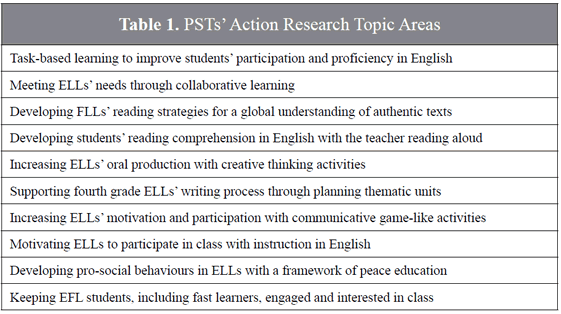
<body><![CDATA[<p><font size="2" face="Verdana, Arial, Helvetica, sans-serif">Data were collected from two sources: a structured   questionnaire that I designed and a 45-minute semi-structured interview.   Twelve PSTs and eight PAs completed a questionnaire which had two   sections: a demographic section to get background information from the   participants, and a perceptions section with an attitude and rating   scale of 82 items divided into 4 themes: a) action research in an   undergraduate program and the practicum; b) seminar methodology to   identify action research topics and formulate questions; c) roles for   PAs and PSTs during this process; and d) the action research topics and   questions. </font></p>       <p><font size="2" face="Verdana, Arial, Helvetica, sans-serif">I developed the items in the first theme based on concerns   that former PSTs and PAs have raised in our program which related to the   following: action research in preservice teacher education;   identification with the role of teacher-researcher; preparation with the   skills of picking a topic, and coming up with a research question;   personal interest in the topic and question; scope of the topic and   question; and duration of the seminar for these two skills. The items in   the second theme were related to the methodological strategies   proposed by the scholars in my literature review. The third theme   included items resulting from: an analysis of the first-semester   practicum syllabi; findings of a research study in Colombia related to   the role of the university   advisor in facilitating graduate students' action research projects (Frodden,   1999); and from roles that I had assumed in my experience. For the   second and third theme, an ''other'' response category was provided as   recommended by Genesee and Upshur (1996). </font></p>       <p><font size="2" face="Verdana, Arial, Helvetica, sans-serif">When the   questionnaires were returned and analyzed, the interviews were scheduled   at the participants' convenience. Eleven PSTs were interviewed in two   groups of four and one of three.<a name="en4" id="en4"></a><a href="#n4"><sup>4</sup></a> Five PAs were interviewed individually and 2   together at their request. Participants received a guided interview   template with questions about the research inquiry before the interview   date. These questions explored their perceptions about the following:   promotion of action research in the teaching practicum; their level of   satisfaction with the two skills; the methodological strategies to   develop the two skills; the roles they assumed and if these influenced   the choice of topics and questions; and process improvement. Eight   interviews were conducted in English, and one in Spanish. I took   detailed notes during the interviews which were tape-recorded with   permission and transcribed. </font></p>       <p><font size="2" face="Verdana, Arial, Helvetica, sans-serif">The data from both instruments were analyzed   in the following way. The questionnaire was analyzed by recording   descriptive statistics on a summary sheet. The interview data were   analyzed inductively (Burns, 1999; Patton, 1990). Initially, I read the   interview transcriptions a few times, underlined important and   interesting information related to the themes of my research questions,   and assigned codes to this information. I wrote the codes on small slips   of paper which I laid out in order to identify patterns. These patterns   were organized into categories that were based on the interview   questions. This enabled me to compare and contrast data from the   questionnaires and interviews. This analysis was shared with my master's   thesis advisor, who is an experienced professor in this topic, and   subsequently with the participants in order to find out if they agreed   with my interpretations. One PST from the original program agreed with the findings but thought that not all her experience was reported.</font></p>       <p>&nbsp;</p>       <p><font size="3" face="Verdana, Arial, Helvetica, sans-serif"><b>5. FINDINGS </b></font></p>       <p><font size="2" face="Verdana, Arial, Helvetica, sans-serif">In this section, I present participants'   attitudes towards their action research topics and questions, 5 useful   methodological strategies with a few difficulties encountered, 10 shared   roles, and the seminar methodology to identify the topics and formulate   the research questions. </font></p>         <p><font size="2" face="Verdana, Arial, Helvetica, sans-serif"><b>5.1 Attitudes Towards the Action Research Topics </b></font></p>     <p><font size="2" face="Verdana, Arial, Helvetica, sans-serif">Many of   the PSTs' projects related to topic areas for action research proposed by Mertler   (2006) and Richards and Lockhart (1994). The PSTs' topic areas were   related to teaching methods, teaching techniques, syllabi, and classroom   management, as shown in <a href="#t01">Table 1</a>.</font></p>         <p>&nbsp;</p>         ]]></body>
<body><![CDATA[<p align="center"><font size="2" face="Verdana, Arial, Helvetica, sans-serif"><a name="t01" id="t01"></a><img src="/img/revistas/ikala/v15n24/v15n24a8t1.gif" /></font></p>     <p>&nbsp;</p>     <p><font size="2" face="Verdana, Arial, Helvetica, sans-serif">All participants thought that the topics were interesting and   relevant (''strongly agree'' and ''agree'' on the scale). One PA reported,   ''Students usually come out with very interesting topics, about what they   have been observing.'' However, the PST whose project was directed towards keeping all   students, including the fast   learners, engaged in class, thought that his topic was not as important   as the others: ''It is hard to not compare with others. Mine is very   simple. It's something that we do every day. It has been worked on   before... My topic is... not new.'' One PA believed that the topics can   be related to common school issues: ''The topics that they have... for   example, I'm not expecting something like, very out of the ordinary,   because our schools usually have the same problems... topics are very,   very similar.'' </font></p>     <p><font size="2" face="Verdana, Arial, Helvetica, sans-serif">More PAs than   PSTs (5, 1) disagreed with the statement that the research questions   formulated were concrete and not broad. One PA commented: ''There are   students who want to do many things. If one looks at the questions,   sometimes they are impossible to study in the time allocated for the   action research   project. So, I think that the topics are broad, the questions too.'' </font></p>     <p><font size="2" face="Verdana, Arial, Helvetica, sans-serif"><b>5.2 Useful   Methodological Strategies </b></font></p>     <p><font size="2" face="Verdana, Arial, Helvetica, sans-serif">The   most useful strategy (''very useful'' or ''useful'' on the scale), despite difficulties   reported, was journal writing combined with collaborative dialogue. Four other   strategies deemed very useful were evaluating and expanding one's   knowledge base of the topic, delimiting topics with criteria, and   demonstrating work on activities. </font></p>        <p><font size="2" face="Verdana, Arial, Helvetica, sans-serif"><b><i>a. The journal </i></b></font></p>     <p><font size="2" face="Verdana, Arial, Helvetica, sans-serif">One PA thought   that including class observations and writing comments in the journal   served both research skills: ''I wouldn't identify two different methodologies;   one for the topic and the other for the question, because everything is   very related.'' As the instructor for both seminars Practicum I and Integrated   Seminar I she used the journal to promote reflection and share her   perspective:</font></p>            <blockquote>    <p><font size="2" face="Verdana, Arial, Helvetica, sans-serif">I was aware of everything that was happening by reading the journals,     the observations that they did. I insist a lot in observation, not only with     the objective being the teaching that they are going to do or the students' learning, but also focusing on the research project. The comments I write     in the journal are related to teaching as well as a possible future research   question, and how I see this and the other.  </font></p></blockquote>     ]]></body>
<body><![CDATA[<p><font size="2" face="Verdana, Arial, Helvetica, sans-serif">The journal   became a tool in which the PSTs could identify topics that were context-situated,   had learning potential, and were related to their personal interests.   This same PA believed that: ''The problem or topic comes from the   context, not the preservice teachers' personal interests... I don't put   my interests or the topic that I like first, over what really happens in   the classroom.'' Connecting the context to personal interests became an   understanding for one PST: ''When I was trying to find a topic, Dr. Susan   Noffke came here, and I had a dilemma... Am I supposed to found &#91;sic&#93; a   topic on my own interests, needs, the context, or me as a   learner?...She told me that, 'Yes you are a learner, and part of the   context, so mix them'.'' </font></p>     <p><font size="2" face="Verdana, Arial, Helvetica, sans-serif">Another PST   recalled having written about personal interests prior to class   observations and then, having matched those to the context. Similarly,   another PST reported having written about personal interests but related   to previous teaching experience. Two PAs also acknowledged this: ''She   immediately started to think on a topic of her interest... maybe because   last year she had the opportunity to start teaching... ideas came to   her easily.''; ''You would focus on certain things and not on others   because of your experiences and what you believe in teaching. And from   there, I know that they come to some ideas... for choosing the topic.''   In addition, another PST commented that personal questions based on a   previous teaching experience which could be connected to her class   observations helped with topic identification. An exploration of   personal beliefs about foreign language instruction and the local   context was also reported by a few advisors: ''I begin exploring first...   the teaching principles that each students has, their beliefs, and a   critical look at those principles and those that they are observing in   their contexts.''; ''I begin exploring teachers' beliefs... what they   think and why.'' </font></p>     <p><font size="2" face="Verdana, Arial, Helvetica, sans-serif"><b><i>b. The journal and collaborative dialogue </i></b></font></p>     <p><font size="2" face="Verdana, Arial, Helvetica, sans-serif">Collaborative   dialogue about journal content during individual advisory sessions or   the group seminars was effective for the participants. Two PAs   conceptualized the seminar as a place for dialoguing: ''The seminar is   where you are going to share, engage in dialogue, and look at what is   happening''; ''I've been trying to have the process with students, a lot   of sharing, a lot of comments, a lot of listening to the other and   commenting on what the others are saying... so we all share and we try   to understand.'' </font></p>     <p><font size="2" face="Verdana, Arial, Helvetica, sans-serif">This dialogue, when accompanied with   questions, enabled PSTs to clarify their ideas, get support and other   perspectives, identify other issues, and ensure their understanding of   the topic. One PST confirmed: ''We read the diary, our observations,   reflections and opinions... our advisor asks us questions to clarify our   ideas and give support.'' Other PSTs reported gaining insight with other   perspectives: ''We shared our observations, read our reflections... the   advisor and classmates told me ideas and I could generate ideas on what   they said''; ''In your diary, you can miss something... the other sees...   both reading and shared reading... the advisor reads everything and   highlights, asks questions for further explanation of things that aren't   clear... he identifies other aspects''; ''My advisor's point of view was   very important... he asked me to explain, to support what I am saying,   to simplify... that helped me to find my topic... I was ignoring ideas,   recurring issues.'' One PA emphasized dialogue with questions to check   the coherence of the PSTs' discourse: ''Research is an exploration of   discourse somehow. It's to be discussing about something that has   happened, about a phenomenon, about a situation.'' This PA used questions   such as: ''How can you support this? and Where are you getting your   information from?'' These questions confronted the PSTs' words and   actions and their relationships with the cooperating teachers and   students. </font></p>     <p><font size="2" face="Verdana, Arial, Helvetica, sans-serif">Notwithstanding these positive   perceptions, the participants identified four issues related to the journal,   and a fifth issue concerning group dialogue. The first issue was   related to the PAs'knowledge of the context and journal content. One PST thought the PAs needed   to know the schools better: ''Maybe an advisor could be more helpful in   that case, if he knows more of the context.'' Another PST believed that the PAs   needed to read the journal regularly: ''I expected our advisor to read   all the journals. In our case, he read two or three entries during the whole semester.'' The   second issue was a lack of sufficient description and reflection. One PA   commented that: ''The journals are not well written, without sufficient   description, and sometimes it is very complicated for them to determine a   research question or the topic based on the observations.'' One PST   recognized this concern and a lack of reflection: '''Why don't you go   deeper? Why didn't the learner answer?'... It was one of the aspects to   improve. We were very descriptive. My advisor wanted us to reflect more.   She wanted to help us with the reflection.'' </font></p>     <p><font size="2" face="Verdana, Arial, Helvetica, sans-serif">The third issue was related to observing   another teacher and unstructured class observations. A few PSTs   questioned the former: ''I think that would be a contradiction, start   observing another teacher, because you have to focus on your own   teaching, so what about the other observations you did at the   beginning''; ''In my case, I think I wasted my time observing the   cooperating teacher... I found the topic when I talked to students, when   I started teaching, when I started reading the program, when I talked   to the coordinator of the program.'' However, one PST believed that   observing another teacher and one's own practice was helpful: ''In my   case, I found it useful to observe my cooperating teacher teaching,   because I found two big topics while observing him, and while observing   me &#91;sic&#93;.'' This PST perceived self-observations as challenging: ''It is   easier to observe someone, but it is not easy to teach and observe   yourself and then be critical and remember everything, and take notes.''   One PST who believed the seminar methodology as not useful disliked   having to write many observations: ''At the beginning, I had my research   question after two observations. 'Why can't we formulate the research   question at that time?'... keep the observations in mind &#91;sic&#93;, not on   paper.'' </font></p>     <p><font size="2" face="Verdana, Arial, Helvetica, sans-serif">Concerning unstructured observations, a few   PSTs felt that they lacked guidance: ''Observe, What?, You are like lost,   so I wrote everything.''; ''At least have a set of key factors or   concepts to have when you are observing. Sometimes you just write down things,   everything you see, just everything.'' One PST believed that observations focused on   theory were more helpful: ''We read articles and focused our observations   on the article's topic, the teacher's principles... with the text, we   could see the situation from a different focus... there were many   windows to identify the main patterns.'' </font></p>     <p><font size="2" face="Verdana, Arial, Helvetica, sans-serif">The fourth issue reported by a few PSTs was   analyzing the journal. One PST commented: ''I also believe that in the process   of identifying the topic and research question... you need to analyze   the diary, so I believe that something that ismissing here is how to   analyze those events and those things that we observe... it has been   very difficult for me to analyze those things and to know how.'' Another PST thought that more time to analyze the   journal was required: ''We need more time to analyze and to collect more data   to identify the problem in a better way... more time to go beyond, see   other things, and get other perspectives.'' </font></p>     <p><font size="2" face="Verdana, Arial, Helvetica, sans-serif">The fifth   issue related to collaborative dialogue among PSTs at the same school   with different topics. One PA perceived that the situation could   compromise discussion: ''Because it is their topic, sometimes they having   difficulty sharing their question, their topic, because they think that   it is not so relevant for the other... if I am interested in   pronunciation, am I going to have a discussion about culture with   another?'' Yet, this PA recognized that common contextual knowledge was a   starting point for dialogue: ''What happens with French is something   very particular... all preservice teachers are in the same institution,   using the same methodology, following the same textbook; in other words,   they can share a lot because their context is very similar, although   one classroom is different to another.'' </font></p>     ]]></body>
<body><![CDATA[<p><font size="2" face="Verdana, Arial, Helvetica, sans-serif"><b><i>c. Evaluating and expanding one's knowledge </i></b></font></p>     <p><font size="2" face="Verdana, Arial, Helvetica, sans-serif">These two strategies were discussing theory from   previous courses in the program, and reading the literature about the   topic. Evaluating previous knowledge about a topic was commented on by   two PSTs: ''We brainstormed ideas about the topics based on our   observations and what you know about the topic''; ''That topic called my   attention since I read about it in previous courses of the program.'' One   PA, likewise, thought this strategy was useful with PSTs: ''When you   talk to them... their beliefs, their ideas, their concepts, the   information that they have collected from the other courses in the   Licensure Program.'' Another PST reported that her choice of topic was   directly related to a personal interest of hers with the principles of   thematic teaching she had learned in one of the Methods courses in the   undergraduate program. </font></p>     <p><font size="2" face="Verdana, Arial, Helvetica, sans-serif">Afew PSTs and PAs commented that reading theory was useful for   both research skills. They believed it helped the PSTs to identify and   expand their knowledge about the topics, and to redirect and reshape the   research questions. One PA and two PSTs stated: ''We read the literature   and this helped to find the starting point.''; ''It is good to have the   preliminary question before reading the literature, then you can change   it.''; ''Reading the literature and finding concepts helps to revise the   question... I found one research question and I had to restate it. I   changed a few details... tried to make it sound better in French,   including new concepts... I didn't know what to call it.'' One PA thought   that her PST was able to revise the question based on guidelines in   theory: ''I also gave her the tips Dr. Susan Noffke had share with the   research group last year to formulate the research questions. I   asked her to formulate it and then revise it with Dr. Noffke's   suggestions to see if it accomplished all those requirements.''Another PA   stated that putting theory read into practice was useful: ''With this   process of identifying a topic and then a research question, one process   is related to... try to make that literature very practical... this is   all done based on the interests and ideas and beliefs they have about   what they have been observing. There is a lot of... reading and   practicing... a lot of theory and examples.'' </font></p>       <p><font size="2" face="Verdana, Arial, Helvetica, sans-serif"><b><i>d. Delimiting topics </i></b></font></p>     <p><font size="2" face="Verdana, Arial, Helvetica, sans-serif">A   number of PAs recognized that they thought it was important delimit the   PSTs' topics: ''Identifying the problem... they want to do many things...   They identify topics, many topics, and they come with lots of ideas...   to work with, but then when they need to &#91;sic&#93; specific, that's when the   problem comes.''; ''What really interests me is that the topic, whatever   it is, is feasible... If it is really broad, I   point out the time and the conditions for the project.''; ''I realized that the topic   was still too broad... so I asked my student to delimit the topic and   then polish the question, then I revised it.''; ''Sometimes we dream too   much... the other preservice teachers help me to delimit too... question   the preservice teacher what has been done about it, if they believe   that they will find something about it, as to how feasible the work will   be with the topic.'' Also, one PST commented on this issue: ''I had a lot   of ideas, questions. I went to my advisor to narrow down the focus...   My advisor helped me to understand that it was a very big topic to   develop in a short time. I had to change the question.'' </font></p>       <p><font size="2" face="Verdana, Arial, Helvetica, sans-serif"><b><i>e. Demonstrating work </i></b></font></p>     <p><font size="2" face="Verdana, Arial, Helvetica, sans-serif">The   strategy of demonstrating work was related to analyzing data in the   journal and writing   the research question. One PAcommented: ''We began analyzing the journals right   away, inductive analysis... I helped with analyzing data and they could do this   independently after, and they found their starting point.'' Concerning   the research question, one PST stated: ''The research question, we had   many sessions, one time we wrote the research question on the board,   discussed them, the wording,   the verbs, modified them.This was very helpful, excellent, not just the advisor, but   the whole group.'' One PA mentioned that she showed how to come up with   the research question using a formula: ''I decided I had to do it simple,   I remembered the structure: how A affects B, and what A and B were.'' </font></p>       <p><font size="2" face="Verdana, Arial, Helvetica, sans-serif"><b>5.3 Roles for the PSTs and   PAs<sup><a name="en5" id="en5"></a><a href="#n5">5</a></sup> </b></font></p>     <p><font size="2" face="Verdana, Arial, Helvetica, sans-serif">Most   participants agreed that the role of the PST was to choose the topic and   to write the question (6 PAs, 10 PSTs) with the PAshowing them   how.Anumber of PSTs stated that they themselves had identified their   topics and formulated their research questions: ''We defined the   topics.''; ''Finally, I could work on what I wanted and my students.'';   ''Our task is to do the research question.''; ''I defined my question.''; ''I   formulated that question.''; ''I found one research question.'' Likewise,   more than half of them believed that the role of the PST was to monitor   their own teaching practice (5 PAs, 9 PSTs) and to use the feedback from   the advisor and/or cooperating teacher to identify the topic and   question (5 PAs, 12 PSTs).Anumber of PAs expressed that their role was   not to influence directly the PSTs' choice of topics or research   questions, but to promote autonomy and ownership of this research   process. One PA commented,</font></p>       <blockquote><font size="2" face="Verdana, Arial, Helvetica, sans-serif">I try not to influence, with my knowledge, my   personal interests, the identification of the topic and much less, the   formulation of the research question... to tell the preservice teacher   the topic to research, the type of question to formulate, is to take   away the preservice teacher's responsibility. It doesn't matter that   there are problems with the topic or question, because this is to be   expected in undergraduate formation. </font></blockquote>      <font size="2" face="Verdana, Arial, Helvetica, sans-serif"> </p> One PST acknowledged this: ''We   all had our topic and idea for the question, and our advisor was very   supportive, accepted, open-minded.'' Another PA agreed: ''The question has   to be connected to the topic, and since I was not the one who chose the   topic, I was not the right person to define the question.'' and pointed   out that their role was to guide the PSTs through this process: ''It is   my student's research project...   so what I had to do was to help her go through the research process.''        ]]></body>
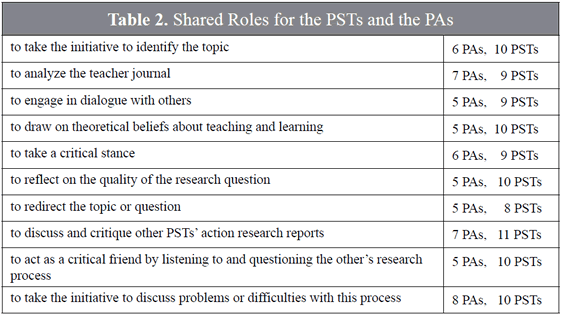
<body><![CDATA[<p>Ten shared roles became apparent during this process (<a href="#t02">Table 2</a>); four were   related to identifying and understanding the topics, and six were associated with giving feedback on the topic.</p> </font>     <p>&nbsp;</p>     <p align="center"><font size="2" face="Verdana, Arial, Helvetica, sans-serif"><a name="t02" id="t02"></a><img src="/img/revistas/ikala/v15n24/v15n24a8t2.gif" /></font></p>     <p>&nbsp;</p>     <p><font size="2" face="Verdana, Arial, Helvetica, sans-serif">A few comments from the PSTs were: ''Our advisor's help is really helpful,   useful.''; ''It was difficult at the beginning, but little by little, I received help from my advisor and overcame those difficulties.''</font></p>     <p><font size="2" face="Verdana, Arial, Helvetica, sans-serif"><b>5.4 Attitudes Towards Seminar Methodology </b></font></p>     <p><font size="2" face="Verdana, Arial, Helvetica, sans-serif">All but one participant thought that   the seminar methodology was useful. More PAs agreed with respect to the   topics (8, one ''strongly'' on the scale) than the research questions (6).   Eleven PSTs agreed (7 ''strongly'') with respect to both research skills.   Despite these perceptions, participants thought that these skills were   difficult. Seven PAs and 10 PSTs disagreed (2 ''strongly'') that it was   easy to identify a topic, and 8 PAs disagreed (1 ''strongly'') and 11 PSTs   (3 ''strongly'') that formulating a research question was easy. Only 1   PST agreed for both questions. While more than half of the PAs (5/8)   believed that they were prepared to guide the PSTs to identify topics   and formulate research questions having done action research, more than   half of them (6/8) thought that they did not have sufficient coaching   skills, even though all the PSTs thought they did. </font></p>     <p>&nbsp;</p>     <p><font size="3" face="Verdana, Arial, Helvetica, sans-serif"><b>6. DISCUSSION AND CONCLUSION </b></font></p>     <p><font size="2" face="Verdana, Arial, Helvetica, sans-serif">The types of the PSTs' topics   indicate projects with a practical and technical orientation to action   research, many of which are focused on issues of classroom teaching. Action research that is practical in nature (Holly,   1994, as cited in Amal, Rinc&oacute;n, and Latorre, 1994) and that allows a   teacher to choose the topic of inquiry and control its processes with   the support of an outsider or critical friend is representative of our   experience in the first semester of the teaching practicum.   FeldmanandAtkin (1995) refer to theroleofoutsiders or facilitators of other teachers' action research projects as   one in which they do not influence the research focus. Likewise, Zeichner and   Gore (1995:21) acknowledge the importance of maintaining ''students'   ownership of their research process'' and minimizing ''overdirecting   students'choice of topics'' so that the research inquiry can respond to   the ''classroom events and conditions'' that PSTs encounter. In this   study, the topics were derived from the PSTs' language teaching and   concerns and not from outside educational professionals or disciplines. </font></p>     ]]></body>
<body><![CDATA[<p><font size="2" face="Verdana, Arial, Helvetica, sans-serif">The methodological process with which PSTs identified their topics and   formulated their research questions is associated with a reflective professional   development endeavour discussed by Crookes (2003) in the context of a   graduate level teaching practicum. Teachers begin with an ''intrapersonal   means of reflection'' by writing about personal interests, prior experiences   and principles related to teaching and learning foreign languages, observing   another teacher's class as well as their own, and their reflections in a teacher   journal. Zeichner and Gore (1995:22) report that some of these tasks assisted their students in an undergraduate teacher education practicum to ''understand   and improve their situation and their practice.'' Teachers who focus on their own    practice, according to Feldman and Atkin (1995:128), somehow become ''the  'subjects' of their own research'' which facilitates self-development. Although   these projects were ''individualistic and technical'' similar to Zeichner and Gore's experience, interaction among the PSTs and the PAs during the seminar   appeared to resemble what Crookes (2003) coins a teacher development group, which broadened the focus of these projects.</font></p>     <p><font size="2" face="Verdana, Arial, Helvetica, sans-serif">The seminar group discussions moved teachers towards a more ''interpersonal   means of reflection'' (Crookes, 2003:22), which in this study was effective   when combined with a critical dialogic questioning of the content in the teacher   journal. Battagali (1995:75) places importance on asking questions about one's   practice and the students' learning process, and changing one's viewpoint by    listening to others. Gaining insight from other perspectives (Crookes, 2003), especially those of the students and teachers at the school, can give teachers a better understanding of the topics. The notion of teachers meeting regularly in a professional community (Feldman and Atkin, 1995) in order to share and discuss teaching and learning experiences, concerns, and readings, and to receive  and give feedback, is instrumental for professional development (Crookes, 2003). According to Stevenson, Noffke, Flores, and Granger (1995:61), these group sessions allow teachers ''to share and critique'' their ''action research experiences.'' These strategies in action research can help PSTs to examine their teaching practices and classroom situations with the goal of making changes for improvement, and to develop professionally (Johnson, 2005).</font></p>     <p><font size="2" face="Verdana, Arial, Helvetica, sans-serif">The process in which the topics were identified appears to be   heuristic or inductive and descriptive (Seliger and Shohamy, 1989:47)   with an emphasis on unstructured class observations, with ''no   preconceived or <i>deductive </i>notion'' of what to observe. Zeichner   and Gore (1995) state that open class observations can help teachers to   focus on broader social and cultural aspects of the schools. Given that   Schuyler and Sitterley (1995:57) question whether action research ''leads   naturally towards a focus on contexts'', PAs who are familiar with and   interested in the school context can guide the PSTs in this direction.   Zeichner and Gore (1995) further suggest that reading key school   documents can be a starting point for observations and discussions. For   teachers observing other teachers, Wajnryb (1992) proposes structured observation as a   means to limit the focus of what teachers observe and make it easier for teachers   to collect, analyze, and interpret data, which helps them to discuss   and reflect on teaching and learning practices. In this study, it is   apparent that many of the topics and questions were linked to ''something   observed'' in a personal teaching and learning experience which led ''to   further questioning'' and dialogue, and the research focus (Seliger and   Shohamy, 1989:46-47). </font></p>     <p><font size="2" face="Verdana, Arial, Helvetica, sans-serif">In this study, the use of class observations, journal writing, and critical dialogic   questioning helped the PSTs to identify the topics and questions for their action   research projects. Notwithstanding, there was an interplay of other strategies   perceived to be useful by participants which included exploring personal   interests, principles, and experiences related to teaching and learning foreign    languages and theoretical knowledge, and the narrowing down of the topics   and demonstrating work during this process. While the PSTs were responsible   for choosing the topics and the research questions, the PAs became active facilitators and provided guidance and support in this process.</font></p>     <p><font size="2" face="Verdana, Arial, Helvetica, sans-serif">Carrying out this case study   has been an enriching experience for me. It has enabled me to become   more aware of the methodological strategies that we, the participants,   use, and the roles we adopt and how these are shared. It has also   motivated me to continue reflecting on how university advisors can   interact with their student teachers in an effective way. Sharing this   report with others will hopefully raise awareness of the need for   continued discussion of the methodologies used during this preliminary   stage of action research. Noffke (1995:7, as cited in Noffke and   Stevenson, 1995) concludes that ''Action research must not be seen as   only a staff development strategy; it must also serve as a means to make   public the understandings of practitioners and the contexts in which   they work.'' While I have learned a great deal about our practice, future   study of this topic can provide greater insight into our actions   promoting educational action research. </font></p>     <p>&nbsp;</p>     <p><font size="3" face="Verdana, Arial, Helvetica, sans-serif"><b>REFERENCES </b></font></p>     <!-- ref --><p><font size="2" face="Verdana, Arial, Helvetica, sans-serif">1. Amal, J.,   Rinc&oacute;n, D., and Latorre, A. (1994). <i>Investigaci&oacute;n educativa:   Fundamentos y metodolog&iacute;as</i>. Barcelona, Espa&ntilde;a:   Editorial Labor. </font>&nbsp;&nbsp;&nbsp;&nbsp;&nbsp;&nbsp;&nbsp;&nbsp;[&#160;<a href="javascript:void(0);" onclick="javascript: window.open('/scielo.php?script=sci_nlinks&ref=000110&pid=S0123-3432201000010000800001&lng=','','width=640,height=500,resizable=yes,scrollbars=1,menubar=yes,');">Links</a>&#160;]<!-- end-ref --><!-- ref --><p><font size="2" face="Verdana, Arial, Helvetica, sans-serif">2. Altrichter, H., Posch, P., &amp; Somekh, B. (1993).   Teachers investigate their work. <i>An introduction to the methods of action research</i>.   London, England: Routledge.</font>&nbsp;&nbsp;&nbsp;&nbsp;&nbsp;&nbsp;&nbsp;&nbsp;[&#160;<a href="javascript:void(0);" onclick="javascript: window.open('/scielo.php?script=sci_nlinks&ref=000111&pid=S0123-3432201000010000800002&lng=','','width=640,height=500,resizable=yes,scrollbars=1,menubar=yes,');">Links</a>&#160;]<!-- end-ref --><!-- ref --><p><font size="2" face="Verdana, Arial, Helvetica, sans-serif">3. Battaglia, C. (1995). Teaching Action   Research: A Case Study. In Noffke, S. and Stevenson, R. (Eds.). <i>Educational   Action Research</i>. NY, USA: Teachers College Press.</font>&nbsp;&nbsp;&nbsp;&nbsp;&nbsp;&nbsp;&nbsp;&nbsp;[&#160;<a href="javascript:void(0);" onclick="javascript: window.open('/scielo.php?script=sci_nlinks&ref=000112&pid=S0123-3432201000010000800003&lng=','','width=640,height=500,resizable=yes,scrollbars=1,menubar=yes,');">Links</a>&#160;]<!-- end-ref --><!-- ref --><p><font size="2" face="Verdana, Arial, Helvetica, sans-serif">4. Burns, A. (1999). <i>Collaborative   action research for English language teachers</i>. Cambridge: Cambridge   University Press.</font>&nbsp;&nbsp;&nbsp;&nbsp;&nbsp;&nbsp;&nbsp;&nbsp;[&#160;<a href="javascript:void(0);" onclick="javascript: window.open('/scielo.php?script=sci_nlinks&ref=000113&pid=S0123-3432201000010000800004&lng=','','width=640,height=500,resizable=yes,scrollbars=1,menubar=yes,');">Links</a>&#160;]<!-- end-ref --><!-- ref --><p><font size="2" face="Verdana, Arial, Helvetica, sans-serif">5. Creswell, J. (1998). <i>Qualitative Inquiry and   Research Design</i>. Thousand Oaks, California: SAGE Publications,   Incorporated.</font>&nbsp;&nbsp;&nbsp;&nbsp;&nbsp;&nbsp;&nbsp;&nbsp;[&#160;<a href="javascript:void(0);" onclick="javascript: window.open('/scielo.php?script=sci_nlinks&ref=000114&pid=S0123-3432201000010000800005&lng=','','width=640,height=500,resizable=yes,scrollbars=1,menubar=yes,');">Links</a>&#160;]<!-- end-ref --><!-- ref --><p><font size="2" face="Verdana, Arial, Helvetica, sans-serif">6. Crookes, G. (2003). <i>A Practicum in TESOL. Professional   Development through Teaching Practice</i>. Cambridge: Cambridge   University Press.</font>&nbsp;&nbsp;&nbsp;&nbsp;&nbsp;&nbsp;&nbsp;&nbsp;[&#160;<a href="javascript:void(0);" onclick="javascript: window.open('/scielo.php?script=sci_nlinks&ref=000115&pid=S0123-3432201000010000800006&lng=','','width=640,height=500,resizable=yes,scrollbars=1,menubar=yes,');">Links</a>&#160;]<!-- end-ref --><!-- ref --><p><font size="2" face="Verdana, Arial, Helvetica, sans-serif">7. Feldman, A., and Atkin, M. (1995). Teaching Action   Research: A Case Study. In Noffke, S. and Stevenson, R. (Eds.). <i>Educational   Action Research</i>. NY, USA: Teachers College Press.</font>&nbsp;&nbsp;&nbsp;&nbsp;&nbsp;&nbsp;&nbsp;&nbsp;[&#160;<a href="javascript:void(0);" onclick="javascript: window.open('/scielo.php?script=sci_nlinks&ref=000116&pid=S0123-3432201000010000800007&lng=','','width=640,height=500,resizable=yes,scrollbars=1,menubar=yes,');">Links</a>&#160;]<!-- end-ref --><!-- ref --><p><font size="2" face="Verdana, Arial, Helvetica, sans-serif">8. Fletcher, S.   (updated November 2005). Book Review: Hopkins, D. (2002) A Teacher's Guide   to Classroom Research, Maidenhood, Open University Press &#91;On-line&#93;,   Internet. Available: <a href="http://www.teacherresearchsearch.net/r_bookreview 4.htm" target="_blank">http://www.teacherresearchsearch.net/r_bookreview 4.htm</a></font>&nbsp;&nbsp;&nbsp;&nbsp;&nbsp;&nbsp;&nbsp;&nbsp;[&#160;<a href="javascript:void(0);" onclick="javascript: window.open('/scielo.php?script=sci_nlinks&ref=000117&pid=S0123-3432201000010000800008&lng=','','width=640,height=500,resizable=yes,scrollbars=1,menubar=yes,');">Links</a>&#160;]<!-- end-ref --><!-- ref --><p><font size="2" face="Verdana, Arial, Helvetica, sans-serif">9. Freeman, D. (1998). <i>Doing teacher-research: From inquiry to   understanding</i>. Toronto, Canada, Heinle and Heinle. </font>&nbsp;&nbsp;&nbsp;&nbsp;&nbsp;&nbsp;&nbsp;&nbsp;[&#160;<a href="javascript:void(0);" onclick="javascript: window.open('/scielo.php?script=sci_nlinks&ref=000118&pid=S0123-3432201000010000800009&lng=','','width=640,height=500,resizable=yes,scrollbars=1,menubar=yes,');">Links</a>&#160;]<!-- end-ref --><!-- ref --><p><font size="2" face="Verdana, Arial, Helvetica, sans-serif">10. Frodden, C. (1999). Action Research in a   Graduate Foreign Language Teaching Program. <i>Ikala, 4</i>, (7, 8),   101-124. </font>&nbsp;&nbsp;&nbsp;&nbsp;&nbsp;&nbsp;&nbsp;&nbsp;[&#160;<a href="javascript:void(0);" onclick="javascript: window.open('/scielo.php?script=sci_nlinks&ref=000119&pid=S0123-3432201000010000800010&lng=','','width=640,height=500,resizable=yes,scrollbars=1,menubar=yes,');">Links</a>&#160;]<!-- end-ref --><!-- ref --><p><font size="2" face="Verdana, Arial, Helvetica, sans-serif">11. Gebhard, J. (1999). Problem posing and solving with action   research. In Gebhard, J. and Oprandy, R. (Eds.). <i>Language teaching   awareness </i>(pp. 59-77). Cambridge, UK: Cambridge University Press. </font>&nbsp;&nbsp;&nbsp;&nbsp;&nbsp;&nbsp;&nbsp;&nbsp;[&#160;<a href="javascript:void(0);" onclick="javascript: window.open('/scielo.php?script=sci_nlinks&ref=000120&pid=S0123-3432201000010000800011&lng=','','width=640,height=500,resizable=yes,scrollbars=1,menubar=yes,');">Links</a>&#160;]<!-- end-ref --><!-- ref --><p><font size="2" face="Verdana, Arial, Helvetica, sans-serif">12. Gebhard, J., and Oprandy, R. (1999). <i>Language teaching   awareness</i>. Cambridge, UK: Cambridge University Press. </font>&nbsp;&nbsp;&nbsp;&nbsp;&nbsp;&nbsp;&nbsp;&nbsp;[&#160;<a href="javascript:void(0);" onclick="javascript: window.open('/scielo.php?script=sci_nlinks&ref=000121&pid=S0123-3432201000010000800012&lng=','','width=640,height=500,resizable=yes,scrollbars=1,menubar=yes,');">Links</a>&#160;]<!-- end-ref --><!-- ref --><p><font size="2" face="Verdana, Arial, Helvetica, sans-serif">13. Genesee, F., and Upshur, J. (1996). <i>Classroom-Based   Evaluation in Second Language Education</i>. Cambridge: Cambridge   University Press. </font>&nbsp;&nbsp;&nbsp;&nbsp;&nbsp;&nbsp;&nbsp;&nbsp;[&#160;<a href="javascript:void(0);" onclick="javascript: window.open('/scielo.php?script=sci_nlinks&ref=000122&pid=S0123-3432201000010000800013&lng=','','width=640,height=500,resizable=yes,scrollbars=1,menubar=yes,');">Links</a>&#160;]<!-- end-ref --><!-- ref --><p><font size="2" face="Verdana, Arial, Helvetica, sans-serif">14. Glesne, C., and Webb, R. (1993). Teaching Qualitative   Research: Who does What? <i>International Journal of Qualitative Studies   in Eduation</i>. 6, (3), 253-266. </font>&nbsp;&nbsp;&nbsp;&nbsp;&nbsp;&nbsp;&nbsp;&nbsp;[&#160;<a href="javascript:void(0);" onclick="javascript: window.open('/scielo.php?script=sci_nlinks&ref=000123&pid=S0123-3432201000010000800014&lng=','','width=640,height=500,resizable=yes,scrollbars=1,menubar=yes,');">Links</a>&#160;]<!-- end-ref --><!-- ref --><p><font size="2" face="Verdana, Arial, Helvetica, sans-serif">15. G&oacute;mez-G&oacute;mez, E., J&iacute;menez-Bonilla, S., Luna-Cortes, M., Mar&iacute;n   de Ot&aacute;lora, M., Martelo, B., Ortega-Hern&aacute;ndez, C., et al. (1993). <i>A   Proposal of a Framework for the Teaching of English in the Colombian   Licenciatura Programs: Working Document Number 3</i>. London: Thames   Valley University. </font>&nbsp;&nbsp;&nbsp;&nbsp;&nbsp;&nbsp;&nbsp;&nbsp;[&#160;<a href="javascript:void(0);" onclick="javascript: window.open('/scielo.php?script=sci_nlinks&ref=000124&pid=S0123-3432201000010000800015&lng=','','width=640,height=500,resizable=yes,scrollbars=1,menubar=yes,');">Links</a>&#160;]<!-- end-ref --><!-- ref --><p><font size="2" face="Verdana, Arial, Helvetica, sans-serif">16. Hopkins, D. (2002). <i>A teacher's guide to classroom research</i>.   Buckingham, UK: Open University Press. </font>&nbsp;&nbsp;&nbsp;&nbsp;&nbsp;&nbsp;&nbsp;&nbsp;[&#160;<a href="javascript:void(0);" onclick="javascript: window.open('/scielo.php?script=sci_nlinks&ref=000125&pid=S0123-3432201000010000800016&lng=','','width=640,height=500,resizable=yes,scrollbars=1,menubar=yes,');">Links</a>&#160;]<!-- end-ref --><!-- ref --><p><font size="2" face="Verdana, Arial, Helvetica, sans-serif">17. Jim&eacute;nez Bonilla, S., Luna Cort&eacute;s, M., and Mar&iacute;n de Ot&aacute;lora, M.   (1993). <i>Action research guide</i>. London, UK: Overseas Development   Agency. </font>&nbsp;&nbsp;&nbsp;&nbsp;&nbsp;&nbsp;&nbsp;&nbsp;[&#160;<a href="javascript:void(0);" onclick="javascript: window.open('/scielo.php?script=sci_nlinks&ref=000126&pid=S0123-3432201000010000800017&lng=','','width=640,height=500,resizable=yes,scrollbars=1,menubar=yes,');">Links</a>&#160;]<!-- end-ref --><!-- ref --><p><font size="2" face="Verdana, Arial, Helvetica, sans-serif">18. Johnson, A. (2005). <i>A short guide to action research</i>.   Boston, USA: Pearson Education Inc. </font>&nbsp;&nbsp;&nbsp;&nbsp;&nbsp;&nbsp;&nbsp;&nbsp;[&#160;<a href="javascript:void(0);" onclick="javascript: window.open('/scielo.php?script=sci_nlinks&ref=000127&pid=S0123-3432201000010000800018&lng=','','width=640,height=500,resizable=yes,scrollbars=1,menubar=yes,');">Links</a>&#160;]<!-- end-ref --><!-- ref --><p><font size="2" face="Verdana, Arial, Helvetica, sans-serif">19. Kemmis, S., and McTaggart, R. (Eds.). (1988). <i>The action   research planner</i>. Victoria,Australia: Deakin University Press. </font>&nbsp;&nbsp;&nbsp;&nbsp;&nbsp;&nbsp;&nbsp;&nbsp;[&#160;<a href="javascript:void(0);" onclick="javascript: window.open('/scielo.php?script=sci_nlinks&ref=000128&pid=S0123-3432201000010000800019&lng=','','width=640,height=500,resizable=yes,scrollbars=1,menubar=yes,');">Links</a>&#160;]<!-- end-ref --><!-- ref --><p><font size="2" face="Verdana, Arial, Helvetica, sans-serif">20. Larabee, D. (2003). The Peculiar Problems of Preparing   Educational Researchers. <i>Educational Researcher</i>, <i>32</i> (4),   13-22. </font>&nbsp;&nbsp;&nbsp;&nbsp;&nbsp;&nbsp;&nbsp;&nbsp;[&#160;<a href="javascript:void(0);" onclick="javascript: window.open('/scielo.php?script=sci_nlinks&ref=000129&pid=S0123-3432201000010000800020&lng=','','width=640,height=500,resizable=yes,scrollbars=1,menubar=yes,');">Links</a>&#160;]<!-- end-ref --><!-- ref --><p><font size="2" face="Verdana, Arial, Helvetica, sans-serif">21. Leedy, P., and Ormrod, J. (2001). <i>Practical research.   Planning and design</i>. New Jersey, USA: Merrill Prentice Hall. </font>&nbsp;&nbsp;&nbsp;&nbsp;&nbsp;&nbsp;&nbsp;&nbsp;[&#160;<a href="javascript:void(0);" onclick="javascript: window.open('/scielo.php?script=sci_nlinks&ref=000130&pid=S0123-3432201000010000800021&lng=','','width=640,height=500,resizable=yes,scrollbars=1,menubar=yes,');">Links</a>&#160;]<!-- end-ref --><!-- ref --><p><font size="2" face="Verdana, Arial, Helvetica, sans-serif">22. Madison Metropolitan School District Action Research Group,   (n.d.) Starting Points. USA: St. Louis Action Research Evaluation   Committee. </font>&nbsp;&nbsp;&nbsp;&nbsp;&nbsp;&nbsp;&nbsp;&nbsp;[&#160;<a href="javascript:void(0);" onclick="javascript: window.open('/scielo.php?script=sci_nlinks&ref=000131&pid=S0123-3432201000010000800022&lng=','','width=640,height=500,resizable=yes,scrollbars=1,menubar=yes,');">Links</a>&#160;]<!-- end-ref --><!-- ref --><p><font size="2" face="Verdana, Arial, Helvetica, sans-serif">23. Madison Metropolitan School District Action Research Group,   (n.d.) <i>What is a Good Action Research Question?</i> USA: St. Louis   Action Research Evaluation Committee. </font>&nbsp;&nbsp;&nbsp;&nbsp;&nbsp;&nbsp;&nbsp;&nbsp;[&#160;<a href="javascript:void(0);" onclick="javascript: window.open('/scielo.php?script=sci_nlinks&ref=000132&pid=S0123-3432201000010000800023&lng=','','width=640,height=500,resizable=yes,scrollbars=1,menubar=yes,');">Links</a>&#160;]<!-- end-ref --><!-- ref --><p><font size="2" face="Verdana, Arial, Helvetica, sans-serif">24. McNulty Ferri, M., and Usma Wilches, J. (2005). Evaluating   research skills development in undergraduate foreign language teaching. <i>Ikala, </i>10 (16), 95-125. </font>&nbsp;&nbsp;&nbsp;&nbsp;&nbsp;&nbsp;&nbsp;&nbsp;[&#160;<a href="javascript:void(0);" onclick="javascript: window.open('/scielo.php?script=sci_nlinks&ref=000133&pid=S0123-3432201000010000800024&lng=','','width=640,height=500,resizable=yes,scrollbars=1,menubar=yes,');">Links</a>&#160;]<!-- end-ref --><!-- ref --><p><font size="2" face="Verdana, Arial, Helvetica, sans-serif">25. Mertler, C. (2006). <i>Action Research. Teachers as   Researchers in the Classrooms</i>. Thousand Oaks, California: Sage   Publications. </font>&nbsp;&nbsp;&nbsp;&nbsp;&nbsp;&nbsp;&nbsp;&nbsp;[&#160;<a href="javascript:void(0);" onclick="javascript: window.open('/scielo.php?script=sci_nlinks&ref=000134&pid=S0123-3432201000010000800025&lng=','','width=640,height=500,resizable=yes,scrollbars=1,menubar=yes,');">Links</a>&#160;]<!-- end-ref --><!-- ref --><p><font size="2" face="Verdana, Arial, Helvetica, sans-serif">26. Noffke, S. and Stevenson, R. (1995). <i>Educational Action   Research. </i>NY: Teachers College Press. </font>&nbsp;&nbsp;&nbsp;&nbsp;&nbsp;&nbsp;&nbsp;&nbsp;[&#160;<a href="javascript:void(0);" onclick="javascript: window.open('/scielo.php?script=sci_nlinks&ref=000135&pid=S0123-3432201000010000800026&lng=','','width=640,height=500,resizable=yes,scrollbars=1,menubar=yes,');">Links</a>&#160;]<!-- end-ref --><!-- ref --><p><font size="2" face="Verdana, Arial, Helvetica, sans-serif">27. Nunan. D. (1989). <i>Designing Tasks for the Communicative   Classroom. </i>Cambridge: Cambridge University Press. </font>&nbsp;&nbsp;&nbsp;&nbsp;&nbsp;&nbsp;&nbsp;&nbsp;[&#160;<a href="javascript:void(0);" onclick="javascript: window.open('/scielo.php?script=sci_nlinks&ref=000136&pid=S0123-3432201000010000800027&lng=','','width=640,height=500,resizable=yes,scrollbars=1,menubar=yes,');">Links</a>&#160;]<!-- end-ref --><!-- ref --><p><font size="2" face="Verdana, Arial, Helvetica, sans-serif">28. Nunan, D. (1992). <i>Research methods in language learning</i>.   Cambridge, UK: Cambridge University Press. </font>&nbsp;&nbsp;&nbsp;&nbsp;&nbsp;&nbsp;&nbsp;&nbsp;[&#160;<a href="javascript:void(0);" onclick="javascript: window.open('/scielo.php?script=sci_nlinks&ref=000137&pid=S0123-3432201000010000800028&lng=','','width=640,height=500,resizable=yes,scrollbars=1,menubar=yes,');">Links</a>&#160;]<!-- end-ref --><!-- ref --><p><font size="2" face="Verdana, Arial, Helvetica, sans-serif">29. Patton, M. (1990). <i>Qualitative evaluation and research   methods</i>. (Rev. ed.) Newbury Park, CA: SAGE Publications, Inc. </font>&nbsp;&nbsp;&nbsp;&nbsp;&nbsp;&nbsp;&nbsp;&nbsp;[&#160;<a href="javascript:void(0);" onclick="javascript: window.open('/scielo.php?script=sci_nlinks&ref=000138&pid=S0123-3432201000010000800029&lng=','','width=640,height=500,resizable=yes,scrollbars=1,menubar=yes,');">Links</a>&#160;]<!-- end-ref --><!-- ref --><p><font size="2" face="Verdana, Arial, Helvetica, sans-serif">30. Quintero, J., Zuluaga, C.,   Gallego, L., Buitrago, S., Gonz&aacute;lez, F., L&oacute;pez, M., et al., (2002). <i>Research   in teaching practicum</i>. <i>Trainee's Guide. </i>Manizales, Colombia:   Universidad de Caldas. </font>&nbsp;&nbsp;&nbsp;&nbsp;&nbsp;&nbsp;&nbsp;&nbsp;[&#160;<a href="javascript:void(0);" onclick="javascript: window.open('/scielo.php?script=sci_nlinks&ref=000139&pid=S0123-3432201000010000800030&lng=','','width=640,height=500,resizable=yes,scrollbars=1,menubar=yes,');">Links</a>&#160;]<!-- end-ref --><!-- ref --><p align=""><font size="2" face="Verdana, Arial, Helvetica, sans-serif">31. Richards, J. and Lockhart, C.   (1994). <i>Teaching Reflective in Second Language Classrooms. </i>Cambridge:   Cambridge University Press.</font>&nbsp;&nbsp;&nbsp;&nbsp;&nbsp;&nbsp;&nbsp;&nbsp;[&#160;<a href="javascript:void(0);" onclick="javascript: window.open('/scielo.php?script=sci_nlinks&ref=000140&pid=S0123-3432201000010000800031&lng=','','width=640,height=500,resizable=yes,scrollbars=1,menubar=yes,');">Links</a>&#160;]<!-- end-ref --><!-- ref --><p align=""><font size="2" face="Verdana, Arial, Helvetica, sans-serif">32. Sagor, R. (1992). <i>How to conduct a   collaborative action rese</i>arch. Alexandria, Virginia, USA:   Association for Supervision and Curriculum Development. </font>&nbsp;&nbsp;&nbsp;&nbsp;&nbsp;&nbsp;&nbsp;&nbsp;[&#160;<a href="javascript:void(0);" onclick="javascript: window.open('/scielo.php?script=sci_nlinks&ref=000141&pid=S0123-3432201000010000800032&lng=','','width=640,height=500,resizable=yes,scrollbars=1,menubar=yes,');">Links</a>&#160;]<!-- end-ref --><!-- ref --><p><font size="2" face="Verdana, Arial, Helvetica, sans-serif">33. Schuyler, P., and Sitterley,   D. (1995). Preservice Teacher Supervision and Reflective Practice. In Noffke, S. and Stevenson,   R. (Eds.). <i>Educational Action Research</i>. NY, USA: Teachers College   Press.</font>&nbsp;&nbsp;&nbsp;&nbsp;&nbsp;&nbsp;&nbsp;&nbsp;[&#160;<a href="javascript:void(0);" onclick="javascript: window.open('/scielo.php?script=sci_nlinks&ref=000142&pid=S0123-3432201000010000800033&lng=','','width=640,height=500,resizable=yes,scrollbars=1,menubar=yes,');">Links</a>&#160;]<!-- end-ref --><!-- ref --><p><font size="2" face="Verdana, Arial, Helvetica, sans-serif">34. Selener, D. (1997). <i>Participatory action research and social   change</i>. Ithaca, NY: Cornell University.</font>&nbsp;&nbsp;&nbsp;&nbsp;&nbsp;&nbsp;&nbsp;&nbsp;[&#160;<a href="javascript:void(0);" onclick="javascript: window.open('/scielo.php?script=sci_nlinks&ref=000143&pid=S0123-3432201000010000800034&lng=','','width=640,height=500,resizable=yes,scrollbars=1,menubar=yes,');">Links</a>&#160;]<!-- end-ref --><!-- ref --><p><font size="2" face="Verdana, Arial, Helvetica, sans-serif">35. Seliger, H. and Shohamy, E.   (1989). <i>Second language research me</i>thods. Oxford: Oxford   University Press. </font>&nbsp;&nbsp;&nbsp;&nbsp;&nbsp;&nbsp;&nbsp;&nbsp;[&#160;<a href="javascript:void(0);" onclick="javascript: window.open('/scielo.php?script=sci_nlinks&ref=000144&pid=S0123-3432201000010000800035&lng=','','width=640,height=500,resizable=yes,scrollbars=1,menubar=yes,');">Links</a>&#160;]<!-- end-ref --><!-- ref --><p><font size="2" face="Verdana, Arial, Helvetica, sans-serif">36. Stevenson, R., Noffke, S.,   Flores, E., and Granger, S. (1995). Teaching Action Research: A Case   Study. In Noffke, S. and Stevenson, R. (Eds.). <i>Educational Action   Research</i>. NY, USA: Teachers College Press. </font>&nbsp;&nbsp;&nbsp;&nbsp;&nbsp;&nbsp;&nbsp;&nbsp;[&#160;<a href="javascript:void(0);" onclick="javascript: window.open('/scielo.php?script=sci_nlinks&ref=000145&pid=S0123-3432201000010000800036&lng=','','width=640,height=500,resizable=yes,scrollbars=1,menubar=yes,');">Links</a>&#160;]<!-- end-ref --><!-- ref --><p><font size="2" face="Verdana, Arial, Helvetica, sans-serif">37. Usma J. (2001). Action plan   for the formulation of the research question. Unpublished document.   Medellin, Colombia: University of Antioquia. </font>&nbsp;&nbsp;&nbsp;&nbsp;&nbsp;&nbsp;&nbsp;&nbsp;[&#160;<a href="javascript:void(0);" onclick="javascript: window.open('/scielo.php?script=sci_nlinks&ref=000146&pid=S0123-3432201000010000800037&lng=','','width=640,height=500,resizable=yes,scrollbars=1,menubar=yes,');">Links</a>&#160;]<!-- end-ref --><!-- ref --><p><font size="2" face="Verdana, Arial, Helvetica, sans-serif">38. Van Der Schee, J. and Rijborz,   D. (2003). Coaching Students in Research Skills: a difficult task for teachers. <i>European   Journal of Teacher Education</i>, 26, (2), 299-237.</font>&nbsp;&nbsp;&nbsp;&nbsp;&nbsp;&nbsp;&nbsp;&nbsp;[&#160;<a href="javascript:void(0);" onclick="javascript: window.open('/scielo.php?script=sci_nlinks&ref=000147&pid=S0123-3432201000010000800038&lng=','','width=640,height=500,resizable=yes,scrollbars=1,menubar=yes,');">Links</a>&#160;]<!-- end-ref --><!-- ref --><p><font size="2" face="Verdana, Arial, Helvetica, sans-serif">39. Wajnryb, R. (1992). <i>Classroom observation tasks</i>. Cambridge, UK: Cambridge University   Press.</font>&nbsp;&nbsp;&nbsp;&nbsp;&nbsp;&nbsp;&nbsp;&nbsp;[&#160;<a href="javascript:void(0);" onclick="javascript: window.open('/scielo.php?script=sci_nlinks&ref=000148&pid=S0123-3432201000010000800039&lng=','','width=640,height=500,resizable=yes,scrollbars=1,menubar=yes,');">Links</a>&#160;]<!-- end-ref --><!-- ref --><p><font size="2" face="Verdana, Arial, Helvetica, sans-serif">40. Zeichner, K. and Gore, J. (1995). Using Action Research as a   Vehicle for Student Teacher Reflection:A Social   Reconstructionsist Approach. In Noffke, S. and Stevenson, R. (Eds.). <i>Educational Action Research</i>.   NY, USA: Teachers College Press. </font>&nbsp;&nbsp;&nbsp;&nbsp;&nbsp;&nbsp;&nbsp;&nbsp;[&#160;<a href="javascript:void(0);" onclick="javascript: window.open('/scielo.php?script=sci_nlinks&ref=000149&pid=S0123-3432201000010000800040&lng=','','width=640,height=500,resizable=yes,scrollbars=1,menubar=yes,');">Links</a>&#160;]<!-- end-ref --><p>&nbsp;</p>     <p>&nbsp;</p>     <p align=""><font size="2" face="Verdana, Arial, Helvetica, sans-serif">* Recibido:   01-09-09<br /> Aceptado: 28-01-10</font></p>     ]]></body>
<body><![CDATA[<p align="">&nbsp;</p>     <p align="">&nbsp;</p>     <p align=""><font size="3" face="Verdana, Arial, Helvetica, sans-serif"><b>NOTES</b></font></p>     <p align=""><font size="2" face="Verdana, Arial, Helvetica, sans-serif"><a name="n1" id="n1"></a><a href="#en1">1</a> This article is the result of research   the author carried out as a requirement of the Master's Degree in   Teaching English as a Second Language from Universidad de Caldas,   Manizales, Colombia. The case study lasted one year and it was presented at one of the   undergraduate foreign languages program committee meetings at   Universidad de Antioquia, in 2009.<br />   <a name="n2" id="n2"></a><a href="#en2">2</a> The term preservice teachers (PSTs) refers   to students in our foreign languages teacher education program who are   doing student teaching and classroom action research for the first time. During this case study, the   majority of the PSTs were also working as EFL teachers with limited experience in public   schools or language institutes in Medell&iacute;n. This is common in our   context due to the high demand for EFL teachers in the city.<br />   <a name="n3" id="n3"></a><a href="#en3">3</a> 	The cooperating teachers   are regular teachers at the schools who provide supervision and   orientation to the PSTs during their student teaching experience or   practicum.<br />   <a name="n4" id="n4"></a><a href="#en4">4</a> 	One PST dropped out of the case study after   having cancelled the practicum due to health reasons.<br />   <a name="n5" id="n5"></a><a href="#en5">5</a> These are partial findings reported from my master's degree research thesis from   Universidad de Caldas, Manizales, Colombia. Only those roles related to identifying and topics and research questions are presented in this article.</font></p>      ]]></body><back>
<ref-list>
<ref id="B1">
<label>1</label><nlm-citation citation-type="book">
<person-group person-group-type="author">
<name>
<surname><![CDATA[Amal]]></surname>
<given-names><![CDATA[J.]]></given-names>
</name>
<name>
<surname><![CDATA[Rincón]]></surname>
<given-names><![CDATA[D.]]></given-names>
</name>
<name>
<surname><![CDATA[Latorre]]></surname>
<given-names><![CDATA[A.]]></given-names>
</name>
</person-group>
<source><![CDATA[Investigación educativa: Fundamentos y metodologías]]></source>
<year>1994</year>
<publisher-loc><![CDATA[Barcelona ]]></publisher-loc>
<publisher-name><![CDATA[Editorial Labor]]></publisher-name>
</nlm-citation>
</ref>
<ref id="B2">
<label>2</label><nlm-citation citation-type="book">
<person-group person-group-type="author">
<name>
<surname><![CDATA[Altrichter]]></surname>
<given-names><![CDATA[H.]]></given-names>
</name>
<name>
<surname><![CDATA[Posch]]></surname>
<given-names><![CDATA[P.]]></given-names>
</name>
<name>
<surname><![CDATA[Somekh]]></surname>
<given-names><![CDATA[B.]]></given-names>
</name>
</person-group>
<source><![CDATA[Teachers investigate their work: An introduction to the methods of action research]]></source>
<year>1993</year>
<publisher-loc><![CDATA[London ]]></publisher-loc>
<publisher-name><![CDATA[Routledge]]></publisher-name>
</nlm-citation>
</ref>
<ref id="B3">
<label>3</label><nlm-citation citation-type="book">
<person-group person-group-type="author">
<name>
<surname><![CDATA[Battaglia]]></surname>
<given-names><![CDATA[C.]]></given-names>
</name>
</person-group>
<article-title xml:lang="en"><![CDATA[Teaching Action Research: A Case Study]]></article-title>
<person-group person-group-type="editor">
<name>
<surname><![CDATA[Noffke]]></surname>
<given-names><![CDATA[S]]></given-names>
</name>
<name>
<surname><![CDATA[Stevenson]]></surname>
<given-names><![CDATA[R.]]></given-names>
</name>
</person-group>
<source><![CDATA[Educational Action Research]]></source>
<year>1995</year>
<publisher-loc><![CDATA[^eNY NY]]></publisher-loc>
<publisher-name><![CDATA[Teachers College Press]]></publisher-name>
</nlm-citation>
</ref>
<ref id="B4">
<label>4</label><nlm-citation citation-type="book">
<person-group person-group-type="author">
<name>
<surname><![CDATA[Burns]]></surname>
<given-names><![CDATA[A.]]></given-names>
</name>
</person-group>
<source><![CDATA[Collaborative action research for English language teachers]]></source>
<year>1999</year>
<publisher-loc><![CDATA[Cambridge ]]></publisher-loc>
<publisher-name><![CDATA[Cambridge University Press]]></publisher-name>
</nlm-citation>
</ref>
<ref id="B5">
<label>5</label><nlm-citation citation-type="book">
<person-group person-group-type="author">
<name>
<surname><![CDATA[Creswell]]></surname>
<given-names><![CDATA[J.]]></given-names>
</name>
</person-group>
<source><![CDATA[Qualitative Inquiry and Research Design]]></source>
<year>1998</year>
<publisher-loc><![CDATA[Thousand Oaks^eCalifornia California]]></publisher-loc>
<publisher-name><![CDATA[SAGE Publications, Incorporated]]></publisher-name>
</nlm-citation>
</ref>
<ref id="B6">
<label>6</label><nlm-citation citation-type="book">
<person-group person-group-type="author">
<name>
<surname><![CDATA[Crookes]]></surname>
<given-names><![CDATA[G.]]></given-names>
</name>
</person-group>
<source><![CDATA[A Practicum in TESOL: Professional Development through Teaching Practice]]></source>
<year>2003</year>
<publisher-loc><![CDATA[Cambridge ]]></publisher-loc>
<publisher-name><![CDATA[Cambridge University Press]]></publisher-name>
</nlm-citation>
</ref>
<ref id="B7">
<label>7</label><nlm-citation citation-type="book">
<person-group person-group-type="author">
<name>
<surname><![CDATA[Feldman]]></surname>
<given-names><![CDATA[A.]]></given-names>
</name>
<name>
<surname><![CDATA[Atkin]]></surname>
<given-names><![CDATA[M.]]></given-names>
</name>
</person-group>
<article-title xml:lang="en"><![CDATA[Teaching Action Research: A Case Study]]></article-title>
<person-group person-group-type="editor">
<name>
<surname><![CDATA[Noffke]]></surname>
<given-names><![CDATA[S]]></given-names>
</name>
<name>
<surname><![CDATA[Stevenson]]></surname>
<given-names><![CDATA[R.]]></given-names>
</name>
</person-group>
<source><![CDATA[Educational Action Research]]></source>
<year>1995</year>
<publisher-loc><![CDATA[NY ]]></publisher-loc>
<publisher-name><![CDATA[Teachers College Press]]></publisher-name>
</nlm-citation>
</ref>
<ref id="B8">
<label>8</label><nlm-citation citation-type="">
<person-group person-group-type="author">
<name>
<surname><![CDATA[Fletcher]]></surname>
<given-names><![CDATA[S.]]></given-names>
</name>
</person-group>
<source><![CDATA[Book Review: Hopkins, D. (2002) A Teacher's Guide to Classroom Research, Maidenhood, Open University Press]]></source>
<year></year>
</nlm-citation>
</ref>
<ref id="B9">
<label>9</label><nlm-citation citation-type="book">
<person-group person-group-type="author">
<name>
<surname><![CDATA[Freeman]]></surname>
<given-names><![CDATA[D.]]></given-names>
</name>
</person-group>
<source><![CDATA[Doing teacher-research: From inquiry to understanding]]></source>
<year>1998</year>
<publisher-loc><![CDATA[Toronto ]]></publisher-loc>
<publisher-name><![CDATA[Heinle and Heinle]]></publisher-name>
</nlm-citation>
</ref>
<ref id="B10">
<label>10</label><nlm-citation citation-type="journal">
<person-group person-group-type="author">
<name>
<surname><![CDATA[Frodden]]></surname>
<given-names><![CDATA[C.]]></given-names>
</name>
</person-group>
<article-title xml:lang="en"><![CDATA[Action Research in a Graduate Foreign Language Teaching Program]]></article-title>
<source><![CDATA[Ikala]]></source>
<year>1999</year>
<volume>4</volume>
<numero>7, 8</numero>
<issue>7, 8</issue>
<page-range>101-124</page-range></nlm-citation>
</ref>
<ref id="B11">
<label>11</label><nlm-citation citation-type="book">
<person-group person-group-type="author">
<name>
<surname><![CDATA[Gebhard]]></surname>
<given-names><![CDATA[J.]]></given-names>
</name>
</person-group>
<article-title xml:lang="en"><![CDATA[Problem posing and solving with action research]]></article-title>
<person-group person-group-type="editor">
<name>
<surname><![CDATA[Gebhard]]></surname>
<given-names><![CDATA[J.]]></given-names>
</name>
<name>
<surname><![CDATA[Oprandy]]></surname>
<given-names><![CDATA[R.]]></given-names>
</name>
</person-group>
<source><![CDATA[Language teaching awareness]]></source>
<year>1999</year>
<page-range>59-77</page-range><publisher-loc><![CDATA[Cambridge ]]></publisher-loc>
<publisher-name><![CDATA[Cambridge University Press]]></publisher-name>
</nlm-citation>
</ref>
<ref id="B12">
<label>12</label><nlm-citation citation-type="book">
<person-group person-group-type="author">
<name>
<surname><![CDATA[Gebhard]]></surname>
<given-names><![CDATA[J.]]></given-names>
</name>
<name>
<surname><![CDATA[Oprandy]]></surname>
<given-names><![CDATA[R.]]></given-names>
</name>
</person-group>
<source><![CDATA[Language teaching awareness]]></source>
<year>1999</year>
<publisher-loc><![CDATA[Cambridge ]]></publisher-loc>
<publisher-name><![CDATA[Cambridge University Press]]></publisher-name>
</nlm-citation>
</ref>
<ref id="B13">
<label>13</label><nlm-citation citation-type="book">
<person-group person-group-type="author">
<name>
<surname><![CDATA[Genesee]]></surname>
<given-names><![CDATA[F.]]></given-names>
</name>
<name>
<surname><![CDATA[Upshur]]></surname>
<given-names><![CDATA[J.]]></given-names>
</name>
</person-group>
<source><![CDATA[Classroom-Based Evaluation in Second Language Education]]></source>
<year>1996</year>
<publisher-loc><![CDATA[Cambridge ]]></publisher-loc>
<publisher-name><![CDATA[Cambridge University Press]]></publisher-name>
</nlm-citation>
</ref>
<ref id="B14">
<label>14</label><nlm-citation citation-type="journal">
<person-group person-group-type="author">
<name>
<surname><![CDATA[Glesne]]></surname>
<given-names><![CDATA[C.]]></given-names>
</name>
<name>
<surname><![CDATA[Webb]]></surname>
<given-names><![CDATA[R.]]></given-names>
</name>
</person-group>
<article-title xml:lang="en"><![CDATA[Teaching Qualitative Research: Who does What?]]></article-title>
<source><![CDATA[International Journal of Qualitative Studies in Eduation]]></source>
<year>1993</year>
<volume>6</volume>
<numero>3</numero>
<issue>3</issue>
<page-range>253-266</page-range></nlm-citation>
</ref>
<ref id="B15">
<label>15</label><nlm-citation citation-type="book">
<person-group person-group-type="author">
<name>
<surname><![CDATA[Gómez-Gómez]]></surname>
<given-names><![CDATA[E.]]></given-names>
</name>
<name>
<surname><![CDATA[Jímenez-Bonilla]]></surname>
<given-names><![CDATA[S.]]></given-names>
</name>
<name>
<surname><![CDATA[Luna-Cortes]]></surname>
<given-names><![CDATA[M.]]></given-names>
</name>
<name>
<surname><![CDATA[Marín de Otálora]]></surname>
<given-names><![CDATA[M.]]></given-names>
</name>
<name>
<surname><![CDATA[Martelo]]></surname>
<given-names><![CDATA[B.]]></given-names>
</name>
<name>
<surname><![CDATA[Ortega-Hernández]]></surname>
<given-names><![CDATA[C.]]></given-names>
</name>
</person-group>
<source><![CDATA[A Proposal of a Framework for the Teaching of English in the Colombian Licenciatura Programs: Working Document Number 3]]></source>
<year>1993</year>
<publisher-loc><![CDATA[London ]]></publisher-loc>
<publisher-name><![CDATA[Thames Valley University]]></publisher-name>
</nlm-citation>
</ref>
<ref id="B16">
<label>16</label><nlm-citation citation-type="book">
<person-group person-group-type="author">
<name>
<surname><![CDATA[Hopkins]]></surname>
<given-names><![CDATA[D.]]></given-names>
</name>
</person-group>
<source><![CDATA[A teacher's guide to classroom research]]></source>
<year>2002</year>
<publisher-loc><![CDATA[Buckingham ]]></publisher-loc>
<publisher-name><![CDATA[Open University Press]]></publisher-name>
</nlm-citation>
</ref>
<ref id="B17">
<label>17</label><nlm-citation citation-type="">
<person-group person-group-type="author">
<name>
<surname><![CDATA[Jiménez Bonilla]]></surname>
<given-names><![CDATA[S.]]></given-names>
</name>
<name>
<surname><![CDATA[Luna Cortés]]></surname>
<given-names><![CDATA[M.]]></given-names>
</name>
<name>
<surname><![CDATA[Marín de Otálora]]></surname>
<given-names><![CDATA[M.]]></given-names>
</name>
</person-group>
<source><![CDATA[Action research guide]]></source>
<year>1993</year>
</nlm-citation>
</ref>
<ref id="B18">
<label>18</label><nlm-citation citation-type="book">
<person-group person-group-type="author">
<name>
<surname><![CDATA[Johnson]]></surname>
<given-names><![CDATA[A.]]></given-names>
</name>
</person-group>
<source><![CDATA[A short guide to action research]]></source>
<year>2005</year>
<publisher-loc><![CDATA[Boston ]]></publisher-loc>
<publisher-name><![CDATA[Pearson Education Inc]]></publisher-name>
</nlm-citation>
</ref>
<ref id="B19">
<label>19</label><nlm-citation citation-type="book">
<person-group person-group-type="author">
<name>
<surname><![CDATA[Kemmis]]></surname>
<given-names><![CDATA[S.]]></given-names>
</name>
<name>
<surname><![CDATA[McTaggart]]></surname>
<given-names><![CDATA[R.]]></given-names>
</name>
</person-group>
<source><![CDATA[The action research planner]]></source>
<year>1988</year>
<publisher-loc><![CDATA[Victoria ]]></publisher-loc>
<publisher-name><![CDATA[Deakin University Press]]></publisher-name>
</nlm-citation>
</ref>
<ref id="B20">
<label>20</label><nlm-citation citation-type="journal">
<person-group person-group-type="author">
<name>
<surname><![CDATA[Larabee]]></surname>
<given-names><![CDATA[D.]]></given-names>
</name>
</person-group>
<article-title xml:lang="en"><![CDATA[The Peculiar Problems of Preparing Educational Researchers]]></article-title>
<source><![CDATA[Educational Researcher]]></source>
<year>2003</year>
<volume>32</volume>
<numero>4</numero>
<issue>4</issue>
<page-range>13-22</page-range></nlm-citation>
</ref>
<ref id="B21">
<label>21</label><nlm-citation citation-type="book">
<person-group person-group-type="author">
<name>
<surname><![CDATA[Leedy]]></surname>
<given-names><![CDATA[P.]]></given-names>
</name>
<name>
<surname><![CDATA[Ormrod]]></surname>
<given-names><![CDATA[J.]]></given-names>
</name>
</person-group>
<source><![CDATA[Practical research: Planning and design]]></source>
<year>2001</year>
<publisher-loc><![CDATA[New Jersey ]]></publisher-loc>
<publisher-name><![CDATA[Merrill Prentice Hall]]></publisher-name>
</nlm-citation>
</ref>
<ref id="B22">
<label>22</label><nlm-citation citation-type="book">
<collab>Madison Metropolitan School District Action Research Group</collab>
<source><![CDATA[Starting Points]]></source>
<year></year>
<publisher-name><![CDATA[St. Louis Action Research Evaluation Committee]]></publisher-name>
</nlm-citation>
</ref>
<ref id="B23">
<label>23</label><nlm-citation citation-type="book">
<collab>Madison Metropolitan School District Action Research Group</collab>
<source><![CDATA[What is a Good Action Research Question?]]></source>
<year></year>
<publisher-name><![CDATA[St. Louis Action Research Evaluation Committee]]></publisher-name>
</nlm-citation>
</ref>
<ref id="B24">
<label>24</label><nlm-citation citation-type="journal">
<person-group person-group-type="author">
<name>
<surname><![CDATA[McNulty Ferri]]></surname>
<given-names><![CDATA[M.]]></given-names>
</name>
<name>
<surname><![CDATA[Usma Wilches]]></surname>
<given-names><![CDATA[J.]]></given-names>
</name>
</person-group>
<article-title xml:lang="en"><![CDATA[Evaluating research skills development in undergraduate foreign language teaching]]></article-title>
<source><![CDATA[Ikala]]></source>
<year>2005</year>
<volume>10</volume>
<numero>16</numero>
<issue>16</issue>
<page-range>95-125</page-range></nlm-citation>
</ref>
<ref id="B25">
<label>25</label><nlm-citation citation-type="book">
<person-group person-group-type="author">
<name>
<surname><![CDATA[Mertler]]></surname>
<given-names><![CDATA[C.]]></given-names>
</name>
</person-group>
<source><![CDATA[Action Research: Teachers as Researchers in the Classrooms]]></source>
<year>2006</year>
<publisher-loc><![CDATA[Thousand Oaks^eCalifornia California]]></publisher-loc>
<publisher-name><![CDATA[Sage Publications]]></publisher-name>
</nlm-citation>
</ref>
<ref id="B26">
<label>26</label><nlm-citation citation-type="book">
<person-group person-group-type="author">
<name>
<surname><![CDATA[Noffke]]></surname>
<given-names><![CDATA[S.]]></given-names>
</name>
<name>
<surname><![CDATA[Stevenson]]></surname>
<given-names><![CDATA[R.]]></given-names>
</name>
</person-group>
<source><![CDATA[Educational Action Research]]></source>
<year>1995</year>
<publisher-name><![CDATA[Teachers College Press]]></publisher-name>
</nlm-citation>
</ref>
<ref id="B27">
<label>27</label><nlm-citation citation-type="book">
<person-group person-group-type="author">
<name>
<surname><![CDATA[Nunan]]></surname>
<given-names><![CDATA[D.]]></given-names>
</name>
</person-group>
<source><![CDATA[Designing Tasks for the Communicative Classroom]]></source>
<year>1989</year>
<publisher-loc><![CDATA[Cambridge ]]></publisher-loc>
<publisher-name><![CDATA[Cambridge University Press]]></publisher-name>
</nlm-citation>
</ref>
<ref id="B28">
<label>28</label><nlm-citation citation-type="book">
<person-group person-group-type="author">
<name>
<surname><![CDATA[Nunan]]></surname>
<given-names><![CDATA[D.]]></given-names>
</name>
</person-group>
<source><![CDATA[Research methods in language learning]]></source>
<year>1992</year>
<publisher-loc><![CDATA[Cambridge ]]></publisher-loc>
<publisher-name><![CDATA[Cambridge University Press]]></publisher-name>
</nlm-citation>
</ref>
<ref id="B29">
<label>29</label><nlm-citation citation-type="book">
<person-group person-group-type="author">
<name>
<surname><![CDATA[Patton]]></surname>
<given-names><![CDATA[M.]]></given-names>
</name>
</person-group>
<source><![CDATA[Qualitative evaluation and research methods]]></source>
<year>1990</year>
<publisher-loc><![CDATA[Newbury Park^eCA CA]]></publisher-loc>
<publisher-name><![CDATA[SAGE Publications, Inc]]></publisher-name>
</nlm-citation>
</ref>
<ref id="B30">
<label>30</label><nlm-citation citation-type="book">
<person-group person-group-type="author">
<name>
<surname><![CDATA[Quintero]]></surname>
<given-names><![CDATA[J.]]></given-names>
</name>
<name>
<surname><![CDATA[Zuluaga]]></surname>
<given-names><![CDATA[C.]]></given-names>
</name>
<name>
<surname><![CDATA[Gallego]]></surname>
<given-names><![CDATA[L.]]></given-names>
</name>
<name>
<surname><![CDATA[Buitrago]]></surname>
<given-names><![CDATA[S.]]></given-names>
</name>
<name>
<surname><![CDATA[González]]></surname>
<given-names><![CDATA[F.]]></given-names>
</name>
<name>
<surname><![CDATA[López]]></surname>
<given-names><![CDATA[M.]]></given-names>
</name>
</person-group>
<source><![CDATA[Research in teaching practicum: Trainee's Guide]]></source>
<year>2002</year>
<publisher-loc><![CDATA[Manizales ]]></publisher-loc>
<publisher-name><![CDATA[Universidad de Caldas]]></publisher-name>
</nlm-citation>
</ref>
<ref id="B31">
<label>31</label><nlm-citation citation-type="book">
<person-group person-group-type="author">
<name>
<surname><![CDATA[Richards]]></surname>
<given-names><![CDATA[J.]]></given-names>
</name>
<name>
<surname><![CDATA[Lockhart]]></surname>
<given-names><![CDATA[C.]]></given-names>
</name>
</person-group>
<source><![CDATA[Teaching Reflective in Second Language Classrooms]]></source>
<year>1994</year>
<publisher-loc><![CDATA[Cambridge ]]></publisher-loc>
<publisher-name><![CDATA[Cambridge University Press]]></publisher-name>
</nlm-citation>
</ref>
<ref id="B32">
<label>32</label><nlm-citation citation-type="book">
<person-group person-group-type="author">
<name>
<surname><![CDATA[Sagor]]></surname>
<given-names><![CDATA[R.]]></given-names>
</name>
</person-group>
<source><![CDATA[How to conduct a collaborative action research.]]></source>
<year>1992</year>
<publisher-loc><![CDATA[Alexandria^eVirginia Virginia]]></publisher-loc>
<publisher-name><![CDATA[Association for Supervision and Curriculum Development]]></publisher-name>
</nlm-citation>
</ref>
<ref id="B33">
<label>33</label><nlm-citation citation-type="book">
<person-group person-group-type="author">
<name>
<surname><![CDATA[Schuyler]]></surname>
<given-names><![CDATA[P.]]></given-names>
</name>
<name>
<surname><![CDATA[Sitterley]]></surname>
<given-names><![CDATA[D.]]></given-names>
</name>
</person-group>
<article-title xml:lang="en"><![CDATA[Preservice Teacher Supervision and Reflective Practice]]></article-title>
<person-group person-group-type="editor">
<name>
<surname><![CDATA[Noffke]]></surname>
<given-names><![CDATA[S.]]></given-names>
</name>
<name>
<surname><![CDATA[Stevenson]]></surname>
<given-names><![CDATA[R.]]></given-names>
</name>
</person-group>
<source><![CDATA[Educational Action Research]]></source>
<year>1995</year>
<publisher-loc><![CDATA[NY ]]></publisher-loc>
<publisher-name><![CDATA[Teachers College Press]]></publisher-name>
</nlm-citation>
</ref>
<ref id="B34">
<label>34</label><nlm-citation citation-type="book">
<person-group person-group-type="author">
<name>
<surname><![CDATA[Selener]]></surname>
<given-names><![CDATA[D.]]></given-names>
</name>
</person-group>
<source><![CDATA[Participatory action research and social change]]></source>
<year>1997</year>
<publisher-loc><![CDATA[Ithaca^eNY NY]]></publisher-loc>
<publisher-name><![CDATA[Cornell University]]></publisher-name>
</nlm-citation>
</ref>
<ref id="B35">
<label>35</label><nlm-citation citation-type="book">
<person-group person-group-type="author">
<name>
<surname><![CDATA[Seliger]]></surname>
<given-names><![CDATA[H.]]></given-names>
</name>
<name>
<surname><![CDATA[Shohamy]]></surname>
<given-names><![CDATA[E.]]></given-names>
</name>
</person-group>
<source><![CDATA[Second language research methods]]></source>
<year>1989</year>
<publisher-loc><![CDATA[Oxford ]]></publisher-loc>
<publisher-name><![CDATA[Oxford University Press]]></publisher-name>
</nlm-citation>
</ref>
<ref id="B36">
<label>36</label><nlm-citation citation-type="book">
<person-group person-group-type="author">
<name>
<surname><![CDATA[Stevenson]]></surname>
<given-names><![CDATA[R.]]></given-names>
</name>
<name>
<surname><![CDATA[Noffke]]></surname>
<given-names><![CDATA[S.]]></given-names>
</name>
<name>
<surname><![CDATA[Flores]]></surname>
<given-names><![CDATA[E.]]></given-names>
</name>
<name>
<surname><![CDATA[Granger]]></surname>
<given-names><![CDATA[S.]]></given-names>
</name>
</person-group>
<article-title xml:lang="en"><![CDATA[Teaching Action Research: A Case Study]]></article-title>
<person-group person-group-type="editor">
<name>
<surname><![CDATA[Noffke]]></surname>
<given-names><![CDATA[S.]]></given-names>
</name>
<name>
<surname><![CDATA[Stevenson]]></surname>
<given-names><![CDATA[R.]]></given-names>
</name>
</person-group>
<source><![CDATA[Educational Action Research]]></source>
<year>1995</year>
<publisher-loc><![CDATA[NY ]]></publisher-loc>
<publisher-name><![CDATA[Teachers College Press]]></publisher-name>
</nlm-citation>
</ref>
<ref id="B37">
<label>37</label><nlm-citation citation-type="book">
<person-group person-group-type="author">
<name>
<surname><![CDATA[Usma]]></surname>
<given-names><![CDATA[J.]]></given-names>
</name>
</person-group>
<source><![CDATA[Action plan for the formulation of the research question: Unpublished document]]></source>
<year>2001</year>
<publisher-loc><![CDATA[Medellin ]]></publisher-loc>
<publisher-name><![CDATA[University of Antioquia]]></publisher-name>
</nlm-citation>
</ref>
<ref id="B38">
<label>38</label><nlm-citation citation-type="journal">
<person-group person-group-type="author">
<name>
<surname><![CDATA[Van Der Schee]]></surname>
<given-names><![CDATA[J.]]></given-names>
</name>
<name>
<surname><![CDATA[Rijborz]]></surname>
<given-names><![CDATA[D.]]></given-names>
</name>
</person-group>
<article-title xml:lang="en"><![CDATA[Coaching Students in Research Skills: a difficult task for teachers]]></article-title>
<source><![CDATA[European Journal of Teacher Education]]></source>
<year>2003</year>
<volume>26</volume>
<numero>2</numero>
<issue>2</issue>
<page-range>299-237</page-range></nlm-citation>
</ref>
<ref id="B39">
<label>39</label><nlm-citation citation-type="book">
<person-group person-group-type="author">
<name>
<surname><![CDATA[Wajnryb]]></surname>
<given-names><![CDATA[R.]]></given-names>
</name>
</person-group>
<source><![CDATA[Classroom observation tasks]]></source>
<year>1992</year>
<publisher-loc><![CDATA[Cambridge ]]></publisher-loc>
<publisher-name><![CDATA[Cambridge University Press]]></publisher-name>
</nlm-citation>
</ref>
<ref id="B40">
<label>40</label><nlm-citation citation-type="book">
<person-group person-group-type="author">
<name>
<surname><![CDATA[Zeichner]]></surname>
<given-names><![CDATA[K.]]></given-names>
</name>
<name>
<surname><![CDATA[Gore]]></surname>
<given-names><![CDATA[J.]]></given-names>
</name>
</person-group>
<article-title xml:lang="en"><![CDATA[Using Action Research as a Vehicle for Student Teacher Reflection: A Social Reconstructionsist Approach]]></article-title>
<person-group person-group-type="editor">
<name>
<surname><![CDATA[Noffke]]></surname>
<given-names><![CDATA[S.]]></given-names>
</name>
<name>
<surname><![CDATA[Stevenson]]></surname>
<given-names><![CDATA[R.]]></given-names>
</name>
</person-group>
<source><![CDATA[Educational Action Research]]></source>
<year>1995</year>
<publisher-loc><![CDATA[^eNY NY]]></publisher-loc>
<publisher-name><![CDATA[Teachers College Press]]></publisher-name>
</nlm-citation>
</ref>
</ref-list>
</back>
</article>