<?xml version="1.0" encoding="ISO-8859-1"?><article xmlns:mml="http://www.w3.org/1998/Math/MathML" xmlns:xlink="http://www.w3.org/1999/xlink" xmlns:xsi="http://www.w3.org/2001/XMLSchema-instance">
<front>
<journal-meta>
<journal-id>0123-7799</journal-id>
<journal-title><![CDATA[TecnoLógicas]]></journal-title>
<abbrev-journal-title><![CDATA[TecnoL.]]></abbrev-journal-title>
<issn>0123-7799</issn>
<publisher>
<publisher-name><![CDATA[Instituto Tecnológico Metropolitano - ITM]]></publisher-name>
</publisher>
</journal-meta>
<article-meta>
<article-id>S0123-77992016000200007</article-id>
<title-group>
<article-title xml:lang="en"><![CDATA[Impact of government incentives in the profitability of green energy production using fuel cells in Colombia]]></article-title>
<article-title xml:lang="es"><![CDATA[Impacto de los incentivos del gobierno en la rentabilidad de la producción de energía renovable mediante celdas de combustible en Colombia]]></article-title>
</title-group>
<contrib-group>
<contrib contrib-type="author">
<name>
<surname><![CDATA[Potosí-Guerrero]]></surname>
<given-names><![CDATA[Bernardo A.]]></given-names>
</name>
<xref ref-type="aff" rid="A01"/>
</contrib>
<contrib contrib-type="author">
<name>
<surname><![CDATA[Ramos-Paja]]></surname>
<given-names><![CDATA[Carlos A.]]></given-names>
</name>
<xref ref-type="aff" rid="A02"/>
</contrib>
<contrib contrib-type="author">
<name>
<surname><![CDATA[Serna-Garcés]]></surname>
<given-names><![CDATA[Sergio I.]]></given-names>
</name>
<xref ref-type="aff" rid="A03"/>
</contrib>
</contrib-group>
<aff id="A01">
<institution><![CDATA[,Universidad Nacional de Colombia Departamento de Energía Eléctrica y Automática ]]></institution>
<addr-line><![CDATA[Medellín ]]></addr-line>
<country>Colombia</country>
</aff>
<aff id="A02">
<institution><![CDATA[,Universidad Nacional de Colombia Departamento de Energía Eléctrica y Automática ]]></institution>
<addr-line><![CDATA[Medellín ]]></addr-line>
<country>Colombia</country>
</aff>
<aff id="A03">
<institution><![CDATA[,Instituto Tecnológico Metropolitano Departamento de Electrónica y Telecomunicaciones ]]></institution>
<addr-line><![CDATA[Medellín ]]></addr-line>
<country>Colombia</country>
</aff>
<pub-date pub-type="pub">
<day>30</day>
<month>07</month>
<year>2016</year>
</pub-date>
<pub-date pub-type="epub">
<day>30</day>
<month>07</month>
<year>2016</year>
</pub-date>
<volume>19</volume>
<numero>37</numero>
<fpage>93</fpage>
<lpage>106</lpage>
<copyright-statement/>
<copyright-year/>
<self-uri xlink:href="http://www.scielo.org.co/scielo.php?script=sci_arttext&amp;pid=S0123-77992016000200007&amp;lng=en&amp;nrm=iso"></self-uri><self-uri xlink:href="http://www.scielo.org.co/scielo.php?script=sci_abstract&amp;pid=S0123-77992016000200007&amp;lng=en&amp;nrm=iso"></self-uri><self-uri xlink:href="http://www.scielo.org.co/scielo.php?script=sci_pdf&amp;pid=S0123-77992016000200007&amp;lng=en&amp;nrm=iso"></self-uri><abstract abstract-type="short" xml:lang="en"><p><![CDATA[Abstract Fuel cells are a technological alternative to produce green energy, however, high costs make fuel cell a non-profitable option. This paper analyses the impact of the Colombian government incentives in the profitability of fuel cells. The analysis is based on the total operation cost of the fuel cell in three representative applications: residential, office and building elevator. The economic viability of fuel cell generation in those cases is contrasted with classical solutions like diesel generators and standard grid to provide a reference framework. Such results enable to evaluate the effectiveness of the Colombian government incentives in promoting the use of fuel cells over other less environmental-friendly options such as diesel generators. Finally, new incentives are proposed by subsidies offered by other countries with higher fuel cell penetration into their electric market. All the analyses are supported in simulations performed with a mathematical model parameterized using the characteristics of commercial devices.]]></p></abstract>
<abstract abstract-type="short" xml:lang="es"><p><![CDATA[Resumen Las celdas de combustible son alternativas tecnológicas para producir energía renovable, sin embargo, los altos costos hacen a estas una opción poco rentable. Este artículo analiza el impacto de los incentivos del Gobierno de Colombia en la rentabilidad de la generación de energía eléctrica a partir de celdas de combustible. El análisis está basado en los costos totales de la operación de las celdas de combustible en tres escenarios representativos: una residencia, una oficina y un elevador de un edificio. La viabilidad económica de la generación con celdas de combustible en estos tres casos es contrastada con soluciones clásicas como generación a partir de diésel y la red eléctrica convencional. Los resultados permiten identificar que los incentivos del Gobierno de Colombia son muy efectivos para quienes generen a partir de energía renovable, como celdas de combustible, en contraste con otras opciones menos amigables con el medio ambiente, como los generadores diésel. Finalmente, nuevos incentivos son propuestos sobre la base de subsidios ofrecidos por otros países con alta penetración de las celdas de combustible en su mercado eléctrico. Todos los análisis están soportados en simulaciones realizadas con modelos matemáticos parametrizados que consideran las características de los dispositivos comerciales.]]></p></abstract>
<kwd-group>
</kwd-group>
</article-meta>
</front><body><![CDATA[   <font size="2" face="verdana">     <p align="right"><b>Art&iacute;culo de investigaci&oacute;n/Research article</b></p>      <p align="center"><font size="4" face="verdana"><b>Impact of government incentives in the profitability of green energy production using fuel cells in Colombia</b></font></p>      <p align="center"><font size="3" face="verdana"><b>Impacto de los incentivos del gobierno en la rentabilidad de la producci&oacute;n de energ&iacute;a renovable mediante celdas de combustible en Colombia </b></font></p>      <p><b>Bernardo A. Potos&iacute;-Guerrero<sup>1</sup>, Carlos A. Ramos-Paja<sup>2</sup> y  Sergio I. Serna-Garc&eacute;s<sup>3</sup></b></p>      <p><sup>1</sup> Ingeniero de Control, Joven Investigador Colciencias, Departamento de Energ&iacute;a El&eacute;ctrica y Autom&aacute;tica, Universidad Nacional de Colombia, Medell&iacute;n-Colombia, <a href="mailto:bapotosig@unal.edu.co">bapotosig@unal.edu.co</a></p>      <p><sup>2</sup> Ph.D. en Ingenier&iacute;a Electr&oacute;nica, Autom&aacute;tica y Comunicaciones, Profesor Asociado, Departamento de Energ&iacute;a El&eacute;ctrica y Autom&aacute;tica, Universidad Nacional de Colombia, Medell&iacute;n-Colombia, <a href="mailto:caramosp@unal.edu.co">caramosp@unal.edu.co</a></p>      <p><sup>3</sup> M.Sc. en Ingenier&iacute;a - Ingenier&iacute;a de Sistemas, Profesor Auxiliar, Departamento de Electr&oacute;nica y Telecomunicaciones, Instituto Tecnol&oacute;gico Metropolitano, Medell&iacute;n-Colombia, <a href="mailto:sergioserna@itm.edu.co">sergioserna@itm.edu.co</a></p>      <p></p>     <p align="center">Fecha de recepci&oacute;n: 19 de febrero de 2016 / Fecha de aceptaci&oacute;n: 23 de junio de 2016</p> <hr>     ]]></body>
<body><![CDATA[<p>Como citar / How to cite</p>     <p>B.A. Potos&iacute;-Guerrero, C.A. Ramos-Paja y S.I. Serna-Garc&eacute;s, &quot;Impact of government incentives in the profitability of green energy production using fuel cells in Colombia&quot;, <i>Tecno L&oacute;gicas</i>, vol. 19, no. 37, pp. 93-106, 2016</p> <hr>     <p></p>     <p><font size="3"><b>Abstract</b></font></p>     <p>Fuel cells are a technological alternative to produce green energy, however, high costs make fuel cell a non-profitable option. This paper analyses the impact of the Colombian government incentives in the profitability of fuel cells. The analysis is based on the total operation cost of the fuel cell in three representative applications: residential, office and building elevator. The economic viability of fuel cell generation in those cases is contrasted with classical solutions like diesel generators and standard grid to provide a reference framework. Such results enable to evaluate the effectiveness of the Colombian government incentives in promoting the use of fuel cells over other less environmental-friendly options such as diesel generators. Finally, new incentives are proposed by subsidies offered by other countries with higher fuel cell penetration into their electric market. All the analyses are supported in simulations performed with a mathematical model parameterized using the characteristics of commercial devices.</p>     <p><b>Keywords: </b>cells, green government, electricity production, tax incentives, government subsidies.</p>     <p></p>     <p><font size="3"><b>Resumen</b></font></p>     <p>Las celdas de combustible son alternativas tecnol&oacute;gicas para producir energ&iacute;a renovable, sin embargo, los altos costos hacen a estas una opci&oacute;n poco rentable. Este art&iacute;culo analiza el impacto de los incentivos del Gobierno de Colombia en la rentabilidad de la generaci&oacute;n de energ&iacute;a el&eacute;ctrica a partir de celdas de combustible. El an&aacute;lisis est&aacute; basado en los costos totales de la operaci&oacute;n de las celdas de combustible en tres escenarios representativos: una residencia, una oficina y un elevador de un edificio. La viabilidad econ&oacute;mica de la generaci&oacute;n con celdas de combustible en estos tres casos es contrastada con soluciones cl&aacute;sicas como generaci&oacute;n a partir de di&eacute;sel y la red el&eacute;ctrica convencional.  Los resultados permiten identificar que los incentivos del Gobierno de Colombia son muy efectivos para quienes generen a partir de energ&iacute;a renovable, como celdas de combustible, en contraste con otras opciones menos amigables con el medio ambiente, como los generadores di&eacute;sel.  Finalmente, nuevos incentivos son propuestos sobre la base de subsidios ofrecidos por otros pa&iacute;ses con alta penetraci&oacute;n de las celdas de combustible en su mercado el&eacute;ctrico.  Todos los an&aacute;lisis est&aacute;n soportados en simulaciones realizadas con modelos matem&aacute;ticos parametrizados que consideran las caracter&iacute;sticas de los dispositivos comerciales.</p>      <p><b>Palabras clave: </b>Celdas de combustible, Gobierno verde, generaci&oacute;n el&eacute;ctrica, incentivos fiscales, subsidios del gobierno.</p>      ]]></body>
<body><![CDATA[<p></p>     <p><font size="3"><b>1. Introduction</b></font></p>     <p>Fuel cells are emerging as an alternative for clean electricity generation, i.e. green power sources. Fuel cells are environmentally friendly power sources due to its free of noise operation, high efficiency and almost free of pollutants residuals. Such characteristics make fuel cells a suitable option to replace classical generators based on internal combustion engines, which are noisy, pollutant and require frequent maintenance due to their large number of mobile parts &#91;1&#93;.</p>      <p>Moreover, fuel cells are predictable green power sources, which is a major advantage over unpredictable renewable generators such as photovoltaic systems (PV) or wind generators (WG) &#91;2&#93;. The power production predictability enables to design, precisely, the power flows in the fuel cell system without the uncertainty caused by, for example, clouding or low wind speed present in PV or WG systems. Moreover, the local area required to install a fuel cell generator is significantly lower in comparison with other green power sources such as PV or WG systems. For example, at Hartford Hospital in Hartford (Connecticut, USA), the installation of a 1.4 MW fuel cell system required 209.02 m<sup>2</sup>, while a solar array with the same power will require 200 times more area as reported in &#91;3&#93;. Similarly, a 14.9 MW fuel cell system installed at a Dominion facility in Bridgeport (Connecticut, USA) required 6,070 m2 as reported in &#91;3&#93;. In contrast, a wind turbine of 2.5 MW requires 242,811 m2 per MW &#91;4&#93;. Hence it is required near to 3640000 m2 with six wind turbines to generate the same capacity.</p>      <p>Despite those benefits, the main disadvantage of fuel cells is its high cost, which prevents its integration in the energy basket of some countries.</p>      <p>However, countries like Germany, USA, Japan, Australia and Brazil, among others, are part of the International Partnership for Hydrogen and Fuel Cells in the Economy (IPHE) created in 2003. The IPHE is aimed at accelerating the transition to a hydrogen economy, promoting their income and commercialization in the energy market through economic incentives and government policies, those with the aim of reducing the fuel cell costs and increase their competitiveness within the market &#91;5&#93;.</p>      <p>In Latin America, Argentina approved in 2006 the &quot;Hydrogen Act&quot; (Act 26,123), which defined &quot;Of national interest the development of hydrogen technology as fuel and energy sector&quot; &#91;6&#93;. This political will contribute at promoting the development and investment in fuel cells. However, delays in the Act regulation have compromised its effectiveness &#91;7&#93;.</p>      <p>Similarly, Colombia approved the Act 1715 in 2014, which regulates the integration of non-conventional renewable energy into the national power grid. This Act establishes incentives to non-conventional renewable energy. Moreover, the current Tax Statute in Colombia provides an additional incentive to legal persons (any company or organization with investment capacity): the investments in environmental improvement are suitable for a tax deduction of 100% of the investment.</p>      <p>Using the previous legal conditions, the profitability of fuel cell generation in Colombia is studied in this paper for three representative cases: residential, office and building elevators. The objective of this study is to analyze the viability of fuel cells as an economical alternative in two applications: first, as a backup generator in urban areas; and second, as the main generator in off-grid zones, which represents near 50% of the Colombian territory. In both applications, the main objective is to replace the large amount of diesel generators, which are pollutant and noisy devices.</p>      <p>The study is performed by comparing the purchasing, taxes, and operation costs of fuel cells and diesel generators using standard load profiles. Moreover, the cost of supplying the load profiles using the conventional power grid is also calculated to provide a reference frame-work. On the basis of the study results, the possible advantages in fuel cell investments in Colombia are discussed and remarked. In addition, the Colombian incentives are compared with incentives provided by other countries, which enable to propose a new government incentive to cover some cases that are out of the scope in the current Colombian legislation. Such, a new incentive will be aimed at promoting the use of fuel cells in residences, which will be very beneficial for non-interconnected zones.</p>      ]]></body>
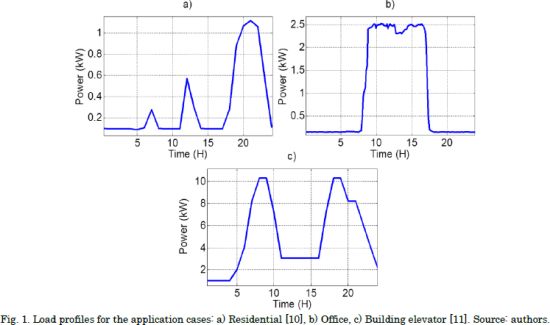
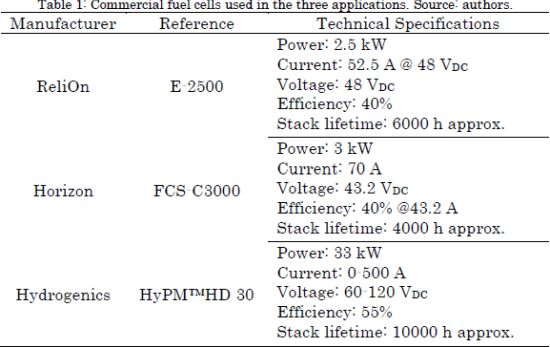
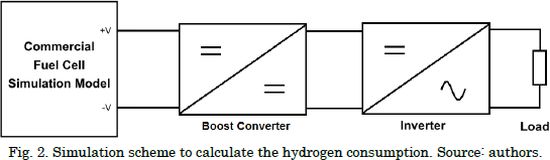
<body><![CDATA[<p>The paper is organized as follows: Section 2 introduces three study cases, for which the operational costs of fuel cell power systems are calculated. Section 3 calculates the operational costs of classical generation solutions for the same applications cases, which enable to evaluate the profitability of fuel cell systems. Then, Section 4 analyzes the impact of the economic incentives provided by the Colombian government aimed at promoting the use of fuel cells. Section 5 analyzes the economic incentives provided by other countries to propose new incentives for the Colombian market. Finally, the conclusions close the paper.</p>      <p></p>     <p><font size="3"><b>2. Calculation of fuel cell operation costs</b></font></p>     <p>A complete analysis of return on investment should include: system size, productivity improvements, system cost, system lifetime, fuel cost and tax credit. Productivity improvements are related with to suspend the service due to refueling. This impact depends on the daytime  when refueling is performed. A cost very hard of to estimate, so that it was not considered.</p>      <p>The first step in the economic analysis is to calculate the operational costs of commercial fuel cells in the application cases, which includes the purchasing, importing, depreciating and hydrogen consumption costs. The residential and office applications were chosen because they conform a large sector of low power rating in Colombia, which uses diesel generators as backup sources. Similarly, a lot of building elevators (in both residential and commercial sectors) use diesel generators as backup sources.</p>      <p>The following subsections illustrate how the hydrogen consumption of commercial fuel cells was calculated for the three application cases. The cost of that hydrogen mass is estimated based on commercial prices in Colombia. Due to the immature technology, the cost of the fuel has large fluctuation, since the costs associated with production, distribution, storage and infrastructure are unknown. Subsequently, the purchasing, importing and depreciating costs are estimated to provide a unified monthly cost.</p>      <p><font size="2"><b>2.1 Hydrogen consumption costs</b></font></p>      <p>The commercial fuel cell for each application was selected from the maximum power re-ported in each load profile. Then, the mathematical fuel cell model reported in &#91;8&#93; was parameterized in agreement with the characteristic of each commercial device. </p>      <p>Those models were used to simulate the operation of each application during 24 hours to calculate the amount of hydrogen consumed. To match the voltage levels between the output of the fuel cells and the load, a DC/DC power boost converter was included in the simulation to provide a realistic power stage. In this fuel cell system, the main power losses are generated by the power stage, it reaching efficiencies of 86.6%, 89.5% and 77.2% for residential, office and building elevator application, respectively. The efficiency of commercial inverters is very high, near to 97% as reported in &#91;9&#93;.</p>       <p><a href="#Figura01">Fig. 1</a> shows the daily load profiles for the three study cases. Similarly, <a href="#Tabla1">Table 1</a> presents the technical specifications of the commercial fuel cells selected for those applications cases: E-2500 for the residential case, FCS-C3000 for the office case and HyPMTMHD 30 for the building elevators case. The lifetime stack parameter indicates the replace time of the Proton Exchange Membrane - PEM. But the complete system is formed by the controller, power conditioning, fuel supply, power supply, measurement equipment, and others. Changing the PEM every two or three years, the complete system has a lifetime of ten years approximately. Nevertheless, for the analysis performed we consider only the stack lifetime. Finally, the block diagram of the simulation scheme, implemented in Simulink/Matlab, is presented in <a href="#Figura02">Fig. 2</a>.</p>      ]]></body>
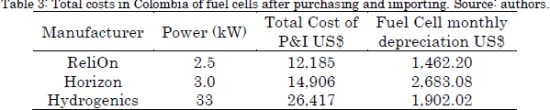
<body><![CDATA[<p align="center"><a name="Figura01"></a><img src="/img/revistas/teclo/v19n37/v19n37a07fig01.jpg"></p>      <p align="center"><a name="Figura02"></a><img src="/img/revistas/teclo/v19n37/v19n37a07fig02.jpg"></p>      <p><a href="#Tabla2">Table 2</a> reports the hydrogen consumption results obtained by the simulations for 24 hours. Moreover, Table 2 also includes the commercial cost of the hydrogen (Type 5) in Colombia, for calculating the consumption costs. Finally, <a href="#Tabla2">Table 2</a> also reports the consumption costs for both daily and monthly periods.</p>      <p align="center"><a name="Tabla2"></a><img src="/img/revistas/teclo/v19n37/v19n37a07tbl02.jpg"></p>      <p>The average monthly cost of the fuel was calculated on the base of 365 days of operation a year. Nevertheless, the office certainly does not operate on weekends or holiday periods, the house probably has an occupancy close to 365 days a year, while the elevator depends on the type of building, whether it is commercial or residential</p>      <p><font size="2"><b>2.2 Purchasing, importing and depreciating costs</b></font></p>      <p>To estimate the complete costs of a fuel cell application, the purchasing, importing and depreciating costs must be included. The purchasing &#91;12&#93;-&#91;14&#93; and importing costs &#91;15&#93;, &#91;16&#93; were obtained from both manufacturers and a local logistic agent, respectively. The total cost of purchasing and importing were calculated as reported in Eq. (1)</p>       <p align="center"><a name="Ecuaci&oacute;n1"></a><img src="/img/revistas/teclo/v19n37/v19n37a07ec01.jpg"></p>      <p>where FCC represents the fuel cell, transportation, and insurance costs; T represents the import tariff in Colombia (5% for this kind of equipment); VAT is the added value tax in Colombia (16%), TLE and CF are the port and forms costs, and LF represents the transportation costs within Colombia &#91;17&#93;, &#91;18&#93;. TLE costs are related to releasing the fuel cell in the airport, while CF corresponds to customs commissions, licenses, forms, declarations, tariff position and warehousing. The additional cost over the price of the fuel cell is approxi-mately 33%.</p>      <p>The depreciating costs were calculated as in Eq. (2) using the fuel cell lifetimes presented in the <a href="#">Table 1</a>. Nevertheless, to get closer to reality, the fuel cell system lifetime should be very much greater. The results are presented in the <a href="#Tabla3">Table 3</a>, which corresponds to a continuous operation during 24 hours and 30 days. The last column of <a href="#Tabla3">Table 3</a> reports the equivalent monthly cost of the fuel cells.</p>      ]]></body>
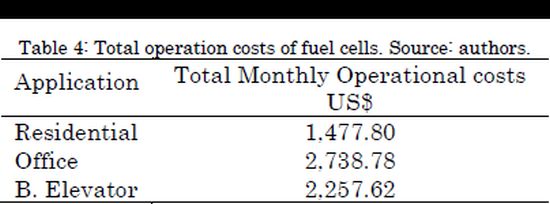
<body><![CDATA[<p align="center"><a name="Ecuaci&oacute;n2"></a><img src="/img/revistas/teclo/v19n37/v19n37a07ec02.jpg"></p>      <p align="center"><a name="Tabla1"></a><img src="/img/revistas/teclo/v19n37/v19n37a07tbl01.jpg"></p>      <p><font size="2"><b>2.3 Total operation costs</b></font></p>      <p>Combining the monthly hydrogen consumption presented in <a href="#Tabla2">Table 2</a> and the fuel cells monthly depreciation given in <a href="#Tabla3">Table 3</a>, the total operation costs of the fuel cells are reported in <a href="#Tabla4">Table 4</a>.</p>      <p align="center"><a name="Tabla3"></a><img src="/img/revistas/teclo/v19n37/v19n37a07tbl03.jpg"></p>      <p align="center"><a name="Tabla4"></a><img src="/img/revistas/teclo/v19n37/v19n37a07tbl04.jpg"></p>      <p><font size="3"><b>3.	Comparison with conventional power sources</b></font></p>      <p>The following subsections describe the calculation of the operational costs in Colombia for diesel generators and conventional grid in the three study cases.</p>      <p><font size="2"><b>3.1 Operational costs of conventional sources</b></font></p>      <p><font size="2"><b>3.1.1 Diesel Generators</b></font></p>      ]]></body>
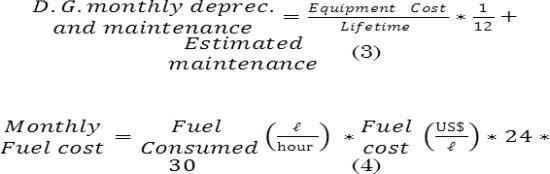
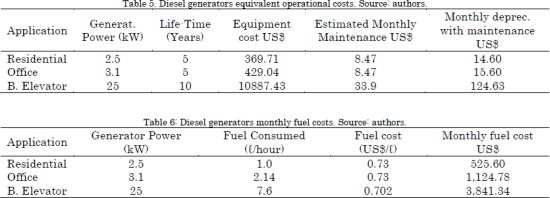
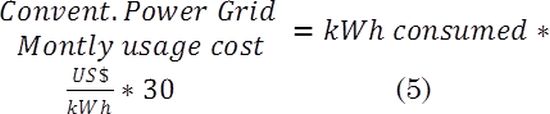
<body><![CDATA[<p>In order to obtain the equivalent monthly operational costs, the price of suitable diesel generators for each application was obtained from local providers. Then, according to the fuel consumption, the fuel cost, the generator lifetime and the estimated installation and maintenance costs of the generator, the operational costs were calculated. Eq. (3)reports the calculation of the monthly depreciation of the diesel generators, adding their estimated monthly maintenance. Similarly, Eq. (4) shows the calculation of the cost of the fuel consumed by each diesel generator. <a href="#Tabla05_06">Table 5</a> and <a href="#Tabla05_06">Table 6</a> report the calculation results.</p>      <p align="center"><a name="Ecuaci&oacute;n3_4"></a><img src="/img/revistas/teclo/v19n37/v19n37a07ec03_04.jpg"></p>      <p align="center"><a name="Tabla05_06"></a><img src="/img/revistas/teclo/v19n37/v19n37a07tbl05_06.jpg"></p>      <p>The total monthly operational costs of diesel generators corresponds to the sum of the monthly depreciation and maintenance costs reported in <a href="#Tabla05_06">Table 5</a> and the monthly fuel cost reported in <a href="#Tabla05_06">Table 6.</a></p>      <p><font size="2"><b>3.1.2 Conventional Power Grid</b></font></p>      <p>The equivalent monthly cost of this energy source was calculated from Eq. (5), using the energy calculated by the simulation of the three load profiles. Moreover, the grid energy cost per kWh was taken from the local provider in Medell&iacute;n - Colombia. Those costs per kWh were differentiated between residential and non-residential customers, which include the lifetime that, for hydroelectric generation, is 50 to 100 years &#91;19&#93;, &#91;20&#93;. Therefore, the office and building elevator applications were classified within the non-residential rate.<a href="#Tabla07"> Table 7</a> reports obtained results.</p>      <p align="center"><a name="Ecuaci&oacute;n5"></a><img src="/img/revistas/teclo/v19n37/v19n37a07ec05.jpg"></p>      <p align="center"><a name="Tabla07"></a><img src="/img/revistas/teclo/v19n37/v19n37a07tbl07.jpg"></p>      <p><font size="2"><b>3.2 Cost comparison between fuel cells and conventional energy sources</b></font></p>      <p><a href="#Tabla08">Table 8</a> shows the comparison between the monthly operation costs of fuel cells, diesel generators and conventional grid. </p>      ]]></body>
<body><![CDATA[<p align="center"><a name="Tabla08"></a><img src="/img/revistas/teclo/v19n37/v19n37a07tbl08.jpg"></p>      <p>Without any additional incentive, fuel cell costs are higher than diesel generators for residential and office applications. However, fuel cells are cheaper than diesel generators as backup for building elevators. This last condition is due to the large amount of fuel consumed by the diesel generator (7.6 â„“/hour) and the associated fuel cost. In all the three cases, the conven-tional grid is cheaper than the two backup generators.</p>      <p>On the other hand, comparing only the fuel consumption costs (<a href="#Tabla2">Table 2</a> and <a href="#Tabla07">Table 7</a>), and the conventional power grid, it is observed a significant reduction of the costs provided by the hydrogen. This condition shows that hydrogen is a cheap energy vector in Colombia for electric generation, although the depreciation of <a href="#Tabla3">Table 3</a> was not included, which also must be very much lower.</p>      <p></p>     <p><font size="3"><b>4. Impact of the government incentives in Colombia over electric generation with fuel cells</b></font></p>      <p>The Act 1715 of 2014 is a firm step made in Colombia to encourage the use of non-conventional energy sources. This Act is aimed at achieving a sustainable economic development, reducing the greenhouse gasses emissions and promoting an efficient energy management &#91;21&#93;. Moreover, the Tax Statute of Colombia establishes additional incentives for companies using non-pollutant energy sources. In the following, those incentives are described and analyzed.</p>      <p>Generating with non-conventional sources. This incentive is aimed to companies obligated to pay an income tax, which invest in non-conventional sources. The Act gives to those companies the right to reduce their income tax a 50% of the value of the investment during five years. However, this deduction must not be higher than the 50% of the total income tax of the company &#91;21&#93;.</p>       <p>Exclusion of VAT. The equipment, machinery and national or imported services for pre-investment, investment, production, and energy use, associated with non-conventional sources, are exempt from paying the Value Added Tax-VAT. Similarly, equipment for measuring and assessment of potential resources are VAT free &#91;21&#93;.</p>      <p>Instruments for promoting renewable energies. This benefit is aimed to natural persons and companies that have new investments or new projects related with non-conventional energy sources. Those projects are exempt from paying customs tariffs for importing machinery, equipment, and materials devoted to pre-investment and investment in those sources &#91;21&#93;.</p>      <p>Accelerated depreciation of assets. The energy generation using non-conventional sources gets the benefit of accelerated depreciation. This benefit can also be applied to the machinery, equipment and facilities to pre-investment, investment, and operation of the non-conventional energy sources. The annual depreciation rate will not be higher than 20% of a global annual rate &#91;21&#93;.</p>      ]]></body>
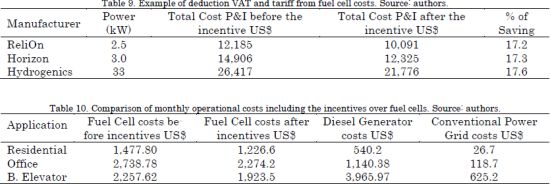
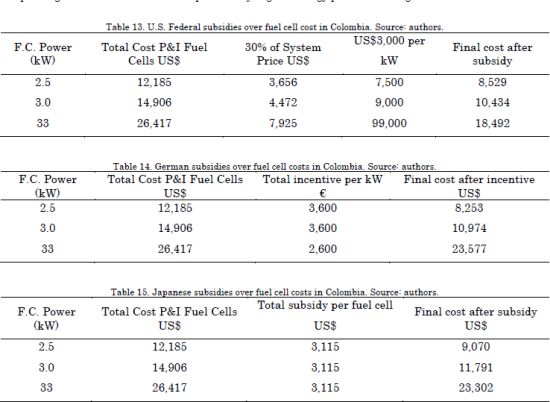
<body><![CDATA[<p>All those benefits are aimed mainly for legal persons like companies or organizations with investment capacity. The impact of incentives on generation with non-conventional sources and accelerated depreciation of assets is the income tax that those companies have to pay to the government, reducing it depending on the investment in non-conventional energy sources. In Colombia, the income tax rate is about 25%. Those incentives, generation with non-conventional sources and accelerated depreciation of assets, are summarized in Eq. (6), where In stands for the total income of the company and Iv represents the investment.</p>      <p align="center"><a name="Ecuaci&oacute;n6"></a><img src="/img/revistas/teclo/v19n37/v19n37a07ec06.jpg"></p>      <p>Finally, with those incentives the legal persons can deduct their investment from the taxes in two years.</p>       <p>Due to the incentives by the exclusion of VAT and the use of instruments for promoting renewable energies, the VAT, and the import tariff will be zero (US$0), reducing the fuel cell costs. According to the results in <a href="#Tabla3">Table 3</a> concerning the fuel cell total purchasing and import cost, and Eq. (1) was used for calculating those values, the impact of the Act 1715 in the fuel cell costs is reported in <a href="#Tabla09_10">Table 9</a>.</p>      <p>In average, the purchasing and importation costs for each case are reduced near to 17.4%. <a href="#Tabla09_10">Table 10</a> shows the recalculated fuel cell operation costs under the Act 1715.</p>       <p align="center"><a name="Tabla09_10"></a><img src="/img/revistas/teclo/v19n37/v19n37a07tbl09_10.jpg"></p>      <p>The Colombian Tax Statute provides incentives in the Article 158-2, where legal entities that have made investments related to control and environmental improvement has the right of deducting the 100% of the invested value, from their income tax &#91;22&#93;. Therefore, a legal entity can deduct from their taxes, the cost of a fuel cell intended to replace diesel generators. Hence the only costs will be related to the monthly hydrogen consumption.</p>      <p><a href="#Tabla11">Table 11</a> presents the comparison of the monthly costs of the three energy sources for the office and building elevator cases, according to the tax incentive defined by the Article 158-2.</p>       <p align="center"><a name="Tabla11"></a><img src="/img/revistas/teclo/v19n37/v19n37a07tbl11.jpg"></p>      <p>Such results evidence that fuel cells are a profitable alternative for legal entities: pollutant and noisy diesel generators used in offices and elevators, which can be replaced with a significantly saving in the operational costs, with the advantage of contributing to a cleaner environment. In fact, fuel cell operation will be cheaper than grid energy; although, that case is out of the Article 158-2.</p>      ]]></body>
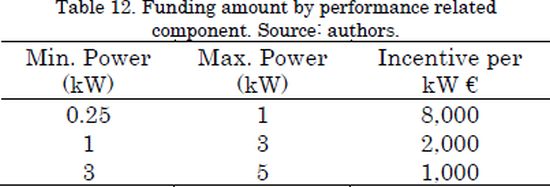
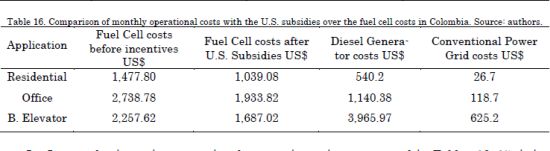
<body><![CDATA[<p>Since the previous tax incentive applies only to legal entities, residential applications are out of the scope of Article 158-2. So, the next section proposes a new incentive for this sector, based on an analysis of international subsidies and experiences.</p>      <p></p>     <p><font size="3"><b>5.	Comparison between colombian government incentives and international subsidies</b></font></p>      <p>There are many kinds of incentives around the world to minimize the cost of fuel cells either for stationary or mobile applications. For stationary applications, United States offers the Federal fuel cell tax incentives approved under The Emergency Economic Stabilization Act of 2008, which gives an investment tax credit of  30% of the fuel cell cost or US$3,000/kW, whichever is less &#91;23&#93;. Moreover, it provides a residential energy-efficiency credit for fuel cells in joint occupancy houses up to US$3,334/kW &#91;23&#93;. Germany provides incentives to invest in fuel cell based cogeneration plants &#91;24&#93;. These incentives are intended for commercial enterprises and regional authorities aimed at supplying industrial plants or residential properties with an electrical capacity up to 20 kW &#91;25&#93;, &#91;26&#93;. Each installation receives a fix amount of &euro;1,600 per unit and an additional incentive depending on the performance, as reported in <a href="#Tabla12">Table 12</a> &#91;27&#93;.</p>      <p align="center"><a name="Tabla12"></a><img src="/img/revistas/teclo/v19n37/v19n37a07tbl12.jpg"></p>      <p>In Japan, the incentives are aimed to ENE-FARM units, which are fuel cells that extract hydrogen from LP gas to produce electricity in the range of 0.3 - 1kW &#91;28&#93;. The ENE-FARM scheme started in 2009, and the Japan government gave a subsidy of US$14,987 per unit to contribute to the purchase price. That subsidy was reduced to reach US$4,817 in 2012 &#91;29&#93;. The current subsidy is about US$3115 and it expires at the end of 2015 &#91;30&#93;.</p>      <p>Comparing the costs of the fuel cells including by the Colombian incentives (<a href="#Tabla09_10">Table 9</a>) with the U.S., German and Japanese incentives presented in <a href="#Tabla13_15">Tables 13-15</a>, it is evident that the last ones are stronger, particularly the U.S. incentives, which provide a larger reduction in the fuel cell costs</p>      <p align="center"><a name="Tabla13_15"></a><img src="/img/revistas/teclo/v19n37/v19n37a07tbl13_15.jpg"></p>      <p>Based on the incentives provided by the U.S., German and Japanese, a new incentive to promote residential fuel cell applications could be defined. For example, recalculating the fuel cell monthly operation costs, i.e. using Eq. (2), including the U.S. federal subsidies over the fuel cell cost reported in <a href="#Tabla13_15">Table 13</a>, enables to estimate the impact of such incentives scheme in the Colombian market as reported in <a href="#Tabla16">Table 16</a>.</p>      <p align="center"><a name="Tabla16"></a><img src="/img/revistas/teclo/v19n37/v19n37a07tbl16.jpg"></p>      ]]></body>
<body><![CDATA[<p>Even in this new scenario, the fuel cells are still more expensive in comparison with diesel generators for residential applications.</p>     <p>Therefore, it is required an additional incentive of 48% over the fuel cell cost to become fuel cells competitive with diesel generators in residential applications. Although this fact probably requires a significant investment by the Colombian state, it would be a necessary incentive to develop a pilot plan to stimulate the adoption of fuel cells in urban and rural areas, which is aimed to reducing the pollution caused by fossil fuels. Such initiative will eventually improve the quality of life in the country.</p>      <p>Other mechanisms to promote the adoption of fuel cell usage within the Colombian electric market would be establishing an Energy Standard Portfolio &#91;31&#93;, in which the government subsidizes the energy providers with a specific fund &#91;31&#93; to decrease the high costs of the fuel cells. It is possible since the Act 1715 of 2014 created the fund named FENOGE (Fondo de Energias No Convencionales y Gesti&oacute;n Eficiente de la Energia in Spanish) to support programs or projects related to non-conventional energy. This fund is also a suitable option to develop fuel cell projects in a large scale, for the non-interconnected zones, aimed at gradually replacing the conventional diesel generators.</p>      <p></p>     <p><font size="3"><b>6. Conclusions</b></font></p>      <p>An analysis of the government incentives for profitable energy production using fuel cells in Colombia has been presented. The results show that fuel cells, without any additional incentive, are a profitable option to replace diesel generators as backup sources for building elevator applications.</p>      <p>Concerning the tax structure in Colombia, the present incentives in the Act 1715 of 2014 and the Tax Statute provide a good structure to encourage the use of fuel cells as backup sources for legal persons in urban areas to reducing the pollutant emissions.</p>      <p>The proposed additional subsidies over the fuel cell cost (48%) will enable the use of those non-pollutant sources in residential applications. This new incentive could trigger a large scale migration from fossil fuel generators to cleaner alternatives to improve the quality of life in Colombian cities.</p>      <p>This analysis not considering opportunity cost, due that some factors are complex to quantify, for example, environmental benefits and those that change unpredictably in the time, such as fuel cost, subsidies, and regulations. Therefore, the operation cost is only considering the current cost of fuel and the depreciation cost.</p>      <p></p>     ]]></body>
<body><![CDATA[<p><font size="3"><b>7. Acknowledgments</b></font></p>      <p>This paper was supported by Universidad Nacional de Colombia, COLCIENCIAS and Automatic, Electronic and Computer Science research group of the Instituto Tecnol&oacute;gico Metropolitano ITM), under the projects FC-121056236765, FC-SIM-26687 (J&oacute;venes Investigadores - 2014), P14215 and P14220.</p>      <p></p>     <p><font size="3" face="verdana"><b>References</b></font></p>      <!-- ref --><p>&#91;1&#93; F. A.  Farret and M. G. Sim&otilde;es, &#147;Power Plants with Fuel Cells,&#148; in <i>Integration of  Alternative Sources of Energy</i>, Hoboken, NJ, USA: John Wiley &amp; Sons,  Inc., 2006, p. 408.    &nbsp;&nbsp;&nbsp;&nbsp;&nbsp;&nbsp;&nbsp;&nbsp;[&#160;<a href="javascript:void(0);" onclick="javascript: window.open('/scielo.php?script=sci_nlinks&ref=5178500&pid=S0123-7799201600020000700001&lng=','','width=640,height=500,resizable=yes,scrollbars=1,menubar=yes,');">Links</a>&#160;]<!-- end-ref --></p>      <!-- ref --><p>&#91;2&#93; D.  Saheb-Koussa, M. Koussa, and N. Said, &#147;A Technical, Economic, and Environmental  Performance of Grid-Connected Hybrid (Photovoltaic-Wind) Power System in  Algeria,&#148; <i>Sci. World J.</i>, vol. 2013, pp. 1-12, 2013.    &nbsp;&nbsp;&nbsp;&nbsp;&nbsp;&nbsp;&nbsp;&nbsp;[&#160;<a href="javascript:void(0);" onclick="javascript: window.open('/scielo.php?script=sci_nlinks&ref=5178502&pid=S0123-7799201600020000700002&lng=','','width=640,height=500,resizable=yes,scrollbars=1,menubar=yes,');">Links</a>&#160;]<!-- end-ref --></p>      <!-- ref --><p>&#91;3&#93; S. Curtin  and J. Gangi, &#147;The Business Case for Fuel Cells 2014: Powering the Bottom Line  for Businesses and Communities,&#148; Washington, D.C., 2014.    &nbsp;&nbsp;&nbsp;&nbsp;&nbsp;&nbsp;&nbsp;&nbsp;[&#160;<a href="javascript:void(0);" onclick="javascript: window.open('/scielo.php?script=sci_nlinks&ref=5178504&pid=S0123-7799201600020000700003&lng=','','width=640,height=500,resizable=yes,scrollbars=1,menubar=yes,');">Links</a>&#160;]<!-- end-ref --></p>      ]]></body>
<body><![CDATA[<!-- ref --><p>&#91;4&#93; Entergy  Arkansas, &#147;A Comparison: Land Use by Energy Source - Nuclear, Wind and Solar,&#148;  New Orleans; LA, USA.    &nbsp;&nbsp;&nbsp;&nbsp;&nbsp;&nbsp;&nbsp;&nbsp;[&#160;<a href="javascript:void(0);" onclick="javascript: window.open('/scielo.php?script=sci_nlinks&ref=5178506&pid=S0123-7799201600020000700004&lng=','','width=640,height=500,resizable=yes,scrollbars=1,menubar=yes,');">Links</a>&#160;]<!-- end-ref --></p>      <!-- ref --><p>&#91;5&#93; International  Partnership for Hydrogen and Fuel Cells in the Economy, &#147;Communiqu&eacute;,&#148; 2009.  &#91;Online&#93;. Available:  <a href="http://www.iphe.net/docs/IPHE Communique Draft For  December 2009 SC Clean - Final.pdf." target="_blank">http://www.iphe.net/docs/IPHE Communique Draft For  December 2009 SC Clean - Final.pdf.    &nbsp;&nbsp;&nbsp;&nbsp;&nbsp;&nbsp;&nbsp;&nbsp;[&#160;<a href="javascript:void(0);" onclick="javascript: window.open('/scielo.php?script=sci_nlinks&ref=5178508&pid=S0123-7799201600020000700005&lng=','','width=640,height=500,resizable=yes,scrollbars=1,menubar=yes,');">Links</a>&#160;]<!-- end-ref --></a></p>      <!-- ref --><p>&#91;6&#93; <i>Ley 26.123 R&eacute;gimen para el desarrollo de  la tecnolog&iacute;a, producci&oacute;n, uso y aplicaciones del hidr&oacute;geno como combustible y  vector energ&iacute;a</i>. Rep&uacute;blica Argentina, 2006.    &nbsp;&nbsp;&nbsp;&nbsp;&nbsp;&nbsp;&nbsp;&nbsp;[&#160;<a href="javascript:void(0);" onclick="javascript: window.open('/scielo.php?script=sci_nlinks&ref=5178510&pid=S0123-7799201600020000700006&lng=','','width=640,height=500,resizable=yes,scrollbars=1,menubar=yes,');">Links</a>&#160;]<!-- end-ref --></p>      <!-- ref --><p>&#91;7&#93; F. Aliaga, F. N. Pondal, and M. Laborde,  &#147;La Ley de Promoci&oacute;n del Hidr&oacute;geno en Argentina: con un Plan Nacional de  Hidr&oacute;geno ya redactado y a la espera de la reglamentaci&oacute;n,&#148; <i>Revista  Petroqu&iacute;mica. </i><i>Petr&oacute;leo,  Gas, Qu&iacute;mica &amp; Energ&iacute;a</i>.  2015.    &nbsp;&nbsp;&nbsp;&nbsp;&nbsp;&nbsp;&nbsp;&nbsp;[&#160;<a href="javascript:void(0);" onclick="javascript: window.open('/scielo.php?script=sci_nlinks&ref=5178512&pid=S0123-7799201600020000700007&lng=','','width=640,height=500,resizable=yes,scrollbars=1,menubar=yes,');">Links</a>&#160;]<!-- end-ref --></p>      <!-- ref --><p>&#91;8&#93; J. T.  Pukrushpan, A. G. Stefanopoulou, and H. Peng, <i>Control of Fuel Cell Power  Systems: Principles, Modeling, Analysis and Feedback Design</i>, Illustrate.  London, UK: Springer Science &amp; Business Media, 2013.    &nbsp;&nbsp;&nbsp;&nbsp;&nbsp;&nbsp;&nbsp;&nbsp;[&#160;<a href="javascript:void(0);" onclick="javascript: window.open('/scielo.php?script=sci_nlinks&ref=5178514&pid=S0123-7799201600020000700008&lng=','','width=640,height=500,resizable=yes,scrollbars=1,menubar=yes,');">Links</a>&#160;]<!-- end-ref --></p>      ]]></body>
<body><![CDATA[<!-- ref --><p>&#91;9&#93; Solaredge,  &#147;Single Phase Solar Inverters,&#148; 2015. &#91;Online&#93;. Available:  <a href="http://www.solaredge.com/groups/inverter/single-phase-solar-inverter" target="_blank">http://www.solaredge.com/groups/inverter/single-phase-solar-inverter</a> &#91;Accessed:  05-Jun-2015&#93;    &nbsp;&nbsp;&nbsp;&nbsp;&nbsp;&nbsp;&nbsp;&nbsp;[&#160;<a href="javascript:void(0);" onclick="javascript: window.open('/scielo.php?script=sci_nlinks&ref=5178516&pid=S0123-7799201600020000700009&lng=','','width=640,height=500,resizable=yes,scrollbars=1,menubar=yes,');">Links</a>&#160;]<!-- end-ref -->.</p>      <!-- ref --><p>&#91;10&#93; C. F. Morales-S&aacute;nchez, &#147;C&aacute;lculo de una tarifa  de alimentaci&oacute;n para instalaciones fotovoltaicas residenciales en Colombia,&#148; <i>Semest. </i><i>Econ&oacute;mico</i>, vol. 16, no. 34, pp. 13-40, 2013.    &nbsp;&nbsp;&nbsp;&nbsp;&nbsp;&nbsp;&nbsp;&nbsp;[&#160;<a href="javascript:void(0);" onclick="javascript: window.open('/scielo.php?script=sci_nlinks&ref=5178518&pid=S0123-7799201600020000700010&lng=','','width=640,height=500,resizable=yes,scrollbars=1,menubar=yes,');">Links</a>&#160;]<!-- end-ref --></p>      <!-- ref --><p>&#91;11&#93; B. A.  Thornton, M. I. Rosenberg, E. E. Richman, W. Wang, Y. Xie, J. Zhang, H. Cho, V. V. Mendon, R. A. Athaye, and B. Liu, &#147;Achieving the 30% Goal: Energy and Cost  Savings Analysis of ASHRAE Standard 90.1-2010,&#148; Richland, WA, 2011.    &nbsp;&nbsp;&nbsp;&nbsp;&nbsp;&nbsp;&nbsp;&nbsp;[&#160;<a href="javascript:void(0);" onclick="javascript: window.open('/scielo.php?script=sci_nlinks&ref=5178520&pid=S0123-7799201600020000700011&lng=','','width=640,height=500,resizable=yes,scrollbars=1,menubar=yes,');">Links</a>&#160;]<!-- end-ref --></p>      <!-- ref --><p>&#91;12&#93; Plug Power,  &#147;Gensure E-2500 Hydrogen Cell,&#148; <i>Gensure: Predictable backup power for an  unpredicrable world</i>. Retrieved August 17, 2015, from <a href="https://www.plugpower.com/products/gensure/e-2500/" target="_blank">https://www.plugpower.com/products/gensure/e-2500/</a>&nbsp;&nbsp;&nbsp;&nbsp;&nbsp;&nbsp;&nbsp;&nbsp;[&#160;<a href="javascript:void(0);" onclick="javascript: window.open('/scielo.php?script=sci_nlinks&ref=5178522&pid=S0123-7799201600020000700012&lng=','','width=640,height=500,resizable=yes,scrollbars=1,menubar=yes,');">Links</a>&#160;]<!-- end-ref --><!-- ref --><p>&#91;13&#93; Horizon,  &#147;Horizon Fuel Cell Shop,&#148; <i>Shop</i>. Retrieved November 11, 2015, from <a href=" http://www.horizonfuelcellshop.com/americas/" target="_blank"> http://www.horizonfuelcellshop.com/americas/</a>&nbsp;&nbsp;&nbsp;&nbsp;&nbsp;&nbsp;&nbsp;&nbsp;[&#160;<a href="javascript:void(0);" onclick="javascript: window.open('/scielo.php?script=sci_nlinks&ref=5178523&pid=S0123-7799201600020000700013&lng=','','width=640,height=500,resizable=yes,scrollbars=1,menubar=yes,');">Links</a>&#160;]<!-- end-ref --><!-- ref --><p>&#91;14&#93; HYDROGENICS,  &#147;Contact,&#148; <i>Sales</i>. 2015. Retrieved October 25, 2015, from <a href="http://www.hydrogenics.com/contact" target="_blank"> http://www.hydrogenics.com/contact</a>&nbsp;&nbsp;&nbsp;&nbsp;&nbsp;&nbsp;&nbsp;&nbsp;[&#160;<a href="javascript:void(0);" onclick="javascript: window.open('/scielo.php?script=sci_nlinks&ref=5178524&pid=S0123-7799201600020000700014&lng=','','width=640,height=500,resizable=yes,scrollbars=1,menubar=yes,');">Links</a>&#160;]<!-- end-ref --><!-- ref --><p>&#91;15&#93; DHL International, &#147;Intermediaci&oacute;n aduanera,  seguridad y seguro internacional,&#148; <i>DHL Colombia -- Log&iacute;stica</i>. Retrieved January 25, 2016, from <a href="http://www.dhl.com.co/es/logistica/seguridad_y_seguro_aduanero.html" target="_blank"> http://www.dhl.com.co/es/logistica/seguridad_y_seguro_aduanero.html</a>&nbsp;&nbsp;&nbsp;&nbsp;&nbsp;&nbsp;&nbsp;&nbsp;[&#160;<a href="javascript:void(0);" onclick="javascript: window.open('/scielo.php?script=sci_nlinks&ref=5178525&pid=S0123-7799201600020000700015&lng=','','width=640,height=500,resizable=yes,scrollbars=1,menubar=yes,');">Links</a>&#160;]<!-- end-ref --><!-- ref --><p>&#91;16&#93; Cooldimes S.A.S., &#147;Servicios Integrales de  Intermediaci&oacute;n Aduanera,&#148; <i>Servicios</i>. Retrieved January 22, 2016, from <a href="http://www.cooldimes.com/Servicios.html" target="_blank"> http://www.cooldimes.com/Servicios.html</a>&nbsp;&nbsp;&nbsp;&nbsp;&nbsp;&nbsp;&nbsp;&nbsp;[&#160;<a href="javascript:void(0);" onclick="javascript: window.open('/scielo.php?script=sci_nlinks&ref=5178526&pid=S0123-7799201600020000700016&lng=','','width=640,height=500,resizable=yes,scrollbars=1,menubar=yes,');">Links</a>&#160;]<!-- end-ref --><!-- ref --><p>&#91;17&#93; Ministerio de Comercio Industria y Turismo,  &#147;Decreto 4589 de 2006: Por el cual se adopta el Arancel de Aduanas y otras  disposiciones.&#148; p. 333, 2006.    &nbsp;&nbsp;&nbsp;&nbsp;&nbsp;&nbsp;&nbsp;&nbsp;[&#160;<a href="javascript:void(0);" onclick="javascript: window.open('/scielo.php?script=sci_nlinks&ref=5178527&pid=S0123-7799201600020000700017&lng=','','width=640,height=500,resizable=yes,scrollbars=1,menubar=yes,');">Links</a>&#160;]<!-- end-ref --></p>      <!-- ref --><p>&#91;18&#93; DIAN -- Direcci&oacute;n de Impuestos y Aduanas  Nacionales, &#147;Consulta Arancel,&#148; <i>Servicios en L&iacute;nea Muisca</i>. Retrieved January 18, 2016, from <a href="https://muisca.dian.gov.co/WebArancel/DefMenuConsultas.faces" target="_blank"> https://muisca.dian.gov.co/WebArancel/DefMenuConsultas.faces</a>&nbsp;&nbsp;&nbsp;&nbsp;&nbsp;&nbsp;&nbsp;&nbsp;[&#160;<a href="javascript:void(0);" onclick="javascript: window.open('/scielo.php?script=sci_nlinks&ref=5178529&pid=S0123-7799201600020000700018&lng=','','width=640,height=500,resizable=yes,scrollbars=1,menubar=yes,');">Links</a>&#160;]<!-- end-ref --><!-- ref --><p>&#91;19&#93; World  Summit on Sustainable Development, &#147;Plan of Implementation of the World Summit  on Sustainable Development,&#148; Johannesburg, 2002.    &nbsp;&nbsp;&nbsp;&nbsp;&nbsp;&nbsp;&nbsp;&nbsp;[&#160;<a href="javascript:void(0);" onclick="javascript: window.open('/scielo.php?script=sci_nlinks&ref=5178530&pid=S0123-7799201600020000700019&lng=','','width=640,height=500,resizable=yes,scrollbars=1,menubar=yes,');">Links</a>&#160;]<!-- end-ref --></p>      <!-- ref --><p>&#91;20&#93; World Water  Forum, <i>The 3er World Water Forum: Final Report</i>. Kyoto,  Shiga &amp; Osaka, Japan: Nexxus Communications K.K., 2003.    &nbsp;&nbsp;&nbsp;&nbsp;&nbsp;&nbsp;&nbsp;&nbsp;[&#160;<a href="javascript:void(0);" onclick="javascript: window.open('/scielo.php?script=sci_nlinks&ref=5178532&pid=S0123-7799201600020000700020&lng=','','width=640,height=500,resizable=yes,scrollbars=1,menubar=yes,');">Links</a>&#160;]<!-- end-ref --></p>      <!-- ref --><p>&#91;21&#93; <i>LEY 1715 DE 2014:Por medio de la cual se  regula la integraci&oacute;n de las energ&iacute;as renovables no convencionales al Sistema  Energ&eacute;tico Nacional</i>. Rep&uacute;blica de Colombia, 2014, p. 26.    &nbsp;&nbsp;&nbsp;&nbsp;&nbsp;&nbsp;&nbsp;&nbsp;[&#160;<a href="javascript:void(0);" onclick="javascript: window.open('/scielo.php?script=sci_nlinks&ref=5178534&pid=S0123-7799201600020000700021&lng=','','width=640,height=500,resizable=yes,scrollbars=1,menubar=yes,');">Links</a>&#160;]<!-- end-ref --></p>      ]]></body>
<body><![CDATA[<!-- ref --><p>&#91;22&#93; Direcci&oacute;n General de Impuestos Nacionales,  &#147;Estatuto Tributario Nacional Art. 158-2. Deducci&oacute;n por inversiones en control  y mejoramiento del medio ambiente.&#148; Direcci&oacute;n General de Impuestos Nacionales, 1989.    &nbsp;&nbsp;&nbsp;&nbsp;&nbsp;&nbsp;&nbsp;&nbsp;[&#160;<a href="javascript:void(0);" onclick="javascript: window.open('/scielo.php?script=sci_nlinks&ref=5178536&pid=S0123-7799201600020000700022&lng=','','width=640,height=500,resizable=yes,scrollbars=1,menubar=yes,');">Links</a>&#160;]<!-- end-ref --></p>      <!-- ref --><p>&#91;23&#93; Office of  Energy Efficiency &amp; Renewable Energy, &#147;Financial Incentives for Hydrogen  and Fuel Cell Projects,&#148; <i>U.S. Department of Energy</i>. 2008.    &nbsp;&nbsp;&nbsp;&nbsp;&nbsp;&nbsp;&nbsp;&nbsp;[&#160;<a href="javascript:void(0);" onclick="javascript: window.open('/scielo.php?script=sci_nlinks&ref=5178538&pid=S0123-7799201600020000700023&lng=','','width=640,height=500,resizable=yes,scrollbars=1,menubar=yes,');">Links</a>&#160;]<!-- end-ref --></p>      <!-- ref --><p>&#91;24&#93; Federal  Ministry of Transport and Digital Infrastructure of Germany, &#147;New Funding  guideline: Fuel cells for highly efficient combined heat and power plants.&#148; &#91;Online&#93;.  Available:  <a href="http://www.bmvi.de/SharedDocs/DE/Artikel/G/foerderrichtlinie-brennstoffzellen-fuer-kraft-waerme-kopplungsanlagen.html?nn=36210" target="_blank"> http://www.bmvi.de/SharedDocs/DE/Artikel/G/foerderrichtlinie-brennstoffzellen-fuer-kraft-waerme-kopplungsanlagen.html?nn=36210</a>&nbsp;&nbsp;&nbsp;&nbsp;&nbsp;&nbsp;&nbsp;&nbsp;[&#160;<a href="javascript:void(0);" onclick="javascript: window.open('/scielo.php?script=sci_nlinks&ref=5178540&pid=S0123-7799201600020000700024&lng=','','width=640,height=500,resizable=yes,scrollbars=1,menubar=yes,');">Links</a>&#160;]<!-- end-ref --><!-- ref --><p>&#91;25&#93; M. Lang and  A. Lang, &#147;BMVI Investment Grants for Fuel Cell CHP Plants,&#148; <i>Environmental  Politics and Fuel Cells</i>. 2015.    &nbsp;&nbsp;&nbsp;&nbsp;&nbsp;&nbsp;&nbsp;&nbsp;[&#160;<a href="javascript:void(0);" onclick="javascript: window.open('/scielo.php?script=sci_nlinks&ref=5178541&pid=S0123-7799201600020000700025&lng=','','width=640,height=500,resizable=yes,scrollbars=1,menubar=yes,');">Links</a>&#160;]<!-- end-ref --></p>     <!-- ref --><p>&#91;26&#93; Federal  Ministry of Transport and Digital Infrastructure of Germany, &#147;Fuel Cells for  highly efficient cogeneration systems - Fuel Cell CHP Directive.&#148; &#91;Online&#93;.  Available:  <a href="http://www.bmvi.de/SharedDocs/DE/Anlage/VerkehrUndMobilitaet/foerderrichtlinie-brennstoffzellen-fuer-kraft-waerme-kopplungsanlagen.pdf?__blob=publicationFile" target="_blank"> http://www.bmvi.de/SharedDocs/DE/Anlage/VerkehrUndMobilitaet/foerderrichtlinie-brennstoffzellen-fuer-kraft-waerme-kopplungsanlagen.pdf?__blob=publicationFile</a>&nbsp;&nbsp;&nbsp;&nbsp;&nbsp;&nbsp;&nbsp;&nbsp;[&#160;<a href="javascript:void(0);" onclick="javascript: window.open('/scielo.php?script=sci_nlinks&ref=5178543&pid=S0123-7799201600020000700026&lng=','','width=640,height=500,resizable=yes,scrollbars=1,menubar=yes,');">Links</a>&#160;]<!-- end-ref --><!-- ref --><p>&#91;27&#93; Federal  Ministry of Transport and Digital Infrastructure of Germany, &#147;Call for  Proposals in accordance with the funding guidelines - Fuel Cells for highly  efficient combined heat and power plants.&#148; &#91;Online&#93;. Available:<a href="http://www.bmvi.de/SharedDocs/DE/Anlage/VerkehrUndMobilitaet/foerderrichtlinie-brennstoffzellen-fuer-kraft-waerme-kopplungsanlagen-aufruf-antragseinreichung.pdf?__blob=publicationFile" target="_blank"> http://www.bmvi.de/SharedDocs/DE/Anlage/VerkehrUndMobilitaet/foerderrichtlinie-brennstoffzellen-fuer-kraft-waerme-kopplungsanlagen-aufruf-antragseinreichung.pdf?__blob=publicationFile</a>&nbsp;&nbsp;&nbsp;&nbsp;&nbsp;&nbsp;&nbsp;&nbsp;[&#160;<a href="javascript:void(0);" onclick="javascript: window.open('/scielo.php?script=sci_nlinks&ref=5178544&pid=S0123-7799201600020000700027&lng=','','width=640,height=500,resizable=yes,scrollbars=1,menubar=yes,');">Links</a>&#160;]<!-- end-ref --><!-- ref --><p>&#91;28&#93; Japan LP  Gas Association, &#147;Home-use Fuel Cell(ENE-FARM),&#148; <i>Appliances</i>. 2015.    &nbsp;&nbsp;&nbsp;&nbsp;&nbsp;&nbsp;&nbsp;&nbsp;[&#160;<a href="javascript:void(0);" onclick="javascript: window.open('/scielo.php?script=sci_nlinks&ref=5178545&pid=S0123-7799201600020000700028&lng=','','width=640,height=500,resizable=yes,scrollbars=1,menubar=yes,');">Links</a>&#160;]<!-- end-ref --></p>      <!-- ref --><p>&#91;29&#93; D. Carter,  &#147;Analyst View - Latest Developments in the Ene-Farm Scheme,&#148; London, UK, 2013.    &nbsp;&nbsp;&nbsp;&nbsp;&nbsp;&nbsp;&nbsp;&nbsp;[&#160;<a href="javascript:void(0);" onclick="javascript: window.open('/scielo.php?script=sci_nlinks&ref=5178547&pid=S0123-7799201600020000700029&lng=','','width=640,height=500,resizable=yes,scrollbars=1,menubar=yes,');">Links</a>&#160;]<!-- end-ref --></p>      <!-- ref --><p>&#91;30&#93; International  Partnership for Hydrogen and Fuel Cells in the Economy, &#147;Overview of FC &amp;  H2 Development in JAPAN,&#148; in <i>21st IPHE Educational Event</i>, 2014, p. 16.    &nbsp;&nbsp;&nbsp;&nbsp;&nbsp;&nbsp;&nbsp;&nbsp;[&#160;<a href="javascript:void(0);" onclick="javascript: window.open('/scielo.php?script=sci_nlinks&ref=5178549&pid=S0123-7799201600020000700030&lng=','','width=640,height=500,resizable=yes,scrollbars=1,menubar=yes,');">Links</a>&#160;]<!-- end-ref --></p>      <!-- ref --><p>&#91;31&#93; &Aacute;. I. Cadena, S. Botero, C. T&aacute;utiva, L.  Betancur, and D. Vesga, &#147;Regulaci&oacute;n para incentivar las energ&iacute;as alternas y la  generaci&oacute;n distribuida en Colombia&#148; (Conclusiones),&#148; <i>Rev. Ing.</i>, no. 28,  pp. 1-9, 2008.    &nbsp;&nbsp;&nbsp;&nbsp;&nbsp;&nbsp;&nbsp;&nbsp;[&#160;<a href="javascript:void(0);" onclick="javascript: window.open('/scielo.php?script=sci_nlinks&ref=5178551&pid=S0123-7799201600020000700031&lng=','','width=640,height=500,resizable=yes,scrollbars=1,menubar=yes,');">Links</a>&#160;]<!-- end-ref --></p>  </font>      ]]></body><back>
<ref-list>
<ref id="B1">
<label>1</label><nlm-citation citation-type="book">
<person-group person-group-type="author">
<name>
<surname><![CDATA[Farret]]></surname>
<given-names><![CDATA[F. A.]]></given-names>
</name>
<name>
<surname><![CDATA[Simões]]></surname>
<given-names><![CDATA[M. G.]]></given-names>
</name>
</person-group>
<article-title xml:lang="en"><![CDATA[Power Plants with Fuel Cells]]></article-title>
<source><![CDATA[Integration of Alternative Sources of Energy]]></source>
<year>2006</year>
<page-range>408</page-range><publisher-loc><![CDATA[Hoboken^eNJ NJ]]></publisher-loc>
<publisher-name><![CDATA[John Wiley & Sons, Inc.]]></publisher-name>
</nlm-citation>
</ref>
<ref id="B2">
<label>2</label><nlm-citation citation-type="journal">
<person-group person-group-type="author">
<name>
<surname><![CDATA[Saheb-Koussa]]></surname>
<given-names><![CDATA[D.]]></given-names>
</name>
<name>
<surname><![CDATA[Koussa]]></surname>
<given-names><![CDATA[M.]]></given-names>
</name>
<name>
<surname><![CDATA[Said]]></surname>
<given-names><![CDATA[N.]]></given-names>
</name>
</person-group>
<article-title xml:lang="en"><![CDATA[A Technical, Economic, and Environmental Performance of Grid-Connected Hybrid (Photovoltaic-Wind) Power System in Algeria]]></article-title>
<source><![CDATA[Sci. World J.]]></source>
<year>2013</year>
<volume>2013</volume>
<page-range>1-12</page-range></nlm-citation>
</ref>
<ref id="B3">
<label>3</label><nlm-citation citation-type="">
<person-group person-group-type="author">
<name>
<surname><![CDATA[Curtin]]></surname>
<given-names><![CDATA[S.]]></given-names>
</name>
<name>
<surname><![CDATA[Gangi]]></surname>
<given-names><![CDATA[J.]]></given-names>
</name>
</person-group>
<article-title xml:lang="en"><![CDATA[The Business Case for Fuel Cells 2014: Powering the Bottom Line for Businesses and Communities]]></article-title>
<source><![CDATA[]]></source>
<year>2014</year>
<publisher-loc><![CDATA[Washington^eD.C. D.C.]]></publisher-loc>
</nlm-citation>
</ref>
<ref id="B4">
<label>4</label><nlm-citation citation-type="">
<collab>Entergy Arkansas</collab>
<article-title xml:lang="en"><![CDATA[A Comparison: Land Use by Energy Source - Nuclear, Wind and Solar]]></article-title>
<source><![CDATA[]]></source>
<year></year>
<publisher-loc><![CDATA[New Orleans^eLA LA]]></publisher-loc>
</nlm-citation>
</ref>
<ref id="B5">
<label>5</label><nlm-citation citation-type="">
<collab>International Partnership for Hydrogen and Fuel Cells in the Economy</collab>
<article-title xml:lang="en"><![CDATA[Communiqué]]></article-title>
<source><![CDATA[]]></source>
<year>2009</year>
</nlm-citation>
</ref>
<ref id="B6">
<label>6</label><nlm-citation citation-type="">
<source><![CDATA[Ley 26.123 Régimen para el desarrollo de la tecnología, producción, uso y aplicaciones del hidrógeno como combustible y vector energía]]></source>
<year>2006</year>
</nlm-citation>
</ref>
<ref id="B7">
<label>7</label><nlm-citation citation-type="journal">
<person-group person-group-type="author">
<name>
<surname><![CDATA[Aliaga]]></surname>
<given-names><![CDATA[F.]]></given-names>
</name>
<name>
<surname><![CDATA[Pondal]]></surname>
<given-names><![CDATA[F. N.]]></given-names>
</name>
<name>
<surname><![CDATA[Laborde]]></surname>
<given-names><![CDATA[M.]]></given-names>
</name>
</person-group>
<article-title xml:lang="es"><![CDATA[La Ley de Promoción del Hidrógeno en Argentina: con un Plan Nacional de Hidrógeno ya redactado y a la espera de la reglamentación]]></article-title>
<source><![CDATA[Revista Petroquímica. Petróleo, Gas, Química & Energía.]]></source>
<year>2015</year>
</nlm-citation>
</ref>
<ref id="B8">
<label>8</label><nlm-citation citation-type="book">
<person-group person-group-type="author">
<name>
<surname><![CDATA[Pukrushpan]]></surname>
<given-names><![CDATA[J. T.]]></given-names>
</name>
<name>
<surname><![CDATA[Stefanopoulou]]></surname>
<given-names><![CDATA[A. G.]]></given-names>
</name>
<name>
<surname><![CDATA[Peng]]></surname>
<given-names><![CDATA[H.]]></given-names>
</name>
</person-group>
<source><![CDATA[Control of Fuel Cell Power Systems: Principles, Modeling, Analysis and Feedback Design, Illustrate]]></source>
<year>2013</year>
<publisher-loc><![CDATA[London ]]></publisher-loc>
<publisher-name><![CDATA[Springer Science & Business Media]]></publisher-name>
</nlm-citation>
</ref>
<ref id="B9">
<label>9</label><nlm-citation citation-type="">
<collab>Solaredge</collab>
<source><![CDATA[Single Phase Solar Inverters]]></source>
<year>2015</year>
</nlm-citation>
</ref>
<ref id="B10">
<label>10</label><nlm-citation citation-type="journal">
<person-group person-group-type="author">
<name>
<surname><![CDATA[Morales-Sánchez]]></surname>
<given-names><![CDATA[C. F.]]></given-names>
</name>
</person-group>
<article-title xml:lang="es"><![CDATA[Cálculo de una tarifa de alimentación para instalaciones fotovoltaicas residenciales en Colombia]]></article-title>
<source><![CDATA[Semest. Económico]]></source>
<year>2013</year>
<volume>16</volume>
<numero>34</numero>
<issue>34</issue>
<page-range>13-40</page-range></nlm-citation>
</ref>
<ref id="B11">
<label>11</label><nlm-citation citation-type="">
<person-group person-group-type="author">
<name>
<surname><![CDATA[Thornton]]></surname>
<given-names><![CDATA[B. A.]]></given-names>
</name>
<name>
<surname><![CDATA[Rosenberg]]></surname>
<given-names><![CDATA[M. I.]]></given-names>
</name>
<name>
<surname><![CDATA[Richman]]></surname>
<given-names><![CDATA[E. E.]]></given-names>
</name>
<name>
<surname><![CDATA[Wang]]></surname>
<given-names><![CDATA[W.]]></given-names>
</name>
<name>
<surname><![CDATA[Xie]]></surname>
<given-names><![CDATA[Y.]]></given-names>
</name>
<name>
<surname><![CDATA[Zhang]]></surname>
<given-names><![CDATA[J.]]></given-names>
</name>
<name>
<surname><![CDATA[Cho]]></surname>
<given-names><![CDATA[H.]]></given-names>
</name>
<name>
<surname><![CDATA[Mendon]]></surname>
<given-names><![CDATA[V. V.]]></given-names>
</name>
<name>
<surname><![CDATA[Athaye]]></surname>
<given-names><![CDATA[R. A.]]></given-names>
</name>
<name>
<surname><![CDATA[Liu]]></surname>
<given-names><![CDATA[B.]]></given-names>
</name>
</person-group>
<article-title xml:lang="en"><![CDATA[Achieving the 30&#37; Goal: Energy and Cost Savings Analysis of ASHRAE Standard 90.1-2010]]></article-title>
<source><![CDATA[]]></source>
<year>2011</year>
<publisher-loc><![CDATA[Richland^eWA WA]]></publisher-loc>
</nlm-citation>
</ref>
<ref id="B12">
<label>12</label><nlm-citation citation-type="">
<collab>Plug Power</collab>
<source><![CDATA[Gensure E-2500 Hydrogen Cell: Gensure: Predictable backup power for an unpredicrable world]]></source>
<year></year>
</nlm-citation>
</ref>
<ref id="B13">
<label>13</label><nlm-citation citation-type="">
<collab>Horizon</collab>
<source><![CDATA[Horizon Fuel Cell Shop]]></source>
<year></year>
</nlm-citation>
</ref>
<ref id="B14">
<label>14</label><nlm-citation citation-type="">
<collab>HYDROGENICS</collab>
<source><![CDATA[Contact: Sales. 2015]]></source>
<year></year>
</nlm-citation>
</ref>
<ref id="B15">
<label>15</label><nlm-citation citation-type="">
<collab>DHL International</collab>
<source><![CDATA[Intermediación aduanera, seguridad y seguro internacional: DHL Colombia -- Logística]]></source>
<year></year>
</nlm-citation>
</ref>
<ref id="B16">
<label>16</label><nlm-citation citation-type="">
<collab>Cooldimes S.A.S.</collab>
<source><![CDATA[Servicios Integrales de Intermediación Aduanera: Servicios]]></source>
<year></year>
</nlm-citation>
</ref>
<ref id="B17">
<label>17</label><nlm-citation citation-type="">
<collab>Ministerio de Comercio Industria y Turismo</collab>
<source><![CDATA[Decreto 4589 de 2006: Por el cual se adopta el Arancel de Aduanas y otras disposiciones]]></source>
<year>2006</year>
<page-range>333</page-range></nlm-citation>
</ref>
<ref id="B18">
<label>18</label><nlm-citation citation-type="">
<collab>DIAN -- Dirección de Impuestos y Aduanas Nacionales</collab>
<source><![CDATA[Consulta Arancel: Servicios en Línea Muisca]]></source>
<year></year>
</nlm-citation>
</ref>
<ref id="B19">
<label>19</label><nlm-citation citation-type="">
<collab>World Summit on Sustainable Development</collab>
<source><![CDATA[Plan of Implementation of the World Summit on Sustainable Development]]></source>
<year>2002</year>
<publisher-loc><![CDATA[Johannesburg ]]></publisher-loc>
</nlm-citation>
</ref>
<ref id="B20">
<label>20</label><nlm-citation citation-type="book">
<collab>World Water Forum</collab>
<source><![CDATA[The 3er World Water Forum: Final Report]]></source>
<year>2003</year>
<publisher-loc><![CDATA[Kyoto^eShiga & Osaka Shiga & Osaka]]></publisher-loc>
<publisher-name><![CDATA[Nexxus Communications K.K.]]></publisher-name>
</nlm-citation>
</ref>
<ref id="B21">
<label>21</label><nlm-citation citation-type="">
<source><![CDATA[LEY 1715 DE 2014: Por medio de la cual se regula la integración de las energías renovables no convencionales al Sistema Energético Nacional.]]></source>
<year>2014</year>
<page-range>26</page-range></nlm-citation>
</ref>
<ref id="B22">
<label>22</label><nlm-citation citation-type="">
<collab>Dirección General de Impuestos Nacionales</collab>
<source><![CDATA[Estatuto Tributario Nacional Art. 158-2: Deducción por inversiones en control y mejoramiento del medio ambiente]]></source>
<year>1989</year>
</nlm-citation>
</ref>
<ref id="B23">
<label>23</label><nlm-citation citation-type="book">
<collab>Office of Energy Efficiency & Renewable Energy</collab>
<source><![CDATA[Financial Incentives for Hydrogen and Fuel Cell Projects]]></source>
<year>2008</year>
<publisher-name><![CDATA[Department of Energy]]></publisher-name>
</nlm-citation>
</ref>
<ref id="B24">
<label>24</label><nlm-citation citation-type="">
<collab>Federal Ministry of Transport and Digital Infrastructure of Germany</collab>
<source><![CDATA[New Funding guideline: Fuel cells for highly efficient combined heat and power plants]]></source>
<year></year>
</nlm-citation>
</ref>
<ref id="B25">
<label>25</label><nlm-citation citation-type="">
<person-group person-group-type="author">
<name>
<surname><![CDATA[Lang]]></surname>
<given-names><![CDATA[M.]]></given-names>
</name>
<name>
<surname><![CDATA[Lang]]></surname>
<given-names><![CDATA[A.]]></given-names>
</name>
</person-group>
<article-title xml:lang="en"><![CDATA[BMVI Investment Grants for Fuel Cell CHP Plants]]></article-title>
<source><![CDATA[Environmental Politics and Fuel Cells]]></source>
<year>2015</year>
</nlm-citation>
</ref>
<ref id="B26">
<label>26</label><nlm-citation citation-type="">
<collab>Federal Ministry of Transport and Digital Infrastructure of Germany</collab>
<source><![CDATA[Fuel Cells for highly efficient cogeneration systems - Fuel Cell CHP Directive.]]></source>
<year></year>
</nlm-citation>
</ref>
<ref id="B27">
<label>27</label><nlm-citation citation-type="">
<collab>Federal Ministry of Transport and Digital Infrastructure of Germany</collab>
<source><![CDATA[Call for Proposals in accordance with the funding guidelines - Fuel Cells for highly efficient combined heat and power plants]]></source>
<year></year>
</nlm-citation>
</ref>
<ref id="B28">
<label>28</label><nlm-citation citation-type="">
<collab>Japan LP Gas Association</collab>
<source><![CDATA[Home-use Fuel Cell(ENE-FARM): Appliances]]></source>
<year>2015</year>
</nlm-citation>
</ref>
<ref id="B29">
<label>29</label><nlm-citation citation-type="">
<person-group person-group-type="author">
<name>
<surname><![CDATA[Carter]]></surname>
<given-names><![CDATA[D.]]></given-names>
</name>
</person-group>
<source><![CDATA[Analyst View - Latest Developments in the Ene-Farm Scheme]]></source>
<year>2013</year>
<publisher-loc><![CDATA[London^eUK UK]]></publisher-loc>
</nlm-citation>
</ref>
<ref id="B30">
<label>30</label><nlm-citation citation-type="confpro">
<collab>International Partnership for Hydrogen and Fuel Cells in the Economy</collab>
<article-title xml:lang="en"><![CDATA[Overview of FC & H2 Development in JAPAN]]></article-title>
<source><![CDATA[]]></source>
<year></year>
<conf-name><![CDATA[21st IPHE Educational Event]]></conf-name>
<conf-date>2014</conf-date>
<conf-loc> </conf-loc>
</nlm-citation>
</ref>
<ref id="B31">
<label>31</label><nlm-citation citation-type="journal">
<person-group person-group-type="author">
<name>
<surname><![CDATA[Cadena]]></surname>
<given-names><![CDATA[Á.I.]]></given-names>
</name>
<name>
<surname><![CDATA[Botero]]></surname>
<given-names><![CDATA[S.]]></given-names>
</name>
<name>
<surname><![CDATA[Táutiva]]></surname>
<given-names><![CDATA[C.]]></given-names>
</name>
<name>
<surname><![CDATA[Betancur]]></surname>
<given-names><![CDATA[L.]]></given-names>
</name>
<name>
<surname><![CDATA[Vesga]]></surname>
<given-names><![CDATA[D.]]></given-names>
</name>
</person-group>
<article-title xml:lang="es"><![CDATA[&#147;Regulación para incentivar las energías alternas y la generación distribuida en Colombia&#148;: (Conclusiones)]]></article-title>
<source><![CDATA[Rev. Ing.]]></source>
<year>2008</year>
<numero>28</numero>
<issue>28</issue>
<page-range>1-9</page-range></nlm-citation>
</ref>
</ref-list>
</back>
</article>