<?xml version="1.0" encoding="ISO-8859-1"?><article xmlns:mml="http://www.w3.org/1998/Math/MathML" xmlns:xlink="http://www.w3.org/1999/xlink" xmlns:xsi="http://www.w3.org/2001/XMLSchema-instance">
<front>
<journal-meta>
<journal-id>0124-0064</journal-id>
<journal-title><![CDATA[Revista de Salud Pública]]></journal-title>
<abbrev-journal-title><![CDATA[Rev. salud pública]]></abbrev-journal-title>
<issn>0124-0064</issn>
<publisher>
<publisher-name><![CDATA[Instituto de Salud Publica, Facultad de Medicina - Universidad Nacional de Colombia]]></publisher-name>
</publisher>
</journal-meta>
<article-meta>
<article-id>S0124-00642004000200003</article-id>
<title-group>
<article-title xml:lang="en"><![CDATA[Non-planed urbanization as a contributing factor for malaria incidence in Manaus-Amazonas, Brazil]]></article-title>
<article-title xml:lang="es"><![CDATA[Urbanización no planeada como factor que contribuye en la incidencia de malaria en Manaos-Amazonas, Brasil]]></article-title>
</title-group>
<contrib-group>
<contrib contrib-type="author">
<name>
<surname><![CDATA[Gonçalves]]></surname>
<given-names><![CDATA[Maria Jacirema Ferreira]]></given-names>
</name>
<xref ref-type="aff" rid="A01"/>
</contrib>
<contrib contrib-type="author">
<name>
<surname><![CDATA[Alecrim]]></surname>
<given-names><![CDATA[Wilson Duarte]]></given-names>
</name>
<xref ref-type="aff" rid="A02"/>
</contrib>
</contrib-group>
<aff id="A01">
<institution><![CDATA[,Universidade Federal do Amazonas Escola de Enfermagem de Manaus ]]></institution>
<addr-line><![CDATA[Manaus Amazonas]]></addr-line>
<country>Brasil</country>
</aff>
<aff id="A02">
<institution><![CDATA[,Fundação de Medicina Tropical do Amazonas Centro Universitário Nilton Lins ]]></institution>
<addr-line><![CDATA[Manaus Amazonas]]></addr-line>
<country>Brasil</country>
</aff>
<pub-date pub-type="pub">
<day>00</day>
<month>00</month>
<year>2004</year>
</pub-date>
<pub-date pub-type="epub">
<day>00</day>
<month>00</month>
<year>2004</year>
</pub-date>
<volume>6</volume>
<numero>2</numero>
<fpage>156</fpage>
<lpage>166</lpage>
<copyright-statement/>
<copyright-year/>
<self-uri xlink:href="http://www.scielo.org.co/scielo.php?script=sci_arttext&amp;pid=S0124-00642004000200003&amp;lng=en&amp;nrm=iso"></self-uri><self-uri xlink:href="http://www.scielo.org.co/scielo.php?script=sci_abstract&amp;pid=S0124-00642004000200003&amp;lng=en&amp;nrm=iso"></self-uri><self-uri xlink:href="http://www.scielo.org.co/scielo.php?script=sci_pdf&amp;pid=S0124-00642004000200003&amp;lng=en&amp;nrm=iso"></self-uri><abstract abstract-type="short" xml:lang="en"><p><![CDATA[OBJECTIVES: This paper presents a study on the dynamics of malaria in Manaus and its relationship with the urban expansion and environmental factors related to it. The purpose of this paper is: to analyse how the form of occupying the emptied space in the city, together with the urbanization and factors related to the environment, have contributed for the establishment, increase and/or sustainability of malaria in the urban area of the city of Manaus, Amazonas, Brazil. METHODS: A retrospective study was carried out on malaria epidemiology from 1986 to 1997; data on the evolution and urban expansion of the city of Manaus were surveyed. Data were descriptively analysed making a relationship between the environmental aspects of urbanization and the way the city of Manaus was occupied and how this has contributed to malaria epidemiology in the city. RESULTS: The findings point out to the importance of the environment on malaria incidence, and to the influence of the anthropic interventions on the modification of the ecosystem, making the urban environment ideal for the proliferation of Anopheles sp mosquitoes, vectors of this disease. CONCLUSION: These elements in association continue to favour the maintenance of the incidence of malaria in the urban area of Manaus.]]></p></abstract>
<abstract abstract-type="short" xml:lang="es"><p><![CDATA[OBJETIVOS: Estudio de la dinámica de malaria en Manaos y su relación con la expansión urbana de la ciudad y los factores ambientales relacionados con la enfermedad. El objetivo es analizar como la forma de ocupación de la ciudad, la urbanización y factores relacionados al ambiente contribuyen en la instalación, aumento y/o manutención de la malaria en el área urbana de Manaus-Amazonas, Brasil. METODOLOGÍA: Se realizó un estudio retrospectivo sobre la epidemiología de la malaria en el período de 1986 a 1997: levantamiento de datos sobre la evolución y expansión urbana de la ciudad de Manaus. Los datos fueron analizados descriptivamente, buscando relación con aspectos ambientales de la urbanización y la forma de crecimiento de la ciudad de Manaos, y cómo contribuyó en la epidemiología de la malaria en la ciudad. RESULTADOS: Los resultados apuntan a la importancia que tiene el ambiente en el mantenimiento de la endemia de malaria, y también, la influencia de las intervenciones humanas en los cambios del ecosistema, dejando el ambiente urbano con las condiciones favorables para la proliferación del Anopheles, transmisor del parásito. CONCLUSIÓN: La asociación de estos elementos favorecen el mantenimiento de la endemia de malaria en el área urbana de Manaos.]]></p></abstract>
<kwd-group>
<kwd lng="en"><![CDATA[Malaria]]></kwd>
<kwd lng="en"><![CDATA[environment]]></kwd>
<kwd lng="en"><![CDATA[urbanization]]></kwd>
<kwd lng="es"><![CDATA[Malaria]]></kwd>
<kwd lng="es"><![CDATA[ambiente]]></kwd>
<kwd lng="es"><![CDATA[urbanización]]></kwd>
</kwd-group>
</article-meta>
</front><body><![CDATA[ <p align="right"><font face="Verdana, Arial, Helvetica, sans-serif" size="2"><b>ARTICULOS</b></font></p>     <p>&nbsp;</p>     <p><font face="Verdana, Arial, Helvetica, sans-serif" size="4"><b>Non-planed urbanization    as a contributing factor for malaria incidence in Manaus-Amazonas, Brazil</b></font></p>     <p>&nbsp;</p>     <p><font face="Verdana, Arial, Helvetica, sans-serif" size="3"><b>Urbanizaci&oacute;n    no planeada como factor que contribuye en la incidencia de malaria en Manaos-Amazonas,    Brasil </b></font></p>     <p>&nbsp;</p>     <p>&nbsp;</p>      <p><font face="Verdana, Arial, Helvetica, sans-serif" size="2"><b>Maria Jacirema    Ferreira Gon&ccedil;alves<sup>I</sup>; Wilson Duarte Alecrim<sup>II</sup></b></font></p>     <p><font face="Verdana, Arial, Helvetica, sans-serif" size="2"><sup>I</sup>Nurse,    Master Science in Environmental Science, Universidade Federal do Amazonas, Escola    de Enfermagem de Manaus, Rua Teresina, 495 &#151; Adrian&oacute;polis, CEP 69057-070,    Manaus &#151; Amazonas &#151; Brasil, E-Mail: <a href="mailto:mjacir@uol.com.br">mjacir@uol.com.br</a>        <br>   <sup>II</sup>Physician, Master Science in Tropical Medicine, Funda&ccedil;&atilde;o    de Medicina Tropical do Amazonas, Centro Universit&aacute;rio Nilton Lins, Manaus    &#151; Amazonas &#151; Brasil, E-Mail:<a href="mailto:walecrim@uol.com.br">walecrim@uol.com.br</a></font></p>     ]]></body>
<body><![CDATA[<p>&nbsp;</p>     <p>&nbsp;</p> <hr size="1" noshade>     <p><font face="Verdana, Arial, Helvetica, sans-serif" size="2"><b>ABSTRACT </b></font></p>      <p><font face="Verdana, Arial, Helvetica, sans-serif" size="2"><b>OBJECTIVES:    </b>This paper presents a study on the dynamics of malaria in Manaus and its    relationship with the urban expansion and environmental factors related to it.    The purpose of this paper is: to analyse how the form of occupying the emptied    space in the city, together with the urbanization and factors related to the    environment, have contributed for the establishment, increase and/or sustainability    of malaria in the urban area of the city of Manaus, Amazonas, Brazil.    <br>   <b>METHODS:</b> A retrospective study was carried out on malaria epidemiology    from 1986 to 1997; data on the evolution and urban expansion of the city of    Manaus were surveyed. Data were descriptively analysed making a relationship    between the environmental aspects of urbanization and the way the city of Manaus    was occupied and how this has contributed to malaria epidemiology in the city.    <br>   <b>RESULTS:</b> The findings point out to the importance of the environment    on malaria incidence, and to the influence of the anthropic interventions on    the modification of the ecosystem, making the urban environment ideal for the    proliferation of <i>Anopheles sp </i>mosquitoes, vectors of this disease.    <br>   <b>CONCLUSION:</b> These elements in association continue to favour the maintenance    of the incidence of malaria in the urban area of Manaus. </font></p>      <p><font face="Verdana, Arial, Helvetica, sans-serif" size="2"><b>Key Words:</b> Malaria, environment, urbanization (<i>source: MeSH, NLM</i>). </font></p> <hr size="1" noshade>      <p><font face="Verdana, Arial, Helvetica, sans-serif" size="2"><b>RESUMEN</b></font></p>      <p><font face="Verdana, Arial, Helvetica, sans-serif" size="2"><b>OBJETIVOS</b>:    Estudio de la din&aacute;mica de malaria en Manaos y su relaci&oacute;n con    la expansi&oacute;n urbana de la ciudad y los factores ambientales relacionados    con la enfermedad. El objetivo es analizar como la forma de ocupaci&oacute;n    de la ciudad, la urbanizaci&oacute;n y factores relacionados al ambiente contribuyen    en la instalaci&oacute;n, aumento y/o manutenci&oacute;n de la malaria en el    &aacute;rea urbana de Manaus-Amazonas, Brasil.    ]]></body>
<body><![CDATA[<br>   <b>METODOLOG&Iacute;A:</b> Se realiz&oacute; un estudio retrospectivo sobre    la epidemiolog&iacute;a de la malaria en el per&iacute;odo de 1986 a 1997: levantamiento    de datos sobre la evoluci&oacute;n y expansi&oacute;n urbana de la ciudad de    Manaus. Los datos fueron analizados descriptivamente, buscando relaci&oacute;n    con aspectos ambientales de la urbanizaci&oacute;n y la forma de crecimiento    de la ciudad de Manaos, y c&oacute;mo contribuy&oacute; en la epidemiolog&iacute;a    de la malaria en la ciudad.     <br>   <b>RESULTADOS:</b> Los resultados apuntan a la importancia que tiene el ambiente    en el mantenimiento de la endemia de malaria, y tambi&eacute;n, la influencia    de las intervenciones humanas en los cambios del ecosistema, dejando el ambiente    urbano con las condiciones favorables para la proliferaci&oacute;n del <i>Anopheles</i>,    transmisor del par&aacute;sito.    <br>   <b>CONCLUSI&Oacute;N:</b> La asociaci&oacute;n de estos elementos favorecen    el mantenimiento de la endemia de malaria en el &aacute;rea urbana de Manaos.    </font></p>      <p><font face="Verdana, Arial, Helvetica, sans-serif" size="2"><b>Palabras Claves:</b>    Malaria, ambiente, urbanizaci&oacute;n (<i>fuente: DeCS, BIREME</i>). </font></p> <hr size="1" noshade>      <p>&nbsp;</p>     <p>&nbsp;</p>     <p><font face="Verdana, Arial, Helvetica, sans-serif" size="2">Malaria stands    out as a major issue in the health care implementation activities, especially    when considering the epidemiological factors, which are determinant for the    establishment and maintenance of its transmission, namely the mosquito (Anopheles),    the protozoa (Plasmodium) and the human being, its susceptible carrier. </font></p>      <p><font face="Verdana, Arial, Helvetica, sans-serif" size="2">From a biological viewpoint, malaria is well understood and simple, yet the established relations between mosquito, man and the environment make the characteristics, which determine the occurrence of a higher or lower number of sick people (1). Under this context, urbanization plays a major role, since the cities have become more urbanised, the Amazonian reality, have favored the ideal conditions for the increase of malaria cases. </font></p>      <p><font face="Verdana, Arial, Helvetica, sans-serif" size="2">When it is studied    the environmental conditions who determine the malaria incidence in Manaus-Amazonas,    Brazil, it can be noted that there is a strong relationship between the disease's    incidence and the environmental urban expansion changes. This might provide    means for future intervention and correction of the identified factors, as well    as serve as a subsidy for the urban-environmental planning. Therefore, this    research study aims to analyze the urbanization aspects that have an influence    on the dynamics of malaria in the city of Manaus-Amazonas, Brazil, and its epidemiology    in the period between 1986 and 1997. </font></p>     <p>&nbsp;</p>      ]]></body>
<body><![CDATA[<p> <font face="Verdana, Arial, Helvetica, sans-serif" size="3"><b>MATERIALS AND    METHODS</b></font>     <p><font face="Verdana, Arial, Helvetica, sans-serif" size="2">A retrospective    study on the Manaus dynamics in Manaus-Amazonas, Brazil during the period of    1986-1997 (12 years), and a descriptive analysis making a relationship between    the urbanization environmental aspects, the way the city has been occupied and    how this contributed to the malaria epidemiology, were carried out, using: </font></p>     <p><font face="Verdana, Arial, Helvetica, sans-serif" size="2">&#151; Epidemiological    data about malaria incidence were obtained in the Brazilian National Health    Foundation (FUNASA) and the Tropical Medicine Foundation of Amazonas (FMT/IMT-AM),    from 1986 to 1997. </font></p>     <p><font face="Verdana, Arial, Helvetica, sans-serif" size="2">&#151; The chronology    of the urban evolution in Manaus, from 1665 to 1990, was collected in the Municipal    Institute of Urban Planning of Manaus (IMPLAN). </font></p>     <p><font face="Verdana, Arial, Helvetica, sans-serif" size="2">&#151; It was made    interview with environmental institutions officials: the President of the Municipal    Company of Urbanization (URBAM), who provided information related to the urban    expansion; employees of the Secretariat Municipal of Works and Basic Sanitation    (SEMOSB); and Real Estate matters Municipal General Office (SEMAF). </font></p>     <p><font face="Verdana, Arial, Helvetica, sans-serif" size="2">&#151; Comparison    of data relative to malaria per year, per city district and with the urban expansion;    Collection and study of information on the infestation and re-infestation by    the <i>Anopheles darlingi</i> in the city's centre-south zone and eastern districts;    </font></p>     <p><font face="Verdana, Arial, Helvetica, sans-serif" size="2">&#151; Comparison    of those findings with the environmental changes resulting from urban expansion    was done also. </font></p>     <p><font face="Verdana, Arial, Helvetica, sans-serif" size="2">Statistical treatment    was performed through the arrangement into spread-sheets, tabulation and interpretation    of the information acquired. Data were plotted in tables and graphs according    to the information characteristic and it was analyzed the malaria occurrence    distribution through the Manaus' neighbourhoods. </font></p>     <p><font face="Verdana, Arial, Helvetica, sans-serif" size="2">As to the ethical    aspects, the explained and informed consent term was used, obeying the rules    of research involving human beings. </font></p>     <p><font face="Verdana, Arial, Helvetica, sans-serif" size="2"><b>Study area characterization    </b> </font></p>     ]]></body>
<body><![CDATA[<p><font face="Verdana, Arial, Helvetica, sans-serif" size="2">Lugar da Barra,    as the city of Manaus &#151; capital of the Amazonas &#151; used to be called    up to the end of the Eighteenth century, was only a settlement. In 1774, its    population summed up only 220 inhabitants whose economic activity was limited    to the extraction of Forest products, the so called "jungle drugs"(2). The economy    evolved with the rubber exploitation and the Manaus Free Zone &#151; MFZ (3).    </font></p>     <p><font face="Verdana, Arial, Helvetica, sans-serif" size="2">Those processes    generated changes in the city, when a large number of people "invaded"    Manaus and came to settle into the peripheral areas. Consequently, the Manaus    urban growth accelerated reaching nearly half all the population of the Amazonas    State in 1980, which occurred without any structuring capable of absorbing and    integrating this population into the social and economic process. </font></p>     <p><font face="Verdana, Arial, Helvetica, sans-serif" size="2">Many were the neighbourhoods    that appeared following the implantation of the MFZ, most of them deprived of    the essential means and town planning, "seeds of grave future problems for the    city" (3-5). </font></p>     <p><font face="Verdana, Arial, Helvetica, sans-serif" size="2">The non-planed    expansion caused an unbalance on the urban ecosystem, which added to the social    economical situation of the inhabitants contributed to the decreasing quality    of life, which is confirmed by the outbreak of disease (1,6). Taking into account    the fact of health being a sensitive indicator of the life and environment in    which an individual is inserted. "Being healthy depends on the quality    of the environment one has to live in"(7). </font></p>     <p><font face="Verdana, Arial, Helvetica, sans-serif" size="2">Several neighbourhoods    appeared obeying the town planing profile for dwelling assemblages and "by occurring    far apart from each other in a dispersed manner they gave way to the appearance    of wide vacant spaces raising the cost of goods and services" (8). This brought    about the arising of environmental problems such as the contamination of the    surface waters, caused by domestic sewage and other wastes from human activity    (9). Those vacant spaces also facilitated the "disorderly" occupation by people    trying to find a place to live that would be the closest possible to an area    already possessing the beginnings of a living infrastructure, and by doing so    hampering the structure and residents already in place. </font></p>     <p><font face="Verdana, Arial, Helvetica, sans-serif" size="2">From 1979 on, the    city kept on expanding and also increasing the "<i>invasions</i>" of the central    area with the improper occupation of the areas near the shorelines of the streams    running through the city. This in fact brought about environmental problems    worsened by the drainage of wastes and used waters, which are polluting these    courses of water (9). </font></p>     <p><font face="Verdana, Arial, Helvetica, sans-serif" size="2">The occupation    of Manaus occurred more pronouncedly towards the East Zone, and in second place,    towards the North Zone. They were previously primary forested areas crosscut    by streams. The natural habitat of some endemic species was invaded by the building    of dwellings, which gave way for the outbreak of diseases on the human beings    moving into those areas. Hence, malaria occurs coinciding with this occupation    process in accordance to the degree of environment alteration and natural resources    exploitation. </font></p>     <p>&nbsp;</p>     <p><font face="Verdana, Arial, Helvetica, sans-serif" size="3"><b>RESULTS</b>    </font></p>     <p><font face="Verdana, Arial, Helvetica, sans-serif" size="2"><b>Malaria in Manaus/Brazil    </b> </font></p>     ]]></body>
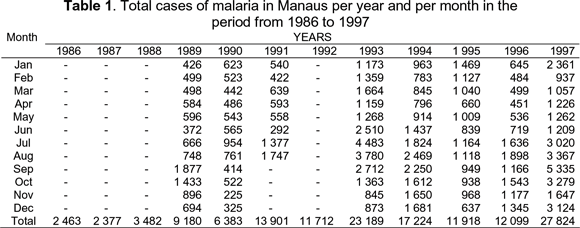
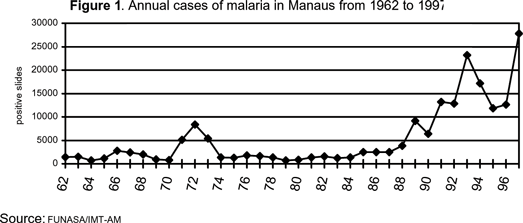
<body><![CDATA[<p><font face="Verdana, Arial, Helvetica, sans-serif" size="2">"Despite the global    effort employed for the eradication of malaria that lasted from 1965 to 1969    at the cost of hundreds of millions of dollars, malaria is still with us. In    fact, malaria remains as the major tropical disease. Furthermore it is returning    to the areas from where it had already been eradicated and its control is showing    to become harder and harder to achieve on account of its ever-increasing resistance    level to insecticides and drugs"(10). </font></p>     <p><font face="Verdana, Arial, Helvetica, sans-serif" size="2">Despite the fact    malaria in the Amazonas had always presented high level of infection, there    has been having increase in the city of Manaus, on the number of cases, mainly    from the 1990s on (<a href="#fig01">Figure 1</a>). Even in 1946, the malaria    was already considered the tropical disease of highest incidence, harmful to    man and economy (11). </font></p>     <p><a name="fig01"></a></p>     <p>&nbsp;</p>     <p align="center"><img src="/img/revistas/rsap/v6n2/a03fig01.gif"></p>     <p>&nbsp;</p>     <p><font face="Verdana, Arial, Helvetica, sans-serif" size="2">In the <a href="#fig01">Figure    1</a> there is the annual cases of malaria in Manaus from 1962 to 1997, showing    three epidemics picks in 1972, 1993 and 1997. The high incidence levels are    accounted by the disease endemism itself, influenced by the continuous settling    and natural resources exploitation due to "disorderly" social development (12,13).    </font></p>     <p><font face="Verdana, Arial, Helvetica, sans-serif" size="2">From 1986 to 1997    (<a href="#tab01">Table 1</a>), it is noted malaria incidence doubled in 1990-1991,    from 6 386 cases to 13 901 respectively. It is emphasised that from 1976 to    1987, there was no occurrence of malaria transmission cases within the Manaus    urban area. In 1988, when transmission re-established itself, malaria incidence    increased rapidly, with the more predominant parasite form brought about by    the <i>P. vivax</i>. </font></p>     <p><a name="tab01"></a></p>     <p>&nbsp;</p>     ]]></body>
<body><![CDATA[<p align="center"><img src="/img/revistas/rsap/v6n2/a03tab01.gif"></p>     <p>&nbsp;</p>     <p><font face="Verdana, Arial, Helvetica, sans-serif" size="2">1989, 1990, 1991,    1993, 1994 and 1997 were characterised for presenting lower incidence in the    first semesters and the largest number of recorded cases of malaria occurring    from July to September (<a href="#tab01">Table 1</a>). </font></p>     <p><font face="Verdana, Arial, Helvetica, sans-serif" size="2">Comparing these    data with earlier studies (14), which reported malaria outbreaks usually starting    in May, June or July, a shift can be observed of the starting time of the malaria    outbreaks to July. </font></p>     <p><font face="Verdana, Arial, Helvetica, sans-serif" size="2">The autochthonous    malaria record in Manaus in 1992 was 687 cases in January, decreased in the    following months, and only increased in October and November. Malaria incidence    was atypical that year being high in the end of the year, contributing for the    large number of cases recorded in the beginning of 1993. </font></p>     <p><font face="Verdana, Arial, Helvetica, sans-serif" size="2">The year of 1995    was characterised by many oscillations of the incidence of malaria, yet it showed    to be high throughout the year, whose lowest indexes were recorded in April,    660 cases; October, 938 cases, and December with 637 cases. </font></p>     <p>&nbsp;</p>     <p>  <font face="Verdana, Arial, Helvetica, sans-serif" size="3"><b>DISCUSSION</b></font></p>      <p><font face="Verdana, Arial, Helvetica, sans-serif" size="2">The distribution    of the highest levels of malaria incidence occurred in the East Zone as compared    to the other Manaus City zones. In this zone itself, the neighbourhood of Jorge    Teixeira was the one recorded with the largest incidence; the second largest    occurrence was in the North Zone, presenting the highest incidence in the neighbourhood    of Santa Etelvina. </font></p>     <p><font face="Verdana, Arial, Helvetica, sans-serif" size="2">The higher occurrence    in the East and North Zones can be accounted for by the way Manaus was settled,    climatic environmental conditions, keeping in mind that several factors contribute    for the maintenance of the malaric incidence (15). The <i>Anopheles</i> has    domestic habits, yet they are not exclusive. The "malaria houses" conditions,    shaded, humid, crude, untidy, are also found in the jungle itself, which favours    the house breaking of the vector (14). We are talking about the feeding sources,    the human blood, which the females fin easily. It is the law of the least the    effort the better. </font></p>     ]]></body>
<body><![CDATA[<p><font face="Verdana, Arial, Helvetica, sans-serif" size="2">The different behavioural    patterns of the <i>Anopheles </i>are in ecologically altered areas (16). According    to the type of dwelling, and if the household is still very near the wilderness    the mosquito that has diurnal and nocturnal habits, facilitates the man-vector    contact, and thus, more possibility of transmission. Depending on the rhythm    of occupation and urbanization process, the activity of the mosquito gets to    being restricted to the nocturnal period. </font></p>     <p><font face="Verdana, Arial, Helvetica, sans-serif" size="2">Together with these    anopheline characteristics, we have the characteristic of the urban expansion    itself, which followed the shoreline along the river, and then went back inland    into the forest, north and east bound, &#151; creating a semicircle of poor    neighbourhoods (17). That, associated to the need of housing or even the cultural    aspect of living close to water sources, should account for the dwelling near    to or on the watercourses themselves. </font></p>     <p><font face="Verdana, Arial, Helvetica, sans-serif" size="2">As to 1993, studies    from 1992 already pointed out for a large increase on malaria incidence (18),    calling attention for a worsening of the endemicity both in the urban and rural    zones. That period coincides with that of the settling of Jorge Teixeira (Easte    Zone), a region that comprised large primary forest areas along with some private    country sites. There were also several headwaters and the Igarap&eacute; do    Mindu, the largest one of that area. Another coincidence was the settlement    named Jo&atilde;o Paulo II (East Zone) late 1992 (18). From 1993 on, with the    incoming of a larger number of people to that location, a high degree of environmental    degradation followed by a high incidence of malaria is being observed. </font></p>     <p><font face="Verdana, Arial, Helvetica, sans-serif" size="2">The occupation    of the Parque das Na&ccedil;&otilde;es (Flores, North Zone) occurred in September/1995,    and this locality alone accounted for 32 % of all the cases of autochthonous    malaria in the urban area of Manaus in 1997. That area had propitious conditions    for the formation of <i>Anopheles </i>breeding sites, which were strengthened    by the way the occupation was carried out and the great physiological alterations    of the ecosystem by the damming of Igarap&eacute; do Bind&aacute;. </font></p>     <p><font face="Verdana, Arial, Helvetica, sans-serif" size="2">The number of lowincome    people inhabiting alongside and on the water-courses themselves is large (9).    This has brought about a wide range of environmental problems. With an emphasis    on high degree of degradation that is already noted on the shorelines and in    the water quality in these streams, caused by the drainage of all types of wastes    and sewage waters, in addition to the alterations on the local fauna and flora.    </font></p>     <p><font face="Verdana, Arial, Helvetica, sans-serif" size="2">Although recent    occupations have played a major role on the malaria incidence, over 70 % of    all cases in 1993 were recorded in areas that had been occupied for some time    with a stable population, that is, areas where control was thought of as viable    and executable with available methods. This demonstrates the degree of technical-administrative    difficulties faced by the public services responsible for the malaria control    in Manaus (19). </font></p>     <p>&nbsp;</p>     <p><font face="Verdana, Arial, Helvetica, sans-serif" size="3"><b>CONCLUSION </b></font></p>     <p><font face="Verdana, Arial, Helvetica, sans-serif" size="2">1. The malaria    epidemiological situation present in Manaus in the period from 1986 to 1997,    showed the occurrence of two epidemics, one in 1993 and another in 1997, having    a larger number of cases caused by <i>Plasmodium vivax </i>occurred in all the    studied years. A relation of the environmental, cultural, social and economical    factors involving climatic characteristics, natural and reconstructed environment,    and city urbanization, linked to the population vulnerability configure the    favourable conditions for the maintenance of the Manaus incidence of malaria.    </font></p>     <p><font face="Verdana, Arial, Helvetica, sans-serif" size="2">2. The analysis    of the malaria cases diagnosed in Manaus shows that the areas most affected    by the disease were in the East, with the highest incidence in Jorge Teixeira,    followed by the North Zones, whose highest recorded number was in Santa Etelvina.    This fact must be related to the environmental, climatic characteristics, and    to the way the city was occupied, which in the last years occurred with a greater    intensity in these zones. They are characterised by the "disorderly" occupations,    which provided the ideal environmental conditions for the occurrence and reproduction    of the <i>Anopheles,</i> which is a vector of this disease. </font></p>     ]]></body>
<body><![CDATA[<p><font face="Verdana, Arial, Helvetica, sans-serif" size="2">3. The malaria    peaks that occurred in Manaus coincude wuth the periods of the appearance of    some neighbourhoods, such as Tancredo Neves, Jorge Teixeira, Jo&atilde;o Paulo    II in the East zone; Santa Etelvina, Monte das Oliveiras, Novo Israel in the    North zone; and Parque das Na&ccedil;&otilde;es, located in Flores, but is a    lot closer to Cidade Nova (North zone). </font></p>     <p><font face="Verdana, Arial, Helvetica, sans-serif" size="2">4. Environmental    alterations such as deforestation, alteration of the soil and of the watercourses.    The population caused these alterations, not because they meant to cause this    damage but because they had to provide themselves with the essential needs for    their survival. This has made them interfere with the environment and many times    have to build on risky areas such as on slopes, valley bottoms and too close    to the untouched forest and become more vulnerable to the disease. </font></p>     <p><font face="Verdana, Arial, Helvetica, sans-serif" size="2">5. The accelerated    urbanization process, which occurred in the city of Manaus, and the consequent    incapacity to be followed up with the proper infrastructure and services, mainly    sanitation is a factor that contributed for the malaria establishment and sustainability.    </font></p>     <p><font face="Verdana, Arial, Helvetica, sans-serif" size="2">6. Environmental    conditions also have an influence on the maintenance of the malaria vector,    and the East zone was found to be where there had bee more anthropic interventions,    characterised by alterations that favoured the appearance of new breeding sites    for <i>Anopheles</i>. </font></p>     <p><font face="Verdana, Arial, Helvetica, sans-serif" size="2">7. In fact, the    increase on the intensity of malaria is related to the natural environmental    matters. It can be stressed that this element by itself is not capable of determining    the maintenance of the endemicity. Therefore, the way the city was expanded,    urbanised and occupied, without the proper urban-environmental planning, which    has a great influence on the incidence of the disease, must be added to the    alterations produced by man on the natural environment&#149;</font></p>     <p>&nbsp;</p>     <p><font face="Verdana, Arial, Helvetica, sans-serif" size="3"><b>REFERENCES </b></font></p>     <!-- ref --><p><font face="Verdana, Arial, Helvetica, sans-serif" size="2">1. Alecrim WD.    Ecossistema amaz&ocirc;nico e o controle das endemias. Rev. Soc. Brasil. Med.    Trop.1994; 2: 428-431, (supl. IV). </font>&nbsp;&nbsp;&nbsp;&nbsp;&nbsp;&nbsp;&nbsp;&nbsp;[&#160;<a href="javascript:void(0);" onclick="javascript: window.open('/scielo.php?script=sci_nlinks&ref=000090&pid=S0124-0064200400020000300001&lng=','','width=640,height=500,resizable=yes,scrollbars=1,menubar=yes,');">Links</a>&#160;]<!-- end-ref --><!-- ref --><p><font face="Verdana, Arial, Helvetica, sans-serif" size="2">2. Monteiro, MY.    Funda&ccedil;&atilde;o de Manaus. 4.ed. aum. S&atilde;o Paulo, Metro C&uacute;bico;    1994. 159p. </font>&nbsp;&nbsp;&nbsp;&nbsp;&nbsp;&nbsp;&nbsp;&nbsp;[&#160;<a href="javascript:void(0);" onclick="javascript: window.open('/scielo.php?script=sci_nlinks&ref=000091&pid=S0124-0064200400020000300002&lng=','','width=640,height=500,resizable=yes,scrollbars=1,menubar=yes,');">Links</a>&#160;]<!-- end-ref --><!-- ref --><p><font face="Verdana, Arial, Helvetica, sans-serif" size="2">3. Freitas Pinto,    ER. Como se produzem as Zonas Francas. Revista Semin&aacute;rio e Debates. Bel&eacute;m,    NAEA/UFPA; 1987:19-38. </font>&nbsp;&nbsp;&nbsp;&nbsp;&nbsp;&nbsp;&nbsp;&nbsp;[&#160;<a href="javascript:void(0);" onclick="javascript: window.open('/scielo.php?script=sci_nlinks&ref=000092&pid=S0124-0064200400020000300003&lng=','','width=640,height=500,resizable=yes,scrollbars=1,menubar=yes,');">Links</a>&#160;]<!-- end-ref --><!-- ref --><p><font face="Verdana, Arial, Helvetica, sans-serif" size="2">4. Andrade M. Manaus:    ruas, fachadas e varandas. Manaus: Humberto Calderaro; 1984. 276 p. </font>&nbsp;&nbsp;&nbsp;&nbsp;&nbsp;&nbsp;&nbsp;&nbsp;[&#160;<a href="javascript:void(0);" onclick="javascript: window.open('/scielo.php?script=sci_nlinks&ref=000093&pid=S0124-0064200400020000300004&lng=','','width=640,height=500,resizable=yes,scrollbars=1,menubar=yes,');">Links</a>&#160;]<!-- end-ref --><!-- ref --><p><font face="Verdana, Arial, Helvetica, sans-serif" size="2">5. Sabroza PC,    Toledo LM, Osanai CH. A organiza&ccedil;&atilde;o do espa&ccedil;o e os processo    end&ecirc;mico-epid&ecirc;micos. In: M. C. Leal, P. C. Sabroza; R. H. Rodr&iacute;guez;    P. M. Buss, orgs. Sa&uacute;de, Ambiente e Desenvolvimento. S&atilde;o Paulo:    Hucitec/ Rio de Janeiro: Abrasco; 1992: 57-77. vol. II. </font>&nbsp;&nbsp;&nbsp;&nbsp;&nbsp;&nbsp;&nbsp;&nbsp;[&#160;<a href="javascript:void(0);" onclick="javascript: window.open('/scielo.php?script=sci_nlinks&ref=000094&pid=S0124-0064200400020000300005&lng=','','width=640,height=500,resizable=yes,scrollbars=1,menubar=yes,');">Links</a>&#160;]<!-- end-ref --><!-- ref --><p><font face="Verdana, Arial, Helvetica, sans-serif" size="2">6. Raggio A. Mal&aacute;ria    urbana. Divulga&ccedil;&atilde;o em sa&uacute;de para debate. Londrina; 1992.    8: 75. </font>&nbsp;&nbsp;&nbsp;&nbsp;&nbsp;&nbsp;&nbsp;&nbsp;[&#160;<a href="javascript:void(0);" onclick="javascript: window.open('/scielo.php?script=sci_nlinks&ref=000095&pid=S0124-0064200400020000300006&lng=','','width=640,height=500,resizable=yes,scrollbars=1,menubar=yes,');">Links</a>&#160;]<!-- end-ref --><!-- ref --><p><font face="Verdana, Arial, Helvetica, sans-serif" size="2">7. Darnton-Hill    I. El envejecimiento con salud y la calidad de la vida. Foro Mundial de la Salud.    Organiza&ccedil;&atilde;o Mundial de Sa&uacute;de, Genebra, 1995; 16(4):381-391.    </font>&nbsp;&nbsp;&nbsp;&nbsp;&nbsp;&nbsp;&nbsp;&nbsp;[&#160;<a href="javascript:void(0);" onclick="javascript: window.open('/scielo.php?script=sci_nlinks&ref=000096&pid=S0124-0064200400020000300007&lng=','','width=640,height=500,resizable=yes,scrollbars=1,menubar=yes,');">Links</a>&#160;]<!-- end-ref --><!-- ref --><p><font face="Verdana, Arial, Helvetica, sans-serif" size="2">8. Oliveira JA.    As cidades amaz&ocirc;nicas: a ilus&atilde;o da busca. Boletim amazonense de    geografia. 1995; 2: 23-41. </font>&nbsp;&nbsp;&nbsp;&nbsp;&nbsp;&nbsp;&nbsp;&nbsp;[&#160;<a href="javascript:void(0);" onclick="javascript: window.open('/scielo.php?script=sci_nlinks&ref=000097&pid=S0124-0064200400020000300008&lng=','','width=640,height=500,resizable=yes,scrollbars=1,menubar=yes,');">Links</a>&#160;]<!-- end-ref --><!-- ref --><p><font face="Verdana, Arial, Helvetica, sans-serif" size="2">9. Santos SSM (coord.).    Saneamento b&aacute;sico e problemas ambientais no munic&iacute;pio de Manaus.    R. bras. Geogr., Rio de Janeiro, 1993; 55 (1/4): 15-60, jan./dez. </font>&nbsp;&nbsp;&nbsp;&nbsp;&nbsp;&nbsp;&nbsp;&nbsp;[&#160;<a href="javascript:void(0);" onclick="javascript: window.open('/scielo.php?script=sci_nlinks&ref=000098&pid=S0124-0064200400020000300009&lng=','','width=640,height=500,resizable=yes,scrollbars=1,menubar=yes,');">Links</a>&#160;]<!-- end-ref --><!-- ref --><p><font face="Verdana, Arial, Helvetica, sans-serif" size="2">10. Litsios S.    The tomorrow of malaria. Geneva: Pacific/ Ecotrends; 1996. 181p. </font>&nbsp;&nbsp;&nbsp;&nbsp;&nbsp;&nbsp;&nbsp;&nbsp;[&#160;<a href="javascript:void(0);" onclick="javascript: window.open('/scielo.php?script=sci_nlinks&ref=000099&pid=S0124-0064200400020000300010&lng=','','width=640,height=500,resizable=yes,scrollbars=1,menubar=yes,');">Links</a>&#160;]<!-- end-ref --><!-- ref --><p><font face="Verdana, Arial, Helvetica, sans-serif" size="2">11. Batista D.    O paludismo na Amaz&ocirc;nia: contribui&ccedil;&atilde;o &agrave; epidemiologia,    &agrave; protozoologia e &agrave; cl&iacute;nica; estudo sobre a febre biliosa-hemoglobin&uacute;rica;    s&iacute;ntese. Rio de Janeiro: Imprensa Nacional; 1946. 211 p. </font>&nbsp;&nbsp;&nbsp;&nbsp;&nbsp;&nbsp;&nbsp;&nbsp;[&#160;<a href="javascript:void(0);" onclick="javascript: window.open('/scielo.php?script=sci_nlinks&ref=000100&pid=S0124-0064200400020000300011&lng=','','width=640,height=500,resizable=yes,scrollbars=1,menubar=yes,');">Links</a>&#160;]<!-- end-ref --><!-- ref --><p><font face="Verdana, Arial, Helvetica, sans-serif" size="2">12. Albuquerque    MFPM. Urbaniza&ccedil;&atilde;o, favelas, e endemias: a produ&ccedil;&atilde;o    da filariose no Recife, Brasil. Cad. Sa&uacute;de P&uacute;bl. Rio de Janeiro,    1993; 9(4): 487-497, out/dez. </font>&nbsp;&nbsp;&nbsp;&nbsp;&nbsp;&nbsp;&nbsp;&nbsp;[&#160;<a href="javascript:void(0);" onclick="javascript: window.open('/scielo.php?script=sci_nlinks&ref=000101&pid=S0124-0064200400020000300012&lng=','','width=640,height=500,resizable=yes,scrollbars=1,menubar=yes,');">Links</a>&#160;]<!-- end-ref --><!-- ref --><p><font face="Verdana, Arial, Helvetica, sans-serif" size="2">13. Organizaci&oacute;n    Mundial de la Salud-OMS. Situaci&oacute;n de Los Programas de Malaria en Las    Americas. Informe XLII. XXIV Confer&ecirc;ncia Sanit&aacute;ria Panamericana    XLVI Reuni&oacute;n Del Comit&eacute; Regional. Washington, D.C.: Organizaci&oacute;n    Panamericana de La Salud, Organizaci&oacute;n Mundial de La Salud. Septiembre;    1994. 113 p. </font>&nbsp;&nbsp;&nbsp;&nbsp;&nbsp;&nbsp;&nbsp;&nbsp;[&#160;<a href="javascript:void(0);" onclick="javascript: window.open('/scielo.php?script=sci_nlinks&ref=000102&pid=S0124-0064200400020000300013&lng=','','width=640,height=500,resizable=yes,scrollbars=1,menubar=yes,');">Links</a>&#160;]<!-- end-ref --><!-- ref --><p><font face="Verdana, Arial, Helvetica, sans-serif" size="2">14. Scorzelli Junior    A, Carreira da Silva A. O problema da mal&aacute;ria em Manaus. Manaus: Imprensa    P&uacute;blica; 1939. 59 p. </font>&nbsp;&nbsp;&nbsp;&nbsp;&nbsp;&nbsp;&nbsp;&nbsp;[&#160;<a href="javascript:void(0);" onclick="javascript: window.open('/scielo.php?script=sci_nlinks&ref=000103&pid=S0124-0064200400020000300014&lng=','','width=640,height=500,resizable=yes,scrollbars=1,menubar=yes,');">Links</a>&#160;]<!-- end-ref --><!-- ref --><p><font face="Verdana, Arial, Helvetica, sans-serif" size="2">15. Alecrim WD.    Estudo cl&iacute;nico-epidemiol&oacute;gico da mal&aacute;ria no Rio Itux&iacute;    &#151; Amazonas. Disserta&ccedil;&atilde;o de mestrado de Medicina Tropical.    Universidade de Bras&iacute;lia; 1979. </font>&nbsp;&nbsp;&nbsp;&nbsp;&nbsp;&nbsp;&nbsp;&nbsp;[&#160;<a href="javascript:void(0);" onclick="javascript: window.open('/scielo.php?script=sci_nlinks&ref=000104&pid=S0124-0064200400020000300015&lng=','','width=640,height=500,resizable=yes,scrollbars=1,menubar=yes,');">Links</a>&#160;]<!-- end-ref --><!-- ref --><p><font face="Verdana, Arial, Helvetica, sans-serif" size="2">16. Tadei WP, Santos    JMM, Costa WLS, Scarpassa VM. Biologia de anofelinos amaz&ocirc;nicos. XII.    Ocorr&ecirc;ncia de esp&eacute;cies de Anopheles, din&acirc;mica da transmiss&atilde;o    e controle da mal&aacute;ria na zona urbana de Ariquemes (Rond&ocirc;nia). Rev.    Inst. Med. trop. S&atilde;o Paulo 1988; 30(3):221-251, maio-junho. </font>&nbsp;&nbsp;&nbsp;&nbsp;&nbsp;&nbsp;&nbsp;&nbsp;[&#160;<a href="javascript:void(0);" onclick="javascript: window.open('/scielo.php?script=sci_nlinks&ref=000105&pid=S0124-0064200400020000300016&lng=','','width=640,height=500,resizable=yes,scrollbars=1,menubar=yes,');">Links</a>&#160;]<!-- end-ref --><!-- ref --><p><font face="Verdana, Arial, Helvetica, sans-serif" size="2">17. Ara&uacute;jo    AV. Sociologia de Manaus: aspectos de sua acultura&ccedil;&atilde;o. Temas de    Sociologia. Manaus: Edi&ccedil;&otilde;es Funda&ccedil;&atilde;o Cultural do    Amazonas; 1974. Vol 2. p. 97-125. </font>&nbsp;&nbsp;&nbsp;&nbsp;&nbsp;&nbsp;&nbsp;&nbsp;[&#160;<a href="javascript:void(0);" onclick="javascript: window.open('/scielo.php?script=sci_nlinks&ref=000106&pid=S0124-0064200400020000300017&lng=','','width=640,height=500,resizable=yes,scrollbars=1,menubar=yes,');">Links</a>&#160;]<!-- end-ref --><!-- ref --><p><font face="Verdana, Arial, Helvetica, sans-serif" size="2">18. Silva EB, Moura    RCS, Silva VMFQ, Sampaio MZM, Sampaio LS, Teixeira FTV, et al. Estudo epidemiol&oacute;gico    da mal&aacute;ria no munic&iacute;pio de Manaus. Resumo. Anais do XXVIII Congresso    da Sociedade Brasileira de Medicina Tropical, Bel&eacute;m; 1992, 23 a 27 de    fevereiro. p. 8 </font>&nbsp;&nbsp;&nbsp;&nbsp;&nbsp;&nbsp;&nbsp;&nbsp;[&#160;<a href="javascript:void(0);" onclick="javascript: window.open('/scielo.php?script=sci_nlinks&ref=000107&pid=S0124-0064200400020000300018&lng=','','width=640,height=500,resizable=yes,scrollbars=1,menubar=yes,');">Links</a>&#160;]<!-- end-ref --><!-- ref --><p><font face="Verdana, Arial, Helvetica, sans-serif" size="2">19. Projeto para    Controle da Mal&aacute;ria em Manaus: proposta de atua&ccedil;&atilde;o do munic&iacute;pio    atrav&eacute;s da contra&ccedil;&atilde;o de servi&ccedil;os. Manaus (mimeo);    1994. </font>&nbsp;&nbsp;&nbsp;&nbsp;&nbsp;&nbsp;&nbsp;&nbsp;[&#160;<a href="javascript:void(0);" onclick="javascript: window.open('/scielo.php?script=sci_nlinks&ref=000108&pid=S0124-0064200400020000300019&lng=','','width=640,height=500,resizable=yes,scrollbars=1,menubar=yes,');">Links</a>&#160;]<!-- end-ref --><p>&nbsp;</p>     <p>&nbsp;</p>     <p><font face="Verdana, Arial, Helvetica, sans-serif" size="2">Recibido 26 Febrero    2004/Enviado para Modificaci&oacute;n 28 Mayo 2004/Aceptado 4 Junio 2004 </font></p>      ]]></body><back>
<ref-list>
<ref id="B1">
<label>1</label><nlm-citation citation-type="journal">
<person-group person-group-type="author">
<name>
<surname><![CDATA[Alecrim]]></surname>
<given-names><![CDATA[WD]]></given-names>
</name>
</person-group>
<article-title xml:lang="pt"><![CDATA[Ecossistema amazônico e o controle das endemias]]></article-title>
<source><![CDATA[Rev. Soc. Brasil. Med. Trop]]></source>
<year>1994</year>
<volume>2</volume>
<numero>^sIV</numero>
<issue>^sIV</issue>
<supplement>IV</supplement>
<page-range>428-431</page-range></nlm-citation>
</ref>
<ref id="B2">
<label>2</label><nlm-citation citation-type="book">
<person-group person-group-type="author">
<name>
<surname><![CDATA[Monteiro]]></surname>
<given-names><![CDATA[MY]]></given-names>
</name>
</person-group>
<source><![CDATA[Fundação de Manaus]]></source>
<year>1994</year>
<edition>4</edition>
<publisher-loc><![CDATA[São Paulo ]]></publisher-loc>
<publisher-name><![CDATA[Metro Cúbico]]></publisher-name>
</nlm-citation>
</ref>
<ref id="B3">
<label>3</label><nlm-citation citation-type="journal">
<person-group person-group-type="author">
<name>
<surname><![CDATA[Freitas Pinto]]></surname>
<given-names><![CDATA[ER]]></given-names>
</name>
</person-group>
<article-title xml:lang="pt"><![CDATA[Como se produzem as Zonas Francas]]></article-title>
<source><![CDATA[Revista Seminário e Debates]]></source>
<year>1987</year>
<page-range>19-38</page-range><publisher-loc><![CDATA[Belém ]]></publisher-loc>
<publisher-name><![CDATA[NAEA/UFPA]]></publisher-name>
</nlm-citation>
</ref>
<ref id="B4">
<label>4</label><nlm-citation citation-type="book">
<person-group person-group-type="author">
<name>
<surname><![CDATA[Andrade]]></surname>
<given-names><![CDATA[M]]></given-names>
</name>
</person-group>
<source><![CDATA[Manaus: ruas, fachadas e varandas]]></source>
<year>1984</year>
<publisher-loc><![CDATA[Manaus ]]></publisher-loc>
<publisher-name><![CDATA[Humberto Calderaro]]></publisher-name>
</nlm-citation>
</ref>
<ref id="B5">
<label>5</label><nlm-citation citation-type="book">
<person-group person-group-type="author">
<name>
<surname><![CDATA[Sabroza]]></surname>
<given-names><![CDATA[PC]]></given-names>
</name>
<name>
<surname><![CDATA[Toledo]]></surname>
<given-names><![CDATA[LM]]></given-names>
</name>
<name>
<surname><![CDATA[Osanai]]></surname>
<given-names><![CDATA[CH]]></given-names>
</name>
</person-group>
<article-title xml:lang="pt"><![CDATA[A organização do espaço e os processo endêmico-epidêmicos]]></article-title>
<person-group person-group-type="editor">
<name>
<surname><![CDATA[Leal]]></surname>
<given-names><![CDATA[M. C.]]></given-names>
</name>
<name>
<surname><![CDATA[Sabroza]]></surname>
<given-names><![CDATA[P. C.]]></given-names>
</name>
<name>
<surname><![CDATA[Rodríguez]]></surname>
<given-names><![CDATA[R. H.]]></given-names>
</name>
<name>
<surname><![CDATA[Buss]]></surname>
<given-names><![CDATA[P. M.]]></given-names>
</name>
</person-group>
<source><![CDATA[Saúde, Ambiente e Desenvolvimento]]></source>
<year>1992</year>
<volume>II</volume>
<page-range>57-77</page-range><publisher-loc><![CDATA[São PauloRio de Janeiro ]]></publisher-loc>
<publisher-name><![CDATA[HucitecAbrasco]]></publisher-name>
</nlm-citation>
</ref>
<ref id="B6">
<label>6</label><nlm-citation citation-type="">
<person-group person-group-type="author">
<name>
<surname><![CDATA[Raggio]]></surname>
<given-names><![CDATA[A]]></given-names>
</name>
</person-group>
<source><![CDATA[Malária urbana: Divulgação em saúde para debate]]></source>
<year>1992</year>
<volume>8</volume>
<publisher-loc><![CDATA[Londrina ]]></publisher-loc>
</nlm-citation>
</ref>
<ref id="B7">
<label>7</label><nlm-citation citation-type="book">
<person-group person-group-type="author">
<name>
<surname><![CDATA[Darnton-Hill]]></surname>
<given-names><![CDATA[I.]]></given-names>
</name>
</person-group>
<source><![CDATA[El envejecimiento con salud y la calidad de la vida]]></source>
<year>1995</year>
<volume>16</volume>
<page-range>381-391</page-range><publisher-loc><![CDATA[Genebra ]]></publisher-loc>
<publisher-name><![CDATA[Foro Mundial de la SaludOrganização Mundial de Saúde]]></publisher-name>
</nlm-citation>
</ref>
<ref id="B8">
<label>8</label><nlm-citation citation-type="journal">
<person-group person-group-type="author">
<name>
<surname><![CDATA[Oliveira]]></surname>
<given-names><![CDATA[JA]]></given-names>
</name>
</person-group>
<article-title xml:lang="pt"><![CDATA[As cidades amazônicas: a ilusão da busca]]></article-title>
<source><![CDATA[Boletim amazonense de geografia]]></source>
<year>1995</year>
<volume>2</volume>
<page-range>23-41</page-range></nlm-citation>
</ref>
<ref id="B9">
<label>9</label><nlm-citation citation-type="journal">
<person-group person-group-type="author">
<name>
<surname><![CDATA[Santos]]></surname>
<given-names><![CDATA[SSM]]></given-names>
</name>
</person-group>
<article-title xml:lang="pt"><![CDATA[Saneamento básico e problemas ambientais no município de Manaus]]></article-title>
<source><![CDATA[R. bras. Geogr.]]></source>
<year>1993</year>
<volume>55</volume>
<numero>1/4</numero>
<issue>1/4</issue>
<page-range>15-60</page-range><publisher-loc><![CDATA[Rio de Janeiro ]]></publisher-loc>
</nlm-citation>
</ref>
<ref id="B10">
<label>10</label><nlm-citation citation-type="book">
<person-group person-group-type="author">
<name>
<surname><![CDATA[Litsios]]></surname>
<given-names><![CDATA[S.]]></given-names>
</name>
</person-group>
<source><![CDATA[The tomorrow of malaria]]></source>
<year>1996</year>
<publisher-loc><![CDATA[Geneva ]]></publisher-loc>
<publisher-name><![CDATA[Pacific/ Ecotrends]]></publisher-name>
</nlm-citation>
</ref>
<ref id="B11">
<label>11</label><nlm-citation citation-type="book">
<person-group person-group-type="author">
<name>
<surname><![CDATA[Batista]]></surname>
<given-names><![CDATA[D]]></given-names>
</name>
</person-group>
<source><![CDATA[O paludismo na Amazônia: contribuição à epidemiologia, à protozoologia e à clínica; estudo sobre a febre biliosa-hemoglobinúrica; síntese]]></source>
<year>1946</year>
<publisher-loc><![CDATA[Rio de Janeiro ]]></publisher-loc>
<publisher-name><![CDATA[Imprensa Nacional]]></publisher-name>
</nlm-citation>
</ref>
<ref id="B12">
<label>12</label><nlm-citation citation-type="journal">
<person-group person-group-type="author">
<name>
<surname><![CDATA[Albuquerque]]></surname>
<given-names><![CDATA[MFPM]]></given-names>
</name>
</person-group>
<article-title xml:lang="pt"><![CDATA[Urbanização, favelas, e endemias: a produção da filariose no Recife, Brasil]]></article-title>
<source><![CDATA[Cad. Saúde Públ]]></source>
<year>1993</year>
<volume>9</volume>
<numero>4</numero>
<issue>4</issue>
<page-range>487-497</page-range><publisher-loc><![CDATA[Rio de Janeiro ]]></publisher-loc>
</nlm-citation>
</ref>
<ref id="B13">
<label>13</label><nlm-citation citation-type="confpro">
<collab>Organización Mundial de la Salud</collab>
<source><![CDATA[Situación de Los Programas de Malaria en Las Americas: Informe XLII]]></source>
<year>1994</year>
<conf-name><![CDATA[XXIVXLVI Conferência Sanitária PanamericanaReunión Del Comité Regional]]></conf-name>
<conf-loc> </conf-loc>
<publisher-loc><![CDATA[Washington^eD.C. D.C.]]></publisher-loc>
<publisher-name><![CDATA[Organización Panamericana de La SaludOrganización Mundial de La Salud]]></publisher-name>
</nlm-citation>
</ref>
<ref id="B14">
<label>14</label><nlm-citation citation-type="book">
<person-group person-group-type="author">
<name>
<surname><![CDATA[Scorzelli Junior]]></surname>
<given-names><![CDATA[A]]></given-names>
</name>
<name>
<surname><![CDATA[Carreira da Silva]]></surname>
<given-names><![CDATA[A]]></given-names>
</name>
</person-group>
<source><![CDATA[O problema da malária em Manaus]]></source>
<year>1939</year>
<publisher-loc><![CDATA[Manaus ]]></publisher-loc>
<publisher-name><![CDATA[Imprensa Pública]]></publisher-name>
</nlm-citation>
</ref>
<ref id="B15">
<label>15</label><nlm-citation citation-type="">
<person-group person-group-type="author">
<name>
<surname><![CDATA[Alecrim]]></surname>
<given-names><![CDATA[WD]]></given-names>
</name>
</person-group>
<source><![CDATA[Estudo clínico-epidemiológico da malária no Rio Ituxí: Amazonas]]></source>
<year></year>
</nlm-citation>
</ref>
<ref id="B16">
<label>16</label><nlm-citation citation-type="journal">
<person-group person-group-type="author">
<name>
<surname><![CDATA[Tadei]]></surname>
<given-names><![CDATA[WP]]></given-names>
</name>
<name>
<surname><![CDATA[Santos]]></surname>
<given-names><![CDATA[JMM]]></given-names>
</name>
<name>
<surname><![CDATA[Costa]]></surname>
<given-names><![CDATA[WLS]]></given-names>
</name>
<name>
<surname><![CDATA[Scarpassa]]></surname>
<given-names><![CDATA[VM]]></given-names>
</name>
</person-group>
<article-title xml:lang="pt"><![CDATA[Biologia de anofelinos amazônicos: XII. Ocorrência de espécies de Anopheles, dinâmica da transmissão e controle da malária na zona urbana de Ariquemes (Rondônia)]]></article-title>
<source><![CDATA[Rev. Inst. Med. trop. São Paulo]]></source>
<year>1988</year>
<volume>30</volume>
<numero>3</numero>
<issue>3</issue>
<page-range>221-251</page-range></nlm-citation>
</ref>
<ref id="B17">
<label>17</label><nlm-citation citation-type="book">
<person-group person-group-type="author">
<name>
<surname><![CDATA[Araújo]]></surname>
<given-names><![CDATA[AV]]></given-names>
</name>
</person-group>
<source><![CDATA[Sociologia de Manaus: aspectos de sua aculturação]]></source>
<year>1974</year>
<volume>2</volume>
<page-range>97-125</page-range><publisher-loc><![CDATA[Manaus ]]></publisher-loc>
<publisher-name><![CDATA[Edições Fundação Cultural do Amazonas]]></publisher-name>
</nlm-citation>
</ref>
<ref id="B18">
<label>18</label><nlm-citation citation-type="confpro">
<person-group person-group-type="author">
<name>
<surname><![CDATA[Silva]]></surname>
<given-names><![CDATA[EB]]></given-names>
</name>
<name>
<surname><![CDATA[Moura]]></surname>
<given-names><![CDATA[RCS]]></given-names>
</name>
<name>
<surname><![CDATA[Silva]]></surname>
<given-names><![CDATA[VMFQ]]></given-names>
</name>
<name>
<surname><![CDATA[Sampaio]]></surname>
<given-names><![CDATA[MZM]]></given-names>
</name>
<name>
<surname><![CDATA[Sampaio]]></surname>
<given-names><![CDATA[LS]]></given-names>
</name>
<name>
<surname><![CDATA[Teixeira]]></surname>
<given-names><![CDATA[FTV]]></given-names>
</name>
</person-group>
<article-title xml:lang="pt"><![CDATA[Estudo epidemiológico da malária no município de Manaus: Resumo]]></article-title>
<source><![CDATA[]]></source>
<year></year>
<conf-name><![CDATA[XXVIII Congresso da Sociedade Brasileira de Medicina Tropical]]></conf-name>
<conf-date>1992</conf-date>
<conf-loc>Belém </conf-loc>
<page-range>8</page-range></nlm-citation>
</ref>
<ref id="B19">
<label>19</label><nlm-citation citation-type="">
<source><![CDATA[Projeto para Controle da Malária em Manaus: proposta de atuação do município através da contração de serviços]]></source>
<year>1994</year>
<publisher-loc><![CDATA[Manaus ]]></publisher-loc>
</nlm-citation>
</ref>
</ref-list>
</back>
</article>