<?xml version="1.0" encoding="ISO-8859-1"?><article xmlns:mml="http://www.w3.org/1998/Math/MathML" xmlns:xlink="http://www.w3.org/1999/xlink" xmlns:xsi="http://www.w3.org/2001/XMLSchema-instance">
<front>
<journal-meta>
<journal-id>0124-0064</journal-id>
<journal-title><![CDATA[Revista de Salud Pública]]></journal-title>
<abbrev-journal-title><![CDATA[Rev. salud pública]]></abbrev-journal-title>
<issn>0124-0064</issn>
<publisher>
<publisher-name><![CDATA[Instituto de Salud Publica, Facultad de Medicina - Universidad Nacional de Colombia]]></publisher-name>
</publisher>
</journal-meta>
<article-meta>
<article-id>S0124-00642004000400001</article-id>
<title-group>
<article-title xml:lang="en"><![CDATA[Assessing options for an innovative malaria control program on the basis of experience with the new Colombian Health Social Security System]]></article-title>
<article-title xml:lang="es"><![CDATA[Evaluación de opciones para un programa innovador de control de la malaria, con base en la experiencia del Sistema de Seguridad Social en Salud de Colombia]]></article-title>
</title-group>
<contrib-group>
<contrib contrib-type="author">
<name>
<surname><![CDATA[Agudelo C]]></surname>
<given-names><![CDATA[Carlos A.]]></given-names>
</name>
<xref ref-type="aff" rid="A01"/>
</contrib>
<contrib contrib-type="author">
<name>
<surname><![CDATA[Corredor A.]]></surname>
<given-names><![CDATA[Augusto]]></given-names>
</name>
<xref ref-type="aff" rid="A01"/>
</contrib>
<contrib contrib-type="author">
<name>
<surname><![CDATA[Valero]]></surname>
<given-names><![CDATA[María Victoria]]></given-names>
</name>
</contrib>
</contrib-group>
<aff id="A01">
<institution><![CDATA[,Universidad Nacional de Colombia Facultad de Medicina Instituto de Salud Pública]]></institution>
<addr-line><![CDATA[ ]]></addr-line>
</aff>
<pub-date pub-type="pub">
<day>00</day>
<month>10</month>
<year>2004</year>
</pub-date>
<pub-date pub-type="epub">
<day>00</day>
<month>10</month>
<year>2004</year>
</pub-date>
<volume>6</volume>
<fpage>1</fpage>
<lpage>39</lpage>
<copyright-statement/>
<copyright-year/>
<self-uri xlink:href="http://www.scielo.org.co/scielo.php?script=sci_arttext&amp;pid=S0124-00642004000400001&amp;lng=en&amp;nrm=iso"></self-uri><self-uri xlink:href="http://www.scielo.org.co/scielo.php?script=sci_abstract&amp;pid=S0124-00642004000400001&amp;lng=en&amp;nrm=iso"></self-uri><self-uri xlink:href="http://www.scielo.org.co/scielo.php?script=sci_pdf&amp;pid=S0124-00642004000400001&amp;lng=en&amp;nrm=iso"></self-uri><abstract abstract-type="short" xml:lang="en"><p><![CDATA[OBJECTIVES: Designing and proposing alternative models for municipal and Departmental malaria control programmes based on evidence obtained concerning the process of malaria on the Colombian Pacific Coast and regarding key problems in the malaria control programme before and following health system reform in 1993. METHODS: An evaluative study was carried out, comparing the situation before and following the 1993 reform; model design was also compared. Control programme is understood as being the institution, the human group and administration in charge of control activities. The study was carried out in 2002 and 2003, in the Departments along the Colombian Pacific Coast; the four departmental capitals, 28 malarial and 5 control municipalities were included primary and secondary information was obtained by means of surveys and semi-structured interviews, community meetings and reviewing documentation in the secretariats of health, the Vector-borne disease control programme-VBDC, the Expanded Immunisation Programme-EIP, Health Promoting Entities-HPE, Subsidised Regime Administrators-SRA and Service-Providing Entities-SPE. RESULTS: The following results were obtained: 1. Illustrating and analysing malarial tendencies in the country and on the Pacific Coast, and the corresponding institutional transformations in the programme; 2. Characterising the control programme which existed before 1993; 3. Characterising departmental modes of decentralising the programme; 4. Identifying the effects of reforming the system and characterising control programme problems; 5. Comparing the programme with the Expanded Immunisation Programme (EIP); 6. Comparative analysis of the programme and identifying current gaps in management capability; 7. Actors' perceptions regarding the control programme; 8. Values and challenges for an innovative control programme; and 9. Designing a model for up-dating/adapting the control programme. DISCUSSION: Malaria control programmes' problems and weaknesses are frequently and inarticulately attributed to the lack of knowledge and management skill of personnel working in such programmes, the lack of an information and communication system or weaknesses in the municipalities or personnel. These factors may well have had an effect; however, a global and institutional approach leads to locating the programmes within a social, political and cultural context. This allows interpreting control programmes' current problems, amidst decentralisation and reform processes, and linking this interpretation to modelling and opening a space for innovation in such programmes. The study's main limitations spring from particularities regarding Pacific Coast control programmes and weakness in health information systems.]]></p></abstract>
<abstract abstract-type="short" xml:lang="es"><p><![CDATA[OBJETIVOS: Diseñar y proponer modelos alternativos para los programas municipales y Departamentales de control de la malaria, con base en evidencias obtenidas sobre el proceso de la malaria en la Costa Pacífica de Colombia y sobre las problemáticas claves del programa de control de la malaria antes y después de la reforma del sistema de salud de 1993. MÉTODOS: Se realizó un estudio evaluativo, de comparación antes y después de la reforma de 1993, y de diseño de modelos. Por programa de control se entendió la institución, el grupo humano y la administración que están a cargo de las actividades de control. El estudio se llevó a cabo durante el año 2002 y 2003, en los Departamentos de la Costa Pacífica colombiana. Se incluyeron las cuatro capitales departamentales, 28 municipios maláricos y 5 de control. Se obtuvo información primaria y secundaria, por medio de encuestas y entrevistas semiestructuradas, reuniones comunitarias y revisión documental en secretarías de salud, programa de Enfermedades Transmitidas por Vectores-ETV, Programa Ampliado de Inmunizaciones-PAI, Empresas Promotoras de Salud-EPS, Administradoras del Régimen Subsidiado-ARS e Instituciones Prestadoras de Servicios-IPS. RESULTADOS: Se obtuvieron los siguientes resultados: 1. Ilustración y análisis de las tendencias de la malaria en el país y la Costa Pacífica, y las correspondientes transformaciones institucionales del programa. 2. Caracterización del programa de control antes de 1993. 3. Modalidades departamentales de la descentralización del programa. 4. Identificación de los efectos de la reforma del sistema y caracterización de las problemáticas del programa de control. 5. Comparación con el programa PAI6. Análisis comparado del programa e identificación de brechas actuales en la capacidad de manejo. 7. Percepción de los actores sobre el programa de control. 8. Valores y retos de un programa de control innovador. 9. Diseño de un modelo para adecuación del programa de control. DISCUSIÓN: Las problemáticas y debilidades de los programas de control de la malaria se atribuyen con frecuencia, y de manera desarticulada, a la falta de conocimiento y habilidades gerenciales del personal que labora en el programa, a la carencia de un sistema de información y comunicación, a la debilidad de los municipios o del personal. Si bien estos factores han incidido, una aproximación más global e institucional permite ubicar los programas en un contexto social, político y cultural. De esta manera es posible interpretar las problemáticas actuales de los programas de control, en medio de los procesos de descentralización y reforma, y enlazar esta interpretación a un ejercicio de modelamiento que abra espacio a la innovación en tales programas. Las principales limitaciones del estudio se desprenden de las particularidades de los programas de control de la Costa Pacífica y de la debilidad de los sistemas de información en salud.]]></p></abstract>
<kwd-group>
<kwd lng="en"><![CDATA[Malaria]]></kwd>
<kwd lng="en"><![CDATA[control programme]]></kwd>
<kwd lng="en"><![CDATA[models]]></kwd>
<kwd lng="en"><![CDATA[decentralisation]]></kwd>
<kwd lng="en"><![CDATA[healthcare system]]></kwd>
<kwd lng="en"><![CDATA[Colombia]]></kwd>
<kwd lng="es"><![CDATA[Malaria]]></kwd>
<kwd lng="es"><![CDATA[programa de control]]></kwd>
<kwd lng="es"><![CDATA[modelo]]></kwd>
<kwd lng="es"><![CDATA[descentralización]]></kwd>
<kwd lng="es"><![CDATA[sistema de salud]]></kwd>
<kwd lng="es"><![CDATA[Colombia]]></kwd>
</kwd-group>
</article-meta>
</front><body><![CDATA[ <p align="right"><font size="2" face="Verdana"><b>ARTICLES/RESEARCH</b></font></p>     <p>&nbsp;</p>     <p><font size="4" face="Verdana"><B>Assessing options for an innovative malaria    control program on the basis of experience with the new Colombian Health Social    Security System </B></font></p>     <p>&nbsp;</p>     <p><FONT SIZE="3" FACE="Verdana"><B>Evaluaci&oacute;n de opciones para un programa    innovador de control de la malaria, con base en la experiencia del Sistema de    Seguridad Social en Salud de Colombia</B></FONT></p>     <p>&nbsp;</p>     <p>&nbsp;</p>     <p><FONT SIZE="2" face="Verdana"><b>Carlos A. Agudelo C.<SUP>I</SUP>; Augusto    Corredor A.<SUP>II</SUP>; Mar&iacute;a Victoria Valero<SUP>III</sup></b></FONT></p>     <p><FONT SIZE="2" face="Verdana"><SUP>I</sup>M&eacute;dico. M. Sc. Salud P&uacute;blica.    M. Sc. Ciencias. Instituto de Salud P&uacute;blica, Facultad de Medicina, Universidad    Nacional de Colombia. E-mail: <a href="mailto:caagudeloc@unal.edu.co">caagudeloc@unal.edu.co</a>    <br>   <SUP>II</sup>M&eacute;dico. Especialista en Medicina Tropical. Instituto de    Salud P&uacute;blica Facultad de Medicina, Universidad Nacional de Colombia.    Bogot&aacute;, DC. Tel 3165405    ]]></body>
<body><![CDATA[<br>   <SUP>III</sup>Bacteri&oacute;loga. M. Sc. Epidemiolog&iacute;a. Investigadora    independiente. E-mail: <a href="mailto:mvvalerob@unal.edu.co">mvvalerob@unal.edu.co</a>    </FONT></p>     <p>&nbsp;</p>     <p>&nbsp;</p> <hr size="1" noshade>     <p><font size="2" face="Verdana"><B>ABSTRACT</B></font></p>     <p><FONT SIZE="2" FACE="Verdana"><B>OBJECTIVES:</b> Designing and proposing alternative    models for municipal and Departmental malaria control programmes based on evidence    obtained concerning the process of malaria on the Colombian Pacific Coast and    regarding key problems in the malaria control programme before and following    health system reform in 1993.    <br>   <B>METHODS:</b> An evaluative study was carried out, comparing the situation    before and following the 1993 reform; model design was also compared. Control    programme is understood as being the institution, the human group and administration    in charge of control activities. The study was carried out in 2002 and 2003,    in the Departments along the Colombian Pacific Coast; the four departmental    capitals, 28 malarial and 5 control municipalities were included primary and    secondary information was obtained by means of surveys and semi-structured interviews,    community meetings and reviewing documentation in the secretariats of health,    the Vector-borne disease control programme-VBDC, the Expanded Immunisation Programme-EIP,    Health Promoting Entities-HPE, Subsidised Regime Administrators-SRA and Service-Providing    Entities-SPE.    <br>   <B>RESULTS:</b> The following results were obtained: 1. Illustrating and analysing    malarial tendencies in the country and on the Pacific Coast, and the corresponding    institutional transformations in the programme; 2. Characterising the control    programme which existed before 1993; 3. Characterising departmental modes of    decentralising the programme; 4. Identifying the effects of reforming the system    and characterising control programme problems; 5. Comparing the programme with    the Expanded Immunisation Programme (EIP); 6. Comparative analysis of the programme    and identifying current gaps in management capability; 7. Actors' perceptions    regarding the control programme; 8. Values and challenges for an innovative    control programme; and 9. Designing a model for up-dating/adapting the control    programme.    <br>   <B>DISCUSSION: </b>Malaria control programmes' problems and weaknesses are frequently    and inarticulately attributed to the lack of knowledge and management skill    of personnel working in such programmes, the lack of an information and communication    system or weaknesses in the municipalities or personnel. These factors may well    have had an effect; however, a global and institutional approach leads to locating    the programmes within a social, political and cultural context. This allows    interpreting control programmes' current problems, amidst decentralisation and    reform processes, and linking this interpretation to modelling and opening a    space for innovation in such programmes. The study's main limitations spring    from particularities regarding Pacific Coast control programmes and weakness    in health information systems.</FONT></p>     <p><FONT SIZE="2" FACE="Verdana"><B>Key Words:</b> Malaria, control programme,    models, decentralisation, healthcare system, Colombia (<I>source: MeSH, NLM</I>).</FONT></p> <hr size="1" noshade>     <p><FONT SIZE="2" FACE="Verdana"><B>RESUMEN</B></FONT></p>     ]]></body>
<body><![CDATA[<p><FONT SIZE="2" FACE="Verdana"><B>OBJETIVOS:</b> Dise&ntilde;ar y proponer modelos    alternativos para los programas municipales y Departamentales de control de    la malaria, con base en evidencias obtenidas sobre el proceso de la malaria    en la Costa Pac&iacute;fica de Colombia y sobre las problem&aacute;ticas claves    del programa de control de la malaria antes y despu&eacute;s de la reforma del    sistema de salud de 1993.    <br>   <B>M&Eacute;TODOS:</b> Se realiz&oacute; un estudio evaluativo, de comparaci&oacute;n    antes y despu&eacute;s de la reforma de 1993, y de dise&ntilde;o de modelos.    Por programa de control se entendi&oacute; la instituci&oacute;n, el grupo humano    y la administraci&oacute;n que est&aacute;n a cargo de las actividades de control.    El estudio se llev&oacute; a cabo durante el a&ntilde;o 2002 y 2003, en los    Departamentos de la Costa Pac&iacute;fica colombiana. Se incluyeron las cuatro    capitales departamentales, 28 municipios mal&aacute;ricos y 5 de control. Se    obtuvo informaci&oacute;n primaria y secundaria, por medio de encuestas y entrevistas    semiestructuradas, reuniones comunitarias y revisi&oacute;n documental en secretar&iacute;as    de salud, programa de Enfermedades Transmitidas por Vectores-ETV, Programa Ampliado    de Inmunizaciones-PAI, Empresas Promotoras de Salud-EPS, Administradoras del    R&eacute;gimen Subsidiado-ARS e Instituciones Prestadoras de Servicios-IPS.    <br>   <B>RESULTADOS:</b> Se obtuvieron los siguientes resultados: 1. Ilustraci&oacute;n    y an&aacute;lisis de las tendencias de la malaria en el pa&iacute;s y la Costa    Pac&iacute;fica, y las correspondientes transformaciones institucionales del    programa. 2. Caracterizaci&oacute;n del programa de control antes de 1993. 3.    Modalidades departamentales de la descentralizaci&oacute;n del programa. 4.    Identificaci&oacute;n de los efectos de la reforma del sistema y caracterizaci&oacute;n    de las problem&aacute;ticas del programa de control. 5. Comparaci&oacute;n con    el programa PAI6. An&aacute;lisis comparado del programa e identificaci&oacute;n    de brechas actuales en la capacidad de manejo. 7. Percepci&oacute;n de los actores    sobre el programa de control. 8. Valores y retos de un programa de control innovador.    9. Dise&ntilde;o de un modelo para adecuaci&oacute;n del programa de control.    <br>   <B>DISCUSI&Oacute;N:</b> Las problem&aacute;ticas y debilidades de los programas    de control de la malaria se atribuyen con frecuencia, y de manera desarticulada,    a la falta de conocimiento y habilidades gerenciales del personal que labora    en el programa, a la carencia de un sistema de informaci&oacute;n y comunicaci&oacute;n,    a la debilidad de los municipios o del personal. Si bien estos factores han    incidido, una aproximaci&oacute;n m&aacute;s global e institucional permite    ubicar los programas en un contexto social, pol&iacute;tico y cultural. De esta    manera es posible interpretar las problem&aacute;ticas actuales de los programas    de control, en medio de los procesos de descentralizaci&oacute;n y reforma,    y enlazar esta interpretaci&oacute;n a un ejercicio de modelamiento que abra    espacio a la innovaci&oacute;n en tales programas. Las principales limitaciones    del estudio se desprenden de las particularidades de los programas de control    de la Costa Pac&iacute;fica y de la debilidad de los sistemas de informaci&oacute;n    en salud.</FONT></p>     <p><FONT SIZE="2" FACE="Verdana"><B>Palabras Claves:</b> Malaria, programa de    control, modelo, descentralizaci&oacute;n, sistema de salud, Colombia (<I>fuente:    DeCS, BIREME</I>).</FONT></p> <hr size="1" noshade>     <p>&nbsp;</p>     <p>&nbsp;</p>     <p><font size="2" face="Verdana">A round 85 % of Colombian territory is endemic    for malaria (1-4). More than 250 000 confirmed cases were registered in 1998.    In 2000, 129 municipalities (12 % of the total) and 3 million inhabitants (7,5    % of the total) presented an Annual Parasite Index (API) greater than 10 per    thousand inhabitants and constant transmission. The incidence of urban malaria    has increased during the last decade, affecting more than 20 municipalities    (5). The areas having the greatest risk of transmitting the disease are the    Pacific Coast, Urab&aacute;, the lower river Cauca, the upper river Sin&uacute;    and the territories of Orinoqu&iacute;a and Amazon&iacute;a (6). On the other    hand, 1,7 million people (4.1% of the total) live in territories having controlled    transmission and around 13.4 millions people inhabit areas having sporadic transmission.    </font></p>     <p><font size="2" face="Verdana">A sequence of changes having a great effect occurred    in Colombia during the 1990s, corresponding to the process of globalisation    and international politics regarding liberalising economies and restructuring    countries (7). The cepalin (<I>Comisi&oacute;n Econ&oacute;mica para Am&eacute;rica    Latina</I> - CEPAL) model for development employed during the previous fifty    years was abandoned and a development model centred on structural adjustment    and reducing fiscal deficit programmes became adopted. At the same time, the    National Health System (NHS) was abandoned and Law 100, 1993, created the General    Social Security in Health System (GSSHS). This dealt with a system of regulated    competition, a mixed public/private model (8,9) based on public contracts (10),    which has also been called structured pluralism (11).</font></p>     <p><font size="2" face="Verdana"> The Ministry of Health, the National Council    for Social Security in Health and Sectional and Local Health Offices represent    the GSSHS management and control organisms. The system has two affiliation regimes;    there is the contributory system receiving 12 % of a person's wage (4 % from    the employee and 8 % from the employer) and the subsidised system for the poor    population, representing people who cannot afford to make a contribution. 52,3    % (12,13) of the total population were affiliated in 2000, 30,5 % in the contributory    regime and 25, 2 % in the subsidised regime. The public and private entities    insuring the system are the Health Promoting Entities (<I>Empresas Promotoras    de Salud - EPS) </I>and the Subsidised Regime Administrators (<I>Administradoras    del R&eacute;gimen Subsidiado - ARS</I>). The former receive contributions,    transferring that surplus value relating to each affiliated family called Unit    of Payment per Capitation (UPC) to the Solidarity and Guarantee Fund (<I>Fondo    de Solidaridad y Garant&iacute;a </I>- Fosyga). The latter receive resources    from general taxes, via Fosyga and the Seccional and Local Health Offices. The    Service-Providing Institutions (SPI) are both public and private. </font></p>     ]]></body>
<body><![CDATA[<p><font size="2" face="Verdana">The set of services for people is called the    Compulsory Health Plan - CHP (<I>Plan Obligatorio de Salud - POS</I>), which    is more extensive in the contributory than in the subsidised regime. Public    health activities were grouped into a Basic Attention Plan – BAP (<I>Plan de    Atenci&oacute;n B&aacute;sica</I> – PAB), in the hands of departmental and municipal    authorities. A large part of those prevention, monitoring, diagnosis and treatment    activities relating to a set of diseases including malaria, leishmaniasis and    dengue is financed by CHP and BAP resources; these are managed by the Vector-borne    disease (<I>Enfermedades Transmitidas por Vectores</I> – ETV) control programme.</font></p>     <p><font size="2" face="Verdana"> 55 % of Colombia's population remained below    the poverty line from 1995 to 2002 (14-25). Health insurance coverage and spending    has grown, but inequality in access to and use of services remains. Departments    and municipalities have progressively assumed management of public health activities    and transmittable disease control programmes, without achieving a suitable transition    towards decentralisation and a model of regulated competition (5,26-32). Very    little research has been done regarding the last aspect to ensure that results    regarding difficulties concerning decentralisation and reform processes can    be understood. Some of them (5,33) suggest problems regarding management capacity,    financing, organisation, personnel, allocating funds, monitoring and intersectorial    coordination.</font></p>     <p><font size="2" face="Verdana"> A research project was thus designed and carried    out for advancing understanding these complex phenomena; it proposed an alternative    model for up-dating/adapting municipal and Departmental malaria control programmes,    based on evidence obtained from the process of malaria on the Colombian Pacific    Coast and key problems arising from the malaria control programme before and    following health system reform in 1993. This included identifying gaps in the    ability for local management of the control programme generated after the 1993    reform.</font></p>     <p>&nbsp;</p>     <p><font size="3" face="Verdana"><b>METHODOLOGY</b> </font></p>     <p><font size="2" face="Verdana">An evaluative study compared the situation before    and following reform in 1993, as well as the design of models. The control programme    was interpreted as being that institution governing or entrusted with control    activities by means of a human group and administration. Models were interpreted    as being formal or systemic representations of some hypotheses contributing    towards obtaining a command of observations and experiences (34,35). The design    of an institutional model corresponds to a coordinated organisation, administration    and operation programme. </font></p>     <p><font size="2" face="Verdana">Population and Methods</font></p>     <p><font size="2" face="Verdana"> The study was carried out in the Departments    bordering the Colombian Pacific Coast: Choc&oacute;, Valle del Cauca, Cauca    and Nari&ntilde;o. These Departments' four capital cities (Quibd&oacute;, Cali,    Popay&aacute;n and Pasto, respectively), 28 other municipalities and 5 controls    were included for a total of 37. The study group's municipalities presented    endemic malaria and epidemic outbreaks and 89,3 % of them corresponded to municipal    categories 5 and 6 (the poorest levels). Control group municipalities did not    present malaria during the study, but did have the VBD programme on hand. Twenty-two    municipalities (59,5 %) were decentralised, 18 corresponding to the study group    (64,3 % of the group).</font></p>     <p><font size="2" face="Verdana"> Primary and secondary information concerning    the malaria control programme (before and after 1993) was obtained from the    following: </font></p>     <p><font size="2" face="Verdana">102 Institutional surveys carried out with Departmental    and municipalities' Vector-born disease control programmes (VBD), Health Promoting    Entities (EPS), Subsidised Regime Administrators (ARS) and Service-Providing    Institutions (IPS);</font></p>     ]]></body>
<body><![CDATA[<p><font size="2" face="Verdana"> 65 semi-structured in-depth interviews carried    out with departmental and municipal Health Secretariat functionaries, members    of community organisations, key informants and NGOs;</font></p>     <p><font size="2" face="Verdana"> 6 unstructured interviews were carried out with    functionaries from the former MES (Malaria Eradication Service), now involved    with the current control programme;</font></p>     <p><font size="2" face="Verdana"> 20 meetings and workshops were held with institutional    and community groups so that the situation regarding malaria and the control    programme could be evaluated;</font></p>     <p><font size="2" face="Verdana"> 19 municipal, Secretariat of Health and Ministry    of Health-National Health Institute documents pertaining to information systems,    data-bases and malaria monitoring were inspected; and</font></p>     <p><font size="2" face="Verdana"> 32 national and international documents, books,    reports and studies regarding control programmes in the country were consulted.</font></p>     <p><font size="2" face="Verdana"> Information about the Extended Immunisation    Programme (EIP) was obtained by means of semi-structured surveys. Survey and    interview forms were tested and adjusted accordingly. People carrying out the    surveys and interviews were similarly trained and submitted to a test of their    consistency. Fieldwork was carried out between September 2002 and January 2003.    </font></p>     <p><font size="2" face="Verdana">Suitable software (Stata, SAS, Epiinfo and NUD*IST)    was used for analysing the quantitative and qualitative information (36,37),    using parametric and non-parametric tests, such as variance analysis, Fisher,    Student t, Kruskas-Wallis and multiple correspondence tests.</font></p>     <p><font size="2" face="Verdana"> Applying the following criteria did before-after    comparison of the malaria control programmes: malarial trends, programme structure    and organisation, functions or responsibilities, efficacy and gaps (planning,    allocation of resources, personnel, training, monitoring of the disease and    intersector coordination).</font></p>     <p><font size="2" face="Verdana"> Comparison with other VBD programmes and the    EIP was only done for the period after 1993. The modelling exercise was done    from those results obtained from the previous methods, including principles,    approaches, objectives, criteria, viability, scope, parameters and components.    </font></p>     <p>&nbsp;</p>     ]]></body>
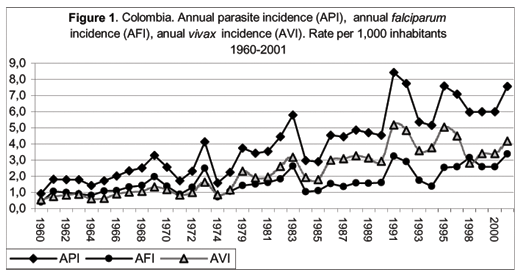
<body><![CDATA[<p><font size="3" face="Verdana"><b>RESULTS</b> </font></p>     <p><font size="2" face="Verdana">1. Control programmes: before-after comparison</font></p>     <p><font size="2" face="Verdana"> Malarial tendencies </font></p>     <p><font size="2" face="Verdana">Two marked tendencies have characterised malaria    in Colombia during the last forty years: decreased mortality and progressive    increase in morbidity (<a href="#fig01">Figure 1</a>). In spite of cases being    under-registered, representing between 15 % and 25 % according to region, an    annual average of 160 thousand cases has been reached during the last few years,    with frequent epidemic outbreaks and urban malaria occurring (38-43). <I>P.    vivax</I> malaria predominates in Colombia. </font></p>     <p><a name="fig01"></a></p>     <p>&nbsp;</p>     <p align="center"><img src="/img/revistas/rsap/v6s1/a01fig01.gif"></p>     <p>&nbsp;</p>     <p><font size="2" face="Verdana">The Pacific Coast area has represented a significant    part of the problem regarding malaria in Colombia. Between 1960 and 1997, 10    % to 46 % of the total number of positive samples from the country corresponded    to this region. However, <I>P. falciparum</I> malaria predominates on the Pacific    Coast. On the other hand, the Pacific Coast has an appreciable list of municipalities    presenting urban malaria: Quibd&oacute;, Istmina, Condoto, Tado, Atrato, Bagad&oacute;,    Sip&iacute; and Llor&oacute; in the Choc&oacute; Department; Buenaventura in    the Valle del Cauca Department; El Charco and Tumaco in the Nari&ntilde;o Department;    and Guapi in the Cauca Department (44-54). </font></p>     <p><font size="2" face="Verdana">The control programme before 1993</font></p>     ]]></body>
<body><![CDATA[<p><font size="2" face="Verdana"> The Malariology Campaign (<I>Campa&ntilde;a    Malariolog&iacute;a</I>) was created in 1943 as a Section of the Interamerican    Cooperative Public Health Service and a dependency of the Ministry of Work,    Hygiene and Social Security. The Campaign became the Malariology Division in    1947; MES was created in 1956 as a dependency of the Ministry of Health Public,    replacing the Malariology Division, putting into practice WHO recommendations    for advancing centrally financed and controlled eradication programmes (55-61).</font></p>     <p><font size="2" face="Verdana">The MES consisted of a Central Office located    in Bogot&aacute;, housing the Management and a laboratory. This had sections    for engineering and operations with insecticides, epidemiology and chemotherapy,    entomology, education and training and administration. It had technical and    administrative autonomy and jurisdiction throughout the whole country (62).    Control campaigns initially included a single annual DDT spraying cycle, protecting    at least 50 % of the population living in malarial areas, but covering just    14,3 % of them. </font></p>     <p><font size="2" face="Verdana">The first eradication campaign began in August    1957 and was extended to October 1958; it was expected that this would achieve    its purpose by interrupting the parasite's transmission cycle. Total coverage    of malarial areas was maintained from 1959 to 1961. At the end of 1962 it finished    its spraying operations and continued with monitoring and prevention activities.    The Eradication Campaign was mainly based on intra-domiciliary DDT spraying    and the mass, free distribution of medicine to patients suffering fever.</font></p>     <p><font size="2" face="Verdana"> The MES functioned as a vertical programme centred    on organising campaigns, being formally dependant on the Ministry of Health,    but functionally autonomous respecting the latter. The eradication strategy    was abandoned towards the end of the 1970s, but it was suggested that its methodologies    should continue to be used (63). The control programme assumed the functions    of active-passive detection of cases, diagnosis, treatment and vector control    in 1969. Problems became identified throughout this whole period, such as the    lack of continuity and official resources and weakness in epidemiological monitoring,    as well as poor civil society participation. The Eradication Campaign did manage    to reduce Colombia's malarial area from 92 % to 85 % of the country's territory    and contributed towards decreasing mortality. </font></p>     <p><font size="2" face="Verdana">The Special Direct Campaign Administrative Unit–SDCAU    (<I>Unidad Administrativa Especial de Campa&ntilde;as Directas</I>-UAECD) was    created in 1976 (64), one year after the creation of the National Health System.    The Malaria Eradication Service's functions were assigned to this unit (65),    its organic structure consisting of personnel distributed amongst 18 Regional    Offices.</font></p>     <p><font size="2" face="Verdana"> The Direct Campaign Division's control activities,    carried out through regional programmes helped by central level, consisted of:</font></p>     <p><font size="2" face="Verdana"> - Spraying with DDT and phenitrotion, where    resistance was detected;    <br>   - UVL spatial applications;    <br>   - Attending people with fever symptoms at 6 500 information posts; and    <br>   - Making diagnoses by 440 microscopes used by volunteers or Health functionaries.</font></p>     ]]></body>
<body><![CDATA[<p><font size="2" face="Verdana"> The spraying, entomology, epidemiology, medication    and case searching operations were undertaken throughout the whole country by    646 operators.</font></p>     <p><font size="2" face="Verdana"> The process of decentralisation by which those    functions regarding tropical disease control became progressively transferred    to the Departments and municipalities began in 1986. The XV Heads of Region    meeting in 1988 proposed methodologies in line with the decentralisation being    experienced in the country, as well as monitoring and prevention strategies    within the context of primary health attention (66) and a less vertical structure    allowing the participation of the community and Sectional Health Services. This    approach was also being promoted within the international setting, implying    a change towards control programmes administratively structured for dealing    with risks in geographical areas whose basic problems were demographic, social    and cultural ones (67). This approach led the Seccional Health Services in Colombia    to assume some functions in the control programme, but the main centralised    and vertical parameters were conserved, since the Direct Campaign division closely    followed the MES model.</font></p>     <p><font size="2" face="Verdana"> Malarial tendencies and the control programme    </font></p>     <p><font size="2" face="Verdana">Analysing the data relating to the 42 years presented    in <a href="#fig01">Figure 1</a> indicates that this series has great variability    and strong self-correlation, preventing it from being valid for use in regression    methodologies. On smoothing the series of data, the progressive increase in    morbidity can be observed and three ascending cycles identified (ten years each).    The long-term process of the malaria control programme has been divided into    two periods for comparison purposes, bearing their transformations and health    system characteristics in mind as follows:</font></p>     <p><font size="2" face="Verdana"> 1960-1991: the Malaria Eradication Service (MES)    during the time of the National Health System; and 1992-2001: the Vector-born    Disease Control programme (VBD) during the time of the GSSHS.</font></p>     <p><font size="2" face="Verdana"> In turn, some sub-periods can be identified    during the first period: </font></p> <table width="305" border="0" cellspacing="0" cellpadding="0">   <tr>      <td width="28">    <p><font size="2" face="Verdana">-</font></p></td>     <td width="277">    <p><font size="2" face="Verdana">1960-76: MES</font></p></td>   </tr>   <tr>      <td>    <p><font size="2" face="Verdana">-</font></p></td>     <td>    <p><font size="2" face="Verdana">1977- 1986: SDCAU</font></p></td>   </tr>   <tr>      <td>    ]]></body>
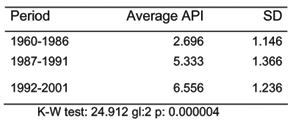
<body><![CDATA[<p><font size="2" face="Verdana">-</font></p></td>     <td>    <p><font size="2" face="Verdana">1987-1991: SDCAU and decentralisation.</font></p></td>   </tr> </table>     <p><font size="2" face="Verdana"> Significant differences were found on regrouping    the first two sub-periods and obtaining the average Annual Parasite Incidence    (API), as indicated below: </font> </p>     <p align="center"><img src="/img/revistas/rsap/v6s1/a01img01.gif"></p>     <p><font size="2" face="Verdana">API averages illustrate the increase in morbidity,    even taking into account those limitations introduced by the variability of    the data. Between the first and last API average there is a 143,5 % increase.    The API for the third period represents a 23,1 % increase on the second period,    whilst the API rose by 98,1 % during the last period respecting the first.</font></p>     <p><font size="2" face="Verdana"> <a href="#fig02">Figure 2</a> shows that malarial    tendencies are related to transformations in the control programme and the processes    of decentralisation and health system reform. </font></p>     <p><a name="fig02"></a></p>     <p>&nbsp;</p>     <p align="center"><img src="/img/revistas/rsap/v6s1/a01fig02.gif"></p>     <p>&nbsp;</p>     ]]></body>
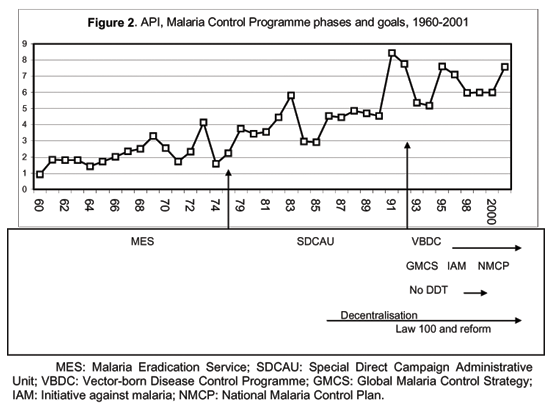
<body><![CDATA[<p><font size="2" face="Verdana">Two clear types of achievement were obtained    during the period corresponding to MES and SDCAU; an appreciable contribution    was made towards the decrease of mortality due to malaria and a methodology    for effective operation, centred on spraying and medicament distribution campaigns.    However, this MES model and methodology became superseded by new, powerful social,    cultural and political conditions in which the problem of malaria which unfolded    during the 1980s. Morbidity increased rapidly from 1986 onwards. In the period    following 1993, morbidity continued to increase and began to become expressed    in a set of connected problems: repeated epidemic outbreaks, the parasite and    vectors' resistance, urban malaria and other similar problems. Even though it    is not a good idea to simply attribute current complex problems regarding malaria    in Colombia to decentralisation and health system reform, the evidence presented    here suggests that the new health system and its VBD Programme has not managed    to confront prior tendencies in a suitable way, nor prevent them becoming worse.    </font></p>     <p><font size="2" face="Verdana">Current programmes' characteristics and problems</font></p>     <p><font size="2" face="Verdana"> The results in terms of those variables considered    are presented next. It should be pointed out that when significant differences    were found between the study group and the control group, these have been specifically    indicated. </font></p>     <p><font size="2" face="Verdana"><I>Service Providers</i>. The Secretariat of    Health directly carried out VBD and malaria action in 86,5 % of those municipalities    studied. Proportions per groups are shown in <a href="#fig03">Figure 3</a>.    Private entities were only found offering services in 3 (8,1 %) out of the 37    municipalities. However, in 16 (43,2 %) out of the 37 municipalities, the Secretariats    of Health were using some form of contracting with municipal public entities,    especially with SPEs, for totally or partially executing the VBD programme,    especially activities regarding diagnosis, treatment and handling severe malaria.</font></p>     <p><a name="fig03"></a></p>     <p>&nbsp;</p>     <p align="center"><img src="/img/revistas/rsap/v6s1/a01fig03.gif"></p>     <p>&nbsp;</p>     <p><font size="2" face="Verdana"> <I>Ownership</i>. Control of malaria was part    of the VBD programme in 30 (81,1 %) out of the 37 municipalities surveyed. It    was thus not differentiated in terms of jobs, personnel or administration (<a href="#fig03">Figure    3</a>).</font></p>     <p><font size="2" face="Verdana"> <I>Planning</i>. Annual operational plans (at    Departmental and municipal levels) were frequently thrown off balance, not up-dated    or out-of-date respecting malarial areas' specific needs and were submitted    to multiple political influences. </font></p>     ]]></body>
<body><![CDATA[<p><FONT SIZE="2" face="Verdana"><I>Organisational structure</i>. 51,4 % of the    total had a structure including a management level, coordination/administration    and execution levels, and at least one horizontal work division in the last    two levels. The proportion of this structure increased on passing from the study    group to the control group and the capital cities, as shown in <a href="#fig03">Figure    3</a>. Overlapping of dependency and job functions was frequently found within    the framework of this structure. The VBD programmes were exceptional in that    they had a shared mission or organisational goals. Management personnel recognised    that they lacked participation and flexibility in allocating work and in decision-making    regarding organisation. At the same time they did not have stable relationships    with training institutions or with properly equipped physical settings/entities.</font></p>     <p> <font size="2" face="Verdana"><I>Control and supervision</i>. 86,5 % of the    municipalities studied had inspection, monitoring and control mechanisms, but    51,4 % of these mechanisms belonged to the municipal or Departmental Secretariat    of Health. 70,3 % of the municipalities reported that there was quality control    regarding programme activities and 67,6 % of them were running supervision activities    (<a href="#fig03">Figure 3</a>).</font></p>     <p><font size="2" face="Verdana"> <I>Financing</i>. All the Departments and municipalities    were operating financing schemes prior to Law 715, 2001 being passed. Those    resources applied to the VBD programme formed part of the municipal health budget,    whose main sources in 2001 were as follows: transfers of current income from    the State (<I>ingresos corrientes de la Naci&oacute;n </I>– ICN), the fiscal    allocation and resources from the Solidarity and Insurance Fund (Fosyga). These    resources represented a little over 60 % of the total health budget. Another    30 % came from Departmental contributions and the sale of Level I Hospital <a name="tx01"></a>services<a href="#nt01"><sup>1</sup></a>.    Some of the resources were partially managed by the Departments in close to    half of the municipalities from the two groups. </font></p>     <p><font size="2" face="Verdana">Most Departments and municipalities considered    that the aforementioned resources were insufficient and that payments were made    late. They frequently found that there was not enough clarity in allocating    and managing those resources destined for the VBD programme. Not one of the    municipalities had any sort of system of public accountability.</font></p>     <p><font size="2" face="Verdana"> <I>Personnel</i>. Heads of VBD programmes in    the Departments had a professional qualification and 75 % of them had some type    of postgraduate degree. VBD programme heads (or those in charge assuming the    management of other programmes) in medium-sized and some cities had had professional    training, but only 25 % to 30 % of them had managed to study for a postgraduate    degree. 26 out of the 28 municipalities in the study group had one or more professionals    in management posts; a third of them had up to two years' seniority and another    third had 20 years or more seniority. Technicians participated in management    posts in 10 out of the 28 municipalities (35,7 %), especially in the smallest    ones, most of them having up to five years' seniority.</font></p>     <p><font size="2" face="Verdana"> 15 out of the 28 municipalities (53,6 %) had    at least one professional in the post of programme coordination; in 10 of the    municipalities (35,7 %) they had up to 1 year's seniority. They had 5 or more    years' seniority in just 4 municipalities (14,3 %). </font></p>     <p><font size="2" face="Verdana">Most interviews highlighted the following aspects:    personnel in charge of the programmes did not have sufficient technical, administrative    and analytical abilities for planning and managing based on objectives and for    performing as managers. Salaries were not appropriate and there were no financial    and/or non-financial incentive systems. Personnel administration was thus not    professional but rather authoritarian, promotions were not made based on merit    and/or performance and they frequently became political ingredients. Corruption    in contracting and recruiting personnel was common.</font></p>     <p><font size="2" face="Verdana"> <I>Training</i>. Training activities were only    carried out in 9 out of the 28 municipalities (32,1 %) in the study group and    2 out of the 5 municipalities (40 %) in the control group during 2001-2002.    There was a lack of shared training processes for VBD programme personnel or    any having a common/heterogeneous purpose.</font></p>     <p><font size="2" face="Verdana"> <I>Operational personnel base and activities.</i>    97,2 % of the operational personnel stayed in the main towns, operating according    to a programme of visits or as a response to emergency situations. On the other    hand, 21,6 % of such personnel were carrying out activities different to just    that of malaria, but within the framework of the VBD programme.</font></p>     <p><font size="2" face="Verdana"> <I>Consumer items</i>. Providing medicine, insecticides    and mosquito netting was generally late and insufficient.</font></p>     ]]></body>
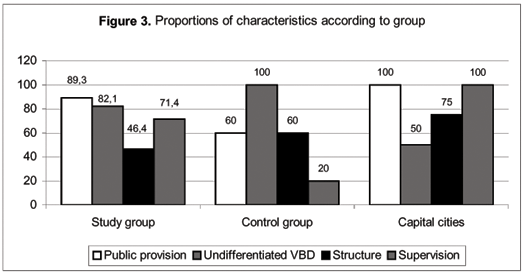
<body><![CDATA[<p><font size="2" face="Verdana"> <I>Networks</i>. It was found that the microscope    network was relatively well developed in the municipalities in the study group,    since 85,7 % of them had it (<a href="#fig04">Figure 4</a>). The same thing    did not happen with other networks required for managing malaria, especially    in entomology.</font></p>     <p><a name="fig04"></a></p>     <p>&nbsp;</p>     <p align="center"><img src="/img/revistas/rsap/v6s1/a01fig04.gif"></p>     <p>&nbsp;</p>     <p><font size="2" face="Verdana"> <I>Monitoring and information system</i>. In    spite of it being considered that capturing cases of malaria was deficient,    more than 80% of the municipalities had an epidemiological monitoring system    and it was considered that the information was reliable (<a href="#fig04">Figure    4</a>). At the same time, everyone had received support for training; however,    only 35,1 % considered that this had been a good opportunity and that feedback    from the information had been useful. The information system lacked integration    and had very little technological development. It also lacked systematic information    regarding the efficacy of chemical and biological control activities. At the    same time, an important discrepancy became presented between the information    regarding cases managed in the municipalities and that used by the Ministry    of Health. </font></p>     <p><FONT SIZE="2" face="Verdana"><I>Social participation</i>. A precarious level    of social participation was observed, this being one of the malaria control    programmes' notable weaknesses. Regarding this aspect, differences between study    and control groups became significant. Only 32 % of study group municipalities    had some type of participation social, whilst the control group had 100 % (<a href="#fig04">Figure    4</a>).</font></p>     <p> <font size="2" face="Verdana"><I>Interaction and coordination</i>. It was    generally found that there were no political frameworks allowing goals for coordinated    action to become defined amongst the municipalities. Vertical and horizontal    interaction amongst VBD programmes, like the public sector, was consequently    weak. Intersector coordination with other programmes reached 54,1 % in all municipalities,    indicating that this tool is not used properly, giving little opportunity for    making other sectors become aware (<a href="#fig04">Figure 4</a>).</font></p>     <p><font size="2" face="Verdana"> <I>Programme dynamics</i>. The perception predominated    that the VBD programme had become weakened from 1997 to 2001, except in the    capital cities (<a href="#fig05">Figure 5</a>). Difficulties were recognised    in both the study and control groups, especially regarding financing, organisation,    personnel, logistics and technical capacity (<a href="#tab01">Table 1</a>).    </font></p>     <p><a name="fig05"></a></p>     ]]></body>
<body><![CDATA[<p>&nbsp;</p>     <p align="center"><img src="/img/revistas/rsap/v6s1/a01fig05.gif"></p>     <p>&nbsp;</p>     <p><a name="tab01"></a></p>     <p>&nbsp;</p>     <p align="center"><img src="/img/revistas/rsap/v6s1/a01tab01.gif"></p>     <p>&nbsp;</p>     <p><font size="2" face="Verdana"><I>VBD coverage</i>. 50 % or more of municipalities    from the three groups stated that programme coverage had diminished during 1995-2001    (<a href="#fig05">Figure 5</a>).</font></p>     <p><font size="2" face="Verdana"> <I>Adapting the VBD-malaria programme to the    scheme laid down in Law 100 and decentralisation</i>. It was found that 56,7    % of the total had adapted their approach very little or not at all to those    schemes laid down in Law 100 and decentralisation (<a href="#fig05">Figure 5</a>).    This suggests that if important transformations had been made to the VBD programme,    these had still not been adequately adopted to the scheme of organisation and    operation laid down in Law 100. </font></p>     <p><FONT SIZE="2" face="Verdana"><I>Relationship between variables</i>. Bivariable    analysis (variable to variable, Kruskas-Wallis test) indicated the existence    of some associations (p&lt;0.002), as shown below. Two types of grouping were    systematically made; on the one hand, the lack of adapting to Law 100, the weakening    of the programme and declining coverage were related to the programme's lack    of differentiation and also to supervision of activities, the existence of a    monitoring system and the absence of social participation. On the other hand,    greater adapting to Law 100 was associated with decentralisation and greater    capacity for providing coverage. The former suggests that it is possible to    find VBD programmes where epidemiological monitoring and supervision activities    are being undertaken, in spite of weaknesses and lack of coverage.</font></p>     ]]></body>
<body><![CDATA[<p><font size="2" face="Verdana"> Multivariable analysis (multiple correspondence)    showed that it was possible to coordinate and simplify the system of relationships,    giving new significance to those, which had previously been identified in bivariable    analysis. Taking municipal development as a parameter, four areas of results    were identified in terms of those variables-categories with which each one was    most associated.</font></p>     <p><font size="2" face="Verdana"> Study group municipalities were associated with    adapting to Law 100 (little or acceptable), apl-p and apl-a, decentralisation    (dm-s), as well as having increased the programme (ep-in) and having the capacity    to provide acceptable coverage (cpc-a), but were independent respecting organisational    structure and programme differentiation. Another delimited area corresponded    to those municipalities which had not adapted to Law 100 (apl-n), with intermediate    or more complex organisational structure (eo-2, eo-3), in which the programme    had stayed the same or had become weakened (ep-ig; ep-hd), were undifferentiated    (gd-nd) but had supervision of activities (sa-s) and were independent of decentralisation.    Category 2 municipalities (cat-2) were most associated in this area (i.e. capital    and intermediate cities). </font></p>     <p><font size="2" face="Verdana"> Control and capital groups (g-cr; g-cap) tended    to be associated with some study group municipalities (cat-4), in terms of social    participation (ps-s). A set of them had no social participation (ps-n), the    programme had become weakened (ep-hd) and did not have supervision of activities.    </font></p>     <p><font size="2" face="Verdana"><I>Insuring entities – SRAs and HPEs (Administradoras    del Regime Subsidizado - ARS, Empresas Promotoras de Salud - EPS)</i>. 15 surveys    were carried out, 13 (86,7 %) with SRAs and 2 (13,3 %) with con HPEs. Out of    the total 5 were public and 10 private. The main variables' frequencies are    given below.</font></p>     <p><font size="2" face="Verdana"> - Payment for activities regarding managing    complicated malaria: 12 (80 %) totally paid and 1 (6,7 %) partially paid;    <br>   - Specific resources for diagnosing and treating the involved population: 10    (66,7 %) had no resources; only 2 (13,3 %) showed that they had them;    <br>   - Reports regarding malaria: 10 (66,7 %) had not presented a report or had not    supplied information; 5 (33,7 %) presented two or more reports during the year    to Departmental or local Secretariats of Health; and    <br>   - Participation: only 6 insuring entities (40 %) participated in some aspect    of designing the local Basic Attention Plan, especially in diagnosis and monitoring    (26,7 %).</font></p>     <p><font size="2" face="Verdana"> <I>Service-providing entities - SPEs (Prestadores    de Servicios – IPS)</i>. 20 surveys were carried out with service-providing    institutions: 16 (80 %) in the study group, 2 (10 %) in the control group and    2 in the capitals. Out of the total, 11 (55 %) were hospitals or clinics; 16    (80 %) were public and 4 private.</font></p>     <p><font size="2" face="Verdana"> The main frequencies indicated that:</font></p>     ]]></body>
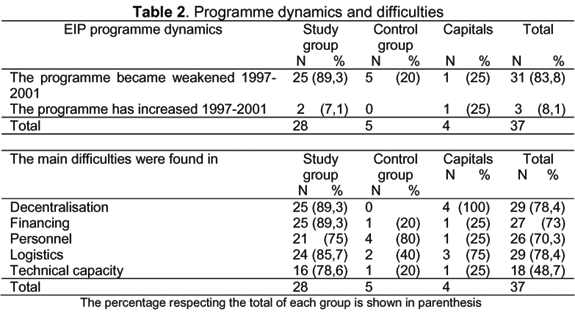
<body><![CDATA[<p><font size="2" face="Verdana"> - Levels: 13 (68,4 %) from level I, 5 (25 %)    from level II and 1 (5 %) from level III;</font></p>     <p><font size="2" face="Verdana"> - Users Association: these were found in 10    (50 %) IPS;</font></p>     <p><font size="2" face="Verdana"> - Resources for individual promotion and prevention:    7 (35 %) had such a resource;</font></p>     <p><font size="2" face="Verdana"> - Reports: 10 (50 %) IPS presented 12 reports    or more per year about malaria, most were sent to the Departmental Secretariat    of health;</font></p>     <p><font size="2" face="Verdana"> - Medicine: 5 (25 %) manifest that the supply    of medicine was appropriate. Out of the total of those IPS receiving medicine,    17 (85 %) received from the Ministry of Health, via the Department or municipality;    and</font></p>     <p><font size="2" face="Verdana"> - Only 10 (50 %) IPS participated in drawing    up the BAP, especially in diagnosing and designing it.</font></p>     <p><font size="2" face="Verdana"> <I>Extended immunisation programme - EIP vs.    VBD Programme</i>. Secretariat of Health SPEs carried out vaccination in 22    out of the 28 study group municipalities; at least 11 of the 28 municipalities    had carried out vaccination campaigns during 2002-2003. Likewise, the municipalities,    except for supplying the vaccines, mostly did those activities forming part    of the vaccination programme. The latter and more than 85 % of the EIP programmes    depended on financing from the Ministry of Health, but also used Departmental    resources.</font></p>     <p><font size="2" face="Verdana"> The same as in the case of the VBD programme,    the perception that this had became weakened predominated in the EIP programme    too (<a href="#tab02">Table 2</a>), being even more accentuate in the study    group. The main difficulties were related to aspects regarding financing, decentralisation,    logistics, technical capacity and personnel. </font></p>     <p><a name="tab02"></a></p>     <p>&nbsp;</p>     ]]></body>
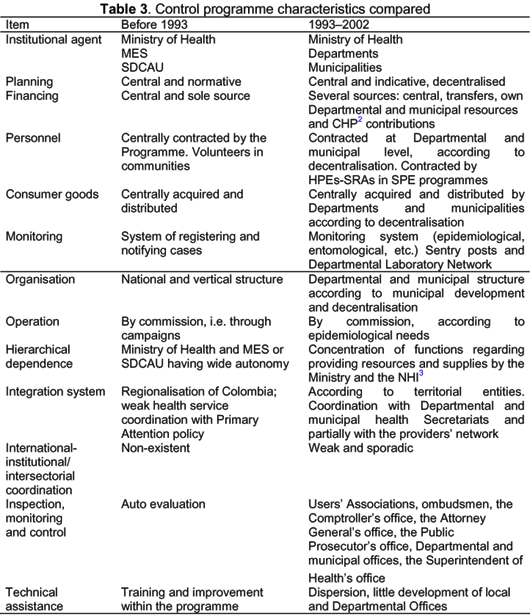
<body><![CDATA[<p align="center"><img src="/img/revistas/rsap/v6s1/a01tab02.gif"></p>     <p>&nbsp;</p>     <p><font size="2" face="Verdana">More than 80 % of the municipalities in both    groups estimated that coverage had diminished or stayed the same during 1995-2001.    On the other hand, no less than 75 % of the EIP programmes had managed to become    adapted to the scheme laid down in Law 100 and current capacity for providing    an acceptable or total response was high, except in the logistics.</font></p>     <p><font size="2" face="Verdana"> The Student t test was used for comparing the    replies obtained in the VBD and EIP surveys, applied to summing the proportions    from the study groups and the capitals in each type of survey (gl=62). Significant    differences were found in the EIP programme (p<u>&lt;</u>0.02), mainly regarding    the "weakening of the programme" and the "acceptable and total capacity for    providing coverage" options; the VBD programme presented the greatest proportion    of significant difference in the "programme has become increased" option.</font></p>     <p><font size="2" face="Verdana"> Comparison and balance</font></p>     <p><font size="2" face="Verdana"> As has been stated, both the control programme    prior to 1993, at least in its final phase, and the programme following 1993    presented low efficacy respecting growing tendencies and new problems regarding    malaria.</font></p>     <p><font size="2" face="Verdana"> The information obtained, complemented by secondary    information (69-72,75-80), led to key malaria control programme characteristics    being identified, as shown in <a href="#tab03">Table 3</a>.</font></p>     <p><a name="tab03"></a></p>     <p>&nbsp;</p>     <p align="center"><img src="/img/revistas/rsap/v6s1/a01tab03.gif" border="0" usemap="#Map">    <map name="Map">     <area shape="rect" coords="355,113,366,124" href="#nt02">     <area shape="rect" coords="415,364,428,380" href="#nt03">   </map> </p>     ]]></body>
<body><![CDATA[<p>&nbsp;</p>     <p><font size="2" face="Verdana"> The balance between the two programmes puts    those aspects conserved from the prior programme and gains from the VBD programme    into relief:</font></p>     <p><font size="2" face="Verdana"> - Aspects persisting from the prior programme,    in the new conditions pertaining to the relationship between the Ministry of    Health and Departmental and municipal Health Services: providing consumer goods,    especially medicine. Likewise, providing consumer goods continues to be insufficient    and hardly opportune.</font></p>     <p><font size="2" face="Verdana"> - Aspects relating to gains from the control    programme post 1993: resources have increased but they are perceived to be less    even applied due to their dispersion throughout many Departments and municipalities    having relative autonomy; there has been a rapid deterioration of conditions    which have led to increased morbidity; the diversity of actors, but these having    little commitment to the programmes; the concurrence of many sources of financing    for the programmes; budgetary control by Departments and municipalities.</font></p>     <p><font size="2" face="Verdana"> <I>Gaps in the current programme</i>. The following    are considered to be gaps in the programme prior to 1993. </font></p>     <p><font size="2" face="Verdana">Positive aspects of that programme which have    not been incorporated into the VBD programme:</font></p>     <p><font size="2" face="Verdana"> - Normative dimension: its own specific normative    frameworks;    <br>   - Planning: ecological coordination according to a regional overview, the experience    and capacity for formulating regional and Departmental plans;    <br>   - Personnel: the volume and stability of personnel according to perceived needs;    motivation of and incentives for personnel;    <br>   - Managerial capacity: countrywide or regional management capacity and global    evaluation; control of resources; the system of information regarding malaria,    within the framework of the National Health System information system;    ]]></body>
<body><![CDATA[<br>   - Training: elaborating partial plans;    <br>   - Strong institutional structures; and    <br>   - Systematic community interventions. </font></p>     <p> <font size="2" face="Verdana"> Potential gains from the new programme which    have not been implemented:</font></p>     <p><font size="2" face="Verdana"> - Planning and supervising activities and analysing    achievements;    <br>   - Continuity in the planning process;    <br>   - Capacity for providing the programmes with Technical Assistance;    <br>   - Flexible and integral management of new strategies and activities;    <br>   - Prepared personnel having sufficient training in managerial and administrative    aspects;    <br>   - Sufficient and continuous training of personnel, with appropriate remuneration;    ]]></body>
<body><![CDATA[<br>   - Managing personnel based on merit and transparent management;    <br>   - Using the BAP as a tool for activities, research and coordination;    <br>   - Appropriate and continuous control of resources;    <br>   - Positive transformation of the effects of how policy is made; and    <br>   - Appropriate availability of entomologists; continuous control efforts being    made.</font></p>     <p><font size="2" face="Verdana"> 2. Decentralisation, territorial models and    health system reform</font></p>     <p><font size="2" face="Verdana"> Decentralisation has been a show, constant,    long-term process in Colombia since 1986, modelled by Law 12 in 1986, 60 in    1993 and 715 in 2001. The last two established and improved the system of transferring    resources between the Nation, Departments and municipalities, serving as the    basis for decentralisation. Law 10, 1990 felt the way forward for decentralisation    in the health sector and introduced some institutional changes in it. Law 100    in 1993 fully reformed the health system and created the GSSHS.</font></p>     <p><font size="2" face="Verdana"> Political and administrative decentralisation    of the municipalities is still far from being finished. Only 522 municipalities    (49 % of the total) had managed to obtain the necessary certification for them    to become decentralised in 2001; the degree to which these municipalities have    fulfilled the requirements for obtaining such certification has not been homogeneous    (68). Decentralisation and reform thus represent the two general and political    frameworks having an effect on all health programmes, including VBD control    (69-71). Pacific Coast Department and municipal experience constitutes a special    and specific case, since VBD control programmes have followed their own route    towards decentralisation.</font></p>     <p><font size="2" face="Verdana"> In the Departments dealt with in this study,    the Institute of Health in the Nari&ntilde;o Department, based in Pasto, has    a VBD Control Unit in Tumaco, its second city, managing the programme for 10    endemic municipalities. The Department is decentralised, as are some municipalities    but in that related to the VBD programme they depend on the Tumaco Unit.</font></p>     <p><font size="2" face="Verdana"> The Cauca Department is decentralised but a    good part of the municipalities are not; the VBD programme is centralised at    Departmental level, operating like this with the malarial municipalities.</font></p>     ]]></body>
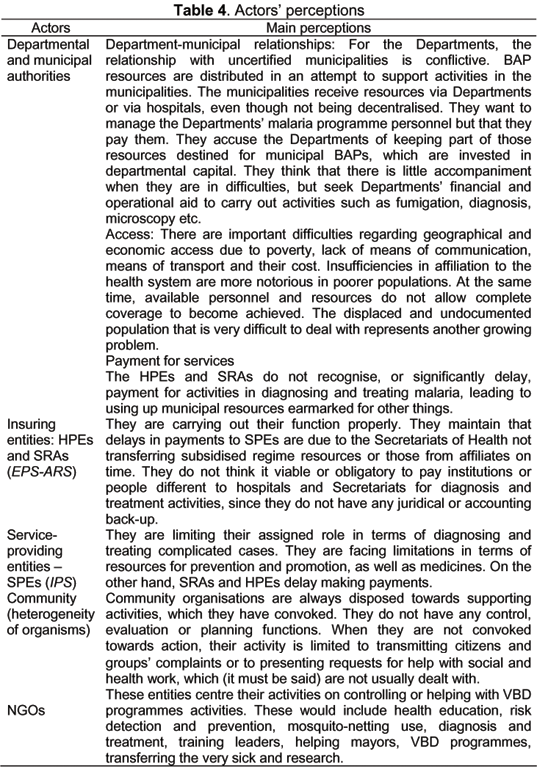
<body><![CDATA[<p><font size="2" face="Verdana"> Former MES personnel in the Valle del Cauca    were appointed to a Decentralised Departmental Institute assuming responsibility    for the VBD programme in 42 municipalities. This Institute has the same hierarchical    level as that of the Secretariat of Health, but this is an operational unit    which in turn centralises the VBD programme in an appreciable number of municipalities,    in spite of some of them being already decentralised.</font></p>     <p><font size="2" face="Verdana"> The Choc&oacute; Department is decentralised    but the municipalities are not and the VBD programme is centralised at Departmental    level, operating like this with its malarial municipalities.</font></p>     <p><font size="2" face="Verdana"> This type of incomplete but stable decentralisation,    in the midst of general processes related to administrative political decentralisation,    has provided space for relationships leading to advantages for some actors;    from the technical point of view it allows more centred managing of those critical    problems which municipalities are not able to confront on their own. But the    problems inherent in this decentralisation scheme are son evident; the regional    or departmental unit assumes responsibility for the control programme and the    municipalities do not carry out activities or assign resources. From a political    point of view, this is a scheme allowing dominant political parties' lines of    clientelist action to use the State's departmental and municipal apparatus,    as well as its public institutions. </font></p>     <p><font size="2" face="Verdana">The achievements and problems of the GSSHS have    an effect on all of the system's dimensions, including the VBD programme. Amongst    the former, it is worth mentioning the increase in insurance and spending on    health, the consolidation of contributions and fiscal resources as sources of    financing, the vertical, horizontal and regional solidarity, the increase of    subsidies to the poor and the broad package of services. On the other hand,    some problems can be highlighted: the insufficient level of affiliation (72),    the inefficacy in spending, the increase in expenses, inappropriate flows of    resources, inadequate and insufficient identification and affiliation of poor    people, segmentation of the population and weak stewardship/management.</font></p>     <p><font size="2" face="Verdana"> 3. Actors' perceptions </font></p>     <p><font size="2" face="Verdana">Other dimensions of VBD programme characteristics    and problems have to do with each actor's perceptions of themselves and the    other others actors, within the framework of the health system. Their perceptions    are given below (<a href="#tab04">Table 4</a>). </font></p>     <p><a name="tab04"></a></p>     <p>&nbsp;</p>     <p align="center"><img src="/img/revistas/rsap/v6s1/a01tab04.gif"></p>     <p>&nbsp;</p>     ]]></body>
<body><![CDATA[<p><font size="2" face="Verdana">4. Control model </font></p>     <p><font size="2" face="Verdana">A large part of the fundamental elements of the    model for malaria control that we are proposing have already been presented    (structural basis and malarial tendencies, the programme's current problems,    etc.). Likewise, those challenges and values found in the National Malaria Control    Plan (<I>Plan Nacional de Control de la Malaria </I>- PNCM) were considered    when designing the model in terms of objectives, goals and strategies (eliminating    transmission, diminishing morbidity, avoiding mortality and complications and    preventing the appearance of outbreaks of malaria). Similarly, the transformation    of the political and institutional context leading to having an effect on programme    control should be pointed out; the Ministry of Health was recently merged with    the Ministry of Work and social Security, forming the Ministry of Social Protection,    generating extensive reorganisation and relocation of functions and dependencies.</font></p>     <p><font size="2" face="Verdana"> The modelling exercise required the following    aspects of the model for the control of malaria to be taken into account:</font></p>     <p><font size="2" face="Verdana"> - Principles underlying the new control model    programme: a set of key capacities must be included having a significant effect    on programmes having different degrees and level of development;    <br>   - Approach: comprehensive, seeking to compensate or equilibrate coverage and    quality; and    <br>   - Purposes and objectives: for contributing towards reducing and preventing    mortality and morbidity, controlling transmission and avoiding epidemic outbreaks,    the model has the following objectives:    <br>   - Augmenting malaria programme control management capacity (building management    capacity) at municipal and Departmental level;    <br>   - Improving control activity quality and scope (prevention, treatment and monitoring)    in the municipalities and Departments;    <br>   - Criteria and viability: these have been conceived as being a realizable challenge,    between the optimal and the desirable, in a complex institutional and social    setting within the current normative framework, without which processes should    be undertaken for modifying or producing Laws and Decrees. Simpler normative    transformations could be necessary (i.e. Ministry Resolutions or Assembly and    Council decisions);</font></p>     <p><font size="2" face="Verdana"> - Scope: applicable at departmental and municipal    level; and    ]]></body>
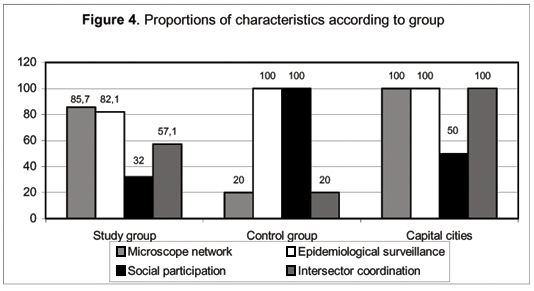
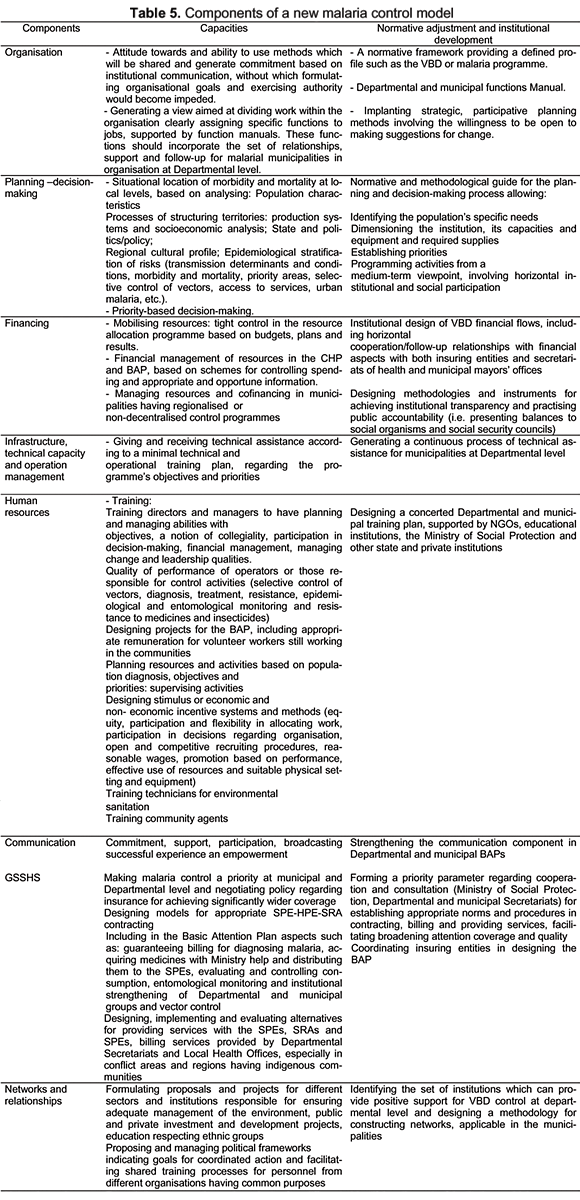
<body><![CDATA[<br>   - Parameters: the model's parameters are strengthening human talent, institutional    adjustment and normative development (organisation, planning, infrastructure,    supplies, etc.).</font></p>     <p><font size="2" face="Verdana"> The control model's components are synthetically    shown in <a href="#tab05">Table 5</a>, in terms of those capacities and aspects    of normative adjustment and institutional development that should be acquired.</font></p>     <p><a name="tab05"></a></p>     <p>&nbsp;</p>     <p align="center"><img src="/img/revistas/rsap/v6s1/a01tab05.gif"></p>     <p>&nbsp;</p>     <p><font size="3" face="Verdana"><b>DISCUSSION</b></font></p>     <p><font size="2" face="Verdana"> The predominating approach of managing malaria    as a public health problem is centred on activities (diagnosis, treatment, insecticides,    mosquito nettings, education, etc.). This approach has contributed much knowledge    regarding malaria, as well as some recent successes (73-75). When a method or    activity whose efficacy has been proved does not give the expected results,    then the difficulties are attributed to isolated factors of control programme    organisation and operation (administration, financing, personnel, etc.) or incontrollable    processes within the context (5,33,76,77).</font></p>     <p><font size="2" face="Verdana"> Health system reform and decentralisation processes    and the growing negative effects of terminating the former National Health System    weakened public health programmes in Colombia (69-71). Taken together, they    suggest that it is not enough to have good methods for confronting malaria or    controlling its effects on the population, but rather others requiring examining    the organisation entrusted with such methods.</font></p>     <p><font size="2" face="Verdana"> This study was focused on the institution entrusted    with the malaria control programme; this institution is part of a health system    (a set of interacting elements), operating as a service (generating products    for a population). Its dynamics and problems can be considered from several    theoretical approaches: systemic development (78), agency roles and stewardship    (79-82). The agency is orientated towards control programmes regarding service    users. Stewardship provides a normative framework guided by ethics; such approach    allows proposing a broader methodology for approaching malaria control programmes,    from which the context and activities can be observed. </font></p>     ]]></body>
<body><![CDATA[<p><font size="2" face="Verdana">Some studies have been carried out at international    level concerning adapting malaria control programmes to local conditions, from    the Garki project's pioneering studies (83), especially as case studies (84).    Most studies in Colombia have been concentrated on the characteristics of the    malaria problem and transmission and programmes and activities (38-55). Some    of them have occupied themselves with factors regarding the social, economic,    political and cultural structures which have had deeply effected malarial tendencies    in our country. Less interest has been provoked by evaluating the effects of    transformations in agrarian production systems, spontaneous and forced migrations,    colonisation (85), growing coca crops and the political confrontation, corruption    and clientelism which have provided greater or lesser impetus than decentralisation    and State reform. </font></p>     <p><font size="2" face="Verdana">The tendencies and the situation of malaria in    the population thus depend on the complex interaction of factors conditioning    the intensity of transmission, the frequency of the disease, its forms of manifestation    and its epidemiological characteristics. Reconstructing malaria's long-term    tendencies led to finding that there was an early increase in morbidity in the    1980s (86). New social, political and cultural processes became combined during    this period that then became added to decentralisation and even later on to    reform. The MES and SDCAU effectively contributed towards reducing mortality    for more than 20 years, but then they became exceeded by structural efforts    and processes governing malaria. The same thing happened again with VBD programmes    put together during the process of decentralisation and reform, which weakened    public health. In this sense, findings from two recent studies (5,33) suggest    that there is limited access to diagnosis and treatment, the disassociation    of qualified personnel has left responsibility for the programme in the hands    of untrained personnel and broken up the public network. Likewise, if decentralisation's    long-term scheme for transferring resources has contributed towards improving    equity in regional allocation (87), the same has not happened with allocating    subsidies to the regions according tot their Unsatisfied Basic Needs (UBN),    whose distribution is widely inequitative (14-16,88). Other Concurring problems    are affecting the health system: insufficient affiliation, many stages and delays    in designing resources as subsidies, insuring entities' inappropriate management,    inequalities in contracting and the absence of monitoring and control mechanisms    from dominating positions and little social participation (88). VBD programmes    thus found themselves amidst multiple pressures originating from economic, socio-political,    decentralisation and health system reform processes. In this respect, some studies    have indicated that those processes affecting the context of public institutions    also have an effect on their organisation, administration, human resources and    financial management (89-93).</font></p>     <p><font size="2" face="Verdana"> Characterising the current malaria control programme's    characteristics and problems has led to identifying its profile. This type of    programme is mainly public in Colombia: SPE managed, financed and curative services.    They have little degree of administrative development and lack training plans;    many personnel have a low degree of scholastic preparation and have recently    become involved with such programmes, lacking incentives and remuneration is    low. There are insufficient consumer products and these are late in being delivered.    The programmes operate mainly through visits to municipalities. There is little    social participation and other social, institutional and civil sectors are not    coordinated. Insuring entities are mainly private but apart from the Secretariats    of Health (respecting the VBD) and they have no affect on drawing up the BAPs.</font></p>     <p><font size="2" face="Verdana"> Comparing the VBD programme with the EIP suggests    that they have experienced similar effects in decentralisation and reform; however,    the processes have been different. The VBD programme tries (without success    to date) to ensure that insures and providers appropriately comply with their    roles and apply the CHP. Vaccination campaigns were progressively abandoned    by the Secretariats of Health after 1997 in the EIP and the programme became    assumed by the HPE-SRA insuring entities and the SPEs, leading to a rapid fall    in vaccination and the level of effective protection. The later return to the    scheme of campaigns, in conditions of more advanced decentralisation, retained    the SPEs as vaccination agents and recovering the role of the Secretariats of    Health, improving the level infant vaccination.</font></p>     <p><font size="2" face="Verdana"> In view of the above, the exercise of VBD malaria    programme institutional modelling was carried out with sufficient foundation,    dealing with those gaps identified and aiming at the objectives proposed in    national malaria control policy. The model is centred on capacities, normative    adjustments and institutional development. This model allows the organisation,    planning methodologies, resource allocation and managing personnel having multiple    abilities to become progressively transformed (94). It likewise leads to institutions    outside the health sector and the private sector to become involved in malaria    control activities (95,96). Just like the institutions, malaria control programmes    must become up-dated and adapted, acquiring the capacity to operate in adverse    conditions.</font></p>     <p><font size="2" face="Verdana"> The study had a set of limitations. In terms    of control programmes, it represents the territorial (Department) centralised    or partially decentralised scheme. It does not have a VBD programme corresponding    to a completely decentralised territorial scheme. On the other hand, it is based    on the malarial, ecological and epidemiological type, predominating on the Pacific    Coast, meaning that as other regions share it then it is not the only one in    the country. The weakness of Departmental and municipal health information systems    restricts any reliable information that can be used •</font> </p>     <p><FONT SIZE="2" face="Verdana"><B>Acknowledgements</b>. This paper was made    possible through support provided by the Alliance for Health Policy and Systems    Research (AHPSR) and the World Health Organisation. We would like to thank Miguel    Gonz&aacute;lez-Block and Indra Pathmanathan (AHPSR Manager and consultant)    for their methodological help. We would also like to thank Carolina Su&aacute;rez,    Adri&aacute;n Mu&ntilde;oz and Diony Pulido for their direct help with the field-work    and the innumerable functionaries from the Departmental and municipal Mayors'    offices and Secretariats of Health, from the SPEs (IPS), SRAs (ARS) and HPEs    (EPS), from the community and from NGOs for their collaboration which made it    possible to obtain all the information used in this study.</font></p>     <p>&nbsp;</p>     <p><font size="3" face="Verdana"><b> REFERENCES </b></font></p>     <!-- ref --><p><FONT SIZE="2" face="Verdana">1. Direcci&oacute;n de Campa&ntilde;as Directas.    Minsalud Colombia. Informe XV reuni&oacute;n de jefes de zona del Servicio de    Erradicaci&oacute;n de Malaria Colombia. Bogot&aacute;; 1989</FONT>&nbsp;&nbsp;&nbsp;&nbsp;&nbsp;&nbsp;&nbsp;&nbsp;[&#160;<a href="javascript:void(0);" onclick="javascript: window.open('/scielo.php?script=sci_nlinks&ref=000232&pid=S0124-0064200400040000100001&lng=','','width=640,height=500,resizable=yes,scrollbars=1,menubar=yes,');">Links</a>&#160;]<!-- end-ref --><!-- ref --><p><FONT SIZE="2" face="Verdana">2. Ministerio de Salud. Colombia. Divisi&oacute;n    de Patolog&iacute;as Tropicales. Propuesta para el control integrado de la malaria    dentro del proceso de descentralizaci&oacute;n a las entidades territoriales.    Bogot&aacute;; 1992</FONT>&nbsp;&nbsp;&nbsp;&nbsp;&nbsp;&nbsp;&nbsp;&nbsp;[&#160;<a href="javascript:void(0);" onclick="javascript: window.open('/scielo.php?script=sci_nlinks&ref=000233&pid=S0124-0064200400040000100002&lng=','','width=640,height=500,resizable=yes,scrollbars=1,menubar=yes,');">Links</a>&#160;]<!-- end-ref --><!-- ref --><p><FONT SIZE="2" face="Verdana">3. Ministerio de Salud. Colombia. Malaria por    Departamentos. Colombia. Muestras examinadas positivas y por especie. 1993-1997.</FONT>&nbsp;&nbsp;&nbsp;&nbsp;&nbsp;&nbsp;&nbsp;&nbsp;[&#160;<a href="javascript:void(0);" onclick="javascript: window.open('/scielo.php?script=sci_nlinks&ref=000234&pid=S0124-0064200400040000100003&lng=','','width=640,height=500,resizable=yes,scrollbars=1,menubar=yes,');">Links</a>&#160;]<!-- end-ref --><!-- ref --><p><FONT SIZE="2" face="Verdana">4. XVTh International congress for tropical medicine    and malaria. Abstract Volumen 1. Roll Back Malaria in Colombia. Cartagena; 2000.    p. 283.</FONT>&nbsp;&nbsp;&nbsp;&nbsp;&nbsp;&nbsp;&nbsp;&nbsp;[&#160;<a href="javascript:void(0);" onclick="javascript: window.open('/scielo.php?script=sci_nlinks&ref=000235&pid=S0124-0064200400040000100004&lng=','','width=640,height=500,resizable=yes,scrollbars=1,menubar=yes,');">Links</a>&#160;]<!-- end-ref --><!-- ref --><p><FONT SIZE="2" face="Verdana">5. Ministerio de Salud – OPS. Reuni&oacute;n    de impulso a la Iniciativa Hacer Retroceder el Paludismo (IHRP) en Colombia.    Bogot&aacute;; 2000. p. 71.</FONT>&nbsp;&nbsp;&nbsp;&nbsp;&nbsp;&nbsp;&nbsp;&nbsp;[&#160;<a href="javascript:void(0);" onclick="javascript: window.open('/scielo.php?script=sci_nlinks&ref=000236&pid=S0124-0064200400040000100005&lng=','','width=640,height=500,resizable=yes,scrollbars=1,menubar=yes,');">Links</a>&#160;]<!-- end-ref --><!-- ref --><p><FONT SIZE="2" face="Verdana">6. Informe Quincenal Epidemiol&oacute;gico Nacional.    Comportamiento de la malaria durante 1999. 30 Septiembre 1999; 4 (18): 274-279.</FONT>&nbsp;&nbsp;&nbsp;&nbsp;&nbsp;&nbsp;&nbsp;&nbsp;[&#160;<a href="javascript:void(0);" onclick="javascript: window.open('/scielo.php?script=sci_nlinks&ref=000237&pid=S0124-0064200400040000100006&lng=','','width=640,height=500,resizable=yes,scrollbars=1,menubar=yes,');">Links</a>&#160;]<!-- end-ref --><!-- ref --><p><FONT SIZE="2" face="Verdana">7. Garay LJ. Globalizaci&oacute;n y crisis. TM    Editores. Colciencias.Bogot&aacute;; 1999.</FONT>&nbsp;&nbsp;&nbsp;&nbsp;&nbsp;&nbsp;&nbsp;&nbsp;[&#160;<a href="javascript:void(0);" onclick="javascript: window.open('/scielo.php?script=sci_nlinks&ref=000238&pid=S0124-0064200400040000100007&lng=','','width=640,height=500,resizable=yes,scrollbars=1,menubar=yes,');">Links</a>&#160;]<!-- end-ref --><!-- ref --><p><FONT SIZE="2" face="Verdana">8. Widdus R. Public-private partnerships for    health: their main targets, their diversity, and their future directions. Bull.    WHO. 2001; 79(8): 713-720.</FONT>&nbsp;&nbsp;&nbsp;&nbsp;&nbsp;&nbsp;&nbsp;&nbsp;[&#160;<a href="javascript:void(0);" onclick="javascript: window.open('/scielo.php?script=sci_nlinks&ref=000239&pid=S0124-0064200400040000100008&lng=','','width=640,height=500,resizable=yes,scrollbars=1,menubar=yes,');">Links</a>&#160;]<!-- end-ref --><!-- ref --><p><FONT SIZE="2" face="Verdana">9. Buse k, Waxman A. Public-private health partnerships:    a strategy for WHO. Bull. WHO. 2001;79(8): 748-754.</FONT>&nbsp;&nbsp;&nbsp;&nbsp;&nbsp;&nbsp;&nbsp;&nbsp;[&#160;<a href="javascript:void(0);" onclick="javascript: window.open('/scielo.php?script=sci_nlinks&ref=000240&pid=S0124-0064200400040000100009&lng=','','width=640,height=500,resizable=yes,scrollbars=1,menubar=yes,');">Links</a>&#160;]<!-- end-ref --><!-- ref --><p><FONT SIZE="2" face="Verdana">10. McPake B, Mills A. What can we learn from    international comparisons of health systems and health system reform?. Bull.    WHO.2000; 78(6): 811-820.</FONT>&nbsp;&nbsp;&nbsp;&nbsp;&nbsp;&nbsp;&nbsp;&nbsp;[&#160;<a href="javascript:void(0);" onclick="javascript: window.open('/scielo.php?script=sci_nlinks&ref=000241&pid=S0124-0064200400040000100010&lng=','','width=640,height=500,resizable=yes,scrollbars=1,menubar=yes,');">Links</a>&#160;]<!-- end-ref --><!-- ref --><p><FONT SIZE="2" face="Verdana">11. Londo&ntilde;o JL, Frenk J. Structured pluralism:    towards an innovative model for health system reform in Latin America. Health    Policy. 1997; 41:1-36.</FONT>&nbsp;&nbsp;&nbsp;&nbsp;&nbsp;&nbsp;&nbsp;&nbsp;[&#160;<a href="javascript:void(0);" onclick="javascript: window.open('/scielo.php?script=sci_nlinks&ref=000242&pid=S0124-0064200400040000100011&lng=','','width=640,height=500,resizable=yes,scrollbars=1,menubar=yes,');">Links</a>&#160;]<!-- end-ref --><!-- ref --><p><FONT SIZE="2" face="Verdana">12. Fresneda O. El sistema de selecci&oacute;n    de beneficiarios y el r&eacute;gimen subsidiado de salud en Colombia. Comercio    Exterior. 2003; 53(6):574-586.</FONT>&nbsp;&nbsp;&nbsp;&nbsp;&nbsp;&nbsp;&nbsp;&nbsp;[&#160;<a href="javascript:void(0);" onclick="javascript: window.open('/scielo.php?script=sci_nlinks&ref=000243&pid=S0124-0064200400040000100012&lng=','','width=640,height=500,resizable=yes,scrollbars=1,menubar=yes,');">Links</a>&#160;]<!-- end-ref --><!-- ref --><p><FONT SIZE="2" face="Verdana">13. Universidad de Antioquia. Cobertura del seguro    de salud en Colombia. Observatorio de la Seguridad Social. 2001; 1:1-11.</FONT>&nbsp;&nbsp;&nbsp;&nbsp;&nbsp;&nbsp;&nbsp;&nbsp;[&#160;<a href="javascript:void(0);" onclick="javascript: window.open('/scielo.php?script=sci_nlinks&ref=000244&pid=S0124-0064200400040000100013&lng=','','width=640,height=500,resizable=yes,scrollbars=1,menubar=yes,');">Links</a>&#160;]<!-- end-ref --><!-- ref --><p><FONT SIZE="2" face="Verdana">14. Londo&ntilde;o J L. Distribuci&oacute;n del    ingreso durante la transformaci&oacute;n estructural. Colombia 1938-1988. Santaf&eacute;    de Bogot&aacute;: Tercer Mundo Editores; 1995.</FONT>&nbsp;&nbsp;&nbsp;&nbsp;&nbsp;&nbsp;&nbsp;&nbsp;[&#160;<a href="javascript:void(0);" onclick="javascript: window.open('/scielo.php?script=sci_nlinks&ref=000245&pid=S0124-0064200400040000100014&lng=','','width=640,height=500,resizable=yes,scrollbars=1,menubar=yes,');">Links</a>&#160;]<!-- end-ref --><!-- ref --><p><FONT SIZE="2" face="Verdana">15. Fresneda O. Pobreza, pol&iacute;ticas sociales    y desarrollo en Colombia. 1972-1993. &#91;Tesis Magister en Econom&iacute;a&#93;. Santaf&eacute;    de Bogot&aacute;: Universidad Nacional de Colombia, Facultad de Econom&iacute;a;    1995.</FONT>&nbsp;&nbsp;&nbsp;&nbsp;&nbsp;&nbsp;&nbsp;&nbsp;[&#160;<a href="javascript:void(0);" onclick="javascript: window.open('/scielo.php?script=sci_nlinks&ref=000246&pid=S0124-0064200400040000100015&lng=','','width=640,height=500,resizable=yes,scrollbars=1,menubar=yes,');">Links</a>&#160;]<!-- end-ref --><!-- ref --><p><FONT SIZE="2" face="Verdana">16. V&eacute;lez CA. Gasto social y desigualdad.    Logros y extrav&iacute;os. Santaf&eacute; de Bogot&aacute;: Departamento Nacional    de Planeaci&oacute;n. Misi&oacute;n Social; 1996.</FONT>&nbsp;&nbsp;&nbsp;&nbsp;&nbsp;&nbsp;&nbsp;&nbsp;[&#160;<a href="javascript:void(0);" onclick="javascript: window.open('/scielo.php?script=sci_nlinks&ref=000247&pid=S0124-0064200400040000100016&lng=','','width=640,height=500,resizable=yes,scrollbars=1,menubar=yes,');">Links</a>&#160;]<!-- end-ref --><!-- ref --><p><FONT SIZE="2" face="Verdana">17. Ocampo JA. (Comp.). Historia Econ&oacute;mica    de Colombia. Cuarta Edici&oacute;n. Santaf&eacute; de Bogot&aacute;: Tercer    Mundo Editores. Fedesarrollo; 1994.</FONT>&nbsp;&nbsp;&nbsp;&nbsp;&nbsp;&nbsp;&nbsp;&nbsp;[&#160;<a href="javascript:void(0);" onclick="javascript: window.open('/scielo.php?script=sci_nlinks&ref=000248&pid=S0124-0064200400040000100017&lng=','','width=640,height=500,resizable=yes,scrollbars=1,menubar=yes,');">Links</a>&#160;]<!-- end-ref --><!-- ref --><p><FONT SIZE="2" face="Verdana">18. C&aacute;rdenas M. (Coordinador). El crecimiento    econ&oacute;mico en Am&eacute;rica Latina. Santaf&eacute; de Bogot&aacute;:    Tercer Mundo Editores. Fedesarrollo; 1996.</FONT>&nbsp;&nbsp;&nbsp;&nbsp;&nbsp;&nbsp;&nbsp;&nbsp;[&#160;<a href="javascript:void(0);" onclick="javascript: window.open('/scielo.php?script=sci_nlinks&ref=000249&pid=S0124-0064200400040000100018&lng=','','width=640,height=500,resizable=yes,scrollbars=1,menubar=yes,');">Links</a>&#160;]<!-- end-ref --><!-- ref --><p><FONT SIZE="2" face="Verdana">19. C&aacute;rdenas M, Lusting N (Compiladores).    Pobreza y desigualdad en Am&eacute;rica Latina. Santaf&eacute; de Bogot&aacute;:    Tercer Mundo Editores; 1999.</FONT>&nbsp;&nbsp;&nbsp;&nbsp;&nbsp;&nbsp;&nbsp;&nbsp;[&#160;<a href="javascript:void(0);" onclick="javascript: window.open('/scielo.php?script=sci_nlinks&ref=000250&pid=S0124-0064200400040000100019&lng=','','width=640,height=500,resizable=yes,scrollbars=1,menubar=yes,');">Links</a>&#160;]<!-- end-ref --><!-- ref --><p><FONT SIZE="2" face="Verdana">20. Corredor C. En busca de una alternativa integral    de desarrollo. Santaf&eacute; de Bogot&aacute;: Cinep; 1995.</FONT>&nbsp;&nbsp;&nbsp;&nbsp;&nbsp;&nbsp;&nbsp;&nbsp;[&#160;<a href="javascript:void(0);" onclick="javascript: window.open('/scielo.php?script=sci_nlinks&ref=000251&pid=S0124-0064200400040000100020&lng=','','width=640,height=500,resizable=yes,scrollbars=1,menubar=yes,');">Links</a>&#160;]<!-- end-ref --><!-- ref --><p><FONT SIZE="2" face="Verdana">21. Departamento Nacional de Planeaci&oacute;n,    Informe de Desarrollo Humano para Colombia 1998. Santaf&eacute; de Bogot&aacute;;    1999.</FONT>&nbsp;&nbsp;&nbsp;&nbsp;&nbsp;&nbsp;&nbsp;&nbsp;[&#160;<a href="javascript:void(0);" onclick="javascript: window.open('/scielo.php?script=sci_nlinks&ref=000252&pid=S0124-0064200400040000100021&lng=','','width=640,height=500,resizable=yes,scrollbars=1,menubar=yes,');">Links</a>&#160;]<!-- end-ref --><!-- ref --><p><FONT SIZE="2" face="Verdana">22. Ocampo JA, P&eacute;rez MJ, Tovar CE, Lasso    FJ. Macroeconom&iacute;a, ajuste estructural y equidad. 1978-1996. En: S&aacute;nchez    F (Comp.). La Distribuci&oacute;n del Ingreso en Colombia. Santaf&eacute; de    Bogot&aacute;: Tercer Mundo Editores, Departamento Nacional de Planeaci&oacute;n;    1998. p. 51.</FONT>&nbsp;&nbsp;&nbsp;&nbsp;&nbsp;&nbsp;&nbsp;&nbsp;[&#160;<a href="javascript:void(0);" onclick="javascript: window.open('/scielo.php?script=sci_nlinks&ref=000253&pid=S0124-0064200400040000100022&lng=','','width=640,height=500,resizable=yes,scrollbars=1,menubar=yes,');">Links</a>&#160;]<!-- end-ref --><!-- ref --><p><FONT SIZE="2" face="Verdana">23. Selowsky M. Who benifits from goverment expenditures?    A case study of Colombia. New York: Oxford University Press-Banco Mundial; 1979.</FONT>&nbsp;&nbsp;&nbsp;&nbsp;&nbsp;&nbsp;&nbsp;&nbsp;[&#160;<a href="javascript:void(0);" onclick="javascript: window.open('/scielo.php?script=sci_nlinks&ref=000254&pid=S0124-0064200400040000100023&lng=','','width=640,height=500,resizable=yes,scrollbars=1,menubar=yes,');">Links</a>&#160;]<!-- end-ref --><!-- ref --><p><FONT SIZE="2" face="Verdana">24. Banco Mundial. La Pobreza en Colombia. Bogot&aacute;:    Tercer Mundo Editores; 1996.</FONT>&nbsp;&nbsp;&nbsp;&nbsp;&nbsp;&nbsp;&nbsp;&nbsp;[&#160;<a href="javascript:void(0);" onclick="javascript: window.open('/scielo.php?script=sci_nlinks&ref=000255&pid=S0124-0064200400040000100024&lng=','','width=640,height=500,resizable=yes,scrollbars=1,menubar=yes,');">Links</a>&#160;]<!-- end-ref --><!-- ref --><p><FONT SIZE="2" face="Verdana">25. S&aacute;nchez F (Comp.). La Distribuci&oacute;n    del Ingreso en Colombia. Santaf&eacute; de Bogot&aacute;: Tercer Mundo Editores,    Departamento Nacional de Planeaci&oacute;n; 1998.</FONT>&nbsp;&nbsp;&nbsp;&nbsp;&nbsp;&nbsp;&nbsp;&nbsp;[&#160;<a href="javascript:void(0);" onclick="javascript: window.open('/scielo.php?script=sci_nlinks&ref=000256&pid=S0124-0064200400040000100025&lng=','','width=640,height=500,resizable=yes,scrollbars=1,menubar=yes,');">Links</a>&#160;]<!-- end-ref --><!-- ref --><p><FONT SIZE="2" face="Verdana">26. Giedion U, Morales LG. Focalizaci&oacute;n    de subsidios p&uacute;blicos para la salud en Colombia. Un caso did&aacute;ctico    preparado para el curso sobre la reforma y financiamiento sustentable del sector    Salud. 1999; 105-117.</FONT>&nbsp;&nbsp;&nbsp;&nbsp;&nbsp;&nbsp;&nbsp;&nbsp;[&#160;<a href="javascript:void(0);" onclick="javascript: window.open('/scielo.php?script=sci_nlinks&ref=000257&pid=S0124-0064200400040000100026&lng=','','width=640,height=500,resizable=yes,scrollbars=1,menubar=yes,');">Links</a>&#160;]<!-- end-ref --><!-- ref --><p><FONT SIZE="2" face="Verdana">27. Paredes N. Plan Obligatorio de Salad (POS)    de la seguridad social en Colombia. Un caso did&aacute;ctico preparado para    el curso sobre la reforma y financiamiento sustentable del sector Salud. 1999;    228-244</FONT>&nbsp;&nbsp;&nbsp;&nbsp;&nbsp;&nbsp;&nbsp;&nbsp;[&#160;<a href="javascript:void(0);" onclick="javascript: window.open('/scielo.php?script=sci_nlinks&ref=000258&pid=S0124-0064200400040000100027&lng=','','width=640,height=500,resizable=yes,scrollbars=1,menubar=yes,');">Links</a>&#160;]<!-- end-ref --><!-- ref --><p><FONT SIZE="2" face="Verdana">28. Agudelo C. Sistema de salud y plan de desarrollo:    cobertura y equidad. Rev. salud p&uacute;blica. 1999; 1(2):117-127.</FONT>&nbsp;&nbsp;&nbsp;&nbsp;&nbsp;&nbsp;&nbsp;&nbsp;[&#160;<a href="javascript:void(0);" onclick="javascript: window.open('/scielo.php?script=sci_nlinks&ref=000259&pid=S0124-0064200400040000100028&lng=','','width=640,height=500,resizable=yes,scrollbars=1,menubar=yes,');">Links</a>&#160;]<!-- end-ref --><!-- ref --><p><FONT SIZE="2" face="Verdana">29. C&eacute;spedes JE, Jaramillo I, Mart&iacute;nez    R, Olaya S, Reynales J, Uribe C, Casta&ntilde;o R, Garz&oacute;n E, Almeida    C, Travassos C, Basto F, Angarita J. Efectos de la reforma de la seguridad social    en salud en Colombia sobre la equidad en el acceso y la utilizaci&oacute;n de    servicios de salud. Sistema de salud y plan de desarrollo: cobertura y equidad.    Rev. salud p&uacute;blica. 2000; 2(2):145-164.</FONT>&nbsp;&nbsp;&nbsp;&nbsp;&nbsp;&nbsp;&nbsp;&nbsp;[&#160;<a href="javascript:void(0);" onclick="javascript: window.open('/scielo.php?script=sci_nlinks&ref=000260&pid=S0124-0064200400040000100029&lng=','','width=640,height=500,resizable=yes,scrollbars=1,menubar=yes,');">Links</a>&#160;]<!-- end-ref --><!-- ref --><p><FONT SIZE="2" face="Verdana">30. M&aacute;laga H. Perspectivas de la epidemiolog&iacute;a    en la reforma de la seguridad social. Rev. salud p&uacute;blica. 1999; 1(2):128-136.</FONT>&nbsp;&nbsp;&nbsp;&nbsp;&nbsp;&nbsp;&nbsp;&nbsp;[&#160;<a href="javascript:void(0);" onclick="javascript: window.open('/scielo.php?script=sci_nlinks&ref=000261&pid=S0124-0064200400040000100030&lng=','','width=640,height=500,resizable=yes,scrollbars=1,menubar=yes,');">Links</a>&#160;]<!-- end-ref --><!-- ref --><p><FONT SIZE="2" face="Verdana">31. M&aacute;laga H, Latorre MC, C&aacute;rdenas    J, Montiel H, Sampson C, de Taborda MC, Granados R, Pastor D. Equidad en la    reforma en salud en Colombia. Rev. salud p&uacute;blica. 2000; 2(3):193-219.</FONT>&nbsp;&nbsp;&nbsp;&nbsp;&nbsp;&nbsp;&nbsp;&nbsp;[&#160;<a href="javascript:void(0);" onclick="javascript: window.open('/scielo.php?script=sci_nlinks&ref=000262&pid=S0124-0064200400040000100031&lng=','','width=640,height=500,resizable=yes,scrollbars=1,menubar=yes,');">Links</a>&#160;]<!-- end-ref --><!-- ref --><p><FONT SIZE="2" face="Verdana">32. Mart&iacute;nez P, Rodr&iacute;guez L, Agudelo    C. Equidad en la pol&iacute;tica de Reforma del Sistema de Salud. Rev. salud    p&uacute;blica. 2001; 3(1):13-39.</FONT>&nbsp;&nbsp;&nbsp;&nbsp;&nbsp;&nbsp;&nbsp;&nbsp;[&#160;<a href="javascript:void(0);" onclick="javascript: window.open('/scielo.php?script=sci_nlinks&ref=000263&pid=S0124-0064200400040000100032&lng=','','width=640,height=500,resizable=yes,scrollbars=1,menubar=yes,');">Links</a>&#160;]<!-- end-ref --><!-- ref --><p><FONT SIZE="2" face="Verdana">33. Kroeger A, Ord&oacute;&ntilde;ez-Gonz&aacute;lez    J, &Aacute;vila AI. Malaria control reinvented: health sector reform and strategy    development in Colombia. Tropical medicine and International Health. 2002; 7(5):    450-458. </FONT>&nbsp;&nbsp;&nbsp;&nbsp;&nbsp;&nbsp;&nbsp;&nbsp;[&#160;<a href="javascript:void(0);" onclick="javascript: window.open('/scielo.php?script=sci_nlinks&ref=000264&pid=S0124-0064200400040000100033&lng=','','width=640,height=500,resizable=yes,scrollbars=1,menubar=yes,');">Links</a>&#160;]<!-- end-ref --><!-- ref --><p><FONT SIZE="2" face="Verdana">34. Zeigler BP. Theory of modeling and simulation.    Jhon Wiley &amp; Sons, Inc., New York, N.Y.; 1976.</FONT>&nbsp;&nbsp;&nbsp;&nbsp;&nbsp;&nbsp;&nbsp;&nbsp;[&#160;<a href="javascript:void(0);" onclick="javascript: window.open('/scielo.php?script=sci_nlinks&ref=000265&pid=S0124-0064200400040000100034&lng=','','width=640,height=500,resizable=yes,scrollbars=1,menubar=yes,');">Links</a>&#160;]<!-- end-ref --><!-- ref --><p><FONT SIZE="2" face="Verdana">35. Henriksen E, Selander G, Rosenqvist U. Can    we bridge the gap between goals and practice through a common vision? A study    if politicians and managers' understanding of the provisions of elderly care    services. Health Policy. 2003; 65(2):129-137.</FONT>&nbsp;&nbsp;&nbsp;&nbsp;&nbsp;&nbsp;&nbsp;&nbsp;[&#160;<a href="javascript:void(0);" onclick="javascript: window.open('/scielo.php?script=sci_nlinks&ref=000266&pid=S0124-0064200400040000100035&lng=','','width=640,height=500,resizable=yes,scrollbars=1,menubar=yes,');">Links</a>&#160;]<!-- end-ref --><!-- ref --><p><FONT SIZE="2" face="Verdana">36. Glaser BG, Strauss AL. The discovery of grounded    theory: strategies for qualitative research. Chicago: Aldine; 1967.</FONT>&nbsp;&nbsp;&nbsp;&nbsp;&nbsp;&nbsp;&nbsp;&nbsp;[&#160;<a href="javascript:void(0);" onclick="javascript: window.open('/scielo.php?script=sci_nlinks&ref=000267&pid=S0124-0064200400040000100036&lng=','','width=640,height=500,resizable=yes,scrollbars=1,menubar=yes,');">Links</a>&#160;]<!-- end-ref --><!-- ref --><p><FONT SIZE="2" face="Verdana">37. Morse JM, Field PA. Qualitative research    methods for health professionals. 2<SUP>nd</SUP> ed. Thousand Oaks, CA: Sage;    1995.</FONT>&nbsp;&nbsp;&nbsp;&nbsp;&nbsp;&nbsp;&nbsp;&nbsp;[&#160;<a href="javascript:void(0);" onclick="javascript: window.open('/scielo.php?script=sci_nlinks&ref=000268&pid=S0124-0064200400040000100037&lng=','','width=640,height=500,resizable=yes,scrollbars=1,menubar=yes,');">Links</a>&#160;]<!-- end-ref --><!-- ref --><p><FONT SIZE="2" face="Verdana">38. Franco S, Blair S, Valderrama R. Malaria:    Econom&iacute;a, cultura y vivienda en Urab&aacute; . Medell&iacute;n;1986.    </FONT>&nbsp;&nbsp;&nbsp;&nbsp;&nbsp;&nbsp;&nbsp;&nbsp;[&#160;<a href="javascript:void(0);" onclick="javascript: window.open('/scielo.php?script=sci_nlinks&ref=000269&pid=S0124-0064200400040000100038&lng=','','width=640,height=500,resizable=yes,scrollbars=1,menubar=yes,');">Links</a>&#160;]<!-- end-ref --><!-- ref --><p><FONT SIZE="2" face="Verdana">39. OPS/OMS. Malaria en las Am&eacute;ricas:    Informe de la 5 Reuni&oacute;n de directores de los servicios nacionales de    la erradicaci&oacute;n de la malaria y directores generales de salud en la Am&eacute;ricas.    Washington, D. C.;1988.</FONT>&nbsp;&nbsp;&nbsp;&nbsp;&nbsp;&nbsp;&nbsp;&nbsp;[&#160;<a href="javascript:void(0);" onclick="javascript: window.open('/scielo.php?script=sci_nlinks&ref=000270&pid=S0124-0064200400040000100039&lng=','','width=640,height=500,resizable=yes,scrollbars=1,menubar=yes,');">Links</a>&#160;]<!-- end-ref --><!-- ref --><p><FONT SIZE="2" face="Verdana">40. Ministerio de Salud, OPS, OMS. Memorias de    la tercera reuni&oacute;n de investigadores de malaria y otras enfermedades    tropicales. Santa Fe de Bogot&aacute;; 1991. p. 162.</FONT>&nbsp;&nbsp;&nbsp;&nbsp;&nbsp;&nbsp;&nbsp;&nbsp;[&#160;<a href="javascript:void(0);" onclick="javascript: window.open('/scielo.php?script=sci_nlinks&ref=000271&pid=S0124-0064200400040000100040&lng=','','width=640,height=500,resizable=yes,scrollbars=1,menubar=yes,');">Links</a>&#160;]<!-- end-ref --><!-- ref --><p><FONT SIZE="2" face="Verdana">41. Memorias Seminario Taller Nacional Malaria:    descentralizaci&oacute;n y control. Medell&iacute;n: Servicio Seccional de Salud    de Antioquia; 1991. </FONT>&nbsp;&nbsp;&nbsp;&nbsp;&nbsp;&nbsp;&nbsp;&nbsp;[&#160;<a href="javascript:void(0);" onclick="javascript: window.open('/scielo.php?script=sci_nlinks&ref=000272&pid=S0124-0064200400040000100041&lng=','','width=640,height=500,resizable=yes,scrollbars=1,menubar=yes,');">Links</a>&#160;]<!-- end-ref --><!-- ref --><p><FONT SIZE="2" face="Verdana">42. Informe Quincenal Epidemiol&oacute;gico Nacional.    Informe de muertes por malaria en Bogot&aacute; y Tunja. 30 Mayo 1998; 3(10):130-132.</FONT>&nbsp;&nbsp;&nbsp;&nbsp;&nbsp;&nbsp;&nbsp;&nbsp;[&#160;<a href="javascript:void(0);" onclick="javascript: window.open('/scielo.php?script=sci_nlinks&ref=000273&pid=S0124-0064200400040000100042&lng=','','width=640,height=500,resizable=yes,scrollbars=1,menubar=yes,');">Links</a>&#160;]<!-- end-ref --><!-- ref --><p><FONT SIZE="2" face="Verdana">43. Informe Quincenal Epidemiol&oacute;gico Nacional.    Epidemia de malaria en La Guajira. 30 Julio 2001; 6 (14):30-33.</FONT>&nbsp;&nbsp;&nbsp;&nbsp;&nbsp;&nbsp;&nbsp;&nbsp;[&#160;<a href="javascript:void(0);" onclick="javascript: window.open('/scielo.php?script=sci_nlinks&ref=000274&pid=S0124-0064200400040000100043&lng=','','width=640,height=500,resizable=yes,scrollbars=1,menubar=yes,');">Links</a>&#160;]<!-- end-ref --><!-- ref --><p><FONT SIZE="2" face="Verdana">44. Olano V, Carrasquilla G, M&eacute;ndez F.    Transmisi&oacute;n de la malaria urbana en buenaventura, Colombia: aspectos    entomol&oacute;gicos. Rev. Panam Salud P&uacute;blica.1997; 1(4): 287-294.</FONT>&nbsp;&nbsp;&nbsp;&nbsp;&nbsp;&nbsp;&nbsp;&nbsp;[&#160;<a href="javascript:void(0);" onclick="javascript: window.open('/scielo.php?script=sci_nlinks&ref=000275&pid=S0124-0064200400040000100044&lng=','','width=640,height=500,resizable=yes,scrollbars=1,menubar=yes,');">Links</a>&#160;]<!-- end-ref --><!-- ref --><p><FONT SIZE="2" face="Verdana">45. Informe Quincenal Epidemiol&oacute;gico Nacional.    Situaci&oacute;n de la malaria en los Departamentos del pac&iacute;fico colombiano.    30 Mayo 1998; 3(10):135-139.</FONT>&nbsp;&nbsp;&nbsp;&nbsp;&nbsp;&nbsp;&nbsp;&nbsp;[&#160;<a href="javascript:void(0);" onclick="javascript: window.open('/scielo.php?script=sci_nlinks&ref=000276&pid=S0124-0064200400040000100045&lng=','','width=640,height=500,resizable=yes,scrollbars=1,menubar=yes,');">Links</a>&#160;]<!-- end-ref --><!-- ref --><p><FONT SIZE="2" face="Verdana">46. Informe Quincenal Epidemiol&oacute;gico Nacional.    Situaci&oacute;n de la malaria en el Pac&iacute;fico nari&ntilde;ense durante    el a&ntilde;o 2001. Informe preliminar. 30 Septiembre 2001; 6(18):269-273.</FONT>&nbsp;&nbsp;&nbsp;&nbsp;&nbsp;&nbsp;&nbsp;&nbsp;[&#160;<a href="javascript:void(0);" onclick="javascript: window.open('/scielo.php?script=sci_nlinks&ref=000277&pid=S0124-0064200400040000100046&lng=','','width=640,height=500,resizable=yes,scrollbars=1,menubar=yes,');">Links</a>&#160;]<!-- end-ref --><!-- ref --><p><FONT SIZE="2" face="Verdana">47. M&eacute;ndez F. Epidemiolog&iacute;a de    la malaria en el Departamento del Valle 1987-1998. Bolet&iacute;n Epidemiol&oacute;gico    del Valle. 1999; 1:11.</FONT>&nbsp;&nbsp;&nbsp;&nbsp;&nbsp;&nbsp;&nbsp;&nbsp;[&#160;<a href="javascript:void(0);" onclick="javascript: window.open('/scielo.php?script=sci_nlinks&ref=000278&pid=S0124-0064200400040000100047&lng=','','width=640,height=500,resizable=yes,scrollbars=1,menubar=yes,');">Links</a>&#160;]<!-- end-ref --><!-- ref --><p><FONT SIZE="2" face="Verdana">48. Informe comportamiento epidemiol&oacute;gico    de malaria 2001. Programa enfermedades tropicales. Buenaventura; 2002.</FONT>&nbsp;&nbsp;&nbsp;&nbsp;&nbsp;&nbsp;&nbsp;&nbsp;[&#160;<a href="javascript:void(0);" onclick="javascript: window.open('/scielo.php?script=sci_nlinks&ref=000279&pid=S0124-0064200400040000100048&lng=','','width=640,height=500,resizable=yes,scrollbars=1,menubar=yes,');">Links</a>&#160;]<!-- end-ref --><!-- ref --><p><FONT SIZE="2" face="Verdana">49. Su&aacute;rez TM, M&eacute;ndez PF. An&aacute;lisis    de aspectos vectoriales de la malaria en buenaventura, 1997-1998. Bolet&iacute;n    Epidemiol&oacute;gico del Valle; 1999:13-20.</FONT>&nbsp;&nbsp;&nbsp;&nbsp;&nbsp;&nbsp;&nbsp;&nbsp;[&#160;<a href="javascript:void(0);" onclick="javascript: window.open('/scielo.php?script=sci_nlinks&ref=000280&pid=S0124-0064200400040000100049&lng=','','width=640,height=500,resizable=yes,scrollbars=1,menubar=yes,');">Links</a>&#160;]<!-- end-ref --><!-- ref --><p><FONT SIZE="2" face="Verdana">50. Olano V, Carrasquilla G. Transmisi&oacute;n    de la malaria urbana en Buenaventura, Colombia: aspectos entomol&oacute;gicos.    Rev. Panam. Salud P&uacute;blica. 1997;(4):287-94.</FONT>&nbsp;&nbsp;&nbsp;&nbsp;&nbsp;&nbsp;&nbsp;&nbsp;[&#160;<a href="javascript:void(0);" onclick="javascript: window.open('/scielo.php?script=sci_nlinks&ref=000281&pid=S0124-0064200400040000100050&lng=','','width=640,height=500,resizable=yes,scrollbars=1,menubar=yes,');">Links</a>&#160;]<!-- end-ref --><!-- ref --><p><FONT SIZE="2" face="Verdana">51. Gonz&aacute;lez JM, Olano V, Vergara J, Ar&eacute;valo    H, Carrasquilla G, Herrera S, L&oacute;pez J.A. Unstable, low-level transmission    of malaria on the Colombian Pacific Coast. Annals of Tropical Medicine and Parasitology.    1997; 91(4):349-58.</FONT>&nbsp;&nbsp;&nbsp;&nbsp;&nbsp;&nbsp;&nbsp;&nbsp;[&#160;<a href="javascript:void(0);" onclick="javascript: window.open('/scielo.php?script=sci_nlinks&ref=000282&pid=S0124-0064200400040000100051&lng=','','width=640,height=500,resizable=yes,scrollbars=1,menubar=yes,');">Links</a>&#160;]<!-- end-ref --><!-- ref --><p><FONT SIZE="2" face="Verdana">52. Cuevas H, Ardila CL, Pab&oacute;n J, Padilla    JC, de la Hoz F, Raad J. El ni&ntilde;o-oscilaci&oacute;n del sur y su relaci&oacute;n    con la incidencia de malaria en Colombia. Informe Quincenal Epidemiol&oacute;gico    Nacional. 1996; 1(3):30-33.</FONT>&nbsp;&nbsp;&nbsp;&nbsp;&nbsp;&nbsp;&nbsp;&nbsp;[&#160;<a href="javascript:void(0);" onclick="javascript: window.open('/scielo.php?script=sci_nlinks&ref=000283&pid=S0124-0064200400040000100052&lng=','','width=640,height=500,resizable=yes,scrollbars=1,menubar=yes,');">Links</a>&#160;]<!-- end-ref --><!-- ref --><p><FONT SIZE="2" face="Verdana">53. Bonilla ME. Evaluaci&oacute;n del impacto    socioecon&oacute;mico de la malaria en la Tola. Bogot&aacute;: Universidad de    los Andes; 1986.</FONT>&nbsp;&nbsp;&nbsp;&nbsp;&nbsp;&nbsp;&nbsp;&nbsp;[&#160;<a href="javascript:void(0);" onclick="javascript: window.open('/scielo.php?script=sci_nlinks&ref=000284&pid=S0124-0064200400040000100053&lng=','','width=640,height=500,resizable=yes,scrollbars=1,menubar=yes,');">Links</a>&#160;]<!-- end-ref --><!-- ref --><p><FONT SIZE="2" face="Verdana">54. Informe Quincenal Epidemiol&oacute;gico Nacional.    El Ni&ntilde;o-oscilaci&oacute;n del sur y su relaci&oacute;n con la incidencia    de la malaria en Colombia. 15 Diciembre 1996; 1(3):30-33.</FONT>&nbsp;&nbsp;&nbsp;&nbsp;&nbsp;&nbsp;&nbsp;&nbsp;[&#160;<a href="javascript:void(0);" onclick="javascript: window.open('/scielo.php?script=sci_nlinks&ref=000285&pid=S0124-0064200400040000100054&lng=','','width=640,height=500,resizable=yes,scrollbars=1,menubar=yes,');">Links</a>&#160;]<!-- end-ref --><!-- ref --><p><FONT SIZE="2" face="Verdana">55. Ministerio de Salud. Seminarios sobre la    participaci&oacute;n de los servicios locales de salud en la erradicaci&oacute;n    de la malaria. Cali; 1967.</FONT>&nbsp;&nbsp;&nbsp;&nbsp;&nbsp;&nbsp;&nbsp;&nbsp;[&#160;<a href="javascript:void(0);" onclick="javascript: window.open('/scielo.php?script=sci_nlinks&ref=000286&pid=S0124-0064200400040000100055&lng=','','width=640,height=500,resizable=yes,scrollbars=1,menubar=yes,');">Links</a>&#160;]<!-- end-ref --><!-- ref --><p><FONT SIZE="2" face="Verdana">56. Ministerio de Salud. Evaluaci&oacute;n del    programa de malaria: Marco de referencia para el grupo de asesoramiento nacional.    Servicio Nacional de Erradicaci&oacute;n de la Malaria. Bogot&aacute;; 1979.</FONT>&nbsp;&nbsp;&nbsp;&nbsp;&nbsp;&nbsp;&nbsp;&nbsp;[&#160;<a href="javascript:void(0);" onclick="javascript: window.open('/scielo.php?script=sci_nlinks&ref=000287&pid=S0124-0064200400040000100056&lng=','','width=640,height=500,resizable=yes,scrollbars=1,menubar=yes,');">Links</a>&#160;]<!-- end-ref --><!-- ref --><p><FONT SIZE="2" face="Verdana">57. Ministerio de Salud; Servicio Nacional de    Erradicaci&oacute;n de la Malaria. El programa de malaria en Colombia 1979-1982.    Bogot&aacute;;1976. </FONT>&nbsp;&nbsp;&nbsp;&nbsp;&nbsp;&nbsp;&nbsp;&nbsp;[&#160;<a href="javascript:void(0);" onclick="javascript: window.open('/scielo.php?script=sci_nlinks&ref=000288&pid=S0124-0064200400040000100057&lng=','','width=640,height=500,resizable=yes,scrollbars=1,menubar=yes,');">Links</a>&#160;]<!-- end-ref --><!-- ref --><p><FONT SIZE="2" face="Verdana">58. Ministerio de Salud. Direcci&oacute;n de    Champa&ntilde;as Directas. Servicio de Erradicaci&oacute;n de Malaria. Informe    de la XV reuni&oacute;n de jefes de zona del servicio de erradicaci&oacute;n    de malaria de Colombia. Bogot&aacute;; 1989.</FONT>&nbsp;&nbsp;&nbsp;&nbsp;&nbsp;&nbsp;&nbsp;&nbsp;[&#160;<a href="javascript:void(0);" onclick="javascript: window.open('/scielo.php?script=sci_nlinks&ref=000289&pid=S0124-0064200400040000100058&lng=','','width=640,height=500,resizable=yes,scrollbars=1,menubar=yes,');">Links</a>&#160;]<!-- end-ref --><!-- ref --><p><FONT SIZE="2" face="Verdana">59. Ministerio de Salud P&uacute;blica; Servicio    Nacional de Erradicaci&oacute;n de la Malaria. Plan de erradicaci&oacute;n de    la malaria.; Ministerio de Salud P&uacute;blica. Bogot&aacute;; 1957.</FONT>&nbsp;&nbsp;&nbsp;&nbsp;&nbsp;&nbsp;&nbsp;&nbsp;[&#160;<a href="javascript:void(0);" onclick="javascript: window.open('/scielo.php?script=sci_nlinks&ref=000290&pid=S0124-0064200400040000100059&lng=','','width=640,height=500,resizable=yes,scrollbars=1,menubar=yes,');">Links</a>&#160;]<!-- end-ref --><!-- ref --><p><FONT SIZE="2" face="Verdana">60. Decreto 2968 de 1956. Rep&uacute;blica de    Colombia. Ministerio de Salud P&uacute;blica.</FONT>&nbsp;&nbsp;&nbsp;&nbsp;&nbsp;&nbsp;&nbsp;&nbsp;[&#160;<a href="javascript:void(0);" onclick="javascript: window.open('/scielo.php?script=sci_nlinks&ref=000291&pid=S0124-0064200400040000100060&lng=','','width=640,height=500,resizable=yes,scrollbars=1,menubar=yes,');">Links</a>&#160;]<!-- end-ref --><!-- ref --><p><FONT SIZE="2" face="Verdana">61. Onori E., Beales PF., Gilles HM. From malaria    eradication to malaria control: the past, present and the future. In: Bruce-Chwatt's.    Essential malariology. Gilles HM and Warrell DA. Third Edition. Oxford University    Press: London; 1995. 267-290.</FONT>&nbsp;&nbsp;&nbsp;&nbsp;&nbsp;&nbsp;&nbsp;&nbsp;[&#160;<a href="javascript:void(0);" onclick="javascript: window.open('/scielo.php?script=sci_nlinks&ref=000292&pid=S0124-0064200400040000100061&lng=','','width=640,height=500,resizable=yes,scrollbars=1,menubar=yes,');">Links</a>&#160;]<!-- end-ref --><!-- ref --><p><FONT SIZE="2" face="Verdana">62. Rep&uacute;blica de Colombia. Ministerio    de Salud P&uacute;blica. SEM. Plan de erradicaci&oacute;n de la malaria. Bogot&aacute;;    1957.</FONT>&nbsp;&nbsp;&nbsp;&nbsp;&nbsp;&nbsp;&nbsp;&nbsp;[&#160;<a href="javascript:void(0);" onclick="javascript: window.open('/scielo.php?script=sci_nlinks&ref=000293&pid=S0124-0064200400040000100062&lng=','','width=640,height=500,resizable=yes,scrollbars=1,menubar=yes,');">Links</a>&#160;]<!-- end-ref --><!-- ref --><p><FONT SIZE="2" face="Verdana">63. Los Servicios Generales de Salud y la Erradicaci&oacute;n    de la Malaria. Seminario Cuernavaca. Memorias; 1965.</FONT>&nbsp;&nbsp;&nbsp;&nbsp;&nbsp;&nbsp;&nbsp;&nbsp;[&#160;<a href="javascript:void(0);" onclick="javascript: window.open('/scielo.php?script=sci_nlinks&ref=000294&pid=S0124-0064200400040000100063&lng=','','width=640,height=500,resizable=yes,scrollbars=1,menubar=yes,');">Links</a>&#160;]<!-- end-ref --><!-- ref --><p><FONT SIZE="2" face="Verdana">64. Rep&uacute;blica de Colombia. Ministerio    De Salud. Decreto 121 de 1976.</FONT>&nbsp;&nbsp;&nbsp;&nbsp;&nbsp;&nbsp;&nbsp;&nbsp;[&#160;<a href="javascript:void(0);" onclick="javascript: window.open('/scielo.php?script=sci_nlinks&ref=000295&pid=S0124-0064200400040000100064&lng=','','width=640,height=500,resizable=yes,scrollbars=1,menubar=yes,');">Links</a>&#160;]<!-- end-ref --><!-- ref --><p><FONT SIZE="2" face="Verdana">65. Rep&uacute;blica de Colombia. Ministerio    de Salud P&uacute;blica. Decreto Nº 2290 de 1978.</FONT>&nbsp;&nbsp;&nbsp;&nbsp;&nbsp;&nbsp;&nbsp;&nbsp;[&#160;<a href="javascript:void(0);" onclick="javascript: window.open('/scielo.php?script=sci_nlinks&ref=000296&pid=S0124-0064200400040000100065&lng=','','width=640,height=500,resizable=yes,scrollbars=1,menubar=yes,');">Links</a>&#160;]<!-- end-ref --><!-- ref --><p><FONT SIZE="2" face="Verdana">66. Ministerio de Salud. Informe de la XV Reuni&oacute;n    de Jefes de zona del Servicio de Erradicaci&oacute;n de la malaria. Bogot&aacute;    13 al 16 de Diciembre de 1988. Bogot&aacute;: Direcci&oacute;n de Campa&ntilde;as    Directas. Servicio de Erradicaci&oacute;n de la malaria; 1988.</FONT>&nbsp;&nbsp;&nbsp;&nbsp;&nbsp;&nbsp;&nbsp;&nbsp;[&#160;<a href="javascript:void(0);" onclick="javascript: window.open('/scielo.php?script=sci_nlinks&ref=000297&pid=S0124-0064200400040000100066&lng=','','width=640,height=500,resizable=yes,scrollbars=1,menubar=yes,');">Links</a>&#160;]<!-- end-ref --><!-- ref --><p><FONT SIZE="2" face="Verdana">67. OPS. Malaria en las Am&eacute;ricas. Informe    de la V Reuni&oacute;n de Directores de los Servicios Nacionales de Erradicaci&oacute;n    de la Malaria y Directores Generales de Salud en la Am&eacute;ricas. Cuaderno    T&eacute;cnico No.19.</FONT>&nbsp;&nbsp;&nbsp;&nbsp;&nbsp;&nbsp;&nbsp;&nbsp;[&#160;<a href="javascript:void(0);" onclick="javascript: window.open('/scielo.php?script=sci_nlinks&ref=000298&pid=S0124-0064200400040000100067&lng=','','width=640,height=500,resizable=yes,scrollbars=1,menubar=yes,');">Links</a>&#160;]<!-- end-ref --><!-- ref --><p><FONT SIZE="2" face="Verdana">68. Jaramillo IP. Evaluaci&oacute;n de la descentralizaci&oacute;n    en salud en Colombia. Informe final. Direcci&oacute;n de Desarrollo Territorial,    Departamento Nacional de Planeaci&oacute;n. COL/99/022/DNP/PNUD; Bogot&aacute;,    D.C.; Septiembre 2001.</FONT>&nbsp;&nbsp;&nbsp;&nbsp;&nbsp;&nbsp;&nbsp;&nbsp;[&#160;<a href="javascript:void(0);" onclick="javascript: window.open('/scielo.php?script=sci_nlinks&ref=000299&pid=S0124-0064200400040000100068&lng=','','width=640,height=500,resizable=yes,scrollbars=1,menubar=yes,');">Links</a>&#160;]<!-- end-ref --><!-- ref --><p><FONT SIZE="2" face="Verdana">69. ASSALUD. La descentralizaci&oacute;n de la    salud en Colombia. Bogot&aacute;; 2002.</FONT>&nbsp;&nbsp;&nbsp;&nbsp;&nbsp;&nbsp;&nbsp;&nbsp;[&#160;<a href="javascript:void(0);" onclick="javascript: window.open('/scielo.php?script=sci_nlinks&ref=000300&pid=S0124-0064200400040000100069&lng=','','width=640,height=500,resizable=yes,scrollbars=1,menubar=yes,');">Links</a>&#160;]<!-- end-ref --><!-- ref --><p><FONT SIZE="2" face="Verdana">70. ASSALUD. La descentralizaci&oacute;n de la    salud. El caso de tres municipios colombianos. Bogot&aacute;; 1998.</FONT>&nbsp;&nbsp;&nbsp;&nbsp;&nbsp;&nbsp;&nbsp;&nbsp;[&#160;<a href="javascript:void(0);" onclick="javascript: window.open('/scielo.php?script=sci_nlinks&ref=000301&pid=S0124-0064200400040000100070&lng=','','width=640,height=500,resizable=yes,scrollbars=1,menubar=yes,');">Links</a>&#160;]<!-- end-ref --><!-- ref --><p><FONT SIZE="2" face="Verdana">71. Silva L, Herrera V, Agudelo C. Promoci&oacute;n,    prevenci&oacute;n municipalizaci&oacute;n y aseguramiento en salud, en siete    municipios. Rev. Salud P&uacute;blica. 2002; 4(1):36-58.</FONT>&nbsp;&nbsp;&nbsp;&nbsp;&nbsp;&nbsp;&nbsp;&nbsp;[&#160;<a href="javascript:void(0);" onclick="javascript: window.open('/scielo.php?script=sci_nlinks&ref=000302&pid=S0124-0064200400040000100071&lng=','','width=640,height=500,resizable=yes,scrollbars=1,menubar=yes,');">Links</a>&#160;]<!-- end-ref --><!-- ref --><p><FONT SIZE="2" face="Verdana">72. Mart&iacute;nez F, Robayo G, Valencia O.    ¿Porqu&eacute; no se logra la cobertura universal de la seguridad social en    salud? Bogot&aacute;: Fundaci&oacute;n para la investigaci&oacute;n y desarrollo    de la salud y la seguridad social-FEDESALUD; 2002.</FONT>&nbsp;&nbsp;&nbsp;&nbsp;&nbsp;&nbsp;&nbsp;&nbsp;[&#160;<a href="javascript:void(0);" onclick="javascript: window.open('/scielo.php?script=sci_nlinks&ref=000303&pid=S0124-0064200400040000100072&lng=','','width=640,height=500,resizable=yes,scrollbars=1,menubar=yes,');">Links</a>&#160;]<!-- end-ref --><!-- ref --><p><FONT SIZE="2" face="Verdana">73. Couto AA, Calvosa VS, Lacerda R, Castro F,    Santa Rosa E, Nascimento JM. Control of malaria transmission in a gold-mining    area in Amapa State, Brazil, with participation by private enterprise. Cad.    Suade Publica. 2001; Jul-Aug; 17(4):897-907.</FONT>&nbsp;&nbsp;&nbsp;&nbsp;&nbsp;&nbsp;&nbsp;&nbsp;[&#160;<a href="javascript:void(0);" onclick="javascript: window.open('/scielo.php?script=sci_nlinks&ref=000304&pid=S0124-0064200400040000100073&lng=','','width=640,height=500,resizable=yes,scrollbars=1,menubar=yes,');">Links</a>&#160;]<!-- end-ref --><!-- ref --><p><FONT SIZE="2" face="Verdana">74. O'Neill K, Bosman A, Teklehaimanot A. Community-based    malaria control in Tigray, northern Ethiopia. Parassitologia. 1999; Sept; 41(1-3):367-371.</FONT>&nbsp;&nbsp;&nbsp;&nbsp;&nbsp;&nbsp;&nbsp;&nbsp;[&#160;<a href="javascript:void(0);" onclick="javascript: window.open('/scielo.php?script=sci_nlinks&ref=000305&pid=S0124-0064200400040000100074&lng=','','width=640,height=500,resizable=yes,scrollbars=1,menubar=yes,');">Links</a>&#160;]<!-- end-ref --><!-- ref --><p><FONT SIZE="2" face="Verdana">75. Hung L, de Vries PJ, Giao PT, Nam NV, Binh    TQ, Chong MT, Quoc, NTTA, Thanh TN, Hung LN, Kager PA. Control of malaria: a    successful experience from Viet Nam. Bulletin of the World Health Organization.    2002; 80:660-666.</FONT>&nbsp;&nbsp;&nbsp;&nbsp;&nbsp;&nbsp;&nbsp;&nbsp;[&#160;<a href="javascript:void(0);" onclick="javascript: window.open('/scielo.php?script=sci_nlinks&ref=000306&pid=S0124-0064200400040000100075&lng=','','width=640,height=500,resizable=yes,scrollbars=1,menubar=yes,');">Links</a>&#160;]<!-- end-ref --><!-- ref --><p><FONT SIZE="2" face="Verdana">76. PAHO. Informe sobre la situaci&oacute;n de    los programas de paludismo en las Am&eacute;ricas. Pan American Journal of Public    Health. 2000; 8:363-367.</FONT>&nbsp;&nbsp;&nbsp;&nbsp;&nbsp;&nbsp;&nbsp;&nbsp;[&#160;<a href="javascript:void(0);" onclick="javascript: window.open('/scielo.php?script=sci_nlinks&ref=000307&pid=S0124-0064200400040000100076&lng=','','width=640,height=500,resizable=yes,scrollbars=1,menubar=yes,');">Links</a>&#160;]<!-- end-ref --><!-- ref --><p><FONT SIZE="2" face="Verdana">77. Schmunis GA, Dias JCP. La reforma del sector    salud, descentralizaci&oacute;n, prevenci&oacute;n y control de enfermedades    transmitidas por vectores. Cadernos de Sa&uacute;de P&uacute;blica. 2000; 16    (Suppl. 2): 177-183.</FONT>&nbsp;&nbsp;&nbsp;&nbsp;&nbsp;&nbsp;&nbsp;&nbsp;[&#160;<a href="javascript:void(0);" onclick="javascript: window.open('/scielo.php?script=sci_nlinks&ref=000308&pid=S0124-0064200400040000100077&lng=','','width=640,height=500,resizable=yes,scrollbars=1,menubar=yes,');">Links</a>&#160;]<!-- end-ref --><!-- ref --><p><FONT SIZE="2" face="Verdana">78. OPS. Los Sistemas Locales de Salud. Washington,    D.C.; 1990. Publicaci&oacute;n cient&iacute;fica 519.</FONT>&nbsp;&nbsp;&nbsp;&nbsp;&nbsp;&nbsp;&nbsp;&nbsp;[&#160;<a href="javascript:void(0);" onclick="javascript: window.open('/scielo.php?script=sci_nlinks&ref=000309&pid=S0124-0064200400040000100078&lng=','','width=640,height=500,resizable=yes,scrollbars=1,menubar=yes,');">Links</a>&#160;]<!-- end-ref --><!-- ref --><p><FONT SIZE="2" face="Verdana">79. Williamson O. Las instituciones econ&oacute;micas    del capitalismo. FCE. M&eacute;xico; 1989.</FONT>&nbsp;&nbsp;&nbsp;&nbsp;&nbsp;&nbsp;&nbsp;&nbsp;[&#160;<a href="javascript:void(0);" onclick="javascript: window.open('/scielo.php?script=sci_nlinks&ref=000310&pid=S0124-0064200400040000100079&lng=','','width=640,height=500,resizable=yes,scrollbars=1,menubar=yes,');">Links</a>&#160;]<!-- end-ref --><!-- ref --><p><FONT SIZE="2" face="Verdana">80. North D. Instituciones, cambio institucional    y comportamiento econ&oacute;mico. Fondo de Cultura Econ&oacute;mica. M&eacute;xico;    1993.</FONT>&nbsp;&nbsp;&nbsp;&nbsp;&nbsp;&nbsp;&nbsp;&nbsp;[&#160;<a href="javascript:void(0);" onclick="javascript: window.open('/scielo.php?script=sci_nlinks&ref=000311&pid=S0124-0064200400040000100080&lng=','','width=640,height=500,resizable=yes,scrollbars=1,menubar=yes,');">Links</a>&#160;]<!-- end-ref --><!-- ref --><p><FONT SIZE="2" face="Verdana">81. Block P. Stewardship-choosing service over    self-interest. San Francisco: Berrett-Koehler Publisher; 1993.</FONT>&nbsp;&nbsp;&nbsp;&nbsp;&nbsp;&nbsp;&nbsp;&nbsp;[&#160;<a href="javascript:void(0);" onclick="javascript: window.open('/scielo.php?script=sci_nlinks&ref=000312&pid=S0124-0064200400040000100081&lng=','','width=640,height=500,resizable=yes,scrollbars=1,menubar=yes,');">Links</a>&#160;]<!-- end-ref --><!-- ref --><p><FONT SIZE="2" face="Verdana">82. Saltman RB, Ferroussier-Davis O. The concept    of stewardship in health policy. Bull WHO. 2000; 78(6):732-739.</FONT>&nbsp;&nbsp;&nbsp;&nbsp;&nbsp;&nbsp;&nbsp;&nbsp;[&#160;<a href="javascript:void(0);" onclick="javascript: window.open('/scielo.php?script=sci_nlinks&ref=000313&pid=S0124-0064200400040000100082&lng=','','width=640,height=500,resizable=yes,scrollbars=1,menubar=yes,');">Links</a>&#160;]<!-- end-ref --><!-- ref --><p><FONT SIZE="2" face="Verdana">83. Molineaux L, Gramiccia G. The Garki Project.    Ginebra. WHO;1980.</FONT>&nbsp;&nbsp;&nbsp;&nbsp;&nbsp;&nbsp;&nbsp;&nbsp;[&#160;<a href="javascript:void(0);" onclick="javascript: window.open('/scielo.php?script=sci_nlinks&ref=000314&pid=S0124-0064200400040000100083&lng=','','width=640,height=500,resizable=yes,scrollbars=1,menubar=yes,');">Links</a>&#160;]<!-- end-ref --><p><FONT SIZE="2" face="Verdana">84. Malaria Consortium. &#91;Internet&#93;. <a href="http://www.mosquito.who.int" target="_blank">http://www.mosquito.who.int</a>.    Backgraound paper for the fourth RBM Global Partners Meeting 18-19 April 2001,    Washington, DC.</font></p>     <!-- ref --><p><FONT SIZE="2" face="Verdana">85. Singer BH, Caldas de Castro M. Agricultural    colonization and malaria on the amazon Frontier. Annals of the New York Academy    Sciences. 2001; 954:184-222.</FONT>&nbsp;&nbsp;&nbsp;&nbsp;&nbsp;&nbsp;&nbsp;&nbsp;[&#160;<a href="javascript:void(0);" onclick="javascript: window.open('/scielo.php?script=sci_nlinks&ref=000316&pid=S0124-0064200400040000100084&lng=','','width=640,height=500,resizable=yes,scrollbars=1,menubar=yes,');">Links</a>&#160;]<!-- end-ref --><!-- ref --><p><FONT SIZE="2" face="Verdana">86. Agudelo C, Corredor A, Echeverry MC, Salcedo    H, Murrain B. Malaria: fundamentos y alcances del control. Caracter&iacute;sticas    en Colombia. Infectio. 1995; 1(1):31-55.</FONT>&nbsp;&nbsp;&nbsp;&nbsp;&nbsp;&nbsp;&nbsp;&nbsp;[&#160;<a href="javascript:void(0);" onclick="javascript: window.open('/scielo.php?script=sci_nlinks&ref=000317&pid=S0124-0064200400040000100085&lng=','','width=640,height=500,resizable=yes,scrollbars=1,menubar=yes,');">Links</a>&#160;]<!-- end-ref --><!-- ref --><p><FONT SIZE="2" face="Verdana">87. Bossert TJ, Larra&ntilde;aga O, Giedion U,    Arbel&aacute;ez JJ, Bowser DM. Decentralization and equity of resource allocation:    evidence from Colombia and Chile. Bull WHO.2003; 81(2):95-100. </FONT>&nbsp;&nbsp;&nbsp;&nbsp;&nbsp;&nbsp;&nbsp;&nbsp;[&#160;<a href="javascript:void(0);" onclick="javascript: window.open('/scielo.php?script=sci_nlinks&ref=000318&pid=S0124-0064200400040000100086&lng=','','width=640,height=500,resizable=yes,scrollbars=1,menubar=yes,');">Links</a>&#160;]<!-- end-ref --><!-- ref --><p><FONT SIZE="2" face="Verdana">88. Ar&eacute;valo D, Mart&iacute;nez F, Rodr&iacute;guez    O. (Ed.) ¿Ha mejorado el acceso en salud?. Evaluaci&oacute;n de los procesos    del R&eacute;gimen Subsidiado. Bogot&aacute;: Ministerio de Salud, Universidad    Nacional de Colombia; 2002.</FONT>&nbsp;&nbsp;&nbsp;&nbsp;&nbsp;&nbsp;&nbsp;&nbsp;[&#160;<a href="javascript:void(0);" onclick="javascript: window.open('/scielo.php?script=sci_nlinks&ref=000319&pid=S0124-0064200400040000100087&lng=','','width=640,height=500,resizable=yes,scrollbars=1,menubar=yes,');">Links</a>&#160;]<!-- end-ref --><!-- ref --><p><FONT SIZE="2" face="Verdana">89. Brinkerhoff DW, Klaus R. Managerial roles    for social development management. Public Administration and Development. 1985;    5(2): 145-156.</FONT>&nbsp;&nbsp;&nbsp;&nbsp;&nbsp;&nbsp;&nbsp;&nbsp;[&#160;<a href="javascript:void(0);" onclick="javascript: window.open('/scielo.php?script=sci_nlinks&ref=000320&pid=S0124-0064200400040000100088&lng=','','width=640,height=500,resizable=yes,scrollbars=1,menubar=yes,');">Links</a>&#160;]<!-- end-ref --><!-- ref --><p><FONT SIZE="2" face="Verdana">90. Cassels A, Janovsky K. Management development    for primary health care: a framework for analysis. International Journal of    Health Planning and Management. 1991; 6:109-124.</FONT>&nbsp;&nbsp;&nbsp;&nbsp;&nbsp;&nbsp;&nbsp;&nbsp;[&#160;<a href="javascript:void(0);" onclick="javascript: window.open('/scielo.php?script=sci_nlinks&ref=000321&pid=S0124-0064200400040000100089&lng=','','width=640,height=500,resizable=yes,scrollbars=1,menubar=yes,');">Links</a>&#160;]<!-- end-ref --><!-- ref --><p><FONT SIZE="2" face="Verdana">91. Hilderbrand ME, Grindle MS. Building sustainable    capacity: challenges for the public sector. Harvard Institute for International    Development. Harvard University; 1994.</FONT>&nbsp;&nbsp;&nbsp;&nbsp;&nbsp;&nbsp;&nbsp;&nbsp;[&#160;<a href="javascript:void(0);" onclick="javascript: window.open('/scielo.php?script=sci_nlinks&ref=000322&pid=S0124-0064200400040000100090&lng=','','width=640,height=500,resizable=yes,scrollbars=1,menubar=yes,');">Links</a>&#160;]<!-- end-ref --><!-- ref --><p><FONT SIZE="2" face="Verdana">92. Alwan A, Hornby P. The implications of health    sector reform for human resources development. Bulletin of the World Health    Organization. 2002; 80:56-60.</FONT>&nbsp;&nbsp;&nbsp;&nbsp;&nbsp;&nbsp;&nbsp;&nbsp;[&#160;<a href="javascript:void(0);" onclick="javascript: window.open('/scielo.php?script=sci_nlinks&ref=000323&pid=S0124-0064200400040000100091&lng=','','width=640,height=500,resizable=yes,scrollbars=1,menubar=yes,');">Links</a>&#160;]<!-- end-ref --><!-- ref --><p><FONT SIZE="2" face="Verdana">93. Van Lerberghe W, Concei&ccedil;&atilde;o    V, Damme W, Ferrinho P. When staff is underpaid: dealing with the individual    coping strategies of health personnel. Bulletin of the World Health Organization.    2002; 80:581-584.</FONT>&nbsp;&nbsp;&nbsp;&nbsp;&nbsp;&nbsp;&nbsp;&nbsp;[&#160;<a href="javascript:void(0);" onclick="javascript: window.open('/scielo.php?script=sci_nlinks&ref=000324&pid=S0124-0064200400040000100092&lng=','','width=640,height=500,resizable=yes,scrollbars=1,menubar=yes,');">Links</a>&#160;]<!-- end-ref --><!-- ref --><p><FONT SIZE="2" face="Verdana">94. Buchan J, Dal Poz MR. Skill mix in the health    care workforce: reviewing the evidence. Bulletin of the World Health Organization.    2002; 80:575-580.</FONT>&nbsp;&nbsp;&nbsp;&nbsp;&nbsp;&nbsp;&nbsp;&nbsp;[&#160;<a href="javascript:void(0);" onclick="javascript: window.open('/scielo.php?script=sci_nlinks&ref=000325&pid=S0124-0064200400040000100093&lng=','','width=640,height=500,resizable=yes,scrollbars=1,menubar=yes,');">Links</a>&#160;]<!-- end-ref --><!-- ref --><p><FONT SIZE="2" face="Verdana">95. Mills A, Brugha R, Hanson K, Mcpake B. What    can be done about the private health sector in low-income countries? Bulletin    of the World Health Organization. 2002; 80:325-330.</FONT>&nbsp;&nbsp;&nbsp;&nbsp;&nbsp;&nbsp;&nbsp;&nbsp;[&#160;<a href="javascript:void(0);" onclick="javascript: window.open('/scielo.php?script=sci_nlinks&ref=000326&pid=S0124-0064200400040000100094&lng=','','width=640,height=500,resizable=yes,scrollbars=1,menubar=yes,');">Links</a>&#160;]<!-- end-ref --><!-- ref --><p><FONT SIZE="2" face="Verdana">96. Palmer N. The use of private-sector contracts    for primary health care: theory evidence and lessons for low-income and middle-income    countries. Bulletin of the World Health Organization. 2002; 78:325-330.</FONT>&nbsp;&nbsp;&nbsp;&nbsp;&nbsp;&nbsp;&nbsp;&nbsp;[&#160;<a href="javascript:void(0);" onclick="javascript: window.open('/scielo.php?script=sci_nlinks&ref=000327&pid=S0124-0064200400040000100095&lng=','','width=640,height=500,resizable=yes,scrollbars=1,menubar=yes,');">Links</a>&#160;]<!-- end-ref --><p>&nbsp;</p>     <p>&nbsp;</p>     <p><FONT FACE="Verdana" SIZE="2">Recibido 14 Noviembre 2003/Enviado para Modificaci&oacute;n    21 Enero 2004/Aceptado 28 Junio 2004</FONT></p>     <p>&nbsp;</p>     <p>&nbsp;</p>     ]]></body>
<body><![CDATA[<p><font size="2" face="Verdana"><a name="nt01"></a><a href="#tx01">1</a> Basic    hospital services (on a national scale of 1-4).    <br>   <a name="nt02"></a><a href="#tab03">2</a> Compulsory Health Plan    <br>   <a name="nt03"></a><a href="#tab03">3</a> INS - <i>Instituto Nacional de Salud</i></font></p>      ]]></body><back>
<ref-list>
<ref id="B1">
<label>1</label><nlm-citation citation-type="confpro">
<collab>Dirección de Campañas Directas</collab>
<article-title xml:lang="es"><![CDATA[Minsalud Colombia]]></article-title>
<source><![CDATA[]]></source>
<year></year>
<conf-name><![CDATA[XV reunión de jefes de zona del Servicio de Erradicación de Malaria Colombia]]></conf-name>
<conf-date>1989</conf-date>
<conf-loc>Bogotá </conf-loc>
</nlm-citation>
</ref>
<ref id="B2">
<label>2</label><nlm-citation citation-type="">
<collab>Ministerio de Salud. Colombia^dDivisión de Patologías Tropicales</collab>
<source><![CDATA[Propuesta para el control integrado de la malaria dentro del proceso de descentralización a las entidades territoriales]]></source>
<year>1992</year>
<publisher-loc><![CDATA[Bogotá ]]></publisher-loc>
</nlm-citation>
</ref>
<ref id="B3">
<label>3</label><nlm-citation citation-type="">
<collab>Ministerio de Salud. Colombia^dMalaria por Departamentos. Colombia</collab>
<source><![CDATA[Muestras examinadas positivas y por especie. 1993-1997]]></source>
<year></year>
</nlm-citation>
</ref>
<ref id="B4">
<label>4</label><nlm-citation citation-type="confpro">
<source><![CDATA[Roll Back Malaria in Colombia]]></source>
<year>2000</year>
<conf-name><![CDATA[XVTh International congress for tropical medicine and malaria]]></conf-name>
<conf-loc> </conf-loc>
<page-range>283</page-range><publisher-loc><![CDATA[Cartagena ]]></publisher-loc>
</nlm-citation>
</ref>
<ref id="B5">
<label>5</label><nlm-citation citation-type="">
<collab>OPS^dMinisterio de Salud</collab>
<source><![CDATA[Reunión de impulso a la Iniciativa Hacer Retroceder el Paludismo (IHRP) en Colombia]]></source>
<year>2000</year>
<page-range>71</page-range><publisher-loc><![CDATA[Bogotá ]]></publisher-loc>
</nlm-citation>
</ref>
<ref id="B6">
<label>6</label><nlm-citation citation-type="journal">
<source><![CDATA[Informe Quincenal Epidemiológico Nacional]]></source>
<year>30 S</year>
<month>ep</month>
<day>ti</day>
<volume>4</volume>
<numero>18</numero>
<issue>18</issue>
<page-range>274-279</page-range></nlm-citation>
</ref>
<ref id="B7">
<label>7</label><nlm-citation citation-type="book">
<person-group person-group-type="author">
<name>
<surname><![CDATA[Garay]]></surname>
<given-names><![CDATA[LJ]]></given-names>
</name>
</person-group>
<source><![CDATA[Globalización y crisis]]></source>
<year>1999</year>
<publisher-loc><![CDATA[Bogotá ]]></publisher-loc>
<publisher-name><![CDATA[TM Editores]]></publisher-name>
</nlm-citation>
</ref>
<ref id="B8">
<label>8</label><nlm-citation citation-type="journal">
<person-group person-group-type="author">
<name>
<surname><![CDATA[Widdus]]></surname>
<given-names><![CDATA[R.]]></given-names>
</name>
</person-group>
<article-title xml:lang="en"><![CDATA[Public-private partnerships for health: their main targets, their diversity, and their future directions]]></article-title>
<source><![CDATA[Bull. WHO]]></source>
<year>2001</year>
<volume>79</volume>
<numero>8</numero>
<issue>8</issue>
<page-range>713-720</page-range></nlm-citation>
</ref>
<ref id="B9">
<label>9</label><nlm-citation citation-type="journal">
<person-group person-group-type="author">
<name>
<surname><![CDATA[Buse]]></surname>
<given-names><![CDATA[k]]></given-names>
</name>
<name>
<surname><![CDATA[Waxman]]></surname>
<given-names><![CDATA[A]]></given-names>
</name>
</person-group>
<article-title xml:lang="en"><![CDATA[Public-private health partnerships: a strategy for WHO]]></article-title>
<source><![CDATA[Bull. WHO]]></source>
<year>2001</year>
<volume>79</volume>
<numero>8</numero>
<issue>8</issue>
<page-range>748-754</page-range></nlm-citation>
</ref>
<ref id="B10">
<label>10</label><nlm-citation citation-type="journal">
<person-group person-group-type="author">
<name>
<surname><![CDATA[McPake]]></surname>
<given-names><![CDATA[B]]></given-names>
</name>
<name>
<surname><![CDATA[Mills]]></surname>
<given-names><![CDATA[A]]></given-names>
</name>
</person-group>
<article-title xml:lang="en"><![CDATA[What can we learn from international comparisons of health systems and health system reform?]]></article-title>
<source><![CDATA[Bull. WHO]]></source>
<year>2000</year>
<volume>78</volume>
<numero>6</numero>
<issue>6</issue>
<page-range>811-820</page-range></nlm-citation>
</ref>
<ref id="B11">
<label>11</label><nlm-citation citation-type="journal">
<person-group person-group-type="author">
<name>
<surname><![CDATA[Londoño]]></surname>
<given-names><![CDATA[JL]]></given-names>
</name>
<name>
<surname><![CDATA[Frenk]]></surname>
<given-names><![CDATA[J]]></given-names>
</name>
</person-group>
<article-title xml:lang="en"><![CDATA[Structured pluralism: towards an innovative model for health system reform in Latin America]]></article-title>
<source><![CDATA[Health Policy]]></source>
<year>1997</year>
<volume>41</volume>
<page-range>1-36</page-range></nlm-citation>
</ref>
<ref id="B12">
<label>12</label><nlm-citation citation-type="journal">
<person-group person-group-type="author">
<name>
<surname><![CDATA[Fresneda]]></surname>
<given-names><![CDATA[O]]></given-names>
</name>
</person-group>
<article-title xml:lang="es"><![CDATA[El sistema de selección de beneficiarios y el régimen subsidiado de salud en Colombia]]></article-title>
<source><![CDATA[Comercio Exterior]]></source>
<year>2003</year>
<volume>53</volume>
<numero>6</numero>
<issue>6</issue>
<page-range>574-586</page-range></nlm-citation>
</ref>
<ref id="B13">
<label>13</label><nlm-citation citation-type="journal">
<collab>Universidad de Antioquia</collab>
<article-title xml:lang="es"><![CDATA[Cobertura del seguro de salud en Colombia]]></article-title>
<source><![CDATA[Observatorio de la Seguridad Social]]></source>
<year>2001</year>
<volume>1</volume>
<page-range>1-11</page-range></nlm-citation>
</ref>
<ref id="B14">
<label>14</label><nlm-citation citation-type="book">
<person-group person-group-type="author">
<name>
<surname><![CDATA[Londoño]]></surname>
<given-names><![CDATA[J L]]></given-names>
</name>
</person-group>
<source><![CDATA[Distribución del ingreso durante la transformación estructural. Colombia 1938-1988]]></source>
<year>1995</year>
<publisher-loc><![CDATA[Santafé de Bogotá ]]></publisher-loc>
<publisher-name><![CDATA[Tercer Mundo Editores]]></publisher-name>
</nlm-citation>
</ref>
<ref id="B15">
<label>15</label><nlm-citation citation-type="">
<person-group person-group-type="author">
<name>
<surname><![CDATA[Fresneda]]></surname>
<given-names><![CDATA[O]]></given-names>
</name>
</person-group>
<source><![CDATA[Pobreza, políticas sociales y desarrollo en Colombia. 1972-1993]]></source>
<year></year>
</nlm-citation>
</ref>
<ref id="B16">
<label>16</label><nlm-citation citation-type="book">
<person-group person-group-type="author">
<name>
<surname><![CDATA[Vélez]]></surname>
<given-names><![CDATA[CA]]></given-names>
</name>
</person-group>
<source><![CDATA[Gasto social y desigualdad: Logros y extravíos]]></source>
<year>1996</year>
<publisher-loc><![CDATA[Santafé de Bogotá ]]></publisher-loc>
<publisher-name><![CDATA[Departamento Nacional de Planeación]]></publisher-name>
</nlm-citation>
</ref>
<ref id="B17">
<label>17</label><nlm-citation citation-type="book">
<person-group person-group-type="author">
<name>
<surname><![CDATA[Ocampo]]></surname>
<given-names><![CDATA[JA]]></given-names>
</name>
</person-group>
<source><![CDATA[Historia Económica de Colombia]]></source>
<year>1994</year>
<edition>Cuarta</edition>
<publisher-loc><![CDATA[Santafé de Bogotá ]]></publisher-loc>
<publisher-name><![CDATA[Tercer Mundo Editores]]></publisher-name>
</nlm-citation>
</ref>
<ref id="B18">
<label>18</label><nlm-citation citation-type="book">
<person-group person-group-type="author">
<name>
<surname><![CDATA[Cárdenas]]></surname>
<given-names><![CDATA[M]]></given-names>
</name>
</person-group>
<source><![CDATA[El crecimiento económico en América Latina]]></source>
<year>1996</year>
<publisher-loc><![CDATA[Santafé de Bogotá ]]></publisher-loc>
<publisher-name><![CDATA[Tercer Mundo Editores]]></publisher-name>
</nlm-citation>
</ref>
<ref id="B19">
<label>19</label><nlm-citation citation-type="book">
<person-group person-group-type="author">
<name>
<surname><![CDATA[Cárdenas]]></surname>
<given-names><![CDATA[M]]></given-names>
</name>
<name>
<surname><![CDATA[Lusting]]></surname>
<given-names><![CDATA[N]]></given-names>
</name>
</person-group>
<source><![CDATA[Pobreza y desigualdad en América Latina]]></source>
<year>1999</year>
<publisher-loc><![CDATA[Santafé de Bogotá ]]></publisher-loc>
<publisher-name><![CDATA[Tercer Mundo Editores]]></publisher-name>
</nlm-citation>
</ref>
<ref id="B20">
<label>20</label><nlm-citation citation-type="book">
<person-group person-group-type="author">
<name>
<surname><![CDATA[Corredor]]></surname>
<given-names><![CDATA[C]]></given-names>
</name>
</person-group>
<source><![CDATA[En busca de una alternativa integral de desarrollo]]></source>
<year>1995</year>
<publisher-loc><![CDATA[Santafé de Bogotá ]]></publisher-loc>
<publisher-name><![CDATA[Cinep]]></publisher-name>
</nlm-citation>
</ref>
<ref id="B21">
<label>21</label><nlm-citation citation-type="">
<collab>Departamento Nacional de Planeación</collab>
<source><![CDATA[Informe de Desarrollo Humano para Colombia 1998]]></source>
<year>1999</year>
<publisher-loc><![CDATA[Santafé de Bogotá ]]></publisher-loc>
</nlm-citation>
</ref>
<ref id="B22">
<label>22</label><nlm-citation citation-type="book">
<person-group person-group-type="author">
<name>
<surname><![CDATA[Ocampo]]></surname>
<given-names><![CDATA[JA]]></given-names>
</name>
<name>
<surname><![CDATA[Pérez]]></surname>
<given-names><![CDATA[MJ]]></given-names>
</name>
<name>
<surname><![CDATA[Tovar]]></surname>
<given-names><![CDATA[CE]]></given-names>
</name>
<name>
<surname><![CDATA[Lasso]]></surname>
<given-names><![CDATA[FJ]]></given-names>
</name>
</person-group>
<article-title xml:lang="es"><![CDATA[Macroeconomía, ajuste estructural y equidad. 1978-1996]]></article-title>
<person-group person-group-type="editor">
<name>
<surname><![CDATA[Sánchez]]></surname>
<given-names><![CDATA[F]]></given-names>
</name>
</person-group>
<source><![CDATA[La Distribución del Ingreso en Colombia]]></source>
<year>1998</year>
<page-range>51</page-range><publisher-loc><![CDATA[Santafé de Bogotá ]]></publisher-loc>
<publisher-name><![CDATA[Tercer Mundo EditoresDepartamento Nacional de Planeación]]></publisher-name>
</nlm-citation>
</ref>
<ref id="B23">
<label>23</label><nlm-citation citation-type="book">
<person-group person-group-type="author">
<name>
<surname><![CDATA[Selowsky]]></surname>
<given-names><![CDATA[M]]></given-names>
</name>
</person-group>
<source><![CDATA[Who benifits from goverment expenditures?: A case study of Colombia]]></source>
<year>1979</year>
<publisher-loc><![CDATA[New York ]]></publisher-loc>
<publisher-name><![CDATA[Oxford University Press-Banco Mundial]]></publisher-name>
</nlm-citation>
</ref>
<ref id="B24">
<label>24</label><nlm-citation citation-type="book">
<collab>Banco Mundial</collab>
<source><![CDATA[La Pobreza en Colombia]]></source>
<year>1996</year>
<publisher-loc><![CDATA[Bogotá ]]></publisher-loc>
<publisher-name><![CDATA[Tercer Mundo Editores]]></publisher-name>
</nlm-citation>
</ref>
<ref id="B25">
<label>25</label><nlm-citation citation-type="book">
<person-group person-group-type="author">
<name>
<surname><![CDATA[Sánchez]]></surname>
<given-names><![CDATA[F]]></given-names>
</name>
</person-group>
<source><![CDATA[La Distribución del Ingreso en Colombia]]></source>
<year>1998</year>
<publisher-loc><![CDATA[Santafé de Bogotá ]]></publisher-loc>
<publisher-name><![CDATA[Tercer Mundo EditoresDepartamento Nacional de Planeación]]></publisher-name>
</nlm-citation>
</ref>
<ref id="B26">
<label>26</label><nlm-citation citation-type="">
<person-group person-group-type="author">
<name>
<surname><![CDATA[Giedion]]></surname>
<given-names><![CDATA[U]]></given-names>
</name>
<name>
<surname><![CDATA[Morales]]></surname>
<given-names><![CDATA[LG]]></given-names>
</name>
</person-group>
<source><![CDATA[Focalización de subsidios públicos para la salud en Colombia: Un caso didáctico preparado para el curso sobre la reforma y financiamiento sustentable del sector Salud]]></source>
<year>1999</year>
<page-range>105-117</page-range></nlm-citation>
</ref>
<ref id="B27">
<label>27</label><nlm-citation citation-type="">
<person-group person-group-type="author">
<name>
<surname><![CDATA[Paredes]]></surname>
<given-names><![CDATA[N]]></given-names>
</name>
</person-group>
<source><![CDATA[Plan Obligatorio de Salad (POS) de la seguridad social en Colombia: Un caso didáctico preparado para el curso sobre la reforma y financiamiento sustentable del sector Salud]]></source>
<year>1999</year>
<page-range>228-244</page-range></nlm-citation>
</ref>
<ref id="B28">
<label>28</label><nlm-citation citation-type="journal">
<person-group person-group-type="author">
<name>
<surname><![CDATA[Agudelo]]></surname>
<given-names><![CDATA[C]]></given-names>
</name>
</person-group>
<article-title xml:lang="es"><![CDATA[Sistema de salud y plan de desarrollo: cobertura y equidad]]></article-title>
<source><![CDATA[Rev. salud pública]]></source>
<year>1999</year>
<volume>1</volume>
<numero>2</numero>
<issue>2</issue>
<page-range>117-127</page-range></nlm-citation>
</ref>
<ref id="B29">
<label>29</label><nlm-citation citation-type="journal">
<person-group person-group-type="author">
<name>
<surname><![CDATA[Céspedes]]></surname>
<given-names><![CDATA[JE]]></given-names>
</name>
<name>
<surname><![CDATA[Jaramillo]]></surname>
<given-names><![CDATA[I]]></given-names>
</name>
<name>
<surname><![CDATA[Martínez]]></surname>
<given-names><![CDATA[R]]></given-names>
</name>
<name>
<surname><![CDATA[Olaya]]></surname>
<given-names><![CDATA[S]]></given-names>
</name>
<name>
<surname><![CDATA[Reynales]]></surname>
<given-names><![CDATA[J]]></given-names>
</name>
<name>
<surname><![CDATA[Uribe]]></surname>
<given-names><![CDATA[C]]></given-names>
</name>
<name>
<surname><![CDATA[Castaño]]></surname>
<given-names><![CDATA[R]]></given-names>
</name>
<name>
<surname><![CDATA[Garzón]]></surname>
<given-names><![CDATA[E]]></given-names>
</name>
<name>
<surname><![CDATA[Almeida]]></surname>
<given-names><![CDATA[C]]></given-names>
</name>
<name>
<surname><![CDATA[Travassos]]></surname>
<given-names><![CDATA[C]]></given-names>
</name>
<name>
<surname><![CDATA[Basto]]></surname>
<given-names><![CDATA[F]]></given-names>
</name>
<name>
<surname><![CDATA[Angarita]]></surname>
<given-names><![CDATA[J]]></given-names>
</name>
</person-group>
<article-title xml:lang="es"><![CDATA[Efectos de la reforma de la seguridad social en salud en Colombia sobre la equidad en el acceso y la utilización de servicios de salud: Sistema de salud y plan de desarrollo: cobertura y equidad]]></article-title>
<source><![CDATA[Rev. salud pública]]></source>
<year>2000</year>
<volume>2</volume>
<numero>2</numero>
<issue>2</issue>
<page-range>145-164</page-range></nlm-citation>
</ref>
<ref id="B30">
<label>30</label><nlm-citation citation-type="journal">
<person-group person-group-type="author">
<name>
<surname><![CDATA[Málaga]]></surname>
<given-names><![CDATA[H]]></given-names>
</name>
</person-group>
<article-title xml:lang="es"><![CDATA[Perspectivas de la epidemiología en la reforma de la seguridad social]]></article-title>
<source><![CDATA[Rev. salud pública]]></source>
<year>1999</year>
<volume>1</volume>
<numero>2</numero>
<issue>2</issue>
<page-range>128-136</page-range></nlm-citation>
</ref>
<ref id="B31">
<label>31</label><nlm-citation citation-type="journal">
<person-group person-group-type="author">
<name>
<surname><![CDATA[Málaga]]></surname>
<given-names><![CDATA[H]]></given-names>
</name>
<name>
<surname><![CDATA[Latorre]]></surname>
<given-names><![CDATA[MC]]></given-names>
</name>
<name>
<surname><![CDATA[Cárdenas]]></surname>
<given-names><![CDATA[J]]></given-names>
</name>
<name>
<surname><![CDATA[Montiel]]></surname>
<given-names><![CDATA[H]]></given-names>
</name>
<name>
<surname><![CDATA[Sampson]]></surname>
<given-names><![CDATA[C]]></given-names>
</name>
<name>
<surname><![CDATA[de Taborda]]></surname>
<given-names><![CDATA[MC]]></given-names>
</name>
<name>
<surname><![CDATA[Granados]]></surname>
<given-names><![CDATA[R]]></given-names>
</name>
<name>
<surname><![CDATA[Pastor]]></surname>
<given-names><![CDATA[D]]></given-names>
</name>
</person-group>
<article-title xml:lang="es"><![CDATA[Equidad en la reforma en salud en Colombia]]></article-title>
<source><![CDATA[Rev. salud pública]]></source>
<year>2000</year>
<volume>2</volume>
<numero>3</numero>
<issue>3</issue>
<page-range>193-219</page-range></nlm-citation>
</ref>
<ref id="B32">
<label>32</label><nlm-citation citation-type="journal">
<person-group person-group-type="author">
<name>
<surname><![CDATA[Martínez]]></surname>
<given-names><![CDATA[P]]></given-names>
</name>
<name>
<surname><![CDATA[Rodríguez]]></surname>
<given-names><![CDATA[L]]></given-names>
</name>
<name>
<surname><![CDATA[Agudelo]]></surname>
<given-names><![CDATA[C]]></given-names>
</name>
</person-group>
<article-title xml:lang="es"><![CDATA[Equidad en la política de Reforma del Sistema de Salud]]></article-title>
<source><![CDATA[Rev. salud pública]]></source>
<year>2001</year>
<volume>3</volume>
<numero>1</numero>
<issue>1</issue>
<page-range>13-39</page-range></nlm-citation>
</ref>
<ref id="B33">
<label>33</label><nlm-citation citation-type="journal">
<person-group person-group-type="author">
<name>
<surname><![CDATA[Kroeger]]></surname>
<given-names><![CDATA[A]]></given-names>
</name>
<name>
<surname><![CDATA[Ordóñez-González]]></surname>
<given-names><![CDATA[J]]></given-names>
</name>
<name>
<surname><![CDATA[Ávila]]></surname>
<given-names><![CDATA[AI]]></given-names>
</name>
</person-group>
<article-title xml:lang="en"><![CDATA[Malaria control reinvented: health sector reform and strategy development in Colombia]]></article-title>
<source><![CDATA[Tropical medicine and International Health]]></source>
<year>2002</year>
<volume>7</volume>
<numero>5</numero>
<issue>5</issue>
<page-range>450-458</page-range></nlm-citation>
</ref>
<ref id="B34">
<label>34</label><nlm-citation citation-type="book">
<person-group person-group-type="author">
<name>
<surname><![CDATA[Zeigler]]></surname>
<given-names><![CDATA[BP]]></given-names>
</name>
</person-group>
<source><![CDATA[Theory of modeling and simulation]]></source>
<year>1976</year>
<publisher-loc><![CDATA[New York^eN.Y. N.Y.]]></publisher-loc>
<publisher-name><![CDATA[Jhon Wiley & Sons, Inc.]]></publisher-name>
</nlm-citation>
</ref>
<ref id="B35">
<label>35</label><nlm-citation citation-type="journal">
<person-group person-group-type="author">
<name>
<surname><![CDATA[Henriksen]]></surname>
<given-names><![CDATA[E]]></given-names>
</name>
<name>
<surname><![CDATA[Selander]]></surname>
<given-names><![CDATA[G]]></given-names>
</name>
<name>
<surname><![CDATA[Rosenqvist]]></surname>
<given-names><![CDATA[U]]></given-names>
</name>
</person-group>
<article-title xml:lang="en"><![CDATA[Can we bridge the gap between goals and practice through a common vision?: A study if politicians and managers' understanding of the provisions of elderly care services]]></article-title>
<source><![CDATA[Health Policy]]></source>
<year>2003</year>
<volume>65</volume>
<numero>2</numero>
<issue>2</issue>
<page-range>129-137</page-range></nlm-citation>
</ref>
<ref id="B36">
<label>36</label><nlm-citation citation-type="">
<person-group person-group-type="author">
<name>
<surname><![CDATA[Glaser]]></surname>
<given-names><![CDATA[BG]]></given-names>
</name>
<name>
<surname><![CDATA[Strauss]]></surname>
<given-names><![CDATA[AL]]></given-names>
</name>
</person-group>
<source><![CDATA[The discovery of grounded theory: strategies for qualitative research]]></source>
<year>1967</year>
<publisher-loc><![CDATA[Chicago ]]></publisher-loc>
</nlm-citation>
</ref>
<ref id="B37">
<label>37</label><nlm-citation citation-type="book">
<person-group person-group-type="author">
<name>
<surname><![CDATA[Morse]]></surname>
<given-names><![CDATA[JM]]></given-names>
</name>
<name>
<surname><![CDATA[Field]]></surname>
<given-names><![CDATA[PA]]></given-names>
</name>
</person-group>
<source><![CDATA[Qualitative research methods for health professionals]]></source>
<year>1995</year>
<edition>2</edition>
<publisher-loc><![CDATA[Thousand Oaks^eCA CA]]></publisher-loc>
<publisher-name><![CDATA[Sage]]></publisher-name>
</nlm-citation>
</ref>
<ref id="B38">
<label>38</label><nlm-citation citation-type="">
<person-group person-group-type="author">
<name>
<surname><![CDATA[Franco]]></surname>
<given-names><![CDATA[S]]></given-names>
</name>
<name>
<surname><![CDATA[Blair]]></surname>
<given-names><![CDATA[S]]></given-names>
</name>
<name>
<surname><![CDATA[Valderrama]]></surname>
<given-names><![CDATA[R]]></given-names>
</name>
</person-group>
<source><![CDATA[Malaria: Economía, cultura y vivienda en Urabá]]></source>
<year>1986</year>
<publisher-loc><![CDATA[Medellín ]]></publisher-loc>
</nlm-citation>
</ref>
<ref id="B39">
<label>39</label><nlm-citation citation-type="">
<collab>OMS^dOPS</collab>
<source><![CDATA[Malaria en las Américas: Informe de la 5 Reunión de directores de los servicios nacionales de la erradicación de la malaria y directores generales de salud en la Américas]]></source>
<year>1988</year>
<publisher-loc><![CDATA[Washington^eD. C. D. C.]]></publisher-loc>
</nlm-citation>
</ref>
<ref id="B40">
<label>40</label><nlm-citation citation-type="">
<collab>OMS^dMinisterio de Salud, OPS</collab>
<source><![CDATA[Memorias de la tercera reunión de investigadores de malaria y otras enfermedades tropicales]]></source>
<year>1991</year>
<page-range>162</page-range><publisher-loc><![CDATA[Santa Fe de Bogotá ]]></publisher-loc>
</nlm-citation>
</ref>
<ref id="B41">
<label>41</label><nlm-citation citation-type="book">
<source><![CDATA[Memorias Seminario Taller Nacional Malaria: descentralización y control]]></source>
<year>1991</year>
<publisher-loc><![CDATA[Medellín ]]></publisher-loc>
<publisher-name><![CDATA[Servicio Seccional de Salud de Antioquia]]></publisher-name>
</nlm-citation>
</ref>
<ref id="B42">
<label>42</label><nlm-citation citation-type="journal">
<source><![CDATA[Informe Quincenal Epidemiológico Nacional]]></source>
<year>30 M</year>
<month>ay</month>
<day>o </day>
<volume>3</volume>
<numero>10</numero>
<issue>10</issue>
<page-range>130-132</page-range></nlm-citation>
</ref>
<ref id="B43">
<label>43</label><nlm-citation citation-type="journal">
<source><![CDATA[Informe Quincenal Epidemiológico Nacional]]></source>
<year>30 J</year>
<month>ul</month>
<day>io</day>
<volume>6</volume>
<numero>14</numero>
<issue>14</issue>
<page-range>30-33</page-range></nlm-citation>
</ref>
<ref id="B44">
<label>44</label><nlm-citation citation-type="journal">
<person-group person-group-type="author">
<name>
<surname><![CDATA[Olano]]></surname>
<given-names><![CDATA[V]]></given-names>
</name>
<name>
<surname><![CDATA[Carrasquilla]]></surname>
<given-names><![CDATA[G]]></given-names>
</name>
<name>
<surname><![CDATA[Méndez]]></surname>
<given-names><![CDATA[F]]></given-names>
</name>
</person-group>
<article-title xml:lang="es"><![CDATA[Transmisión de la malaria urbana en buenaventura, Colombia: aspectos entomológicos]]></article-title>
<source><![CDATA[Rev. Panam Salud Pública]]></source>
<year>1997</year>
<volume>1</volume>
<numero>4</numero>
<issue>4</issue>
<page-range>287-294</page-range></nlm-citation>
</ref>
<ref id="B45">
<label>45</label><nlm-citation citation-type="journal">
<source><![CDATA[Informe Quincenal Epidemiológico Nacional]]></source>
<year>30 M</year>
<month>ay</month>
<day>o </day>
<volume>3</volume>
<numero>10</numero>
<issue>10</issue>
<page-range>135-139</page-range></nlm-citation>
</ref>
<ref id="B46">
<label>46</label><nlm-citation citation-type="journal">
<source><![CDATA[Informe Quincenal Epidemiológico Nacional]]></source>
<year>30 S</year>
<month>ep</month>
<day>ti</day>
<volume>6</volume>
<numero>18</numero>
<issue>18</issue>
<page-range>269-273</page-range></nlm-citation>
</ref>
<ref id="B47">
<label>47</label><nlm-citation citation-type="journal">
<person-group person-group-type="author">
<name>
<surname><![CDATA[Méndez]]></surname>
<given-names><![CDATA[F]]></given-names>
</name>
</person-group>
<article-title xml:lang="es"><![CDATA[Epidemiología de la malaria en el Departamento del Valle 1987-1998]]></article-title>
<source><![CDATA[Boletín Epidemiológico del Valle]]></source>
<year>1999</year>
<volume>1</volume>
<numero>11</numero>
<issue>11</issue>
</nlm-citation>
</ref>
<ref id="B48">
<label>48</label><nlm-citation citation-type="book">
<source><![CDATA[Informe comportamiento epidemiológico de malaria 2001: Programa enfermedades tropicales]]></source>
<year>2002</year>
<publisher-name><![CDATA[Buenaventura]]></publisher-name>
</nlm-citation>
</ref>
<ref id="B49">
<label>49</label><nlm-citation citation-type="journal">
<person-group person-group-type="author">
<name>
<surname><![CDATA[Suárez]]></surname>
<given-names><![CDATA[TM]]></given-names>
</name>
<name>
<surname><![CDATA[Méndez]]></surname>
<given-names><![CDATA[PF]]></given-names>
</name>
</person-group>
<article-title xml:lang="es"><![CDATA[Análisis de aspectos vectoriales de la malaria en buenaventura, 1997-1998]]></article-title>
<source><![CDATA[Boletín Epidemiológico del Valle]]></source>
<year>1999</year>
<page-range>13-20</page-range></nlm-citation>
</ref>
<ref id="B50">
<label>50</label><nlm-citation citation-type="journal">
<person-group person-group-type="author">
<name>
<surname><![CDATA[Olano]]></surname>
<given-names><![CDATA[V]]></given-names>
</name>
<name>
<surname><![CDATA[Carrasquilla]]></surname>
<given-names><![CDATA[G]]></given-names>
</name>
</person-group>
<article-title xml:lang="es"><![CDATA[Transmisión de la malaria urbana en Buenaventura, Colombia: aspectos entomológicos]]></article-title>
<source><![CDATA[Rev. Panam. Salud Pública]]></source>
<year>1997</year>
<numero>4</numero>
<issue>4</issue>
<page-range>287-94</page-range></nlm-citation>
</ref>
<ref id="B51">
<label>51</label><nlm-citation citation-type="journal">
<person-group person-group-type="author">
<name>
<surname><![CDATA[González]]></surname>
<given-names><![CDATA[JM]]></given-names>
</name>
<name>
<surname><![CDATA[Olano]]></surname>
<given-names><![CDATA[V]]></given-names>
</name>
<name>
<surname><![CDATA[Vergara]]></surname>
<given-names><![CDATA[J]]></given-names>
</name>
<name>
<surname><![CDATA[Arévalo]]></surname>
<given-names><![CDATA[H]]></given-names>
</name>
<name>
<surname><![CDATA[Carrasquilla]]></surname>
<given-names><![CDATA[G]]></given-names>
</name>
<name>
<surname><![CDATA[Herrera]]></surname>
<given-names><![CDATA[S]]></given-names>
</name>
<name>
<surname><![CDATA[López]]></surname>
<given-names><![CDATA[J.A]]></given-names>
</name>
</person-group>
<article-title xml:lang="en"><![CDATA[Unstable, low-level transmission of malaria on the Colombian Pacific Coast]]></article-title>
<source><![CDATA[Annals of Tropical Medicine and Parasitology]]></source>
<year>1997</year>
<volume>91</volume>
<numero>4</numero>
<issue>4</issue>
<page-range>349-58</page-range></nlm-citation>
</ref>
<ref id="B52">
<label>52</label><nlm-citation citation-type="journal">
<person-group person-group-type="author">
<name>
<surname><![CDATA[Cuevas]]></surname>
<given-names><![CDATA[H]]></given-names>
</name>
<name>
<surname><![CDATA[Ardila]]></surname>
<given-names><![CDATA[CL]]></given-names>
</name>
<name>
<surname><![CDATA[Pabón]]></surname>
<given-names><![CDATA[J]]></given-names>
</name>
<name>
<surname><![CDATA[Padilla]]></surname>
<given-names><![CDATA[JC]]></given-names>
</name>
<name>
<surname><![CDATA[de la Hoz]]></surname>
<given-names><![CDATA[F]]></given-names>
</name>
<name>
<surname><![CDATA[Raad]]></surname>
<given-names><![CDATA[J]]></given-names>
</name>
</person-group>
<article-title xml:lang="es"><![CDATA[El niño-oscilación del sur y su relación con la incidencia de malaria en Colombia]]></article-title>
<source><![CDATA[Informe Quincenal Epidemiológico Nacional]]></source>
<year>1996</year>
<volume>1</volume>
<numero>3</numero>
<issue>3</issue>
<page-range>30-33</page-range></nlm-citation>
</ref>
<ref id="B53">
<label>53</label><nlm-citation citation-type="book">
<person-group person-group-type="author">
<name>
<surname><![CDATA[Bonilla]]></surname>
<given-names><![CDATA[ME]]></given-names>
</name>
</person-group>
<source><![CDATA[Evaluación del impacto socioeconómico de la malaria en la Tola]]></source>
<year>1986</year>
<publisher-loc><![CDATA[Bogotá ]]></publisher-loc>
<publisher-name><![CDATA[Universidad de los Andes]]></publisher-name>
</nlm-citation>
</ref>
<ref id="B54">
<label>54</label><nlm-citation citation-type="journal">
<source><![CDATA[Informe Quincenal Epidemiológico Nacional]]></source>
<year>15 D</year>
<month>ic</month>
<day>ie</day>
<volume>1</volume>
<numero>3</numero>
<issue>3</issue>
<page-range>30-33</page-range></nlm-citation>
</ref>
<ref id="B55">
<label>55</label><nlm-citation citation-type="">
<collab>Ministerio de Salud</collab>
<source><![CDATA[Seminarios sobre la participación de los servicios locales de salud en la erradicación de la malaria]]></source>
<year>1967</year>
<publisher-loc><![CDATA[Cali ]]></publisher-loc>
</nlm-citation>
</ref>
<ref id="B56">
<label>56</label><nlm-citation citation-type="book">
<collab>Ministerio de Salud</collab>
<source><![CDATA[Evaluación del programa de malaria: Marco de referencia para el grupo de asesoramiento nacional]]></source>
<year>1979</year>
<publisher-loc><![CDATA[Bogotá ]]></publisher-loc>
<publisher-name><![CDATA[Servicio Nacional de Erradicación de la Malaria]]></publisher-name>
</nlm-citation>
</ref>
<ref id="B57">
<label>57</label><nlm-citation citation-type="">
<collab>Ministerio de Salud^dServicio Nacional de Erradicación de la Malaria</collab>
<source><![CDATA[El programa de malaria en Colombia 1979-1982]]></source>
<year>1976</year>
<publisher-loc><![CDATA[Bogotá ]]></publisher-loc>
</nlm-citation>
</ref>
<ref id="B58">
<label>58</label><nlm-citation citation-type="">
<collab>Ministerio de Salud^dDirección de Champañas Directas</collab>
<source><![CDATA[Servicio de Erradicación de Malaria: Informe de la XV reunión de jefes de zona del servicio de erradicación de malaria de Colombia]]></source>
<year>1989</year>
<publisher-loc><![CDATA[Bogotá ]]></publisher-loc>
</nlm-citation>
</ref>
<ref id="B59">
<label>59</label><nlm-citation citation-type="book">
<collab>Ministerio de Salud Pública^dServicio Nacional de Erradicación de la Malaria</collab>
<source><![CDATA[Plan de erradicación de la malaria]]></source>
<year>1957</year>
<publisher-loc><![CDATA[Bogotá ]]></publisher-loc>
<publisher-name><![CDATA[Ministerio de Salud Pública]]></publisher-name>
</nlm-citation>
</ref>
<ref id="B60">
<label>60</label><nlm-citation citation-type="book">
<source><![CDATA[Decreto 2968 de 1956]]></source>
<year></year>
<publisher-name><![CDATA[Ministerio de Salud Pública]]></publisher-name>
</nlm-citation>
</ref>
<ref id="B61">
<label>61</label><nlm-citation citation-type="book">
<person-group person-group-type="author">
<name>
<surname><![CDATA[Onori]]></surname>
<given-names><![CDATA[E.]]></given-names>
</name>
<name>
<surname><![CDATA[Beales]]></surname>
<given-names><![CDATA[PF]]></given-names>
</name>
<name>
<surname><![CDATA[Gilles]]></surname>
<given-names><![CDATA[HM]]></given-names>
</name>
</person-group>
<article-title xml:lang="en"><![CDATA[From malaria eradication to malaria control: the past, present and the future]]></article-title>
<person-group person-group-type="editor">
<name>
<surname><![CDATA[Gilles]]></surname>
<given-names><![CDATA[HM]]></given-names>
</name>
<name>
<surname><![CDATA[Warrell]]></surname>
<given-names><![CDATA[DA]]></given-names>
</name>
</person-group>
<source><![CDATA[Bruce-Chwatt's: Essential malariology]]></source>
<year>1995</year>
<edition>Third</edition>
<page-range>267-290</page-range><publisher-loc><![CDATA[London ]]></publisher-loc>
<publisher-name><![CDATA[Oxford University Press]]></publisher-name>
</nlm-citation>
</ref>
<ref id="B62">
<label>62</label><nlm-citation citation-type="">
<collab>República de Colombia^dMinisterio de Salud Pública</collab>
<source><![CDATA[Plan de erradicación de la malaria]]></source>
<year>1957</year>
<publisher-loc><![CDATA[Bogotá ]]></publisher-loc>
</nlm-citation>
</ref>
<ref id="B63">
<label>63</label><nlm-citation citation-type="confpro">
<article-title xml:lang="es"><![CDATA[Los Servicios Generales de Salud y la Erradicación de la Malaria]]></article-title>
<source><![CDATA[]]></source>
<year></year>
<conf-name><![CDATA[ Seminario Cuernavaca]]></conf-name>
<conf-date>1965</conf-date>
<conf-loc> </conf-loc>
</nlm-citation>
</ref>
<ref id="B64">
<label>64</label><nlm-citation citation-type="">
<collab>República de Colombia^dMinisterio De Salud</collab>
<source><![CDATA[Decreto 121 de 1976]]></source>
<year></year>
</nlm-citation>
</ref>
<ref id="B65">
<label>65</label><nlm-citation citation-type="">
<collab>República de Colombia^dMinisterio de Salud Pública</collab>
<source><![CDATA[Decreto Nº 2290 de 1978]]></source>
<year></year>
</nlm-citation>
</ref>
<ref id="B66">
<label>66</label><nlm-citation citation-type="confpro">
<source><![CDATA[]]></source>
<year></year>
<conf-name><![CDATA[XV Reunión de Jefes de zona del Servicio de Erradicación de la malaria]]></conf-name>
<conf-date>13 al 16 de Diciembre de 1988</conf-date>
<conf-loc>Bogotá </conf-loc>
</nlm-citation>
</ref>
<ref id="B67">
<label>67</label><nlm-citation citation-type="">
<collab>OPS</collab>
<article-title xml:lang="es"><![CDATA[Malaria en las Américas]]></article-title>
<source><![CDATA[]]></source>
<year></year>
</nlm-citation>
</ref>
<ref id="B68">
<label>68</label><nlm-citation citation-type="book">
<person-group person-group-type="author">
<name>
<surname><![CDATA[Jaramillo]]></surname>
<given-names><![CDATA[IP]]></given-names>
</name>
</person-group>
<source><![CDATA[Evaluación de la descentralización en salud en Colombia: Informe final]]></source>
<year>Sept</year>
<month>ie</month>
<day>mb</day>
<publisher-loc><![CDATA[Bogotá ]]></publisher-loc>
<publisher-name><![CDATA[Dirección de Desarrollo TerritorialDepartamento Nacional de Planeación]]></publisher-name>
</nlm-citation>
</ref>
<ref id="B69">
<label>69</label><nlm-citation citation-type="">
<collab>ASSALUD</collab>
<source><![CDATA[La descentralización de la salud en Colombia]]></source>
<year>2002</year>
<publisher-loc><![CDATA[Bogotá ]]></publisher-loc>
</nlm-citation>
</ref>
<ref id="B70">
<label>70</label><nlm-citation citation-type="">
<collab>ASSALUD</collab>
<source><![CDATA[La descentralización de la salud: El caso de tres municipios colombianos]]></source>
<year>1998</year>
<publisher-loc><![CDATA[Bogotá ]]></publisher-loc>
</nlm-citation>
</ref>
<ref id="B71">
<label>71</label><nlm-citation citation-type="journal">
<person-group person-group-type="author">
<name>
<surname><![CDATA[Silva]]></surname>
<given-names><![CDATA[L]]></given-names>
</name>
<name>
<surname><![CDATA[Herrera]]></surname>
<given-names><![CDATA[V]]></given-names>
</name>
<name>
<surname><![CDATA[Agudelo]]></surname>
<given-names><![CDATA[C]]></given-names>
</name>
</person-group>
<article-title xml:lang="es"><![CDATA[Promoción, prevención municipalización y aseguramiento en salud, en siete municipios]]></article-title>
<source><![CDATA[Rev. Salud Pública]]></source>
<year></year>
<volume>4</volume>
<numero>1</numero>
<issue>1</issue>
<page-range>36-58</page-range></nlm-citation>
</ref>
<ref id="B72">
<label>72</label><nlm-citation citation-type="book">
<person-group person-group-type="author">
<name>
<surname><![CDATA[Martínez]]></surname>
<given-names><![CDATA[F]]></given-names>
</name>
<name>
<surname><![CDATA[Robayo]]></surname>
<given-names><![CDATA[G]]></given-names>
</name>
<name>
<surname><![CDATA[Valencia]]></surname>
<given-names><![CDATA[O]]></given-names>
</name>
</person-group>
<source><![CDATA[¿Porqué no se logra la cobertura universal de la seguridad social en salud?]]></source>
<year>2002</year>
<publisher-loc><![CDATA[Bogotá ]]></publisher-loc>
<publisher-name><![CDATA[Fundación para la investigación y desarrollo de la salud y la seguridad social-FEDESALUD]]></publisher-name>
</nlm-citation>
</ref>
<ref id="B73">
<label>73</label><nlm-citation citation-type="journal">
<person-group person-group-type="author">
<name>
<surname><![CDATA[Couto]]></surname>
<given-names><![CDATA[AA]]></given-names>
</name>
<name>
<surname><![CDATA[Calvosa]]></surname>
<given-names><![CDATA[VS]]></given-names>
</name>
<name>
<surname><![CDATA[Lacerda]]></surname>
<given-names><![CDATA[R]]></given-names>
</name>
<name>
<surname><![CDATA[Castro]]></surname>
<given-names><![CDATA[F]]></given-names>
</name>
<name>
<surname><![CDATA[Santa Rosa]]></surname>
<given-names><![CDATA[E]]></given-names>
</name>
<name>
<surname><![CDATA[Nascimento]]></surname>
<given-names><![CDATA[JM]]></given-names>
</name>
</person-group>
<article-title xml:lang="en"><![CDATA[Control of malaria transmission in a gold-mining area in Amapa State, Brazil, with participation by private enterprise]]></article-title>
<source><![CDATA[Cad. Suade Publica]]></source>
<year>2001</year>
<volume>17</volume>
<numero>4</numero>
<issue>4</issue>
<page-range>897-907</page-range></nlm-citation>
</ref>
<ref id="B74">
<label>74</label><nlm-citation citation-type="journal">
<person-group person-group-type="author">
<name>
<surname><![CDATA[O'Neill]]></surname>
<given-names><![CDATA[K]]></given-names>
</name>
<name>
<surname><![CDATA[Bosman]]></surname>
<given-names><![CDATA[A]]></given-names>
</name>
<name>
<surname><![CDATA[Teklehaimanot]]></surname>
<given-names><![CDATA[A]]></given-names>
</name>
</person-group>
<article-title xml:lang="en"><![CDATA[Community-based malaria control in Tigray, northern Ethiopia]]></article-title>
<source><![CDATA[Parassitologia]]></source>
<year>1999</year>
<volume>41</volume>
<numero>1-3</numero>
<issue>1-3</issue>
<page-range>367-371</page-range></nlm-citation>
</ref>
<ref id="B75">
<label>75</label><nlm-citation citation-type="journal">
<person-group person-group-type="author">
<name>
<surname><![CDATA[Hung]]></surname>
<given-names><![CDATA[L]]></given-names>
</name>
<name>
<surname><![CDATA[de Vries]]></surname>
<given-names><![CDATA[PJ]]></given-names>
</name>
<name>
<surname><![CDATA[Giao]]></surname>
<given-names><![CDATA[PT]]></given-names>
</name>
<name>
<surname><![CDATA[Nam]]></surname>
<given-names><![CDATA[NV]]></given-names>
</name>
<name>
<surname><![CDATA[Binh]]></surname>
<given-names><![CDATA[TQ]]></given-names>
</name>
<name>
<surname><![CDATA[Chong]]></surname>
<given-names><![CDATA[MT]]></given-names>
</name>
<name>
<surname><![CDATA[Quoc]]></surname>
<given-names><![CDATA[NTTA]]></given-names>
</name>
<name>
<surname><![CDATA[Thanh]]></surname>
<given-names><![CDATA[TN]]></given-names>
</name>
<name>
<surname><![CDATA[Hung]]></surname>
<given-names><![CDATA[LN]]></given-names>
</name>
<name>
<surname><![CDATA[Kager]]></surname>
<given-names><![CDATA[PA]]></given-names>
</name>
</person-group>
<article-title xml:lang="en"><![CDATA[Control of malaria: a successful experience from Viet Nam]]></article-title>
<source><![CDATA[Bulletin of the World Health Organization]]></source>
<year>2002</year>
<volume>80</volume>
<page-range>660-666</page-range></nlm-citation>
</ref>
<ref id="B76">
<label>76</label><nlm-citation citation-type="journal">
<collab>PAHO</collab>
<article-title xml:lang="es"><![CDATA[Informe sobre la situación de los programas de paludismo en las Américas]]></article-title>
<source><![CDATA[Pan American Journal of Public Health]]></source>
<year>2000</year>
<volume>8</volume>
<page-range>363-367</page-range></nlm-citation>
</ref>
<ref id="B77">
<label>77</label><nlm-citation citation-type="journal">
<person-group person-group-type="author">
<name>
<surname><![CDATA[Schmunis]]></surname>
<given-names><![CDATA[GA]]></given-names>
</name>
<name>
<surname><![CDATA[Dias]]></surname>
<given-names><![CDATA[JCP]]></given-names>
</name>
</person-group>
<article-title xml:lang="es"><![CDATA[La reforma del sector salud, descentralización, prevención y control de enfermedades transmitidas por vectores]]></article-title>
<source><![CDATA[Cadernos de Saúde Pública]]></source>
<year>2000</year>
<volume>16</volume>
<numero>^s2</numero>
<issue>^s2</issue>
<supplement>2</supplement>
<page-range>177-183</page-range></nlm-citation>
</ref>
<ref id="B78">
<label>78</label><nlm-citation citation-type="">
<collab>OPS</collab>
<source><![CDATA[Los Sistemas Locales de Salud]]></source>
<year>1990</year>
<volume>519</volume>
<publisher-loc><![CDATA[Washington^eD.C. D.C.]]></publisher-loc>
</nlm-citation>
</ref>
<ref id="B79">
<label>79</label><nlm-citation citation-type="book">
<person-group person-group-type="author">
<name>
<surname><![CDATA[Williamson]]></surname>
<given-names><![CDATA[O]]></given-names>
</name>
</person-group>
<source><![CDATA[Las instituciones económicas del capitalismo]]></source>
<year>1989</year>
<publisher-loc><![CDATA[México ]]></publisher-loc>
<publisher-name><![CDATA[FCE]]></publisher-name>
</nlm-citation>
</ref>
<ref id="B80">
<label>80</label><nlm-citation citation-type="book">
<person-group person-group-type="author">
<name>
<surname><![CDATA[North]]></surname>
<given-names><![CDATA[D]]></given-names>
</name>
</person-group>
<source><![CDATA[Instituciones, cambio institucional y comportamiento económico]]></source>
<year>1993</year>
<publisher-name><![CDATA[Fondo de Cultura Económica]]></publisher-name>
</nlm-citation>
</ref>
<ref id="B81">
<label>81</label><nlm-citation citation-type="book">
<person-group person-group-type="author">
<name>
<surname><![CDATA[Block]]></surname>
<given-names><![CDATA[P.]]></given-names>
</name>
</person-group>
<source><![CDATA[Stewardship-choosing service over self-interest]]></source>
<year>1993</year>
<publisher-loc><![CDATA[San Francisco ]]></publisher-loc>
<publisher-name><![CDATA[Berrett-Koehler Publisher]]></publisher-name>
</nlm-citation>
</ref>
<ref id="B82">
<label>82</label><nlm-citation citation-type="journal">
<person-group person-group-type="author">
<name>
<surname><![CDATA[Saltman]]></surname>
<given-names><![CDATA[RB]]></given-names>
</name>
<name>
<surname><![CDATA[Ferroussier-Davis]]></surname>
<given-names><![CDATA[O]]></given-names>
</name>
</person-group>
<article-title xml:lang="en"><![CDATA[The concept of stewardship in health policy]]></article-title>
<source><![CDATA[Bull WHO]]></source>
<year>2000</year>
<volume>78</volume>
<numero>6</numero>
<issue>6</issue>
<page-range>732-739</page-range></nlm-citation>
</ref>
<ref id="B83">
<label>83</label><nlm-citation citation-type="book">
<person-group person-group-type="author">
<name>
<surname><![CDATA[Molineaux]]></surname>
<given-names><![CDATA[L]]></given-names>
</name>
<name>
<surname><![CDATA[Gramiccia]]></surname>
<given-names><![CDATA[G]]></given-names>
</name>
</person-group>
<source><![CDATA[The Garki Project]]></source>
<year>1980</year>
<publisher-loc><![CDATA[Ginebra ]]></publisher-loc>
<publisher-name><![CDATA[WHO]]></publisher-name>
</nlm-citation>
</ref>
<ref id="B84">
<label>85</label><nlm-citation citation-type="journal">
<person-group person-group-type="author">
<name>
<surname><![CDATA[Singer]]></surname>
<given-names><![CDATA[BH]]></given-names>
</name>
<name>
<surname><![CDATA[Caldas de Castro]]></surname>
<given-names><![CDATA[M]]></given-names>
</name>
</person-group>
<article-title xml:lang="en"><![CDATA[Agricultural colonization and malaria on the amazon Frontier]]></article-title>
<source><![CDATA[Annals of the New York Academy Sciences]]></source>
<year>2001</year>
<volume>954</volume>
<page-range>184-222</page-range></nlm-citation>
</ref>
<ref id="B85">
<label>86</label><nlm-citation citation-type="journal">
<person-group person-group-type="author">
<name>
<surname><![CDATA[Agudelo]]></surname>
<given-names><![CDATA[C]]></given-names>
</name>
<name>
<surname><![CDATA[Corredor]]></surname>
<given-names><![CDATA[A]]></given-names>
</name>
<name>
<surname><![CDATA[Echeverry]]></surname>
<given-names><![CDATA[MC]]></given-names>
</name>
<name>
<surname><![CDATA[Salcedo]]></surname>
<given-names><![CDATA[H]]></given-names>
</name>
<name>
<surname><![CDATA[Murrain]]></surname>
<given-names><![CDATA[B]]></given-names>
</name>
</person-group>
<article-title xml:lang="es"><![CDATA[Malaria: fundamentos y alcances del control: Características en Colombia]]></article-title>
<source><![CDATA[Infectio]]></source>
<year>1995</year>
<volume>1</volume>
<numero>1</numero>
<issue>1</issue>
<page-range>31-55</page-range></nlm-citation>
</ref>
<ref id="B86">
<label>87</label><nlm-citation citation-type="journal">
<person-group person-group-type="author">
<name>
<surname><![CDATA[Bossert]]></surname>
<given-names><![CDATA[TJ]]></given-names>
</name>
<name>
<surname><![CDATA[Larrañaga]]></surname>
<given-names><![CDATA[O]]></given-names>
</name>
<name>
<surname><![CDATA[Giedion]]></surname>
<given-names><![CDATA[U]]></given-names>
</name>
<name>
<surname><![CDATA[Arbeláez]]></surname>
<given-names><![CDATA[JJ]]></given-names>
</name>
<name>
<surname><![CDATA[Bowser]]></surname>
<given-names><![CDATA[DM]]></given-names>
</name>
</person-group>
<article-title xml:lang="en"><![CDATA[Decentralization and equity of resource allocation: evidence from Colombia and Chile]]></article-title>
<source><![CDATA[Bull WHO]]></source>
<year>2003</year>
<volume>81</volume>
<numero>2</numero>
<issue>2</issue>
<page-range>95-100</page-range></nlm-citation>
</ref>
<ref id="B87">
<label>88</label><nlm-citation citation-type="book">
<person-group person-group-type="author">
<name>
<surname><![CDATA[Arévalo]]></surname>
<given-names><![CDATA[D]]></given-names>
</name>
<name>
<surname><![CDATA[Martínez]]></surname>
<given-names><![CDATA[F]]></given-names>
</name>
<name>
<surname><![CDATA[Rodríguez]]></surname>
<given-names><![CDATA[O]]></given-names>
</name>
</person-group>
<source><![CDATA[.) ¿Ha mejorado el acceso en salud?: Evaluación de los procesos del Régimen Subsidiado]]></source>
<year>2002</year>
<publisher-loc><![CDATA[Bogotá ]]></publisher-loc>
<publisher-name><![CDATA[Ministerio de SaludUniversidad Nacional de Colombia]]></publisher-name>
</nlm-citation>
</ref>
<ref id="B88">
<label>89</label><nlm-citation citation-type="journal">
<person-group person-group-type="author">
<name>
<surname><![CDATA[Brinkerhoff]]></surname>
<given-names><![CDATA[DW]]></given-names>
</name>
<name>
<surname><![CDATA[Klaus]]></surname>
<given-names><![CDATA[R]]></given-names>
</name>
</person-group>
<article-title xml:lang="en"><![CDATA[Managerial roles for social development management]]></article-title>
<source><![CDATA[Public Administration and Development]]></source>
<year>1985</year>
<volume>5</volume>
<numero>2</numero>
<issue>2</issue>
<page-range>145-156</page-range></nlm-citation>
</ref>
<ref id="B89">
<label>90</label><nlm-citation citation-type="journal">
<person-group person-group-type="author">
<name>
<surname><![CDATA[Cassels]]></surname>
<given-names><![CDATA[A]]></given-names>
</name>
<name>
<surname><![CDATA[Janovsky]]></surname>
<given-names><![CDATA[K]]></given-names>
</name>
</person-group>
<article-title xml:lang="en"><![CDATA[Management development for primary health care: a framework for analysis]]></article-title>
<source><![CDATA[International Journal of Health Planning and Management]]></source>
<year>1991</year>
<volume>6</volume>
<page-range>109-124</page-range></nlm-citation>
</ref>
<ref id="B90">
<label>91</label><nlm-citation citation-type="book">
<person-group person-group-type="author">
<name>
<surname><![CDATA[Hilderbrand]]></surname>
<given-names><![CDATA[ME]]></given-names>
</name>
<name>
<surname><![CDATA[Grindle]]></surname>
<given-names><![CDATA[MS]]></given-names>
</name>
</person-group>
<source><![CDATA[Building sustainable capacity: challenges for the public sector]]></source>
<year>1994</year>
<publisher-name><![CDATA[Harvard Institute for International DevelopmentHarvard University]]></publisher-name>
</nlm-citation>
</ref>
<ref id="B91">
<label>92</label><nlm-citation citation-type="journal">
<person-group person-group-type="author">
<name>
<surname><![CDATA[Alwan]]></surname>
<given-names><![CDATA[A]]></given-names>
</name>
<name>
<surname><![CDATA[Hornby]]></surname>
<given-names><![CDATA[P]]></given-names>
</name>
</person-group>
<article-title xml:lang="en"><![CDATA[The implications of health sector reform for human resources development]]></article-title>
<source><![CDATA[Bulletin of the World Health Organization]]></source>
<year>2002</year>
<volume>80</volume>
<page-range>56-60</page-range></nlm-citation>
</ref>
<ref id="B92">
<label>93</label><nlm-citation citation-type="journal">
<person-group person-group-type="author">
<name>
<surname><![CDATA[Van Lerberghe]]></surname>
<given-names><![CDATA[W]]></given-names>
</name>
<name>
<surname><![CDATA[Conceição]]></surname>
<given-names><![CDATA[V]]></given-names>
</name>
<name>
<surname><![CDATA[Damme]]></surname>
<given-names><![CDATA[W]]></given-names>
</name>
<name>
<surname><![CDATA[Ferrinho]]></surname>
<given-names><![CDATA[P]]></given-names>
</name>
</person-group>
<article-title xml:lang="en"><![CDATA[When staff is underpaid: dealing with the individual coping strategies of health personnel]]></article-title>
<source><![CDATA[Bulletin of the World Health Organization]]></source>
<year>2002</year>
<volume>80</volume>
<page-range>581-584</page-range></nlm-citation>
</ref>
<ref id="B93">
<label>94</label><nlm-citation citation-type="journal">
<person-group person-group-type="author">
<name>
<surname><![CDATA[Buchan]]></surname>
<given-names><![CDATA[J]]></given-names>
</name>
<name>
<surname><![CDATA[Dal Poz]]></surname>
<given-names><![CDATA[MR]]></given-names>
</name>
</person-group>
<article-title xml:lang="en"><![CDATA[Skill mix in the health care workforce: reviewing the evidence]]></article-title>
<source><![CDATA[Bulletin of the World Health Organization]]></source>
<year>2002</year>
<volume>80</volume>
<page-range>575-580</page-range></nlm-citation>
</ref>
<ref id="B94">
<label>95</label><nlm-citation citation-type="journal">
<person-group person-group-type="author">
<name>
<surname><![CDATA[Mills]]></surname>
<given-names><![CDATA[A]]></given-names>
</name>
<name>
<surname><![CDATA[Brugha]]></surname>
<given-names><![CDATA[R]]></given-names>
</name>
<name>
<surname><![CDATA[Hanson]]></surname>
<given-names><![CDATA[K]]></given-names>
</name>
<name>
<surname><![CDATA[Mcpake]]></surname>
<given-names><![CDATA[B]]></given-names>
</name>
</person-group>
<article-title xml:lang="en"><![CDATA[What can be done about the private health sector in low-income countries?]]></article-title>
<source><![CDATA[Bulletin of the World Health Organization]]></source>
<year>2002</year>
<volume>80</volume>
<page-range>325-330</page-range></nlm-citation>
</ref>
<ref id="B95">
<label>96</label><nlm-citation citation-type="journal">
<person-group person-group-type="author">
<name>
<surname><![CDATA[Palmer]]></surname>
<given-names><![CDATA[N]]></given-names>
</name>
</person-group>
<article-title xml:lang="en"><![CDATA[The use of private-sector contracts for primary health care: theory evidence and lessons for low-income and middle-income countries]]></article-title>
<source><![CDATA[Bulletin of the World Health Organization]]></source>
<year>2002</year>
<volume>78</volume>
<page-range>325-330</page-range></nlm-citation>
</ref>
</ref-list>
</back>
</article>