<?xml version="1.0" encoding="ISO-8859-1"?><article xmlns:mml="http://www.w3.org/1998/Math/MathML" xmlns:xlink="http://www.w3.org/1999/xlink" xmlns:xsi="http://www.w3.org/2001/XMLSchema-instance">
<front>
<journal-meta>
<journal-id>0304-2847</journal-id>
<journal-title><![CDATA[Revista Facultad Nacional de Agronomía Medellín]]></journal-title>
<abbrev-journal-title><![CDATA[Rev. Fac. Nac. Agron. Medellín]]></abbrev-journal-title>
<issn>0304-2847</issn>
<publisher>
<publisher-name><![CDATA[Facultad de Ciencias Agrarias - Universidad Nacional de Colombia]]></publisher-name>
</publisher>
</journal-meta>
<article-meta>
<article-id>S0304-28472005000200003</article-id>
<title-group>
<article-title xml:lang="en"><![CDATA[NET PHOTOSYNTHESIS AND CO2 COMPENSATION CONCENTRATION IN THREE COFFEE (Coffea sp.) GENOTYPES, BEAN AND MAIZE UNDER THREE TEMPERATURES]]></article-title>
<article-title xml:lang="es"><![CDATA[FOTOSÍNTESIS NETA Y CONCENTRACIÓN DE COMPENSACIÓN DE CO2 EN TRES GENOTIPOS DE CAFÉ (Coffea sp.), FRÍJOL Y MAÍZ BAJO TRES TEMPERATURA]]></article-title>
</title-group>
<contrib-group>
<contrib contrib-type="author">
<name>
<surname><![CDATA[Mosquera Sánchez]]></surname>
<given-names><![CDATA[Lyda Patricia]]></given-names>
</name>
<xref ref-type="aff" rid="A01"/>
</contrib>
<contrib contrib-type="author">
<name>
<surname><![CDATA[Riańo Herrera]]></surname>
<given-names><![CDATA[Néstor Miguel]]></given-names>
</name>
<xref ref-type="aff" rid="A02"/>
</contrib>
<contrib contrib-type="author">
<name>
<surname><![CDATA[López Forero]]></surname>
<given-names><![CDATA[Yamel]]></given-names>
</name>
<xref ref-type="aff" rid="A03"/>
</contrib>
<contrib contrib-type="author">
<name>
<surname><![CDATA[Arcila Pulgarín]]></surname>
<given-names><![CDATA[Jaime]]></given-names>
</name>
<xref ref-type="aff" rid="A04"/>
</contrib>
</contrib-group>
<aff id="A01">
<institution><![CDATA[,Universidad del Cauca Departamento de Biología Unidad de Microscopia Electrónica]]></institution>
<addr-line><![CDATA[Cauca ]]></addr-line>
<country>Colombia</country>
</aff>
<aff id="A02">
<institution><![CDATA[,Centro Nacional de Investigaciones de Café  ]]></institution>
<addr-line><![CDATA[Caldas ]]></addr-line>
<country>Colombia</country>
</aff>
<aff id="A03">
<institution><![CDATA[,Universidad Nacional de Colombia Facultad de Ciencias Agropecuarias ]]></institution>
<addr-line><![CDATA[Palmira ]]></addr-line>
<country>Colombia</country>
</aff>
<aff id="A04">
<institution><![CDATA[,Centro Nacional de Investigaciones de Café  ]]></institution>
<addr-line><![CDATA[Caldas ]]></addr-line>
<country>Colombia</country>
</aff>
<pub-date pub-type="pub">
<day>00</day>
<month>12</month>
<year>2005</year>
</pub-date>
<pub-date pub-type="epub">
<day>00</day>
<month>12</month>
<year>2005</year>
</pub-date>
<volume>58</volume>
<numero>2</numero>
<fpage>2827</fpage>
<lpage>2838</lpage>
<copyright-statement/>
<copyright-year/>
<self-uri xlink:href="http://www.scielo.org.co/scielo.php?script=sci_arttext&amp;pid=S0304-28472005000200003&amp;lng=en&amp;nrm=iso"></self-uri><self-uri xlink:href="http://www.scielo.org.co/scielo.php?script=sci_abstract&amp;pid=S0304-28472005000200003&amp;lng=en&amp;nrm=iso"></self-uri><self-uri xlink:href="http://www.scielo.org.co/scielo.php?script=sci_pdf&amp;pid=S0304-28472005000200003&amp;lng=en&amp;nrm=iso"></self-uri><abstract abstract-type="short" xml:lang="en"><p><![CDATA[The coffee (Coffea arabica L.) genotypes Colombia, Caturra, and Híbrido de Timor, and bean (Phaseolus vulgaris L.) and maize (Zea mays L.) plants were exposed to three temperatures ( 15°C, 25°C and 35°C), and net photosynthetic rates (P N) and CO2 compensation concentrations (GCO2) were measured. P N in coffee leaves was similar for the three genotypes at 15 °C &#91;5,0 - 5,3 µmol(CO2) m-2s-1&#93; and 35 °C &#91;4,9 - 5,5 µmol(CO2) m-2s-1&#93;, but lower at 25 °C &#91;5,4 - 11,7 µmol(CO2) m-2s-1&#93;. GCO2 increased with temperature in coffee and bean, while in maize no effect was observed. P N and GCO2 values documented in coffee genotypes were typical for C3 plants.]]></p></abstract>
<abstract abstract-type="short" xml:lang="es"><p><![CDATA[Se expusieron plantas de café Coffea arabica L. de los genotipos Colombia, Caturra e Híbrido de Timor, fríjol (Phaseolus vulgaris L.), maíz (Zea mays L.), a tres temperaturas ( 15 °C, 25 °C y 35 °C); se midió la fotosíntesis neta (P N) y se obtuvo la concentración de compensación de CO2 (GCO2). P N en las hojas de café fueron similares para los tres genotipos a 15 °C &#91;5,0 - 5,3 µmol(CO2) m-2s-1&#93; y 35 °C &#91;4.9 - 5,5 µmol(CO2) m-2s-1&#93; pero más bajas a 25 °C &#91;5,4 - 11,7 µmol(CO2) m-2s-1&#93;. El GCO2 en café y fríjol se incrementó con la temperatura, mientras en maíz no se presentó ningún efecto. Los valores observados P N y de GCO2, en los genotipos de café fueron los típicos de plantas C3.]]></p></abstract>
<kwd-group>
<kwd lng="en"><![CDATA[Coffee]]></kwd>
<kwd lng="en"><![CDATA[Coffea arabica L.]]></kwd>
<kwd lng="en"><![CDATA[CO2 compensation concentration]]></kwd>
<kwd lng="en"><![CDATA[leaf temperature]]></kwd>
<kwd lng="en"><![CDATA[net photosynthesis]]></kwd>
<kwd lng="en"><![CDATA[bean]]></kwd>
<kwd lng="en"><![CDATA[maize]]></kwd>
<kwd lng="es"><![CDATA[Café]]></kwd>
<kwd lng="es"><![CDATA[Coffea arabica L.]]></kwd>
<kwd lng="es"><![CDATA[concentración de compensación de CO2]]></kwd>
<kwd lng="es"><![CDATA[temperatura de la hoja]]></kwd>
<kwd lng="es"><![CDATA[fotosíntesis neta]]></kwd>
<kwd lng="es"><![CDATA[fríjol]]></kwd>
<kwd lng="es"><![CDATA[maíz]]></kwd>
</kwd-group>
</article-meta>
</front><body><![CDATA[ <p><font size="4" face="Verdana, Arial, Helvetica, sans-serif"><b>NET PHOTOSYNTHESIS  AND CO<sub>2</sub> COMPENSATION CONCENTRATION IN THREE COFFEE (<i>Coffea</i> sp.)  GENOTYPES, BEAN AND MAIZE UNDER THREE TEMPERATURES</b></font></p>     <p><b><font size="2" face="Verdana, Arial, Helvetica, sans-serif"><i>FOTOSÍNTESIS NETA Y CONCENTRACIÓN  DE COMPENSACIÓN DE CO<sub>2</sub> EN TRES  GENOTIPOS  DE CAFÉ (Coffea sp.),  FRÍJOL Y MAÍZ BAJO TRES TEMPERATURAS</i></font></b></p>     <p>&nbsp;</p>     <p><font size="2" face="Verdana, Arial, Helvetica, sans-serif"><b>Lyda Patricia       Mosquera Sánchez<sup>1</sup>; Néstor Miguel Riańo Herrera<sup>2</sup>;       Yamel López Forero<sup>3</sup> y  Jaime Arcila Pulgarín<sup>4</sup></b></font></p>     <p>&nbsp;</p>     <p><font size="2" face="Verdana, Arial, Helvetica, sans-serif"><b><sup><i>1</i></sup></b><i> Departamento       de Biología,  Unidad de Microscopia Electrónica.  Universidad del Cauca. Popayán, Cauca,  Colombia. &lt;<a href="mailto:lmosquera@ucauca.edu.co">lmosquera@ucauca.edu.co</a>&gt;    <br>  <b><sup>2</sup></b> Fisiología Vegetal, Centro  Nacional de Investigaciones de Café.  CENICAFÉ, Chinchiná, Caldas, Colombia. &lt;<a href="mailto:nestorm.riano@cafedecolombia.com">nestorm.riano@cafedecolombia.com</a>&gt;    <br>  <b><sup>3</sup></b> Facultad  de Ciencias Agropecuarias, Universidad Nacional de Colombia, Palmira, Colombia. &lt;<a href="mailto:yamel@telesat.com.co">yamel@telesat.com.co</a>&gt;    <br>  <b><sup>4</sup></b> Fitotecnia,  Centro Nacional de Investigaciones de Café. CENICAFÉ, Chinchiná, Caldas, Colombia. &lt;<a href="mailto:cenicafe@cafedecolombia.com">cenicafe@cafedecolombia.com</a>&gt;</i></font></p>     <p>&nbsp;</p>     ]]></body>
<body><![CDATA[<p><font size="2" face="Verdana, Arial, Helvetica, sans-serif"><b>Recibido:  Junio   1 de 2005; aceptado: Octubre 10 de 2005. </b></font></p> <hr>     <p><font size="2" face="Verdana, Arial, Helvetica, sans-serif"><b><i>ABSTRACT</i></b></font></p>     <p><font size="2" face="Verdana, Arial, Helvetica, sans-serif"><i>The coffee (<b>Coffea arabica</b> L.)       genotypes Colombia, Caturra, and Híbrido de Timor, and bean (<b>Phaseolus vulgaris</b> L.)  and maize (<b>Zea mays</b> L.) plants were exposed to three temperatures  (15°C, 25°C and 35°C), and net  photosynthetic rates (P<sub>N</sub>) and CO<sub>2</sub> compensation concentrations  (GCO<sub>2</sub>) were measured. P<sub>N</sub> in coffee leaves  was similar for the three genotypes at 15 °C [5,0 – 5,3 µmol(CO<sub>2</sub>)  m<sup>-2</sup>s<sup>-1</sup>] and 35 °C [4,9 – 5,5 µmol(CO<sub>2</sub>)  m<sup>-2</sup>s<sup>-1</sup>], but lower at 25 °C [5,4 – 11,7 µmol(CO<sub>2</sub>)  m<sup>-2</sup>s<sup>-1</sup>]. GCO<sub>2</sub> increased with  temperature in coffee and bean, while in maize no effect was observed. P<sub>N </sub> and  GCO<sub>2</sub> values  documented in coffee genotypes were typical for C<sub>3</sub> plants.</i></font></p>     <p><font size="2" face="Verdana, Arial, Helvetica, sans-serif"><b>Key words:</b> Coffee, <i>Coffea</i> <i>arabica</i> L., CO<sub>2</sub> compensation concentration, leaf temperature, net photosynthesis, bean, maize. </font></p> <hr>     <p><font size="2" face="Verdana, Arial, Helvetica, sans-serif"><i><b>RESUMEN</b></i></font></p>     <p><font size="2" face="Verdana, Arial, Helvetica, sans-serif"><i>Se expusieron       plantas de café <b>Coffea arabica</b> L.  de los genotipos Colombia, Caturra e Híbrido de Timor, fríjol (<b>Phaseolus  vulgaris</b> L.), maíz (<b>Zea mays</b> L.), a tres temperaturas (15 °C,  25 °C y 35 °C); se midió la fotosíntesis neta (P<sub>N</sub>) y se obtuvo  la concentración de compensación de CO<sub>2</sub> (GCO<sub>2</sub>).  P<sub>N</sub> en las hojas de café fueron similares para los tres genotipos  a 15 °C [5,0 – 5,3 µmol(CO<sub>2</sub>) m<sup>-2</sup>s<sup>-1</sup>]  y 35 °C [4.9 – 5,5 µmol(CO<sub>2</sub>) m<sup>-2</sup>s<sup>-1</sup>]  pero más bajas a 25 °C [5,4 – 11,7 µmol(CO<sub>2</sub>) m<sup>-2</sup>s<sup>-1</sup>].  El GCO<sub>2 </sub>en café y fríjol se incrementó  con la temperatura, mientras en maíz no se presentó ningún efecto.  Los valores observados P<sub>N</sub> y de GCO<sub>2</sub>,  en los genotipos de café fueron los  típicos de plantas C<sub>3</sub>.</i></font></p>     <p><font size="2" face="Verdana, Arial, Helvetica, sans-serif"><b><i>Palabras clave</i></b><i>: </i>Café, <i>Coffea  arabica</i> L., concentración de compensación de CO<sub>2</sub>, temperatura  de la hoja, fotosíntesis neta, fríjol, maíz.</font></p>     <p><font size="2" face="Verdana, Arial, Helvetica, sans-serif"><i><b>Abbreviations</b></i><b>: </b>ATP – adenosine  triphosphate; NADH – nicotinamide adenine dinucleotide reduced form; PAR – photosynthetic  active radiation; P<sub>i</sub> – inorganic phosphate; <i>P</i><sub>N</sub> – net  photosynthesis; RuDP –  Ribulose 1,5-diphosphate; VPD – vapour pressure deficit; GCO<sub>2</sub> – CO<sub>2</sub> compensation  concentration.</font></p> <hr>     <p><font size="2"><b><font face="Verdana, Arial, Helvetica, sans-serif"><a name="indice"></a><a href="#1"><img src="/img/revistas/rfnam/v58n2/down.gif" border="0"></a> MATERIALS         AND METHODS    <br>   </font><font size="2"><b><font face="Verdana, Arial, Helvetica, sans-serif"><a href="#2"><img src="/img/revistas/rfnam/v58n2/down.gif" border="0"></a> </font></b></font><font face="Verdana, Arial, Helvetica, sans-serif">RESULTS AND DISCUSSION    ]]></body>
<body><![CDATA[<br> </font><font size="2"><b><font face="Verdana, Arial, Helvetica, sans-serif"><a href="#3"><img src="/img/revistas/rfnam/v58n2/down.gif" border="0"></a> </font></b></font><font face="Verdana, Arial, Helvetica, sans-serif">REFERENCES</font></b></font></p> <hr>     <p>&nbsp;</p>     <p><font size="2" face="Verdana, Arial, Helvetica, sans-serif">Continuous increase in concentration of CO<sub>2</sub> and   other atmospheric gases are contributing to the rise of global air temperature,   causing variations in plant growth (Kimball <i>et al.,</i>1993; Taylor <i>et     al.,</i> 1994).</font></p>     <p><font size="2" face="Verdana, Arial, Helvetica, sans-serif">The effect of temperature on photosynthesis depends  on plant species and environmental conditions under which the plant is growing  (Kimball <i>et al.,</i> 1993; Larcher, 1995).  In general, optimum temperatures  for photosynthesis in C<sub>3</sub> plants with high GCO<sub>2</sub> are between  20 °C and 25 °C, while for C<sub>4</sub> plants optimum temperature is between  30 °C and 40 °C (Fitter and Hay, 1987; Kimball <i>et al., </i>1993).  GCO<sub>2</sub> has  been used to estimate photosynthetic efficiency: In C<sub>4</sub> plants this  value is near to zero, which makes them photosynthetically more efficient than  C<sub>3</sub> plants, which have GCO<sub>2</sub> values above [30 µmol(CO<sub>2</sub>)mol<sup>-1</sup>(air)]  (Kennedy 1976, Ogren, 1984, Kimball <i>et al.,</i> 1993; Taylor <i>et al.,</i> 1994).</font></p>     <p><font size="2" face="Verdana, Arial, Helvetica, sans-serif">In coffee, the study of factors that influence  photosynthesis started with the works of Nutman (1937), who established that <i>P</i><sub>N</sub> is  higher under low light intensities and leaf temperatures because stomatal opening  is not affected.  Nunes <i>et al.</i> (1968) and Kumar and Tieszen (1980),  confirmed Nutman’s observations and found that optimum temperature for photosynthetic  activity is between 20 °C and 25 °C.</font></p>     <p><font size="2" face="Verdana, Arial, Helvetica, sans-serif">Photosynthesis in C<sub>3</sub> plants     is limited by photorespiration and most of this activity is closely related     to temperature (Zelitch, 1971; Long, 1991 and Pastenes, 1996).  Pioneer works of Decker and  Tio (1959) showed that photosynthesis in coffee leaves were cancelled almost  immediately by respiration in the presence of light (photorespiration) and  only a small fraction was left as net gain.  Heath and Orchard (1957), Jones  and Mansfield (1970), and Sondhal (1976) studied GCO<sub>2 </sub>as an estimate  for photosynthesis efficiency involving photorespiration, and found GCO<sub>2</sub> values  close to [65 µmol(CO<sub>2</sub>)mol<sup>-1</sup>(air)] at 25°C.</font></p>     <p><font size="2" face="Verdana, Arial, Helvetica, sans-serif">The objective of this research was to study the  behavior of <i>P</i><sub>N</sub> and GCO<sub>2</sub>, under different temperatures,  in three coffee (<i>Coffea</i> <i>arabica</i> L.) genotypes, bean (<i>Phaseolus</i> <i>vulgaris</i> L.),  and maize (<i>Zea</i> <i>mays</i> L.), under conditions of the Colombian central  coffee-growing zone.</font></p>     <p>&nbsp;</p>     <p><font size="3" face="Verdana, Arial, Helvetica, sans-serif"><b><a name="1"></a>MATERIALS AND METHODS </b></font> <a href="#indice"><img src="/img/revistas/rfnam/v58n2/up.gif" border="0"></a></p>     <p><font size="2" face="Verdana, Arial, Helvetica, sans-serif">This research     was performed at the Centro Nacional de Investigaciones de Café CENICAFE, Chinchiná, Colombia, 5°01’ N, 75°36’ W,  altitude of 1425 m, mean annual temperature of 20,6 °C, 2530 mm cumulative  rainfall and 1830 hours cumulative sunshine.</font></p>     ]]></body>
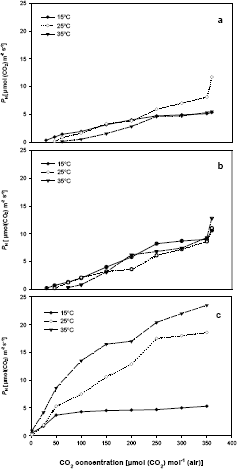
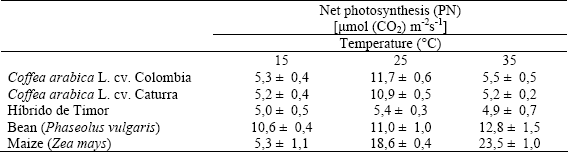
<body><![CDATA[<p><font size="2" face="Verdana, Arial, Helvetica, sans-serif">8 months <i>Coffea arabica</i> L.     cv. Caturra, Colombia , and interspecific natural hybrid “Híbrido de Timor” -     plants; bean (<i>Phaseolus vulgaris</i> L. cv. Ica Cafetero PVA 916) and maize (<i>Zea mays</i> L.  cv. ICA V305) plants were 45 days old.  All were planted in individual pots  with soil and decomposed coffee fruit pericarp (3:1), and growing under full  exposition to sunlight.  Net photosynthesis rate (<i>P</i><sub>N</sub>) was  measured with a portable photosynthesis system (model 6200, LI-COR, Lincoln,  NE, U.S.A. ), infrared gas analyzer (IRGA), data logger, and a 4 L Plexiglas  leaf chamber. <i>P</i><sub>N</sub> was measured on two mature leaves of the  higher part of five plants per genotype, between 08:00 hours and 12:00 hours,  with photosynthetic active radiation (PAR) above [600 µmol(photon) m<sup>-2 </sup>s<sup>-1</sup>],  measured with a quantum sensor (model LI-190S-1, LI-COR, Lincoln, NE, U.S.A.).  Air and leaf temperatures inside the chamber (15 °C, 25 °C, and 35 °C) were  maintained with a JULABO-J10 recirculation water system. Measurement started  with air containing [450 µmol(CO<sub>2</sub>) mol<sup>-1</sup>(air)] and <i>P</i><sub>N</sub> was  recorded for every [50  µmol(CO<sub>2</sub>) mol<sup>-1</sup>(air)] decrease inside the leaf chamber  until a constant CO<sub>2</sub> concentration (GCO<sub>2</sub>) was reached.</font></p>     <p>&nbsp;</p>     <p><font size="3" face="Verdana, Arial, Helvetica, sans-serif"><b><a name="2" id="2"></a>RESULTS AND DISCUSSION </b></font> <a href="#indice"><img src="/img/revistas/rfnam/v58n2/up.gif" border="0"></a></p>     <p><font size="2" face="Verdana, Arial, Helvetica, sans-serif">The highest <i>P</i><sub>N</sub> observed     for the three genotypes [11,7 µmol(CO<sub>2</sub>)m<sup>-2</sup> s<sup>-1</sup>]     was reached at 25°C and [350  µmol(CO<sub>2</sub>) mol<sup>-1</sup>(air)] (<a href="#fig01">Figure 1a</a>),  with values higher than those reported by Nutman (1937) [0,44 - 2,84 µmol(CO<sub>2</sub>) m<sup>-2</sup>s<sup>-1</sup>]  at 25°C; Nunes <i>et al.,</i> (1968) [3,51 - 4,41 µmol(CO<sub>2</sub>) m<sup>-2 </sup>s<sup>1</sup>]  at 24°C; Sondhal (1976) [3,87 µmol(CO<sub>2</sub>) m<sup>-2</sup>s<sup>1</sup>]  at 20°C; Yamaguchi and Friend (1979) [3,5 µmol(CO<sub>2</sub>) m<sup>-2</sup>s<sup>1</sup>]  at 25°C and Friend (1984) [4,4 µmol(CO<sub>2</sub>) m<sup>-2</sup>s<sup>1</sup>].  Temperature influenced <i>P</i><sub>N</sub> directly, when measured at [350 µmol(CO<sub>2</sub>)  mol<sup>-1</sup>(air)] (<a href="#tab01">Table 1</a>), values obtained at 15 °C and 35 °C were similar,  but lower than those at 25 °C.  At 15 °C, <i>P</i><sub>N</sub> would be limited  by RuDP regeneration, because electronic transport velocity diminishes and  consequently ATP and NADH formation are limited, and P<sub>i</sub> regeneration  capacity during starch and sucrose synthesis is lowered, as well as carbohydrate  transport from chloroplasts (Azcon-Bieto, 1983; Makino, Nakano and Mae<i>,</i> 1994).  Another  limitation is Rubisco activity because its optimum activation temperature in  coffee is between 25 °C and 28 °C (Riańo and López, 1998), similar to what  has been reported for other perennial species (Woodrow and Berry, 1988).  At  35 °C, decrease in <i>P</i><sub>N</sub> would be related to stomatal closure,  leaf sensitivity to increase in water vapor pressure deficit (VPD) as reported  by Hernández, Cock and E-Sharkawy (1989), and the increase of photorespiration  due to increase of oxygenase activity on RuBPCO, caused by higher diffusion  of O<sub>2</sub> to the active site, which causes an additional CO<sub>2</sub> loss  (Zelitch, 1971; Ogren, 1984; Lawlor, 1987; Poorter, 1993; Pearson and Brooks,  1995; Pastenes and Horton, 1996a,b), thus lowering photosynthetic efficiency.  Additionally,  temperatures above the optimum reduce RuBPCO content, as reported by Vu <i>et  al.,</i> (1997) in soybean and rice. </font></p>     <p align="center"><font size="2" face="Verdana, Arial, Helvetica, sans-serif"><b><a name="fig01"></a><img src="/img/revistas/rfnam/v58n2/a03fig01.gif">    <br>   Figure 1. </b>Net photosynthesis (<i>P</i>N) under   15&nbsp; &deg;C (&middot;), 25&nbsp; &deg;C (&iexcl;), 35&nbsp; &deg;C (&Ntilde;)   and different CO<sub>2</sub> concentrations in (a) coffee (<i>Coffea</i> <i>arabica</i> L.)   cv. Caturra, (b) bean (<i>Phaseolus</i> <i>vulgaris</i> L.) (c) maize (<i>Zea mays</i> L).</font></p>     <p align="center"><font size="2" face="Verdana, Arial, Helvetica, sans-serif"><b><a name="tab01"></a>Table 1. </b>Net photosynthesis (<i>P</i><sub>N</sub>)   of <i>Coffea</i> sp genotypes, bean and maize under three temperatures and   [350 &micro;mol(CO<sub>2</sub>) mol<sup>-1</sup>(air)]. Means &plusmn; SD of ten measurements.    <br> <img src="/img/revistas/rfnam/v58n2/a03tab01.gif"></font></p>     <p><font size="2" face="Verdana, Arial, Helvetica, sans-serif">In bean plants (<a href="#fig01">Figure 1b</a>), <i>P</i><sub>N</sub> increased  slightly with temperature variation despite being considered a C<sub>3</sub> plant.  The  genotype used, ICA Cafetero PVA 916, adapted to the Colombian central coffee-growing  zone conditions, [1000 - 2000 m of altitude], accounts for this behavior, even  though GCO<sub>2</sub> was within the range for C<sub>3</sub> plants (<a href="#tab02">Table  2</a>).</font></p>     <p align="center"><font size="2" face="Verdana, Arial, Helvetica, sans-serif"><b><a name="tab02"></a>Table 2.</b>&nbsp; CO<sub>2 </sub>compensation point   (GCO<sub>2</sub>) in <i>Coffea arabica</i> L. cvs. Caturra and Colombia, H&iacute;brido   de Timor, bean and maize, for 15 &deg;C, 25 &deg;C, and 35 &deg;C. Means &plusmn;   SD of ten measurements.    ]]></body>
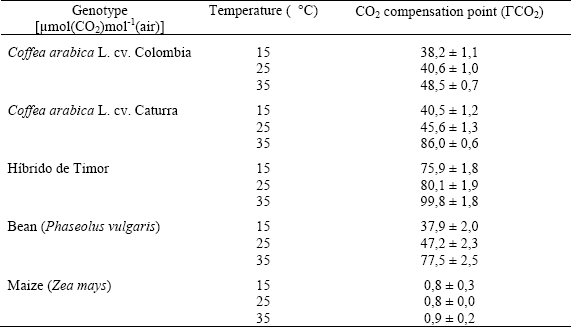
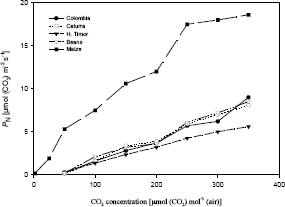
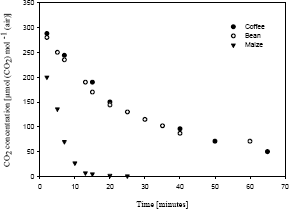
<body><![CDATA[<br>   <img src="/img/revistas/rfnam/v58n2/a03tab02.gif"></font></p>     <p><font size="2" face="Verdana, Arial, Helvetica, sans-serif">Maize (C<sub>4 </sub> photosynthetic     metabolism), showed an increase in <i>P</i><sub>N</sub> with temperature     increase, reaching highest values at 35 °C (<a href="#fig01">Figure 1c</a>). High temperatures induced higher activity  of phosphoenol pyruvate carboxylase (PEPC) in this species (Tolbert,1980; Ogren,  1984).</font></p>     <p><font size="2" face="Verdana, Arial, Helvetica, sans-serif">Two groups, according to photosynthetic activity  are formed (<a href="#fig02">Figure 2</a>) for 25 °C and several CO<sub>2</sub> concentrations.  The  first group is conformed by coffee and bean with <i>P</i><sub>N</sub> between  [5,4 and 13  µmol(CO<sub>2</sub>) m<sup>-2</sup>s<sup>-1</sup>], and the second group is  represented by maize with higher rates [18,6 µmol(CO<sub>2</sub>) m<sup>-2</sup> s<sup>-1</sup>].</font></p>     <p align="center"><font size="2" face="Verdana, Arial, Helvetica, sans-serif"><b><a name="fig02"></a><img src="/img/revistas/rfnam/v58n2/a03fig02.gif">    <br>   Figure 2.&nbsp; </b>Net photosynthesis (<i>P</i><sub>N</sub>)   of coffee (<i>Coffea arabica</i> L.) cv. Caturra (&iexcl;), Colombia (l), H&iacute;brido   de Timor (&Ntilde;), bean (<i>Phaseolus vulgaris </i>L.) (&Ntilde;) and maize   (<i>Zea mays</i> L.) () at 25 &deg;C and several CO<sub>2</sub> concentrations [&micro;mol (CO<sub>2</sub>) mol<sup>-1</sup>(air)].</font></p>     <p><font size="2" face="Verdana, Arial, Helvetica, sans-serif">For the species studied, the lower the CO<sub>2 </sub>concentration   at the three temperatures (15 °C, 25 °C, and 35 °C), the lower the <i>P</i><sub>N</sub>,   until CO<sub>2</sub> compensation point is reached, where photosynthesis rate   is equal to CO<sub>2</sub> release by photorespiration and mitochondrial respiration   (Espie and Colman, 1987).  In coffee and bean, GCO<sub>2</sub> increased with   temperature, while in maize no changes were observed (Table 2).  This increase   in GCO<sub>2</sub> with higher temperatures in coffee and bean indicates the   occurrence of photorespiration, not detected in maize (Zelitch, 1971; Canvin,1979;   Tolbert, 1980; Ogren, 1984).</font></p>     <p><font size="2" face="Verdana, Arial, Helvetica, sans-serif">Highest GCO<sub>2</sub> value     at 25 °C in coffee  was observed with Híbrido de Timor [80,1 ± 1,9 µmol(CO<sub>2</sub>) mol<sup>-1</sup>(air)],  suggesting the occurrence of a higher photorespiration rate in this genotype,  followed by Caturra [45,6 ± 1,3 µmol(CO<sub>2</sub>) mol<sup>-1</sup>(air)]  and Colombia [40,6 ± 1,0  µmol(CO<sub>2</sub>) mol<sup>-1</sup>(air)]. For the last two genotypes, GCO<sub>2</sub> values  are lower than those found by Jones and Mansfield (1970) [85 µmol(CO<sub>2</sub>)  mol<sup>-1</sup>(air)] and Sondhal (1976) [65 µmol(CO<sub>2</sub>) mol<sup>-1</sup> (air)],  at 23 °C and 25 °C, respectively.  GCO<sub>2</sub> at 25 °C in bean plants  [36,05 ± 0,5  µmol(CO<sub>2</sub>) mol<sup>-1</sup>(air)], and maize [0,8 ± 0,3  µmol(CO<sub>2</sub>) mol<sup>-1</sup>(air)] are similar to the values presented  by Zelitch (1971).</font></p>     <p><font size="2" face="Verdana, Arial, Helvetica, sans-serif">In <i>Coffea arabica</i> L. cv. Colombia and bean,  60-65 minutes were necessary to reach GCO<sub>2</sub>, while in maize only  25 min were needed (<a href="#fig03">Figure 3</a>).  Comparison of times necessary  to reach GCO<sub>2 </sub>in  C<sub>3</sub> and C<sub>4</sub> plants is an evidence of the level of competition  caused by photorespiration in C<sub>3</sub> plants, which is poorly reported  in literature.  Under the same temperature and initial CO<sub>2</sub> concentration  in a closed system, more time is required by C<sub>3</sub> plants due to significant  return of the CO<sub>2</sub> fixed to the environment by photorespiration (Zelitch,  1971; Tolbert, 1980; Ogren, 1984).  In maize, a C<sub>4</sub> plant, where  CO<sub>2</sub> lost by photorespiration is recycled; time necessary to reach  GCO<sub>2 </sub>is shorter, allowing higher net CO<sub>2</sub> input rates  than those in C<sub>3</sub> plants (Canvin, 1979).</font></p>     <p align="center"><font size="2" face="Verdana, Arial, Helvetica, sans-serif"><b><a name="fig03"></a><img src="/img/revistas/rfnam/v58n2/a03fig03.gif">    <br>   Figure 3. </b>Time required for coffee <i>Coffea arabica</i> L.   cv. Caturra (&middot;), bean <i>Phaseolus vulgaris</i> L. (&iexcl;) and maize <i>Zea   mays</i> L. (&Ntilde;) to reach photosynthesis and (dark respiration + photorespiration) balance [CO<sub>2</sub> compensation point (GCO<sub>2</sub>)] at 25&nbsp; &deg;C.</font></p>     ]]></body>
<body><![CDATA[<p><font size="2" face="Verdana, Arial, Helvetica, sans-serif">Results indicate that in coffee plants, similar  to what happens with other C<sub>3</sub> plants, GCO<sub>2 </sub>is dependent  on temperature and that there is a wide range of variation in photosynthetic  activity directly related to photorespiratory competition.  The study of different  genotypes of <i>Coffea arabica</i> L., species and <i>Coffea</i> genus would  allow identification of photosynthetically efficient genotypes to be used in  breeding programs in order to increase productivity.  Photosynthetic behavior  of the plants studied was that of a typical C<sub>3</sub> plant, and optimum  leaf temperature for photosynthesis under conditions of the Colombian central  coffee-growing zone is around 25 °C.</font></p>     <p>&nbsp;</p>     <p><font size="3" face="Verdana, Arial, Helvetica, sans-serif"><b><a name="3"></a>REFERENCES</b></font> <a href="#indice"><img src="/img/revistas/rfnam/v58n2/up.gif" border="0"></a></p>     <!-- ref --><p><font size="2" face="Verdana, Arial, Helvetica, sans-serif">AZCON – BIETO,     J. Inhibition of photosynthesis by carbohydrates in wheat leaves.  <i>In</i>: Plant Physiology. Vol. 73 (1983);  p. 681-686. </font>&nbsp;&nbsp;&nbsp;&nbsp;&nbsp;&nbsp;&nbsp;&nbsp;[&#160;<a href="javascript:void(0);" onclick="javascript: window.open('/scielo.php?script=sci_nlinks&ref=000056&pid=S0304-2847200500020000300001&lng=','','width=640,height=500,resizable=yes,scrollbars=1,menubar=yes,');">Links</a>&#160;]<!-- end-ref --><!-- ref --><p><font size="2" face="Verdana, Arial, Helvetica, sans-serif">CANVIN, D.T. Photorespiration: comparison between  C<sub>3</sub> and C<sub>4</sub> plants. In: GIBBS, M., and LATZKO, E., eds.  Encyclopedia of Plant Physiology.    Berlin: Springer Verlag, 1979. p. 368-398.</font>&nbsp;&nbsp;&nbsp;&nbsp;&nbsp;&nbsp;&nbsp;&nbsp;[&#160;<a href="javascript:void(0);" onclick="javascript: window.open('/scielo.php?script=sci_nlinks&ref=000057&pid=S0304-2847200500020000300002&lng=','','width=640,height=500,resizable=yes,scrollbars=1,menubar=yes,');">Links</a>&#160;]<!-- end-ref --><!-- ref --><p><font size="2" face="Verdana, Arial, Helvetica, sans-serif">DECKER, J. P. and TIO, M. A. Photosynthetic surges  in Coffee seedlings. <i>In</i>: Journal of Agriculture of the University ofPuerto  Rico. Vol. 43 (1959); p. 50-55. </font>&nbsp;&nbsp;&nbsp;&nbsp;&nbsp;&nbsp;&nbsp;&nbsp;[&#160;<a href="javascript:void(0);" onclick="javascript: window.open('/scielo.php?script=sci_nlinks&ref=000058&pid=S0304-2847200500020000300003&lng=','','width=640,height=500,resizable=yes,scrollbars=1,menubar=yes,');">Links</a>&#160;]<!-- end-ref --><!-- ref --><p><font size="2" face="Verdana, Arial, Helvetica, sans-serif">ESPIE, G. S., COLMAN, B. The effect of pH, CO<sub>2</sub> and  temperature on the CO<sub>2</sub> compensation point of isolated Asparagus  mesophyll cells. <i>In</i>: Plant Physiology.  Vol. 83 (1987); p. 113-117. </font>&nbsp;&nbsp;&nbsp;&nbsp;&nbsp;&nbsp;&nbsp;&nbsp;[&#160;<a href="javascript:void(0);" onclick="javascript: window.open('/scielo.php?script=sci_nlinks&ref=000059&pid=S0304-2847200500020000300004&lng=','','width=640,height=500,resizable=yes,scrollbars=1,menubar=yes,');">Links</a>&#160;]<!-- end-ref --><!-- ref --><p><font size="2" face="Verdana, Arial, Helvetica, sans-serif">FITTER, A. H. and HAY, R. K. M. Environmental physiology  of plants. London: Academic Press, 1987. 367 p.</font>&nbsp;&nbsp;&nbsp;&nbsp;&nbsp;&nbsp;&nbsp;&nbsp;[&#160;<a href="javascript:void(0);" onclick="javascript: window.open('/scielo.php?script=sci_nlinks&ref=000060&pid=S0304-2847200500020000300005&lng=','','width=640,height=500,resizable=yes,scrollbars=1,menubar=yes,');">Links</a>&#160;]<!-- end-ref --><!-- ref --><p><font size="2" face="Verdana, Arial, Helvetica, sans-serif">FRIEND, D. J. C. Shade adaptation of photosynthesis  in <i>Coffea arabica</i> L. <i>In</i>: Photosynthesis Research. Vol. 5 (1984);  p. 325-334. </font>&nbsp;&nbsp;&nbsp;&nbsp;&nbsp;&nbsp;&nbsp;&nbsp;[&#160;<a href="javascript:void(0);" onclick="javascript: window.open('/scielo.php?script=sci_nlinks&ref=000061&pid=S0304-2847200500020000300006&lng=','','width=640,height=500,resizable=yes,scrollbars=1,menubar=yes,');">Links</a>&#160;]<!-- end-ref --><!-- ref --><p><font size="2" face="Verdana, Arial, Helvetica, sans-serif">HEATH, O. V. S.     and ORCHARD, B. Midday closure of stomata. Temperature effects on the minimum  intercellular space carbon dioxide concentration “G”.  <i>In</i>: Nature. Vol. 180 (1957); : p. 180-182. </font>&nbsp;&nbsp;&nbsp;&nbsp;&nbsp;&nbsp;&nbsp;&nbsp;[&#160;<a href="javascript:void(0);" onclick="javascript: window.open('/scielo.php?script=sci_nlinks&ref=000062&pid=S0304-2847200500020000300007&lng=','','width=640,height=500,resizable=yes,scrollbars=1,menubar=yes,');">Links</a>&#160;]<!-- end-ref --><!-- ref --><p><font size="2" face="Verdana, Arial, Helvetica, sans-serif">HERNANDEZ, A. Del P.; COCK, J. H. and EL-SHARKAWY,  M. A. The responses of leaves gas exchange and stomatal conductance to air  humidity in shade grown coffee, tea and cacao plants as compared with sunflower. <i>In</i>:  Revista Brasileira de Fisiología Vegetal.  Vol. 1 (1989); p. 155-161. </font>&nbsp;&nbsp;&nbsp;&nbsp;&nbsp;&nbsp;&nbsp;&nbsp;[&#160;<a href="javascript:void(0);" onclick="javascript: window.open('/scielo.php?script=sci_nlinks&ref=000063&pid=S0304-2847200500020000300008&lng=','','width=640,height=500,resizable=yes,scrollbars=1,menubar=yes,');">Links</a>&#160;]<!-- end-ref --><!-- ref --><p><font size="2" face="Verdana, Arial, Helvetica, sans-serif">JONES, M. B., Mansfield, T. A. A circadian rhythm  in the level of the carbon dioxide compensation point in Briophyllum and Coffea. <i>In</i>:  Journal of Experimental Botany.  Vol.  21 (1970); p. 159-163.</font>&nbsp;&nbsp;&nbsp;&nbsp;&nbsp;&nbsp;&nbsp;&nbsp;[&#160;<a href="javascript:void(0);" onclick="javascript: window.open('/scielo.php?script=sci_nlinks&ref=000064&pid=S0304-2847200500020000300009&lng=','','width=640,height=500,resizable=yes,scrollbars=1,menubar=yes,');">Links</a>&#160;]<!-- end-ref --><!-- ref --><p><font size="2" face="Verdana, Arial, Helvetica, sans-serif">KENNEDY, R. A. Photorespiration in C<sub>3</sub> and  C<sub>4</sub> plant tissue cultures. <i>In</i>: Plant Physiology.  Vol. 58  (1976); p. 573 – 575. </font>&nbsp;&nbsp;&nbsp;&nbsp;&nbsp;&nbsp;&nbsp;&nbsp;[&#160;<a href="javascript:void(0);" onclick="javascript: window.open('/scielo.php?script=sci_nlinks&ref=000065&pid=S0304-2847200500020000300010&lng=','','width=640,height=500,resizable=yes,scrollbars=1,menubar=yes,');">Links</a>&#160;]<!-- end-ref --><!-- ref --><p><font size="2" face="Verdana, Arial, Helvetica, sans-serif">KIMBALL, A. <i>et al</i>.  Effects     of increasing atmospheric CO<sub>2</sub> on vegetation. <i>In</i>: ROZEMA, J. <i>et al.</i>,  eds.  CO<sub>2</sub> and biosphere.  The Netherlands: Kluwer, Dordrecht, 1993.  p. 65-75.</font>&nbsp;&nbsp;&nbsp;&nbsp;&nbsp;&nbsp;&nbsp;&nbsp;[&#160;<a href="javascript:void(0);" onclick="javascript: window.open('/scielo.php?script=sci_nlinks&ref=000066&pid=S0304-2847200500020000300011&lng=','','width=640,height=500,resizable=yes,scrollbars=1,menubar=yes,');">Links</a>&#160;]<!-- end-ref --><!-- ref --><p><font size="2" face="Verdana, Arial, Helvetica, sans-serif">KUMAR, D. and TIESZEN, L. D. Photosynthesis in <i>Coffea  arabica</i> L. Part 1. Effects of light and temperature.  <i>In</i>: Experimental  Agriculture.  Vol. 16 (1980); p. 13-19.</font>&nbsp;&nbsp;&nbsp;&nbsp;&nbsp;&nbsp;&nbsp;&nbsp;[&#160;<a href="javascript:void(0);" onclick="javascript: window.open('/scielo.php?script=sci_nlinks&ref=000067&pid=S0304-2847200500020000300012&lng=','','width=640,height=500,resizable=yes,scrollbars=1,menubar=yes,');">Links</a>&#160;]<!-- end-ref --><!-- ref --><p><font size="2" face="Verdana, Arial, Helvetica, sans-serif">LARCHER, W. Photosynthesis     as a tool for indicating temperature stress events. In: SCHULZE, E. D. and     CALDWELL, M. M., eds.  Ecophysiology  of photosynyhesis. New York:  Springer Verlag, 1995. p. 261-274.</font>&nbsp;&nbsp;&nbsp;&nbsp;&nbsp;&nbsp;&nbsp;&nbsp;[&#160;<a href="javascript:void(0);" onclick="javascript: window.open('/scielo.php?script=sci_nlinks&ref=000068&pid=S0304-2847200500020000300013&lng=','','width=640,height=500,resizable=yes,scrollbars=1,menubar=yes,');">Links</a>&#160;]<!-- end-ref --><!-- ref --><p><font size="2" face="Verdana, Arial, Helvetica, sans-serif">LAWLOR, D. W. Photosynthesis: metabolism control  and physiology. New York: Longman Scientific and Technical, 1987, p. 183-201.</font>&nbsp;&nbsp;&nbsp;&nbsp;&nbsp;&nbsp;&nbsp;&nbsp;[&#160;<a href="javascript:void(0);" onclick="javascript: window.open('/scielo.php?script=sci_nlinks&ref=000069&pid=S0304-2847200500020000300014&lng=','','width=640,height=500,resizable=yes,scrollbars=1,menubar=yes,');">Links</a>&#160;]<!-- end-ref --><!-- ref --><p><font size="2" face="Verdana, Arial, Helvetica, sans-serif">LONG, S. P. Modification of the response of photosynthetic  productivity to rising temperature by atmospheric CO<sub>2</sub> concentrations:  Has its importance been underestimated? <i>In</i>: Plant Cell and Environment.  Vol. 14 (1991); p. 739-736.</font>&nbsp;&nbsp;&nbsp;&nbsp;&nbsp;&nbsp;&nbsp;&nbsp;[&#160;<a href="javascript:void(0);" onclick="javascript: window.open('/scielo.php?script=sci_nlinks&ref=000070&pid=S0304-2847200500020000300015&lng=','','width=640,height=500,resizable=yes,scrollbars=1,menubar=yes,');">Links</a>&#160;]<!-- end-ref --><!-- ref --><p><font size="2" face="Verdana, Arial, Helvetica, sans-serif">MAKINO, A.; NAKANO, H. and MAE, T. Effects of growth  temperature on the response of ribulose- 1,5 - bisphosphate carboxylase, electron  transport components and sucrose synthesis enzymes to leaf nitrogen in rice  and their relationships to photosynthesis. <i>In</i>: Plant Physiology.  Vol.  105 (1994); p. 1231-1238. </font>&nbsp;&nbsp;&nbsp;&nbsp;&nbsp;&nbsp;&nbsp;&nbsp;[&#160;<a href="javascript:void(0);" onclick="javascript: window.open('/scielo.php?script=sci_nlinks&ref=000071&pid=S0304-2847200500020000300016&lng=','','width=640,height=500,resizable=yes,scrollbars=1,menubar=yes,');">Links</a>&#160;]<!-- end-ref --><!-- ref --><p><font size="2" face="Verdana, Arial, Helvetica, sans-serif">NUNES, M. A.; BIERHUIZEN, J. F. and PLOEGMAN, C.  Effect of light, temperature and CO<sub>2</sub> concentration on photosynthesis  of <i>Coffea arabica</i> L. <i>In</i>: Acta Botanica Neerlandica.  Vol. 17  (1968); p. 93-102.</font>&nbsp;&nbsp;&nbsp;&nbsp;&nbsp;&nbsp;&nbsp;&nbsp;[&#160;<a href="javascript:void(0);" onclick="javascript: window.open('/scielo.php?script=sci_nlinks&ref=000072&pid=S0304-2847200500020000300017&lng=','','width=640,height=500,resizable=yes,scrollbars=1,menubar=yes,');">Links</a>&#160;]<!-- end-ref --><!-- ref --><p><font size="2" face="Verdana, Arial, Helvetica, sans-serif">NUTMAN, F. J. Studies of the physiology of <i>Coffea  arabica</i>: photosynthesis of coffee leaves under natural conditions.  <i>In</i>:  Annals of  Botany, London. Vol. 1, No. 3 (1937); p. 353-367. </font>&nbsp;&nbsp;&nbsp;&nbsp;&nbsp;&nbsp;&nbsp;&nbsp;[&#160;<a href="javascript:void(0);" onclick="javascript: window.open('/scielo.php?script=sci_nlinks&ref=000073&pid=S0304-2847200500020000300018&lng=','','width=640,height=500,resizable=yes,scrollbars=1,menubar=yes,');">Links</a>&#160;]<!-- end-ref --><!-- ref --><p><font size="2" face="Verdana, Arial, Helvetica, sans-serif">OGREN, W. L. Photorespiration: pathways, regulation  and modification. <i>In</i>: Annual Review of Plant Physiology. Vol. 35 (1984);  p.  415-442.</font>&nbsp;&nbsp;&nbsp;&nbsp;&nbsp;&nbsp;&nbsp;&nbsp;[&#160;<a href="javascript:void(0);" onclick="javascript: window.open('/scielo.php?script=sci_nlinks&ref=000074&pid=S0304-2847200500020000300019&lng=','','width=640,height=500,resizable=yes,scrollbars=1,menubar=yes,');">Links</a>&#160;]<!-- end-ref --><!-- ref --><p><font size="2" face="Verdana, Arial, Helvetica, sans-serif">PASTENES, C. and     HORTON, P. Effect of high temperature on photosynthesis in beans.  Part 1:     oxygen evolution and chlorophyll fluorescence.  <i>In</i>:  Plant Physiology.  Vol.112 (1996); p. 1245-1251.</font>&nbsp;&nbsp;&nbsp;&nbsp;&nbsp;&nbsp;&nbsp;&nbsp;[&#160;<a href="javascript:void(0);" onclick="javascript: window.open('/scielo.php?script=sci_nlinks&ref=000075&pid=S0304-2847200500020000300020&lng=','','width=640,height=500,resizable=yes,scrollbars=1,menubar=yes,');">Links</a>&#160;]<!-- end-ref --><!-- ref --><p><font size="2" face="Verdana, Arial, Helvetica, sans-serif">________ and ________.     Effect of high temperature on photosynthesis in beans. Part 2:  CO<sub>2</sub> assimilation  and  metabolite contents. <i>In</i>: Plant Physiology.  Vol. 112 (1996); p. 1253-1260. </font>&nbsp;&nbsp;&nbsp;&nbsp;&nbsp;&nbsp;&nbsp;&nbsp;[&#160;<a href="javascript:void(0);" onclick="javascript: window.open('/scielo.php?script=sci_nlinks&ref=000076&pid=S0304-2847200500020000300021&lng=','','width=640,height=500,resizable=yes,scrollbars=1,menubar=yes,');">Links</a>&#160;]<!-- end-ref --><!-- ref --><p><font size="2" face="Verdana, Arial, Helvetica, sans-serif">PEARSON, M. and BROOKS, G. The influence of the  elevated CO<sub>2</sub> on growth and age -related  changes  in leaf gas exchange. <i>In</i>:  Journal of Experimental Botany.  Vol. 46 (1995); p. 1651-1659. </font>&nbsp;&nbsp;&nbsp;&nbsp;&nbsp;&nbsp;&nbsp;&nbsp;[&#160;<a href="javascript:void(0);" onclick="javascript: window.open('/scielo.php?script=sci_nlinks&ref=000077&pid=S0304-2847200500020000300022&lng=','','width=640,height=500,resizable=yes,scrollbars=1,menubar=yes,');">Links</a>&#160;]<!-- end-ref --><!-- ref --><p><font size="2" face="Verdana, Arial, Helvetica, sans-serif">POORTER, H. Interspecific variation in the growth  response of plants to an elevated ambient CO<sub>2</sub> concentration. <i>In</i>:  ROZEMA, J. <i>et al</i>., eds. CO<sub>2</sub> and biosphere. The Netherlands:  Kluwer, Dordrecht,  1993. p. 677-697.</font>&nbsp;&nbsp;&nbsp;&nbsp;&nbsp;&nbsp;&nbsp;&nbsp;[&#160;<a href="javascript:void(0);" onclick="javascript: window.open('/scielo.php?script=sci_nlinks&ref=000078&pid=S0304-2847200500020000300023&lng=','','width=640,height=500,resizable=yes,scrollbars=1,menubar=yes,');">Links</a>&#160;]<!-- end-ref --><!-- ref --><p><font size="2" face="Verdana, Arial, Helvetica, sans-serif">RIAŃO, N. M. y LÓPEZ, Y. Cuantificación de RuBPCO  en hojas y frutos de café. <i>En</i>: OSPINA, H. F., ed.  Informe anual de  labores. Chinchiná, Colombia : Cenicafé, 1998. p. 95- 97.</font>&nbsp;&nbsp;&nbsp;&nbsp;&nbsp;&nbsp;&nbsp;&nbsp;[&#160;<a href="javascript:void(0);" onclick="javascript: window.open('/scielo.php?script=sci_nlinks&ref=000079&pid=S0304-2847200500020000300024&lng=','','width=640,height=500,resizable=yes,scrollbars=1,menubar=yes,');">Links</a>&#160;]<!-- end-ref --><!-- ref --><p><font size="2" face="Verdana, Arial, Helvetica, sans-serif">SONDHAL, M. R. Measurements of <sup>14</sup>C incorporation  by illuminated intact leaves of coffee plants from gas mixtures containing <sup>14</sup>CO2.  <i>In</i>:  Journal  of  Experimental Botany.  Vol. 27 (1976); p. 1187-1195.</font>&nbsp;&nbsp;&nbsp;&nbsp;&nbsp;&nbsp;&nbsp;&nbsp;[&#160;<a href="javascript:void(0);" onclick="javascript: window.open('/scielo.php?script=sci_nlinks&ref=000080&pid=S0304-2847200500020000300025&lng=','','width=640,height=500,resizable=yes,scrollbars=1,menubar=yes,');">Links</a>&#160;]<!-- end-ref --><!-- ref --><p><font size="2" face="Verdana, Arial, Helvetica, sans-serif">TAYLOR, G. <i>et al. </i> Elevated     CO<sub>2</sub> and  plant growth: celular mechanisms and responses of whole plants.  <i>In</i>:  Journal of Experimental Botany.  Vol. 45 (1994); p. 1761-1774.</font>&nbsp;&nbsp;&nbsp;&nbsp;&nbsp;&nbsp;&nbsp;&nbsp;[&#160;<a href="javascript:void(0);" onclick="javascript: window.open('/scielo.php?script=sci_nlinks&ref=000081&pid=S0304-2847200500020000300026&lng=','','width=640,height=500,resizable=yes,scrollbars=1,menubar=yes,');">Links</a>&#160;]<!-- end-ref --><!-- ref --><p><font size="2" face="Verdana, Arial, Helvetica, sans-serif">TOLBERT, N. E. Glicolate metabolism by higher plants  and algae. <i>In</i>: GIBBS, M. and LATZKO, E., ed. Encyclopedie of Plant Physiology.  Berlin: Springer Verlag, 1980. p. 338-351.</font>&nbsp;&nbsp;&nbsp;&nbsp;&nbsp;&nbsp;&nbsp;&nbsp;[&#160;<a href="javascript:void(0);" onclick="javascript: window.open('/scielo.php?script=sci_nlinks&ref=000082&pid=S0304-2847200500020000300027&lng=','','width=640,height=500,resizable=yes,scrollbars=1,menubar=yes,');">Links</a>&#160;]<!-- end-ref --><!-- ref --><p><font size="2" face="Verdana, Arial, Helvetica, sans-serif">VU, J. C. V. <i>et al. </i> Effects     of elevated CO<sub>2</sub> and temperature on photosynthesis and rubisco     in rice and soybean.  <i>In</i>:  Plant Cell and Environment.  Vol. 20 (1997); p. 68-76.</font>&nbsp;&nbsp;&nbsp;&nbsp;&nbsp;&nbsp;&nbsp;&nbsp;[&#160;<a href="javascript:void(0);" onclick="javascript: window.open('/scielo.php?script=sci_nlinks&ref=000083&pid=S0304-2847200500020000300028&lng=','','width=640,height=500,resizable=yes,scrollbars=1,menubar=yes,');">Links</a>&#160;]<!-- end-ref --><!-- ref --><p><font size="2" face="Verdana, Arial, Helvetica, sans-serif">WOODROW, I. E. and BERRY, J. A. Enzymatic regulation  of photosynthetic CO<sub>2</sub> fixation in C<sub>3</sub> plants. <i>In</i>:  Annual Review of. Plant Physiology.  Vol. 39 (1988); p. 533-594. </font>&nbsp;&nbsp;&nbsp;&nbsp;&nbsp;&nbsp;&nbsp;&nbsp;[&#160;<a href="javascript:void(0);" onclick="javascript: window.open('/scielo.php?script=sci_nlinks&ref=000084&pid=S0304-2847200500020000300029&lng=','','width=640,height=500,resizable=yes,scrollbars=1,menubar=yes,');">Links</a>&#160;]<!-- end-ref --><!-- ref --><p><font size="2" face="Verdana, Arial, Helvetica, sans-serif">YAMAGUCHI, D. and FRIEND, D. J. C. Effect of leaf  and irradiance on photosynthesis of <i>Coffea arabica</i> L.  <i>In</i>: Photosynthetica.  Vol. 13 (1979); p. 271-278. </font>&nbsp;&nbsp;&nbsp;&nbsp;&nbsp;&nbsp;&nbsp;&nbsp;[&#160;<a href="javascript:void(0);" onclick="javascript: window.open('/scielo.php?script=sci_nlinks&ref=000085&pid=S0304-2847200500020000300030&lng=','','width=640,height=500,resizable=yes,scrollbars=1,menubar=yes,');">Links</a>&#160;]<!-- end-ref --><!-- ref --><p><font size="2" face="Verdana, Arial, Helvetica, sans-serif">ZELITCH, I. Photosynthesis,     photorespiration and plant productivity. New York: Academic Press,  1971.  347 p.</font>&nbsp;&nbsp;&nbsp;&nbsp;&nbsp;&nbsp;&nbsp;&nbsp;[&#160;<a href="javascript:void(0);" onclick="javascript: window.open('/scielo.php?script=sci_nlinks&ref=000086&pid=S0304-2847200500020000300031&lng=','','width=640,height=500,resizable=yes,scrollbars=1,menubar=yes,');">Links</a>&#160;]<!-- end-ref --> ]]></body><back>
<ref-list>
<ref id="B1">
<nlm-citation citation-type="journal">
<person-group person-group-type="author">
<name>
<surname><![CDATA[AZCON - BIETO]]></surname>
<given-names><![CDATA[J.]]></given-names>
</name>
</person-group>
<article-title xml:lang="en"><![CDATA[Inhibition of photosynthesis by carbohydrates in wheat leaves]]></article-title>
<source><![CDATA[Plant Physiology]]></source>
<year>1983</year>
<volume>73</volume>
<page-range>681-686</page-range></nlm-citation>
</ref>
<ref id="B2">
<nlm-citation citation-type="book">
<person-group person-group-type="author">
<name>
<surname><![CDATA[CANVIN]]></surname>
<given-names><![CDATA[D.T.]]></given-names>
</name>
</person-group>
<article-title xml:lang="en"><![CDATA[Photorespiration: comparison between C3 and C4 plants]]></article-title>
<person-group person-group-type="editor">
<name>
<surname><![CDATA[GIBBS]]></surname>
<given-names><![CDATA[M.]]></given-names>
</name>
<name>
<surname><![CDATA[LATZKO]]></surname>
<given-names><![CDATA[E.]]></given-names>
</name>
</person-group>
<source><![CDATA[Encyclopedia of Plant Physiology]]></source>
<year>1979</year>
<page-range>368-398</page-range><publisher-loc><![CDATA[Berlin ]]></publisher-loc>
<publisher-name><![CDATA[Springer Verlag]]></publisher-name>
</nlm-citation>
</ref>
<ref id="B3">
<nlm-citation citation-type="journal">
<person-group person-group-type="author">
<name>
<surname><![CDATA[DECKER]]></surname>
<given-names><![CDATA[J. P.]]></given-names>
</name>
<name>
<surname><![CDATA[TIO]]></surname>
<given-names><![CDATA[M. A.]]></given-names>
</name>
</person-group>
<article-title xml:lang="en"><![CDATA[Photosynthetic surges in Coffee seedlings]]></article-title>
<source><![CDATA[Journal of Agriculture of the University of Puerto Rico]]></source>
<year>1959</year>
<volume>43</volume>
<page-range>50-55</page-range></nlm-citation>
</ref>
<ref id="B4">
<nlm-citation citation-type="journal">
<person-group person-group-type="author">
<name>
<surname><![CDATA[ESPIE]]></surname>
<given-names><![CDATA[G. S.]]></given-names>
</name>
<name>
<surname><![CDATA[COLMAN]]></surname>
<given-names><![CDATA[B.]]></given-names>
</name>
</person-group>
<article-title xml:lang="en"><![CDATA[The effect of pH, CO2 and temperature on the CO2 compensation point of isolated Asparagus mesophyll cells]]></article-title>
<source><![CDATA[Plant Physiology]]></source>
<year>1987</year>
<volume>83</volume>
<page-range>113-117</page-range></nlm-citation>
</ref>
<ref id="B5">
<nlm-citation citation-type="book">
<person-group person-group-type="author">
<name>
<surname><![CDATA[FITTER]]></surname>
<given-names><![CDATA[A. H.]]></given-names>
</name>
<name>
<surname><![CDATA[HAY, R.]]></surname>
<given-names><![CDATA[K. M.]]></given-names>
</name>
</person-group>
<source><![CDATA[Environmental physiology of plants]]></source>
<year>1987</year>
<publisher-loc><![CDATA[London ]]></publisher-loc>
<publisher-name><![CDATA[Academic Press]]></publisher-name>
</nlm-citation>
</ref>
<ref id="B6">
<nlm-citation citation-type="journal">
<person-group person-group-type="author">
<name>
<surname><![CDATA[FRIEND, D.]]></surname>
<given-names><![CDATA[J. C.]]></given-names>
</name>
</person-group>
<article-title xml:lang="en"><![CDATA[Shade adaptation of photosynthesis in Coffea arabica L.]]></article-title>
<source><![CDATA[Photosynthesis Research]]></source>
<year>1984</year>
<volume>5</volume>
<page-range>325-334</page-range></nlm-citation>
</ref>
<ref id="B7">
<nlm-citation citation-type="journal">
<person-group person-group-type="author">
<name>
<surname><![CDATA[HEATH, O.]]></surname>
<given-names><![CDATA[V. S.]]></given-names>
</name>
<name>
<surname><![CDATA[ORCHARD]]></surname>
<given-names><![CDATA[B.]]></given-names>
</name>
</person-group>
<article-title xml:lang="en"><![CDATA[Midday closure of stomata. Temperature effects on the minimum intercellular space carbon dioxide concentration "G"]]></article-title>
<source><![CDATA[Nature]]></source>
<year>1957</year>
<volume>180</volume>
<page-range>180-182</page-range></nlm-citation>
</ref>
<ref id="B8">
<nlm-citation citation-type="journal">
<person-group person-group-type="author">
<name>
<surname><![CDATA[HERNANDEZ]]></surname>
<given-names><![CDATA[A. Del P.]]></given-names>
</name>
<name>
<surname><![CDATA[COCK]]></surname>
<given-names><![CDATA[J. H.]]></given-names>
</name>
<name>
<surname><![CDATA[EL-SHARKAWY]]></surname>
<given-names><![CDATA[M. A.]]></given-names>
</name>
</person-group>
<article-title xml:lang="en"><![CDATA[The responses of leaves gas exchange and stomatal conductance to air humidity in shade grown coffee, tea and cacao plants as compared with sunflower]]></article-title>
<source><![CDATA[Revista Brasileira de Fisiología Vegetal]]></source>
<year>1989</year>
<volume>1</volume>
<page-range>155-161</page-range></nlm-citation>
</ref>
<ref id="B9">
<nlm-citation citation-type="journal">
<person-group person-group-type="author">
<name>
<surname><![CDATA[JONES]]></surname>
<given-names><![CDATA[M. B.]]></given-names>
</name>
<name>
<surname><![CDATA[Mansfield]]></surname>
<given-names><![CDATA[T. A.]]></given-names>
</name>
</person-group>
<article-title xml:lang="en"><![CDATA[A circadian rhythm in the level of the carbon dioxide compensation point in Briophyllum and Coffea]]></article-title>
<source><![CDATA[Journal of Experimental Botany]]></source>
<year>1970</year>
<volume>21</volume>
<page-range>159-163</page-range></nlm-citation>
</ref>
<ref id="B10">
<nlm-citation citation-type="journal">
<person-group person-group-type="author">
<name>
<surname><![CDATA[KENNEDY]]></surname>
<given-names><![CDATA[R. A.]]></given-names>
</name>
</person-group>
<article-title xml:lang="en"><![CDATA[Photorespiration in C3 and C4 plant tissue cultures]]></article-title>
<source><![CDATA[Plant Physiology]]></source>
<year>1976</year>
<volume>58</volume>
<page-range>573 - 575</page-range></nlm-citation>
</ref>
<ref id="B11">
<nlm-citation citation-type="book">
<person-group person-group-type="author">
<name>
<surname><![CDATA[KIMBALL]]></surname>
<given-names><![CDATA[A.]]></given-names>
</name>
</person-group>
<article-title xml:lang="en"><![CDATA[Effects of increasing atmospheric CO2 on vegetation]]></article-title>
<person-group person-group-type="editor">
<name>
<surname><![CDATA[ROZEMA]]></surname>
<given-names><![CDATA[J.]]></given-names>
</name>
</person-group>
<source><![CDATA[CO2 and biosphere]]></source>
<year>1993</year>
<page-range>65-75</page-range><publisher-loc><![CDATA[The Netherlands ]]></publisher-loc>
<publisher-name><![CDATA[Dordrecht]]></publisher-name>
</nlm-citation>
</ref>
<ref id="B12">
<nlm-citation citation-type="journal">
<person-group person-group-type="author">
<name>
<surname><![CDATA[KUMAR]]></surname>
<given-names><![CDATA[D.]]></given-names>
</name>
<name>
<surname><![CDATA[TIESZEN]]></surname>
<given-names><![CDATA[L. D.]]></given-names>
</name>
</person-group>
<article-title xml:lang="en"><![CDATA[Photosynthesis in Coffea arabica L.: Part 1. Effects of light and temperature]]></article-title>
<source><![CDATA[Experimental Agriculture]]></source>
<year>1980</year>
<volume>16</volume>
<page-range>13-19</page-range></nlm-citation>
</ref>
<ref id="B13">
<nlm-citation citation-type="book">
<person-group person-group-type="author">
<name>
<surname><![CDATA[LARCHER]]></surname>
<given-names><![CDATA[W.]]></given-names>
</name>
</person-group>
<article-title xml:lang="en"><![CDATA[Photosynthesis as a tool for indicating temperature stress events]]></article-title>
<person-group person-group-type="editor">
<name>
<surname><![CDATA[SCHULZE]]></surname>
<given-names><![CDATA[E. D.]]></given-names>
</name>
<name>
<surname><![CDATA[CALDWELL]]></surname>
<given-names><![CDATA[M. M.]]></given-names>
</name>
</person-group>
<source><![CDATA[Ecophysiology of photosynyhesis]]></source>
<year>1995</year>
<page-range>261-274</page-range><publisher-loc><![CDATA[New York ]]></publisher-loc>
<publisher-name><![CDATA[Springer Verlag]]></publisher-name>
</nlm-citation>
</ref>
<ref id="B14">
<nlm-citation citation-type="book">
<person-group person-group-type="author">
<name>
<surname><![CDATA[LAWLOR]]></surname>
<given-names><![CDATA[D. W.]]></given-names>
</name>
</person-group>
<source><![CDATA[Photosynthesis: metabolism control and physiology]]></source>
<year>1987</year>
<page-range>183-201</page-range><publisher-loc><![CDATA[New York ]]></publisher-loc>
<publisher-name><![CDATA[Longman Scientific and Technical]]></publisher-name>
</nlm-citation>
</ref>
<ref id="B15">
<nlm-citation citation-type="journal">
<person-group person-group-type="author">
<name>
<surname><![CDATA[LONG]]></surname>
<given-names><![CDATA[S. P.]]></given-names>
</name>
</person-group>
<article-title xml:lang="en"><![CDATA[Modification of the response of photosynthetic productivity to rising temperature by atmospheric CO2 concentrations: Has its importance been underestimated?]]></article-title>
<source><![CDATA[Plant Cell and Environment]]></source>
<year>1991</year>
<volume>14</volume>
<page-range>739-736</page-range></nlm-citation>
</ref>
<ref id="B16">
<nlm-citation citation-type="journal">
<person-group person-group-type="author">
<name>
<surname><![CDATA[MAKINO]]></surname>
<given-names><![CDATA[A.]]></given-names>
</name>
<name>
<surname><![CDATA[NAKANO]]></surname>
<given-names><![CDATA[H.]]></given-names>
</name>
<name>
<surname><![CDATA[MAE]]></surname>
<given-names><![CDATA[T.]]></given-names>
</name>
</person-group>
<article-title xml:lang="en"><![CDATA[Effects of growth temperature on the response of ribulose- 1,5 - bisphosphate carboxylase, electron transport components and sucrose synthesis enzymes to leaf nitrogen in rice and their relationships to photosynthesis]]></article-title>
<source><![CDATA[Plant Physiology]]></source>
<year>1994</year>
<volume>105</volume>
<page-range>1231-1238</page-range></nlm-citation>
</ref>
<ref id="B17">
<nlm-citation citation-type="journal">
<person-group person-group-type="author">
<name>
<surname><![CDATA[NUNES]]></surname>
<given-names><![CDATA[M. A.]]></given-names>
</name>
<name>
<surname><![CDATA[BIERHUIZEN]]></surname>
<given-names><![CDATA[J. F.]]></given-names>
</name>
<name>
<surname><![CDATA[PLOEGMAN]]></surname>
<given-names><![CDATA[C.]]></given-names>
</name>
</person-group>
<article-title xml:lang="en"><![CDATA[Effect of light, temperature and CO2 concentration on photosynthesis of Coffea arabica L.]]></article-title>
<source><![CDATA[Acta Botanica Neerlandica]]></source>
<year>1968</year>
<volume>17</volume>
<page-range>93-102</page-range></nlm-citation>
</ref>
<ref id="B18">
<nlm-citation citation-type="journal">
<person-group person-group-type="author">
<name>
<surname><![CDATA[NUTMAN]]></surname>
<given-names><![CDATA[F. J.]]></given-names>
</name>
</person-group>
<article-title xml:lang="en"><![CDATA[Studies of the physiology of Coffea arabica: photosynthesis of coffee leaves under natural conditions]]></article-title>
<source><![CDATA[Annals of Botany]]></source>
<year>1937</year>
<volume>1</volume>
<numero>3</numero>
<issue>3</issue>
<page-range>353-367</page-range><publisher-loc><![CDATA[London ]]></publisher-loc>
</nlm-citation>
</ref>
<ref id="B19">
<nlm-citation citation-type="journal">
<person-group person-group-type="author">
<name>
<surname><![CDATA[OGREN]]></surname>
<given-names><![CDATA[W. L.]]></given-names>
</name>
</person-group>
<article-title xml:lang="en"><![CDATA[Photorespiration: pathways, regulation and modification]]></article-title>
<source><![CDATA[Annual Review of Plant Physiology]]></source>
<year>1984</year>
<volume>35</volume>
<page-range>415-442</page-range></nlm-citation>
</ref>
<ref id="B20">
<nlm-citation citation-type="journal">
<person-group person-group-type="author">
<name>
<surname><![CDATA[PASTENES]]></surname>
<given-names><![CDATA[C.]]></given-names>
</name>
<name>
<surname><![CDATA[HORTON]]></surname>
<given-names><![CDATA[P.]]></given-names>
</name>
</person-group>
<article-title xml:lang="en"><![CDATA[Effect of high temperature on photosynthesis in beans: Part 1: oxygen evolution and chlorophyll fluorescence]]></article-title>
<source><![CDATA[Plant Physiology]]></source>
<year>1996</year>
<volume>112</volume>
<page-range>1245-1251</page-range></nlm-citation>
</ref>
<ref id="B21">
<nlm-citation citation-type="journal">
<person-group person-group-type="author">
<name>
<surname><![CDATA[HORTON]]></surname>
<given-names><![CDATA[P.]]></given-names>
</name>
<name>
<surname><![CDATA[PASTENES]]></surname>
<given-names><![CDATA[C.]]></given-names>
</name>
</person-group>
<article-title xml:lang="en"><![CDATA[Effect of high temperature on photosynthesis in beans: Part 2: CO2 assimilation and metabolite contents]]></article-title>
<source><![CDATA[Plant Physiology]]></source>
<year>1996</year>
<page-range>112</page-range><page-range>1253-1260</page-range></nlm-citation>
</ref>
<ref id="B22">
<nlm-citation citation-type="journal">
<person-group person-group-type="author">
<name>
<surname><![CDATA[PEARSON]]></surname>
<given-names><![CDATA[M.]]></given-names>
</name>
<name>
<surname><![CDATA[BROOKS]]></surname>
<given-names><![CDATA[G.]]></given-names>
</name>
</person-group>
<article-title xml:lang="en"><![CDATA[The influence of the elevated CO2 on growth and age -related changes in leaf gas exchange]]></article-title>
<source><![CDATA[Journal of Experimental Botany]]></source>
<year>1995</year>
<volume>46</volume>
<page-range>1651-1659</page-range></nlm-citation>
</ref>
<ref id="B23">
<nlm-citation citation-type="book">
<person-group person-group-type="author">
<name>
<surname><![CDATA[POORTER]]></surname>
<given-names><![CDATA[H.]]></given-names>
</name>
</person-group>
<article-title xml:lang="en"><![CDATA[Interspecific variation in the growth response of plants to an elevated ambient CO2 concentration]]></article-title>
<person-group person-group-type="editor">
<name>
<surname><![CDATA[ROZEMA]]></surname>
<given-names><![CDATA[J.]]></given-names>
</name>
</person-group>
<source><![CDATA[CO2 and biosphere]]></source>
<year>1993</year>
<page-range>677-697</page-range><publisher-loc><![CDATA[The Netherlands ]]></publisher-loc>
<publisher-name><![CDATA[Dordrecht]]></publisher-name>
</nlm-citation>
</ref>
<ref id="B24">
<nlm-citation citation-type="book">
<person-group person-group-type="author">
<name>
<surname><![CDATA[RIAŃO]]></surname>
<given-names><![CDATA[N. M.]]></given-names>
</name>
<name>
<surname><![CDATA[LÓPEZ]]></surname>
<given-names><![CDATA[Y.]]></given-names>
</name>
</person-group>
<article-title xml:lang="es"><![CDATA[Cuantificación de RuBPCO en hojas y frutos de café]]></article-title>
<person-group person-group-type="editor">
<name>
<surname><![CDATA[OSPINA]]></surname>
<given-names><![CDATA[H. F.]]></given-names>
</name>
</person-group>
<source><![CDATA[Informe anual de labores]]></source>
<year>1998</year>
<page-range>95- 97</page-range><publisher-loc><![CDATA[Chinchiná ]]></publisher-loc>
<publisher-name><![CDATA[Cenicafé]]></publisher-name>
</nlm-citation>
</ref>
<ref id="B25">
<nlm-citation citation-type="journal">
<person-group person-group-type="author">
<name>
<surname><![CDATA[SONDHAL]]></surname>
<given-names><![CDATA[M. R.]]></given-names>
</name>
</person-group>
<article-title xml:lang="en"><![CDATA[Measurements of 14C incorporation by illuminated intact leaves of coffee plants from gas mixtures containing 14CO2]]></article-title>
<source><![CDATA[Journal of Experimental Botany]]></source>
<year>1976</year>
<volume>27</volume>
<page-range>1187-1195</page-range></nlm-citation>
</ref>
<ref id="B26">
<nlm-citation citation-type="journal">
<person-group person-group-type="author">
<name>
<surname><![CDATA[TAYLOR]]></surname>
<given-names><![CDATA[G.]]></given-names>
</name>
</person-group>
<article-title xml:lang="en"><![CDATA[Elevated CO2 and plant growth: celular mechanisms and responses of whole plants]]></article-title>
<source><![CDATA[Journal of Experimental Botany]]></source>
<year>1994</year>
<volume>45</volume>
<page-range>1761-1774</page-range></nlm-citation>
</ref>
<ref id="B27">
<nlm-citation citation-type="book">
<person-group person-group-type="author">
<name>
<surname><![CDATA[TOLBERT]]></surname>
<given-names><![CDATA[N. E.]]></given-names>
</name>
</person-group>
<article-title xml:lang="en"><![CDATA[Glicolate metabolism by higher plants and]]></article-title>
<person-group person-group-type="editor">
<name>
<surname><![CDATA[GIBBS]]></surname>
<given-names><![CDATA[M.]]></given-names>
</name>
<name>
<surname><![CDATA[LATZKO]]></surname>
<given-names><![CDATA[E.]]></given-names>
</name>
</person-group>
<source><![CDATA[Encyclopedie of Plant Physiology]]></source>
<year>1980</year>
<page-range>338-351</page-range><publisher-loc><![CDATA[Berlin ]]></publisher-loc>
<publisher-name><![CDATA[Springer Verlag]]></publisher-name>
</nlm-citation>
</ref>
<ref id="B28">
<nlm-citation citation-type="journal">
<person-group person-group-type="author">
<name>
<surname><![CDATA[VU, J.]]></surname>
<given-names><![CDATA[C. V.]]></given-names>
</name>
</person-group>
<article-title xml:lang="en"><![CDATA[Effects of elevated CO2 and temperature on photosynthesis and rubisco in rice and soybean]]></article-title>
<source><![CDATA[Plant Cell and Environment]]></source>
<year>1997</year>
<volume>20</volume>
<page-range>68-76</page-range></nlm-citation>
</ref>
<ref id="B29">
<nlm-citation citation-type="journal">
<person-group person-group-type="author">
<name>
<surname><![CDATA[WOODROW]]></surname>
<given-names><![CDATA[I. E.]]></given-names>
</name>
<name>
<surname><![CDATA[BERRY]]></surname>
<given-names><![CDATA[J. A.]]></given-names>
</name>
</person-group>
<article-title xml:lang="en"><![CDATA[Enzymatic regulation of photosynthetic CO2 fixation in C3 plants]]></article-title>
<source><![CDATA[Annual Review of. Plant Physiology]]></source>
<year>1988</year>
<volume>39</volume>
<page-range>533-594</page-range></nlm-citation>
</ref>
<ref id="B30">
<nlm-citation citation-type="journal">
<person-group person-group-type="author">
<name>
<surname><![CDATA[YAMAGUCHI]]></surname>
<given-names><![CDATA[D.]]></given-names>
</name>
<name>
<surname><![CDATA[FRIEND, D.]]></surname>
<given-names><![CDATA[J. C.]]></given-names>
</name>
</person-group>
<article-title xml:lang="en"><![CDATA[Effect of leaf and irradiance on photosynthesis of Coffea arabica L.]]></article-title>
<source><![CDATA[Photosynthetica]]></source>
<year>1979</year>
<volume>13</volume>
<page-range>271-278</page-range></nlm-citation>
</ref>
<ref id="B31">
<nlm-citation citation-type="book">
<person-group person-group-type="author">
<name>
<surname><![CDATA[ZELITCH]]></surname>
<given-names><![CDATA[I.]]></given-names>
</name>
</person-group>
<source><![CDATA[Photosynthesis, photorespiration and plant productivity]]></source>
<year>1971</year>
<publisher-loc><![CDATA[New York ]]></publisher-loc>
<publisher-name><![CDATA[Academic Press]]></publisher-name>
</nlm-citation>
</ref>
</ref-list>
</back>
</article>