<?xml version="1.0" encoding="ISO-8859-1"?><article xmlns:mml="http://www.w3.org/1998/Math/MathML" xmlns:xlink="http://www.w3.org/1999/xlink" xmlns:xsi="http://www.w3.org/2001/XMLSchema-instance">
<front>
<journal-meta>
<journal-id>0304-2847</journal-id>
<journal-title><![CDATA[Revista Facultad Nacional de Agronomía Medellín]]></journal-title>
<abbrev-journal-title><![CDATA[Rev. Fac. Nac. Agron. Medellín]]></abbrev-journal-title>
<issn>0304-2847</issn>
<publisher>
<publisher-name><![CDATA[Facultad de Ciencias Agrarias - Universidad Nacional de Colombia]]></publisher-name>
</publisher>
</journal-meta>
<article-meta>
<article-id>S0304-28472011000200021</article-id>
<title-group>
<article-title xml:lang="en"><![CDATA[Electronic Coffee Grains Separator]]></article-title>
<article-title xml:lang="es"><![CDATA[Separador Electrónico de Granos de Café]]></article-title>
</title-group>
<contrib-group>
<contrib contrib-type="author">
<name>
<surname><![CDATA[Sanz-Uribe]]></surname>
<given-names><![CDATA[Juan Rodrigo]]></given-names>
</name>
<xref ref-type="aff" rid="A01"/>
</contrib>
<contrib contrib-type="author">
<name>
<surname><![CDATA[Pabón-Usaquén]]></surname>
<given-names><![CDATA[Jenny Paola]]></given-names>
</name>
<xref ref-type="aff" rid="A02"/>
</contrib>
<contrib contrib-type="author">
<name>
<surname><![CDATA[Cardona-Duque]]></surname>
<given-names><![CDATA[Julián Andrés]]></given-names>
</name>
<xref ref-type="aff" rid="A03"/>
</contrib>
<contrib contrib-type="author">
<name>
<surname><![CDATA[Ramos-Giraldo]]></surname>
<given-names><![CDATA[Paula Jimena]]></given-names>
</name>
<xref ref-type="aff" rid="A04"/>
</contrib>
<contrib contrib-type="author">
<name>
<surname><![CDATA[Oliveros-Tascón]]></surname>
<given-names><![CDATA[Carlos Eugenio]]></given-names>
</name>
<xref ref-type="aff" rid="A05"/>
</contrib>
</contrib-group>
<aff id="A01">
<institution><![CDATA[,Centro Nacional de Investigaciones de Café - CENICAFÉ  ]]></institution>
<addr-line><![CDATA[Manizales ]]></addr-line>
<country>Colombia</country>
</aff>
<aff id="A02">
<institution><![CDATA[,Centro Nacional de Investigaciones de Café - CENICAFÉ  ]]></institution>
<addr-line><![CDATA[Manizales ]]></addr-line>
<country>Colombia</country>
</aff>
<aff id="A03">
<institution><![CDATA[,ABB Ltda  ]]></institution>
<addr-line><![CDATA[Dosquebradas ]]></addr-line>
<country>Colombia</country>
</aff>
<aff id="A04">
<institution><![CDATA[,Centro Nacional de Investigaciones de Café - CENICAFÉ  ]]></institution>
<addr-line><![CDATA[Manizales ]]></addr-line>
<country>Colombia</country>
</aff>
<aff id="A05">
<institution><![CDATA[,Centro Nacional de Investigaciones de Café - CENICAFÉ  ]]></institution>
<addr-line><![CDATA[Manizales ]]></addr-line>
<country>Colombia</country>
</aff>
<pub-date pub-type="pub">
<day>00</day>
<month>12</month>
<year>2011</year>
</pub-date>
<pub-date pub-type="epub">
<day>00</day>
<month>12</month>
<year>2011</year>
</pub-date>
<volume>64</volume>
<numero>2</numero>
<fpage>6241</fpage>
<lpage>6246</lpage>
<copyright-statement/>
<copyright-year/>
<self-uri xlink:href="http://www.scielo.org.co/scielo.php?script=sci_arttext&amp;pid=S0304-28472011000200021&amp;lng=en&amp;nrm=iso"></self-uri><self-uri xlink:href="http://www.scielo.org.co/scielo.php?script=sci_abstract&amp;pid=S0304-28472011000200021&amp;lng=en&amp;nrm=iso"></self-uri><self-uri xlink:href="http://www.scielo.org.co/scielo.php?script=sci_pdf&amp;pid=S0304-28472011000200021&amp;lng=en&amp;nrm=iso"></self-uri><abstract abstract-type="short" xml:lang="en"><p><![CDATA[Accurate coffee sorting is a response to pressures for product quality and to a growing market for specialty coffees. One of the major challenges in this regard is to prepare the raw coffee fruits for sorting in one-by-one electronic machines. In this paper, we present a mechanical device developed to separate clusters and impurities from the main process. The mechanical device consists of two inclined belt conveyors with upward motion, working in series. This arrangement conveys upwards any elements with more than three contact points on the belt's flat surface, while quasi-spherical elements (fruits) roll down on the belts. The experimental set up was designed to allow each belt's inclination and speed to vary, in order to run a 3 x 3 factorial treatment design (Three inclinations: 10º, 14º and 18º and three speeds: 0.17, 0.20 and 0.24 m s-1). The belt transport surface material was PVC. The best performance was obtained at the speed of 0.20 m s-1 and between 10º and 14º of inclination. After these findings, three treatments were conducted at a working speed of 0.20 m s-1 and three inclinations between 10º and 14º, finding the best performance at 11º. In these conditions the mean efficacy of separation was 98.8%, varying within a range between 97.5% and 100%. The resulting system from this research work is suitable to run as pretreatment of one-by-one electronic sorters of coffee and coffee-like products.]]></p></abstract>
<abstract abstract-type="short" xml:lang="es"><p><![CDATA[La clasificación precisa del café surge como respuesta a las exigencias de calidad del producto en los crecientes mercados de cafés especiales. Uno de los retos más importantes al respecto, es la preparación de los frutos del café en bruto para que sean clasificados uno por uno por las máquinas electrónicas. En este trabajo se presenta un dispositivo mecánico desarrollado para separar glomérulos y las impurezas del proceso principal. El dispositivo mecánico consiste en dos cintas transportadoras inclinadas con movimiento ascendente, trabajando en serie. Este mecanismo conduce hacia arriba todos los elementos con más de tres puntos de contacto en una superficie plana de la banda, mientras que los frutos que son cuasiesféricos bajan por las bandas. El trabajo experimental fue diseñado con el fin de determinar la inclinación de cada banda y las variaciones en la velocidad; se ejecutó un diseño 3 x 3 de tratamiento factorial (tres inclinaciones: 10º, 14 º y 18º y tres velocidades: 0,17, 0,20 y 0,24 m s-1 ). La superficie de las bandas transportadoras fueron elaboradas en PVC. El mejor comportamiento se obtuvo con la velocidad de 0,20 m s-1, y entre 10° y 14° de inclinación. Después de estos resultados, los tres tratamientos se llevaron a cabo a una velocidad de trabajo de 0,20 m s-1 y tres inclinaciones entre 10° y 14° encontrándose el mejor desempeño a los 11º. En estas condiciones, la eficacia media de la separación fue del 98,8%, variando en un rango entre 97,5% y 100%. El resultado de este trabajo de investigación es adecuado para funcionar como pre-tratamiento de tipo de electrónico para clasificadoras de café y productos derivados de éste.]]></p></abstract>
<kwd-group>
<kwd lng="en"><![CDATA[Agro industrial machinery]]></kwd>
<kwd lng="en"><![CDATA[raw material preparation]]></kwd>
<kwd lng="en"><![CDATA[separation of clusters]]></kwd>
<kwd lng="en"><![CDATA[automation]]></kwd>
<kwd lng="es"><![CDATA[Maquinaria agroindustrial]]></kwd>
<kwd lng="es"><![CDATA[preparación de materias primas]]></kwd>
<kwd lng="es"><![CDATA[separación de grupos]]></kwd>
<kwd lng="es"><![CDATA[automatización]]></kwd>
</kwd-group>
</article-meta>
</front><body><![CDATA[ <p><font size="4" face="Verdana, Arial, Helvetica, sans-serif"><b>Electronic Coffee Grains Separator</b></font></p>     <p><i><font size="3"><b><font face="Verdana, Arial, Helvetica, sans-serif">Separador Electr&oacute;nico de Granos de Caf&eacute;</font></b></font></i></p>     <p>&nbsp;</p>     <p><b><font size="2" face="Verdana, Arial, Helvetica, sans-serif">Juan Rodrigo Sanz-Uribe<sup>1</sup>; Jenny Paola Pab&oacute;n-Usaqu&eacute;n<sup>2</sup>; Juli&aacute;n Andr&eacute;s Cardona-Duque<sup>3</sup>; Paula Jimena Ramos-Giraldo<sup>4</sup> y Carlos Eugenio Oliveros-Tasc&oacute;n<sup>5</sup></font></b></p>     <p>&nbsp;</p>     <p><font size="2" face="Verdana, Arial, Helvetica, sans-serif"><b><sup>1</sup></b><i> Investigador Cient&iacute;fico II. Centro Nacional de Investigaciones de Caf&eacute; -; CENICAF&Eacute;. Sede Planalto, km 4 v&iacute;a antigua Chinchin&aacute; -; Manizales, Manizales, Colombia. &lt;<a href="mailto:juanr.sanz@cafedecolombia.com">juanr.sanz@cafedecolombia.com</a>&gt;</i>    <br>   <b><sup>2</sup></b><i> Investigador Asociado. Centro Nacional de Investigaciones de Caf&eacute; -; CENICAF&Eacute;. Sede Planalto, km 4 v&iacute;a antigua Chinchin&aacute; -; Manizales, Manizales, Colombia. &lt;<a href="mailto:jenny.pabon@cafedecolombia.com">jenny.pabon@cafedecolombia.com</a>&gt;</i>    <br>   <b><sup>3</sup></b><i> Coordinador Dise&ntilde;o Mecanico. ABB Ltda. - Calle 16 No 15-124 Zona Industrial La Popa, Dosquebradas - Colombia. &lt;<a href="mailto:julian.cardona@co.abb.com">julian.cardona@co.abb.com</a>&gt;</i>    <br>   <b><sup>4 </sup></b><i>Investigador Cient&iacute;fico I. Centro Nacional de Investigaciones de Caf&eacute; -; CENICAF&Eacute;. Sede Planalto, km 4 v&iacute;a antigua Chinchin&aacute; -; Manizales, Manizales, Colombia. &lt;<a href="mailto:paula.ramos@cafedecolombia.com">paula.ramos@cafedecolombia.com</a>&gt;</i>    <br>   <b><sup>5 </sup></b><i>Investigador Principal. Centro Nacional de Investigaciones de Caf&eacute; -; CENICAF&Eacute;. Sede Planalto, km 4 v&iacute;a antigua Chinchin&aacute; -; Manizales, Manizales, Colombia. &lt;<a href="mailto:carlos.oliveros@cafedecolombia.com">carlos.oliveros@cafedecolombia.com</a>&gt;</i></font></p>     ]]></body>
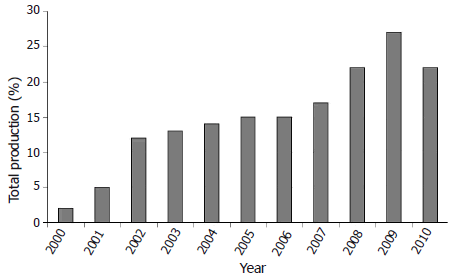
<body><![CDATA[<p>&nbsp;</p>     <p><font size="2" face="Verdana, Arial, Helvetica, sans-serif"><b>Recibido: Agosto 23 de 2011; aceptado: Octubre 31 de 2011. </b></font></p> <hr>     <p><font size="2" face="Verdana, Arial, Helvetica, sans-serif"><i><b>Abstract.</b> Accurate coffee sorting is a response to pressures for product quality and to a growing market for specialty coffees. One of the major challenges in this regard is to prepare the raw coffee fruits for sorting in one-by-one electronic machines. In this paper, we present a mechanical device developed to separate clusters and impurities from the main process. The mechanical device consists of two inclined belt conveyors with upward motion, working in series. This arrangement conveys upwards any elements with more than three contact points on the belt's flat surface, while quasi-spherical elements (fruits) roll down on the belts. The experimental set up was designed to allow each belt's inclination and speed to vary, in order to run a 3 x 3 factorial treatment design (Three inclinations: 10&ordm;, 14&ordm; and 18&ordm; and three speeds: 0.17, 0.20 and 0.24 </i>m s<sup>-1</sup><i>). The belt transport surface material was PVC. The best performance was obtained at the speed of 0.20 </i>m s<sup>-1</sup><i> and between 10&ordm; and 14&ordm; of inclination. After these findings, three treatments were conducted at a working speed of 0.20 </i>m s<sup>-1</sup><i> and three inclinations between 10&ordm; and 14&ordm;, finding the best performance at 11&ordm;. In these conditions the mean efficacy of separation was 98.8%, varying within a range between 97.5% and 100%. The resulting system from this research work is suitable to run as pretreatment of one-by-one electronic sorters of coffee and coffee-like products.</i></font></p>     <p><font size="2" face="Verdana, Arial, Helvetica, sans-serif"><b>Key words:</b> Agro industrial machinery, raw material preparation, separation of clusters, automation.</font></p>     <p><font size="2" face="Verdana, Arial, Helvetica, sans-serif"><i><b>Resumen.</b> La clasificaci&oacute;n precisa del caf&eacute; surge como respuesta a las exigencias de calidad del producto en los crecientes mercados de caf&eacute;s especiales. Uno de los retos m&aacute;s importantes al respecto, es la preparaci&oacute;n de los frutos del caf&eacute; en bruto para que sean clasificados uno por uno por las m&aacute;quinas electr&oacute;nicas. En este trabajo se presenta un dispositivo mec&aacute;nico desarrollado para separar glom&eacute;rulos y las impurezas del proceso principal. El dispositivo mec&aacute;nico consiste en dos cintas transportadoras inclinadas con movimiento ascendente, trabajando en serie. Este mecanismo conduce hacia arriba todos los elementos con m&aacute;s de tres puntos de contacto en una superficie plana de la banda, mientras que los frutos que son cuasiesf&eacute;ricos bajan por las bandas. El trabajo experimental fue dise&ntilde;ado con el fin de determinar la inclinaci&oacute;n de cada banda y las variaciones en la velocidad; se ejecut&oacute; un dise&ntilde;o 3 x 3 de tratamiento factorial (tres inclinaciones: 10&ordm;, 14 &ordm; y 18&ordm; y tres velocidades: 0,17, 0,20 y 0,24 </i>m s<sup>-1</sup><i> ). La superficie de las bandas transportadoras fueron elaboradas en PVC. El mejor comportamiento se obtuvo con la velocidad de 0,20 </i>m s<sup>-1</sup><i>, y entre 10&deg; y 14&deg; de inclinaci&oacute;n. Despu&eacute;s de estos resultados, los tres tratamientos se llevaron a cabo a una velocidad de trabajo de 0,20 </i>m s<sup>-1</sup> <i>y tres inclinaciones entre 10&deg; y 14&deg; encontr&aacute;ndose el mejor desempe&ntilde;o a los 11&ordm;. En estas condiciones, la eficacia media de la separaci&oacute;n fue del 98,8%, variando en un rango entre 97,5% y 100%. El resultado de este trabajo de investigaci&oacute;n es adecuado para funcionar como pre-tratamiento de tipo de electr&oacute;nico para clasificadoras de caf&eacute; y productos derivados de &eacute;ste.</i></font></p>     <p><font size="2" face="Verdana, Arial, Helvetica, sans-serif"><b>Palabras clave.</b> Maquinaria agroindustrial, preparaci&oacute;n de materias primas, separaci&oacute;n de grupos, automatizaci&oacute;n.</font></p> <hr>     <p>&nbsp;</p>     <p><font size="2" face="Verdana, Arial, Helvetica, sans-serif">Coffee is important for Colombia not only because it is the agricultural product that gives the greatest income to the country but also because more than 500.000 families depend on this crop.</font></p>     <p><font size="2" face="Verdana, Arial, Helvetica, sans-serif">Since the average coffee farm in Colombia has an area of only 1.31 ha (Federaci&oacute;n Nacional de Cafeteros, 2010), most of the coffee growers are small-farm owners with a small-profit business. One factor that has helped growers to improve their income is the production of coffees with differentiated characteristics, attributed to special environmental effects such as climate, soil, agricultural labors, selective harvesting, special cares and/or processing conditions. As a result, the market for specialty coffees has constantly grown in the way shown in <a href="#fig01">Figure 1</a>.</font></p>     <p align="center"><font size="2" face="Verdana, Arial, Helvetica, sans-serif"><a name="fig01"></a><b><img src="/img/revistas/rfnam/v64n2/a21fig01.gif">    ]]></body>
<body><![CDATA[<br>   Figure 1.</b> Percentage of the total production in specialty coffees in Colombia (Federaci&oacute;n Nacional de Cafeteros, 2010).</font></p>     <p><font size="2" face="Verdana, Arial, Helvetica, sans-serif">Even though harvesting is done manually by coffee pickers who carefully detach and collect the ripe fruits one by one, it is difficult for the coffee growers to receive a homogeneous raw material. The main reason for this heterogeneity is the wide bimodal crop distribution that generates the presence of fruits in all maturation stages during the whole year, which in turn causes pickers to accidentally detach undesired fruits. Another factor that promotes this problem is harvesting passes have to be spaced at the beginning and end of the crop for low offer of fruits, leading to overmature and dry fruits to appear in the harvested fruits. A diverse raw material also affects the consistency of the product.</font></p>     <p><font size="2" face="Verdana, Arial, Helvetica, sans-serif">Some devices have been developed for improving the raw material by density. A very common device is the siphon tank, which permits the precipitation in water of dense fruits that are extracted from the bottom through a siphon pipe; while light fruits and impurities are removed by flotation. A recent development is the Hydraulic Separator with Hopper and Screw Conveyor (HSHSC) (Oliveros <i>et al</i>., 2009), in which the principle of precipitation in water is also used to eliminate low quality fruits and impurities, with less water consumption. However, these hydro-mechanical devices are not able to remove all the undesired fruits.</font></p>     <p><font size="2" face="Verdana, Arial, Helvetica, sans-serif">In order to improve the product consistency, or help in the preparation of special raw materials, a low-cost electronic analyzer able to identify coffee fruits in up to five different maturation stages was developed (Sanz <i>et al</i>., 2008; Oliveros, 2008; Ramos, 2008). The electronic analyzer was also intended for sorting mechanically harvested coffee, because there is a motivation for developing machines for this purpose in order to reduce production costs.</font></p>     <p><font size="2" face="Verdana, Arial, Helvetica, sans-serif">One of the major challenges for the use of electronic sorters is the fruits have to be fed in one-by-one way to be analyzed. In that way, presence of clusters of coffee fruits, as well as impurities, cause machine stops and interfere in its performance.</font></p>     <p><font size="2" face="Verdana, Arial, Helvetica, sans-serif">The purpose of this research work was to develop a simple machine to remove clusters from the main mass of coffee. The machine can be used also to separate impurities, such as leaves and steams that can interfere in the electronic analysis. This paper presents the description of the principle used to achieve the separation and the steps followed in the design, construction and evaluation, as well as the results obtained.</font></p>     <p>&nbsp;</p>     <p><font size="3" face="Verdana, Arial, Helvetica, sans-serif"><b>MATERIALS AND METHODS</b></font></p>     <p><font size="2" face="Verdana, Arial, Helvetica, sans-serif"><i><b>Preliminary tests.</b></i> The equipment developed for separating clusters of coffee fruits is based on the principle that any element is in stable equilibrium in a flat surface if it has three or more contact points.</font></p>     <p><font size="2" face="Verdana, Arial, Helvetica, sans-serif">Since coffee fruits are quasi-spherical, they are in unstable equilibrium because every fruit has just one contact point on the flat surface. In contrast, a cluster of fruits stays in equilibrium because has three or more contact points. If the flat surface is inclined to a certain angle, fruits roll down by gravity while clusters remain on the flat surface. If the angle is steeper, it can reach a condition at which clusters start to slide down the flat surface. Very steep angles can make clusters roll.</font></p>     ]]></body>
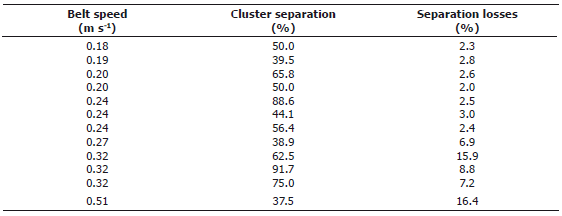
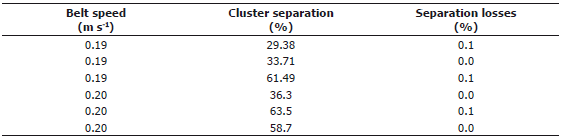
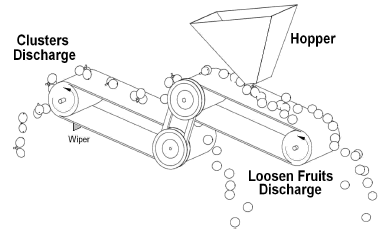
<body><![CDATA[<p><font size="2" face="Verdana, Arial, Helvetica, sans-serif">The principle was originally tested in an inclined belt conveyor moving upwards, but some fruits were retained by clusters and did not let them roll down. To avoid this problem another inclined belt conveyor was added at a lower level, moving upwards as well, to let trapped fruits fall first, and roll down on the lower belt, as shown in <a href="#fig02">Figure 2</a>. The belts used are of the brand Habasit and reference UV15MR, where transport surface is made of PVC. Impurities like dirt, parts of leaves, parts of fruit skin and pulped fruits are conveyed like clusters. Coffee fruits are received in the lower part of the machine and clusters of fruits, as well as impurities, are discharged in the upper part.</font></p>     <p align="center"><font size="2" face="Verdana, Arial, Helvetica, sans-serif"><a name="fig02"></a><b><img src="/img/revistas/rfnam/v64n2/a21fig02.gif">    <br>   Figure 2.</b> Physical principle used to separate clusters of coffee fruits.</font></p>     <p><font size="2" face="Verdana, Arial, Helvetica, sans-serif">A preliminary trial and error search determined a range which contained the optimal inclination. Twelve tests were conducted using 50 kg of coffee fruits of which contents of clusters were quantified. The belt's inclination was kept at 16&ordm; with respect to the horizontal and the speed was varied between 0,18 and 0,51 m s<sup>-1</sup> <a href="#tab01">Table 1</a> shows the results of the 12 preliminary tests.</font></p>     <p align="center"><font size="2" face="Verdana, Arial, Helvetica, sans-serif"><a name="tab01"></a><b>Table 1.</b> Preliminary tests at 16&deg; of a inclination and different belt speeds in a cluster coffee fruits separating equipment.</font>    <br>   <img src="/img/revistas/rfnam/v64n2/a21tab01.gif"></p>     <p><font size="2" face="Verdana, Arial, Helvetica, sans-serif">It was found that the separation of clusters varied between 37.5% and 91.7% and the separation losses, defined as loose fruits within the separated clusters divided by the initial mass, between 2.0% and 16.4%. These tests evidenced the necessity of varying the belts speed and the feeding rate.</font></p>     <p><font size="2" face="Verdana, Arial, Helvetica, sans-serif"><a href="#tab02">Table 2</a> shows the results of running the belt at an inclination of 17&ordm; and a speed of 0.19 and 0.20 m s<sup>-1</sup>. It was noticed a negative effect on the efficacy of separation of clusters and a positive effect on the separation losses.</font></p>     <p align="center"><font size="2" face="Verdana, Arial, Helvetica, sans-serif"><a name="tab02"></a><b>Table 2.</b> Preliminary tests at 17&deg; of inclination and a speed of around 0.2 m s<sup>-1</sup> in a cluster coffee fruits separating equipment.</font>    <br>   <img src="/img/revistas/rfnam/v64n2/a21tab02.gif"></p>     ]]></body>
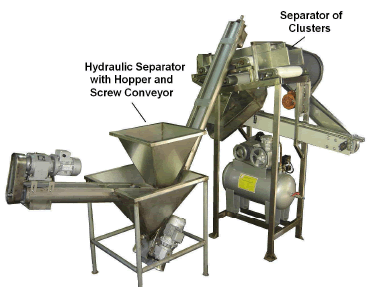
<body><![CDATA[<p><font size="2" face="Verdana, Arial, Helvetica, sans-serif">In the runs it was also noticed impurities such as parts of skin, parts of leaves, dirt and pulped fruits adhered to the belts. This feature can be used as an advantage because those impurities can be easily removed with wipers.</font></p>     <p><font size="2" face="Verdana, Arial, Helvetica, sans-serif"><i><b>Experimental setup</b></i><b>.</b> In order to achieve a constant feeding rate, the Hydraulic Separator with Hopper and Screw Conveyor (HSHSC) developed by Oliveros et al. (2009) was adapted to feed the belts and calibrated to give 300 kg h-1 of coffee fruits, &plusmn;10 kg, which is the feeding rate required by the electronic analyzer. This hydro-mechanical device assures a raw material with less bored coffee fruits, and free of dry vane fruits and light impurities.</font></p>     <p><font size="2" face="Verdana, Arial, Helvetica, sans-serif">Since the feeding rate is maintained with the use of the HSHSC, the structure was designed to change the inclination of the belts and the electric motor was driven by a variable-frequency drive in order to change the belts speed. <a href="#fig03">Figure 3</a> shows a picture of the experimental setup.</font></p>     <p align="center"><font size="2" face="Verdana, Arial, Helvetica, sans-serif"><a name="fig03"></a><b><img src="/img/revistas/rfnam/v64n2/a21fig03.gif">    <br>   Figure 3.</b> Experimental setup of a cluster coffee fruits separating equipment.</font></p>     <p><font size="2" face="Verdana, Arial, Helvetica, sans-serif"><i><b>Methodology.</b></i> The tests were conducted in the National Research Center of Coffee - Cenicaf&eacute;, located in the city of Chinchin&aacute; -; Colombia, at an altitude of 1,310 masl, with a mean temperature of 21.4 &ordm;C and a mean relative humidity of 82.5%.</font></p>     <p><font size="2" face="Verdana, Arial, Helvetica, sans-serif">The experimental design was a 3 x 3 factorial design, with three inclinations (10&deg;, 14&deg; and 18&deg;) and three speeds (0.17, 0.20 and 0.24 m s<sup>-1</sup>), for a total of nine treatments. Every treatment was repeated four times. The experimental unit consisted of 250 kg of coffee fruits of the Castillo variety&reg;.</font></p>     <p><font size="2" face="Verdana, Arial, Helvetica, sans-serif">In each run the content of clusters of the experimental unit was measured in 1.0 kg samples, which corresponded to the initial content of clusters. The response variables were the final content of clusters, the mass of coffee separated as clusters and the loosened fruits within the separated clusters. These response variables then determined the efficacy of cluster separation and the separation losses.</font></p>     <p><font size="2" face="Verdana, Arial, Helvetica, sans-serif">The efficacy was calculated by the ratio between the final content of clusters, <i>c</i>f, divided by the initial content, <i>c</i>i, as expressed in equation 1.</font></p>     <p><font size="2" face="Verdana, Arial, Helvetica, sans-serif"><img src="/img/revistas/rfnam/v64n2/a21eq01.gif"></font></p>     ]]></body>
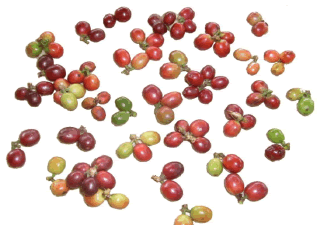
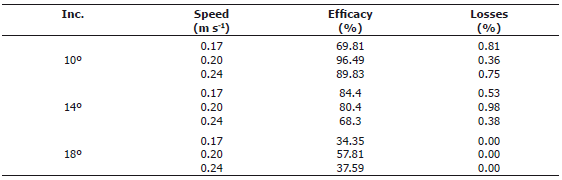
<body><![CDATA[<p><font size="2" face="Verdana, Arial, Helvetica, sans-serif">The separation losses, <i>l</i>, were calculated dividing the mass of loosened fruits within the separated clusters, <i>l</i>l, by the initial mass of loose fruits, <i>l</i>0, as seen in equation 2.</font></p>     <p><font size="2" face="Verdana, Arial, Helvetica, sans-serif"><img src="/img/revistas/rfnam/v64n2/a21eq02.gif"></font></p>     <p><font size="2" face="Verdana, Arial, Helvetica, sans-serif">The average and standard deviation of every variable were obtained.</font></p>     <p>&nbsp;</p>     <p><font size="3" face="Verdana, Arial, Helvetica, sans-serif"><b>RESULTS AND DISCUSSION</b></font></p>     <p><font size="2" face="Verdana, Arial, Helvetica, sans-serif">The mean content of clusters in the initial mass was 2.0% with a standard deviation of 1.0%, a maximum value of 4.3% and a minimum of 0.9%. This corresponds approximately to a mean of 7 clusters per kg, with a maximum value of 11 and a minimum value of 4. <a href="#fig04">Figure 4</a> shows a picture of the clusters found in the mass of coffee fruits. In the picture it can be seen that the clusters have fruits in all the maturation stages.</font></p>     <p align="center"><font size="2" face="Verdana, Arial, Helvetica, sans-serif"><a name="fig04"></a><b><img src="/img/revistas/rfnam/v64n2/a21fig04.gif">    <br>   Figure 4.</b> Clusters of coffee fruits found in the harvested coffee.</font></p>     <p><font size="2" face="Verdana, Arial, Helvetica, sans-serif"><a href="#tab03">Table 3</a> shows the means for the cluster separation efficacy and separation losses for the nine treatments as well as their standard deviations. The greatest values of efficacy of separation were found at the inclinations of 10&ordm; and 14&ordm;. Even though the separation losses were null for the inclination of 18&ordm;, the results for the variable efficacy of separation were very low.</font></p>     <p align="center"><font size="2" face="Verdana, Arial, Helvetica, sans-serif"><a name="tab03"></a><b>Table 3.</b> Efficacies and separation losses for the separator of clusters of coffee fruits for different belts inclinations and speeds.</font>    ]]></body>
<body><![CDATA[<br>   <img src="/img/revistas/rfnam/v64n2/a21tab03.gif"></p>     <p><font size="2" face="Verdana, Arial, Helvetica, sans-serif">The very best result was obtained at a speed of 0.20 m s<sup>-1</sup> and the best operation condition between 10 and 14&ordm;. For theses reasons three other treatments for inclinations of 11&ordm;, 12&ordm; and 13&ordm;, were conducted at the speed of 0.2 m s<sup>-1</sup>. <a href="#tab04">Table 4</a> shows the results for cluster separation efficacy and separation losses. The best results were obtained for the inclination of 11&ordm; at a speed of 0.2 m s<sup>-1</sup>. At these conditions, it was obtained an efficacy of separation of clusters of 98,8% with separation losses of only 0.13%. The mean efficacy was a result of repeated values for the cluster separation efficacy of 100% and a minimum of 97.5%. </font></p>     <p align="center"><font size="2" face="Verdana, Arial, Helvetica, sans-serif"><a name="tab04"></a><b>Table 4.</b> Efficacies and separation losses for belts inclinations of 11&ordm;, 12&ordm; and 13&ordm;, at a belts speed of 0,2 m s<sup>-1</sup>.</font>    <br>   <img src="/img/revistas/rfnam/v64n2/a21tab04.gif"></p>     <p>&nbsp;</p>     <p><font size="3" face="Verdana, Arial, Helvetica, sans-serif"><b>CONCLUSIONS</b></font></p>     <p><font size="2" face="Verdana, Arial, Helvetica, sans-serif">The best result was obtained at the inclination of 11&ordm; and a speed of 0.2 m s<sup>-1</sup>. These conditions obtained a cluster separation efficacy of 98.8% with separation losses of only 0.13%.</font></p>     <p><font size="2" face="Verdana, Arial, Helvetica, sans-serif">It was also observed that impurities such as parts of fruits skin, parts of leaves, dirt and pulped fruits can be also removed with this mechanical device leaving the coffee fruits free of dirt.</font></p>     <p><font size="2" face="Verdana, Arial, Helvetica, sans-serif">The system resulting of this research work is suitable to run as pretreatment of one-by-one electronic sorters of coffee.</font></p>     <p><font size="2" face="Verdana, Arial, Helvetica, sans-serif">The knowledge acquired in this research work can be used in other agricultural products that also have problems with clusters.</font></p>     ]]></body>
<body><![CDATA[<p>&nbsp;</p>     <p><font size="3" face="Verdana, Arial, Helvetica, sans-serif"><b>ACKNOWLEDGMENTS</b></font></p>     <p><font size="2" face="Verdana, Arial, Helvetica, sans-serif">The authors would like to thank the National Science Foundation of Colombia -; Colciencias, and the National Federation of Coffee Growers of Colombia for economic support for this research project. The authors are also grateful to the people at the machine shop of the Department of Agricultural Engineering at Cenicaf&eacute; and to the company Luque Internacional for donating the belts.</font></p>     <p>&nbsp;</p>     <p><font size="3" face="Verdana, Arial, Helvetica, sans-serif"><b>BIBLIOGRAPHY</b></font></p>     <!-- ref --><p><font size="2" face="Verdana, Arial, Helvetica, sans-serif">Federaci&oacute;n Nacional de Cafeteros de Colombia. Informe Gerencia General 2010. Santaf&eacute; de Bogot&aacute;. 156 p.</font>&nbsp;&nbsp;&nbsp;&nbsp;&nbsp;&nbsp;&nbsp;&nbsp;[&#160;<a href="javascript:void(0);" onclick="javascript: window.open('/scielo.php?script=sci_nlinks&ref=000078&pid=S0304-2847201100020002100001&lng=','','width=640,height=500,resizable=yes,scrollbars=1,menubar=yes,');">Links</a>&#160;]<!-- end-ref --><!-- ref --><p><font size="2" face="Verdana, Arial, Helvetica, sans-serif">Oliveros, C.E., J.R. Sanz, E.C. Montoya y E.L. Moreno. 2009. Dispositivo hidr&aacute;ulico de bajo impacto ambiental para limpieza y clasificaci&oacute;n del caf&eacute; cereza. Cenicaf&eacute; 60(3): 229-238.</font>&nbsp;&nbsp;&nbsp;&nbsp;&nbsp;&nbsp;&nbsp;&nbsp;[&#160;<a href="javascript:void(0);" onclick="javascript: window.open('/scielo.php?script=sci_nlinks&ref=000079&pid=S0304-2847201100020002100002&lng=','','width=640,height=500,resizable=yes,scrollbars=1,menubar=yes,');">Links</a>&#160;]<!-- end-ref --><!-- ref --><p><font size="2" face="Verdana, Arial, Helvetica, sans-serif">Sanz, J.R., P.J. Ramos and C.E. Oliveros. 2008. Chapter 20: Algorithm to identify maturation stages of coffee fruits. pp. 167-174. In: IAENG transactions on electrical and electronics engineering. Volume I. IEEE Computer Society, California, USA. 295 p.</font>&nbsp;&nbsp;&nbsp;&nbsp;&nbsp;&nbsp;&nbsp;&nbsp;[&#160;<a href="javascript:void(0);" onclick="javascript: window.open('/scielo.php?script=sci_nlinks&ref=000080&pid=S0304-2847201100020002100003&lng=','','width=640,height=500,resizable=yes,scrollbars=1,menubar=yes,');">Links</a>&#160;]<!-- end-ref --><!-- ref --><p><font size="2" face="Verdana, Arial, Helvetica, sans-serif">Oliveros, C.E., 2008. M&aacute;quina seleccionadora de frutos de caf&eacute;. Informe T&eacute;cnico Final. Proyecto Colciencias: 2251-07-18438. Santaf&eacute; de Bogot&aacute;. 77 p.</font>&nbsp;&nbsp;&nbsp;&nbsp;&nbsp;&nbsp;&nbsp;&nbsp;[&#160;<a href="javascript:void(0);" onclick="javascript: window.open('/scielo.php?script=sci_nlinks&ref=000081&pid=S0304-2847201100020002100004&lng=','','width=640,height=500,resizable=yes,scrollbars=1,menubar=yes,');">Links</a>&#160;]<!-- end-ref --><!-- ref --><p><font size="2" face="Verdana, Arial, Helvetica, sans-serif">Ramos, P.J., 2008. Dise&ntilde;o, construcci&oacute;n y evaluaci&oacute;n de un sistema de identificaci&oacute;n de estados de maduraci&oacute;n de frutos de caf&eacute; a altas velocidades. Tesis Mag&iacute;ster en Ingenier&iacute;a El&eacute;ctrica. Facultad de Ingenier&iacute;a El&eacute;ctrica. Universidad Tecnol&oacute;gica de Pereira. Pereira. 1 CD-ROM.</font>&nbsp;&nbsp;&nbsp;&nbsp;&nbsp;&nbsp;&nbsp;&nbsp;[&#160;<a href="javascript:void(0);" onclick="javascript: window.open('/scielo.php?script=sci_nlinks&ref=000082&pid=S0304-2847201100020002100005&lng=','','width=640,height=500,resizable=yes,scrollbars=1,menubar=yes,');">Links</a>&#160;]<!-- end-ref --> ]]></body><back>
<ref-list>
<ref id="B1">
<nlm-citation citation-type="">
<collab>Federación Nacional de Cafeteros de Colombia</collab>
<source><![CDATA[Informe Gerencia General 2010]]></source>
<year></year>
<page-range>156</page-range><publisher-loc><![CDATA[Santafé de Bogotá ]]></publisher-loc>
</nlm-citation>
</ref>
<ref id="B2">
<nlm-citation citation-type="journal">
<person-group person-group-type="author">
<name>
<surname><![CDATA[Oliveros]]></surname>
<given-names><![CDATA[C.E]]></given-names>
</name>
<name>
<surname><![CDATA[Sanz]]></surname>
<given-names><![CDATA[J.R]]></given-names>
</name>
<name>
<surname><![CDATA[Montoya]]></surname>
<given-names><![CDATA[E.C]]></given-names>
</name>
<name>
<surname><![CDATA[Moreno]]></surname>
<given-names><![CDATA[E.L]]></given-names>
</name>
</person-group>
<article-title xml:lang="es"><![CDATA[Dispositivo hidráulico de bajo impacto ambiental para limpieza y clasificación del café cereza]]></article-title>
<source><![CDATA[Cenicafé]]></source>
<year>2009</year>
<volume>60</volume>
<numero>3</numero>
<issue>3</issue>
<page-range>229-238</page-range></nlm-citation>
</ref>
<ref id="B3">
<nlm-citation citation-type="book">
<person-group person-group-type="author">
<name>
<surname><![CDATA[Sanz]]></surname>
<given-names><![CDATA[J.R]]></given-names>
</name>
<name>
<surname><![CDATA[Ramos]]></surname>
<given-names><![CDATA[P.J]]></given-names>
</name>
<name>
<surname><![CDATA[Oliveros]]></surname>
<given-names><![CDATA[C.E]]></given-names>
</name>
</person-group>
<article-title xml:lang="en"><![CDATA[Chapter 20: Algorithm to identify maturation stages of coffee fruits]]></article-title>
<collab>IAENG</collab>
<source><![CDATA[transactions on electrical and electronics engineering]]></source>
<year>2008</year>
<volume>I</volume>
<page-range>167-174</page-range><page-range>295</page-range><publisher-loc><![CDATA[^eCalifornia California]]></publisher-loc>
<publisher-name><![CDATA[IEEE Computer Society]]></publisher-name>
</nlm-citation>
</ref>
<ref id="B4">
<nlm-citation citation-type="book">
<person-group person-group-type="author">
<name>
<surname><![CDATA[Oliveros]]></surname>
<given-names><![CDATA[C.E]]></given-names>
</name>
</person-group>
<source><![CDATA[Máquina seleccionadora de frutos de café. Informe Técnico Final]]></source>
<year>2008</year>
<page-range>77</page-range><publisher-loc><![CDATA[Santafé de Bogotá ]]></publisher-loc>
<publisher-name><![CDATA[Proyecto Colciencias]]></publisher-name>
</nlm-citation>
</ref>
<ref id="B5">
<nlm-citation citation-type="">
<person-group person-group-type="author">
<name>
<surname><![CDATA[Ramos]]></surname>
<given-names><![CDATA[P.J]]></given-names>
</name>
</person-group>
<source><![CDATA[Diseño, construcción y evaluación de un sistema de identificación de estados de maduración de frutos de café a altas velocidades]]></source>
<year>2008</year>
</nlm-citation>
</ref>
</ref-list>
</back>
</article>