<?xml version="1.0" encoding="ISO-8859-1"?><article xmlns:mml="http://www.w3.org/1998/Math/MathML" xmlns:xlink="http://www.w3.org/1999/xlink" xmlns:xsi="http://www.w3.org/2001/XMLSchema-instance">
<front>
<journal-meta>
<journal-id>0366-5232</journal-id>
<journal-title><![CDATA[Caldasia]]></journal-title>
<abbrev-journal-title><![CDATA[Caldasia]]></abbrev-journal-title>
<issn>0366-5232</issn>
<publisher>
<publisher-name><![CDATA[Instituto de Ciencias Naturales, Facultad de Ciencias-Universidad Nacional de Colombia]]></publisher-name>
</publisher>
</journal-meta>
<article-meta>
<article-id>S0366-52322005000100007</article-id>
<title-group>
<article-title xml:lang="en"><![CDATA[NOTES ON THE GENUS NYMPHOIDES (MENYANTHACEAE) OF COLOMBIA]]></article-title>
<article-title xml:lang="es"><![CDATA[Notas sobre el género Nymphoides (Menyanthaceae) en Colombia]]></article-title>
</title-group>
<contrib-group>
<contrib contrib-type="author">
<name>
<surname><![CDATA[SCHMIDT-MUMM]]></surname>
<given-names><![CDATA[UDO]]></given-names>
</name>
<xref ref-type="aff" rid="A01"/>
</contrib>
</contrib-group>
<aff id="A01">
<institution><![CDATA[,Universidad del Tolima Facultad de Ciencias Grupo de Investigación en Zoología]]></institution>
<addr-line><![CDATA[ ]]></addr-line>
</aff>
<pub-date pub-type="pub">
<day>30</day>
<month>06</month>
<year>2005</year>
</pub-date>
<pub-date pub-type="epub">
<day>30</day>
<month>06</month>
<year>2005</year>
</pub-date>
<volume>27</volume>
<numero>1</numero>
<fpage>127</fpage>
<lpage>130</lpage>
<copyright-statement/>
<copyright-year/>
<self-uri xlink:href="http://www.scielo.org.co/scielo.php?script=sci_arttext&amp;pid=S0366-52322005000100007&amp;lng=en&amp;nrm=iso"></self-uri><self-uri xlink:href="http://www.scielo.org.co/scielo.php?script=sci_abstract&amp;pid=S0366-52322005000100007&amp;lng=en&amp;nrm=iso"></self-uri><self-uri xlink:href="http://www.scielo.org.co/scielo.php?script=sci_pdf&amp;pid=S0366-52322005000100007&amp;lng=en&amp;nrm=iso"></self-uri><abstract abstract-type="short" xml:lang="en"><p><![CDATA[Nymphoides, a cosmopolitan genus, comprises to date 22 aquatic species. Two species are actually known to occur in Colombia , Nymphoides indica with a pantropical distribution and Nymphoides flaccida, an endemic species of the Colombian Llanos. Recently I got the opportunity to collect flowering and fruiting material of N. flaccida, which I take for presenting a broader description of the mentioned species. A key for the Colombian species is given. The geographical distribution, ecological preferences, and descriptions are presented under each species. Probably species richness of aquatic macrophytes in the neotropics, and particularly of Colombia , may be higher than presently recognized because of the incomplete knowledge of the aquatic flora.]]></p></abstract>
<abstract abstract-type="short" xml:lang="es"><p><![CDATA[El género Nymphoides es cosmopolita y comprende 22 especies acuáticas, dos de las cuales están presentes en Colombia: Nymphoides indica, la que exhibe una distribución pantropical, y Nymphoides flaccida, la cual es endémica de los Llanos Orientales de Colombia. Recientemente tuve la oportunidad de recolectar material en flor y fruto de N. flaccida, con lo que amplío la descripción de esta especie. Se presenta una clave para separar las especies presentes en Colombia, así como las descripciones de las mismas, sus preferencias ecológicas y su distribución geográfica.]]></p></abstract>
<kwd-group>
<kwd lng="en"><![CDATA[Menyanthaceae]]></kwd>
<kwd lng="en"><![CDATA[Nymphoides]]></kwd>
<kwd lng="en"><![CDATA[Flora of Colombia]]></kwd>
<kwd lng="en"><![CDATA[aquatic plants]]></kwd>
<kwd lng="es"><![CDATA[Menyanthaceae]]></kwd>
<kwd lng="es"><![CDATA[Nymphoides]]></kwd>
<kwd lng="es"><![CDATA[Flora de Colombia]]></kwd>
<kwd lng="es"><![CDATA[plantas acuáticas]]></kwd>
</kwd-group>
</article-meta>
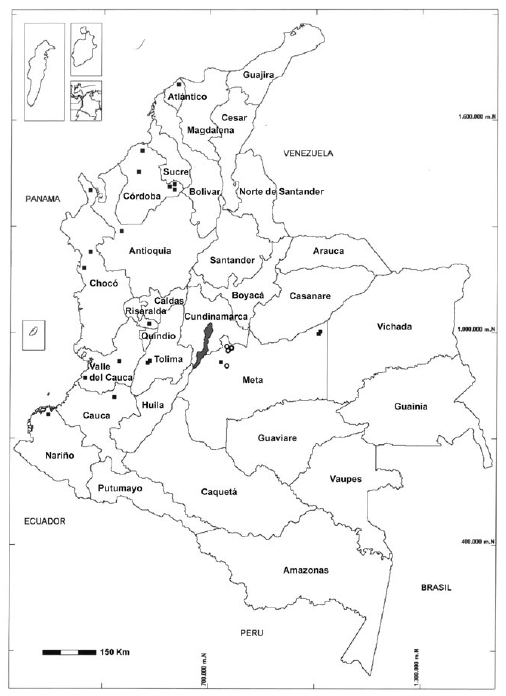
</front><body><![CDATA[ <P align=center><font size="3" face="Verdana">    <BR> <B>NOTES ON THE GENUS NYMPHOIDES (MENYANTHACEAE) OF COLOMBIA</B></font></P>     <P align=center><font size="2" face="Verdana"><B>Notas sobre el g&eacute;nero Nymphoides (Menyanthaceae) en Colombia</B></font></P> <font size="2" face="Verdana">    <BR> </font>     <P><font size="2" face="Verdana"><B>UDO SCHMIDT-MUMM</B></font></P>      <P align="left"><font size="2" face="Verdana"><I>Grupo de Investigación en Zoología, Facultad de Ciencias, Universidad del Tolima, Altos de Santa Elena, A. A. 546. Ibagué-Tolima-Colombia. <a href="mailto:gilbar02@hotmail.com; gilbar03@yahoo.es">gilbar02@hotmail.com; gilbar03@yahoo.es</a></I>   </font>     <P><font size="2" face="Verdana"><B>ABSTRACT</B></font></P>     <P align="justify"><font size="2" face="Verdana">Nymphoides, a cosmopolitan genus, comprises to date 22 aquatic species. Two species are actually known to occur in Colombia, Nymphoides indica with a pantropical distribution and Nymphoides flaccida, an endemic species of the Colombian Llanos. Recently I got the opportunity to collect flowering and fruiting material of N. flaccida, which I take for presenting a broader description of the mentioned species. A key for the Colombian species is given. The geographical distribution, ecological preferences, and descriptions are presented under each species. Probably species richness of aquatic macrophytes in the neotropics, and particularly of Colombia, may be higher than presently recognized because of the incomplete knowledge of the aquatic flora.</font></P>     <P><font size="2" face="Verdana"><B>Key words .</B>  Menyanthaceae, Nymphoides, Flora of Colombia, aquatic plants. </font></P>     <P><font size="2" face="Verdana"><B>RESUMEN</B></font></P>     ]]></body>
<body><![CDATA[<P><font size="2" face="Verdana">El g&eacute;nero Nymphoides es cosmopolita y comprende 22 especies acu&aacute;ticas, dos de las cuales est&aacute;n presentes en Colombia: Nymphoides indica, la que exhibe una distribuci&oacute;n pantropical, y Nymphoides flaccida, la cual es end&eacute;mica de los Llanos Orientales de Colombia. Recientemente tuve la oportunidad de recolectar material en flor y fruto de N. flaccida, con lo que ampl&iacute;o la descripci&oacute;n de esta especie. Se presenta una clave para separar las especies presentes en Colombia, as&iacute; como las descripciones de las mismas, sus preferencias ecol&oacute;gicas y su distribuci&oacute;n geogr&aacute;fica.</font></P>     <P><font size="2" face="Verdana"><B>Palabras clave .</B> Menyanthaceae, Nymphoides, Flora de Colombia, plantas acu&aacute;ticas.</font></P>     <P><font size="2" face="Verdana"><B>INTRODUCTION</B></font></P>  <font size="2" face="Verdana"> </font>     <p><font size="2" face="Verdana">Nymphoides, a cosmopolitan genus, comprises to date 22 aquatic species (Cook 1996). Two species are actually known to occur in Colombia, Nymphoides indica with a pantropical distribution and Nymphoides flaccida, an endemic species of the Colombian Llanos. This species is less well known and descriptions of fruits and seeds are actually lacking from the type specimen (Smith 1952). Recently I got the opportunity to collect flowering and fruiting material of N. flaccida, which I take for presenting a broader description of the mentioned species. Large-scale comparisons of plant richness between neotropical and temperate areas are problematic because most of its aquatic floras are not as well studied as those of Europe or North America (Crow 1993, Jacobsen &amp; Terneus, 2001). Probably species richness of aquatic macrophytes in the neotropics, and particularly of Colombia, may be higher then presently recognized because of the incomplete knowledge of the aquatic flora.</font></p>     <p><font size="2" face="Verdana"><b>Key to the species of Nymphoides in Colombia</b></font></font></p>     <p><font size="2" face="Verdana">1.	Leaves orbicular to subovate, coriaceous; usually in quite waters 	              N. indica    <br>   1&rsquo;.	Leaves oblong, flaccid; in running waters 	                                                     N. flaccida</font></p>     <p><font size="2" face="Verdana"><b><i>Nymphoides flaccida</i> L. B. Smith</b>, J. Wash. Acad. Scien. 42: 160. 1952. Type. COLOMBIA. Meta: Eastern Llanos, Ca&ntilde;o Quenane, 25 jan 1942, Dugand &amp; Jaramillo 3121 (holotype COL).</font></p>     <p><font size="2" face="Verdana">Perennial aquatic herb from submerged rhizome; stems succulent, ascending, weak, up to 22 cm long, with a single terminal leaf or usually branching near the apex bearing one to several leaves and a cluster of flowers; leaves usually floating and submerged during low waters, all submerged during high waters, flaccid, oblong, margins undulate, base cuneate to oblong, apex obtuse, occasionally emarginate, blade glandular, 13 cm long, 2.5 cm wide; inflorescence of many fascicled flowers, appearing umbellate; flowers pedicellate, the pedicel 2&ndash;7 cm long, glabrous; calyx 2.5&ndash;6.5 mm long, sepals linear to lanceolate, apex acute; corolla ca. 15 mm long, fimbriate, white, proximally yellow; stamens 5; anthers sagittate, introrse, 2.4 mm long; capsule indehiscent or rupturing irregularly, ellipsoid to orbicular, 2.6&ndash;4.2 mm wide, 4.2&ndash;5.6 mm long, style persistent; seeds ellipsoid to suborbicular, dorsiventrally flattened, 1.7-2 mm long, grayish to brown, shiny, papillose, tegument hard.</font></p>     <p><font size="2" face="Verdana"><b>Observations.</b> The observed populations of N. flaccida grow on a cobble to gravel unconsolidated bottom, preferentially in fast to moderately flowing waters. Leaves are submerged during high waters but most of them may float during the dry season when water level is low. Flowering seemed to be timed with the low water level conditions (for example slow running waters that permits the flower to maintain itself emerged o floating during anthesis), however flower buts and fruits are usually submerged. On the other hand one can note that the distribution of N. flaccida overlaps with the distribution of another aquatic endemic represented by Macarenia clavigera v. Royen (Podostemaceae).</font></p>     ]]></body>
<body><![CDATA[<p><font size="2" face="Verdana"><b>Specimens examined</b></font></p>     <p><font size="2" face="Verdana">COLOMBIA. Meta: Alrededores de Villavicencio, ca&ntilde;o de Peralonso, 450 m, 24-28 jul 1946, Jaramillo et al. 362 (COL); Llanos Orientales, Ca&ntilde;o Pachaquiaro, 450 m, 8 ago 1964, Reyes s.n. (COL); Mun. Villavicencio, Quebrada Peralonso, 8 jun 1970, Lozano 2772 (COL); Mun. Fuente de Oro, Ca&ntilde;o Iraca, al oeste de Fuente de Oro, 250 m, 7 mar 1994, Schmidt-Mumm 1273 (COL, HPUJ).</font></p>     <p><font size="2" face="Verdana"><b><i>Nymphoides indica</i> (L.) Kunze</b>, Rev. Gen. Pl. 2: 429. 1891. Type. Specimen of uncertain origin, numbered 203.2 in Linnaean herbarium (lectotype LINN) (fide Pringle 1995). <a href="#figura1">Fig 1.</a> </font></p>     <p align="center"><img src="/img/revistas/cal/v27n1/v27n1a7fig1.gif"><a name="figura1"></a></p>     <p align="center"><font size="2" face="Verdana"><b>Figure 1.</b> Distribution of Nymphoides indica () and Nymphoides flaccida () in Colombia.</font></p>     <p><font size="2" face="Verdana">Nymphodes humboltiana (Kunth) Kuntze, Rev. Gen. Pl. 2: 429. 1891. Type. COLOMBIA. &ldquo;prope Guaduas, 590 hex.&rdquo;, Humbold &amp; Bonpland s.n. (holotype P-Bonpl.) (fide Pringle 1995).</font></p>     <p><font size="2" face="Verdana">Further synonymy can be found in Raynal (1974), Sivarajan &amp; Joseph (1993) and Pringle (1994).</font></p>     <p><font size="2" face="Verdana">Descriptions of this species are already available for most of the surrounding countries, e.g. Panama (Elias 1969), Venezuela (Vel&aacute;squez 1994), Southeastern Brazil (Fabris &amp; Klein 1971) and Ecuador (Pringle 1995), and no additional one is intended here. To maintain this as a short note only the geographical distribution of specimens within Colombia has been considered here. However Elias (1969) and recently also Pringle (1995) suggest to maintain the Neotropical plants segregated as N. humboltiana until additional evidence has been considered.</font></p>     <p><font size="2" face="Verdana"><b>Specimens examined</b></font></font></p>     <p><font size="2" face="Verdana">COLOMBIA. Antioquia: Mun. Mutat&aacute;, carretera Mutat&aacute;-Pavarand&oacute;, potreros Hacienda El Dari&eacute;n, 150 m, 29 abr 1987, Fonnegra et al. 1942 (HUA). Atl&aacute;ntico: Cerca de Baranquilla, Las Flores, en pantano pr&oacute;ximo a la orilla del r&iacute;o Magdalena, 2 jul 1961, Dugand 5700 (COL). Cauca: Cauca valley, 8 km N of Santander, 1125 m, 26 dec 1944, Grant 10622 (COL). Choc&oacute;: Delta del Atrato, Ci&eacute;naga de la Isla, 22 jun 1954, West 3 (COL); In open ground around Pizzaro, 5 m, 2 aug 1973, White &amp; Warner 84 (COL, HUA); Mun. Bah&iacute;a Solano, corregimiento El Valle, carretera entre el puente sobre la Quebrada Tund&oacute; y el Km 7 del Valle, 25 abr 1989, Espina et al. 2988 (HUA); Mun. Bojay&aacute;, Ci&eacute;naga de Bojayacito, cerca de Bellavista, ca. 40 m, 13 abr 1982, Forero et al. 9191 (COL). C&oacute;rdoba: El Cerrito, 10 km SE of Monter&iacute;a, 12 m, 2 nov 1969, Anderson 1856 (COL); Ci&eacute;naga de Ayapel, 50 m, 9 jul 1973, Idrobo &amp; Cleef 6544 (COL), Ca&ntilde;o Bugue, 28 oct 1984, Franco 2183 (COL); Ci&eacute;naga de Ayapel, Mun. Ayapel, 25 m, 5 dic 1989, Marulanda &amp; Salcedo 1610 (HUA); Ci&eacute;naga de Ayapel, La Quebradona, 22 m, 19 may 1992, Rondon ODC-M-097 (HUA); Mun. Pur&iacute;sima, sistema cenagoso de Lorica, 75&deg;44&rsquo; W, 9&deg;13&rsquo; N, 6 m, 3 sep 1991, Rold&aacute;n 1660, 1666 (HUA). Meta: Lago Carimagua, en la cabecera del r&iacute;o Muco, 19 nov 1963, Blydenstein 10622 (COL); Mun. Puerto Gait&aacute;n, laguna de Carimagua, ribera NE, 150 m, 31 oct 1993, Schmidt-Mumm 1255 (HPUJ); Mun. San Mart&iacute;n, finca Los Guaduales, 350 m, 1 jun 1978, Rangel et al. 1434 (COL). Nari&ntilde;o: Tumaco, alrededores del Pi&ntilde;al Dulce, 8 oct 1955, Romero-Casta&ntilde;eda 5353 (COL). Risaralda: Pereira, 04.50N 75.53W, 900 m, 30 dic 1994, Silverstone &amp; Paz 7230 (CUVC, MO). Tolima: Dissected plateau, 6 km east of Chaparral, 810 m, 27 jan 1949, Mason 13789 (COL); ca. 4 km southeast of Chaparral, 880 m, 26 jul 1950, Galen Smith 1267 (COL). Valle del Cauca: Costa del Pac&iacute;fico, isla del Guayabal, en la desembocadura del r&iacute;o Cajambre, 5 m, 11-12 feb 1944, Cuatrecasas 16196 (COL); Buga, estaci&oacute;n de piscicultura, 10 ene 1964, Fern&aacute;ndez-P&eacute;rez 6158 (COL).</font></p>     ]]></body>
<body><![CDATA[<p><font size="2"><b><font face="Verdana">ACKNOWLEDGMENTS</font></b></font></p>     <p><font size="2" face="Verdana">I thank M. Gonzalo Andrade-C., Jos&eacute; Luis Fern&aacute;ndez-Alonso, Roberto Jaramillo M. for their valuable help at the Herbario Nacional Colombiano (COL) and R. Fonnegra at the Herbario Universidad de Antioquia (HUA). Gabriel Guillot and Flor Adela Forero for assistance in the field.</font></p>     <p><font size="2" face="Verdana"><b>LITERATURE CITED</b></font></p> <font size="2" face="Verdana">     <!-- ref --><p>1. COOK, C. D. K. 1996. Aquatic plant book. APB Academic Publishing, Amsterdam.&nbsp;&nbsp;&nbsp;&nbsp;&nbsp;&nbsp;&nbsp;&nbsp;[&#160;<a href="javascript:void(0);" onclick="javascript: window.open('/scielo.php?script=sci_nlinks&ref=000036&pid=S0366-5232200500010000700001&lng=','','width=640,height=500,resizable=yes,scrollbars=1,menubar=yes,');">Links</a>&#160;]<!-- end-ref --><!-- ref --><p>2. CROW, G. E., 1993. Species diversity in aquatic angiosperms: latitudinal patterns. Aquat. Bot. 44: 229-258.&nbsp;&nbsp;&nbsp;&nbsp;&nbsp;&nbsp;&nbsp;&nbsp;[&#160;<a href="javascript:void(0);" onclick="javascript: window.open('/scielo.php?script=sci_nlinks&ref=000037&pid=S0366-5232200500010000700002&lng=','','width=640,height=500,resizable=yes,scrollbars=1,menubar=yes,');">Links</a>&#160;]<!-- end-ref --><!-- ref --><p>3. ELIAS, T. S., 1969. Menyanthaceae. In: R. F. Woodson & R. W. Schery (eds.), Flora of Panama. Ann. Missouri Bot. Gard. 56: 29-32.&nbsp;&nbsp;&nbsp;&nbsp;&nbsp;&nbsp;&nbsp;&nbsp;[&#160;<a href="javascript:void(0);" onclick="javascript: window.open('/scielo.php?script=sci_nlinks&ref=000038&pid=S0366-5232200500010000700003&lng=','','width=640,height=500,resizable=yes,scrollbars=1,menubar=yes,');">Links</a>&#160;]<!-- end-ref --><!-- ref --><p>4. FABRIS, H. A. & R. M. KLEIN, 1971. Meniantáceas. En: P. R. Reitz (ed.), Flora Ilustrada Catarinense 1: Fasc. MENIA, 1-8.&nbsp;&nbsp;&nbsp;&nbsp;&nbsp;&nbsp;&nbsp;&nbsp;[&#160;<a href="javascript:void(0);" onclick="javascript: window.open('/scielo.php?script=sci_nlinks&ref=000039&pid=S0366-5232200500010000700004&lng=','','width=640,height=500,resizable=yes,scrollbars=1,menubar=yes,');">Links</a>&#160;]<!-- end-ref --><!-- ref --><p>5. JACOBSEN, D. & E. TERNEUS, 2001. Aquatic macrophytes in cool aseasonal and seasonal streams: a comparison between Ecuadorian highland and Danish lowland streams. Aquat. Bot. 71: 281-295.&nbsp;&nbsp;&nbsp;&nbsp;&nbsp;&nbsp;&nbsp;&nbsp;[&#160;<a href="javascript:void(0);" onclick="javascript: window.open('/scielo.php?script=sci_nlinks&ref=000040&pid=S0366-5232200500010000700005&lng=','','width=640,height=500,resizable=yes,scrollbars=1,menubar=yes,');">Links</a>&#160;]<!-- end-ref --><!-- ref --><p>6. ORNDUFF, R., 1969. Neotropical Nymphoides (Menyanthaceae): Meso-American and West Indian species. Brittonia 21: 346-352.&nbsp;&nbsp;&nbsp;&nbsp;&nbsp;&nbsp;&nbsp;&nbsp;[&#160;<a href="javascript:void(0);" onclick="javascript: window.open('/scielo.php?script=sci_nlinks&ref=000041&pid=S0366-5232200500010000700006&lng=','','width=640,height=500,resizable=yes,scrollbars=1,menubar=yes,');">Links</a>&#160;]<!-- end-ref --><!-- ref --><p>7. PRINGLE, J. S., 1995. Menyanthaceae. In: G. Harling & L. Andersson (eds.), Flora of Ecuador 53: 135-139.&nbsp;&nbsp;&nbsp;&nbsp;&nbsp;&nbsp;&nbsp;&nbsp;[&#160;<a href="javascript:void(0);" onclick="javascript: window.open('/scielo.php?script=sci_nlinks&ref=000042&pid=S0366-5232200500010000700007&lng=','','width=640,height=500,resizable=yes,scrollbars=1,menubar=yes,');">Links</a>&#160;]<!-- end-ref --><!-- ref --><p>8. RAYNAL, A., 1974. Le genre Nymphoides (Menyanthaceae) en Afrique et à Madagascar. Adansonia, sér. 2, 14: 227-270, 405-458.&nbsp;&nbsp;&nbsp;&nbsp;&nbsp;&nbsp;&nbsp;&nbsp;[&#160;<a href="javascript:void(0);" onclick="javascript: window.open('/scielo.php?script=sci_nlinks&ref=000043&pid=S0366-5232200500010000700008&lng=','','width=640,height=500,resizable=yes,scrollbars=1,menubar=yes,');">Links</a>&#160;]<!-- end-ref --><!-- ref --><p>9. SIVARAJAN, S. S. & K. T. JOSEPH, 1993. The genus Nymphoides Séguier (Menyanthaceae) in India. Aquatic Bot. 45: 145-170.&nbsp;&nbsp;&nbsp;&nbsp;&nbsp;&nbsp;&nbsp;&nbsp;[&#160;<a href="javascript:void(0);" onclick="javascript: window.open('/scielo.php?script=sci_nlinks&ref=000044&pid=S0366-5232200500010000700009&lng=','','width=640,height=500,resizable=yes,scrollbars=1,menubar=yes,');">Links</a>&#160;]<!-- end-ref --><!-- ref --><p>10. SMITH, L. B., 1952. A new Nymphoides from Colombia. J. Wash. Acad. Scien. 42: 160.&nbsp;&nbsp;&nbsp;&nbsp;&nbsp;&nbsp;&nbsp;&nbsp;[&#160;<a href="javascript:void(0);" onclick="javascript: window.open('/scielo.php?script=sci_nlinks&ref=000045&pid=S0366-5232200500010000700010&lng=','','width=640,height=500,resizable=yes,scrollbars=1,menubar=yes,');">Links</a>&#160;]<!-- end-ref --><!-- ref --><p>11. VELÁSQUEZ, J., 1994. Plantas acuáticas vasculares de Venezuela. Universidad Central de Venezuela, Consejo de Desarrollo Científico y HumanÍstico, Caracas. &nbsp;&nbsp;&nbsp;&nbsp;&nbsp;&nbsp;&nbsp;&nbsp;[&#160;<a href="javascript:void(0);" onclick="javascript: window.open('/scielo.php?script=sci_nlinks&ref=000046&pid=S0366-5232200500010000700011&lng=','','width=640,height=500,resizable=yes,scrollbars=1,menubar=yes,');">Links</a>&#160;]<!-- end-ref -->Recibido:   19/01/2004    <br>   Aceptado:  10/09/2004    <br> </font><font size="2" face="Verdana"></font></font>      ]]></body><back>
<ref-list>
<ref id="B1">
<label>1.</label><nlm-citation citation-type="book">
<person-group person-group-type="author">
<name>
<surname><![CDATA[COOK]]></surname>
<given-names><![CDATA[C. D. K.]]></given-names>
</name>
</person-group>
<source><![CDATA[Aquatic plant book]]></source>
<year>1996</year>
<publisher-loc><![CDATA[Amsterdam ]]></publisher-loc>
<publisher-name><![CDATA[APB Academic Publishing]]></publisher-name>
</nlm-citation>
</ref>
<ref id="B2">
<label>2.</label><nlm-citation citation-type="journal">
<person-group person-group-type="author">
<name>
<surname><![CDATA[CROW]]></surname>
<given-names><![CDATA[G. E.]]></given-names>
</name>
</person-group>
<article-title xml:lang="en"><![CDATA[Species diversity in aquatic angiosperms: latitudinal patterns]]></article-title>
<source><![CDATA[Aquat. Bot.]]></source>
<year>1993</year>
<volume>44</volume>
<page-range>229-258</page-range></nlm-citation>
</ref>
<ref id="B3">
<label>3.</label><nlm-citation citation-type="">
<person-group person-group-type="author">
<name>
<surname><![CDATA[ELIAS]]></surname>
<given-names><![CDATA[T. S.]]></given-names>
</name>
</person-group>
<article-title xml:lang="en"><![CDATA[Menyanthaceae]]></article-title>
<person-group person-group-type="editor">
<name>
<surname><![CDATA[Woodson]]></surname>
<given-names><![CDATA[R. F.]]></given-names>
</name>
<name>
<surname><![CDATA[Schery]]></surname>
<given-names><![CDATA[R. W.]]></given-names>
</name>
</person-group>
<source><![CDATA[Flora of Panama]]></source>
<year>1969</year>
<volume>56</volume>
<page-range>29-32</page-range></nlm-citation>
</ref>
<ref id="B4">
<label>4.</label><nlm-citation citation-type="book">
<person-group person-group-type="author">
<name>
<surname><![CDATA[FABRIS]]></surname>
<given-names><![CDATA[H. A.]]></given-names>
</name>
<name>
<surname><![CDATA[KLEIN]]></surname>
<given-names><![CDATA[R. M.]]></given-names>
</name>
</person-group>
<article-title xml:lang="es"><![CDATA[Meniantáceas]]></article-title>
<person-group person-group-type="editor">
<name>
<surname><![CDATA[Reitz]]></surname>
<given-names><![CDATA[P. R.]]></given-names>
</name>
</person-group>
<source><![CDATA[Flora Ilustrada Catarinense]]></source>
<year>1971</year>
<volume>1</volume>
<page-range>1-8</page-range><publisher-name><![CDATA[Fasc. MENIA]]></publisher-name>
</nlm-citation>
</ref>
<ref id="B5">
<label>5.</label><nlm-citation citation-type="journal">
<person-group person-group-type="author">
<name>
<surname><![CDATA[JACOBSEN]]></surname>
<given-names><![CDATA[D.]]></given-names>
</name>
<name>
<surname><![CDATA[TERNEUS]]></surname>
<given-names><![CDATA[E.]]></given-names>
</name>
</person-group>
<article-title xml:lang="en"><![CDATA[Aquatic macrophytes in cool aseasonal and seasonal streams: a comparison between Ecuadorian highland and Danish lowland streams]]></article-title>
<source><![CDATA[Aquat. Bot.]]></source>
<year>2001</year>
<volume>71</volume>
<page-range>281-295</page-range></nlm-citation>
</ref>
<ref id="B6">
<label>6.</label><nlm-citation citation-type="journal">
<person-group person-group-type="author">
<name>
<surname><![CDATA[ORNDUFF]]></surname>
<given-names><![CDATA[R.]]></given-names>
</name>
</person-group>
<article-title xml:lang="en"><![CDATA[Neotropical Nymphoides (Menyanthaceae): Meso-American and West Indian species]]></article-title>
<source><![CDATA[Brittonia]]></source>
<year>1969</year>
<volume>21</volume>
<page-range>346-352</page-range></nlm-citation>
</ref>
<ref id="B7">
<label>7.</label><nlm-citation citation-type="">
<person-group person-group-type="author">
<name>
<surname><![CDATA[PRINGLE]]></surname>
<given-names><![CDATA[J. S.]]></given-names>
</name>
</person-group>
<article-title xml:lang="en"><![CDATA[Menyanthaceae]]></article-title>
<person-group person-group-type="editor">
<name>
<surname><![CDATA[Harling]]></surname>
<given-names><![CDATA[G.]]></given-names>
</name>
<name>
<surname><![CDATA[Andersson]]></surname>
<given-names><![CDATA[L.]]></given-names>
</name>
</person-group>
<source><![CDATA[Flora of Ecuador]]></source>
<year>1995</year>
<volume>53</volume>
<page-range>135-139</page-range></nlm-citation>
</ref>
<ref id="B8">
<label>8.</label><nlm-citation citation-type="journal">
<person-group person-group-type="author">
<name>
<surname><![CDATA[RAYNAL]]></surname>
<given-names><![CDATA[A.]]></given-names>
</name>
</person-group>
<article-title xml:lang="zz"><![CDATA[Le genre Nymphoides (Menyanthaceae) en Afrique et à Madagascar]]></article-title>
<source><![CDATA[Adansonia]]></source>
<year>1974</year>
<volume>14</volume>
<page-range>227-270, 405-458</page-range></nlm-citation>
</ref>
<ref id="B9">
<label>9.</label><nlm-citation citation-type="journal">
<person-group person-group-type="author">
<name>
<surname><![CDATA[SIVARAJAN]]></surname>
<given-names><![CDATA[S. S.]]></given-names>
</name>
<name>
<surname><![CDATA[JOSEPH]]></surname>
<given-names><![CDATA[K. T.]]></given-names>
</name>
</person-group>
<article-title xml:lang="en"><![CDATA[The genus Nymphoides Séguier (Menyanthaceae) in India]]></article-title>
<source><![CDATA[Aquatic Bot.]]></source>
<year>1993</year>
<volume>45</volume>
<page-range>145-170</page-range></nlm-citation>
</ref>
<ref id="B10">
<label>10.</label><nlm-citation citation-type="journal">
<person-group person-group-type="author">
<name>
<surname><![CDATA[SMITH]]></surname>
<given-names><![CDATA[L. B.]]></given-names>
</name>
</person-group>
<article-title xml:lang="en"><![CDATA[A new Nymphoides from Colombia]]></article-title>
<source><![CDATA[J. Wash. Acad. Scien.]]></source>
<year>1952</year>
<volume>42</volume>
<page-range>160</page-range></nlm-citation>
</ref>
<ref id="B11">
<label>11.</label><nlm-citation citation-type="book">
<person-group person-group-type="author">
<name>
<surname><![CDATA[VELÁSQUEZ]]></surname>
<given-names><![CDATA[J.]]></given-names>
</name>
</person-group>
<source><![CDATA[Plantas acuáticas vasculares de Venezuela]]></source>
<year>1994</year>
<publisher-loc><![CDATA[Caracas ]]></publisher-loc>
<publisher-name><![CDATA[Universidad Central de Venezuela, Consejo de Desarrollo Científico y HumanÍstico]]></publisher-name>
</nlm-citation>
</ref>
</ref-list>
</back>
</article>
