<?xml version="1.0" encoding="ISO-8859-1"?><article xmlns:mml="http://www.w3.org/1998/Math/MathML" xmlns:xlink="http://www.w3.org/1999/xlink" xmlns:xsi="http://www.w3.org/2001/XMLSchema-instance">
<front>
<journal-meta>
<journal-id>0366-5232</journal-id>
<journal-title><![CDATA[Caldasia]]></journal-title>
<abbrev-journal-title><![CDATA[Caldasia]]></abbrev-journal-title>
<issn>0366-5232</issn>
<publisher>
<publisher-name><![CDATA[Instituto de Ciencias Naturales, Facultad de Ciencias-Universidad Nacional de Colombia]]></publisher-name>
</publisher>
</journal-meta>
<article-meta>
<article-id>S0366-52322008000100012</article-id>
<title-group>
<article-title xml:lang="en"><![CDATA[SPECIES RICHNESS AND INDICES OF ABUNDANCE OF MEDIUM-SIZED MAMMALS IN ANDEAN FOREST AND REFORESTATIONS WITH ANDEAN ALDER: A PRELIMINARY ANALYSIS]]></article-title>
<article-title xml:lang="es"><![CDATA[Riqueza de especies e índices de abundancia de los mamíferos medianos en bosque andino y en reforestaciones con aliso: un análisis preliminar]]></article-title>
</title-group>
<contrib-group>
<contrib contrib-type="author">
<name>
<surname><![CDATA[SÁNCHEZ]]></surname>
<given-names><![CDATA[FRANCISCO]]></given-names>
</name>
<xref ref-type="aff" rid="A01"/>
</contrib>
<contrib contrib-type="author">
<name>
<surname><![CDATA[SÁNCHEZ-PALOMINO]]></surname>
<given-names><![CDATA[PEDRO]]></given-names>
</name>
<xref ref-type="aff" rid="A02"/>
</contrib>
<contrib contrib-type="author">
<name>
<surname><![CDATA[CADENA]]></surname>
<given-names><![CDATA[ALBERTO]]></given-names>
</name>
<xref ref-type="aff" rid="A03"/>
</contrib>
</contrib-group>
<aff id="A01">
<institution><![CDATA[,Universidad Nacional de Colombia  ]]></institution>
<addr-line><![CDATA[Bogotá ]]></addr-line>
</aff>
<aff id="A02">
<institution><![CDATA[,Universidad Nacional de Colombia Departamento de Biología ]]></institution>
<addr-line><![CDATA[ ]]></addr-line>
</aff>
<aff id="A03">
<institution><![CDATA[,Universidad Nacional de Colombia Instituto de Ciencias Naturales ]]></institution>
<addr-line><![CDATA[Bogotá D. C.]]></addr-line>
<country>Colombia</country>
</aff>
<pub-date pub-type="pub">
<day>30</day>
<month>06</month>
<year>2008</year>
</pub-date>
<pub-date pub-type="epub">
<day>30</day>
<month>06</month>
<year>2008</year>
</pub-date>
<volume>30</volume>
<numero>1</numero>
<fpage>197</fpage>
<lpage>208</lpage>
<copyright-statement/>
<copyright-year/>
<self-uri xlink:href="http://www.scielo.org.co/scielo.php?script=sci_arttext&amp;pid=S0366-52322008000100012&amp;lng=en&amp;nrm=iso"></self-uri><self-uri xlink:href="http://www.scielo.org.co/scielo.php?script=sci_abstract&amp;pid=S0366-52322008000100012&amp;lng=en&amp;nrm=iso"></self-uri><self-uri xlink:href="http://www.scielo.org.co/scielo.php?script=sci_pdf&amp;pid=S0366-52322008000100012&amp;lng=en&amp;nrm=iso"></self-uri><abstract abstract-type="short" xml:lang="en"><p><![CDATA[We studied the species richness and two indices of abundance of medium-sized mammals in areas with Andean forest and Andean alder (Alnus acuminata) reforestations in a reserve at the Central Andes of Colombia. Since reforested areas have a less complex habitat structure and lower plant diversity than native forests, we predicted that they have lower richness of mammals than areas with Andean forest. We obtained the indices of abundance from direct contacts in transects and from the use of track stations. Our results suggest that, indeed, areas with Andean forest had a higher richness of mammals than reforestations, but this pattern may be modified by anthropogenic factors. We found no differences between the indices of abundance of the squirrel, Sciurus granatensis, in the two forest types. In contrast, the coatis were recorded more frequently in the reforestations than in areas with Andean forest at the reserve.]]></p></abstract>
<abstract abstract-type="short" xml:lang="es"><p><![CDATA[Estudiamos la riqueza y dos índices de abundancia de mamíferos medianos en áreas con bosque nativo y con reforestaciones de aliso (Alnus acuminata) en una reserva en los Andes centrales de Colombia. Las reforestaciones son menos complejas en estructura de hábitat y tienen menor diversidad vegetal que las áreas con bosque nativo. Por ello esperábamos que las reforestaciones tuvieran una menor riqueza de mamíferos que las áreas con bosque andino. Obtuvimos los índices de abundancia de conteos directos en transectos y del uso de estaciones de huellas. Nuestros resultados sugieren que, en efecto, las áreas de bosque andino tuvieron una mayor riqueza de mamíferos que las reforestaciones, pero este patrón puede ser modificado por efectos antrópicos. No encontramos diferencias entre los índices de abundancia de la ardilla, Sciurus granatensis, en los dos tipos de bosque. Sin embargo, los coatíes se registraron con mayor frecuencia en las reforestaciones que en las áreas con bosque andino de la reserva.]]></p></abstract>
<kwd-group>
<kwd lng="en"><![CDATA[Alnus acuminata]]></kwd>
<kwd lng="en"><![CDATA[Andes]]></kwd>
<kwd lng="en"><![CDATA[Colombia]]></kwd>
<kwd lng="en"><![CDATA[plantations]]></kwd>
<kwd lng="es"><![CDATA[Alnus acuminata]]></kwd>
<kwd lng="es"><![CDATA[Andes]]></kwd>
<kwd lng="es"><![CDATA[Colombia]]></kwd>
<kwd lng="es"><![CDATA[plantaciones]]></kwd>
</kwd-group>
</article-meta>
</front><body><![CDATA[  <font size="2" face="verdana">      <p><font size="4">        <center>     <b> SPECIES RICHNESS AND INDICES OF ABUNDANCE OF MEDIUM-SIZED MAMMALS IN ANDEAN      FOREST AND REFORESTATIONS WITH ANDEAN ALDER: A PRELIMINARY ANALYSIS </b>    </center>   </font></p>     <p><font size="3">        <center>     <b>Riqueza de especies e &iacute;ndices de abundancia de los mam&iacute;feros      medianos en bosque andino y en reforestaciones con aliso: un an&aacute;lisis      preliminar</b>    </center>   </font></p>     <p><b>FRANCISCO S&Aacute;NCHEZ</b></p>     <p><b>PEDRO S&Aacute;NCHEZ-PALOMINO</b></p>     <p><b>ALBERTO CADENA</b></p>     <p><i>Universidad Nacional de Colombia, Bogot&aacute;. <a href="mailto:fasbos@gmail.com">fasbos@gmail.com</a></i></p>     <p><i>Departamento de Biolog&iacute;a. Universidad Nacional de Colombia. <a href="mailto:psanchez@ciencias.unal.edu.co">psanchez@ciencias.unal.edu.co</a></i></p>     ]]></body>
<body><![CDATA[<p><i>Instituto de Ciencias Naturales, Universidad Nacional de Colombia, Apartado    7495, Bogot&aacute; D. C., Colombia. <a href="mailto:acadena38@yahoo.es">acadena38@yahoo.es</a></i></p>     <p><b>ABSTRACT</b></p>     <p>We studied the species richness and two indices of abundance of medium-sized    mammals in areas with Andean forest and Andean alder (Alnus acuminata) reforestations    in a reserve at the Central Andes of Colombia. Since reforested areas have a    less complex habitat structure and lower plant diversity than native forests,    we predicted that they have lower richness of mammals than areas with Andean    forest. We obtained the indices of abundance from direct contacts in transects    and from the use of track stations. Our results suggest that, indeed, areas    with Andean forest had a higher richness of mammals than reforestations, but    this pattern may be modified by anthropogenic factors. We found no differences    between the indices of abundance of the squirrel, Sciurus granatensis, in the    two forest types. In contrast, the coatis were recorded more frequently in the    reforestations than in areas with Andean forest at the reserve. </p>     <p><b>Key words.</b> Alnus acuminata, Andes, Colombia, plantations.</p>     <p><b>RESUMEN</b></p>     <p>Estudiamos la riqueza y dos &iacute;ndices de abundancia de mam&iacute;feros    medianos en &aacute;reas con bosque nativo y con reforestaciones de aliso (Alnus    acuminata) en una reserva en los Andes centrales de Colombia. Las reforestaciones    son menos complejas en estructura de h&aacute;bitat y tienen menor diversidad    vegetal que las &aacute;reas con bosque nativo. Por ello esper&aacute;bamos    que las reforestaciones tuvieran una menor riqueza de mam&iacute;feros que las    &aacute;reas con bosque andino. Obtuvimos los &iacute;ndices de abundancia de    conteos directos en transectos y del uso de estaciones de huellas. Nuestros    resultados sugieren que, en efecto, las &aacute;reas de bosque andino tuvieron    una mayor riqueza de mam&iacute;feros que las reforestaciones, pero este patr&oacute;n    puede ser modificado por efectos antr&oacute;picos. No encontramos diferencias    entre los &iacute;ndices de abundancia de la ardilla, Sciurus granatensis, en    los dos tipos de bosque. Sin embargo, los coat&iacute;es se registraron con    mayor frecuencia en las reforestaciones que en las &aacute;reas con bosque andino    de la reserva.</p>     <p><b>Palabras clave.</b> Alnus acuminata, Andes, Colombia, plantaciones.</p> INTRODUCTION      <p>Modification of habitats may generate boundaries for species due to the newly    created patchiness in the landscape, and this process may alter the structure    and dynamics of biological communities (Cadenasso et al. 2003). A dramatic example    of habitat modification is deforestation, which reduces, or eliminates, the    area available for forest-dwelling species and also exposes them to edge-related    effects (Murcia 1995). One way to restore the forest cover is the use of reforestations,    i.e., the planting of seeds, plants, or parts of plants to establish trees where    forests used to be present. The planting of trees often benefits the recovery    of degraded sites, because of the tree's ability to use water and nutrients    inaccessible to plants with shallow roots (Anonymous 1983, Parrotta et al. 1997b).    In addition, tree canopies act as protection against the direct impact of raindrops    on the soil and therefore reduce erosion. Forested sites also have lower variation    in temperature than non-forested ones, allowing re-accumulation of organic matter    that restores soil structure and microbiota, and also enhance moisture- and    nutrient-holding abilities (Anonymous 1983, Lugo 1997). Hence, forest restoration    in mountainous regions, such as the Andes, may be particularly important for    reducing land degradation, given that these soils are on steep slopes, which    are prone to erosion.    <br>       <br>   In the Andes of Colombia, large areas have been deforested due to human activities    such as construction of settlements, conventional agriculture, and growing of    illegal crops (Cavelier &amp; Etter 1995, Kattan &amp; Alvarez-L&oacute;pez    1996). According to Etter (1998), less than 30% of the original forest remains    on the Colombian Andes, and plantations of exotic and native species have been    used to reforest the Andes of Colombia for economic purposes and restoration    (Murcia 1997, Cavelier &amp; Tobler 1998). Thus, several questions arise: do    these plantations affect the fauna and flora that inhabit the Andes, and should    these plantations be considered for managing and preserving diversity in this    region of Colombia? </p>     ]]></body>
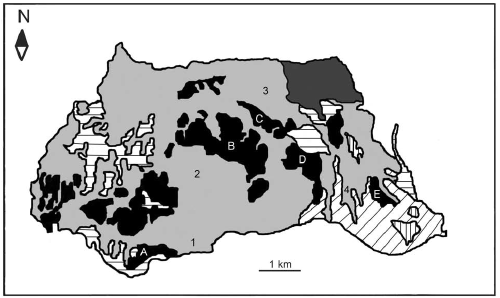
<body><![CDATA[<p>The studies addressing the effects of plantations on biological communities    in the Andes indicate that plant diversity is lower in plantations of both native    (e.g. Alnus acuminata) and exotic (e.g. Pinus spp., Cupressus lusitanica) species    than in native forests or even secondary forests (Cavelier 1995, Murcia 1997,    Cavelier &amp; Tobler 1998, Cavelier et al. 1999). Vertebrate groups such as    anurans also have lower species richness and abundance in Quercus humboldtii    plantations than in native Andean forests (Guti&eacute;rrez-Lamus et al. 2004).    In contrast, understory birds appear to show little differences in their abundance    in plantations of the exotic species Fraxinus chinensis and secondary forest    (Dur&aacute;n &amp; Kattan 2005), and also show little differences in the use    of strata in F. chinensis plantations and native Andean forests (Lentijo &amp;    Kattan 2005). Nevertheless, to the best of our knowledge, there is no information    on how reforestation affects the mammals inhabiting the Colombian Andes. In    particular, although the Andean alder, A. acuminata, has been the preferred    species for the restoration of forest cover and the protection of water sources    in the Central Andes of Colombia, there is no information on whether these monocultures    affect mammals.</p>     <p>In this study, we compare species richness and indices of abundance of medium-sized    mammals, i.e., animals with body mass between ~0.2 and 10 kg, in areas with    Andean forest and areas reforested with Andean alder, in a protected reserve    near the city of Manizales, Caldas Department. Reforestation is expected to    benefit forest-dwelling species by extending their available habitat, due to    the low contrast between native and planted forests (Foster et al. 2002). However,    given that differences in habitat structure and plant diversity may affect the    species diversity of animal groups, via the modulation of available niches (MacArthur    &amp; MacArthur 1961, August 1983), we expected to find differences in richness    between Andean forest and reforested areas. Thus, we predicted that areas with    Andean forest have a richer fauna of mammals than reforested ones, owing to    the lower habitat complexity and plant diversity of the reforestations (Cavelier    1995, Murcia 1997). </p>     <p>MATERIALS AND METHODS</p>     <p>Study site: We did the study during January and April 1999, in the R&iacute;o    Blanco Reserve, Municipality of Manizales, Department of Caldas. The Reserve    is on the Cordillera Central of the Colombian Andes, covers approximately 34    km2, its altitude ranges from 2150 to 3750 m, and it protects the watershed    for Manizales' aqueduct. The climate of the Reserve can be classified    as isomesothermic in the lower parts, i.e., annual average temperatures around    15 &ordm;C, and as isomicrothermic in the upper ones, i.e., annual average temperatures    around 9 &ordm;C (Hern&aacute;ndez-Camacho 1992). The annual average precipitation    is 2400 mm, and its distribution follows a bimodal, tetra-seasonal pattern with    two pluviosity peaks: March &quot; May, and September &quot; November. However,    due to the phenomenon of &#8220;La Ni&ntilde;a&#8221;, January and February    1999 had values of precipitation above the average, between 200 and 280 mm,    which are typical of rainy months. </p>     <p>The Reserve is a forest remnant surrounded by pastures, agricultural fields    and urban areas. Areas with native forests cover 15.79 km2, whereas reforestations    with A. acuminata and areas in regeneration dominated by grasses cover 7.26    km2 and 5.26 km2, respectively (<a href="#figura1">Fig. 1</a>). Areas in regeneration    dominated by secondary forest and reforestations with exotic species cover about    5.70 km2. Between 2150-2350 m of altitude, the native vegetation corresponds    to sub-Andean forest, and above 2350 m it is represented by Andean forest (Cuatrecasas    1958). </p>     <center>   <img src="/img/revistas/cal/v30n1/v30n1a12fig1.gif"><a name="figura1"></a>  </center>     <p>        <center>     Figure 1. Vegetation types in the R&iacute;o Blanco Reserve (Manizales, Caldas):      Native forest (Light grey), secondary forest (dark gray), areas reforested      with Andean alder, Alnus acuminata (Black), pastures (Horizontal lines pattern),      areas in regeneration where grasses are dominant (Diagonal lines pattern),      and areas reforested with exotic tree species (Vertical lines pattern). Sampling      sites in native Andean forest areas: 1) La Coca, 2) La Guerra, 3) R&iacute;o      Blanco, 4) Hoyo Grande. Sampling sites in areas reforested with Andean alder:      A) El Zancudo, B) Betania, C) R&iacute;o Blanco, D) Pinares, E) El Laurel.      Altitude, in general, increases from West to East from ~2150 to 3750 m.    </center>       <br>     <p>We sampled areas with Andean forest and reforestations of A. acuminata, between    2600 and 3200 m of altitude. Areas with Andean forest are characterized by the    presence of at least two strata of trees (5-15 m and 20-25 m), and the understory    is up to 5 m (Anonymous 1987). Trees have umbrella-shaped canopies, with branches    and trunks abundant in vascular and non-vascular epiphytes due to the influence    of frequent mist (Hern&aacute;ndez-Camacho &amp; S&aacute;nchez 1992). In general,    areas with Andean forest in the Reserve are associated with water streams, and    the height of the trees tends to decrease with altitude. In this kind of forest    the families Asteraceae, Melastomataceae, Solanaceae, and Ericaceae are well    represented in terms of genera and species; in particular, the species Weinmmannia    pubescens, Freziera canescens, and Saurauia brachybotris are abundant (Alvear    2000). The tree ferns of the genus Cyathea and the palm Ceroxylon quindiuense    are also characteristic of the areas with Andean forest.</p>     ]]></body>
<body><![CDATA[<p>Reforestations of A. acuminata in the Reserve are characterized by a uniform    canopy. In plantations older than 20 years there are one or two strata of trees.    Usually, reforestations with 40 years or more of growth have trees of 35 to    40 m, but in some of the plots trees do not exceed 30 m. The understory is usually    dominated by Bocconia frutescens, and other heliophilous plants also accompany    this species. Young plantations are abundant in grasses, but the older the reforestation,    the lower the cover of grasses and the higher the cover of other herbs and shrubs.    Moreover, the older the plantation, the higher the abundance of organic matter    accumulated in the soil. Water streams are not as often in the reforestations,    as they are in the Andean forest areas. Additional information on the vegetation    of the reforestations in the Cordillera Central of Colombia can be found in    Cavelier (1995) and Murcia (1997). </p>     <p>Direct counts: We walked the available trails in four areas with Andean forest,    and five areas reforested with A. acuminata (Table 1). These reforestations    were between 16 and 42 years old in 1999 (Table 1). We did 36 censuses in Andean    forest areas and 43 censuses in reforestations, between 05:00 h and 07:00 h.    The walking speed in Andean forest was 0.7-1.0 km/h, and 1.5&quot;2.0 km/h    in the reforestations. Due to the low number of contacts, we did not estimate    absolute abundance or density of mammals. Instead, we calculated an index of    abundance for each species that was expressed relative to the total distance    walked in each area, i.e., individuals/km (Teller&iacute;a 1986). Groups of    animals sighted were considered as single contacts.</p>     <p>Track stations: We prepared circle-shaped track stations (diameter ~1 m) by    removing vegetation and rocks, and plowing the soil. After plowing, the surface    of the station was smoothed. In areas near water streams, we prepared stations    with sand or humid mud. Each station had banana, potato pieces, maize, and/or    sausage as attractants. Roofs made of branches and leaves were placed at 1.5    m above stations in places of open canopy, to protect them from the rain. The    stations were located along transects and separated by 20 to 120 m. The distance    between stations depended on the accessibility of the area. We used track stations    in three areas with Andean forest and three areas with reforestations (Table    2). We made transects in areas with Andean forest following both already existing    and new trails. In reforestations, we set transects perpendicular to available    trails and separated them by 300 to 500 m. We identified tracks using the figures    from Aranda (1981) and Emmons (1997), and with the help of a former hunter.    We checked stations for presence of tracks between 07:00 h and 10:00 h. We calculated    an index of abundance expressed as the number of stations with tracks of a species    divided by the total number of stations used in each area. Tracks found in consecutive    stations or from the same station in consecutive days, and with similar shape,    length and width, were considered to be from the same individual. The tracks    of the coatis, Nasua nasua and Nasuella olivacea, were pooled due to their similarity    in shape. For the same reason, we also pooled the tracks of the foxes, Urocyon    cinereoargenteus and Cerdocyon thous.</p>     <p>Species richness: We compared species richness between the sampled areas with    individual-based rarefaction curves (Colwell et al. 2004), using only the data    from the track stations. To estimate total species richness, we used the non-parametric    estimators of Chao 1, incidence-based coverage (ICE), abundance-based coverage    (ACE), and first Jackknife (reviewed by Colwell &amp; Coddington 1994). We used    EstimateS 7.5 (Colwell 2006) to obtain the rarefaction curves and species richness    estimators, after randomizing the samples 100 times. </p>     <p>Statistical analyses: We used Mann-Whitney test (Zar 1999) to compare the indices    of abundance of the squirrel Sciurus granatensis, Squirrels/km, between Andean    forest and reforested areas. We also applied this test to analyze the results    from the track stations for the coatis. P &lt; 0.05 was chosen as the minimum    level of statistical significance.    <br>   Results</p>     <p>Direct counts: We sighted ten individuals of four mammal species after walking    a total of 58.83 km in areas with Andean forest; after walking 68.1 km in reforested    areas we sighted 16 individuals belonging to three species. In areas with Andean    forest, we sighted the following three species only once: Sciurus pucheranii    at La Coca (0.1 individuals/km), Nasuella olivacea at La Guerra (0.035 individuals/km),    and Mustela frenata at La Guerra (0.035 individuals/km). In reforested areas,    we recorded only once Nasua nasua at El Zancudo (0.17 individuals/km) and Didelphis    albiventris at Betania (0.02 individuals/km). The squirrel S. granatensis was    the only species sighted in all sampled areas, and was also the most sighted    mammal in areas with Andean forest, 0.158 &plusmn; 0.118 (Mean &plusmn; SD)    individuals/km, and reforestations, 0.402 &plusmn; 0.307 individuals/km. Nevertheless,    we found no significant difference between the indices of abundance of this    squirrel in both forest types (Mann-Whitney U = 4, ?2 approximation = 1.33,    df = 1, P = 0.248).</p>     <p>Track stations: We recorded tracks of eleven to thirteen mammal species in    areas with Andean forest, and seven to nine species in reforested areas (<a href="#figura2">Fig.    2</a>). In addition, we found one set of tracks of a domestic cat at the reforested    site of Pinares, which was not included in our analyses. The examination of    the indices of abundance suggests that abundances were more evenly distributed    among species in Andean forest areas than in reforested ones (<a href="#figura2">Fig.    2</a>). The coatis were the only mammals found in all Andean forest and reforested    areas. Furthermore, the values of their indices of abundance in reforestations,    0.042 &plusmn; 0.029 (Mean &plusmn; SD) tracks/total stations, were significantly    higher than in Andean forest sites, 0.009 &plusmn; 0.006 tracks/total stations    (Mann-Whitney U = 0.00, ?2 approximation = 3.857, df = 1, P = 0.049). </p>     <center>   <img src="/img/revistas/cal/v30n1/v30n1a12fig2.gif"><a name="figura2"></a>  </center>     <p>       ]]></body>
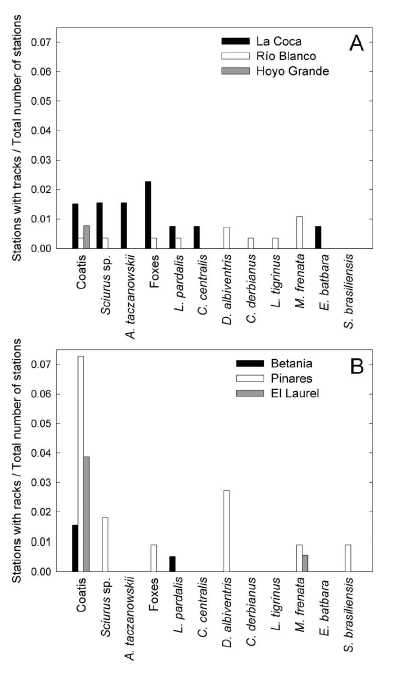
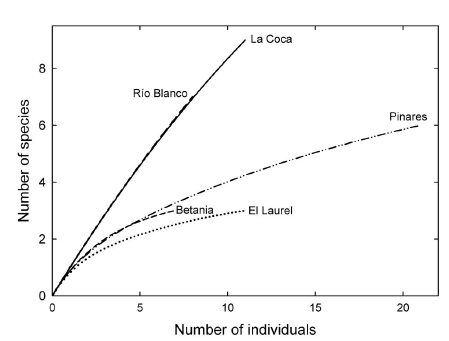
<body><![CDATA[<center>     Figure 2. Indices of abundance, based on track stations data, of mammals in      areas with Andean forest (A) and areas reforested with Andean alder, Alnus      acuminata (B). The indices were expressed as the number of stations with tracks      of a species divided by the total number of stations used in a particular      area. The coatis were significantly more abundant in reforested areas than      in areas with Andean forest (Mann-Whitney test, P &lt; 0.05). Coatis = Nasua      nasua and Nasuella olivacea; A. taczanowskii = Agouti taczanowski; Foxes =      Cerdocyon thous and Urocyon cinereoargenteus; L. pardalis = Leopardus pardalis;      D. albiventris = Didelphis albiventris; C. derbianus = Caluromys derbianus;      L tigrinus = Leopardus tigrinus; M. frenata = Mustela frenata; E. barbara      = Eira barbara; S. brasiliensis = Sylvilagus brasiliensis.   </center>       <br> </p>     <p>Species richness: We found only one species in the track stations in Hoyo Grande    (<a href="#figura2">Fig. 2</a>), and therefore we did not build a rarefaction    curve for this site. Species accumulation curves for areas with Andean forest    in R&iacute;o Blanco and La Coca suggest that these areas had a higher number    of mammals than the reforested areas examined (<a href="#figura3">Fig. 3</a>).    This idea is further supported by most of the estimators of species richness    (Table 3). We recorded the species Caluromys derbianus, Cabassous centralis,    Eira barbara, Leopardus tigrinus, and Agouti taczanowskii only in areas with    Andean forest (<a href="#figura2">Fig. 2</a>). Sylvilagus brasiliensis was the    only species recorded exclussively in reforestations. In addition, R&iacute;o    Blanco and La Coca had a similar number of species, but the species found in    each of these sites were not the same.</p>     <center>   <img src="/img/revistas/cal/v30n1/v30n1a12fig3.gif"><a name="figura3"></a>  </center>     <p>    <center>Figure 3. Rarefaction curves for mammals estimated from the track stations    data, in areas with Andean forest (long-dashed line, R&iacute;o Blanco; solid    line, La Coca) and areas reforested with Andean alder, Alnus acuminata (dash-dotted    line, Pinares; short-dashed line, Betania; dotted line, El Laurel).</center>    <br> </p>     <p>DISCUSSION</p>     <p>Our prediction that species richness would be higher in areas with Andean forest    than in reforestations was partially supported by the results. Indeed, the data    from the track stations suggested that the Andean forest areas of La Coca and    R&iacute;o Blanco had more species of mammals than the reforestations studied.    Nonetheless, the Andean forest of Hoyo Grande appeared to have the lowest richness    of mammals in the Reserve. The Hoyo Grande area was the highest point sampled,    it is surrounded by areas in regeneration dominated by grasses, and it is near    agricultural fields and pastures for cattle. This spatial configuration may    have left this area more exposed to edge effects than the other areas with Andean    forest. In addition, although the Reserve is a protected zone, local hunters    visit it (S&aacute;nchez et al. 2004), and they have better access to Hoyo Grande    than to the other sites with Andean forest. These factors may explain why in    this area of Andean forest we only recorded two mammal species using track stations    and direct counts. Among the reforestations, the richness of mammals appeared    to be lowest in the highest and youngest site sampled, El Laurel (3200 m, 16    years). However, the oldest reforestation examined, Betania (2800 m, 40 years),    had lower richness than Pinares (2800 m, 20 years). This suggests that factors    different from the age of the reforestation may also affect the use of these    habitats by Andean mammals.</p>     <p>The data from the track stations also indicated that the distribution of the    individuals among species was less even in reforestations than in areas with    Andean forest. Thus, the data on species richness and the indices of abundance    suggest that reforestations had lower diversity of mammals than areas with Andean    forest. This pattern is consistent with the findings of Guti&eacute;rrez-Lamus    et al. (2004), who reported a richer community of anurans in Andean forests    than in plantations of Quercus humboldtii. However, the pattern found for the    mammals in the Reserve differs from that of birds from another site in the Central    Andes of Colombia, in that the birds did not appear to react to the differences    between plantations of the exotic species F. chinensis and native forest (Lentijo    &amp; Kattan 2005). Lentijo and Kattan (2005) argued that the fact that small    patches of reforested areas were surrounded by native forest could explain the    neutral effect of plantations on the use of forest strata by birds. In our study    site, reforestations are also surrounded by native forest, suggesting that differences    in the pattern of diversity for birds and mammals in the Andes might be better    explained by the higher mobility of birds. </p>     ]]></body>
<body><![CDATA[<p>Several studies in temperate and Neotropical sites show that plantations, even    heavily managed ones, can increase the available area for forest-dwelling mammals    (Parrotta et al. 1997a, Carey 2000, Foster et al. 2002, Harvey et al. 2006).    Those studies have also indicated that not all forest-dwelling mammals react    to the new habitat in the same way. At the Reserve, eight species of mammals    have been recorded exclusively in areas with Andean forest; five mentioned in    this paper, plus Dynomys branickii, Dasypus novemcinctus and Coendou rufescens    (S&aacute;nchez &amp; Alvear 2003). This suggests that A. acuminata reforestations    may act as a barrier for several mammals. Nonetheless, we recorded in the reforestations    seven to nine species of medium-sized mammals. Moreover, we have reported earlier    that the deer Mazama rufina and the sloth Choloepus hoffmanni have been found    in both Andean forests and reforestations of the Reserve above 2500 m of altitude    (S&aacute;nchez &amp; Alvear 2003). Thus, the reforestations have increased    the available area for more than half of the medium-sized mammals of the Reserve    within the altitudinal range examined. </p>     <p>The reforestations might have even favored the abundance of several mammals.    The squirrel S. granatensis and the coatis were found in all sampled areas,    and they seemed to be the most abundant medium-sized mammals in the Reserve.    The ecological flexibility of S. granatensis in diet and habitat use (Heaney    &amp; Thorington 1978, Glanz 1984, Nitikman 1985) probably allows this rodent    to reach high abundances in some reforested areas. However, more intensive additional    sampling is required to assess whether reforested areas increase the abundance    of this squirrel or not. The high values obtained from the indices of abundance    for coatis in reforestations might be related to the availability of food resources    in this habitat. Kattan et al. (2006) found that during rainy seasons, Andean    alder plantations have higher abundance of leaf-litter arthropods than secondary-Andean    forest areas, whereas during the low-rainfall period that difference was not    found. Therefore, it is possible that invertebrate-eaters such as the coatis    Nasua nasua and Nasuella olivacea (Gompper &amp; Decker 1998, Rodr&iacute;guez-Bola&ntilde;os    et al. 2000) indirectly benefited from the reforestations, via the increase    in the abundance of their preys compared to native forests. Indeed, a study    on a closely related species, Nasua narica, showed that abundance and distribution    of this species is highly influenced by the abundance of invertebrate fauna    inhabiting the leaf-litter (Russell 1990). </p>     <p>Another species that might benefit from the reforestations is the rabbit S.    brasiliensis. This was the only mammal recorded with the track stations in the    reforestations and was absent in the Andean forest. Although this species can    be found in the Reserve in areas with Andean forest (S&aacute;nchez &amp; Alvear    2003), this rabbit is known to be efficient in exploiting grass- and herb-rich    open habitats (D&iacute;az et al. 1997). </p>     <p>In conclusion, although the results from this research are preliminary due    to the short time of sampling, the small number of replicates, and the lack    of additional methods to verify the trends of abundance, our findings may provide    important insights for understanding the effects of A. acuminata reforestations    on the species richness and abundance of mammals in the study area: 1) the Andean    alder reforestations increased the available area for several species of medium-sized    mammals in the Reserve, 2) the reforestations had lower richness of mammals    than areas with Andean forest, and 3) the reforestations have favored the abundance    of at least one group of mammals, the coatis. Murcia (1997) recognized that    the Andean alder is a good alternative for restoring forest cover on the Andes    because monocultures of this species create a forest cover faster than secondary    regeneration, but she also acknowledged that natural regeneration might be a    better strategy to restore and to conserve biological diversity. In the light    of the above, we suggest that a combined approach using natural regeneration    as the predominant managing strategy for restoration, and plantations only at    highly deteriorated places (preferably polycultures of native species), could    be one of the best ways to increase the habitat available for Andean forest-dwelling    mammals and to preserve the diversity of Andean communities.</p>     <p>ACKNOWLEDGEMENTS</p>     <p>We are grateful to Rimma Gluhih, and two anonymous reviewers for their constructive    comments on early versions of the manuscript. Dinesh Rao and Orly Razgur provided    comments to improve the English of the paper. F. S&aacute;nchez would like to    thank the families living at the Reserve and the field assistants for their    help during the fieldwork. In particular, to Alsonso Uribe for sharing his knowledge    on the tracks of Andean mammals. F. S&aacute;nchez also thanks the Fundaci&oacute;n    Ecol&oacute;gica Gabriel Arango Restrepo for financial assistance to the project    &#8220;Mam&iacute;feros de la Reserva R&iacute;o Blanco&#8221; and to Corpocaldas    for the permits to do the research.</p>     <p>LITERATURE CITED</p>     <!-- ref --><p>1. ALVEAR, M. 2000. Flora y vegetaci&oacute;n de la Reserva Torre Cuatro (Manizales,    Colombia). Tesis de pregrado. Departamento de Biolog&iacute;a, Universidad Nacional    de Colombia, Bogot&aacute;.    &nbsp;&nbsp;&nbsp;&nbsp;&nbsp;&nbsp;&nbsp;&nbsp;[&#160;<a href="javascript:void(0);" onclick="javascript: window.open('/scielo.php?script=sci_nlinks&ref=000060&pid=S0366-5232200800010001200001&lng=','','width=640,height=500,resizable=yes,scrollbars=1,menubar=yes,');">Links</a>&#160;]<!-- end-ref --><!-- ref --><br>   2. ANONYMOUS. 1983. Sustaining tropical forest resources: reforestation of degraded    lands. Background paper 1. Congress of the United States, Office of Technology    Assessment OTA, Tropical Forestry Staff, Washington, D. C.    &nbsp;&nbsp;&nbsp;&nbsp;&nbsp;&nbsp;&nbsp;&nbsp;[&#160;<a href="javascript:void(0);" onclick="javascript: window.open('/scielo.php?script=sci_nlinks&ref=000061&pid=S0366-5232200800010001200002&lng=','','width=640,height=500,resizable=yes,scrollbars=1,menubar=yes,');">Links</a>&#160;]<!-- end-ref --><!-- ref --><br>   3. ANONYMOUS. 1987. Cartograf&iacute;a integrada del medio natural: Chinchin&aacute;    - Manizales. An&aacute;lisis Geogr&aacute;ficos - Instituto Geogr&aacute;fico    Agust&iacute;n Codazzi 8, Bogot&aacute;, D.C.    &nbsp;&nbsp;&nbsp;&nbsp;&nbsp;&nbsp;&nbsp;&nbsp;[&#160;<a href="javascript:void(0);" onclick="javascript: window.open('/scielo.php?script=sci_nlinks&ref=000062&pid=S0366-5232200800010001200003&lng=','','width=640,height=500,resizable=yes,scrollbars=1,menubar=yes,');">Links</a>&#160;]<!-- end-ref --><!-- ref --><br>   4. ARANDA, J. M. 1981. Rastros de los mam&iacute;feros silvestres de M&eacute;xico:    Manual de Campo. Instituto Nacional de Investigaciones sobre Recursos Bi&oacute;ticos,    Xalapa, M&eacute;xico.    &nbsp;&nbsp;&nbsp;&nbsp;&nbsp;&nbsp;&nbsp;&nbsp;[&#160;<a href="javascript:void(0);" onclick="javascript: window.open('/scielo.php?script=sci_nlinks&ref=000063&pid=S0366-5232200800010001200004&lng=','','width=640,height=500,resizable=yes,scrollbars=1,menubar=yes,');">Links</a>&#160;]<!-- end-ref --><!-- ref --><br>   5. AUGUST, P. V. 1983. The role of habitat complexity and heterogeneity in structuring    tropical communities. Ecology 64:1495-1507.    &nbsp;&nbsp;&nbsp;&nbsp;&nbsp;&nbsp;&nbsp;&nbsp;[&#160;<a href="javascript:void(0);" onclick="javascript: window.open('/scielo.php?script=sci_nlinks&ref=000064&pid=S0366-5232200800010001200005&lng=','','width=640,height=500,resizable=yes,scrollbars=1,menubar=yes,');">Links</a>&#160;]<!-- end-ref --><!-- ref --><br>   6. CADENASSO, M. L., S. T. A. PICKETT, K. C. WEATHERS &amp; C. G. JONES. 2003.    A framework for a theory of ecology boundaries. BioScience 53:750-758.    &nbsp;&nbsp;&nbsp;&nbsp;&nbsp;&nbsp;&nbsp;&nbsp;[&#160;<a href="javascript:void(0);" onclick="javascript: window.open('/scielo.php?script=sci_nlinks&ref=000065&pid=S0366-5232200800010001200006&lng=','','width=640,height=500,resizable=yes,scrollbars=1,menubar=yes,');">Links</a>&#160;]<!-- end-ref --><!-- ref --><br>   7. CAREY, A. B. 2000. Effects of new forest management strategies on squirrel    populations. Ecological Applications 10:248-257.    &nbsp;&nbsp;&nbsp;&nbsp;&nbsp;&nbsp;&nbsp;&nbsp;[&#160;<a href="javascript:void(0);" onclick="javascript: window.open('/scielo.php?script=sci_nlinks&ref=000066&pid=S0366-5232200800010001200007&lng=','','width=640,height=500,resizable=yes,scrollbars=1,menubar=yes,');">Links</a>&#160;]<!-- end-ref --><!-- ref --><br>   8. CAVELIER, J. 1995. Reforestation with the native tree Alnus acuminata: Effects    on phytodiversity and species richness in an upper montain rain forest area    of Colombia. Pages 125-137 in: L. S. Hamilton, J. O. Juvik &amp; F. N. Scatena    (eds.). Tropical montane cloud forest. Springer-Verlag, New York.    &nbsp;&nbsp;&nbsp;&nbsp;&nbsp;&nbsp;&nbsp;&nbsp;[&#160;<a href="javascript:void(0);" onclick="javascript: window.open('/scielo.php?script=sci_nlinks&ref=000067&pid=S0366-5232200800010001200008&lng=','','width=640,height=500,resizable=yes,scrollbars=1,menubar=yes,');">Links</a>&#160;]<!-- end-ref --><!-- ref --><br>   9. CAVELIER, J., T. M. AIDE, J. M. DUPUY, A. M. EUSSE &amp; C. SANTOS. 1999.    Long-term effects of deforestation on soil properties and vegetation in a tropical    lowland forest in Colombia. Ecotropicos 12:57-68.    &nbsp;&nbsp;&nbsp;&nbsp;&nbsp;&nbsp;&nbsp;&nbsp;[&#160;<a href="javascript:void(0);" onclick="javascript: window.open('/scielo.php?script=sci_nlinks&ref=000068&pid=S0366-5232200800010001200009&lng=','','width=640,height=500,resizable=yes,scrollbars=1,menubar=yes,');">Links</a>&#160;]<!-- end-ref --><!-- ref --><br>   10. CAVELIER, J. &amp; A. ETTER. 1995. Deforestation of montane forests in Colombia    as a result of illegal plantations of opium (Papaver somniferum). Pages 125-137    in: S. P. Churchill, H. Balslev, E. Forero &amp; J. L. Luteyn (eds.). Biodiversity    and conservation of Neotropical montane forests. The New York Botanical Garden,    New York.    &nbsp;&nbsp;&nbsp;&nbsp;&nbsp;&nbsp;&nbsp;&nbsp;[&#160;<a href="javascript:void(0);" onclick="javascript: window.open('/scielo.php?script=sci_nlinks&ref=000069&pid=S0366-5232200800010001200010&lng=','','width=640,height=500,resizable=yes,scrollbars=1,menubar=yes,');">Links</a>&#160;]<!-- end-ref --><!-- ref --><br>   11. CAVELIER, J. &amp; A. TOBLER. 1998. The effect of abandoned plantations    of Pinus patula and Cupressus lusitanica on soils and regeneration of a tropical    montane rain forest in Colombia. Biodiversity and Conservation 7:335-347.    &nbsp;&nbsp;&nbsp;&nbsp;&nbsp;&nbsp;&nbsp;&nbsp;[&#160;<a href="javascript:void(0);" onclick="javascript: window.open('/scielo.php?script=sci_nlinks&ref=000070&pid=S0366-5232200800010001200011&lng=','','width=640,height=500,resizable=yes,scrollbars=1,menubar=yes,');">Links</a>&#160;]<!-- end-ref --><!-- ref --><br>   12. COLWELL, R. K. 2006. EstimateS: Statistical estimation of species richness    and shared species from samples. Version 7.5. User's Guide and application    published at: <a href="http://purl.oclc.org/estimates" target=”blank”>http://purl.oclc.org/estimates</a>.    &nbsp;&nbsp;&nbsp;&nbsp;&nbsp;&nbsp;&nbsp;&nbsp;[&#160;<a href="javascript:void(0);" onclick="javascript: window.open('/scielo.php?script=sci_nlinks&ref=000071&pid=S0366-5232200800010001200012&lng=','','width=640,height=500,resizable=yes,scrollbars=1,menubar=yes,');">Links</a>&#160;]<!-- end-ref --><!-- ref --><br>   13. COLWELL, R. K. &amp; J. A. CODDINGTON. 1994. Estimating terrestrial biodiversity    through extrapolation. Philosophical Transactions of the Real Society of London    345:101-118.    &nbsp;&nbsp;&nbsp;&nbsp;&nbsp;&nbsp;&nbsp;&nbsp;[&#160;<a href="javascript:void(0);" onclick="javascript: window.open('/scielo.php?script=sci_nlinks&ref=000072&pid=S0366-5232200800010001200013&lng=','','width=640,height=500,resizable=yes,scrollbars=1,menubar=yes,');">Links</a>&#160;]<!-- end-ref --><!-- ref --><br>   14. COLWELL, R. K., C. X. MAO &amp; J. CHANG. 2004. Interpolating, extrapolating,    and comparing incidence-based species accumulation curves. Ecology 85:2117-2727.    &nbsp;&nbsp;&nbsp;&nbsp;&nbsp;&nbsp;&nbsp;&nbsp;[&#160;<a href="javascript:void(0);" onclick="javascript: window.open('/scielo.php?script=sci_nlinks&ref=000073&pid=S0366-5232200800010001200014&lng=','','width=640,height=500,resizable=yes,scrollbars=1,menubar=yes,');">Links</a>&#160;]<!-- end-ref --><!-- ref --><br>   15. CUATRECASAS, J. 1958. Aspectos de la vegetaci&oacute;n natural de Colombia.    Revista de la Academia Colombiana de Ciencias Exactas, F&iacute;sicas y Naturales    10:221-268.    &nbsp;&nbsp;&nbsp;&nbsp;&nbsp;&nbsp;&nbsp;&nbsp;[&#160;<a href="javascript:void(0);" onclick="javascript: window.open('/scielo.php?script=sci_nlinks&ref=000074&pid=S0366-5232200800010001200015&lng=','','width=640,height=500,resizable=yes,scrollbars=1,menubar=yes,');">Links</a>&#160;]<!-- end-ref --><!-- ref --><br>   16. DIAZ, A., J. E. PEFAUR &amp; P. DURANT. 1997. Ecology of South American    p&aacute;ramos with emphasis on the fauna of the Venezuelan p&aacute;ramos.    Pages 263-310 in: F. E. Wielgolaski (ed.). Polar and Alpine tundra, Ecosystems    of the World 3. Elsevier, Amsterdam.    &nbsp;&nbsp;&nbsp;&nbsp;&nbsp;&nbsp;&nbsp;&nbsp;[&#160;<a href="javascript:void(0);" onclick="javascript: window.open('/scielo.php?script=sci_nlinks&ref=000075&pid=S0366-5232200800010001200016&lng=','','width=640,height=500,resizable=yes,scrollbars=1,menubar=yes,');">Links</a>&#160;]<!-- end-ref --><!-- ref --><br>   17. DUR&Aacute;N, S. M. &amp; G. H. KATTAN. 2005. A test of the utility of exotic    tree plantations for understory birds and food resources in the Colombian Andes.    Biotropica 37:129-135.    &nbsp;&nbsp;&nbsp;&nbsp;&nbsp;&nbsp;&nbsp;&nbsp;[&#160;<a href="javascript:void(0);" onclick="javascript: window.open('/scielo.php?script=sci_nlinks&ref=000076&pid=S0366-5232200800010001200017&lng=','','width=640,height=500,resizable=yes,scrollbars=1,menubar=yes,');">Links</a>&#160;]<!-- end-ref --><!-- ref --><br>   18. EMMONS, L. H. 1997. Neotropical rainforest mammals. 2nd edition. The University    of Chicago Press, Chicago.    &nbsp;&nbsp;&nbsp;&nbsp;&nbsp;&nbsp;&nbsp;&nbsp;[&#160;<a href="javascript:void(0);" onclick="javascript: window.open('/scielo.php?script=sci_nlinks&ref=000077&pid=S0366-5232200800010001200018&lng=','','width=640,height=500,resizable=yes,scrollbars=1,menubar=yes,');">Links</a>&#160;]<!-- end-ref --><!-- ref --><br>   19. ETTER, A. 1998. Mapa general de Colombia (1:1.500.000). Informe nacional    sobre el estado de la biodiversidad en Colombia 1997. Ministerio del Medio Ambiente    - Instituto de Investigaci&oacute;n de Recursos Biol&oacute;gicos Alexander    von Humboldt, Bogot&aacute;.    &nbsp;&nbsp;&nbsp;&nbsp;&nbsp;&nbsp;&nbsp;&nbsp;[&#160;<a href="javascript:void(0);" onclick="javascript: window.open('/scielo.php?script=sci_nlinks&ref=000078&pid=S0366-5232200800010001200019&lng=','','width=640,height=500,resizable=yes,scrollbars=1,menubar=yes,');">Links</a>&#160;]<!-- end-ref --><!-- ref --><br>   20. FOSTER, D. R., G. MOTZKIN, D. BERNARDOS &amp; J. CARDOZA. 2002. Wildlife    dynamics in the changing New England landscape. Journal of Biogeography 29:1337-1357.    &nbsp;&nbsp;&nbsp;&nbsp;&nbsp;&nbsp;&nbsp;&nbsp;[&#160;<a href="javascript:void(0);" onclick="javascript: window.open('/scielo.php?script=sci_nlinks&ref=000079&pid=S0366-5232200800010001200020&lng=','','width=640,height=500,resizable=yes,scrollbars=1,menubar=yes,');">Links</a>&#160;]<!-- end-ref --><!-- ref --><br>   21. GLANZ, W. E. 1984. Food and habitat use by two sympatric Sciurus species    in cenrtal Panama. Journal of Mammalogy 65:342-347.    &nbsp;&nbsp;&nbsp;&nbsp;&nbsp;&nbsp;&nbsp;&nbsp;[&#160;<a href="javascript:void(0);" onclick="javascript: window.open('/scielo.php?script=sci_nlinks&ref=000080&pid=S0366-5232200800010001200021&lng=','','width=640,height=500,resizable=yes,scrollbars=1,menubar=yes,');">Links</a>&#160;]<!-- end-ref --><!-- ref --><br>   22. GOMPPER, M. E. &amp; D. M. DECKER. 1998. Nasua nasua. Mammalian Species    580:1-9.    &nbsp;&nbsp;&nbsp;&nbsp;&nbsp;&nbsp;&nbsp;&nbsp;[&#160;<a href="javascript:void(0);" onclick="javascript: window.open('/scielo.php?script=sci_nlinks&ref=000081&pid=S0366-5232200800010001200022&lng=','','width=640,height=500,resizable=yes,scrollbars=1,menubar=yes,');">Links</a>&#160;]<!-- end-ref --><!-- ref --><br>   23. GUTI&Eacute;RREZ-LAMUS, D. L., V. H. SERRANO &amp; M. P. RAM&Iacute;REZ-PINILLA.    2004. Composici&oacute;n y abundancia de anuros en dos tipos de bosque (natural    y cultivado) en la Cordillera Oriental colombiana. Caldasia 26:245-264.    &nbsp;&nbsp;&nbsp;&nbsp;&nbsp;&nbsp;&nbsp;&nbsp;[&#160;<a href="javascript:void(0);" onclick="javascript: window.open('/scielo.php?script=sci_nlinks&ref=000082&pid=S0366-5232200800010001200023&lng=','','width=640,height=500,resizable=yes,scrollbars=1,menubar=yes,');">Links</a>&#160;]<!-- end-ref --><!-- ref --><br>   24. HARVEY, C. A., J. GONZ&Aacute;LEZ &amp; E. SOMARRIBA. 2006. Dung beetle    and terrestrial mammal diversity in forests, indigenous agroforestry systems    and plantain monocultures in Talamanca, Costa Rica. Biodiversity and Conservation    15:555-585.    &nbsp;&nbsp;&nbsp;&nbsp;&nbsp;&nbsp;&nbsp;&nbsp;[&#160;<a href="javascript:void(0);" onclick="javascript: window.open('/scielo.php?script=sci_nlinks&ref=000083&pid=S0366-5232200800010001200024&lng=','','width=640,height=500,resizable=yes,scrollbars=1,menubar=yes,');">Links</a>&#160;]<!-- end-ref --><!-- ref --><br>   25. HEANEY, L. R. &amp; R. W. J. THORINGTON. 1978. Ecology of Neotropical red-tailed    squirrels Sciurus granatensis, in the Panama canal zone. Journal of Mammalogy    59:846-851.    &nbsp;&nbsp;&nbsp;&nbsp;&nbsp;&nbsp;&nbsp;&nbsp;[&#160;<a href="javascript:void(0);" onclick="javascript: window.open('/scielo.php?script=sci_nlinks&ref=000084&pid=S0366-5232200800010001200025&lng=','','width=640,height=500,resizable=yes,scrollbars=1,menubar=yes,');">Links</a>&#160;]<!-- end-ref --><!-- ref --><br>   26. HERN&Aacute;NDEZ-CAMACHO, J. I. 1992. Carac-terizaci&oacute;n geogr&aacute;fica    de Colombia. Pages 45-53 in: G. C. C. Halffter (ed.). Diversidad biol&oacute;gica    de Iberoam&eacute;rica I. Instituto de Ecolog&iacute;a, Xalapa, M&eacute;xico.    &nbsp;&nbsp;&nbsp;&nbsp;&nbsp;&nbsp;&nbsp;&nbsp;[&#160;<a href="javascript:void(0);" onclick="javascript: window.open('/scielo.php?script=sci_nlinks&ref=000085&pid=S0366-5232200800010001200026&lng=','','width=640,height=500,resizable=yes,scrollbars=1,menubar=yes,');">Links</a>&#160;]<!-- end-ref --><!-- ref --><br>   27. HERN&Aacute;NDEZ-CAMACHO, J. I. &amp; H. S&Aacute;NCHEZ. 1992. Biomas terrestres    de Colombia.in: G. C. C. Halffter (ed.). Diversidad biol&oacute;gica de Iberoam&eacute;rica    I. Instituto de Ecolog&iacute;a, Xalapa, M&eacute;xico.    &nbsp;&nbsp;&nbsp;&nbsp;&nbsp;&nbsp;&nbsp;&nbsp;[&#160;<a href="javascript:void(0);" onclick="javascript: window.open('/scielo.php?script=sci_nlinks&ref=000086&pid=S0366-5232200800010001200027&lng=','','width=640,height=500,resizable=yes,scrollbars=1,menubar=yes,');">Links</a>&#160;]<!-- end-ref --><!-- ref --><br>   28. KATTAN, G. H. &amp; H. ALVAREZ-L&Oacute;PEZ. 1996. Preservation and management    of biodiversity in fragmented landscapes in the Colombian Andes. Pages 3-18    in: J. Schelhas &amp; R. Greenberg (eds.). Forest patches in tropical landscapes.    Island Press, Washington, D. C.    &nbsp;&nbsp;&nbsp;&nbsp;&nbsp;&nbsp;&nbsp;&nbsp;[&#160;<a href="javascript:void(0);" onclick="javascript: window.open('/scielo.php?script=sci_nlinks&ref=000087&pid=S0366-5232200800010001200028&lng=','','width=640,height=500,resizable=yes,scrollbars=1,menubar=yes,');">Links</a>&#160;]<!-- end-ref --><!-- ref --><br>   29. KATTAN, G. H., D. CORREA, F. ESCOBAR &amp; C. MEDINA. 2006. Leaf-litter    arthropods in restored forests in the Colombian Andes: A comparison between    secondary forest and tree plantations. Restoration Ecology 14:95-102.    &nbsp;&nbsp;&nbsp;&nbsp;&nbsp;&nbsp;&nbsp;&nbsp;[&#160;<a href="javascript:void(0);" onclick="javascript: window.open('/scielo.php?script=sci_nlinks&ref=000088&pid=S0366-5232200800010001200029&lng=','','width=640,height=500,resizable=yes,scrollbars=1,menubar=yes,');">Links</a>&#160;]<!-- end-ref --><!-- ref --><br>   30. LENTIJO, G. M. &amp; G. H. KATTAN. 2005. Estratificaci&oacute;n vertical    de las aves en una plantaci&oacute;n monoespec&iacute;fica y en un bosque nativo    en la Cordillera Central de Colombia. Ornitolog&iacute;a Colombiana 3:51-61.    &nbsp;&nbsp;&nbsp;&nbsp;&nbsp;&nbsp;&nbsp;&nbsp;[&#160;<a href="javascript:void(0);" onclick="javascript: window.open('/scielo.php?script=sci_nlinks&ref=000089&pid=S0366-5232200800010001200030&lng=','','width=640,height=500,resizable=yes,scrollbars=1,menubar=yes,');">Links</a>&#160;]<!-- end-ref --><!-- ref --><br>   31. LUGO, A. E. 1997. The apparent paradox of reestablishing species richness    on degraded lands with tree monocultures. Forest Ecology and Management 99:9-19.    &nbsp;&nbsp;&nbsp;&nbsp;&nbsp;&nbsp;&nbsp;&nbsp;[&#160;<a href="javascript:void(0);" onclick="javascript: window.open('/scielo.php?script=sci_nlinks&ref=000090&pid=S0366-5232200800010001200031&lng=','','width=640,height=500,resizable=yes,scrollbars=1,menubar=yes,');">Links</a>&#160;]<!-- end-ref --><!-- ref --><br>   32. MACARTHUR, R. H. &amp; J. W. MACARTHUR. 1961. On bird species diversity.    Ecology 42:594-598.    &nbsp;&nbsp;&nbsp;&nbsp;&nbsp;&nbsp;&nbsp;&nbsp;[&#160;<a href="javascript:void(0);" onclick="javascript: window.open('/scielo.php?script=sci_nlinks&ref=000091&pid=S0366-5232200800010001200032&lng=','','width=640,height=500,resizable=yes,scrollbars=1,menubar=yes,');">Links</a>&#160;]<!-- end-ref --><!-- ref --><br>   33. MURCIA, C. 1995. Edge effects in fragmented forests: Implications for conservation.    Trends in Ecology and Evolution 10:58-62.    &nbsp;&nbsp;&nbsp;&nbsp;&nbsp;&nbsp;&nbsp;&nbsp;[&#160;<a href="javascript:void(0);" onclick="javascript: window.open('/scielo.php?script=sci_nlinks&ref=000092&pid=S0366-5232200800010001200033&lng=','','width=640,height=500,resizable=yes,scrollbars=1,menubar=yes,');">Links</a>&#160;]<!-- end-ref --><!-- ref --><br>   34. MURCIA, C. 1997. Evaluation of Andean alder as a catalist for the recovery    of tropical cloud forest in Colombia. Forest Ecology and Management 99:163-170.    &nbsp;&nbsp;&nbsp;&nbsp;&nbsp;&nbsp;&nbsp;&nbsp;[&#160;<a href="javascript:void(0);" onclick="javascript: window.open('/scielo.php?script=sci_nlinks&ref=000093&pid=S0366-5232200800010001200034&lng=','','width=640,height=500,resizable=yes,scrollbars=1,menubar=yes,');">Links</a>&#160;]<!-- end-ref --><!-- ref --><br>   35. NITIKMAN, L. Z. 1985. Sciurus granatensis. Mammalian Species 246:1-8.    &nbsp;&nbsp;&nbsp;&nbsp;&nbsp;&nbsp;&nbsp;&nbsp;[&#160;<a href="javascript:void(0);" onclick="javascript: window.open('/scielo.php?script=sci_nlinks&ref=000094&pid=S0366-5232200800010001200035&lng=','','width=640,height=500,resizable=yes,scrollbars=1,menubar=yes,');">Links</a>&#160;]<!-- end-ref --><!-- ref --><br>   36. PARROTTA, J. A., O. H. KNOWLES &amp; J. M. WUNDERLE, Jr. 1997a. Development    of floristic diversity in 10-year-old restoration forests on a bauxite mined    site in Amazonia. Forest Ecology and Management 99:21-42.    &nbsp;&nbsp;&nbsp;&nbsp;&nbsp;&nbsp;&nbsp;&nbsp;[&#160;<a href="javascript:void(0);" onclick="javascript: window.open('/scielo.php?script=sci_nlinks&ref=000095&pid=S0366-5232200800010001200036&lng=','','width=640,height=500,resizable=yes,scrollbars=1,menubar=yes,');">Links</a>&#160;]<!-- end-ref --><!-- ref --><br>   37. PARROTTA, J. A., J. W. TURNBULL &amp; N. JONES. 1997b. Catalyzing native    forest regeneration on degraded tropical lands. Forest Ecology and Management    99:1-7.    &nbsp;&nbsp;&nbsp;&nbsp;&nbsp;&nbsp;&nbsp;&nbsp;[&#160;<a href="javascript:void(0);" onclick="javascript: window.open('/scielo.php?script=sci_nlinks&ref=000096&pid=S0366-5232200800010001200037&lng=','','width=640,height=500,resizable=yes,scrollbars=1,menubar=yes,');">Links</a>&#160;]<!-- end-ref --><!-- ref --><br>   38. RODR&Iacute;GUEZ-BOLA&Ntilde;OS, A., A. CADENA &amp; P. S&Aacute;NCHEZ-PALOMINO.    2000. Trophic characteristics in social groups of the mountain coati, Nasuella    olivacea (Carnivora: Procyonidae). Small Carnivore Conservation 23:1-6.    &nbsp;&nbsp;&nbsp;&nbsp;&nbsp;&nbsp;&nbsp;&nbsp;[&#160;<a href="javascript:void(0);" onclick="javascript: window.open('/scielo.php?script=sci_nlinks&ref=000097&pid=S0366-5232200800010001200038&lng=','','width=640,height=500,resizable=yes,scrollbars=1,menubar=yes,');">Links</a>&#160;]<!-- end-ref --><!-- ref --><br>   39. RUSSELL, J. K. 1990. Influencia de las fluctuaciones alimentarias sobre    la &eacute;poca de reproducci&oacute;n de los coat&iacute;es (Nasua narica).    Pages 481-499 in: E. G. Leigh, Jr., A. S. Rand &amp; D. M. Windsor (eds.). Ecolog&iacute;a    de un bosque tropical: Ciclos estacionales y cambios a largo plazo. Smithsonian    Institution, Washington, D. C.    &nbsp;&nbsp;&nbsp;&nbsp;&nbsp;&nbsp;&nbsp;&nbsp;[&#160;<a href="javascript:void(0);" onclick="javascript: window.open('/scielo.php?script=sci_nlinks&ref=000098&pid=S0366-5232200800010001200039&lng=','','width=640,height=500,resizable=yes,scrollbars=1,menubar=yes,');">Links</a>&#160;]<!-- end-ref --><!-- ref --><br>   40. S&Aacute;NCHEZ, F. &amp; M. ALVEAR. 2003. Comentarios sobre el uso de h&aacute;bitat,    dieta y conocimiento popular de los mam&iacute;feros en un bosque andino de    Caldas, Colombia. Bolet&iacute;n Cient&iacute;fico, Museo de Historia Natural,    Universidad de Caldas 7:121-144.    &nbsp;&nbsp;&nbsp;&nbsp;&nbsp;&nbsp;&nbsp;&nbsp;[&#160;<a href="javascript:void(0);" onclick="javascript: window.open('/scielo.php?script=sci_nlinks&ref=000099&pid=S0366-5232200800010001200040&lng=','','width=640,height=500,resizable=yes,scrollbars=1,menubar=yes,');">Links</a>&#160;]<!-- end-ref --><!-- ref --><br>   41. S&Aacute;NCHEZ, F., P. S&Aacute;NCHEZ-PALOMINO &amp; A. CADENA. 2004. Inventario    de mam&iacute;feros en un bosque de los Andes centrales de Colombia. Caldasia    26:291-309.    &nbsp;&nbsp;&nbsp;&nbsp;&nbsp;&nbsp;&nbsp;&nbsp;[&#160;<a href="javascript:void(0);" onclick="javascript: window.open('/scielo.php?script=sci_nlinks&ref=000100&pid=S0366-5232200800010001200041&lng=','','width=640,height=500,resizable=yes,scrollbars=1,menubar=yes,');">Links</a>&#160;]<!-- end-ref --><!-- ref --><br>   42. TELLER&Iacute;A, J. L. 1986. Manual para el censo de los vertebrados terrestres.    Editorial Ra&iacute;ces, Madrid.    &nbsp;&nbsp;&nbsp;&nbsp;&nbsp;&nbsp;&nbsp;&nbsp;[&#160;<a href="javascript:void(0);" onclick="javascript: window.open('/scielo.php?script=sci_nlinks&ref=000101&pid=S0366-5232200800010001200042&lng=','','width=640,height=500,resizable=yes,scrollbars=1,menubar=yes,');">Links</a>&#160;]<!-- end-ref --><!-- ref --><br>   43. ZAR, J. H. 1999. Biostatistical analysis. 4th edition. Prentice Hall, Upper    Saddle River, New Jersey.&nbsp;&nbsp;&nbsp;&nbsp;&nbsp;&nbsp;&nbsp;&nbsp;[&#160;<a href="javascript:void(0);" onclick="javascript: window.open('/scielo.php?script=sci_nlinks&ref=000102&pid=S0366-5232200800010001200043&lng=','','width=640,height=500,resizable=yes,scrollbars=1,menubar=yes,');">Links</a>&#160;]<!-- end-ref --><p>Recibido: 07/03/2007    <br>   Aceptado: 21/02/2008</p>     <p>&nbsp;</p> </font>       ]]></body><back>
<ref-list>
<ref id="B1">
<label>1.</label><nlm-citation citation-type="">
<person-group person-group-type="author">
<name>
<surname><![CDATA[ALVEAR]]></surname>
<given-names><![CDATA[M.]]></given-names>
</name>
</person-group>
<source><![CDATA[Flora y vegetación de la Reserva Torre Cuatro (Manizales, Colombia)]]></source>
<year>2000</year>
</nlm-citation>
</ref>
<ref id="B2">
<label>2.</label><nlm-citation citation-type="book">
<person-group person-group-type="author">
<name>
</name>
<name>
</name>
</person-group>
<source><![CDATA[Sustaining tropical forest resources: reforestation of degraded lands]]></source>
<year>1983</year>
<publisher-loc><![CDATA[Washington^eD. C. D. C.]]></publisher-loc>
<publisher-name><![CDATA[Congress of the United States, Office of Technology Assessment OTA, Tropical Forestry Staff]]></publisher-name>
</nlm-citation>
</ref>
<ref id="B3">
<label>3.</label><nlm-citation citation-type="book">
<person-group person-group-type="author">
<name>
</name>
<name>
</name>
</person-group>
<source><![CDATA[Cartografía integrada del medio natural: Chinchiná - Manizales]]></source>
<year>1987</year>
<volume>8</volume>
<publisher-loc><![CDATA[Bogotá^eD.C. D.C.]]></publisher-loc>
<publisher-name><![CDATA[Análisis Geográficos - Instituto Geográfico Agustín Codazzi]]></publisher-name>
</nlm-citation>
</ref>
<ref id="B4">
<label>4.</label><nlm-citation citation-type="book">
<person-group person-group-type="author">
<name>
<surname><![CDATA[ARANDA]]></surname>
<given-names><![CDATA[J. M.]]></given-names>
</name>
</person-group>
<source><![CDATA[Rastros de los mamíferos silvestres de México: Manual de Campo]]></source>
<year>1981</year>
<publisher-loc><![CDATA[Xalapa ]]></publisher-loc>
<publisher-name><![CDATA[Instituto Nacional de Investigaciones sobre Recursos Bióticos]]></publisher-name>
</nlm-citation>
</ref>
<ref id="B5">
<label>5.</label><nlm-citation citation-type="journal">
<person-group person-group-type="author">
<name>
<surname><![CDATA[AUGUST]]></surname>
<given-names><![CDATA[P. V.]]></given-names>
</name>
</person-group>
<article-title xml:lang="en"><![CDATA[The role of habitat complexity and heterogeneity in structuring tropical communities]]></article-title>
<source><![CDATA[Ecology]]></source>
<year>1983</year>
<volume>64</volume>
<page-range>1495-1507</page-range></nlm-citation>
</ref>
<ref id="B6">
<label>6.</label><nlm-citation citation-type="journal">
<person-group person-group-type="author">
<name>
<surname><![CDATA[CADENASSO]]></surname>
<given-names><![CDATA[M. L.]]></given-names>
</name>
<name>
<surname><![CDATA[PICKETT]]></surname>
<given-names><![CDATA[S. T. A.]]></given-names>
</name>
<name>
<surname><![CDATA[WEATHERS]]></surname>
<given-names><![CDATA[K. C.]]></given-names>
</name>
<name>
<surname><![CDATA[JONES]]></surname>
<given-names><![CDATA[C. G.]]></given-names>
</name>
</person-group>
<article-title xml:lang="en"><![CDATA[A framework for a theory of ecology boundaries]]></article-title>
<source><![CDATA[BioScience]]></source>
<year>2003</year>
<volume>53</volume>
<page-range>750-758</page-range></nlm-citation>
</ref>
<ref id="B7">
<label>7.</label><nlm-citation citation-type="journal">
<person-group person-group-type="author">
<name>
<surname><![CDATA[CAREY]]></surname>
<given-names><![CDATA[A. B.]]></given-names>
</name>
</person-group>
<article-title xml:lang="en"><![CDATA[Effects of new forest management strategies on squirrel populations]]></article-title>
<source><![CDATA[Ecological Applications]]></source>
<year>2000</year>
<volume>10</volume>
<page-range>248-257</page-range></nlm-citation>
</ref>
<ref id="B8">
<label>8.</label><nlm-citation citation-type="book">
<person-group person-group-type="author">
<name>
<surname><![CDATA[CAVELIER]]></surname>
<given-names><![CDATA[J.]]></given-names>
</name>
</person-group>
<article-title xml:lang="en"><![CDATA[Reforestation with the native tree Alnus acuminata: Effects on phytodiversity and species richness in an upper montain rain forest area of Colombia]]></article-title>
<person-group person-group-type="editor">
<name>
<surname><![CDATA[Hamilton]]></surname>
<given-names><![CDATA[L. S.]]></given-names>
</name>
<name>
<surname><![CDATA[Juvik]]></surname>
<given-names><![CDATA[J. O.]]></given-names>
</name>
<name>
<surname><![CDATA[Scatena]]></surname>
<given-names><![CDATA[F. N.]]></given-names>
</name>
</person-group>
<source><![CDATA[]]></source>
<year>1995</year>
<page-range>125-137</page-range><publisher-loc><![CDATA[Springer-Verlag, New York ]]></publisher-loc>
<publisher-name><![CDATA[Tropical montane cloud forest]]></publisher-name>
</nlm-citation>
</ref>
<ref id="B9">
<label>9.</label><nlm-citation citation-type="journal">
<person-group person-group-type="author">
<name>
<surname><![CDATA[CAVELIER]]></surname>
<given-names><![CDATA[J.]]></given-names>
</name>
<name>
<surname><![CDATA[AIDE]]></surname>
<given-names><![CDATA[T. M.]]></given-names>
</name>
<name>
<surname><![CDATA[DUPUY]]></surname>
<given-names><![CDATA[J. M.]]></given-names>
</name>
<name>
<surname><![CDATA[EUSSE]]></surname>
<given-names><![CDATA[A. M.]]></given-names>
</name>
<name>
<surname><![CDATA[SANTOS]]></surname>
<given-names><![CDATA[C.]]></given-names>
</name>
</person-group>
<article-title xml:lang="en"><![CDATA[Long-term effects of deforestation on soil properties and vegetation in a tropical lowland forest in Colombia]]></article-title>
<source><![CDATA[Ecotropicos]]></source>
<year>1999</year>
<volume>12</volume>
<page-range>57-68</page-range></nlm-citation>
</ref>
<ref id="B10">
<label>10.</label><nlm-citation citation-type="book">
<person-group person-group-type="author">
<name>
<surname><![CDATA[CAVELIER]]></surname>
<given-names><![CDATA[J.]]></given-names>
</name>
<name>
<surname><![CDATA[ETTER]]></surname>
<given-names><![CDATA[A.]]></given-names>
</name>
</person-group>
<article-title xml:lang="en"><![CDATA[Deforestation of montane forests in Colombia as a result of illegal plantations of opium (Papaver somniferum)]]></article-title>
<person-group person-group-type="editor">
<name>
<surname><![CDATA[Churchill]]></surname>
<given-names><![CDATA[S. P.]]></given-names>
</name>
<name>
<surname><![CDATA[Balslev]]></surname>
<given-names><![CDATA[H.]]></given-names>
</name>
<name>
<surname><![CDATA[Forero]]></surname>
<given-names><![CDATA[E.]]></given-names>
</name>
<name>
<surname><![CDATA[Luteyn]]></surname>
<given-names><![CDATA[J. L.]]></given-names>
</name>
</person-group>
<source><![CDATA[Biodiversity and conservation of Neotropical montane forests]]></source>
<year>1995</year>
<page-range>125-137</page-range><publisher-loc><![CDATA[New York ]]></publisher-loc>
<publisher-name><![CDATA[The New York Botanical Garden]]></publisher-name>
</nlm-citation>
</ref>
<ref id="B11">
<label>11.</label><nlm-citation citation-type="journal">
<person-group person-group-type="author">
<name>
<surname><![CDATA[CAVELIER]]></surname>
<given-names><![CDATA[J.]]></given-names>
</name>
<name>
<surname><![CDATA[TOBLER]]></surname>
<given-names><![CDATA[A.]]></given-names>
</name>
</person-group>
<article-title xml:lang="en"><![CDATA[The effect of abandoned plantations of Pinus patula and Cupressus lusitanica on soils and regeneration of a tropical montane rain forest in Colombia]]></article-title>
<source><![CDATA[Biodiversity and Conservation]]></source>
<year>1998</year>
<volume>7</volume>
<page-range>335-347</page-range></nlm-citation>
</ref>
<ref id="B12">
<label>12.</label><nlm-citation citation-type="">
<person-group person-group-type="author">
<name>
<surname><![CDATA[COLWELL]]></surname>
<given-names><![CDATA[R. K.]]></given-names>
</name>
</person-group>
<source><![CDATA[EstimateS: Statistical estimation of species richness and shared species from samples. Version 7.5.]]></source>
<year>2006</year>
</nlm-citation>
</ref>
<ref id="B13">
<label>13.</label><nlm-citation citation-type="journal">
<person-group person-group-type="author">
<name>
<surname><![CDATA[COLWELL]]></surname>
<given-names><![CDATA[R. K.]]></given-names>
</name>
<name>
<surname><![CDATA[CODDINGTON]]></surname>
<given-names><![CDATA[J. A.]]></given-names>
</name>
</person-group>
<article-title xml:lang="en"><![CDATA[Estimating terrestrial biodiversity through extrapolation]]></article-title>
<source><![CDATA[Philosophical Transactions of the Real Society of London]]></source>
<year>1994</year>
<volume>345</volume>
<page-range>101-118</page-range></nlm-citation>
</ref>
<ref id="B14">
<label>14.</label><nlm-citation citation-type="journal">
<person-group person-group-type="author">
<name>
<surname><![CDATA[COLWELL]]></surname>
<given-names><![CDATA[R. K.]]></given-names>
</name>
<name>
<surname><![CDATA[MAO]]></surname>
<given-names><![CDATA[C. X.]]></given-names>
</name>
<name>
<surname><![CDATA[CHANG]]></surname>
<given-names><![CDATA[J.]]></given-names>
</name>
</person-group>
<article-title xml:lang="en"><![CDATA[Interpolating, extrapolating, and comparing incidence-based species accumulation curves]]></article-title>
<source><![CDATA[Ecology]]></source>
<year>2004</year>
<volume>85</volume>
<page-range>2117-2727</page-range></nlm-citation>
</ref>
<ref id="B15">
<label>15.</label><nlm-citation citation-type="journal">
<person-group person-group-type="author">
<name>
<surname><![CDATA[CUATRECASAS]]></surname>
<given-names><![CDATA[J.]]></given-names>
</name>
</person-group>
<article-title xml:lang="es"><![CDATA[Aspectos de la vegetación natural de Colombia]]></article-title>
<source><![CDATA[Revista de la Academia Colombiana de Ciencias Exactas, Físicas y Naturales]]></source>
<year>1958</year>
<volume>10</volume>
<page-range>221-268</page-range></nlm-citation>
</ref>
<ref id="B16">
<label>16.</label><nlm-citation citation-type="book">
<person-group person-group-type="author">
<name>
<surname><![CDATA[DIAZ]]></surname>
<given-names><![CDATA[A.]]></given-names>
</name>
<name>
<surname><![CDATA[PEFAUR]]></surname>
<given-names><![CDATA[J. E.]]></given-names>
</name>
<name>
<surname><![CDATA[DURANT]]></surname>
<given-names><![CDATA[P.]]></given-names>
</name>
</person-group>
<article-title xml:lang="en"><![CDATA[Ecology of South American páramos with emphasis on the fauna of the Venezuelan páramos]]></article-title>
<person-group person-group-type="editor">
<name>
<surname><![CDATA[Wielgolaski]]></surname>
<given-names><![CDATA[F. E.]]></given-names>
</name>
</person-group>
<source><![CDATA[Polar and Alpine tundra]]></source>
<year>1997</year>
<volume>3</volume>
<page-range>263-310</page-range><publisher-loc><![CDATA[Amsterdam ]]></publisher-loc>
<publisher-name><![CDATA[Elsevier]]></publisher-name>
</nlm-citation>
</ref>
<ref id="B17">
<label>17.</label><nlm-citation citation-type="journal">
<person-group person-group-type="author">
<name>
<surname><![CDATA[DURÁN]]></surname>
<given-names><![CDATA[S. M.]]></given-names>
</name>
<name>
<surname><![CDATA[KATTAN]]></surname>
<given-names><![CDATA[G. H.]]></given-names>
</name>
</person-group>
<article-title xml:lang="en"><![CDATA[A test of the utility of exotic tree plantations for understory birds and food resources in the Colombian Andes]]></article-title>
<source><![CDATA[Biotropica]]></source>
<year>2005</year>
<volume>37</volume>
<page-range>129-135</page-range></nlm-citation>
</ref>
<ref id="B18">
<label>18.</label><nlm-citation citation-type="book">
<person-group person-group-type="author">
<name>
<surname><![CDATA[EMMONS]]></surname>
<given-names><![CDATA[L. H.]]></given-names>
</name>
</person-group>
<source><![CDATA[Neotropical rainforest mammals]]></source>
<year>1997</year>
<edition>2nd</edition>
<publisher-loc><![CDATA[Chicago ]]></publisher-loc>
<publisher-name><![CDATA[The University of Chicago Press]]></publisher-name>
</nlm-citation>
</ref>
<ref id="B19">
<label>19.</label><nlm-citation citation-type="book">
<person-group person-group-type="author">
<name>
<surname><![CDATA[ETTER]]></surname>
<given-names><![CDATA[A.]]></given-names>
</name>
</person-group>
<source><![CDATA[Mapa general de Colombia (1:1.500.000)]]></source>
<year>1998</year>
<publisher-loc><![CDATA[Bogotá ]]></publisher-loc>
<publisher-name><![CDATA[Ministerio del Medio Ambiente - Instituto de Investigación de Recursos Biológicos Alexander von Humboldt]]></publisher-name>
</nlm-citation>
</ref>
<ref id="B20">
<label>20.</label><nlm-citation citation-type="journal">
<person-group person-group-type="author">
<name>
<surname><![CDATA[FOSTER]]></surname>
<given-names><![CDATA[D. R.]]></given-names>
</name>
<name>
<surname><![CDATA[MOTZKIN]]></surname>
<given-names><![CDATA[G.]]></given-names>
</name>
<name>
<surname><![CDATA[BERNARDOS]]></surname>
<given-names><![CDATA[D.]]></given-names>
</name>
<name>
<surname><![CDATA[CARDOZA]]></surname>
<given-names><![CDATA[J.]]></given-names>
</name>
</person-group>
<article-title xml:lang="en"><![CDATA[Wildlife dynamics in the changing New England landscape]]></article-title>
<source><![CDATA[Journal of Biogeography]]></source>
<year>2002</year>
<volume>29</volume>
<numero>1337-1357</numero>
<issue>1337-1357</issue>
</nlm-citation>
</ref>
<ref id="B21">
<label>21.</label><nlm-citation citation-type="journal">
<person-group person-group-type="author">
<name>
<surname><![CDATA[GLANZ]]></surname>
<given-names><![CDATA[W. E.]]></given-names>
</name>
</person-group>
<article-title xml:lang="en"><![CDATA[Food and habitat use by two sympatric Sciurus species in cenrtal Panama]]></article-title>
<source><![CDATA[Journal of Mammalogy]]></source>
<year>1984</year>
<volume>65</volume>
<page-range>342-347</page-range></nlm-citation>
</ref>
<ref id="B22">
<label>22.</label><nlm-citation citation-type="journal">
<person-group person-group-type="author">
<name>
<surname><![CDATA[GOMPPER]]></surname>
<given-names><![CDATA[M. E.]]></given-names>
</name>
<name>
<surname><![CDATA[DECKER]]></surname>
<given-names><![CDATA[D. M.]]></given-names>
</name>
</person-group>
<article-title xml:lang="en"><![CDATA[Nasua nasua]]></article-title>
<source><![CDATA[Mammalian Species]]></source>
<year>1998</year>
<volume>580</volume>
<page-range>1-9</page-range></nlm-citation>
</ref>
<ref id="B23">
<label>23.</label><nlm-citation citation-type="journal">
<person-group person-group-type="author">
<name>
<surname><![CDATA[GUTIÉRREZ-LAMUS]]></surname>
<given-names><![CDATA[D. L.]]></given-names>
</name>
<name>
<surname><![CDATA[SERRANO]]></surname>
<given-names><![CDATA[V. H.]]></given-names>
</name>
<name>
<surname><![CDATA[RAMÍREZ-PINILLA]]></surname>
<given-names><![CDATA[M. P.]]></given-names>
</name>
</person-group>
<article-title xml:lang="es"><![CDATA[Composición y abundancia de anuros en dos tipos de bosque (natural y cultivado) en la Cordillera Oriental colombiana]]></article-title>
<source><![CDATA[Caldasia]]></source>
<year>2004</year>
<volume>26</volume>
<page-range>245-264</page-range></nlm-citation>
</ref>
<ref id="B24">
<label>24.</label><nlm-citation citation-type="journal">
<person-group person-group-type="author">
<name>
<surname><![CDATA[HARVEY]]></surname>
<given-names><![CDATA[C. A.]]></given-names>
</name>
<name>
<surname><![CDATA[GONZÁLEZ]]></surname>
<given-names><![CDATA[J.]]></given-names>
</name>
<name>
<surname><![CDATA[SOMARRIBA]]></surname>
<given-names><![CDATA[E.]]></given-names>
</name>
</person-group>
<article-title xml:lang="en"><![CDATA[Dung beetle and terrestrial mammal diversity in forests, indigenous agroforestry systems and plantain monocultures in Talamanca, Costa Rica]]></article-title>
<source><![CDATA[Biodiversity and Conservation]]></source>
<year>2006</year>
<volume>15</volume>
<page-range>555-585</page-range></nlm-citation>
</ref>
<ref id="B25">
<label>25.</label><nlm-citation citation-type="journal">
<person-group person-group-type="author">
<name>
<surname><![CDATA[HEANEY]]></surname>
<given-names><![CDATA[L. R.]]></given-names>
</name>
<name>
<surname><![CDATA[THORINGTON]]></surname>
<given-names><![CDATA[R. W. J.]]></given-names>
</name>
</person-group>
<article-title xml:lang="en"><![CDATA[Ecology of Neotropical red-tailed squirrels Sciurus granatensis, in the Panama canal zone]]></article-title>
<source><![CDATA[Journal of Mammalogy]]></source>
<year>1978</year>
<volume>59</volume>
<page-range>846-851</page-range></nlm-citation>
</ref>
<ref id="B26">
<label>26.</label><nlm-citation citation-type="book">
<person-group person-group-type="author">
<name>
<surname><![CDATA[HERNÁNDEZ-CAMACHO]]></surname>
<given-names><![CDATA[J. I.]]></given-names>
</name>
</person-group>
<article-title xml:lang="es"><![CDATA[Carac-terización geográfica de Colombia]]></article-title>
<person-group person-group-type="editor">
<name>
<surname><![CDATA[Halffter]]></surname>
<given-names><![CDATA[G. C. C.]]></given-names>
</name>
</person-group>
<source><![CDATA[Diversidad biológica de Iberoamérica I]]></source>
<year>1992</year>
<page-range>45-53</page-range><publisher-loc><![CDATA[Xalapa ]]></publisher-loc>
<publisher-name><![CDATA[Instituto de Ecología]]></publisher-name>
</nlm-citation>
</ref>
<ref id="B27">
<label>27.</label><nlm-citation citation-type="book">
<person-group person-group-type="author">
<name>
<surname><![CDATA[HERNÁNDEZ-CAMACHO]]></surname>
<given-names><![CDATA[J. I.]]></given-names>
</name>
<name>
<surname><![CDATA[SÁNCHEZ]]></surname>
<given-names><![CDATA[H.]]></given-names>
</name>
</person-group>
<article-title xml:lang="es"><![CDATA[Biomas terrestres de Colombia]]></article-title>
<person-group person-group-type="editor">
<name>
<surname><![CDATA[Halffter]]></surname>
<given-names><![CDATA[G. C. C.]]></given-names>
</name>
</person-group>
<source><![CDATA[Diversidad biológica de Iberoamérica I]]></source>
<year>1992</year>
<publisher-loc><![CDATA[Xalapa ]]></publisher-loc>
<publisher-name><![CDATA[Instituto de Ecología]]></publisher-name>
</nlm-citation>
</ref>
<ref id="B28">
<label>28.</label><nlm-citation citation-type="book">
<person-group person-group-type="author">
<name>
<surname><![CDATA[KATTAN]]></surname>
<given-names><![CDATA[G. H.]]></given-names>
</name>
<name>
<surname><![CDATA[ALVAREZ-LÓPEZ]]></surname>
<given-names><![CDATA[H.]]></given-names>
</name>
</person-group>
<article-title xml:lang="en"><![CDATA[Preservation and management of biodiversity in fragmented landscapes in the Colombian Andes]]></article-title>
<person-group person-group-type="editor">
<name>
<surname><![CDATA[Schelhas]]></surname>
<given-names><![CDATA[J.]]></given-names>
</name>
<name>
<surname><![CDATA[Greenberg]]></surname>
<given-names><![CDATA[R.]]></given-names>
</name>
</person-group>
<source><![CDATA[Forest patches in tropical landscapes]]></source>
<year>1996</year>
<page-range>3-18</page-range><publisher-loc><![CDATA[Washington^eD. C. D. C.]]></publisher-loc>
<publisher-name><![CDATA[Island Press]]></publisher-name>
</nlm-citation>
</ref>
<ref id="B29">
<label>29.</label><nlm-citation citation-type="journal">
<person-group person-group-type="author">
<name>
<surname><![CDATA[KATTAN]]></surname>
<given-names><![CDATA[G. H.]]></given-names>
</name>
<name>
<surname><![CDATA[CORREA]]></surname>
<given-names><![CDATA[D.]]></given-names>
</name>
<name>
<surname><![CDATA[ESCOBAR]]></surname>
<given-names><![CDATA[F.]]></given-names>
</name>
<name>
<surname><![CDATA[MEDINA]]></surname>
<given-names><![CDATA[C.]]></given-names>
</name>
</person-group>
<article-title xml:lang="en"><![CDATA[Leaf-litter arthropods in restored forests in the Colombian Andes: A comparison between secondary forest and tree plantations]]></article-title>
<source><![CDATA[Restoration Ecology]]></source>
<year>2006</year>
<volume>14</volume>
<page-range>95-102</page-range></nlm-citation>
</ref>
<ref id="B30">
<label>30.</label><nlm-citation citation-type="journal">
<person-group person-group-type="author">
<name>
<surname><![CDATA[LENTIJO]]></surname>
<given-names><![CDATA[G. M.]]></given-names>
</name>
<name>
<surname><![CDATA[KATTAN]]></surname>
<given-names><![CDATA[G. H.]]></given-names>
</name>
</person-group>
<article-title xml:lang="es"><![CDATA[Estratificación vertical de las aves en una plantación monoespecífica y en un bosque nativo en la Cordillera Central de Colombia]]></article-title>
<source><![CDATA[Ornitología Colombiana]]></source>
<year>2005</year>
<volume>3</volume>
<page-range>51-61</page-range></nlm-citation>
</ref>
<ref id="B31">
<label>31.</label><nlm-citation citation-type="journal">
<person-group person-group-type="author">
<name>
<surname><![CDATA[LUGO]]></surname>
<given-names><![CDATA[A. E.]]></given-names>
</name>
</person-group>
<article-title xml:lang="en"><![CDATA[The apparent paradox of reestablishing species richness on degraded lands with tree monocultures]]></article-title>
<source><![CDATA[Forest Ecology and Management]]></source>
<year>1997</year>
<volume>99</volume>
<page-range>9-19</page-range></nlm-citation>
</ref>
<ref id="B32">
<label>32.</label><nlm-citation citation-type="journal">
<person-group person-group-type="author">
<name>
<surname><![CDATA[MACARTHUR]]></surname>
<given-names><![CDATA[R. H.]]></given-names>
</name>
<name>
<surname><![CDATA[MACARTHUR]]></surname>
<given-names><![CDATA[J. W.]]></given-names>
</name>
</person-group>
<article-title xml:lang="en"><![CDATA[On bird species diversity]]></article-title>
<source><![CDATA[Ecology]]></source>
<year>1961</year>
<volume>42</volume>
<page-range>594-598</page-range></nlm-citation>
</ref>
<ref id="B33">
<label>33.</label><nlm-citation citation-type="journal">
<person-group person-group-type="author">
<name>
<surname><![CDATA[MURCIA]]></surname>
<given-names><![CDATA[C.]]></given-names>
</name>
</person-group>
<article-title xml:lang="en"><![CDATA[Edge effects in fragmented forests: Implications for conservation]]></article-title>
<source><![CDATA[Trends in Ecology and Evolution]]></source>
<year>1995</year>
<volume>10</volume>
<page-range>58-62</page-range></nlm-citation>
</ref>
<ref id="B34">
<label>34.</label><nlm-citation citation-type="journal">
<person-group person-group-type="author">
<name>
<surname><![CDATA[MURCIA]]></surname>
<given-names><![CDATA[C.]]></given-names>
</name>
</person-group>
<article-title xml:lang="en"><![CDATA[Evaluation of Andean alder as a catalist for the recovery of tropical cloud forest in Colombia]]></article-title>
<source><![CDATA[Forest Ecology and Management]]></source>
<year>1997</year>
<volume>99</volume>
<page-range>163-170</page-range></nlm-citation>
</ref>
<ref id="B35">
<label>35.</label><nlm-citation citation-type="journal">
<person-group person-group-type="author">
<name>
<surname><![CDATA[NITIKMAN]]></surname>
<given-names><![CDATA[L. Z.]]></given-names>
</name>
</person-group>
<article-title xml:lang="en"><![CDATA[Sciurus granatensis]]></article-title>
<source><![CDATA[Mammalian Species]]></source>
<year>1985</year>
<volume>246</volume>
<page-range>1-8</page-range></nlm-citation>
</ref>
<ref id="B36">
<label>36.</label><nlm-citation citation-type="journal">
<person-group person-group-type="author">
<name>
<surname><![CDATA[PARROTTA]]></surname>
<given-names><![CDATA[J. A.]]></given-names>
</name>
<name>
<surname><![CDATA[KNOWLES]]></surname>
<given-names><![CDATA[O. H.]]></given-names>
</name>
<name>
<surname><![CDATA[WUNDERLE, Jr.]]></surname>
<given-names><![CDATA[J. M.]]></given-names>
</name>
</person-group>
<article-title xml:lang="en"><![CDATA[Development of floristic diversity in 10-year-old restoration forests on a bauxite mined site in Amazonia]]></article-title>
<source><![CDATA[Forest Ecology and Management]]></source>
<year>1997</year>
<volume>99</volume>
<page-range>21-42</page-range></nlm-citation>
</ref>
<ref id="B37">
<label>37.</label><nlm-citation citation-type="journal">
<person-group person-group-type="author">
<name>
<surname><![CDATA[PARROTTA]]></surname>
<given-names><![CDATA[J. A.]]></given-names>
</name>
<name>
<surname><![CDATA[TURNBULL]]></surname>
<given-names><![CDATA[J. W.]]></given-names>
</name>
<name>
<surname><![CDATA[JONES]]></surname>
<given-names><![CDATA[N.]]></given-names>
</name>
</person-group>
<article-title xml:lang="en"><![CDATA[Catalyzing native forest regeneration on degraded tropical lands]]></article-title>
<source><![CDATA[Forest Ecology and Management]]></source>
<year>1997</year>
<volume>99</volume>
<page-range>1-7</page-range></nlm-citation>
</ref>
<ref id="B38">
<label>38.</label><nlm-citation citation-type="journal">
<person-group person-group-type="author">
<name>
<surname><![CDATA[RODRÍGUEZ-BOLAÑOS]]></surname>
<given-names><![CDATA[A.]]></given-names>
</name>
<name>
<surname><![CDATA[CADENA]]></surname>
<given-names><![CDATA[A.]]></given-names>
</name>
<name>
<surname><![CDATA[SÁNCHEZ-PALOMINO]]></surname>
<given-names><![CDATA[P.]]></given-names>
</name>
</person-group>
<article-title xml:lang="en"><![CDATA[Trophic characteristics in social groups of the mountain coati, Nasuella olivacea (Carnivora: Procyonidae)]]></article-title>
<source><![CDATA[Small Carnivore Conservation]]></source>
<year>2000</year>
<volume>23</volume>
<page-range>1-6</page-range></nlm-citation>
</ref>
<ref id="B39">
<label>39.</label><nlm-citation citation-type="book">
<person-group person-group-type="author">
<name>
<surname><![CDATA[RUSSELL]]></surname>
<given-names><![CDATA[J. K.]]></given-names>
</name>
</person-group>
<article-title xml:lang="es"><![CDATA[Influencia de las fluctuaciones alimentarias sobre la época de reproducción de los coatíes (Nasua narica)]]></article-title>
<person-group person-group-type="editor">
<name>
<surname><![CDATA[Leigh, Jr.,]]></surname>
<given-names><![CDATA[E. G.]]></given-names>
</name>
<name>
<surname><![CDATA[Rand]]></surname>
<given-names><![CDATA[A. S.]]></given-names>
</name>
<name>
<surname><![CDATA[Windsor]]></surname>
<given-names><![CDATA[D. M.]]></given-names>
</name>
</person-group>
<source><![CDATA[Ecología de un bosque tropical: Ciclos estacionales y cambios a largo plazo]]></source>
<year>1990</year>
<page-range>481-499</page-range><publisher-loc><![CDATA[Washington^eD. C. D. C.]]></publisher-loc>
<publisher-name><![CDATA[Smithsonian Institution]]></publisher-name>
</nlm-citation>
</ref>
<ref id="B40">
<label>40.</label><nlm-citation citation-type="journal">
<person-group person-group-type="author">
<name>
<surname><![CDATA[SÁNCHEZ]]></surname>
<given-names><![CDATA[F.]]></given-names>
</name>
<name>
<surname><![CDATA[ALVEAR]]></surname>
<given-names><![CDATA[M.]]></given-names>
</name>
</person-group>
<article-title xml:lang="es"><![CDATA[Comentarios sobre el uso de hábitat, dieta y conocimiento popular de los mamíferos en un bosque andino de Caldas, Colombia]]></article-title>
<source><![CDATA[Boletín Científico, Museo de Historia Natural, Universidad de Caldas]]></source>
<year>2003</year>
<volume>7</volume>
<page-range>121-144</page-range></nlm-citation>
</ref>
<ref id="B41">
<label>41.</label><nlm-citation citation-type="journal">
<person-group person-group-type="author">
<name>
<surname><![CDATA[SÁNCHEZ]]></surname>
<given-names><![CDATA[F.]]></given-names>
</name>
<name>
<surname><![CDATA[SÁNCHEZ-PALOMINO]]></surname>
<given-names><![CDATA[P.]]></given-names>
</name>
<name>
<surname><![CDATA[CADENA]]></surname>
<given-names><![CDATA[A.]]></given-names>
</name>
</person-group>
<article-title xml:lang="es"><![CDATA[Inventario de mamíferos en un bosque de los Andes centrales de Colombia]]></article-title>
<source><![CDATA[Caldasia]]></source>
<year>2004</year>
<volume>26</volume>
<page-range>291-309</page-range></nlm-citation>
</ref>
<ref id="B42">
<label>42.</label><nlm-citation citation-type="book">
<person-group person-group-type="author">
<name>
<surname><![CDATA[TELLERÍA]]></surname>
<given-names><![CDATA[J. L.]]></given-names>
</name>
</person-group>
<source><![CDATA[Manual para el censo de los vertebrados terrestres]]></source>
<year>1986</year>
<publisher-loc><![CDATA[Madrid ]]></publisher-loc>
<publisher-name><![CDATA[Editorial Raíces]]></publisher-name>
</nlm-citation>
</ref>
<ref id="B43">
<label>43.</label><nlm-citation citation-type="book">
<person-group person-group-type="author">
<name>
<surname><![CDATA[ZAR]]></surname>
<given-names><![CDATA[J. H.]]></given-names>
</name>
</person-group>
<source><![CDATA[Biostatistical analysis]]></source>
<year>1999</year>
<edition>4th</edition>
<publisher-loc><![CDATA[New Jersey ]]></publisher-loc>
<publisher-name><![CDATA[Prentice Hall, Upper Saddle River]]></publisher-name>
</nlm-citation>
</ref>
</ref-list>
</back>
</article>