<?xml version="1.0" encoding="ISO-8859-1"?><article xmlns:mml="http://www.w3.org/1998/Math/MathML" xmlns:xlink="http://www.w3.org/1999/xlink" xmlns:xsi="http://www.w3.org/2001/XMLSchema-instance">
<front>
<journal-meta>
<journal-id>1794-9165</journal-id>
<journal-title><![CDATA[Ingeniería y Ciencia]]></journal-title>
<abbrev-journal-title><![CDATA[ing.cienc.]]></abbrev-journal-title>
<issn>1794-9165</issn>
<publisher>
<publisher-name><![CDATA[Escuela de Ciencias y Humanidades y Escuela de Ingeniería de la Universidad EAFIT]]></publisher-name>
</publisher>
</journal-meta>
<article-meta>
<article-id>S1794-91652011000200002</article-id>
<title-group>
<article-title xml:lang="en"><![CDATA[Product and Quotient of Independent Gauss Hypergeometric Variables]]></article-title>
<article-title xml:lang="pt"><![CDATA[Produto e Quociente de Variáveis Independentes Gauss Hipergeométrica]]></article-title>
<article-title xml:lang="es"><![CDATA[Producto y Cociente de Variables Independientes Hipergeométrica de Gauss]]></article-title>
</title-group>
<contrib-group>
<contrib contrib-type="author">
<name>
<surname><![CDATA[Nagar]]></surname>
<given-names><![CDATA[Daya K]]></given-names>
</name>
<xref ref-type="aff" rid="A01"/>
</contrib>
<contrib contrib-type="author">
<name>
<surname><![CDATA[Bedoya Valencia]]></surname>
<given-names><![CDATA[Danilo]]></given-names>
</name>
<xref ref-type="aff" rid="A02"/>
</contrib>
</contrib-group>
<aff id="A01">
<institution><![CDATA[,Universidad de Antioquia Departamento de Matemáticas ]]></institution>
<addr-line><![CDATA[Medellín ]]></addr-line>
<country>Colombia</country>
</aff>
<aff id="A02">
<institution><![CDATA[,Universidad Nacional de Colombia Escuela de Sistemas ]]></institution>
<addr-line><![CDATA[Medellín ]]></addr-line>
<country>Colombia</country>
</aff>
<pub-date pub-type="pub">
<day>00</day>
<month>12</month>
<year>2011</year>
</pub-date>
<pub-date pub-type="epub">
<day>00</day>
<month>12</month>
<year>2011</year>
</pub-date>
<volume>7</volume>
<numero>14</numero>
<fpage>29</fpage>
<lpage>48</lpage>
<copyright-statement/>
<copyright-year/>
<self-uri xlink:href="http://www.scielo.org.co/scielo.php?script=sci_arttext&amp;pid=S1794-91652011000200002&amp;lng=en&amp;nrm=iso"></self-uri><self-uri xlink:href="http://www.scielo.org.co/scielo.php?script=sci_abstract&amp;pid=S1794-91652011000200002&amp;lng=en&amp;nrm=iso"></self-uri><self-uri xlink:href="http://www.scielo.org.co/scielo.php?script=sci_pdf&amp;pid=S1794-91652011000200002&amp;lng=en&amp;nrm=iso"></self-uri><abstract abstract-type="short" xml:lang="en"><p><![CDATA[In this article, we have derived the probability density functions of the product and the quotient of two independent random variables having Gauss hypergeometric distribution. These densities have been expressed in terms of Appell's first hypergeometric function F1. Further, Rényi and Shannon entropies have also been derived for the Gauss hypergeometric distribution.]]></p></abstract>
<abstract abstract-type="short" xml:lang="pt"><p><![CDATA[Neste artigo, vamos derivar as funções de densidade de probabilidade do produto e o quociente de duas variáveis aleatórias independentes com distribuição hipergeométrica de Gauss. Estas densidades foram expressas em termos da primeira função hipergeométrica de Appell F1. Além disso, entropias de Rényi e Shannon também foram derivadas para a distribuição hipergeométrica de Gauss.]]></p></abstract>
<abstract abstract-type="short" xml:lang="es"><p><![CDATA[En este artículo, hemos derivado las funciones de densidad de probabilidad del producto y el cociente de dos variables aleatorias independientes que tienen una distribución hipergeométrica de Gauss. Estas densidades se hayan expresadas en términos de la primera función hipergeométrica de Appell F1. Además, entropías Rényi y Shannon también se han derivado de la distribución hipergeométrica de Gauss.]]></p></abstract>
<kwd-group>
<kwd lng="en"><![CDATA[Appell's first hypergeometric function]]></kwd>
<kwd lng="en"><![CDATA[beta distribution]]></kwd>
<kwd lng="en"><![CDATA[Gauss hypergeometric distribution]]></kwd>
<kwd lng="en"><![CDATA[quotient]]></kwd>
<kwd lng="en"><![CDATA[transformation]]></kwd>
<kwd lng="pt"><![CDATA[Primeira funcão hipergeométrica de Appell]]></kwd>
<kwd lng="pt"><![CDATA[distribução beta]]></kwd>
<kwd lng="pt"><![CDATA[função hipergeométrica de Gauss]]></kwd>
<kwd lng="pt"><![CDATA[quociente]]></kwd>
<kwd lng="pt"><![CDATA[produto]]></kwd>
<kwd lng="pt"><![CDATA[transformação]]></kwd>
<kwd lng="es"><![CDATA[Primera función hipergeométrica Appell]]></kwd>
<kwd lng="es"><![CDATA[beta distribución]]></kwd>
<kwd lng="es"><![CDATA[distribución hipergeométrica de Gauss]]></kwd>
<kwd lng="es"><![CDATA[cociente]]></kwd>
<kwd lng="es"><![CDATA[transformación]]></kwd>
</kwd-group>
</article-meta>
</front><body><![CDATA[ <p align="center"><font face="Verdana, Arial, Helvetica, sans-serif" size="4"><b>Product  and Quotient of Independent Gauss  Hypergeometric Variables</b></font></p>     <p align="center"><font face="Verdana, Arial, Helvetica, sans-serif" size="3"><b>Produto e Quociente  de Vari&aacute;veis Independentes Gauss Hipergeom&eacute;trica</b></font></p>     <p align="center"><font face="Verdana, Arial, Helvetica, sans-serif" size="3"><b>Producto y Cociente  de Variables Independientes Hipergeom&eacute;trica de  Gauss</b></font></p>     <p align="center"></p>     <p><font face="Verdana, Arial, Helvetica, sans-serif" size="2">Daya K. Nagar<sup>1</sup> and Danilo Bedoya  Valencia<sup>2</sup> </font></p>     <p><font face="Verdana, Arial, Helvetica, sans-serif" size="2"><sup>1</sup> Ph.  D. en ciencia, <a href="mailto:nagar@matematicas.udea.edu.co">nagar@matematicas.udea.edu.co, </a>Profesor Titular, Departamento de Matem&aacute;ticas, Universidad de Antioquia, Calle  67, No. 53-108, Medell&iacute;n&ndash;Colombia. </font></p>     <p><font face="Verdana, Arial, Helvetica, sans-serif" size="2"><sup>2</sup> Mag&iacute;ster  en Matem&aacute;ticas, <a href="mailto:danilo.bv@gmail.com">danilo.bv@gmail.com, </a>Estudiante  del Doctorado en Ingenier&iacute;a   Sistemas e Inform&aacute;tica, Escuela de  Sistemas, Universidad Nacional de Colombia, Carrera   80,  No 65-223 N&acute;ucleo Robledo, Medell&iacute;n&ndash;Colombia.</font></p>     <p><font face="Verdana, Arial, Helvetica, sans-serif" size="2">(Recepci&oacute;n:  03-jun-2010. Modificaci&oacute;n: 27-oct-2011. Aceptaci&oacute;n: 22-nov-2011)</font></p> <hr size="1" />     <p>&nbsp;</p>     <p><font face="Verdana, Arial, Helvetica, sans-serif" size="2"><b>Abstract</b></font></p>     ]]></body>
<body><![CDATA[<p><font face="Verdana, Arial, Helvetica, sans-serif" size="2">In  this article, we have derived the probability density functions of the product and  the quotient of two independent random variables having Gauss hypergeometric  distribution. These densities have been expressed in terms of Appell's first  hypergeometric function <i>F</i><sub>1</sub>. Further, R&eacute;nyi and  Shannon entropies have also  been derived for the Gauss hypergeometric distribution.</font></p>     <p><font face="Verdana, Arial, Helvetica, sans-serif" size="2"><b>Key words:</b> Appell's first  hypergeometric function, beta distribution, Gauss hypergeometric  distribution, quotient, transformation.</font></p> <hr size="1" />     <p>&nbsp;</p>     <p><font face="Verdana, Arial, Helvetica, sans-serif" size="2"><b>Resumo</b></font></p>     <p><font face="Verdana, Arial, Helvetica, sans-serif" size="2">   Neste  artigo, vamos derivar as fun&ccedil;&otilde;es de densidade de probabilidade do produto  e o quociente de duas vari&aacute;veis aleat&oacute;rias independentes com distribui&ccedil;&atilde;o hipergeom&eacute;trica  de Gauss. Estas densidades foram expressas em termos da primeira  fun&ccedil;&atilde;o hipergeom&eacute;trica de Appell <i>F</i><sub>1</sub>.  Al&eacute;m disso, entropias de R&eacute;nyi e  Shannon tamb&eacute;m foram derivadas para a distribui&ccedil;&atilde;o hipergeom&eacute;trica de Gauss.</font></p>     <p><font face="Verdana, Arial, Helvetica, sans-serif" size="2"><b>Palavras chaves:</b> Primeira  func&atilde;o hipergeom&eacute;trica de Appell, distribu&ccedil;&atilde;o beta,  fun&ccedil;&atilde;o hipergeom&eacute;trica de Gauss, quociente, produto, transforma&ccedil;&atilde;o.</font></p> <hr size="1" />     <p>&nbsp;</p>     <p><font face="Verdana, Arial, Helvetica, sans-serif" size="2"><b>Resumen</b></font></p>     <p><font face="Verdana, Arial, Helvetica, sans-serif" size="2">En  este art&iacute;culo, hemos derivado las funciones de densidad de probabilidad del producto  y el cociente de dos variables aleatorias independientes que tienen una  distribuci&oacute;n hipergeom&eacute;trica de Gauss. Estas densidades se hayan expresadas en t&eacute;rminos de la primera funci&oacute;n hipergeom&eacute;trica de  Appell <i>F</i><sub>1</sub>. Adem&aacute;s,  entrop&iacute;as R&eacute;nyi y Shannon tambi&eacute;n se han derivado de la distribuci&oacute;n  hipergeom&eacute;trica de Gauss.</font></p>     <p><font face="Verdana, Arial, Helvetica, sans-serif" size="2"><b>Palabras  claves:</b> Primera funci&oacute;n hipergeom&eacute;trica Appell, beta distribuci&oacute;n, distribuci&oacute;n  hipergeom&eacute;trica de Gauss, cociente, transformaci&oacute;n.</font></p> <hr size="1" />     ]]></body>
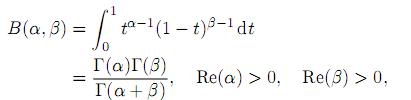
<body><![CDATA[<p>&nbsp;</p>     <p><font face="Verdana, Arial, Helvetica, sans-serif" size="3"><b>1 Introduction</b></font></p>     <p><font face="Verdana, Arial, Helvetica, sans-serif" size="2">A random variable X  is said to have a beta (type 1) distribution with parameters &alpha; and &beta; if its  probability density function (pdf) is given by</font></p>     <p align="right"><img src="/img/revistas/ince/v7n14/a02g1.jpg" /></p>     <p><font face="Verdana, Arial, Helvetica, sans-serif" size="2">where &alpha; &gt; 0 and &beta;  &gt; 0, and</font></p>     <p align="center"><img src="/img/revistas/ince/v7n14/a02g2.jpg" /></p>     <p><font face="Verdana, Arial, Helvetica, sans-serif" size="2">denotes the beta  function. The beta distribution is very versatile and a variety of uncertainties can  be usefully modeled by it. Many of the finite range distributions  encountered in practice can easily be transformed into the standard beta distribution.  Several univariate and matrix variate generalizations of this  distribution are given in Gordy 1., Gupta and Nagar 2., Johnson, Kotz and  Balakrishnan 3., McDonald and Xu 4., and  Nagar and Zarrazola 5.. A  natural univariate generalization of the beta distribution is the Gauss hypergeometric  distribution defined by Armero and Bayarri 6.. The random variable X is said to  have a Gauss hypergeometric distribution, denoted by X &sim; GH(&alpha;, &beta;, &gamma;, &xi;), if its density function is given by</font></p>     <p align="right"><img src="/img/revistas/ince/v7n14/a02g3.jpg" /></p>     <p><font face="Verdana, Arial, Helvetica, sans-serif" size="2">where &alpha; &gt; 0, &beta; &gt; 0, &minus;&infin; &lt; &gamma; &lt; &infin; and &xi; &gt; &minus;1. The normalizing constant <i>C</i>(&alpha;, &beta;, &gamma;, &xi;) is  given by</font></p>     <p align="right"><img src="/img/revistas/ince/v7n14/a02g4.jpg" /></p>     ]]></body>
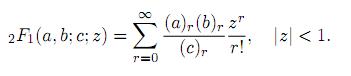
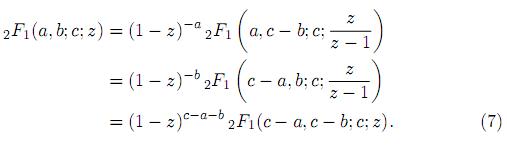
<body><![CDATA[<p><font face="Verdana, Arial, Helvetica, sans-serif" size="2">where <sub>2</sub><i>F</i><sub>1</sub>represents the Gauss  hypergeometric function (Luke 7.). Note that the Gauss hypergeometric function <sub>2</sub><i>F</i><sub>1</sub> in (3) can be expanded in series form  if &minus;1 &lt; &xi; &lt; 1. However, if &xi; &gt; 1, then we use suitably (7) to  rewrite <sub>2</sub><i>F</i><sub>1</sub> to have absolute  value of the argument less than one.</font></p>     <p><font face="Verdana, Arial, Helvetica, sans-serif" size="2">The  above distribution was suggested by Armero and Bayarri 6. in  connection with the prior distribution of the parameter &rho;, 0 &lt; &rho; &lt; 1, which represents the trafic  intensity in a <i>M</i>/<i>M</i>/1  queueing system. A brief introduction of this  distribution is given in the encyclopedic work of Johnson, Kotz and Balakrishnan 3, p. 253.. In the context of Bayesian analysis of unreported  Poisson count data, while deriving the marginal posterior distribution of the  reporting probablity p, Fader and Hardie 8. have shown that q = 1 &minus; p has a Gauss hypergeometric distribution. The  Gauss hypergeometric distribution  has also been used by Dauxois 9. to introduce conjugate priors  in the Bayesian inference for linear growth birth and death processes. Sarabia  and Castillo 10. have pointed out that this distribution is  conjugate prior for the  binomial distribution.</font></p>     <p><font face="Verdana, Arial, Helvetica, sans-serif" size="2">Gauss hypergeometric  distribution reduces to a beta type 1 distribution when either &gamma; or &xi;  equals to zero. Further, for &gamma; = &alpha; +&beta; and &xi; = 1, the Gauss hypergeometric  distribution simplifies to a beta type 3 distribution given by the density (Carde&ntilde;o,  Nagar and S&aacute;nchez 11., S&aacute;nchez and Nagar 12.),</font></p>     <p align="right"><img src="/img/revistas/ince/v7n14/a02g5.jpg" /></p>     <p><font face="Verdana, Arial, Helvetica, sans-serif" size="2">where &alpha; &gt; 0 and &beta; &gt; 0. For &gamma; = &alpha; + &beta; and &xi; = &minus;(1 &minus; &lambda;) it slides to a three parameter generalized  beta distribution defined by the density</font></p>     <p align="right"><img src="/img/revistas/ince/v7n14/a02g6.jpg" /></p>     <p><font face="Verdana, Arial, Helvetica, sans-serif" size="2">where &alpha; &gt; 0 and &beta;  &gt; 0. This distribution was defined and used by Libby and Novic 13. for utility function fitting. The beta distribution  sometimes does not provide suficient flexibility for a prior for probability of success in a binomial  distribution. Among various properties, the distribution defined by the density (5) can more flexibly account for heavy tails or skewness, and it reduces to the ordinary  beta (type 1) distribution for certain parameter choices. The  resulting posterior distribution in this case is a four-parameter type of beta. Chen and Novic 14. provided tables as evidence for its usefulness. Several properties and  special cases of this distribution are given in Johnson, Kotz  and Balakrishnan 3, p. 251.. For further results and  properties, the reader  is referred to Aryal and Nadarajah 15., Nadarajah 16., Nagar and Rada-Mora 17., Pham-Gia and Duong 18., and Sarabia and  Castillo 10..</font></p>     <p><font face="Verdana, Arial, Helvetica, sans-serif" size="2">In this article, we  derive distributions of the product and the ratio of two independent random  variables when at least one of them is Gauss hypergeometric. We also study  several properties of this distribution including R&eacute;nyi and Shannon  entropies.</font></p>     <p>&nbsp;</p>     <p><font face="Verdana, Arial, Helvetica, sans-serif" size="3"><b>2 Some Known Definitions  and Results</b></font></p>     ]]></body>
<body><![CDATA[<p><font face="Verdana, Arial, Helvetica, sans-serif" size="2">In  this section, we give definitions and results that are used in subsequent sections. Throughout  this work we will use the Pochhammer coeficient (<i>a</i>)<i><sub>n</sub></i> defined by (<i>a</i>)<sub>n</sub>= <i>a</i>(<i>a</i>+1) &middot; &middot; &middot; (<i>a</i>+<i>n</i>&minus;1)  = (<i>a</i>)<i><sub>n</sub></i><sub>&minus;1</sub>(<i>a</i>+<i>n</i>&minus;1) for <i>n</i> = 1, 2, . . . , and (<i>a</i>)<sub>0</sub> = 1. The integral  representation of the Gauss hypergeometric function is given as</font></p>     <p align="right"><img src="/img/revistas/ince/v7n14/a02g7.jpg" /></p>     <p><font face="Verdana, Arial, Helvetica, sans-serif" size="2">Note that, by expanding (1 &minus; <i>zt</i>)<sub>&minus;<i>b</i></sub>,|<i>zt</i>| &lt; 1, in (6) and  integrating <i>t</i>, the series expansion for<sub> 2</sub><i>F</i><sub>1</sub>can be obtained as</font></p>     <p align="center"><img src="/img/revistas/ince/v7n14/a02g8.jpg" /></p>     <p><font face="Verdana, Arial, Helvetica, sans-serif" size="2">The Gauss  hypergeometric function <sub>2</sub><i>F</i><sub>1</sub> (<i>a, b; c; z</i>) satisfies Euler's relation</font></p>     <p align="right"><img src="/img/revistas/ince/v7n14/a02g9.jpg" /></p>     <p><font face="Verdana, Arial, Helvetica, sans-serif" size="2">For properties and  further results the reader is referred to Luke 7..</font></p>     <p><font face="Verdana, Arial, Helvetica, sans-serif" size="2">   The Appell's first  hypergeometric function <i>F</i><sub>1</sub> is defined by</font></p>     <p align="right"><img src="/img/revistas/ince/v7n14/a02g10.jpg" /></p>     <p><font face="Verdana, Arial, Helvetica, sans-serif" size="2">where |<i>z</i><sub>1</sub>|&lt; 1 and |<i>z</i><sub>2</sub>|&lt; 1. It is  straightforward to show that</font></p>     ]]></body>

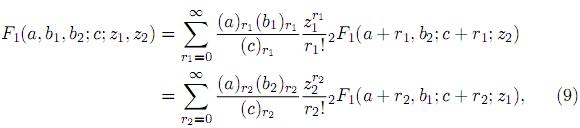
<body><![CDATA[<p align="right"><img src="/img/revistas/ince/v7n14/a02g11.jpg" /></p>     <p><font face="Verdana, Arial, Helvetica, sans-serif" size="2">where <sub>2</sub><i>F</i><sub>1</sub> is the Gauss  hypergeometric series. Using the results</font></p>     <p align="center"><img src="/img/revistas/ince/v7n14/a02g12.jpg" /></p>     <p><font face="Verdana, Arial, Helvetica, sans-serif" size="2">where Re(c) &gt;  Re(<i>a</i>) &gt; 0,</font></p>     <p align="center"><img src="/img/revistas/ince/v7n14/a02g13.jpg" /></p>     <p><font face="Verdana, Arial, Helvetica, sans-serif" size="2">in (8), one  obtains</font></p>     <p align="right"><img src="/img/revistas/ince/v7n14/a02g14.jpg" /></p>     <p><font face="Verdana, Arial, Helvetica, sans-serif" size="2">where Re(<i>c</i>) &gt; Re(<i>a</i>) &gt; 0. Note that for <i>b</i><sub>1</sub> = 0, <i>F</i><sub>1</sub> reduces to a <sub>2</sub><i>F</i><sub>1</sub> function. For properties and  further results of these function the reader is referred to Srivastava and  Karlsson 19..</font></p>     <p><font face="Verdana, Arial, Helvetica, sans-serif" size="2"><b>Lemma 2.1.</b> <i>Let</i></font></p>     <p align="right"><img src="/img/revistas/ince/v7n14/a02g15.jpg" /></p>     ]]></body>
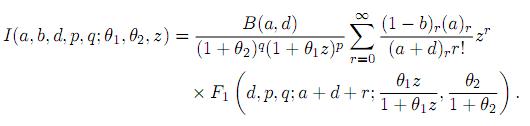
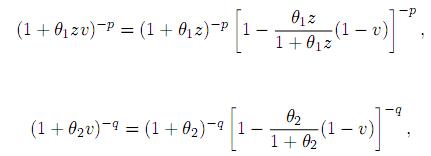
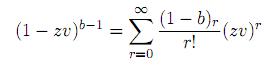
<body><![CDATA[<p><font face="Verdana, Arial, Helvetica, sans-serif" size="2"><i>Then, for a &gt; 0, d &gt;  0 and 0 &lt; z &lt; 1, we have</i></font></p>     <p align="center"><img src="/img/revistas/ince/v7n14/a02g16.jpg" /></p>     <p><font face="Verdana, Arial, Helvetica, sans-serif" size="2"><i>Proof</i>. Writing</font></p>     <p align="center"><img src="/img/revistas/ince/v7n14/a02g17.jpg" /></p>     <p><font face="Verdana, Arial, Helvetica, sans-serif" size="2">and</font></p>     <p align="center"><img src="/img/revistas/ince/v7n14/a02g18.jpg" /></p>     <p><font face="Verdana, Arial, Helvetica, sans-serif" size="2">in (11) and  substituting <i>v</i> = 1 &minus; <i>w</i>, we obtain</font></p>     <p align="center"><img src="/img/revistas/ince/v7n14/a02g19.jpg" /></p>     <p><font face="Verdana, Arial, Helvetica, sans-serif" size="2">Now, using the definition  of the Appell's first hypergeometric function, we get the desired result.</font></p>     <p align="right"><img src="/img/revistas/ince/v7n14/a02g20.jpg" /></p>     ]]></body>
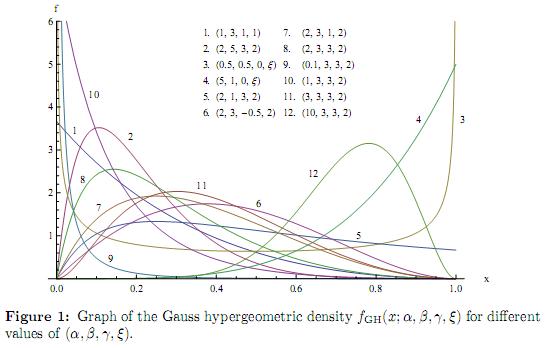
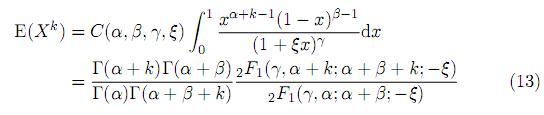
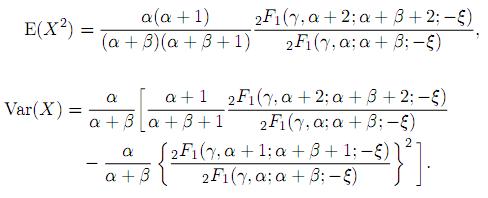
<body><![CDATA[<p>&nbsp;</p>     <p><font face="Verdana, Arial, Helvetica, sans-serif" size="3"><b>3 Properties</b></font></p>     <p><font face="Verdana, Arial, Helvetica, sans-serif" size="2">The graph of the  Gauss hypergeometric density for different values of the parameters is shown  in the <a href="#f1">Figure 1.</a></font></p>     <p align="center"><a name="f1"><img src="/img/revistas/ince/v7n14/a02f1.jpg" /></a></p>     <p><font face="Verdana, Arial, Helvetica, sans-serif" size="2">The <i>k</i>-th moment of the variable <i>X</i> having  Gauss hypergeometric distribution, obtained in  Armero and Bayarri 6., can be calculated as</font></p>     <p align="center"><img src="/img/revistas/ince/v7n14/a02g21.jpg" /></p>     <p><font face="Verdana, Arial, Helvetica, sans-serif" size="2">from which the  expected value and the variance of this distribution are obtained as</font></p>     <p align="center"><img src="/img/revistas/ince/v7n14/a02g22.jpg" /></p>     <p align="center"><img src="/img/revistas/ince/v7n14/a02g23.jpg" /></p>     <p><font face="Verdana, Arial, Helvetica, sans-serif" size="2">Moreover, the  cumulative distribution function (CDF) can be derived in terms of special functions  as shown in the following theorem.</font></p>     ]]></body>
<body><![CDATA[<p><font face="Verdana, Arial, Helvetica, sans-serif" size="2"><b>Theorem 3.1.</b> Let <i>X</i> &sim; GH(&alpha;, &beta;, &gamma;, &xi;). </font><font face="Verdana, Arial, Helvetica, sans-serif" size="2"><i>Then, the CDF of X is  given by</i></font></p>     <p align="center"><img src="/img/revistas/ince/v7n14/a02g24.jpg" /></p>     <p><font face="Verdana, Arial, Helvetica, sans-serif" size="2"><i>Proof</i>. The CDF of <i>X</i> is  evaluated as</font></p>     <p align="center"><img src="/img/revistas/ince/v7n14/a02g25.jpg" /></p>     <p><font face="Verdana, Arial, Helvetica, sans-serif" size="2">By making the  substitution <i>u</i> = <i>t</i>/<i>x</i>, we can express the above integral as</font></p>     <p align="center"><img src="/img/revistas/ince/v7n14/a02g26.jpg" /></p>     <p><font face="Verdana, Arial, Helvetica, sans-serif" size="2">Now, using the  integral representation (10) of <i>F</i><sub>1</sub>, substituting for <i>C</i>(&alpha;,  &beta;, &gamma;, &xi;) from (3) and  simplifying, we obtain the desired result. </font></p>     <p align="right"><img src="/img/revistas/ince/v7n14/a02g20.jpg" /></p>     <p><font face="Verdana, Arial, Helvetica, sans-serif" size="2">The  following theorem suggests a generalized beta type 2 distribution, from the Gauss  hypergeometric distribution.</font></p>     <p><font face="Verdana, Arial, Helvetica, sans-serif" size="2"><b>Theorem 3.2.</b><i> Let X &sim; GH(&alpha;,  &beta;, &gamma;, &xi;). Then, the pdf of the random variable Y = X/(1 &minus; X) is given by</i></font></p>     ]]></body>
<body><![CDATA[<p align="right"><img src="/img/revistas/ince/v7n14/a02g27.jpg" /></p>     <p><font face="Verdana, Arial, Helvetica, sans-serif" size="2"><i>where C(&alpha;, &beta;, &gamma;, &xi;) is the  normalizing constant given by (3)</i>.</font></p>     <p><font face="Verdana, Arial, Helvetica, sans-serif" size="2"><i>Proof</i>. Making the  transformation <i>Y</i> = <i>X</i>/(1 &minus; <i>X</i>),  with the Jacobian <i>J</i>(<i>x</i> &rarr;     <i>y</i>) = (1 + <i>y</i>)<sup>&minus;2</sup> in (2), we  get the desired result.</font></p>     <p align="right"><img src="/img/revistas/ince/v7n14/a02g20.jpg" /></p>     <p><font face="Verdana, Arial, Helvetica, sans-serif" size="2">As expected, if in the density (14) we  take &gamma; = 0 or &xi; = 0 with &beta;  &gt; &gamma;, then we obtain the  beta type 2 density.</font></p>     <p>&nbsp;</p>     <p><font face="Verdana, Arial, Helvetica, sans-serif" size="3"><b>4 Entropies</b></font></p>     <p><font face="Verdana, Arial, Helvetica, sans-serif" size="2">In  this section, exact forms of R&eacute;nyi and Shannon entropies are obtained for the Gauss  hypergeometric distribution defined in Section 1.</font></p>     <p><font face="Verdana, Arial, Helvetica, sans-serif" size="2">Let (<img src="/img/revistas/ince/v7n14/a02g28.jpg" />) be a probability space. Consider a pdf <i>f</i> associated with <img src="/img/revistas/ince/v7n14/a02g30.jpg" />, dominated by &sigma;&minus;finite measure &micro;  on <img src="/img/revistas/ince/v7n14/a02g29.jpg" />. Denote by <i>H<sub>SH</sub></i> (f )  the well-known Shannon entropy  introduced in Shannon 20. It is defined by</font></p>     <p align="right"><img src="/img/revistas/ince/v7n14/a02g31.jpg" /></p>     ]]></body>
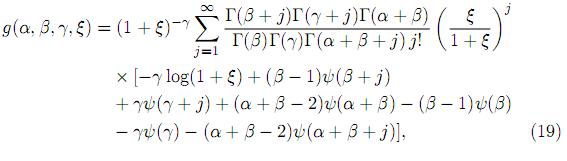
<body><![CDATA[<p><font face="Verdana, Arial, Helvetica, sans-serif" size="2">One of the main  extensions of the Shannon entropy was defined by R&eacute;nyi 21. This generalized  entropy measure is given by</font></p>     <p align="right"><i></i><img src="/img/revistas/ince/v7n14/a02g32.jpg" /></p>     <p><font face="Verdana, Arial, Helvetica, sans-serif" size="2">where</font></p>     <p align="center"><img src="/img/revistas/ince/v7n14/a02g33.jpg" /></p>     <p><font face="Verdana, Arial, Helvetica, sans-serif" size="2">The additional parameter &eta; is used to describe complex behavior in probability  models and the associated process under study. R&eacute;nyi entropy is monotonically  decreasing in &eta;, while Shannon entropy (15) is obtained from (16) for &eta; &uarr; 1. For details see Nadarajah and Zografos 22., Zografos 23., and Zografos and  Nadarajah 24..</font></p>     <p><font face="Verdana, Arial, Helvetica, sans-serif" size="2">First, we give the  following lemma useful in deriving these entropies.</font></p>     <p><font face="Verdana, Arial, Helvetica, sans-serif" size="2"><b>Lemma 4.1.</b> <i>Let g(&alpha;, &beta;, &gamma;, &xi;)  = lim<sub>&eta;</sub>&rarr;1 h(&eta;), where</i></font></p>     <p align="right"><img src="/img/revistas/ince/v7n14/a02g34.jpg" /></p>     <p><font face="Verdana, Arial, Helvetica, sans-serif" size="2"><i>Then, for &minus;1 &lt; &xi;  &lt; 1, we have</i></font></p>     <p align="right"><img src="/img/revistas/ince/v7n14/a02g35.jpg" /></p>     ]]></body>
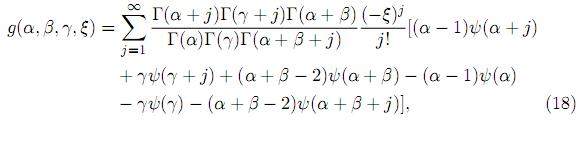
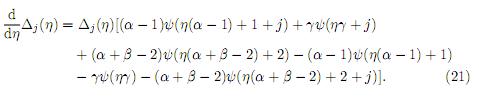
<body><![CDATA[<p><font face="Verdana, Arial, Helvetica, sans-serif" size="2"><i>and for</i> &xi; &ge; 1,</font></p>     <p align="right"><img src="/img/revistas/ince/v7n14/a02g36.jpg" /></p>     <p><font face="Verdana, Arial, Helvetica, sans-serif" size="2"><i>where &psi;(z) = &Gamma;&acute;(z)/&Gamma;(z) is the digamma  function</i>.</font></p>     <p><font face="Verdana, Arial, Helvetica, sans-serif" size="2"><i>Proof</i>. Using the series  expansion of <sub>2</sub><i>F</i><sub>1</sub>, for &minus;1 &lt; &xi; &lt; 1, we write</font></p>     <p align="right"><img src="/img/revistas/ince/v7n14/a02g37.jpg" /></p>     <p><font face="Verdana, Arial, Helvetica, sans-serif" size="2">where</font></p>     <p align="center"><img src="/img/revistas/ince/v7n14/a02g38.jpg" /></p>     <p><font face="Verdana, Arial, Helvetica, sans-serif" size="2">Now, differentiating the logarithm of &Delta;<sub><i>j</i></sub>(&eta;) w.r.t. &eta;, we  arrive at</font></p>     <p align="right"><img src="/img/revistas/ince/v7n14/a02g39.jpg" /></p>     <p><font face="Verdana, Arial, Helvetica, sans-serif" size="2">Finally, substituting (21) in (20) and taking &eta; &rarr; 1, we obtain (18). To obtain (19), we use (7) to write</font></p>     ]]></body>
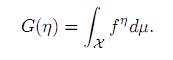
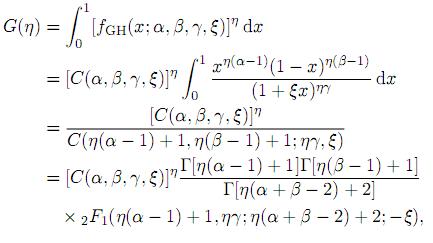
<body><![CDATA[<p align="right"><img src="/img/revistas/ince/v7n14/a02g41.jpg" /></p>     <p><font face="Verdana, Arial, Helvetica, sans-serif" size="2">and proceed  similarly.</font></p>     <p align="right"><img src="/img/revistas/ince/v7n14/a02g20.jpg" /></p>     <p><font face="Verdana, Arial, Helvetica, sans-serif" size="2"><b>Theorem 4.1.</b> <i>For the  Gauss hypergeometric distribution defined by the pdf (2), the  R&eacute;nyi and the Shannon entropies are given by</i></font></p>     <p align="right"><img src="/img/revistas/ince/v7n14/a02g42.jpg" /></p>     <p><font face="Verdana, Arial, Helvetica, sans-serif" size="2"><i>and</i></font></p>     <p align="right"><img src="/img/revistas/ince/v7n14/a02g43.jpg" /></p>     <p><font face="Verdana, Arial, Helvetica, sans-serif" size="2"><i>respectively, where  for &minus;1 &lt; &xi; &lt; 1, g(&alpha;, &beta;, &gamma;, &xi;) is given by (18), and  for &xi; &ge; 1 g(&alpha;, &beta;, &gamma;, &xi;) is given by (19).</i></font></p>     <p><font face="Verdana, Arial, Helvetica, sans-serif" size="2"><i>Proof</i>. For &eta; &gt; 0 and &eta;   &ne;   1, using the density of <i>X</i> given by (2), we have</font></p>     <p align="center"><img src="/img/revistas/ince/v7n14/a02g44.jpg" /></p>     ]]></body>
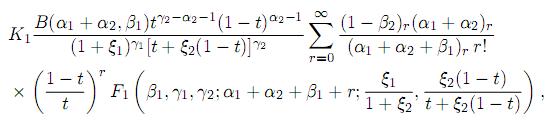
<body><![CDATA[<p><font face="Verdana, Arial, Helvetica, sans-serif" size="2">where the last line  has been obtained by using (3). Now, taking logarithm of G(&eta;) and using (16) we get (23). The Shannon entropy is obtained from (23) by taking &eta; &uarr; 1 and  using L'Hopital's rule.</font></p>     <p>&nbsp;</p>     <p><font face="Verdana, Arial, Helvetica, sans-serif" size="3"><b>5 Distribution of The  Product</b></font></p>     <p><font face="Verdana, Arial, Helvetica, sans-serif" size="2">In this section, we  obtain distributional results for the product of two independent random  variables involving Gauss hypergeometric distribution.</font></p>     <p><font face="Verdana, Arial, Helvetica, sans-serif" size="2"><b>Theorem 5.1.</b> <i>Let X<sub>1</sub> and X<sub>2</sub> be  independent, Xi&sim; GH(&alpha;<i><sub>i</sub></i>, &beta;<i><sub>i</sub></i>, &gamma;<i><sub>i</sub></i>, &xi;<i><sub>i</sub></i>), i = 1, 2. Then, the pdf of Z = X<sub>1</sub>X<sub>2</sub> is given by</i></font></p>     <p align="center"><img src="/img/revistas/ince/v7n14/a02g45.jpg" /></p>     <p><font face="Verdana, Arial, Helvetica, sans-serif" size="2"><i>where</i></font></p>     <p align="center"><img src="/img/revistas/ince/v7n14/a02g46.jpg" /></p>     <p><font face="Verdana, Arial, Helvetica, sans-serif" size="2"><i>Proof</i>. Using the independence, the joint pdf of <i>X</i><sub>1</sub> and <i>X</i><sub>2</sub> is given by</font></p>     <p align="right"><img src="/img/revistas/ince/v7n14/a02g47.jpg" /></p>     ]]></body>
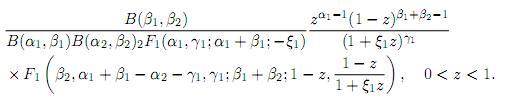
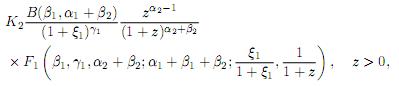
<body><![CDATA[<p><font face="Verdana, Arial, Helvetica, sans-serif" size="2">Transforming <i>Z</i> = <i>X</i><sub>1</sub><i>X</i><sub>2</sub>, <i>X</i><sub>2</sub> = <i>X</i><sub>2</sub> with the Jacobian <i>J</i>(<i>x</i><sub>1</sub>, <i>x</i><sub>2</sub> &rarr; <i>z</i>, <i>x</i><sub>2</sub>) = 1/<i>x</i><sub>2</sub>, we obtain the joint pdf of <i>Z</i> and  <i>X</i><sub>2</sub> as</font></p>     <p align="right"><img src="/img/revistas/ince/v7n14/a02g48.jpg" /></p>     <p><font face="Verdana, Arial, Helvetica, sans-serif" size="2">To find the marginal  pdf of <i>Z</i>, we integrate (26) with respect to <i>x</i><sub>2</sub> to get</font></p>     <p align="right"><img src="/img/revistas/ince/v7n14/a02g49.jpg" /></p>     <p><font face="Verdana, Arial, Helvetica, sans-serif" size="2">In (27) change  of variable <i>w</i> = (1 &minus; <i>x</i><sub>2</sub>)/(1 &minus; <i>z</i>) yields</font></p>     <p align="center"><img src="/img/revistas/ince/v7n14/a02g50.jpg" /></p>     <p><font face="Verdana, Arial, Helvetica, sans-serif" size="2">where the last step  has been obtained by expanding 1&minus;(1&minus;<i>z</i>)<i>w</i>.&minus;<sup>(&alpha;<sub>1</sub>+&beta;<sub>1</sub>&minus;&gamma;<sub>1</sub>&minus;&alpha;<sub>2</sub>)</sup> in power series.  Finally, applying (10), we obtain the desired result.</font></p>     <p align="right"><img src="/img/revistas/ince/v7n14/a02g20.jpg" /></p>     <p><font face="Verdana, Arial, Helvetica, sans-serif" size="2"><b>Corollary 5.1.1.</b> <i>Let X<sub>1</sub> &sim; GH(&alpha;<sub>1</sub>, &beta;<sub>1</sub>, &gamma;<sub>1</sub>, &xi;<sub>1</sub>) and X<sub>2</sub> &sim; B1(&alpha;<sub>2</sub>, &beta;<sub>2</sub>) be independent. Then, the pdf of Z = X<sub>1</sub> X<sub>2</sub> is</i></font></p>     <p align="center"><img src="/img/revistas/ince/v7n14/a02g51.jpg" /></p>     ]]></body>
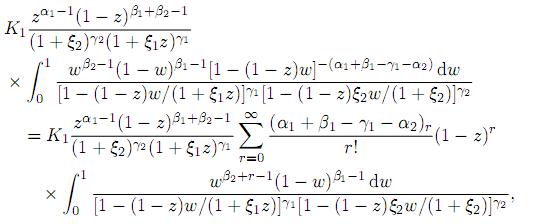
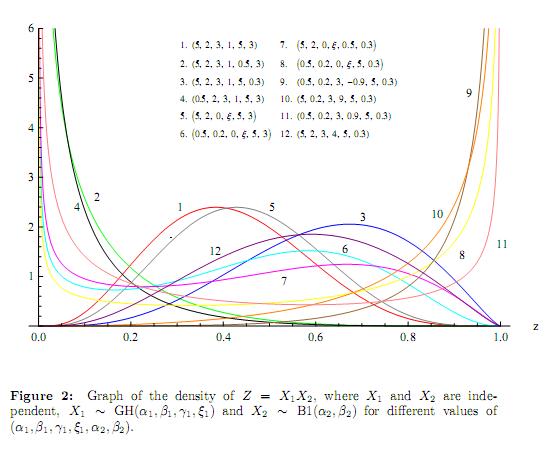
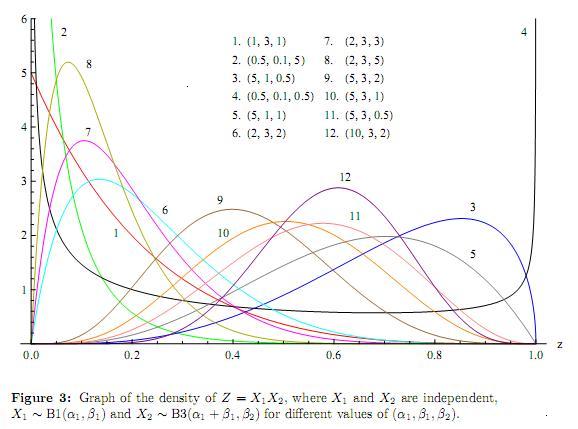
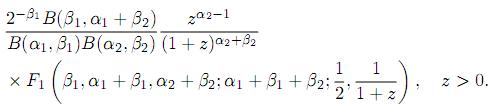
<body><![CDATA[<p><font face="Verdana, Arial, Helvetica, sans-serif" size="2"><i>Proof</i>. Substituting &gamma;<sub>2</sub> = 0 in Theorem 5.1 and using (9) we  get the desired result.</font></p>     <p align="right"><img src="/img/revistas/ince/v7n14/a02g20.jpg" /></p>     <p><font face="Verdana, Arial, Helvetica, sans-serif" size="2"><b>Corollary 5.1.2.</b> <i>Let the random variables X<sub>1</sub> and  X<sub>2</sub> be  independent, X<sub>1</sub> &sim;  B1(&alpha;<sub>1</sub>, &beta;<sub>1</sub>) and X<sub>2</sub>&sim; B3(&alpha;<sub>2</sub>, &beta;<sub>2</sub>). If &alpha;<sub>2</sub>= &alpha;<sub>1</sub>+ &beta;<sub>1</sub>, then the pdf of Z = X<sub>1</sub>X<sub>2</sub> is given by</i></font></p>     <p align="center"><img src="/img/revistas/ince/v7n14/a02g52.jpg" /></p>     <p><font face="Verdana, Arial, Helvetica, sans-serif" size="2">The graphs of the pdf of <i>Z</i> = <i>X</i><sub>1</sub><i>X</i><sub>2</sub>, where <i>X</i><sub>1</sub> and <i>X</i><sub>2</sub> are independent, <i>X</i><sub>1</sub> &sim; GH(&alpha;<sub>1</sub> , &beta;<sub>1</sub>, &gamma;<sub>1</sub>, &xi;<sub>1</sub>)  and X<sub>2</sub> &sim; B1(&alpha;<sub>2</sub>, &beta;<sub>2</sub>)  for different  values of (&alpha;<sub>1</sub>, &beta;<sub>1</sub>, &gamma;<sub>1</sub>, &xi;<sub>1</sub>, &alpha;<sub>2</sub>, &beta;<sub>2</sub>)  for different  values of the parameters is shown in the <a href="#f2">Figure 2. </a>Further, <a href="#f3">Figure 3 </a>depicts graphs of the  density of <i>Z</i> = <i>X</i><sub>1</sub><i>X</i><sub>2</sub>, where <i>X</i><sub>1</sub> and <i>X</i><sub>2</sub> are independent, <i>X</i><sub>1</sub> &sim; B1(&alpha;<sub>1</sub>, &beta;<sub>1</sub>) and <i>X</i><sub>2</sub> &sim; B3(&alpha;<sub>1</sub> + &beta;<sub>1</sub>, &beta;<sub>2</sub>) for different values of (&alpha;<sub>1</sub>, &beta;<sub>1</sub>, &beta;<sub>2</sub>).</font></p>     <p align="center"><a name="f2"><img src="/img/revistas/ince/v7n14/a02f2.jpg" /></a></p>     <p align="center"><a name="f3"><img src="/img/revistas/ince/v7n14/a02f3.jpg" /></a></p>     <p><font face="Verdana, Arial, Helvetica, sans-serif" size="2"><b>Theorem 5.2.</b> <i>Let the random variables X<sub>1</sub> and X<sub>2</sub> be independent, X<sub>1</sub> &sim;  GH(&alpha;<sub>1</sub>, &beta;<sub>1</sub>, &gamma;<sub>1</sub>, &xi;<sub>1</sub>) and X<sub>2</sub> &sim; B2(&alpha;<sub>2</sub>, &beta;<sub>2</sub>). Then, the pdf of Z  = X<sub>1</sub>X<sub>2</sub> is given by</i></font></p>     <p align="center"><img src="/img/revistas/ince/v7n14/a02g53.jpg" /></p>     <p><font face="Verdana, Arial, Helvetica, sans-serif" size="2"><i>where</i></font></p>     ]]></body>
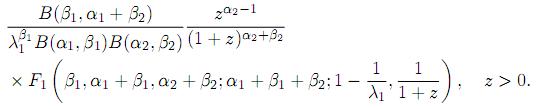
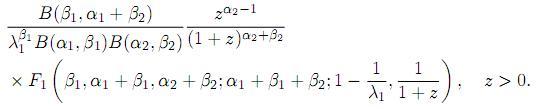
<body><![CDATA[<p align="center"><img src="/img/revistas/ince/v7n14/a02g54.jpg" /></p>     <p><font face="Verdana, Arial, Helvetica, sans-serif" size="2"><i>Proof</i>. Since <i>X</i><sub>1</sub> and <i>X</i><sub>2</sub> are independent,  their joint pdf is given by</font></p>     <p align="center"><img src="/img/revistas/ince/v7n14/a02g55.jpg" /></p>     <p><font face="Verdana, Arial, Helvetica, sans-serif" size="2">Now consider the transformation <i>Z</i> = <i>X</i><sub>1</sub><i>X</i><sub>2</sub>, <i>W</i> = 1 &minus; <i>X</i><sub>1</sub> whose Jacobian is <i>J</i> (<i>x</i><sub>1</sub>, <i>x</i><sub>2</sub> &rarr; <i>w</i>, <i>z</i>) = 1/(1 &minus; <i>w</i>).  Thus, we obtain the joint pdf of <i>W</i> and <i>Z</i> as</font></p>     <p align="right"><img src="/img/revistas/ince/v7n14/a02g56.jpg" /></p>     <p><font face="Verdana, Arial, Helvetica, sans-serif" size="2">where <i>z</i> &gt; 0 and 0  &lt; <i>w</i> &lt; 1. Finally, integrating <i>w</i> using (10) and  substituting for <i>K</i><sub>2</sub> in (28), we  obtain the desired result.</font></p>     <p align="right"><img src="/img/revistas/ince/v7n14/a02g20.jpg" /></p>     <p><font face="Verdana, Arial, Helvetica, sans-serif" size="2"><b>Corollary 5.2.1.</b> <i>Let the random variables X<sub>1</sub> and  X<sub>2</sub> be  independent, X<sub>1</sub> &sim;  B1(&alpha;1, &beta;1; &lambda;1) and X<sub>2</sub>&sim; B2(&alpha;<sub>2</sub>, &beta;<sub>2</sub>). Then, the pdf of Z = X<sub>1</sub>X<sub>2</sub> is given by</i></font></p>     <p>&nbsp;</p>     <p align="center"><img src="/img/revistas/ince/v7n14/a02g57.jpg" /></p>     ]]></body>
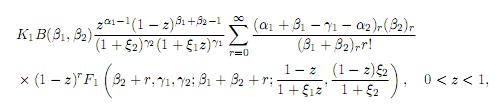
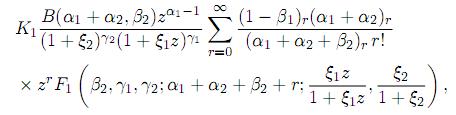
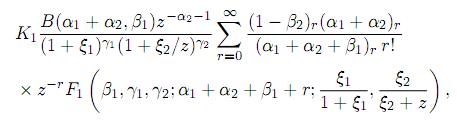
<body><![CDATA[<p><font face="Verdana, Arial, Helvetica, sans-serif" size="2"><b>Corollary 5.2.2.</b> <i>Let the random variables X<sub>1</sub> and X<sub>2</sub> be independent, X<sub>1</sub> &sim;  B1(&alpha;<sub>1</sub>, &beta;<sub>1</sub>) and X2 &sim; B2(&alpha;<sub>2</sub>, &beta;<sub>2</sub>). Then, the pdf of Z = X<sub>1</sub>X<sub>2</sub> is given by</i></font></p>     <p align="center"><img src="/img/revistas/ince/v7n14/a02g58.jpg" /></p>     <p><font face="Verdana, Arial, Helvetica, sans-serif" size="2"><b>Corollary 5.2.3.</b> <i>Let the random variables X<sub>1</sub> and X<sub>2</sub> be independent, X<sub>1</sub> &sim;    B3(&alpha;<sub>1</sub>, &beta;<sub>1</sub>) and X<sub>2</sub> &sim; B2(&alpha;<sub>2</sub>, &beta;<sub>2</sub>). Then, the pdf of Z = X<sub>1</sub>X<sub>2</sub> is given by</i></font></p>     <p align="center"><img src="/img/revistas/ince/v7n14/a02g59.jpg" /></p>     <p>&nbsp;</p>     <p><font face="Verdana, Arial, Helvetica, sans-serif" size="3"><b>6 Distribution of The  Quotient</b></font></p>     <p><font face="Verdana, Arial, Helvetica, sans-serif" size="2">In this section we  obtain distributional results for the quotient of two independent random  variables involving Gauss hypergeometric distribution.</font></p>     <p><font face="Verdana, Arial, Helvetica, sans-serif" size="2">In the following  theorem, we consider the case where both the random variables are  distributed as Gauss hypergeometric.</font></p>     <p><font face="Verdana, Arial, Helvetica, sans-serif" size="2"><b>Theorem 6.1.</b> <i>Let the  random variables X<sub>1</sub> and X<sub>2</sub> be independent, X<sub>i</sub>&sim;  GH(&alpha;<sub>i</sub>, &beta;<sub>i</sub>, &gamma;<sub>i</sub>, &xi;<sub>i</sub>), i = 1, 2. Then,  the pdf of Z = X<sub>1</sub>/X<sub>2</sub> is given by</i></font></p>     <p align="center"><img src="/img/revistas/ince/v7n14/a02g60.jpg" /></p>     ]]></body>
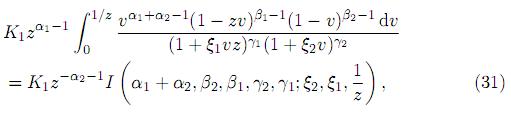
<body><![CDATA[<p><font face="Verdana, Arial, Helvetica, sans-serif" size="2"><i>for 0 &lt; z &le; 1, and</i></font></p>     <p align="center"><img src="/img/revistas/ince/v7n14/a02g61.jpg" /></p>     <p><font face="Verdana, Arial, Helvetica, sans-serif" size="2"><i>for z &gt; 1.</i></font></p>     <p><font face="Verdana, Arial, Helvetica, sans-serif" size="2"><i>Proof</i>. The joint pdf of <i>X</i><sub>1</sub> and <i>X</i><sub>2</sub> is given by (25). Now, transforming     <i>Z</i> = <i>X</i><sub>1</sub>/<i>X</i><sub>2</sub> , <i>V</i> = <i>X</i><sub>2</sub> with the Jacobian <i>J</i>(<i>x</i><sub>1</sub>, <i>x</i><sub>2</sub> &rarr; <i>z</i>, <i>v</i>) = <i>v</i>, we  obtain the joint pdf of <i>Z</i> and <i>V</i> as</font></p>     <p align="right"><img src="/img/revistas/ince/v7n14/a02g62.jpg" /></p>     <p><font face="Verdana, Arial, Helvetica, sans-serif" size="2">where 0 &lt; <i>v</i> &lt; 1 for 0 &lt; <i>z</i> &le; 1, and 0 &lt; <i>v</i> &lt; 1/<i>z</i> for <i>z</i> &gt; 1. For 0  &lt; <i>z</i> &le; 1, the marginal pdf of <i>Z</i> is  obtained by integrating (29) over 0 &lt; <i>v</i> &lt; 1. Thus, the pdf of <i>Z</i>, for 0  &lt; <i>z</i> &le; 1, is obtained as</font></p>     <p align="right"><img src="/img/revistas/ince/v7n14/a02g63.jpg" /></p>     <p><font face="Verdana, Arial, Helvetica, sans-serif" size="2">Now, using Lemma 2.1 and substituting <i>K</i><sub>1</sub> in the density (30) we get the desired result. For <i>z</i> &gt; 1, the density of <i>Z</i> is given by</font></p>     <p align="right"><img src="/img/revistas/ince/v7n14/a02g64.jpg" /></p>     <p><font face="Verdana, Arial, Helvetica, sans-serif" size="2">where the last line  has been obtained by substituting w = vz. Finally, using Lemma 2.1 and substituting for <i>K</i><sub>1</sub>, we obtain the pdf of  <i>Z</i> for <i>z</i> &gt; 1.</font></p>     ]]></body>
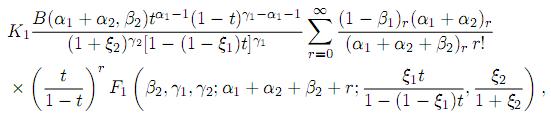
<body><![CDATA[<p align="right"><img src="/img/revistas/ince/v7n14/a02g20.jpg" /></p>     <p><font face="Verdana, Arial, Helvetica, sans-serif" size="2"><b>Theorem 6.2.</b><i> Let the random variables X<sub>1</sub> and X<sub>2</sub> be independent, X<sub>i</sub> &sim;  GH(&alpha;<sub>i</sub>, &beta;<sub>i</sub>, &gamma;<sub>i</sub>, &xi;<sub>i</sub>), i = 1, 2. Then, the pdf of T =  X<sub>1</sub> /(X<sub>1</sub> + X<sub>2</sub>) is given by</i></font></p>     <p align="center"><img src="/img/revistas/ince/v7n14/a02g65.jpg" /></p>     <p><font face="Verdana, Arial, Helvetica, sans-serif" size="2"><i>for 0 &lt; t &le; 1/2,  and</i></font></p>     <p align="center"><img src="/img/revistas/ince/v7n14/a02g66.jpg" /></p>     <p><font face="Verdana, Arial, Helvetica, sans-serif" size="2"><i>for 1/2 &lt; t &lt;  1.</i></font></p>     <p><font face="Verdana, Arial, Helvetica, sans-serif" size="2"><i>Proof</i>. Making the  transformation <i>T</i> = <i>Z</i>/(1 + <i>Z</i>) with the  Jacobian <i>J</i>(<i>z</i> &rarr;     <i>t</i>) = (1 &minus; <i>t</i>)<sup>&minus;2</sup> in Theorem 6.1 we get the desired result</font> </p>     <p align="right"><img src="/img/revistas/ince/v7n14/a02g20.jpg" /></p>     <p>&nbsp;</p>     <p><font face="Verdana, Arial, Helvetica, sans-serif" size="3"><b>Acknowledgment</b></font></p>     ]]></body>
<body><![CDATA[<p><font face="Verdana, Arial, Helvetica, sans-serif" size="2">This research work  was supported by the Comit&eacute; para el Desarrollo de la   Investigaci&oacute;n(CODI),  Universidad de Antioquia research grant no. IN560CE.</font></p>     <p>&nbsp;</p>     <p><font face="Verdana, Arial, Helvetica, sans-serif" size="3"><b>References</b></font></p>     <!-- ref --><p><font face="Verdana, Arial, Helvetica, sans-serif" size="2">1.  Michael B. Gordy. <i>Computationally  convenient distributional assumptions for common-value auctions</i>. Computational  Economics, ISSN: 0927–7099, EISSN:  1572–9974, 12(1), 61–78 (1998). 30</font>&nbsp;&nbsp;&nbsp;&nbsp;&nbsp;&nbsp;&nbsp;&nbsp;[&#160;<a href="javascript:void(0);" onclick="javascript: window.open('/scielo.php?script=sci_nlinks&ref=000206&pid=S1794-9165201100020000200001&lng=','','width=640,height=500,resizable=yes,scrollbars=1,menubar=yes,');">Links</a>&#160;]<!-- end-ref --><!-- ref --><p><font face="Verdana, Arial, Helvetica, sans-serif" size="2">2.  A. K. Gupta and D. K. Nagar. <i>Matrix variate  distributions</i>. Chapman  &amp;   Hall/CRC  Monographs and Surveys in Pure and Applied Mathematics,   104,  ISBN: 1-58488-046-5, Chapman &amp;  Hall/CRC, Boca Raton, FL,   2000. 30</font>&nbsp;&nbsp;&nbsp;&nbsp;&nbsp;&nbsp;&nbsp;&nbsp;[&#160;<a href="javascript:void(0);" onclick="javascript: window.open('/scielo.php?script=sci_nlinks&ref=000207&pid=S1794-9165201100020000200002&lng=','','width=640,height=500,resizable=yes,scrollbars=1,menubar=yes,');">Links</a>&#160;]<!-- end-ref --><!-- ref --><p><font face="Verdana, Arial, Helvetica, sans-serif" size="2">3. N. L. Johnson, S. Kotz and N. Balakrishnan. <i>Continuous  univariate   distributions</i>. Vol.  2. Second edition, Wiley Series in Probability and   Mathematical  Statistics: Applied Probability and Statistics. A WileyInterscience  Publication, ISBN: 978-0-471-58494-0, John Wiley &amp;  Sons,   Inc., New York, 1995. 30, 31, 32</font>&nbsp;&nbsp;&nbsp;&nbsp;&nbsp;&nbsp;&nbsp;&nbsp;[&#160;<a href="javascript:void(0);" onclick="javascript: window.open('/scielo.php?script=sci_nlinks&ref=000208&pid=S1794-9165201100020000200003&lng=','','width=640,height=500,resizable=yes,scrollbars=1,menubar=yes,');">Links</a>&#160;]<!-- end-ref --><!-- ref --><p><font face="Verdana, Arial, Helvetica, sans-serif" size="2">4.  J. B. McDonald and Y. J. Xu. <i>A generalization  of the beta distribution   with applications</i>. Journal of  Econometrics, ISSN: 0304-4076, 66(1&amp;2),   133–152 (1995). 30</font>&nbsp;&nbsp;&nbsp;&nbsp;&nbsp;&nbsp;&nbsp;&nbsp;[&#160;<a href="javascript:void(0);" onclick="javascript: window.open('/scielo.php?script=sci_nlinks&ref=000209&pid=S1794-9165201100020000200004&lng=','','width=640,height=500,resizable=yes,scrollbars=1,menubar=yes,');">Links</a>&#160;]<!-- end-ref --><!-- ref --><p><font face="Verdana, Arial, Helvetica, sans-serif" size="2">5. D. K. Nagar and E. Zarrazola. <i>Distributions of the product and the   quotient of independent Kummer-beta  variables</i>. Scientiae Mathematicae Japonicae, ISSN:  1346–0862, EISSN: 1346–0447, 61(1),  109–117   (2005). 30</font>&nbsp;&nbsp;&nbsp;&nbsp;&nbsp;&nbsp;&nbsp;&nbsp;[&#160;<a href="javascript:void(0);" onclick="javascript: window.open('/scielo.php?script=sci_nlinks&ref=000210&pid=S1794-9165201100020000200005&lng=','','width=640,height=500,resizable=yes,scrollbars=1,menubar=yes,');">Links</a>&#160;]<!-- end-ref --><!-- ref --><p><font face="Verdana, Arial, Helvetica, sans-serif" size="2">6.  C. Armero and M. Bayarri. <i>Prior assessments  for predictions in queues</i>.   The Statistician, ISSN:  1467–9884, 43(1), 139–153 (1994). 30, 31, 35</font>&nbsp;&nbsp;&nbsp;&nbsp;&nbsp;&nbsp;&nbsp;&nbsp;[&#160;<a href="javascript:void(0);" onclick="javascript: window.open('/scielo.php?script=sci_nlinks&ref=000211&pid=S1794-9165201100020000200006&lng=','','width=640,height=500,resizable=yes,scrollbars=1,menubar=yes,');">Links</a>&#160;]<!-- end-ref --><!-- ref --><p><font face="Verdana, Arial, Helvetica, sans-serif" size="2">7. Y. L. Luke. <i>The special  functions and their approximations</i>, Vol.  I.   Mathematics  in Science and Engineering, Vol. 53, ISBN: 0-124-59901-X,   Academic Press, New  York-London, 1969. 31, 33</font>&nbsp;&nbsp;&nbsp;&nbsp;&nbsp;&nbsp;&nbsp;&nbsp;[&#160;<a href="javascript:void(0);" onclick="javascript: window.open('/scielo.php?script=sci_nlinks&ref=000212&pid=S1794-9165201100020000200007&lng=','','width=640,height=500,resizable=yes,scrollbars=1,menubar=yes,');">Links</a>&#160;]<!-- end-ref --><!-- ref --><p><font face="Verdana, Arial, Helvetica, sans-serif" size="2">8. Peter S. Fader and Bruce G. S. Hardie. <i>A note on  modelling underreported Poisson  counts</i>. Journal of Applied  Statistics, PISSN: ISSN:   0266-4763, OISSN:  1360-0532, 27(8), 953–964 (2000). 31 </font>&nbsp;&nbsp;&nbsp;&nbsp;&nbsp;&nbsp;&nbsp;&nbsp;[&#160;<a href="javascript:void(0);" onclick="javascript: window.open('/scielo.php?script=sci_nlinks&ref=000213&pid=S1794-9165201100020000200008&lng=','','width=640,height=500,resizable=yes,scrollbars=1,menubar=yes,');">Links</a>&#160;]<!-- end-ref --><!-- ref --><p><font face="Verdana, Arial, Helvetica, sans-serif" size="2">9.  J.-Y. Dauxois. <i>Bayesian inference  for linear growth birth and death processes</i>. Journal of  Statistical Planning and Inference, ISSN: 0378-3758,   121(1), 1–19 (2004). 31</font>&nbsp;&nbsp;&nbsp;&nbsp;&nbsp;&nbsp;&nbsp;&nbsp;[&#160;<a href="javascript:void(0);" onclick="javascript: window.open('/scielo.php?script=sci_nlinks&ref=000214&pid=S1794-9165201100020000200009&lng=','','width=640,height=500,resizable=yes,scrollbars=1,menubar=yes,');">Links</a>&#160;]<!-- end-ref --><!-- ref --><p><font face="Verdana, Arial, Helvetica, sans-serif" size="2">10. Jos&eacute; Mar&iacute;a Sarabia and Enrique Castillo. <i>Bivariate  distributions based   on the generalized  three-parameter beta distribution</i>. Advances in  distribution theory,  order statistics, and inference, ISBN: 978-0-8176-4361-4,   85–110,  Stat. Ind. Technol., Birkh&auml;user Boston, Boston, MA, 2006. 31,  32</font>&nbsp;&nbsp;&nbsp;&nbsp;&nbsp;&nbsp;&nbsp;&nbsp;[&#160;<a href="javascript:void(0);" onclick="javascript: window.open('/scielo.php?script=sci_nlinks&ref=000215&pid=S1794-9165201100020000200010&lng=','','width=640,height=500,resizable=yes,scrollbars=1,menubar=yes,');">Links</a>&#160;]<!-- end-ref --><!-- ref --><p><font face="Verdana, Arial, Helvetica, sans-serif" size="2">11. Liliam Carde&ntilde;o, Daya K. Nagar and Luz Estela S&aacute;nchez. <i>Beta type 3   distribution and  its multivariate generalization</i>. Tamsui Oxford Journal   of Mathematical Sciences, ISSN:  1561-8307, 21(2), 225–241 (2005). 31</font>&nbsp;&nbsp;&nbsp;&nbsp;&nbsp;&nbsp;&nbsp;&nbsp;[&#160;<a href="javascript:void(0);" onclick="javascript: window.open('/scielo.php?script=sci_nlinks&ref=000216&pid=S1794-9165201100020000200011&lng=','','width=640,height=500,resizable=yes,scrollbars=1,menubar=yes,');">Links</a>&#160;]<!-- end-ref --><!-- ref --><p><font face="Verdana, Arial, Helvetica, sans-serif" size="2">12. Luz E. S&aacute;nchez and Daya K. Nagar. <i>Distributions of  the product and   quotient of independent beta type 3 variables</i>. Far East Journal of Theoretical Statistics, ISSN: 0972-0863,  17(2), 239–251 (2005). 31 </font>&nbsp;&nbsp;&nbsp;&nbsp;&nbsp;&nbsp;&nbsp;&nbsp;[&#160;<a href="javascript:void(0);" onclick="javascript: window.open('/scielo.php?script=sci_nlinks&ref=000217&pid=S1794-9165201100020000200012&lng=','','width=640,height=500,resizable=yes,scrollbars=1,menubar=yes,');">Links</a>&#160;]<!-- end-ref --><!-- ref --><p><font face="Verdana, Arial, Helvetica, sans-serif" size="2">13.  D. L. Libby and M. R. Novic. <i>Multivariate  generalized beta distributions   with applications to utility assessment</i>. Journal of Educational Statistics,   ISSN: 0362-9791,  7(4), 271–294 (1982). 32</font>&nbsp;&nbsp;&nbsp;&nbsp;&nbsp;&nbsp;&nbsp;&nbsp;[&#160;<a href="javascript:void(0);" onclick="javascript: window.open('/scielo.php?script=sci_nlinks&ref=000218&pid=S1794-9165201100020000200013&lng=','','width=640,height=500,resizable=yes,scrollbars=1,menubar=yes,');">Links</a>&#160;]<!-- end-ref --><!-- ref --><p><font face="Verdana, Arial, Helvetica, sans-serif" size="2"> 14.  J. J. Chen and M. R. Novick. <i>Bayesian analysis  for binomial models with   generalized beta prior distributions</i>.Journal of Educational Statistics,   ISSN: 0362-9791, 9,  163–175 (1984). 32</font>&nbsp;&nbsp;&nbsp;&nbsp;&nbsp;&nbsp;&nbsp;&nbsp;[&#160;<a href="javascript:void(0);" onclick="javascript: window.open('/scielo.php?script=sci_nlinks&ref=000219&pid=S1794-9165201100020000200014&lng=','','width=640,height=500,resizable=yes,scrollbars=1,menubar=yes,');">Links</a>&#160;]<!-- end-ref --><!-- ref --><p><font face="Verdana, Arial, Helvetica, sans-serif" size="2"> 15. Gokarna Aryal and Saralees Nadarajah. <i>Information matrix  for beta   distributions</i>. Serdica Mathematical Journal, ISSN:  1310-6600, 30(4),   513–526 (2004). 32</font>&nbsp;&nbsp;&nbsp;&nbsp;&nbsp;&nbsp;&nbsp;&nbsp;[&#160;<a href="javascript:void(0);" onclick="javascript: window.open('/scielo.php?script=sci_nlinks&ref=000220&pid=S1794-9165201100020000200015&lng=','','width=640,height=500,resizable=yes,scrollbars=1,menubar=yes,');">Links</a>&#160;]<!-- end-ref --><!-- ref --><p><font face="Verdana, Arial, Helvetica, sans-serif" size="2"> 16.  Saralees Nadarajah. <i>Sums, products and  ratios of generalized beta variables</i>. Statistical  Papers, PISSN: 0932-5026, EISSN: 1613-9798, 47, (1),   69–90 (2006). 32</font>&nbsp;&nbsp;&nbsp;&nbsp;&nbsp;&nbsp;&nbsp;&nbsp;[&#160;<a href="javascript:void(0);" onclick="javascript: window.open('/scielo.php?script=sci_nlinks&ref=000221&pid=S1794-9165201100020000200016&lng=','','width=640,height=500,resizable=yes,scrollbars=1,menubar=yes,');">Links</a>&#160;]<!-- end-ref --><!-- ref --><p><font face="Verdana, Arial, Helvetica, sans-serif" size="2">17. Daya K. Nagar and Erika Alejandra Rada-Mora. <i>Properties of multivariate beta distributions</i>. Far East Journal of Theoretical  Statistics,   ISSN: 0972–0863,  24(1), 73–94 (2008). 32</font>&nbsp;&nbsp;&nbsp;&nbsp;&nbsp;&nbsp;&nbsp;&nbsp;[&#160;<a href="javascript:void(0);" onclick="javascript: window.open('/scielo.php?script=sci_nlinks&ref=000222&pid=S1794-9165201100020000200017&lng=','','width=640,height=500,resizable=yes,scrollbars=1,menubar=yes,');">Links</a>&#160;]<!-- end-ref --><!-- ref --><p><font face="Verdana, Arial, Helvetica, sans-serif" size="2">18. T. Pham-Gia and Q. P. Duong. <i>The generalized  beta and F -distributions in  statistical modelling</i>. Mathematics and  Computer Modelling,   ISSN: 0895-7177,  12(12), 1613–1625 (1989). 32</font>&nbsp;&nbsp;&nbsp;&nbsp;&nbsp;&nbsp;&nbsp;&nbsp;[&#160;<a href="javascript:void(0);" onclick="javascript: window.open('/scielo.php?script=sci_nlinks&ref=000223&pid=S1794-9165201100020000200018&lng=','','width=640,height=500,resizable=yes,scrollbars=1,menubar=yes,');">Links</a>&#160;]<!-- end-ref --><!-- ref --><p><font face="Verdana, Arial, Helvetica, sans-serif" size="2">19.  H. M. Srivastava and P. W. Karlsson. <i>Multiple Gaussian  hypergeometric   series</i>, ISBN:  0-470-20100-2, Halsted Press John Wiley &amp; Sons., New   York, 1985. 33</font>&nbsp;&nbsp;&nbsp;&nbsp;&nbsp;&nbsp;&nbsp;&nbsp;[&#160;<a href="javascript:void(0);" onclick="javascript: window.open('/scielo.php?script=sci_nlinks&ref=000224&pid=S1794-9165201100020000200019&lng=','','width=640,height=500,resizable=yes,scrollbars=1,menubar=yes,');">Links</a>&#160;]<!-- end-ref --><!-- ref --><p><font face="Verdana, Arial, Helvetica, sans-serif" size="2">20.  C. E. Shannon. <i>A mathematical  theory of communication</i>. Bell System   Technical Journal, ISSN : 0005-8580, 27,  379–423, 623–656 (1948). 37</font>&nbsp;&nbsp;&nbsp;&nbsp;&nbsp;&nbsp;&nbsp;&nbsp;[&#160;<a href="javascript:void(0);" onclick="javascript: window.open('/scielo.php?script=sci_nlinks&ref=000225&pid=S1794-9165201100020000200020&lng=','','width=640,height=500,resizable=yes,scrollbars=1,menubar=yes,');">Links</a>&#160;]<!-- end-ref --><!-- ref --><p><font face="Verdana, Arial, Helvetica, sans-serif" size="2">21.  A. R&eacute;nyi. <i>On measures of  entropy and information</i>, Proceedings of the   Fourth Berkeley  Symposium on Mathematical Statistics and Probability, Volume 1:  Contributions to the Theory of Statistics, ISSN: 00970433,  University of California Press, Berkeley, California, pp. 547–561   (1961). 37</font>&nbsp;&nbsp;&nbsp;&nbsp;&nbsp;&nbsp;&nbsp;&nbsp;[&#160;<a href="javascript:void(0);" onclick="javascript: window.open('/scielo.php?script=sci_nlinks&ref=000226&pid=S1794-9165201100020000200021&lng=','','width=640,height=500,resizable=yes,scrollbars=1,menubar=yes,');">Links</a>&#160;]<!-- end-ref --><!-- ref --><p><font face="Verdana, Arial, Helvetica, sans-serif" size="2">22.  S. Nadarajah and K. Zografos. <i>Expressions for R&eacute;nyi and Shannon  entropies for  bivariate distributions</i>. Information  Sciences, ISSN: 00200255, 170(2-4),  173–189 (2005). 37</font>&nbsp;&nbsp;&nbsp;&nbsp;&nbsp;&nbsp;&nbsp;&nbsp;[&#160;<a href="javascript:void(0);" onclick="javascript: window.open('/scielo.php?script=sci_nlinks&ref=000227&pid=S1794-9165201100020000200022&lng=','','width=640,height=500,resizable=yes,scrollbars=1,menubar=yes,');">Links</a>&#160;]<!-- end-ref --><!-- ref --><p><font face="Verdana, Arial, Helvetica, sans-serif" size="2">23.  K. Zografos. <i>On maximum entropy  characterization of Pearson's type   II and VII  multivariate distributions</i>. Journal of  Multivariate Analysis,   ISSN: 0047-259X,  71(1), 67–75 (1999). 37</font>&nbsp;&nbsp;&nbsp;&nbsp;&nbsp;&nbsp;&nbsp;&nbsp;[&#160;<a href="javascript:void(0);" onclick="javascript: window.open('/scielo.php?script=sci_nlinks&ref=000228&pid=S1794-9165201100020000200023&lng=','','width=640,height=500,resizable=yes,scrollbars=1,menubar=yes,');">Links</a>&#160;]<!-- end-ref --><!-- ref --><p><font face="Verdana, Arial, Helvetica, sans-serif" size="2">24.  K. Zografos and S. Nadarajah. <i>Expressions for R&eacute;nyi and Shannon  entropies for  multivariate distributions</i>. Statistics &amp;  Probability Letters,   ISSN: 0167-7152,  71(1), 71–84 (2005). 37</font>&nbsp;&nbsp;&nbsp;&nbsp;&nbsp;&nbsp;&nbsp;&nbsp;[&#160;<a href="javascript:void(0);" onclick="javascript: window.open('/scielo.php?script=sci_nlinks&ref=000229&pid=S1794-9165201100020000200024&lng=','','width=640,height=500,resizable=yes,scrollbars=1,menubar=yes,');">Links</a>&#160;]<!-- end-ref --> ]]></body><back>
<ref-list>
<ref id="B1">
<label>1</label><nlm-citation citation-type="journal">
<person-group person-group-type="author">
<name>
<surname><![CDATA[Gordy]]></surname>
<given-names><![CDATA[Michael B]]></given-names>
</name>
</person-group>
<article-title xml:lang="en"><![CDATA[Computationally convenient distributional assumptions for common-value auctions]]></article-title>
<source><![CDATA[Computational Economics]]></source>
<year>1998</year>
<volume>12</volume>
<numero>1</numero>
<issue>1</issue>
<page-range>61-78</page-range></nlm-citation>
</ref>
<ref id="B2">
<label>2</label><nlm-citation citation-type="book">
<person-group person-group-type="author">
<name>
<surname><![CDATA[Gupta]]></surname>
<given-names><![CDATA[A. K]]></given-names>
</name>
<name>
<surname><![CDATA[Nagar]]></surname>
<given-names><![CDATA[D. K]]></given-names>
</name>
</person-group>
<source><![CDATA[Matrix variate distributions. Chapman & Hall/CRC Monographs and Surveys in Pure and Applied Mathematics]]></source>
<year>2000</year>
<page-range>104</page-range><publisher-loc><![CDATA[Boca Raton ]]></publisher-loc>
<publisher-name><![CDATA[Chapman & Hall/CRC]]></publisher-name>
</nlm-citation>
</ref>
<ref id="B3">
<label>3</label><nlm-citation citation-type="book">
<person-group person-group-type="author">
<name>
<surname><![CDATA[Johnson]]></surname>
<given-names><![CDATA[N. L]]></given-names>
</name>
<name>
<surname><![CDATA[Kotz]]></surname>
<given-names><![CDATA[S]]></given-names>
</name>
<name>
<surname><![CDATA[Balakrishnan]]></surname>
<given-names><![CDATA[N]]></given-names>
</name>
</person-group>
<source><![CDATA[Continuous univariate distributions]]></source>
<year>1995</year>
<volume>2</volume>
<edition>Second</edition>
<publisher-loc><![CDATA[New York ]]></publisher-loc>
<publisher-name><![CDATA[A WileyInterscience Publication]]></publisher-name>
</nlm-citation>
</ref>
<ref id="B4">
<label>4</label><nlm-citation citation-type="journal">
<person-group person-group-type="author">
<name>
<surname><![CDATA[McDonald]]></surname>
<given-names><![CDATA[J. B]]></given-names>
</name>
<name>
<surname><![CDATA[Xu]]></surname>
<given-names><![CDATA[Y. J]]></given-names>
</name>
</person-group>
<article-title xml:lang="en"><![CDATA[A generalization of the beta distribution with applications]]></article-title>
<source><![CDATA[Journal of Econometrics]]></source>
<year>1995</year>
<volume>66</volume>
<numero>1&2</numero>
<issue>1&2</issue>
<page-range>133-152</page-range></nlm-citation>
</ref>
<ref id="B5">
<label>5</label><nlm-citation citation-type="journal">
<person-group person-group-type="author">
<name>
<surname><![CDATA[Nagar]]></surname>
<given-names><![CDATA[D. K]]></given-names>
</name>
<name>
<surname><![CDATA[Zarrazola]]></surname>
<given-names><![CDATA[E]]></given-names>
</name>
</person-group>
<article-title xml:lang="en"><![CDATA[Distributions of the product and the quotient of independent Kummer-beta variables]]></article-title>
<source><![CDATA[Scientiae Mathematicae Japonicae]]></source>
<year>2005</year>
<volume>61</volume>
<numero>1</numero>
<issue>1</issue>
<page-range>109-117</page-range></nlm-citation>
</ref>
<ref id="B6">
<label>6</label><nlm-citation citation-type="journal">
<person-group person-group-type="author">
<name>
<surname><![CDATA[Armero]]></surname>
<given-names><![CDATA[C]]></given-names>
</name>
<name>
<surname><![CDATA[Bayarri]]></surname>
<given-names><![CDATA[M]]></given-names>
</name>
</person-group>
<article-title xml:lang="en"><![CDATA[Prior assessments for predictions in queues]]></article-title>
<source><![CDATA[The Statistician]]></source>
<year>1994</year>
<volume>43</volume>
<numero>1</numero>
<issue>1</issue>
<page-range>139-153</page-range></nlm-citation>
</ref>
<ref id="B7">
<label>7</label><nlm-citation citation-type="book">
<person-group person-group-type="author">
<name>
<surname><![CDATA[Luke]]></surname>
<given-names><![CDATA[Y. L]]></given-names>
</name>
</person-group>
<source><![CDATA[The special functions and their approximations]]></source>
<year>1969</year>
<volume>I</volume>
<publisher-loc><![CDATA[New York-London ]]></publisher-loc>
<publisher-name><![CDATA[Academic Press]]></publisher-name>
</nlm-citation>
</ref>
<ref id="B8">
<label>8</label><nlm-citation citation-type="journal">
<person-group person-group-type="author">
<name>
<surname><![CDATA[Fader]]></surname>
<given-names><![CDATA[Peter S]]></given-names>
</name>
<name>
<surname><![CDATA[Hardie]]></surname>
<given-names><![CDATA[Bruce G]]></given-names>
</name>
</person-group>
<article-title xml:lang="en"><![CDATA[A note on modelling underreported Poisson counts]]></article-title>
<source><![CDATA[Journal of Applied Statistics]]></source>
<year>2000</year>
<volume>27</volume>
<numero>8</numero>
<issue>8</issue>
<page-range>953-964</page-range></nlm-citation>
</ref>
<ref id="B9">
<label>9</label><nlm-citation citation-type="journal">
<person-group person-group-type="author">
<name>
<surname><![CDATA[Dauxois]]></surname>
<given-names><![CDATA[J.-Y]]></given-names>
</name>
</person-group>
<article-title xml:lang="en"><![CDATA[Bayesian inference for linear growth birth and death processes]]></article-title>
<source><![CDATA[Journal of Statistical Planning and Inference]]></source>
<year>2004</year>
<volume>121</volume>
<numero>1</numero>
<issue>1</issue>
<page-range>1-19</page-range></nlm-citation>
</ref>
<ref id="B10">
<label>10</label><nlm-citation citation-type="">
<person-group person-group-type="author">
<name>
<surname><![CDATA[Sarabia]]></surname>
<given-names><![CDATA[José María]]></given-names>
</name>
<name>
<surname><![CDATA[Castillo]]></surname>
<given-names><![CDATA[Enrique]]></given-names>
</name>
</person-group>
<source><![CDATA[Bivariate distributions based on the generalized three-parameter beta distribution: Advances in distribution theory, order statistics, and inference]]></source>
<year>2006</year>
<page-range>85-110</page-range><publisher-loc><![CDATA[Boston ]]></publisher-loc>
</nlm-citation>
</ref>
<ref id="B11">
<label>11</label><nlm-citation citation-type="journal">
<person-group person-group-type="author">
<name>
<surname><![CDATA[Cardeño]]></surname>
<given-names><![CDATA[Liliam]]></given-names>
</name>
<name>
<surname><![CDATA[Nagar]]></surname>
<given-names><![CDATA[Daya K]]></given-names>
</name>
<name>
<surname><![CDATA[Sánchez]]></surname>
<given-names><![CDATA[Luz Estela]]></given-names>
</name>
</person-group>
<article-title xml:lang="en"><![CDATA[Beta type 3 distribution and its multivariate generalization]]></article-title>
<source><![CDATA[Tamsui Oxford Journal of Mathematical Sciences]]></source>
<year>2005</year>
<volume>21</volume>
<numero>2</numero>
<issue>2</issue>
<page-range>225-241</page-range></nlm-citation>
</ref>
<ref id="B12">
<label>12</label><nlm-citation citation-type="journal">
<person-group person-group-type="author">
<name>
<surname><![CDATA[Sánchez]]></surname>
<given-names><![CDATA[Luz E]]></given-names>
</name>
<name>
<surname><![CDATA[Nagar]]></surname>
<given-names><![CDATA[Daya K]]></given-names>
</name>
</person-group>
<article-title xml:lang="en"><![CDATA[Distributions of the product and quotient of independent beta type 3 variables]]></article-title>
<source><![CDATA[Far East Journal of Theoretical Statistics]]></source>
<year>2005</year>
<volume>17</volume>
<numero>2</numero>
<issue>2</issue>
<page-range>239-251</page-range></nlm-citation>
</ref>
<ref id="B13">
<label>13</label><nlm-citation citation-type="journal">
<person-group person-group-type="author">
<name>
<surname><![CDATA[Libby]]></surname>
<given-names><![CDATA[D. L]]></given-names>
</name>
<name>
<surname><![CDATA[Novic]]></surname>
<given-names><![CDATA[M. R]]></given-names>
</name>
</person-group>
<article-title xml:lang="en"><![CDATA[Multivariate generalized beta distributions with applications to utility assessment]]></article-title>
<source><![CDATA[Journal of Educational Statistics]]></source>
<year>1982</year>
<volume>7</volume>
<numero>4</numero>
<issue>4</issue>
<page-range>271-294</page-range></nlm-citation>
</ref>
<ref id="B14">
<label>14</label><nlm-citation citation-type="journal">
<person-group person-group-type="author">
<name>
<surname><![CDATA[Chen]]></surname>
<given-names><![CDATA[J. J]]></given-names>
</name>
<name>
<surname><![CDATA[Novick]]></surname>
<given-names><![CDATA[M. R]]></given-names>
</name>
</person-group>
<article-title xml:lang="en"><![CDATA[Bayesian analysis for binomial models with generalized beta prior distributions]]></article-title>
<source><![CDATA[Journal of Educational Statistics]]></source>
<year>1984</year>
</nlm-citation>
</ref>
<ref id="B15">
<label>15</label><nlm-citation citation-type="journal">
<person-group person-group-type="author">
<name>
<surname><![CDATA[Gokarna]]></surname>
<given-names><![CDATA[Aryal]]></given-names>
</name>
<name>
<surname><![CDATA[Nadarajah]]></surname>
<given-names><![CDATA[Saralees]]></given-names>
</name>
</person-group>
<article-title xml:lang="en"><![CDATA[Information matrix for beta distributions]]></article-title>
<source><![CDATA[Serdica Mathematical Journal]]></source>
<year>2004</year>
<volume>30</volume>
<numero>4</numero>
<issue>4</issue>
<page-range>513-526</page-range></nlm-citation>
</ref>
<ref id="B16">
<label>16</label><nlm-citation citation-type="journal">
<person-group person-group-type="author">
<name>
<surname><![CDATA[Nadarajah]]></surname>
<given-names><![CDATA[Saralees]]></given-names>
</name>
</person-group>
<article-title xml:lang="en"><![CDATA[Sums, products and ratios of generalized beta variables]]></article-title>
<source><![CDATA[Statistical Papers]]></source>
<year>2006</year>
<volume>47</volume>
<numero>1</numero>
<issue>1</issue>
<page-range>69-90</page-range></nlm-citation>
</ref>
<ref id="B17">
<label>17</label><nlm-citation citation-type="journal">
<person-group person-group-type="author">
<name>
<surname><![CDATA[Nagar]]></surname>
<given-names><![CDATA[Daya K]]></given-names>
</name>
<name>
<surname><![CDATA[Rada-Mora]]></surname>
<given-names><![CDATA[Erika Alejandra]]></given-names>
</name>
</person-group>
<article-title xml:lang="en"><![CDATA[Properties of multivariate beta distributions]]></article-title>
<source><![CDATA[Far East Journal of Theoretical Statistics]]></source>
<year>2008</year>
<volume>24</volume>
<numero>1</numero>
<issue>1</issue>
<page-range>73-94</page-range></nlm-citation>
</ref>
<ref id="B18">
<label>18</label><nlm-citation citation-type="journal">
<person-group person-group-type="author">
<name>
<surname><![CDATA[Pham-Gia]]></surname>
<given-names><![CDATA[T]]></given-names>
</name>
<name>
<surname><![CDATA[Duong]]></surname>
<given-names><![CDATA[Q. P]]></given-names>
</name>
</person-group>
<article-title xml:lang="en"><![CDATA[The generalized beta and F -distributions in statistical modelling]]></article-title>
<source><![CDATA[Mathematics and Computer Modelling]]></source>
<year>1989</year>
<volume>12</volume>
<numero>12</numero>
<issue>12</issue>
<page-range>1613-1625</page-range></nlm-citation>
</ref>
<ref id="B19">
<label>19</label><nlm-citation citation-type="book">
<person-group person-group-type="author">
<name>
<surname><![CDATA[Srivastava]]></surname>
<given-names><![CDATA[H. M]]></given-names>
</name>
<name>
<surname><![CDATA[Karlsson]]></surname>
<given-names><![CDATA[P. W]]></given-names>
</name>
</person-group>
<source><![CDATA[Multiple Gaussian hypergeometric series]]></source>
<year>1985</year>
<publisher-loc><![CDATA[New York ]]></publisher-loc>
<publisher-name><![CDATA[Halsted Press John Wiley & Sons]]></publisher-name>
</nlm-citation>
</ref>
<ref id="B20">
<label>20</label><nlm-citation citation-type="journal">
<person-group person-group-type="author">
<name>
<surname><![CDATA[Shannon]]></surname>
<given-names><![CDATA[C. E]]></given-names>
</name>
</person-group>
<article-title xml:lang="en"><![CDATA[A mathematical theory of communication]]></article-title>
<source><![CDATA[Bell System Technical Journal]]></source>
<year>1948</year>
<volume>27</volume>
<page-range>379-423, 623-656</page-range></nlm-citation>
</ref>
<ref id="B21">
<label>21</label><nlm-citation citation-type="confpro">
<person-group person-group-type="author">
<name>
<surname><![CDATA[Rényi]]></surname>
<given-names><![CDATA[A]]></given-names>
</name>
</person-group>
<article-title xml:lang="en"><![CDATA[On measures of entropy and information]]></article-title>
<source><![CDATA[Contributions to the Theory of Statistics]]></source>
<year>1961</year>
<volume>1</volume>
<conf-name><![CDATA[Fourth Berkeley Symposium on Mathematical Statistics and Probability]]></conf-name>
<conf-loc> </conf-loc>
<page-range>547-561</page-range><publisher-loc><![CDATA[Berkeley ]]></publisher-loc>
<publisher-name><![CDATA[University of California Press]]></publisher-name>
</nlm-citation>
</ref>
<ref id="B22">
<label>22</label><nlm-citation citation-type="journal">
<person-group person-group-type="author">
<name>
<surname><![CDATA[Nadarajah]]></surname>
<given-names><![CDATA[S]]></given-names>
</name>
<name>
<surname><![CDATA[Zografos]]></surname>
<given-names><![CDATA[K]]></given-names>
</name>
</person-group>
<article-title xml:lang="en"><![CDATA[Expressions for Rényi and Shannon entropies for bivariate distributions]]></article-title>
<source><![CDATA[Information Sciences]]></source>
<year>2005</year>
<volume>170</volume>
<numero>4</numero>
<issue>4</issue>
<page-range>173-189</page-range></nlm-citation>
</ref>
<ref id="B23">
<label>23</label><nlm-citation citation-type="journal">
<person-group person-group-type="author">
<name>
<surname><![CDATA[Zografos]]></surname>
<given-names><![CDATA[K]]></given-names>
</name>
</person-group>
<article-title xml:lang="en"><![CDATA[On maximum entropy characterization of Pearson's type II and VII multivariate distributions]]></article-title>
<source><![CDATA[Journal of Multivariate Analysis]]></source>
<year>1999</year>
<volume>71</volume>
<numero>1</numero>
<issue>1</issue>
<page-range>67-75</page-range></nlm-citation>
</ref>
<ref id="B24">
<label>24</label><nlm-citation citation-type="journal">
<person-group person-group-type="author">
<name>
<surname><![CDATA[Zografos]]></surname>
<given-names><![CDATA[K]]></given-names>
</name>
<name>
<surname><![CDATA[Nadarajah]]></surname>
<given-names><![CDATA[S]]></given-names>
</name>
</person-group>
<article-title xml:lang="en"><![CDATA[Expressions for Rényi and Shannon entropies for multivariate distributions]]></article-title>
<source><![CDATA[Statistics & Probability Letters]]></source>
<year>2005</year>
<volume>71</volume>
<numero>1</numero>
<issue>1</issue>
<page-range>71-84</page-range></nlm-citation>
</ref>
</ref-list>
</back>
</article>