<?xml version="1.0" encoding="ISO-8859-1"?><article xmlns:mml="http://www.w3.org/1998/Math/MathML" xmlns:xlink="http://www.w3.org/1999/xlink" xmlns:xsi="http://www.w3.org/2001/XMLSchema-instance">
<front>
<journal-meta>
<journal-id>1794-9165</journal-id>
<journal-title><![CDATA[Ingeniería y Ciencia]]></journal-title>
<abbrev-journal-title><![CDATA[ing.cienc.]]></abbrev-journal-title>
<issn>1794-9165</issn>
<publisher>
<publisher-name><![CDATA[Escuela de Ciencias y Humanidades y Escuela de Ingeniería de la Universidad EAFIT]]></publisher-name>
</publisher>
</journal-meta>
<article-meta>
<article-id>S1794-91652011000200003</article-id>
<title-group>
<article-title xml:lang="en"><![CDATA[Optical properties of ldpe films with different additives mixtures]]></article-title>
<article-title xml:lang="pt"><![CDATA[Propriedades ópticas de ldpe cobertura com aditivos diferentes mixtures]]></article-title>
<article-title xml:lang="es"><![CDATA[Propiedades ópticas de películas pebd con diferentes mezclas de aditivos]]></article-title>
</title-group>
<contrib-group>
<contrib contrib-type="author">
<name>
<surname><![CDATA[Delgado]]></surname>
<given-names><![CDATA[A. E]]></given-names>
</name>
<xref ref-type="aff" rid="A01"/>
</contrib>
<contrib contrib-type="author">
<name>
<surname><![CDATA[Aperador]]></surname>
<given-names><![CDATA[W]]></given-names>
</name>
<xref ref-type="aff" rid="A02"/>
</contrib>
<contrib contrib-type="author">
<name>
<surname><![CDATA[Bautista Ruíz]]></surname>
<given-names><![CDATA[J. H]]></given-names>
</name>
<xref ref-type="aff" rid="A03"/>
</contrib>
</contrib-group>
<aff id="A01">
<institution><![CDATA[,Universidad Militar Nueva Granada, Escuela Colombiana de Ingeniería Julio Garavito  ]]></institution>
<addr-line><![CDATA[Bogotá ]]></addr-line>
<country>Colombia</country>
</aff>
<aff id="A02">
<institution><![CDATA[,Universidad Militar Nueva Granada  ]]></institution>
<addr-line><![CDATA[Bogotá ]]></addr-line>
<country>Colombia</country>
</aff>
<aff id="A03">
<institution><![CDATA[,Universidad Francisco de Paula Santander Departamento de Física ]]></institution>
<addr-line><![CDATA[Cúcuta ]]></addr-line>
<country>Colombia</country>
</aff>
<pub-date pub-type="pub">
<day>00</day>
<month>12</month>
<year>2011</year>
</pub-date>
<pub-date pub-type="epub">
<day>00</day>
<month>12</month>
<year>2011</year>
</pub-date>
<volume>7</volume>
<numero>14</numero>
<fpage>49</fpage>
<lpage>70</lpage>
<copyright-statement/>
<copyright-year/>
<self-uri xlink:href="http://www.scielo.org.co/scielo.php?script=sci_arttext&amp;pid=S1794-91652011000200003&amp;lng=en&amp;nrm=iso"></self-uri><self-uri xlink:href="http://www.scielo.org.co/scielo.php?script=sci_abstract&amp;pid=S1794-91652011000200003&amp;lng=en&amp;nrm=iso"></self-uri><self-uri xlink:href="http://www.scielo.org.co/scielo.php?script=sci_pdf&amp;pid=S1794-91652011000200003&amp;lng=en&amp;nrm=iso"></self-uri><abstract abstract-type="short" xml:lang="es"><p><![CDATA[En este artículo se exponen los resultados del procesamiento de diferentes formulaciones de polietileno lineal de baja densidad (PEBD) mezclado con 5 tipos de aditivos diferentes, cuyo objetivo es analizar el efecto de los aditivos en las propiedades ópticas de películas de PEBD de protección de cultivo dirigida fundamentalmente para construcciones de invernaderos adecuados para el desempeño en medios tropicales. Los resultados de la transmisión de la región ultra violeta y visible muestran que la transmisión de luz de las película de referencia es mayor en la zona visible que en las películas fabricadas con mezclas de aditivos, debido al efecto difusivo de algunos elementos y a la acción sinérgica de los aditivos disminuyendo la transmisión de luz en la zona ultra violeta y visible.]]></p></abstract>
<abstract abstract-type="short" xml:lang="pt"><p><![CDATA[Neste artigo sao expostos os resultados do processamento de diferentes formulações de polietileno linear de baixa densidade (PEBD) misturado com 5 diferentes tipos de aditivos, que visa analisar o efeito de aditivos sobre as propriedades ópticas de filmes de PEBD dirigido protecção das culturas, principalmente para a construção de estufas adequadas para o desempenho em tropical. Os resultados da transmissão de ultra-violeta e mostram região visível que a transmissão de luz a partir da película de referência é maior no visível do que os filmes feitos com misturas de aditivos, devido aos elementos efeito difusivo e da acção sinérgica aditivos diminuir a transmissão de luz no ultravioleta e visível.]]></p></abstract>
<abstract abstract-type="short" xml:lang="en"><p><![CDATA[This article presents the results of processing different formulations of linear low density polyethylene (LDPE) formulations, mixed it with five kind of different additives whose objective was analyzing the additives effects in the optical properties of LDPE films on greenhouse cover structure in protected cultivation for tropical environments. The results of ultra violet and visible region showed that the light transmission from the reference film was higher than additives films mixtures in the visible region, effect of some elements and synergistic action from additives contributing to decrease the light transmission in the ultra violet and visible region.]]></p></abstract>
<kwd-group>
<kwd lng="es"><![CDATA[Polietileno lineal de baja densidad (PEBD)]]></kwd>
<kwd lng="es"><![CDATA[aditivos]]></kwd>
<kwd lng="es"><![CDATA[propiedades ópticas]]></kwd>
<kwd lng="es"><![CDATA[plasticultura]]></kwd>
<kwd lng="pt"><![CDATA[Polietileno linear de baixa densidade (LDPE)]]></kwd>
<kwd lng="pt"><![CDATA[aditivos]]></kwd>
<kwd lng="pt"><![CDATA[propriedades ópticas]]></kwd>
<kwd lng="pt"><![CDATA[plasticultura]]></kwd>
<kwd lng="en"><![CDATA[linear low density polyethylene (LDPE)]]></kwd>
<kwd lng="en"><![CDATA[additives]]></kwd>
<kwd lng="en"><![CDATA[optical properties]]></kwd>
<kwd lng="en"><![CDATA[plasticulture]]></kwd>
</kwd-group>
</article-meta>
</front><body><![CDATA[ <p align="center"><font face="Verdana, Arial, Helvetica, sans-serif" size="4"><b>Optical  properties of ldpe films with   different additives mixtures</b></font></p>      <p align="center"><font face="Verdana, Arial, Helvetica, sans-serif" size="3"><b>Propriedades &oacute;pticas  de ldpe cobertura com aditivos diferentes mixtures</b></font></p>     <p align="center"><font face="Verdana, Arial, Helvetica, sans-serif" size="3"><b>Propiedades &oacute;pticas  de pel&iacute;culas pebd con diferentes mezclas de aditivos</b></font></p>     <p>&nbsp;</p>     <p><font face="Verdana, Arial, Helvetica, sans-serif" size="2"><sup>1</sup>   A. E. Delgado   <sup>2</sup> , W. Aperador   y J. H. Bautista Ru&iacute;z <sup>3</sup></font></p>     <p><font face="Verdana, Arial, Helvetica, sans-serif" size="2"><sup>1</sup> Mechanical Engineer, MSc in Mechanical Engineering.,<a href="mailto:arnoldo.delgado@unimilitar.edu.co">arnoldo.delgado@unimilitar.edu.co,</a>research professor, Department of Mechatronics   Engineering,  Universidad Militar Nueva Granada, Escuela Colombiana de Ingenier&iacute;a Julio   Garavito&ndash;,Bogot&aacute;&ndash;Colombia. </font></p>     <p><font face="Verdana, Arial, Helvetica, sans-serif" size="2"><sup>2</sup> Physical,  Master of Science (Metallurgical and Materials Engineering), PhD in Materials   Engineering, <a href="mailto:g.ing.materiales@gmail.com">g.ing.materiales@gmail.com, </a>research  professor, Department of Mechatronics   Engineering,  Universidad Militar Nueva Granada&ndash;,Bogot&aacute;&ndash;Colombia. </font></p>     <p><font face="Verdana, Arial, Helvetica, sans-serif" size="2"><sup>3</sup> Degree  in physics, Master of Science (Metallurgical and Materials Engineering), <a href="mailto:jbautista@yahoo.com">jbautista@yahoo.com, </a>research professor,  Departamento de F&iacute;sica, Universidad Francisco   de  Paula Santander, San Jos&eacute; de C&uacute;cuta&ndash;Colombia.</font></b></p>     <p><font face="Verdana, Arial, Helvetica, sans-serif" size="2">(Recepci&oacute;n:  17-jun-2010. Modificaci&oacute;n: 07-sep-2010. Aceptaci&oacute;n: 05-oct-2011)</font></p> <hr size="1" />     <p>&nbsp;</p>     ]]></body>
<body><![CDATA[<p><font face="Verdana, Arial, Helvetica, sans-serif" size="2"><b>Resumen</b></font></p>     <p><font face="Verdana, Arial, Helvetica, sans-serif" size="2">En  este art&iacute;culo se exponen los resultados del procesamiento de diferentes formulaciones  de polietileno lineal de baja densidad (PEBD) mezclado con 5 tipos de  aditivos diferentes, cuyo objetivo es analizar el efecto de los aditivos en las propiedades  &oacute;pticas de pel&iacute;culas de PEBD de protecci&oacute;n de cultivo dirigida fundamentalmente  para construcciones de invernaderos adecuados para el desempe&ntilde;o  en medios tropicales. Los resultados de la transmisi&oacute;n de la regi&oacute;n ultra violeta y visible muestran que la transmisi&oacute;n de luz de las pel&iacute;cula  de referencia  es mayor en la zona visible que en las pel&iacute;culas fabricadas con mezclas  de aditivos, debido al efecto difusivo de algunos elementos y a la acci&oacute;n sin&eacute;rgica  de los aditivos disminuyendo la transmisi&oacute;n de luz en la zona ultra violeta  y visible.</font></p>     <p><font face="Verdana, Arial, Helvetica, sans-serif" size="2">   <b>Palabras  claves:</b> Polietileno lineal de baja densidad (PEBD), aditivos,   propiedades  &oacute;pticas, plasticultura.</font></p> <hr size="1" />     <p>&nbsp;</p>     <p><font face="Verdana, Arial, Helvetica, sans-serif" size="2"><b>Resumo </b></font></p>     <p><font face="Verdana, Arial, Helvetica, sans-serif" size="2">Neste  artigo sao expostos os resultados do processamento de diferentes formula&ccedil;&otilde;es  de polietileno linear de baixa densidade (PEBD) misturado com 5   diferentes  tipos de aditivos, que visa analisar o efeito de aditivos sobre as propriedades  &oacute;pticas de filmes de PEBD dirigido protec&ccedil;&atilde;o das culturas, principalmente  para a constru&ccedil;&atilde;o de estufas adequadas para o desempenho em tropical.   Os  resultados da transmiss&atilde;o de ultra-violeta e mostram regi&atilde;o vis&iacute;vel que a   transmiss&atilde;o  de luz a partir da pel&iacute;cula de refer&ecirc;ncia &eacute; maior no vis&iacute;vel do que   os filmes  feitos com misturas de aditivos, devido aos elementos efeito difusivo   e da  ac&ccedil;&atilde;o sin&eacute;rgica aditivos diminuir a transmiss&atilde;o de luz no ultravioleta e   vis&iacute;vel.</font></p>     <p><font face="Verdana, Arial, Helvetica, sans-serif" size="2"><b>Palavras chaves:</b> Polietileno  linear de baixa densidade (LDPE), aditivos, propriedades  &oacute;pticas, plasticultura.</font></p> <hr size="1" />     <p>&nbsp;</p>     <p><font face="Verdana, Arial, Helvetica, sans-serif" size="2"><b>Abstract</b></font></p>     <p><font face="Verdana, Arial, Helvetica, sans-serif" size="2">This  article presents the results of processing different formulations of linear   low  density polyethylene (LDPE) formulations, mixed it with five kind of   different additives whose objective was  analyzing the additives effects  in the   optical  properties of LDPE films on greenhouse cover structure in protected   cultivation  for tropical environments. The results of ultra violet and visible   region  showed that the light transmission from the reference film was higher   than  additives films mixtures in the visible region, effect of some elements and   synergistic  action from additives contributing to decrease the light transmission  in the ultra violet and visible region.</font></p>     ]]></body>
<body><![CDATA[<p><font face="Verdana, Arial, Helvetica, sans-serif" size="2"><b>Key words:</b> linear  low density polyethylene (LDPE), additives, optical properties,  plasticulture.</font></p> <hr size="1" />     <p><font face="Verdana, Arial, Helvetica, sans-serif" size="2">   </div>   </font></p>     <p>&nbsp;</p>     <p><font face="Verdana, Arial, Helvetica, sans-serif" size="3"><b>1 Introduction</b></font></p>     <p><font face="Verdana, Arial, Helvetica, sans-serif" size="2">Plasticulture (the  use of plastics in agriculture since the mid-twentieth century) was introduced  primarily in developed countries, recently extended to developing  countries, the use is particularly abundant in areas with limited farmland as in  Europe, Japan and Korea &#91;1&#93; &#91;4&#93;. The increasing use of plastics in agriculture  has enabled farmers to increase production and reduce dependence  on weather conditions. Today, the use of plastics consumption generates less  herbicides and pesticides, improved food security and more eficient  use of water as a result, the use of plastics in agriculture is increasing worldwide, as a  result of the agricultural transformation toward industrialization &#91;3&#93; &#91;4&#93;.</font></p>     <p><font face="Verdana, Arial, Helvetica, sans-serif" size="2">According to the  International Committee of Plastics in Agriculture (CIPA)  &#91;5&#93;. there  are about 500,000 hectares under greenhouse worldwide and 4.5 million hectares are  using plastic as mulch. Therefore, it is estimated 2 to 3 million tons of  plastic are used each year in agricultural applications, based on the report of JP  Jouet &#91;6&#93;,agriculture consumes 2.5% of world production of plastics (4  million tonnes in 2000) &#91;7&#93;...The conventional agricultural plastic films used  today are made of polyethylene of low and high density, linear low density  polyethylene (LDPE), poly (vinyl chloride), polybutylene or copolymers of  ethylene and vinyl acetate &#91;8&#93; &#91;9&#93;.</font></p>     <p><font face="Verdana, Arial, Helvetica, sans-serif" size="2">The degradation of  polymers used in agriculture is mainly due to radiation in the ultraviolet  region  &#91;10&#93; &#91;11&#93; and recently has generated an evolution in the plastics  additives applied in order to improve this degradation in severe environmental  conditions, but additionally these do not wane the mechanical properties of  plastics. Parallel to the growth of polyolefins industry has improved the  additives performanceespecially in blocking the near infrared, antioxidants and the  area of the light stabilizer, either new chemical structures or through the  effects synergistic &#91;12&#93; &#91;13&#93; &#91;14&#93;. The  trend of innovative additives is to  maintain the properties of polymers and extend the shelf life. Thanks to new  developments in the production of plastics, has been found that using low  concentrations provide less degradation effects and increased mechanical properties &#91;15&#93; &#91;16&#93;.</font></p>     <p><font face="Verdana, Arial, Helvetica, sans-serif" size="2">Colombia has great  agricultural potential but little industrialized, the reasons are varied, one  of the most important is the lack of cultivation techniques, despite this  they have planted about 4,500 hectares, thus developed the plasticulture  technique mainly in flower industry. On the other hand, the traditional crops  should be monitored to convert to productive element independent on  geo-climatic conditions &#91;17&#93;. Also in areas close to major consumption centers are  desert, that are absolutely unproductive and leading to poverty of the  inhabitants of the region. It is necessary to create mechanisms that can enhance  these sites and turn them into useful land &#91;19&#93;.</font></p>     <p><font face="Verdana, Arial, Helvetica, sans-serif" size="2">In addition, the  traditional farming changes depend on the new development on polymeric use  in the greenhouses and new developments in polymeric materials production.</font></p>     <p><font face="Verdana, Arial, Helvetica, sans-serif" size="2">The purpose of this  paper is to study several films protection alternatives on crops aimed to  farmers and greenhouse builders. To validate this goals is necessary to  understand the phenomena and variables that control the plants  vegetative development, being the most important the radiologists and climate  from viewpoint the polymers engineering. With this work we pretend to  visualize the effect  that the additives have in LDPE blow grade and the aging's film behavior  of polyethylene TRI-CO-EXTRUCTION of low density in a harsh  environment (temperatura, ultraviolet and sandstorm).</font></p>     ]]></body>
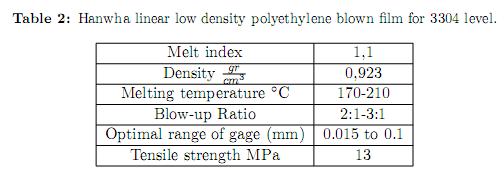
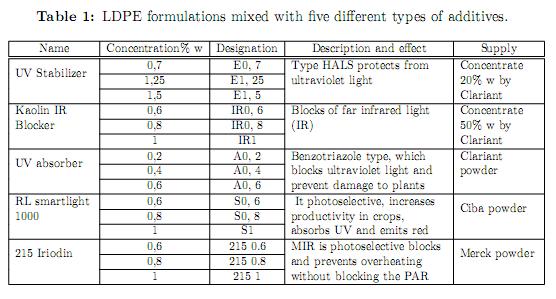
<body><![CDATA[<p>&nbsp;</p>     <p><font face="Verdana, Arial, Helvetica, sans-serif" size="3"><b>2 Experimental  development</b></font></p>     <p><font face="Verdana, Arial, Helvetica, sans-serif" size="2">The  purpose of this stage is to analyze the effect of additives in each film.   This pilot phase will  be implemented in two levels:</font></p>     <p><font face="Verdana, Arial, Helvetica, sans-serif" size="2">       <blockquote>1. Development of the  additive concentrate and mixing process</blockquote> </font></p>     <p><font face="Verdana, Arial, Helvetica, sans-serif" size="2">       <blockquote>2. Blown film made</blockquote> </font></p>     <p>&nbsp;</p>     <p><font face="Verdana, Arial, Helvetica, sans-serif" size="3"><b>2.1 Mixing Processor</b></font></p>     <p><font face="Verdana, Arial, Helvetica, sans-serif" size="2">For the development  of this stage were processed 15 formulations of LDPE   blended with five  types of additives: for each three concentrations used (<a href="#t2">Table   2</a>). To mix the additive in the polymer was made a premixed with an internal   mixer rotor  tangential plastic-corder equipped Brabender PLE331, creating   a  concentrate and achieving a good distribution and dispersion in the final   product,  then were ground and formed into pellets in the pelletizing section   of  the same team. To select the additives was carried out an optimization   process  using different  formulations in accordance with the following parameters:  absorption, stabilization, thermal, photoselection . <a href="#t1">Table 1 </a>shows  the   additives  and concentrations with which the films were produced as well as   mixtures thereof  according to the desired characteristics.</font></p>     ]]></body>
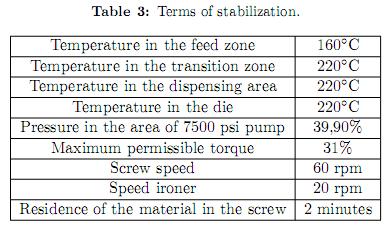
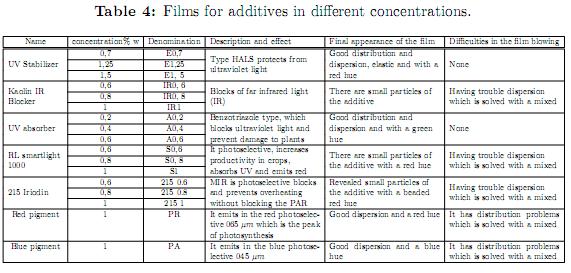
<body><![CDATA[<p align="center"><a name="t1"><img src="/img/revistas/ince/v7n14/a03t1.jpg" /></a></p>     <p>&nbsp;</p>     <p><font face="Verdana, Arial, Helvetica, sans-serif" size="3"><b>2.2 Blown Film</b></font></p>     <p><font face="Verdana, Arial, Helvetica, sans-serif" size="2">The first step in the  blown film process is the study of the basic principles governing this type  of process: the characteristics of the material to be blown, the temperature of different areas of the screw, screw speed, cooling film (flow and height), the  bubble pressure, speed of calendaring and thickness of the die. The  selection criteria were the processability of polymer materials, low cost and  better mechanical properties. For these reasons the films were processed with  linear low density polyethylene whose characteristics are shown in <a href="#t2">Table 2.</a></font></p>     <p align="center"><a name="t2"><img src="/img/revistas/ince/v7n14/a03t2.jpg" /></a></p>     <p><font face="Verdana, Arial, Helvetica, sans-serif" size="2">In order to achieve  additive compared with each other, the variables are kept constant in all films,  and for this we use the computer Brabender PlasticCorder PLE 331 with a screw 047 L / D 25:1 25 <img src="/img/revistas/ince/v7n14/a03g1.jpg" /> fillets inch single stage compression  ratio of 4-1. <a href="#t3">Table 3 </a>shows the condition of equipment in which they managed to  stabilize the film.</font></p>     <p align="center"><a name="t3"><img src="/img/revistas/ince/v7n14/a03t3.jpg" /></a></p>     <p><font face="Verdana, Arial, Helvetica, sans-serif" size="2">It blew two types of films:  the first with a single additive but varying the quantity and the  second with a mixture of several additives. The results are explained below:</font></p>     <p><font face="Verdana, Arial, Helvetica, sans-serif" size="2"><b>2.2.1 First type of film</b> Dificulties arose in the  process of obtaining the films  due to moisture in the additive that creates a break in the film because the craters formed by  water vapor which prevents the formation of the plastic bubble.  In addition, problems in the mixture for the dispersion of the additive which  produced clumps or clusters that do not break in the polyethylene, the distribution of the  additive also did not occupy it everywhere in the film, the characteristics  obtained in the movies seen in <a href="#t4">Table 4.</a></font></p>     <p align="center"><a name="t4"><img src="/img/revistas/ince/v7n14/a03t4.jpg" /></a></p>     ]]></body>
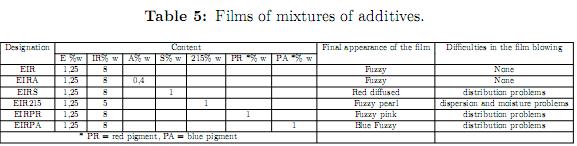
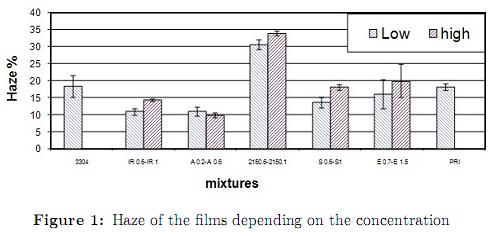
<body><![CDATA[<p><font face="Verdana, Arial, Helvetica, sans-serif" size="2"><a><b>2.2.2 Second type of film</b></a> The second type of film was developed with  a mixture of various  additives added in a single concentration, the characteristics  of the films obtained are shown in <a href="#t5">Table 5. </a>By adding each additive  the transmission  of light decreases, in this sense, the mixture was made more dificult  EIR215 as the light transmission decreased significantly and the mixture of  additives (stabilizer, kaolin and Iriodin) prevented stabilization blowing process, because it  was necessary to reduce the concentration of kaolin from 8%  to 5% and get this film. By contrast the mixture EIRA had the best processing, was  composed of stabilizer, kaolin and UV absorber.</font></p>     <p align="center"><a name="t5"><img src="/img/revistas/ince/v7n14/a03t5.jpg" /></a></p>     <p>&nbsp;</p>     <p><font face="Verdana, Arial, Helvetica, sans-serif" size="3"><b>2.3 Evaluation of optical  properties</b></font></p>     <p><font face="Verdana, Arial, Helvetica, sans-serif" size="2">To evaluate the  optical properties are worked according to ASTM D 1003  19.., the team Cary 50 Conc UV-Visible Spectrophotometese, the range of   200nm  to 1000nm measuring equipment in the ultra violet and visible.For   this  evaluation, cut rectangular pieces of film 1 cm by 4 cm and placed in   the  cavity of the team entry shows the percentage of light transmission in   the previous  range.Haze measurement was performed according to ASTM D   1003, using the  computer model Hazemeter Gardner HG1204 with rotating   dial,  digital photoelectric unit PG5500 and Gardner digital photometric unit,   between  the sphere and the light emitting chips are placed square film (2in x   2in) and the computer  measures the percentage of diffuse light.</font></p>     <p>&nbsp;</p>     <p><font face="Verdana, Arial, Helvetica, sans-serif" size="3"><b>3 Results</b></font></p>     <p><font face="Verdana, Arial, Helvetica, sans-serif" size="3"><b>3.1 Haze measurements</b></font></p>     <p><font face="Verdana, Arial, Helvetica, sans-serif" size="2">The haze results for  the first type of film are shown in <a href="#f1">Figure 1 </a>where it is clear that the  additive that affects the diffused light is the Iriodin. Moreover the other additives  do not haze increase with respect the film without any additives.</font></p>     <p align="center"><a name="f1"><img src="/img/revistas/ince/v7n14/a03f1.jpg" /></a></p>     ]]></body>
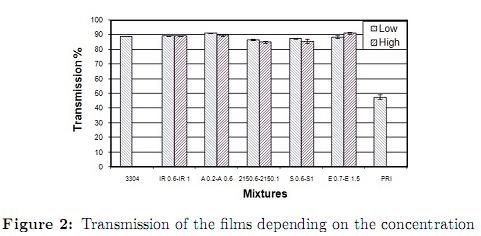
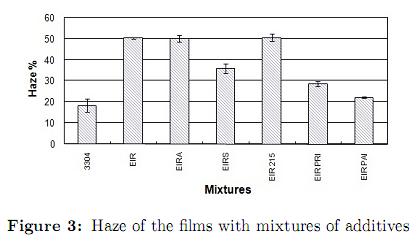
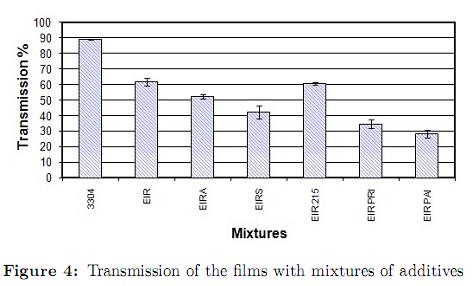
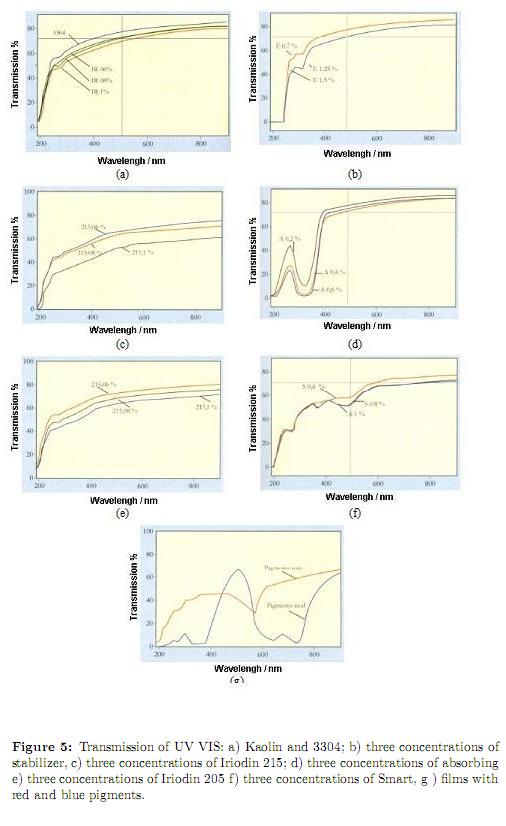
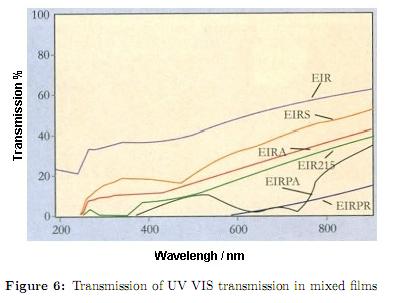
<body><![CDATA[<p><font face="Verdana, Arial, Helvetica, sans-serif" size="2">The light diffuse transmission results for the first type of films are shown in  <a href="#f2">Figure 2, </a>it shows little variation by changing the concentration and  the only  additive that reduces transmission of light is the red pigment significantly reducing by half.</font></p>     <p align="center"><a name="f2"><img src="/img/revistas/ince/v7n14/a03f2.jpg" /></a></p>     <p><font face="Verdana, Arial, Helvetica, sans-serif" size="2">The haze results of  the second type of films are shown in <a href="#f3">Figure 3</a>. Here you  can see that the film are mixed diffusive about the lm without additive. And the films most affected are those with EIR, such as EIRs, EIRPR, EIRP. The  diffusive  effect  is formed by the IR kaolin due to high concentrations (8%).  The results of light transmission of the second type of films are shown in  <a href="#f4">Figure 4. </a>In this we see that additive films is not 3304, have a high  light transmission  with respect additive films, because when compared to the EIR, the  same transmission Iriodin is probably because of the concentration of kaolin  (5%).The UV absorber decreased slightly transmission and the Smart decreased  much more, but the bad behaved had the red and the blue pigments, the worse being blue.</font></p>     <p align="center"><a name="f3"><img src="/img/revistas/ince/v7n14/a03f3.jpg" /></a></p>     <p align="center"><a name="f4"><img src="/img/revistas/ince/v7n14/a03f4.jpg" /></a></p>     <p>&nbsp;</p>     <p><font face="Verdana, Arial, Helvetica, sans-serif" size="3"><b>3.2 Transmission  Ultraviolet Visible (UV-VIS)</b></font></p>     <p><font face="Verdana, Arial, Helvetica, sans-serif" size="2"><b>3.2.1 First type of film</b> The results of transmission in the  ultraviolet to the visible range  200-900 nm for the first type of film are shown by the additive  in the following order: 3304 with kaolin (IR), stabilizer (E), absorption (A),  Smart (S ) Iriodin 215, pigment red, pigment blue movies. The results of  the transmission of polyethylene without additives (3304) and three concentrations of kaolin  to block the IR are shown in <a href="#f5">Figure 5</a>a, there is observed that  with increasing transmission additive concentration decreases.The movie stabilizer and three  concentrations are shown in <a href="#f5">Figure 5</a>b, <a href="#11"></a>this shows that the transmission is  in the area of 300 nm, then decreases to 250 nm, below this range there is no  transmission, as well as concentrations 1.25% and 1.5% did not  show variations, with absorber and three concentrations is shown <a href="#f5">Figure 5</a>c, this  is seen in the area near 400 nm, there is a drop in the absorption of 300nm to 350 nm, then  let between 300nm and 250nm, the effect of ultraviolet  light absorption does not change significantly in concentrations of 0.4% to 0.6%  obtained similar results with these concentrations. The transfer of the film  with Smart and three concentrations are shown in <a href="#f5">Figure 5</a>d, the  which shows a reduction in  transmission at 600 nm and another at 250 nm, shows that  the concentrations of 0.8% and 1% are very similar in the transmission of  light. <a href="#f5">Figure 5</a>e shows the movie with three concentrations  Iriodin 215 and in  this we see that the light transmission has a slight decrease by increasing the concentration of  0.6% to 0.8% of Iriodin, however, with increasing concentration 1% light  transmission decreases broadly. <a href="#f5">Figure 5</a>f shows that the compound  Iriodin 205, allows more light passed at the same concentrations, however, its main  application is as a shadow in architectural structures and greenhouses.The  film with red and blue pigment are shown in <a href="#f5">Figure 5</a>g <a href="#11"></a>red absorbs  below 600 nm and emits in the 450nm blue and the other lengths generate low  transmittance. By comparing the UV-VIS transmission of mixtures will be  appreciated the stabilizer at a rate of 0.7 and 0.2% absorbed, than  the transmission of polyethylene without additives, other additives reduce UV transmission  of SIV in different proportions.</font></p>     <p align="center"><a name="f5"><img src="/img/revistas/ince/v7n14/a03f5.jpg" /></a></p>     <p><font face="Verdana, Arial, Helvetica, sans-serif" size="2"><b>3.2.2 Second type of film</b> The results of the UV-VIS transmission  in mixed films are shown  in <a href="#f6">Figure 6</a> where it is seen that the addition of additives reduces  transmission of light.The results are discussed in descending order in transmission:  the movie EIR, there is a reduction of transmission that comes from  the high percentage of kaolin (8%), by adding other additives decreases the transmission.  With a lower transmission is the EIRS, this film has the best  performance against the transmission of light having three additives. Subsequently  the film is EIR215 despite having a lower percentage of kaolin than  the others, the results in light transmission are not representative, so if  the content of kaolin increases light transmission decrease. Running EIRA mix,  this is the movie that contains a smaller amount of absorption, however does not favor the  synergistic action.Then there are two pigments whose light transmission is more  complicated than the others: the EIRPA and EIRPR. The mixture EIRPA,  and the transmission of wavelengths is equal to the EIRPR, EIRPA however  allows some transmission of other wavelengths. The red  EIRPR has stabilizer 1.25% 8% kaolin and red pigment is less than 1% transmission, however  the wavelengths it emits 0.650 nm are used for plant growth. In general  the transmission in the red for all films is approximately: EIR 50%, 40% EIRs,  EIR215 30% EIRA25%, 10% EIRPR and EIRP.</font></p>     ]]></body>
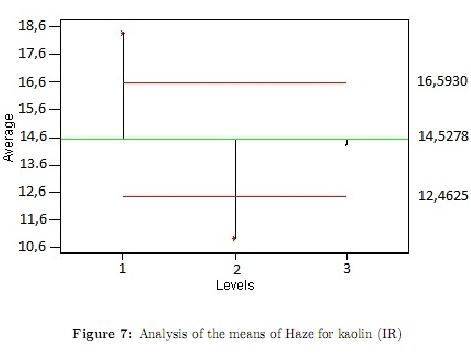
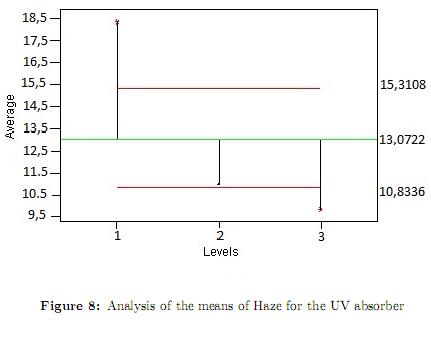
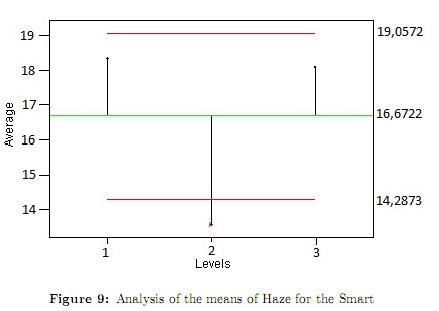
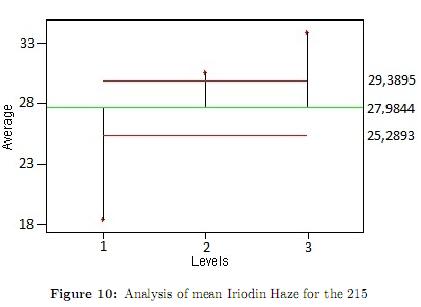
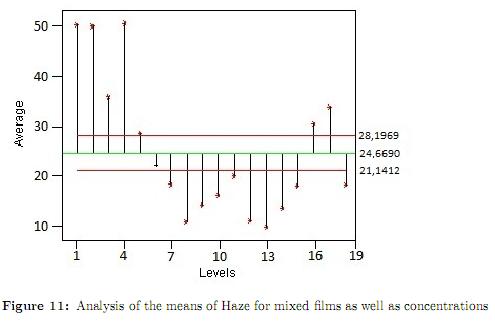
<body><![CDATA[<p align="center"><a name="f6"><img src="/img/revistas/ince/v7n14/a03f6.jpg" /></a></p>     <p>&nbsp;</p>     <p><font face="Verdana, Arial, Helvetica, sans-serif" size="3"><b>4 Analysis of results:</b></font></p>     <p><font face="Verdana, Arial, Helvetica, sans-serif" size="3"><b>4.1 Analysis of Haze</b></font></p>     <p><font face="Verdana, Arial, Helvetica, sans-serif" size="2">The results of  analysis of variance in Haze for the first type of film is as follows: the additive E (UV  stabilizer) did not modify the Haze compared with the polymer without the  additive.IR additives, A, S (Kaolin, UV absorber and SMAST) decreased  Haze, as shown in figures <a href="#f7">7, </a><a href="#f8">8 </a>and <a href="#f9">9 </a>respectively.  The additive  215 (Iriodin 215) Haze increased as shown in <a href="#f10">Figure 10. </a>The  results of analysis of  variance (ANOVA) on Haze for the second type of film are shown  in <a href="#f11">Figure 11, </a>this one the first films on the left are diffusive, this effect is  caused by the content of kaolin in its components. The EIRs (3 in <a href="#f11">Figure 11</a>) </a>has the least the first 4 Haze EIR, and EIR215 EIRA. The effect on the EIR215  Haze (4 in <a href="#f11">Figure 11</a>) </a>is equal to the EIR (1 in <a href="#f11">Figure 11</a>>), </a>taking into  account that the three separate components of the former are more Haze that  the separate components of the second (see Iriodin 215 with numbers 16 and 17 of the figure).</font></p>     <p><font face="Verdana, Arial, Helvetica, sans-serif" size="2"></font></p>     <p align="center"><a name="f7"><img src="/img/revistas/ince/v7n14/a03f7.jpg" /></a></p>     <p align="center"><a name="f8"><img src="/img/revistas/ince/v7n14/a03f8.jpg" /></a></p>     <p align="center"><a name="f9"><img src="/img/revistas/ince/v7n14/a03f9.jpg" /></a></p>     <p align="center"><a name="f10"><img src="/img/revistas/ince/v7n14/a03f10.jpg" /></a></p>     ]]></body>
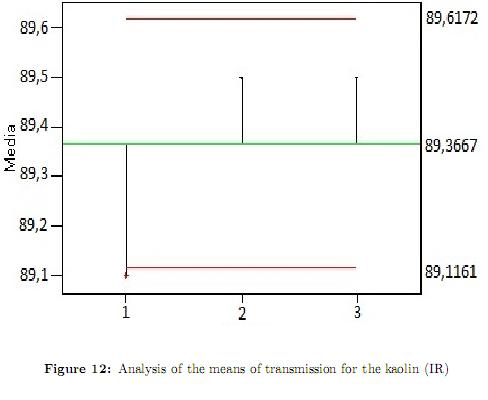
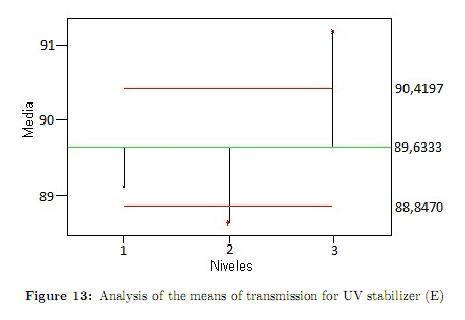
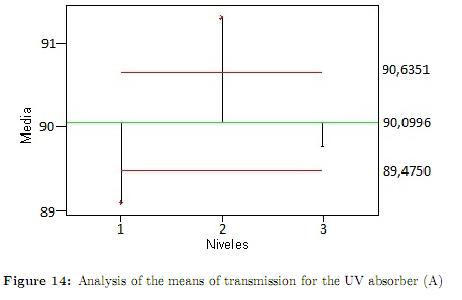
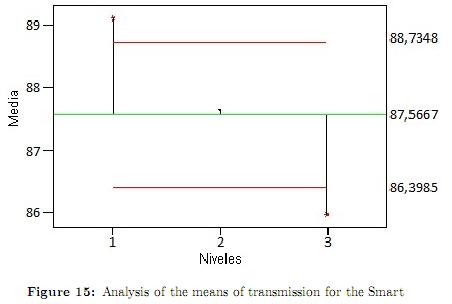
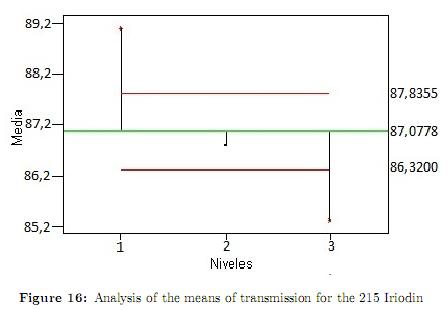
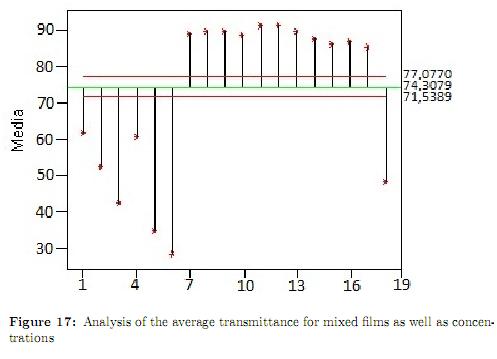
<body><![CDATA[<p align="center"><a name="f11"><img src="/img/revistas/ince/v7n14/a03f11.jpg" /></a></p>     <p>&nbsp;</p>     <p><font face="Verdana, Arial, Helvetica, sans-serif" size="3"><b>4.2 Analysis of  Transmission</b></font></p>     <p><font face="Verdana, Arial, Helvetica, sans-serif" size="2">ANOVA analysis for  the transmission of light is shown in Figures <a href="#f12">12</a>-<a href="#f17">17</a>. </a>For   the first  type of films are shown in <a href="#f15">Figure 15</a> that the kaolin, in concentrations   of  0.6 and 0.8%, up a bit light transmission, this is because the small crystals   allow  yet more disorder in the film, the same applies to the UV stabilizer and   UV absorber, the figures <a href="#f13">13 </a>and <a href="#f14">14 </a>show this effect. Figures <a href="#f15">15 </a>and <a href="#f16">16 </a>show   how  smart and reduce the transmission Iriodin 215. <a href="#f17">Figure 17 </a>shows  the light   transmission  for films whose numbers correspond mixed 1 to 6, they see that   the  light transmission is lower than in the movies that have only one additive   (8  to 18).It is noteworthy that in the first six movies, has Iriodin (EIR215)   of  the number 4, does not increase the transmission with respect to a (EIR),   kaolin is at a  concentration of 5% while EIR215 the EIR is 8%.</font></p>     <p align="center"><a name="f12"><img src="/img/revistas/ince/v7n14/a03f12.jpg" /></a></p>     <p align="center"><a name="f13"><img src="/img/revistas/ince/v7n14/a03f13.jpg" /></a></p>     <p align="center"><a name="f14"><img src="/img/revistas/ince/v7n14/a03f14.jpg" /></a></p>     <p align="center"><a name="f15"><img src="/img/revistas/ince/v7n14/a03f15.jpg" /></a></p>     <p align="center"><a name="f16"><img src="/img/revistas/ince/v7n14/a03f16.jpg" /></a></p>     <p align="center"><a name="f17"><img src="/img/revistas/ince/v7n14/a03f17.jpg" /></a></p>     ]]></body>
<body><![CDATA[<p>&nbsp;</p>     <p><font face="Verdana, Arial, Helvetica, sans-serif" size="3"><b>4.3 Analysis of  Transmission UV VIS</b></font></p>     <p><font face="Verdana, Arial, Helvetica, sans-serif" size="2">The  transmission of the first type of film in the range of UV to Visible (200900  nm) did not significantly decrease the transmission of light in the PAR   region (400-700 nm).  Iriodin additives 205 and 215 are the least likely to   transmit  light PAR as shown in Figures 5.23 and 5.24 of Chapter III. UV   stabilizer additives  and UV absorber block light in the UV area of 200-400 nm.   Transmits  only the red pigment in the range of 650-700 nm where the plants   just  use the full activation of photosynthesis. By mixing additives decreases   the  transmission and the synergy of elements behavior makes them differently,   because some decrease  further transmission to others. It is important to see   that  the red pigment additives and blue are the lowest PAR light transmission   are, however, the red  pigment crop growth than in the blue, this is because   the plant uses for  photosynthesis length red wave.</font></p>     <p><font face="Verdana, Arial, Helvetica, sans-serif" size="2"></font></p>     <p>&nbsp;</p>     <p><font face="Verdana, Arial, Helvetica, sans-serif" size="3"><b>5 Conclusions</b></font></p>     <p><font face="Verdana, Arial, Helvetica, sans-serif" size="2">Processing techniques  were developed for pilot production of film with different formulations and  protocols for eficient mixing. Within  the set of formulations developed  for the process of obtaining LDPE films with different mixtures of additives  suitable for performance in tropical environments. We obtained  a wide range of innovative alternatives for many essential applications  in agriculture: plastic cold and retention of near-and half IR. Mixed films  were diffusive  compared to film without additive. Also, the more diffusive  films were those containing EIR, because to diffusive effect  is composed by  the IR kaolin because to high concentrations. The light transmission on mixes films without  3304 additivehad a high transmission light with respect to films  with this additive. Besides the UV absorber decreased in a minimum proportion, the  transmission and Smart it decreased in a higher proportion as  red and blue pigments. The UV VIS transmission results in mixed films it showed to adding  additives the light transmission decreasing.</font></p>     <p>&nbsp;</p>     <p><font face="Verdana, Arial, Helvetica, sans-serif" size="3"><b>References</b></font></p>     <!-- ref --><p><font face="Verdana, Arial, Helvetica, sans-serif" size="2">1.  Association of Plastic Manufacturers in Europe. <i>An analysis of plastic consumption and recovery in Western Europe Spring</i>,(2002). Referenciado en 51 </font>&nbsp;&nbsp;&nbsp;&nbsp;&nbsp;&nbsp;&nbsp;&nbsp;[&#160;<a href="javascript:void(0);" onclick="javascript: window.open('/scielo.php?script=sci_nlinks&ref=000102&pid=S1794-9165201100020000300001&lng=','','width=640,height=500,resizable=yes,scrollbars=1,menubar=yes,');">Links</a>&#160;]<!-- end-ref --><!-- ref --><p><font face="Verdana, Arial, Helvetica, sans-serif" size="2">2.  Hiskakis M, Briassoulis D. <i>Design of agricultural plastic waste chain for  Greece   from generation to disposal; a pilot test for energy recovery</i> , Proceedings of   the  International Conference of Agricultural Engineers, AgEng, World Congress   2006,  Bonn, Germany, September 3e7,2006.Conf page 4401/1958, Archive no   440119580813.Referenciado  en 51 </font>&nbsp;&nbsp;&nbsp;&nbsp;&nbsp;&nbsp;&nbsp;&nbsp;[&#160;<a href="javascript:void(0);" onclick="javascript: window.open('/scielo.php?script=sci_nlinks&ref=000103&pid=S1794-9165201100020000300002&lng=','','width=640,height=500,resizable=yes,scrollbars=1,menubar=yes,');">Links</a>&#160;]<!-- end-ref --><!-- ref --><p><font face="Verdana, Arial, Helvetica, sans-serif" size="2">3.  Council Directive 1999/31/EC of 26 April 1999 on the landfill of waste. <i>Oficial   Journal  L</i>,16/07/1999;182:0001e19.Referenciado en 51 </font>&nbsp;&nbsp;&nbsp;&nbsp;&nbsp;&nbsp;&nbsp;&nbsp;[&#160;<a href="javascript:void(0);" onclick="javascript: window.open('/scielo.php?script=sci_nlinks&ref=000104&pid=S1794-9165201100020000300003&lng=','','width=640,height=500,resizable=yes,scrollbars=1,menubar=yes,');">Links</a>&#160;]<!-- end-ref --><!-- ref --><p><font face="Verdana, Arial, Helvetica, sans-serif" size="2">4.  Directive 2000/76/EC of the European Parliament and of the Council of 4 December  2000 on the incineration of waste. <i>Oficial Journal L</i> ,28.12.2000;332:91.Referenciado  en 51 </font>&nbsp;&nbsp;&nbsp;&nbsp;&nbsp;&nbsp;&nbsp;&nbsp;[&#160;<a href="javascript:void(0);" onclick="javascript: window.open('/scielo.php?script=sci_nlinks&ref=000105&pid=S1794-9165201100020000300004&lng=','','width=640,height=500,resizable=yes,scrollbars=1,menubar=yes,');">Links</a>&#160;]<!-- end-ref --><!-- ref --><p><font face="Verdana, Arial, Helvetica, sans-serif" size="2">5. CIPA. <i>International  Committee of Plastics in Agriculture</i> ,65,  rue de Prony e   75854  Paris Ce'dex 17.Referenciado en 51 </font>&nbsp;&nbsp;&nbsp;&nbsp;&nbsp;&nbsp;&nbsp;&nbsp;[&#160;<a href="javascript:void(0);" onclick="javascript: window.open('/scielo.php?script=sci_nlinks&ref=000106&pid=S1794-9165201100020000300005&lng=','','width=640,height=500,resizable=yes,scrollbars=1,menubar=yes,');">Links</a>&#160;]<!-- end-ref --><!-- ref --><p><font face="Verdana, Arial, Helvetica, sans-serif" size="2">6.  Jouet JP. <i>Los pl&aacute;sticos en el mundo (plastics in the world</i>),In: XV Congreso   Internacional  de Pl&aacute;sticos en Agricultura (15th International Congress for Plastics   in  Agriculture). Plasticulture no 120. CIPA; 2001. p. 46e57.Referenciado en 51</font>&nbsp;&nbsp;&nbsp;&nbsp;&nbsp;&nbsp;&nbsp;&nbsp;[&#160;<a href="javascript:void(0);" onclick="javascript: window.open('/scielo.php?script=sci_nlinks&ref=000107&pid=S1794-9165201100020000300006&lng=','','width=640,height=500,resizable=yes,scrollbars=1,menubar=yes,');">Links</a>&#160;]<!-- end-ref --><!-- ref --><p><font face="Verdana, Arial, Helvetica, sans-serif" size="2">7. Briassoulis D. <i>An overview on the mechanical behaviour of biodegradable agricultural films</i>, Journal of Polymers and the Environment   2004,12(2):65e81.Referenciado  en 51</font>&nbsp;&nbsp;&nbsp;&nbsp;&nbsp;&nbsp;&nbsp;&nbsp;[&#160;<a href="javascript:void(0);" onclick="javascript: window.open('/scielo.php?script=sci_nlinks&ref=000108&pid=S1794-9165201100020000300007&lng=','','width=640,height=500,resizable=yes,scrollbars=1,menubar=yes,');">Links</a>&#160;]<!-- end-ref --><!-- ref --><p><font face="Verdana, Arial, Helvetica, sans-serif" size="2">8.  Sundt P, Martinez T. <i>Recycling schemes for agriculture (bilde EO)</i>,Presentation   during  the 'EPRO-meeting' in Paris 2001; 22e23.11.01.Referenciado en 51</font>&nbsp;&nbsp;&nbsp;&nbsp;&nbsp;&nbsp;&nbsp;&nbsp;[&#160;<a href="javascript:void(0);" onclick="javascript: window.open('/scielo.php?script=sci_nlinks&ref=000109&pid=S1794-9165201100020000300008&lng=','','width=640,height=500,resizable=yes,scrollbars=1,menubar=yes,');">Links</a>&#160;]<!-- end-ref --><!-- ref --><p><font face="Verdana, Arial, Helvetica, sans-serif" size="2">9.  Dilara PA, Briassoulis D. <i>Degradation and  stabilization of low density polyethylene (LDPE) films  used as greenhouse covering materials</i>, Journal of  Agricultural   Engineering  Research 2000;76:309e21. Referenciado en 51</font>&nbsp;&nbsp;&nbsp;&nbsp;&nbsp;&nbsp;&nbsp;&nbsp;[&#160;<a href="javascript:void(0);" onclick="javascript: window.open('/scielo.php?script=sci_nlinks&ref=000110&pid=S1794-9165201100020000300009&lng=','','width=640,height=500,resizable=yes,scrollbars=1,menubar=yes,');">Links</a>&#160;]<!-- end-ref --><!-- ref --><p><font face="Verdana, Arial, Helvetica, sans-serif" size="2">10.  Briassoulis D. <i>Mechanical design  requirements for low tunnel biodegradable and   conventional films</i>, Biosystems  Engineering 2004;87(2): 209e23. Referenciado en   51</font>&nbsp;&nbsp;&nbsp;&nbsp;&nbsp;&nbsp;&nbsp;&nbsp;[&#160;<a href="javascript:void(0);" onclick="javascript: window.open('/scielo.php?script=sci_nlinks&ref=000111&pid=S1794-9165201100020000300010&lng=','','width=640,height=500,resizable=yes,scrollbars=1,menubar=yes,');">Links</a>&#160;]<!-- end-ref --><!-- ref --><p><font face="Verdana, Arial, Helvetica, sans-serif" size="2">11. Scarascia-Mugnozza G, Schettini E, Vox G. <i>Effects of solar  radiation on the   radiometric  properties of biodegradable films for agricultural applications</i>, Biosystems Engineering 2004;87(4):479e87.  Referenciado en 51</font>&nbsp;&nbsp;&nbsp;&nbsp;&nbsp;&nbsp;&nbsp;&nbsp;[&#160;<a href="javascript:void(0);" onclick="javascript: window.open('/scielo.php?script=sci_nlinks&ref=000112&pid=S1794-9165201100020000300011&lng=','','width=640,height=500,resizable=yes,scrollbars=1,menubar=yes,');">Links</a>&#160;]<!-- end-ref --><!-- ref --><p><font face="Verdana, Arial, Helvetica, sans-serif" size="2">12. Briassoulis D. <i>Mechanical  behaviour of biodegradable agricultural films under   real field  conditions</i>, Polymer Degradation  and Stability 2006;91:1256e72. Referenciado  en 51</font>&nbsp;&nbsp;&nbsp;&nbsp;&nbsp;&nbsp;&nbsp;&nbsp;[&#160;<a href="javascript:void(0);" onclick="javascript: window.open('/scielo.php?script=sci_nlinks&ref=000113&pid=S1794-9165201100020000300012&lng=','','width=640,height=500,resizable=yes,scrollbars=1,menubar=yes,');">Links</a>&#160;]<!-- end-ref --><!-- ref --><p><font face="Verdana, Arial, Helvetica, sans-serif" size="2">13.  Briassoulis D. <i>Mechanical  performance and design criteria of biodegradable lowtunnel films</i>, Journal of Polymers and the  Environment 2006;14(3):289e307. Referenciado  en 51</font>&nbsp;&nbsp;&nbsp;&nbsp;&nbsp;&nbsp;&nbsp;&nbsp;[&#160;<a href="javascript:void(0);" onclick="javascript: window.open('/scielo.php?script=sci_nlinks&ref=000114&pid=S1794-9165201100020000300013&lng=','','width=640,height=500,resizable=yes,scrollbars=1,menubar=yes,');">Links</a>&#160;]<!-- end-ref --><!-- ref --><p><font face="Verdana, Arial, Helvetica, sans-serif" size="2">14.  Scarascia-Mugnozza G, Schettini E, Vox G, Malinconico M, Immirzi B, Pagliara   S. <i>Mechanical  properties decay and morphological behaviour of biodegradable films   for agricultural  mulching in real scale experiment</i>, Polymer  Degradation and Stability 2006;91:2801e8.  Referenciado en 51</font>&nbsp;&nbsp;&nbsp;&nbsp;&nbsp;&nbsp;&nbsp;&nbsp;[&#160;<a href="javascript:void(0);" onclick="javascript: window.open('/scielo.php?script=sci_nlinks&ref=000115&pid=S1794-9165201100020000300014&lng=','','width=640,height=500,resizable=yes,scrollbars=1,menubar=yes,');">Links</a>&#160;]<!-- end-ref --><!-- ref --><p><font face="Verdana, Arial, Helvetica, sans-serif" size="2">15.  Kapanen A. <i>VTT biotechnology, Finland ,Personal communication</i>; 2005. Referenciado  en 51</font>&nbsp;&nbsp;&nbsp;&nbsp;&nbsp;&nbsp;&nbsp;&nbsp;[&#160;<a href="javascript:void(0);" onclick="javascript: window.open('/scielo.php?script=sci_nlinks&ref=000116&pid=S1794-9165201100020000300015&lng=','','width=640,height=500,resizable=yes,scrollbars=1,menubar=yes,');">Links</a>&#160;]<!-- end-ref --><!-- ref --><p><font face="Verdana, Arial, Helvetica, sans-serif" size="2">16.  Briassoulis D. <i>An overview on the  mechanical behaviour of biodegradable agricultural films</i>, Journal of Polymers and the  Environment 2004;12(2):65e81. Referenciado  en 51</font>&nbsp;&nbsp;&nbsp;&nbsp;&nbsp;&nbsp;&nbsp;&nbsp;[&#160;<a href="javascript:void(0);" onclick="javascript: window.open('/scielo.php?script=sci_nlinks&ref=000117&pid=S1794-9165201100020000300016&lng=','','width=640,height=500,resizable=yes,scrollbars=1,menubar=yes,');">Links</a>&#160;]<!-- end-ref --><!-- ref --><p><font face="Verdana, Arial, Helvetica, sans-serif" size="2">17.  Karlsson S, Albertsson AC. <i>Biodegradable  polymers and environmental interaction.</i> Polymer Engineering  and Science 1998;38:1251e3. Referenciado en 51</font>&nbsp;&nbsp;&nbsp;&nbsp;&nbsp;&nbsp;&nbsp;&nbsp;[&#160;<a href="javascript:void(0);" onclick="javascript: window.open('/scielo.php?script=sci_nlinks&ref=000118&pid=S1794-9165201100020000300017&lng=','','width=640,height=500,resizable=yes,scrollbars=1,menubar=yes,');">Links</a>&#160;]<!-- end-ref --><!-- ref --><p><font face="Verdana, Arial, Helvetica, sans-serif" size="2">18.  Briassoulis D. <i>Mechanical design  requirements for low tunnel biodegradable and   conventional films</i>, Biosystems  Engineering 2004;87(2): 209e23. Referenciado en   52, 56</font>&nbsp;&nbsp;&nbsp;&nbsp;&nbsp;&nbsp;&nbsp;&nbsp;[&#160;<a href="javascript:void(0);" onclick="javascript: window.open('/scielo.php?script=sci_nlinks&ref=000119&pid=S1794-9165201100020000300018&lng=','','width=640,height=500,resizable=yes,scrollbars=1,menubar=yes,');">Links</a>&#160;]<!-- end-ref --><!-- ref --><p><font face="Verdana, Arial, Helvetica, sans-serif" size="2">19.  ASTM D1003 07e1 Standard Test Method for Haze and Luminous Transmittance  of Transparent Plastics. <i>West Conshohocken</i>, PA, American Society for   Testing  and Materials, 2009. Referenciado en 52, 56</font>&nbsp;&nbsp;&nbsp;&nbsp;&nbsp;&nbsp;&nbsp;&nbsp;[&#160;<a href="javascript:void(0);" onclick="javascript: window.open('/scielo.php?script=sci_nlinks&ref=000120&pid=S1794-9165201100020000300019&lng=','','width=640,height=500,resizable=yes,scrollbars=1,menubar=yes,');">Links</a>&#160;]<!-- end-ref --> ]]></body><back>
<ref-list>
<ref id="B1">
<label>1</label><nlm-citation citation-type="">
<collab>Association of Plastic Manufacturers in Europe</collab>
<source><![CDATA[An analysis of plastic consumption and recovery in Western Europe Spring]]></source>
<year>2002</year>
</nlm-citation>
</ref>
<ref id="B2">
<label>2</label><nlm-citation citation-type="confpro">
<person-group person-group-type="author">
<name>
<surname><![CDATA[Hiskakis]]></surname>
<given-names><![CDATA[M]]></given-names>
</name>
<name>
<surname><![CDATA[Briassoulis]]></surname>
<given-names><![CDATA[D]]></given-names>
</name>
</person-group>
<source><![CDATA[Design of agricultural plastic waste chain for Greece from generation to disposal; a pilot test for energy recovery]]></source>
<year></year>
<conf-name><![CDATA[ International Conference of Agricultural Engineers]]></conf-name>
<conf-date>2006</conf-date>
<conf-loc>Bonn </conf-loc>
</nlm-citation>
</ref>
<ref id="B3">
<label>3</label><nlm-citation citation-type="journal">
<article-title xml:lang="en"><![CDATA[Council Directive 1999/31/EC of 26 April 1999 on the landfill of waste]]></article-title>
<source><![CDATA[Oficial Journal]]></source>
<year>1999</year>
</nlm-citation>
</ref>
<ref id="B4">
<label>4</label><nlm-citation citation-type="journal">
<article-title xml:lang="en"><![CDATA[Directive 2000/76/EC of the European Parliament and of the Council of 4 December 2000 on the incineration of waste]]></article-title>
<source><![CDATA[Oficial Journal L]]></source>
<year>2000</year>
</nlm-citation>
</ref>
<ref id="B5">
<label>5</label><nlm-citation citation-type="">
<collab>CIPA</collab>
<source><![CDATA[International Committee of Plastics in Agriculture]]></source>
<year></year>
</nlm-citation>
</ref>
<ref id="B6">
<label>6</label><nlm-citation citation-type="confpro">
<person-group person-group-type="author">
<name>
<surname><![CDATA[Jouet]]></surname>
<given-names><![CDATA[JP]]></given-names>
</name>
</person-group>
<source><![CDATA[Los plásticos en el mundo (plastics in the world)]]></source>
<year>2001</year>
<conf-name><![CDATA[XV Congreso Internacional de Plásticos en Agricultura]]></conf-name>
<conf-loc> </conf-loc>
<page-range>46e57</page-range><publisher-name><![CDATA[CIPA]]></publisher-name>
</nlm-citation>
</ref>
<ref id="B7">
<label>7</label><nlm-citation citation-type="journal">
<person-group person-group-type="author">
<name>
<surname><![CDATA[Briassoulis]]></surname>
<given-names><![CDATA[D]]></given-names>
</name>
</person-group>
<article-title xml:lang="en"><![CDATA[An overview on the mechanical behaviour of biodegradable agricultural films]]></article-title>
<source><![CDATA[Journal of Polymers and the Environment]]></source>
<year>2004</year>
<volume>12</volume>
<numero>2</numero>
<issue>2</issue>
<page-range>65e81</page-range></nlm-citation>
</ref>
<ref id="B8">
<label>8</label><nlm-citation citation-type="">
<person-group person-group-type="author">
<name>
<surname><![CDATA[Sundt]]></surname>
<given-names><![CDATA[P]]></given-names>
</name>
<name>
<surname><![CDATA[Martinez]]></surname>
<given-names><![CDATA[T]]></given-names>
</name>
</person-group>
<source><![CDATA[Recycling schemes for agriculture (bilde EO)]]></source>
<year>2001</year>
</nlm-citation>
</ref>
<ref id="B9">
<label>9</label><nlm-citation citation-type="journal">
<person-group person-group-type="author">
<name>
<surname><![CDATA[Dilara]]></surname>
<given-names><![CDATA[PA]]></given-names>
</name>
<name>
<surname><![CDATA[Briassoulis]]></surname>
<given-names><![CDATA[D]]></given-names>
</name>
</person-group>
<article-title xml:lang="en"><![CDATA[Degradation and stabilization of low density polyethylene (LDPE) films used as greenhouse covering materials]]></article-title>
<source><![CDATA[Journal of Agricultural Engineering Research]]></source>
<year>2000</year>
<numero>76</numero>
<issue>76</issue>
<page-range>309e21</page-range></nlm-citation>
</ref>
<ref id="B10">
<label>10</label><nlm-citation citation-type="journal">
<person-group person-group-type="author">
<name>
<surname><![CDATA[Briassoulis]]></surname>
<given-names><![CDATA[D]]></given-names>
</name>
</person-group>
<article-title xml:lang="en"><![CDATA[Mechanical design requirements for low tunnel biodegradable and conventional films]]></article-title>
<source><![CDATA[Biosystems Engineering]]></source>
<year>2004</year>
<volume>87</volume>
<numero>2</numero>
<issue>2</issue>
<page-range>209e23</page-range></nlm-citation>
</ref>
<ref id="B11">
<label>11</label><nlm-citation citation-type="journal">
<person-group person-group-type="author">
<name>
<surname><![CDATA[Scarascia-Mugnozza]]></surname>
<given-names><![CDATA[G]]></given-names>
</name>
<name>
<surname><![CDATA[Schettini]]></surname>
<given-names><![CDATA[E]]></given-names>
</name>
<name>
<surname><![CDATA[Vox]]></surname>
<given-names><![CDATA[G]]></given-names>
</name>
</person-group>
<article-title xml:lang="en"><![CDATA[Effects of solar radiation on the radiometric properties of biodegradable films for agricultural applications]]></article-title>
<source><![CDATA[Biosystems Engineering]]></source>
<year>2004</year>
<volume>87</volume>
<numero>4</numero>
<issue>4</issue>
<page-range>479e87</page-range></nlm-citation>
</ref>
<ref id="B12">
<label>12</label><nlm-citation citation-type="journal">
<person-group person-group-type="author">
<name>
<surname><![CDATA[Briassoulis]]></surname>
<given-names><![CDATA[D]]></given-names>
</name>
</person-group>
<article-title xml:lang="en"><![CDATA[Mechanical behaviour of biodegradable agricultural films under real field conditions]]></article-title>
<source><![CDATA[Polymer Degradation and Stability]]></source>
<year>2006</year>
<volume>91</volume>
<page-range>1256e72</page-range></nlm-citation>
</ref>
<ref id="B13">
<label>13</label><nlm-citation citation-type="journal">
<person-group person-group-type="author">
<name>
<surname><![CDATA[Briassoulis]]></surname>
<given-names><![CDATA[D]]></given-names>
</name>
</person-group>
<article-title xml:lang="en"><![CDATA[Mechanical performance and design criteria of biodegradable lowtunnel films]]></article-title>
<source><![CDATA[Journal of Polymers and the Environment]]></source>
<year>2006</year>
<volume>14</volume>
<numero>3</numero>
<issue>3</issue>
<page-range>289e307</page-range></nlm-citation>
</ref>
<ref id="B14">
<label>14</label><nlm-citation citation-type="journal">
<person-group person-group-type="author">
<name>
<surname><![CDATA[Scarascia-Mugnozza]]></surname>
<given-names><![CDATA[G]]></given-names>
</name>
<name>
<surname><![CDATA[Schettini]]></surname>
<given-names><![CDATA[E]]></given-names>
</name>
<name>
<surname><![CDATA[Vox]]></surname>
<given-names><![CDATA[G]]></given-names>
</name>
<name>
<surname><![CDATA[Malinconico]]></surname>
<given-names><![CDATA[M]]></given-names>
</name>
<name>
<surname><![CDATA[Immirzi]]></surname>
<given-names><![CDATA[B]]></given-names>
</name>
<name>
<surname><![CDATA[Pagliara]]></surname>
<given-names><![CDATA[S]]></given-names>
</name>
</person-group>
<article-title xml:lang="en"><![CDATA[Mechanical properties decay and morphological behaviour of biodegradable films for agricultural mulching in real scale experiment]]></article-title>
<source><![CDATA[Polymer Degradation and Stability]]></source>
<year>2006</year>
<volume>91</volume>
<page-range>2801e8</page-range></nlm-citation>
</ref>
<ref id="B15">
<label>15</label><nlm-citation citation-type="">
<source><![CDATA[]]></source>
<year></year>
</nlm-citation>
</ref>
<ref id="B16">
<label>16</label><nlm-citation citation-type="journal">
<person-group person-group-type="author">
<name>
<surname><![CDATA[Briassoulis]]></surname>
<given-names><![CDATA[D]]></given-names>
</name>
</person-group>
<article-title xml:lang="en"><![CDATA[An overview on the mechanical behaviour of biodegradable agricultural films]]></article-title>
<source><![CDATA[Journal of Polymers and the Environment]]></source>
<year>2004</year>
<volume>12</volume>
<numero>2</numero>
<issue>2</issue>
<page-range>65e81</page-range></nlm-citation>
</ref>
<ref id="B17">
<label>17</label><nlm-citation citation-type="journal">
<person-group person-group-type="author">
<name>
<surname><![CDATA[Karlsson]]></surname>
<given-names><![CDATA[S]]></given-names>
</name>
<name>
<surname><![CDATA[Albertsson]]></surname>
<given-names><![CDATA[AC]]></given-names>
</name>
</person-group>
<article-title xml:lang="en"><![CDATA[Biodegradable polymers and environmental interaction]]></article-title>
<source><![CDATA[Polymer Engineering and Science]]></source>
<year>1998</year>
<volume>38</volume>
<page-range>1251e3</page-range></nlm-citation>
</ref>
<ref id="B18">
<label>18</label><nlm-citation citation-type="journal">
<person-group person-group-type="author">
<name>
<surname><![CDATA[Briassoulis]]></surname>
<given-names><![CDATA[D]]></given-names>
</name>
</person-group>
<article-title xml:lang="en"><![CDATA[Mechanical design requirements for low tunnel biodegradable and conventional films]]></article-title>
<source><![CDATA[Biosystems Engineering]]></source>
<year>2004</year>
<volume>87</volume>
<numero>2</numero>
<issue>2</issue>
<page-range>209e23</page-range></nlm-citation>
</ref>
<ref id="B19">
<label>19</label><nlm-citation citation-type="book">
<source><![CDATA[ASTM D1003 07e1 Standard Test Method for Haze and Luminous Transmittance of Transparent Plastics]]></source>
<year>2009</year>
<publisher-name><![CDATA[American Society for Testing and Materials]]></publisher-name>
</nlm-citation>
</ref>
</ref-list>
</back>
</article>