




 English (pdf)
 Article in xml format
 Article references
 Automatic translation
 Send this article by e-mail
 Cited by SciELO
  Cited by Google
  Similars in
SciELO
Similars in
SciELO  Similars in Google
 Permalink
Introduction
It is widely recognized that high-impact crises-such as wars, natural disasters, or pandemics-provoke intense uncertainty and are often perceived as highly threatening. These events tend to disrupt the normative social order and traditional ways of life, leading to a psychological state of disorientation and meaninglessness commonly conceptualized as anomie (Iwegbu and Okoli 2023; Teymoori et al. 2016). In such situations, individuals attempt to restore a sense of stability and control, often activating defensive psychological mechanisms that result in authoritarian attitudes and increased support for strong leaders (Altemeyer 1996; Feldman 2013; Neerdaels et al. 2024). Recent studies suggest that authoritarian ideologies may function as a form of existential coping, helping individuals manage the psychological distress caused by perceived threat and social disintegration (Hou et al. 2024; Mezzalira et al. 2023; Pizarro et al. 2024; Siraaj et al. 2022). These ideologies provide individuals with a sense of order, meaning, and predictability-psychological resources that may mitigate the negative emotional consequences of uncertainty (Ku et al. 2023; Womick et al. 2019). We focus our theoretical framing on anomie as operationalized here and its hypothesized links to strong-leader preferences and right-wing authoritarianism (RWA). This streamlined account maintains only constructs that are directly tested in our models and avoids peripheral debates that are not essential to the present aims. Following the Perception of Anomie Scale (PAS) distinction between social fabric disintegration and leadership breakdown, we conceptualize anomie accordingly and, due to pandemic-era respondent burden, operationalize it here with a brief global index.
One of the primary goals of this study is to explore how the perception of social disorder (anomie) and authoritarian attitudes can influence psychological distress, particularly in contexts of high social instability, such as the COVID-19 pandemic. Specifically, we examine whether perceived anomie is associated with psychological distress through a sequential pathway involving strong-leader preferences and RWA. We avoid causal wording and do not assume a buffering effect of authoritarian attitudes. In this study, the outcome is psychological distress-not psychological well-being. Accordingly, we adopt a symptom-based approach and assess psychological distress with the short form of the General Health Questionnaire (GHQ-6), which taps anxiety, depressed mood, and social dysfunction (Goldberg and Williams 1988; Rocha et al. 2011). In this sense, we focus on how RWA and support for strong leadership might mitigate the negative emotional impact of social uncertainty, acting as a psychological coping mechanism during the pandemic.
To empirically examine these theoretical propositions, this study tests a sequential mediation model in which perceived anomie influences psychological distress through support for strong leadership and RWA. By applying this model to two countries with contrasting sociopolitical trajectories-Chile and Spain-we aim to assess whether authoritarianism’s psychological appeal and regulatory function operate similarly across divergent cultural contexts.
Anomie and Social Disorder
Anomie, originally conceptualized by Émile Durkheim (1951), refers to a condition in which social norms are weakened, unclear, or in conflict, resulting in a breakdown of the moral fabric of society and generating feelings of disorientation and alienation in individuals. Durkheim’s work highlighted how rapid social transformations, such as economic shifts or political crises, could produce this sense of normlessness. Building on this foundation, Merton (1938) reframed anomie as a consequence of the disjunction between culturally prescribed goals and the socially structured means to achieve them, emphasizing its roots in societal strain and inequality.
In contemporary psychology, anomie is defined as a subjective experience of social disorder and a perception that shared norms and values no longer provide reliable guidance (Teymoori et al. 2016). These perceptions are especially likely to arise during acute societal crises, such as economic recessions, political unrest, or pandemics, when individuals perceive institutional failure and a loss of collective purpose. Such a normative breakdown can lead to diminished trust in institutions, reduced social cohesion, and increased psychological distress (Neerdaels et al. 2024).
Following the PAS, we conceptualize anomie as perceptions of social-fabric disintegration and leadership breakdown (Teymoori et al. 2016). However, in this study we rely on a brief global index of anomie, due to respondent burden during the pandemic. Making this operationalization explicit clarifies why anomie may align with strong-leader preferences as an authoritarian-coping route under crisis.
The connection between perceived anomie and political responses has received growing empirical support. Individuals experiencing high levels of anomie are more likely to endorse authoritarian ideologies and favor strong leadership that promises to restore order and stability (Neerdaels et al. 2024). In these contexts, support for strong leaders may act as a psychological strategy that precedes or facilitates the endorsement of broader authoritarian attitudes. This dynamic aligns with the idea that the preference for strong leadership buffers psychological distress, offering a sense of control and stability during times of social uncertainty.
Recent empirical research has also linked experiences of anomie to deteriorating mental health in contexts of social disruption. In a study conducted in Chile following the 2019 social uprising, known as the Estallido social, Moyano-Díaz et al. (2023) found that higher levels of perceived anomie were associated with greater irritation and declining happiness, suggesting that perceptions of normative breakdown can significantly undermine psychological well-being. These findings underscore the need to explore how individuals navigate feelings of social disorder and the psychological mechanisms they rely on to re-establish a sense of meaning and stability, which in this study is operationalized as the absence of psychological distress. In this sense, reducing psychological distress through the preference for strong leadership may be a key coping mechanism for individuals facing societal crises.
Support for Strong Leaders
Support for strong leaders refers to individuals’ willingness to endorse political figures who promise order, stability, and decisive action, often at the expense of deliberation, institutional checks, or participatory processes. While conceptually related to RWA, this construct focuses more specifically on attitudes toward leadership style rather than adherence to general ideological or moral norms.
In contexts of social crisis, support for strong leaders tends to increase as people seek protection from perceived disorder and uncertainty. Research has shown that individuals experiencing heightened perceptions of threat or instability are more likely to prefer authoritative leaders who can reestablish control (Mezzalira et al. 2023; Stevens et al. 2024). This preference may be driven not only by political motivations but also by psychological needs for safety, structure, and predictability. For example, Bor, Jørgensen, and Petersen (2023) found that during the COVID-19 pandemic, systemic support weakened even as individuals continued to value social cohesion, indicating that citizens may shift their political preferences in favor of perceived order and support for strong leadership as a response to contextual uncertainty and institutional fragility. Authoritarian attitudes often precede or accompany these preferences, providing the ideological foundation for legitimizing concentrated power in a single figure (Neerdaels et al. 2024).
Evidence from previous crises and recent pandemics suggests that trust in strong leadership may play a symbolic role in uncertain times. In some contexts, public support for authoritarian-style leadership has increased among individuals who perceive threats to their values or cultural norms (Napier and Jost 2008). However, this dynamic is not uniform across societies, and the meaning and implications of supporting strong leaders vary depending on the historical and institutional conditions.
While such preferences may provide short-term psychological reassurance by offering a sense of stability and control, they have also been linked to trade-offs in democratic attitudes and civic engagement (Hartman et al. 2021). Additionally, this preference for strong leadership may help individuals cope with psychological distress during times of crisis. Specifically, individuals who experience higher levels of anomie (perceived social disorder) may seek authoritative leadership as a way to reduce psychological distress, offering psychological relief by providing clearer guidance and a sense of order in response to emotional uncertainty.
In this sense, support for strong leadership is not only a political preference. However, it may serve a psychologically meaningful purpose, acting as a bridge between ideological orientations and individuals’ capacity to cope with perceived social disorder. This aligns with theories such as the Dual Process Motivational Model (Duckitt and Sibley 2010) and recent empirical findings suggesting that authoritarian preferences can be activated as affective strategies in contexts of instability and threat (Mezzalira et al. 2023; Neerdaels et al. 2024).
RWA as a Coping Mechanism
RWA has traditionally been associated with social conformity, cognitive rigidity, and prejudice toward outgroups. However, recent research highlights that under certain conditions authoritarian attitudes may have a regulatory psychological function, particularly in contexts of uncertainty or perceived threat. Rather than representing a purely maladaptive disposition, RWA may help individuals re-establish a sense of order, stability, and coherence, thus reducing emotional discomfort.
Van Hiel and De Clercq (2009) found that individuals with higher levels of RWA reported lower psychological distress when confronted with stressful life situations. This suggests that authoritarian beliefs may function as a buffer by simplifying the complexity of social reality. By framing the world in terms of clear moral dichotomies and legitimized authority, RWA may offer cognitive shortcuts that ease emotional strain in unstable environments.
Complementary findings support the idea that authoritarian ideologies fulfill existential or motivational needs. Womick et al. (2019) showed that exposure to authoritarian values increased perceived meaning in life, even when it did not enhance positive affect, indicating that such beliefs may help individuals impose a sense of purpose and structure in threatening contexts. Similarly, Ku et al. (2023) found that authoritarian beliefs predicted higher life satisfaction among individuals facing elevated existential concerns, reinforcing the idea that such ideologies may serve as a coping mechanism under psychological duress.
These patterns have also been confirmed in cross-cultural studies. For example, Hou et al. (2024) demonstrated that higher RWA scores in China were associated with greater subjective well-being, especially in contexts characterized by hierarchical cultural values. Liu et al. (2019) observed that this relationship was particularly evident among students in military institutions, suggesting that authoritarian beliefs may align with institutional environments that emphasize structure, duty, and obedience. In these settings, authoritarianism may reinforce identity and reduce uncertainty, thereby enhancing psychological stability.
Nonetheless, the potential psychological benefits of RWA must be considered alongside its broader sociopolitical implications. Authoritarian attitudes have been consistently linked to intolerance, social exclusion, and reduced democratic engagement (Duckitt and Sibley 2017; Feldman 2003). Moreover, the buffering effect of authoritarianism appears to be context-specific-it is more likely to manifest in environments marked by social instability, economic hardship, or political crisis. In stable democratic contexts, RWA may be less psychologically protective and more closely tied to distrust and polarization.
Therefore, it is more accurate to conceptualize RWA not as inherently adaptive or maladaptive, but as a context-dependent coping strategy. In moments of perceived social disorder, authoritarian worldviews may offer individuals a sense of psychological security, clarity, and control. Endorsing authoritarian ideologies may provide emotional relief, but at the cost of eroding societal cohesion, pluralism, and democratic resilience. Understanding these dual effects is essential for a nuanced perspective on authoritarianism’s psychological and political dynamics.
Authoritarianism and Psychological Well-Being
Although authoritarian attitudes are commonly associated with rigidity and intolerance, recent research has shown that, under certain conditions, such beliefs may play a psychologically adaptive role. In situations marked by uncertainty or perceived social disorder, authoritarian worldviews can help individuals restore a sense of order, coherence, and predictability, potentially alleviating emotional strain.
A meta-analysis by Onraet et al. (2013), which synthesized data from 36 studies, revealed important distinctions between right-wing ideological orientations. While Social Dominance Orientation (SDO) consistently predicted poorer psychological outcomes, RWA showed a more complex pattern: in threat-prone or unstable contexts, particularly in North America, RWA was modestly but positively associated with indicators such as self-esteem and life satisfaction. These results highlight the context-sensitive nature of authoritarian beliefs and their potential role in emotional regulation during times of social instability.
Empirical findings further reinforce this interpretation. In Belgium, Van Hiel and De Clercq (2009) observed a negative relationship between RWA and psychological distress, suggesting a buffering function. Similarly, Van Hiel and Brebels (2011) reported that older adults endorsing culturally conservative values scored higher in self-esteem. In the U.S., Napier and Jost (2008) found that conservatives reported greater subjective well-being than liberals, likely due to their stronger preference for structure, certainty, and ideological consistency. According to Schlenker et al. (2012), this pattern reflects a broader tendency among conservatives to derive well-being from beliefs in personal control, moral clarity, and optimism-dimensions that align closely with authoritarian worldviews.
Cross-cultural evidence also suggests that the psychological effects of RWA vary depending on sociocultural context. Using data from China, Hou et al. (2024) found that individuals with high levels of RWA reported greater subjective well-being and lower negative affect. Similarly, Siraaj et al. (2022) reported that, in Pakistan, well-being was influenced less by authoritarianism itself and more by the interaction between ideological beliefs and personal values such as self-transcendence and openness.
These findings suggest that in unstable or threatening environments, RWA may serve to restore psychological stability by offering a consistent worldview and reaffirming normative boundaries. However, the psychological advantages of authoritarianism must be weighed against its broader social consequences. Duckitt and Sibley’s (2017) dual-process motivational model cautions that authoritarian beliefs can offer a sense of security but reinforce threat sensitivity and intergroup prejudice, especially under perceived social threat.
Despite the growing international evidence, very few studies have examined the link between authoritarianism and psychological well-being in Spain or Latin American countries. This lack of research underscores the contribution of this study, which addresses this intersection in two culturally and politically distinct contexts affected by the COVID-19 pandemic. Consistent with symptom-based frameworks, psychological well-being in our study is conceptualized as the absence of psychological distress (Goldberg and Williams 1988; Rocha et al. 2011), allowing us to explore how ideological beliefs may relate to emotional vulnerability in response to perceived anomie.
Study Context and Objectives
This study investigates the relationship between perceived anomie and psychological distress, through a sequential mediation model involving support for strong leaders and RWA. The model is tested separately in Chile and Spain, two countries that experienced notable social unrest during the COVID-19 pandemic, albeit under distinct historical and political conditions. This approach allows for a contextualized examination of the pathways linking perceptions of social disorder to lower psychological distress across different sociopolitical environments.
In Chile, the pandemic coincided with the aftermath of the 2019 Estallido social, characterized by mass protests demanding systemic reforms and a new constitution. These events, combined with perceptions of institutional failure and persistent inequality, may have heightened feelings of social disorder and anomie, influencing Chileans’ attitudes toward leadership and authority. Empirical evidence supports this interpretation, indicating increased psychological distress associated with both economic uncertainty (Duarte and Jiménez-Molina 2021) and heightened perceptions of anomie during the early stages of the pandemic (Delgado-García et al. 2024). Significantly, the social context in Chile may have shaped the way RWA operates, potentially serving-as hypothesized in prior literature-as a psychological buffer against psychological distress during times of uncertainty and crisis. This is consistent with research highlighting the emotional and interpersonal dimensions of the Estallido social, where protest participation was shaped by shared affect, ritualized practices, and mobilization through social networks (Asún et al. 2020).
In contrast, Spain faced the pandemic amid intensifying political polarization and long-standing debates over regional autonomy. The government’s crisis management, which included strict lockdown measures, generated public dissatisfaction and led to demonstrations across the political spectrum. The far-right party Vox capitalized on this context by promoting anti-lockdown protests and reinforcing populist narratives, contributing to growing affective polarization (Daphi et al. 2024; Galais and Balinhas 2025). Furthermore, research suggests that the pandemic exacerbated ideological divides and belief polarization in the Spanish public (Bernacer et al. 2021). These dynamics could have influenced Spanish citizens’ perceptions of social order and their support for authoritarian measures. However, the relationship between RWA and psychological distress may differ from that observed in Chile, as the nature and intensity of political upheaval followed distinct trajectories, potentially shaping the socio-psychological processes involved.
These contrasting contexts offer a valuable opportunity to examine how perceptions of societal disorder are connected to attitudinal orientations toward authority and how these orientations, in turn, relate to lower psychological distress. By testing a sequential mediation model in which support for strong leadership and RWA are positioned as intermediary variables, the study investigates not only the direct impact of perceived anomie on psychological distress, but also the underlying psychological processes through which individuals may respond to experiences of instability and social disintegration. The latter may provide short-term psychological relief in some contexts. At the same time, modeling these dynamics separately for Chile and Spain enables the identification of context-specific patterns in the activation and consequences of authoritarian attitudes. In doing so, the study contributes to broader debates on the psychosocial functions of authoritarianism and the role of sociopolitical environments in shaping the link between perceived disorder and lower psychological distress, particularly in underexplored contexts such as Southern Europe and Latin America.
Objectives and Hypotheses
The primary objective of this study is to test a sequential mediation model in which perceived anomie predicts psychological distress, through support for strong leadership and RWA. A secondary objective is to assess whether the proposed model exhibits comparable patterns across Chile and Spain, two national contexts that responded differently to the pandemic and its sociopolitical repercussions.
Building on the PAS, which conceptualizes anomie as perceived breakdowns in social fabric and leadership, and on evidence that uncertainty and inequality can heighten preferences for strong leaders, we examine whether anomie relates to psychological distress via political-attitudinal pathways. Prior work links societal instability to authoritarian orientations and, in some contexts, suggests a potential palliative (context-sensitive) function of right-wing attitudes for mental distress; however, findings are mixed, warranting cautious, non-causal hypotheses.
H1: Perceived anomie will be positively associated with support for strong leaders.
This is supported by prior work showing that feelings of societal breakdown or disorder increase the appeal of strong leadership figures who promise control and stability (Arikan 2022; Delgado-García et al. 2024).
H2: Support for strong leaders will be positively associated with RWA.
Research suggests that individuals who endorse strong leadership often also support authoritarian ideologies emphasizing conformity, submission, and aggression to defend the status quo (Duckitt and Sibley 2017; Neerdaels et al. 2024).
H3: RWA will be negatively associated with psychological distress.
While RWA is typically linked to adverse intergroup outcomes, several studies indicate that it may act as a psychological buffer in times of uncertainty, reducing anxiety and emotional discomfort (Napier and Jost 2008; Onraet et al. 2013; Siraaj et al. 2022; Van Hiel and De Clercq 2009).
H4: Perceived anomie will have a sequential indirect effect on psychological distress through support for strong leadership and RWA.
This integrative hypothesis builds on models of ideological coping, where perceived disorder leads to greater support for authoritarian leadership and ideologies, which in turn help stabilize emotional states (Duckitt and Sibley 2017; Onraet et al. 2013; Womick et al. 2019). Nevertheless, given mixed evidence on the relation between right-wing orientations and well-being/distress, we do not specify the sign of the indirect association a priori and interpret country differences cautiously.
H5: The strength and/or direction of these associations will differ between the Chilean and Spanish samples, reflecting differences in the political and social responses to the pandemic.
Prior research suggests that the function of authoritarian attitudes can vary across cultural and historical contexts (Bernacer et al. 2021; Hou et al. 2024; Liu et al. 2019), and that societal conditions such as protest, institutional trust, and economic stress modulate these dynamics (Duarte and Jiménez-Molina 2021; Galais and Balinhas 2025).
Method
Design
We focus our theoretical framing on anomie as operationalized here and its hypothesized links to strong-leader preferences and RWA. This streamlined account maintains only constructs that are directly tested in our models and avoids peripheral debates that are not essential to the present aims. Following the PAS distinction between social fabric disintegration and leadership breakdown, we conceptualize anomie accordingly and, due to pandemic-era respondent burden, operationalize it here with a brief global index.
Participants
The final sample consisted of 403 adult participants, including 224 residents of Chile (M = 39.25 years, SD = 12.56, 49.6% women) and 179 residents of Spain (M = 36.35 years, SD = 12.12, 59.8% women). Participants were recruited through non-probabilistic convenience sampling and completed an online self-administered questionnaire. Eligibility criteria included being 18 years or older and residing in either Chile or Spain at the time of the study. Data was collected in November 2020, a period that corresponded to one of the most severe phases of the COVID-19 crisis in both countries. In Chile, November 2020 marked the peak of the second wave with sustained pressure on the health system (Ministerio de Salud 2020), while it coincided with a resurgence of infections and the reimplementation of strict containment measures in Spain (Ministerio de Sanidad 2020).
Measures
We assessed psychological distress using self-report scales adapted to Spanish; we do not equate the absence of symptoms with well-being. To limit respondent burden during the pandemic, several instruments were abbreviated. Internal consistency is reported as Cronbach’s α and McDonald’s ω (computed from polychoric correlations); for very short scales we also report the mean inter-item correlation and, for two-item scales, the Spearman-Brown coefficient (ρ_SB). Because abbreviation can increase random error and attenuate associations, estimates are interpreted cautiously. For transparency, Supplement S1 provides item-level traceability for all scales (Anomie, Strong-Leader Preference, RWA-2, GHQ-6)-dataset variable name, Spanish wording, reverse-coding, response range, and country use (CL/ES)-along with brief psychometric notes. To facilitate cross-linguistic transparency, Supplement X includes the full Spanish wording of every item together with its English counterpart, presented in a parallel table format consistent with the abbreviated measures used in the study.
Perceived Anomie
Perceived anomie was measured using four items adapted from the dual-pathway anomie scale developed by Teymoori et al. (2016). Two items tapped social fabric breakdown (e.g., “People think that there are no clear moral standards to follow”) and two tapped leadership breakdowns (“At present, people in my country feel abandoned”). Although PAS is often framed as conceptually dual-faceted, here we model a single summary representation of anomie given the abbreviated item set and study aims. Ordinal CFAs by country showed adequate fit for this representation; details are provided in Supplement S1. Responses were recorded on a 7-point Likert scale ranging from 1 (Strongly disagree) to 7 (Strongly agree). Higher scores reflect greater perceived anomie.
Support for Strong Leadership
Support for strong leadership was assessed using three items reflecting preference for centralized, authoritative leadership in times of crisis (e.g., “We need strong leadership to overcome society’s difficulties”), based on the formulation used by Neerdaels et al. (2024). Items were rated on a 7-point Likert scale (1 = Strongly disagree; 7 = Strongly agree). Higher scores indicate greater endorsement of strong leadership.
Right-Wing Authoritarianism (RWA)
RWA was measured using two items adapted from Saunders and Ngo’s (2017) abbreviated international measure of authoritarianism (Pizarro et al. 2024). An example item is: “What our country needs most is discipline, with everyone following our leaders in unity.” Responses were rated on a 7-point Likert scale (1 = Strongly disagree; 7 = Strongly agree). Higher scores reflect stronger authoritarian attitudes.
Psychological Distress (GHQ-6)
We assessed psychological distress with six items from the GHQ-12 (Goldberg and Williams 1988), using Spanish wordings validated in prior work (e.g., Navarro-Carrillo et al. 2021; Rocha et al. 2011). Items were rated from 0 (“Less than usual”) to 3 (“Much more than usual”); reverse-coded items were recoded, so higher scores reflect greater psychological distress. We computed a mean index (0-3). Reliability (α; ω from polychoric matrices by country), CFA details (WLSMV), and verbatim items appear in Table 1 and Supplement CFA Report. Consistent with reviewer guidance, we treat GHQ-6 as a symptom-based indicator of psychological distress and do not equate absence of symptoms with well-being.
Procedure
Data collection took place simultaneously in Chile and Spain in November 2020, amid one of the most challenging phases of the COVID-19 pandemic. During this time, both countries were grappling with their worst recorded health indicators to date. This timing enhances the study’s significance by capturing public perceptions and psychological responses during a period of profound uncertainty and crisis. A 30-minute online questionnaire was distributed via social media platforms, including Twitter (now X) and WhatsApp. Additionally, snowball sampling was employed to further broaden the survey’s reach.
Procedures complied with the Declaration of Helsinki (2013). All participants provided electronic informed consent prior to data collection, with explicit assurance of confidentiality and anonymity. The study protocol was approved by the Ethics Committee at Universidad Católica del Norte, Chile (Approval Ref: 0041/2019; 2019).
Data Analysis
Data were analyzed using R standard packages, as well as IBM SPSS Statistics version 28 and the PROCESS macro (Model 6; Hayes 2013, 2022) to test the proposed sequential mediation model. The model assessed whether perceived anomie predicted psychological distress, through the mediators: support for strong leadership and RWA.
Descriptive statistics and bivariate correlations were computed for the total sample and separately for participants from Chile and Spain (see Tables 1 and 2). These analyses explored the associations between the key variables and informed the interpretation of the mediation pathways.
A bootstrapping procedure with 5,000 resamples was employed to test the hypothesized indirect effects to generate bias-corrected 95% confidence intervals (CIs). The mediation model was run separately for each national sample to examine potential context-specific differences in the strength and significance of the pathways. Indirect effects were considered statistically significant when the confidence intervals did not include zero. A brief sensitivity/power check for serial indirect effects is provided in Supplement S-Power.
Results
Descriptive Statistics
Table 1 presents descriptive statistics for all study variables for the Chilean and Spanish subsamples, including means, standard deviations, and internal consistency coefficients. Participants from Chile reported higher levels of perceived anomie (M = 4.74, SD = 1.24 and support for strong leadership (M = 5.26, SD = 1.67) than those from Spain (anomie: M = 4.55, SD = 1.08; strong leadership: M = 3.50, SD = 1.78). These patterns suggest cross-national differences in perceptions of social disorder and political preferences during the COVID-19 pandemic.
Table 1. Descriptive Statistics and Reliability by Country
| Chile | Spain | |||||||||
| Range | M (SD) | ω | α | M (SD) | ω | α | t | p | d | |
| Anomie | 1-7 | 4.74 (1.24) | .67 | .66 | 4.55 (1.08) | .64 | .64 | 3.784 | 0.001 | .120 |
| RWA | 1-7 | 4.14 (1.86) | - | .78 | 2.87 (1.59) | - | .74 | 7.237 | 0.000 | .729 |
| Strong leadership | 1-7 | 5.26 (1.67) | .92 | .92 | 3.50 (1.78) | .94 | .94 | 10.219 | 0.000 | 1.260 |
| GHQ (psychological distress) | 0-3 | 1.44 (0.53) | .77 | .79 | 1.37 (0.50) | .85 | .85 | 1.233 | 0.218 | .140 |
Note: M = mean; SD = standard deviation; ω = McDonald’s omega; α = Cronbach’s alpha; d = Cohen’s d. p values from independent-samples t tests (two-tailed); p shown to three decimals; p < .001 when appropriate. Country samples: Chile (n = 224), Spain (n = 179).
Source: Authors based on collected data.
Correlations Among Study Variables
Table 2 displays separate correlation matrices for Chile and Spain. In both countries, perceived anomie was positively correlated with support for strong leadership, with a stronger association observed in Chile (r = .470, p < .001) than in Spain (r = .259, p < .001). In the Chilean sample, RWA was significantly and negatively correlated with psychological distress (r = -.135, p < .05), suggesting a potential buffering effect. This relationship was not observed in the Spanish subsample, highlighting possible contextual differences in the psychological functions of authoritarian attitudes.
Table 2. Correlations among Study Variables by Country
| 1 | 2 | 3 | 4 | |
| 1 Anomie | - | .470*** | .259*** | .013 |
| 2 Strong leadership | .340*** | - | .494*** | -.019 |
| 3 RWA | .300*** | .564*** | - | -.135* |
| 4 GHQ (psychological distress) | .254** | .176* | .137† | - |
Note: Upper triangle (above diagonal) shows Chilean sample correlations; lower triangle (below diagonal) shows Spanish sample correlations. Pearson two-tailed correlations. *p < .05, ** p < .01, ***p < .001, †p ≤ .10.
Source: Authors based on collected data.
Sequential Mediation Analysis for Chile
We estimated a serial mediation model (PROCESS v4.1, Model 6), using 5000 bias corrected bootstrap samples to obtain 95% CIs for indirect effects. We report both direct and indirect effects and do not include covariates. A brief sensitivity/power check for serial indirect effects is provided in Supplement S-Power. This analysis was executed independently for each country included in the study to ascertain the mechanisms through which perceived anomie impacts psychological distress. Specifically, the study aimed to determine whether the relationship between perceived anomie and psychological distress is mediated by two significant variables: support for strong leadership and RWA. This multifaceted approach allows for a nuanced understanding of how contextual factors specific to each country may influence the psychological effects of perceived anomie, while simultaneously highlighting the roles of leadership preferences and authoritarian tendencies in shaping individuals’ mental health outcomes. We did not preregister an a priori power plan; instead, we provide a post-hoc sensitivity/power check for serial indirect effects in Supplement S-Power, and we report bias-corrected bootstrap CIs for indirect effects to avoid over-interpretation.
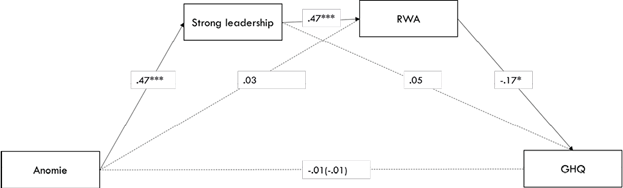
In the Chilean sample analyzed, a robust association was observed between perceived anomie and the preference for strong leadership, with a significant coefficient (b = 0.6315, SE = 0.0797, p < .001, β = 0.4695). This suggests that individuals who perceive higher levels of anomie-characterized by feelings of normlessness and societal instability-tend to express a stronger preference for strong leaders. Furthermore, the analyses revealed that support for strong leadership serves as a significant predictor of RWA, evidenced by a considerable coefficient (b = 0.5326, SE = 0.0739, p < .001, β = 0.4775). This indicates that those inclined to endorse strong leadership are more likely to exhibit RWA characteristics, which often include a preference for order, conformity, and adherence to traditional values.
The direct effect of perceived anomie on RWA was not statistically significant (b = 0.0516, SE = 0.0993, p = .6038), implying that the relationship between these two constructs is not direct. Instead, it suggests that individual support for strong leadership mediates the effect of anomie on RWA. Therefore, the preference for strong leadership in Chile appears to serve as a crucial intermediary that influences the manifestation of right-wing authoritarian tendencies in response to experiences of anomie. Interestingly, the analysis revealed that anomie did not have a statistically significant predictive effect on psychological distress within the Chilean population (b = 0.0055, SE = 0.0289, p = .8504, β = 0.0127). This suggests that feelings of normlessness or social disarray may not directly relate to psychological distress in this context. Overall, the model indicates an indirect association consistent with a sequential pathway (anomie → strong-leader preference → RWA → psychological distress) (for transparency: b = −0.0162, SE_boot = 0.0075, 95% CI [−0.0318, −0.0021]). Effects were small and should be interpreted cautiously given the cross-sectional design. Taken together with the mediation results, RWA may function as a modest buffer of psychological distress under perceived social disorder. The zero- order association between RWA and psychological distress was small and did not remain robust once covariates and measurement constraints were considered (b = -0.0481, SE = 0.0220, p = .0297, β = -0.1679). Consistent with this pattern, individuals in Chile endorsing RWA reported somewhat lower psychological distress when perceiving higher anomie. This pattern may reflect the complex interplay between belief systems and mental health outcomes in the face of perceived social instability (Figure 1).
Sequential Mediation Analysis for Spain
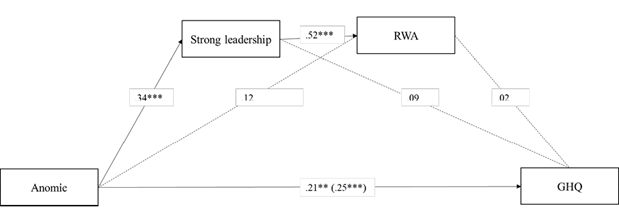
In the analysis of the Spanish sample, a significant positive relationship was established between perceived anomie and support for strong leadership. Specifically, the regression coefficient indicated that for each unit increase in perceived anomie, there was a corresponding increase in the likelihood of supporting strong leaders (b = 0.5233, SE = 0.1087, p < .001, β = 0.3401). This finding highlights the potential for perceived societal disintegration to correlate with a desire for authoritative governance structures. Moreover, the data revealed that the preference for strong leadership significantly predicted RWA, as evidenced by a regression coefficient of b = 0.4656 (SE = 0.0585, p < .001, β = 0.5221). This suggests that individuals who strongly prefer assertive leadership are also more likely to exhibit authoritarian tendencies, reinforcing the connection between leadership preferences and authoritarian ideologies.
It is pertinent to note, however, that the direct effect of anomie on RWA was not statistically significant (b = 0.1686, SE = 0.0899, p = .0626). Findings are consistent with an indirect pathway via preference for strong leadership, while direct effects were comparatively attenuated. Hence, the relationship between societal disintegration and authoritarianism appears to be mediated rather than direct, further underscoring the complexity of the dynamics at play in shaping political attitudes and behaviors.
The analysis of psychological distress in relation to anomie revealed noteworthy findings. The total effect of anomie on psychological distress was found to be statistically significant (b = 0.1094, SE = 0.0314, p = .0006, β = 0.2537), indicating a strong relationship. Even after controlling for potential mediators, the predictive power of anomie on psychological distress remained significant (b = 0.0935, SE = 0.0337, p = .0061, β = 0.2168). This reinforces the notion that anomie is a substantial factor contributing to psychological distress.
However, the indirect pathways involving preference for strong leaders or RWA did not yield significant results. Specifically, the sequential mediation pathway, which aimed to illustrate the relationship between anomie and psychological distress, yielded a non- significant result (b = 0.0016, SE_boot = 0.0081, BootLLCI = -0.0153, BootULCI = 0.0177). These findings suggest that, in the context of Spain, anomie exerts an influence on psychological distress that operates independently of authoritarian attitudes or preferences for strong leadership. This independence underscores the unique role of anomic conditions in contributing to lower psychological distress, highlighting the importance of addressing social disintegration and its psychological repercussions (Figure 2).
The detailed results of the sequential mediation model for Chile and Spain are summarized in the next Section in Table 3.
Statistical Comparison Between Chile and Spain
The statistical comparison of results between Chile and Spain reveals notable differences in the mediation processes. Both countries exhibited a significant positive relationship between perceived anomie and preference for strong leadership. However, as shown in Table 3, this effect was more substantial in Chile (r = .470, p < .001) than in Spain (r = .259, p < .001). This suggests that perceptions of social disorder in Chile were more strongly linked to a desire for authoritative leadership.
Additionally, the sequential mediation analysis confirmed that support for strong leadership significantly predicted RWA in both countries, with similar coefficients for Chile (b = 0.5326, SE = 0.0739, p < .001, β = 0.4775) and Spain (b = 0.4656, SE = 0.0585, p < .001, β = 0.5221). However, a notable difference emerged in the direct effect of anomie on psychological distress: in Spain, anomie had a significant positive effect on psychological distress (b = 0.1094, SE = 0.0314, p < .001, β = 0.2537), while no such direct relationship was observed in Chile (b = 0.0055, SE = 0.0289, p = .850, β = 0.013).
The most pronounced difference between the two countries appeared in the indirect effects of anomie on psychological distress. Overall, the model indicates an indirect association consistent with a sequential pathway (anomie → strong-leader preference → RWA → psychological distress). Effects were small-to-moderate and should be interpreted cautiously given the cross-sectional design. In Chile, this pattern suggests that RWA may help explain lower psychological distress under perceived social disorder, whereas in Spain the mediation pathway did not reach significance, indicating that anomie directly relates to psychological distress independent of authoritarian attitudes or leadership preferences.
Table 3. Direct and Indirect Effects in the Sequential Mediation Model (Chile and Spain)
| Pathway/Effect | Chile | Spain |
|---|---|---|
| Panel A. Direct effects (unstandardized) | ||
| Anomie → Strong Leadership | b = 0.6315, p < .001 | b = 0.5233, p < .001 |
| Strong Leadership → RWA | b = 0.5326, p < .001 | b = 0.4656, p < .001 |
| Anomie → RWA (direct) | b = 0.0516, p = 0.604 | b = 0.1686, p = 0.063 |
| RWA → Psychological distress | b = -0.0481, p = 0.030 | b = 0.0081, p = 0.776 |
| Anomie → Psychological distress (direct) | b = 0.0055, p = 0.850 | b = 0.1094, p < .001 |
| Panel B. Indirect effects (completely standardized, 5,000 bootstrap, 95% CI) | ||
| Total indirect | β_cs = -0.0208, SE_boot = 0.0362, 95% CI [-0.0911, 0.0515] | β_cs = 0.0369, SE_boot = 0.0315, 95% CI [-0.0224, 0.1033] |
| Ind1: Anomie → Strong Leadership → Psychological distress | β_cs = 0.0226, SE_boot = 0.0381, 95% CI [-0.0517, 0.0994] | β_cs = 0.0307, SE_boot = 0.0377, 95% CI [-0.0381, 0.1104] |
| Ind2: Anomie → RWA → Psychological distress | β_cs = -0.0058, SE_boot = 0.0140, 95% CI [-0.0373, 0.0197] | β_cs = 0.0025, SE_boot = 0.0143, 95% CI [-0.0262, 0.0336] |
| Ind3: Anomie → Strong Leadership → RWA → Psychological distress | β_cs = -0.0376, SE_boot = 0.0169, 95% CI [-0.0727, -0.0059] | β_cs = 0.0036, SE_boot = 0.0188, 95% CI [-0.0350, 0.0402] |
Note: PROCESS v4.1 (Model 6); 5,000 bias-corrected bootstrap samples; 95% CIs. Panel A shows unstandardized coefficients (b) and p values. Panel B shows completely standardized indirect effects (β_cs) with bootstrap standard errors (SE_boot) and 95% CIs. Outcome: psychological distress (GHQ-6). Models are estimated separately by country.
Source: Authors based on collected data.
These findings underscore the significance of national context in influencing the psychological dynamics associated with perceived social disorder. While authoritarian beliefs in Chile provided a psychological refuge against psychological distress, the exact mechanism was not observed in Spain, where the relationship between anomie and psychological distress was independent of authoritarian attitudes.
Discussion
Pathways of Authoritarian Coping
The primary objective of this study was to investigate a sequential mediation model wherein perceived anomie influences psychological distress through support for strong leadership and RWA. The results largely substantiated our hypotheses while also revealing notable discrepancies between the two countries examined.
First, Hypothesis 1 posited that perceived anomie would have a positive association with support for strong leaders, a prediction that was confirmed in both Chile and Spain. In both contexts, individuals perceiving heightened social disorder exhibited a stronger preference for authoritarian leadership. Hypothesis 2, which anticipated a positive relationship between support for strong leaders and RWA, was also supported in both countries. This pattern is expected within the PAS framework: leadership breakdown clarifies why anomie aligns with strong-leader preference, while social-fabric disintegration captures uncertainty and norm ambiguity-conditions under which authoritarian coping becomes appealing (Teymoori et al. 2016).
Hypothesis 3, which proposed a negative relationship between RWA and psychological distress, was only supported in Chile. In this context, individuals with higher authoritarian attitudes reported lower levels of psychological distress, suggesting that such attitudes may function as a psychological buffer, mitigating the adverse emotional consequences stemming from perceived social disorder. This finding is congruent with theoretical frameworks that conceptualize authoritarianism as a coping mechanism (Pizarro et al. 2024; Van Hiel and De Clercq 2009; Womick et al. 2019).
In contrast, the anticipated direct effect of RWA on psychological distress was not evident in Spain, suggesting that the link between authoritarianism and distress varies across sociopolitical contexts. Rather than characterizing Spain as simply “stable” post-Franco, it is more accurate to note that institutional consolidation has coexisted with recurrent episodes of contention from 2008-2020-including the 15M/Indignados cycle, the 2017 Catalan constitutional crisis, the 2018 no-confidence vote, and notable pandemic-era mobilization-so any cross-national differences should be interpreted against this dynamic backdrop (Cetrà and Castañas-Adam 2018; Daphi et al. 2024; Flesher Fominaya 2020; Reuters 2018).
Hypothesis 4 proposed a sequential indirect effect of perceived anomie on psychological distress mediated by support for strong leadership and RWA. This hypothesis was confirmed in Chile but not in Spain, suggesting that leadership preferences and authoritarian beliefs mediate the pathway linking social disorder to psychological distress in Chile. Conversely, Spain did not exhibit a similar pattern, suggesting that distinct psychological mechanisms may be at play in each country.
Lastly, Hypothesis 5 anticipated that the strength and direction of these associations would differ between the Chilean and Spanish samples, a fully supported prediction. The results underscore significant cultural and contextual differences in the interrelations among anomie, authoritarianism, and psychological distress.
Contrasting Authoritarian Dynamics
The findings of this study underscore the critical role of national context in shaping the relationship between perceived anomie, authoritarian attitudes, and psychological distress. These results are consistent with a growing body of research indicating that authoritarian ideologies-particularly RWA-may serve as psychological buffers in times of social instability (Mezzalira et al. 2023; Napier and Jost 2008; Onraet et al. 2013; Van Hiel and De Clercq 2009; Womick et al. 2019).
In Chile, a context marked by political turbulence and the enduring aftermath of the 2019 Estallido Social (Somma and Donoso 2022), perceived anomie was strongly associated with support for strong leadership, which in turn was linked to reduced psychological distress through increased RWA. This is further supported by qualitative research on the 2019 Estallido social, which highlights the emotional intensity, collective rituals, and interpersonal mobilization that shaped protest participation in Chile (Asún et al. 2020). These affective dynamics may have amplified perceptions of disorder and fostered a stronger psychological need for ideological structure and authority. This pattern aligns with Hobfoll’s (2001) Conservation of Resources theory, suggesting that individuals may turn to ideological belief systems as emotional resources to restore order and stability in response to societal disruption. In this sense, authoritarian beliefs may function as “cognitive structuring tools” offering clarity and predictability in uncertain environments (Feldman 2003, 2013).
This compensatory function of RWA is also observed in culturally diverse settings. Studies in China and Pakistan show that authoritarianism can be positively associated with well-being, especially in institutional environments characterized by hierarchy and norm enforcement (Hou et al. 2024; Liu et al. 2019; Siraaj et al. 2022). Similarly, research from the United States suggests that conservatives, who typically endorse higher levels of RWA, report greater life satisfaction due to enhanced perceptions of control and stability (Schlenker et al. 2012; Van Hiel and Brebels 2011). In this light, authoritarianism may act as an emotional safeguard in contexts of heightened threat.
Notably, the Chilean context may intensify the salience of such mechanisms. As Censolo and Morelli (2020) argue, pandemics can exacerbate perceptions of social instability and diminish trust in institutions-conditions that heighten receptivity to authoritarian messaging. In such cases, authoritarianism becomes both a reaction to external threat and an internal regulator of psychological distress (Duckitt and Sibley 2010; Stenner 2005).
Conversely, in Spain, a country with more stable democratic institutions and a long-standing historical memory of authoritarianism, the psychological benefits of RWA were not observed. Although Spaniards also expressed support for strong leadership, these attitudes did not translate into lower levels of psychological distress. This divergence may reflect contextual moderators, such as lower exposure to acute social disintegration and a more ambivalent cultural stance toward authoritarian figures due to the legacy of Franco’s regime (Bernacer et al. 2021; Galais and Balinhas 2025).
Another explanatory mechanism involves intolerance of uncertainty, which has been proposed as a mediator between perceived disorder and emotional maladjustment (Reizer et al. 2021). In Chile, RWA may buffer psychological distress by attenuating uncertainty and offering a sense of ontological security. In Spain, where uncertainty may be less prevalent or less politicized, authoritarian ideologies might lack this compensatory function.
In addition, the System Justification Theory (Jost et al. 2004) suggests that individuals may adopt hierarchical ideologies to justify and preserve the social order, especially when under threat. However, this process depends on the system’s perceived legitimacy and historical resonance. In Chile, ongoing social protests and institutional distrust may have made authoritarianism appealing as a response to the perceived failure of the democratic order. In Spain, democratic consolidation may have made system justification more compatible with liberal norms, reducing the affective appeal of authoritarian ideologies.
Recent empirical work also supports this interpretation. For example, Hartman et al. (2021) found that pandemic-induced anxiety heightened authoritarian and nationalist sentiments, especially when perceived threat was high. Similarly, a classic meta-analysis showed that existential threats such as death anxiety and perceptions of system instability are robustly associated with conservative attitudes, including authoritarian forms of right-wing ideology, reinforcing the notion that such ideologies may serve important social and psychological functions (Jost et al. 2003).
Nonetheless, these compensatory benefits are not without cost. As Altemeyer (1996) and Nail et al. (2009) have shown, authoritarian attitudes are also associated with political intolerance, prejudice, and opposition to democratic principles. Thus, even if authoritarianism provides emotional relief, it may erode the very social fabric it aims to stabilize.
Finally, the Chile-Spain contrast illustrates how legacies of authoritarianism, protest culture, and civic engagement modulate the emotional significance of ideological beliefs. In Chile, where inequality and instability persist, authoritarian attitudes may be more readily activated as affective coping strategies. In Spain, lingering ambivalence from the Franco era may lead to weaker emotional identification with authoritarian narratives. Further research should examine how sociopolitical history, perceived threat, uncertainty, and personal values interact to shape the psychological role of authoritarianism in different cultural settings.
Limitations and Future Directions
While this study provides valuable insights into the relationship between perceived anomie, RWA, and psychological distress in Chile and Spain, the results of the study should be interpreted with caution. First, we measured psychological distress, not psychological well-being. The absence of symptoms should not be understood as the presence of well-being. Given abbreviated scales, ordinal indicators, and the time-bound pandemic context, findings are best understood as suggestive patterns that warrant replication and longitudinal/experimental tests. While the instruments have demonstrated acceptable reliability, they may not fully capture the multidimensionality of the constructs, potentially limiting the depth of interpretation. Future research would benefit from using more comprehensive measures to assess complex sociopolitical constructs.
Further, data were collected during the COVID-19 emergency, which may have elevated background stressors and introduced time-bound confounds. We therefore refrain from extrapolating beyond this context and encourage replication under non-emergency conditions.
The cross-sectional design and the absence of formal multi-group measurement invariance tests (we do not compare latent means) limit causal and between-country claims. Future studies should examine configural/metric invariance (and scalar when comparing latent means), ideally with longer item batteries and estimators suited to ordinal indicators (e.g., WLSMV), and use longitudinal/experimental designs that enable an assessment of how these psychological and ideological dynamics unfold over time, particularly in response to ongoing political change or crisis.
Second, exclusive reliance on self-report measures may have introduced social desirability or response biases, particularly in the assessment of politically sensitive constructs. Future research should consider incorporating behavioral indicators, experimental manipulations, or implicit measures to enhance validity.
Third, this study focused on only two countries, each with distinct sociopolitical trajectories. While this allowed for meaningful cross-contextual comparisons, broader sampling-including cases from other regions with varying levels of democratic consolidation, protest culture, or authoritarian legacy-would help assess the generalizability of these mechanisms. Countries experiencing recent political transitions or systemic disruptions may yield especially relevant comparisons.
Moreover, unequal sample sizes between the Chilean and Spanish groups likely reduced statistical power for the mediation tests-especially in Spain, where several effects were weaker or non-significant. Although both samples met the model’s minimum requirements, our power checks (Supplement S-Power) indicate adequate power for medium × medium serial paths but borderline/low power when one or more constituent paths are small. Accordingly, near-zero or marginal indirect effects are interpreted cautiously. Future studies with larger, more balanced samples would improve the robustness of cross-national comparisons and the stability of indirect estimates.
In addition, the role of political ideology should be further explored. Prior studies indicate that the psychological effects of authoritarian beliefs may differ based on individuals’ ideological alignment, particularly in polarized contexts (Onraet et al. 2013). Including this dimension could help clarify when and for whom authoritarianism functions as a psychological buffer.
Also, we did not assess left-wing authoritarianism (LWA). Recent work conceptualizes LWA as structurally analogous to RWA-distinct in content but sharing an authoritarian core (Costello et al. 2022). If authoritarian orientations function as existential coping mechanisms, similar pathways could emerge on the left under specific threat profiles and ideological alignments. Future studies should include validated LWA measures alongside RWA to test symmetry versus asymmetry, and probe whether effects vary by ideological identification and national context.
Further, the inclusion of social trust, political efficacy, and perceived threat as moderating or mediating variables could help elucidate the psychosocial pathways linking anomie to authoritarianism and psychological distress. Previous work shows that low trust and high uncertainty can heighten susceptibility to authoritarian appeals (Moyano-Díaz et al. 2021; Reizer et al. 2021).
Finally, integrating theories such as System Justification Theory (Jost et al. 2004) and the Dual Process Motivational Model (Duckitt and Sibley 2017) may provide richer theoretical frameworks to explain how and why individuals adopt authoritarian attitudes in times of crisis. These models emphasize the motivational, existential, and ideological mechanisms through which individuals seek order, coherence, and security.
Conclusion
This study advances our understanding of authoritarianism by testing a sequential mediation model in which perceptions of social disorder (anomie) influence psychological distress through support for strong leadership and RWA. The findings highlight that authoritarian beliefs may serve as context-sensitive psychological resources during periods of social instability, helping individuals reduce emotional psychological distress by restoring a sense of order and coherence.
Our cross-national comparison reveals that this mechanism is not universal. In Chile, a country marked by recent political unrest and institutional fragility, authoritarian attitudes played a buffering role, indirectly alleviating psychological distress. In contrast, the same pathway was not supported in Spain, where democratic institutions are more consolidated and anomie predicted psychological distress independently of authoritarian beliefs. These results underscore the conditional nature of ideological coping strategies and the importance of situating psychological responses within broader cultural and historical contexts.
Our findings suggest that authoritarianism may serve not only as a political orientation but also as an affective response to perceived social breakdown. Recognizing this dual function is critical for understanding the psychosocial dynamics of crisis. Future research should further investigate how individual dispositions, cultural narratives, and system-level trust interact to shape the emotional appeal of authoritarian ideologies across societies.
Adopting a sociocultural grounded perspective on authoritarianism may inform public interventions aimed at mitigating psychological distress while reinforcing democratic values and social cohesion in turbulent times.

