




 English (pdf)
 Article in xml format
 Article references
 Automatic translation
 Send this article by e-mail
 Cited by SciELO
  Cited by Google
  Similars in
SciELO
Similars in
SciELO  Similars in Google
 Permalink

1. Introduction
The operations of foreign trade and their communication needs facilitated by maritime transportation have boosted this sector, making it the largest contributor to the movement of goods and the driver of global economic development (Lun et al., 2014). However, the increase in maritime activity has generated adverse impacts on the environment, leading governments and the international community to express concern over waste and pollution generated by activities associated primarily with the shipping industry (Lai et al., 2011). This industry has been responsible for generating 3 % of global Carbon Dioxide (CO2) emissions, 14-15 % of nitrogen oxides, and 16 % of sulfur oxides (Sherbaz & Duan, 2012).
The academic community and those involved in transportation processes have intensified research in this area, particularly in the years following 2012 (Shi et al., 2018). Some of the proposed strategies to counteract the environmental impacts caused by maritime transportation include speed reduction, alternative fuel options, and the implementation of optimization models to calculate the optimal values of operations (Lin et al., 2021). Other activities include establishing a collaborative network among shipping companies, reducing shipping costs through information exchange, investing in environmentally friendly vessels, and supporting ships that use liquefied natural gas as fuel (T. Lee & Nam, 2017).
To current needs, organizations must consider container movements based on capacities, shipping policy specifications, and suppliers to simultaneously enhance environmental and financial performance (Lirn et al., 2014). To achieve this, eco-friendly shipping practices, known as green shipping, emerge as strategies to counteract the environmental impact caused by the shipping industry (Justavino-Castillo et al., 2020). Consequently, the future of maritime transportation lies in efforts made towards green shipping by the industry and engineers, in collaboration with regulatory authorities and communities, and in considering optimal routes and modes for goods delivery (Wan et al., 2016).
Regarding green shipping, literature reviews have been conducted with various approaches. One of them focused on documents published in the Social Science Citation Index (SSCI) between 1988 and 2017, emphasizing air pollution and the classification of sustainable shipping practices (Shi et al., 2018). Additionally, a review was conducted on the use of hydrogen as an alternative fuel (Wang et al., 2021). Furthermore, another study focused on regulations and existing technologies to support decision-making for sustainable fleets (Tadros et al., 2023). Moreover, an ecological design for ship recycling was considered within sustainable shipping strategies (Samsudin et al., 2022). However, the consulted documents to date do not identify a global literature review on green shipping involving methodologies such as the tree metaphor for identifying original documents, structural documents, and research clusters based on information available in the Scopus database between 2004 and 2023.
Considering the aforementioned, the objective of this research is to contribute to the field of green shipping through an exhaustive bibliometric analysis of its origin, evolution, and conceptual development. To conduct this evaluation, specialized tools such as R-Studio, Bibliometrix, and the Tree of Science (ToS) have been used, allowing for comprehensive visualization of trends and dynamics in scientific production accumulated up to the date of consultation. The sections comprising this research begin with a detailed exposition of the implemented methodology, followed by an exploration of the theoretical foundations of the subject. Subsequently, a meticulous bibliometric analysis is presented, and finally, the Tree of Science is displayed, providing a representation of the thematic structure and connections between research. In conclusion, the main observations derived from the analysis are presented, and recommendations are provided to guide future research in this constantly evolving field.
2. Methodology
This work is based on the scientific mapping approach, employing bibliometric tools to graphically represent the intellectual structure, patterns, and trends within a field of knowledge (Chen, 2017; Leydesdorff, 1987; Noyons et al., 1999). To achieve this, various analysis methods are utilized, including indicators and metrics such as publication counts (by author, country, institution, journal) (Zupic & Čater, 2015). Additionally, graph theory is applied to form co-citation networks of authors, documents, and countries (Herman et al., 2000). Furthermore, the metaphor of the Tree of Science (ToS) is employed to identify and classify the most relevant documents in this field (Robledo et al., 2022; Robledo-Giraldo et al., 2023; Valencia-Hernandez et al., 2020).
2.1 Data selection
To carry out the scientific mapping of research in green shipping, an exploration was conducted within the Scopus database, considered one of the most relevant databases globally (Martín-Martín et al., 2018; Pranckutė, 2021). During the search process, the term "green shipping" was employed as the search expression, considering works whose titles, abstracts, and keywords contain these terms as inclusion criteria. No exclusion criteria, such as publication date, journal, or field of knowledge, were established, and no other options provided by the database were utilized. This was done to ensure an accurate perspective on the evolution of this field of study. Based on these criteria, a total of 238 results were obtained, with the query date being June 6, 2023.
2.2 Processing, analysis and visualization
For this work, tools such as Bibliometrix (Aria & Cuccurullo, 2017), ToS (Robledo et al., 2022; Valencia-Hernandez et al., 2020) and Gephi (Mathieu et al., 2009) were employed. Version 3.1 of Bibliometrix, a bibliometric analysis tool available in the R-Studio software, was used. It is a freely accessible tool with multiple functions for conducting studies of this nature (Aria et al., 2020), as various research works have utilized (Di Vaio et al., 2021; Duque, Trejos, et al., 2021; Duque & Oliva, 2022; Homolak et al., 2020; Rodríguez et al., 2022).
Additionally, ToS was employed, which is a package based on graph theory that allows extracting references from the records obtained in the database. (Robledo et al., 2022; Valencia-Hernandez et al., 2020). From these references, the co-citation network of documents can be constructed, enabling the understanding of bibliometric metrics such as citation and co-citation indicators. These indicators are useful for identifying and classifying the most relevant documents in the field using the metaphorical scheme of the Tree of Science. It's worth noting that this package has been validated and used in various research studies (Castellanos et al., 2022; Grisales et al., 2023; Hoyos et al., 2022; Mogollón et al., 2022; Rodríguez et al., 2022).
To visualize the network generated by ToS, the Gephi tool was employed (Mathieu et al., 2009). Being an open-source and freely available tool, Gephi has been widely used to conduct studies of this nature, allowing interaction with network data and each document within it (Clavijo-Tapia et al., 2021; Donthu et al., 2020; Jacomy et al., 2014; Meier, 2020; Ramos-Enríquez et al., 2021; Restrepo et al., 2023). This method has been successfully employed in previous research studies (Duque, Meza, et al., 2021; Hoyos et al., 2023; Hurtado & Ortiz, 2022; Loaiza et al., 2022; Robledo et al., 2023; Trejos-Salazar et al., 2021).
3. Results and discussion
3.1 Scientific mapping
Figure 1 displays the chronological record of publications between 2004 and 2023 available in the Scopus database. Throughout this timeframe, there is an annual growth rate of 22.04%, amassing a total of 238 publications. Remarkably, the last five years stand out, contributing 53.36% of the total publications, although it's crucial to note that the year 2023 includes only the initial months. The surge in publication count is attributable to the significant growth in maritime transportation activities since 2019, in conjunction with global concerns aimed at mitigating factors linked to resource depletion and carbon footprint.
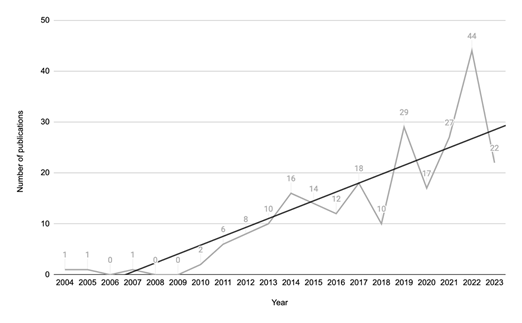
Table 1 provides an overview of the leading countries contributing to publications on the subject of green shipping. China stands out with a substantial 28.15 % of publications, solidifying the prominent position of the Asian continent with a significant 42.86 % global contribution. Europe follows in importance, contributing 43.70%, while the Americas contribute 7.14 %. Moreover, the network graph illustrates prominent collaborations, emphasizing strong cooperation among China, the United States, Hong Kong, and Australia. Additionally, two additional collaboration groups are identified, one centered on the United Kingdom and another on Germany.

Table 2 displays relevant information such as the H-index, quartile, and Scimago Journal Rank (SJR) of journals with substantial presence in green shipping-related publications. Naval Architect leads the ranking in terms of document volume in this field, albeit exhibiting more modest indicators compared to other listed journals. On the other hand, Journal of Cleaner Production and Transportation Research Part E Logistics and Transportation Review stand out due to their H-index and SJR indicators, respectively. Additionally, the results underscore the impact of these journals, primarily located in Q1 and Q2 quartiles, with over 50 % of them based in the United Kingdom.
Table 2 Publications by journal.
| Source | Number of publications | H index | Quartil SJR | SJR 2022 |
|---|---|---|---|---|
| Naval Architect | 17 | 6 | Q4 | 0.1 |
| Transportation Research Part D Transport and Environment | 12 | 126 | Q1 | 2.02 |
| Maritime Policy and Management | 10 | 67 | Q1 | 1.07 |
| Ocean Engineering | 9 | 167 | Q1 | 1.38 |
| Sustainability Switzerland | 9 | 136 | Q1 | 0.66 |
| Polish Maritime Research | 8 | 25 | Q2 | 0.46 |
| Journal of Cleaner Production | 6 | 268 | Q1 | 1.92 |
| Journal of Marine Science and Engineering | 6 | 39 | Q2 | 0.54 |
| Transportation Research Part E Logistics and Transportation Review | 5 | 134 | Q1 | 2.83 |
| Dalian Haishi Daxue Xuebao Journal of Dalian Maritime University | 3 | 67 | Q1 | 0.14 |
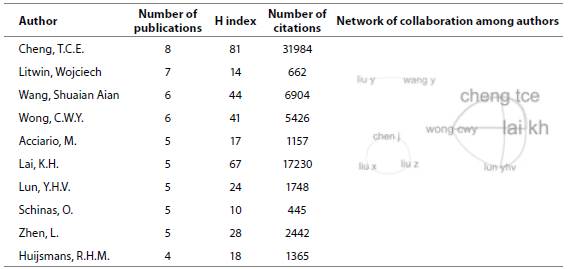
Table 3 exhibits the relevant indicators of key authors in the field of study. Foremost is T.C. Edwin Cheng from the Hong Kong Polytechnic University, leading with 8 publications and holding the position of the most cited author, accumulating a total of 31984 citations. Following in terms of indicators is K.H. Lai, positioned sixth, with a total of 17230 citations. Furthermore, other authors within the top 10 also feature in the table. Concerning author collaborations, the network emphasizes marked collaboration among T.C.E. Chen, C.W.Y. Wong, K.H. Lai, and Y.H.V. Lun, all included in the list of key authors.
3.2 Network analysis
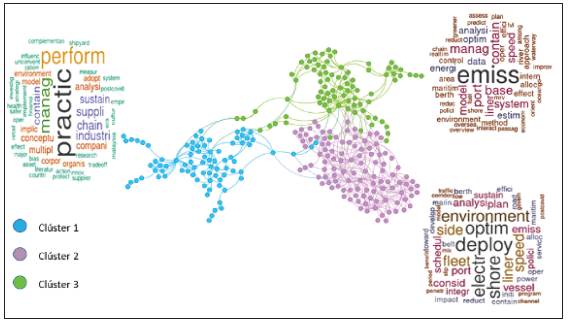
In this study, a comprehensive analysis of global research on green shipping is presented. To conduct this analysis, a network graphing tool called Gephi is utilized, allowing visualization and analysis of networks. Through this tool, clusters or groups of documents related to the topic are examined, revealing three primary categories representing the most relevant approaches and areas of interest today (Figure 2).
Classical documents (Roots)
Maritime transportation, as a significant source of pollutant emissions and greenhouse gases, has spurred studies to assess the environmental impact of the shipping industry and seek solutions to mitigate its environmental footprint. Some have focused on developing models to optimize maritime routes, the utilization of clean fuels, and the implementation of sustainable navigation policies, aiming to introduce ecological solutions within the shipping industry to enhance business logistics, decrease fuel emissions, and increase productivity in international goods transportation.
Several authors-initiated research on maritime transportation and environmental impact. Viana et al. (2009) conducted a study evaluating ship pollution and varying emission levels in ports of a Mediterranean city. Subsequently, Lindstad et al. (2011) analyzed the reduction of greenhouse gas emissions and associated costs linked to vessel speed.
Research endeavors aim to achieve more productive and profitable maritime shipments while reducing costs and increasing profits, concurrently lessening environmental impact (Ng et al., 2013). Additionally, models for optimizing maritime routes based on criteria like clean energy, costs, fuel, and speed have facilitated the creation of more efficient and productive execution plans (Zhen, Wu, et al., 2020). Similarly, upgrading fleets of ships and vessels is a strategy promoting the use of clean fuels, ensuring that upon arrival at ports, they do not contribute to coastal pollution or harm ecosystem (Prause, 2014b).
For shipping companies, updating navigation policies and environmental stewardship is crucial to increasing market share and addressing ecological requisites that encourage contracts from organizations (Lai et al., 2011). Implementing regulations that limit vessel speed to reduce CO2 emissions and mitigate the environmental impact caused by maritime transportation is a beneficial challenge for stakeholders (Corbett et al., 2009), Likewise, implementing strategies to transition to electric or environmentally friendly engines can enhance business logistics, reduce fuel emissions, and greenhouse gases (Dekker et al., 2012).
In the shipping industry, discussions have surfaced regarding the possibility that slower navigation might be associated with decreased CO2 emissions, contrary to the rise in vessel manufacturing. Hence, reducing fuel costs has been proposed to incentivize slower speeds, leading to delayed deliveries and increased business expenses, yet demonstrating commitment and concern for the environment (Cariou, 2011). Concerning vessel numbers, there are benefits to having a sufficiently large fleet for container transportation, summarized in increased productivity by transporting more goods and meeting the growing international demand (Yang, 2020).
Structural documents (Trunk)
Establishing green corridors through the adoption of sustainable logistics solutions can enhance production efficiency while safeguarding the environment. However, risks to infrastructure and the economy need assessment before implementation. Green corridors should be centralized and adhere to ecological standards. Activities like fleet upgrades with hybrid engines and advocating environmentally conscious transportation can further reduce emissions. Imposing taxes isn't the solution; instead, promoting sustainable transport alternatives is imperative to mitigate harm caused by combustion vehicles.
Green corridors (hereafter referred to as GC) denote maritime routes or specific areas implementing sustainable practices to curtail the environmental impact of the shipping industry. Implementing policies within each country through GC necessitates a comprehensive analysis of potential infrastructure and economic risks (Schröder & Prause, 2015). Nevertheless, by employing sustainable logistics solutions, GC can enhance production chain efficiency by establishing shorter shipping routes and times for regional development, without neglecting the environment (Hunke & Prause, 2013). While few systems currently exist, new techniques are gradually being adopted for application in these corridors, aiming to create more environmentally friendly logistics centers (Prause & Hunke, 2014). Additionally, the aim is to centralize GC and logistics centers according to ecological standards set by relevant authorities (Prause, 2014a). Hence, establishing management centers for hazardous substances that do not disrupt the environmentally oriented corridors and implementing environmental protection policies in transportation through these corridors is crucial (Litwin et al., 2019).
The navigation policies leading to reduced vessel speeds have shown a positive environmental impact (Kunicka & Litwin, 2019). The use of hybrid engines allows ships to navigate more efficiently, reducing pollution and increasing economic profitability (Litwin et al., 2019). Achieving this balance involves upgrading the vehicle fleet through measurement methods tailored to the needs, highlighting the advantages promoting environmental protection and sustainable production in countries (Bai et al., 2015).
Another strategy to foster environmental awareness is promoting sustainable transportation modes rather than imposing taxes to force migration to these modes (Soto et al., 2018). Studies indicate that the circulation of vehicles, trains, ships, and combustion engine-based transport modes leads to a daily increase in CO2 emissions, resulting in severe environmental damage (Hussain et al., 2022).
Cluster 1. Innovation and environmental policies as key measures to minimize pollution
Themes within the first research trend encompass the need for shipping companies to take measures to minimize their environmental impact through organizational policies and studies, necessitating an assessment of the feasibility and effectiveness of environmental management practices. Furthermore, corrective measures indicate ports adopting electrical connection points to reduce CO2 emissions from ships. Additionally, suggestions are proposed to revitalize trade and distribution centers, including the creation of eco-friendly ports. It's emphasized that adherence to environmental policies allows shipping companies to enhance profits, especially in international shipments.
Organizations adopting environmental conservation practices experience increased market perception, leading to higher demand for their production. However, they face challenges in meeting product and service volumes while complying with established environmental policies (Pang et al., 2021). Thus, the incorporation of measurement tools becomes an ally in identifying weaknesses and establishing improvement plans to meet environmental policies, demonstrating commitment to this sector (Lai et al., 2013). Consequently, integrating carbon emission reduction measures will enhance companies' profits by adhering to green port policies, yielding future benefits in international trade participation (Huang et al., 2023).
Studies and policies generated by shipping companies must be reinforced to mitigate environmental impact and promote actions that do not compromise production (Lai et al., 2011). Additionally, these environmental management practices should be viable and effective in addressing environmental issues (Zhu et al., 2008). Some research has focused on environmentally friendly alternatives, controlling ship-generated pollution levels by using measurement and descriptive reporting (Viana et al., 2009). Moreover, profitability and resource management have been focal points as innovative management sources for effectively developing business operations (Montabon et al., 2007).
Ports have implemented strategies to reduce fuel use and subsequently CO2 emissions into the environment by setting up electrical connection points for ships during their stay and transit towards green corridors (Daniel et al., 2022). Similarly, strategies aimed at reviving trade and distribution centers focus on investments, infrastructure, design, and project implementation to boost the economy, like China's proposal for eco-friendly ports (P. T.-W. Lee & Song, 2023). Overall, all companies must gradually implement environmental management policies in the short and medium term due to global impact awareness, which will eventually become mandatory requirements for future navigation (Zhou et al., 2023).
Cluster 2. Alternatives to Reduce Environmental Pollutant Emissions
Research within this group emphasizes strategies for reducing ship pollution and measures adopted by ports. Suggestions include minimizing auxiliary engines on ships, imposing fuel taxes to reduce the number of trips, converting to natural gas, and optimal route planning, dedicating exclusive channels to ports. Shipping companies face the challenge of complying with environmental policies while maintaining market activity. Fleet modernization requires significant investment to position companies as sustainability leaders.
In order to enhance the efficiency of "green" shipments and considering the post-COVID-19 surge in foreign trade operations, companies face the challenge of adhering to ecological navigation policies (Prokopenko & Miśkiewicz, 2020). This condition positions shipping companies as sustainability leaders, forefronting "green ports" and using fleets with clean fuels (Zhen, Zhuge, et al., 2020). However, the pursuit of these goals and increased port regulations necessitate investment in technology and infrastructure, posing a challenge in cost-benefit relations for compliance with policies and market participation (Fan et al., 2020). Some of the largest economic investments by shipping companies suggest fleet modernization through the acquisition of new ships or updating existing ones (Schinas & Bergmann, 2021).
As alternatives to discourage fuel use and reduce the number of trips, adding a fuel tax to decrease CO2 generation in the environment has been suggested (Corbett et al., 2009). Other measures, like avoiding auxiliary engines on ships for power generation by directly sourcing power from the port, have been proposed (Winkel et al., 2016). Connecting ships to cities' electrical grids in ports has proven to reduce emissions generated by ship engines (Hall, 2010).
Other alternatives to mitigate environmental impact include converting ships' conventional engines to natural gas systems (Wu et al., 2022) and creating dedicated channels for port operations to enhance route efficiency, emissions control, and transportation operation scheduling (Jiang et al., 2022). Additionally, efficient route planning and controlling vessel speeds significantly contribute to reducing environmental pollution by avoiding high sulfur content fuels (Wang et al., 2021).
Cluster 3. Shipping Industry Strategies for Maritime Transportation Decarbonization
Reducing pollution in the shipping industry entails analyzing fuel consumption and its relationship with vessel speed. This research cluster identified factors influencing this issue, such as average speed for cargo transportation, scheduling to prevent engines running during extended waiting periods, and the supply of clean energy in ports. Additionally, aiming for decarbonization and generating economic and environmental benefits, measurement systems for CO2 emissions at sea were determined, along with the promotion of incentives for adopting cleaner fuels.
Analysis of the relationship between fuel consumption and vessel speed revealed that higher speeds result in greater fuel consumption and environmental pollution (Wang & Meng, 2012). This happens due to lower engine workload at lower speeds (Psaraftis & Kontovas, 2013). However, maintaining an average speed could reduce CO2 emissions without compromising company productivity (Cariou, 2011).
Another strategy to prevent pollutants in ports and enhance maritime traffic flow efficiency involves implementing schedules to minimize vessel waiting time with engines running in the port entrance zone (Qi & Song, 2012). Likewise, supplying clean energy to ships during loading processes could increase through establishing incentive plans or freight rates that encourage fuel adoption (Ekmekçioğlu et al., 2022). Moreover, raising awareness among the maritime community, as conducted at sea where CO2 emissions were measured, could sensitize them to these issues (Ünlügençoğlu et al., 2019).
With governmental and societal support, shipping companies and ports can benefit from engaging in environmental activities (Huang et al., 2023). Strategies like accessing port energy discourage the use of auxiliary engines in ships (Yu et al., 2022); Additionally, implementing an access scheduling system to avoid ship queues when entering the port has been identified as beneficial (Ekmekçioğlu et al., 2022).
4. Conclusions
The analysis of scientific publications related to green shipping reveals a growing global interest in addressing the environmental challenges faced by the shipping industry. China leads this trend in terms of the number of publications, followed by European nations. Renowned authors such as T.C. Edwin Cheng and Kh Lai have made highly influential contributions and are widely recognized in the field of sustainable maritime transportation. These results accurately reflect the relevance and influence of these authors in research aimed at sustainable solutions for the shipping industry.
Maritime transport represents a substantial source of pollutant emissions and greenhouse gases, which has prompted research to assess its environmental impact and explore sustainable alternatives. Researchers have developed models to optimize maritime routes, adopt clean fuels, and promote environmentally friendly navigation policies. These solutions aim to improve business logistics, reduce emissions, and enhance efficiency in international freight transport.
The implementation of green corridors and sustainable logistics approaches can contribute to optimizing production efficiency while preserving the environment. However, it is crucial to evaluate the risks to infrastructure and the economy before implementing these solutions, in addition to adhering to standardized ecological standards. Fleet modernization through the adoption of hybrid engines and the promotion of environmentally conscious transport can lead to even more significant emission reductions. Instead of imposing levies, promoting sustainable transport alternatives is imperative to mitigate the impact of combustion vehicles.
Shipping companies must implement measures to minimize their environmental footprint through organizational policies and studies. It is essential to assess the viability and effectiveness of proposed environmental management practices. The implementation of measurement tools facilitates the identification of improvement areas. Ports are incorporating electrical connection points to reduce CO2 emissions generated by vessels. Ideas are proposed to revitalize trade and distribution centers, including the creation of eco-friendly ports. By complying with environmental policies, shipping companies can improve their profitability and consider these measures in the context of international shipments.
Measures to reduce pollution and ensure compliance with environmental regulations are being implemented in ports. These actions include reducing the use of auxiliary engines on vessels, imposing fuel taxes to incentivize reduced travel and CO2 emissions, considering transitioning to natural gas, and optimizing route planning. Specialized channels in ports are improving efficiency and emission control. Shipping companies face the challenge of meeting environmental policies while sustaining their market activity, although fleet modernization demands significant investments. However, these measures position companies as sustainability leaders and enable them to stand out in the green ports market.
In an effort to reduce pollution in the shipping industry, actions such as analyzing fuel consumption in relation to vessel speed and adopting average speed values for cargo transportation are being implemented. Schedules that prevent idling with engines running are being established, and the supply of clean energy in ports is being promoted. Additionally, measurement systems for CO2 emissions at sea are being developed, and incentives for the adoption of cleaner fuels are being introduced. These actions aim to achieve decarbonization of the shipping industry, generating both economic and environmental benefits.
This article presents certain limitations that deserve attention. Notably, the database utilized for information analysis was Scopus. Future research should consider comparisons with other databases such as the Web of Science (WoS) to provide a more comprehensive perspective. Additionally, this study exclusively focused on documents published between 2004 and 2023, which may result in the exclusion of relevant earlier research.
Finally, the results yielded future research directions to continue addressing the areas of study. Specifically, within the cluster "Innovation and Environmental Policies as Key Measures to Minimize Pollution," it is proposed to analyze the effects of EEDI, EEXI, and CII regulations on emissions in the global fleet, considering SWOT analysis aspects (Daniel et al., 2022), delve deeper into techniques for reducing port costs (Zhou et al., 2023), and study the role of central governments in maritime ports in accordance with the update of the sixth-generation port model (6GP) (P. T.-W. Lee & Song, 2023).
In the "Alternatives to Reduce Environmental Pollutant Emissions" cluster, the proposal includes analyzing the relationship between sustainable ports, sustainable maritime transportation, and emission reduction policies (Zhen, Zhuge, et al., 2020) and identifying alternative marine fuels, such as hydrogen and biofuels (Wu et al., 2022). Additionally, the "Strategies of the Shipping Industry for Maritime Transport Decarbonization" cluster suggests defining the impacts of government subsidies, regulation (cap and trade), and carbon taxation policies (Huang et al., 2023) and evaluating efficient variation of ship arrival schedules (Yu et al., 2022).

