




 English (pdf)
 Article in xml format
 Article references
 Automatic translation
 Send this article by e-mail
 Cited by SciELO
  Cited by Google
  Similars in
SciELO
Similars in
SciELO  Similars in Google
 Permalink

1. Introduction
Conflicts, natural disasters, health emergencies, and climate change are the leading causes of food crises and the main challenges to sustainable development (Blom, 2014; Girardot, 2010). For rural communities, they are evidenced in aspects such as migration, lack of economic opportunities, deterioration of the institutional framework and loss of identity, which prevents them from taking advantage of the natural and cultural wealth of their territories (García-Madurga et al., 2020; García, 2021).
In order to prevent, prepare, and recover territories in the face of different shocks and threats (Blom, 2014), it is necessary to create and strengthen different types of capacities, considered as abilities of individuals, organizations, institutions, and systems to identify and solve their problems and use available resources (human, financial, natural, physical and political) in the development and implementation of strategies that address their needs (Costamagna, 2015).
Territorial development presupposes the strengthening and accumulation of endogenous capacities (collective skills and abilities) based on the articulation, participation, and learning of territorial actors, considering a new directionality in the management of their material and immaterial resources (Cummings, 2021), which vary between tangible (physical and infrastructure productive factors) and intangible elements (local and specialized knowledge, social behavior and networks) (Trujillo-Osorio et al., 2018).
Agroecology establishes a synergistic relationship between sustainability and innovation, which arises through a creative process of interaction between small producers and their natural environments (Levidow, 2015, p. 34), considered not only technological but also that which establishes new forms of social and organizational innovation, which in turn allows improving the functioning and governance of agrifood chains.
The adoption of agroecological innovations by a broad number of farmers, known as “massification” or “scaling up” of agroecology, is a process that does not occur linearly but iteratively, “reworking” technologies and practices based on the recognition of the complex interactions between biophysical, social, economic and institutional factors (Terán-Giménez Cacho et al., 2018; Wigboldus et al., 2016).
Although the scientific literature on innovation and agroecology is extensive, no study still needs to help identify and understand the territorial capacities involved in scaling-up processes. Nor is there a definition of concrete indicators to identify these in specific territorial areas, which would allow differential public policy efforts to build or strengthen capacities, with particular interest in the Colombian context, where social organizations, academia, and government are making efforts to consolidate agroecological innovation at the territorial level.
The article seeks to establish which are the territorial capacities related to the scaling up of agroecological innovations, for which a literature review was carried out in specialized databases, taking as an analytical framework the link between territorial capital, its most relevant capacities, and its attributes (qualities or characteristics), which favor scaling up processes of agroecological innovations. Based on this, indicators were sought to measure and evaluate capacities at the territorial level in the Colombian context.
The document is organized as follows: First, the analysis framework is established through the relationship between the concepts of territorial capital, capacities, and scaling up. Second, based on the findings, the territorial capacities related to the scaling up agroecological innovations are described. Third, the paper concludes with a discussion of the identified territorial capacities and the proposal of indicators and indices that can contribute to measuring and evaluating them at the territorial level.
2. Methodology
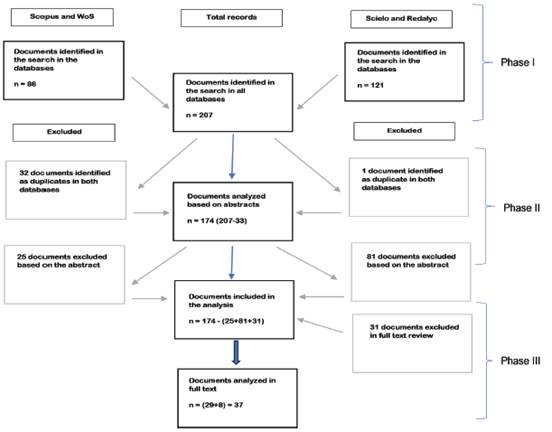
The article is based on a systematic literature review through a search conducted on March 18, 2023, in specialized databases (Scopus, Web of Science, Scielo, and Redalyc). Only research and review papers on capacity and innovation in agroecology were included. It was conducted in five phases (Figure 1), as follows:
Phase I. Database search
Systematic search in the Scopus and Web of Science (WoS) databases, with the search equation:
((capacity* OR capability*) AND (territorial OR development) AND (innovation AND agroecolog*)), which yielded 86 documents in total. Additionally, in order to incorporate into the analysis some evidence in the literature on the research topic in the Colombian context, a search was conducted in the databases of Scielo, with the equation (capacities and territorial) or (innovation and agroecology) and Redalyc with the equation: (“territorial capacities”) AND (innovation and agroecology), which yielded 121 additional records for a total of 207 documents.
Phase II. Reading and analysis of abstracts
From the Scopus and WoS databases, 32 records were excluded because they were duplicates, and 25 additional records were also excluded because, according to their reading, they did not deal directly with agroecological innovations and territorial capacities, giving 29 records for these two databases.
In the case of the Scielo and Redalyc databases, after reading the abstracts, 82 documents were excluded (1 record was repeated) because they needed to deal with capacities applied to agroecological innovations or innovations in the agricultural field.
Phase III. Reading and content analysis
Finally, 37 documents were made part of the list of selected research articles, including review articles and book chapters, on which their content was analyzed.
A matrix was prepared to classify the articles by categories (territorial capacities) of analysis, identifying their attributes (qualities or characteristics) to give an idea of how to measure and evaluate them in a specific territory. The analysis focused on collective capacities (organizational and systemic), considering that innovation as a social process involves multiple actors. There may be a more significant impact at the territorial level if an intervention in capacities favors collective action.
Phase IV. Search for indicators
After analyzing the content of the selected documents, it could be evidenced that in no case were indicators or indexes mentioned that would allow field verification of the presence or absence of the territorial capacities referenced in each document, so it was decided to expand the search by using the search engine of the “Google Scholar” website, where additional documents of both scientific nature and gray literature were consulted, to select the proposals for indicators or indexes.
3. Results and discussion
3.1 Analytical framework
The analytical framework was defined based on the relationship between two bodies of literature for which there is little evidence of their integration. On the one hand, territorial development is conceived as an endogenous process of expanding and accumulating individual and collective capacities conditioned by organizational, economic, and institutional factors (Gariazzo et al., 2014; Menardi et al., 2016). On the other hand, there is the scaling out or massification of agroecology, a process through which a large number of farmers adopt agroecological practices on a larger spatial scale and which is composed of two interdependent processes that co-occur, known as “scaling out” or horizontal type diffusion and “scaling up” referring to vertical processes of scaling up institutional practices (Schut et al., 2018; Millar & Connell, 2010).
A synergistic relationship was identified between territorial capital and endogenous capacities in driving the transformation toward sustainable agriculture by adopting agroecological innovations. In this sense, it is relevant to facilitate the construction and strengthening of endogenous territorial capacities that facilitate the generation and adoption of such innovations at local and regional levels (Figure 2).
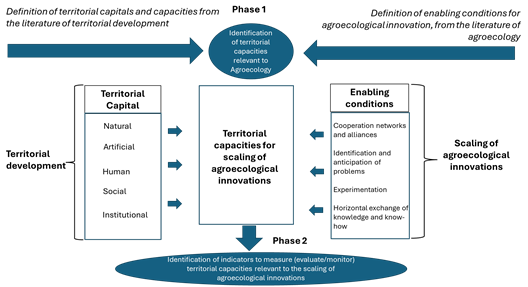
Figure 2 Integration of the concepts of territorial capital, capacities, and scaling of agroecological innovations.
This review made it possible to establish a correspondence in the concepts of territorial capital and capacities for agroecological scaling, identifying three relevant territorial capacities: agency capacity, territorial governance, and co-construction of knowledge and dialogue of knowledge, which are manifested in solidarity-based collective action, self-organization for the generation of transdisciplinary knowledge, adaptive governance and democratic participation in the definition of policies. To be relevant to developing, disseminating, and using agroecological innovations, allow for efficient management of natural and artificial resources in specific territories.
Agency capacity
Agency capacity is the capacity of actors to change their disadvantaged social and structural conditions and build shared visions of territorial development alternatives (Cummings, 2021). It refers to the possibilities that individuals have to influence their social reality (Aguirre, 2021), through the conformation of formal and informal networks of solidarity, cooperation, self-organization (Ostrom, 2009) and learning (Trujillo-Osorio et al., 2018; Dubois, 2019; Ibrahim, 2017; Gamache et al., 2020).
As agents of change, people define life trajectories that lead to social and political transformations (Wolfram, 2016) from endogenous processes of self-determination based on their abilities and capacities to define and pursue their own goals (Dubois, 2019; Ariza et al., 2019).
Levidow et al. (2021), when analyzing two case studies on agroecological solidarity economy schemes in Brazil, evidenced the strengthening of collective self-management capacities for constructing short solidarity circuits and broad support networks and interfaces with public policies. On the other hand, Badstue et al. (2020), conducted a study to understand the factors that promote or limit innovative capacities in women, identifying the capacity to define one's objectives and act critically to achieve them, with attributes such as self-confidence, determination, and risk management.
In an analysis of the link between individual capabilities and social structures using self-help as a conceptual framework, Ibrahim (2017), finds that while critical self-reflection allows improving living conditions and taking action to solve problems, the occurrence of political changes for people in conditions of poverty can occur in a better way by collective agency, as a capacity acquired by the individual through their participation in collective actions.
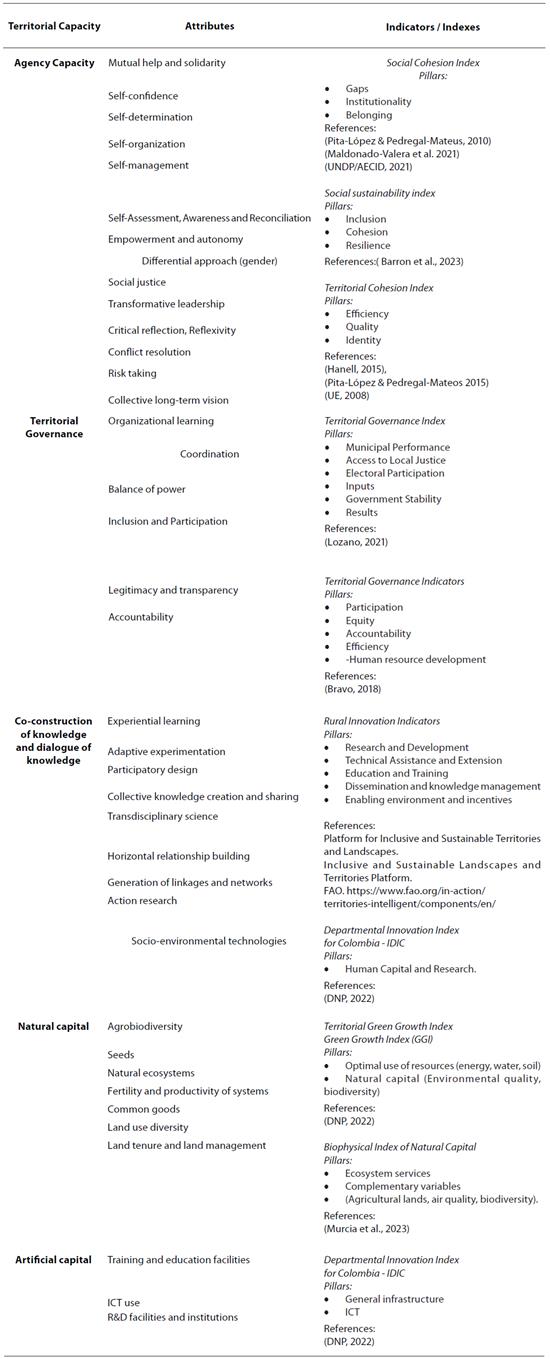
In the food system of the community of Valencia in Spain, Sarabia et al. (2021), identified using the Urban Transformative Capacities Framework that empowered social movements have promoted reflection and social learning as capacities for the elaboration of a vision of disruptive changes for sustainability, also supported by systemic awareness and collective vision of sustainability (Table 1). Romero-Riaño et al. (2019), in a literature review, examined capacities in agricultural innovation systems, finding that the development of systemic capacities is based on the interaction and interdependence of actors, which generates links and collective action for networking through processes of social learning, adaptability, and self-organization.
In Colombia, reference can be made to the development of a protocol to strengthen the capacity for agency in the socioeconomic reincorporation of ex-combatants who signed the 2016 peace agreement, which allowed them to act autonomously in decision-making and carry out effective project management, identifying aspects such as education, training and vocational training, networking and access to resources such as housing, health care and financial support (Ruano & Castillo, 2022).
Based on the attributes referring to agency capacity (Table 1), some indicators and indexes were identified that can account for the measurement of this capacity in a given territory, such as the Social Cohesion Index, whose pillars for its construction are identified with (i) Gaps, (ii) Institutionality and (iii) Belonging; the Social Sustainability Index, which has as pillars: i) Inclusion, ii) Cohesion and iii) Resilience and the Territorial Cohesion Index, which is based on the pillars of (i) Efficiency, (ii) Quality and (iii) Identity.
Territorial governance
It is a mechanism through which the participation of civil society actors in the process of policy formulation and implementation is guaranteed (Palacios & Estrada, 2020) through a scheme of interaction for cooperation and conciliation of interests, among territorial actors, including the State, in multilevel and multisectoral public-private networks, which allow addressing political and economic changes for the sustainable transformation of conventional agricultural production systems (García-Madurga et al., 2020; Gariazzo et al., 2014; Anderson et al., 2019).
Territorial governance “is based on horizontality and the social, institutional and geographic proximity of socio-territorial actors” (Torres-Salcido, 2018, p. 75); it can be considered as a tool that gives them the capacity to articulate interests and make decisions for collective action (Camacho-Fandiño, 2020).
Governance with flexible, diversified structures and stakeholder participation brings about changes in economic and political power relations (Sarabia et al., 2021; Kang et al., 2022), and increases the capacity for community action through aspects such as autonomy, implementation of mechanisms for accountability and conflict resolution (Anderson et al., 2019; Farreras & Salvador, 2022; Snapp & Pound, 2017).
Wolfram (2016) states that governance capacity is mediated by different collective actions, such as collaborative decision-making, the construction of social networks among multiple actors, the participation and inclusion of stakeholders, and the joint development of economic and social agendas (Table 1). Similarly, for Speich (2023), participation, engagement, and collaboration are fundamental aspects to guarantee success in the implementation processes of territorial planning policies.
Experimentation for the development of agroecological innovations facilitates, in turn, a new approach to governance based on the assignment of new roles and forms of relationship and cooperation between actors that are present at different scales (Gamache et al., 2020; Anderson et al., 2019).
In this sense, the decision-making process with a systemic approach is analyzed by Granada-Vahos (2017), in light of the resource allocation process of the General Royalties System in Colombia and the use of funds allocated to Science, Technology, and Innovation - CTeI, highlighting the need to enable a transparent and impartial process of accountability. It requires improving the capacities of the territorial governments and, in general, of the departmental systems to guarantee an efficient execution of the resources.
Additionally, Lozano (2021), proposed a “Territorial Governance Index” for the Department of Tolima in Colombia (Table 1), which allows evidencing the initial conditions and their opportunities for improvement in terms of effectiveness, legitimacy, innovation, results, and stability. For this purpose, it took as pillars: i) Municipal Performance, ii) Access to Local Justice, iii) Electoral Participation, iv) Inputs, vi) Governmental Stability, and v) Results.
Co-construction of knowledge and dialogue of knowledge
Local knowledge (knowledge, practices, and beliefs) is considered territorial capital and cultural heritage, fundamental for sustainable transition in agro-food systems with an agroecological approach. They consist of skills and processes that arise from experiences about the environment and the direct relationship with the ecosystem, applied by territorial actors as part of their agricultural production practices through the preservation of biocultural heritages, the dialogue of knowledge, and the different systems of social organization (García, 2021).
The co-construction of local knowledge occurs through a system of social organization that allows the integration of local knowledge through transdisciplinary territorial networks of knowledge and innovation (García, 2021; Camagni, 2017; Trujillo-Osorio et al., 2018; López & García, 2020). In it, knowledge is exchanged between farmers and external experts, integrating traditional knowledge with scientific knowledge, using participatory methods of experimentation and collective learning (Levidow et al., 2021; Chávez et al., 2015).
Since agroecology is based on principles dependent on local realities, local knowledge, and farmers' ingenuity occupy a prominent place, demonstrating that the dialogue of knowledge allows for building a framework for the mobilization and transformation of agricultural production practices (Martinez-Torres & Rosset, 2014).
Wezel et al. (2020), in analyzing agroecological principles and their evolution, comparing the elements of FAO agroecology and specialized literature, identify as one of the entry points the "co-creation and exchange of knowledge," which requires the development of holistic or systemic thinking capabilities, to generate diverse agroecological practices adapted to local conditions.
Sarabia et al. (2021), evaluating the capacity for transformation towards sustainability of the agri-food system in the city of Valencia (Spain), observed that agri-food innovations are "insufficiently developed" (isolated, fragmented and with low adoption) to compete with the dominant agri-food regime, so they propose as a response, the strengthening of capacities for the transdisciplinary co-production of transformational knowledge.
Analyzing participatory design methods for generating agroecological innovations, Berthet et al. (2016), state that it is necessary to build local knowledge exploration dynamics, integrating scientific knowledge and locally situated knowledge, to identify knowledge and capacity gaps.
This capacity lacks experiences that refer to any indicator or variable that pretends to account for a transdisciplinary knowledge management scheme based on the dialogue of knowledge. There are only a few ways of calculating different aspects related to innovation management in general, such as FAO's rural innovation indicators: Research and Development, Technical Assistance and Extension, Education and Training, Knowledge Dissemination and Management, and Enabling Environment and Incentives for Innovation (Table 1).
In this sense, the National Planning Department (DNP), calculates every year the Departmental Innovation Index for Colombia - IDIC, within which we can highlight the Human Capital and Research pillar, which estimates the functioning and quality of the education and science and technology systems and is built from the sub-pillars of coverage and performance of secondary, middle and higher education and the level and quality of Research and Development activities (DNP, 2022).
Natural and artificial capital
Natural capital is the stock of nature's assets or physical resources of natural origin (soil, vegetation cover, water bodies, fauna, atmosphere, and forests), which enhance agricultural activity and the conservation of ecosystems (García, 2021; Trujillo-Osorio et al., 2018).
Co-production with nature, on which agroecology is based, proposes a synergistic relationship between people and the natural environment with low use of external inputs (Levidow et al., 2022), in addition to the security of land tenure, availability and access to seeds, soil and water management and biodiversity conservation (Anderson et al., 2019).
For Giraldo-Valdés et al. (2013), knowledge of the environmental base and ecosystem services is considered part of the territorial capacities for a territorial environmental planning proposal in the municipality of Pereira (Department of Risaralda, Colombia), which seeks to give sustainability to the land occupation model, through regulatory, management and financing proposals.
Artificial capital consists of the endowment of physical elements and infrastructure, which accumulate from economic activity and represent the transformation of natural capital by human intervention and technological change (Trujillo-Osorio et al., 2018; Camagni, 2017). For Kapgen and Roudart (2022), the availability of research and development (R&D) facilities and institutions in rural areas can provide an enabling environment for innovation by supporting local entrepreneurs, researchers, and inventors.
According to Lacey (2021), within the public policies that should be adopted to support agroecology, actions that contribute to ensuring the availability of resources such as seeds, water, soil, and biodiversity, but also to the collaboration of communities and support agencies for the acquisition of facilities for training and education and presence of scientists and advisors in the field with expertise in agroecology, should be relevant.
For Colombia, the Territorial Green Growth Index (TGGI), proposed in 2022 (Table 1), refers to two pillars: i) Optimal use of resources (energy, water, soil) and ii) Natural capital (environmental quality, biodiversity) and the infrastructure pillar of the IDIC considers general infrastructure (electricity production, logistics performance and public investment in fixed capital), and ICT infrastructure (access, use, service and online participation).
4. Conclusions
Agency, co-constructed knowledge, and participatory territorial governance are the three pillars of the processes of accumulation of capacities that allow the participation of communities in the transformation processes through the strengthening of social and political aspects such as autonomy and community self-organization, which make it possible to address the political and economic changes required for a transition to agroecology, as a paradigm that transforms conventional agricultural production systems.
It became evident that the relationship between territorial capacities and the processes of creation, linkage, transfer, and use of agroecological innovations, refers to the involvement of a broad base of territorial actors in collective action efforts for the development of planning and policy formulation processes, in a bottom-up approach, based on principles such as participation, appropriation, collaboration, commitment, and mutual trust.
The review of the attributes associated with capacities made it possible to learn about different indexes and indicators that can account for the existence and status of capacities in specific territories but not for the co-construction of knowledge and the dialogue of knowledge, so it is considered essential to work on the design of measurement systems, based on a discussion among stakeholders.
Finally, it should be affirmed that the State must lead reforms in both policies and in the CTeI systems, which will make it possible to address the processes of territorial capacity building at all levels, guaranteeing articulation, participation, and collective learning for the formulation of participatory policies, the construction of shared visions of ideal futures and the systemic generation of trans-disciplinary innovations.

